𝗙𝗨𝗟𝗟 𝗦𝗧𝗢𝗥𝗬 The Morning Celeste Harrow Thought She Could Stop My Harvest With One Blocked Road
𝗙𝗨𝗟𝗟 𝗦𝗧𝗢𝗥𝗬
Her jaw tightened slightly.
First crack I had seen.
By 7:18, sweat had darkened the back of my navy shirt. The gravel radiated heat through my boots. One tractor was still idling because I had kept telling myself this would be over in five more minutes.
I finally walked back and shut it down.
The sudden silence hurt worse than the engine noise.
I climbed onto the step. Dad’s brass pocket watch swung from its leather cord inside the cab. I flipped it open.
7:21.
Almost one hour and forty minutes.
When I turned around, Matteo was watching me.
“Boss.”
“What?”
He nodded toward the orchard.
“If we’re standing here, the fruit isn’t.”
I looked past him.
Three hundred empty bins. Peaches warming on the branches. A packing line sitting still.
Celeste had six of my workers tied up without tying a single rope, and I had tied up the rest myself by refusing to walk away from the argument.
I closed the watch in my fist.
Norah called again.
I answered immediately.
“Can you get Russ Camden?”
“Probably. Why?”
“Ask if his small tractor can come through the orchard road from the west.”
She paused.
“You’re changing access.”
“I’m changing everything.”
I looked at Matteo.
“You and the guys stay calm. Don’t argue. Don’t give them anything.”
“What are you doing?”
“Harvesting.”
Celeste heard that.
She stepped closer.
“Mr. Hail, your operation is suspended.”
I slid the pocket watch into my jeans and started toward my pickup.
“You suspended a road.”
I opened the door.
“You didn’t suspend my farm.”
For the first time that morning, she stopped looking satisfied.
Russ Camden answered Norah’s call before I made it halfway across the farm.
Twenty-three minutes later, I heard his little John Deere before I saw it, the engine popping through the trees west of Block Four. He came through the old orchard lane with one hand on the wheel and a flatbed trailer bouncing behind him.
No HOA road.
No security checkpoint.
Just a dirt track my grandfather had cut between two fence lines before half the houses around us existed.
Norah stood beside the packing shed, waving him in.
“You owe me breakfast,” Russ called.
“Put it on my tab.”
“Your tab’s getting embarrassing.”
He grinned and dropped the trailer.
That sound—steel hitch striking steel—was the first good sound I had heard all morning.
I put Norah at the shed with two workers who had arrived separately through the south field. Russ took the west rows. I climbed onto my tractor and started Block Four myself.
The branches were warm against my forearms now. Peach fuzz stuck to the sweat on my skin. Every piece of fruit that dropped into a picking bag felt like something pulled back from the edge.
At 8:06, my phone rang.
Matteo.
“They’re letting us leave.”
I stopped the tractor.
“All of you?”
“They said we can leave the area. Still say we can’t use the road.”
I looked toward the subdivision rooftops beyond the trees.
“Don’t use it.”
“Then how do we get in?”
“Go west on County 18. Russ has a cattle gate about a mile past the church. He’ll meet you.”
Matteo went quiet.
“You got another road?”
“I’ve got another farm.”
Fifteen minutes later, Russ peeled away on his ATV.
At 8:34, the first three workers came walking through the orchard from his property carrying water jugs and gloves. Matteo was in front. His shirt was damp across the chest and dust covered his boots.
He stopped beside my tractor.
“You still paying us for standing next to that SUV?”
“I said I was.”
“Good.”
He pulled on his gloves.
“Then let’s make you regret it.”
I almost laughed.
Instead, I pointed east.
“You take Block Four. Luis gets the lower rows. Keep the soft fruit separate.”
The farm changed shape.
Over the next hour, we stopped moving like one crew. Norah ran the packing shed. Russ fed empty bins through the west lane. Two workers harvested along the south field. Matteo led peaches in the east blocks. I moved between them in my pickup with the radio on the dash and Dad’s pocket watch beside it.
At 9:17, I passed the north access road.
Celeste was still there.
So were three security SUVs.
But there was nobody left for them to stop.
She stood beside the hood in that red suit, watching a tractor move behind the orchard fence where she could not reach it. Her phone was pressed to her ear. She saw me.
I tipped two fingers against the brim of my hat and kept driving.
Ten minutes later, Norah radioed me.
“First bins are coming in.”
I turned toward the shed.
Russ’s tractor emerged between the trees, towing twelve yellow harvest bins, every one stacked with peaches.
The packing line started with a low electric hum.
Then belts began moving.
Workers fed fruit onto the rollers. Brushes spun. Cardboard boxes opened. For the first time since dawn, the farm sounded like harvest.
Matteo came in behind the trailer and wiped his forehead with his sleeve.
“They stopped six people,” he said.
“Not the farm.”
“Not yet.”
He looked at me.
“You think she’s done?”
Across the field, sunlight flashed off a white SUV moving slowly along the subdivision road. It stopped near our fence. Celeste stepped out. She was not looking at the workers anymore. She was watching Russ’s tractor, the packing shed, and the trucks waiting beside it.
Then she raised her phone and started taking pictures.
I checked Dad’s watch.
9:31.
We had lost almost four hours, but the bins were filling.
I closed the watch and slipped it back into my pocket.
Celeste had tried to choke the farm at one road. Now she was learning what I should have remembered from the beginning.
Farms have roots.
And roots rarely run in just one direction.
At 10:12, Celeste stopped watching the harvest and started choking the machinery that kept it alive.
Norah’s voice cracked through my radio while I was hauling empty bins toward Block Six.
“Graham, fuel truck stuck at the north road.”
I hit the brakes hard enough to make the bins knock together behind me.
“Why?”
“Security says commercial vehicles are prohibited.”
I looked at the fuel gauge on my tractor.
Just under a quarter tank.
“Tell the driver not to argue. I’m coming.”
The asphalt at the north entrance shimmered under the heat when I pulled up. Our fuel supplier’s tanker sat twenty yards outside the gate with a security SUV angled across its path. Celeste stood in the narrow strip of shade beside another vehicle. Her red jacket was folded over one arm now, her light blouse bright against the blacktop.
She had traded her morning smile for something flatter.
“Move the SUV,” I said.
The security supervisor shook his head.
“Commercial vehicle restriction.”
“That tanker has been delivering here for eleven years.”
Celeste answered for him.
“Past violations do not create future permission.”
“It isn’t your road to regulate.”
“That remains disputed.”
I glanced at the tanker driver. He gave me a small shrug through his open window. He was getting paid to deliver diesel, not become part of somebody else’s war.
I stepped back.
“Go.”
Celeste blinked.
“Excuse me?”
I pointed toward the county road.
“I said go.”
The tanker pulled away.
She watched it disappear, then looked at me as if she had won something.
At 10:38, Norah called again.
“Repair van this time.”
“Where?”
“Same place.”
Our oldest packing line motor had started overheating. The technician carrying the replacement bearing could not get through.
I did not even drive north.
“Send him to Russ’s place.”
“His van won’t clear the orchard trail.”
I rubbed a hand across my jaw.
“Have him park there. I’ll pick up the parts.”
At 11:05, I carried a greasy cardboard box across Russ’s cattle gate myself. By then, the temperature had climbed past ninety. Sweat ran between my shoulder blades. Peach dust stuck to my wrists. The packing shed smelled like warm fruit and electric motors.
We got the bearing installed, but while we worked, the tractor on the west rows ran dry.
The engine coughed twice and died.
Silence rolled across that section of the orchard.
Matteo climbed down and kicked dust from his boots.
“Fuel.”
“Fuel.”
“She figured out the road didn’t matter.”
“Yeah,” I said. “So now everything matters.”
He was right.
At noon, a refrigerated truck arrived to take the first packed load.
Security stopped that one too.
The driver called me from half a mile away.
“I’ve got another pickup after yours,” he said. “I can wait thirty minutes.”
“Don’t,” I told him. “Go make your other pickup.”
I hung up and stared through the open shed door at eighty cases of peaches stacked on pallets.
Cold storage on my farm could hold some of them.
Not all.
Norah stood beside me with a pencil tucked behind her ear.
“Russ has that old cold room three miles away.”
“Still cold?”
“Still cold.”
I checked Dad’s pocket watch.
12:08.
The brass case felt hot from my jeans.
Every workaround cost us something now.
Fuel.
Labor.
Mileage.
Time.
Fruit.
I could keep trying to force the north road open, or I could spend what I had left keeping peaches cold.
“Call Russ,” I said.
Twenty minutes later, we started loading pickups.
Not big trucks.
Half-ton farm pickups, four pallets at a time.
We drove west through the orchard, crossed the cattle gate, hit the county road, and carried the fruit to Russ’s cold room in relays. It was slow and ugly. One pallet shifted on a turn, and we had to restack it by hand. Several boxes had softened enough that Norah marked them down for seconds.
But the fruit got cold.
At 1:16, I returned for another load and saw Celeste’s white SUV parked beyond our fence. She stood beside it, phone raised, photographing the pickups moving through the orchard.
Matteo followed my eyes.
“She looks mad.”
I wiped sweat from my forehead.
“Good.”
He glanced at the rows still waiting.
“We’re losing fruit.”
I opened Dad’s watch.
The second hand swept forward without caring about Celeste, me, or anybody else.
“I know.”
I snapped it shut.
So we stopped trying to save everything.
Matteo looked at me.
“What do we save?”
I watched Norah wave another pickup toward the west lane.
“Whatever we can keep moving.”
By two o’clock, the farm had stopped looking organized. Pickups moved where refrigerated trucks should have been. Half-full bins sat under shade cloth because we no longer had enough diesel to run every tractor. Norah had turned Russ’s cold room into a second loading station. Matteo was rotating crews between the hottest rows so nobody stayed in the sun too long.
We were still harvesting.
But Celeste had forced us into survival mode.
I was tightening a strap over four pallets when Norah pulled in fast enough to throw dust across the shed apron. She stepped out holding her phone.
“You need to see this.”
“If it’s another road restriction, I don’t.”
“It isn’t.”
She held the screen toward me.
A photograph showed one of our pickups crossing Russ’s cattle gate. Under it was a neighborhood message warning residents about unauthorized commercial traffic using private property to bypass HOA safety controls.
I recognized the angle immediately.
Celeste had taken it from the fence.
Matteo leaned over my shoulder.
“So now she wants neighbors doing security’s job.”
I handed the phone back.
“Let her.”
Norah stared at me.
“That’s your plan?”
“No. My plan is to stop giving her one target.”
I walked into the shed and grabbed the whiteboard we used for harvest assignments.
Until that moment, every route still ended at Russ’s cold room.
One place.
One bottleneck.
I erased it.
“Norah, call Ben Foster. Ask if we can stage six pallets in his equipment barn until evening. Matteo, take two pickups south instead of west. Russ can handle the north half. I’ll move the soft fruit straight to the roadside stand.”
Matteo looked at the board.
“That’s slower.”
“It’s harder to stop.”
We changed again.
By 2:40, the operation looked almost ridiculous from above. Small vehicles moved through separate fields, disappeared behind windbreaks, crossed different gates, then met again miles away. It cost us time. But Celeste could not block what she could not concentrate.
Then she made her next move.
At 3:06, I saw a black security SUV parked on County 18 beside Russ’s gate. The supervisor stood near the shoulder photographing license plates. He was not blocking traffic.
He did not need to.
Two workers saw him and turned around before reaching the gate.
When I arrived, Celeste was there too. Her ponytail had loosened slightly in the heat, but her red pantsuit still looked cleaner than anything within a mile of my farm.
“You’re intimidating my employees off public roads now?” I asked.
“We’re documenting violations.”
“Of what?”
“Unauthorized commercial activity affecting Brier Glenn.”
“This isn’t Brier Glenn.”
She pointed toward Russ’s gate.
“Your vehicles are being used to circumvent restrictions.”
“On a county road.”
“We’ll let the proper authorities determine that.”
Something in the way she said it caught my attention.
Not the threat.
The confidence.
Then I noticed the security supervisor holding a printed sheet with vehicle numbers written down the side.
Not just today’s trucks.
I recognized one plate from Norah’s pickup.
Another belonged to Matteo’s old Ford.
They had been tracking our vehicles before this morning.
“How long have you been doing this?” I asked.
Celeste’s eyes shifted to the sheet, then back to me.
“Doing what?”
“Writing down my workers’ plates.”
The supervisor lowered the page.
Too late.
Celeste stepped toward him.
“We’re done here.”
That was the first time all day she retreated before I did.
I watched the SUV pull away, dust curling behind it.
Matteo came up beside me.
“What was that?”
“I don’t know.”
“You going to find out?”
I checked Dad’s pocket watch.
3:11.
We still had fruit on the trees, fuel running low, and hours of daylight left. That morning, I would have chased Celeste’s answer. Now I understood the price of letting her choose what I focused on.
I closed the watch.
“Not yet.”
Matteo raised an eyebrow.
“Then what?”
I climbed into my pickup.
“We finish today’s harvest.”
At 4:26, the first refrigerated truck finally backed into Russ’s yard from the county side. Nobody from Brier Glenn could stop it there. We loaded every cold pallet we had saved. The driver shut the doors, locked them, and pulled away.
Norah stood beside me, watching the truck disappear.
“We got one out.”
I nodded.
For about thirty seconds, it felt like we had won one.
Then Matteo’s voice came over my radio.
“Graham, you better get back here.”
I grabbed the handset.
“What happened?”
A pause.
“Sheriff’s deputy just pulled into the farm.”
The deputy was standing beside Matteo when I pulled into the packing yard. His cruiser sat under the pecan tree with the engine running, blue uniform bright against the dusty white paint of the shed. Nobody was in cuffs. Nobody was shouting.
That helped.
What did not help was Celeste’s white SUV parked twenty yards behind him.
I killed my engine and stepped out.
“Deputy.”
He turned.
“Graham Hail?”
“That’s me.”
“Deputy Aaron Pike. We got a complaint about repeated trespass and unlawful commercial access involving your operation.”
Celeste came around her SUV before I could answer.
“And continued violations after multiple warnings.”
Pike looked at her.
Then at me.
“I’ll hear one person at a time.”
Celeste stopped.
I liked him immediately—not because he was on my side, but because he was not automatically on hers.
“My workers were stopped this morning by HOA security,” I said. “We rerouted through neighboring private property with permission and used County 18. Nobody entered HOA property after that.”
Pike pulled a small notebook from his pocket.
“Any physical confrontation?”
“No.”
“Threats?”
“No.”
“Property damage?”
“No.”
Celeste folded her arms.
“That ignores the access violations from this morning.”
Pike looked at her.
“Were these men arrested?”
“They were detained pending verification by sworn officers.”
Silence.
The packing line hummed behind us. A peach rolled off a sorting belt and dropped softly into a padded bin.
Pike wrote something down.
“Who authorized the detention?”
Celeste’s mouth tightened.
“Our security contractor acted under community enforcement policy.”
Matteo shifted beside me. I saw his eyes move toward Celeste, but he kept quiet, exactly what I had asked him to do.
Pike turned to him.
“Were you told you couldn’t leave?”
Matteo thought before answering.
“They said we could leave the area. But every time we tried to go toward work, they blocked us.”
“Did anybody touch you?”
“No.”
“Take your property?”
Matteo glanced at me.
Then back at Pike.
“They photographed our driver’s licenses.”
The yard went still inside my head.
“Your licenses?” I asked.
Matteo nodded.
“All six?”
I looked at Celeste.
That explained the plate list.
Pike’s pen stopped.
“Who photographed them?”
“Security.”
“Why did you hand them over?”
Matteo rubbed his thumb across the edge of his work glove.
“They told us they needed identification before they could release us.”
Celeste stepped forward.
“That is a standard security procedure.”
Pike’s expression changed by almost nothing.
“On private HOA property, maybe. Were these men on HOA-owned land?”
“The access corridor is under HOA control.”
“That was not my question.”
Celeste opened her mouth.
Then closed it.
I remembered the morning supervisor lowering that sheet when I noticed the plate numbers. I had assumed they were documenting traffic. Now the pieces looked different. Not enough to tell the whole story, but enough to make me stop talking.
Pike asked Matteo for his full name and phone number. Then he asked for the other five workers.
Celeste’s phone buzzed. She checked it, turned slightly away, and answered in a low voice.
Pike watched her for a second.
“Mr. Hail, do you have documents showing your right to use that north access at the house?”
“Yes.”
“Get copies. Don’t bring originals.”
“You shutting me down?”
“No.”
Celeste turned back sharply.
Pike continued before she could speak.
“I’m telling both sides to avoid contact until the property question is reviewed. Your farm can operate. HOA security does not have authority to arrest people.”
The word landed harder than anything else he had said.
Arrest.
Celeste’s eyes narrowed.
“Nobody was arrested.”
Matteo looked at her.
“You told us we were under detention.”
Pike closed his notebook.
“Ms. Harrow, I’m going to need the name of your security company and the supervisor who was working this morning.”
“For what purpose?”
“So I don’t have to ask twice.”
For the first time all day, Celeste looked toward her SUV instead of at me.
Pike walked back to his cruiser. I followed him halfway.
“Deputy?”
He stopped.
“Those license photos. Is that something I should worry about?”
He rested one hand on the open car door.
“I wouldn’t guess yet. But tell your workers not to delete messages, photos, or anything they received from security. You do the same.”
Then he drove away.
Celeste stayed another thirty seconds. She did not threaten me. She did not smile. She got into her SUV and followed him out.
Matteo exhaled beside me.
“That felt good.”
I watched the dust settle behind them.
“Too good.”
Norah came from the shed carrying a clipboard.
“He said we can operate.”
“Yeah.”
“So we won.”
I pulled Dad’s pocket watch out and checked the time.
4:51.
The harvest was moving. The deputy had rejected Celeste’s attempt to shut us down. For one clean minute, I wanted to believe that was the end of it.
Then Matteo’s phone vibrated.
He looked at the screen, and the color drained from his face.
“Boss.”
He turned it toward me.
A photograph of his driver’s license filled the screen beneath a message from an unknown number. Under the image were his home address and the names of two other men from my crew.
I felt the brass watch go cold in my palm.
“Don’t answer it,” I said.
Matteo looked toward the road where Celeste had disappeared.
“Who has this?”
I closed the watch.
“That’s what we’re about to find out.”
Matteo kept the phone in his open palm like it had turned into something dirty.
The message contained no direct threat.
That made it worse.
Just his license photograph, his address, two names from the crew, and one sentence.
We know who is working the Hail property.
I took a screenshot with my phone, then told him to lock his screen.
“Nobody replies. Nobody calls that number.”
“My wife is home.”
“Call her. Tell her not to answer the door for anyone she doesn’t know.”
He walked toward the shade beside the packing shed.
I called Deputy Pike.
This time, he answered before the second ring.
I told him exactly what Matteo had received. His voice lost the easy patience he had used earlier.
“Keep the original message. Don’t forward it around. I’m coming back.”
“What about the others?”
“Have them check their phones, but don’t turn this into a group discussion yet.”
When I hung up, Norah was watching me.
“This isn’t about a road anymore.”
“No.”
The afternoon heat pressed against the metal roof until the shed ticked and snapped above us. I shut down one section of the packing line and gathered the six men who had been stopped that morning.
Three had received similar messages.
Luis had one with a photograph of his license and the make of his truck. Another worker had nothing. Matteo’s included the most information.
I could see what the messages were doing without anybody explaining it. Men who had spent all day lifting fifty-pound picking bags were suddenly checking the road every few seconds.
“Anybody wants to go home, go,” I said. “You get paid through the end of the shift.”
Luis looked at me.
“You need us.”
“That isn’t the question.”
Matteo slipped his phone into his pocket.
“I’m staying.”
Two others stayed.
Three left.
I watched them drive out through the south field and I did not blame them. But losing half that crew meant Block Seven would sit overnight. Some of those peaches would not make tomorrow.
That was the cost Celeste finally managed to put directly in my hands.
At 5:37, Pike returned with another deputy. He photographed the messages from the original phones, then asked each worker the same short questions separately.
When he finished, he walked with me toward the north fence.
“Your access documents.”
I handed him copies Norah had brought from the house.
He studied the old recorded easement, then folded the pages once.
“This predates Brier Glenn by twenty-six years, and nobody amended it?”
“Not that I know of.”
He nodded, but his attention stayed on the phones.
“The messages concern me more.”
“Can you trace the number?”
“Maybe. But that’s not the first question.”
“What is?”
“Who had the license images?”
I looked toward the subdivision.
“Security.”
“Exactly.”
A white SUV appeared beyond the fence, slowed, then kept moving when the driver saw the cruisers.
Pike watched it pass.
“Did Celeste personally tell your workers to surrender identification?”
“I wasn’t close enough to hear that.”
“Good answer.”
He tucked the easement copy into his folder.
“Keep giving me answers you know, not answers you want.”
That stung because he was right.
All day, I had been turning every move into Celeste. Some were hers. Some might not have been. If this was going to matter legally, anger would not help.
Facts would.
At 6:14, Pike left again.
The sun had dropped low enough to throw the orchard into bands of light and shade. We kept working with the smaller crew until the packing shed lights came on. At 7:02, Russ drove in carrying two red fuel cans and a paper sack of sandwiches.
“Figured diesel and ham were equally urgent.”
Norah laughed for the first time all day.
I poured fuel into the small tractor while Matteo ate sitting on an overturned bin.
Then my phone rang.
Pike.
“Mr. Hail, I need you to listen carefully. The security company says the license photographs were uploaded to a shared incident account created specifically for Brier Glenn.”
I straightened.
“Who could access it?”
“Security supervisors and two HOA administrators.”
“Celeste.”
“I’m not naming anyone yet.”
Behind me, diesel splashed against the funnel.
“Then why call?”
Pike paused.
“Because somebody deleted the incident folder less than an hour after I asked Ms. Harrow for the contractor’s records.”
I stopped pouring.
“Deleted.”
“The company recovered an activity log. I’m working on the rest.”
I looked across the darkening rows toward the subdivision lights.
“So somebody knew you were looking.”
“That’s one possibility.”
“And the other?”
“That they were already cleaning house.”
The line went quiet for a beat.
“Do not confront her, Graham.”
I set the fuel can down.
“I won’t.”
“I mean it.”
“I heard you.”
After we hung up, I opened Dad’s pocket watch under the shed light.
7:09.
The brass was scratched. The glass was cloudy near one edge.
The second hand still moved.
That morning, I had wanted to beat Celeste by refusing to move. By sunset, I understood something different. I did not need her to confess. I needed her to keep making decisions.
And for the first time, those decisions were starting to cost her more than they cost me.
I was back in Block Seven before sunrise.
The peaches we had left overnight were softer than I wanted. A few had split where they pressed against neighboring fruit, and yellow jackets hovered around the sweetest ones. I pulled one from a branch, pressed my thumb lightly against the skin, and felt it give.
That was yesterday’s bill.
Not something I could argue away.
Matteo arrived at 5:26 with Luis behind him. Three of the men who had gone home never came back. I did not ask why. We started with whoever showed up.
By 6:10, the first picking bags were filling.
No security SUVs waited at the north entrance.
No Celeste.
The road sat empty in the cool gray light.
Norah drove through it slowly, stopped beside me, and lowered her window.
“Nobody stopped me.”
“Keep moving.”
“You don’t want to enjoy this?”
“Not yet.”
At 7:42, a fuel tanker came down the same road Celeste had blocked the day before. I stood beside the fence while it rolled onto the farm without interference.
The driver leaned out.
“Where do you want me?”
“Anywhere that keeps you moving.”
He laughed and headed toward the equipment shed.
For the next two hours, the farm began putting itself back together. Tractors stayed fueled. The packing line ran steady. A refrigerated truck backed directly to the loading dock. We were still short-handed, still behind, still sorting too much damaged fruit into seconds, but we were no longer bleeding time at every gate.
It felt like a win.
That made me nervous.
At 10:18, Deputy Pike called.
“Where are you?”
“Packing shed.”
“Stay there.”
“Why?”
“Because I’m coming to you.”
He arrived twenty minutes later in an unmarked county vehicle with a woman I had not seen before. She introduced herself as Investigator Dana Mercer. No dramatic entrance. No flashing lights. She carried a thin folder and asked if we could talk somewhere quiet.
We used my office behind the packing room.
Through the wall, I could hear peaches knocking softly against the rollers.
Mercer placed three printed pages on my desk.
“The security contractor recovered access logs from the deleted Brier Glenn incident folder.”
I did not touch them.
“An HOA administrator downloaded the license photographs yesterday morning,” she continued. “At 9:46, the same account accessed resident management records containing vehicle information. At 4:03, after Deputy Pike requested preservation of the contractor records, that account deleted the folder.”
“Whose account?”
Mercer paused.
“Celeste Harrow’s.”
I stared at the paper without reading it.
Yesterday, I would have expected satisfaction.
Instead, I pictured Matteo standing beside that SUV before dawn.
“The messages?” I asked.
“We’re still working attribution.”
“So you don’t know she sent them.”
“Correct.”
Pike gave me the same look he had the day before.
Facts, not wishes.
I nodded.
Mercer slid another page forward.
“But we found something else. The security contractor’s original service agreement does not authorize detention, identification collection, or enforcement on your easement.”
“Then why did they do it?”
“According to their supervisor, Ms. Harrow gave direct instructions before your harvest began.”
The office door opened. Norah leaned in, face tight.
“Graham.”
I stood.
“What?”
“Celeste is outside.”
Pike was already moving.
We stepped into the white glare of late morning.
Celeste stood near the north entrance beside her SUV, red pantsuit sharp against the dust. Two HOA board members were with her. She saw Pike, then Mercer, and stopped.
“Mr. Hail,” she called. “I’m here to resolve this privately.”
I walked toward her but stopped several yards away.
“Yesterday was your chance for private.”
One board member shifted uncomfortably.
Celeste lowered her voice.
“Continuing this helps nobody.”
“My workers might disagree.”
“Your operation is open. Your access has been restored. We can consider the matter closed.”
For half a second, I understood the temptation.
The trucks were moving. The fruit was leaving. I could turn around and harvest.
That was the easiest victory I had been offered since dawn yesterday.
Pike said nothing.
Neither did Mercer.
The choice was mine.
I looked past Celeste at the open road, then at Matteo loading boxes near the shed.
“No,” I said.
Celeste’s face hardened.
“Think carefully.”
“I finally am.”
Mercer stepped forward.
“Ms. Harrow, we need to speak with you regarding the deletion of records and the collection of employee identification.”
Celeste turned toward her.
“On whose authority?”
Mercer showed her credentials.
Celeste’s eyes flicked toward Pike, then toward the board members. One of them took a slow step away from her.
That small movement told me more than any speech could have.
Celeste had spent two days using everyone around her as an extension of her authority.
Security guards.
HOA administrators.
Neighbors.
Roads.
Rules.
Now, one by one, they were becoming witnesses to what she had ordered.
I pulled Dad’s pocket watch from my jeans.
10:47.
Behind me, the packing line kept running.
This time, I did not close the watch immediately. I watched the second hand move while Mercer asked Celeste to come with them voluntarily to answer questions.
Celeste looked at me once before getting into her SUV to follow the county vehicle.
She still was not under arrest.
Not yet.
But for the first time since this began, she was not deciding where anyone went.
Three mornings later, I was standing beside the packing shed when the sheriff’s cruiser came through the north entrance without slowing down. Behind it were two county vehicles. I knew something had changed because Pike was not driving.
Sheriff Daniel Mercer was behind the wheel himself.
He parked under the pecan tree, stepped out, and walked toward me with a folded document in his hand.
The harvest kept moving around us. Forklift tires hummed across concrete. Cardboard boxes slid down the packing line. The air smelled like peaches, diesel, and cold air leaking from the refrigerated trailer.
“Graham,” he said, “is Celeste Harrow at the Brier Glenn office this morning?”
I looked across the fields toward the clubhouse roof.
“Board meeting at nine.”
He checked his watch.
“8:52. Good.”
He started back toward his cruiser.
I looked at the folded paper.
“Sheriff.”
He stopped.
“Is that what I think it is?”
“Search warrant,” he said. “Records, devices, and the HOA administrative office.”
He let the words sit there.
“We also have an arrest warrant for Ms. Harrow.”
Matteo had been carrying a stack of flattened boxes behind me. He stopped so suddenly one slipped from his hands.
“For what?” I asked.
The sheriff’s face stayed neutral.
“Charges related to unlawful restraint, misuse of personal identifying information, and evidence tampering. The court will sort out what sticks.”
He got back into the cruiser.
I did not follow him immediately.
I looked at Dad’s pocket watch.
8:53.
Then I handed Norah the packing clipboard.
“Keep everything moving.”
We drove to Brier Glenn in my pickup, Matteo beside me and Norah following in hers. We stayed across the parking lot. I was not going inside.
This was not my stage anymore.
Through the clubhouse windows, I could see Celeste standing at the end of a conference table in the same red pantsuit. One hand raised while she spoke to the board.
Pike entered first.
Sheriff Mercer followed.
The room changed before anyone touched her.
Chairs shifted.
One board member stood.
Another moved away from Celeste.
She turned toward the sheriff, and even through glass, I recognized the posture she had used on me that first morning.
Shoulders square.
Chin lifted.
One finger pointing as if authority could still be summoned by gesture.
The sheriff unfolded the warrant.
Her hand dropped.
Ten minutes later, Celeste came through the clubhouse doors with Pike beside her. No spectacle. No shouting. Her wrists were secured in front, and her face had gone pale beneath the hard morning light.
She saw me across the parking lot.
I did not smile.
Matteo did not either.
The security supervisor was already inside with investigators carrying boxes from the administrative office. Two board members stood near the doorway, watching everything they had once allowed happen in their name.
Celeste stopped beside the cruiser for half a second.
“You think this makes you right?” she called across the pavement.
I looked at Matteo.
Then back at her.
“No.”
I nodded toward the warrant in Pike’s hand.
“That wasn’t my decision.”
The rear door closed.
The cruiser pulled away.
That afternoon, Brier Glenn terminated the security contract and removed Celeste from every HOA position she still held. The board issued written notice that my recorded farm easement would not be obstructed again. The contractor turned over the remaining account records.
Nobody asked my workers for identification at that road after that.
But justice did not put peaches back on branches.
We lost nearly fourteen percent of Block Seven to heat and delay. Three workers never returned that season. I paid every hour I had promised anyway.
It hurt.
It was supposed to.
Consequences that cost nothing are not consequences.
Two weeks later, Matteo and I were loading the final refrigerated trailer of the harvest. The evening air had cooled enough that I could smell cut grass from the subdivision beyond the fence. Russ leaned against his tractor, eating one of our bruised peaches over the sink. Norah shut the trailer doors and slapped the metal twice.
“Last one.”
The driver pulled away through the north access road.
No SUV blocked him.
No guard photographed his plate.
Just tires rolling over gravel that had carried farm trucks since before Brier Glenn had a name.
I climbed into my tractor and found Dad’s brass pocket watch still hanging from its leather cord. I had forgotten it there that morning.
I opened the case.
6:18.
The second hand moved with the same quiet certainty it had shown while Celeste wasted our first harvest day.
Matteo leaned against the tractor tire.
“You keeping that road open tomorrow?”
“Tomorrow we don’t need it.”
He smiled.
“Feels strange.”
“Give it time.”
I hung the watch back where Dad used to keep it.
Across the orchard, the last sunlight caught the empty yellow bins stacked beside the shed.
Empty was good now.
Empty meant the fruit had made it out.
I started the tractor, and the engine settled into a steady rumble.
For two days, Celeste Harrow had tried to turn one road into a weapon. She had mistaken a recorded easement for an HOA privilege, working men for bargaining chips, and a harvest for something she could pause until I behaved the way she wanted.
She learned what my father had known long before Brier Glenn existed.
A farm is more than a road.
It is people who show up before daylight. Neighbors who open old gates. A sister who can turn chaos into a loading schedule. Workers who come back after being humiliated. Records old enough to outlast new authority. Roots running under fences, through fields, and across years of weather no HOA meeting ever had to survive.
The road stayed open behind me.
I did not look back.
𝗧𝗛𝗘 𝗘𝗡𝗗
The Morning Celeste Harrow Thought She Could Stop My Harvest With One Blocked Road
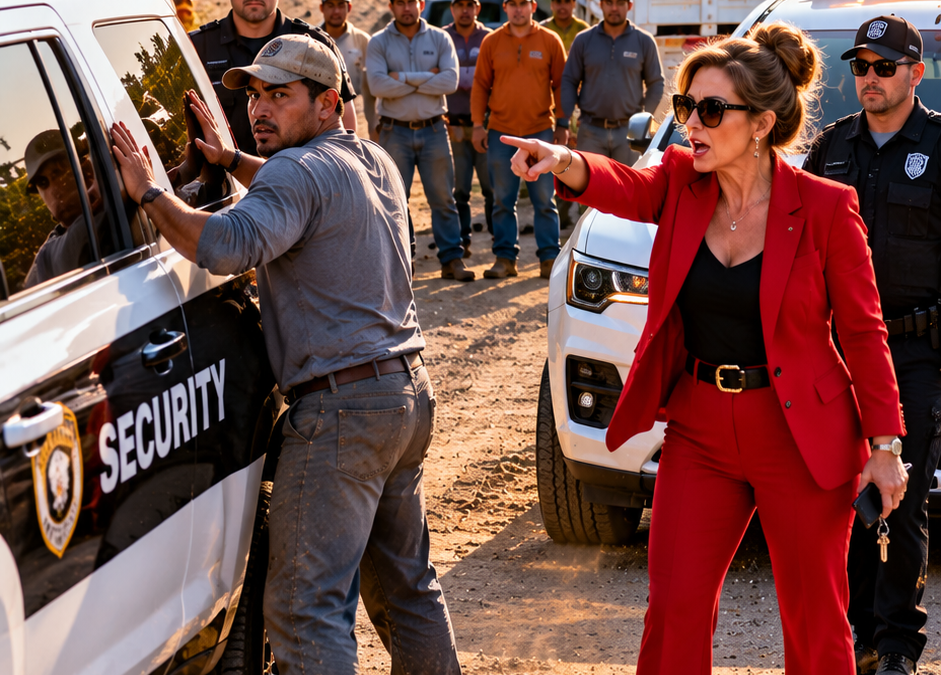
The first thing I saw was Matteo Ruiz with both hands spread against the side of a white security SUV. Six of my harvest workers stood under flashing amber lights at the end of my farm road while three hundred empty peach bins waited beside the orchard. Celeste Harrow had chosen the hottest harvest morning of July to learn that stopping a road was not the same thing as stopping a farm.
My name is Graham Hail, and peaches do not wait for paperwork.
That was one of the first lessons my father taught me. Not in a classroom way, not with lectures or neat sayings meant to sound wise. He taught it by waking me before dawn when I was twelve years old, handing me a pair of gloves still stiff from yesterday’s work, and leading me into rows heavy with fruit while the world was gray and quiet around us.
“Heat changes everything,” he told me, tapping the face of his old brass pocket watch. “You pick when the fruit is ready, not when people feel like showing up.”
That watch had hung in our tractor cab for as long as I could remember. Brass case, cracked glass near one edge, leather cord dark from sweat and dust. My father checked it against the sun, the temperature, the packing schedule, and the mood of the orchard. When he died, I left it in the tractor because taking it into the house felt wrong. The watch belonged where decisions were made.
And on that July morning, every decision mattered.
We had forty acres ready.
Block Four was at peak. Block Seven was close enough to worry me. The early rows were heavy with peaches that had colored beautifully in the last stretch of heat, but that same heat was about to turn them against us. Another day on the tree and the softest fruit would bruise under its own weight. Another afternoon and half the premium grade would fall into seconds. Another delay and I would be explaining to buyers why the fruit they expected had not made it out clean.
So I started early.
At 5:43 in the morning, I drove toward the north farm access road expecting to see my crew rolling in, water jugs on tailgates, gloves tucked into back pockets, men joking quietly before the sun got mean.
Instead, I saw security lights.
Three white SUVs sat angled across the gravel. Amber bars flashed across the dust, the orchard fence, and the faces of my workers. Matteo stood against the side of the nearest SUV, palms flat, jaw tight. Luis stared at the ground. The others looked like men trying to stay calm because they understood that anger would cost them more than silence.
My tractor idled fifty yards behind me. Diesel rattled through the morning air. Three hundred empty bins sat stacked beside the orchard, waiting like accusations.
I stepped out of my pickup.
“Graham,” Matteo called.
One of the guards raised his palm.
“Stay back, sir.”
I kept walking.
“Those men work for me.”
“They’re being detained.”
That stopped me.
“By who?”
The guard glanced toward the second SUV.
That look told me more than his answer.
A woman stepped around the hood wearing a red pantsuit that looked almost black in the blue morning light. Brown hair pulled high and tight. Silver key ring in one hand, phone in the other. She walked onto my gravel like she owned every stone beneath her shoes.
Celeste Harrow.
President of the Brier Glenn HOA.
I had dealt with her for months by then, though “dealt with” was too generous a phrase for the letters, complaints, and polished threats she liked to send. Brier Glenn wrapped around three sides of my farm like a velvet rope around something it wished would disappear. The houses were new, expensive, and full of people who loved the look of orchards from their second-story balconies but hated the reality of tractors, dust, diesel, harvest crews, and commercial trucks before breakfast.
Celeste had appointed herself the voice of that irritation.
She complained about noise.
Then dust.
Then headlights.
Then “industrial traffic inconsistent with residential character.”
Every argument ended the same way. My family had farmed this ground long before Brier Glenn existed. The north access road had served the orchard for decades. The recorded easement predated their HOA, their gates, their clubhouse, their landscaping rules, and Celeste’s red pantsuit.
She knew all of that.
Which was why she had not picked a random morning.
She had picked harvest.
“Your workers entered through restricted community access,” she said.
“That road is my farm access.”
“It passes through Brier Glenn.”
“It existed twenty years before Brier Glenn.”
Her expression did not change.
Behind her, another guard was taking names from my workers.
Matteo stared at him, then at Celeste.
“We didn’t trespass.”
Celeste turned her eyes toward him.
“You don’t need to speak.”
I felt my jaw tighten.
“He can speak whenever he wants.”
The guard stepped between us.
I could smell hot exhaust, road dust, and crushed weeds under my boots. Somewhere behind the packing shed, the irrigation pump kicked on. Everything on my farm was starting its day except the people I needed to harvest it.
I looked at the guard.
“Are you law enforcement?”
“HOA security.”
“Then why are you detaining anybody?”
He looked at Celeste again.
That bothered me more than anything he had said.
Celeste checked the time on her phone.
“Until your access status is resolved, your labor operation is suspended.”
I stared at her.
“You timed this.”
A faint breeze moved through the peach trees. The fruit was already warming in the rows behind me. We had maybe two good days to pull the first blocks clean, and today mattered most.
Celeste knew that.
She slipped her phone into her jacket.
“Resolve the access issue first.”
“How long?”
“That depends on you.”
There it was.
Not safety.
Not trespass.
Leverage.
Matteo turned his head toward the orchard.
“Boss.”
I followed his eyes.
Empty bins.
Idling machinery.
Forty acres waiting.
The sun climbed another inch above the tree line.
I stepped closer to Celeste, stopping well short of the guard.
“You think keeping six working men beside a security truck gives you control of my farm?”
She gave me a small polished smile.
“This morning, Mr. Hail, it appears to.”
Behind me, the tractor kept running, burning fuel while nobody moved.
I pulled my phone from my pocket and checked the time.
5:51.
Eight minutes gone.
Then nine.
I should have been thinking about another way into the orchard. Instead, I planted my boots in that gravel and decided I was going to make Celeste Harrow back down.
It was the first mistake I made that morning.
By 6:07, I had accomplished exactly nothing.
The sun had cleared the trees, turning the gravel pale and throwing long shadows from the security SUVs across my access road. I stood ten feet from Celeste with my phone pressed to my ear while the tractor behind me kept coughing diesel into the warming air.
I called the HOA office twice.
Voicemail.
I called their management company. An answering service told me someone would return my call during normal business hours.
“Normal business hours start at nine,” I said. “My harvest started twenty-seven minutes ago.”
The woman apologized in the careful voice of somebody sitting under fluorescent lights nowhere near a peach orchard.
I hung up.
Celeste watched me without moving.
“Finished?” she asked.
“Not even close.”
I called the county non-emergency line.
While I waited, another security SUV rolled in and stopped behind the first two. Two more guards stepped out.
That was when I realized what my stubbornness was buying me.
Reinforcements for her.
Nothing for the farm.
Matteo and the others were still beside the SUV. Nobody was handcuffed, but every time one of them shifted toward the road, a guard told him to stay where he was.
I turned toward the security supervisor.
“If they’re free to leave, say it.”
“They can leave the area.”
“Can they walk onto my farm?”
He glanced at Celeste.
“Not through this access.”
“So they’re not free to go where they were going.”
“Sir, don’t make this harder.”
“I’m not the one making it harder.”
My county call connected.
I explained the situation in thirty seconds. The dispatcher asked whether anyone was injured, whether weapons were present, whether there was an immediate threat.
No.
No.
No.
She said a deputy would respond when available.
No time estimate.
I looked toward the orchard.
Sunlight had reached the tops of the peach trees. The air already felt different against my neck. The cool dawn was lifting fast.
At 6:32, Norah called.
My sister ran the packing shed with a pencil behind one ear and the kind of patience that disappeared only when time or fruit was being wasted.
“Why is the north crew still parked?”
She could hear the tractor through my phone.
“HOA security stopped them.”
Silence.
Then, “All of them?”
“Six.”
“Graham. Block Four is ready now.”
“I know.”
“No, I mean now.”
I looked at Celeste instead of answering.
That was another mistake.
At 6:51, one of the workers asked if he was still being paid.
“Yes,” I said before I even thought about it.
Celeste heard me.
“Your payroll decisions are not my concern.”
I turned toward her.
“Neither are my workers.”
Her jaw tightened slightly.
First crack I had seen.
By 7:18, sweat had darkened the back of my navy shirt. The gravel radiated heat through my boots. One tractor was still idling because I had kept telling myself this would be over in five more minutes.
I finally walked back and shut it down.
The sudden silence hurt worse than the engine noise.
I climbed onto the step. Dad’s brass pocket watch swung from its leather cord inside the cab. I flipped it open.
7:21.
Almost one hour and forty minutes.
When I turned around, Matteo was watching me.
“Boss.”
“What?”
He nodded toward the orchard.
“If we’re standing here, the fruit isn’t.”
I looked past him.
Three hundred empty bins. Peaches warming on the branches. A packing line sitting still.
Celeste had six of my workers tied up without tying a single rope, and I had tied up the rest myself by refusing to walk away from the argument.
I closed the watch in my fist.
Norah called again.
I answered immediately.
“Can you get Russ Camden?”
“Probably. Why?”
“Ask if his small tractor can come through the orchard road from the west.”
She paused.
“You’re changing access.”
“I’m changing everything.”
I looked at Matteo.
“You and the guys stay calm. Don’t argue. Don’t give them anything.”
“What are you doing?”
“Harvesting.”
Celeste heard that.
She stepped closer.
“Mr. Hail, your operation is suspended.”
I slid the pocket watch into my jeans and started toward my pickup.
“You suspended a road.”
I opened the door.
“You didn’t suspend my farm.”
For the first time that morning, she stopped looking satisfied.
Russ Camden answered Norah’s call before I made it halfway across the farm.
Twenty-three minutes later, I heard his little John Deere before I saw it, the engine popping through the trees west of Block Four. He came through the old orchard lane with one hand on the wheel and a flatbed trailer bouncing behind him.
No HOA road.
No security checkpoint.
Just a dirt track my grandfather had cut between two fence lines before half the houses around us existed.
Norah stood beside the packing shed, waving him in.
“You owe me breakfast,” Russ called.
“Put it on my tab.”
“Your tab’s getting embarrassing.”
He grinned and dropped the trailer.
That sound—steel hitch striking steel—was the first good sound I had heard all morning.
I put Norah at the shed with two workers who had arrived separately through the south field. Russ took the west rows. I climbed onto my tractor and started Block Four myself.
The branches were warm against my forearms now. Peach fuzz stuck to the sweat on my skin. Every piece of fruit that dropped into a picking bag felt like something pulled back from the edge.
At 8:06, my phone rang.
Matteo.
“They’re letting us leave.”
I stopped the tractor.
“All of you?”
“They said we can leave the area. Still say we can’t use the road.”
I looked toward the subdivision rooftops beyond the trees.
“Don’t use it.”
“Then how do we get in?”
“Go west on County 18. Russ has a cattle gate about a mile past the church. He’ll meet you.”
Matteo went quiet.
“You got another road?”
“I’ve got another farm.”
Fifteen minutes later, Russ peeled away on his ATV.
At 8:34, the first three workers came walking through the orchard from his property carrying water jugs and gloves. Matteo was in front. His shirt was damp across the chest and dust covered his boots.
He stopped beside my tractor.
“You still paying us for standing next to that SUV?”
“I said I was.”
“Good.”
He pulled on his gloves.
“Then let’s make you regret it.”
I almost laughed.
Instead, I pointed east.
“You take Block Four. Luis gets the lower rows. Keep the soft fruit separate.”
The farm changed shape.
Over the next hour, we stopped moving like one crew. Norah ran the packing shed. Russ fed empty bins through the west lane. Two workers harvested along the south field. Matteo led peaches in the east blocks. I moved between them in my pickup with the radio on the dash and Dad’s pocket watch beside it.
At 9:17, I passed the north access road.
Celeste was still there.
So were three security SUVs.
But there was nobody left for them to stop.
She stood beside the hood in that red suit, watching a tractor move behind the orchard fence where she could not reach it. Her phone was pressed to her ear. She saw me.
I tipped two fingers against the brim of my hat and kept driving.
Ten minutes later, Norah radioed me.
“First bins are coming in.”
I turned toward the shed.
Russ’s tractor emerged between the trees, towing twelve yellow harvest bins, every one stacked with peaches.
The packing line started with a low electric hum.
Then belts began moving.
Workers fed fruit onto the rollers. Brushes spun. Cardboard boxes opened. For the first time since dawn, the farm sounded like harvest.
Matteo came in behind the trailer and wiped his forehead with his sleeve.
“They stopped six people,” he said.
“Not the farm.”
“Not yet.”
He looked at me.
“You think she’s done?”
Across the field, sunlight flashed off a white SUV moving slowly along the subdivision road. It stopped near our fence. Celeste stepped out. She was not looking at the workers anymore. She was watching Russ’s tractor, the packing shed, and the trucks waiting beside it.
Then she raised her phone and started taking pictures.
I checked Dad’s watch.
9:31.
We had lost almost four hours, but the bins were filling.
I closed the watch and slipped it back into my pocket.
Celeste had tried to choke the farm at one road. Now she was learning what I should have remembered from the beginning.
Farms have roots.
And roots rarely run in just one direction.
At 10:12, Celeste stopped watching the harvest and started choking the machinery that kept it alive.
Norah’s voice cracked through my radio while I was hauling empty bins toward Block Six.
“Graham, fuel truck stuck at the north road.”
I hit the brakes hard enough to make the bins knock together behind me.
“Why?”
“Security says commercial vehicles are prohibited.”
I looked at the fuel gauge on my tractor.
Just under a quarter tank.
“Tell the driver not to argue. I’m coming.”
The asphalt at the north entrance shimmered under the heat when I pulled up. Our fuel supplier’s tanker sat twenty yards outside the gate with a security SUV angled across its path. Celeste stood in the narrow strip of shade beside another vehicle. Her red jacket was folded over one arm now, her light blouse bright against the blacktop.
She had traded her morning smile for something flatter.
“Move the SUV,” I said.
The security supervisor shook his head.
“Commercial vehicle restriction.”
“That tanker has been delivering here for eleven years.”
Celeste answered for him.
“Past violations do not create future permission.”
“It isn’t your road to regulate.”
“That remains disputed.”
I glanced at the tanker driver. He gave me a small shrug through his open window. He was getting paid to deliver diesel, not become part of somebody else’s war.
I stepped back.
“Go.”
Celeste blinked.
“Excuse me?”
I pointed toward the county road.
“I said go.”
The tanker pulled away.
She watched it disappear, then looked at me as if she had won something.
At 10:38, Norah called again.
“Repair van this time.”
“Where?”
“Same place.”
Our oldest packing line motor had started overheating. The technician carrying the replacement bearing could not get through.
I did not even drive north.
“Send him to Russ’s place.”
“His van won’t clear the orchard trail.”
I rubbed a hand across my jaw.
“Have him park there. I’ll pick up the parts.”
At 11:05, I carried a greasy cardboard box across Russ’s cattle gate myself. By then, the temperature had climbed past ninety. Sweat ran between my shoulder blades. Peach dust stuck to my wrists. The packing shed smelled like warm fruit and electric motors.
We got the bearing installed, but while we worked, the tractor on the west rows ran dry.
The engine coughed twice and died.
Silence rolled across that section of the orchard.
Matteo climbed down and kicked dust from his boots.
“Fuel.”
“Fuel.”
“She figured out the road didn’t matter.”
“Yeah,” I said. “So now everything matters.”
He was right.
At noon, a refrigerated truck arrived to take the first packed load.
Security stopped that one too.
The driver called me from half a mile away.
“I’ve got another pickup after yours,” he said. “I can wait thirty minutes.”
“Don’t,” I told him. “Go make your other pickup.”
I hung up and stared through the open shed door at eighty cases of peaches stacked on pallets.
Cold storage on my farm could hold some of them.
Not all.
Norah stood beside me with a pencil tucked behind her ear.
“Russ has that old cold room three miles away.”
“Still cold?”
“Still cold.”
I checked Dad’s pocket watch.
12:08.
The brass case felt hot from my jeans.
Every workaround cost us something now.
Fuel.
Labor.
Mileage.
Time.
Fruit.
I could keep trying to force the north road open, or I could spend what I had left keeping peaches cold.
“Call Russ,” I said.
Twenty minutes later, we started loading pickups.
Not big trucks.
Half-ton farm pickups, four pallets at a time.
We drove west through the orchard, crossed the cattle gate, hit the county road, and carried the fruit to Russ’s cold room in relays. It was slow and ugly. One pallet shifted on a turn, and we had to restack it by hand. Several boxes had softened enough that Norah marked them down for seconds.
But the fruit got cold.
At 1:16, I returned for another load and saw Celeste’s white SUV parked beyond our fence. She stood beside it, phone raised, photographing the pickups moving through the orchard.
Matteo followed my eyes.
“She looks mad.”
I wiped sweat from my forehead.
“Good.”
He glanced at the rows still waiting.
“We’re losing fruit.”
I opened Dad’s watch.
The second hand swept forward without caring about Celeste, me, or anybody else.
“I know.”
I snapped it shut.
So we stopped trying to save everything.
Matteo looked at me.
“What do we save?”
I watched Norah wave another pickup toward the west lane.
“Whatever we can keep moving.”
By two o’clock, the farm had stopped looking organized. Pickups moved where refrigerated trucks should have been. Half-full bins sat under shade cloth because we no longer had enough diesel to run every tractor. Norah had turned Russ’s cold room into a second loading station. Matteo was rotating crews between the hottest rows so nobody stayed in the sun too long.
We were still harvesting.
But Celeste had forced us into survival mode.
I was tightening a strap over four pallets when Norah pulled in fast enough to throw dust across the shed apron. She stepped out holding her phone.
“You need to see this.”
“If it’s another road restriction, I don’t.”
“It isn’t.”
She held the screen toward me.
A photograph showed one of our pickups crossing Russ’s cattle gate. Under it was a neighborhood message warning residents about unauthorized commercial traffic using private property to bypass HOA safety controls.
I recognized the angle immediately.
Celeste had taken it from the fence.
Matteo leaned over my shoulder.
“So now she wants neighbors doing security’s job.”
I handed the phone back.
“Let her.”
Norah stared at me.
“That’s your plan?”
“No. My plan is to stop giving her one target.”
I walked into the shed and grabbed the whiteboard we used for harvest assignments.
Until that moment, every route still ended at Russ’s cold room.
One place.
One bottleneck.
I erased it.
“Norah, call Ben Foster. Ask if we can stage six pallets in his equipment barn until evening. Matteo, take two pickups south instead of west. Russ can handle the north half. I’ll move the soft fruit straight to the roadside stand.”
Matteo looked at the board.
“That’s slower.”
“It’s harder to stop.”
We changed again.
By 2:40, the operation looked almost ridiculous from above. Small vehicles moved through separate fields, disappeared behind windbreaks, crossed different gates, then met again miles away. It cost us time. But Celeste could not block what she could not concentrate.
Then she made her next move.
At 3:06, I saw a black security SUV parked on County 18 beside Russ’s gate. The supervisor stood near the shoulder photographing license plates. He was not blocking traffic.
He did not need to.
Two workers saw him and turned around before reaching the gate.
When I arrived, Celeste was there too. Her ponytail had loosened slightly in the heat, but her red pantsuit still looked cleaner than anything within a mile of my farm.
“You’re intimidating my employees off public roads now?” I asked.
“We’re documenting violations.”
“Of what?”
“Unauthorized commercial activity affecting Brier Glenn.”
“This isn’t Brier Glenn.”
She pointed toward Russ’s gate.
“Your vehicles are being used to circumvent restrictions.”
“On a county road.”
“We’ll let the proper authorities determine that.”
Something in the way she said it caught my attention.
Not the threat.
The confidence.
Then I noticed the security supervisor holding a printed sheet with vehicle numbers written down the side.
Not just today’s trucks.
I recognized one plate from Norah’s pickup.
Another belonged to Matteo’s old Ford.
They had been tracking our vehicles before this morning.
“How long have you been doing this?” I asked.
Celeste’s eyes shifted to the sheet, then back to me.
“Doing what?”
“Writing down my workers’ plates.”
The supervisor lowered the page.
Too late.
Celeste stepped toward him.
“We’re done here.”
That was the first time all day she retreated before I did.
I watched the SUV pull away, dust curling behind it.
Matteo came up beside me.
“What was that?”
“I don’t know.”
“You going to find out?”
I checked Dad’s pocket watch.
3:11.
We still had fruit on the trees, fuel running low, and hours of daylight left. That morning, I would have chased Celeste’s answer. Now I understood the price of letting her choose what I focused on.
I closed the watch.
“Not yet.”
Matteo raised an eyebrow.
“Then what?”
I climbed into my pickup.
“We finish today’s harvest.”
At 4:26, the first refrigerated truck finally backed into Russ’s yard from the county side. Nobody from Brier Glenn could stop it there. We loaded every cold pallet we had saved. The driver shut the doors, locked them, and pulled away.
Norah stood beside me, watching the truck disappear.
“We got one out.”
I nodded.
For about thirty seconds, it felt like we had won one.
Then Matteo’s voice came over my radio.
“Graham, you better get back here.”
I grabbed the handset.
“What happened?”
A pause.
“Sheriff’s deputy just pulled into the farm.”
The deputy was standing beside Matteo when I pulled into the packing yard. His cruiser sat under the pecan tree with the engine running, blue uniform bright against the dusty white paint of the shed. Nobody was in cuffs. Nobody was shouting.
That helped.
What did not help was Celeste’s white SUV parked twenty yards behind him.
I killed my engine and stepped out.
“Deputy.”
He turned.
“Graham Hail?”
“That’s me.”
“Deputy Aaron Pike. We got a complaint about repeated trespass and unlawful commercial access involving your operation.”
Celeste came around her SUV before I could answer.
“And continued violations after multiple warnings.”
Pike looked at her.
Then at me.
“I’ll hear one person at a time.”
Celeste stopped.
I liked him immediately—not because he was on my side, but because he was not automatically on hers.
“My workers were stopped this morning by HOA security,” I said. “We rerouted through neighboring private property with permission and used County 18. Nobody entered HOA property after that.”
Pike pulled a small notebook from his pocket.
“Any physical confrontation?”
“No.”
“Threats?”
“No.”
“Property damage?”
“No.”
Celeste folded her arms.
“That ignores the access violations from this morning.”
Pike looked at her.
“Were these men arrested?”
“They were detained pending verification by sworn officers.”
Silence.
The packing line hummed behind us. A peach rolled off a sorting belt and dropped softly into a padded bin.
Pike wrote something down.
“Who authorized the detention?”
Celeste’s mouth tightened.
“Our security contractor acted under community enforcement policy.”
Matteo shifted beside me. I saw his eyes move toward Celeste, but he kept quiet, exactly what I had asked him to do.
Pike turned to him.
“Were you told you couldn’t leave?”
Matteo thought before answering.
“They said we could leave the area. But every time we tried to go toward work, they blocked us.”
“Did anybody touch you?”
“No.”
“Take your property?”
Matteo glanced at me.
Then back at Pike.
“They photographed our driver’s licenses.”
The yard went still inside my head.
“Your licenses?” I asked.
Matteo nodded.
“All six?”
I looked at Celeste.
That explained the plate list.
Pike’s pen stopped.
“Who photographed them?”
“Security.”
“Why did you hand them over?”
Matteo rubbed his thumb across the edge of his work glove.
“They told us they needed identification before they could release us.”
Celeste stepped forward.
“That is a standard security procedure.”
Pike’s expression changed by almost nothing.
“On private HOA property, maybe. Were these men on HOA-owned land?”
“The access corridor is under HOA control.”
“That was not my question.”
Celeste opened her mouth.
Then closed it.
I remembered the morning supervisor lowering that sheet when I noticed the plate numbers. I had assumed they were documenting traffic. Now the pieces looked different. Not enough to tell the whole story, but enough to make me stop talking.
Pike asked Matteo for his full name and phone number. Then he asked for the other five workers.
Celeste’s phone buzzed. She checked it, turned slightly away, and answered in a low voice.
Pike watched her for a second.
“Mr. Hail, do you have documents showing your right to use that north access at the house?”
“Yes.”
“Get copies. Don’t bring originals.”
“You shutting me down?”
“No.”
Celeste turned back sharply.
Pike continued before she could speak.
“I’m telling both sides to avoid contact until the property question is reviewed. Your farm can operate. HOA security does not have authority to arrest people.”
The word landed harder than anything else he had said.
Arrest.
Celeste’s eyes narrowed.
“Nobody was arrested.”
Matteo looked at her.
“You told us we were under detention.”
Pike closed his notebook.
“Ms. Harrow, I’m going to need the name of your security company and the supervisor who was working this morning.”
“For what purpose?”
“So I don’t have to ask twice.”
For the first time all day, Celeste looked toward her SUV instead of at me.
Pike walked back to his cruiser. I followed him halfway.
“Deputy?”
He stopped.
“Those license photos. Is that something I should worry about?”
He rested one hand on the open car door.
“I wouldn’t guess yet. But tell your workers not to delete messages, photos, or anything they received from security. You do the same.”
Then he drove away.
Celeste stayed another thirty seconds. She did not threaten me. She did not smile. She got into her SUV and followed him out.
Matteo exhaled beside me.
“That felt good.”
I watched the dust settle behind them.
“Too good.”
Norah came from the shed carrying a clipboard.
“He said we can operate.”
“Yeah.”
“So we won.”
I pulled Dad’s pocket watch out and checked the time.
4:51.
The harvest was moving. The deputy had rejected Celeste’s attempt to shut us down. For one clean minute, I wanted to believe that was the end of it.
Then Matteo’s phone vibrated.
He looked at the screen, and the color drained from his face.
“Boss.”
He turned it toward me.
A photograph of his driver’s license filled the screen beneath a message from an unknown number. Under the image were his home address and the names of two other men from my crew.
I felt the brass watch go cold in my palm.
“Don’t answer it,” I said.
Matteo looked toward the road where Celeste had disappeared.
“Who has this?”
I closed the watch.
“That’s what we’re about to find out.”
Matteo kept the phone in his open palm like it had turned into something dirty.
The message contained no direct threat.
That made it worse.
Just his license photograph, his address, two names from the crew, and one sentence.
We know who is working the Hail property.
I took a screenshot with my phone, then told him to lock his screen.
“Nobody replies. Nobody calls that number.”
“My wife is home.”
“Call her. Tell her not to answer the door for anyone she doesn’t know.”
He walked toward the shade beside the packing shed.
I called Deputy Pike.
This time, he answered before the second ring.
I told him exactly what Matteo had received. His voice lost the easy patience he had used earlier.
“Keep the original message. Don’t forward it around. I’m coming back.”
“What about the others?”
“Have them check their phones, but don’t turn this into a group discussion yet.”
When I hung up, Norah was watching me.
“This isn’t about a road anymore.”
“No.”
The afternoon heat pressed against the metal roof until the shed ticked and snapped above us. I shut down one section of the packing line and gathered the six men who had been stopped that morning.
Three had received similar messages.
Luis had one with a photograph of his license and the make of his truck. Another worker had nothing. Matteo’s included the most information.
I could see what the messages were doing without anybody explaining it. Men who had spent all day lifting fifty-pound picking bags were suddenly checking the road every few seconds.
“Anybody wants to go home, go,” I said. “You get paid through the end of the shift.”
Luis looked at me.
“You need us.”
“That isn’t the question.”
Matteo slipped his phone into his pocket.
“I’m staying.”
Two others stayed.
Three left.
I watched them drive out through the south field and I did not blame them. But losing half that crew meant Block Seven would sit overnight. Some of those peaches would not make tomorrow.
That was the cost Celeste finally managed to put directly in my hands.
At 5:37, Pike returned with another deputy. He photographed the messages from the original phones, then asked each worker the same short questions separately.
When he finished, he walked with me toward the north fence.
“Your access documents.”
I handed him copies Norah had brought from the house.
He studied the old recorded easement, then folded the pages once.
“This predates Brier Glenn by twenty-six years, and nobody amended it?”
“Not that I know of.”
He nodded, but his attention stayed on the phones.
“The messages concern me more.”
“Can you trace the number?”
“Maybe. But that’s not the first question.”
“What is?”
“Who had the license images?”
I looked toward the subdivision.
“Security.”
“Exactly.”
A white SUV appeared beyond the fence, slowed, then kept moving when the driver saw the cruisers.
Pike watched it pass.
“Did Celeste personally tell your workers to surrender identification?”
“I wasn’t close enough to hear that.”
“Good answer.”
He tucked the easement copy into his folder.
“Keep giving me answers you know, not answers you want.”
That stung because he was right.
All day, I had been turning every move into Celeste. Some were hers. Some might not have been. If this was going to matter legally, anger would not help.
Facts would.
At 6:14, Pike left again.
The sun had dropped low enough to throw the orchard into bands of light and shade. We kept working with the smaller crew until the packing shed lights came on. At 7:02, Russ drove in carrying two red fuel cans and a paper sack of sandwiches.
“Figured diesel and ham were equally urgent.”
Norah laughed for the first time all day.
I poured fuel into the small tractor while Matteo ate sitting on an overturned bin.
Then my phone rang.
Pike.
“Mr. Hail, I need you to listen carefully. The security company says the license photographs were uploaded to a shared incident account created specifically for Brier Glenn.”
I straightened.
“Who could access it?”
“Security supervisors and two HOA administrators.”
“Celeste.”
“I’m not naming anyone yet.”
Behind me, diesel splashed against the funnel.
“Then why call?”
Pike paused.
“Because somebody deleted the incident folder less than an hour after I asked Ms. Harrow for the contractor’s records.”
I stopped pouring.
“Deleted.”
“The company recovered an activity log. I’m working on the rest.”
I looked across the darkening rows toward the subdivision lights.
“So somebody knew you were looking.”
“That’s one possibility.”
“And the other?”
“That they were already cleaning house.”
The line went quiet for a beat.
“Do not confront her, Graham.”
I set the fuel can down.
“I won’t.”
“I mean it.”
“I heard you.”
After we hung up, I opened Dad’s pocket watch under the shed light.
7:09.
The brass was scratched. The glass was cloudy near one edge.
The second hand still moved.
That morning, I had wanted to beat Celeste by refusing to move. By sunset, I understood something different. I did not need her to confess. I needed her to keep making decisions.
And for the first time, those decisions were starting to cost her more than they cost me.
I was back in Block Seven before sunrise.
The peaches we had left overnight were softer than I wanted. A few had split where they pressed against neighboring fruit, and yellow jackets hovered around the sweetest ones. I pulled one from a branch, pressed my thumb lightly against the skin, and felt it give.
That was yesterday’s bill.
Not something I could argue away.
Matteo arrived at 5:26 with Luis behind him. Three of the men who had gone home never came back. I did not ask why. We started with whoever showed up.
By 6:10, the first picking bags were filling.
No security SUVs waited at the north entrance.
No Celeste.
The road sat empty in the cool gray light.
Norah drove through it slowly, stopped beside me, and lowered her window.
“Nobody stopped me.”
“Keep moving.”
“You don’t want to enjoy this?”
“Not yet.”
At 7:42, a fuel tanker came down the same road Celeste had blocked the day before. I stood beside the fence while it rolled onto the farm without interference.
The driver leaned out.
“Where do you want me?”
“Anywhere that keeps you moving.”
He laughed and headed toward the equipment shed.
For the next two hours, the farm began putting itself back together. Tractors stayed fueled. The packing line ran steady. A refrigerated truck backed directly to the loading dock. We were still short-handed, still behind, still sorting too much damaged fruit into seconds, but we were no longer bleeding time at every gate.
It felt like a win.
That made me nervous.
At 10:18, Deputy Pike called.
“Where are you?”
“Packing shed.”
“Stay there.”
“Why?”
“Because I’m coming to you.”
He arrived twenty minutes later in an unmarked county vehicle with a woman I had not seen before. She introduced herself as Investigator Dana Mercer. No dramatic entrance. No flashing lights. She carried a thin folder and asked if we could talk somewhere quiet.
We used my office behind the packing room.
Through the wall, I could hear peaches knocking softly against the rollers.
Mercer placed three printed pages on my desk.
“The security contractor recovered access logs from the deleted Brier Glenn incident folder.”
I did not touch them.
“An HOA administrator downloaded the license photographs yesterday morning,” she continued. “At 9:46, the same account accessed resident management records containing vehicle information. At 4:03, after Deputy Pike requested preservation of the contractor records, that account deleted the folder.”
“Whose account?”
Mercer paused.
“Celeste Harrow’s.”
I stared at the paper without reading it.
Yesterday, I would have expected satisfaction.
Instead, I pictured Matteo standing beside that SUV before dawn.
“The messages?” I asked.
“We’re still working attribution.”
“So you don’t know she sent them.”
“Correct.”
Pike gave me the same look he had the day before.
Facts, not wishes.
I nodded.
Mercer slid another page forward.
“But we found something else. The security contractor’s original service agreement does not authorize detention, identification collection, or enforcement on your easement.”
“Then why did they do it?”
“According to their supervisor, Ms. Harrow gave direct instructions before your harvest began.”
The office door opened. Norah leaned in, face tight.
“Graham.”
I stood.
“What?”
“Celeste is outside.”
Pike was already moving.
We stepped into the white glare of late morning.
Celeste stood near the north entrance beside her SUV, red pantsuit sharp against the dust. Two HOA board members were with her. She saw Pike, then Mercer, and stopped.
“Mr. Hail,” she called. “I’m here to resolve this privately.”
I walked toward her but stopped several yards away.
“Yesterday was your chance for private.”
One board member shifted uncomfortably.
Celeste lowered her voice.
“Continuing this helps nobody.”
“My workers might disagree.”
“Your operation is open. Your access has been restored. We can consider the matter closed.”
For half a second, I understood the temptation.
The trucks were moving. The fruit was leaving. I could turn around and harvest.
That was the easiest victory I had been offered since dawn yesterday.
Pike said nothing.
Neither did Mercer.
The choice was mine.
I looked past Celeste at the open road, then at Matteo loading boxes near the shed.
“No,” I said.
Celeste’s face hardened.
“Think carefully.”
“I finally am.”
Mercer stepped forward.
“Ms. Harrow, we need to speak with you regarding the deletion of records and the collection of employee identification.”
Celeste turned toward her.
“On whose authority?”
Mercer showed her credentials.
Celeste’s eyes flicked toward Pike, then toward the board members. One of them took a slow step away from her.
That small movement told me more than any speech could have.
Celeste had spent two days using everyone around her as an extension of her authority.
Security guards.
HOA administrators.
Neighbors.
Roads.
Rules.
Now, one by one, they were becoming witnesses to what she had ordered.
I pulled Dad’s pocket watch from my jeans.
10:47.
Behind me, the packing line kept running.
This time, I did not close the watch immediately. I watched the second hand move while Mercer asked Celeste to come with them voluntarily to answer questions.
Celeste looked at me once before getting into her SUV to follow the county vehicle.
She still was not under arrest.
Not yet.
But for the first time since this began, she was not deciding where anyone went.
Three mornings later, I was standing beside the packing shed when the sheriff’s cruiser came through the north entrance without slowing down. Behind it were two county vehicles. I knew something had changed because Pike was not driving.
Sheriff Daniel Mercer was behind the wheel himself.
He parked under the pecan tree, stepped out, and walked toward me with a folded document in his hand.
The harvest kept moving around us. Forklift tires hummed across concrete. Cardboard boxes slid down the packing line. The air smelled like peaches, diesel, and cold air leaking from the refrigerated trailer.
“Graham,” he said, “is Celeste Harrow at the Brier Glenn office this morning?”
I looked across the fields toward the clubhouse roof.
“Board meeting at nine.”
He checked his watch.
“8:52. Good.”
He started back toward his cruiser.
I looked at the folded paper.
“Sheriff.”
He stopped.
“Is that what I think it is?”
“Search warrant,” he said. “Records, devices, and the HOA administrative office.”
He let the words sit there.
“We also have an arrest warrant for Ms. Harrow.”
Matteo had been carrying a stack of flattened boxes behind me. He stopped so suddenly one slipped from his hands.
“For what?” I asked.
The sheriff’s face stayed neutral.
“Charges related to unlawful restraint, misuse of personal identifying information, and evidence tampering. The court will sort out what sticks.”
He got back into the cruiser.
I did not follow him immediately.
I looked at Dad’s pocket watch.
8:53.
Then I handed Norah the packing clipboard.
“Keep everything moving.”
We drove to Brier Glenn in my pickup, Matteo beside me and Norah following in hers. We stayed across the parking lot. I was not going inside.
This was not my stage anymore.
Through the clubhouse windows, I could see Celeste standing at the end of a conference table in the same red pantsuit. One hand raised while she spoke to the board.
Pike entered first.
Sheriff Mercer followed.
The room changed before anyone touched her.
Chairs shifted.
One board member stood.
Another moved away from Celeste.
She turned toward the sheriff, and even through glass, I recognized the posture she had used on me that first morning.
Shoulders square.
Chin lifted.
One finger pointing as if authority could still be summoned by gesture.
The sheriff unfolded the warrant.
Her hand dropped.
Ten minutes later, Celeste came through the clubhouse doors with Pike beside her. No spectacle. No shouting. Her wrists were secured in front, and her face had gone pale beneath the hard morning light.
She saw me across the parking lot.
I did not smile.
Matteo did not either.
The security supervisor was already inside with investigators carrying boxes from the administrative office. Two board members stood near the doorway, watching everything they had once allowed happen in their name.
Celeste stopped beside the cruiser for half a second.
“You think this makes you right?” she called across the pavement.
I looked at Matteo.
Then back at her.
“No.”
I nodded toward the warrant in Pike’s hand.
“That wasn’t my decision.”
The rear door closed.
The cruiser pulled away.
That afternoon, Brier Glenn terminated the security contract and removed Celeste from every HOA position she still held. The board issued written notice that my recorded farm easement would not be obstructed again. The contractor turned over the remaining account records.
Nobody asked my workers for identification at that road after that.
But justice did not put peaches back on branches.
We lost nearly fourteen percent of Block Seven to heat and delay. Three workers never returned that season. I paid every hour I had promised anyway.
It hurt.
It was supposed to.
Consequences that cost nothing are not consequences.
Two weeks later, Matteo and I were loading the final refrigerated trailer of the harvest. The evening air had cooled enough that I could smell cut grass from the subdivision beyond the fence. Russ leaned against his tractor, eating one of our bruised peaches over the sink. Norah shut the trailer doors and slapped the metal twice.
“Last one.”
The driver pulled away through the north access road.
No SUV blocked him.
No guard photographed his plate.
Just tires rolling over gravel that had carried farm trucks since before Brier Glenn had a name.
I climbed into my tractor and found Dad’s brass pocket watch still hanging from its leather cord. I had forgotten it there that morning.
I opened the case.
6:18.
The second hand moved with the same quiet certainty it had shown while Celeste wasted our first harvest day.
Matteo leaned against the tractor tire.
“You keeping that road open tomorrow?”
“Tomorrow we don’t need it.”
He smiled.
“Feels strange.”
“Give it time.”
I hung the watch back where Dad used to keep it.
Across the orchard, the last sunlight caught the empty yellow bins stacked beside the shed.
Empty was good now.
Empty meant the fruit had made it out.
I started the tractor, and the engine settled into a steady rumble.
For two days, Celeste Harrow had tried to turn one road into a weapon. She had mistaken a recorded easement for an HOA privilege, working men for bargaining chips, and a harvest for something she could pause until I behaved the way she wanted.
She learned what my father had known long before Brier Glenn existed.
A farm is more than a road.
It is people who show up before daylight. Neighbors who open old gates. A sister who can turn chaos into a loading schedule. Workers who come back after being humiliated. Records old enough to outlast new authority. Roots running under fences, through fields, and across years of weather no HOA meeting ever had to survive.
The road stayed open behind me.
I did not look back.








