𝗣𝗔𝗥𝗧 𝟮 The Morning an Excavator Cut Across My Hayfield, I Realized Someone at Cedar Glenn Was Counting on Me Not to Read the Fine Print
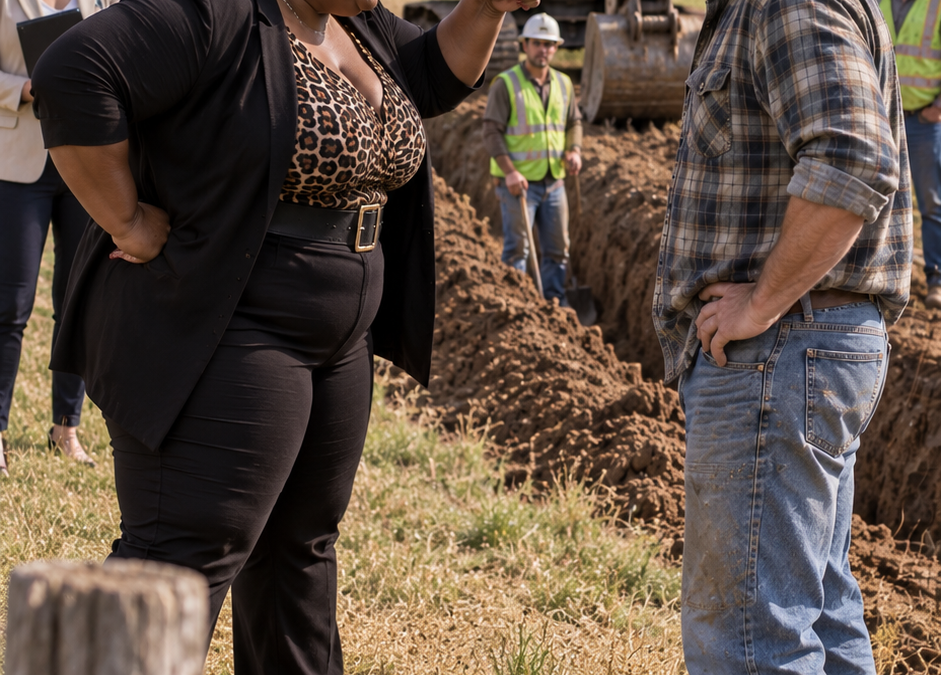
𝗣𝗔𝗥𝗧 𝟮
The new berm looked too high.
And it appeared to run almost exactly where I remembered the original overflow swale being.
I remember gripping the steering wheel and thinking:
Did they just bury the drainage route?
Then I told myself I might be remembering the alignment wrong.
It wasn’t my project.
It wasn’t my property.
So I kept driving.
Nine months later, on a Monday morning in June, I was standing at my kitchen sink drinking coffee when I heard the excavator.
At first I assumed somebody was working around the pond.
Then I heard the machine load its hydraulics.
Close.
Very close.
That sound had been part of my life for eleven years.
You don’t forget it.
I stepped onto the porch.
The boom of an excavator rose above the hay about three hundred feet inside my property.
For a second, I honestly could not make sense of what I was seeing.
Then the bucket disappeared.
A moment later, dark soil rolled upward.
I set my coffee down on the railing and walked.
I didn’t run.
Running doesn’t improve facts.
By the time I reached the machine, a trench had already been cut through a long strip of hay.
It started near Cedar Glenn’s pond and headed southwest across my property toward the natural ditch along my back line.
The trench was deep enough that nobody could mistake it for a shallow grading adjustment.
This was deliberate drainage work.
A man standing beside the excavator turned when he saw me.
He was maybe forty-three, sunburned across the back of his neck, wearing work boots and a faded safety shirt.
He offered his hand.
“Derek Puit.”
“Evan Hollis.”
He nodded.
Then I said, “I own this field.”
His expression changed.
Not dramatically.
Just enough.
He looked toward the property line.
Then toward the trench.
Then down at the clipboard in his hand.
“You own this parcel?”
“All thirty-eight acres.”
He flipped a sheet.
“The association scheduled this work.”
“I understand that.”
He frowned.
“They told us access was already confirmed.”
That sentence changed everything.
“Who told you?”
“The HOA president.”
“Rebecca Sutter?”
“Yeah.”
“Did she give you an easement?”
“That would be handled through the office.”
“Did she give you written landowner permission?”
He hesitated.
“As far as I know, everything’s cleared.”
“As far as you know isn’t enough when you’re standing three hundred feet inside somebody else’s property.”
Derek looked uncomfortable, but he didn’t become aggressive.
That mattered.
I pointed toward the machine.
“Nobody has asked me for permission. Nobody has permission. I’m the sole owner of record. Until somebody can show me a legal right to be here, that machine needs to stop.”
He looked at me for a few seconds.
Then he raised one hand toward his operator and made a cutting motion.
The bucket stopped.
The boom lowered.
The engine dropped to idle.
Then shut down.
The silence was astonishing.
I could hear insects in the grass.
Derek exhaled.
“If there’s a property issue, I’m not touching anything until they sort it out.”
“I appreciate that.”
That peaceful moment lasted roughly ninety seconds.
Then a white SUV came bouncing down the pond access lane.
Rebecca stepped out holding a folder.
She wasn’t worried.
That’s what I remember.
She wasn’t surprised.
She looked irritated.
Like a supervisor arriving because somebody beneath her had delayed a schedule.
“Why is the equipment stopped?” she asked Derek.
He nodded toward me.
“Mr. Hollis says this is his property and we don’t have authorization to be on it.”
Rebecca finally looked at me.
“You’re interfering with a community infrastructure project.”
No hello.
No apology.
No acknowledgment that an excavator had opened a trench across my field without a phone call.
“What legal right do you have to be here?” I asked.
“The association has a drainage easement.”
“Across this parcel?”
“Yes.”
“Recorded where?”
Her expression changed slightly.
“What do you mean?”
“I mean the instrument number.”
She stared at me.
I continued.
“What recorded document grants Cedar Glenn a drainage easement across my land?”
“The easement was established when the subdivision was built.”
“Okay. Show me.”
She gave a short laugh.
Not because anything was funny.
Because she wanted Derek to hear her laughing at me.
“The pond has been reaching dangerous levels. More than three hundred homes depend on that drainage system. I’m not going to allow one man’s ego to put an entire neighborhood at risk.”
I kept my hands in my pockets.
“What’s the permit number for this new discharge?”
She blinked.
“Excuse me?”
“County stormwater permit. If you’re creating a new outfall, where is the approval?”
“This isn’t a new outfall.”
“It wasn’t here yesterday.”
“It is maintenance.”
“Maintenance of what existing feature?”
Her jaw tightened.
I pointed toward the pond.
“Which stamped drawing shows a drainage channel across this parcel?”
Silence.
“Who is the engineer of record?”
She folded her arms.
“Mr. Hollis, owning a tractor doesn’t make you an engineer.”
Derek looked away.
I almost smiled.
Instead, I took out my phone.
I photographed the excavator with the machine identification visible.
I photographed the company name on the door.
Derek’s truck.
The trench.
Both ends.
The orange paint marks.
The stockpiled topsoil.
The pond.
My fence line.
The berm on Cedar Glenn property.
I unfolded the rule I kept in my truck and photographed the trench depth.
Then I stood at the property boundary and took a photograph showing exactly where Cedar Glenn ended and my field began.
Twenty-two photographs in roughly six minutes.
I didn’t know yet how valuable they would become.
I only knew from experience that memory is an argument.
Photographs are evidence.
When I finished, I looked at Derek.
“I want this stated clearly in front of everybody. Any assumed permission to enter my property is withdrawn. I’ll put that in writing today. No additional work happens here unless I personally authorize it or somebody produces a valid recorded right allowing it.”
Derek nodded immediately.
“Understood.”
Rebecca opened her folder.
“Fine.”
She pulled out a photocopy.
“Since you insist.”
She held it in front of me.
It was a reproduction of an old plat, grainy enough that some of the smaller lettering was hard to read.
A dashed line crossed the parcel that was now mine.
Beside it were the words:
TEMPORARY CONSTRUCTION EASEMENT.
Rebecca tapped the paper.
“There. See? Exactly what I’ve been telling you.”
I looked more closely.
The label continued toward the right edge.
Then disappeared.
The photocopy had been cut off.
I could see enough to know there was text missing.
I did not point that out.
Instead I asked, “Can I have a copy?”
“This is the association copy.”
“I didn’t ask to keep it.”
She stared at me.
Then lowered it.
“I suggest you stop delaying the work.”
“I’ll review the record.”
Rebecca gave Derek a pointed look.
He shook his head.
“We’re not continuing until our office clears the property question.”
That irritated her more than anything I’d said.
By late afternoon, the excavator was loaded onto a lowboy and hauled away.
I stood alone at the edge of the trench after sunset.
A hundred-foot strip of hay had been destroyed.
That bothered me.
But what bothered me more was the direction.
The trench made no sense.
If Cedar Glenn already had an approved overflow route, why create a second one through my field?
Nobody spends money excavating two hundred feet of drainage channel because they are bored.
Nobody risks trespass because the legal route is working perfectly.
Something had changed.
I went inside, cleared my kitchen table, and brought out every deed, survey, old plat, closing document, and property record my family had kept.
The following morning, I was standing at the county recorder’s office when it opened.
A clerk helped me pull the subdivision plat.
Then the original development file.
Then the drainage submittals.
Then the easement Rebecca had shown me.
There was an easement.
That much was true.
My grandfather had signed it.
But Rebecca had described almost everything else incorrectly.
The full document was titled:
TEMPORARY CONSTRUCTION EASEMENT.
Not drainage easement.
Not perpetual access easement.
Not stormwater conveyance easement.
Temporary construction easement.
It had been granted by my grandfather to Cedar Glenn’s original developer because, during construction, heavy equipment needed to cross the field to reach low ground where stormwater facilities were being built.
That was its only purpose.
It allowed temporary access for construction equipment.
It did not authorize the creation of a permanent drainage channel.
It did not authorize discharge of stormwater across the property.
And it did not transfer any continuing right to the homeowners association.
Then I reached the final paragraph.
The section Rebecca’s photocopy had cut away.
The language was simple.
The easement would automatically terminate upon final acceptance of Cedar Glenn’s infrastructure by the county.
I asked the clerk for the acceptance record.
She found it three folders later.
The county had accepted Cedar Glenn’s streets and stormwater infrastructure more than ten years earlier.
A Tuesday in October.
Case number.
Resolution.
Signatures.
Final acceptance.
That meant the easement Rebecca had waved at me like a warrant had expired automatically more than a decade before she ever stood in my field.
It wasn’t ambiguous.
It wasn’t under dispute.
It wasn’t dormant.
It was dead.
I sat beside the window with both documents in front of me.
The question was no longer whether Rebecca was inconveniencing me.
Someone had entered private land using a right that did not exist.
Then I opened the original drainage drawings.
That’s when the larger problem became obvious.
The system was beautifully straightforward.
Stormwater entered the detention pond.
The pond released through a controlled overflow structure.
Water then traveled through a graded grass swale across Cedar Glenn common property.
The swale contained small check features to slow velocity and allow sediment to settle.
At the end, the flow entered a county culvert.
Pond.
Swale.
County culvert.
Not one line crossed my property.
Not on the original plan.
Not on the revisions.
Not on any sheet.
There was no channel.
No pipe.
No drainage easement.
No approved outfall.
Nothing.
The trench in my hayfield wasn’t maintenance.
It was new construction.
Unapproved construction.
On private property.
I ordered certified copies of everything.
One set went into the safe at home.
Another stayed in my truck.
That evening, I received an email from Derek.
He had apparently spent the day asking his own questions.
His note was brief.
He said his company was suspending any additional Cedar Glenn work until authorization issues were resolved.
Attached was the work order.
The scope read:
Excavate drainage channel from detention pond to rear ditch.
It included dimensions.
Equipment.
Estimated hours.
Mobilization.
And a note near the bottom.
PROPERTY OWNER CONSENT CONFIRMED BY HOA PRESIDENT.
I read that line several times.
Then I printed it.
The next morning, I called the engineering firm whose seal appeared on Cedar Glenn’s stormwater plans.
I gave the receptionist my parcel number and explained that excavation had taken place on my property adjacent to the subdivision.
“I’d like to confirm whether your office issued a revision authorizing a new drainage discharge across parcel 18-442.”
She put me on hold.
Six minutes.
When she returned, her tone was different.
“I don’t see a change order.”
“Could it be under another file?”
“I’m checking the revision log too.”
A pause.
“No. There’s nothing.”
I told her where the trench began.
She asked me to hold again.
Nine minutes this time.
Then she came back.
“The engineer of record is still with the firm.”
“Who is that?”
“Graham Keane.”
I recognized the name from the drawings.
“He would like to inspect the site personally.”
I looked through the kitchen window toward the field.
“When?”
“Friday morning.”
Then she said something that confirmed this was no longer routine.
“Please don’t allow the excavation to be filled before he gets there.”
“I wasn’t planning to.”
I hung up.
Rebecca had no idea Graham Keane was coming.
While I was gathering records, she was creating her own paper trail.
That afternoon, I received a letter from Cedar Glenn Association.
Embossed logo.
Formal tone.
Rebecca’s signature.
The letter requested that I permit the drainage improvements to continue “without further delay” because of a potential flooding threat.
It referred to my “responsibilities as a neighboring property owner.”
I read that phrase twice.
Then laughed.
I had no contractual responsibilities to Cedar Glenn.
I wasn’t a member.
There was no covenant burdening my land.
There was no recorded drainage right.
There was no law requiring me to surrender my property because an association president wanted a cheaper solution.
But I recognized what Rebecca was doing.
Documentation.
She was building a story.
Responsible association.
Dangerous infrastructure problem.
Uncooperative adjacent landowner.
If the situation escalated, she wanted the file to show that Cedar Glenn had behaved reasonably and Evan Hollis had refused to cooperate.
I’d watched project managers build defensive records exactly that way.
What still bothered me was the trench itself.
Why this route?
Why now?
So I walked.
Not onto Cedar Glenn’s private paths.
I stayed on public areas and my own ground.
I studied the pond.
Its water level was high for June.
A dark stain on the bank showed it had recently risen at least another foot.
The concrete overflow structure looked clear.
That wasn’t the blockage.
I followed the alignment from the drainage plan in my head.
Then I saw it.
The swale was gone.
Not neglected.
Not clogged.
Gone.
The Cedar Glenn Beautification Initiative had been built directly across it.
The imported soil berm stood approximately two and a half feet above the original grade.
Decorative boulders occupied the channel.
Ornamental grasses sat in mulched beds where stormwater was supposed to move.
And the dry-stacked wall crossed the alignment almost perpendicular to flow.
Rebecca’s centerpiece was a dam.
I stood on the sidewalk looking at it while everything clicked into place.
The approved drainage route hadn’t mysteriously failed.
They had buried it.
The pond had started backing up because the neighborhood’s legal outlet had been blocked by its own landscaping project.
Removing the berm would mean destroying Rebecca’s showcase.
It would mean admitting the beautification project had damaged essential infrastructure.
It would mean explaining to hundreds of homeowners why their money had first been spent building the problem and now had to be spent removing it.
There was another option.
Cut through Evan Hollis’s field.
The fellow with the tractor.
No vote.
No public embarrassment.
No demolition of Rebecca’s signature project.
Just tell the contractor access was handled.
Wave an old photocopy if anybody objected.
That was the plan.
And for a few hours, it almost worked.
By Thursday, residents were talking.
Rebecca responded by getting in front of the story.
At the regular association meeting that evening, she announced that an “uncooperative adjacent landowner” was obstructing critical drainage repairs and spreading misinformation.
She warned that the delay could increase costs.
Several residents apparently believed her.
But the meeting minutes were being recorded by Cedar Glenn’s treasurer, Lauren Fisk.
Lauren was fifty-two, meticulous, and not easily distracted by personality.
She had already started wondering where the trench had come from because she couldn’t find an approved expenditure for it.
Friday morning was clear and cool.
I was fixing a hinge on my field gate when a silver pickup turned in.
A tall man stepped out.
Late fifties.
Gray at the temples.
Reflective vest.
He pulled a heavy roll of drawings from the truck bed.
“Evan Hollis?”
“Yes.”
“Graham Keane.”
We shook hands.
He didn’t immediately ask me what had happened.
He studied the ground.
That told me everything I needed to know about him.
He walked the entire trench.
Stopped several times.
Squatted at the edge.
Examined the soil layers.
Measured.
Set up a small tripod and shot elevations toward the rear ditch.
Then he asked where the natural ditch went.
I told him.
He asked whether it connected directly to the county system.
I explained the route.
He wrote something down.
No accusation.
No sympathy.
No conclusions.
Just facts.
About ten minutes later, Rebecca arrived.
Somebody must have called her.
She came down the access lane quickly and walked toward us wearing the expression I had seen the first morning.
Control had arrived.
“Mr. Keane,” she said brightly. “Thank you for coming out.”
Graham nodded.
“We’re making a minor field modification,” she continued. “The existing route became inadequate, so the board approved an adjustment to improve drainage performance.”
Graham opened one of his drawings.
“Change order number?”
Rebecca paused.
“I’d have to pull that.”
He made a pencil mark.
“Revised stormwater management plan?”
“The board was advised this qualified as routine maintenance.”
“By whom?”
Another pause.
“We were working under urgent conditions.”
“County discharge approval for the new point of release?”
“The situation required immediate action.”
Graham looked up.
“Was an emergency declared by the county?”
Rebecca didn’t answer.
“Emergency management?”
Nothing.
“Public works?”
Her voice hardened.
“This neighborhood has more than three hundred homes.”
“I understand.”
“We could not wait indefinitely while water continued rising.”
Graham nodded.
Then looked toward Derek, who had arrived a few minutes earlier at the engineering firm’s request.
“Do you have the work authorization?”
Derek handed it over.
He also produced a hand-drawn sketch.
It showed a line from the pond across my parcel toward the rear ditch.
Two dimensions were written in ballpoint pen.
Graham held it for several seconds.
“This isn’t an approved engineering drawing.”
Rebecca said, “It was intended to show the alignment.”
“Who selected the alignment?”
“The existing corridor was no longer viable.”
“Why?”
“It degraded.”
Graham slowly turned toward the beautification area.
The berm.
The boulders.
The grasses.
The stone wall.
He unrolled another drainage sheet across the hood of his truck.
Then he pointed.
“Because somebody built that directly across the approved drainage route.”
Rebecca said nothing.
Graham traced the design with his pencil.
“Pond outlet.”
He moved the pencil.
“Conveyance swale.”
Again.
“Check structures.”
Again.
“County culvert.”
Then he tapped the swale.
“This is the outlet.”
Nobody spoke.
“This has always been the outlet. It’s the only outlet this development has ever been permitted to use.”
He moved his pencil onto the blank area representing my property.
“There has never been an approved drainage feature here. Not on the original plan. Not on any revision I’ve signed. Not in twenty-two years.”
Rebecca reached into her folder.
She pulled out the photocopy.
“The association relied on a recorded easement.”
Graham took the paper.
He read it.
Then he placed one finger at the right edge where the text disappeared.
“Do you have the complete instrument?”
“This is what’s in our file.”
“You need the complete recorded document.”
“I have it,” I said.
I opened my folder.
I placed the certified copy beside hers.
The difference was obvious.
Graham read the title.
Then the termination clause.
Temporary construction easement.
Automatically terminated upon final county acceptance.
I placed the county acceptance resolution beside it.
More than ten years old.
Rebecca stared down at the documents.
For the first time since I’d known her, she had nothing ready to say.
Then someone else walked toward us from the pond gate.
Lauren Fisk.
She carried a manila envelope.
Derek had called her the night before.
“I think you need these,” she said.
Lauren had spent eleven days reviewing Cedar Glenn’s financial records, minutes, and board authorizations.
She found exactly one legitimate action related to the drainage issue.
The board had approved money to investigate drainage alternatives.
Investigate.
Not excavate.
Not build.
Not enter private property.
Not authorize a new outfall.
There was no board vote approving the trench.
No vote approving construction on my property.
No approved expenditure covering the amount already billed.
Rebecca’s signature appeared on the contractor authorization alone.
Lauren opened the association’s governing documents.
“The president’s independent purchasing authority is limited to routine expenses under the stated threshold.”
She named the amount.
A few hundred dollars.
Then she read the contractor invoice.
Many times that amount.
Rebecca looked at Derek.
“The contractor was responsible for verifying site conditions.”
Derek didn’t react.
He reached into his truck.
“I brought the email chain.”
He handed it to Graham.
Then Lauren.
Then me.
A project manager from Derek’s company had asked a direct question before mobilization:
Has property-owner permission been secured for the eastern alignment?
Rebecca’s response contained eight words.
Ownership permission has been handled. Proceed as marked.
I looked at Rebecca.
For weeks, every time I challenged her, she had reached for some symbol of authority.
The HOA letterhead.
The old easement.
The supposed emergency.
The contractor.
The board.
Now every one of those things was sitting on the hood of Graham’s pickup as evidence pointing in the opposite direction.
No valid easement.
No engineering approval.
No landowner consent.
No county permit.
No board authorization.
She still tried.
“You’re turning this into a legal exercise,” she said to me. “People could lose property to flooding while you argue over technical language.”
“No,” I said.
My voice stayed calm.
“I’m asking you not to dig up my land without permission.”
“This is exactly what I’m talking about.”
“No. That’s the whole issue.”
Graham rolled up his drawings.
He didn’t argue with her.
He stepped away with his phone.
I heard him identify himself.
Then his professional license number.
Then Cedar Glenn’s original approval case.
And finally two phrases.
“Unpermitted alteration.”
“Unauthorized discharge.”
He spoke for about six minutes.
When he returned, he said a county stormwater inspector would be there Monday morning.
Nothing was to be disturbed before then.
Not the trench.
Not the landscaping.
Not the pond outlet.
Nothing.
Rebecca asked, “Is that really necessary?”
Graham looked at her.
“It isn’t optional anymore.”
Monday morning, a county truck arrived at nine.
The inspector was Nora Beckett.
Fifty years old.
Fourteen years in stormwater management.
She unloaded a camera, measuring wheel, clipboard, and the kind of expression that discouraged storytelling.
There were no police.
No shouting.
No dramatic confrontation.
Everything that happened next occurred through questions, documents, measurements, and signatures.
That was why it mattered.
Nora began with Rebecca.
Rebecca described the excavation as emergency work performed to protect homes from imminent flooding.
Nora looked up from her clipboard.
“Who declared the emergency?”
“The board understood the seriousness.”
“That wasn’t my question. Who declared the emergency?”
“There wasn’t time—”
“County emergency management?”
“No.”
“Public works?”
“No.”
“Stormwater office?”
“No.”
Nora wrote.
She turned to Graham.
“Did the engineer of record approve this trench?”
“No.”
“Any revised plan?”
“No.”
“Any hydraulic analysis for the alternate outlet?”
“No.”
She turned to Derek.
“Permit number?”
“We weren’t provided one.”
“Why did you mobilize?”
“We were told access and approvals were confirmed by the association.”
“Do you have that in writing?”
“Yes.”
He handed her the documents.
Then Nora faced me.
“Mr. Hollis, are you the owner of record?”
“Yes.”
“Did you grant the association or contractor permission to enter this parcel?”
“No.”
“Written permission?”
“No.”
“Verbal?”
“No.”
“Do you hold any agreement allowing stormwater discharge from Cedar Glenn across your property?”
“No.”
She gave me a form.
“Please certify that.”
I did.
Rebecca made one final attempt.
“The contractor exceeded what I instructed.”
Derek didn’t argue.
He simply handed Nora the signed work order.
Then the association sketch.
Then the email.
Ownership permission has been handled. Proceed as marked.
Nora read all three.
“Ms. Sutter, is this your signature?”
Rebecca looked at the page.
“Yes.”
Nora wrote.
Before leaving, she issued a stop-work order.
Then she described the required corrective action.
Cedar Glenn would have to restore my property.
The trench had to be backfilled properly.
Topsoil had to be replaced to its original depth.
Grades had to be restored.
Disturbed areas had to be seeded and stabilized.
Temporary erosion controls had to remain until vegetation returned.
That was only the beginning.
The association would also have to restore its own drainage system.
The unpermitted fill obstructing the approved swale had to be removed.
The decorative berm had to go.
The boulders had to go.
The dry-stacked wall had to go.
The mulch beds and ornamental landscaping occupying the conveyance corridor had to go.
Then the swale had to be reconstructed to the approved elevations and verified by survey.
A licensed engineer would have to seal the restoration plan.
The county would inspect the work.
Every item had a deadline.
Rebecca’s Beautification Initiative had become a correction order.
I watched her standing beside that landscaped berm after everyone else left.
For months it had been the visual symbol of her presidency.
Now it had orange stakes around it.
I didn’t enjoy that.
I wasn’t interested in humiliating her.
I wanted my field restored.
I wanted Cedar Glenn’s water to stay on the route that had been designed for it.
But there was still one question everybody needed answered.
Who was paying?
The answer began that evening at a special association meeting.
Lauren called it under a bylaw provision that apparently hadn’t been used in years.
Roughly ninety residents attended.
The room wasn’t loud.
That made it more serious.
People sat in folding chairs holding copies of emails and budget pages.
Lauren stood beside a projector.
She displayed the approved board expenditure for investigating drainage alternatives.
Then the contractor invoices.
Then the president’s spending authority.
Then the signed work order.
She didn’t accuse Rebecca of anything.
She didn’t need to.
The documents did the work.
Graham spoke next.
He placed the drainage plans on an easel.
He explained how the detention pond had operated for more than two decades.
He showed the overflow structure.
The swale.
The county culvert.
Then he showed the location of the beautification project.
A man in the third row raised his hand.
“Was there already a problem with the system before the landscaping?”
“No,” Graham said.
“You’re sure?”
“The system had functioned as designed for more than twenty years.”
“So what changed?”
Graham pointed at the plan.
“Fill was placed across the approved conveyance corridor within the last year.”
A voice from the back said, “We paid to put that there.”
Nobody laughed.
Lauren changed slides.
Three sentences appeared.
If the approved swale had not been blocked, a new trench would not have been necessary.
If the landowner had been contacted, the property dispute would not have occurred.
If the project had been submitted to the board and engineer, the conflict would have been identified before mobilization.
For a long moment, nobody said anything.
Then a woman near the front turned toward Rebecca.
“Why didn’t you just call him?”
Rebecca stood.
“I made a judgment under significant pressure. The pond was rising. We had homes to protect. Mr. Hollis refused to cooperate from the beginning.”
That was when I stood.
I hadn’t planned to speak.
I only said one thing.
“You never asked me.”
Rebecca looked at me.
“You put an excavator on my land. Then you told me I was obligated to accept it.”
I sat down.
That was enough.
The board entered executive session.
Eleven minutes later, they returned.
Rebecca Sutter was removed as president.
Lauren Fisk was appointed acting president until the next election.
A financial review began the following week.
It eventually identified two other agreements Rebecca had signed without proper board authorization.
I never learned every detail of how those were handled.
I didn’t need to.
My issue was the field.
And now, for the first time, Cedar Glenn needed something from me legitimately.
They needed permission.
Restoring my property required equipment.
A dozer.
Tracked excavator.
Dump trucks.
Compaction equipment.
Nine days of work, maybe more.
Every one of those machines would have to enter land the association had just been formally told it had no right to enter.
So this time, they knocked.
Lauren and Graham came to my house on a Wednesday afternoon.
I made coffee.
We sat at the same kitchen table where I had spread my grandfather’s property documents weeks earlier.
Lauren placed a four-page agreement in front of me.
“First,” she said, “I want to apologize.”
I waited.
“The association entered your property without lawful authority.”
Simple words.
No qualifications.
No “misunderstanding.”
No “communication issue.”
No attempt to share responsibility.
“We shouldn’t have done it.”
“Thank you.”
“We can’t comply with the county restoration order unless you allow access.”
“I understand.”
Graham added, “The county won’t approve our restoration plan without documented landowner consent attached.”
I read the agreement.
Then I added conditions.
A licensed surveyor would stake the work limits before mobilization.
No equipment outside those limits.
The contractor would provide proof of general liability coverage and name me as additional insured for the project duration.
Machines would enter by one designated field lane.
Work hours would be agreed in advance.
Topsoil would be separated from underlying material and restored at the correct depth.
Any damage to my fence, gate, lane, drainage, or remaining hay would be repaired or compensated.
The agreement would expire on a stated date.
Most importantly, one paragraph would say that the temporary access created no permanent easement, implied right, prescriptive claim, or future entitlement.
Any future work would require separate written permission.
Lauren read the changes.
“Agreed.”
Graham nodded.
Not one condition was unreasonable.
That was the bitter irony.
If Rebecca had walked to my house that first morning and said:
Evan, we’ve discovered a drainage problem. We may need temporary access to your land while we solve it. Can we sit down and work something out?
I probably would have made coffee.
We could have discussed routes.
Insurance.
Restoration.
Engineering.
Maybe I would have allowed temporary equipment access while they repaired the proper swale.
Instead, she chose an excavator.
Derek’s company provided the insurance certificate within two days.
The surveyor came Monday morning.
Orange flags marked every boundary.
I stood on my porch looking at them.
Such small things.
Tiny pieces of plastic on wire stakes.
Yet those stakes represented something the first trench never had.
Permission.
The restoration work took nine days.
The trench was backfilled in controlled lifts.
Material was compacted.
Subgrade was restored.
Topsoil went back.
The field was shaped carefully until the contour disappeared beneath the machine tracks.
Then it was seeded and mulched.
Near the end of the job, Rebecca came back.
I saw her car parked along the county road.
She walked to the fence.
She wasn’t president anymore.
I had heard she might sell her house.
The internal review was still ongoing.
She stood watching the dozer finish the final grading.
I walked toward her.
For several seconds, neither of us spoke.
Then she said, “All of this could have been avoided if you’d been willing to cooperate.”
There are moments when anger feels useful.
This wasn’t one of them.
I looked across the stripped ground.
The same ground my grandfather had cleared.
The same ground my father had worked.
The same ground she had once treated like blank space on somebody else’s sketch.
I felt tired.
But cleanly tired.
Like the end of a long job.
“You’re right,” I said.
She seemed surprised.
“It could have been avoided.”
I looked at her.
“If you’d asked before you dug.”
Her face tightened.
She stayed there a few more seconds.
Then walked back to her car.
That was the last conversation we ever had.
Six weeks later, my field looked like a field again.
The seed came up quickly because we caught a soft rain three days after restoration.
By the end of summer, a narrow stripe of brighter green crossed the hay where the trench had been.
You could see where the soil had been disturbed.
You probably still could if you knew where to look.
I don’t mind.
Some scars aren’t injuries anymore.
They’re records.
Across the fence, Cedar Glenn looked different.
The beautification project disappeared piece by piece.
An excavator pulled out the boulders.
Trucks hauled away the imported soil.
The retaining wall came down.
The ornamental grasses disappeared.
Then the crew reopened the original swale.
Station by station.
Elevation by elevation.
Exactly according to Graham Keane’s drawings.
The finished drainage corridor wasn’t attractive.
It was a broad, shallow depression covered in grass.
There were no decorative stones.
No expensive plantings.
No newsletter photographs.
It looked like almost nothing.
Which is what good infrastructure often looks like.
It simply works.
A surveyor certified the grades.
Graham signed the final engineering documentation.
Nora Beckett returned on a Friday afternoon.
She walked the swale.
Checked the elevations.
Photographed the restored corridor.
Then signed off.
The real test came in October.
A major storm moved through the county and dropped almost four inches of rain in eleven hours.
I stood under my porch roof near dusk with a cup of coffee.
The field shimmered under the rain.
Water ran in thin sheets toward the natural low spots.
Beyond my fence, Cedar Glenn’s detention pond started filling.
Slowly.
Exactly as designed.
Brown stormwater climbed the banks.
For a while, nothing happened.
Then the level reached the overflow structure.
Water entered the outlet.
I could see it moving through the restored swale.
Past the check features.
Toward the county culvert.
I stood there in the darkening rain and watched.
The pond didn’t overtop.
No water crossed my fence.
No emergency trucks arrived.
Nobody needed an excavator in my field.
Nobody waved an old photocopy.
Nobody argued about neighborly responsibility.
The system simply did what Graham Keane had designed it to do twenty-two years earlier.
Not one basement flooded.
Not one drop needed my property.
I stayed on that porch longer than I needed to.
Rebecca Sutter had believed authority was something you could create by speaking confidently enough.
A title on letterhead.
A folder under your arm.
A room where people expected you to know the answer.
She had looked at thirty-eight acres that did not belong to her and decided necessity gave her permission.
Then she found an old document, read the part that supported what she wanted, ignored the part that didn’t, and sent a machine across my property.
Maybe she genuinely believed she was protecting Cedar Glenn by then.
People are capable of turning their own mistakes into emergencies remarkably quickly.
But property records don’t care how urgent you feel.
Engineering drawings don’t care how persuasive you sound.
Elevation doesn’t change because a board president dislikes where water is supposed to go.
And a temporary easement doesn’t become permanent because the last paragraph is inconvenient.
The strangest thing is that Cedar Glenn never needed my field.
It never needed a new drainage route.
It didn’t need an emergency solution.
Its system had worked for more than twenty years.
The real problem had been created when somebody decided appearance mattered more than understanding what was beneath it.
The berm looked beautiful.
The boulders looked expensive.
The ornamental grasses photographed perfectly.
And beneath them sat the neighborhood’s only lawful outlet.
By trying to hide that mistake, Rebecca made it larger.
First it cost them landscaping.
Then excavation.
Then engineering.
Then county inspections.
Then restoration.
Then nine days of work rebuilding my field.
And eventually it cost her the authority she had been so determined to exercise over everyone else.
I sometimes think back to that Friday morning beside Graham’s silver pickup.
Rebecca still had her folder then.
She still had her confidence.
She still believed the conversation was about whether some stubborn farmer understood the needs of a modern subdivision.
Graham never raised his voice.
Never insulted her.
Never accused her of anything.
He simply looked at the trench, looked at the approved drawings, and asked the question every person involved should have asked before the first bucket entered my soil.
Who approved this?
In the end, that question did more than stop an excavator.
It forced everyone to look at the difference between authority and assumption.
Between maintenance and construction.
Between an easement that actually existed and one somebody wished still existed.
Between protecting a neighborhood and protecting a mistake.
And every time it rains hard now, the answer runs quietly through Cedar Glenn’s grass swale, into the county culvert, and away from my land exactly where it belonged from the beginning.
Have you finished reading the story and want to read it again?
The Morning an Excavator Cut Across My Hayfield, I Realized Someone at Cedar Glenn Was Counting on Me Not to Read the Fine Print
I knew the sound before I knew what it meant.
A diesel engine was working hard somewhere beyond my kitchen window, close enough that I could feel the vibration through the porch boards.
By the time I reached the field, an excavator had already cut a deep trench through land my family had owned for three generations.
My name is Evan Hollis.
I was forty-nine years old that summer, and I owned thirty-eight acres of open ground directly behind a subdivision called Cedar Glenn.
My grandfather bought the property back when that whole side of the county was pasture, gravel roads, and fence posts leaning under their own age. He raised cattle there. My father shifted most of it to hay. By the time it passed to me, houses had started creeping toward us from the east, one cul-de-sac at a time.
Cedar Glenn arrived last.
More than three hundred homes, neat sidewalks, matching mailboxes, decorative entrance walls, landscaped common areas, and a homeowners association that governed nearly every visible inch inside its recorded boundaries.
My land was not inside those boundaries.
That distinction would eventually become the most important fact in the entire story.
For years, nobody had trouble understanding it.
I wasn’t a member of Cedar Glenn’s association.
I didn’t pay dues.
I didn’t vote in board elections.
I didn’t receive violation notices.
I didn’t ask permission to repair my fence or park my equipment.
My deed had been recorded long before Cedar Glenn existed, and the subdivision had simply been built beside me.
That was all.
Most of the residents understood that perfectly.
They waved when I drove the tractor past their back fences. Kids sometimes stood on decks and watched me bale hay. A few families bought sweet corn from me in late summer, though I gave away more than I sold. During winter, when the field turned brown and quiet, I hardly thought about the subdivision at all.
I preferred it that way.
Before farming full-time, I had spent eleven years as a field supervisor for an infrastructure contractor.
I wasn’t an engineer.
I never pretended to be.
But I had spent enough years around survey stakes, drainage plans, grading sheets, trench boxes, culverts, compacted fill, and irritated inspectors to know how civil work was supposed to happen.
I could read elevations.
I knew what a swale was.
I knew the difference between a temporary construction easement and a permanent utility easement.
More importantly, I knew there were questions that had to be answered before a machine touched soil.
Who owns the land?
What right do we have to enter?
Where is the approved plan?
Where is the permit?
Who signed the change?
Those questions were muscle memory to me.
For years, that background had been useless.
Then Rebecca Sutter became president of the Cedar Glenn Association.
Rebecca was forty-six and had the kind of personality that made ordinary administrative authority look ceremonial.
She didn’t simply chair meetings.
She presided over them.
She didn’t suggest standards.
She issued them.
Within her first three months as president, Cedar Glenn suddenly had revised landscaping guidelines, parking rules, fence specifications, mailbox standards, and a seasonal exterior appearance checklist.
Rebecca carried a laminated copy of the covenants in her SUV.
I know because I saw her pull it out more than once.
There was nothing inherently wrong with caring about a neighborhood.
I understood why people bought into communities with standards. If you agreed to certain rules when you purchased your home, you couldn’t act surprised when those rules were enforced.
What bothered me was that Rebecca seemed deeply uncomfortable with the existence of anything she couldn’t enforce.
Especially my field.
Thirty-eight acres sat behind her subdivision, visible from dozens of Cedar Glenn backyards, and not one square foot answered to her.
That seemed to offend her on principle.
The first time she approached me about the height of grass along my eastern fence line, I thought she was joking.
“Some of the residents feel it looks neglected,” she said.
“I cut it when I cut hay.”
“It affects the appearance of the community.”
“I’m not in the community.”
She gave me a small smile.
Not friendly.
Patient.
The kind teachers use when a child gives the wrong answer with confidence.
“We’re all part of the same area, Mr. Hollis.”
“Maybe geographically.”
Her smile tightened.
Another time, at the cluster of mailboxes along the county road, she was standing with two Cedar Glenn residents when I pulled up in my truck.
She nodded toward me and said, loud enough for me to hear, “That’s the fellow with the tractor.”
Not Evan.
Not the landowner.
The fellow with the tractor.
I let it go.
I’d spent too many years around job sites to be wounded by condescension. People who needed to diminish somebody in front of an audience were usually compensating for something that had nothing to do with the person they were insulting.
I had hay down.
Rain was coming.
I had better things to do.
But there was a piece of Cedar Glenn’s geography I had been watching long before Rebecca ever became president.
Behind the final row of houses, between the subdivision and my property, sat a stormwater detention pond.
It was entirely on Cedar Glenn common property.
The pond wasn’t decorative, even though the association had landscaped around it.
Its real purpose was hydraulic.
Three hundred roofs, streets, driveways, sidewalks, and parking areas shed a tremendous amount of water during a storm. Instead of allowing all that runoff to hit the county system at once, the subdivision’s drainage network collected it and directed it into the detention pond.
The pond temporarily stored the runoff.
Then it released the water at a controlled rate.
Simple concept.
Critical function.
The pond’s outlet connected to a shallow engineered grass swale that ran across Cedar Glenn common ground toward a county culvert.
From there, the water entered the public drainage system downstream.
I knew that because I had seen the original grading work twenty years earlier.
More importantly, it was shown clearly on the recorded drainage plans.
Nothing about that system crossed my property.
Nothing needed to.
Then, late the previous summer, Rebecca announced what she called the Cedar Glenn Beautification Initiative.
The strip of common ground around the pond became the centerpiece.
Landscapers brought in truckloads of soil.
They constructed a raised berm.
They installed clusters of large decorative boulders.
They planted ornamental grasses and dogwood shrubs in deep mulch.
A low wall of dry-stacked stone went along the rear edge.
It looked polished.
Expensive.
Photogenic.
At Cedar Glenn’s annual meeting, Rebecca stood in front of a photograph of it and called the project proof of what “focused leadership” could accomplish.
I drove past it one afternoon and slowed my truck.
Something about the grading bothered me.
The new berm looked too high.
And it appeared to run almost exactly where I remembered the original overflow swale being.
I remember gripping the steering wheel and thinking:
Did they just bury the drainage route?
Then I told myself I might be remembering the alignment wrong.
It wasn’t my project.
It wasn’t my property.
So I kept driving.
Nine months later, on a Monday morning in June, I was standing at my kitchen sink drinking coffee when I heard the excavator.
At first I assumed somebody was working around the pond.
Then I heard the machine load its hydraulics.
Close.
Very close.
That sound had been part of my life for eleven years.
You don’t forget it.
I stepped onto the porch.
The boom of an excavator rose above the hay about three hundred feet inside my property.
For a second, I honestly could not make sense of what I was seeing.
Then the bucket disappeared.
A moment later, dark soil rolled upward.
I set my coffee down on the railing and walked.
I didn’t run.
Running doesn’t improve facts.
By the time I reached the machine, a trench had already been cut through a long strip of hay.
It started near Cedar Glenn’s pond and headed southwest across my property toward the natural ditch along my back line.
The trench was deep enough that nobody could mistake it for a shallow grading adjustment.
This was deliberate drainage work.
A man standing beside the excavator turned when he saw me.
He was maybe forty-three, sunburned across the back of his neck, wearing work boots and a faded safety shirt.
He offered his hand.
“Derek Puit.”
“Evan Hollis.”
He nodded.
Then I said, “I own this field.”
His expression changed.
Not dramatically.
Just enough.
He looked toward the property line.
Then toward the trench.
Then down at the clipboard in his hand.
“You own this parcel?”
“All thirty-eight acres.”
He flipped a sheet.
“The association scheduled this work.”
“I understand that.”
He frowned.
“They told us access was already confirmed.”
That sentence changed everything.
“Who told you?”
“The HOA president.”
“Rebecca Sutter?”
“Yeah.”
“Did she give you an easement?”
“That would be handled through the office.”
“Did she give you written landowner permission?”
He hesitated.
“As far as I know, everything’s cleared.”
“As far as you know isn’t enough when you’re standing three hundred feet inside somebody else’s property.”
Derek looked uncomfortable, but he didn’t become aggressive.
That mattered.
I pointed toward the machine.
“Nobody has asked me for permission. Nobody has permission. I’m the sole owner of record. Until somebody can show me a legal right to be here, that machine needs to stop.”
He looked at me for a few seconds.
Then he raised one hand toward his operator and made a cutting motion.
The bucket stopped.
The boom lowered.
The engine dropped to idle.
Then shut down.
The silence was astonishing.
I could hear insects in the grass.
Derek exhaled.
“If there’s a property issue, I’m not touching anything until they sort it out.”
“I appreciate that.”
That peaceful moment lasted roughly ninety seconds.
Then a white SUV came bouncing down the pond access lane.
Rebecca stepped out holding a folder.
She wasn’t worried.
That’s what I remember.
She wasn’t surprised.
She looked irritated.
Like a supervisor arriving because somebody beneath her had delayed a schedule.
“Why is the equipment stopped?” she asked Derek.
He nodded toward me.
“Mr. Hollis says this is his property and we don’t have authorization to be on it.”
Rebecca finally looked at me.
“You’re interfering with a community infrastructure project.”
No hello.
No apology.
No acknowledgment that an excavator had opened a trench across my field without a phone call.
“What legal right do you have to be here?” I asked.
“The association has a drainage easement.”
“Across this parcel?”
“Yes.”
“Recorded where?”
Her expression changed slightly.
“What do you mean?”
“I mean the instrument number.”
She stared at me.
I continued.
“What recorded document grants Cedar Glenn a drainage easement across my land?”
“The easement was established when the subdivision was built.”
“Okay. Show me.”
She gave a short laugh.
Not because anything was funny.
Because she wanted Derek to hear her laughing at me.
“The pond has been reaching dangerous levels. More than three hundred homes depend on that drainage system. I’m not going to allow one man’s ego to put an entire neighborhood at risk.”
I kept my hands in my pockets.
“What’s the permit number for this new discharge?”
She blinked.
“Excuse me?”
“County stormwater permit. If you’re creating a new outfall, where is the approval?”
“This isn’t a new outfall.”
“It wasn’t here yesterday.”
“It is maintenance.”
“Maintenance of what existing feature?”
Her jaw tightened.
I pointed toward the pond.
“Which stamped drawing shows a drainage channel across this parcel?”
Silence.
“Who is the engineer of record?”
She folded her arms.
“Mr. Hollis, owning a tractor doesn’t make you an engineer.”
Derek looked away.
I almost smiled.
Instead, I took out my phone.
I photographed the excavator with the machine identification visible.
I photographed the company name on the door.
Derek’s truck.
The trench.
Both ends.
The orange paint marks.
The stockpiled topsoil.
The pond.
My fence line.
The berm on Cedar Glenn property.
I unfolded the rule I kept in my truck and photographed the trench depth.
Then I stood at the property boundary and took a photograph showing exactly where Cedar Glenn ended and my field began.
Twenty-two photographs in roughly six minutes.
I didn’t know yet how valuable they would become.
I only knew from experience that memory is an argument.
Photographs are evidence.
When I finished, I looked at Derek.
“I want this stated clearly in front of everybody. Any assumed permission to enter my property is withdrawn. I’ll put that in writing today. No additional work happens here unless I personally authorize it or somebody produces a valid recorded right allowing it.”
Derek nodded immediately.
“Understood.”
Rebecca opened her folder.
“Fine.”
She pulled out a photocopy.
“Since you insist.”
She held it in front of me.
It was a reproduction of an old plat, grainy enough that some of the smaller lettering was hard to read.
A dashed line crossed the parcel that was now mine.
Beside it were the words:
TEMPORARY CONSTRUCTION EASEMENT.
Rebecca tapped the paper.
“There. See? Exactly what I’ve been telling you.”
I looked more closely.
The label continued toward the right edge.
Then disappeared.
The photocopy had been cut off.
I could see enough to know there was text missing.
I did not point that out.
Instead I asked, “Can I have a copy?”
“This is the association copy.”
“I didn’t ask to keep it.”
She stared at me.
Then lowered it.
“I suggest you stop delaying the work.”
“I’ll review the record.”
Rebecca gave Derek a pointed look.
He shook his head.
“We’re not continuing until our office clears the property question.”
That irritated her more than anything I’d said.
By late afternoon, the excavator was loaded onto a lowboy and hauled away.
I stood alone at the edge of the trench after sunset.
A hundred-foot strip of hay had been destroyed.
That bothered me.
But what bothered me more was the direction.
The trench made no sense.
If Cedar Glenn already had an approved overflow route, why create a second one through my field?
Nobody spends money excavating two hundred feet of drainage channel because they are bored.
Nobody risks trespass because the legal route is working perfectly.
Something had changed.
I went inside, cleared my kitchen table, and brought out every deed, survey, old plat, closing document, and property record my family had kept.
The following morning, I was standing at the county recorder’s office when it opened.
A clerk helped me pull the subdivision plat.
Then the original development file.
Then the drainage submittals.
Then the easement Rebecca had shown me.
There was an easement.
That much was true.
My grandfather had signed it.
But Rebecca had described almost everything else incorrectly.
The full document was titled:
TEMPORARY CONSTRUCTION EASEMENT.
Not drainage easement.
Not perpetual access easement.
Not stormwater conveyance easement.
Temporary construction easement.
It had been granted by my grandfather to Cedar Glenn’s original developer because, during construction, heavy equipment needed to cross the field to reach low ground where stormwater facilities were being built.
That was its only purpose.
It allowed temporary access for construction equipment.
It did not authorize the creation of a permanent drainage channel.
It did not authorize discharge of stormwater across the property.
And it did not transfer any continuing right to the homeowners association.
Then I reached the final paragraph.
The section Rebecca’s photocopy had cut away.
The language was simple.
The easement would automatically terminate upon final acceptance of Cedar Glenn’s infrastructure by the county.
I asked the clerk for the acceptance record.
She found it three folders later.
The county had accepted Cedar Glenn’s streets and stormwater infrastructure more than ten years earlier.
A Tuesday in October.
Case number.
Resolution.
Signatures.
Final acceptance.
That meant the easement Rebecca had waved at me like a warrant had expired automatically more than a decade before she ever stood in my field.
It wasn’t ambiguous.
It wasn’t under dispute.
It wasn’t dormant.
It was dead.
I sat beside the window with both documents in front of me.
The question was no longer whether Rebecca was inconveniencing me.
Someone had entered private land using a right that did not exist.
Then I opened the original drainage drawings.
That’s when the larger problem became obvious.
The system was beautifully straightforward.
Stormwater entered the detention pond.
The pond released through a controlled overflow structure.
Water then traveled through a graded grass swale across Cedar Glenn common property.
The swale contained small check features to slow velocity and allow sediment to settle.
At the end, the flow entered a county culvert.
Pond.
Swale.
County culvert.
Not one line crossed my property.
Not on the original plan.
Not on the revisions.
Not on any sheet.
There was no channel.
No pipe.
No drainage easement.
No approved outfall.
Nothing.
The trench in my hayfield wasn’t maintenance.
It was new construction.
Unapproved construction.
On private property.
I ordered certified copies of everything.
One set went into the safe at home.
Another stayed in my truck.
That evening, I received an email from Derek.
He had apparently spent the day asking his own questions.
His note was brief.
He said his company was suspending any additional Cedar Glenn work until authorization issues were resolved.
Attached was the work order.
The scope read:
Excavate drainage channel from detention pond to rear ditch.
It included dimensions.
Equipment.
Estimated hours.
Mobilization.
And a note near the bottom.
PROPERTY OWNER CONSENT CONFIRMED BY HOA PRESIDENT.
I read that line several times.
Then I printed it.
The next morning, I called the engineering firm whose seal appeared on Cedar Glenn’s stormwater plans.
I gave the receptionist my parcel number and explained that excavation had taken place on my property adjacent to the subdivision.
“I’d like to confirm whether your office issued a revision authorizing a new drainage discharge across parcel 18-442.”
She put me on hold.
Six minutes.
When she returned, her tone was different.
“I don’t see a change order.”
“Could it be under another file?”
“I’m checking the revision log too.”
A pause.
“No. There’s nothing.”
I told her where the trench began.
She asked me to hold again.
Nine minutes this time.
Then she came back.
“The engineer of record is still with the firm.”
“Who is that?”
“Graham Keane.”
I recognized the name from the drawings.
“He would like to inspect the site personally.”
I looked through the kitchen window toward the field.
“When?”
“Friday morning.”
Then she said something that confirmed this was no longer routine.
“Please don’t allow the excavation to be filled before he gets there.”
“I wasn’t planning to.”
I hung up.
Rebecca had no idea Graham Keane was coming.
While I was gathering records, she was creating her own paper trail.
That afternoon, I received a letter from Cedar Glenn Association.
Embossed logo.
Formal tone.
Rebecca’s signature.
The letter requested that I permit the drainage improvements to continue “without further delay” because of a potential flooding threat.
It referred to my “responsibilities as a neighboring property owner.”
I read that phrase twice.
Then laughed.
I had no contractual responsibilities to Cedar Glenn.
I wasn’t a member.
There was no covenant burdening my land.
There was no recorded drainage right.
There was no law requiring me to surrender my property because an association president wanted a cheaper solution.
But I recognized what Rebecca was doing.
Documentation.
She was building a story.
Responsible association.
Dangerous infrastructure problem.
Uncooperative adjacent landowner.
If the situation escalated, she wanted the file to show that Cedar Glenn had behaved reasonably and Evan Hollis had refused to cooperate.
I’d watched project managers build defensive records exactly that way.
What still bothered me was the trench itself.
Why this route?
Why now?
So I walked.
Not onto Cedar Glenn’s private paths.
I stayed on public areas and my own ground.
I studied the pond.
Its water level was high for June.
A dark stain on the bank showed it had recently risen at least another foot.
The concrete overflow structure looked clear.
That wasn’t the blockage.
I followed the alignment from the drainage plan in my head.
Then I saw it.
The swale was gone.
Not neglected.
Not clogged.
Gone.
The Cedar Glenn Beautification Initiative had been built directly across it.
The imported soil berm stood approximately two and a half feet above the original grade.
Decorative boulders occupied the channel.
Ornamental grasses sat in mulched beds where stormwater was supposed to move.
And the dry-stacked wall crossed the alignment almost perpendicular to flow.
Rebecca’s centerpiece was a dam.
I stood on the sidewalk looking at it while everything clicked into place.
The approved drainage route hadn’t mysteriously failed.
They had buried it.
The pond had started backing up because the neighborhood’s legal outlet had been blocked by its own landscaping project.
Removing the berm would mean destroying Rebecca’s showcase.
It would mean admitting the beautification project had damaged essential infrastructure.
It would mean explaining to hundreds of homeowners why their money had first been spent building the problem and now had to be spent removing it.
There was another option.
Cut through Evan Hollis’s field.
The fellow with the tractor.
No vote.
No public embarrassment.
No demolition of Rebecca’s signature project.
Just tell the contractor access was handled.
Wave an old photocopy if anybody objected.
That was the plan.
And for a few hours, it almost worked.
By Thursday, residents were talking.
Rebecca responded by getting in front of the story.
At the regular association meeting that evening, she announced that an “uncooperative adjacent landowner” was obstructing critical drainage repairs and spreading misinformation.
She warned that the delay could increase costs.
Several residents apparently believed her.
But the meeting minutes were being recorded by Cedar Glenn’s treasurer, Lauren Fisk.
Lauren was fifty-two, meticulous, and not easily distracted by personality.
She had already started wondering where the trench had come from because she couldn’t find an approved expenditure for it.
Friday morning was clear and cool.
I was fixing a hinge on my field gate when a silver pickup turned in.
A tall man stepped out.
Late fifties.
Gray at the temples.
Reflective vest.
He pulled a heavy roll of drawings from the truck bed.
“Evan Hollis?”
“Yes.”
“Graham Keane.”
We shook hands.
He didn’t immediately ask me what had happened.
He studied the ground.
That told me everything I needed to know about him.
He walked the entire trench.
Stopped several times.
Squatted at the edge.
Examined the soil layers.
Measured.
Set up a small tripod and shot elevations toward the rear ditch.
Then he asked where the natural ditch went.
I told him.
He asked whether it connected directly to the county system.
I explained the route.
He wrote something down.
No accusation.
No sympathy.
No conclusions.
Just facts.
About ten minutes later, Rebecca arrived.
Somebody must have called her.
She came down the access lane quickly and walked toward us wearing the expression I had seen the first morning.
Control had arrived.
“Mr. Keane,” she said brightly. “Thank you for coming out.”
Graham nodded.
“We’re making a minor field modification,” she continued. “The existing route became inadequate, so the board approved an adjustment to improve drainage performance.”
Graham opened one of his drawings.
“Change order number?”
Rebecca paused.
“I’d have to pull that.”
He made a pencil mark.
“Revised stormwater management plan?”
“The board was advised this qualified as routine maintenance.”
“By whom?”
Another pause.
“We were working under urgent conditions.”
“County discharge approval for the new point of release?”
“The situation required immediate action.”
Graham looked up.
“Was an emergency declared by the county?”
Rebecca didn’t answer.
“Emergency management?”
Nothing.
“Public works?”
Her voice hardened.
“This neighborhood has more than three hundred homes.”
“I understand.”
“We could not wait indefinitely while water continued rising.”
Graham nodded.
Then looked toward Derek, who had arrived a few minutes earlier at the engineering firm’s request.
“Do you have the work authorization?”
Derek handed it over.
He also produced a hand-drawn sketch.
It showed a line from the pond across my parcel toward the rear ditch.
Two dimensions were written in ballpoint pen.
Graham held it for several seconds.
“This isn’t an approved engineering drawing.”
Rebecca said, “It was intended to show the alignment.”
“Who selected the alignment?”
“The existing corridor was no longer viable.”
“Why?”
“It degraded.”
Graham slowly turned toward the beautification area.
The berm.
The boulders.
The grasses.
The stone wall.
He unrolled another drainage sheet across the hood of his truck.
Then he pointed.
“Because somebody built that directly across the approved drainage route.”
Rebecca said nothing.
Graham traced the design with his pencil.
“Pond outlet.”
He moved the pencil.
“Conveyance swale.”
Again.
“Check structures.”
Again.
“County culvert.”
Then he tapped the swale.
“This is the outlet.”
Nobody spoke.
“This has always been the outlet. It’s the only outlet this development has ever been permitted to use.”
He moved his pencil onto the blank area representing my property.
“There has never been an approved drainage feature here. Not on the original plan. Not on any revision I’ve signed. Not in twenty-two years.”
Rebecca reached into her folder.
She pulled out the photocopy.
“The association relied on a recorded easement.”
Graham took the paper.
He read it.
Then he placed one finger at the right edge where the text disappeared.
“Do you have the complete instrument?”
“This is what’s in our file.”
“You need the complete recorded document.”
“I have it,” I said.
I opened my folder.
I placed the certified copy beside hers.
The difference was obvious.
Graham read the title.
Then the termination clause.
Temporary construction easement.
Automatically terminated upon final county acceptance.
I placed the county acceptance resolution beside it.
More than ten years old.
Rebecca stared down at the documents.
For the first time since I’d known her, she had nothing ready to say.
Then someone else walked toward us from the pond gate.
Lauren Fisk.
She carried a manila envelope.
Derek had called her the night before.
“I think you need these,” she said.
Lauren had spent eleven days reviewing Cedar Glenn’s financial records, minutes, and board authorizations.
She found exactly one legitimate action related to the drainage issue.
The board had approved money to investigate drainage alternatives.
Investigate.
Not excavate.
Not build.
Not enter private property.
Not authorize a new outfall.
There was no board vote approving the trench.
No vote approving construction on my property.
No approved expenditure covering the amount already billed.
Rebecca’s signature appeared on the contractor authorization alone.
Lauren opened the association’s governing documents.
“The president’s independent purchasing authority is limited to routine expenses under the stated threshold.”
She named the amount.
A few hundred dollars.
Then she read the contractor invoice.
Many times that amount.
Rebecca looked at Derek.
“The contractor was responsible for verifying site conditions.”
Derek didn’t react.
He reached into his truck.
“I brought the email chain.”
He handed it to Graham.
Then Lauren.
Then me.
A project manager from Derek’s company had asked a direct question before mobilization:
Has property-owner permission been secured for the eastern alignment?
Rebecca’s response contained eight words.
Ownership permission has been handled. Proceed as marked.
I looked at Rebecca.
For weeks, every time I challenged her, she had reached for some symbol of authority.
The HOA letterhead.
The old easement.
The supposed emergency.
The contractor.
The board.
Now every one of those things was sitting on the hood of Graham’s pickup as evidence pointing in the opposite direction.
No valid easement.
No engineering approval.
No landowner consent.
No county permit.
No board authorization.
She still tried.
“You’re turning this into a legal exercise,” she said to me. “People could lose property to flooding while you argue over technical language.”
“No,” I said.
My voice stayed calm.
“I’m asking you not to dig up my land without permission.”
“This is exactly what I’m talking about.”
“No. That’s the whole issue.”
Graham rolled up his drawings.
He didn’t argue with her.
He stepped away with his phone.
I heard him identify himself.
Then his professional license number.
Then Cedar Glenn’s original approval case.
And finally two phrases.
“Unpermitted alteration.”
“Unauthorized discharge.”
He spoke for about six minutes.
When he returned, he said a county stormwater inspector would be there Monday morning.
Nothing was to be disturbed before then.
Not the trench.
Not the landscaping.
Not the pond outlet.
Nothing.
Rebecca asked, “Is that really necessary?”
Graham looked at her.
“It isn’t optional anymore.”
Monday morning, a county truck arrived at nine.
The inspector was Nora Beckett.
Fifty years old.
Fourteen years in stormwater management.
She unloaded a camera, measuring wheel, clipboard, and the kind of expression that discouraged storytelling.
There were no police.
No shouting.
No dramatic confrontation.
Everything that happened next occurred through questions, documents, measurements, and signatures.
That was why it mattered.
Nora began with Rebecca.
Rebecca described the excavation as emergency work performed to protect homes from imminent flooding.
Nora looked up from her clipboard.
“Who declared the emergency?”
“The board understood the seriousness.”
“That wasn’t my question. Who declared the emergency?”
“There wasn’t time—”
“County emergency management?”
“No.”
“Public works?”
“No.”
“Stormwater office?”
“No.”
Nora wrote.
She turned to Graham.
“Did the engineer of record approve this trench?”
“No.”
“Any revised plan?”
“No.”
“Any hydraulic analysis for the alternate outlet?”
“No.”
She turned to Derek.
“Permit number?”
“We weren’t provided one.”
“Why did you mobilize?”
“We were told access and approvals were confirmed by the association.”
“Do you have that in writing?”
“Yes.”
He handed her the documents.
Then Nora faced me.
“Mr. Hollis, are you the owner of record?”
“Yes.”
“Did you grant the association or contractor permission to enter this parcel?”
“No.”
“Written permission?”
“No.”
“Verbal?”
“No.”
“Do you hold any agreement allowing stormwater discharge from Cedar Glenn across your property?”
“No.”
She gave me a form.
“Please certify that.”
I did.
Rebecca made one final attempt.
“The contractor exceeded what I instructed.”
Derek didn’t argue.
He simply handed Nora the signed work order.
Then the association sketch.
Then the email.
Ownership permission has been handled. Proceed as marked.
Nora read all three.
“Ms. Sutter, is this your signature?”
Rebecca looked at the page.
“Yes.”
Nora wrote.
Before leaving, she issued a stop-work order.
Then she described the required corrective action.
Cedar Glenn would have to restore my property.
The trench had to be backfilled properly.
Topsoil had to be replaced to its original depth.
Grades had to be restored.
Disturbed areas had to be seeded and stabilized.
Temporary erosion controls had to remain until vegetation returned.
That was only the beginning.
The association would also have to restore its own drainage system.
The unpermitted fill obstructing the approved swale had to be removed.
The decorative berm had to go.
The boulders had to go.
The dry-stacked wall had to go.
The mulch beds and ornamental landscaping occupying the conveyance corridor had to go.
Then the swale had to be reconstructed to the approved elevations and verified by survey.
A licensed engineer would have to seal the restoration plan.
The county would inspect the work.
Every item had a deadline.
Rebecca’s Beautification Initiative had become a correction order.
I watched her standing beside that landscaped berm after everyone else left.
For months it had been the visual symbol of her presidency.
Now it had orange stakes around it.
I didn’t enjoy that.
I wasn’t interested in humiliating her.
I wanted my field restored.
I wanted Cedar Glenn’s water to stay on the route that had been designed for it.
But there was still one question everybody needed answered.
Who was paying?
The answer began that evening at a special association meeting.
Lauren called it under a bylaw provision that apparently hadn’t been used in years.
Roughly ninety residents attended.
The room wasn’t loud.
That made it more serious.
People sat in folding chairs holding copies of emails and budget pages.
Lauren stood beside a projector.
She displayed the approved board expenditure for investigating drainage alternatives.
Then the contractor invoices.
Then the president’s spending authority.
Then the signed work order.
She didn’t accuse Rebecca of anything.
She didn’t need to.
The documents did the work.
Graham spoke next.
He placed the drainage plans on an easel.
He explained how the detention pond had operated for more than two decades.
He showed the overflow structure.
The swale.
The county culvert.
Then he showed the location of the beautification project.
A man in the third row raised his hand.
“Was there already a problem with the system before the landscaping?”
“No,” Graham said.
“You’re sure?”
“The system had functioned as designed for more than twenty years.”
“So what changed?”
Graham pointed at the plan.
“Fill was placed across the approved conveyance corridor within the last year.”
A voice from the back said, “We paid to put that there.”
Nobody laughed.
Lauren changed slides.
Three sentences appeared.
If the approved swale had not been blocked, a new trench would not have been necessary.
If the landowner had been contacted, the property dispute would not have occurred.
If the project had been submitted to the board and engineer, the conflict would have been identified before mobilization.
For a long moment, nobody said anything.
Then a woman near the front turned toward Rebecca.
“Why didn’t you just call him?”
Rebecca stood.
“I made a judgment under significant pressure. The pond was rising. We had homes to protect. Mr. Hollis refused to cooperate from the beginning.”
That was when I stood.
I hadn’t planned to speak.
I only said one thing.
“You never asked me.”
Rebecca looked at me.
“You put an excavator on my land. Then you told me I was obligated to accept it.”
I sat down.
That was enough.
The board entered executive session.
Eleven minutes later, they returned.
Rebecca Sutter was removed as president.
Lauren Fisk was appointed acting president until the next election.
A financial review began the following week.
It eventually identified two other agreements Rebecca had signed without proper board authorization.
I never learned every detail of how those were handled.
I didn’t need to.
My issue was the field.
And now, for the first time, Cedar Glenn needed something from me legitimately.
They needed permission.
Restoring my property required equipment.
A dozer.
Tracked excavator.
Dump trucks.
Compaction equipment.
Nine days of work, maybe more.
Every one of those machines would have to enter land the association had just been formally told it had no right to enter.
So this time, they knocked.
Lauren and Graham came to my house on a Wednesday afternoon.
I made coffee.
We sat at the same kitchen table where I had spread my grandfather’s property documents weeks earlier.
Lauren placed a four-page agreement in front of me.
“First,” she said, “I want to apologize.”
I waited.
“The association entered your property without lawful authority.”
Simple words.
No qualifications.
No “misunderstanding.”
No “communication issue.”
No attempt to share responsibility.
“We shouldn’t have done it.”
“Thank you.”
“We can’t comply with the county restoration order unless you allow access.”
“I understand.”
Graham added, “The county won’t approve our restoration plan without documented landowner consent attached.”
I read the agreement.
Then I added conditions.
A licensed surveyor would stake the work limits before mobilization.
No equipment outside those limits.
The contractor would provide proof of general liability coverage and name me as additional insured for the project duration.
Machines would enter by one designated field lane.
Work hours would be agreed in advance.
Topsoil would be separated from underlying material and restored at the correct depth.
Any damage to my fence, gate, lane, drainage, or remaining hay would be repaired or compensated.
The agreement would expire on a stated date.
Most importantly, one paragraph would say that the temporary access created no permanent easement, implied right, prescriptive claim, or future entitlement.
Any future work would require separate written permission.
Lauren read the changes.
“Agreed.”
Graham nodded.
Not one condition was unreasonable.
That was the bitter irony.
If Rebecca had walked to my house that first morning and said:
Evan, we’ve discovered a drainage problem. We may need temporary access to your land while we solve it. Can we sit down and work something out?
I probably would have made coffee.
We could have discussed routes.
Insurance.
Restoration.
Engineering.
Maybe I would have allowed temporary equipment access while they repaired the proper swale.
Instead, she chose an excavator.
Derek’s company provided the insurance certificate within two days.
The surveyor came Monday morning.
Orange flags marked every boundary.
I stood on my porch looking at them.
Such small things.
Tiny pieces of plastic on wire stakes.
Yet those stakes represented something the first trench never had.
Permission.
The restoration work took nine days.
The trench was backfilled in controlled lifts.
Material was compacted.
Subgrade was restored.
Topsoil went back.
The field was shaped carefully until the contour disappeared beneath the machine tracks.
Then it was seeded and mulched.
Near the end of the job, Rebecca came back.
I saw her car parked along the county road.
She walked to the fence.
She wasn’t president anymore.
I had heard she might sell her house.
The internal review was still ongoing.
She stood watching the dozer finish the final grading.
I walked toward her.
For several seconds, neither of us spoke.
Then she said, “All of this could have been avoided if you’d been willing to cooperate.”
There are moments when anger feels useful.
This wasn’t one of them.
I looked across the stripped ground.
The same ground my grandfather had cleared.
The same ground my father had worked.
The same ground she had once treated like blank space on somebody else’s sketch.
I felt tired.
But cleanly tired.
Like the end of a long job.
“You’re right,” I said.
She seemed surprised.
“It could have been avoided.”
I looked at her.
“If you’d asked before you dug.”
Her face tightened.
She stayed there a few more seconds.
Then walked back to her car.
That was the last conversation we ever had.
Six weeks later, my field looked like a field again.
The seed came up quickly because we caught a soft rain three days after restoration.
By the end of summer, a narrow stripe of brighter green crossed the hay where the trench had been.
You could see where the soil had been disturbed.
You probably still could if you knew where to look.
I don’t mind.
Some scars aren’t injuries anymore.
They’re records.
Across the fence, Cedar Glenn looked different.
The beautification project disappeared piece by piece.
An excavator pulled out the boulders.
Trucks hauled away the imported soil.
The retaining wall came down.
The ornamental grasses disappeared.
Then the crew reopened the original swale.
Station by station.
Elevation by elevation.
Exactly according to Graham Keane’s drawings.
The finished drainage corridor wasn’t attractive.
It was a broad, shallow depression covered in grass.
There were no decorative stones.
No expensive plantings.
No newsletter photographs.
It looked like almost nothing.
Which is what good infrastructure often looks like.
It simply works.
A surveyor certified the grades.
Graham signed the final engineering documentation.
Nora Beckett returned on a Friday afternoon.
She walked the swale.
Checked the elevations.
Photographed the restored corridor.
Then signed off.
The real test came in October.
A major storm moved through the county and dropped almost four inches of rain in eleven hours.
I stood under my porch roof near dusk with a cup of coffee.
The field shimmered under the rain.
Water ran in thin sheets toward the natural low spots.
Beyond my fence, Cedar Glenn’s detention pond started filling.
Slowly.
Exactly as designed.
Brown stormwater climbed the banks.
For a while, nothing happened.
Then the level reached the overflow structure.
Water entered the outlet.
I could see it moving through the restored swale.
Past the check features.
Toward the county culvert.
I stood there in the darkening rain and watched.
The pond didn’t overtop.
No water crossed my fence.
No emergency trucks arrived.
Nobody needed an excavator in my field.
Nobody waved an old photocopy.
Nobody argued about neighborly responsibility.
The system simply did what Graham Keane had designed it to do twenty-two years earlier.
Not one basement flooded.
Not one drop needed my property.
I stayed on that porch longer than I needed to.
Rebecca Sutter had believed authority was something you could create by speaking confidently enough.
A title on letterhead.
A folder under your arm.
A room where people expected you to know the answer.
She had looked at thirty-eight acres that did not belong to her and decided necessity gave her permission.
Then she found an old document, read the part that supported what she wanted, ignored the part that didn’t, and sent a machine across my property.
Maybe she genuinely believed she was protecting Cedar Glenn by then.
People are capable of turning their own mistakes into emergencies remarkably quickly.
But property records don’t care how urgent you feel.
Engineering drawings don’t care how persuasive you sound.
Elevation doesn’t change because a board president dislikes where water is supposed to go.
And a temporary easement doesn’t become permanent because the last paragraph is inconvenient.
The strangest thing is that Cedar Glenn never needed my field.
It never needed a new drainage route.
It didn’t need an emergency solution.
Its system had worked for more than twenty years.
The real problem had been created when somebody decided appearance mattered more than understanding what was beneath it.
The berm looked beautiful.
The boulders looked expensive.
The ornamental grasses photographed perfectly.
And beneath them sat the neighborhood’s only lawful outlet.
By trying to hide that mistake, Rebecca made it larger.
First it cost them landscaping.
Then excavation.
Then engineering.
Then county inspections.
Then restoration.
Then nine days of work rebuilding my field.
And eventually it cost her the authority she had been so determined to exercise over everyone else.
I sometimes think back to that Friday morning beside Graham’s silver pickup.
Rebecca still had her folder then.
She still had her confidence.
She still believed the conversation was about whether some stubborn farmer understood the needs of a modern subdivision.
Graham never raised his voice.
Never insulted her.
Never accused her of anything.
He simply looked at the trench, looked at the approved drawings, and asked the question every person involved should have asked before the first bucket entered my soil.
Who approved this?
In the end, that question did more than stop an excavator.
It forced everyone to look at the difference between authority and assumption.
Between maintenance and construction.
Between an easement that actually existed and one somebody wished still existed.
Between protecting a neighborhood and protecting a mistake.
And every time it rains hard now, the answer runs quietly through Cedar Glenn’s grass swale, into the county culvert, and away from my land exactly where it belonged from the beginning.








