The Morning a Cop Put His Hands on My Father, He Mistook the Wrong Family for an Easy Target
The Morning a Cop Put His Hands on My Father, He Mistook the Wrong Family for an Easy Target
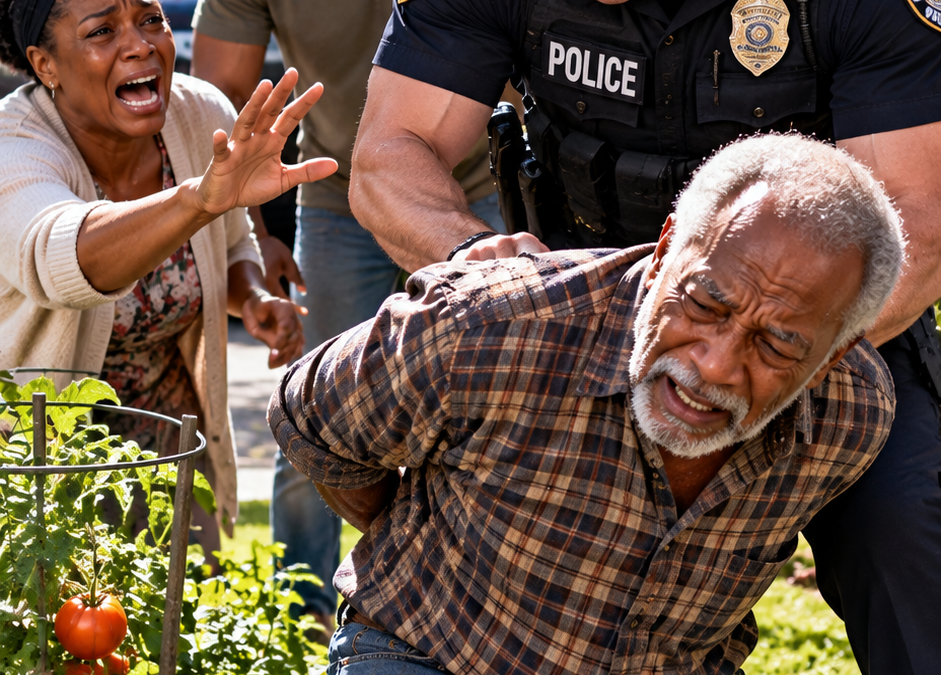
The first sound I heard that morning was my mother screaming my name. By the time I reached the front door, a police officer had my seventy-one-year-old father twisted up in our yard like the man who had paid for that house over thirty-eight years was some kind of intruder. What stayed with me long after the sirens, the handcuffs, and the headlines was the sickening realization that the bruise on my father’s arm was only the beginning of what they intended to do to us.
My name is Darwin Harbison, and I have spent most of my adult life in places where chaos had rules.
War has rules, even when they are brutal ones. Training has rules. Command has rules. Even fear has a pattern when you’ve lived with it long enough.
What happened on Maple Ridge Lane taught me that corruption has its own pattern too, and it can look deceptively ordinary right up until it puts a hand around your father’s arm in broad daylight.
I had come home three days earlier on leave.
That mattered more to my parents than I think I fully understood at the time.
My mother, Tessa, had cooked enough food the first night to feed a church basement. My father, Wilson, had pretended not to be emotional about seeing me, which for him meant he shook my hand too hard, hugged me too long, and kept finding pointless reasons to stand in the same room with me. He was seventy-one, his back a little stiffer than it used to be, his hair almost completely silver, and his pride still stubborn enough to survive anything short of an earthquake.
My parents had lived on Maple Ridge Lane for nearly four decades. That house wasn’t just a piece of property to them. It was the place where my mother had patched together miracles on a hospital worker’s paycheck, where my father had mowed the same strip of lawn through layoffs, inflation, funerals, and birthdays, where every crack in the driveway and squeak in the hallway had become part of our family language.
To other people, it was a modest brick house with a deep front yard and a backyard big enough for tomato plants and collard greens.
To my father, it was proof that his life had amounted to something no one could take away.
At least that was what he thought.
That Saturday morning started soft and beautiful, the kind of morning that tricks you into believing nothing ugly could possibly happen before noon. The sun came through the trees in strips of gold. Sprinklers hissed somewhere farther down the block. Birds argued from branch to branch like they had neighborhood business to settle.
Dad was in the garden, kneeling down slower than he used to but still too stubborn to ask for help. Mom was beside him, pulling weeds and teasing him the way she had my entire life.
“You’re gonna break your back out here,” she said.
“Better that than break my spirit inside watching the news,” he told her.
She laughed.
I was inside, rinsing out a coffee mug at the kitchen sink, half listening to them through the screen door, feeling that strange peace a man feels when he returns to the people who taught him what safe sounded like.
Across the street, Maggie Travis was watching.
I didn’t know that yet.
Everybody on Maple Ridge knew Maggie. She lived alone in a cream-colored house with lace curtains and the kind of porch furniture nobody ever seemed to sit in. She smiled in short, tidy ways, spoke just sweet enough to keep people from calling her what she really was, and had spent the last few months asking my parents whether they had ever considered selling.
My father had always answered with the same calm certainty.
“No.”
Apparently that had become a problem.
We learned later that Maggie had a financial interest in a development company called Crestline Partners. They had been quietly buying properties along that stretch of road, waiting for a rezoning vote that would turn ordinary family homes into lucrative pieces of a much bigger plan. My parents were among the holdouts. So were two other households. If all three sold before the vote, Maggie stood to make enough money to change her life.
Greed doesn’t always arrive wearing a villain’s face.
Sometimes it arrives in sensible shoes, neat hair, and a voice that knows how to sound frightened on the phone.
At 9:14 that morning, Maggie called 911 and reported suspicious people outside the Harbison house.
She told dispatch she didn’t recognize them.
She said she thought they might be casing the property.
It was a lie so shameless it would have sounded ridiculous if it hadn’t worked.
Ten minutes later, Officer Blake Campbell pulled up in front of my parents’ house.
I didn’t see the car arrive. I heard the shift in the air first.
People who grew up like I did know that sound. Not literally, maybe, but somewhere in the body. A pause in the rhythm. A pressure change. The instant a peaceful morning stops belonging only to the people living inside it.
By the time I glanced through the front window, Dad was already rising from the garden bed, brushing dirt off his jeans. Mom had straightened up beside him. Campbell was stepping out of his cruiser with sunglasses on and one hand hovering a little too close to his belt.
“Morning,” he said.
It wasn’t a greeting. It was an inspection.
Dad answered anyway.
“Morning, officer. Something wrong?”
“Call came in about suspicious activity at this address.”
He looked at my parents the way some men look at spilled trash.
“You two live here?”
Mom answered first. “Yes, we live here. This is our home.”
Campbell didn’t soften.
“I’m going to need to see some identification.”
Dad blinked once. “Identification? For standing in my own yard?”
“That’s what I said.”
I could see my father’s posture change even from inside. Not aggressive. Careful. The kind of careful a Black man of his generation learns because experience teaches him that one wrong tone can become an excuse in somebody else’s report.
“My wallet’s inside,” he said. “Kitchen counter.”
“Then go get it.”
Dad raised his hands slightly. “I’m just going to step inside and get my ID.”
He turned toward the front steps.
That was when the whole morning broke open.
“Stop right there!”
Campbell’s voice cracked across the yard like a shot.
Dad froze, one foot near the porch step, hand half lifted.
“I said don’t move.”
“Officer, I’m just getting my—”
Campbell came around the front of the cruiser fast, closing the distance in long, angry strides.
“Turn around slowly.”
Mom stepped forward. “He told you the wallet is inside.”
“Ma’am, I didn’t ask for commentary.”
He grabbed my father’s arm before Dad fully turned, fingers digging in hard enough that Dad gasped.
At first, I didn’t move.
That sounds cold when I say it now, but it’s the truth.
Years of training compress you in moments like that. Your mind takes pictures faster than your emotions can catch up. My father’s face tightening. My mother’s hands flying upward. The officer’s stance widening. The exact angle of the grip. The distance between porch and cruiser. The neighborhood watching from behind curtains.
Then my mother cried out, and all the discipline in the world stopped mattering.
“Let go of him! He didn’t do anything!”
Campbell shoved her back with his free hand.
She stumbled against the porch railing.
That was when she screamed my name.
“Darwin! Son, come outside! Someone’s hurting your father!”
I don’t remember crossing the living room.
One second I was inside. The next, I was at the door, then on the porch, then down the steps with my eyes fixed on the man who had my father’s arm twisted behind him.
I am a large man. There’s no polite way around that fact. Six-foot-four, heavily built, shoulders shaped by years of training and deployment. I know what effect that can have on people, especially frightened men with too much authority and too little discipline.
Campbell saw me and stiffened immediately.
“Get back!” he barked, releasing my father and pivoting toward me. His hand dropped to the taser at his hip. “Sir, stop right there.”
I kept walking, not fast, not slow, the way you approach a dangerous animal when sudden movement makes everything worse.
“That’s my father,” I said. “Take your hands off him.”
“I said get back!”
I stopped about three feet away.
Close enough to make it clear I was not retreating. Far enough to keep my hands visible and give him no excuse he didn’t already intend to invent.
My father was behind me now, cradling his arm. My mother stood near the railing, shaking so hard I could see it in her shoulders.
Campbell’s fingers tightened around the taser.
“I will tase you,” he said. “I swear to God I will.”
His voice was loud, but underneath it I heard something else.
Fear.
Not the clean fear of a man responding to danger. The ugly fear of a man who suddenly realized the old Black couple he had decided to bully had a son standing between them and him now, and that son was not afraid.
“You don’t need to do that,” I told him.
“My name is Darwin Harbison. I am Chief Petty Officer Darwin Harbison, United States Navy. I am standing on my parents’ property. My father is seventy-one years old. You put your hands on him for trying to get identification you asked for.”
I spoke slowly on purpose.
The first thing panicked authority hates is clear language.
Campbell swallowed.
It was subtle, but I saw it.
So did my father.
So did the neighbors, who were now fully outside with phones in their hands.
A boy on a bike had stopped at the curb, filming. A woman across the street had her mouth open and her camera up. Somewhere to the left, a screen door banged shut.
I kept my eyes on Campbell.
“We are calm,” I said quietly. “You’re the one who needs to think very carefully about what you do next.”
His grip loosened on the taser.
For a moment, nobody moved.
Then his partner, Officer White, stepped closer and touched his shoulder.
“Let’s go, Blake.”
Campbell looked at my father, then at the phones pointed at him, then back at me.
“I’m going to need everybody to calm down,” he muttered. “This was a misunderstanding.”
It wasn’t an apology. It was an exit strategy.
They got back in the cruiser and drove away.
The street slowly inhaled again.
The phones lowered. Curtains shifted back into place. People retreated into their own homes carrying the kind of shaken relief that belongs to witnesses who are grateful the worst thing happened to someone else.
I turned to my father.
Red marks were already rising along his arm.
“Let me see,” I said.
“I’m fine.”
“You’re not fine.”
He sat down on the porch step because I told him to, which was how I knew he was rattled more than he wanted to admit. My mother crouched beside him, touching his sleeve with the careful tenderness of somebody afraid that even kindness might hurt.
“That man had no right,” she said.
“No,” I answered. “He didn’t.”
That evening, we sat at the kitchen table under the old yellow lamp and tried to act like the day could be folded up and put away.
None of us were very good at pretending.
Dad poked at rice he wasn’t really eating. Mom kept looking toward the front window. I checked the door locks twice and the windows once.
“You should have seen his face when you came out,” my mother said, trying for humor. “That officer almost swallowed his own tongue.”
Dad let out a short laugh, then rubbed his arm.
I didn’t laugh.
“I didn’t like how fast he reached for that taser,” I said.
“He was scared,” Dad replied. “Scared of a Black man standing up for his family. That’s all.”
Mom went quiet for a second.
Then she said, “Maggie was watching us before he got there.”
Dad waved that away at first, but I felt something settle hard and cold in my gut.
My mother noticed things other people missed. Always had.
“What do you mean, watching?”
“She was at the window. Just staring. And she’s been acting strange for weeks. Ever since that development meeting. Ever since she asked again if we’d ever think about selling.”
Dad shrugged. “She’s nosy.”
I didn’t answer.
I went out to the porch later and stood looking at the street, now dark and empty and deceptively peaceful. I remember thinking the whole thing should have been over already.
I also remember knowing it wasn’t.
Across town, Officer Blake Campbell was writing his report.
The next morning, my father and mother went to the precinct to file a complaint.
My father believed in recordkeeping. Paper trails. Official language. He had lived long enough to know that if something mattered, you put it in writing.
He told the desk officer exactly what had happened. He described the bruising. He mentioned the neighbors recording. He filled out every line.
The complaint went down a hallway and into the office of Chief Morgan Dash.
Dash was Blake Campbell’s uncle.
He read my father’s complaint.
Then he placed it in a drawer and closed it.
What happened next took less than a day and changed everything.
Campbell filed a report claiming my father had been uncooperative and evasive. He claimed I had charged him aggressively. He wrote that he feared for his safety and had been forced to draw his taser in self-defense.
Under body-cam footage, he typed two words that would come back later like poison:
Equipment malfunction.
By that afternoon, Chief Dash had pushed a warrant through.
Assault on a police officer.
Resisting arrest.
For me.
I found out the next day while helping my father re-stake tomato plants in the same yard where the whole thing had started.
That detail still hurts me.
We were literally fixing what their chaos had disrupted when the cruisers came back.
This time there were two cars, then a third. Officers stepped out already arranged in the posture of people who weren’t there to ask questions.
Blake Campbell leaned against one cruiser with his arms folded and a thin smile on his face.
One of the officers came up the path.
“Darwin Harbison?”
“That’s me.”
“We have a warrant for your arrest.”
My father got to his feet too quickly for a man his age.
“What? No. That’s a lie. He’s the one who—”
“Sir, step back.”
My mother came out of the house just in time to see the handcuffs come out.
There’s a kind of silence that lives inside humiliation. I felt it the second I understood they had already decided how this scene would go. This wasn’t about truth. It wasn’t even about punishment yet. It was about control. About rewriting yesterday in public.
I put my hands behind my back before they asked.
I would not give them the extra theater of forcing me.
“Darwin!” my mother cried.
The metal clicked around my wrists.
Campbell pushed away from the cruiser and came closer, stopping where only I could fully hear him.
“Big tough Navy SEAL,” he said softly. “Don’t look so tough in cuffs.”
I looked at him and said nothing.
The neighbors were outside again, filming again, staring again. I remember thinking how quickly a street can learn to become an audience.
My father’s face had gone pale.
He pressed one hand to his chest, and I knew immediately something was wrong.
“Dad,” I said. “Dad, are you okay?”
“I’m fine,” he lied.
I was put in the back of the cruiser while my mother cried in the yard and my father stood rooted in place, trying to look steady for her.
That was how I left my parents’ house.
Not in uniform.
Not under orders.
Not because I had failed them.
In handcuffs, because a corrupt man was embarrassed.
By evening, a grainy phone video of my arrest was already moving through social media under captions that made me sound like a hero to some people and a threat to others.
That night my mother called Lexi Vander.
If you have never met a civil-rights attorney who is both tired and dangerous, you should count yourself lucky.
Lexi arrived the next morning with a worn leather briefcase, sharp eyes, and the calm focus of somebody who had seen injustice so often she no longer wasted time being shocked by it.
“Tell me everything,” she said.
We did.
She listened without interrupting. She asked about Maggie. About the phones in the neighborhood. About what time the first officer arrived. About body-cam footage.
When we told her the department claimed the footage was corrupted, something in her face hardened.
“Convenient,” she said.
She started looking immediately.
Around the same time, a reporter named Precious Austin started digging too.
Precious worked for the Tribune, and unlike a lot of people in local media, she still seemed to believe that the truth mattered more than access. She filed a public-records request on Blake Campbell’s personnel file and uncovered three prior complaints—two for excessive force, one for improper conduct during a traffic stop. All had been dismissed quickly. All had been reviewed by Chief Morgan Dash.
She kept digging and found the family connection.
Dash wasn’t just a superior officer.
He was Campbell’s uncle.
When Lexi and Precious met, the case opened wider.
Precious had gone through property records and HOA minutes around Maple Ridge. She found Crestline Partners buying up parcels. She found Maggie Travis listed as a minority stakeholder. She found documentation showing Maggie stood to make a six-figure payout if the last holdout properties on the lane sold before the rezoning vote.
My parents were one of those holdouts.
The “suspicious persons” call stopped looking like prejudice alone.
It started looking like strategy.
Then my father had his first cardiac event.
He was sitting in his recliner when my mother noticed he looked wrong. Pale. Sweating. Breathing too shallow.
By the time I got to the hospital after making bail, he was stable but exhausted, lying in a bed that made him look smaller than I had ever seen him.
I sat with him long after my mother dozed in the chair beside him.
“This is my fault,” I said.
His eyes opened.
“Don’t you dare,” he whispered.
“Dad—”
“Don’t you dare blame yourself for standing up for your family.”
He reached for my hand with the same arm that still carried bruises from Campbell’s fingers.
“I’m proud of you,” he said. “No matter what happens next, I need you to know that.”
I had been through harder environments than that hospital room. I had been afraid in more immediate ways. But I do not know that I had ever felt more helpless.
My father was discharged with orders to rest.
Lexi came by with what Precious had uncovered about Maggie and Crestline.
The story broke publicly the next morning. Campbell’s history. Dash’s role. The family connection. The buried complaints. A decorated service member arrested after defending his elderly parents.
The article spread fast.
Internal Affairs finally opened a formal investigation into Campbell and Dash.
A retired officer named Victor Reyes came forward and said he had once reported seeing Campbell shove a handcuffed suspect face-first into a patrol car for no reason beyond personal anger. That report, too, had vanished.
For the first time since my arrest, hope entered our house.
Mom cooked a real dinner.
Dad laughed.
I almost believed the pressure was starting to work.
Then my phone rang.
It was my command.
Because criminal charges were still pending, my security clearance was being suspended until the matter was resolved.
I thanked the man on the line because that is what training teaches you to do when your world is shifting and you cannot stop it.
Then I walked back into the kitchen and lied.
“Everything okay?” my mother asked.
“Everything’s fine.”
It was not fine.
The next morning, an edited video started circulating online.
Eight seconds.
That was all it took.
Eight seconds of me crossing the lawn.
Eight seconds of Campbell stepping backward with his hand on his taser.
No footage of him grabbing my father.
No footage of him shoving my mother.
No audio of my father explaining that his identification was inside.
No context at all.
Just a large Black man moving toward an officer.
The caption told people to judge for themselves.
People did.
The tide turned almost instantly. Comment sections filled with strangers calling me a thug, a liar, a danger. Outlets that had run sympathetic stories began hedging their language. People who had no idea what actually happened felt very comfortable offering certainty.
That same day, my command called again.
My clearance suspension became formal.
Years of my life, my work, my identity, all pushed into uncertainty by a lie and a clip built to survive only because it was shorter than the truth.
I was still holding the phone when I heard my mother scream from the kitchen.
This time it was my father collapsing.
He was on the floor by the table when I got there, hand clutched to his chest, his face ashen, his breath ragged. Training took over. I got him down carefully, checked his pulse, kept talking to him while my mother called 911.
The ambulance took eleven minutes.
It felt like an entire lifetime passing through my hands.
At the hospital they called it a second cardiac event, worse than the first.
Critical, but stable.
That phrase became the air we lived on for the next two days.
My mother barely left his side. I paced the hallways like motion might do something useful. Every few minutes I checked my phone, as if charges, headlines, and command consequences might somehow rearrange themselves if I stared hard enough.
That was when Precious came back.
She found my mother in the waiting room and asked for something no one else had asked for properly.
The whole story.
Not the clip.
Not the legal posture.
Not the outrage cycle.
The human story.
My mother gave it to her.
She talked about seeing her husband’s arm bruise under a stranger’s hand. About watching her son handcuffed in the same yard where he had once played with toy trucks. About sitting beside a hospital bed wondering whether stress was going to kill the man she had loved for forty-two years.
Precious published the piece under the headline: A Mother’s Plea: We Just Wanted to Be Left Alone.
It moved people because it was true.
While that happened, Lexi kept going door to door on Maple Ridge asking about security cameras. Most people had nothing useful. Bad angles. No system. Footage overwritten. Memory too vague to help.
Then she reached the house of an elderly man named Ace at the far end of the block.
He had an old security camera mounted above his garage.
He barely remembered it was there.
Lexi did what good lawyers do.
She checked anyway.
The footage changed everything.
Grainy, yes. Distant, yes. But clear enough.
It showed Campbell arriving.
It showed his aggression from the first moment.
It showed my father complying.
It showed him grabbing my father’s arm.
It showed him shoving my mother.
It showed me coming out calm, controlled, hands open, not charging, not threatening, not doing any of the things Campbell later claimed.
Unedited truth.
The same afternoon Lexi found that footage, she got a call from my commanding officer, Master Chief Owen Banister.
Banister had been quietly looking into Campbell from the military side the moment my name got tied to a questionable arrest. He brought Lexi a prior complaint filed by another veteran Campbell had roughed up years earlier. It matched the pattern almost line for line, right down to the false reporting and Dash’s role in making it disappear.
By the time Banister came to the hospital to meet us, the shape of the whole thing was finally visible.
Not one bad day.
Not one misunderstanding.
Not one overworked officer making a mistake.
A system.
A greedy neighbor.
A corrupt cop.
An uncle with command influence.
Buried complaints.
Destroyed evidence.
Edited video.
Pressure applied from every direction until a family either broke or gave in.
Banister looked at me after watching the full footage.
“I want this handled right,” he said. “Not quietly.”
“So do I,” I answered.
Lexi closed the laptop and said the words that gave us our first real path out.
“Then we force it into daylight.”
The city council hearing was set as an open emergency session because the pressure had grown too public to contain.
By the time the date arrived, my father had been discharged but was weak enough that walking from the parking lot to the chamber required care. He refused to stay home.
“I’m not missing the day they finally have to listen,” he told us.
He went in a wheelchair because the doctors insisted. He hated every second of that part.
The council chamber was packed.
Press along the walls.
Residents in the seats.
Whispers moving like static across the room.
Maggie Travis was there too, dressed in soft colors as if innocence could be tailored. Chief Dash sat stiff-backed and composed. Blake Campbell looked irritated in the way only men accustomed to getting away with things can look when forced to sit through accountability.
Lexi started.
She did not perform.
She laid bricks.
First she established the timeline.
Then the 911 call.
Then Maggie’s financial connection to Crestline Partners.
Then the record of holdout properties.
Then Campbell’s prior complaints.
Then Dash’s family relationship and suppression history.
Precious had obtained HOA meeting minutes showing Maggie had directly pressured my parents to sell two months earlier.
When asked why she called 911 on people she had known for years, Maggie tried to say she had panicked, that she thought strangers might be trespassing, that she had only wanted a welfare check.
Lexi placed a photo of my parents on the screen, taken from a neighborhood block party the previous summer, Maggie standing right beside them.
“That’s your arm around Mrs. Harbison, isn’t it?” Lexi asked.
Maggie’s face tightened.
“Yes, but—”
“And this was taken less than a year before your emergency call claiming you did not recognize them?”
No answer sounds good when the truth has already entered the room.
Then Lexi played Ace’s security footage.
People in that chamber leaned forward as one body.
There was my father in the yard.
There was Campbell approaching with suspicion already in his posture.
There was my father explaining about the identification.
There was the grab.
There was my mother being shoved.
There was me stepping outside when she screamed.
No lunge.
No attack.
No aggression.
No legal justification for what came after.
Just abuse.
Then came the question of the missing body-cam footage.
A digital-forensics expert testified that Campbell’s camera had not malfunctioned at all. It had been manually deactivated before the confrontation escalated and certain files later deleted from the upload sequence.
That was the moment Dash stopped looking annoyed and started looking afraid.
Then Master Chief Banister testified about the prior veteran complaint and about the consequences the false report had already triggered inside the military system. He didn’t make speeches. He didn’t dramatize. He simply explained, in the precise language of a man used to command and consequence, that one falsified report had nearly cost a service member his career and had done measurable damage to the well-being of an elderly civilian family.
When it was my turn, I spoke plainly.
I talked about hearing my mother scream.
I talked about seeing my father grabbed in his own yard.
I talked about why I approached slowly, why I kept my hands open, why discipline is not aggression.
I talked about being arrested in front of my parents.
I talked about my father collapsing.
I talked about the eight-second lie that traveled farther than the truth ever gets to on its own.
Then my father asked to speak.
The room quieted in a different way when he rolled forward.
My father had always been a dignified man. Even hurt, even exhausted, there was something in him that refused spectacle. He took the microphone with one bruised hand and looked out at a room full of people who had spent the past weeks discussing our lives like evidence.
“I bought my house in 1988,” he said. “Paid on it month after month, year after year. Raised my son there. Buried friends from that address. Paid taxes from that address. Mowed that lawn in heat that would kill younger men.”
He paused to catch his breath.
“And on a Saturday morning, I got grabbed like I didn’t belong on my own property.”
Nobody moved.
“I want every person in this room to understand something. My son didn’t create this problem by protecting me. My wife didn’t create this problem by calling for help. I didn’t create this problem by growing tomatoes in my own yard. The people who created it are the people who thought they could lie about us and nobody important would care.”
He looked at Campbell then.
Not with rage.
With disappointment.
“That’s what broke my heart,” he said softly. “Not fear. Not age. Disappointment.”
You could have heard the lights buzzing.
The council recessed for deliberation.
That hour felt longer than deployment nights.
My mother held my father’s hand.
I sat beside them and stared at the floor because if I looked at either of them too long, I thought something inside me might finally crack.
When the council returned, the chair didn’t waste words.
The charges against me were ordered dropped immediately.
Officer Blake Campbell was being referred for criminal charges involving filing a false report, civil-rights violations, and evidence tampering.
Two officers approached him then and there.
I will never forget the look on his face when the handcuffs came out.
Not because it satisfied me.
Because for the first time, he looked like a man encountering consequences he had always assumed belonged only to other people.
Chief Morgan Dash was publicly stripped of confidence by the council. He resigned effective immediately rather than wait to be removed.
Maggie Travis was referred for investigation related to harassment and possible conspiracy involving Crestline’s property pressure campaign. Lexi moved for a restraining order on my parents’ behalf the same afternoon.
Then the council chair looked at my parents and did something rare for institutions that have already failed you.
She apologized.
Formally.
Clearly.
Without excuses.
She announced the city would cover the remaining balance on my parents’ mortgage as part of a settlement agreement.
My mother broke down.
My father cried quietly, the way older men sometimes do when the body can no longer carry all the weight dignity forced it to hold.
I knelt beside him.
“It’s over,” I told him.
He wiped his eyes and gave me the faintest smile.
“No,” he said. “Now we get to live again.”
A week later, I drove him home from one final hospital check.
When we turned onto Maple Ridge Lane, he went completely still.
The whole neighborhood was on our lawn.
The same teenage boy who had filmed from his bike held a sign that said WELCOME HOME, MR. HARBISON.
The woman across the street had lemonade.
Families from farther down the block stood shoulder to shoulder.
People who had stayed silent at first came forward now with apologies, casseroles, folded chairs, awkward sincerity, and the sheepish gratitude of those who had watched too long before choosing a side.
My mother came out onto the porch already crying.
Dad got out slowly, leaning on my arm, and walked up the front path while people clapped.
Not for a spectacle this time.
For him.
For surviving humiliation.
For surviving stress.
For staying.
Lexi stood at the edge of the lawn with a folder under her arm—the settlement completed, the restraining order filed, the case formally closed in our favor. Precious was there too, camera lowered, not chasing a headline anymore, just preserving a moment that deserved to outlive the ugliness that made it necessary.
Then another car pulled up.
Master Chief Banister stepped out in full uniform and walked straight across the grass toward me.
I stood automatically.
“At ease, Harbison,” he said.
He extended his hand.
“Your clearance has been fully reinstated effective immediately.”
I let out a breath I felt like I had been holding for a month.
“Thank you, sir.”
He shook his head. “Don’t thank me. You put your family first and kept your discipline under pressure. That’s exactly the kind of man this country ought to trust.”
I did not know what to say to that, so I nodded and gripped his hand a second time.
The rest of the afternoon moved like healing usually does—slowly, imperfectly, warmly.
Food on folding tables.
Neighbors telling stories.
My father holding court from a lawn chair like a man reclaiming territory without ever having to say the words.
My mother moved through the crowd hugging people, still tired, still carrying scars from the weeks behind us, but lighter somehow. Not because all damage disappears when justice arrives, but because hope had finally become something sturdier than denial.
As the sun lowered, the crowd thinned.
Eventually it was just the three of us on the porch again.
The lawn was quiet. The chairs were half folded. The street that had watched our worst day now looked almost gentle.
I stood at the top of the steps and looked out over the patch of yard where it had started—where my father had been grabbed, where my mother had screamed, where I had stepped into sunlight and realized peace can vanish in seconds.
Then I turned back toward my parents.
They were standing together near the door, hands linked, tired and proud and still here.
I straightened without thinking. Old training. Old instinct.
Then I raised my hand in a formal salute.
My father lifted his chin.
My mother squeezed his hand.
Down the street, a few lingering neighbors saw it and began clapping softly, the sound carrying over the same grass that had held our fear and now, finally, held something like peace.
I used to think strength meant control.
Then I thought it meant force.
Then the military taught me discipline, and life taught me endurance.
But what happened to my family taught me something deeper than all of that.
Strength is an old man standing in his own yard and refusing to surrender his dignity.
It is a woman who keeps telling the truth even after fear has wrung her dry.
It is a son who knows exactly how much damage he is capable of and chooses restraint anyway because the people he loves need him free, not furious.
It is a reporter who keeps digging.
A lawyer who keeps knocking on doors.
A commander who refuses to let a lie harden into record.
A neighborhood that finally stops watching and starts standing beside the people it should have protected from the beginning.
My father still gardens.
His knees still complain.
My mother still tells him he is too old to be wrestling with tomato stakes.
He still tells her he would rather break his back than his spirit.
Some things survived all of it unchanged.
When I visit now, I always pause for a second before I step back inside the house.
Not because I’m afraid.
Because I remember.
I remember my mother’s scream.
I remember my father’s bruised arm.
I remember the false calm in Campbell’s voice.
I remember the weight of cuffs on my wrists and the worse weight of seeing my father clutch his chest while I was being taken away.
I remember how close corruption came to rewriting us.
And I remember that it failed.
Not quickly.
Not cleanly.
Not without cost.
But it failed.
Because the truth lasted longer than the lie.
Because my parents were harder to erase than greed expected.
Because some people still know the difference between order and justice.
Because the family Officer Blake Campbell thought he could intimidate turned out to be a family willing to stand, speak, document, endure, and fight until the whole rotten structure had to answer for itself.
The morning he put his hands on my father, he thought he was dealing with an old man in a yard.
He was really putting a hand on a lifetime.
A marriage.
A home.
A son.
A record.
A truth that was going to survive him.
And in the end, that truth did what honest truth always does.
It stood in the light long enough that everybody had to see exactly who the real threat was.
Have you finished reading the story and want to read it again?
The Morning a Cop Put His Hands on My Father, He Mistook the Wrong Family for an Easy Target
The first sound I heard that morning was my mother screaming my name. By the time I reached the front door, a police officer had my seventy-one-year-old father twisted up in our yard like the man who had paid for that house over thirty-eight years was some kind of intruder. What stayed with me long after the sirens, the handcuffs, and the headlines was the sickening realization that the bruise on my father’s arm was only the beginning of what they intended to do to us.
My name is Darwin Harbison, and I have spent most of my adult life in places where chaos had rules.
War has rules, even when they are brutal ones. Training has rules. Command has rules. Even fear has a pattern when you’ve lived with it long enough.
What happened on Maple Ridge Lane taught me that corruption has its own pattern too, and it can look deceptively ordinary right up until it puts a hand around your father’s arm in broad daylight.
I had come home three days earlier on leave.
That mattered more to my parents than I think I fully understood at the time.
My mother, Tessa, had cooked enough food the first night to feed a church basement. My father, Wilson, had pretended not to be emotional about seeing me, which for him meant he shook my hand too hard, hugged me too long, and kept finding pointless reasons to stand in the same room with me. He was seventy-one, his back a little stiffer than it used to be, his hair almost completely silver, and his pride still stubborn enough to survive anything short of an earthquake.
My parents had lived on Maple Ridge Lane for nearly four decades. That house wasn’t just a piece of property to them. It was the place where my mother had patched together miracles on a hospital worker’s paycheck, where my father had mowed the same strip of lawn through layoffs, inflation, funerals, and birthdays, where every crack in the driveway and squeak in the hallway had become part of our family language.
To other people, it was a modest brick house with a deep front yard and a backyard big enough for tomato plants and collard greens.
To my father, it was proof that his life had amounted to something no one could take away.
At least that was what he thought.
That Saturday morning started soft and beautiful, the kind of morning that tricks you into believing nothing ugly could possibly happen before noon. The sun came through the trees in strips of gold. Sprinklers hissed somewhere farther down the block. Birds argued from branch to branch like they had neighborhood business to settle.
Dad was in the garden, kneeling down slower than he used to but still too stubborn to ask for help. Mom was beside him, pulling weeds and teasing him the way she had my entire life.
“You’re gonna break your back out here,” she said.
“Better that than break my spirit inside watching the news,” he told her.
She laughed.
I was inside, rinsing out a coffee mug at the kitchen sink, half listening to them through the screen door, feeling that strange peace a man feels when he returns to the people who taught him what safe sounded like.
Across the street, Maggie Travis was watching.
I didn’t know that yet.
Everybody on Maple Ridge knew Maggie. She lived alone in a cream-colored house with lace curtains and the kind of porch furniture nobody ever seemed to sit in. She smiled in short, tidy ways, spoke just sweet enough to keep people from calling her what she really was, and had spent the last few months asking my parents whether they had ever considered selling.
My father had always answered with the same calm certainty.
“No.”
Apparently that had become a problem.
We learned later that Maggie had a financial interest in a development company called Crestline Partners. They had been quietly buying properties along that stretch of road, waiting for a rezoning vote that would turn ordinary family homes into lucrative pieces of a much bigger plan. My parents were among the holdouts. So were two other households. If all three sold before the vote, Maggie stood to make enough money to change her life.
Greed doesn’t always arrive wearing a villain’s face.
Sometimes it arrives in sensible shoes, neat hair, and a voice that knows how to sound frightened on the phone.
At 9:14 that morning, Maggie called 911 and reported suspicious people outside the Harbison house.
She told dispatch she didn’t recognize them.
She said she thought they might be casing the property.
It was a lie so shameless it would have sounded ridiculous if it hadn’t worked.
Ten minutes later, Officer Blake Campbell pulled up in front of my parents’ house.
I didn’t see the car arrive. I heard the shift in the air first.
People who grew up like I did know that sound. Not literally, maybe, but somewhere in the body. A pause in the rhythm. A pressure change. The instant a peaceful morning stops belonging only to the people living inside it.
By the time I glanced through the front window, Dad was already rising from the garden bed, brushing dirt off his jeans. Mom had straightened up beside him. Campbell was stepping out of his cruiser with sunglasses on and one hand hovering a little too close to his belt.
“Morning,” he said.
It wasn’t a greeting. It was an inspection.
Dad answered anyway.
“Morning, officer. Something wrong?”
“Call came in about suspicious activity at this address.”
He looked at my parents the way some men look at spilled trash.
“You two live here?”
Mom answered first. “Yes, we live here. This is our home.”
Campbell didn’t soften.
“I’m going to need to see some identification.”
Dad blinked once. “Identification? For standing in my own yard?”
“That’s what I said.”
I could see my father’s posture change even from inside. Not aggressive. Careful. The kind of careful a Black man of his generation learns because experience teaches him that one wrong tone can become an excuse in somebody else’s report.
“My wallet’s inside,” he said. “Kitchen counter.”
“Then go get it.”
Dad raised his hands slightly. “I’m just going to step inside and get my ID.”
He turned toward the front steps.
That was when the whole morning broke open.
“Stop right there!”
Campbell’s voice cracked across the yard like a shot.
Dad froze, one foot near the porch step, hand half lifted.
“I said don’t move.”
“Officer, I’m just getting my—”
Campbell came around the front of the cruiser fast, closing the distance in long, angry strides.
“Turn around slowly.”
Mom stepped forward. “He told you the wallet is inside.”
“Ma’am, I didn’t ask for commentary.”
He grabbed my father’s arm before Dad fully turned, fingers digging in hard enough that Dad gasped.
At first, I didn’t move.
That sounds cold when I say it now, but it’s the truth.
Years of training compress you in moments like that. Your mind takes pictures faster than your emotions can catch up. My father’s face tightening. My mother’s hands flying upward. The officer’s stance widening. The exact angle of the grip. The distance between porch and cruiser. The neighborhood watching from behind curtains.
Then my mother cried out, and all the discipline in the world stopped mattering.
“Let go of him! He didn’t do anything!”
Campbell shoved her back with his free hand.
She stumbled against the porch railing.
That was when she screamed my name.
“Darwin! Son, come outside! Someone’s hurting your father!”
I don’t remember crossing the living room.
One second I was inside. The next, I was at the door, then on the porch, then down the steps with my eyes fixed on the man who had my father’s arm twisted behind him.
I am a large man. There’s no polite way around that fact. Six-foot-four, heavily built, shoulders shaped by years of training and deployment. I know what effect that can have on people, especially frightened men with too much authority and too little discipline.
Campbell saw me and stiffened immediately.
“Get back!” he barked, releasing my father and pivoting toward me. His hand dropped to the taser at his hip. “Sir, stop right there.”
I kept walking, not fast, not slow, the way you approach a dangerous animal when sudden movement makes everything worse.
“That’s my father,” I said. “Take your hands off him.”
“I said get back!”
I stopped about three feet away.
Close enough to make it clear I was not retreating. Far enough to keep my hands visible and give him no excuse he didn’t already intend to invent.
My father was behind me now, cradling his arm. My mother stood near the railing, shaking so hard I could see it in her shoulders.
Campbell’s fingers tightened around the taser.
“I will tase you,” he said. “I swear to God I will.”
His voice was loud, but underneath it I heard something else.
Fear.
Not the clean fear of a man responding to danger. The ugly fear of a man who suddenly realized the old Black couple he had decided to bully had a son standing between them and him now, and that son was not afraid.
“You don’t need to do that,” I told him.
“My name is Darwin Harbison. I am Chief Petty Officer Darwin Harbison, United States Navy. I am standing on my parents’ property. My father is seventy-one years old. You put your hands on him for trying to get identification you asked for.”
I spoke slowly on purpose.
The first thing panicked authority hates is clear language.
Campbell swallowed.
It was subtle, but I saw it.
So did my father.
So did the neighbors, who were now fully outside with phones in their hands.
A boy on a bike had stopped at the curb, filming. A woman across the street had her mouth open and her camera up. Somewhere to the left, a screen door banged shut.
I kept my eyes on Campbell.
“We are calm,” I said quietly. “You’re the one who needs to think very carefully about what you do next.”
His grip loosened on the taser.
For a moment, nobody moved.
Then his partner, Officer White, stepped closer and touched his shoulder.
“Let’s go, Blake.”
Campbell looked at my father, then at the phones pointed at him, then back at me.
“I’m going to need everybody to calm down,” he muttered. “This was a misunderstanding.”
It wasn’t an apology. It was an exit strategy.
They got back in the cruiser and drove away.
The street slowly inhaled again.
The phones lowered. Curtains shifted back into place. People retreated into their own homes carrying the kind of shaken relief that belongs to witnesses who are grateful the worst thing happened to someone else.
I turned to my father.
Red marks were already rising along his arm.
“Let me see,” I said.
“I’m fine.”
“You’re not fine.”
He sat down on the porch step because I told him to, which was how I knew he was rattled more than he wanted to admit. My mother crouched beside him, touching his sleeve with the careful tenderness of somebody afraid that even kindness might hurt.
“That man had no right,” she said.
“No,” I answered. “He didn’t.”
That evening, we sat at the kitchen table under the old yellow lamp and tried to act like the day could be folded up and put away.
None of us were very good at pretending.
Dad poked at rice he wasn’t really eating. Mom kept looking toward the front window. I checked the door locks twice and the windows once.
“You should have seen his face when you came out,” my mother said, trying for humor. “That officer almost swallowed his own tongue.”
Dad let out a short laugh, then rubbed his arm.
I didn’t laugh.
“I didn’t like how fast he reached for that taser,” I said.
“He was scared,” Dad replied. “Scared of a Black man standing up for his family. That’s all.”
Mom went quiet for a second.
Then she said, “Maggie was watching us before he got there.”
Dad waved that away at first, but I felt something settle hard and cold in my gut.
My mother noticed things other people missed. Always had.
“What do you mean, watching?”
“She was at the window. Just staring. And she’s been acting strange for weeks. Ever since that development meeting. Ever since she asked again if we’d ever think about selling.”
Dad shrugged. “She’s nosy.”
I didn’t answer.
I went out to the porch later and stood looking at the street, now dark and empty and deceptively peaceful. I remember thinking the whole thing should have been over already.
I also remember knowing it wasn’t.
Across town, Officer Blake Campbell was writing his report.
The next morning, my father and mother went to the precinct to file a complaint.
My father believed in recordkeeping. Paper trails. Official language. He had lived long enough to know that if something mattered, you put it in writing.
He told the desk officer exactly what had happened. He described the bruising. He mentioned the neighbors recording. He filled out every line.
The complaint went down a hallway and into the office of Chief Morgan Dash.
Dash was Blake Campbell’s uncle.
He read my father’s complaint.
Then he placed it in a drawer and closed it.
What happened next took less than a day and changed everything.
Campbell filed a report claiming my father had been uncooperative and evasive. He claimed I had charged him aggressively. He wrote that he feared for his safety and had been forced to draw his taser in self-defense.
Under body-cam footage, he typed two words that would come back later like poison:
Equipment malfunction.
By that afternoon, Chief Dash had pushed a warrant through.
Assault on a police officer.
Resisting arrest.
For me.
I found out the next day while helping my father re-stake tomato plants in the same yard where the whole thing had started.
That detail still hurts me.
We were literally fixing what their chaos had disrupted when the cruisers came back.
This time there were two cars, then a third. Officers stepped out already arranged in the posture of people who weren’t there to ask questions.
Blake Campbell leaned against one cruiser with his arms folded and a thin smile on his face.
One of the officers came up the path.
“Darwin Harbison?”
“That’s me.”
“We have a warrant for your arrest.”
My father got to his feet too quickly for a man his age.
“What? No. That’s a lie. He’s the one who—”
“Sir, step back.”
My mother came out of the house just in time to see the handcuffs come out.
There’s a kind of silence that lives inside humiliation. I felt it the second I understood they had already decided how this scene would go. This wasn’t about truth. It wasn’t even about punishment yet. It was about control. About rewriting yesterday in public.
I put my hands behind my back before they asked.
I would not give them the extra theater of forcing me.
“Darwin!” my mother cried.
The metal clicked around my wrists.
Campbell pushed away from the cruiser and came closer, stopping where only I could fully hear him.
“Big tough Navy SEAL,” he said softly. “Don’t look so tough in cuffs.”
I looked at him and said nothing.
The neighbors were outside again, filming again, staring again. I remember thinking how quickly a street can learn to become an audience.
My father’s face had gone pale.
He pressed one hand to his chest, and I knew immediately something was wrong.
“Dad,” I said. “Dad, are you okay?”
“I’m fine,” he lied.
I was put in the back of the cruiser while my mother cried in the yard and my father stood rooted in place, trying to look steady for her.
That was how I left my parents’ house.
Not in uniform.
Not under orders.
Not because I had failed them.
In handcuffs, because a corrupt man was embarrassed.
By evening, a grainy phone video of my arrest was already moving through social media under captions that made me sound like a hero to some people and a threat to others.
That night my mother called Lexi Vander.
If you have never met a civil-rights attorney who is both tired and dangerous, you should count yourself lucky.
Lexi arrived the next morning with a worn leather briefcase, sharp eyes, and the calm focus of somebody who had seen injustice so often she no longer wasted time being shocked by it.
“Tell me everything,” she said.
We did.
She listened without interrupting. She asked about Maggie. About the phones in the neighborhood. About what time the first officer arrived. About body-cam footage.
When we told her the department claimed the footage was corrupted, something in her face hardened.
“Convenient,” she said.
She started looking immediately.
Around the same time, a reporter named Precious Austin started digging too.
Precious worked for the Tribune, and unlike a lot of people in local media, she still seemed to believe that the truth mattered more than access. She filed a public-records request on Blake Campbell’s personnel file and uncovered three prior complaints—two for excessive force, one for improper conduct during a traffic stop. All had been dismissed quickly. All had been reviewed by Chief Morgan Dash.
She kept digging and found the family connection.
Dash wasn’t just a superior officer.
He was Campbell’s uncle.
When Lexi and Precious met, the case opened wider.
Precious had gone through property records and HOA minutes around Maple Ridge. She found Crestline Partners buying up parcels. She found Maggie Travis listed as a minority stakeholder. She found documentation showing Maggie stood to make a six-figure payout if the last holdout properties on the lane sold before the rezoning vote.
My parents were one of those holdouts.
The “suspicious persons” call stopped looking like prejudice alone.
It started looking like strategy.
Then my father had his first cardiac event.
He was sitting in his recliner when my mother noticed he looked wrong. Pale. Sweating. Breathing too shallow.
By the time I got to the hospital after making bail, he was stable but exhausted, lying in a bed that made him look smaller than I had ever seen him.
I sat with him long after my mother dozed in the chair beside him.
“This is my fault,” I said.
His eyes opened.
“Don’t you dare,” he whispered.
“Dad—”
“Don’t you dare blame yourself for standing up for your family.”
He reached for my hand with the same arm that still carried bruises from Campbell’s fingers.
“I’m proud of you,” he said. “No matter what happens next, I need you to know that.”
I had been through harder environments than that hospital room. I had been afraid in more immediate ways. But I do not know that I had ever felt more helpless.
My father was discharged with orders to rest.
Lexi came by with what Precious had uncovered about Maggie and Crestline.
The story broke publicly the next morning. Campbell’s history. Dash’s role. The family connection. The buried complaints. A decorated service member arrested after defending his elderly parents.
The article spread fast.
Internal Affairs finally opened a formal investigation into Campbell and Dash.
A retired officer named Victor Reyes came forward and said he had once reported seeing Campbell shove a handcuffed suspect face-first into a patrol car for no reason beyond personal anger. That report, too, had vanished.
For the first time since my arrest, hope entered our house.
Mom cooked a real dinner.
Dad laughed.
I almost believed the pressure was starting to work.
Then my phone rang.
It was my command.
Because criminal charges were still pending, my security clearance was being suspended until the matter was resolved.
I thanked the man on the line because that is what training teaches you to do when your world is shifting and you cannot stop it.
Then I walked back into the kitchen and lied.
“Everything okay?” my mother asked.
“Everything’s fine.”
It was not fine.
The next morning, an edited video started circulating online.
Eight seconds.
That was all it took.
Eight seconds of me crossing the lawn.
Eight seconds of Campbell stepping backward with his hand on his taser.
No footage of him grabbing my father.
No footage of him shoving my mother.
No audio of my father explaining that his identification was inside.
No context at all.
Just a large Black man moving toward an officer.
The caption told people to judge for themselves.
People did.
The tide turned almost instantly. Comment sections filled with strangers calling me a thug, a liar, a danger. Outlets that had run sympathetic stories began hedging their language. People who had no idea what actually happened felt very comfortable offering certainty.
That same day, my command called again.
My clearance suspension became formal.
Years of my life, my work, my identity, all pushed into uncertainty by a lie and a clip built to survive only because it was shorter than the truth.
I was still holding the phone when I heard my mother scream from the kitchen.
This time it was my father collapsing.
He was on the floor by the table when I got there, hand clutched to his chest, his face ashen, his breath ragged. Training took over. I got him down carefully, checked his pulse, kept talking to him while my mother called 911.
The ambulance took eleven minutes.
It felt like an entire lifetime passing through my hands.
At the hospital they called it a second cardiac event, worse than the first.
Critical, but stable.
That phrase became the air we lived on for the next two days.
My mother barely left his side. I paced the hallways like motion might do something useful. Every few minutes I checked my phone, as if charges, headlines, and command consequences might somehow rearrange themselves if I stared hard enough.
That was when Precious came back.
She found my mother in the waiting room and asked for something no one else had asked for properly.
The whole story.
Not the clip.
Not the legal posture.
Not the outrage cycle.
The human story.
My mother gave it to her.
She talked about seeing her husband’s arm bruise under a stranger’s hand. About watching her son handcuffed in the same yard where he had once played with toy trucks. About sitting beside a hospital bed wondering whether stress was going to kill the man she had loved for forty-two years.
Precious published the piece under the headline: A Mother’s Plea: We Just Wanted to Be Left Alone.
It moved people because it was true.
While that happened, Lexi kept going door to door on Maple Ridge asking about security cameras. Most people had nothing useful. Bad angles. No system. Footage overwritten. Memory too vague to help.
Then she reached the house of an elderly man named Ace at the far end of the block.
He had an old security camera mounted above his garage.
He barely remembered it was there.
Lexi did what good lawyers do.
She checked anyway.
The footage changed everything.
Grainy, yes. Distant, yes. But clear enough.
It showed Campbell arriving.
It showed his aggression from the first moment.
It showed my father complying.
It showed him grabbing my father’s arm.
It showed him shoving my mother.
It showed me coming out calm, controlled, hands open, not charging, not threatening, not doing any of the things Campbell later claimed.
Unedited truth.
The same afternoon Lexi found that footage, she got a call from my commanding officer, Master Chief Owen Banister.
Banister had been quietly looking into Campbell from the military side the moment my name got tied to a questionable arrest. He brought Lexi a prior complaint filed by another veteran Campbell had roughed up years earlier. It matched the pattern almost line for line, right down to the false reporting and Dash’s role in making it disappear.
By the time Banister came to the hospital to meet us, the shape of the whole thing was finally visible.
Not one bad day.
Not one misunderstanding.
Not one overworked officer making a mistake.
A system.
A greedy neighbor.
A corrupt cop.
An uncle with command influence.
Buried complaints.
Destroyed evidence.
Edited video.
Pressure applied from every direction until a family either broke or gave in.
Banister looked at me after watching the full footage.
“I want this handled right,” he said. “Not quietly.”
“So do I,” I answered.
Lexi closed the laptop and said the words that gave us our first real path out.
“Then we force it into daylight.”
The city council hearing was set as an open emergency session because the pressure had grown too public to contain.
By the time the date arrived, my father had been discharged but was weak enough that walking from the parking lot to the chamber required care. He refused to stay home.
“I’m not missing the day they finally have to listen,” he told us.
He went in a wheelchair because the doctors insisted. He hated every second of that part.
The council chamber was packed.
Press along the walls.
Residents in the seats.
Whispers moving like static across the room.
Maggie Travis was there too, dressed in soft colors as if innocence could be tailored. Chief Dash sat stiff-backed and composed. Blake Campbell looked irritated in the way only men accustomed to getting away with things can look when forced to sit through accountability.
Lexi started.
She did not perform.
She laid bricks.
First she established the timeline.
Then the 911 call.
Then Maggie’s financial connection to Crestline Partners.
Then the record of holdout properties.
Then Campbell’s prior complaints.
Then Dash’s family relationship and suppression history.
Precious had obtained HOA meeting minutes showing Maggie had directly pressured my parents to sell two months earlier.
When asked why she called 911 on people she had known for years, Maggie tried to say she had panicked, that she thought strangers might be trespassing, that she had only wanted a welfare check.
Lexi placed a photo of my parents on the screen, taken from a neighborhood block party the previous summer, Maggie standing right beside them.
“That’s your arm around Mrs. Harbison, isn’t it?” Lexi asked.
Maggie’s face tightened.
“Yes, but—”
“And this was taken less than a year before your emergency call claiming you did not recognize them?”
No answer sounds good when the truth has already entered the room.
Then Lexi played Ace’s security footage.
People in that chamber leaned forward as one body.
There was my father in the yard.
There was Campbell approaching with suspicion already in his posture.
There was my father explaining about the identification.
There was the grab.
There was my mother being shoved.
There was me stepping outside when she screamed.
No lunge.
No attack.
No aggression.
No legal justification for what came after.
Just abuse.
Then came the question of the missing body-cam footage.
A digital-forensics expert testified that Campbell’s camera had not malfunctioned at all. It had been manually deactivated before the confrontation escalated and certain files later deleted from the upload sequence.
That was the moment Dash stopped looking annoyed and started looking afraid.
Then Master Chief Banister testified about the prior veteran complaint and about the consequences the false report had already triggered inside the military system. He didn’t make speeches. He didn’t dramatize. He simply explained, in the precise language of a man used to command and consequence, that one falsified report had nearly cost a service member his career and had done measurable damage to the well-being of an elderly civilian family.
When it was my turn, I spoke plainly.
I talked about hearing my mother scream.
I talked about seeing my father grabbed in his own yard.
I talked about why I approached slowly, why I kept my hands open, why discipline is not aggression.
I talked about being arrested in front of my parents.
I talked about my father collapsing.
I talked about the eight-second lie that traveled farther than the truth ever gets to on its own.
Then my father asked to speak.
The room quieted in a different way when he rolled forward.
My father had always been a dignified man. Even hurt, even exhausted, there was something in him that refused spectacle. He took the microphone with one bruised hand and looked out at a room full of people who had spent the past weeks discussing our lives like evidence.
“I bought my house in 1988,” he said. “Paid on it month after month, year after year. Raised my son there. Buried friends from that address. Paid taxes from that address. Mowed that lawn in heat that would kill younger men.”
He paused to catch his breath.
“And on a Saturday morning, I got grabbed like I didn’t belong on my own property.”
Nobody moved.
“I want every person in this room to understand something. My son didn’t create this problem by protecting me. My wife didn’t create this problem by calling for help. I didn’t create this problem by growing tomatoes in my own yard. The people who created it are the people who thought they could lie about us and nobody important would care.”
He looked at Campbell then.
Not with rage.
With disappointment.
“That’s what broke my heart,” he said softly. “Not fear. Not age. Disappointment.”
You could have heard the lights buzzing.
The council recessed for deliberation.
That hour felt longer than deployment nights.
My mother held my father’s hand.
I sat beside them and stared at the floor because if I looked at either of them too long, I thought something inside me might finally crack.
When the council returned, the chair didn’t waste words.
The charges against me were ordered dropped immediately.
Officer Blake Campbell was being referred for criminal charges involving filing a false report, civil-rights violations, and evidence tampering.
Two officers approached him then and there.
I will never forget the look on his face when the handcuffs came out.
Not because it satisfied me.
Because for the first time, he looked like a man encountering consequences he had always assumed belonged only to other people.
Chief Morgan Dash was publicly stripped of confidence by the council. He resigned effective immediately rather than wait to be removed.
Maggie Travis was referred for investigation related to harassment and possible conspiracy involving Crestline’s property pressure campaign. Lexi moved for a restraining order on my parents’ behalf the same afternoon.
Then the council chair looked at my parents and did something rare for institutions that have already failed you.
She apologized.
Formally.
Clearly.
Without excuses.
She announced the city would cover the remaining balance on my parents’ mortgage as part of a settlement agreement.
My mother broke down.
My father cried quietly, the way older men sometimes do when the body can no longer carry all the weight dignity forced it to hold.
I knelt beside him.
“It’s over,” I told him.
He wiped his eyes and gave me the faintest smile.
“No,” he said. “Now we get to live again.”
A week later, I drove him home from one final hospital check.
When we turned onto Maple Ridge Lane, he went completely still.
The whole neighborhood was on our lawn.
The same teenage boy who had filmed from his bike held a sign that said WELCOME HOME, MR. HARBISON.
The woman across the street had lemonade.
Families from farther down the block stood shoulder to shoulder.
People who had stayed silent at first came forward now with apologies, casseroles, folded chairs, awkward sincerity, and the sheepish gratitude of those who had watched too long before choosing a side.
My mother came out onto the porch already crying.
Dad got out slowly, leaning on my arm, and walked up the front path while people clapped.
Not for a spectacle this time.
For him.
For surviving humiliation.
For surviving stress.
For staying.
Lexi stood at the edge of the lawn with a folder under her arm—the settlement completed, the restraining order filed, the case formally closed in our favor. Precious was there too, camera lowered, not chasing a headline anymore, just preserving a moment that deserved to outlive the ugliness that made it necessary.
Then another car pulled up.
Master Chief Banister stepped out in full uniform and walked straight across the grass toward me.
I stood automatically.
“At ease, Harbison,” he said.
He extended his hand.
“Your clearance has been fully reinstated effective immediately.”
I let out a breath I felt like I had been holding for a month.
“Thank you, sir.”
He shook his head. “Don’t thank me. You put your family first and kept your discipline under pressure. That’s exactly the kind of man this country ought to trust.”
I did not know what to say to that, so I nodded and gripped his hand a second time.
The rest of the afternoon moved like healing usually does—slowly, imperfectly, warmly.
Food on folding tables.
Neighbors telling stories.
My father holding court from a lawn chair like a man reclaiming territory without ever having to say the words.
My mother moved through the crowd hugging people, still tired, still carrying scars from the weeks behind us, but lighter somehow. Not because all damage disappears when justice arrives, but because hope had finally become something sturdier than denial.
As the sun lowered, the crowd thinned.
Eventually it was just the three of us on the porch again.
The lawn was quiet. The chairs were half folded. The street that had watched our worst day now looked almost gentle.
I stood at the top of the steps and looked out over the patch of yard where it had started—where my father had been grabbed, where my mother had screamed, where I had stepped into sunlight and realized peace can vanish in seconds.
Then I turned back toward my parents.
They were standing together near the door, hands linked, tired and proud and still here.
I straightened without thinking. Old training. Old instinct.
Then I raised my hand in a formal salute.
My father lifted his chin.
My mother squeezed his hand.
Down the street, a few lingering neighbors saw it and began clapping softly, the sound carrying over the same grass that had held our fear and now, finally, held something like peace.
I used to think strength meant control.
Then I thought it meant force.
Then the military taught me discipline, and life taught me endurance.
But what happened to my family taught me something deeper than all of that.
Strength is an old man standing in his own yard and refusing to surrender his dignity.
It is a woman who keeps telling the truth even after fear has wrung her dry.
It is a son who knows exactly how much damage he is capable of and chooses restraint anyway because the people he loves need him free, not furious.
It is a reporter who keeps digging.
A lawyer who keeps knocking on doors.
A commander who refuses to let a lie harden into record.
A neighborhood that finally stops watching and starts standing beside the people it should have protected from the beginning.
My father still gardens.
His knees still complain.
My mother still tells him he is too old to be wrestling with tomato stakes.
He still tells her he would rather break his back than his spirit.
Some things survived all of it unchanged.
When I visit now, I always pause for a second before I step back inside the house.
Not because I’m afraid.
Because I remember.
I remember my mother’s scream.
I remember my father’s bruised arm.
I remember the false calm in Campbell’s voice.
I remember the weight of cuffs on my wrists and the worse weight of seeing my father clutch his chest while I was being taken away.
I remember how close corruption came to rewriting us.
And I remember that it failed.
Not quickly.
Not cleanly.
Not without cost.
But it failed.
Because the truth lasted longer than the lie.
Because my parents were harder to erase than greed expected.
Because some people still know the difference between order and justice.
Because the family Officer Blake Campbell thought he could intimidate turned out to be a family willing to stand, speak, document, endure, and fight until the whole rotten structure had to answer for itself.
The morning he put his hands on my father, he thought he was dealing with an old man in a yard.
He was really putting a hand on a lifetime.
A marriage.
A home.
A son.
A record.
A truth that was going to survive him.
And in the end, that truth did what honest truth always does.
It stood in the light long enough that everybody had to see exactly who the real threat was.








