𝗙𝗨𝗟𝗟 𝗦𝗧𝗢𝗥𝗬 The Moment My Brother Grabbed My Arm, Everyone Learned Which One of Us Had Been Invisible Too Long
𝗙𝗨𝗟𝗟 𝗦𝗧𝗢𝗥𝗬
I carried that sentence for years.
By sixteen, I had stopped waiting for Dad to notice my report cards.
By seventeen, I had stopped trying to explain to Mom why I preferred cross-country to the cotillion committee meetings she believed would improve my social life.
Then, during my senior year, a guidance counselor named Mrs. Keating placed a brochure on her desk between us.
United States Military Academy.
West Point.
I stared at the gray stone buildings pictured beneath an autumn sky.
“You’ve got the academic record,” she said. “Captain of the cross-country team. Student council treasurer. Strong recommendations.”
I almost laughed.
“My family owns a hardware store.”
Mrs. Keating lifted one eyebrow.
“I don’t recall that being listed as a disqualifying condition.”
I took the brochure home.
For three days, it stayed hidden inside my chemistry textbook.
Then Grandpa Walter found me studying it at his kitchen table.
He did not look surprised.
“Thinking about it?”
“I don’t know.”
“That usually means yes.”
I looked through the window.
Across the alley, Dad was unloading lawn fertilizer from a delivery truck while ten-year-old Nolan sat on a stack of mulch bags, entertaining two customers with a story so elaborate I could hear their laughter through the closed glass.
“What if I don’t belong there?” I asked.
Grandpa pulled out the chair across from me.
“Everybody who goes somewhere difficult wonders that.”
“You make it sound simple.”
“No.” He tapped the brochure. “I’m telling you it won’t be simple.”
Then he leaned back.
“But you’ve spent half your childhood learning how to succeed without being encouraged. Might as well put the skill somewhere useful.”
That was Grandpa.
Not sentimental.
Not cruel.
Precise.
I applied.
For months, I told almost no one.
Mrs. Keating helped me navigate the nomination process. Grandpa reviewed my essays but refused to rewrite a single sentence.
“Your words ought to sound like you,” he said.
When the appointment came, I found the thick envelope in our mailbox on a rainy March afternoon.
I stood beneath the covered porch for almost five minutes before opening it.
Then I walked to the hardware store.
Dad was behind the counter.
Mom had stopped by with groceries.
Nolan, twelve by then, was testing a new baseball glove near the paint aisle.
“I got into West Point,” I said.
Dad blinked.
Mom lowered a paper bag onto the counter.
Nolan stopped tossing the ball into his glove.
For perhaps three seconds, no one spoke.
Then Mom said, “West Point?”
“The military academy.”
“I know what West Point is.”
Her surprise became worry almost immediately.
“But why?”
Dad looked at the letter.
“Is this a scholarship thing?”
“In a way,” I said carefully. “I’d serve afterward.”
“For how long?”
“At least five years active duty.”
Dad stared at me as if I had announced I was moving to another planet.
“You’ve never talked about joining the Army.”
“I’m talking about it now.”
Mom touched my wrist.
“What about college? A normal college?”
Something inside me hardened.
Not because she was worried.
Because she had used the word normal.
Grandpa Walter came through the side door fifteen minutes later carrying a box of old invoices.
Dad showed him the appointment letter.
“You knew?”
Grandpa looked at me.
“She asked my advice.”
Dad’s expression changed.
“And you encouraged this?”
“I encouraged her to choose for herself.”
That conversation lasted nearly an hour.
Nobody shouted.
That somehow made it harder.
Mom worried I would be lonely.
Dad worried I would change my mind after making a commitment.
Beneath both concerns sat something neither of them knew how to name.
I had built a future without asking their permission.
Eventually, Dad folded the appointment letter and handed it back to me.
“Well,” he said, “if you’re going to do it, do it properly.”
It was not a blessing.
But it was the closest thing he knew how to give.
Grandpa Walter drove me to New York that summer.
My parents came too, along with Nolan, but Grandpa drove.
Somewhere in Pennsylvania, while Dad slept in the passenger seat and Mom passed sandwiches backward, Grandpa met my eyes in the rearview mirror.
He did not smile.
He merely nodded.
I understood.
Do something worthwhile whether anybody applauds or not.
So I did.
The first year was harder than anything I had imagined.
I discovered quickly that being competent in a small Virginia town did not make me exceptional among hundreds of disciplined, ambitious cadets.
That realization was painful.
It was also freeing.
Nobody at West Point cared that Nolan had been the favorite child.
Nobody knew I had repaired our furnace at fourteen or balanced Dad’s books while he taught my brother how to run the register.
I could not earn respect by being useful in the background.
I had to speak.
Decide.
Lead.
Fail.
Learn.
I almost quit once.
Only once.
It happened during my second year after three miserable weeks in which everything seemed to go wrong. I performed poorly in a field exercise, received criticism I knew I deserved, and ended the week exhausted enough to mistake discouragement for certainty.
I called Grandpa Walter from a pay phone.
“I think I made a mistake.”
He was silent for a moment.
“Maybe.”
That irritated me.
“You’re supposed to tell me I didn’t.”
“No,” he said. “I’m supposed to help you think.”
I leaned against the wall.
“Everybody here seems better at this than I am.”
“Some probably are.”
“Grandpa.”
“What?”
“I called because I’m miserable.”
“I know.”
His voice softened.
“But misery and wrong direction aren’t the same thing, Evelyn.”
That sentence kept me there.
Years later, I would repeat versions of it to young officers under my command.
Discomfort is information.
Failure is information.
Fear is information.
None of them is automatically an instruction.
I graduated.
Dad wore a new suit.
Mom cried.
Nolan, fifteen and suddenly taller than me, kept telling everyone his sister was “basically going to be a spy,” which was completely untrue but apparently impressed his friends.
Grandpa Walter stood farther back from the crowd.
When I found him afterward, he shook my hand before hugging me.
“Well?” he asked.
“Well what?”
“What did you fix today?”
I laughed.
“Myself, maybe.”
He shook his head.
“Careful. People aren’t broken machines.”
It was the most affectionate correction he ever gave me.
My Army career did not unfold as a straight line.
Careers rarely do.
There were assignments I loved and assignments I endured. Commanders who taught me how leadership should feel, and others who accidentally taught me what never to become.
I served overseas.
I worked in logistics and operations before shifting toward strategic planning.
I became good at seeing what would fail three steps before everyone else noticed the first crack.
The skill that had once made me useful in Dad’s hardware store—seeing small inconsistencies, remembering details, noticing who was being overlooked—became part of how I led.
I learned names.
I asked junior soldiers what senior officers forgot to ask.
I read reports all the way to the final page.
I knew a vehicle maintenance statistic could represent twelve exhausted mechanics who had been working nights for a month.
I knew a personnel number could conceal a family problem, a training gap, or a good soldier quietly reaching the end of what they could carry.
Promotions came slowly at first.
Then steadily.
Captain.
Major.
Lieutenant colonel.
Colonel.
Each time, Mom mailed newspaper clippings to relatives.
Dad began keeping my military photographs beside the cash register.
Yet our family had an odd way of being proud of me without becoming curious about me.
They liked the visible parts.
The rank.
The uniform.
The ceremonies.
The Christmas photographs.
They rarely asked about the work.
For a long time, that suited me.
Nolan, meanwhile, followed his own wandering path.
He had been expected to inherit Dad’s hardware store.
Everyone assumed it.
Including Nolan.
But at nineteen, after one semester at community college and six months working beside Dad, he came to visit me at Fort Bragg.
He was unusually quiet the first evening.
The next morning, while we drank coffee at my kitchen table, he said, “I think Dad’s going to be disappointed in me.”
“For what?”
“I don’t want the store.”
I had known for years.
Dad had not.
“What do you want?”
Nolan looked embarrassed.
“The Army.”
I studied him carefully.
“Because of me?”
“No.”
Then, after a pause, he said, “Not exactly.”
He pushed his mug around the table.
“You know how everybody thinks things are easy for me?”
I almost smiled.
“Do they?”
“You do.”
He was right.
I said nothing.
Nolan looked toward the window.
“Dad’s already decided my whole life. Store. Rotary Club. House near Mom. Probably somebody named Jennifer.”
Despite myself, I laughed.
“So your rebellion is joining the Army?”
“I’m serious.”
“I know.”
He looked at me.
“I need to find out if I can do something where nobody already expects me to win.”
That sentence changed something between us.
Not enough.
But something.
I helped him understand his options without making the decision for him.
He eventually finished college and entered through Officer Candidate School.
Dad resisted for months.
Mom worried twice as much because now both of her children wore uniforms.
Grandpa Walter merely listened.
The night before Nolan reported for training, Grandpa gave him the same advice he had given me in different words.
“Don’t confuse being admired with being trusted.”
Nolan told me later, laughing.
“Grandpa really knows how to make a man feel good about himself.”
“He’s better at useful advice.”
“Apparently.”
For a while, our relationship improved.
We spoke every few weeks.
Nolan asked questions.
Real ones.
He wanted to know how to handle difficult senior officers, how to admit mistakes without undermining confidence, how to be firm without pretending certainty.
I tried to answer without becoming his second commanding officer.
But the older we got, the more complicated our roles became.
When I made colonel, Nolan was a captain.
When he made major, I was serving in a position he knew was significant but did not fully understand.
And then Grandpa Walter died.
He was eighty-seven.
It happened quietly, after a short illness.
No dramatic final words.
No bedside revelation.
He spent his last coherent afternoon complaining about weak hospital coffee and asking whether Dad had finally replaced the back steps behind the store.
At the funeral, Nolan stood beside me in uniform.
Afterward, we walked to Grandpa’s bungalow.
Dad had given us both keys.
The place smelled exactly as it always had: cedar, old books, and the faint metallic scent of tools.
Nolan opened drawers.
I sorted papers.
Near dusk, I found a sealed envelope in Grandpa’s desk.
My name was written on the front.
EVELYN.
Inside were two pages.
The first was a letter.
The second was a photocopy of an old financial document.
I read the letter twice.
Then I folded it and put it back.
“What’s that?” Nolan asked.
“Something Grandpa left me.”
“What does it say?”
“I’m not sure yet.”
That was true.
The letter described a decision Grandpa had made thirty years earlier.
Dad’s hardware store—the business Grant Hart believed he had built entirely by his own effort—had nearly failed before I was born.
Grandpa Walter had quietly invested most of his retirement savings to keep it alive.
He had never told Dad the full amount.
That alone would not have changed our family.
But the second page did.
It showed that years later, when Dad expanded into the neighboring storefront, Grandpa had transferred a significant ownership interest into a trust.
The beneficiary was not Dad.
It was not Nolan.
It was me.
I sat alone in Grandpa’s bungalow after everyone left, reading the document beneath the yellow light of his desk lamp.
At first, I thought there had been a mistake.
The next morning, I called the attorney named in the letter.
Margaret Bell was patient, precise, and old enough that she had no interest in softening facts for family comfort.
“There is no mistake,” she said.
“Why me?”
She was silent long enough for me to know she was choosing her words.
“Walter believed your father loved both his children.”
“That isn’t an answer.”
“No,” she admitted.
Then she exhaled.
“He was worried Grant had confused inheritance with expectation.”
I closed my eyes.
Margaret continued carefully.
“Your father assumed Nolan would own the business someday because Nolan was his son and because Nolan enjoyed working beside him when he was young. Walter did not think that assumption was fair to either of you.”
I almost laughed at the irony.
“I don’t want the store.”
“Your grandfather knew that.”
“Then why leave me part of it?”
“Because he wanted you to have a voice in what happened to something you helped preserve long before anyone acknowledged your role.”
The bookkeeping error.
The furnace.
The invoices.
The summers doing inventory.
All those invisible hours.
I looked out the window.
“What am I supposed to do with it?”
“That,” Margaret said, “was the one question Walter insisted I not answer for you.”
I told nobody.
Not Dad.
Not Mom.
Not Nolan.
Perhaps that was my mistake.
But Grandpa had been gone less than two weeks, and grief makes some decisions feel temporary when they are quietly becoming permanent.
Then life accelerated.
A demanding assignment took me overseas again.
Dad’s store began struggling against larger chains and online retailers.
Nolan deployed.
Mom had surgery and recovered well.
Years folded into one another.
The trust remained in place, producing little income and giving me little reason to interfere.
Then Dad decided to sell the building.
That was when the secret could no longer remain invisible.
He called me one Sunday afternoon.
“Got an offer.”
“For the store?”
“The whole property.”
He sounded tired.
Dad was seventy-one by then. His knees hurt. Mom wanted him home more. The buyer planned to turn the building into a mixed-use development with retail below and apartments above.
“It’s a good price,” he said.
“What does Nolan think?”
“He says I should sell.”
Dad paused.
“Always figured he’d take it.”
I heard something in his voice I had never expected.
Relief mixed with sadness.
“Are you asking what I think?” I said.
“Well.”
A longer pause.
“Turns out I need your signature.”
Silence settled between us.
Margaret Bell had contacted him.
Of course she had.
“You know,” I said.
“I know Grandpa gave you part of my store.”
The word my landed heavily.
“Dad—”
“Why didn’t you tell me?”
“I found out after he died.”
“That was seven years ago.”
“I know.”
He did not raise his voice.
That made it worse.
“Were you waiting?”
“For what?”
“To see if I failed?”
I stood from my desk.
“No.”
“To see if you could step in and rescue everything again?”
“Dad, no.”
But he was hurt, and hurt rarely listens on its first hearing.
He ended the call politely.
For months, our conversations became short.
Mom tried to mediate without fully understanding the issue.
Nolan surprised me by defending Dad.
“You should’ve told him,” he said.
“Probably.”
“Probably?”
“I was trying to understand what Grandpa intended.”
“For seven years?”
I let that land.
Then I said, “You’re right that I waited too long.”
Nolan seemed almost disappointed that I agreed.
Eventually, I signed the sale documents.
I could have blocked the sale.
I did not.
My share of the proceeds was substantial.
I transferred most of it into an investment account and tried not to think about what it represented.
Dad and I slowly returned to ordinary conversation.
But the ease never fully came back.
Then, three years before Nolan’s promotion party, I received word that I had been selected for brigadier general.
I told my parents before the public announcement.
Mom cried.
Dad was silent for so long that I wondered whether the call had dropped.
Finally, he said, “Your grandpa would’ve liked that.”
I swallowed.
“Yes.”
Then Dad added, “I like it too.”
It was one of the rare times he had corrected himself aloud.
The ceremony was small by our family’s standards.
Nolan could not attend because of an assignment.
He sent flowers.
The card said:
Looks like you finally made something of yourself.
—N
It was exactly the kind of joke we had made for years.
I kept the card.
But afterward, something changed in Nolan.
He was moving upward quickly himself.
He was competent, hardworking, and increasingly aware of how his peers viewed his career.
He began comparing.
Not openly.
Never directly.
But I noticed.
He asked whether my current assignment had helped my promotion.
Whether certain generals had sponsored me.
Whether timing mattered more than performance.
All reasonable questions.
Except beneath them, I heard another question.
Was your path really earned?
I should have asked him about it.
Instead, I answered professionally.
That was another mistake.
Families do not always need polished answers.
Sometimes they need the uncomfortable question underneath.
By the time Nolan was selected for colonel, we had become cordial rather than close.
Mom blamed our schedules.
Dad blamed the Army.
I blamed nothing.
Blame had never interested me much.
But I noticed.
Nolan’s promotion ceremony was held at Fort Belvoir.
His wife, Claire, invited me.
Not Nolan.
Claire.
She called two weeks beforehand.
“You’re coming, right?”
“I wasn’t sure Nolan wanted a crowd.”
“He wants everyone there.”
Her pause told me something.
“Did he invite you?”
“No.”
“Oh.”
I smiled despite myself.
“It’s fine.”
“No, Evelyn. It isn’t.”
Claire was one of the few people who could say my name in a way that made it impossible to hide inside composure.
“I’ll come,” I said.
“Good.”
“What should I wear?”
“Anything except your uniform.”
I laughed.
“Why?”
“Because I want one family photograph where you two don’t look like you’re negotiating a treaty.”
So I wore a navy dress.
No ribbons.
No stars.
No visible clue of rank except the posture twenty-five years in uniform had permanently installed in my spine.
Dad and Mom arrived early.
Dad had aged in ways photographs failed to capture. He was smaller, softer, his hair almost entirely white. Mom fussed with Nolan’s collar before the ceremony until he finally took both her hands and kissed her forehead.
For a few hours, everything felt easy.
Nolan was promoted.
Claire pinned on one insignia.
Dad pinned on the other.
Their daughter, fourteen-year-old Sophie, watched proudly from the front row.
Afterward, we moved to the reception hall.
I stayed near the edges.
That was habit, not strategy.
Several officers greeted me casually without immediately recognizing me out of uniform.
A few did recognize me and kept their greetings appropriately quiet.
It was Nolan’s day.
I wanted it to remain Nolan’s day.
Then a lieutenant colonel named Briggs approached while I was speaking with Claire.
“Ma’am?”
I turned.
Recognition spread across his face.
“General Hart?”
I smiled.
“Tonight I’m Evelyn.”
He laughed nervously.
“Yes, ma’am.”
Nolan saw us.
From across the room.
His expression changed.
Not anger at first.
Concern.
Then Briggs shook my hand.
A second officer approached.
Then a third.
Each interaction was brief.
Respectful.
Almost invisible.
But Nolan noticed all of them.
Five minutes later, he touched my elbow.
“Can I talk to you?”
We walked into the corridor.
The instant the doors closed behind us, his composure cracked.
“Why didn’t you tell me?”
“Tell you what?”
“That half my brigade apparently knows you.”
“I didn’t know who would be here.”
“You knew senior staff would be here.”
“Yes.”
“And you came dressed like this.”
I looked down at my dress.
“You asked me not to wear a uniform.”
“I didn’t ask you anything.”
There it was.
The sentence neither of us wanted.
I let the silence hold.
Nolan rubbed his forehead.
“I’m sorry.”
“You’re nervous.”
“I’m not nervous.”
“You’ve been promoted for approximately forty minutes.”
He almost smiled.
Almost.
Then the reception doors opened.
Someone called his name.
He glanced back.
“Just… stay low-key.”
“I have been.”
“I know.”
But he clearly did not believe it.
For the next twenty minutes, I made myself even smaller.
I spoke mostly with Sophie.
She had recently become interested in architecture and wanted to redesign Grandpa Walter’s old bungalow using software on her tablet.
“Mom says I can’t knock out every wall,” she said.
“Your mother is wise.”
“But Grandpa Grant says walls are what hold the roof up.”
“Your grandfather is also wise.”
She sighed.
“This family is exhausting.”
I laughed so suddenly Mom turned around.
Then the brigade commander arrived.
Major General Thomas Mercer.
Tom and I had known each other for eleven years.
We had worked together twice.
He outranked me by one star and had a reputation for remembering everything.
I saw him enter.
I deliberately stayed near the back.
Nolan saw him too.
And perhaps because he was already tense, perhaps because he had spent the evening measuring how others looked at both of us, he misunderstood my attempt to disappear.
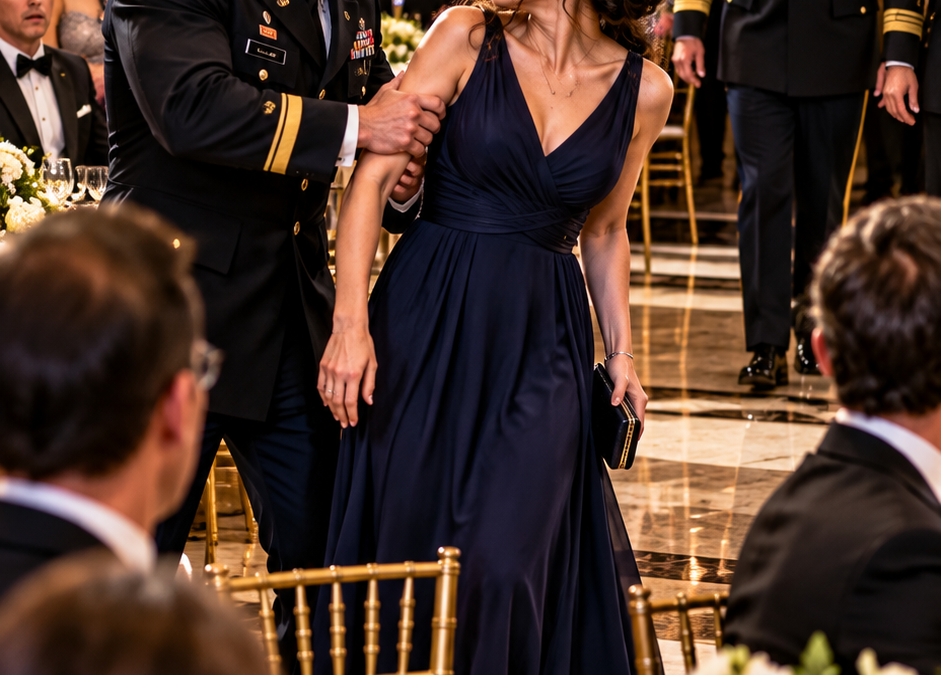
He crossed the room.
His fingers closed around my upper arm.
Not painfully.
But urgently.
“Who let you in?”
I stared at him.
He was speaking too quietly for anyone else to hear.
“Excuse me?”
“Get out. Now.”
“Nolan.”
“You’re humiliating me in front of my unit.”
There was fear in his face.
Not hatred.
That realization stopped me from reacting.
“Nolan, let go.”
“You don’t understand.”
“I think I do.”
He released me immediately.
But before he could say anything else, the room behind us became strangely quiet.
Tom Mercer had reached the doorway.
His gaze moved from Nolan to me.
He understood, or at least understood enough.
He straightened.
“General, is there a problem?”
The color left Nolan’s face.
I turned.
Dozens of eyes were now pointed toward us.
There were many ways I could have answered.
Some would have been satisfying.
Some would have been clever.
Most would have caused damage no apology could entirely repair.
So I smiled.
“No problem, sir.”
Tom looked unconvinced.
“Nolan was just showing me where the family photographs are being taken.”
I touched my brother lightly on the shoulder.
“Weren’t you?”
Nolan swallowed.
“Yes, ma’am.”
I gave him a look.
“Evelyn.”
His mouth tightened.
“Yes. Evelyn.”
Tom studied both of us.
Then something almost amused entered his expression.
“Good.”
He lowered his voice.
“Congratulations, Colonel Hart.”
“Thank you, sir.”
Then Tom nodded toward me.
“Try not to let your sister give you too much career advice tonight.”
A few people laughed.
The room breathed again.
And the moment passed.
At least publicly.
Nolan stood beside me in the corridor, staring at the floor.
“I didn’t know Mercer knew you that well.”
“That wasn’t the problem.”
“I know.”
“No,” I said quietly. “I don’t think you do.”
He looked up.
For once, he had no charming answer.
Claire appeared at the end of the hallway.
She took one look at us and stopped.
“What happened?”
Nolan opened his mouth.
I spoke first.
“Your husband needs five minutes.”
Claire’s eyes narrowed.
“With you?”
“With himself.”
I returned to the reception.
For the rest of the evening, Nolan was gracious.
Perfect, even.
He thanked everyone.
He posed for photographs.
He laughed at Dad’s stories.
He held Claire’s hand.
Nobody mentioned the hallway.
Not even Tom.
But something had shifted.
After the guests left, I helped Mom pack leftover cake into foil containers. Dad carried flowers to the car. Sophie showed Claire photographs on her phone.
Nolan approached me.
“Can we talk tomorrow?”
I looked at him.
“Are you asking as my brother?”
His face tightened.
“Yes.”
“Then yes.”
The next morning, he came to my hotel alone.
No uniform.
Jeans.
Gray sweater.
He stood outside my door looking ten years younger.
“I owe you an apology.”
I stepped aside.
He entered.
I poured coffee.
He remained standing until I pointed at the chair.
Finally, Nolan said, “I’ve spent three years thinking you looked down on me.”
I blinked.
“What?”
“You don’t call unless Mom reminds you.”
“You don’t call me either.”
“I know.”
“You never ask me anything personal.”
“You answer everything like a staff briefing.”
“That is unfair.”
“Is it?”
I opened my mouth.
Closed it.
Nolan leaned forward.
“You know exactly what to say to everyone else. Junior officers love you. Mom says you remember the name of every nurse who helped Grandpa. Dad says you still send Christmas cards to three people who used to work at the hardware store.”
His expression softened.
“But with me, you’re always careful.”
I stared into my coffee.
“What are you saying?”
“I’m saying I never know if you’re my sister or if I’m being evaluated.”
The words hurt because they were not entirely wrong.
He continued.
“When I made lieutenant colonel, I called you.”
“I remember.”
“You said, ‘Congratulations. The next level will require more delegation and stronger staff development.’”
I winced.
“That does sound terrible when you repeat it.”
“It was terrible when you said it.”
Despite everything, I laughed.
Nolan did too.
Then the laughter disappeared.
“I thought you didn’t respect me,” he said.
“I thought you didn’t want advice.”
“I didn’t want advice.”
He rubbed his hands together.
“I wanted you to tell me you were proud.”
That silenced me.
For a moment, I was fourteen again, sitting on Grandpa Walter’s porch with a mug of lemonade while Nolan’s meaningless baseball trophy gleamed inside our parents’ house.
A lifetime had passed.
And somehow, we had traded places without noticing.
“Nolan.”
He looked away.
“I know how ridiculous that sounds.”
“It doesn’t.”
I had spent years learning how not to need applause.
Then I had assumed that lesson belonged to everyone.
“I am proud of you,” I said.
He looked at me.
“I should have told you.”
His jaw tightened.
“More than once.”
“Probably.”
He smiled faintly.
Then he inhaled.
“There’s something else.”
“What?”
“Dad told me about Grandpa’s trust.”
I sat back.
“All of it?”
“He told me you inherited part of the store.”
“That isn’t all of it.”
“I know.”
My attention sharpened.
Nolan reached into his coat pocket and placed a folded envelope on the table.
“Dad found this six weeks ago.”
The paper was old.
On the front, in Grandpa Walter’s handwriting, were two words:
FOR GRANT.
My father.
I looked up.
“Where was it?”
“In a box from the bungalow. Sophie wanted old photographs for a school project, so Dad finally went through the last things Grandpa left behind.”
“Did Dad open it?”
“Yes.”
“What does it say?”
Nolan looked uncomfortable.
“You should read it.”
Inside was a three-page handwritten letter.
The first paragraph was ordinary.
Grandpa talked about the store.
About Dad’s work ethic.
About the mistakes both of them had made.
Then I reached the middle.
Grant,
I need you to know the trust was never intended to choose Evelyn over Nolan, nor to punish you for loving your son loudly.
I created it because I watched Evelyn spend her childhood becoming indispensable and then apologizing for taking up space.
You trusted her with responsibilities you did not trust to others, but because she carried them quietly, you often mistook her competence for lack of need.
Then came the line that made my hands stop moving.
I also owe you the truth about the first expansion.
Evelyn’s share was not entirely mine to give.
I read it again.
Then again.
Nolan watched me.
“What does that mean?”
“I don’t know.”
“There’s more.”
I kept reading.
Years before, during the period when Dad’s store nearly failed, an investor had contributed money alongside Grandpa Walter.
The investor’s name was deliberately omitted from the letter.
Grandpa wrote only:
She asked me never to tell you while she was alive.
She believed the money would cause more pain than it solved.
That promise no longer serves anyone.
The final paragraph contained an instruction.
Speak to Margaret Bell. Ask for File 17.
I folded the letter.
Nolan stared at me.
“Who do you think she was?”
I shook my head.
“Grandma?” he asked.
“She died before the expansion.”
“A relative?”
“Maybe.”
Nolan leaned back.
“Dad thinks Grandpa was hiding something from him.”
“Grandpa hid plenty of things when he believed the timing mattered.”
“That isn’t comforting.”
“No.”
I took out my phone.
Margaret Bell had retired two years earlier.
But I still had her number.
She answered on the fourth ring.
“Evelyn?”
“Margaret.”
I looked at Nolan.
“I need to ask you about File 17.”
Silence.
A long silence.
Then Margaret sighed.
“I wondered when someone would finally find Walter’s letter.”
“Who was she?”
“I can’t tell you over the phone.”
“Why?”
“Because Walter left something with the file.”
“What?”
“A statement.”
“From whom?”
Margaret paused.
Then she said the name.
For a second, I stopped breathing.
Nolan leaned forward.
“What is it?”
I lowered the phone.
Because the woman who had quietly invested in Dad’s hardware store all those years ago—the woman whose money had eventually become part of the ownership Grandpa placed in trust for me—was not Grandma.
It was my mother.
Elaine Hart.
The same woman who had spent my childhood seeming to care more about appearances than accounts.
The same woman who had always told everyone Dad built the business himself.
According to Margaret Bell, Mom had left an explanation.
One she had never intended either of her children to read until Grandpa Walter decided the truth could no longer remain hidden.
Two days later, Nolan and I drove to Margaret Bell’s office together.
It was the first time in years we had spent more than an hour alone without retreating into jokes or military shorthand.
He drove.
I watched Virginia roll past the window.
Neither of us spoke for the first twenty minutes.
Finally, Nolan said, “Do you think Mom knows Dad found the letter?”
“I don’t know.”
“She’s going to hate this.”
“Yes.”
“Dad too.”
“Yes.”
He tightened his hands around the wheel.
“Why does this family keep hiding things until they become explosions?”
I looked at him.
“Because hiding things feels peaceful to the person doing it.”
He nodded slowly.
“And expensive to everyone else.”
That sounded like Grandpa.
I almost told him so.
Then I decided he probably knew.
Margaret Bell’s office sat in a brick building behind a bank, with windows that overlooked a narrow parking lot and a row of crepe myrtles. She was smaller than I remembered, but her eyes had not softened at all.
She greeted Nolan first.
“Colonel Hart.”
Then me.
“General Hart.”
I sighed.
“Margaret.”
She almost smiled.
“Evelyn, then.”
She led us into a conference room and placed a thick folder on the table.
FILE 17.
My mother’s statement was inside.
So were bank records, partnership documents, and several handwritten notes between Mom and Grandpa Walter.
Margaret did not open the folder immediately.
“Before you read this,” she said, “understand that your mother did not act from one clean motive. People rarely do. There was love in it. Pride too. Fear. Resentment. Sacrifice. Perhaps some cowardice. Walter believed you deserved the truth anyway.”
Nolan looked at me.
I nodded.
Margaret opened the folder.
The statement was in my mother’s handwriting.
Elaine’s script was careful and elegant, the same handwriting she used on church invitations and thank-you notes.
To my children, if you are reading this, then either Walter has decided the truth can no longer wait, or I have finally become brave enough to say aloud what I should have said years ago.
I looked at Nolan.
He was staring at the page as if it might rearrange itself into something easier.
I kept reading.
When your father’s store nearly failed, I was the one who brought Walter the first set of numbers.
Grant was too proud to admit how bad things had become. He believed working harder would solve everything because work had always been the only language he trusted.
But the store was drowning.
I had money then.
Not much compared to wealthy people, but more than anyone knew. My aunt left me a small inheritance before I married your father. I kept it separate because, in those days, I told myself every woman should have one thing that was entirely hers.
I used most of it to help save the store.
Nolan whispered, “Mom?”
I kept reading.
I did not tell Grant because I knew what it would do to him. I told myself I was protecting his dignity. That was partly true.
But I was also protecting my image of him.
I wanted to be married to a man who built something strong. I wanted people to look at our family and see success. I wanted to believe that if the store survived, all the fear we had lived through would become worthwhile.
Walter knew. He told me secrecy had a cost.
I told him I was willing to pay it.
I did not understand that my children would pay too.
My throat tightened.
Margaret sat silently across from us.
Nolan’s face had gone pale.
The next page was harder.
When Evelyn was little, I saw how much she noticed. I saw how early she became useful. I saw Grant rely on her and praise Nolan.
I wish I could say I corrected it.
I did not.
I had spent years making sure the world saw the family I wanted us to be. Evelyn made that easier because she handled what needed handling. Nolan made that easier because he reflected the kind of joy people liked to admire.
That is an ugly sentence.
It is also true.
My vision blurred.
I forced myself to keep reading.
When Walter created the trust, he asked my permission to include part of my investment in what would someday become Evelyn’s share.
I agreed.
Not because I loved Nolan less.
Not because I wanted to reward Evelyn for being useful.
Because I had watched my daughter spend years holding up corners of a family that rarely turned around to see her hands.
I did not know how to say it to her.
So I let Walter put it in paper.
I covered my mouth.
For years, I had believed Mom had not seen me.
The truth was worse.
She had seen.
She had simply remained silent.
Nolan stood abruptly and walked to the window.
His shoulders rose and fell.
Margaret waited.
I read the last page alone.
Grant, if you read this, forgive me for hiding what I should have trusted you to know.
Nolan, you were loved loudly. That was not your fault. But do not mistake loud love for deeper love.
Evelyn, I am sorry I let your strength become an excuse not to care for you more gently.
You were not invisible.
I saw you.
I was just too afraid of what would happen if I asked everyone else to see you too.
I lowered the page.
The room was very quiet.
Margaret folded her hands.
“Your mother came to me once, years ago. She considered revising the statement. She said it sounded too harsh on herself.”
“What did Grandpa say?” I asked.
“He told her truth that has been polished until it stops cutting is no longer truth.”
I almost smiled.
That sounded like him.
Nolan turned from the window.
“Does Dad know all this?”
“Not yet,” Margaret said. “He knows the file exists. He does not know its contents unless Elaine has told him.”
“She hasn’t,” I said.
I knew without asking.
My mother had built her life around careful presentation. Confession would feel like stepping outside without skin.
Nolan returned to the table.
“What happens now?”
Margaret looked at me.
“That depends on what Evelyn decides to do.”
I laughed once, softly.
“Grandpa really did refuse to answer the only hard questions.”
“He considered it a form of respect.”
“It feels inconvenient.”
“Respect often is.”
We made copies.
Then Nolan and I sat in his car for nearly twenty minutes without starting the engine.
Finally, he said, “She saw you.”
“Yes.”
“And still let it happen.”
“Yes.”
He wiped both hands over his face.
“I don’t know whether that makes it better or worse.”
“Both.”
He nodded.
“Both sounds right.”
We drove straight to our parents’ house.
Mom knew the moment she opened the door.
Maybe it was our faces.
Maybe it was the folder in my hand.
Maybe she had been waiting years for the truth to finally arrive wearing one of our expressions.
Dad was in the kitchen, reading the local paper with a cup of coffee.
He looked up.
“What happened?”
No one answered immediately.
Mom gripped the back of a chair.
“Grant,” she said softly. “Sit down.”
He frowned.
“I am sitting.”
She almost smiled.
Then she looked at me.
“You found File 17.”
Dad’s face changed.
“You knew?”
Mom closed her eyes.
“Yes.”
The conversation that followed was not clean.
Real conversations rarely are.
Dad was angry first.
Not loud.
Wounded.
“You gave Walter money for my store?”
“Our store,” Mom said.
He stared at her.
She swallowed.
“I should have said that years ago.”
“You let me believe—”
“I know.”
“You let me stand behind that counter for forty years thinking my father had saved me alone.”
“No,” Mom said. “I let you believe you had never needed saving at all.”
That silenced him.
Nolan looked at the table.
I stood near the sink, holding the folder like evidence in a case no court could decide.
Dad’s voice dropped.
“Why?”
Mom’s eyes filled.
“Because I was proud. Because you were proud. Because I thought if I admitted how frightened I was, the whole life we were building would feel less solid.”
Dad laughed without humor.
“So you lied to make it solid?”
“Yes.”
The single word landed harder than any explanation.
Then Dad looked at me.
“And the trust?”
Mom pressed her lips together.
“I agreed to it.”
“You agreed to give Evelyn part of the store?”
“I agreed to acknowledge that part of what saved the store came from me, and that Evelyn had spent her childhood helping preserve it in ways you and I both failed to honor.”
Dad pushed away from the table.
“She was a child.”
“Yes.”
Mom’s voice broke.
“And we treated her competence like permission to need less from us.”
I looked away.
There are moments when hearing the truth does not heal the wound.
It only proves the wound was real.
Dad stood and walked to the window over the sink.
For a long time, he said nothing.
Then he whispered, “Evie.”
I hated how much that name still affected me.
I looked at him.
His face had aged ten years in ten minutes.
“I thought you liked being the capable one.”
I closed my eyes briefly.
“I liked being valued.”
He flinched.
“That’s not the same thing.”
“No.”
Mom cried then.
Quietly.
No performance.
No appeal.
She simply sat at the table and cried into her hands.
Nolan moved first.
He crossed to her and put a hand on her shoulder.
For a second, I saw the golden boy of our childhood comforting the mother who had helped build his pedestal and regretted the cost too late.
Then Nolan looked at me.
Not asking me to join.
Not asking me to forgive.
Just seeing whether I was still there.
I was.
Dad turned from the window.
“I don’t know how to fix this.”
Grandpa’s old question rose in my mind.
What did you fix today?
But people are not broken machines.
“I don’t think we fix it today,” I said.
Dad nodded slowly.
“What do we do, then?”
“We stop pretending.”
That was the beginning.
Not the ending.
The beginning was ugly.
Dad had to grieve the story he had told himself about the store.
Mom had to live with the truth that seeing harm and stopping harm were not the same thing.
Nolan had to confront the fact that being loved loudly had not protected him from insecurity. In some ways, it had fed it.
And I had to admit something I had avoided for years.
I was angry.
Not composed.
Not above it.
Not healed by rank, command, or distance.
Angry.
At Dad for not seeing me.
At Mom for seeing me and staying silent.
At Nolan for grabbing my arm in that hallway because his fear mattered more to him than my dignity.
At Grandpa for hiding truths inside documents and calling it respect.
At myself for pretending that being useful was the same as being known.
We did not solve all of it quickly.
Families rarely do.
There were uncomfortable dinners.
Short phone calls.
Long silences.
One argument in Dad’s kitchen where Nolan finally said, “I spent my whole life thinking I had to become what everyone expected,” and Dad said, “So did I,” and Mom left the room because the honesty was more than she could absorb at once.
There was a morning when Mom came to my hotel before I left Virginia and handed me a small box.
Inside was a set of keys.
Old brass keys from the hardware store.
“I kept them,” she said. “I don’t know why.”
I turned one over in my palm.
“Maybe because part of you knew the store was never just Dad’s.”
She nodded.
“I think so.”
Then she said, “I’m sorry I did not care for you more gently.”
It was the sentence from her letter.
Spoken aloud this time.
I looked at my mother.
She seemed smaller without her careful presentation.
But also more real.
“Thank you for saying it.”
“Is that enough?”
“No.”
Her eyes filled.
“But it matters,” I said.
And it did.
Several months after Nolan’s promotion party, I returned to Staunton for Sophie’s architecture showcase at school.
She had redesigned Grandpa Walter’s bungalow.
Digitally, because Claire had wisely refused to let her knock out real walls.
The model kept the front porch.
“It’s important,” Sophie explained.
“Why?” Nolan asked.
She looked at him as if he had asked whether roofs mattered.
“Because people talked there.”
I glanced at Nolan.
He glanced at me.
Neither of us said anything.
After the showcase, the family gathered at Mom and Dad’s house.
It was not perfect.
Dad still talked too much when nervous.
Mom still tried to refill plates instead of answering uncomfortable questions.
Nolan still made jokes when silence lasted longer than he liked.
I still defaulted to analysis when emotion would have been more honest.
But something had changed.
At dinner, Dad raised his glass.
“To Sophie,” he said. “For building something better than what she inherited.”
Sophie rolled her eyes.
“It’s a school project, Grandpa.”
“No,” Dad said quietly. “It’s more than that.”
The table went still.
Then Nolan lifted his glass too.
“To building better.”
Mom followed.
Then Claire.
Then Sophie, though she looked confused.
Finally, I lifted mine.
Grandpa Walter’s voice returned to me, as clear as if he were sitting on the porch behind the store.
One day, your family is going to understand exactly who you are.
I had asked him what happened if they never did.
He had not answered the way I wanted.
He had given me a choice instead.
Applause, or worthwhile work.
For years, I thought that meant I should stop wanting to be seen.
I was wrong.
It meant I should not let the lack of applause decide the worth of what I built.
Being seen still mattered.
Being known still mattered.
Love that never looked closely was not enough.
But I no longer needed my family’s recognition to prove I existed.
That evening, after dinner, Nolan found me on the back porch.
The air smelled like cut grass and distant rain.
He leaned against the railing beside me.
“I owe you another apology,” he said.
“You’re developing a habit.”
“I know. It’s terrible.”
I smiled.
He looked out toward the dark yard.
“I wasn’t humiliated because people knew you,” he said. “I was humiliated because I thought they respected you more than me.”
I said nothing.
“I know how small that sounds.”
“It sounds honest.”
He nodded.
“I spent my whole life being admired at home. Then I entered a world where admiration had to be earned every day, and you had already earned so much of it that I felt like I was always arriving late to my own name.”
I looked at him.
“That does not excuse grabbing me.”
“No,” he said immediately. “It doesn’t.”
“Or telling me to leave.”
“No.”
“Or treating my existence like a threat.”
He swallowed.
“No.”
The old Nolan would have joked.
This one stayed with the truth.
“I am proud of you,” he said.
I turned toward him.
His jaw tightened, but he kept going.
“I should have said it when you made general. I should have said it when you came to my ceremony. I should have said it years ago.”
My throat tightened.
“I am proud of you too.”
He laughed softly.
“Even though I acted like an idiot?”
“Especially then. Growth requires material.”
He groaned.
“There she is. Staff briefing Evelyn.”
I smiled.
“Sorry.”
“No,” he said. “Don’t be. Just also be my sister.”
So I tried.
I put my arm around his shoulders.
It was awkward at first.
Then it was not.
Inside the house, Mom called through the screen door that dessert was ready.
Nolan looked at me.
“Truce?”
“No.”
He blinked.
I smiled.
“Truth.”
He considered that.
Then nodded.
“Truth.”
A year later, Dad sold the last piece of store equipment he had kept in storage: the old key-cutting machine.
He gave me the brass measuring gauge from it.
“I thought you might want this,” he said.
I ran my thumb over the worn metal.
“Why?”
He looked embarrassed.
“Because you always knew how things fit.”
It was not a perfect apology.
It was not poetry.
But it was Dad.
And for once, I let it be enough for the moment.
Mom began volunteering with a local women’s business group, helping younger women understand finances before marriage, before children, before they found themselves hiding strength behind someone else’s pride.
Nolan became a better commander after that night.
I know because some of his officers told me quietly, and because he stopped asking me questions designed to measure himself against me.
He started asking real ones again.
As for me, I returned to my work.
There were still briefings.
Decisions.
Long flights.
Difficult rooms.
People who underestimated me until someone said my title aloud.
But after Nolan’s promotion party, I carried my stillness differently.
Before, silence had been armor.
Now, sometimes, it was simply choice.
The last time I visited Grandpa Walter’s porch, I brought a cup of weak lemonade and sat in his old chair.
The bungalow had not changed much.
Sophie’s redesigned version existed only on her laptop, but she had convinced Dad to repair the steps and Mom to plant lavender near the walkway.
I sat there at sunset and thought about the crowded reception hall.
Nolan’s hand on my arm.
Tom Mercer in the doorway.
General, is there a problem?
There had been a problem.
Not the one Tom saw.
Not just a brother losing control for one frightened moment.
The problem was older than that.
Older than Nolan.
Older than me.
A family that praised what shone and used what held.
A father who confused visibility with worth.
A mother who saw too much and said too little.
A daughter who became indispensable because she did not know how else to be loved.
A son who was admired so loudly that he mistook every shadow for rejection.
Grandpa had known more than he said.
Maybe he had hoped we would learn faster.
Maybe he had known we would not.
Either way, he had left us work.
Not chores.
Work.
The kind that takes years.
The kind nobody applauds.
The kind that matters anyway.
I lifted the lemonade toward the empty chair beside me.
“What did I fix today?” I whispered.
The answer came slowly.
Not everything.
Not even close.
But enough to begin again.








