𝗣𝗔𝗥𝗧 𝟮 The Military K9 Refused to Leave the Waitress Who Was Selling Her Silver Star for Grocery Money
𝗣𝗔𝗥𝗧 𝟮
I knew exactly what each medal had cost.
Not in money.
Money would have been easier.
The Purple Heart came from a night when shrapnel entered my left side and I continued working for twenty-three minutes because there were still men worse off than I was.
The Bronze Star came from an evacuation during which we moved three casualties through terrain command had considered impossible to cross before daylight.
The Silver Star was different.
That one came from saying no.
The irony had never left me.
The medal honored the same decision that later ended my career.
I lifted it.
The silver caught the fluorescent locker-room light.
Seven years.
Twelve classified missions.
Nine Marines who were still alive because of one decision.
And I was considering turning all of it into groceries.
Six weeks earlier, I had looked up military medal values on a library computer.
Not mine.
The library’s.
Shame feels strangely smaller when the search history is not attached to your name.
A Silver Star with a documented citation and traceable operation history could bring a significant amount from a serious collector.
Enough to cover rent.
Maybe two months.
Maybe more.
I had closed the browser after reading the estimate.
I told myself I was only curious.
Curiosity became preparation.
Preparation became that Wednesday.
I shut the box.
Then I walked four blocks to Clement Street without changing clothes.
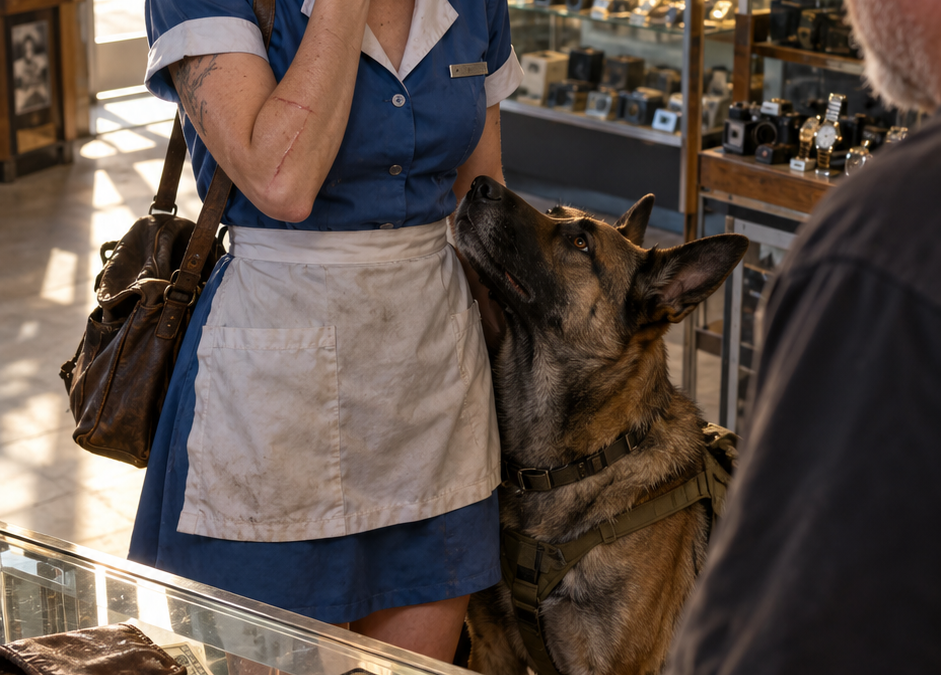
I left my apron tied around my waist.
My name tag was still pinned over my heart.
Part of me did that intentionally.
If I changed, if I showered, if I put on civilian clothes and prepared for what I was doing, then it would become an event.
I did not want an event.
I wanted money for food and rent.
That was all.
The bell above the pawn shop door made a tired metallic sound when I walked in.
The shop smelled like old carpet, metal, dust, and the faint electrical heat of too many aging electronics plugged into one room.
Guitars hung behind me.
Power tools filled one wall.
A glass case displayed watches, jewelry, knives, coins, old military patches, and things that had probably once mattered deeply to someone before becoming inventory.
A man in his late fifties sat behind the counter.
Reading glasses rested on his forehead.
Phone in one hand.
“Help you?”
I walked to the counter.
“Yes.”
I placed the wooden box on the glass.
His eyes finally left his phone.
“What’ve you got?”
I opened the lid.
The shop became very quiet.
He leaned forward.
Not emotionally.
Professionally.
He lifted the Silver Star between two fingers.
Turned it over.
Read the engraving.
Then the Bronze Star.
Then the Purple Heart.
His expression did not change.
“Forty bucks.”
I thought I had misheard him.
“For what?”
“The lot.”
I looked at him.
“All three?”
“Forty.”
He reached for his phone again.
I stared at the medals.
There are humiliations that happen loudly.
Someone shouts.
A door slams.
A uniform is taken.
A room full of people watches you lose something.
This humiliation was quiet.
That made it worse.
Seven years sat beneath fluorescent light.
Forty dollars.
I said, “The Silver Star alone is worth considerably more than that.”
He shrugged.
“To a collector.”
“You are a pawn shop.”
“I’m not a military collector.”
He tapped the counter.
“I’m buying metal and resale risk.”
“It has a documented citation.”
“Great.”
He looked at his phone again.
“Forty.”
I felt my left hand begin to tremble.
So I put both hands into the pockets of my apron.
No one needed to see that.
“You looked at the engraving.”
“Yep.”
“You know it’s named.”
“Yep.”
“And forty is your offer?”
He finally looked at me.
“To me, they’re three medals from somebody who needs cash.”
That sentence landed harder than the price.
Somebody who needs cash.
There was no Marine in his sentence.
No mission.
No wound.
No nine lives.
Just need.
And he was right.
That was the worst part.
I needed cash.
He leaned back.
“You want it or not?”
I looked toward the front window.
People walked past carrying grocery bags.
A mother held the hand of a little boy in a red jacket.
A cyclist waited at the light.
A delivery truck rolled slowly through the intersection.
Ordinary Wednesday.
Nobody outside knew that inside the pawn shop a woman was deciding whether memory had a minimum acceptable price.
I gave myself thirty seconds.
That was an old habit.
Before dangerous entries, difficult medical decisions, or moments when emotion threatened to become interference, I gave myself a fixed amount of time.
Feel it.
Then decide.
Thirty seconds.
At ten, I thought about rent.
At fifteen, groceries.
At eighteen, medication.
At twenty, the box.
At twenty-five, nine Marines.
At twenty-eight, I knew I was going to take the forty dollars.
Not because the medals were worth forty.
Because I was.
That was what I believed in that moment.
Not intellectually.
Somewhere worse.
Somewhere deeper.
The bell above the door rang.
A Belgian Malinois entered first.
My attention snapped toward him automatically.
Working harness.
Military markings.
Lean, powerful frame.
Clear eyes.
Well maintained.
His paws touched the floor with controlled confidence.
No pulling.
No unnecessary movement.
A professional animal.
The man holding the leash came in behind him.
Early thirties.
Broad shoulders.
Civilian clothes.
Dark jacket.
Short hair.
He carried himself the way active-duty officers often carried themselves outside uniform—relaxed only to people who did not know what they were looking at.
Marine.
I knew that before I saw the small USMC emblem stitched into the edge of his gear bag.
He headed toward a display case.
The dog followed for three steps.
Then stopped.
The captain gave the leash a light correction.
“Heel.”
The Malinois did not move.
His head turned toward me.
Ears forward.
Body suddenly still.
I knew that kind of stillness.
Working dogs did not freeze because they were uncertain.
They went still because every sense had chosen one thing.
The captain looked down.
“Ranger.”
The dog continued staring at me.
“Come.”
Nothing.
The captain’s expression changed.
Not anger.
Surprise.
He gave the command again.
“Ranger. Heel.”
The dog walked.
Just not toward him.
He crossed the pawn shop floor.
Straight toward me.
I did not move.
He reached my left side and sat.
Pressed his shoulder gently against my leg.
Then looked forward.
Perfectly calm.
I stared down at him.
The captain stared too.
“Ranger.”
One ear moved.
Otherwise, nothing.
The captain approached slowly.
“I’m sorry.”
“It’s fine.”
“He doesn’t do this.”
The pawn shop owner grunted.
“Dog likes waitresses.”
The captain ignored him.
He reached for Ranger’s harness.
The dog remained seated.
Then the captain saw the counter.
The medals.
His hand stopped.
His eyes went first to the Purple Heart.
Then the Bronze Star.
Then the Silver Star.
He looked at me.
Back at the medals.
“Are those yours?”
Before I could answer, the pawn shop owner said, “She’s selling them.”
I felt something inside me close.
The captain looked at me again.
I could see the question in his face.
Not judgment.
That almost made it harder.
I said, “I haven’t decided yet.”
The pawn shop owner laughed softly.
“She’s deciding between forty dollars and walking out broke.”
The captain turned toward him.
“Forty?”
“All three.”
Something cold passed across the captain’s face.
He reached toward the Silver Star, then stopped before touching it.
“May I?”
That mattered.
He asked.
I nodded.
He picked it up with both hands.
Not because medals physically require two hands.
Because he understood what he was holding.
He turned it over.
Read the name.
OLIVIA M. HART.
Then the operation designation.
His hands went still.
He read it again.
I watched the color leave his face.
Ranger pressed closer against my leg.
The captain lifted his eyes.
This time he was not looking at a waitress.
He was looking for someone.
“Is this you?”
I held his gaze.
“Yes.”
His expression changed completely.
He set the medal down carefully.
“My name is James Reed.”
He did not offer his hand.
I appreciated that too.
“Captain, United States Marine Corps.”
“I figured.”
His eyes returned to the Silver Star.
“You were on Black Lantern?”
The operation name had not been public.
I said nothing.
He immediately understood.
“Right. Sorry.”
I looked at his face more carefully.
“Where did you hear that designation?”
His jaw tightened.
“Leadership course.”
I waited.
“Three years ago.”
Something cold moved through me.
He continued.
“They showed us an anonymized case.”
I stopped breathing normally.
“Compromised movement route. Field intelligence warning. Direct order to advance anyway.”
He looked at me.
“One person refused.”
The pawn shop seemed to fall farther away.
Reed continued.
“Forty minutes later, the route was hit.”
I stared at him.
“Nine Marines avoided the ambush because their medical lead refused to move them into it.”
He looked at the medal.
“The instructor said it was one of the best field judgment calls he had studied in thirty years.”
My hands came out of my pockets.
The shaking had stopped.
“What name was on the file?”
Reed’s eyes held mine.
“None.”
I already knew.
But hearing it still hurt.
“He said the operator’s identity had been removed.”
I laughed once.
There was no humor in it.
“Convenient.”
Reed looked at my waitress uniform.
Then the medals.
Then the pawn shop owner.
“What happened?”
“I got discharged.”
His face hardened.
“For that?”
“For disobeying a lawful order.”
“That order would’ve gotten nine Marines killed.”
“So I was told later.”
Reed stared.
“You knew before.”
“Yes.”
“How?”
I looked at him.
“Because that was my job.”
He stood there for several seconds.
Ranger had still not moved.
Finally, Reed said, “Do you have ten minutes?”
“No.”
His expression did not change.
“Five?”
“Captain—”
“Not here.”
He glanced toward the pawn shop owner.
No insult.
Just fact.
“There’s a coffee shop on the corner.”
“I have things to do.”
“I know.”
“No, you don’t.”
The words came sharper than I intended.
“You don’t know.”
Reed nodded.
“You’re right.”
That stopped me.
No defense.
No attempt to overpower the conversation.
He continued.
“But I know that citation.”
I looked at the wooden box.
He lowered his voice.
“And I know forty dollars isn’t what should happen to it.”
Pity rose in my throat like acid.
“I don’t need charity.”
“I didn’t offer any.”
“Then what do you want?”
“The complete story.”
“Why?”
“Because I’ve spent three years wondering why the person who made that call disappeared from the file.”
I almost laughed.
“People disappear from files every day.”
“Yes.”
His face hardened.
“Usually because somebody wants them gone.”
Silence.
Ranger looked up at me.
I had worked around military dogs enough to know better than to assign mystical meaning to normal animal behavior.
He was not a prophet.
He did not understand medals.
He did not know what rent was.
But something about my scent, my posture, maybe traces of working-dog handling still embedded in the way I stood, had convinced him that my side was where he wanted to be.
When Reed tried gently to move him, Ranger resisted.
Not aggressively.
He simply sat harder.
I looked down.
“You always this disobedient?”
Ranger’s mouth opened slightly.
Reed said, “Only when he’s right.”
I looked at Reed.
“That sounds dangerous.”
“It has been.”
Against my better judgment, I almost smiled.
I closed the wooden box.
The pawn shop owner looked up.
“So no deal?”
“No deal.”
He shrugged.
“Your choice.”
I lifted the box.
For the first time in forty-eight hours, I had no idea how I was going to buy groceries.
Strangely, I felt lighter anyway.
“Five minutes,” I told Reed.
He nodded.
“Five.”
Ranger stood.
We walked outside together.
The dog moved between us.
The coffee shop had four small tables near the windows.
Reed bought two coffees.
“Black?”
he asked.
“Yes.”
He nodded as if confirming something.
“You guessed?”
“People who look at every exit before sitting down usually drink coffee black.”
“That is terrible logic.”
“It worked.”
We sat.
Ranger lay under the table with his body positioned partly against my boots.
I placed the wooden box between us.
Reed waited.
That was the first thing I noticed about him.
He did not rush silence.
Most people become uncomfortable when another person is deciding whether to speak.
They fill the space.
Ask another question.
Offer reassurance.
Reed waited.
I opened the box.
“The mission was seven years ago.”
He nodded.
“My team had nine Marines attached to a joint movement element.”
I traced one finger along the edge of the Silver Star ribbon.
“We were ordered through a road corridor I didn’t trust.”
“Why?”
“Human intelligence had changed.”
“How recent?”
“Forty-seven minutes.”
His eyebrows moved.
“That recent?”
“Yes.”
“We had intercepted traffic indicating the opposing force had shifted two teams toward the corridor.”
“Was command updated?”
“Three times.”
“What did they say?”
“That the intelligence was unconfirmed.”
Reed’s jaw tightened.
I continued.
“The route was part of a larger synchronized movement. Colonel Richard Holt didn’t want the schedule changed.”
Reed looked up sharply.
“Holt?”
“You know him?”
“I know the name.”
“That’s enough.”
I remembered the operations room.
The map.
The radio.
Holt’s voice.
Captain Hart, move your people.
“We received a direct order.”
“And you refused.”
“I delayed.”
“That’s not the same thing.”
“To Holt it was.”
“What happened?”
“I pulled the Marines into covered position and requested alternate verification.”
“How long?”
“Thirty-two minutes.”
“And the ambush?”
“Hit the route eight minutes after that.”
Reed stared at me.
“Forty minutes after the original order.”
“Yes.”
“How bad?”
I looked toward the window.
“Bad enough.”
There were things I would not describe.
Not there.
Not ever, maybe.
I continued.
“Nine Marines went home.”
“And you got the Silver Star.”
“Eventually.”
“What came first?”
“The discharge process.”
His face changed.
“How fast?”
“Seventy-two hours after we returned.”
“That’s impossible.”
“No.”
I looked at him.
“It’s efficient.”
He leaned back.
“Charges?”
“Failure to obey a lawful order. Conduct unbecoming. Operational insubordination.”
“Appeal?”
“Three.”
“Results?”
“Denied.”
“By whom?”
“Same administrative office each time.”
“Who signed?”
“Holt was attached to the first recommendation. Deputy personnel command signed the final decision.”
Reed was quiet.
I watched him process it.
Then he asked, “Why didn’t the Silver Star stop it?”
I laughed bitterly.
“Because one system awarded it while another buried why.”
“That doesn’t make sense.”
“It doesn’t have to.”
“Olivia—”
“Captain.”
I leaned forward.
“You’re trying to make institutional behavior logical.”
His mouth closed.
“It isn’t always.”
I looked at the medal.
“The citation was classified heavily enough that the details weren’t visible to the people processing the discharge. The administrative file framed the refusal as a breakdown in discipline.”
“And Holt knew that.”
“Yes.”
“Did he know the intelligence was right afterward?”
“He knew before the ambush ended.”
Reed stared at me.
“So he saved himself.”
I said nothing.
He understood anyway.
I had never told the whole story to a stranger.
Not once.
After my discharge, friends had asked.
Former teammates called.
One commander quietly offered to connect me with a lawyer.
I refused everyone.
Not because I did not care.
Because I had spent months watching people with more authority turn truth into paperwork.
Eventually, I stopped believing more paperwork would save me.
I took jobs.
Moved.
Changed phone numbers.
Stopped answering military calls.
And learned how to carry trays.
Reed’s voice softened.
“Why sell the medals now?”
That question hurt more than everything before it.
I looked at my coffee.
“Rent.”
He said nothing.
“Transmission.”
Nothing.
“Medication.”
Still nothing.
“And groceries.”
My throat tightened.
“So there it is.”
I looked at him.
“The great mystery.”
He did not pity me.
I could have hated him if he did.
Instead, he asked, “How short are you?”
My expression hardened.
“No.”
“That wasn’t charity.”
“It was absolutely going to become charity.”
“No.”
I started closing the box.
“Then what?”
“Information.”
I stopped.
“How short?”
“I’m not answering that.”
“Fine.”
He nodded.
“Different question. Do I have permission to look into your case?”
I almost laughed.
“You think you can?”
“Yes.”
“Based on what?”
“Based on the fact that I know the case study exists, I know people who taught it, and now I have the name they removed.”
“You think that’s enough?”
“No.”
Reed leaned forward.
“But it’s a start.”
“Why?”
His answer came immediately.
“Because nine Marines are alive.”
I looked away.
“That doesn’t make this your responsibility.”
“No.”
He paused.
“It makes ignoring it my choice.”
That stayed with me.
Before leaving, he wrote his number on a napkin.
I almost refused it.
Ranger solved the problem by placing one paw on my shoe.
Reed sighed.
“Apparently he would like you to take it.”
I looked down at the dog.
“Manipulative animal.”
“Extremely.”
I took the napkin.
Then I went home.
I spent the evening eating two eggs and the last apple.
I did not pawn the medals.
That was the only practical difference Captain Reed made that day.
At least, that was what I thought.
Three days later, he was sitting at his kitchen table at two in the morning with six personnel files open around him.
I did not know that yet.
I learned later.
He had begun with my case.
Then Holt.
Then appeals.
Then signatures.
One name led to another.
Five Marines over nine years.
Different units.
Different incidents.
Same pattern.
An operator questions or refuses a high-risk order.
The operator is later proven correct or partially correct.
Holt experiences no consequence.
The operator receives administrative action.
Appeal passes through the same office.
Career ends quietly.
One Marine had refused to send an armored vehicle across a bridge he believed had been compromised.
The bridge partially collapsed during the next movement.
He was discharged for disobedience before an engineering review confirmed structural sabotage.
Another challenged an order to continue a training evolution after heat casualties started appearing.
He was removed for insubordination.
Two men were hospitalized later that afternoon.
Five careers.
Then mine.
Six.
Reed called General Patricia Walsh.
He told me later he chose her because she had a reputation for reading original documents instead of summaries.
Apparently that was enough to make her unusual.
She agreed to meet him Thursday morning.
Walsh read every page.
Thirty-five minutes.
No interruptions.
No assistant summarizing.
When she reached my file, she slowed.
Then she saw the operation designation.
She had used the case in a leadership seminar four years earlier.
The same anonymous decision.
The same unnamed operator.
The same nine Marines.
When Reed told me that later, I did not know whether to laugh or scream.
The Corps had been teaching officers to admire my decision while still allowing my service record to punish me for making it.
There was something so absurd about that I could not even be angry properly.
General Walsh could.
She called Holt into her office.
I was not there.
Reed was.
He described it to me later.
Holt entered calm.
Confident.
Why wouldn’t he be?
For years, institutional processes had bent in ways that protected him.
Walsh placed six files on her desk.
“Six Marines,” she said.
Holt asked what the meeting concerned.
“Nine years.”
He looked at the files.
“Same categories of charges.”
Silence.
“Same appeals office.”
His expression changed slightly.
“Same pattern of unfavorable action after personnel challenged operational decisions connected to you.”
Holt immediately used the language men like him always use when reality becomes dangerous.
Command authority.
Discipline.
Battlefield cohesion.
Breakdown of trust.
Second-guessing.
Walsh let him speak.
Then opened the first file.
A Marine who had refused the bridge crossing.
She summarized the engineering report completed after his discharge.
Second file.
Heat casualties.
Third.
Training safety override.
Fourth.
Intelligence dispute.
Fifth.
Transport condition.
Then mine.
Walsh placed my Silver Star citation on top.
Holt reportedly stopped talking.
She said, “Captain Olivia Hart.”
Nothing.
“Black Lantern.”
His face changed.
“Ordered route.”
No answer.
“Ambush forty minutes later.”
Holt looked down.
Walsh said the word that had followed me for seven years.
“Insubordination.”
Then she let it sit between them.
Reed told me later that was the moment Holt stopped behaving like a commander and started behaving like a man searching for legal protection.
Walsh contacted NCIS.
The review widened.
Emails were recovered.
Appeal procedures examined.
Pressure from Holt’s office documented.
Several retired officers agreed to speak.
One administrator admitted that some personnel findings had been accelerated at Holt’s request.
Another produced archived correspondence.
I knew none of that while it was happening.
I was at Murphy’s pouring beer.
Friday afternoon, my phone vibrated in my apron.
I almost ignored it.
Then I saw Reed’s name.
I stepped into the narrow hallway beside the manager’s office.
“Captain.”
“Olivia.”
Something in his voice changed my breathing.
“What happened?”
“Walsh finished the first review.”
I gripped the phone.
“And?”
“Your discharge is being reversed.”
For a second, I thought I had misunderstood him.
“What?”
“Your service characterization is corrected effective to the original separation date.”
I leaned against the wall.
He kept talking.
“Pension eligibility restored. Medical benefits reinstated. Back benefits under review, but Walsh expects initial restoration immediately.”
I closed my eyes.
The corridor became very quiet.
“Olivia?”
“I’m here.”
“There are five others.”
“I know.”
“No, I mean Walsh reviewed the other five files.”
I opened my eyes.
“All of them?”
“All five.”
“What happened?”
“Four are being formally reopened. One had already been partially corrected, but the adverse findings remain, so they’re reviewing that too.”
I covered my mouth.
Reed continued.
“Holt is under formal investigation.”
I did not speak.
“NCIS.”
The word landed differently than I expected.
Not triumph.
Not revenge.
Weight leaving.
Seven years.
I had imagined vindication before.
In those fantasies I screamed.
I confronted Holt.
I walked into a room in uniform and made everyone who doubted me look at what they had done.
Reality was quieter.
I leaned against a painted hallway wall in a waitress uniform while someone told me by phone that the sentence attached to my name had finally been corrected.
My knees weakened.
I slid down until I was sitting on the floor.
“Olivia?”
“I’m okay.”
“You don’t sound okay.”
“I said I’m okay.”
He waited.
Then I laughed.
It came out half sob.
“I almost sold the medal for forty dollars.”
Reed was quiet.
I wiped my face.
“Your dog.”
“What about him?”
“None of this happens without him.”
A pause.
Then Reed said, “I just followed the dog.”
I laughed again.
This time it hurt less.
When I returned to the floor, nobody knew anything had happened.
Table seven needed another beer.
A couple at the bar wanted their check separated.
A man near the window complained that his fries were cold.
The world had not changed.
Mine had.
I finished the shift.
At closing, I went to my locker.
Took out the wooden box.
Carried it behind the bar.
There was a shelf high above the liquor bottles where our owner kept special things.
A bottle of bourbon from his father.
A photograph of the original Murphy’s sign.
A baseball signed by a player nobody under fifty recognized.
I moved the baseball slightly.
Placed the wooden box beside it.
Then opened the lid.
Silver Star.
Bronze Star.
Purple Heart.
For years, I had hidden them wherever I lived.
Closet.
Drawer.
Locker.
Never displayed.
Never thrown away.
Always hidden.
That night, I left them where they could be seen.
Not because I wanted customers to ask.
Not because I wanted praise.
Because I was tired of treating my history like contraband.
Saturday morning, someone knocked on the bar door forty minutes before opening.
I looked through the glass.
Reed.
Ranger beside him.
I unlocked the door.
Ranger walked in first.
No hesitation.
Crossed the empty room.
Sat beside my left leg.
I looked at Reed.
“This is becoming a problem.”
Reed shrugged.
“I’ve lost command authority.”
“Apparently.”
I put one hand on Ranger’s neck.
His eyes closed.
That almost undid me.
Reed saw the wooden box behind the bar.
“You kept them.”
“Yes.”
“Good.”
“Do not sound too pleased with yourself.”
“I’m not.”
“You are.”
“Ranger is.”
The dog opened one eye.
I smiled.
That was the first morning Reed saw me smile without it being defensive.
The next Tuesday, the front door opened during lunch.
Conversation changed before I even looked up.
There are people whose presence alters a room.
General Patricia Walsh was one of them.
Full dress uniform.
Two aides behind her.
Customers straightened without consciously deciding to.
I froze with a coffee pot in my hand.
Walsh found me immediately.
She walked toward the bar.
Every old military instinct I had tried to bury came back at once.
Posture.
Attention.
Breathing.
I set the coffee pot down.
“General.”
“Captain Hart.”
The title struck like a physical thing.
I had not been called that officially in seven years.
The bar went silent.
Walsh stopped three feet from me.
She looked at my blue-and-white waitress uniform.
The apron.
The small Olivia name tag.
Not dismissively.
Just seeing all of it.
Then she said, “I came here because some things should not be corrected by email.”
My throat tightened.
She continued.
“Seven years ago, you received intelligence indicating that a movement route had been compromised.”
Nobody in Murphy’s moved.
“You challenged the order to proceed.”
I looked at the floor once, then back at her.
“You were directed to move nine Marines down that corridor.”
“Yes, ma’am.”
“You refused.”
“Yes.”
“Forty minutes later, the corridor was ambushed.”
Someone at the bar whispered, “Jesus.”
Walsh did not look away from me.
“Those nine Marines survived because you exercised the judgment we claim we expect from people in positions like yours.”
My hands began shaking.
This time I let them.
“You were subsequently punished for that decision.”
Silence.
“The investigation now underway indicates that punishment was not merely incorrect. It was part of a repeated pattern of administrative retaliation.”
My eyes burned.
Walsh’s voice softened.
“Your discharge has been vacated.”
She paused.
“Your service record has been restored.”
Another pause.
“Your benefits have been reinstated.”
I nodded once because speaking had become difficult.
Then she said the thing I remembered most.
“We do not get to ask people to bleed for this country and then pretend not to know them afterward.”
The room stayed completely still.
I felt seven years move through me.
Every unanswered appeal.
Every cheap apartment.
Every job application where I had avoided discussing my service.
Every morning I had put on an apron and told myself that the woman in uniform had been someone else.
Every time I had opened the wooden box alone.
Every dollar I counted.
Every question I refused to answer.
Every night I wondered whether Holt had been right about me after all.
I looked at General Walsh.
“Thank you, ma’am.”
She gave me one slow nod.
Not superior to subordinate.
One Marine to another.
Then she looked over my shoulder.
At the box.
“You nearly sold them?”
I exhaled.
“Someone talks too much.”
One of her aides almost smiled.
Walsh looked at the medals.
“How much?”
“Forty dollars.”
For the first time, General Patricia Walsh looked genuinely offended.
“For all three?”
“Yes.”
She shook her head.
“Criminal.”
“Technically just insulting.”
That got a small laugh from the room.
The tension broke.
Walsh reached into her jacket.
She removed an envelope.
“This is yours.”
I opened it.
Inside was the corrected service record.
The first page showed my name.
Captain Olivia M. Hart.
Honorable service characterization.
Decorations listed.
Silver Star.
Bronze Star.
Purple Heart.
No adverse discharge finding.
My vision blurred.
I had spent seven years imagining what it would feel like to see that record corrected.
The paper weighed almost nothing.
My hands could barely hold it.
Walsh lowered her voice.
“This should have happened years ago.”
I looked at her.
“Yes.”
She did not flinch.
That mattered too.
No excuses.
No speeches about complicated systems.
“Yes,” she repeated.
Then she left.
I stood behind the bar holding a few sheets of paper.
Nobody spoke for several seconds.
Finally Frank, one of our oldest regulars, said, “Olivia?”
I looked at him.
“You were a Marine?”
I laughed through tears.
“Apparently.”
“You never told us.”
“No.”
“Why?”
I looked around the bar.
At people who had known me three years without knowing anything important about the seven before them.
“I didn’t know how.”
Frank nodded as if that was enough.
It was.
Murphy’s owner, Mike, came from the kitchen.
He had clearly heard everything.
His eyes went to the medals.
Then me.
“Are you quitting?”
That question surprised me.
“No.”
He looked relieved.
“Good.”
A younger bartender stared.
“You’re not?”
I shook my head.
“This is still my job.”
“But you’re a decorated Marine captain.”
“I was one before lunch too.”
No one had an answer to that.
Neither did I, really.
That was something I had to learn.
Correction does not turn back time.
The military restored my record.
It could not restore seven years.
It could not give me back the missions I would have served.
The promotions I might have earned.
The people I would have worked beside.
The version of myself who still trusted command without reservation.
Money eventually arrived.
Back benefits.
Medical compensation.
Pension adjustments.
Enough that rent stopped being something I calculated in units of hunger.
I went to the grocery store the first evening the payment cleared.
I bought ordinary things.
Bread.
Chicken.
Rice.
Vegetables.
Coffee.
Laundry detergent.
Toothpaste.
The prescription I had postponed.
I stood in the cereal aisle longer than necessary.
There were thirty kinds.
For months I had measured food by cheapest calories.
Suddenly, choice itself felt extravagant.
I bought the cereal I liked.
Then I cried in the parking lot.
Not dramatically.
Just sitting behind the steering wheel with grocery bags in the backseat.
I thought about the forty dollars.
I thought about the medals.
I thought about Ranger.
Captain Reed called that night.
“Everything okay?”
“How do you know something isn’t?”
“Ranger keeps staring at the phone.”
“You blame that dog for everything.”
“He’s usually right.”
“I bought groceries.”
A pause.
“That’s good.”
“I bought expensive cereal.”
“How expensive?”
“Six dollars.”
“Reckless.”
“I may never recover financially.”
“I’ll notify Walsh.”
I laughed.
That friendship grew in strange increments.
Coffee.
Phone calls.
Ranger insisting on sitting beside me.
Reed telling me pieces of what the investigation uncovered.
Five other Marines gradually receiving calls they had stopped hoping would come.
One of them, Staff Sergeant Thomas Bell, found my number.
He called late one evening.
“You Hart?”
“Yes.”
“They said your case reopened mine.”
I did not know what to say.
He continued.
“I lost fourteen years.”
“I’m sorry.”
“No.”
His voice broke.
“Don’t be.”
He took a breath.
“I thought I was crazy.”
That sentence stopped me.
“What?”
“For nine years, I thought maybe I remembered the whole thing wrong.”
I closed my eyes.
I knew.
He said, “You know what I mean?”
“Yes.”
His breathing changed.
“You do.”
“Yes.”
We sat silently on the phone for almost a minute.
Sometimes the most powerful thing another person can give you is proof that your private damage has a name.
Institutional betrayal had made all of us question our own memories.
Holt had not only damaged careers.
He had taught good people to distrust the instincts that once made them good at their jobs.
That was harder to repair than a service record.
The formal investigation lasted months.
Holt was eventually removed from command authority while proceedings continued.
Several administrative officers were disciplined.
Appeal procedures were reviewed.
More cases surfaced.
I stopped counting after nine.
Reed wanted me at one of the hearings.
I refused.
“You sure?”
“Yes.”
“You don’t want to see him?”
“No.”
That surprised both of us.
For years, I imagined confronting Richard Holt.
In those fantasies, I had perfect words.
I told him exactly what he had taken.
I watched him understand.
But by the time accountability finally reached him, I no longer needed his understanding.
He already knew what he had done.
People who destroy others to protect themselves are rarely confused about the transaction.
They simply believe the cost will never reach them.
I did not need to deliver that cost personally.
I had a life.
That became more important than revenge.
One morning, Reed came into Murphy’s with Ranger.
The dog went directly to his usual place beside me.
“You know,” I said, “people are going to assume he’s mine.”
Reed sat at the bar.
“Would that be terrible?”
“For you?”
“For him.”
I looked down.
Ranger looked up.
“I’m not stealing your dog.”
Reed took a sip of coffee.
“I didn’t say you were.”
“You were thinking it.”
“I was thinking he clearly outranks me.”
“Smart captain.”
There was a story behind Ranger too.
Reed eventually told me.
Three years earlier, Ranger’s original handler had been wounded during an operation.
The dog refused to leave him.
Even after evacuation, Ranger stayed pressed against the stretcher.
He had to be physically separated for medical transport.
Afterward, he became Reed’s responsibility.
That explained something.
“He recognizes loss,” I said.
Reed looked at me.
“Maybe.”
“No.”
I watched Ranger resting against my leg.
“He recognizes people holding it.”
Reed did not answer.
He did not need to.
Months passed.
The medals remained behind the bar.
I bought a proper display case eventually.
Not elaborate.
Dark wood.
Simple glass.
The citation documents were stored beneath each medal.
Mike wanted to hang the case prominently.
I refused.
“Not above the liquor.”
“Why?”
“Because drunk people touch things.”
“Fair.”
We mounted it on the wall near the office.
Not hidden.
Not centered.
Just there.
Customers asked sometimes.
“Those yours?”
“Yes.”
“What’d you do?”
I usually answered, “My job.”
Some people pushed.
Most learned not to.
The point was not to turn Murphy’s into a shrine.
The point was that I no longer needed to hide them.
That distinction mattered.
A year after the pawn shop, Reed took me back to a Marine leadership course.
I almost refused.
He did not ask me to speak about medals.
He asked me to speak about refusal.
The room held thirty officers.
Young.
Alert.
Some eager.
Some tired.
All familiar.
I stood at the front in civilian clothes.
No uniform.
My corrected record existed.
That did not mean I needed to put the uniform back on.
I told them about the route.
The intelligence.
Holt.
The order.
One captain asked, “How did you know you were right?”
“I didn’t.”
That surprised them.
“You thought the ambush was certain?”
“No.”
I looked around.
“I thought the probability was high enough that obeying without verification was irresponsible.”
Another officer asked, “What if you had been wrong?”
“Then I would have accepted responsibility for the delay.”
“And if your commander still punished you?”
I smiled without humor.
“He did.”
A few people shifted.
I continued.
“Good judgment does not guarantee good consequences.”
Silence.
“That is why integrity is expensive.”
One lieutenant looked uncomfortable.
“So you’re telling us to disobey?”
“No.”
I shook my head.
“I’m telling you that obedience is not a substitute for judgment.”
That room became very still.
“Most lawful orders should be obeyed. Most commanders deserve the benefit of experience you may not possess.”
I looked at them one by one.
“But if your profession asks you to think, then someday it may punish you for thinking correctly at an inconvenient moment.”
No one wrote that down immediately.
Eventually, several did.
I finished with the thing I wished someone had told me seven years earlier.
“If you make the right call and the institution punishes you, punishment does not retroactively make the call wrong.”
That sentence was for them.
It was also for me.
Afterward, an older instructor approached.
He stared at my face for several seconds.
Then said, “I taught your case.”
“I know.”
“I never knew your name.”
“I know.”
His eyes filled slightly.
“We should have.”
I had no answer.
Ranger was waiting outside with Reed.
When I stepped through the doors, he immediately stood.
Crossed the sidewalk.
Sat beside my left leg.
Exactly as he had in the pawn shop.
I laughed.
“Still doing this?”
Reed said, “Apparently.”
I crouched and scratched behind Ranger’s ears.
That dog had no idea what he had started.
Or maybe he did.
Not in the human sense.
He did not understand appeals.
Or medals.
Or pension restoration.
Or administrative retaliation.
He understood something simpler.
He walked into a room.
Found a person carrying more tension than she could hide.
And chose not to leave.
Sometimes I think that was the first honest form of recognition I had received in seven years.
Not the Silver Star.
Not General Walsh.
Not the corrected record.
A dog.
No résumé.
No file.
No rank.
No narrative.
He simply decided I belonged beside someone.
That decision changed the course of my life.
I still work at Murphy’s sometimes.
People find that strange.
After the pension restoration, I did not need the shifts financially.
But Murphy’s had given me something the Corps could not restore.
Ordinary life.
The right to be useful without being exceptional.
To carry coffee instead of blood.
To remember that getting someone’s order correct could matter too.
I eventually began consulting on leadership and operational ethics.
Not because I believed institutions were evil.
That would have been too easy.
Institutions are people.
Some courageous.
Some cowardly.
Some honorable.
Some ambitious.
Some willing to protect a system.
Some willing to protect the person the system failed.
Holt had been part of the Marine Corps.
So was Reed.
So was Walsh.
That complexity saved me from becoming bitter in ways I might never have escaped.
The same institution that damaged me eventually corrected itself because people inside it chose to act differently.
That did not erase the damage.
But it mattered.
A few weeks after the first anniversary, I walked past the pawn shop again.
I stopped.
The same man was behind the counter.
He recognized me.
“Medal lady.”
I almost kept walking.
Then I went inside.
He looked uncomfortable.
“I saw something on the news.”
There had been a small article after several cases became public.
No operational details.
Enough.
He rubbed the back of his neck.
“About your record.”
“Yes.”
He looked toward the counter.
“Guess forty was low.”
I stared at him.
Then I laughed.
He seemed surprised.
“What?”
“Nothing.”
He tried to smile.
“I didn’t know.”
“I know.”
“I wasn’t trying to disrespect you.”
“You were trying to make money.”
He nodded.
“That’s the business.”
“Yes.”
For months, I thought I hated him.
Standing there, I realized I didn’t.
The pawn shop owner had not destroyed my career.
He had simply met me at the worst moment of my financial life and behaved according to the incentives of his business.
He saw desperation.
He priced it.
Cruel?
Maybe.
Unusual?
Not particularly.
I asked, “Do you still buy military medals?”
“Sometimes.”
“Do me a favor.”
“What?”
“If somebody walks in with medals like mine, tell them where to get them appraised properly.”
He blinked.
“You want me to send business somewhere else?”
“If you’re going to offer forty dollars, yes.”
He laughed.
Then he nodded.
“Fair.”
I turned to leave.
“Hey.”
I looked back.
“I really am sorry.”
This time I believed him.
“Okay.”
Outside, Reed was waiting.
Ranger sat beside him.
The dog saw me and immediately stood.
Reed sighed.
“Here we go.”
Ranger crossed the sidewalk.
Sat beside me.
I looked at Reed.
“You’ve had a year to train this out of him.”
“I’ve decided it’s a feature.”
I put my hand on Ranger’s head.
“Good decision.”
Sometimes Reed still asks me what I would have done if he had entered the pawn shop ten minutes later.
I know the answer.
I would have taken the forty dollars.
I would have walked to the grocery store.
I would have bought food.
I would have paid whatever fraction of rent I could.
And those medals would probably have entered a resale market where someone who understood their real value would eventually buy them for hundreds or thousands of dollars.
Maybe my name would have meant something to the collector.
Maybe not.
The strangest part is that I do not think selling them would have dishonored my service.
I believed that then.
I do not anymore.
Medals are objects.
Beautiful objects.
Heavy objects.
Important objects.
But metal did not save those nine Marines.
I did.
The medal did not make the decision right.
The decision made the medal meaningful.
If survival had required selling it, the story would still have been mine.
That took me years to understand.
What hurt in the pawn shop was not the possibility of losing the Silver Star.
It was believing I had already lost the woman who earned it.
I had confused poverty with failure.
Discharge with disgrace.
Silence with worthlessness.
Forty-one dollars in an account with forty-one dollars of human value.
That was the real lie.
Ranger interrupted it before I could make it permanent.
Years have passed now.
His muzzle is gray.
He is slower getting into vehicles.
Reed pretends not to notice when Ranger ignores commands he obeyed instantly in his younger years.
I tell him the dog is retired and entitled to selective hearing.
Ranger still comes to Murphy’s.
Still crosses the room.
Still settles beside my left leg.
Always the left.
I once asked Reed why.
He shrugged.
“Maybe because your scars are on that side.”
I looked at him.
“You think he knows?”
“He’s a dog.”
“That is not an answer.”
“It’s the only one I have.”
Maybe Ranger smelled old injury.
Maybe he recognized medication.
Maybe the posture of my left side reminded him of his first wounded handler.
Maybe none of it was that complicated.
Maybe he liked me.
Not every meaningful thing needs a classified explanation.
The Silver Star still hangs in the small case at Murphy’s.
So do the Bronze Star and Purple Heart.
The wooden box sits beneath them.
I kept it.
Sometimes a young Marine notices the display.
Sometimes he asks.
Sometimes she sees my name tag and then the engraved name and looks confused.
“You?”
“Yes.”
“You work here?”
“Yes.”
“Why?”
That question always makes me smile.
Because people still imagine our lives should move neatly upward.
Medic.
Officer.
Hero.
Retirement.
Anything else looks like falling.
Life is rarely that clean.
“I like the coffee.”
That is usually what I tell them.
It is even partly true.
But the deeper answer is simpler.
I spent seven years believing my worth came from what I could endure for other people.
Then seven more learning that I was allowed to exist without earning the right every day.
Some days I helped save lives.
Some days I served drinks.
Both lives belonged to me.
Neither canceled the other.
The corrected service record is stored at home now.
Not hidden.
Framed.
Next to it is a photograph of Ranger sitting beside me outside Murphy’s.
Reed took it without telling me.
I am wearing the blue-and-white waitress uniform.
Ranger is looking straight at the camera.
I am looking down at him.
Behind us, through the bar window, you can just barely see the medal case.
That photograph means more to me than most of my official ones.
Because the woman in it is not choosing between identities.
She is not deciding whether she is a Marine or a waitress.
Decorated or disgraced.
Strong or desperate.
She is simply Olivia.
The woman with forty-one dollars.
The captain who refused the road.
The medic who kept nine Marines alive.
The waitress who almost traded three medals for groceries.
The woman a dog chose to sit beside.
All of it.
That is what dignity became for me eventually.
Not a spotless record.
Not a medal.
Not rank.
Not pretending you never need help.
Dignity is surviving the moment when life strips away every symbol you used to prove who you were—and discovering there is still someone underneath.
I almost forgot that person.
A military dog did not.
And on the Wednesday afternoon when I thought I was deciding how cheaply to sell my past, Ranger sat beside me as if the decision had already been made.
I was still here.
I was still worth finding.
And this time, somebody had walked into the room who knew how to look.








