𝗙𝗨𝗟𝗟 𝗦𝗧𝗢𝗥𝗬 The Military K9 Everyone Called Unmanageable Was Guarding Something None of Us Could See
𝗣𝗔𝗥𝗧 𝟮
The room went quiet.
Ventilation whispered overhead.
Rex remained standing.
Ten seconds.
His eyes stayed on the corridor.
Twenty.
His paws stopped making those tiny adjustments against the rubber floor.
Thirty.
His breathing began to slow.
Forty.
Then, for the first time since I had entered the room, Rex looked away from the doorway.
Directly at me.
I did not smile.
Did not praise him.
Did not lift a hand.
I let him look.
Two seconds.
Three.
Then his eyes returned to the hallway.
Daniel’s arms slowly unfolded.
“Nurse Carter.”
His voice had changed.
Less certain.
“If he isn’t refusing us, what is he doing?”
“I don’t know.”
That answer surprised him.
I watched Rex return to the same position he had held before anyone came into the bay.
“I just don’t think refusal explains everything.”
Behind Daniel, the sixth handler began clearing equipment from the failed session.
Without thinking, he reached toward a worn leather collar hanging from a wall hook beside a folded lead.
Rex shot upright.
Absolute tension.
Still no bark.
No lunge.
No retreat.
My eyes moved from the old collar to Rex’s tactical harness.
Then to the doorway.
“Don’t touch that.”
The handler froze.
Daniel looked at the collar.
Then Rex.
Then me.
Nobody spoke.
This time, Daniel did not remind me that behavior was his responsibility.
He simply motioned everyone away from the wall.
The handler stepped back.
Rex remained planted between the room and the corridor.
And something changed in Daniel’s expression.
Six handlers had spent two days trying to make Rex abandon that position.
For the first time, I think Daniel considered the possibility that Rex had never been refusing to move.
He might have been refusing to abandon something none of us understood.
I stood.
“Nobody touches his old gear.”
Daniel looked toward the visible edge of the wound dressing.
“We still need the exam.”
“I know.”
“And that dressing change.”
“I know.”
He checked the clock.
“We’re already behind.”
I looked through the glass.
“Forcing it before we understand where his reaction starts won’t teach us anything.”
“What do you want?”
“Show me the last attempt.”
Daniel frowned.
“You want us to provoke him?”
“No.”
I shook my head.
“I want to see exactly where the reaction begins.”
Daniel pointed to Cole, one of the handlers.
“No contact. The second she says stop, you stop.”
Cole approached at an angle.
Rex watched him.
One step.
Two.
Nothing.
Cole crouched.
Still nothing.
Then his hand lifted toward the buckle at Rex’s shoulder.
Rex turned to stone.
“Stop.”
Cole froze inches away.
Rex did not growl.
Did not strike.
Did not back away.
His entire body simply locked.
“Back up.”
Cole retreated.
Several seconds passed.
Rex’s weight gradually shifted forward again.
Toward the door.
I looked at Daniel.
“Again. Same distance. Keep your hands down.”
Cole repeated the approach.
Crouched.
Both hands remained against his thighs.
Rex tracked him.
But he did not harden.
Daniel saw it.
“It’s the reach.”
“Looks like it.”
“Or he knows the reach comes before restraint.”
“Could be.”
I kept watching Rex.
“Either way, now we know where the pressure starts.”
Daniel studied me.
Then the clock.
“Five minutes.”
“For?”
“To show me a medical plan.”
I pulled a stool close to the kennel.
Placed my tray on it.
Saline.
Gauze.
Tape.
Scissors.
I lifted each item before setting it down where Rex could see it.
His eyes followed my hands.
The scissors touched stainless steel.
A soft click.
One of Rex’s ears flicked.
Daniel watched.
“You think showing him gauze changes anything?”
“I think knowing what moves next might.”
I pulled on one glove.
The nitrile snapped against my wrist.
Rex turned his head.
I stopped.
Waited.
His attention returned to the corridor.
Only then did I put on the second glove.
I stepped toward the kennel entrance.
Daniel immediately moved in front of me.
“No.”
I stopped.
“You’re medical staff. If he reacts inside that kennel, I answer for you and him.”
“Then keep me outside.”
His expression shifted.
“I only want the door opened.”
“Why?”
“Because every time someone controls the entrance, he changes.”
Daniel looked at Rex.
“You think the doorway matters.”
“I think we can find out without touching him.”
Daniel considered it.
Then placed a hand on the latch.
“You stay behind the threshold.”
“Agreed.”
“No reaching.”
“Agreed.”
The latch clicked.
Rex’s ears snapped forward.
Daniel opened the kennel door.
I stayed exactly where I promised.
Rex stared into the corridor.
His breathing quickened.
I did nothing.
Ten seconds.
Twenty.
Then Rex moved.
One slow step sideways.
Not toward me.
Across me.
Until his body stood between me and the open doorway.
Daniel narrowed his eyes.
“He’s blocking it.”
I stayed still.
Rex glanced briefly toward his harness.
Then toward the worn collar and folded lead on the wall.
I stepped backward.
Rex did not follow me.
He held the doorway.
“Close it,” I said.
Daniel did.
The latch settled.
Rex remained tense for several seconds.
Then loosened slightly.
“We’re done.”
Daniel looked at the dressing.
“The wound isn’t.”
“I know.”
I pulled off the gloves.
“But now we know proximity isn’t the whole problem.”
“Meaning?”
“Cole could get close until his hand moved toward the harness. I could stay close until the door opened. The old gear changes him. The doorway changes him.”
Daniel glanced toward both.
“And that helps how?”
“We stop trying to take away the harness before we figure out how to reach the wound underneath it.”
Daniel checked the schedule.
“Next wound-care window is in forty minutes.”
“Then give me forty.”
“For what?”
“To build a way in without turning his gear into a fight.”
Daniel was quiet.
Then he waved the other handlers away.
No apology.
No speech about trusting me.
Just space.
That was enough.
He set his tablet beside my tray.
“What do you need first?”
“Clear the room.”
Daniel looked across the rehabilitation bay.
“Mason, outside. Cole, stay.”
The door closed behind Mason.
Corridor noise softened.
Thirty-eight minutes.
I arranged the medical supplies where Rex could see them.
Daniel watched.
“Now?”
“You go in.”
His eyebrows lifted.
“Not me?”
“He already knows you.”
“And?”
“If this only works while I’m beside him, we haven’t solved anything.”
Daniel looked through the glass.
Then opened the kennel.
“Tell me where to stop.”
I shook my head.
“Watch Rex. He’ll tell you before I do.”
Daniel entered empty-handed.
Rex rose.
Did not retreat.
“Rex, I’m coming closer.”
Daniel stepped forward.
Rex watched.
Another step.
The dog’s weight shifted.
Daniel stopped.
He did not ask me whether he was close enough.
He watched the dog.
Several seconds later, Rex’s shoulders loosened.
Daniel held up a square of gauze.
“I’m touching your shoulder.”
His hand moved.
Rex stiffened.
Daniel froze.
No correction.
No command.
No irritation.
He simply waited.
When the tension eased, he placed his fingertips against the fur above the harness.
Rex stayed.
Daniel removed his hand before Rex had to pull away.
That mattered.
Rex looked toward the doorway.
Then back at him.
Daniel approached again.
“I’m touching the strap.”
His fingers reached the harness.
Paused.
Rex’s breathing quickened.
But he did not lock.
Daniel slipped two fingers beneath the strap.
Lifted it barely an inch.
The edge of the dressing appeared.
I put on fresh gloves.
Daniel looked at me.
“Come in.”
“That’s his decision.”
I stepped through the doorway.
Stopped.
Rex watched me.
I held up the saline.
“I’m coming beside you.”
One step.
Wait.
Another.
I knelt several feet away.
“I’m reaching toward your shoulder.”
My hand moved.
Rex stiffened.
I stopped.
Waited until his attention came back to me.
Tried again.
This time, my fingers reached the space beneath the lifted strap.
Rex stayed.
I exposed only what I needed.
Wet gauze.
Cleaned the wound edge.
When his breathing changed, I stopped.
When it settled, I continued.
Daniel held the harness open without gripping the dog.
One minute later, I replaced the dressing.
Pressed the tape.
“Done.”
I withdrew first.
Daniel lowered the harness and stepped back.
Rex remained standing.
No muzzle.
No restraint.
No fight.
Outside the kennel, I removed my gloves.
Daniel picked up his tablet.
“What goes in the chart?”
“Announce every contact.”
He typed.
“Show equipment before it moves toward him.”
Typed.
“Stop when his attention or breathing changes.”
Typed.
“Don’t force the harness.”
Typed.
I hesitated.
“Don’t mistake tolerance for permission to push farther.”
Daniel’s thumb stopped.
Then he entered that too.
He added my name beside the wound-care instructions.
“I’m not a K9 handler.”
“I know.”
Daniel lowered the tablet.
“That’s why I’m still the one entering the kennel.”
He nodded toward Rex.
“But you’re seeing something I wasn’t.”
His jaw tightened slightly.
“So until I can see it too, you’re part of this.”
Behind the glass, Rex slowly lowered himself onto his front paws.
His head remained up.
But the constant shifting stopped.
Daniel reached toward the collar on the wall.
Rex’s ears lifted.
Daniel stopped before I said anything.
Dropped his hand.
Rex settled again.
That was the real change.
Not in Rex.
In Daniel.
He was beginning to notice what the dog said before the dog had to say it loudly.
Daniel picked up the tray.
“Tomorrow you stay outside.”
I looked at him.
“And?”
“I do everything we did today without needing you to stop me.”
He glanced toward Rex.
“If this helps him, it has to become something I know how to do.”
The next morning, Daniel entered Rex’s kennel before I said a word.
The collar stayed on the wall.
The folded lead remained beside it.
“Rex, I’m coming closer.”
One step.
Pause.
“I’m touching your shoulder.”
Daniel lifted his hand only after Rex looked at it.
His fingers settled.
Rex stayed loose.
“I’m touching the strap.”
Pause.
Daniel lifted the harness edge.
Checked the dressing.
Released it before Rex needed to pull away.
Then stepped back.
He looked through the glass at me.
“How was that?”
I glanced toward Rex.
“Ask him.”
Daniel looked back.
Rex stood close to him instead of retreating to the rear of the kennel.
Daniel gave a faint nod.
“Fair enough.”
By noon, I had returned to my hospital duties twice.
Each time I came back to the rehabilitation bay, Daniel was using the same structure.
He announced the water bowl before moving it.
Paused at the latch.
Stopped when Rex’s breathing changed.
He was no longer waiting for Rex to become rigid.
That afternoon, Daniel picked up the lead.
The old leather loop lifted from the wall.
Rex saw it.
His entire body changed.
He backed away.
Crossed the kennel.
Planted himself between the lead and the doorway.
Daniel stopped.
Did not hide the lead.
Did not correct him.
“Rex, I’m holding the lead.”
The dog stayed braced.
“I’m not coming closer.”
I had just entered the bay.
Daniel glanced at me.
“He was fine until this.”
“Then don’t make it disappear.”
He looked at the lead.
“Leave it out. See if he can settle while it exists.”
Daniel placed it on a chair several yards away.
Nobody moved toward Rex.
Ventilation hummed.
Nearly a minute passed.
His breathing slowed.
But he stayed between the chair and the doorway.
Daniel saw it.
“He settled.”
“Yes.”
“But he didn’t move.”
“No.”
Daniel looked from the lead to Rex.
“So the lead means something different.”
“We know it changes what he does.”
“That’s all?”
“That’s all we actually know.”
Daniel rested both hands on the counter.
“His evaluation is tomorrow.”
“For continued rehabilitation.”
“For whether operational rehabilitation is still realistic.”
He looked at Rex.
“I need to show he can be handled outside this room. Controlled movement. Physical assessment. Transition work.”
“And if he can’t?”
“They’ll recommend another placement instead of working-status rehabilitation.”
Daniel picked up the lead again.
Stayed where he was.
Rex rose instantly.
Blocked the doorway.
“Rex. Here.”
One ear turned.
No movement.
“Rex. Here.”
Nothing.
The dog was not watching Daniel.
He was watching the door.
Daniel lowered the lead.
“Yesterday I thought we needed to teach him the harness was safe.”
I waited.
“Now I’m not sure safety is what he’s worried about.”
“What changed?”
“He lets me touch him.”
Daniel nodded toward Rex.
“He can settle around the harness.”
Then the lead.
“But the second this comes out, he takes that position.”
I stepped closer to the glass.
“Then stop asking whether he’ll go through the door.”
Daniel looked at me.
“I need him through the door.”
“I know.”
“So what am I supposed to ask?”
I watched Rex hold position.
“What he thinks will happen if he leaves it.”
Daniel said nothing.
Neither of us pretended that answer was scientific.
But repeating the same command was not going to explain the behavior.
Daniel went to the counter.
Picked up Rex’s transfer folder.
Until then, we had worked from the medical pages.
Injury.
Medication.
Rehabilitation notes.
He opened deeper into the file.
Several deployment entries sat behind an access marker.
I stayed where I was.
“You’re his handler.”
Daniel looked toward the restricted section.
“And I’ve been treating this like a training problem.”
He opened the first available deployment note.
“If he’s protecting something instead of refusing something, I need to know what happened before he got here.”
I looked at Rex.
“Whatever he’s waiting for didn’t start in this room.”
Daniel read.
Then read again.
Finally:
“Previous handler, Lieutenant Aaron Hayes. SEAL K9 element.”
The name changed the room.
I stayed quiet.
Daniel scrolled.
Stopped.
“Hayes was killed during Rex’s final deployment.”
The ventilation system hummed.
Nothing else moved.
I looked toward Rex.
Not the screen.
“What happened to Rex afterward?”
“Recovered with Hayes’s equipment. Treated overseas. Transferred stateside.”
Daniel read farther.
“Some handling details are restricted.”
“Anything about his last task?”
“Not here.”
He lowered the tablet.
“So he lost his handler.”
“Yes.”
“That could explain all of this.”
“It could.”
I looked toward the doorway.
“But it doesn’t explain enough.”
Daniel frowned.
“A frightened dog usually shows you that distance matters.”
I nodded toward Rex.
“He keeps choosing position.”
“Meaning?”
“He watches the exit. The lead appears, he moves between it and the doorway. Someone reaches for his harness, he doesn’t run away from the gear.”
I paused.
“He holds ground around it.”
Daniel looked at Rex.
“You think he’s waiting for Hayes.”
“I think we should be careful deciding what a dog believes.”
That mattered.
We could turn grief into a story too easily because stories comfort humans.
Rex deserved better than our need for symbolism.
“But whatever this is,” I continued, “it has structure.”
Daniel studied me.
“You’ve seen something like that before.”
I was quiet for a moment.
“I spent several years in trauma rehabilitation around special operations personnel.”
He waited.
“Sometimes people came in after the danger ended, but their bodies hadn’t caught up yet.”
I looked toward Rex.
“Certain routines mattered. Certain words mattered. You didn’t break those routines just because you didn’t understand them.”
Daniel glanced at the tactical harness.
“And working dogs?”
“I saw enough teams pass through rehab to know some cues aren’t ordinary obedience commands.”
“Task cues.”
“Yes.”
“Release cues.”
“Yes.”
His eyes narrowed.
“End-of-work cues.”
“Sometimes.”
I kept watching Rex.
“And sometimes the language belonged to one handler-dog relationship more than anyone else around them.”
Daniel looked toward the restricted record.
“You think Hayes had one.”
“I think we don’t know enough to use anything we find.”
Through the glass, Rex stayed facing the corridor.
Daniel stared at him.
Then something shifted.
“He’s not trying to get away from the lead.”
I said nothing.
Daniel looked at the dog’s position.
“Every time it appears…”
He paused.
“He gets between the gear and the exit.”
“Yes.”
“He’s taking a position.”
I nodded once.
Nothing more.
Daniel approached the kennel.
“Rex.”
The dog looked at him.
Daniel put one hand on the latch.
Waited.
“I’m opening the door.”
The latch clicked.
He opened it.
Then stepped aside.
No recall.
No lead.
No hand reaching toward the harness.
Rex stood behind the threshold.
Daniel moved several feet away and sat down.
The corridor remained completely open.
I stayed beside the medical cart.
Nobody called the dog.
One minute passed.
Rex stared down the empty hallway.
Then stepped forward.
One paw crossed.
Then the other.
He stopped halfway.
Half inside.
Half outside.
Daniel’s hand moved automatically toward the lead.
He caught himself.
Dropped it.
Rex stayed.
Breathing steady.
Daniel looked at me.
“So getting him through the door was never enough.”
“No.”
I studied Rex’s position.
“He can cross it and still hold the same watch.”
Daniel rose.
Returned to the folder.
“Then I want the complete handling file.”
I looked at him.
“All preserved material from Hayes’s team?”
“Command categories. Recovery notes. Equipment logs.”
“If there’s a restricted cue, we don’t test it because you’re running out of time.”
“Agreed.”
“Not even for tomorrow’s evaluation.”
Daniel hesitated.
Then:
“Agreed.”
He submitted the request.
Rex stayed halfway across the threshold.
Free to go either direction.
Daniel stared at him.
“A day ago, I would’ve called that progress.”
I understood.
“Now?”
“Now it just makes the question bigger.”
He lowered his voice.
“Yesterday, I needed him to obey.”
Then looked at Rex.
“Today I need to know whether anyone ever told him the job was over.”
That sentence stayed with me.
“Maybe that’s the first question that matters.”
The complete handling record arrived before the rehabilitation bay closed for the evening.
Daniel opened it at the counter.
Rex remained near the kennel entrance.
Free to move.
“Most of this is routine.”
Daniel scrolled.
“Feeding schedules. Transport. Equipment. Standard obedience.”
His thumb stopped.
“There.”
I moved beside him.
One entry was flagged.
Legacy handler cue. Retired. Do not use for routine handling.
Daniel opened it.
Associated exclusively with Lieutenant Hayes. Not transferred to replacement personnel.
Beneath that:
Task release — end of watch.
I went still.
Daniel noticed.
“That means something.”
“The category does.”
“You mentioned release cues.”
“They’re not obedience shortcuts.”
I looked at Rex.
“They end something specific.”
Daniel scrolled farther.
Most operational context was redacted.
But one note remained.
Legacy verbal cue retained for behavioral context only.
Daniel frowned.
“So they kept it because someone thought his behavior might still be connected to the task.”
“Maybe.”
I pointed toward the warning above it.
“But they retired it because Hayes was the person who gave it.”
Daniel opened the final notation.
His thumb stopped.
I read over his shoulder.
Neither of us spoke.
Across the room, Rex watched the corridor.
Daniel looked from the screen to the dog.
“That’s it.”
“It’s a phrase.”
“It’s listed under task release.”
“Yes.”
“Then what are we missing?”
“The thing he’s being released from.”
Daniel looked again at the final line.
“You think this could end it?”
“I think we still don’t know enough to say it.”
“We know what it was for.”
“We know the category.”
I turned toward him.
“We don’t know what Hayes asked Rex to do last.”
Daniel went quiet.
“We don’t know what Rex connects those words with.”
Nothing.
“And we don’t know what happens if someone who isn’t Hayes says them in the wrong context.”
Daniel glanced at the clock.
“Tomorrow’s evaluation may decide whether he stays in operational rehabilitation.”
“I know.”
“If those words release him…”
“Then using them tonight just to see what happens would be the worst possible reason to use them.”
Daniel went silent.
I stepped away.
“A release has to release something.”
I nodded toward Rex.
“Until Rex shows us what that is, those words stay in the record.”
Daniel stared at the screen.
Then locked the tablet.
The phrase disappeared.
“We don’t test it.”
“No.”
“Even if tomorrow goes badly.”
“Especially then.”
He turned the tablet face down.
“What are you willing to take responsibility for?”
“His wound care. Medical limitations. What I can observe.”
I nodded toward the dark screen.
“If Rex gives us the missing context, I’ll tell you what I see.”
“But you’re not taking over training.”
“No.”
“Or becoming his handler.”
I looked at Rex.
“He already lost one.”
That answer landed differently.
“I don’t want his recovery to depend on another person he can’t function without.”
Daniel followed my gaze.
“Then tomorrow I handle him.”
“Yes.”
“You handle the medical judgment.”
“Yes.”
“And Rex decides whether he moves.”
I nodded.
Daniel walked to the kennel.
“Rex. I’m opening the door.”
The latch clicked.
Daniel stepped aside.
No lead.
No recall.
I deliberately moved farther from the entrance.
Rex looked at me.
Then Daniel.
Then the empty corridor.
Nobody called.
Several seconds passed.
He stepped forward.
One paw.
Then another.
Again, he stopped halfway through the doorway.
Daniel kept both hands down.
I stayed beside the cart.
“Tomorrow,” I said, “if he freezes, you don’t force him through.”
“If the evaluator stops us?”
“That’s their authority.”
Daniel glanced toward the locked tablet.
“And if Rex shows us what the cue was meant to release?”
“Then we judge what is actually in front of us.”
“And if you think the context is right?”
I waited.
“Then we decide whether those words belong in that moment.”
Daniel studied me.
“Not because we need him to pass.”
“Not because we need him to pass.”
He nodded.
Then took the lead from the chair and placed it on the counter.
Away from Rex’s path.
“I need you in the room tomorrow.”
I watched Rex.
“I’ll be there.”
That night, the restricted command sat locked inside Daniel’s tablet.
Known only to us.
Neither of us said it.
Rex remained at the threshold.
Facing the empty corridor.
And for the first time, I understood why the word frightened me.
It was not dangerous because it could control him.
It was dangerous because it might mean something.
The evaluation began the next morning with the kennel door already open.
Nobody held the lead.
Daniel stood several yards down the corridor.
I stayed beside the medical cart.
Exactly where I had promised.
“Rex, I’m moving ahead.”
Daniel stepped backward.
Rex watched him.
Then crossed the threshold by himself.
One step.
Another.
Nails clicking against polished floor.
Daniel kept his hands low.
“Rex. Here.”
Rex followed.
No leash.
No pressure.
His tactical harness stayed across his chest.
They passed the treatment bay.
Then the equipment station came into view.
Rex stopped.
Daniel stopped with him.
Several pieces of recovered working gear had been placed on a bench.
Daniel had requested them after the complete record confirmed Rex had returned stateside with equipment from his final deployment.
One item sat apart.
A faded handling harness.
Hayes’s.
Rex stared at it.
His ears lifted.
Breathing changed.
But he did not retreat.
Instead, he moved toward the bench.
Then turned.
By the time Daniel understood what he was seeing, Rex had positioned himself between Hayes’s harness and everyone else in the corridor.
Something tightened beneath my ribs.
The doorway.
The old collar.
The lead.
Rex’s tactical harness.
Every time those objects entered the situation, Rex had taken a position.
Now the pattern had led us here.
Daniel tried once.
“Rex. Here.”
One ear turned.
Rex stayed beside Hayes’s harness.
Daniel did not repeat the command.
Behind the observation glass, the evaluator lowered his pen.
A technician started toward the corridor.
Daniel raised one hand.
“Stay back.”
The technician stopped.
Rex never looked away from the faded harness.
Daniel looked toward me.
I watched Rex’s front legs.
Shoulders.
Weight.
No retreat.
No panic.
A watch.
Daniel looked at the harness again.
Then at the dog guarding it.
His voice was barely above a whisper.
“End of watch.”
I gave the smallest nod.
The phrase in the record had finally acquired context.
Daniel stepped back.
He did not tell me to speak.
Did not ask permission.
He simply opened space between Rex and me.
I left the medical cart.
My shoes sounded too loud in the corridor.
Rex turned one ear.
Held position.
I stopped several feet away.
No hand extended.
No lead.
No attempt to touch Hayes’s harness.
“Rex.”
His eyes shifted toward me for less than a second.
Then returned to the old nylon.
I crouched.
Daniel remained behind me.
The ventilation fan hummed.
A latch sounded in another wing.
Then silence.
The night before, the phrase had been nothing but text inside a restricted file.
I had refused to use it because words without context become experiments.
Now Rex had given us the missing piece.
The record gave us the language.
Rex had shown us what he was still guarding.
Hayes’s gear.
Hayes’s watch.
Maybe the final duty a dead handler had never lived long enough to end.
I waited.
Rex’s ear turned toward me again.
I lowered my voice.
“Rex.”
His eyes flicked.
Then I spoke the retired command no replacement handler had been authorized to use.
“Stand down.”
Nothing moved.
Daniel held his breath.
Behind the glass, the evaluator’s pen stopped above the page.
One second.
Then another.
I did not repeat it.
If the command mattered, it did not need me forcing it.
Rex lowered his eyes.
His nose touched the frayed strap of Hayes’s harness.
Once.
He inhaled against the old nylon.
And something in him changed.
Not dramatically.
No collapse.
No whine.
No sudden transformation.
His jaw loosened.
The rigid line across his shoulders softened.
His front legs unlocked.
Then Rex stepped away from the bench.
Nobody spoke.
He looked back at Hayes’s harness.
Took another step.
Toward me.
I stayed crouched.
Hands open on my knees.
Rex crossed the distance slowly.
Stopped in front of me.
For several seconds, he only stood there.
Breathing.
Then he lowered his head against my chest.
My eyes closed.
My fingers trembled once.
One hand settled gently against the side of his neck.
No applause.
Daniel did not praise him.
Nobody reached for the leash.
Nobody touched Hayes’s harness.
I felt one breath against me.
Then another.
I opened my eyes.
And moved my hand away first.
“Daniel.”
Nothing more.
Daniel stepped into Rex’s field of view.
No heel.
No recall.
He waited.
Rex lifted his head from me.
Looked once toward Hayes’s harness.
It remained where he had left it.
Nobody had taken it.
Nobody asked him to return to it.
Rex looked at Daniel.
Then walked to him.
On his own.
Daniel lifted a hand toward Rex’s shoulder.
Stopped several inches away.
Waited.
Rex stayed loose.
Only then did Daniel touch the tactical harness.
Behind the glass, the evaluator finally lowered his pen.
“Do you want to continue?”
Daniel looked at me.
Not as Rex’s handler.
For the medical judgment he had promised would remain mine.
I watched Rex.
Breathing steady.
Stance balanced.
Shoulders loose.
Wound protected.
I nodded once.
Daniel faced the corridor.
“We continue.”
He started forward.
Rex followed.
They passed the equipment station.
Rex looked back once.
Hayes’s harness remained on the bench.
For a second, he slowed.
Daniel did not call.
I did not speak.
Rex turned forward.
Continued beside Daniel.
Their footsteps softened down the corridor.
I stayed beside the old harness.
Did not follow.
For the first time since Rex had arrived at the rehabilitation clinic, Hayes’s gear stayed behind.
And Rex chose to leave it there.
Daniel did not reach for the lead when Rex stopped beside him.
Instead, he turned toward the evaluator.
“Give us a minute.”
The evaluator lowered the clipboard.
Stepped back.
Rex remained loose at Daniel’s side.
His eyes moved once toward Hayes’s harness.
Then forward.
I approached only far enough to assess him.
“Breathing steady.”
Daniel listened.
“Gait even. No guarding at the shoulder. Dressing intact.”
“Stable?”
“Yes.”
Daniel nodded.
“Then we stop.”
The evaluator glanced at his checklist.
“You still have three handling measures.”
“Tomorrow.”
Daniel answered without hesitation.
“I’m not trading what he just gave us for three boxes on a form.”
The evaluator looked at Rex.
Then marked the sheet.
Left.
Only after the corridor door closed did Daniel speak again.
“That cue stays out of routine handling.”
“Yes.”
“Not recall.”
“Yes.”
“Not compliance.”
“Yes.”
He looked at me.
“And I don’t ask you to use it again.”
I waited.
Then nodded.
Daniel walked toward Hayes’s harness.
Reached for it.
Rex’s head came up.
Daniel stopped immediately.
Waited.
“Rex. I’m putting this away.”
Rex watched.
Daniel lifted the faded harness.
Carried it toward a secured equipment cabinet on the opposite side of the room.
Never brought it near the dog.
Placed it inside.
Closed the door.
Metal latch clicked.
Rex stayed where he was.
Loose.
Daniel returned empty-handed.
“Rex, I’m opening the kennel.”
He opened the door.
Stepped aside.
No recall.
No leash.
Rex approached within seconds.
Paused at the threshold.
Then walked inside.
On his own.
Daniel closed the door gently.
“That’s enough.”
I started returning supplies to the medical cart.
Daniel glanced over.
“You’re leaving?”
“I have patients.”
A faint humor entered my voice.
“Remember those?”
“Unfortunately.”
“Tomorrow’s dressing change.”
He nodded.
“You do the wound.”
“You do the approach.”
“And if he tightens up?”
I slid the saline into a drawer.
“You stop before I have to tell you.”
Daniel nodded.
The next morning, I walked into the rehabilitation bay carrying fresh gauze.
Daniel was already inside the kennel.
“I’m touching your shoulder.”
He waited.
Rex stayed loose.
“I’m lifting the strap.”
Pause.
Daniel loosened the harness just enough to expose the dressing.
He watched Rex.
Not me.
“Ready when you are.”
I entered with the tray.
Nobody cleared the room.
Nobody hid the collar.
Nobody moved the lead.
I knelt beside Rex.
“I’m cleaning the wound.”
Daniel held the harness without gripping him.
Rex’s breathing remained even.
I removed the dressing.
Cleaned.
Checked healing tissue.
Replaced the gauze.
“Done.”
I withdrew.
Daniel secured the strap.
Rex looked at him.
Then lowered his head.
I removed my gloves.
Daniel picked up the rehabilitation schedule.
A second handling session had been planned for that afternoon.
He watched Rex.
Then crossed it out.
“Recovery time.”
I washed my hands at the stainless sink.
“Good call.”
Daniel did not look at me for approval.
That mattered.
His attention stayed on Rex.
I dried my hands.
“You don’t need me for the next handling session.”
Daniel glanced over.
“Medical?”
“Call me.”
“Training?”
I looked toward Rex, resting near the kennel entrance.
“That’s yours.”
Daniel accepted the distinction.
I pushed my medical cart toward the corridor.
Behind me, the kennel latch clicked.
I slowed.
Looked back.
Daniel’s hand rested on the latch.
Door still closed.
“Rex, I’m opening the door.”
He waited.
Rex raised his head.
Ears toward Daniel.
Body loose.
Daniel opened the door.
Stepped aside.
I watched just long enough to see Rex rise without being called.
Then I turned away.
Nobody stopped me.
Nobody asked what came next.
That was how I knew the work had actually changed.
Three weeks later, I passed the rehabilitation yard carrying a sealed dressing kit I no longer needed for Rex.
Morning light stretched across the concrete.
Wet grass.
Clean canvas.
Cool air.
Beyond the fence, Daniel walked with Rex at his left side.
No lead pulled tight.
No second handler waiting at the gate.
I slowed.
Daniel had not seen me.
I kept walking until one of the fence posts partly hid me.
He stopped beside a low training platform.
“Rex, I’m touching your harness.”
His hand hovered.
Rex looked up.
Daniel waited.
Then adjusted the strap.
“Up.”
Rex stepped onto the platform.
Crossed.
Returned to Daniel’s side.
No hesitation.
No glance toward the clinic doors.
At the gate, Daniel raised the latch.
Stepped aside.
Rex looked through the opening.
For a second, I found myself watching his front paws.
Three weeks earlier, an open doorway had transformed his entire body.
Rex stepped through.
Daniel followed.
Then Rex saw me.
His ears lifted.
I stopped.
Did not crouch.
Did not call his name.
Daniel gave no command.
Rex looked at me.
Then back at Daniel.
Daniel kept both hands at his sides.
The decision remained Rex’s.
Rex left him.
Crossed half the distance between us.
I held out the back of my hand.
His nose touched my knuckles once.
“Hey.”
He stood there another second.
Breathing easy.
Shoulders loose.
Then he turned.
Walked back to Daniel.
No recall brought him there.
Daniel placed one hand against his shoulder.
Rex leaned into the contact briefly.
Then faced the yard.
I looked down at the sealed dressing kit.
“Guess I can finally stop carrying this over here.”
Daniel glanced at it.
“His wound closed last week.”
“I know.”
“Then why are you still carrying it?”
I looked at the package.
“Habit.”
Daniel nodded toward the clinic.
“Sounds familiar.”
A faint smile touched my face.
I placed the kit on a supply cart.
Daniel opened Rex’s rehabilitation chart.
Read the morning notes.
Watched him move across the concrete.
Then closed the folder.
“We’re done for the morning.”
Only then did he look at me.
“Anything medical you disagree with?”
I watched Rex shift his weight.
“No guarding.”
“No favoring the healed side.”
“No.”
“Good.”
Daniel tucked the chart beneath his arm.
Footsteps approached from the far side of the yard.
Cole came toward us carrying a lead.
Weeks earlier, the sight of that leather line had sent Rex straight toward a doorway.
Now Cole stopped several feet away.
“Coming in on your right, Rex.”
One ear turned.
Cole waited until Rex looked at him.
Then lifted the lead where the dog could see it.
Only after that did he approach.
Rex remained loose.
Cole clipped it to the working harness.
No tension.
No correction.
No fight.
I watched.
“He’s getting better.”
Daniel looked at Cole.
Then Rex.
“Cole is.”
I laughed softly.
“Both of them.”
The corner of Daniel’s mouth moved.
“Fair.”
I checked the time.
Hospital shift in six minutes.
I turned toward the entrance.
Metal clicked behind me.
A gate latch.
My step slowed.
I looked back.
Cole had opened the gate.
Rex stood beside Daniel.
Relaxed.
Cole waited.
Did not pull.
Daniel waited too.
After a moment, Rex walked through.
Nobody hurried him.
Nobody reached for his harness without warning.
Nobody looked toward me for instructions.
Daniel caught my eye across the yard.
He gave a small nod.
I returned it.
Nothing more.
I turned toward the hospital.
Another shift waited.
A patient would need medication.
Somebody would need a dressing changed.
A call light would come on.
The ordinary work of the day would continue without knowing anything important had happened in that rehabilitation yard.
Behind me, boots moved across pavement.
Canvas shifted.
Metal touched metal.
I reached the hospital entrance.
Did not look back again.
Later, Daniel would tell me that Rex had stopped at one more doorway on the way to the training field.
Not frozen.
Not rigid.
Just stopped.
Daniel had opened the passage.
Stepped aside.
Said nothing.
Cole stayed quiet.
Rex looked at the open field beyond it.
For three weeks, we had been learning that progress was not getting him through doors.
Progress was giving him enough information, enough space, and enough trust to decide the door no longer required guarding.
Rex stood there for several seconds.
Then crossed.
No command.
No pull.
No retired cue.
Just a dog choosing the next place to stand.
When Daniel told me that later, I thought about the first morning I had seen Rex.
Six handlers called him unmanageable.
One wanted a muzzle.
Another thought he was shut down.
We believed the problem was obedience because obedience was the language we understood.
But Rex had never been withholding cooperation.
He had been continuing a duty no one had told him was finished.
Hayes died.
Rex came home.
The equipment came home.
The harness came home.
The lead came home.
But somewhere between the battlefield and rehabilitation, the one person whose voice had always ended Rex’s watch never came back to say the words.
So Rex kept the doorway.
Guarded the gear.
Held position.
And waited.
The command I spoke that day did not make him choose me.
That was never what happened.
It did something more important.
It told him there was no longer anything he had to protect for a man who could not return to relieve him.
After that, Rex came to me because he chose to.
Then he went back to Daniel because he chose that too.
Weeks later, he could watch Cole lift a lead and remain calm because the lead no longer meant someone was dragging him away from unfinished work.
Daniel learned to stop demanding answers before Rex had given the question.
Cole learned to announce his hands.
And I learned something I carried back into the hospital with me.
Patients do not always resist care because they do not understand what we want.
Sometimes we are the ones who do not understand what they are protecting.
A routine.
A memory.
A piece of control.
A doorway.
The last instruction someone they trusted ever gave them.
It is easy to call resistance a problem when you are the person holding the authority.
Harder to ask what the resistance is trying to preserve.
Rex taught me to ask that question.
Daniel taught himself to keep asking it after I left the room.
That was why rehabilitation eventually worked.
Not because one nurse discovered a magic command.
Not because Rex suddenly became obedient.
And not because Hayes’s old words transferred some kind of loyalty from one person to another.
They didn’t.
The words ended a watch.
What came after belonged to Rex.
Three months after that first day, I passed the yard again near sunset.
Daniel and Rex were at the far end.
No audience.
No evaluator.
No clinic staff.
Just the two of them moving through a simple handling sequence.
Daniel stopped at the final gate.
Opened it.
Stepped aside.
Rex paused.
Looked at him.
Daniel said nothing.
Rex walked through.
Then, halfway across the field, he turned back.
For one second, I wondered whether he was looking toward the rehabilitation building.
Toward the corridor.
Toward something that no longer existed.
Instead, he looked at Daniel.
Waited.
Daniel joined him.
And they continued together.
I stood there longer than I needed to.
Then kept walking.
Because that was the part I had needed to understand too.
Rex did not need another person to replace Lieutenant Aaron Hayes.
Some losses cannot be replaced.
He needed someone patient enough not to mistake replacement for recovery.
He needed Daniel to become a new handler without pretending to become the old one.
He needed Cole to learn that a leash could be offered without being imposed.
He needed me, briefly, to recognize a pattern and refuse to use a powerful word before the moment deserved it.
Then he needed us to get out of the way.
The last time I saw Rex that month, a handler opened the training-field gate.
Rex stopped at the threshold.
Daniel stayed beside him.
Nobody spoke.
For a heartbeat, the old habit seemed to return.
Ears forward.
Eyes on the open space.
Then Rex’s body softened.
He stepped through.
No leash tightened.
No command released him.
No ghost waited on the other side.
And for the first time since he came home from war, the doorway was only a doorway.
Have you finished reading the story and want to read it again?
The Military K9 Everyone Called Unmanageable Was Guarding Something None of Us Could See
Everyone thought Rex was refusing to obey.
I knew he was guarding something none of us could see.
By the time I understood what he was waiting for, one word had become too dangerous to say carelessly.
My name is Emily Carter, and the first time I saw Rex, six trained handlers had already failed to move him.
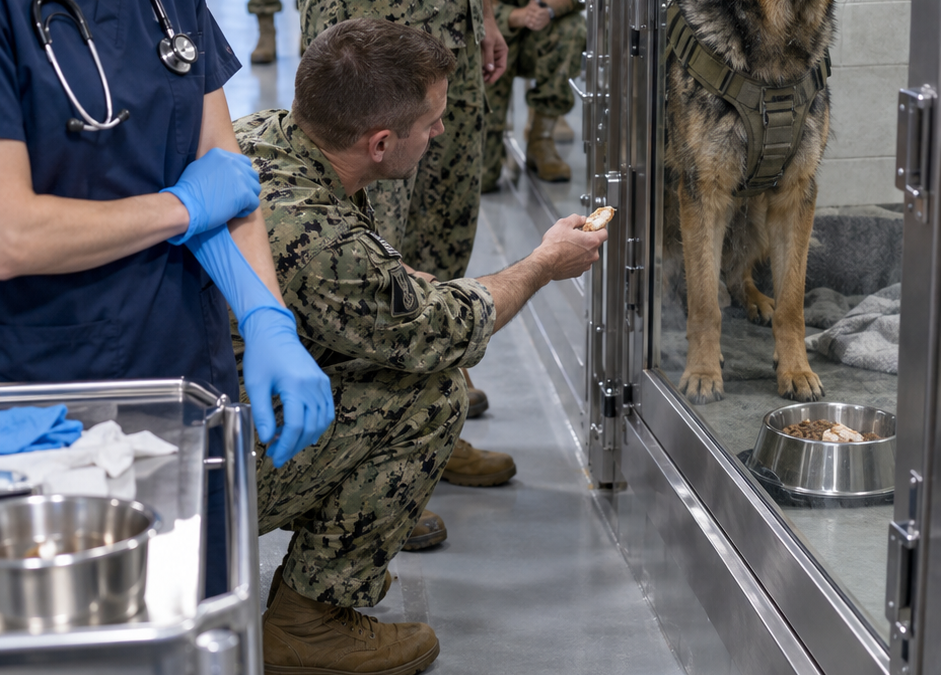
He stood inside the rear kennel of the Navy rehabilitation clinic with a worn tactical harness strapped across his chest, amber eyes fixed through the glass toward the corridor.
Not at the men around him.
Not at the food.
Not at the leash.
The corridor.
That was the first thing I noticed.
Senior handler Daniel Mercer stood near the kennel door with a tablet tucked under one arm.
“Rex. Heel.”
Nothing.
Daniel waited three seconds.
“Rex. Here.”
One ear turned toward him.
The rest of the dog did not move.
Daniel lowered the lead.
Behind his shoulder, the handling log already showed five names marked unsuccessful.
He added a sixth.
Nobody said anything.
A stainless-steel bowl sat untouched against the kennel wall.
Someone had added warm chicken to Rex’s food earlier in the morning.
By the time I arrived, it had gone cold.
“That’s six,” Daniel said.
The sixth handler crouched sideways outside the kennel, holding another piece of chicken between two fingers.
“Easy, Rex.”
Rex ignored him.
“Good boy.”
Nothing.
The handler glanced toward Daniel.
“He’s shut down.”
I was standing beside the medical cart pulling on blue examination gloves.
I had been brought into the rehabilitation bay for one reason.
A dressing beneath Rex’s harness needed to be changed.
That was all.
Daniel had made the boundary clear the moment I arrived.
“Medical only, Nurse Carter. We handle behavior.”
I had nodded.
I wasn’t offended.
I wasn’t a dog trainer.
Before nursing school, I had spent years around military rehabilitation medicine, enough to know that competence becomes dangerous when it starts pretending to be authority.
So I stayed inside my lane.
At least, I tried to.
But the sixth handler’s assessment bothered me.
Shut down.
I looked at Rex again.
A shut-down animal retreats inward.
Weight shifts back.
Head lowers.
Eyes search for distance.
Body becomes smaller.
Rex was doing none of those things.
His breathing was quick but controlled.
His head was high.
His front paws were planted under him.
His weight was forward.
He did not look like an animal trying to disappear.
He looked ready.
For what, I didn’t know.
A kennel latch slammed farther down the corridor.
Metal against metal.
Rex’s ears snapped toward the sound.
One front paw moved half an inch toward the doorway.
Then stopped.
I looked at Daniel.
“How long has he been doing that?”
He kept watching the dog.
“Ignoring commands?”
“No.”
I nodded toward the glass.
“Watching the door.”
Daniel finally followed my eyes.
“He watches everything.”
“Maybe.”
I stepped half a pace left.
For one second, my body blocked Rex’s line of sight into the corridor.
His reaction was immediate.
No barking.
No growling.
He simply moved his head around me until he could see the hallway again.
I stepped right.
His head followed.
I moved away.
Rex returned to his original position.
Daniel lowered the tablet slightly.
“Vigilance.”
“Could be.”
“He came off a combat deployment.”
“I know.”
I crouched beside the medical cart.
A strip of dressing was visible beneath the lower edge of Rex’s tactical harness.
The gauze had begun to lift.
A faint stain had spread through one side.
“When was that changed?”
“Yesterday morning.”
“It needs to come off.”
Daniel’s jaw tightened.
“That’s why you’re here.”
“Has anyone managed to reach it without sedating him?”
The silence answered before he did.
“We tried.”
He looked toward the harness.
“No one gets near that strap.”
The handler beside the kennel stood.
“Then muzzle him and get it done. Evaluation starts tomorrow. We can’t keep negotiating with him.”
He reached toward the latch.
Rex changed before the man touched it.
His shoulders rose.
Front legs braced.
Eyes sharpened.
But again, he was not looking at the handler.
He was looking past him.
At the opening the man was about to create.
I pulled off one glove.
“Wait.”
The handler stopped.
“Don’t open it.”
Daniel turned.
“That dressing has to come off.”
“I know.”
“Medication, wound care, handling evaluation tomorrow afternoon. If he can’t be safely managed outside this kennel, rehabilitation changes direction.”
I looked at Rex.
“Give me one minute.”
Daniel checked the wall clock.
“For what?”
I removed my second glove.
Then I sat on the cold floor outside the kennel.
Several feet from the glass.
No food.
No lead.
No command.
I put my hands loosely in my lap.
I wanted every part of my body to stop asking Rex for something.
Daniel folded his arms.
“Six trained handlers couldn’t move him.”
“I noticed.”
“And your plan is to sit there.”
“For one minute.”
The room went quiet.
Ventilation whispered overhead.
Rex remained standing.
Ten seconds.
His eyes stayed on the corridor.
Twenty.
His paws stopped making those tiny adjustments against the rubber floor.
Thirty.
His breathing began to slow.
Forty.
Then, for the first time since I had entered the room, Rex looked away from the doorway.
Directly at me.
I did not smile.
Did not praise him.
Did not lift a hand.
I let him look.
Two seconds.
Three.
Then his eyes returned to the hallway.
Daniel’s arms slowly unfolded.
“Nurse Carter.”
His voice had changed.
Less certain.
“If he isn’t refusing us, what is he doing?”
“I don’t know.”
That answer surprised him.
I watched Rex return to the same position he had held before anyone came into the bay.
“I just don’t think refusal explains everything.”
Behind Daniel, the sixth handler began clearing equipment from the failed session.
Without thinking, he reached toward a worn leather collar hanging from a wall hook beside a folded lead.
Rex shot upright.
Absolute tension.
Still no bark.
No lunge.
No retreat.
My eyes moved from the old collar to Rex’s tactical harness.
Then to the doorway.
“Don’t touch that.”
The handler froze.
Daniel looked at the collar.
Then Rex.
Then me.
Nobody spoke.
This time, Daniel did not remind me that behavior was his responsibility.
He simply motioned everyone away from the wall.
The handler stepped back.
Rex remained planted between the room and the corridor.
And something changed in Daniel’s expression.
Six handlers had spent two days trying to make Rex abandon that position.
For the first time, I think Daniel considered the possibility that Rex had never been refusing to move.
He might have been refusing to abandon something none of us understood.
I stood.
“Nobody touches his old gear.”
Daniel looked toward the visible edge of the wound dressing.
“We still need the exam.”
“I know.”
“And that dressing change.”
“I know.”
He checked the clock.
“We’re already behind.”
I looked through the glass.
“Forcing it before we understand where his reaction starts won’t teach us anything.”
“What do you want?”
“Show me the last attempt.”
Daniel frowned.
“You want us to provoke him?”
“No.”
I shook my head.
“I want to see exactly where the reaction begins.”
Daniel pointed to Cole, one of the handlers.
“No contact. The second she says stop, you stop.”
Cole approached at an angle.
Rex watched him.
One step.
Two.
Nothing.
Cole crouched.
Still nothing.
Then his hand lifted toward the buckle at Rex’s shoulder.
Rex turned to stone.
“Stop.”
Cole froze inches away.
Rex did not growl.
Did not strike.
Did not back away.
His entire body simply locked.
“Back up.”
Cole retreated.
Several seconds passed.
Rex’s weight gradually shifted forward again.
Toward the door.
I looked at Daniel.
“Again. Same distance. Keep your hands down.”
Cole repeated the approach.
Crouched.
Both hands remained against his thighs.
Rex tracked him.
But he did not harden.
Daniel saw it.
“It’s the reach.”
“Looks like it.”
“Or he knows the reach comes before restraint.”
“Could be.”
I kept watching Rex.
“Either way, now we know where the pressure starts.”
Daniel studied me.
Then the clock.
“Five minutes.”
“For?”
“To show me a medical plan.”
I pulled a stool close to the kennel.
Placed my tray on it.
Saline.
Gauze.
Tape.
Scissors.
I lifted each item before setting it down where Rex could see it.
His eyes followed my hands.
The scissors touched stainless steel.
A soft click.
One of Rex’s ears flicked.
Daniel watched.
“You think showing him gauze changes anything?”
“I think knowing what moves next might.”
I pulled on one glove.
The nitrile snapped against my wrist.
Rex turned his head.
I stopped.
Waited.
His attention returned to the corridor.
Only then did I put on the second glove.
I stepped toward the kennel entrance.
Daniel immediately moved in front of me.
“No.”
I stopped.
“You’re medical staff. If he reacts inside that kennel, I answer for you and him.”
“Then keep me outside.”
His expression shifted.
“I only want the door opened.”
“Why?”
“Because every time someone controls the entrance, he changes.”
Daniel looked at Rex.
“You think the doorway matters.”
“I think we can find out without touching him.”
Daniel considered it.
Then placed a hand on the latch.
“You stay behind the threshold.”
“Agreed.”
“No reaching.”
“Agreed.”
The latch clicked.
Rex’s ears snapped forward.
Daniel opened the kennel door.
I stayed exactly where I promised.
Rex stared into the corridor.
His breathing quickened.
I did nothing.
Ten seconds.
Twenty.
Then Rex moved.
One slow step sideways.
Not toward me.
Across me.
Until his body stood between me and the open doorway.
Daniel narrowed his eyes.
“He’s blocking it.”
I stayed still.
Rex glanced briefly toward his harness.
Then toward the worn collar and folded lead on the wall.
I stepped backward.
Rex did not follow me.
He held the doorway.
“Close it,” I said.
Daniel did.
The latch settled.
Rex remained tense for several seconds.
Then loosened slightly.
“We’re done.”
Daniel looked at the dressing.
“The wound isn’t.”
“I know.”
I pulled off the gloves.
“But now we know proximity isn’t the whole problem.”
“Meaning?”
“Cole could get close until his hand moved toward the harness. I could stay close until the door opened. The old gear changes him. The doorway changes him.”
Daniel glanced toward both.
“And that helps how?”
“We stop trying to take away the harness before we figure out how to reach the wound underneath it.”
Daniel checked the schedule.
“Next wound-care window is in forty minutes.”
“Then give me forty.”
“For what?”
“To build a way in without turning his gear into a fight.”
Daniel was quiet.
Then he waved the other handlers away.
No apology.
No speech about trusting me.
Just space.
That was enough.
He set his tablet beside my tray.
“What do you need first?”
“Clear the room.”
Daniel looked across the rehabilitation bay.
“Mason, outside. Cole, stay.”
The door closed behind Mason.
Corridor noise softened.
Thirty-eight minutes.
I arranged the medical supplies where Rex could see them.
Daniel watched.
“Now?”
“You go in.”
His eyebrows lifted.
“Not me?”
“He already knows you.”
“And?”
“If this only works while I’m beside him, we haven’t solved anything.”
Daniel looked through the glass.
Then opened the kennel.
“Tell me where to stop.”
I shook my head.
“Watch Rex. He’ll tell you before I do.”
Daniel entered empty-handed.
Rex rose.
Did not retreat.
“Rex, I’m coming closer.”
Daniel stepped forward.
Rex watched.
Another step.
The dog’s weight shifted.
Daniel stopped.
He did not ask me whether he was close enough.
He watched the dog.
Several seconds later, Rex’s shoulders loosened.
Daniel held up a square of gauze.
“I’m touching your shoulder.”
His hand moved.
Rex stiffened.
Daniel froze.
No correction.
No command.
No irritation.
He simply waited.
When the tension eased, he placed his fingertips against the fur above the harness.
Rex stayed.
Daniel removed his hand before Rex had to pull away.
That mattered.
Rex looked toward the doorway.
Then back at him.
Daniel approached again.
“I’m touching the strap.”
His fingers reached the harness.
Paused.
Rex’s breathing quickened.
But he did not lock.
Daniel slipped two fingers beneath the strap.
Lifted it barely an inch.
The edge of the dressing appeared.
I put on fresh gloves.
Daniel looked at me.
“Come in.”
“That’s his decision.”
I stepped through the doorway.
Stopped.
Rex watched me.
I held up the saline.
“I’m coming beside you.”
One step.
Wait.
Another.
I knelt several feet away.
“I’m reaching toward your shoulder.”
My hand moved.
Rex stiffened.
I stopped.
Waited until his attention came back to me.
Tried again.
This time, my fingers reached the space beneath the lifted strap.
Rex stayed.
I exposed only what I needed.
Wet gauze.
Cleaned the wound edge.
When his breathing changed, I stopped.
When it settled, I continued.
Daniel held the harness open without gripping the dog.
One minute later, I replaced the dressing.
Pressed the tape.
“Done.”
I withdrew first.
Daniel lowered the harness and stepped back.
Rex remained standing.
No muzzle.
No restraint.
No fight.
Outside the kennel, I removed my gloves.
Daniel picked up his tablet.
“What goes in the chart?”
“Announce every contact.”
He typed.
“Show equipment before it moves toward him.”
Typed.
“Stop when his attention or breathing changes.”
Typed.
“Don’t force the harness.”
Typed.
I hesitated.
“Don’t mistake tolerance for permission to push farther.”
Daniel’s thumb stopped.
Then he entered that too.
He added my name beside the wound-care instructions.
“I’m not a K9 handler.”
“I know.”
Daniel lowered the tablet.
“That’s why I’m still the one entering the kennel.”
He nodded toward Rex.
“But you’re seeing something I wasn’t.”
His jaw tightened slightly.
“So until I can see it too, you’re part of this.”
Behind the glass, Rex slowly lowered himself onto his front paws.
His head remained up.
But the constant shifting stopped.
Daniel reached toward the collar on the wall.
Rex’s ears lifted.
Daniel stopped before I said anything.
Dropped his hand.
Rex settled again.
That was the real change.
Not in Rex.
In Daniel.
He was beginning to notice what the dog said before the dog had to say it loudly.
Daniel picked up the tray.
“Tomorrow you stay outside.”
I looked at him.
“And?”
“I do everything we did today without needing you to stop me.”
He glanced toward Rex.
“If this helps him, it has to become something I know how to do.”
The next morning, Daniel entered Rex’s kennel before I said a word.
The collar stayed on the wall.
The folded lead remained beside it.
“Rex, I’m coming closer.”
One step.
Pause.
“I’m touching your shoulder.”
Daniel lifted his hand only after Rex looked at it.
His fingers settled.
Rex stayed loose.
“I’m touching the strap.”
Pause.
Daniel lifted the harness edge.
Checked the dressing.
Released it before Rex needed to pull away.
Then stepped back.
He looked through the glass at me.
“How was that?”
I glanced toward Rex.
“Ask him.”
Daniel looked back.
Rex stood close to him instead of retreating to the rear of the kennel.
Daniel gave a faint nod.
“Fair enough.”
By noon, I had returned to my hospital duties twice.
Each time I came back to the rehabilitation bay, Daniel was using the same structure.
He announced the water bowl before moving it.
Paused at the latch.
Stopped when Rex’s breathing changed.
He was no longer waiting for Rex to become rigid.
That afternoon, Daniel picked up the lead.
The old leather loop lifted from the wall.
Rex saw it.
His entire body changed.
He backed away.
Crossed the kennel.
Planted himself between the lead and the doorway.
Daniel stopped.
Did not hide the lead.
Did not correct him.
“Rex, I’m holding the lead.”
The dog stayed braced.
“I’m not coming closer.”
I had just entered the bay.
Daniel glanced at me.
“He was fine until this.”
“Then don’t make it disappear.”
He looked at the lead.
“Leave it out. See if he can settle while it exists.”
Daniel placed it on a chair several yards away.
Nobody moved toward Rex.
Ventilation hummed.
Nearly a minute passed.
His breathing slowed.
But he stayed between the chair and the doorway.
Daniel saw it.
“He settled.”
“Yes.”
“But he didn’t move.”
“No.”
Daniel looked from the lead to Rex.
“So the lead means something different.”
“We know it changes what he does.”
“That’s all?”
“That’s all we actually know.”
Daniel rested both hands on the counter.
“His evaluation is tomorrow.”
“For continued rehabilitation.”
“For whether operational rehabilitation is still realistic.”
He looked at Rex.
“I need to show he can be handled outside this room. Controlled movement. Physical assessment. Transition work.”
“And if he can’t?”
“They’ll recommend another placement instead of working-status rehabilitation.”
Daniel picked up the lead again.
Stayed where he was.
Rex rose instantly.
Blocked the doorway.
“Rex. Here.”
One ear turned.
No movement.
“Rex. Here.”
Nothing.
The dog was not watching Daniel.
He was watching the door.
Daniel lowered the lead.
“Yesterday I thought we needed to teach him the harness was safe.”
I waited.
“Now I’m not sure safety is what he’s worried about.”
“What changed?”
“He lets me touch him.”
Daniel nodded toward Rex.
“He can settle around the harness.”
Then the lead.
“But the second this comes out, he takes that position.”
I stepped closer to the glass.
“Then stop asking whether he’ll go through the door.”
Daniel looked at me.
“I need him through the door.”
“I know.”
“So what am I supposed to ask?”
I watched Rex hold position.
“What he thinks will happen if he leaves it.”
Daniel said nothing.
Neither of us pretended that answer was scientific.
But repeating the same command was not going to explain the behavior.
Daniel went to the counter.
Picked up Rex’s transfer folder.
Until then, we had worked from the medical pages.
Injury.
Medication.
Rehabilitation notes.
He opened deeper into the file.
Several deployment entries sat behind an access marker.
I stayed where I was.
“You’re his handler.”
Daniel looked toward the restricted section.
“And I’ve been treating this like a training problem.”
He opened the first available deployment note.
“If he’s protecting something instead of refusing something, I need to know what happened before he got here.”
I looked at Rex.
“Whatever he’s waiting for didn’t start in this room.”
Daniel read.
Then read again.
Finally:
“Previous handler, Lieutenant Aaron Hayes. SEAL K9 element.”
The name changed the room.
I stayed quiet.
Daniel scrolled.
Stopped.
“Hayes was killed during Rex’s final deployment.”
The ventilation system hummed.
Nothing else moved.
I looked toward Rex.
Not the screen.
“What happened to Rex afterward?”
“Recovered with Hayes’s equipment. Treated overseas. Transferred stateside.”
Daniel read farther.
“Some handling details are restricted.”
“Anything about his last task?”
“Not here.”
He lowered the tablet.
“So he lost his handler.”
“Yes.”
“That could explain all of this.”
“It could.”
I looked toward the doorway.
“But it doesn’t explain enough.”
Daniel frowned.
“A frightened dog usually shows you that distance matters.”
I nodded toward Rex.
“He keeps choosing position.”
“Meaning?”
“He watches the exit. The lead appears, he moves between it and the doorway. Someone reaches for his harness, he doesn’t run away from the gear.”
I paused.
“He holds ground around it.”
Daniel looked at Rex.
“You think he’s waiting for Hayes.”
“I think we should be careful deciding what a dog believes.”
That mattered.
We could turn grief into a story too easily because stories comfort humans.
Rex deserved better than our need for symbolism.
“But whatever this is,” I continued, “it has structure.”
Daniel studied me.
“You’ve seen something like that before.”
I was quiet for a moment.
“I spent several years in trauma rehabilitation around special operations personnel.”
He waited.
“Sometimes people came in after the danger ended, but their bodies hadn’t caught up yet.”
I looked toward Rex.
“Certain routines mattered. Certain words mattered. You didn’t break those routines just because you didn’t understand them.”
Daniel glanced at the tactical harness.
“And working dogs?”
“I saw enough teams pass through rehab to know some cues aren’t ordinary obedience commands.”
“Task cues.”
“Yes.”
“Release cues.”
“Yes.”
His eyes narrowed.
“End-of-work cues.”
“Sometimes.”
I kept watching Rex.
“And sometimes the language belonged to one handler-dog relationship more than anyone else around them.”
Daniel looked toward the restricted record.
“You think Hayes had one.”
“I think we don’t know enough to use anything we find.”
Through the glass, Rex stayed facing the corridor.
Daniel stared at him.
Then something shifted.
“He’s not trying to get away from the lead.”
I said nothing.
Daniel looked at the dog’s position.
“Every time it appears…”
He paused.
“He gets between the gear and the exit.”
“Yes.”
“He’s taking a position.”
I nodded once.
Nothing more.
Daniel approached the kennel.
“Rex.”
The dog looked at him.
Daniel put one hand on the latch.
Waited.
“I’m opening the door.”
The latch clicked.
He opened it.
Then stepped aside.
No recall.
No lead.
No hand reaching toward the harness.
Rex stood behind the threshold.
Daniel moved several feet away and sat down.
The corridor remained completely open.
I stayed beside the medical cart.
Nobody called the dog.
One minute passed.
Rex stared down the empty hallway.
Then stepped forward.
One paw crossed.
Then the other.
He stopped halfway.
Half inside.
Half outside.
Daniel’s hand moved automatically toward the lead.
He caught himself.
Dropped it.
Rex stayed.
Breathing steady.
Daniel looked at me.
“So getting him through the door was never enough.”
“No.”
I studied Rex’s position.
“He can cross it and still hold the same watch.”
Daniel rose.
Returned to the folder.
“Then I want the complete handling file.”
I looked at him.
“All preserved material from Hayes’s team?”
“Command categories. Recovery notes. Equipment logs.”
“If there’s a restricted cue, we don’t test it because you’re running out of time.”
“Agreed.”
“Not even for tomorrow’s evaluation.”
Daniel hesitated.
Then:
“Agreed.”
He submitted the request.
Rex stayed halfway across the threshold.
Free to go either direction.
Daniel stared at him.
“A day ago, I would’ve called that progress.”
I understood.
“Now?”
“Now it just makes the question bigger.”
He lowered his voice.
“Yesterday, I needed him to obey.”
Then looked at Rex.
“Today I need to know whether anyone ever told him the job was over.”
That sentence stayed with me.
“Maybe that’s the first question that matters.”
The complete handling record arrived before the rehabilitation bay closed for the evening.
Daniel opened it at the counter.
Rex remained near the kennel entrance.
Free to move.
“Most of this is routine.”
Daniel scrolled.
“Feeding schedules. Transport. Equipment. Standard obedience.”
His thumb stopped.
“There.”
I moved beside him.
One entry was flagged.
Legacy handler cue. Retired. Do not use for routine handling.
Daniel opened it.
Associated exclusively with Lieutenant Hayes. Not transferred to replacement personnel.
Beneath that:
Task release — end of watch.
I went still.
Daniel noticed.
“That means something.”
“The category does.”
“You mentioned release cues.”
“They’re not obedience shortcuts.”
I looked at Rex.
“They end something specific.”
Daniel scrolled farther.
Most operational context was redacted.
But one note remained.
Legacy verbal cue retained for behavioral context only.
Daniel frowned.
“So they kept it because someone thought his behavior might still be connected to the task.”
“Maybe.”
I pointed toward the warning above it.
“But they retired it because Hayes was the person who gave it.”
Daniel opened the final notation.
His thumb stopped.
I read over his shoulder.
Neither of us spoke.
Across the room, Rex watched the corridor.
Daniel looked from the screen to the dog.
“That’s it.”
“It’s a phrase.”
“It’s listed under task release.”
“Yes.”
“Then what are we missing?”
“The thing he’s being released from.”
Daniel looked again at the final line.
“You think this could end it?”
“I think we still don’t know enough to say it.”
“We know what it was for.”
“We know the category.”
I turned toward him.
“We don’t know what Hayes asked Rex to do last.”
Daniel went quiet.
“We don’t know what Rex connects those words with.”
Nothing.
“And we don’t know what happens if someone who isn’t Hayes says them in the wrong context.”
Daniel glanced at the clock.
“Tomorrow’s evaluation may decide whether he stays in operational rehabilitation.”
“I know.”
“If those words release him…”
“Then using them tonight just to see what happens would be the worst possible reason to use them.”
Daniel went silent.
I stepped away.
“A release has to release something.”
I nodded toward Rex.
“Until Rex shows us what that is, those words stay in the record.”
Daniel stared at the screen.
Then locked the tablet.
The phrase disappeared.
“We don’t test it.”
“No.”
“Even if tomorrow goes badly.”
“Especially then.”
He turned the tablet face down.
“What are you willing to take responsibility for?”
“His wound care. Medical limitations. What I can observe.”
I nodded toward the dark screen.
“If Rex gives us the missing context, I’ll tell you what I see.”
“But you’re not taking over training.”
“No.”
“Or becoming his handler.”
I looked at Rex.
“He already lost one.”
That answer landed differently.
“I don’t want his recovery to depend on another person he can’t function without.”
Daniel followed my gaze.
“Then tomorrow I handle him.”
“Yes.”
“You handle the medical judgment.”
“Yes.”
“And Rex decides whether he moves.”
I nodded.
Daniel walked to the kennel.
“Rex. I’m opening the door.”
The latch clicked.
Daniel stepped aside.
No lead.
No recall.
I deliberately moved farther from the entrance.
Rex looked at me.
Then Daniel.
Then the empty corridor.
Nobody called.
Several seconds passed.
He stepped forward.
One paw.
Then another.
Again, he stopped halfway through the doorway.
Daniel kept both hands down.
I stayed beside the cart.
“Tomorrow,” I said, “if he freezes, you don’t force him through.”
“If the evaluator stops us?”
“That’s their authority.”
Daniel glanced toward the locked tablet.
“And if Rex shows us what the cue was meant to release?”
“Then we judge what is actually in front of us.”
“And if you think the context is right?”
I waited.
“Then we decide whether those words belong in that moment.”
Daniel studied me.
“Not because we need him to pass.”
“Not because we need him to pass.”
He nodded.
Then took the lead from the chair and placed it on the counter.
Away from Rex’s path.
“I need you in the room tomorrow.”
I watched Rex.
“I’ll be there.”
That night, the restricted command sat locked inside Daniel’s tablet.
Known only to us.
Neither of us said it.
Rex remained at the threshold.
Facing the empty corridor.
And for the first time, I understood why the word frightened me.
It was not dangerous because it could control him.
It was dangerous because it might mean something.
The evaluation began the next morning with the kennel door already open.
Nobody held the lead.
Daniel stood several yards down the corridor.
I stayed beside the medical cart.
Exactly where I had promised.
“Rex, I’m moving ahead.”
Daniel stepped backward.
Rex watched him.
Then crossed the threshold by himself.
One step.
Another.
Nails clicking against polished floor.
Daniel kept his hands low.
“Rex. Here.”
Rex followed.
No leash.
No pressure.
His tactical harness stayed across his chest.
They passed the treatment bay.
Then the equipment station came into view.
Rex stopped.
Daniel stopped with him.
Several pieces of recovered working gear had been placed on a bench.
Daniel had requested them after the complete record confirmed Rex had returned stateside with equipment from his final deployment.
One item sat apart.
A faded handling harness.
Hayes’s.
Rex stared at it.
His ears lifted.
Breathing changed.
But he did not retreat.
Instead, he moved toward the bench.
Then turned.
By the time Daniel understood what he was seeing, Rex had positioned himself between Hayes’s harness and everyone else in the corridor.
Something tightened beneath my ribs.
The doorway.
The old collar.
The lead.
Rex’s tactical harness.
Every time those objects entered the situation, Rex had taken a position.
Now the pattern had led us here.
Daniel tried once.
“Rex. Here.”
One ear turned.
Rex stayed beside Hayes’s harness.
Daniel did not repeat the command.
Behind the observation glass, the evaluator lowered his pen.
A technician started toward the corridor.
Daniel raised one hand.
“Stay back.”
The technician stopped.
Rex never looked away from the faded harness.
Daniel looked toward me.
I watched Rex’s front legs.
Shoulders.
Weight.
No retreat.
No panic.
A watch.
Daniel looked at the harness again.
Then at the dog guarding it.
His voice was barely above a whisper.
“End of watch.”
I gave the smallest nod.
The phrase in the record had finally acquired context.
Daniel stepped back.
He did not tell me to speak.
Did not ask permission.
He simply opened space between Rex and me.
I left the medical cart.
My shoes sounded too loud in the corridor.
Rex turned one ear.
Held position.
I stopped several feet away.
No hand extended.
No lead.
No attempt to touch Hayes’s harness.
“Rex.”
His eyes shifted toward me for less than a second.
Then returned to the old nylon.
I crouched.
Daniel remained behind me.
The ventilation fan hummed.
A latch sounded in another wing.
Then silence.
The night before, the phrase had been nothing but text inside a restricted file.
I had refused to use it because words without context become experiments.
Now Rex had given us the missing piece.
The record gave us the language.
Rex had shown us what he was still guarding.
Hayes’s gear.
Hayes’s watch.
Maybe the final duty a dead handler had never lived long enough to end.
I waited.
Rex’s ear turned toward me again.
I lowered my voice.
“Rex.”
His eyes flicked.
Then I spoke the retired command no replacement handler had been authorized to use.
“Stand down.”
Nothing moved.
Daniel held his breath.
Behind the glass, the evaluator’s pen stopped above the page.
One second.
Then another.
I did not repeat it.
If the command mattered, it did not need me forcing it.
Rex lowered his eyes.
His nose touched the frayed strap of Hayes’s harness.
Once.
He inhaled against the old nylon.
And something in him changed.
Not dramatically.
No collapse.
No whine.
No sudden transformation.
His jaw loosened.
The rigid line across his shoulders softened.
His front legs unlocked.
Then Rex stepped away from the bench.
Nobody spoke.
He looked back at Hayes’s harness.
Took another step.
Toward me.
I stayed crouched.
Hands open on my knees.
Rex crossed the distance slowly.
Stopped in front of me.
For several seconds, he only stood there.
Breathing.
Then he lowered his head against my chest.
My eyes closed.
My fingers trembled once.
One hand settled gently against the side of his neck.
No applause.
Daniel did not praise him.
Nobody reached for the leash.
Nobody touched Hayes’s harness.
I felt one breath against me.
Then another.
I opened my eyes.
And moved my hand away first.
“Daniel.”
Nothing more.
Daniel stepped into Rex’s field of view.
No heel.
No recall.
He waited.
Rex lifted his head from me.
Looked once toward Hayes’s harness.
It remained where he had left it.
Nobody had taken it.
Nobody asked him to return to it.
Rex looked at Daniel.
Then walked to him.
On his own.
Daniel lifted a hand toward Rex’s shoulder.
Stopped several inches away.
Waited.
Rex stayed loose.
Only then did Daniel touch the tactical harness.
Behind the glass, the evaluator finally lowered his pen.
“Do you want to continue?”
Daniel looked at me.
Not as Rex’s handler.
For the medical judgment he had promised would remain mine.
I watched Rex.
Breathing steady.
Stance balanced.
Shoulders loose.
Wound protected.
I nodded once.
Daniel faced the corridor.
“We continue.”
He started forward.
Rex followed.
They passed the equipment station.
Rex looked back once.
Hayes’s harness remained on the bench.
For a second, he slowed.
Daniel did not call.
I did not speak.
Rex turned forward.
Continued beside Daniel.
Their footsteps softened down the corridor.
I stayed beside the old harness.
Did not follow.
For the first time since Rex had arrived at the rehabilitation clinic, Hayes’s gear stayed behind.
And Rex chose to leave it there.
Daniel did not reach for the lead when Rex stopped beside him.
Instead, he turned toward the evaluator.
“Give us a minute.”
The evaluator lowered the clipboard.
Stepped back.
Rex remained loose at Daniel’s side.
His eyes moved once toward Hayes’s harness.
Then forward.
I approached only far enough to assess him.
“Breathing steady.”
Daniel listened.
“Gait even. No guarding at the shoulder. Dressing intact.”
“Stable?”
“Yes.”
Daniel nodded.
“Then we stop.”
The evaluator glanced at his checklist.
“You still have three handling measures.”
“Tomorrow.”
Daniel answered without hesitation.
“I’m not trading what he just gave us for three boxes on a form.”
The evaluator looked at Rex.
Then marked the sheet.
Left.
Only after the corridor door closed did Daniel speak again.
“That cue stays out of routine handling.”
“Yes.”
“Not recall.”
“Yes.”
“Not compliance.”
“Yes.”
He looked at me.
“And I don’t ask you to use it again.”
I waited.
Then nodded.
Daniel walked toward Hayes’s harness.
Reached for it.
Rex’s head came up.
Daniel stopped immediately.
Waited.
“Rex. I’m putting this away.”
Rex watched.
Daniel lifted the faded harness.
Carried it toward a secured equipment cabinet on the opposite side of the room.
Never brought it near the dog.
Placed it inside.
Closed the door.
Metal latch clicked.
Rex stayed where he was.
Loose.
Daniel returned empty-handed.
“Rex, I’m opening the kennel.”
He opened the door.
Stepped aside.
No recall.
No leash.
Rex approached within seconds.
Paused at the threshold.
Then walked inside.
On his own.
Daniel closed the door gently.
“That’s enough.”
I started returning supplies to the medical cart.
Daniel glanced over.
“You’re leaving?”
“I have patients.”
A faint humor entered my voice.
“Remember those?”
“Unfortunately.”
“Tomorrow’s dressing change.”
He nodded.
“You do the wound.”
“You do the approach.”
“And if he tightens up?”
I slid the saline into a drawer.
“You stop before I have to tell you.”
Daniel nodded.
The next morning, I walked into the rehabilitation bay carrying fresh gauze.
Daniel was already inside the kennel.
“I’m touching your shoulder.”
He waited.
Rex stayed loose.
“I’m lifting the strap.”
Pause.
Daniel loosened the harness just enough to expose the dressing.
He watched Rex.
Not me.
“Ready when you are.”
I entered with the tray.
Nobody cleared the room.
Nobody hid the collar.
Nobody moved the lead.
I knelt beside Rex.
“I’m cleaning the wound.”
Daniel held the harness without gripping him.
Rex’s breathing remained even.
I removed the dressing.
Cleaned.
Checked healing tissue.
Replaced the gauze.
“Done.”
I withdrew.
Daniel secured the strap.
Rex looked at him.
Then lowered his head.
I removed my gloves.
Daniel picked up the rehabilitation schedule.
A second handling session had been planned for that afternoon.
He watched Rex.
Then crossed it out.
“Recovery time.”
I washed my hands at the stainless sink.
“Good call.”
Daniel did not look at me for approval.
That mattered.
His attention stayed on Rex.
I dried my hands.
“You don’t need me for the next handling session.”
Daniel glanced over.
“Medical?”
“Call me.”
“Training?”
I looked toward Rex, resting near the kennel entrance.
“That’s yours.”
Daniel accepted the distinction.
I pushed my medical cart toward the corridor.
Behind me, the kennel latch clicked.
I slowed.
Looked back.
Daniel’s hand rested on the latch.
Door still closed.
“Rex, I’m opening the door.”
He waited.
Rex raised his head.
Ears toward Daniel.
Body loose.
Daniel opened the door.
Stepped aside.
I watched just long enough to see Rex rise without being called.
Then I turned away.
Nobody stopped me.
Nobody asked what came next.
That was how I knew the work had actually changed.
Three weeks later, I passed the rehabilitation yard carrying a sealed dressing kit I no longer needed for Rex.
Morning light stretched across the concrete.
Wet grass.
Clean canvas.
Cool air.
Beyond the fence, Daniel walked with Rex at his left side.
No lead pulled tight.
No second handler waiting at the gate.
I slowed.
Daniel had not seen me.
I kept walking until one of the fence posts partly hid me.
He stopped beside a low training platform.
“Rex, I’m touching your harness.”
His hand hovered.
Rex looked up.
Daniel waited.
Then adjusted the strap.
“Up.”
Rex stepped onto the platform.
Crossed.
Returned to Daniel’s side.
No hesitation.
No glance toward the clinic doors.
At the gate, Daniel raised the latch.
Stepped aside.
Rex looked through the opening.
For a second, I found myself watching his front paws.
Three weeks earlier, an open doorway had transformed his entire body.
Rex stepped through.
Daniel followed.
Then Rex saw me.
His ears lifted.
I stopped.
Did not crouch.
Did not call his name.
Daniel gave no command.
Rex looked at me.
Then back at Daniel.
Daniel kept both hands at his sides.
The decision remained Rex’s.
Rex left him.
Crossed half the distance between us.
I held out the back of my hand.
His nose touched my knuckles once.
“Hey.”
He stood there another second.
Breathing easy.
Shoulders loose.
Then he turned.
Walked back to Daniel.
No recall brought him there.
Daniel placed one hand against his shoulder.
Rex leaned into the contact briefly.
Then faced the yard.
I looked down at the sealed dressing kit.
“Guess I can finally stop carrying this over here.”
Daniel glanced at it.
“His wound closed last week.”
“I know.”
“Then why are you still carrying it?”
I looked at the package.
“Habit.”
Daniel nodded toward the clinic.
“Sounds familiar.”
A faint smile touched my face.
I placed the kit on a supply cart.
Daniel opened Rex’s rehabilitation chart.
Read the morning notes.
Watched him move across the concrete.
Then closed the folder.
“We’re done for the morning.”
Only then did he look at me.
“Anything medical you disagree with?”
I watched Rex shift his weight.
“No guarding.”
“No favoring the healed side.”
“No.”
“Good.”
Daniel tucked the chart beneath his arm.
Footsteps approached from the far side of the yard.
Cole came toward us carrying a lead.
Weeks earlier, the sight of that leather line had sent Rex straight toward a doorway.
Now Cole stopped several feet away.
“Coming in on your right, Rex.”
One ear turned.
Cole waited until Rex looked at him.
Then lifted the lead where the dog could see it.
Only after that did he approach.
Rex remained loose.
Cole clipped it to the working harness.
No tension.
No correction.
No fight.
I watched.
“He’s getting better.”
Daniel looked at Cole.
Then Rex.
“Cole is.”
I laughed softly.
“Both of them.”
The corner of Daniel’s mouth moved.
“Fair.”
I checked the time.
Hospital shift in six minutes.
I turned toward the entrance.
Metal clicked behind me.
A gate latch.
My step slowed.
I looked back.
Cole had opened the gate.
Rex stood beside Daniel.
Relaxed.
Cole waited.
Did not pull.
Daniel waited too.
After a moment, Rex walked through.
Nobody hurried him.
Nobody reached for his harness without warning.
Nobody looked toward me for instructions.
Daniel caught my eye across the yard.
He gave a small nod.
I returned it.
Nothing more.
I turned toward the hospital.
Another shift waited.
A patient would need medication.
Somebody would need a dressing changed.
A call light would come on.
The ordinary work of the day would continue without knowing anything important had happened in that rehabilitation yard.
Behind me, boots moved across pavement.
Canvas shifted.
Metal touched metal.
I reached the hospital entrance.
Did not look back again.
Later, Daniel would tell me that Rex had stopped at one more doorway on the way to the training field.
Not frozen.
Not rigid.
Just stopped.
Daniel had opened the passage.
Stepped aside.
Said nothing.
Cole stayed quiet.
Rex looked at the open field beyond it.
For three weeks, we had been learning that progress was not getting him through doors.
Progress was giving him enough information, enough space, and enough trust to decide the door no longer required guarding.
Rex stood there for several seconds.
Then crossed.
No command.
No pull.
No retired cue.
Just a dog choosing the next place to stand.
When Daniel told me that later, I thought about the first morning I had seen Rex.
Six handlers called him unmanageable.
One wanted a muzzle.
Another thought he was shut down.
We believed the problem was obedience because obedience was the language we understood.
But Rex had never been withholding cooperation.
He had been continuing a duty no one had told him was finished.
Hayes died.
Rex came home.
The equipment came home.
The harness came home.
The lead came home.
But somewhere between the battlefield and rehabilitation, the one person whose voice had always ended Rex’s watch never came back to say the words.
So Rex kept the doorway.
Guarded the gear.
Held position.
And waited.
The command I spoke that day did not make him choose me.
That was never what happened.
It did something more important.
It told him there was no longer anything he had to protect for a man who could not return to relieve him.
After that, Rex came to me because he chose to.
Then he went back to Daniel because he chose that too.
Weeks later, he could watch Cole lift a lead and remain calm because the lead no longer meant someone was dragging him away from unfinished work.
Daniel learned to stop demanding answers before Rex had given the question.
Cole learned to announce his hands.
And I learned something I carried back into the hospital with me.
Patients do not always resist care because they do not understand what we want.
Sometimes we are the ones who do not understand what they are protecting.
A routine.
A memory.
A piece of control.
A doorway.
The last instruction someone they trusted ever gave them.
It is easy to call resistance a problem when you are the person holding the authority.
Harder to ask what the resistance is trying to preserve.
Rex taught me to ask that question.
Daniel taught himself to keep asking it after I left the room.
That was why rehabilitation eventually worked.
Not because one nurse discovered a magic command.
Not because Rex suddenly became obedient.
And not because Hayes’s old words transferred some kind of loyalty from one person to another.
They didn’t.
The words ended a watch.
What came after belonged to Rex.
Three months after that first day, I passed the yard again near sunset.
Daniel and Rex were at the far end.
No audience.
No evaluator.
No clinic staff.
Just the two of them moving through a simple handling sequence.
Daniel stopped at the final gate.
Opened it.
Stepped aside.
Rex paused.
Looked at him.
Daniel said nothing.
Rex walked through.
Then, halfway across the field, he turned back.
For one second, I wondered whether he was looking toward the rehabilitation building.
Toward the corridor.
Toward something that no longer existed.
Instead, he looked at Daniel.
Waited.
Daniel joined him.
And they continued together.
I stood there longer than I needed to.
Then kept walking.
Because that was the part I had needed to understand too.
Rex did not need another person to replace Lieutenant Aaron Hayes.
Some losses cannot be replaced.
He needed someone patient enough not to mistake replacement for recovery.
He needed Daniel to become a new handler without pretending to become the old one.
He needed Cole to learn that a leash could be offered without being imposed.
He needed me, briefly, to recognize a pattern and refuse to use a powerful word before the moment deserved it.
Then he needed us to get out of the way.
The last time I saw Rex that month, a handler opened the training-field gate.
Rex stopped at the threshold.
Daniel stayed beside him.
Nobody spoke.
For a heartbeat, the old habit seemed to return.
Ears forward.
Eyes on the open space.
Then Rex’s body softened.
He stepped through.
No leash tightened.
No command released him.
No ghost waited on the other side.
And for the first time since he came home from war, the doorway was only a doorway.








