𝗙𝗨𝗟𝗟 𝗦𝗧𝗢𝗥𝗬 The Men Who Threw Me Into a Freezing Ditch Never Understood Why I Kept Watching My Wristwatch Instead of Begging for Help
𝗙𝗨𝗟𝗟 𝗦𝗧𝗢𝗥𝗬
The answer had been complicated.
I learned I could work.
I could ruck.
I could sleep on concrete.
I could take orders from idiots without becoming one.
I could make friends.
I could endure cruelty.
I could survive being overlooked.
But staring up at Marcus Miller from the bottom of that ditch, I learned something else.
Endurance was not always virtue.
Sometimes refusing to act only gave cruel men more room.
Miller stepped closer to the edge.
“You don’t dictate terms to me, Specialist.”
His voice hardened.
“You are a body in a uniform. I own your time. I own your assignments. And right now, I decide whether you spend the night down there.”
I looked at my watch.
Ten seconds.
Pip whispered again.
“Sergeant.”
Miller snapped his head toward her.
“What?”
She held my patrol cap tighter.
“Please.”
Jax scoffed.
Miller stared at Pip until she dropped her gaze.
Five seconds.
Four.
Three.
I looked up.
Jax was still smiling.
Miller was still certain.
Pip looked like she might cry.
The display changed.
15:00.
I lowered my wrist.
“Time’s up.”
The base siren screamed.
Jax’s smile vanished.
This was not the routine warning tone we heard during exercises.
It was continuous and violent, rising and falling through the cold afternoon until the sound seemed to vibrate inside the ditch itself.
Pip dropped my cap.
Miller spun toward the motor pool.
“What the hell?”
Then the ground began trembling.
At first, it was faint.
Then stronger.
Engines.
Several.
Heavy.
Fast.
Down the long access road, black vehicles appeared through the trees.
Four armored SUVs led the convoy.
Behind them came tactical vehicles packed with military police and federal personnel.
Lights flashed inside dark grilles.
Nobody slowed for the speed bumps.
Jax stepped back from the ditch.
“Is that CID?”
Miller didn’t answer.
Dust and red gravel rose behind the vehicles.
They entered the motor pool in a coordinated sweep, splitting toward every exit and sealing the yard before most soldiers nearby understood anything was happening.
Doors opened.
Men and women in tactical armor poured out.
Weapons low but ready.
Commands exploded across the yard.
“STEP AWAY FROM THE VEHICLES!”
“HANDS VISIBLE!”
“NOBODY LEAVES!”
Jax went pale.
“What did you do?”
I said nothing.
The lead SUV stopped near the center of the motor pool.
The rear door opened.
My father stepped out.
General Raymond Vance had spent nearly four decades learning how to enter a place without hurry and still make everyone else feel late.
He wore a dark suit beneath a black overcoat.
Silver showed at his temples.
Four stars marked the authority he carried.
Behind him came federal investigators from the Joint Federal Investigation and Corruption Task Force.
My father had spent years dismantling theft networks, procurement fraud, bribery chains, black-market military supply routes, and the officers who believed decorations could make them untouchable.
Miller knew his name.
Almost every senior logistics leader in the Army knew his name.
Miller just didn’t know mine.
Not yet.
My father surveyed the yard.
His eyes found the shipping containers first.
Then Miller.
Then me.
I stood in the ditch.
Water ran from my sleeves.
Blood had dried along my cheek.
Mud covered everything below my waist.
Miller looked from my father to me.
I watched the first crack appear in his certainty.
“Why is General Vance here?” Jax whispered.
Nobody answered.
Federal agents surrounded them.
A woman with dark hair tucked beneath her tactical helmet approached.
Special Agent Evelyn Carter.
I had never met her in person.
I knew her voice from one encrypted phone call.
“Hands up.”
Jax raised his hands.
“What is this?”
“Up.”
Miller complied more slowly.
His face was changing as he calculated.
That was what men like Miller did when power shifted.
They calculated.
What does he know?
Who talked?
What can I deny?
What can I blame on someone else?
My father stopped at the edge of the ditch.
For several seconds, he only looked at me.
There was no dramatic reunion.
We were not a dramatic family.
He looked at the cut on my face.
The angle of my injured shoulder.
The mud.
His jaw tightened.
“Specialist.”
I straightened.
“Sir.”
“State your full name and unit for the record.”
Miller’s eyes moved toward me.
I could almost hear his thoughts.
Why would a four-star general ask her name?
I lifted my chin.
“Specialist Clara Vance. Bravo Company, 407th Support Battalion.”
Silence.
Even the siren seemed farther away.
Jax looked at me.
Then at my father.
Then back at me.
Miller stopped breathing for a second.
Captain Reynolds came running out of the company office.
“What is the meaning of this?”
He looked around wildly.
“I’m the company commander. You cannot initiate a federal containment operation without notifying—”
Then he saw my father.
His voice died.
He saw me.
“Vance?”
His gaze moved between us.
“No.”
Miller whispered something under his breath.
I looked up at him from the ditch.
“Thirty seconds.”
His face went completely white.
“I told you.”
Miller moved toward the edge.
“General, sir.”
My father looked at him.
“Sir, there’s been a misunderstanding.”
Miller pointed toward me.
“She fell.”
Jax stared at him.
Miller kept going.
“Routine maintenance detail. The ground was wet. She slipped near the culvert. We were about to help her when—”
My father raised one hand.
“Stop talking.”
Miller’s mouth closed.
My father turned toward Agent Carter.
“Execute the warrants.”
Miller’s eyes widened.
“What warrants?”
Carter signaled.
Agents moved.
“Staff Sergeant Marcus Miller and Specialist Brody Jax, you are being detained pursuant to federal warrants involving theft of government property, wire fraud, conspiracy, and interstate transport of restricted military equipment.”
Jax almost collapsed.
“What?”
Steel restraints appeared.
Jax jerked backward.
“No, no. I didn’t—Miller!”
An agent forced his hands behind him.
Jax panicked.
“It was him!”
Miller spun.
“Shut up!”
“He told me to do it!”
“Jax!”
“He told me she was going to talk!”
Every head turned.
Jax was shouting now.
“He told me to push her! He said she found the manifests!”
Miller lunged half a step toward him.
Agents slammed him against the side of a truck.
“Shut your mouth, you idiot!”
“You have the right to remain silent—”
My father looked at Carter.
“Photograph Specialist Vance.”
Carter nodded.
“Every visible injury,” my father continued. “Get medical documentation.”
His eyes never left Miller.
“I want the prosecutor to understand exactly what Staff Sergeant Miller considers routine maintenance.”
For the first time, I saw fear in Miller.
Not embarrassment.
Not anger.
Fear.
My father extended one gloved hand toward me.
“Come out of there, Clara.”
He used my first name.
Something in my chest tightened.
His glove was black leather.
Clean.
Mine were covered in mud.
For most of my life, that hand represented everything I wanted to escape.
Influence.
Authority.
The certainty that one telephone call from Raymond Vance could change a career.
I looked at it.
Then at him.
And I did not take it.
I planted my boot into the wall of the ditch.
My shoulder screamed when I reached for the grass.
I climbed.
Mud slid beneath my soles.
For one ugly second I nearly went backward.
I found another grip.
Pulled.
My injured shoulder sent white pain through my chest.
I kept moving.
Finally, my knee reached the pavement.
Then the other.
I stood.
My entire body shook from cold.
My father lowered his hand.
His expression barely changed.
But his eyes did.
“I told them thirty seconds,” I said.
My voice trembled.
Not from fear.
From cold.
“They didn’t believe me.”
My father looked toward Miller.
“They rarely do.”
I did not feel victorious.
That surprised me.
For months, I had imagined what it would feel like when Miller finally lost control.
I thought there would be satisfaction.
Maybe relief.
Instead, I felt tired.
Deeply tired.
Jax had tormented me.
Miller had tried to break me.
Reynolds had ignored every warning sign.
Still, watching men placed in restraints did not give back the nights I had spent awake wondering what they would sabotage next.
It did not erase the moment I had started checking the hallway before opening my barracks door.
It did not remove the mud from my clothes.
Justice is necessary.
But justice is not a time machine.
Two hours later, I sat inside a medical tent wrapped in an Army blanket.
The gravel had been cleaned from my cheek.
A butterfly bandage covered the cut.
My shoulder was badly sprained but still in place.
Somebody handed me coffee strong enough to dissolve paint.
I held the cup with both hands because I was still shivering.
Outside, Bravo Company had stopped functioning as a military unit.
Federal agents had turned the motor pool into an evidence site.
Portable floodlights illuminated shipping containers.
Computers appeared.
Boxes were sealed.
Soldiers were separated for interviews.
Serial numbers were checked.
Captain Reynolds disappeared into an interrogation room.
Jax was already talking.
Miller, according to Carter, had requested counsel.
The tent opened.
Cold wind entered first.
My father followed carrying a dry uniform.
He placed it beside me.
I looked down.
The nametape read VANCE.
Not Davenport.
Vance.
He adjusted the small heater.
For a few moments, neither of us spoke.
“The installation commander wants to see you.”
“I’m sure he does.”
“He wants to apologize.”
“He didn’t know.”
“He should have.”
“So should half the company.”
My father looked at me.
“Do you want to defend them?”
“No.”
I stared into my coffee.
“I’m just tired of pretending one man could have noticed everything I deliberately hid.”
My father crossed his arms.
“Why did you let it continue for six months?”
I knew the question was coming.
I still hated it.
“You could have called me.”
“I know.”
“One call.”
“I know.”
“I would have had investigators here.”
“I know.”
He stepped closer.
“They sabotaged your equipment.”
“Yes.”
“They falsified counseling statements.”
“Yes.”
“They put you on unsafe details.”
“Yes.”
“And today they threw you into a drainage ditch.”
I looked up.
“You think I don’t understand that?”
His jaw tightened.
“Then explain it.”
I set the coffee down.
“Because I needed to know whether I could do this without you.”
He stared at me.
I pointed toward the stars on his uniform.
“Without those.”
His face changed slightly.
“The whole reason I enlisted the way I did was because I spent my life being Raymond Vance’s daughter.”
“You are my daughter.”
“That’s not the same thing.”
He said nothing.
“At school, teachers knew.”
I stood despite the pain.
“At military events, officers knew. Recruiters knew. Even people who had never met me treated me differently once they heard the name.”
“Clara—”
“I needed one place where nobody cared.”
I picked up the uniform.
“Do you understand what it is like to wonder whether every door opens because somebody recognizes your father?”
He looked away.
That answer was enough.
“I didn’t go to West Point because everyone would have said you got me there.”
“That would not have been true.”
“It would not have mattered.”
I ran my thumb across the new nametape.
“I wanted to know what happened when the name disappeared.”
“And?”
I laughed once.
No humor in it.
“I learned plenty.”
He waited.
“I learned most soldiers are good people.”
I thought about Gus.
About clerks who had quietly warned me.
About Pip.
“And I learned good people can become very quiet when bad people make courage expensive.”
My father’s expression hardened.
“Miller is more than a bully.”
“I know.”
“The preliminary evidence indicates an organized theft network.”
“I know that too.”
“You pulled on one thread.”
“And found the whole uniform coming apart.”
For the first time, something like pride moved across his face.
Then I remembered Pip.
“What happens to Pippin?”
His expression closed.
“She signed false manifests.”
My stomach tightened.
“Dad.”
“She is implicated.”
“No.”
He stared at me.
“She signed documents enabling theft of military property.”
“She was coerced.”
“She was standing there when they threw you into the ditch.”
“She didn’t touch me.”
“She watched.”
“She tried to stop them.”
“Quietly.”
“She was terrified.”
“So?”
I stood fully.
Pain tore through my shoulder.
I ignored it.
“So there is a difference between someone benefiting from corruption and someone trapped inside it.”
My father’s eyes narrowed.
“Fear does not erase responsibility.”
“No.”
I stepped closer.
“But responsibility is not identical for everyone.”
He did not answer.
“Miller knew about her brother.”
My father frowned.
“Leo.”
I nodded.
“He has Down syndrome. Their mother cannot cover all the therapy costs. Pip sends almost everything home.”
“How do you know?”
“Because I listened.”
I lowered my voice.
“Miller threatened her. He told her he would make sure she left the Army with a record that destroyed her benefits if she talked.”
“That does not make false signatures legal.”
“I didn’t say it did.”
“Then what are you asking me to do?”
“Look at why she did it.”
My father’s stare sharpened.
“She held your patrol cap while you were in a ditch.”
“Yes.”
“She did not help you.”
“No.”
“She did not apologize when you gave them thirty seconds.”
“No.”
I felt anger rise.
Not at Pip.
At him.
“There is a difference between a monster and a hostage.”
The heater hummed.
He said nothing.
“You taught me to find the monster.”
My voice shook now for a reason that had nothing to do with temperature.
“Do not let this investigation destroy the hostages just because they were in the same room.”
My father stared at me for a long time.
Then he reached inside his coat.
A black notebook.
He opened it.
Turned several pages.
Made one mark with his pen.
“She will be interviewed as a cooperating witness.”
I released a breath.
“If the coercion is substantiated,” he continued, “the prosecutors will take it into account.”
“Her brother?”
“We are not taking her brother’s care away because Marcus Miller threatened her.”
My eyes burned.
“Thank you.”
He closed the notebook.
“You’re not finished.”
I looked at him.
“The Davenport story is over.”
My eyes went to the new uniform.
“Tomorrow, everyone will know who you are.”
I touched the nametape.
VANCE.
For most of my life, those five letters had felt like weight.
That night, they felt different.
Not lighter.
Mine.
“I’m ready.”
I changed.
When I stepped outside, snow had begun drifting through the floodlights.
Soldiers stopped talking.
Some of them had laughed when Jax joked about me.
Some had looked away when Miller gave me impossible details.
Some had seen enough to know something was wrong and decided not to become involved.
Now they stared at my real name.
I did not stare back.
I walked toward Agent Carter.
A figure stepped from near the guard shack.
Pip.
Her wrists were red where the restraints had been removed.
A civilian jacket hung over her uniform.
Her face was swollen from crying.
She held my patrol cap.
She stepped toward me.
Stopped.
Looked at my nametape.
VANCE.
Then at my face.
“I’m sorry.”
Her voice broke.
I said nothing.
“I should have helped you.”
Tears ran down her cheeks.
“I should’ve said something months ago.”
I took my cap from her hands.
She continued.
“I was scared.”
“I know.”
“I kept telling myself I was protecting my family.”
Her mouth twisted.
“Then every time I stayed quiet, he got worse.”
I put the cap on.
Adjusted the brim.
Pip looked at the ground.
“When you gave them thirty seconds…”
She swallowed.
“I wanted to pull you out.”
“Why didn’t you?”
She looked at me.
“Because I was afraid Miller would destroy me.”
The answer hurt because I believed it.
I could have said she should have been braver.
It would have been true.
It also would have been easy coming from someone who knew a four-star general and twenty federal agents were already on their way.
Pip did not know rescue was coming.
That mattered too.
“The thirty seconds are over,” I said.
Her face crumpled.
She thought I was rejecting her.
I reached out.
Placed my good hand on her shoulder.
“But so is the storm.”
She stared at me.
“Tell the truth in the interview.”
“I will.”
“All of it.”
“Yes.”
“Even the parts that make you look bad.”
She nodded.
“Then go home when they let you.”
Another tear fell.
“Your brother still needs his sister.”
She covered her mouth.
“Clara…”
“You’re not safe because my father is a general.”
I squeezed her shoulder.
“You’re safe because Miller doesn’t own you anymore.”
For the first time since I had known her, Pip looked like she believed that might be true.
Later that night, I sat with Master Sergeant Thomas Gustafson in a borrowed battalion office while investigators moved through the motor pool outside.
Gus had twenty-four years in uniform and the kind of face that looked carved by sun, engine smoke, and disappointment.
He stood near the window.
“I knew something was wrong.”
I waited.
He looked outside.
“I didn’t know all of it.”
He rubbed a hand over his jaw.
“But I knew enough.”
He told me about cut locks.
Late-night visits to shipping containers.
Inventory numbers that never reconciled.
He had raised concerns to Captain Reynolds.
Reynolds told him the new tracking system was unreliable.
Told him he was getting old.
Told him if he disliked the direction of the company, retirement paperwork was available.
“So I stopped pushing,” Gus said.
He looked at me.
“I spent twenty-four years telling young soldiers that NCOs are supposed to protect them.”
His voice became rough.
“And then I watched Miller make your life hell because I wanted two quiet years before retirement.”
I looked into my coffee.
“You were surviving him.”
“That’s a polite word.”
“It’s still true.”
He shook his head.
“I saw Jax hide your rucksack before the march.”
I looked up.
“I saw the weekend details.”
His eyes reddened.
“I saw enough.”
He stared through the window.
“Tonight it took a four-star general’s daughter to do the job I should have done.”
“That isn’t what happened.”
“Isn’t it?”
“No.”
I leaned back carefully.
“It took evidence.”
“It took you.”
“It took everyone who finally talked.”
Gus looked at me.
“That doesn’t make me feel better.”
“It shouldn’t.”
He gave me a tired smile.
“That sounds like your father.”
“Please never say that again.”
For the first time that night, Gus laughed.
Only once.
Then he became serious.
“You’re going to remember this when you make Sergeant.”
“I haven’t even made Sergeant yet.”
“You will.”
He pointed toward the yard.
“And when you do, remember what this place felt like.”
His voice lowered.
“The worst thing a leader can do isn’t always stealing.”
I listened.
“Sometimes it’s making good people believe nobody is coming.”
That stayed with me.
The investigation kept widening.
Jax talked quickly.
I did not sit inside his interrogation, but later I read enough of his statement to understand what happened.
He had grown up with violence.
He learned early that strength meant being the person holding the belt instead of the one receiving it.
Miller recognized that hunger.
Fed it.
Gave Jax small privileges.
Protected him.
Used him.
Jax admitted hiding my equipment.
Admitted threatening younger soldiers.
Admitted knowing some stolen equipment was leaving the installation.
And admitted pushing me.
His excuse appeared again and again in the transcript.
Miller told me to.
Agent Carter did not accept it as absolution.
Neither did I.
A victim can become a bully.
That may explain the road.
It does not erase where the road leads.
Miller was different.
He denied almost everything.
He had been decorated in combat.
Bronze Star with Valor.
Purple Heart.
Three deployments.
A record that looked impressive until someone examined the man underneath it.
My father eventually told me about the moment Miller’s façade cracked.
It was not because of me.
It was a lighter.
Gold-plated Zippo.
I had seen Miller use it dozens of times.
He carried it like a trophy.
Investigators discovered it once belonged to PFC Benjamin Foster, a nineteen-year-old soldier killed during Miller’s earlier deployment.
Miller had processed Foster’s personal effects.
The lighter never appeared on the official property list.
Its serial number tied it to Foster’s grandfather.
Miller had stolen from a dead soldier.
That detail explained him more clearly than anything else.
He did not steal only because he wanted money.
He stole because he believed the unseen had no rights.
A dead private without parents.
A frightened PFC with a disabled brother.
A quiet Specialist using another surname.
People he believed no powerful person would defend.
My father told him the truth.
He had not been trapped by me.
He had built the trap himself.
The logistics case expanded beyond our company.
Investigators traced thermal sights and other restricted equipment to a civilian militia network in Idaho.
Payments moved through shell companies.
Captain Reynolds had been receiving a cut.
When confronted with evidence connecting his wife’s name to one of the accounts, he started cooperating.
More names followed.
Logistics officers elsewhere.
A lieutenant colonel.
Civilian intermediaries.
What started as three missing thermal sights became a federal conspiracy.
I did not feel proud when people told me I had uncovered it.
Mostly, I felt angry.
Not because corruption existed.
Because of how many people had seen fragments and decided the fragments were too inconvenient to assemble.
The next time my father came into the medical tent, snow was falling hard.
He looked tired.
Without cameras around him, Raymond Vance always looked ten years older.
“Your shoulder needs light duty.”
“I’ll survive.”
“That phrase is not medical clearance.”
I looked down at the VANCE nametape.
“What happens to Bravo Company?”
“Deactivated.”
I raised my eyes.
“Completely?”
“Effective midnight.”
He sat opposite me.
“The soldiers who are not implicated will be reassigned.”
“Gus?”
“Handling closure.”
“And then?”
“Retirement.”
I thought about his face.
“He told investigators he plans to work at a veterans’ center.”
That surprised me.
My father noticed.
“He said he wants to remember what helping people feels like.”
I nodded.
“Reynolds?”
“Cooperating.”
“Of course.”
My father almost smiled.
Then he reached into his pocket.
The silver ring lay in his palm.
My mother’s.
I stared at it.
“I thought that was with my personal effects.”
“It was.”
He held it toward me.
I did not take it immediately.
“Why didn’t you stop me?”
My father looked confused.
“When?”
“When I enlisted this way.”
He understood.
“You knew what I was doing.”
“Yes.”
“You knew I used Mom’s name at first.”
“Yes.”
“You knew where I was assigned.”
“Yes.”
I stared.
“You could have stopped the whole thing.”
“Yes.”
“Why didn’t you?”
For several seconds, he said nothing.
Then he looked down at the ring.
“When your mother and I were young, we had nothing.”
That was not the answer I expected.
“We lived in a trailer outside Fort Campbell.”
He smiled faintly.
“No heat worth mentioning.”
I pictured my father young.
It was difficult.
He had existed in my memory forever as a man already carrying responsibility.
“I deployed constantly.”
His thumb moved across the silver ring.
“Grenada. Panama. The Gulf.”
He looked at me.
“Your mother waited through all of it.”
My throat tightened.
“When she became sick, I was in Stuttgart.”
I knew that part.
I had weaponized it against him more than once.
“You came back late.”
“Three days before she died.”
His voice changed.
“She told me something in the hospital.”
I waited.
“She said you had spent your entire childhood believing our name belonged to me.”
I looked down.
“She said one day you would try to run away from it.”
The heater clicked.
“She was right.”
“She usually was.”
His eyes returned to the ring.
“She told me if you joined the Army, I was not allowed to clear the road ahead of you.”
I stared at him.
“What?”
“She made me promise.”
I felt something shift.
“She knew?”
“She knew you.”
He placed the ring in my palm.
“Eleanor said if I protected you from every hard thing, you would never know which strength belonged to you and which belonged to the stars on my shoulders.”
My fingers closed around the ring.
My vision blurred.
He continued.
“I wanted to intervene.”
I looked up.
“How early?”
“Very early.”
“You knew about Miller?”
“Not the full scale.”
“But enough.”
“Yes.”
Anger appeared.
“You watched?”
“No.”
His voice hardened.
“I investigated.”
“That’s a very Raymond Vance distinction.”
“It matters.”
“Not when I’m the one sleeping in the barracks.”
He accepted that.
“I wanted to come here personally.”
“Why didn’t you?”
“Because your mother asked me not to fight your battles.”
He looked older in that moment than I had ever seen him.
“And because you asked me not to.”
I remembered every argument.
Every time I told him I did not need help.
Every time I accused him of trying to control my life.
“I spent months wondering whether trusting you was courage or cowardice,” he said.
That silenced me.
“I don’t know if I chose correctly.”
My anger softened.
He looked at the silver ring in my hand.
“But today, when I saw you in that ditch…”
His voice stopped.
My father almost never lost words.
I waited.
He swallowed.
“I wanted to kill him.”
A small laugh escaped me through tears.
“That would have complicated the investigation.”
“Yes.”
“You taught me paperwork is more painful.”
“It often is.”
I looked down at the nametape on my chest.
VANCE.
“I thought the name was a prison.”
“I know.”
“I thought if I used it, nothing I did would count.”
“That was never true.”
“I know that now.”
He stood.
I looked at him.
“I’m done running from it.”
For the first time in years, I said the words without resentment.
“I’m Clara Vance.”
I touched the ring.
“And I’m still me.”
His eyes held mine.
Pride appeared there.
Not General Vance evaluating a soldier.
My father looking at his daughter.
He cleared his throat.
“0600 tomorrow.”
I smiled.
“What?”
“Transfer.”
“Where?”
“18th Airborne Corps.”
I stared at him.
“You arranged that?”
His eyebrows rose.
“Careful.”
I laughed.
“Did you?”
“No.”
“Sure?”
“Clara.”
“Just checking.”
“They need people.”
“I’m on light duty.”
“They have paperwork.”
“Cruel.”
My father almost smiled.
“They also have a leadership structure that appears capable of distinguishing a soldier from stolen property.”
“That’s encouraging.”
“Get some sleep.”
“Yes, sir.”
He left.
The next morning, the snow had transformed the motor pool.
Oil stains disappeared beneath white.
Tire tracks softened.
The floodlights were gone.
The black federal vehicles had mostly departed.
Bravo Company felt like the shell of a building after a fire.
My barracks room was almost empty.
Two duffel bags sat on the bed.
My shoulder still ached.
A white bandage remained on my cheek.
I stood in front of the mirror.
VANCE.
No disguise.
No Davenport.
No apology.
Someone knocked.
Gus entered carrying coffee and a folder.
“Transport’s downstairs.”
“I’ll be there.”
“The driver offered to carry your bags.”
“I can carry them.”
Gus looked at my taped shoulder.
“You’re exactly as stubborn as your father.”
“That is twice in twenty-four hours someone has insulted me that way.”
He placed the folder on the desk.
“Your records.”
I opened it.
The counseling statements Miller used against me were gone.
False negative evaluations removed.
Extra-duty records reviewed.
My official name restored everywhere.
“You’re clean,” Gus said.
I looked up.
“I wasn’t dirty.”
His face tightened.
“I know.”
That mattered.
He held out his hand.
“You’ll be an NCO someday.”
“So you keep telling me.”
“When it happens, remember this place.”
“I will.”
“Remember Miller.”
“I will.”
“Remember Jax.”
“I will.”
He hesitated.
“And remember me.”
That surprised me.
“You?”
“Especially me.”
His eyes became serious.
“Because Miller is easy to recognize once you know what he is.”
He tapped his own chest.
“Men like me are harder.”
“What kind of man is that?”
“The one who knows better and waits too long.”
I said nothing.
Gus nodded.
“Don’t become that.”
I shook his hand.
“I won’t.”
Several weeks later, I learned Miller had accepted a plea agreement.
He was not the untouchable career soldier anymore.
No uniform.
No authority.
No men afraid to challenge him.
The government pursued stolen-property, conspiracy, fraud, and related charges.
Assets were seized.
His military career ended.
Jax cooperated and received a shorter sentence.
Reynolds named everyone he could remember.
The investigation spread far beyond the motor pool.
I learned all of that from reports.
None of it stayed with me as much as Pip’s letter.
It arrived weeks later.
Her case had been reviewed as my father promised.
Investigators confirmed coercion.
She cooperated fully.
She did not walk away untouched.
There were administrative consequences and months of review.
But she was not treated as though her fear made her identical to Miller.
She was transferred.
Her family support remained intact.
In her letter, she wrote about Leo.
She wrote that for two years she had woken every morning afraid Miller would find a reason to destroy her career.
She wrote that fear had gradually made decisions for her.
She apologized again.
Then she wrote one sentence I read several times.
I thought survival meant staying invisible, but I understand now that disappearing is another way of letting people like him decide who gets to exist.
I wrote back.
Not a speech.
Not forgiveness wrapped in pretty language.
Just the truth.
Fear explains silence. It does not make silence harmless. You know that now. Use what you learned the next time someone smaller than you is standing alone.
I signed it Clara.
Not Specialist Vance.
Not General Vance’s daughter.
Clara.
My transfer to the 18th Airborne Corps did not transform my life overnight.
There was no magical unit where everyone was honest and every leader was wise.
Armies are made of people.
People are complicated everywhere.
The difference was that, in my new unit, questions did not automatically become threats.
The first time I pointed out an inventory discrepancy, my new Sergeant looked at the paperwork and said, “Good catch.”
That was it.
No warning.
No hallway whisper.
No missing equipment the next morning.
Just good catch.
I almost laughed.
Months of abuse had trained me to expect punishment for accuracy.
It took time to unlearn that.
My shoulder healed.
The scar on my cheek faded into a thin pale line.
The nightmares about the ditch lasted longer.
In some of them, the convoy never came.
The watch reached zero.
Nothing happened.
Miller walked away.
Pip disappeared.
I stayed in the water until I woke.
Those dreams taught me something I had not admitted before.
I had been afraid.
Deeply.
The calm in the ditch had not meant I lacked fear.
I had simply known what to do with it for thirty seconds.
That was different.
One winter morning, I stood in formation on the parade field beneath a sky almost the same color as the one above the ditch.
Snow blew across the ground.
Three hundred soldiers stood around me.
My shoulder gave a dull ache whenever the wind pressed against my gear.
I felt the VANCE nametape beneath my vest.
For once, it did not feel heavy.
After formation, I saw a black SUV near the edge of the field.
My father stood beside it.
Dark overcoat.
Hands in his pockets.
Waiting.
I walked toward him carrying my duffel.
He looked at the bag.
“Need help?”
“No.”
“I assumed.”
We stood there.
My relationship with my father had always been full of things neither of us knew how to say.
My mother had been our translator.
After she died, silence grew between us until it became almost architectural.
Now, somehow, the ditch had cracked part of it open.
“The Corps is treating you well?” he asked.
“Yes.”
“Supervisor?”
“Competent.”
“That sounds like high praise from you.”
“It is.”
He reached into his overcoat.
For one second, I thought he was going to produce another investigation file.
Instead, he handed me an old leather address book.
My mother’s name was embossed on the front.
ELEANOR.
The letters were fading.
I ran my thumb over them.
“What is this?”
“Your aunt’s address is inside.”
I looked at him.
“She lives in Alexandria.”
“I know.”
“She has been asking whether you plan to visit before one of you dies of stubbornness.”
“That sounds like her.”
My father looked toward the SUV.
“I’ll be in Washington for a while.”
“Investigation?”
“When isn’t it?”
I smiled.
He looked uncomfortable.
Then he said, “If you get a long weekend…”
I waited.
“You could take the train.”
It was the closest Raymond Vance came to saying he wanted to see me.
I held the address book.
The same man who could order federal agents into a military installation apparently could not ask his own daughter to come to dinner.
“Dad.”
“Yes?”
“I’ll take the train.”
The hard line of his jaw softened.
Only slightly.
But I saw it.
“Good.”
I reached out and squeezed his wrist.
One firm grip.
Enough.
He got into the vehicle.
The door closed.
I watched the convoy move toward the gate until snow swallowed the taillights.
Then I turned toward my new barracks.
The wind was brutal.
My shoulder still ached in the cold.
My boots sank into fresh snow.
And for the first time in my life, I did not feel that I was walking toward or away from my father.
I was simply walking as myself.
Clara Vance.
Specialist.
Soldier.
Daughter.
All of it.
For years, I believed strength meant proving I could stand without anyone.
Bravo Company taught me how incomplete that idea was.
Strength was also knowing when endurance had become permission.
It was Pip finally telling the truth while terrified.
It was Gus admitting that survival had turned into cowardice.
It was my father honoring a promise to my mother even when every instinct in him wanted to intervene.
And sometimes strength was nothing more glamorous than dragging yourself out of a freezing ditch because the hand offered to you, however loving, was not the reason you had survived.
Marcus Miller once told me I was nothing but a body in a uniform he controlled.
For six months, he tried to prove it.
He failed.
Not because I was a general’s daughter.
Not because federal agents came through the gate.
Not because his name eventually appeared on criminal charges.
He failed because the thing he understood least about power was the thing that ultimately destroyed him.
Real power does not come from making frightened people obey.
It comes from what you choose to do when someone frightened is depending on you.
I learned that from Pip.
From Gus.
From my mother.
Even from my father.
Most of all, I learned it from the thirty seconds at the bottom of that drainage ditch.
The mud washed out of my uniform.
The bruise on my shoulder disappeared.
The cut on my face healed.
But I never forgot the view from down there.
Three soldiers standing above me.
One enjoying my pain.
One permitting it.
One too frightened to stop it.
Three different kinds of failure.
If I ever earned stripes of my own, I knew exactly what kind of leader I refused to become.
I would never make a soldier wonder whether anyone was coming.
I would never teach silence as the price of belonging.
And I would never mistake someone’s fear for permission to control them.
The snow thickened as I reached the orderly room.
A young Sergeant I barely knew held the door.
“Morning, Vance.”
“Morning, Sergeant.”
He glanced toward the weather.
“Hell of a day.”
I looked once more toward the gate where my father’s convoy had disappeared.
“No.”
I stepped into the warm building.
“I’ve had worse.”
He laughed.
I smiled.
Then I walked inside under my own name.
And this time, I had no intention of hiding it.
Have you finished reading the story and want to read it again?
The Men Who Threw Me Into a Freezing Ditch Never Understood Why I Kept Watching My Wristwatch Instead of Begging for Help
I didn’t beg them to pull me out.
I didn’t threaten them with my father’s name.
I only watched the seconds disappear from my wristwatch because I knew exactly what was coming when they reached zero.
The water in the drainage ditch tasted like diesel fuel, rusted iron, and North Carolina clay.
I knew that because some of it had gone into my mouth when Specialist Brody Jax shoved me over the concrete edge.
I hit shoulder first.
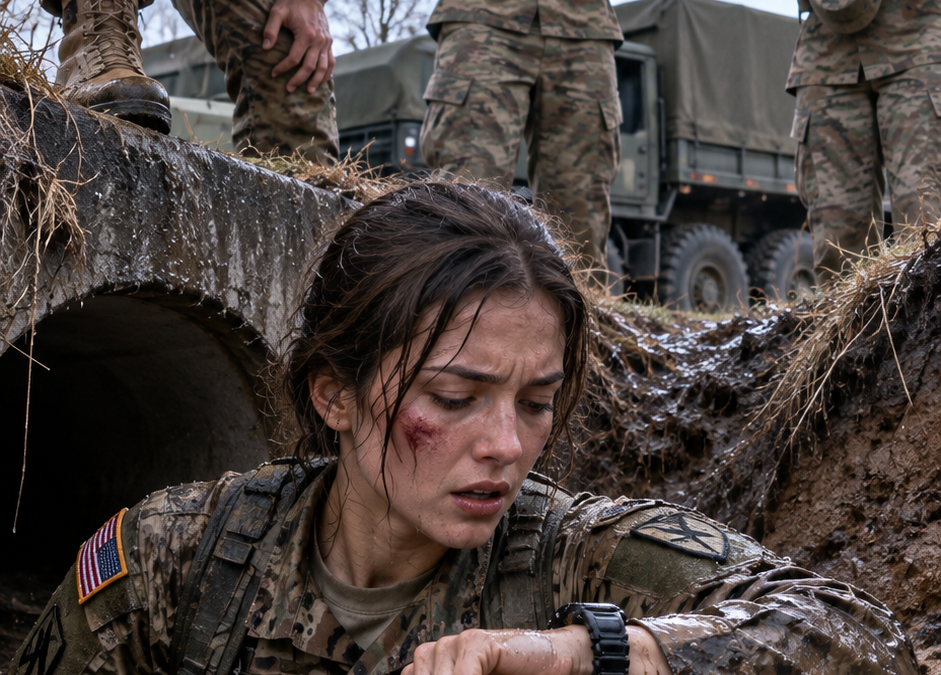
Pain exploded from the left side of my body, hot and immediate, before the freezing water erased almost everything except the shock of the cold. My boots disappeared into thick red mud. Gravel tore the skin along my cheek. For one breathless second, I lay on my back staring at a gray winter sky framed by weeds and concrete.
Then I heard Jax laughing.
“Would you look at that?”
His voice echoed down the culvert.
“The high-and-mighty Davenport finally found where she belongs.”
Davenport.
That was the name most of them knew me by.
My mother’s maiden name.
The name I had entered the Army carrying because I wanted one part of my life that did not begin with someone asking whether I was related to General Raymond Vance.
Jax leaned over the edge.
He was huge, the kind of man who built his identity around how much space he could occupy. A faded pit-viper tattoo curled along his forearm. Tobacco pushed against his lower lip. He spat into the weeds beside my face.
“Down there with the rats.”
A few feet behind him stood Staff Sergeant Marcus Miller.
Miller wasn’t laughing.
That made him worse.
Jax needed an audience.
Miller needed obedience.
He stood with his arms crossed and watched me from above as though I were a piece of damaged equipment he was deciding whether to salvage.
Beside them stood Private First Class Sarah Pippin.
We called her Pip.
Twenty-one years old.
Thin enough that her uniform always looked a size too large.
She was holding my patrol cap with both hands.
Her fingers were shaking.
Pip was not like them.
That mattered.
It did not excuse her silence, but it mattered.
For six months I had watched Miller turn fear into a management system.
Extra guard shifts if he disliked you.
Missing mail if you questioned him.
Counseling statements for things that had never happened.
Equipment that vanished before inspections and mysteriously reappeared after you had already been blamed.
He had created a little kingdom inside Bravo Company where everyone learned the same lesson.
Keeping your head down was safer than being right.
I had tried keeping mine down.
Then I found the inventory discrepancies.
The first one had been small.
Three thermal sights listed as transferred but never received by the gaining unit.
Then six.
Then a shipping container whose electronic seal number did not match the paper manifest.
Then another.
I was a Specialist, not an investigator.
But numbers do not care about rank.
I asked a logistics clerk a question.
Miller heard about it.
After that, the harassment stopped being subtle.
And now I was in a drainage ditch.
“You brought this on yourself,” Miller said.
His voice was calm.
Almost bored.
“You wanted to ask questions.”
I pushed myself onto my elbows.
Mud dragged at my uniform.
My left shoulder burned every time I moved it.
Miller stared down at me.
“In my squad, we protect each other.”
I looked at him.
“Is that what you call it?”
His eyes narrowed.
Jax grinned.
“Careful, Davenport.”
Miller continued.
“We don’t have room for snitches.”
Behind him, Pip looked sick.
“Miller,” she whispered.
He ignored her.
I got one knee under me.
The water reached above my boots.
My cheek stung where the gravel had opened the skin.
I could feel blood mixing with cold rainwater near my jaw.
For six months, they had mistaken silence for weakness.
That had been useful.
People tell you a great deal when they think you cannot hurt them.
Miller had talked too freely around me.
Jax had bragged too loudly.
Captain Thomas Reynolds had signed things without reading who was watching.
And Pip, terrified Pip, had once left a stack of duplicate manifests open long enough for me to photograph every page.
I had sent the evidence through exactly one secure channel.
One message.
One location.
One request.
Wait until 1500.
My father had answered with four words.
UNDERSTOOD. DO NOT INTERFERE.
That was at 0227 the night before.
Now I wiped mud from my black Casio watch.
14:59.
Twenty-nine seconds remained.
I looked up.
“Miller.”
He frowned.
“Jax.”
Jax smiled.
I raised my voice just enough for them both to hear clearly.
“You have thirty seconds to apologize.”
Jax barked out a laugh.
I continued.
“And thirty seconds to pull me out of this ditch.”
Jax slapped his thigh.
“You hear this?”
He looked at Miller.
“The princess is giving orders.”
Pip took one nervous step forward.
“Sergeant, maybe we should just help her.”
Jax turned on her.
“Shut up.”
“She could be hurt.”
“She’s fine.”
“She hit the culvert.”
“Pippin.”
Miller’s voice was quiet.
Pip stopped.
That was how he controlled people.
He rarely needed to yell.
He made consequences live in their imagination.
Jax looked back at me.
“What are you going to do, Davenport?”
He spread his arms.
“Call your mommy?”
Something moved inside me at that.
Not anger.
Grief.
My mother had been dead for five years.
Jax could not have known.
That did not make the words hurt less.
Beneath my wet uniform, beside my dog tags, a small silver ring rested against my chest.
Eleanor Vance’s wedding ring.
My mother had worn it through years of deployments, cheap military housing, missed anniversaries, three wars, and the long loneliness of loving a man who believed duty was measured by how much of yourself you were willing to surrender.
Cancer had taken her while my father was overseas.
He reached the hospital three days before she died.
For years, I blamed him for that.
For years, I blamed the four stars.
I blamed the Pentagon.
I blamed our name.
So I joined the Army without taking the path everyone expected.
No West Point.
No commission.
No telephone calls from Washington.
I wanted to know what Clara was worth when nobody cared that Raymond Vance was her father.
The answer had been complicated.
I learned I could work.
I could ruck.
I could sleep on concrete.
I could take orders from idiots without becoming one.
I could make friends.
I could endure cruelty.
I could survive being overlooked.
But staring up at Marcus Miller from the bottom of that ditch, I learned something else.
Endurance was not always virtue.
Sometimes refusing to act only gave cruel men more room.
Miller stepped closer to the edge.
“You don’t dictate terms to me, Specialist.”
His voice hardened.
“You are a body in a uniform. I own your time. I own your assignments. And right now, I decide whether you spend the night down there.”
I looked at my watch.
Ten seconds.
Pip whispered again.
“Sergeant.”
Miller snapped his head toward her.
“What?”
She held my patrol cap tighter.
“Please.”
Jax scoffed.
Miller stared at Pip until she dropped her gaze.
Five seconds.
Four.
Three.
I looked up.
Jax was still smiling.
Miller was still certain.
Pip looked like she might cry.
The display changed.
15:00.
I lowered my wrist.
“Time’s up.”
The base siren screamed.
Jax’s smile vanished.
This was not the routine warning tone we heard during exercises.
It was continuous and violent, rising and falling through the cold afternoon until the sound seemed to vibrate inside the ditch itself.
Pip dropped my cap.
Miller spun toward the motor pool.
“What the hell?”
Then the ground began trembling.
At first, it was faint.
Then stronger.
Engines.
Several.
Heavy.
Fast.
Down the long access road, black vehicles appeared through the trees.
Four armored SUVs led the convoy.
Behind them came tactical vehicles packed with military police and federal personnel.
Lights flashed inside dark grilles.
Nobody slowed for the speed bumps.
Jax stepped back from the ditch.
“Is that CID?”
Miller didn’t answer.
Dust and red gravel rose behind the vehicles.
They entered the motor pool in a coordinated sweep, splitting toward every exit and sealing the yard before most soldiers nearby understood anything was happening.
Doors opened.
Men and women in tactical armor poured out.
Weapons low but ready.
Commands exploded across the yard.
“STEP AWAY FROM THE VEHICLES!”
“HANDS VISIBLE!”
“NOBODY LEAVES!”
Jax went pale.
“What did you do?”
I said nothing.
The lead SUV stopped near the center of the motor pool.
The rear door opened.
My father stepped out.
General Raymond Vance had spent nearly four decades learning how to enter a place without hurry and still make everyone else feel late.
He wore a dark suit beneath a black overcoat.
Silver showed at his temples.
Four stars marked the authority he carried.
Behind him came federal investigators from the Joint Federal Investigation and Corruption Task Force.
My father had spent years dismantling theft networks, procurement fraud, bribery chains, black-market military supply routes, and the officers who believed decorations could make them untouchable.
Miller knew his name.
Almost every senior logistics leader in the Army knew his name.
Miller just didn’t know mine.
Not yet.
My father surveyed the yard.
His eyes found the shipping containers first.
Then Miller.
Then me.
I stood in the ditch.
Water ran from my sleeves.
Blood had dried along my cheek.
Mud covered everything below my waist.
Miller looked from my father to me.
I watched the first crack appear in his certainty.
“Why is General Vance here?” Jax whispered.
Nobody answered.
Federal agents surrounded them.
A woman with dark hair tucked beneath her tactical helmet approached.
Special Agent Evelyn Carter.
I had never met her in person.
I knew her voice from one encrypted phone call.
“Hands up.”
Jax raised his hands.
“What is this?”
“Up.”
Miller complied more slowly.
His face was changing as he calculated.
That was what men like Miller did when power shifted.
They calculated.
What does he know?
Who talked?
What can I deny?
What can I blame on someone else?
My father stopped at the edge of the ditch.
For several seconds, he only looked at me.
There was no dramatic reunion.
We were not a dramatic family.
He looked at the cut on my face.
The angle of my injured shoulder.
The mud.
His jaw tightened.
“Specialist.”
I straightened.
“Sir.”
“State your full name and unit for the record.”
Miller’s eyes moved toward me.
I could almost hear his thoughts.
Why would a four-star general ask her name?
I lifted my chin.
“Specialist Clara Vance. Bravo Company, 407th Support Battalion.”
Silence.
Even the siren seemed farther away.
Jax looked at me.
Then at my father.
Then back at me.
Miller stopped breathing for a second.
Captain Reynolds came running out of the company office.
“What is the meaning of this?”
He looked around wildly.
“I’m the company commander. You cannot initiate a federal containment operation without notifying—”
Then he saw my father.
His voice died.
He saw me.
“Vance?”
His gaze moved between us.
“No.”
Miller whispered something under his breath.
I looked up at him from the ditch.
“Thirty seconds.”
His face went completely white.
“I told you.”
Miller moved toward the edge.
“General, sir.”
My father looked at him.
“Sir, there’s been a misunderstanding.”
Miller pointed toward me.
“She fell.”
Jax stared at him.
Miller kept going.
“Routine maintenance detail. The ground was wet. She slipped near the culvert. We were about to help her when—”
My father raised one hand.
“Stop talking.”
Miller’s mouth closed.
My father turned toward Agent Carter.
“Execute the warrants.”
Miller’s eyes widened.
“What warrants?”
Carter signaled.
Agents moved.
“Staff Sergeant Marcus Miller and Specialist Brody Jax, you are being detained pursuant to federal warrants involving theft of government property, wire fraud, conspiracy, and interstate transport of restricted military equipment.”
Jax almost collapsed.
“What?”
Steel restraints appeared.
Jax jerked backward.
“No, no. I didn’t—Miller!”
An agent forced his hands behind him.
Jax panicked.
“It was him!”
Miller spun.
“Shut up!”
“He told me to do it!”
“Jax!”
“He told me she was going to talk!”
Every head turned.
Jax was shouting now.
“He told me to push her! He said she found the manifests!”
Miller lunged half a step toward him.
Agents slammed him against the side of a truck.
“Shut your mouth, you idiot!”
“You have the right to remain silent—”
My father looked at Carter.
“Photograph Specialist Vance.”
Carter nodded.
“Every visible injury,” my father continued. “Get medical documentation.”
His eyes never left Miller.
“I want the prosecutor to understand exactly what Staff Sergeant Miller considers routine maintenance.”
For the first time, I saw fear in Miller.
Not embarrassment.
Not anger.
Fear.
My father extended one gloved hand toward me.
“Come out of there, Clara.”
He used my first name.
Something in my chest tightened.
His glove was black leather.
Clean.
Mine were covered in mud.
For most of my life, that hand represented everything I wanted to escape.
Influence.
Authority.
The certainty that one telephone call from Raymond Vance could change a career.
I looked at it.
Then at him.
And I did not take it.
I planted my boot into the wall of the ditch.
My shoulder screamed when I reached for the grass.
I climbed.
Mud slid beneath my soles.
For one ugly second I nearly went backward.
I found another grip.
Pulled.
My injured shoulder sent white pain through my chest.
I kept moving.
Finally, my knee reached the pavement.
Then the other.
I stood.
My entire body shook from cold.
My father lowered his hand.
His expression barely changed.
But his eyes did.
“I told them thirty seconds,” I said.
My voice trembled.
Not from fear.
From cold.
“They didn’t believe me.”
My father looked toward Miller.
“They rarely do.”
I did not feel victorious.
That surprised me.
For months, I had imagined what it would feel like when Miller finally lost control.
I thought there would be satisfaction.
Maybe relief.
Instead, I felt tired.
Deeply tired.
Jax had tormented me.
Miller had tried to break me.
Reynolds had ignored every warning sign.
Still, watching men placed in restraints did not give back the nights I had spent awake wondering what they would sabotage next.
It did not erase the moment I had started checking the hallway before opening my barracks door.
It did not remove the mud from my clothes.
Justice is necessary.
But justice is not a time machine.
Two hours later, I sat inside a medical tent wrapped in an Army blanket.
The gravel had been cleaned from my cheek.
A butterfly bandage covered the cut.
My shoulder was badly sprained but still in place.
Somebody handed me coffee strong enough to dissolve paint.
I held the cup with both hands because I was still shivering.
Outside, Bravo Company had stopped functioning as a military unit.
Federal agents had turned the motor pool into an evidence site.
Portable floodlights illuminated shipping containers.
Computers appeared.
Boxes were sealed.
Soldiers were separated for interviews.
Serial numbers were checked.
Captain Reynolds disappeared into an interrogation room.
Jax was already talking.
Miller, according to Carter, had requested counsel.
The tent opened.
Cold wind entered first.
My father followed carrying a dry uniform.
He placed it beside me.
I looked down.
The nametape read VANCE.
Not Davenport.
Vance.
He adjusted the small heater.
For a few moments, neither of us spoke.
“The installation commander wants to see you.”
“I’m sure he does.”
“He wants to apologize.”
“He didn’t know.”
“He should have.”
“So should half the company.”
My father looked at me.
“Do you want to defend them?”
“No.”
I stared into my coffee.
“I’m just tired of pretending one man could have noticed everything I deliberately hid.”
My father crossed his arms.
“Why did you let it continue for six months?”
I knew the question was coming.
I still hated it.
“You could have called me.”
“I know.”
“One call.”
“I know.”
“I would have had investigators here.”
“I know.”
He stepped closer.
“They sabotaged your equipment.”
“Yes.”
“They falsified counseling statements.”
“Yes.”
“They put you on unsafe details.”
“Yes.”
“And today they threw you into a drainage ditch.”
I looked up.
“You think I don’t understand that?”
His jaw tightened.
“Then explain it.”
I set the coffee down.
“Because I needed to know whether I could do this without you.”
He stared at me.
I pointed toward the stars on his uniform.
“Without those.”
His face changed slightly.
“The whole reason I enlisted the way I did was because I spent my life being Raymond Vance’s daughter.”
“You are my daughter.”
“That’s not the same thing.”
He said nothing.
“At school, teachers knew.”
I stood despite the pain.
“At military events, officers knew. Recruiters knew. Even people who had never met me treated me differently once they heard the name.”
“Clara—”
“I needed one place where nobody cared.”
I picked up the uniform.
“Do you understand what it is like to wonder whether every door opens because somebody recognizes your father?”
He looked away.
That answer was enough.
“I didn’t go to West Point because everyone would have said you got me there.”
“That would not have been true.”
“It would not have mattered.”
I ran my thumb across the new nametape.
“I wanted to know what happened when the name disappeared.”
“And?”
I laughed once.
No humor in it.
“I learned plenty.”
He waited.
“I learned most soldiers are good people.”
I thought about Gus.
About clerks who had quietly warned me.
About Pip.
“And I learned good people can become very quiet when bad people make courage expensive.”
My father’s expression hardened.
“Miller is more than a bully.”
“I know.”
“The preliminary evidence indicates an organized theft network.”
“I know that too.”
“You pulled on one thread.”
“And found the whole uniform coming apart.”
For the first time, something like pride moved across his face.
Then I remembered Pip.
“What happens to Pippin?”
His expression closed.
“She signed false manifests.”
My stomach tightened.
“Dad.”
“She is implicated.”
“No.”
He stared at me.
“She signed documents enabling theft of military property.”
“She was coerced.”
“She was standing there when they threw you into the ditch.”
“She didn’t touch me.”
“She watched.”
“She tried to stop them.”
“Quietly.”
“She was terrified.”
“So?”
I stood fully.
Pain tore through my shoulder.
I ignored it.
“So there is a difference between someone benefiting from corruption and someone trapped inside it.”
My father’s eyes narrowed.
“Fear does not erase responsibility.”
“No.”
I stepped closer.
“But responsibility is not identical for everyone.”
He did not answer.
“Miller knew about her brother.”
My father frowned.
“Leo.”
I nodded.
“He has Down syndrome. Their mother cannot cover all the therapy costs. Pip sends almost everything home.”
“How do you know?”
“Because I listened.”
I lowered my voice.
“Miller threatened her. He told her he would make sure she left the Army with a record that destroyed her benefits if she talked.”
“That does not make false signatures legal.”
“I didn’t say it did.”
“Then what are you asking me to do?”
“Look at why she did it.”
My father’s stare sharpened.
“She held your patrol cap while you were in a ditch.”
“Yes.”
“She did not help you.”
“No.”
“She did not apologize when you gave them thirty seconds.”
“No.”
I felt anger rise.
Not at Pip.
At him.
“There is a difference between a monster and a hostage.”
The heater hummed.
He said nothing.
“You taught me to find the monster.”
My voice shook now for a reason that had nothing to do with temperature.
“Do not let this investigation destroy the hostages just because they were in the same room.”
My father stared at me for a long time.
Then he reached inside his coat.
A black notebook.
He opened it.
Turned several pages.
Made one mark with his pen.
“She will be interviewed as a cooperating witness.”
I released a breath.
“If the coercion is substantiated,” he continued, “the prosecutors will take it into account.”
“Her brother?”
“We are not taking her brother’s care away because Marcus Miller threatened her.”
My eyes burned.
“Thank you.”
He closed the notebook.
“You’re not finished.”
I looked at him.
“The Davenport story is over.”
My eyes went to the new uniform.
“Tomorrow, everyone will know who you are.”
I touched the nametape.
VANCE.
For most of my life, those five letters had felt like weight.
That night, they felt different.
Not lighter.
Mine.
“I’m ready.”
I changed.
When I stepped outside, snow had begun drifting through the floodlights.
Soldiers stopped talking.
Some of them had laughed when Jax joked about me.
Some had looked away when Miller gave me impossible details.
Some had seen enough to know something was wrong and decided not to become involved.
Now they stared at my real name.
I did not stare back.
I walked toward Agent Carter.
A figure stepped from near the guard shack.
Pip.
Her wrists were red where the restraints had been removed.
A civilian jacket hung over her uniform.
Her face was swollen from crying.
She held my patrol cap.
She stepped toward me.
Stopped.
Looked at my nametape.
VANCE.
Then at my face.
“I’m sorry.”
Her voice broke.
I said nothing.
“I should have helped you.”
Tears ran down her cheeks.
“I should’ve said something months ago.”
I took my cap from her hands.
She continued.
“I was scared.”
“I know.”
“I kept telling myself I was protecting my family.”
Her mouth twisted.
“Then every time I stayed quiet, he got worse.”
I put the cap on.
Adjusted the brim.
Pip looked at the ground.
“When you gave them thirty seconds…”
She swallowed.
“I wanted to pull you out.”
“Why didn’t you?”
She looked at me.
“Because I was afraid Miller would destroy me.”
The answer hurt because I believed it.
I could have said she should have been braver.
It would have been true.
It also would have been easy coming from someone who knew a four-star general and twenty federal agents were already on their way.
Pip did not know rescue was coming.
That mattered too.
“The thirty seconds are over,” I said.
Her face crumpled.
She thought I was rejecting her.
I reached out.
Placed my good hand on her shoulder.
“But so is the storm.”
She stared at me.
“Tell the truth in the interview.”
“I will.”
“All of it.”
“Yes.”
“Even the parts that make you look bad.”
She nodded.
“Then go home when they let you.”
Another tear fell.
“Your brother still needs his sister.”
She covered her mouth.
“Clara…”
“You’re not safe because my father is a general.”
I squeezed her shoulder.
“You’re safe because Miller doesn’t own you anymore.”
For the first time since I had known her, Pip looked like she believed that might be true.
Later that night, I sat with Master Sergeant Thomas Gustafson in a borrowed battalion office while investigators moved through the motor pool outside.
Gus had twenty-four years in uniform and the kind of face that looked carved by sun, engine smoke, and disappointment.
He stood near the window.
“I knew something was wrong.”
I waited.
He looked outside.
“I didn’t know all of it.”
He rubbed a hand over his jaw.
“But I knew enough.”
He told me about cut locks.
Late-night visits to shipping containers.
Inventory numbers that never reconciled.
He had raised concerns to Captain Reynolds.
Reynolds told him the new tracking system was unreliable.
Told him he was getting old.
Told him if he disliked the direction of the company, retirement paperwork was available.
“So I stopped pushing,” Gus said.
He looked at me.
“I spent twenty-four years telling young soldiers that NCOs are supposed to protect them.”
His voice became rough.
“And then I watched Miller make your life hell because I wanted two quiet years before retirement.”
I looked into my coffee.
“You were surviving him.”
“That’s a polite word.”
“It’s still true.”
He shook his head.
“I saw Jax hide your rucksack before the march.”
I looked up.
“I saw the weekend details.”
His eyes reddened.
“I saw enough.”
He stared through the window.
“Tonight it took a four-star general’s daughter to do the job I should have done.”
“That isn’t what happened.”
“Isn’t it?”
“No.”
I leaned back carefully.
“It took evidence.”
“It took you.”
“It took everyone who finally talked.”
Gus looked at me.
“That doesn’t make me feel better.”
“It shouldn’t.”
He gave me a tired smile.
“That sounds like your father.”
“Please never say that again.”
For the first time that night, Gus laughed.
Only once.
Then he became serious.
“You’re going to remember this when you make Sergeant.”
“I haven’t even made Sergeant yet.”
“You will.”
He pointed toward the yard.
“And when you do, remember what this place felt like.”
His voice lowered.
“The worst thing a leader can do isn’t always stealing.”
I listened.
“Sometimes it’s making good people believe nobody is coming.”
That stayed with me.
The investigation kept widening.
Jax talked quickly.
I did not sit inside his interrogation, but later I read enough of his statement to understand what happened.
He had grown up with violence.
He learned early that strength meant being the person holding the belt instead of the one receiving it.
Miller recognized that hunger.
Fed it.
Gave Jax small privileges.
Protected him.
Used him.
Jax admitted hiding my equipment.
Admitted threatening younger soldiers.
Admitted knowing some stolen equipment was leaving the installation.
And admitted pushing me.
His excuse appeared again and again in the transcript.
Miller told me to.
Agent Carter did not accept it as absolution.
Neither did I.
A victim can become a bully.
That may explain the road.
It does not erase where the road leads.
Miller was different.
He denied almost everything.
He had been decorated in combat.
Bronze Star with Valor.
Purple Heart.
Three deployments.
A record that looked impressive until someone examined the man underneath it.
My father eventually told me about the moment Miller’s façade cracked.
It was not because of me.
It was a lighter.
Gold-plated Zippo.
I had seen Miller use it dozens of times.
He carried it like a trophy.
Investigators discovered it once belonged to PFC Benjamin Foster, a nineteen-year-old soldier killed during Miller’s earlier deployment.
Miller had processed Foster’s personal effects.
The lighter never appeared on the official property list.
Its serial number tied it to Foster’s grandfather.
Miller had stolen from a dead soldier.
That detail explained him more clearly than anything else.
He did not steal only because he wanted money.
He stole because he believed the unseen had no rights.
A dead private without parents.
A frightened PFC with a disabled brother.
A quiet Specialist using another surname.
People he believed no powerful person would defend.
My father told him the truth.
He had not been trapped by me.
He had built the trap himself.
The logistics case expanded beyond our company.
Investigators traced thermal sights and other restricted equipment to a civilian militia network in Idaho.
Payments moved through shell companies.
Captain Reynolds had been receiving a cut.
When confronted with evidence connecting his wife’s name to one of the accounts, he started cooperating.
More names followed.
Logistics officers elsewhere.
A lieutenant colonel.
Civilian intermediaries.
What started as three missing thermal sights became a federal conspiracy.
I did not feel proud when people told me I had uncovered it.
Mostly, I felt angry.
Not because corruption existed.
Because of how many people had seen fragments and decided the fragments were too inconvenient to assemble.
The next time my father came into the medical tent, snow was falling hard.
He looked tired.
Without cameras around him, Raymond Vance always looked ten years older.
“Your shoulder needs light duty.”
“I’ll survive.”
“That phrase is not medical clearance.”
I looked down at the VANCE nametape.
“What happens to Bravo Company?”
“Deactivated.”
I raised my eyes.
“Completely?”
“Effective midnight.”
He sat opposite me.
“The soldiers who are not implicated will be reassigned.”
“Gus?”
“Handling closure.”
“And then?”
“Retirement.”
I thought about his face.
“He told investigators he plans to work at a veterans’ center.”
That surprised me.
My father noticed.
“He said he wants to remember what helping people feels like.”
I nodded.
“Reynolds?”
“Cooperating.”
“Of course.”
My father almost smiled.
Then he reached into his pocket.
The silver ring lay in his palm.
My mother’s.
I stared at it.
“I thought that was with my personal effects.”
“It was.”
He held it toward me.
I did not take it immediately.
“Why didn’t you stop me?”
My father looked confused.
“When?”
“When I enlisted this way.”
He understood.
“You knew what I was doing.”
“Yes.”
“You knew I used Mom’s name at first.”
“Yes.”
“You knew where I was assigned.”
“Yes.”
I stared.
“You could have stopped the whole thing.”
“Yes.”
“Why didn’t you?”
For several seconds, he said nothing.
Then he looked down at the ring.
“When your mother and I were young, we had nothing.”
That was not the answer I expected.
“We lived in a trailer outside Fort Campbell.”
He smiled faintly.
“No heat worth mentioning.”
I pictured my father young.
It was difficult.
He had existed in my memory forever as a man already carrying responsibility.
“I deployed constantly.”
His thumb moved across the silver ring.
“Grenada. Panama. The Gulf.”
He looked at me.
“Your mother waited through all of it.”
My throat tightened.
“When she became sick, I was in Stuttgart.”
I knew that part.
I had weaponized it against him more than once.
“You came back late.”
“Three days before she died.”
His voice changed.
“She told me something in the hospital.”
I waited.
“She said you had spent your entire childhood believing our name belonged to me.”
I looked down.
“She said one day you would try to run away from it.”
The heater clicked.
“She was right.”
“She usually was.”
His eyes returned to the ring.
“She told me if you joined the Army, I was not allowed to clear the road ahead of you.”
I stared at him.
“What?”
“She made me promise.”
I felt something shift.
“She knew?”
“She knew you.”
He placed the ring in my palm.
“Eleanor said if I protected you from every hard thing, you would never know which strength belonged to you and which belonged to the stars on my shoulders.”
My fingers closed around the ring.
My vision blurred.
He continued.
“I wanted to intervene.”
I looked up.
“How early?”
“Very early.”
“You knew about Miller?”
“Not the full scale.”
“But enough.”
“Yes.”
Anger appeared.
“You watched?”
“No.”
His voice hardened.
“I investigated.”
“That’s a very Raymond Vance distinction.”
“It matters.”
“Not when I’m the one sleeping in the barracks.”
He accepted that.
“I wanted to come here personally.”
“Why didn’t you?”
“Because your mother asked me not to fight your battles.”
He looked older in that moment than I had ever seen him.
“And because you asked me not to.”
I remembered every argument.
Every time I told him I did not need help.
Every time I accused him of trying to control my life.
“I spent months wondering whether trusting you was courage or cowardice,” he said.
That silenced me.
“I don’t know if I chose correctly.”
My anger softened.
He looked at the silver ring in my hand.
“But today, when I saw you in that ditch…”
His voice stopped.
My father almost never lost words.
I waited.
He swallowed.
“I wanted to kill him.”
A small laugh escaped me through tears.
“That would have complicated the investigation.”
“Yes.”
“You taught me paperwork is more painful.”
“It often is.”
I looked down at the nametape on my chest.
VANCE.
“I thought the name was a prison.”
“I know.”
“I thought if I used it, nothing I did would count.”
“That was never true.”
“I know that now.”
He stood.
I looked at him.
“I’m done running from it.”
For the first time in years, I said the words without resentment.
“I’m Clara Vance.”
I touched the ring.
“And I’m still me.”
His eyes held mine.
Pride appeared there.
Not General Vance evaluating a soldier.
My father looking at his daughter.
He cleared his throat.
“0600 tomorrow.”
I smiled.
“What?”
“Transfer.”
“Where?”
“18th Airborne Corps.”
I stared at him.
“You arranged that?”
His eyebrows rose.
“Careful.”
I laughed.
“Did you?”
“No.”
“Sure?”
“Clara.”
“Just checking.”
“They need people.”
“I’m on light duty.”
“They have paperwork.”
“Cruel.”
My father almost smiled.
“They also have a leadership structure that appears capable of distinguishing a soldier from stolen property.”
“That’s encouraging.”
“Get some sleep.”
“Yes, sir.”
He left.
The next morning, the snow had transformed the motor pool.
Oil stains disappeared beneath white.
Tire tracks softened.
The floodlights were gone.
The black federal vehicles had mostly departed.
Bravo Company felt like the shell of a building after a fire.
My barracks room was almost empty.
Two duffel bags sat on the bed.
My shoulder still ached.
A white bandage remained on my cheek.
I stood in front of the mirror.
VANCE.
No disguise.
No Davenport.
No apology.
Someone knocked.
Gus entered carrying coffee and a folder.
“Transport’s downstairs.”
“I’ll be there.”
“The driver offered to carry your bags.”
“I can carry them.”
Gus looked at my taped shoulder.
“You’re exactly as stubborn as your father.”
“That is twice in twenty-four hours someone has insulted me that way.”
He placed the folder on the desk.
“Your records.”
I opened it.
The counseling statements Miller used against me were gone.
False negative evaluations removed.
Extra-duty records reviewed.
My official name restored everywhere.
“You’re clean,” Gus said.
I looked up.
“I wasn’t dirty.”
His face tightened.
“I know.”
That mattered.
He held out his hand.
“You’ll be an NCO someday.”
“So you keep telling me.”
“When it happens, remember this place.”
“I will.”
“Remember Miller.”
“I will.”
“Remember Jax.”
“I will.”
He hesitated.
“And remember me.”
That surprised me.
“You?”
“Especially me.”
His eyes became serious.
“Because Miller is easy to recognize once you know what he is.”
He tapped his own chest.
“Men like me are harder.”
“What kind of man is that?”
“The one who knows better and waits too long.”
I said nothing.
Gus nodded.
“Don’t become that.”
I shook his hand.
“I won’t.”
Several weeks later, I learned Miller had accepted a plea agreement.
He was not the untouchable career soldier anymore.
No uniform.
No authority.
No men afraid to challenge him.
The government pursued stolen-property, conspiracy, fraud, and related charges.
Assets were seized.
His military career ended.
Jax cooperated and received a shorter sentence.
Reynolds named everyone he could remember.
The investigation spread far beyond the motor pool.
I learned all of that from reports.
None of it stayed with me as much as Pip’s letter.
It arrived weeks later.
Her case had been reviewed as my father promised.
Investigators confirmed coercion.
She cooperated fully.
She did not walk away untouched.
There were administrative consequences and months of review.
But she was not treated as though her fear made her identical to Miller.
She was transferred.
Her family support remained intact.
In her letter, she wrote about Leo.
She wrote that for two years she had woken every morning afraid Miller would find a reason to destroy her career.
She wrote that fear had gradually made decisions for her.
She apologized again.
Then she wrote one sentence I read several times.
I thought survival meant staying invisible, but I understand now that disappearing is another way of letting people like him decide who gets to exist.
I wrote back.
Not a speech.
Not forgiveness wrapped in pretty language.
Just the truth.
Fear explains silence. It does not make silence harmless. You know that now. Use what you learned the next time someone smaller than you is standing alone.
I signed it Clara.
Not Specialist Vance.
Not General Vance’s daughter.
Clara.
My transfer to the 18th Airborne Corps did not transform my life overnight.
There was no magical unit where everyone was honest and every leader was wise.
Armies are made of people.
People are complicated everywhere.
The difference was that, in my new unit, questions did not automatically become threats.
The first time I pointed out an inventory discrepancy, my new Sergeant looked at the paperwork and said, “Good catch.”
That was it.
No warning.
No hallway whisper.
No missing equipment the next morning.
Just good catch.
I almost laughed.
Months of abuse had trained me to expect punishment for accuracy.
It took time to unlearn that.
My shoulder healed.
The scar on my cheek faded into a thin pale line.
The nightmares about the ditch lasted longer.
In some of them, the convoy never came.
The watch reached zero.
Nothing happened.
Miller walked away.
Pip disappeared.
I stayed in the water until I woke.
Those dreams taught me something I had not admitted before.
I had been afraid.
Deeply.
The calm in the ditch had not meant I lacked fear.
I had simply known what to do with it for thirty seconds.
That was different.
One winter morning, I stood in formation on the parade field beneath a sky almost the same color as the one above the ditch.
Snow blew across the ground.
Three hundred soldiers stood around me.
My shoulder gave a dull ache whenever the wind pressed against my gear.
I felt the VANCE nametape beneath my vest.
For once, it did not feel heavy.
After formation, I saw a black SUV near the edge of the field.
My father stood beside it.
Dark overcoat.
Hands in his pockets.
Waiting.
I walked toward him carrying my duffel.
He looked at the bag.
“Need help?”
“No.”
“I assumed.”
We stood there.
My relationship with my father had always been full of things neither of us knew how to say.
My mother had been our translator.
After she died, silence grew between us until it became almost architectural.
Now, somehow, the ditch had cracked part of it open.
“The Corps is treating you well?” he asked.
“Yes.”
“Supervisor?”
“Competent.”
“That sounds like high praise from you.”
“It is.”
He reached into his overcoat.
For one second, I thought he was going to produce another investigation file.
Instead, he handed me an old leather address book.
My mother’s name was embossed on the front.
ELEANOR.
The letters were fading.
I ran my thumb over them.
“What is this?”
“Your aunt’s address is inside.”
I looked at him.
“She lives in Alexandria.”
“I know.”
“She has been asking whether you plan to visit before one of you dies of stubbornness.”
“That sounds like her.”
My father looked toward the SUV.
“I’ll be in Washington for a while.”
“Investigation?”
“When isn’t it?”
I smiled.
He looked uncomfortable.
Then he said, “If you get a long weekend…”
I waited.
“You could take the train.”
It was the closest Raymond Vance came to saying he wanted to see me.
I held the address book.
The same man who could order federal agents into a military installation apparently could not ask his own daughter to come to dinner.
“Dad.”
“Yes?”
“I’ll take the train.”
The hard line of his jaw softened.
Only slightly.
But I saw it.
“Good.”
I reached out and squeezed his wrist.
One firm grip.
Enough.
He got into the vehicle.
The door closed.
I watched the convoy move toward the gate until snow swallowed the taillights.
Then I turned toward my new barracks.
The wind was brutal.
My shoulder still ached in the cold.
My boots sank into fresh snow.
And for the first time in my life, I did not feel that I was walking toward or away from my father.
I was simply walking as myself.
Clara Vance.
Specialist.
Soldier.
Daughter.
All of it.
For years, I believed strength meant proving I could stand without anyone.
Bravo Company taught me how incomplete that idea was.
Strength was also knowing when endurance had become permission.
It was Pip finally telling the truth while terrified.
It was Gus admitting that survival had turned into cowardice.
It was my father honoring a promise to my mother even when every instinct in him wanted to intervene.
And sometimes strength was nothing more glamorous than dragging yourself out of a freezing ditch because the hand offered to you, however loving, was not the reason you had survived.
Marcus Miller once told me I was nothing but a body in a uniform he controlled.
For six months, he tried to prove it.
He failed.
Not because I was a general’s daughter.
Not because federal agents came through the gate.
Not because his name eventually appeared on criminal charges.
He failed because the thing he understood least about power was the thing that ultimately destroyed him.
Real power does not come from making frightened people obey.
It comes from what you choose to do when someone frightened is depending on you.
I learned that from Pip.
From Gus.
From my mother.
Even from my father.
Most of all, I learned it from the thirty seconds at the bottom of that drainage ditch.
The mud washed out of my uniform.
The bruise on my shoulder disappeared.
The cut on my face healed.
But I never forgot the view from down there.
Three soldiers standing above me.
One enjoying my pain.
One permitting it.
One too frightened to stop it.
Three different kinds of failure.
If I ever earned stripes of my own, I knew exactly what kind of leader I refused to become.
I would never make a soldier wonder whether anyone was coming.
I would never teach silence as the price of belonging.
And I would never mistake someone’s fear for permission to control them.
The snow thickened as I reached the orderly room.
A young Sergeant I barely knew held the door.
“Morning, Vance.”
“Morning, Sergeant.”
He glanced toward the weather.
“Hell of a day.”
I looked once more toward the gate where my father’s convoy had disappeared.
“No.”
I stepped into the warm building.
“I’ve had worse.”
He laughed.
I smiled.
Then I walked inside under my own name.
And this time, I had no intention of hiding it.








