𝗣𝗔𝗥𝗧 𝟮 The Men Who Fired Me Had No Idea Why I Had Been Watching Their Factory for Six Weeks
𝗣𝗔𝗥𝗧 𝟮
I became very familiar with the language institutions use when they want to sound as though they are answering you without actually doing it.
Only one person treated my original report as though it mattered.
Rear Admiral Marcus Hollis.
He was not involved in the first investigation.
He found my report later.
He called me into a secure office on a Thursday afternoon.
He had my file open in front of him.
“I read the full annex,” he said.
Nobody had said that to me before.
I sat very still.
“Then you saw the relay sequence.”
“I did.”
“And?”
“And I think someone stopped looking too soon.”
Something hot rose behind my ribs.
“Then reopen it.”
His jaw tightened.
“I can’t.”
“Can’t or won’t?”
“Can’t. Not with what I have.”
I hated him for that answer for perhaps three seconds.
Then I saw his face.
He hated it too.
“What do you need?”
“A pattern.”
“I gave you a pattern.”
“You gave me one event.”
“Three men died.”
“I know.”
“Then how many events do you need?”
His voice softened.
“Enough that they can’t call yours isolated.”
That sentence followed me for years.
Enough that they can’t call yours isolated.
My teammates had become an isolated event.
A statistical inconvenience.
A file that could be closed.
I submitted my separation papers two weeks later.
Some people assumed I was burned out.
Others assumed I blamed myself.
Both were true in ways I could not explain.
But the biggest reason was simpler.
I could not keep serving inside a system that required me to pretend its answer was acceptable.
Hollis contacted me eighteen months later.
I was working in a diner.
Not because I dreamed of serving coffee.
Because ordinary work had rules I could understand.
People ordered eggs.
I brought eggs.
Someone spilled coffee.
I cleaned it.
Nobody died because a report disappeared into a chain of review.
He walked in wearing civilian clothes and sat in my section.
I recognized him immediately.
“You look terrible,” I told him.
“Good to see you too.”
I poured coffee.
“What do you want?”
“Five minutes.”
“You already have coffee. That’s worth three.”
He almost smiled.
Then he placed a thin folder on the table.
No markings visible.
“I found your pattern.”
My hand stopped.
I sat across from him.
He told me about a defense contractor named Ironclad.
Similar relay family.
Different production batches.
Three internal incidents over several years.
All low-level.
No fatalities.
Every one explained as handling error.
Every one closed quickly.
“Same manufacturer?”
“Part of the same supply network.”
“Same certification lab?”
He looked at me.
That was enough.
“Yes.”
I stared at the folder.
“Why are you telling me?”
“Because I’m building something I couldn’t build five years ago.”
“What?”
“A case.”
“Then build it.”
“I am.”
His eyes stayed on mine.
“I need someone inside.”
I laughed once.
No humor in it.
“Absolutely not.”
“I haven’t asked yet.”
“You crossed three states to sit in my diner. You asked when you walked through the door.”
He folded his hands.
“I need someone who knows the failure signature before it becomes an engineering chart.”
“There are engineers for that.”
“They’re visible.”
“So?”
“The person I need can’t be.”
I understood.
I wished I didn’t.
He continued.
“Six weeks. Maybe less.”
“Doing what?”
“Observing.”
“Under what authority?”
He told me.
Enough to satisfy me.
Not enough to make me comfortable.
Then he said the one sentence that made refusal almost impossible.
“I need someone who knows what this defect costs before it becomes another casualty report.”
I looked toward the kitchen.
A waitress was arguing with the cook about pancakes.
Someone at table seven wanted more syrup.
A child had dropped a fork.
Ordinary life.
I had spent years trying to convince myself ordinary was enough.
“Who knows?”
“Very few people.”
“If this turns out to be nothing?”
“You go home.”
“And if it’s real?”
“We act.”
I looked back at him.
“You said that five years ago.”
His expression changed.
“I said I wouldn’t stop looking.”
“Did you?”
“No.”
That mattered.
More than I wanted it to.
I said yes.
Six weeks later, I was working at Ironclad Defense Systems.
The job had been designed to make me forgettable.
Clean background.
Low access.
Constant movement.
The cafeteria served all three production shifts.
Every department came through eventually.
Engineers who discussed pressure tolerances over oatmeal.
Technicians who complained about supervisors.
Quality-control staff who argued over paperwork while drinking bad coffee.
Shipping employees who knew exactly which products were leaving and when.
I never asked direct questions.
Direct questions make people remember you.
I listened.
I learned the building.
Which testing bays ran late.
Which supervisors signed incident reports.
Which technicians were careful.
Which ones were scared.
Which doors closed when corporate auditors visited.
Which conversations stopped when Gerald Voss entered a room.
Voss was plant director.
Late fifties.
Expensive watch.
Perfect hair.
A man who said “my people” often and knew almost none of their names.
He visited the cafeteria twice each week.
Same coffee.
No sugar.
Never said thank you.
I watched him without appearing to.
By the second week, I understood his priority structure.
Production first.
Schedule second.
Reputation third.
Everything else negotiated beneath those.
That alone was not criminal.
Plenty of bad managers worship deadlines.
I needed evidence.
It began with little things.
A quality technician muttering that Bay Four’s thermal gauge read low again.
A supervisor telling him to note recalibration after the shipment.
A maintenance employee complaining about repeated seal replacement on the same relay housing.
Two incident forms with nearly identical wording.
Operator handling error.
Then I met Marcus Diaz.
Twenty-five years old.
Electrical technician.
Curly dark hair he was always pushing off his forehead.
Polite enough to apologize when he needed a bandage.
The first time, he came to the counter with a cut on his thumb.
“Do you guys have anything for this?”
I looked.
“You need stitches?”
His eyes widened.
“No.”
“I’m asking.”
“Oh. No. Definitely not.”
I handed him a bandage.
He said, “Sorry.”
“For bleeding?”
“For bothering you.”
“Marcus.”
He blinked.
“Yeah?”
“Your blood is not a customer-service inconvenience.”
He smiled.
“Fair.”
That was how people started talking to you.
Not because you asked.
Because you remembered they were human.
Over the next weeks, I learned he had a younger sister applying to colleges.
His father repaired air conditioners.
His mother called him every Sunday.
He hated mushrooms.
He liked the engineering work but not some of Ironclad’s safety shortcuts.
That last part he never stated directly.
He didn’t have to.
One Tuesday afternoon, I was restocking napkins when I heard it.
Two rooms away.
Barely two seconds.
A release cycle.
Wrong pitch.
Wrong rhythm.
My entire body went cold.
Five years disappeared.
I was back in dust.
Static.
Bennett shouting.
Ross over the relay.
Avery bleeding.
I gripped the napkin dispenser until its plastic edge hurt my hand.
Then I made myself breathe.
One.
Two.
Three.
Present.
Ironclad.
Cafeteria.
Tuesday.
No incoming fire.
No team on the ground.
Not yet.
I walked toward the testing corridor.
Slowly.
People notice running.
Through reinforced glass, I saw Marcus holding one forearm against his chest.
Not seriously injured.
Pain.
A pressure-test rig behind him was venting.
A supervisor shut the cycle down manually.
The sound stopped.
I watched the gauge.
Then the seal.
Then the technician resetting the panel.
The sequence was wrong.
Not similar.
The same.
That evening, alone in my apartment, I opened the notebook Hollis had authorized.
Paper only.
Never connected to Ironclad.
I wrote:
Bay Four.
14:17.
Relay designation.
Pressure-release irregularity.
Manual shutdown.
Potential seal progression.
It was the third entry involving the same product family.
The next morning, the official incident report appeared.
Operator handling error.
Four words.
Exactly the phrase I had seen in the report that followed my teammates’ deaths.
I sat in my car for fifteen minutes before going inside.
Not crying.
Not shaking.
Just staring through the windshield.
Five years earlier, I had wondered whether the original investigators had been careless.
Now I knew something worse.
The language was systemic.
It was being used before anyone could ask the next question.
I gave Hollis a secure update that night.
He listened.
“Enough?” I asked.
“Close.”
“Three incidents.”
“I know.”
“Same wording.”
“I know.”
“What are you waiting for?”
“Confirmation of suppression at the decision level.”
“People could get hurt while you confirm management intent.”
“We move too early, they call it procedural noise and restructure before we get the records.”
I hated that he was right.
“How long?”
“Not long.”
“What do you need from me?”
“A complaint.”
I understood immediately.
“You want me to show them the defect.”
“I want you to use their system correctly.”
“And see what they do.”
“Yes.”
The next Wednesday, I filed a formal safety complaint.
It was the most conservative document I had ever written.
No accusation.
No reference to my service.
No emotional language.
Six weeks of observations.
Three incidents.
Relay designations.
Failure signatures.
Similar report wording.
Formal request for independent inspection.
I addressed it to Gerald Voss and copied site safety compliance.
Then I returned to the cafeteria.
I served meatloaf.
Replaced forks.
Cleaned coffee from a table.
At four that afternoon, no response.
By seven the next morning, I received a notice for a mandatory floor-wide safety meeting at 8:00.
No agenda.
That told me enough.
I arrived four minutes early.
Forty employees stood beneath fluorescent lights.
Marcus Diaz was two rows behind me.
Curtis from security stood near the entrance.
Voss entered exactly at eight.
He did not carry a presentation.
No laptop.
No printed safety metrics.
He looked directly at me.
“Olivia Carter.”
The room changed.
I felt it.
He stepped forward.
“I believe in transparency.”
That is often how people begin when they are preparing to humiliate someone publicly.
“Our employees deserve to know when resources are being wasted on manufactured concerns.”
Nobody moved.
Voss continued.
“A complaint was submitted yesterday by an individual with no engineering background, no technical certification, and no professional standing to evaluate Ironclad equipment.”
He pointed at me.
“This employee has attempted to fabricate safety issues in areas far outside her responsibilities.”
Marcus looked at me.
Several engineers suddenly became very interested in the floor.
Voss’s voice hardened.
“A cafeteria waitress does not get to second-guess engineers who have spent decades designing and certifying these systems.”
I said nothing.
“Ms. Carter, your employment is terminated effective immediately.”
Silence.
“Clean out your locker. Turn in your badge.”
Forty people.
Nobody defended me.
I do not blame them as much as I once would have.
Fear is powerful when your mortgage depends on the person doing the humiliating.
Still, I remember the silence.
I remember how Marcus’s face changed.
I remember Curtis looking away.
I remember Voss waiting for me to fight him.
He wanted an argument.
An emotional employee.
Something that would make the complaint look personal.
I gave him nothing.
“Thank you for the opportunity,” I said.
Four words.
His expression tightened.
I took the notebook from my apron pocket.
He noticed.
“What is that?”
“Mine.”
“Company notes need to remain on site.”
“They aren’t company notes.”
He stared at me.
“Give them to security for review.”
“No.”
That was the first time I had contradicted him publicly.
His face darkened.
“Ms. Carter—”
“My employment is terminated.”
I removed my apron.
Folded it.
Placed it on a chair.
“So I’m leaving.”
I walked out.
No one stopped me.
At the front desk, my badge was taken.
A cardboard box had already been prepared.
My name written in marker.
That detail told me the decision had been made before the meeting.
I carried it through the gate.
Placed it in my trunk.
Then sat behind the steering wheel.
For perhaps a minute, I felt nothing.
Not anger.
Anger needs surprise.
Voss had simply confirmed what six weeks of observation already suggested.
He would protect production from safety concerns.
Even when those concerns were documented correctly.
I reached beneath the passenger seat.
The encrypted phone was taped inside a narrow compartment.
I removed it.
Dialed the only stored number.
Hollis answered immediately.
“It’s me.”
“I know.”
“It’s confirmed.”
Silence on his end.
“Everything?”
“Defect pattern. Repeated incident language. Management suppression. I filed through the official channel yesterday.”
“And?”
“He fired me in front of the whole floor.”
A pause.
Not surprise.
Confirmation.
“You have the notebook?”
“In my hand.”
“Any digital copies?”
“None.”
“Good.”
I looked back toward the plant.
Workers were beginning to return to their stations.
“What do you want me to do?”
“Your call.”
Those words mattered.
He had given me authority before insertion.
Once management suppression was confirmed, I could recommend immediate action.
Five years earlier, I had begged people to stop a defective system after three men died.
Now Hollis was asking before somebody else did.
I closed my eyes.
Saw Bennett.
Avery.
Ross.
Then Marcus Diaz holding his forearm.
“Fire every one of them. Now.”
Hollis did not ask me to clarify.
“Understood.”
The call ended.
I had not started the engine when alarms began screaming inside Ironclad.
I looked up.
Not a fire alarm.
Not evacuation drill.
Containment failure.
For one half second, I sat completely still.
Then I heard the pitch through the walls.
My stomach dropped.
Bay Four.
I knew it.
I shoved the phone into my pocket and got out.
The front gate guard saw me approaching.
“Ma’am, you can’t—”
“Containment alarm.”
“I know, but your badge—”
“Bay Four?”
He hesitated.
That was enough.
I went through.
“Ms. Carter!”
I was already moving.
Employees poured from doors.
Confused.
Some carrying phones.
Some trying to locate supervisors.
The evacuation flow was wrong.
I saw it immediately.
The east corridor ran beneath the affected test section.
If the secondary containment ruptured, pressure and debris could vent directly into the route they were using.
“North stairwell!” I shouted.
People turned.
A supervisor pointed the opposite way.
“Main exit!”
“No! North stairwell!”
He stared at me.
“Who the hell—”
“Do you want forty people underneath Bay Four when the housing lets go?”
His face changed.
“Move!” I shouted. “North stairwell!”
The word moved through the crowd.
People turned.
Years earlier, I had learned something about emergencies.
People do not need you to sound loud.
They need you to sound certain.
I reached the test floor in less than ninety seconds.
The bay door stood open.
Bad.
A venting housing sat at the center.
Worse.
Two technicians remained inside.
One was Marcus.
His hand hovered over an emergency shutoff panel.
The second technician had blood along his cheek from flying debris.
“Don’t touch that valve!” I shouted.
Marcus froze.
He saw me.
“Olivia?”
“Blue valve. Quarter turn. Slowly.”
He stared.
“Now.”
He obeyed.
The pitch of the vent changed.
“Stop!”
He stopped.
I moved inside.
“You’re fired,” he said breathlessly.
“Apparently.”
Despite everything, he almost laughed.
“What do I do?”
“Primary isolation first. Then we bleed the secondary.”
“The procedure says full closure.”
“The procedure assumes the seal is intact.”
“How do you know it isn’t?”
“Because I’m listening to it.”
His eyes searched my face.
He trusted me.
That terrified me more than if he had questioned me.
“Blue valve another eighth.”
He turned it.
“Good.”
The second technician staggered.
I caught him.
“Sit down.”
“I’m fine.”
“You’re bleeding.”
“It’s nothing.”
“I used to hear that for a living. Sit.”
He sat.
Marcus stared at me again.
“What did you used to do?”
“Later.”
The housing shuddered.
A sound hit me like a fist.
Five years.
Same progression.
I was back there.
For one dangerous second, I saw Ross instead of Marcus.
I smelled dust instead of industrial coolant.
My hand began to shake.
No.
Not again.
I pressed my palm against the panel.
Cold metal.
Ironclad.
Bay Four.
Marcus alive.
People evacuating.
Now.
“Olivia?”
“I’m good.”
“You don’t look good.”
“Neither does that seal.”
I crossed to the manual secondary control.
The electronic panel was showing stable pressure.
It was lying.
The physical housing was not.
“Gauge is wrong,” I said.
Marcus looked.
“It’s within tolerance.”
“It’s lagging.”
“By how much?”
“Enough.”
I opened the manual bleed in controlled increments.
The hiss rose.
Marcus flinched.
“That’s worse.”
“Wait.”
Three seconds.
Four.
Then the pitch lowered.
Pressure on the secondary gauge dropped.
The housing stopped vibrating.
“Again,” I said.
Marcus followed.
Another reduction.
We were getting ahead of it.
Footsteps came behind us.
Gerald Voss.
Of course.
He entered the corridor wearing the expression of a man who believed management meant appearing wherever the crowd was largest.
Then he saw me.
His face hardened.
“What are you doing here?”
I did not turn.
“Stabilizing your secondary seal.”
“You were terminated.”
“Very observant.”
“You are trespassing on private property.”
Marcus stared at him.
I kept my hand on the manual control.
“Gerald,” I said, “this housing is six minutes from becoming somebody else’s lifelong memory. Choose your next sentence carefully.”
The corridor went silent.
He walked closer.
“Step away from that equipment.”
“No.”
“I am ordering you—”
“You fired me.”
His jaw tightened.
“Then you have even less authority to touch that system.”
“Correct.”
I finally looked at him.
“So if you’d like to remove the only person in this room who understands why your pressure gauge is lying, go ahead.”
His face changed.
Just slightly.
He knew.
Not what I had been.
But that I knew something he didn’t.
“Response team is coming.”
“They’re four minutes out.”
“How do you know?”
“I counted from the alarm.”
“Step away.”
The seal emitted another low vibration.
I looked back at it.
“No.”
Voss turned.
“Curtis.”
Security officer Curtis stood near the door.
The same man who had taken my badge.
“Remove her.”
Curtis looked at me.
Then at the housing.
Then at Marcus.
“Sir…”
“Now.”
Curtis stepped forward.
I kept my eyes on the pressure.
“Curtis.”
He stopped.
“I know you’re doing your job.”
He said nothing.
“I’m asking you not to make this the worst order you’ve ever followed.”
His hand remained at his side.
Voss’s voice sharpened.
“Officer!”
Curtis looked at him.
“Sir, she’s keeping the system stable.”
“That is not your determination.”
“No, sir.”
“Then remove her.”
Curtis took one step backward.
“I’m not touching her.”
Voss stared at him.
I heard someone behind us whisper, “Holy hell.”
I worked the manual valve again.
Pressure dropped.
Seven percent.
Then five.
Then three.
The hiss softened.
Marcus exhaled.
“Is that it?”
“Not yet.”
Another thirty seconds.
Gauge steady.
Physical vibration gone.
I waited.
Checked again.
Then once more.
“Now.”
Marcus’s knees seemed to stop working.
He sat hard against the wall.
The injured technician laughed nervously.
“Are we good?”
“We’re stable.”
Marcus put both hands over his face.
I crouched beside him.
“You hurt?”
He shook his head.
“Just—”
“I know.”
“I thought it was going.”
“So did I.”
He looked at me through his fingers.
“How did you know what to do?”
I opened my mouth.
Then the sound of engines came through the exterior wall.
Multiple vehicles.
Heavy.
Coordinated.
I knew that sound too.
Hollis had moved.
Voss turned toward the window.
The first black SUV came through the gate.
Then another.
Then a third.
Behind them came federal transport vehicles.
The color drained from his face.
“What is this?”
I stood slowly.
“Consequences.”
The first team entered the building minutes later.
No shouting.
No theatrics.
That was how professionals moved.
Two columns.
One toward records and servers.
One toward shipping.
Security did not stop them.
Nobody had the authority.
The floor workers lined the corridor.
Some still in evacuation gear.
Some staring at me.
Reeves-style disbelief did not exist here.
These people had watched their plant director fire a cafeteria worker.
Then they had watched that cafeteria worker return and prevent a containment failure.
Now armed federal personnel were securing the facility.
The arithmetic was becoming uncomfortable.
A senior agent approached Voss.
“Gerald Voss?”
“Yes.”
“We need you to remain where you are.”
“On whose authority?”
The agent showed credentials.
Voss’s eyes flicked toward me.
Understanding was arriving.
Not enough of it.
But enough.
Four minutes later, Admiral Marcus Hollis entered.
Dress uniform.
Four stars.
Straight posture.
No wasted motion.
He crossed the floor.
People moved aside.
He did not look at Voss first.
He came to me.
“Containment?”
“Stable.”
“Casualties?”
“Minor injury. No major exposure.”
Marcus Diaz raised one hand weakly.
“Still here.”
Hollis looked at him.
“Glad to hear it.”
Then he turned to me.
“You all right?”
That question almost undid me.
Not Are you injured?
Not Is the system safe?
You all right?
I nodded.
“Yes, sir.”
He knew I was lying.
He let me.
Then he faced the employees gathered in the corridor.
“My name is Admiral Marcus Hollis.”
No one moved.
“The woman many of you watched being terminated this morning was placed inside this facility under authorized federal investigative supervision.”
A sound moved through the crowd.
Voss stepped forward.
“This is absurd.”
A federal agent blocked him.
Hollis continued without raising his voice.
“Ms. Carter’s employment in the cafeteria was cover.”
Marcus Diaz looked at me.
I avoided his eyes.
“She was tasked with identifying repeated safety anomalies connected to a component family currently supplied under military contract.”
Voss tried again.
“I was never informed—”
“No,” Hollis said. “You weren’t.”
That shut him up.
“The investigation concerns falsified safety certification, suppression of internal incident reports, and the continued shipment of components with known failure signatures.”
Every face around us changed.
Hollis gestured toward me.
“For six weeks, Ms. Carter documented incidents in a handwritten record kept outside Ironclad’s digital infrastructure.”
He paused.
“The complaint she filed yesterday was not a stunt.”
He looked directly at Voss.
“It was a test of your internal safety process.”
Voss went rigid.
“You cannot bait management—”
“You received a documented safety complaint.”
Hollis’s voice remained calm.
“You chose to fire the employee who submitted it before conducting an independent review.”
“It came from a cafeteria employee.”
“Which is relevant how?”
“She had no qualifications.”
Hollis looked at me briefly.
Then back at Voss.
“You based that conclusion on the uniform she was wearing.”
Voss said nothing.
Hollis continued.
“Olivia Carter served eight years as an operational combat medic attached to Naval Special Warfare.”
The silence became absolute.
Marcus Diaz whispered something I could not hear.
Hollis looked around the room.
“She has field experience with the same relay failure family currently under investigation.”
Voss stared at me.
For the first time since I met him, he looked uncertain.
“Why?”
One word.
I knew what he meant.
Why me?
Why this plant?
Why now?
Hollis answered.
“Because a related communications relay failed five years ago during an operation.”
My chest tightened.
“Three service members died.”
Somebody behind me inhaled sharply.
“The original investigation attributed the loss to operator error.”
Hollis’s eyes hardened.
“Evidence gathered here indicates that conclusion may have relied on falsified or incomplete certification data.”
I stopped hearing the room clearly.
Bennett.
Ross.
Avery.
Their names filled my head.
Voss spoke again.
“You cannot connect my facility to an event five years ago based on some waitress’s notebook.”
I turned toward him.
He realized the mistake too late.
Some waitress.
I had spent years hearing people reduce evidence by reducing the person carrying it.
Hollis did not get angry.
That was worse for Voss.
“The notebook is corroborative evidence.”
He nodded toward the federal team.
“The server records currently being preserved will establish the rest.”
Voss’s face changed.
Servers.
That was what he feared.
A second agent approached Hollis and handed him a folder.
Hollis opened it.
Then looked at Voss.
“The shipment scheduled for sixteen hundred hours has been stopped.”
Voss’s mouth tightened.
“Those units have already passed certification.”
“Exactly.”
Hollis closed the folder.
“That’s the problem.”
Federal personnel had found the outgoing units.
Same relay family.
Same defect risk.
Already cleared for military delivery.
If we had waited one more day, they would have left Ironclad.
Maybe they would have worked.
Maybe they would have failed.
That uncertainty had once been acceptable to people who never stood on the receiving end.
It was not acceptable to me.
Voss began talking about review boards.
Procedure.
Corporate counsel.
Scope of authority.
Hollis let him finish.
Then said, “Agents at the front desk will explain the process.”
Voss looked at me.
Something ugly entered his expression.
“You set me up.”
“No.”
My voice was quiet.
“You set yourself up.”
“You came here pretending to be something you weren’t.”
I shook my head.
“I served food.”
“So this was deception.”
“I never told you I was unqualified.”
“You had an obligation—”
“My obligation was to see what you did when the person raising a safety concern had no status you respected.”
He stared at me.
“And now you know.”
He was escorted away.
Not handcuffed in front of everyone.
No dramatic struggle.
Just a man walking through a building that no longer belonged entirely to the version of reality he had controlled.
Curtis watched him go.
Then came to me.
“Olivia.”
“Hey.”
He looked uncomfortable.
“I should’ve said something this morning.”
“You did.”
“When?”
“You didn’t touch me.”
He shook his head.
“That was later.”
I knew what he meant.
During the firing.
Nobody defended me.
“It’s okay.”
“No, it isn’t.”
I appreciated that more than an excuse.
“You were protecting your job.”
“So was everyone else.”
“Fear makes rooms quiet.”
He looked toward the floor.
“Doesn’t make it right.”
“No.”
I touched his arm.
“But you made the right call when it mattered.”
He nodded once.
Marcus Diaz remained in medical for an hour.
Minor pressure exposure.
Bruising.
Nothing permanent.
When he came out, his face was pale but steady.
He found me near the loading dock.
“You really were a SEAL medic?”
“Attached to them.”
“That’s not a denial.”
“I know.”
He stared at me.
“I complained to you about my supervisor.”
“Several times.”
His eyes widened.
I almost smiled.
“I’m not putting that in a federal report.”
“Thank God.”
He rubbed his face.
“How much of what I said did you remember?”
“Your sister wants to study biomedical engineering.”
His expression softened.
“She got in.”
“What?”
“Last night.”
Despite everything around us, I smiled.
“Which school?”
“The one she wanted.”
“That’s great.”
“I was going to tell you at lunch.”
Something in that sentence hit me unexpectedly.
At lunch.
A future ordinary moment that had almost been replaced by a casualty report.
“I’m glad you’re okay,” I said.
His eyes dropped.
“You came back.”
“What?”
“They fired you.”
“Yes.”
“You could’ve driven away.”
I looked toward Bay Four.
“I’ve driven away from one failed relay before.”
He did not understand every layer of that sentence.
He understood enough.
“I couldn’t do it again.”
Marcus held out his hand.
I took it.
He covered mine with his other hand.
“Thank you.”
I nodded because speaking suddenly seemed difficult.
The plant was shut down for full inspection.
Every component in the affected family was quarantined.
Federal investigators seized certification records, internal correspondence, incident reports, maintenance histories, test logs, and shipment data.
Ironclad corporate leadership arrived before sunset.
Nobody looked at me like a waitress anymore.
Strangely, I missed it.
Invisibility had been easier.
Hollis found me outside near my car after dark.
The cardboard box was still in the trunk.
I had forgotten about it.
He stood beside me.
“Long day.”
“I’ve had worse.”
“I know.”
We were quiet.
Then he said, “They’re reopening it.”
I knew what he meant.
I stopped moving.
“The mission review?”
“Full technical reinvestigation.”
My hand tightened around my car keys.
“Based on this?”
“Based on Ironclad plus records from the certification lab.”
“You found the lab records?”
“We found enough to compel the rest.”
I looked away.
Lights from the plant reflected against the pavement.
Five years.
“Will they change the finding?”
“I won’t promise what I can’t guarantee.”
“Marcus.”
“But I can tell you operator error is no longer considered sufficient.”
I closed my eyes.
That phrase.
Operator error.
Fourteen letters and a space between two words had followed me longer than most people followed a marriage.
“What about their families?”
“If the finding changes, they will be formally briefed.”
“They should hear before the press does.”
“I agree.”
“From someone who understands what happened.”
“Yes.”
I looked at him.
“Not corporate.”
“No.”
“Not a lawyer.”
“No.”
“Someone who says their names.”
Hollis’s expression softened.
“Yes.”
That was when I finally cried.
Not dramatically.
No collapse.
Just tears I could not stop.
I leaned against my car and covered my face.
“I asked for this five years ago.”
“I know.”
“I gave them everything.”
“I know.”
“They made me feel insane.”
Hollis said nothing.
“They made me question whether I heard what I heard.”
My voice broke.
“Whether Ross had mishandled it. Whether Bennett had done something wrong. Whether I was trying to blame a piece of equipment because blaming myself was worse.”
Hollis stepped closer.
“But you kept your notes.”
“Because I couldn’t trust my memory.”
“Your memory was right.”
I laughed through tears.
“That’s not as comforting as you think.”
“No.”
He looked toward Ironclad.
“But it matters.”
I wiped my face.
“Three men are still dead.”
“Yes.”
“Nothing fixes that.”
“No.”
It was why I trusted Hollis.
He never tried to turn justice into resurrection.
He knew better.
Two months later, the preliminary reinvestigation cleared my team of the operational-error finding.
The relay failure was formally recognized as a material contributing factor.
Later reviews uncovered manipulated certification data, suppressed test results, and internal decisions that allowed questionable components to remain in the supply chain.
I received the report at home.
I read Bennett’s name.
Avery’s.
Ross’s.
Then the line stating that their actions had been consistent with established procedure under degraded equipment conditions.
I sat at my kitchen table for a long time.
Those words were bureaucratic.
Cold.
Careful.
They were also the closest thing the system knew how to say to three dead men:
You did not fail.
I called Bennett’s wife first.
Sarah.
She answered on the third ring.
“Olivia?”
“Hi.”
She heard something in my voice.
“What happened?”
I closed my eyes.
“They reopened the investigation.”
Silence.
“And?”
“The original finding was wrong.”
She did not speak.
“The relay failed.”
Still nothing.
“Eric didn’t cause it.”
A sound came through the phone.
Not quite a sob.
More like the body giving up something it had carried too long.
“I knew that,” she whispered.
“I know.”
“They told me he made a mistake.”
“I know.”
“For five years, they told my son his father made a mistake.”
My throat closed.
“I’m sorry.”
“Don’t.”
Her voice sharpened.
“Don’t apologize for them.”
I held the phone tighter.
“They’re changing the record.”
She cried then.
So did I.
That call was harder than anything I did at Ironclad.
Then I called the others.
One family at a time.
There was no perfect reaction.
Anger.
Relief.
Grief renewed.
Questions.
Long silences.
But their men got their names back.
That mattered.
Ironclad changed too.
Voss did not return.
Several managers were removed pending investigation.
The company established independent incident review for military-contract production.
Whether that reform lasted forever, I could not control.
I had learned not to confuse one corrected outcome with a perfect system.
Marcus Diaz stayed.
So did Curtis.
Months later, Marcus sent me a picture of his sister standing outside her college dorm.
Big smile.
Two suitcases.
He wrote:
She made it.
I saved the picture.
Hollis offered me a permanent oversight position.
I declined.
He looked offended.
“You’d be good at it.”
“That’s the problem.”
“Explain.”
“I’d start thinking I could fix everything.”
“Could be worse.”
“I already spent five years carrying one thing I couldn’t fix.”
He understood.
“What are you going to do?”
“I don’t know.”
That answer felt healthy.
Three weeks after Ironclad, I started working mornings at a diner in a small town about forty minutes away.
People found that strange when they learned about it.
I did not.
I liked ordinary work.
Ordinary work had not betrayed me.
People had.
Systems had.
Coffee had always simply been coffee.
I opened at five-thirty.
There was an older man named Ray who arrived every morning at six.
Black coffee.
Two eggs.
Dry wheat toast.
For three weeks he never mentioned Ironclad.
Then one morning he unfolded a newspaper.
My photograph was inside.
Not a good one.
I had been leaving the facility.
“That you?” he asked.
I looked.
“Unfortunately.”
He studied me.
“Says you exposed some defense-contract mess.”
“Paper says a lot.”
“Says you were undercover.”
“I worked cafeteria.”
“Sounds undercover.”
I refilled his coffee.
He watched me.
“Why come work here?”
“Why not?”
“After all that?”
I leaned against the counter.
“Ray, people still need breakfast after federal investigations.”
He considered that.
“Fair point.”
Then he looked at the article again.
“They fired you?”
“Yes.”
“For reporting the safety issue?”
“Yes.”
“And you went back inside when the alarm went off?”
“Yes.”
“Why?”
I looked toward the kitchen window.
There were many possible answers.
Because Marcus was inside.
Because forty employees did not deserve to pay for Gerald Voss.
Because being right would have felt meaningless beside another body.
Because five years earlier, I had heard the same sound and could not save three men.
But the simplest answer was best.
“Because people were still in there.”
Ray nodded.
Nothing dramatic.
“Coffee’s good today.”
“It’s the same coffee.”
“Nope.”
I smiled.
“Drink it before it gets cold.”
Life became quieter.
Not empty.
Quieter.
There is a difference.
For years, silence had meant the moment after communications died.
Then the silence after funerals.
Then conference rooms where people refused to see what I saw.
Eventually, silence became mornings before the diner opened.
Sunlight on polished counters.
A coffee machine warming up.
The hum of refrigeration.
Peace.
I learned not every quiet room was waiting for something terrible.
Sometimes nothing was coming.
That took time to trust.
One morning Hollis visited.
No uniform.
He sat at the counter.
“You still look terrible,” I said.
“You said that last time.”
“Still true.”
I poured him coffee.
He looked around.
“So this is retirement?”
“I’m thirty-something.”
“Emotional retirement.”
“From you, maybe.”
He smiled.
Then became serious.
“The final findings came through.”
I stopped wiping the counter.
“Everything?”
“Everything we’re going to get.”
“And?”
“Your report five years ago is now part of the official corrective record.”
I stared at him.
“The original one?”
“Unedited.”
Something inside me moved.
Not pain exactly.
“What happens to it?”
“Training. Procurement review. Failure analysis.”
I looked down.
“So somebody might read it before the next team takes one of those relays out.”
“That’s the idea.”
I nodded.
That, more than the news stories, mattered.
The report had finally become what I wrote it to be.
A warning.
Not a memorial.
Hollis sipped his coffee.
Then said, “You know what bothers me?”
“Your coffee?”
“This is terrible coffee.”
“Then leave.”
He smiled.
“What bothers me is you still call yourself just a waitress.”
“I am a waitress.”
“You were a combat medic.”
“Also true.”
“You ran an undercover investigation.”
“Apparently.”
“You stopped a containment failure.”
“Marcus did half the work.”
“Olivia.”
“What?”
He shook his head.
“You don’t need to disappear anymore.”
I knew he meant more than the diner.
I thought about it.
“I don’t think I’m disappearing.”
“No?”
“No.”
I looked around.
“I think I’m finally choosing where I stand.”
He accepted that.
Before leaving, he placed money beside his coffee.
Too much.
I pushed part of it back.
“That’s excessive.”
“Consider it hazard pay.”
“For coffee?”
“For dealing with admirals.”
I almost laughed.
Then he walked out.
I watched him cross the parking lot.
For a long time after Ironclad, people wanted to make the story about the moment the black SUVs arrived.
That was the dramatic part.
The part newspapers liked.
The fired waitress who turned out not to be a waitress.
The admiral.
The raid.
The corrupt director.
But that was never the part I remembered most.
I remembered forty employees looking at the floor while Voss humiliated me.
I remembered Curtis deciding not to obey him.
I remembered Marcus’s hand hovering over the wrong valve.
I remembered hearing the same failure signature that had haunted me for five years.
And I remembered having a choice.
I could have driven away.
Nobody reasonable would have blamed me.
I had been fired.
Publicly insulted.
Escorted out.
Voss had told the entire floor I was unqualified.
If I had started my car and gone home, the responsibility for whatever happened next would have belonged to Ironclad.
Legally, maybe that would have been true.
But morality is rarely interested in what your lawyer could defend afterward.
There were people in that building.
Marcus.
Curtis.
Engineers who had remained silent because they were afraid.
Technicians who had never seen my complaint.
Men and women with families waiting for them.
They were not Gerald Voss.
So I went back.
That decision saved something in me too.
For five years, the worst night of my life had ended with me leaving three men behind because there was no other choice.
At Ironclad, when the alarm sounded, I got to run back toward the problem.
I got to hear that failure pattern again.
And this time, nobody died.
I do not believe life gives us neat second chances.
Reality is not that kind.
I did not save Bennett.
Avery.
Ross.
I did not rewrite the night they died.
I would insult them if I pretended otherwise.
But I did prevent the same lie from becoming somebody else’s grief.
Maybe that is as close to redemption as people should ask for.
Years later, I can still hear Gerald Voss telling the room that a waitress did not get to question engineers.
He was right about one thing.
I was a waitress.
What he never understood was that jobs tell you what a person is doing.
They do not tell you everything a person knows.
Uniforms work the same way.
So do titles.
So do badges.
I had once worn body armor and carried medical equipment into places most people would never see.
Then I wore a cafeteria apron.
Later, I wore a diner apron.
None of those uniforms changed the thing underneath.
I paid attention.
I listened.
I remembered.
And when someone was in danger, I moved toward them.
That was what I had always been.
Not a SEAL.
Not really a waitress.
Not an investigator.
A medic.
Five years after my team died, I finally understood the word did not require a uniform.
Marcus Diaz still sends me a Christmas card.
His sister finished her engineering degree.
Curtis eventually became head of security under new management.
Hollis retired.
He still complains about my coffee whenever he visits.
And the names Eric Bennett, Tom Avery, and Caleb Ross no longer sit beneath the words operator error in the official record.
Sometimes I take their corrected report out of my desk.
I read the first page.
Never all of it.
I do not need to anymore.
At the bottom of one section is a sentence acknowledging that equipment failure materially degraded their ability to obtain support.
Clinical language.
But I know what it means.
I know what their families hear inside it.
I know what I hear.
You were telling the truth.
For years, I thought that was what I needed most.
To be proven right.
It wasn’t.
I needed the truth to become useful.
At Ironclad, it finally did.
One afternoon, Ray sat at my counter long after the lunch crowd had gone.
He had seen another article about the case.
“They sentenced that plant director,” he said.
I nodded.
“I saw.”
“You happy?”
I wiped the counter.
“No.”
He looked surprised.
“Thought you would be.”
“I wanted the components stopped.”
“They were.”
“I wanted the report corrected.”
“It was.”
“I wanted the families told.”
“They were.”
He waited.
“Then what’s missing?”
“Nothing.”
He frowned.
“Then why aren’t you happy?”
I thought about the question.
“Because justice isn’t happiness.”
Ray stayed quiet.
“It’s just justice.”
He nodded slowly.
“Maybe that’s enough.”
I looked toward the window.
Late sunlight crossed the empty booths.
“Sometimes.”
He finished his coffee.
Before leaving, he turned back.
“Olivia?”
“Yeah?”
“If you had to do it again, would you?”
Six weeks pretending to be invisible.
Public humiliation.
Running back into a building that had just thrown me out.
Reopening wounds I had spent years sealing shut.
Calling three families and making them grieve again.
I thought of Marcus alive against that wall.
I thought of stopped shipments.
I thought of three names restored.
“Yes,” I said.
No hesitation.
Ray nodded.
“Figured.”
After he left, I stood alone behind the counter.
For a moment, I could almost hear my old team.
Ross complaining about the coffee.
Avery stealing sugar packets.
Bennett telling everyone to stop bothering the medic.
Memory can be cruel.
But it can also become gentle if you give it enough years.
I no longer remember them only as the three men who died because a relay failed.
I remember them laughing.
Arguing.
Eating terrible field food.
Giving me grief because I carried too much medical tape.
Alive.
That was the last victory the investigation gave me.
The failure no longer owned the whole memory.
Neither did Ironclad.
Neither did Voss.
Neither did the report.
They were my team before they were casualties.
And I was their medic before I became the survivor who kept asking questions nobody wanted answered.
I locked the diner that night and stepped into the cool air.
No alarms.
No black SUVs.
No shouting.
Just a quiet parking lot.
My car waiting beneath a streetlight.
For years, I had believed peace would feel like finally forgetting.
It doesn’t.
Peace is remembering without being dragged backward.
I got into my car.
Started the engine.
For one moment, before pulling away, I looked at my hands on the steering wheel.
Those hands had held pressure on wounds.
Written reports.
Carried cafeteria trays.
Turned a failing containment valve.
Dialed an encrypted phone.
Held the hands of grieving families.
Same hands.
Different rooms.
I used to think the most important decision I made at Ironclad was the phone call.
It wasn’t.
“Fire every one of them” activated an investigation that was already waiting.
The most important decision came minutes later.
The alarm sounded.
The building that had humiliated me was in trouble.
And I went back inside.
Not for Voss.
Not for Ironclad.
For the people.
That was the line separating what he was from what I refused to become.
Five years earlier, a broken relay had taken three men from me and a broken system had tried to bury the reason.
At Ironclad, I finally reached the same failure before it reached another family.
I could not change the night my team died.
I could not make the missing years disappear.
But I could make sure their deaths stopped being convenient.
And when the truth finally came through those gates, it did not arrive because I had shouted louder than everyone else.
It arrived because for six weeks, I had stood behind a cafeteria counter, poured coffee, listened carefully, and written down what everyone else had decided was too small to matter.
Gerald Voss thought firing me would make the problem disappear.
He never understood that by then, I was no longer the problem he needed to fear.
The truth was already inside the building.
I had simply been the one quiet enough to hear it.
Have you finished reading the story and want to read it again?
The Men Who Fired Me Had No Idea Why I Had Been Watching Their Factory for Six Weeks
They thought I was nobody.
For six weeks, that was exactly what I needed them to believe.
By the time they threw me out, the most dangerous thing in that building was no longer hidden from me.
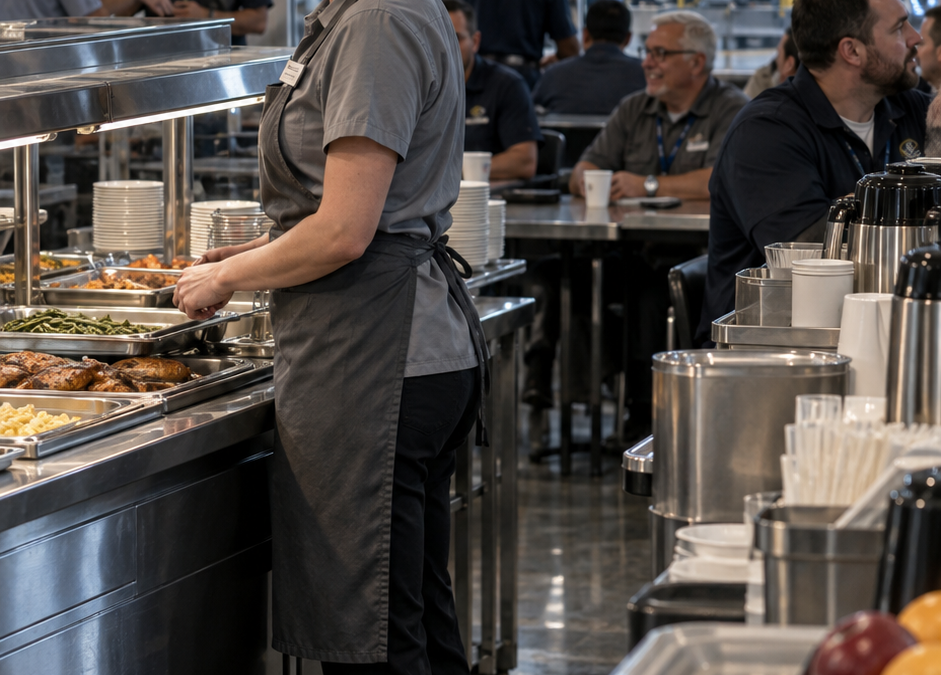
My name is Olivia Carter, and for six weeks I worked behind the cafeteria counter at Ironclad Defense Systems.
I wore a gray apron.
A plastic name tag.
Black nonslip shoes.
Every morning at 5:40, I unlocked the service door, turned on the coffee urns, checked the warming trays, and wiped down the same stretch of stainless steel until it reflected the fluorescent lights above me.
Nobody found any of that interesting.
That was the point.
Ironclad employed engineers, machinists, technicians, quality-control specialists, security contractors, and enough supervisors to make a simple maintenance request require three signatures.
The cafeteria workers existed somewhere beneath all of them.
People looked through us.
They talked over us.
They stood six feet away and discussed problems they would never mention inside a conference room because nobody considers the woman replacing napkins part of the room.
I understood that before my first shift.
Invisibility had once kept me alive.
At Ironclad, it made me useful.
People knew me as Olivia from the cafeteria.
Quiet.
Reliable.
Never late.
Good memory for orders.
If anyone asked about my past, I gave them the version in my employment file.
A few medical-support jobs.
Food service.
Some gaps.
Nothing remarkable.
Nobody knew I had spent eight years in the Navy.
Nobody knew that the word medic did not begin to explain what I had done.
And nobody at Ironclad knew I had been sent there because five years earlier, a component manufactured under one of their supply chains had helped kill three men I loved like brothers.
I still remembered the night.
I wished I didn’t.
Some memories soften with time.
That one had sharpened.
We were four people operating together so long that conversation had become optional.
Lieutenant Eric Bennett could communicate annoyance with one eyebrow.
Tom Avery always checked the same pocket twice before movement.
Caleb Ross hummed when he was nervous, though he denied it every time I pointed it out.
And I was the medic.
The one expected to remain calm after everyone else’s calm had become irrelevant.
We had gone into dangerous places before.
That night was supposed to be easier.
A routine extraction.
A clean communications window.
A relay package that had passed civilian certification and had been installed according to specification.
That was what the paperwork said.
Paperwork has never bled in my hands.
People have.
Our relay failed during sustained operation.
Not all at once.
That would almost have been merciful.
It began with a pattern.
A pressure oscillation.
A slight irregular hiss from the housing.
A delay in signal recovery.
Then the communications link collapsed precisely when we needed support.
I remember Bennett shouting for a secondary connection.
I remember Ross working the equipment.
I remember hearing static where another human voice should have been.
Then the situation changed faster than we could.
I did what I had been trained to do.
I treated what I could reach.
I made decisions I still replay in the dark.
I told myself help was coming.
Then I stopped telling myself that because lying wastes energy.
I made it out.
They did not.
There is no dignified way to describe returning alone.
People think survival feels like victory because the alternative is death.
Sometimes survival feels like arriving at the end of a sentence and realizing every word before your name has been erased.
Three families were waiting.
Three sets of parents.
Two wives.
Children.
Questions.
And me.
I filed my report that same week.
Exact times.
Exact failure sequence.
Environmental conditions.
Equipment designation.
The audible release pattern.
The relay instability.
Every detail I remembered.
I did not write emotionally.
Emotion gives people somewhere convenient to look when they want to avoid evidence.
I wrote like a medic.
Plainly.
Precisely.
The investigation concluded operator error.
I read the findings twice because the first time I thought exhaustion had made me miss a page.
The component was barely mentioned.
The certification process was not meaningfully reviewed.
The failure sequence I had described had been reduced to language suggesting improper handling under field conditions.
I appealed.
I requested technical review.
I pushed it up through every channel available to me.
Four months.
Meeting after meeting.
The same careful voices.
The same phrases.
“Insufficient evidence.”
“Field variables.”
“Unable to reproduce.”
“Closed finding.”
I became very familiar with the language institutions use when they want to sound as though they are answering you without actually doing it.
Only one person treated my original report as though it mattered.
Rear Admiral Marcus Hollis.
He was not involved in the first investigation.
He found my report later.
He called me into a secure office on a Thursday afternoon.
He had my file open in front of him.
“I read the full annex,” he said.
Nobody had said that to me before.
I sat very still.
“Then you saw the relay sequence.”
“I did.”
“And?”
“And I think someone stopped looking too soon.”
Something hot rose behind my ribs.
“Then reopen it.”
His jaw tightened.
“I can’t.”
“Can’t or won’t?”
“Can’t. Not with what I have.”
I hated him for that answer for perhaps three seconds.
Then I saw his face.
He hated it too.
“What do you need?”
“A pattern.”
“I gave you a pattern.”
“You gave me one event.”
“Three men died.”
“I know.”
“Then how many events do you need?”
His voice softened.
“Enough that they can’t call yours isolated.”
That sentence followed me for years.
Enough that they can’t call yours isolated.
My teammates had become an isolated event.
A statistical inconvenience.
A file that could be closed.
I submitted my separation papers two weeks later.
Some people assumed I was burned out.
Others assumed I blamed myself.
Both were true in ways I could not explain.
But the biggest reason was simpler.
I could not keep serving inside a system that required me to pretend its answer was acceptable.
Hollis contacted me eighteen months later.
I was working in a diner.
Not because I dreamed of serving coffee.
Because ordinary work had rules I could understand.
People ordered eggs.
I brought eggs.
Someone spilled coffee.
I cleaned it.
Nobody died because a report disappeared into a chain of review.
He walked in wearing civilian clothes and sat in my section.
I recognized him immediately.
“You look terrible,” I told him.
“Good to see you too.”
I poured coffee.
“What do you want?”
“Five minutes.”
“You already have coffee. That’s worth three.”
He almost smiled.
Then he placed a thin folder on the table.
No markings visible.
“I found your pattern.”
My hand stopped.
I sat across from him.
He told me about a defense contractor named Ironclad.
Similar relay family.
Different production batches.
Three internal incidents over several years.
All low-level.
No fatalities.
Every one explained as handling error.
Every one closed quickly.
“Same manufacturer?”
“Part of the same supply network.”
“Same certification lab?”
He looked at me.
That was enough.
“Yes.”
I stared at the folder.
“Why are you telling me?”
“Because I’m building something I couldn’t build five years ago.”
“What?”
“A case.”
“Then build it.”
“I am.”
His eyes stayed on mine.
“I need someone inside.”
I laughed once.
No humor in it.
“Absolutely not.”
“I haven’t asked yet.”
“You crossed three states to sit in my diner. You asked when you walked through the door.”
He folded his hands.
“I need someone who knows the failure signature before it becomes an engineering chart.”
“There are engineers for that.”
“They’re visible.”
“So?”
“The person I need can’t be.”
I understood.
I wished I didn’t.
He continued.
“Six weeks. Maybe less.”
“Doing what?”
“Observing.”
“Under what authority?”
He told me.
Enough to satisfy me.
Not enough to make me comfortable.
Then he said the one sentence that made refusal almost impossible.
“I need someone who knows what this defect costs before it becomes another casualty report.”
I looked toward the kitchen.
A waitress was arguing with the cook about pancakes.
Someone at table seven wanted more syrup.
A child had dropped a fork.
Ordinary life.
I had spent years trying to convince myself ordinary was enough.
“Who knows?”
“Very few people.”
“If this turns out to be nothing?”
“You go home.”
“And if it’s real?”
“We act.”
I looked back at him.
“You said that five years ago.”
His expression changed.
“I said I wouldn’t stop looking.”
“Did you?”
“No.”
That mattered.
More than I wanted it to.
I said yes.
Six weeks later, I was working at Ironclad Defense Systems.
The job had been designed to make me forgettable.
Clean background.
Low access.
Constant movement.
The cafeteria served all three production shifts.
Every department came through eventually.
Engineers who discussed pressure tolerances over oatmeal.
Technicians who complained about supervisors.
Quality-control staff who argued over paperwork while drinking bad coffee.
Shipping employees who knew exactly which products were leaving and when.
I never asked direct questions.
Direct questions make people remember you.
I listened.
I learned the building.
Which testing bays ran late.
Which supervisors signed incident reports.
Which technicians were careful.
Which ones were scared.
Which doors closed when corporate auditors visited.
Which conversations stopped when Gerald Voss entered a room.
Voss was plant director.
Late fifties.
Expensive watch.
Perfect hair.
A man who said “my people” often and knew almost none of their names.
He visited the cafeteria twice each week.
Same coffee.
No sugar.
Never said thank you.
I watched him without appearing to.
By the second week, I understood his priority structure.
Production first.
Schedule second.
Reputation third.
Everything else negotiated beneath those.
That alone was not criminal.
Plenty of bad managers worship deadlines.
I needed evidence.
It began with little things.
A quality technician muttering that Bay Four’s thermal gauge read low again.
A supervisor telling him to note recalibration after the shipment.
A maintenance employee complaining about repeated seal replacement on the same relay housing.
Two incident forms with nearly identical wording.
Operator handling error.
Then I met Marcus Diaz.
Twenty-five years old.
Electrical technician.
Curly dark hair he was always pushing off his forehead.
Polite enough to apologize when he needed a bandage.
The first time, he came to the counter with a cut on his thumb.
“Do you guys have anything for this?”
I looked.
“You need stitches?”
His eyes widened.
“No.”
“I’m asking.”
“Oh. No. Definitely not.”
I handed him a bandage.
He said, “Sorry.”
“For bleeding?”
“For bothering you.”
“Marcus.”
He blinked.
“Yeah?”
“Your blood is not a customer-service inconvenience.”
He smiled.
“Fair.”
That was how people started talking to you.
Not because you asked.
Because you remembered they were human.
Over the next weeks, I learned he had a younger sister applying to colleges.
His father repaired air conditioners.
His mother called him every Sunday.
He hated mushrooms.
He liked the engineering work but not some of Ironclad’s safety shortcuts.
That last part he never stated directly.
He didn’t have to.
One Tuesday afternoon, I was restocking napkins when I heard it.
Two rooms away.
Barely two seconds.
A release cycle.
Wrong pitch.
Wrong rhythm.
My entire body went cold.
Five years disappeared.
I was back in dust.
Static.
Bennett shouting.
Ross over the relay.
Avery bleeding.
I gripped the napkin dispenser until its plastic edge hurt my hand.
Then I made myself breathe.
One.
Two.
Three.
Present.
Ironclad.
Cafeteria.
Tuesday.
No incoming fire.
No team on the ground.
Not yet.
I walked toward the testing corridor.
Slowly.
People notice running.
Through reinforced glass, I saw Marcus holding one forearm against his chest.
Not seriously injured.
Pain.
A pressure-test rig behind him was venting.
A supervisor shut the cycle down manually.
The sound stopped.
I watched the gauge.
Then the seal.
Then the technician resetting the panel.
The sequence was wrong.
Not similar.
The same.
That evening, alone in my apartment, I opened the notebook Hollis had authorized.
Paper only.
Never connected to Ironclad.
I wrote:
Bay Four.
14:17.
Relay designation.
Pressure-release irregularity.
Manual shutdown.
Potential seal progression.
It was the third entry involving the same product family.
The next morning, the official incident report appeared.
Operator handling error.
Four words.
Exactly the phrase I had seen in the report that followed my teammates’ deaths.
I sat in my car for fifteen minutes before going inside.
Not crying.
Not shaking.
Just staring through the windshield.
Five years earlier, I had wondered whether the original investigators had been careless.
Now I knew something worse.
The language was systemic.
It was being used before anyone could ask the next question.
I gave Hollis a secure update that night.
He listened.
“Enough?” I asked.
“Close.”
“Three incidents.”
“I know.”
“Same wording.”
“I know.”
“What are you waiting for?”
“Confirmation of suppression at the decision level.”
“People could get hurt while you confirm management intent.”
“We move too early, they call it procedural noise and restructure before we get the records.”
I hated that he was right.
“How long?”
“Not long.”
“What do you need from me?”
“A complaint.”
I understood immediately.
“You want me to show them the defect.”
“I want you to use their system correctly.”
“And see what they do.”
“Yes.”
The next Wednesday, I filed a formal safety complaint.
It was the most conservative document I had ever written.
No accusation.
No reference to my service.
No emotional language.
Six weeks of observations.
Three incidents.
Relay designations.
Failure signatures.
Similar report wording.
Formal request for independent inspection.
I addressed it to Gerald Voss and copied site safety compliance.
Then I returned to the cafeteria.
I served meatloaf.
Replaced forks.
Cleaned coffee from a table.
At four that afternoon, no response.
By seven the next morning, I received a notice for a mandatory floor-wide safety meeting at 8:00.
No agenda.
That told me enough.
I arrived four minutes early.
Forty employees stood beneath fluorescent lights.
Marcus Diaz was two rows behind me.
Curtis from security stood near the entrance.
Voss entered exactly at eight.
He did not carry a presentation.
No laptop.
No printed safety metrics.
He looked directly at me.
“Olivia Carter.”
The room changed.
I felt it.
He stepped forward.
“I believe in transparency.”
That is often how people begin when they are preparing to humiliate someone publicly.
“Our employees deserve to know when resources are being wasted on manufactured concerns.”
Nobody moved.
Voss continued.
“A complaint was submitted yesterday by an individual with no engineering background, no technical certification, and no professional standing to evaluate Ironclad equipment.”
He pointed at me.
“This employee has attempted to fabricate safety issues in areas far outside her responsibilities.”
Marcus looked at me.
Several engineers suddenly became very interested in the floor.
Voss’s voice hardened.
“A cafeteria waitress does not get to second-guess engineers who have spent decades designing and certifying these systems.”
I said nothing.
“Ms. Carter, your employment is terminated effective immediately.”
Silence.
“Clean out your locker. Turn in your badge.”
Forty people.
Nobody defended me.
I do not blame them as much as I once would have.
Fear is powerful when your mortgage depends on the person doing the humiliating.
Still, I remember the silence.
I remember how Marcus’s face changed.
I remember Curtis looking away.
I remember Voss waiting for me to fight him.
He wanted an argument.
An emotional employee.
Something that would make the complaint look personal.
I gave him nothing.
“Thank you for the opportunity,” I said.
Four words.
His expression tightened.
I took the notebook from my apron pocket.
He noticed.
“What is that?”
“Mine.”
“Company notes need to remain on site.”
“They aren’t company notes.”
He stared at me.
“Give them to security for review.”
“No.”
That was the first time I had contradicted him publicly.
His face darkened.
“Ms. Carter—”
“My employment is terminated.”
I removed my apron.
Folded it.
Placed it on a chair.
“So I’m leaving.”
I walked out.
No one stopped me.
At the front desk, my badge was taken.
A cardboard box had already been prepared.
My name written in marker.
That detail told me the decision had been made before the meeting.
I carried it through the gate.
Placed it in my trunk.
Then sat behind the steering wheel.
For perhaps a minute, I felt nothing.
Not anger.
Anger needs surprise.
Voss had simply confirmed what six weeks of observation already suggested.
He would protect production from safety concerns.
Even when those concerns were documented correctly.
I reached beneath the passenger seat.
The encrypted phone was taped inside a narrow compartment.
I removed it.
Dialed the only stored number.
Hollis answered immediately.
“It’s me.”
“I know.”
“It’s confirmed.”
Silence on his end.
“Everything?”
“Defect pattern. Repeated incident language. Management suppression. I filed through the official channel yesterday.”
“And?”
“He fired me in front of the whole floor.”
A pause.
Not surprise.
Confirmation.
“You have the notebook?”
“In my hand.”
“Any digital copies?”
“None.”
“Good.”
I looked back toward the plant.
Workers were beginning to return to their stations.
“What do you want me to do?”
“Your call.”
Those words mattered.
He had given me authority before insertion.
Once management suppression was confirmed, I could recommend immediate action.
Five years earlier, I had begged people to stop a defective system after three men died.
Now Hollis was asking before somebody else did.
I closed my eyes.
Saw Bennett.
Avery.
Ross.
Then Marcus Diaz holding his forearm.
“Fire every one of them. Now.”
Hollis did not ask me to clarify.
“Understood.”
The call ended.
I had not started the engine when alarms began screaming inside Ironclad.
I looked up.
Not a fire alarm.
Not evacuation drill.
Containment failure.
For one half second, I sat completely still.
Then I heard the pitch through the walls.
My stomach dropped.
Bay Four.
I knew it.
I shoved the phone into my pocket and got out.
The front gate guard saw me approaching.
“Ma’am, you can’t—”
“Containment alarm.”
“I know, but your badge—”
“Bay Four?”
He hesitated.
That was enough.
I went through.
“Ms. Carter!”
I was already moving.
Employees poured from doors.
Confused.
Some carrying phones.
Some trying to locate supervisors.
The evacuation flow was wrong.
I saw it immediately.
The east corridor ran beneath the affected test section.
If the secondary containment ruptured, pressure and debris could vent directly into the route they were using.
“North stairwell!” I shouted.
People turned.
A supervisor pointed the opposite way.
“Main exit!”
“No! North stairwell!”
He stared at me.
“Who the hell—”
“Do you want forty people underneath Bay Four when the housing lets go?”
His face changed.
“Move!” I shouted. “North stairwell!”
The word moved through the crowd.
People turned.
Years earlier, I had learned something about emergencies.
People do not need you to sound loud.
They need you to sound certain.
I reached the test floor in less than ninety seconds.
The bay door stood open.
Bad.
A venting housing sat at the center.
Worse.
Two technicians remained inside.
One was Marcus.
His hand hovered over an emergency shutoff panel.
The second technician had blood along his cheek from flying debris.
“Don’t touch that valve!” I shouted.
Marcus froze.
He saw me.
“Olivia?”
“Blue valve. Quarter turn. Slowly.”
He stared.
“Now.”
He obeyed.
The pitch of the vent changed.
“Stop!”
He stopped.
I moved inside.
“You’re fired,” he said breathlessly.
“Apparently.”
Despite everything, he almost laughed.
“What do I do?”
“Primary isolation first. Then we bleed the secondary.”
“The procedure says full closure.”
“The procedure assumes the seal is intact.”
“How do you know it isn’t?”
“Because I’m listening to it.”
His eyes searched my face.
He trusted me.
That terrified me more than if he had questioned me.
“Blue valve another eighth.”
He turned it.
“Good.”
The second technician staggered.
I caught him.
“Sit down.”
“I’m fine.”
“You’re bleeding.”
“It’s nothing.”
“I used to hear that for a living. Sit.”
He sat.
Marcus stared at me again.
“What did you used to do?”
“Later.”
The housing shuddered.
A sound hit me like a fist.
Five years.
Same progression.
I was back there.
For one dangerous second, I saw Ross instead of Marcus.
I smelled dust instead of industrial coolant.
My hand began to shake.
No.
Not again.
I pressed my palm against the panel.
Cold metal.
Ironclad.
Bay Four.
Marcus alive.
People evacuating.
Now.
“Olivia?”
“I’m good.”
“You don’t look good.”
“Neither does that seal.”
I crossed to the manual secondary control.
The electronic panel was showing stable pressure.
It was lying.
The physical housing was not.
“Gauge is wrong,” I said.
Marcus looked.
“It’s within tolerance.”
“It’s lagging.”
“By how much?”
“Enough.”
I opened the manual bleed in controlled increments.
The hiss rose.
Marcus flinched.
“That’s worse.”
“Wait.”
Three seconds.
Four.
Then the pitch lowered.
Pressure on the secondary gauge dropped.
The housing stopped vibrating.
“Again,” I said.
Marcus followed.
Another reduction.
We were getting ahead of it.
Footsteps came behind us.
Gerald Voss.
Of course.
He entered the corridor wearing the expression of a man who believed management meant appearing wherever the crowd was largest.
Then he saw me.
His face hardened.
“What are you doing here?”
I did not turn.
“Stabilizing your secondary seal.”
“You were terminated.”
“Very observant.”
“You are trespassing on private property.”
Marcus stared at him.
I kept my hand on the manual control.
“Gerald,” I said, “this housing is six minutes from becoming somebody else’s lifelong memory. Choose your next sentence carefully.”
The corridor went silent.
He walked closer.
“Step away from that equipment.”
“No.”
“I am ordering you—”
“You fired me.”
His jaw tightened.
“Then you have even less authority to touch that system.”
“Correct.”
I finally looked at him.
“So if you’d like to remove the only person in this room who understands why your pressure gauge is lying, go ahead.”
His face changed.
Just slightly.
He knew.
Not what I had been.
But that I knew something he didn’t.
“Response team is coming.”
“They’re four minutes out.”
“How do you know?”
“I counted from the alarm.”
“Step away.”
The seal emitted another low vibration.
I looked back at it.
“No.”
Voss turned.
“Curtis.”
Security officer Curtis stood near the door.
The same man who had taken my badge.
“Remove her.”
Curtis looked at me.
Then at the housing.
Then at Marcus.
“Sir…”
“Now.”
Curtis stepped forward.
I kept my eyes on the pressure.
“Curtis.”
He stopped.
“I know you’re doing your job.”
He said nothing.
“I’m asking you not to make this the worst order you’ve ever followed.”
His hand remained at his side.
Voss’s voice sharpened.
“Officer!”
Curtis looked at him.
“Sir, she’s keeping the system stable.”
“That is not your determination.”
“No, sir.”
“Then remove her.”
Curtis took one step backward.
“I’m not touching her.”
Voss stared at him.
I heard someone behind us whisper, “Holy hell.”
I worked the manual valve again.
Pressure dropped.
Seven percent.
Then five.
Then three.
The hiss softened.
Marcus exhaled.
“Is that it?”
“Not yet.”
Another thirty seconds.
Gauge steady.
Physical vibration gone.
I waited.
Checked again.
Then once more.
“Now.”
Marcus’s knees seemed to stop working.
He sat hard against the wall.
The injured technician laughed nervously.
“Are we good?”
“We’re stable.”
Marcus put both hands over his face.
I crouched beside him.
“You hurt?”
He shook his head.
“Just—”
“I know.”
“I thought it was going.”
“So did I.”
He looked at me through his fingers.
“How did you know what to do?”
I opened my mouth.
Then the sound of engines came through the exterior wall.
Multiple vehicles.
Heavy.
Coordinated.
I knew that sound too.
Hollis had moved.
Voss turned toward the window.
The first black SUV came through the gate.
Then another.
Then a third.
Behind them came federal transport vehicles.
The color drained from his face.
“What is this?”
I stood slowly.
“Consequences.”
The first team entered the building minutes later.
No shouting.
No theatrics.
That was how professionals moved.
Two columns.
One toward records and servers.
One toward shipping.
Security did not stop them.
Nobody had the authority.
The floor workers lined the corridor.
Some still in evacuation gear.
Some staring at me.
Reeves-style disbelief did not exist here.
These people had watched their plant director fire a cafeteria worker.
Then they had watched that cafeteria worker return and prevent a containment failure.
Now armed federal personnel were securing the facility.
The arithmetic was becoming uncomfortable.
A senior agent approached Voss.
“Gerald Voss?”
“Yes.”
“We need you to remain where you are.”
“On whose authority?”
The agent showed credentials.
Voss’s eyes flicked toward me.
Understanding was arriving.
Not enough of it.
But enough.
Four minutes later, Admiral Marcus Hollis entered.
Dress uniform.
Four stars.
Straight posture.
No wasted motion.
He crossed the floor.
People moved aside.
He did not look at Voss first.
He came to me.
“Containment?”
“Stable.”
“Casualties?”
“Minor injury. No major exposure.”
Marcus Diaz raised one hand weakly.
“Still here.”
Hollis looked at him.
“Glad to hear it.”
Then he turned to me.
“You all right?”
That question almost undid me.
Not Are you injured?
Not Is the system safe?
You all right?
I nodded.
“Yes, sir.”
He knew I was lying.
He let me.
Then he faced the employees gathered in the corridor.
“My name is Admiral Marcus Hollis.”
No one moved.
“The woman many of you watched being terminated this morning was placed inside this facility under authorized federal investigative supervision.”
A sound moved through the crowd.
Voss stepped forward.
“This is absurd.”
A federal agent blocked him.
Hollis continued without raising his voice.
“Ms. Carter’s employment in the cafeteria was cover.”
Marcus Diaz looked at me.
I avoided his eyes.
“She was tasked with identifying repeated safety anomalies connected to a component family currently supplied under military contract.”
Voss tried again.
“I was never informed—”
“No,” Hollis said. “You weren’t.”
That shut him up.
“The investigation concerns falsified safety certification, suppression of internal incident reports, and the continued shipment of components with known failure signatures.”
Every face around us changed.
Hollis gestured toward me.
“For six weeks, Ms. Carter documented incidents in a handwritten record kept outside Ironclad’s digital infrastructure.”
He paused.
“The complaint she filed yesterday was not a stunt.”
He looked directly at Voss.
“It was a test of your internal safety process.”
Voss went rigid.
“You cannot bait management—”
“You received a documented safety complaint.”
Hollis’s voice remained calm.
“You chose to fire the employee who submitted it before conducting an independent review.”
“It came from a cafeteria employee.”
“Which is relevant how?”
“She had no qualifications.”
Hollis looked at me briefly.
Then back at Voss.
“You based that conclusion on the uniform she was wearing.”
Voss said nothing.
Hollis continued.
“Olivia Carter served eight years as an operational combat medic attached to Naval Special Warfare.”
The silence became absolute.
Marcus Diaz whispered something I could not hear.
Hollis looked around the room.
“She has field experience with the same relay failure family currently under investigation.”
Voss stared at me.
For the first time since I met him, he looked uncertain.
“Why?”
One word.
I knew what he meant.
Why me?
Why this plant?
Why now?
Hollis answered.
“Because a related communications relay failed five years ago during an operation.”
My chest tightened.
“Three service members died.”
Somebody behind me inhaled sharply.
“The original investigation attributed the loss to operator error.”
Hollis’s eyes hardened.
“Evidence gathered here indicates that conclusion may have relied on falsified or incomplete certification data.”
I stopped hearing the room clearly.
Bennett.
Ross.
Avery.
Their names filled my head.
Voss spoke again.
“You cannot connect my facility to an event five years ago based on some waitress’s notebook.”
I turned toward him.
He realized the mistake too late.
Some waitress.
I had spent years hearing people reduce evidence by reducing the person carrying it.
Hollis did not get angry.
That was worse for Voss.
“The notebook is corroborative evidence.”
He nodded toward the federal team.
“The server records currently being preserved will establish the rest.”
Voss’s face changed.
Servers.
That was what he feared.
A second agent approached Hollis and handed him a folder.
Hollis opened it.
Then looked at Voss.
“The shipment scheduled for sixteen hundred hours has been stopped.”
Voss’s mouth tightened.
“Those units have already passed certification.”
“Exactly.”
Hollis closed the folder.
“That’s the problem.”
Federal personnel had found the outgoing units.
Same relay family.
Same defect risk.
Already cleared for military delivery.
If we had waited one more day, they would have left Ironclad.
Maybe they would have worked.
Maybe they would have failed.
That uncertainty had once been acceptable to people who never stood on the receiving end.
It was not acceptable to me.
Voss began talking about review boards.
Procedure.
Corporate counsel.
Scope of authority.
Hollis let him finish.
Then said, “Agents at the front desk will explain the process.”
Voss looked at me.
Something ugly entered his expression.
“You set me up.”
“No.”
My voice was quiet.
“You set yourself up.”
“You came here pretending to be something you weren’t.”
I shook my head.
“I served food.”
“So this was deception.”
“I never told you I was unqualified.”
“You had an obligation—”
“My obligation was to see what you did when the person raising a safety concern had no status you respected.”
He stared at me.
“And now you know.”
He was escorted away.
Not handcuffed in front of everyone.
No dramatic struggle.
Just a man walking through a building that no longer belonged entirely to the version of reality he had controlled.
Curtis watched him go.
Then came to me.
“Olivia.”
“Hey.”
He looked uncomfortable.
“I should’ve said something this morning.”
“You did.”
“When?”
“You didn’t touch me.”
He shook his head.
“That was later.”
I knew what he meant.
During the firing.
Nobody defended me.
“It’s okay.”
“No, it isn’t.”
I appreciated that more than an excuse.
“You were protecting your job.”
“So was everyone else.”
“Fear makes rooms quiet.”
He looked toward the floor.
“Doesn’t make it right.”
“No.”
I touched his arm.
“But you made the right call when it mattered.”
He nodded once.
Marcus Diaz remained in medical for an hour.
Minor pressure exposure.
Bruising.
Nothing permanent.
When he came out, his face was pale but steady.
He found me near the loading dock.
“You really were a SEAL medic?”
“Attached to them.”
“That’s not a denial.”
“I know.”
He stared at me.
“I complained to you about my supervisor.”
“Several times.”
His eyes widened.
I almost smiled.
“I’m not putting that in a federal report.”
“Thank God.”
He rubbed his face.
“How much of what I said did you remember?”
“Your sister wants to study biomedical engineering.”
His expression softened.
“She got in.”
“What?”
“Last night.”
Despite everything around us, I smiled.
“Which school?”
“The one she wanted.”
“That’s great.”
“I was going to tell you at lunch.”
Something in that sentence hit me unexpectedly.
At lunch.
A future ordinary moment that had almost been replaced by a casualty report.
“I’m glad you’re okay,” I said.
His eyes dropped.
“You came back.”
“What?”
“They fired you.”
“Yes.”
“You could’ve driven away.”
I looked toward Bay Four.
“I’ve driven away from one failed relay before.”
He did not understand every layer of that sentence.
He understood enough.
“I couldn’t do it again.”
Marcus held out his hand.
I took it.
He covered mine with his other hand.
“Thank you.”
I nodded because speaking suddenly seemed difficult.
The plant was shut down for full inspection.
Every component in the affected family was quarantined.
Federal investigators seized certification records, internal correspondence, incident reports, maintenance histories, test logs, and shipment data.
Ironclad corporate leadership arrived before sunset.
Nobody looked at me like a waitress anymore.
Strangely, I missed it.
Invisibility had been easier.
Hollis found me outside near my car after dark.
The cardboard box was still in the trunk.
I had forgotten about it.
He stood beside me.
“Long day.”
“I’ve had worse.”
“I know.”
We were quiet.
Then he said, “They’re reopening it.”
I knew what he meant.
I stopped moving.
“The mission review?”
“Full technical reinvestigation.”
My hand tightened around my car keys.
“Based on this?”
“Based on Ironclad plus records from the certification lab.”
“You found the lab records?”
“We found enough to compel the rest.”
I looked away.
Lights from the plant reflected against the pavement.
Five years.
“Will they change the finding?”
“I won’t promise what I can’t guarantee.”
“Marcus.”
“But I can tell you operator error is no longer considered sufficient.”
I closed my eyes.
That phrase.
Operator error.
Fourteen letters and a space between two words had followed me longer than most people followed a marriage.
“What about their families?”
“If the finding changes, they will be formally briefed.”
“They should hear before the press does.”
“I agree.”
“From someone who understands what happened.”
“Yes.”
I looked at him.
“Not corporate.”
“No.”
“Not a lawyer.”
“No.”
“Someone who says their names.”
Hollis’s expression softened.
“Yes.”
That was when I finally cried.
Not dramatically.
No collapse.
Just tears I could not stop.
I leaned against my car and covered my face.
“I asked for this five years ago.”
“I know.”
“I gave them everything.”
“I know.”
“They made me feel insane.”
Hollis said nothing.
“They made me question whether I heard what I heard.”
My voice broke.
“Whether Ross had mishandled it. Whether Bennett had done something wrong. Whether I was trying to blame a piece of equipment because blaming myself was worse.”
Hollis stepped closer.
“But you kept your notes.”
“Because I couldn’t trust my memory.”
“Your memory was right.”
I laughed through tears.
“That’s not as comforting as you think.”
“No.”
He looked toward Ironclad.
“But it matters.”
I wiped my face.
“Three men are still dead.”
“Yes.”
“Nothing fixes that.”
“No.”
It was why I trusted Hollis.
He never tried to turn justice into resurrection.
He knew better.
Two months later, the preliminary reinvestigation cleared my team of the operational-error finding.
The relay failure was formally recognized as a material contributing factor.
Later reviews uncovered manipulated certification data, suppressed test results, and internal decisions that allowed questionable components to remain in the supply chain.
I received the report at home.
I read Bennett’s name.
Avery’s.
Ross’s.
Then the line stating that their actions had been consistent with established procedure under degraded equipment conditions.
I sat at my kitchen table for a long time.
Those words were bureaucratic.
Cold.
Careful.
They were also the closest thing the system knew how to say to three dead men:
You did not fail.
I called Bennett’s wife first.
Sarah.
She answered on the third ring.
“Olivia?”
“Hi.”
She heard something in my voice.
“What happened?”
I closed my eyes.
“They reopened the investigation.”
Silence.
“And?”
“The original finding was wrong.”
She did not speak.
“The relay failed.”
Still nothing.
“Eric didn’t cause it.”
A sound came through the phone.
Not quite a sob.
More like the body giving up something it had carried too long.
“I knew that,” she whispered.
“I know.”
“They told me he made a mistake.”
“I know.”
“For five years, they told my son his father made a mistake.”
My throat closed.
“I’m sorry.”
“Don’t.”
Her voice sharpened.
“Don’t apologize for them.”
I held the phone tighter.
“They’re changing the record.”
She cried then.
So did I.
That call was harder than anything I did at Ironclad.
Then I called the others.
One family at a time.
There was no perfect reaction.
Anger.
Relief.
Grief renewed.
Questions.
Long silences.
But their men got their names back.
That mattered.
Ironclad changed too.
Voss did not return.
Several managers were removed pending investigation.
The company established independent incident review for military-contract production.
Whether that reform lasted forever, I could not control.
I had learned not to confuse one corrected outcome with a perfect system.
Marcus Diaz stayed.
So did Curtis.
Months later, Marcus sent me a picture of his sister standing outside her college dorm.
Big smile.
Two suitcases.
He wrote:
She made it.
I saved the picture.
Hollis offered me a permanent oversight position.
I declined.
He looked offended.
“You’d be good at it.”
“That’s the problem.”
“Explain.”
“I’d start thinking I could fix everything.”
“Could be worse.”
“I already spent five years carrying one thing I couldn’t fix.”
He understood.
“What are you going to do?”
“I don’t know.”
That answer felt healthy.
Three weeks after Ironclad, I started working mornings at a diner in a small town about forty minutes away.
People found that strange when they learned about it.
I did not.
I liked ordinary work.
Ordinary work had not betrayed me.
People had.
Systems had.
Coffee had always simply been coffee.
I opened at five-thirty.
There was an older man named Ray who arrived every morning at six.
Black coffee.
Two eggs.
Dry wheat toast.
For three weeks he never mentioned Ironclad.
Then one morning he unfolded a newspaper.
My photograph was inside.
Not a good one.
I had been leaving the facility.
“That you?” he asked.
I looked.
“Unfortunately.”
He studied me.
“Says you exposed some defense-contract mess.”
“Paper says a lot.”
“Says you were undercover.”
“I worked cafeteria.”
“Sounds undercover.”
I refilled his coffee.
He watched me.
“Why come work here?”
“Why not?”
“After all that?”
I leaned against the counter.
“Ray, people still need breakfast after federal investigations.”
He considered that.
“Fair point.”
Then he looked at the article again.
“They fired you?”
“Yes.”
“For reporting the safety issue?”
“Yes.”
“And you went back inside when the alarm went off?”
“Yes.”
“Why?”
I looked toward the kitchen window.
There were many possible answers.
Because Marcus was inside.
Because forty employees did not deserve to pay for Gerald Voss.
Because being right would have felt meaningless beside another body.
Because five years earlier, I had heard the same sound and could not save three men.
But the simplest answer was best.
“Because people were still in there.”
Ray nodded.
Nothing dramatic.
“Coffee’s good today.”
“It’s the same coffee.”
“Nope.”
I smiled.
“Drink it before it gets cold.”
Life became quieter.
Not empty.
Quieter.
There is a difference.
For years, silence had meant the moment after communications died.
Then the silence after funerals.
Then conference rooms where people refused to see what I saw.
Eventually, silence became mornings before the diner opened.
Sunlight on polished counters.
A coffee machine warming up.
The hum of refrigeration.
Peace.
I learned not every quiet room was waiting for something terrible.
Sometimes nothing was coming.
That took time to trust.
One morning Hollis visited.
No uniform.
He sat at the counter.
“You still look terrible,” I said.
“You said that last time.”
“Still true.”
I poured him coffee.
He looked around.
“So this is retirement?”
“I’m thirty-something.”
“Emotional retirement.”
“From you, maybe.”
He smiled.
Then became serious.
“The final findings came through.”
I stopped wiping the counter.
“Everything?”
“Everything we’re going to get.”
“And?”
“Your report five years ago is now part of the official corrective record.”
I stared at him.
“The original one?”
“Unedited.”
Something inside me moved.
Not pain exactly.
“What happens to it?”
“Training. Procurement review. Failure analysis.”
I looked down.
“So somebody might read it before the next team takes one of those relays out.”
“That’s the idea.”
I nodded.
That, more than the news stories, mattered.
The report had finally become what I wrote it to be.
A warning.
Not a memorial.
Hollis sipped his coffee.
Then said, “You know what bothers me?”
“Your coffee?”
“This is terrible coffee.”
“Then leave.”
He smiled.
“What bothers me is you still call yourself just a waitress.”
“I am a waitress.”
“You were a combat medic.”
“Also true.”
“You ran an undercover investigation.”
“Apparently.”
“You stopped a containment failure.”
“Marcus did half the work.”
“Olivia.”
“What?”
He shook his head.
“You don’t need to disappear anymore.”
I knew he meant more than the diner.
I thought about it.
“I don’t think I’m disappearing.”
“No?”
“No.”
I looked around.
“I think I’m finally choosing where I stand.”
He accepted that.
Before leaving, he placed money beside his coffee.
Too much.
I pushed part of it back.
“That’s excessive.”
“Consider it hazard pay.”
“For coffee?”
“For dealing with admirals.”
I almost laughed.
Then he walked out.
I watched him cross the parking lot.
For a long time after Ironclad, people wanted to make the story about the moment the black SUVs arrived.
That was the dramatic part.
The part newspapers liked.
The fired waitress who turned out not to be a waitress.
The admiral.
The raid.
The corrupt director.
But that was never the part I remembered most.
I remembered forty employees looking at the floor while Voss humiliated me.
I remembered Curtis deciding not to obey him.
I remembered Marcus’s hand hovering over the wrong valve.
I remembered hearing the same failure signature that had haunted me for five years.
And I remembered having a choice.
I could have driven away.
Nobody reasonable would have blamed me.
I had been fired.
Publicly insulted.
Escorted out.
Voss had told the entire floor I was unqualified.
If I had started my car and gone home, the responsibility for whatever happened next would have belonged to Ironclad.
Legally, maybe that would have been true.
But morality is rarely interested in what your lawyer could defend afterward.
There were people in that building.
Marcus.
Curtis.
Engineers who had remained silent because they were afraid.
Technicians who had never seen my complaint.
Men and women with families waiting for them.
They were not Gerald Voss.
So I went back.
That decision saved something in me too.
For five years, the worst night of my life had ended with me leaving three men behind because there was no other choice.
At Ironclad, when the alarm sounded, I got to run back toward the problem.
I got to hear that failure pattern again.
And this time, nobody died.
I do not believe life gives us neat second chances.
Reality is not that kind.
I did not save Bennett.
Avery.
Ross.
I did not rewrite the night they died.
I would insult them if I pretended otherwise.
But I did prevent the same lie from becoming somebody else’s grief.
Maybe that is as close to redemption as people should ask for.
Years later, I can still hear Gerald Voss telling the room that a waitress did not get to question engineers.
He was right about one thing.
I was a waitress.
What he never understood was that jobs tell you what a person is doing.
They do not tell you everything a person knows.
Uniforms work the same way.
So do titles.
So do badges.
I had once worn body armor and carried medical equipment into places most people would never see.
Then I wore a cafeteria apron.
Later, I wore a diner apron.
None of those uniforms changed the thing underneath.
I paid attention.
I listened.
I remembered.
And when someone was in danger, I moved toward them.
That was what I had always been.
Not a SEAL.
Not really a waitress.
Not an investigator.
A medic.
Five years after my team died, I finally understood the word did not require a uniform.
Marcus Diaz still sends me a Christmas card.
His sister finished her engineering degree.
Curtis eventually became head of security under new management.
Hollis retired.
He still complains about my coffee whenever he visits.
And the names Eric Bennett, Tom Avery, and Caleb Ross no longer sit beneath the words operator error in the official record.
Sometimes I take their corrected report out of my desk.
I read the first page.
Never all of it.
I do not need to anymore.
At the bottom of one section is a sentence acknowledging that equipment failure materially degraded their ability to obtain support.
Clinical language.
But I know what it means.
I know what their families hear inside it.
I know what I hear.
You were telling the truth.
For years, I thought that was what I needed most.
To be proven right.
It wasn’t.
I needed the truth to become useful.
At Ironclad, it finally did.
One afternoon, Ray sat at my counter long after the lunch crowd had gone.
He had seen another article about the case.
“They sentenced that plant director,” he said.
I nodded.
“I saw.”
“You happy?”
I wiped the counter.
“No.”
He looked surprised.
“Thought you would be.”
“I wanted the components stopped.”
“They were.”
“I wanted the report corrected.”
“It was.”
“I wanted the families told.”
“They were.”
He waited.
“Then what’s missing?”
“Nothing.”
He frowned.
“Then why aren’t you happy?”
I thought about the question.
“Because justice isn’t happiness.”
Ray stayed quiet.
“It’s just justice.”
He nodded slowly.
“Maybe that’s enough.”
I looked toward the window.
Late sunlight crossed the empty booths.
“Sometimes.”
He finished his coffee.
Before leaving, he turned back.
“Olivia?”
“Yeah?”
“If you had to do it again, would you?”
Six weeks pretending to be invisible.
Public humiliation.
Running back into a building that had just thrown me out.
Reopening wounds I had spent years sealing shut.
Calling three families and making them grieve again.
I thought of Marcus alive against that wall.
I thought of stopped shipments.
I thought of three names restored.
“Yes,” I said.
No hesitation.
Ray nodded.
“Figured.”
After he left, I stood alone behind the counter.
For a moment, I could almost hear my old team.
Ross complaining about the coffee.
Avery stealing sugar packets.
Bennett telling everyone to stop bothering the medic.
Memory can be cruel.
But it can also become gentle if you give it enough years.
I no longer remember them only as the three men who died because a relay failed.
I remember them laughing.
Arguing.
Eating terrible field food.
Giving me grief because I carried too much medical tape.
Alive.
That was the last victory the investigation gave me.
The failure no longer owned the whole memory.
Neither did Ironclad.
Neither did Voss.
Neither did the report.
They were my team before they were casualties.
And I was their medic before I became the survivor who kept asking questions nobody wanted answered.
I locked the diner that night and stepped into the cool air.
No alarms.
No black SUVs.
No shouting.
Just a quiet parking lot.
My car waiting beneath a streetlight.
For years, I had believed peace would feel like finally forgetting.
It doesn’t.
Peace is remembering without being dragged backward.
I got into my car.
Started the engine.
For one moment, before pulling away, I looked at my hands on the steering wheel.
Those hands had held pressure on wounds.
Written reports.
Carried cafeteria trays.
Turned a failing containment valve.
Dialed an encrypted phone.
Held the hands of grieving families.
Same hands.
Different rooms.
I used to think the most important decision I made at Ironclad was the phone call.
It wasn’t.
“Fire every one of them” activated an investigation that was already waiting.
The most important decision came minutes later.
The alarm sounded.
The building that had humiliated me was in trouble.
And I went back inside.
Not for Voss.
Not for Ironclad.
For the people.
That was the line separating what he was from what I refused to become.
Five years earlier, a broken relay had taken three men from me and a broken system had tried to bury the reason.
At Ironclad, I finally reached the same failure before it reached another family.
I could not change the night my team died.
I could not make the missing years disappear.
But I could make sure their deaths stopped being convenient.
And when the truth finally came through those gates, it did not arrive because I had shouted louder than everyone else.
It arrived because for six weeks, I had stood behind a cafeteria counter, poured coffee, listened carefully, and written down what everyone else had decided was too small to matter.
Gerald Voss thought firing me would make the problem disappear.
He never understood that by then, I was no longer the problem he needed to fear.
The truth was already inside the building.
I had simply been the one quiet enough to hear it.








