𝗣𝗔𝗥𝗧 𝟮 The Marine Who Called My Wounded Dog Useless Never Once Asked Why the Sergeant Major Went Pale When He Saw Me
𝗣𝗔𝗥𝗧 𝟮
The mess hall doors opened.
Sergeant Major Raymond Hayes walked in carrying a paper cup of coffee and the Saturday newspaper folded beneath one arm.
He took two normal steps.
Then stopped.
Hayes had spent nearly thirty years in uniform.
He had walked through post-blast scenes.
He had stood beside me during wildfire evacuations when entire housing blocks were threatened.
He had informed parents that their nineteen-year-old son had died during training.
I had seen him remain calm through events that made younger men forget how to speak.
The moment he saw me, the color left his face.
His gaze moved to Bruno.
Then the overturned trays.
Then Mercer.
The coffee slipped from his hand.
It hit the floor and splashed across his polished boots.
Hayes never looked down.
Mercer glanced over his shoulder.
“Sergeant Major, perfect timing.”
Hayes did not answer immediately.
Mercer gestured toward me.
“This civilian brought some beat-up pet in here and started causing trouble.”
The silence in the room grew heavier.
Hayes looked at me.
I gave him the smallest shake of my head.
Not yet.
He understood.
That was one of the reasons he was my senior enlisted adviser.
He understood orders I never had to speak.
His shoulders squared.
“What happened?”
Mercer responded immediately.
“She was blocking the serving line. I tried to get past her, and she made a whole thing out of it.”
A woman behind the grill lowered her spatula.
“That’s not what happened.”
Mercer turned.
She was a civilian employee in her forties with her hair tucked beneath a kitchen cap.
I knew her face but not her name.
Mercer frowned.
“Nobody asked you.”
The woman stepped closer to the counter.
“My name is Denise Alvarez.”
She pointed the spatula toward him.
“And I watched you shove her.”
Mercer’s three friends moved slightly farther away.
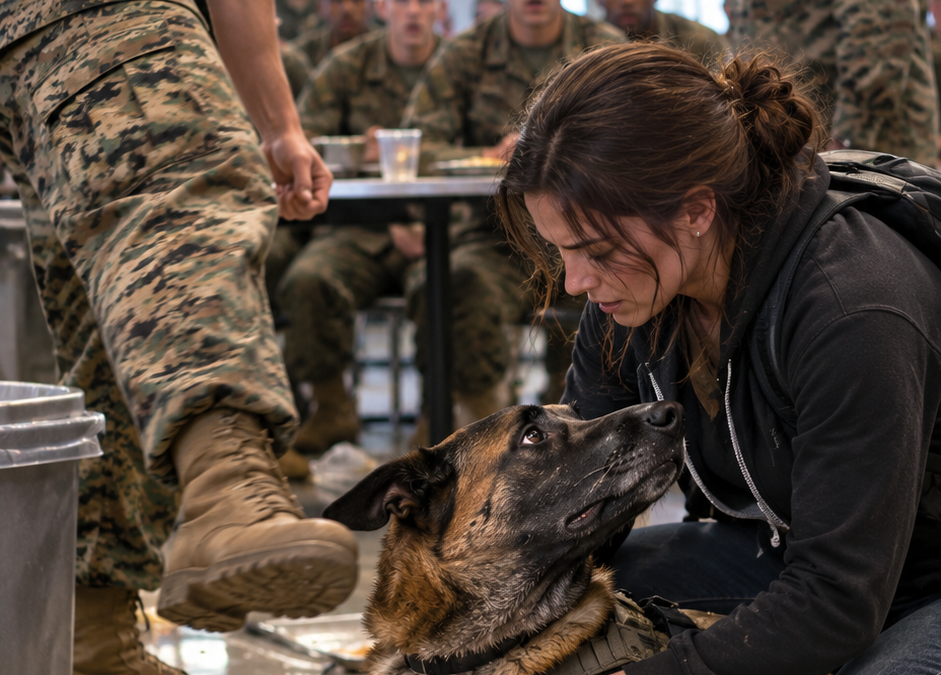
I crouched beside Bruno again.
He pressed his muzzle against my knee.
Hayes came closer.
His voice softened.
“Can he stand?”
“I don’t know.”
The answer came out colder than I intended.
Hayes heard it.
He knew that voice.
He had heard me use it while coordinating evacuation routes during the Canyon Ridge fire.
He had heard it after two Marines died when a training vehicle overturned the previous year.
It was the tone I used when I could not afford emotion yet.
Hayes turned toward the kitchen.
“Call the veterinary clinic.”
Denise reached for the wall phone.
Mercer gave a short laugh.
“For a dog?”
Hayes looked at him.
“For a Marine veteran.”
That changed the room.
Eyes moved toward Bruno’s harness.
Most people had seen the missing leg.
The damaged ear.
The scar.
Only now did they seem to notice the faded patch sewn near his shoulder.
RETIRED MILITARY WORKING DOG.
Mercer noticed too.
He shrugged.
“He’s still a dog.”
Hayes stepped toward him.
Slowly.
“You should consider remaining silent.”
Mercer did not understand the warning.
“With respect, Sergeant Major, this woman shouldn’t have brought him inside.”
One of his friends spoke again.
“Tyler, stop.”
Mercer spun.
“Parker, you saw her blocking the line.”
Parker’s eyes moved toward me.
“No.”
Mercer stared.
“What?”
“I saw you cut the line.”
The balance of the room began changing.
Mercer looked toward the other two Marines.
Neither supported him.
Behind me, Bruno attempted to stand again.
I slid one arm beneath his chest.
His rear legs found their footing.
His remaining front leg shook violently.
“Don’t force it.”
He leaned against me.
Three years earlier, he had refused to stay down while a compound burned around him.
I knew the story because his handler had told it to me personally.
Staff Sergeant Owen Price.
One of mine.
Twenty-eight years old.
Newly married.
Terrible singer.
Excellent squad leader.
The kind of Marine who carried dog biscuits in one cargo pocket because he could not walk past an animal without offering food.
During a deployment overseas, Owen and Bruno had entered a damaged compound searching for Marines trapped after an explosion.
The first blast had brought down part of the outer wall.
Secondary fires spread inside.
Bruno found two wounded men through smoke and debris.
He went back twice.
The second time, another blast tore through the structure.
Shrapnel destroyed Bruno’s left front leg.
Fragments ripped through his ear and opened the scar that still crossed his ribs.
He kept moving.
He dragged one Marine far enough for Owen to reach him.
Then went back toward the second.
Owen told me later that Bruno collapsed only after he saw both men breathing in cover.
“He didn’t cry,” Owen said.
We had been standing outside a field hospital.
Owen had dried blood on his sleeves.
“He just kept staring at them, General. Like he needed proof they were okay.”
I remembered laughing softly.
“Sounds familiar.”
Owen had smiled.
“Yes, ma’am. He learned from Marines.”
Eighteen months later, Owen did not come home from another deployment.
I stood beside his wife, Hannah, when the folded flag was placed into her hands.
There are moments command never prepares you for.
You can brief casualty procedures.
You can rehearse notifications.
You can memorize names.
Nothing prepares you for the sound a young widow makes when she understands the triangle of folded cloth in front of her is all the ceremony can give back.
Before that deployment, Owen had come to my office.
Bruno was close to retirement.
“If anything happens to me,” Owen said, “I need one favor.”
“Don’t start a sentence like that.”
He smiled.
“You know we all start sentences like that.”
“What is it?”
“Take Bruno.”
I stared at him.
“You already discussed this with Hannah?”
“She loves him. But her apartment doesn’t allow large dogs, and she travels for work. Bruno knows you.”
“He has met me three times.”
“He likes you.”
“Bruno likes anyone holding bacon.”
“That’s not true, General.”
“It absolutely is.”
Owen became serious.
“Please.”
I promised.
I hated promises made before deployments.
Too often, they became instructions left behind.
Bruno officially retired two weeks before the morning Mercer kicked him.
Administrative delays kept him at the working dog kennel until Friday afternoon.
Saturday breakfast was supposed to be something simple.
Ordinary.
The start of civilian life.
Plain scrambled eggs.
Owen used to sneak Bruno eggs after successful missions.
I thought he deserved them.
That was all.
No ceremony.
No uniform.
No aides.
No staff vehicle.
For once, I wanted to be Katherine instead of General Vance.
My daughter had given me the gray hoodie years earlier.
There were no stars on the shoulders.
No command insignia.
No visible evidence that nearly every operational unit at Camp Pendleton eventually answered through my headquarters.
Mercer looked at me and saw a middle-aged woman in old clothes standing beside a damaged dog.
In his mind, that meant weak.
Hayes knew the truth.
He knew I was Major General Katherine Vance.
Commanding general.
He also knew I could make one call and ensure Mercer’s battalion commander had him standing outside an office before breakfast ended.
That was exactly why I refused to do it.
Not yet.
The veterinary team arrived within minutes.
A young Navy corpsman came through the doors with Petty Officer Lena Brooks, one of our veterinary technicians.
Brooks knelt several feet from Bruno rather than approaching directly.
“Hey, Gunny.”
Bruno watched her.
She extended the back of her hand.
“Can I come closer?”
Bruno sniffed.
Then looked at me.
“It’s okay.”
Only then did Brooks touch him.
Mercer laughed under his breath.
“She called the dog Gunny?”
Brooks looked over her shoulder.
“His honorary rank is Gunnery Sergeant.”
Mercer smirked.
“That’s not a real rank.”
Hayes answered.
“No.”
His eyes stayed on Mercer.
“But his service was real.”
Brooks palpated Bruno’s shoulder.
Then elbow.
Then wrist.
Bruno remained still until she reached the lower joint.
He flinched.
My fingers tightened around the edge of his harness.
The corpsman turned toward me.
“Ma’am, I need to look at your shoulder too.”
“I’m fine.”
“That wasn’t what I asked.”
I almost smiled.
Hayes almost did too.
I rotated my arm.
Pain caught beneath the shoulder blade.
“No numbness.”
The corpsman touched the swelling through my hoodie.
“You hit the counter hard.”
“I’ve had worse.”
“That is the official motto of patients who need examinations.”
Mercer scoffed.
“She barely touched it.”
Denise slammed her spatula onto the grill.
The metallic crack made several people jump.
“You sent her across the floor.”
Mercer’s head snapped toward her.
“Watch your tone.”
Denise stepped from behind the serving station.
“I watched everything.”
Hayes raised one hand.
“Everyone will give a statement.”
Mercer’s expression changed.
“A statement?”
I looked at him.
“You wanted this treated officially.”
He stared at me.
“Documentation is part of official.”
That was the first time I saw uncertainty enter his face.
“Who are you?”
“That shouldn’t matter.”
“It matters if you’re trespassing.”
“I passed security.”
Mercer looked at the dining manager.
The manager nodded.
“She’s cleared.”
“As what?”
Hayes answered.
“As someone you should have treated with basic dignity.”
Mercer looked around.
For the first time, he seemed to notice that nobody was with him anymore.
His confidence depended on an audience.
The audience had turned.
A Gunnery Sergeant near the windows stood.
“Corporal.”
Mercer looked over.
“Remove the tobacco.”
Mercer’s hand went automatically to the bulge beneath his lip.
He removed it.
Wrapped it in a napkin.
For a few seconds, training overpowered ego.
Then resentment returned.
“This whole thing is ridiculous.”
Hayes stepped closer.
“No, Corporal.”
His voice dropped.
“This is accountability arriving before breakfast.”
Brooks placed a padded sling beneath Bruno.
The corpsman helped.
Bruno resisted when they lifted him.
I stayed beside his head.
“I’m coming.”
He stopped struggling.
Mercer watched.
Something about Bruno trusting me seemed to irritate him.
“Can we finish this later?” he asked. “My platoon has formation.”
Hayes checked his watch.
“Your platoon will adjust.”
“My staff sergeant is going to want to know why.”
“He will.”
“Am I being detained?”
“No.”
Mercer started to relax.
Hayes continued.
“You are being ordered to remain here.”
Mercer stiffened again.
“That sounds like detention.”
“It sounds like an order because it is one.”
A pause.
“Yes, Sergeant Major.”
As Brooks and the corpsman began moving Bruno toward the doors, I stopped beside Hayes.
“Preserve the security footage.”
“Yes, ma’am.”
Mercer’s eyes flicked between us.
“Get contact information for every witness.”
“Yes, ma’am.”
Mercer frowned.
Why was the Sergeant Major responding to me that way?
I could almost see the question forming.
I left before he found the answer.
Behind me, Mercer’s voice followed into the corridor.
“This is getting blown completely out of proportion.”
I kept walking.
At the veterinary clinic, Bruno received X-rays immediately.
I sat on the floor beside the exam table.
He hated raised surfaces.
Always had.
Even during active duty, Owen said Bruno preferred treatment at ground level whenever possible.
The images showed no fracture.
The relief nearly weakened my knees.
Brooks pointed toward the joint.
“Bad bruising. Likely sprain. We’ll treat the inflammation, keep him resting, and monitor the weight-bearing.”
“He’ll recover?”
“I expect him to.”
I released the breath I had been holding.
Bruno lowered his head across my shoe.
The corpsman examined my shoulder.
Deep contusion.
Nothing broken.
No neurological symptoms.
“You were lucky.”
I watched Bruno.
“He was luckier.”
The corpsman followed my gaze.
“Some people might call neither of you lucky.”
My phone vibrated.
A message from Hayes.
SECURITY FOOTAGE SECURED. MERCER REMAINS PRESENT. AWAITING DIRECTION.
I read the line twice.
Anger told me to return immediately.
Experience told me to stay where I was.
One of the hardest lessons command ever taught me was that having authority and using it correctly were separate skills.
I could punish Mercer emotionally in five minutes.
I could walk back into that mess hall, reveal my rank, watch his face collapse, and have every senior leader between him and the installation gates scrambling to prove how seriously they took the incident.
That would feel satisfying.
For approximately five minutes.
Then I would have to live with the possibility that the process had become about insulting me rather than about what he actually did.
Bruno did not become more deserving of protection because he belonged to a general.
The shove did not become worse because the person who hit the counter happened to command the base.
Mercer’s conduct mattered before anyone knew my name.
That distinction mattered to me.
I called my deputy commander.
Brigadier General Marcus Cole answered quickly.
“Morning, General.”
“I need you at the main mess hall.”
His tone changed immediately.
“What happened?”
“A corporal shoved me into a counter.”
Silence.
“And injured Bruno.”
The silence became different.
“Did you say a corporal shoved you?”
“Yes.”
“Does he know who you are?”
“No.”
Cole exhaled.
“I’ll be there.”
“Bring Lieutenant Colonel Nguyen.”
“The SJA?”
“Yes.”
“That serious?”
I looked down at Bruno.
His eyes were closed.
His surviving ear remained angled toward my voice.
“It was serious before he knew my rank.”
Cole understood.
“I’ll be there.”
I ended the call.
Brooks adjusted the blanket beneath Bruno.
I ran two fingers along the scar crossing his ribs.
“I should’ve moved faster.”
Brooks looked at me.
“What?”
“When he shoved me.”
“That wasn’t your fault.”
“I brought Bruno there.”
“You brought him to breakfast.”
“I should’ve protected him.”
Brooks leaned back against the examination cabinet.
“General.”
I looked up.
“You weren’t commanding an operation.”
I said nothing.
“You were having breakfast with your dog.”
“He’s not just my dog.”
“I know.”
She glanced at the faded harness.
“He’s family.”
That word landed differently.
Family.
For twenty-four years, responsibility had usually come with structure.
Chain of command.
Mission sets.
Rules.
Defined authority.
Family had no such boundaries.
It simply gave you people whose pain became yours.
My phone rang.
Hayes.
“General.”
“What happened?”
“Mercer is changing his account.”
I looked at Bruno.
“How?”
“He says Bruno moved aggressively toward him.”
I nearly laughed.
Not because it was funny.
Because the lie was so predictable.
“Does the video support that?”
“No, ma’am.”
“Witnesses?”
“No.”
“Record his statement exactly.”
“Yes, ma’am.”
A pause.
“He’s demanding your identity.”
“Tell him I’ll answer personally.”
“When?”
I looked toward Brooks.
“He can stay here?”
“As long as needed.”
I stroked Bruno’s muzzle.
“I’ll be back.”
His eyes opened.
His tail tapped the mat once.
I changed nothing about my clothes.
I walked across Camp Pendleton in jeans and the same gray hoodie.
Marines passed me.
Some nodded.
Some did not.
A few moved aside politely.
Nobody saluted because nobody recognized me.
Usually, anonymity felt like freedom.
That morning it felt like evidence.
Power changes behavior.
Sometimes that is useful.
Sometimes it hides who people really are.
Mercer had shown his character because he believed power was absent.
When I returned to the mess hall, two military police officers were waiting outside.
Inside, Mercer sat with Parker and the other two Marines.
Hayes stood near the kitchen.
Cole was there.
So was Lieutenant Colonel Rachel Nguyen, our senior legal officer.
Both were in civilian clothes, having been pulled away from their Saturday morning.
Cole started toward me.
I lifted one finger.
He stopped.
Mercer noticed.
His eyes narrowed.
Hayes came over.
“Bruno?”
“No fracture.”
A trace of relief crossed his face.
“Bad bruising.”
“And you?”
“Same.”
Mercer rose from the table.
“Can someone finally tell me why I’m still here?”
Nguyen opened a notebook.
“Corporal Mercer, you are not under arrest.”
He looked at her.
“Who are you?”
“Lieutenant Colonel Rachel Nguyen. Staff judge advocate.”
That changed his expression.
He knew the title.
Legal had arrived.
Nguyen continued.
“You are not being interrogated. We are preserving witness information and evidence.”
Mercer glanced toward the MPs.
“Why are they here?”
I answered.
“You wanted security.”
Someone near the beverage station coughed to hide a laugh.
Mercer turned toward me.
“You think this is funny?”
“No.”
“You’ve got everyone here acting like I committed some crime.”
“I haven’t told anyone what to think.”
He took one step toward me.
Hayes moved instantly between us.
“Hold your position.”
Mercer stopped.
His hands opened and closed.
“I’m the one being treated like I did something terrible.”
Nguyen spoke calmly.
“No findings have been made.”
“I told Sergeant Major Hayes the dog came at me.”
Denise’s voice came from behind the counter.
“He was sitting beside her.”
Mercer pointed.
“She’s lying.”
Three people answered almost together.
“No, she isn’t.”
Mercer turned.
A Lance Corporal near the drink station raised his hand.
“I saw the whole thing.”
Another Marine beside him nodded.
“So did I.”
Parker stood last.
“Bruno never moved toward you.”
Mercer stared at him.
“You didn’t even know the dog’s name.”
“I read the harness after you knocked him down.”
Mercer’s voice lowered.
“Choose your next words carefully.”
Parker’s face changed.
Fear.
I knew fear when I saw it.
But he didn’t sit.
“I watched you shoulder-check her.”
Mercer’s jaw tightened.
“You calling me a liar?”
Parker swallowed.
“I’m saying what I saw.”
That mattered.
Courage is rarely the absence of fear.
Usually, it is fear that has been given something more important to stand beside.
“You did the right thing,” I told him.
Mercer looked at me.
“Stop acting like you’re in charge.”
Cole looked up toward the ceiling.
Nguyen pressed her lips together.
Hayes became perfectly still.
I walked to a table.
Pulled out a chair.
“Sit down, Corporal.”
Mercer blinked.
“You don’t give me orders.”
“Then consider it a request.”
“I’ll stand.”
“Fine.”
I sat.
Nguyen’s pen hovered.
“Start from the moment you entered the mess hall.”
Mercer folded his arms.
“I’m not answering questions until I know who you are.”
“That is your right in any formal process.”
“Is this formal?”
“Not yet.”
He looked toward Nguyen.
She gave nothing away.
Finally, Mercer spoke.
“I came for breakfast. She was standing in the serving area.”
“Did you ask me to move?”
“You should’ve seen me coming.”
“That wasn’t the question.”
“No.”
“What did you do?”
“I moved around you.”
Parker shook his head.
“You went straight through her.”
Mercer ignored him.
“The dog got underfoot.”
“Bruno was sitting beside my left leg.”
“That’s your version.”
“And the camera’s.”
His eyes moved toward the security dome mounted above the entrance.
For the first time, he seemed to remember it existed.
“Cameras don’t show everything.”
“No.”
“They don’t show intent.”
“That is also true.”
My agreement seemed to encourage him.
“Exactly.”
“But they show what you did afterward.”
His confidence faltered.
“What are you talking about?”
“You laughed.”
“I didn’t.”
“Several witnesses heard you.”
“They misunderstood.”
“You called Bruno useless.”
“I called him a mutt.”
“You called him both.”
Mercer looked around.
No rescue came.
“Why?” I asked.
He shrugged.
“I was irritated.”
“Why?”
“He was in the way.”
“So inconvenience made contempt acceptable?”
Mercer rolled his eyes.
“It was a word.”
“Words tell people what you think you are allowed to do.”
“That sounds dramatic.”
“No.”
I leaned slightly forward.
“It sounds precise.”
Mercer looked toward Hayes.
“Sergeant Major, do I actually have to sit here while some civilian lectures me?”
Hayes answered without expression.
“You should listen more carefully than you have listened to anything all morning.”
Mercer’s face reddened.
“You’re taking her side.”
“I’m taking the side of evidence.”
“That’s convenient.”
Hayes stepped closer.
“I took an oath, Corporal.”
Mercer scoffed.
“So did I.”
Hayes’s stare hardened.
“Then remember it.”
A silence followed.
I let it.
People reveal more when you stop helping them fill quiet spaces.
Mercer eventually looked at me again.
“I didn’t kick the dog on purpose.”
“I believe you.”
The concession surprised him.
“So you understand.”
“I understand that the impact may have been accidental.”
His shoulders loosened slightly.
Then I continued.
“Your response was not.”
His eyes hardened again.
“You could have apologized.”
He looked away.
“You could have helped him stand.”
No answer.
“You could have checked whether either of us needed treatment.”
His gaze dropped toward Hayes’s spilled coffee stain on the floor.
“Instead, you mocked a wounded animal because you believed nobody important was watching.”
“That isn’t fair.”
“Then correct me.”
Mercer opened his mouth.
Stopped.
I waited.
Finally, he said, “You don’t know what I was thinking.”
“You’re right.”
I nodded.
“Tell me.”
He couldn’t.
Hayes walked toward the entrance.
A display of senior installation leadership hung on the wall.
My official portrait occupied the center.
Dress uniform.
Ribbons.
Decorations.
Two stars on each shoulder.
Hair neatly pinned.
An expression my daughter once described as “the face you make when Congress asks a stupid question.”
Hayes stood beside it.
“Corporal Mercer.”
Mercer turned.
“Identify the current commanding general of this installation.”
Mercer frowned.
“Major General Vance.”
“First name.”
“Katherine.”
“Have you met her?”
“No.”
“Seen her speak?”
“No.”
“Studied your chain of command?”
“I’ve been here six weeks.”
Hayes’s voice sharpened.
“That was not the question.”
Mercer hesitated.
“No, Sergeant Major.”
Hayes pointed toward the portrait.
Mercer looked.
Then looked at me.
Back to the portrait.
Back to me.
I saw the moment understanding reached him.
His face emptied.
“No.”
Nobody spoke.
He took two slow steps toward the photograph.
The woman in the frame wore a general officer’s uniform.
The woman sitting fifteen feet away wore worn jeans and a gray hoodie stained with coffee and scrambled egg.
Same face.
Same scar near the chin.
Same eyes.
“That’s not—”
Hayes’s voice thundered across the mess hall.
“Attention on deck.”
Every Marine stood at once.
Chairs scraped in a single wave.
Bodies straightened.
Mercer turned toward me.
His heels snapped together so hard one boot struck a fork lying on the floor.
It skittered beneath a table.
Hayes spoke clearly.
“Major General Katherine Vance, commanding general, Marine Corps Base Camp Pendleton.”
Mercer went white.
“Ma’am.”
The word barely came out.
I stood.
There should have been satisfaction in the reversal.
There wasn’t.
Twenty minutes earlier, Mercer had seemed enormous.
Now he looked young.
Terrified.
Fear had replaced arrogance.
Fear was not the lesson I wanted him to learn.
“At ease.”
The room shifted.
Mercer did not.
“Corporal.”
He forced his feet apart.
His hands shook behind his back.
“I didn’t know, General.”
“I know.”
“If I had known who you were—”
I lifted one hand.
He stopped.
“That sentence is why we are still here.”
Mercer swallowed.
“I meant I would never have touched a general.”
“But you were willing to shove a civilian.”
“No, ma’am.”
“A military spouse?”
“No, ma’am.”
“A kitchen employee?”
“No, ma’am.”
“A disabled veteran?”
His eyes flicked toward Bruno’s empty place beside me.
“No, ma’am.”
“Then my rank should not matter.”
“It doesn’t.”
“You just told me it does.”
Mercer looked trapped.
Not by me.
By his own words.
“Try again.”
His jaw worked.
Then something gave way.
“I treated you that way because I thought you couldn’t do anything about it.”
No one moved.
The sentence hung in the room.
Mercer continued.
His voice was quieter now.
“I thought nobody would challenge me.”
“Why?”
He looked toward the floor.
“Because usually nobody does.”
There it was.
Not a single mistake.
A habit.
I looked toward Parker.
“Has this happened before?”
Parker’s face tightened.
Mercer turned toward him.
The threat in the look was brief.
But real.
Parker saw it.
So did I.
“Yes, ma’am.”
“Explain.”
Parker took a breath.
“He cuts lines.”
Mercer interrupted.
“Seriously?”
Parker kept talking.
“He takes gear without asking. Makes junior Marines carry his stuff. Has people clean his room before inspections.”
“That is not true.”
Another Marine spoke.
“It is.”
Mercer turned.
“Davis?”
Davis looked miserable.
But he did not step back.
“You made Ellison clean your wall locker because you said you’d make his life hell if he refused.”
“He volunteered.”
“He was scared of you.”
Mercer looked toward the third Marine.
“Lee?”
Lance Corporal Lee had barely spoken all morning.
He lowered his eyes.
Then raised them again.
“You told us rank only matters when somebody stronger is around.”
Mercer’s shoulders sagged.
That statement changed the incident more than anything else.
The boot hitting Bruno may have been careless.
The shove may have been impulsive.
But the contempt?
The intimidation?
Those were practiced.
Selective.
Controlled.
He knew how to stop whenever authority appeared.
The problem was not that Mercer lacked discipline.
He had decided who deserved his discipline.
Nguyen closed her pen.
“We need a broader inquiry.”
Hayes nodded.
Mercer looked at me.
“General, I made a mistake.”
“You made several.”
“I’m sorry.”
“Who are you apologizing to?”
His eyes went immediately to me.
“You, ma’am.”
“That answer is still wrong.”
He stared.
Then looked toward the doors through which Bruno had been carried.
“To Bruno.”
“His name is Bruno.”
“To Bruno.”
“What about Ms. Alvarez?”
Mercer turned.
Denise had crossed her arms.
“I’m sorry.”
She looked directly at him.
“You’re scared.”
Mercer’s face tightened.
Denise continued.
“That isn’t the same thing as sorry.”
I did not correct her.
She was right.
Fear creates quick apologies.
Remorse has to survive after fear fades.
Brigadier General Cole stepped forward.
“His command should take control from here.”
I nodded.
Mercer’s eyes widened.
“Am I being discharged?”
“That decision will be handled through the proper process.”
“But you command the base.”
“Yes.”
“Then you can decide.”
“Command authority does not erase due process.”
For the first time, he looked genuinely confused.
He had expected either vengeance or special mercy.
Fairness was less dramatic.
Lieutenant Colonel Nguyen spoke.
“The footage will be reviewed. Witnesses will be interviewed. Prior conduct will be examined. You will have the same procedural rights afforded to any Marine.”
Mercer glanced toward the MPs.
“Am I going with them?”
Hayes shook his head.
“Your first sergeant is coming.”
The doors opened almost on cue.
First Sergeant Anthony Ruiz entered with Mercer’s staff sergeant.
Ruiz saw me.
Saluted.
I returned it.
Then he looked at Mercer.
His face showed no anger.
Only disappointment.
That is often worse.
“Corporal.”
“Yes, First Sergeant.”
“Outside.”
Mercer started to move.
Then stopped.
“Permission to say something?”
Ruiz looked at me.
I nodded.
Mercer faced Parker first.
“I shouldn’t have threatened you.”
Parker said nothing.
Mercer looked at Davis.
Then Lee.
“I shouldn’t have put you in that position.”
Finally, Denise.
“I shouldn’t have spoken to you like that.”
She gave a small nod.
Then he faced me.
“I should’ve asked you to move.”
I waited.
He knew there was more.
“I should’ve watched where I was going.”
A longer pause.
“And when Bruno fell…”
His voice nearly disappeared.
“I should’ve helped him.”
His jaw clenched.
“I shouldn’t have laughed.”
That was the first moment I believed he was remembering the act instead of merely anticipating punishment.
Not remorse.
Not yet.
But perhaps the beginning of shame.
“Go with your first sergeant.”
“Yes, ma’am.”
As he reached the doors, Mercer looked one last time at my portrait.
Then at the hoodie I wore.
He seemed to understand the lesson would have been easier if I had been wearing stars.
That was precisely why the stars had never been the point.
After they left, nobody resumed breakfast.
Everyone watched me.
I looked around the mess hall.
“You witnessed a leadership failure this morning.”
Several people lowered their eyes.
“It was not only Corporal Mercer’s.”
Parker looked surprised.
“Some of you had seen pieces of this before.”
Silence.
“You expected someone else to correct it.”
A Gunnery Sergeant near the windows stared at his tray.
I continued.
“Rank gives us authority.”
I looked toward Denise.
“Character determines when we are willing to use whatever influence we have.”
Denise shifted uncomfortably.
“Lance Corporal Parker told the truth despite pressure.”
Parker’s face colored.
“Davis and Lee supported him.”
I nodded toward the kitchen.
“Ms. Alvarez challenged a Marine without knowing whether anyone senior would support her.”
Denise folded her arms.
“That matters more to me than everyone standing at attention after learning my name.”
No one moved.
My eyes found Bruno’s service harness.
Brooks had left it beside the table when she transferred him.
I picked it up.
The fabric was worn smooth along the edges.
“That dog once went into a burning structure after human beings were already trying to escape it.”
The room listened.
“He didn’t know whether the Marines trapped inside had rank.”
I ran my thumb over the faded stitching.
“He didn’t know whether they could reward him.”
Owen’s face surfaced in my memory.
“He went because they needed him.”
My throat tightened.
“That is service.”
Hayes looked down.
“That is courage.”
I set the harness gently on the table.
“And if we require someone to be powerful before we treat them with dignity, then we understand neither.”
Nobody spoke.
After a moment, I looked toward Denise.
“Are the scrambled eggs still salvageable?”
She blinked.
Then smiled faintly.
“Yes, General.”
“Plain?”
“Yes.”
“Could you save a small plate?”
“For Bruno?”
“For Gunnery Sergeant Bruno.”
A ripple of relieved laughter passed through the room.
Denise prepared the eggs herself.
She handed me the covered plate.
“No charge.”
“I believe accepting free food may create paperwork.”
“Then call it replacement breakfast.”
Nguyen closed her notebook.
“I think legal can survive that.”
“Barely.”
The tension finally broke.
I carried the eggs back to the clinic.
Bruno lifted his head before the door fully opened.
His tail began thumping against the mat.
Brooks laughed.
“He heard you.”
“He smelled the eggs.”
“That too.”
I sat on the floor.
Bruno shifted upright carefully, keeping the injured leg light.
Brooks watched him.
“Slow.”
I opened the container.
He sniffed.
His expression changed immediately.
“You remember these, don’t you?”
He leaned forward.
I fed him a small bite.
He swallowed almost without chewing.
“Bruno.”
He stared at the plate.
“You have survived improvised explosive devices, and eggs are still what destroys your discipline.”
His tail struck the floor.
Brooks smiled.
“I believe his medical plan includes seconds.”
“He wrote that plan himself.”
Bruno nudged my wrist.
I gave him another bite.
For five minutes, I was not a commanding general.
No investigations.
No legal questions.
No chain of command.
Just a woman sitting on the clinic floor feeding eggs to the dog a dead Marine had trusted her to protect.
That simplicity almost broke me.
The formal inquiry began Monday.
Security footage confirmed the sequence.
Mercer entered loudly.
Separated from his group.
Passed the serving line.
He never asked me to move.
He lowered his shoulder and drove through the space I occupied.
His boot hit Bruno because he never bothered looking down.
Afterward, he laughed.
Audio captured his words clearly.
KEEP THAT USELESS MUTT AWAY FROM REAL MARINES.
The phrase was worse on recording.
Detached from adrenaline.
Cold.
Ordinary.
Additional interviews uncovered months of behavior.
Mercer had not broken bones or started fights.
That would have been easier to identify.
Instead, he operated in the gray spaces where bullying often survives.
He took equipment from junior Marines.
Forced them to perform personal tasks.
Mocked anyone who resisted.
Used his size to crowd people.
Humiliated weaker Marines when senior leadership was absent.
Stopped the moment someone influential appeared.
That mattered.
His conduct was selective.
He was capable of control.
He simply decided certain people did not deserve it.
His battalion commander recommended reduction in rank, formal punishment, mandatory counseling, and suspended administrative separation.
Nguyen brought the packet to my office.
The morning sun reflected from the windows behind her.
I wore my uniform again.
Two stars on each shoulder.
All the authority Mercer had finally learned to fear.
“What does First Sergeant Ruiz recommend?” I asked.
“Retention under strict conditions.”
“Why?”
“He believes Mercer can change.”
“What evidence?”
Nguyen slid a handwritten statement across my desk.
Mercer had rewritten his account without the lie about Bruno.
He admitted the dog never approached him.
Admitted he had lied because he thought it might protect his career.
Admitted intimidating younger Marines.
One sentence held me.
I confused being feared with being respected.
I read it again.
“Did Ruiz help him write this?”
“No.”
“Counselor?”
“No.”
“Attorney?”
“No.”
Nguyen turned another page.
“He also requested assignment to the military working dog facility as part of his corrective duties.”
I looked up.
“He requested it?”
“Yes.”
“Why?”
“He wrote that he needs to understand what Bruno represented before he insulted him.”
I sat back.
“That does not replace punishment.”
“It won’t.”
Nguyen nodded toward the packet.
“He will lose rank.”
“Privileges?”
“Restricted.”
“His record?”
“Documented.”
“Parker?”
“Requested transfer to another platoon.”
“Approve it.”
“It’s already moving.”
“Retaliation protections?”
“In writing.”
I looked out across the base.
Thousands of young men and women arrived on installations like Camp Pendleton carrying unfinished versions of themselves.
Some arrived disciplined.
Some frightened.
Some arrogant.
Some with no idea what leadership actually meant.
The military could shape people.
But it could also magnify their worst instincts if senior people looked away.
Mercer had failed.
His immediate leaders had missed the pattern.
I had to consider both.
“What does Nguyen recommend?” I asked.
She gave me the slight look people gave generals when generals pretended the legal adviser in front of them was not also Nguyen.
“Reduction to lance corporal.”
“Agreed.”
“Supervised service at the working dog facility.”
“Not as public penance.”
“No publicity.”
“Counseling.”
“Yes.”
“Leadership and ethics retraining.”
“Yes.”
“Suspended separation.”
“Twelve months. Any confirmed intimidation activates review.”
I looked at the signature block.
Bruno did not need revenge.
Neither did I.
The installation needed accountability strong enough to matter and fair enough to teach.
I signed.
Two weeks later, Bruno had his first rehabilitation appointment at the working dog facility.
We arrived before sunrise.
The air smelled like damp concrete, dog food, and disinfectant.
Mercer was already there.
His Corporal chevrons were gone.
The difference looked small on his uniform.
It did not look small on him.
A kennel supervisor handed him cleaning equipment.
Mercer saw me.
Straightened.
“Good morning, General.”
“Morning, Lance Corporal.”
He absorbed the title.
“How is Bruno?”
“Recovering.”
Bruno stood beside me.
Mercer did not approach.
That was good.
“I read his service record,” he said.
I waited.
“He located Staff Sergeant Bell and Corporal Adams after the blast.”
“Yes.”
“He went inside twice.”
“Yes.”
“The second blast took his leg.”
“Yes.”
Mercer looked at Bruno.
“And Staff Sergeant Price carried him out.”
My throat tightened.
“Yes.”
“First Sergeant Ruiz made me read the report aloud.”
“That sounds like Ruiz.”
Mercer lowered his gaze.
“I called him useless.”
I did not rescue him from the discomfort.
He needed to sit inside that word.
“I hear myself saying it every night.”
“That belongs to you.”
“I know.”
He looked at me.
“I’m not asking you to make it easier.”
That was new.
The kennel supervisor called his name.
Mercer picked up the cleaning tools.
Before turning away, he looked at Bruno.
“I’m sorry, Gunnery Sergeant.”
Bruno stared at him.
Then turned his head toward me.
No forgiveness.
No anger.
No dramatic moment.
Animals do not exist to complete human redemption stories.
Mercer nodded slightly.
As if he understood.
Then went to work.
Bruno’s physical recovery took longer than I expected.
The bruising faded.
The joint healed.
But he became cautious on slick surfaces.
At my house, I covered the hallways with non-slip runners.
Bruno hated where I placed one near the kitchen.
He dragged it four feet to the left.
I moved it back.
The next morning, he moved it again.
I surrendered.
Even retired Gunnery Sergeants apparently had opinions about interior design.
At night, he slept on Owen’s old field blanket.
Hannah had given it to me after Bruno’s retirement.
The smell of deployment was long gone.
But Bruno curled into the same corner every night.
Sometimes I wondered whether scent lasted longer for dogs than grief lasted for us.
Then I realized the comparison was useless.
Grief has no expiration.
Hannah visited one Sunday.
Bruno recognized the sound of her car before I did.
He ran to the front door on three legs.
Not fast.
But determined.
The moment Hannah entered, he pressed himself against her knees.
She dropped to the floor.
“Oh, Bruno.”
He whined.
Hannah buried her face in his neck.
“You remember me.”
I turned toward the kitchen.
Some moments deserve privacy even when they happen in your own living room.
Later, we sat outside on my porch.
Bruno slept between us in the California sun.
Hannah ran her fingers along his damaged ear.
“I heard about the mess hall.”
“I’m sorry.”
She looked at me.
“For what?”
“I took him there.”
“You took him to get eggs.”
“I should have—”
“No.”
Her voice stopped me.
“You don’t get to turn someone else’s cruelty into your failure.”
I stared toward the yard.
“That sounds like something I would tell a Marine.”
“Then maybe listen to yourself occasionally.”
I smiled faintly.
“Owen would have been furious.”
“So was I.”
Hannah laughed softly.
“Owen’s anger burned hot for ten minutes.”
She looked at me.
“Yours opens an investigation.”
That made me laugh.
A real one.
The first time I had laughed about that morning.
Then Hannah became quiet.
“Did you discharge him?”
“No.”
She studied me.
“Why?”
“He was punished. Reduced. Separation is suspended if he fails his corrective plan.”
“You think he can change?”
“I don’t know.”
“You’re the general.”
“That does not make me psychic.”
Hannah rubbed Bruno’s neck.
“People expect dogs like him to save everyone.”
She watched him sleeping.
“Maybe Mercer needs to save himself.”
That stayed with me.
Mercer’s redemption was not Bruno’s responsibility.
No wounded dog owed emotional healing to the person who harmed him.
No victim should have to participate in somebody else becoming better.
If Mercer changed, he would have to do it without demanding forgiveness as proof.
Three months passed.
The kennel supervisor sent periodic reports.
Mercer arrived early.
Cleaned runs without complaint.
Studied canine first aid.
Learned how to approach injured animals.
One afternoon, a frightened young working dog snapped at a junior Marine during handling.
Two Marines started laughing.
Mercer stopped them.
The supervisor later reported his exact words.
“He’s scared. Don’t punish fear.”
Mercer did not know anyone senior was listening.
That detail mattered more than almost anything in his file.
Parker transferred successfully.
During a training exercise, he identified a safety hazard and stopped movement until leadership checked it.
His platoon commander wrote him up for recognition.
Denise received a civilian service commendation.
She tried to refuse it.
“I told the truth.”
Hayes answered before I could.
“That remains worth recognizing.”
The mess hall widened the passage beside the serving line.
Non-slip floor treatment was added near the grill.
Witness reporting procedures were reviewed.
A new channel allowed junior Marines to document intimidation outside their immediate chain when they feared retaliation.
Small institutional changes.
That is how good organizations usually improve.
Not through speeches.
Through embarrassing failures nobody chooses to waste.
In November, Camp Pendleton held a ceremony honoring retired military working dogs.
Bruno was scheduled to receive a commemorative service collar.
I considered declining.
Crowds tired him.
Applause sometimes made him tense.
Hannah changed my mind.
“Owen would want people to hear Bruno’s name.”
So we went.
Families filled rows of folding chairs beneath white canopies.
Handlers stood beside dogs that had searched vehicles, found explosives, cleared buildings, and protected Marines overseas.
Bruno wore his formal harness.
His coat had regained its shine.
His injured leg had healed, although he still favored it after long walks.
I wore my service uniform.
As we entered, people stood.
Bruno looked around.
Confused.
“Not for me today,” I whispered.
His ear tilted toward me.
Hayes waited near the platform.
Denise sat with her husband.
Parker attended with his new platoon.
Hannah stood near the front holding a photograph of Owen.
And Mercer?
Mercer was working the event.
Water station.
Cleanup.
Assisting handlers when requested.
He did not approach Bruno.
I noticed that.
The master of ceremonies began reading Bruno’s final operational history.
The compound.
The explosion.
The trapped Marines.
The smoke.
The second entry.
The men he located.
The injury.
When Owen’s name was spoken, Hannah lowered her head.
I reached for her hand.
Bruno stood between us.
Unaware that hundreds of people were listening to the story of the worst day of his life.
The commemorative collar bore his service number, name, and honorary rank.
Hayes knelt.
Fastened it gently around Bruno’s neck.
Applause rose.
Bruno startled.
His body tightened.
I crouched immediately.
“Easy.”
Without anyone asking, the applause softened.
That moved me more than the applause itself.
People were paying attention.
Then Bruno saw Hannah.
He pulled toward her.
She knelt.
He pressed his head beneath her chin.
Hannah closed her arms around him.
No medal.
No speech.
No ceremony could say more.
Afterward, children asked permission before petting the retired dogs.
Handlers told stories.
Families took photographs.
Mercer continued carrying cases of water.
A little boy dropped a tray near Bruno.
It hit the pavement with a hard crack.
Bruno recoiled.
Before I could move, Mercer stopped several feet away.
He lowered himself.
Not too close.
Hands visible.
“Easy, Gunny.”
Bruno stared.
Mercer did not reach.
Did not crowd.
Did not call anyone over.
He simply waited.
After several seconds, Bruno’s breathing slowed.
Mercer stood.
Backed away.
Then returned to work.
He never looked around to see if anyone had noticed.
I had.
That mattered.
Near the end of the afternoon, Mercer approached me.
“Permission to speak, General?”
“Granted.”
He held a small envelope.
“This is for Staff Sergeant Price’s wife.”
Hannah was standing nearby.
Mercer turned toward her.
“Ma’am.”
She looked at the envelope.
“What is it?”
“An apology.”
“You never met Owen.”
“No, ma’am.”
“Then why apologize to him?”
Mercer looked toward Bruno.
“Because I insulted something he trusted people to protect.”
Hannah’s face remained unreadable.
“Owen protected people.”
“Yes, ma’am.”
“Sometimes people who didn’t deserve it.”
Mercer swallowed.
“Yes, ma’am.”
She accepted the envelope.
“I’ll read this when I’m ready.”
“That’s fair.”
She slid it into her purse.
Did not thank him.
Did not forgive him.
She did not owe either.
Her eyes moved toward the water station.
“You’re running low.”
Mercer looked.
“Yes, ma’am.”
“You should probably fix that.”
“Yes, ma’am.”
He went.
Hannah watched him walk away.
“That’s him?”
“Yes.”
“He looks young.”
“They usually do once consequences remove the swagger.”
She touched the envelope.
“I don’t forgive him yet.”
“You don’t have to.”
Her shoulders loosened slightly.
“Good.”
The ceremony ended without reconciliation.
That was important to me.
Bruno never walked up to Mercer.
Hannah never opened the letter in front of him.
Mercer received no public praise for behaving decently.
He finished his assigned work.
Sometimes progress should look ordinary.
By sunset, the field had nearly emptied.
Chairs were folded.
Canopies came down.
Families drove away.
I changed out of my uniform before taking Bruno home.
The gray hoodie was lying in the back of my vehicle.
There was still a faint stain near the pocket.
Egg.
Coffee.
Maybe something from the clinic.
I had thought about throwing it away.
Instead, I put it on.
Bruno climbed into the back seat using his ramp.
His new collar caught the orange light.
Hayes walked over before I closed the door.
“He looks good.”
“He believes the ceremony should have included dinner.”
“He ate half a bag of treats.”
“Appetizers.”
Hayes smiled.
Then his expression became serious.
“I should’ve seen Mercer’s pattern earlier.”
“You have thousands of people beneath your attention.”
“That is context.”
He looked at me.
“Not absolution.”
I nodded.
“No.”
He appreciated that I didn’t comfort him falsely.
“We changed the reporting system.”
“I heard.”
“Parker helped design parts of it.”
“Good.”
Hayes looked toward Bruno.
“Do you regret retaining Mercer?”
I thought about the question.
“Ask me next year.”
“You really don’t know?”
“Leadership becomes dangerous when it pretends uncertainty is weakness.”
He nodded.
“For whatever it’s worth, I think he understands now.”
“Understanding matters only if it survives when nobody powerful is present.”
Hayes glanced at my hoodie.
“I suspect that lesson has spread across the installation.”
I followed his eyes.
“Everyone memorizing my civilian wardrobe?”
“Senior leaders are suddenly very interested in command photographs.”
That made me laugh.
Hayes saluted.
I returned it.
Then Bruno and I drove home along the coastal road.
The Pacific glowed beyond the hills.
Bruno rested his muzzle near the open window.
The wind moved through what remained of his left ear.
At home, I mixed plain chicken with his dinner.
He looked into the bowl.
Then at me.
“You had eggs.”
He stared.
“Treats too.”
His tail hit the cabinet.
“Bribery will not work.”
Another thump.
I added one small piece of chicken.
“Do not confuse compromise with weakness.”
He began eating.
I carried Owen’s blanket onto the porch.
The evening smelled like salt and dry grass.
When Bruno finished, he came outside.
Turned in a circle twice.
Then lowered himself onto the blanket.
His commemorative collar rested above the old scar.
I sat beside him.
For most of my adult life, silence had meant I should be making a decision.
Command trained you to fill empty spaces.
Issue guidance.
Fix something.
Move someone.
Prepare for the next problem.
Bruno wanted nothing from silence.
He simply leaned against my leg.
My shoulder had healed.
His leg would always carry stiffness.
Mercer’s punishment would remain in his record.
Hannah would always have an empty place in her life where Owen should have been.
None of that disappeared because the story reached a quieter chapter.
I had stopped believing good endings required old pain to vanish.
Sometimes a good ending simply means pain no longer owns every room it enters.
A distant aircraft crossed the darkening sky.
Bruno lifted his head.
His body became tense.
I placed my palm gently against his chest.
“You’re home.”
He listened.
The aircraft sound faded toward the ocean.
Slowly, Bruno lowered his head across my knee.
His breathing softened.
I touched the edge of Owen’s blanket.
For a moment, I saw Owen as clearly as I had in my office years earlier.
Young.
Smiling.
Trying to make an impossible request sound casual.
Take Bruno.
I had thought the promise meant giving Bruno a home.
Food.
Medical care.
A yard.
Someone beside him when thunderstorms came.
I understood now that Owen had been asking for something larger.
Do not let the world convince him that everything he gave was forgotten.
I looked down at the dog sleeping against me.
Mercer once called him useless.
He had looked at missing limbs and scars and decided damage meant worthlessness.
That belief had been the ugliest thing about him.
Not because it insulted Bruno.
Because it revealed how easily Mercer confused vulnerability with insignificance.
A three-legged dog had eventually taught him what rank, punishment, and humiliation could not.
Strength is not the ability to frighten someone weaker.
Service is not something you perform only while important people are watching.
And respect that appears only after stars enter the room is not respect at all.
Bruno shifted in his sleep.
His paw touched my boot.
I rested my hand on his neck.
For once, nobody needed General Vance.
Nobody needed the commanding officer of Camp Pendleton.
Nobody needed an order.
A wounded Marine veteran had survived one more cruel morning.
A frightened young corporal had been forced to see himself clearly.
And an old promise to a Marine who never came home was still being kept.
That was enough for me.
More than enough.
Because the most important thing Mercer learned that morning was not that he had shoved a general.
It was that he never should have needed to know who I was before deciding I deserved dignity.
Neither should Bruno.
Neither should anyone.








