𝗙𝗨𝗟𝗟 𝗦𝗧𝗢𝗥𝗬 The Man Watching My Parents’ Door Had No Idea What His Phone Call Would Uncover
𝗙𝗨𝗟𝗟 𝗦𝗧𝗢𝗥𝗬
Unfortunately, that sense of home had begun to change three months earlier.
I first noticed something was bothering Dad when Mama returned inside to prepare lemonade.
He glanced toward the management office across the parking lot.
Then he reached into his jacket and produced three folded sheets of paper.
“While you’re here, take a look at these.”
I unfolded the first page.
Property violation notice.
The second was another notice.
Then a third.
I looked at him.
“Three?”
He nodded.
“In three weeks.”
I read them carefully.
The first alleged that Mama’s flower pots partially obstructed the walkway outside their apartment.
The second accused Dad of repeatedly parking his Buick across the painted boundary of his assigned space.
The third concerned the wooden bench beside their front door.
I glanced toward the bench.
My parents had owned it for years.
I’d personally helped repair one of its legs the previous summer.
“Have they issued notices to everybody?”
Dad looked toward the office again.
“Not everybody.”
“What do you mean?”
“Mostly the people who’ve been here a long time.”
He leaned closer.
“The new manager is trying to make life uncomfortable.”
I looked across the parking lot.
A man stood outside the management office, watching us.
He was lean, pale, and impeccably dressed despite the heat.
His sandy hair was precisely parted, and he wore narrow rectangular glasses that gave him the appearance of a man who enjoyed finding technical violations in documents nobody else had bothered to read.
His name was Richard Voss.
He’d been hired three months earlier after managing several recently renovated apartment properties.
I knew almost nothing about him at the time.
Later, I would discover that his arrival coincided with discussions about selling Maple Terrace to a development company.
But that afternoon, all I knew was that he seemed unusually interested in my parents’ apartment.
“That’s him?” I asked.
Dad nodded.
“He watches everybody.”
Mama stepped outside carrying three glasses of lemonade.
She followed our gaze.
“He’s watching us right now.”
Voss turned slightly.
Then he disappeared behind a hedge near the management office.
Mama handed me a glass.
“He wants people like us to leave.”
I looked at her.
“Has he said that?”
“Not in those words.”
She gestured toward the notices.
“He doesn’t have to.”
I studied the documents again.
For years, I’d investigated people who relied on intimidation, manipulation, and other people’s uncertainty to get what they wanted.
I knew a pattern when I saw one.
But I also knew how dangerous it could be to mistake suspicion for proof.
“Let me look into this,” I told them.
Dad looked dissatisfied.
“That’s all?”
“For now.”
He pointed toward the management office.
“That man thinks he can push us around because we’re old.”
Mama touched his shoulder.
“Samuel, let Elijah handle it.”
I folded the notices and placed them inside my Tahoe.
Then I returned to the cabinet.
I didn’t realize that while we were talking, Richard Voss had stepped behind the hedge and called 911.
I learned the details later from the recording.
He identified himself as the property manager.
Then he reported a large Black man hanging around an elderly couple’s apartment.
He described me as aggressive.
He suggested I might be attempting to force my way inside.
He mentioned the open apartment door.
He mentioned my size.
He mentioned my clothing.
He didn’t mention that he’d spoken to neither my parents nor me.
He didn’t mention the hand cart, the groceries, or the cabinet.
And he didn’t tell the dispatcher that he had absolutely no evidence of a burglary.
Instead, he presented his assumptions as an emergency.
That call would bring Officer Grant Mercer into our parking lot.
And everything about my life would change in the minutes that followed.
I was placing the last grocery bag inside my parents’ doorway when I heard sirens approaching.
At first, I didn’t think much of it.
Maple Terrace sat near a busy road, and emergency vehicles passed the complex regularly.
Then a marked Charlotte-Mecklenburg Police Department cruiser turned into our parking lot.
It was moving quickly.
Its tires struck a pothole hard enough to send a sharp sound through the courtyard.
Two children abandoned their bicycles and ran toward the stairs.
I stepped away from the apartment entrance.
The cruiser stopped approximately twenty feet from Building C.
The driver’s door opened almost immediately.
A broad-shouldered officer climbed out.
He was in his early forties, with closely cut sandy hair and a face already tightened by suspicion.
His nameplate read Mercer.
His younger partner emerged from the passenger side.
She was tall and lean, with light brown hair pulled into a tight bun.
Her nameplate read Cole.
I would later learn that Hannah Cole was twenty-four years old and had been with the department for only eight months.
Mercer had thirteen years on patrol and was serving as her field training officer.
That experience should have made him the calmer person.
It didn’t.
Mercer looked directly at me.
“Hey! You in the gray hoodie!”
I turned.
“Yes, officer?”
“Hands out of your pockets!”
My right hand had been resting loosely inside the front pouch of my sleeveless hoodie.
My left held my car keys.
I slowly withdrew the right hand.
Then I raised both hands to chest level.
“My hands are visible.”
“Keep them where I can see them!”
I remained still.
“Of course.”
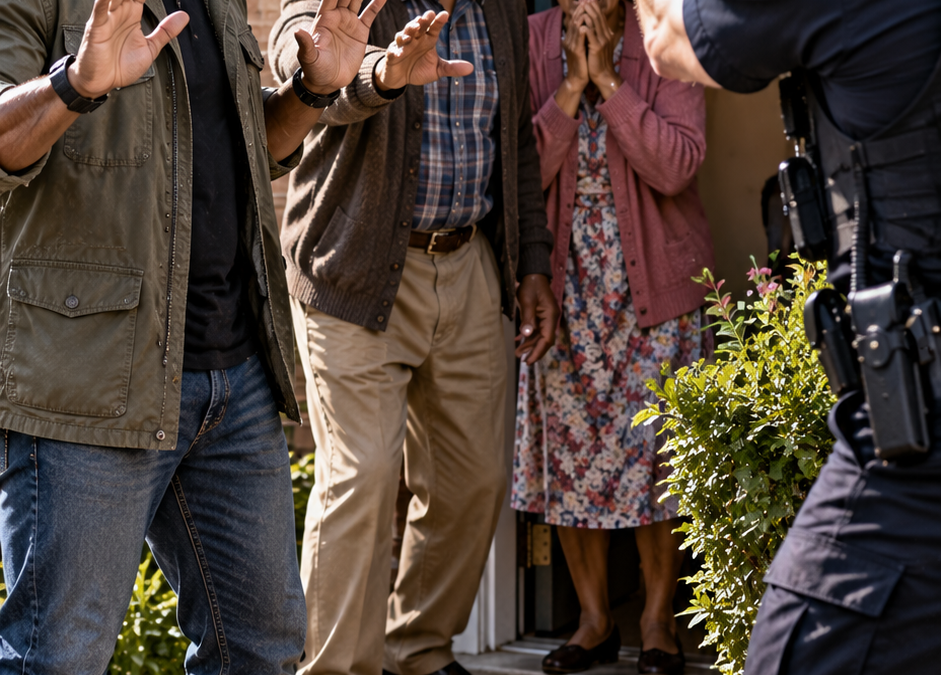
Dad stepped away from the apartment doorway.
“Officer, that’s my son.”
Mercer turned sharply.
“Sir, stay back.”
“He’s helping us move furniture.”
“I said stay back!”
I saw Dad’s jaw tighten.
It was the expression he’d worn when a supervisor at the bus depot tried blaming him for somebody else’s mistake.
At seventy-two, he hadn’t become particularly tolerant of people who shouted without listening.
Mama noticed it, too.
She caught his arm.
“Sam. Don’t.”
Officer Cole remained near the passenger side of the cruiser.
She hadn’t drawn her weapon.
Her eyes moved between me, my parents, the hand cart, and the open apartment door.
I could see her studying the scene.
Something about it wasn’t matching whatever information dispatch had provided.
I kept my hands raised.
“Officer, may I ask what you’re investigating?”
Mercer walked toward me.
“You don’t ask the questions.”
“I’m asking because this is my parents’ apartment.”
Dad lifted his cane slightly.
“That’s what I’ve been telling you. He’s our son!”
Mercer’s expression hardened.
“Sir, one more time. Stay back!”
I glanced toward my father.
“Dad, please.”
He looked at me.
I gave him the smallest shake of my head.
I didn’t want him arguing with an armed officer.
Especially one who appeared determined to ignore the information being offered.
Above us, I heard the sliding balcony door open.
Maya stepped outside.
When she saw me standing with my hands raised, she stopped.
I watched her reach for her phone.
Then she began recording.
At that moment, I was grateful somebody had thought to document what was happening.
I just hoped the recording wouldn’t become evidence of something tragic.
Across the courtyard, another window opened.
Denise Carter, Maya’s grandmother, leaned outside.
Denise had worked for twenty-seven years supervising a hospital cafeteria and possessed a voice capable of carrying across an entire city block.
“That boy grew up here!” she shouted.
Mercer turned toward her.
“Everybody stay inside!”
Denise ignored him.
“That’s Samuel Brooks’s son!”
Other residents began appearing on their balconies.
A man carrying laundry stopped halfway down the stairs.
Two elderly women emerged from Building B.
The children who’d abandoned their bicycles watched from behind a railing.
I could feel the situation growing more dangerous with every additional person.
Mercer was becoming visibly irritated.
And the more witnesses contradicted his apparent assumptions, the more determined he seemed to prove them wrong.
Officer Cole stepped closer to him.
“Grant, the residents are confirming his identity.”
He ignored her.
His attention remained fixed on me.
“What’s your name?”
“Elijah Brooks.”
“Where do you live?”
“Across town. Samuel and Lorraine Brooks are my parents. I came here to help my father move a cabinet after knee replacement surgery.”
“Identification?”
“Yes.”
“Where?”
“In my wallet. Back right pocket.”
His posture changed immediately.
“Don’t reach for it!”
I kept my hands raised.
“I wasn’t going to reach without telling you.”
Dad took another step forward.
“For God’s sake, he just told you who he is!”
“Dad,” I warned.
Mercer’s hand moved toward his pistol.
I saw it happen.
There are movements you learn to recognize when you’ve spent years working around firearms.
The shift in his shoulders.
The tightening of his stance.
The deliberate positioning of his feet.
I knew exactly what he was preparing to do.
And I knew that any sudden movement from me could turn the situation into a shooting.
“Officer, there’s no threat here,” I said.
Mercer glared at me.
“I’ll decide what the threat is.”
His pistol cleared the holster.
He brought it up with both hands.
The muzzle settled directly over the center of my chest.
Everything around me seemed to slow down.
I could hear my mother’s breath catch.
I could hear somebody shouting from a balcony.
I could feel sweat moving down the back of my neck.
But the only thing I looked at was the pistol.
I’d been on the receiving end of hostile weapons before.
In the Army, I’d learned to control the urge to move when movement might get somebody killed.
As a federal fugitive inspector, I’d encountered armed people whose intentions weren’t always clear.
But those experiences had involved criminals.
Men who knew what they were doing.
Men whose actions I could assess within an established tactical operation.
This was different.
I was standing outside my parents’ apartment.
The officer pointing a weapon at me had been told repeatedly that I belonged there.
And my elderly father was standing only a few feet behind him.
I understood immediately that reaching for my wallet would be the worst possible decision.
My federal identification was only inches from my right hand.
But pulling it out could easily be mistaken for reaching for a weapon.
I looked directly at Mercer.
“I’m going to lower myself onto my knees.”
“Do it!”
I moved slowly.
First one knee.
Then the other.
Gravel pressed through my pants.
I kept both hands raised beside my head.
“My parents live in Apartment C14. I came here to help my father after surgery. You can verify everything I’m telling you.”
“Stop talking!”
“You asked why I’m here.”
“I gave you an order!”
Behind Mercer, my father finally lost patience.
“Enough of this!”
He pulled away from Mama.
Then he took one step toward me.
Mercer pivoted.
His pistol followed the movement.
The muzzle moved away from my chest and toward my father.
For the first time that afternoon, my composure broke.
“DAD! STOP!”
My voice cracked across the courtyard.
Dad froze.
The sight of that gun pointed toward him is something I will remember for the rest of my life.
He was seventy-two.
He was recovering from surgery.
He had one hand wrapped around an aluminum cane.
And he was looking at an armed police officer with the expression of a father who couldn’t bear to watch his son being threatened.
Mama grabbed him from behind.
“Samuel, please!”
Her voice broke.
Officer Cole moved immediately.
“Mr. Brooks, come back with me.”
Dad shook his head.
“He’s pointing a gun at my son!”
“I know. But I need you back here.”
“That’s my boy!”
She lowered her voice.
“I heard you. Please come back with me.”
She guided him toward the apartment entrance while Mama clung to his arm.
I watched them retreat.
Only when they were several steps away did I begin breathing normally again.
Mercer eventually lowered his weapon.
Then he approached me.
“Hands behind your back.”
I obeyed.
He pulled my wrists together.
The handcuffs closed tightly enough that I immediately felt the metal biting into my skin.
He tightened them again.
Pain shot through my hands.
I clenched my jaw.
I wasn’t going to give him another reason to escalate.
“Elijah Brooks,” I said carefully. “Senior federal law enforcement officer. My identification is in my wallet, back right pocket. You have permission to retrieve it.”
Mercer gave a humorless laugh.
“Now you’re federal?”
I looked straight ahead.
“Verify my identity.”
He began searching me.
He removed my keys.
Then my phone.
Finally, my wallet.
He opened it.
My driver’s license appeared first.
Then he shifted the interior flap.
The metal of my federal badge caught the sunlight.
Officer Cole stepped closer.
I watched her expression change.
“Grant.”
Mercer examined the identification.
The shield clearly displayed the United States Marshals Service insignia.
My federal credentials carried my name, photograph, and identifying information.
For several seconds, nobody spoke.
Then Mercer shook his head.
“Anybody can buy something that looks like this online.”
Cole looked at him.
“With a matching federal credential?”
He ignored her.
“People fake identification all the time.”
I slowly lifted my head.
“Call the verification number printed on the credential.”
He didn’t answer.
Cole stepped away toward the patrol car.
She opened the mobile terminal and entered my name.
Then she checked the Tahoe’s license plate.
I couldn’t see the screen.
But I saw her stop moving.
She stared at the terminal.
Then she looked toward me.
“Grant.”
He turned.
“What?”
“Come here.”
He walked toward the cruiser.
She pointed at the display.
I later learned that the vehicle return contained a federal law enforcement designation instructing officers to contact the relevant agency before conducting a search.
Mercer stared at the screen.
Then he looked back at me.
For the first time since arriving, his certainty seemed to disappear.
I was still on my knees.
My hands were cuffed behind my back.
My parents were standing near their doorway, terrified.
And the man who’d insisted I might be dangerous was finally holding the proof he’d refused to look for.
I kept my voice calm.
“Call the number on my credential.”
Hannah Cole did exactly that.
She entered the number and identified herself to the duty officer who answered.
“United States Marshals Service, Duty Operations.”
“This is Officer Hannah Cole with Charlotte-Mecklenburg Police. I need to verify a federal credential.”
The duty officer requested my name.
“Elijah Marcus Brooks.”
There was a brief pause.
Then the voice on the other end changed.
“Repeat your agency.”
She did.
Another pause followed.
Then the duty officer asked a question that made Hannah look directly at Mercer.
“Why is Senior Inspector Brooks being detained?”
Nobody answered.
I later learned the duty officer confirmed that I supervised a fugitive task group operating in the Carolinas.
He also requested the circumstances surrounding my detention, the names of the involved officers, and confirmation that my credentials and vehicle had been handled appropriately.
Hannah lowered the phone.
Mercer stared at her.
For the first time, he seemed to understand that the encounter had moved beyond his control.
Hannah approached me.
“Mr. Brooks, I’m going to remove the handcuffs.”
Mercer stepped forward.
“Hold on.”
She looked at him.
“His identity is confirmed.”
“We still have a burglary call.”
“And the residents have been telling us the entire time that he’s their son.”
He stopped.
Hannah unlocked the cuffs.
I slowly brought my hands forward.
Deep red marks circled both wrists.
My fingers tingled.
I flexed them carefully, trying to restore circulation.
Then I stood.
I didn’t look at Mercer.
I didn’t mention lawsuits.
I didn’t remind him of my federal authority.
I didn’t tell him what could happen to his career.
I turned toward my father.
Dad was shaking.
At first, I thought it was anger.
Then I saw his right hand.
The tremor began in his fingers and traveled up his arm until his cane rattled against the concrete.
I crossed the courtyard.
“Dad.”
He looked at me.
“I’m fine,” I said.
He shook his head.
“No, you’re not.”
I touched his wrist.
His pulse was racing.
“Dad, sit down.”
He tried to pull away.
“Don’t start treating me like I’m eighty.”
“Dad.”
My voice changed.
He looked at me.
I turned toward Hannah.
“Call EMS. I want his blood pressure checked.”
She nodded immediately.
Within minutes, an ambulance arrived.
Two paramedics examined Dad beside the apartment entrance.
His blood pressure was dangerously elevated from the stress.
Mama stood beside him, one hand resting on his shoulder.
She kept looking toward me.
Every time our eyes met, she looked as though she was about to cry.
Dad refused transport.
Of course he did.
The paramedics monitored him until his readings began moving downward and explained the warning signs that would require immediate medical attention.
I stayed beside him the entire time.
Only after I was satisfied he was stable did I turn back toward the officers.
“I want a field supervisor here.”
Hannah nodded.
“Already requested.”
Mercer stood beside the cruiser.
He looked as though he was waiting for me to explode.
Part of me wanted to.
I’d spent years learning how to control dangerous situations.
I’d taught younger officers the importance of slowing down, gathering information, and making decisions based on actual threats rather than assumptions.
And I’d just watched an experienced patrol officer ignore repeated identification from witnesses, threaten my elderly parents, and point a loaded weapon at a man who’d done nothing more suspicious than help carry a cabinet.
But anger wasn’t going to protect my father.
It wasn’t going to explain why the police had been called.
And it wasn’t going to preserve evidence.
So I waited.
Captain Rachel Donovan arrived fourteen minutes later.
She stepped out of an unmarked Ford Explorer and surveyed the courtyard before saying anything.
She was forty-eight, compact and sharp-eyed, with short auburn hair and the controlled bearing of someone who had spent years supervising difficult situations.
Her eyes moved from my parents to me.
Then to Hannah.
Then Mercer.
“Officer Cole. Start from the beginning.”
Hannah gave a complete account.
She explained the original dispatch.
She described our statements.
She reported that my parents had repeatedly identified me as their son before Mercer drew his weapon.
She mentioned the residents who’d confirmed the same thing.
Then she described Mercer pointing his pistol toward Dad after he stepped forward.
She didn’t soften anything.
She didn’t exaggerate.
She simply reported what had happened.
Donovan listened without interrupting.
When Hannah finished, she turned toward Mercer.
“Officer Mercer, place your weapon on the hood of the cruiser.”
His eyes widened.
“Captain—”
“That’s an order.”
He hesitated.
“This isn’t necessary.”
“I’m preserving evidence. Put your weapon on the hood.”
He obeyed.
Donovan had the firearm secured according to departmental evidence procedures.
Then she ordered preservation of all body-camera footage, radio communications, dispatch records, and written reports.
I watched her work.
She wasn’t trying to protect the department from embarrassment.
She was trying to establish what had happened.
That distinction mattered.
Above us, Maya was still standing on her balcony.
Her phone remained in her hand.
Donovan looked up.
“Did anybody record the incident?”
Maya raised her hand.
“I did.”
She came downstairs.
I noticed how badly her fingers were trembling when she approached.
“I recorded most of it,” she said.
Donovan studied her.
“Did you edit the video?”
“No.”
“Post it anywhere?”
“No.”
“Send it to anybody?”
“My brother has a copy. He told me to preserve the original.”
Donovan nodded.
“Your brother gave you good advice.”
Maya provided a copy through the department’s evidence intake system while keeping her original file intact.
I put a hand on her shoulder.
“Thank you.”
She looked at me.
“I was scared.”
I understood.
“So was I.”
Her eyes filled.
“I thought he was going to shoot you.”
I couldn’t answer immediately.
Then I pulled her into a brief hug.
“You did the right thing.”
I meant it.
Maya hadn’t stepped between an armed officer and a suspect.
She hadn’t shouted instructions or tried to become part of the confrontation.
She’d stayed somewhere safe and preserved a record of what happened.
That recording would become important.
But before anybody could understand the full significance of the video, Donovan asked another question.
“Who made the original 911 call?”
Dispatch provided the information.
Richard Voss.
Property manager.
I looked toward the management office.
Voss was no longer standing outside.
Donovan requested the recording.
We listened beside the cruiser.
His voice came through clearly.
He described a large Black man hanging around an elderly couple’s apartment.
He suggested the man looked aggressive.
He claimed there might be an attempted break-in.
Dad stared toward the office.
“He never came near us.”
Mama shook her head.
“He didn’t ask us anything.”
I looked at the hand cart beside the walkway.
The groceries were still visible through the apartment doorway.
The cabinet was exactly where I’d left it.
Nothing about the scene supported a burglary.
Voss had seen what he wanted to see.
Or perhaps he’d reported what he wanted the police to believe.
Donovan listened again.
This time, she seemed particularly interested in what Voss had failed to say.
No weapon.
No forced entry.
No direct contact with either elderly resident.
No confirmation that anybody had requested help.
Just a collection of assumptions presented with enough urgency to summon armed officers.
Then something unexpected happened.
One of my parents’ neighbors approached Donovan carrying several folded notices.
She asked whether the investigation would also examine what had been happening at Maple Terrace.
Another resident joined her.
Then another.
Within minutes, three families were showing the captain similar documents signed by Richard Voss.
Parking citations.
Walkway violations.
Warnings about personal belongings.
Notices threatening further action if residents failed to comply.
I looked toward Mama.
She gave me a sad smile.
“That’s what I was trying to tell you.”
I finally understood.
The confrontation with Mercer hadn’t come out of nowhere.
Somebody had been making life difficult for the people living at Maple Terrace.
And the false report against me might have exposed a larger pattern.
By Monday morning, the police encounter had become the subject of a formal internal investigation.
Mercer was removed from street duty pending review.
His service weapon remained secured as evidence.
Both officers’ body-camera recordings were preserved, along with Maya’s original video, the 911 call, dispatch logs, and witness statements.
I gave my statement.
So did my parents.
I described every command.
Every movement.
Every warning.
I explained where my hands had been and exactly what I’d said before Mercer drew his weapon.
Then I described watching him point it toward my father.
That was the part I struggled to speak about.
I could discuss being handcuffed.
I could discuss having a firearm aimed at my chest.
I could even describe the humiliation of kneeling on gravel while neighbors watched.
But every time I remembered my father’s frightened expression, something tightened painfully in my throat.
I’d spent years preparing to confront danger.
I hadn’t prepared for the possibility that my own decisions might fail to protect the people who had raised me.
Lieutenant Marcus Hail from Internal Affairs conducted much of the review.
He was fifty-one, with a shaved head and a quiet manner that made people uncomfortable when they tried to avoid answering questions.
Hail had spent nineteen years investigating police misconduct.
He didn’t seem interested in dramatic accusations.
He wanted facts.
He and Donovan reviewed the recordings together.
They identified several moments when Mercer had been given information that should have caused him to reconsider his threat assessment.
My father identifying me.
My mother doing the same.
Denise calling from her window.
Hannah warning him that the residents were confirming my identity.
The open apartment door.
The furniture.
The groceries.
The absence of any reported weapon.
Each moment had offered an opportunity to slow down.
Mercer had ignored them.
Hannah’s conduct became part of the review, too.
She’d questioned the assumptions behind the dispatch before they arrived.
She’d avoided drawing her weapon.
She’d attempted to intervene verbally.
And she’d protected my father when Mercer redirected his pistol toward him.
But the investigation also required her to examine what she could have done sooner.
I respected that.
Accountability shouldn’t depend on whether somebody’s overall intentions were good.
It should include an honest examination of decisions made under pressure.
Hannah submitted a detailed supplemental report.
She later told me that several officers had encouraged her to soften certain descriptions.
One veteran, Dean Wallace, suggested she didn’t need to document every little thing.
He claimed she could protect Mercer without actually lying.
Hannah asked him which part of the report hadn’t happened.
He had no answer.
She submitted it unchanged.
Donovan reassigned her to another training officer the following morning.
While the police department investigated Mercer, Maya’s older brother began asking questions of his own.
Jordan Carter was twenty-one and studying journalism at the University of North Carolina at Charlotte.
He was patient, methodical, and unusually careful with evidence.
Maya had called him while the confrontation was still happening.
He’d instructed her to preserve the original recording, avoid editing it, and make a backup that retained its date and metadata.
Afterward, he became interested in the person who had made the original 911 call.
Richard Voss.
Jordan started with publicly available property records.
He searched corporate filings, management documents, rental listings, and planning records.
He expected to find little more than an apartment ownership company and a property manager with a habit of issuing petty violations.
Instead, he discovered Carolina Residential Holdings LLC.
That was the company that owned Maple Terrace.
Then he found another name.
Stonebridge Urban Development.
Stonebridge specialized in acquiring older residential properties, renovating them, and repositioning them for tenants who could afford substantially higher rents.
Its managing partner was Calvin Ree, a developer with an impressive reputation for turning aging apartment complexes into profitable real estate investments.
Three weeks before the confrontation with Mercer, Carolina Residential Holdings had signed a preliminary letter of intent with Stonebridge concerning Maple Terrace.
Jordan read the documents carefully.
They didn’t explicitly say existing tenants needed to leave.
But they contained financial projections based partly on higher rental income after renovations and the repositioning of existing units at current market rates.
Jordan compared those projections with advertised rents for renovated apartments nearby.
Then he asked my parents whether they would show him their lease.
Their monthly rent was barely more than half the price being advertised for comparable renovated units.
That was when the violation notices began to make a different kind of sense.
Long-term tenants paying below-market rent were financially inconvenient to a developer planning to increase rental income.
And a property manager who could pressure those tenants into leaving might help make the proposed investment more attractive.
Jordan didn’t immediately accuse anybody.
He began collecting evidence.
Maya helped him speak with residents.
By the end of the first day, they had identified nine families who’d received repeated notices or experienced unusual pressure since Voss arrived.
One was Eleanor Price.
She was seventy-six, a widow with white hair and a quiet voice.
She’d lived at Maple Terrace since before her husband died six years earlier.
While she was hospitalized, her car registration sticker expired.
Voss arranged for the vehicle to be towed.
She had to pay three hundred forty dollars to retrieve it.
When Jordan interviewed her, she seemed embarrassed to complain.
“I suppose the sticker was expired,” she admitted.
“But I was in the hospital.”
Another resident showed him photographs of a ceiling leak that maintenance had ignored for nearly two months.
When the resident placed a bucket beneath the leak, management issued a warning about storing personal items in the hallway.
A single mother described repeated parking citations after she rejected an offer to terminate her lease early.
Two other residents reported that Voss had called police over minor disputes that the previous manager would have resolved with an ordinary conversation.
None of the complaints alone established a coordinated campaign.
Some could have legitimate explanations.
But taken together, they raised serious questions about how the property was being managed.
I sat at my parents’ kitchen table one evening while Jordan spread the documents in front of us.
Dad read through the notices.
Then he looked at me.
“So he’s trying to clear us out.”
I studied the evidence.
“We don’t know that for certain yet.”
Mama gave me a look.
“You believe that?”
“I believe we’re seeing a pattern. But if we’re going to challenge it, we need proof.”
Dad tapped the table.
“He called police on you.”
“I know.”
“He told them you were breaking into my apartment.”
“I know.”
“He almost got you shot!”
His voice cracked.
I looked at him.
“I know that, too.”
For several seconds, we stared at each other.
Then Dad pushed his chair backward.
“How can you sit there so calmly?”
I looked down at the documents.
Because I wasn’t calm.
Every time I closed my eyes, I could see Mercer’s pistol turning toward him.
I could hear Mama pleading.
I could feel the handcuffs cutting into my wrists.
And I wanted somebody to answer for every second of it.
But I’d spent too many years investigating people who believed anger justified whatever they did next.
I wasn’t going to make the same mistake.
“Because anger isn’t evidence, Dad.”
He stared at me.
Then he slowly sat down.
Mama placed a hand over his.
For a while, none of us spoke.
Jordan continued gathering documents.
Maya interviewed neighbors.
I helped my parents organize their notices and connected several residents with attorneys experienced in housing disputes.
We wanted to understand whether the violations were legitimate, selectively enforced, or being used as leverage to make existing tenants leave.
I also wanted to make sure the investigation into Mercer remained focused on his conduct.
Voss might have made a false or misleading report.
But Mercer was responsible for the decisions he made after arriving.
Those were separate questions.
And both deserved answers.
Over the following months, the two investigations moved forward.
Hannah’s report became an important part of the police department’s review.
When investigators compared it with the body-camera recordings, they found that she’d accurately described the information Mercer had received and his response to it.
She’d also documented her own attempts to slow the encounter.
That honesty came at a professional cost.
Some officers believed she’d betrayed her training partner.
Others quietly thanked her for refusing to falsify or soften her account.
I learned that she had been reassigned permanently to another field training officer.
Donovan also involved her in a pilot program focused on de-escalation and procedural justice.
The training emphasized how quickly an officer’s first assumptions could distort the interpretation of everything that followed.
Hannah never seemed particularly comfortable being praised for her conduct.
When somebody later called her a hero, she reportedly replied that she should have intervened sooner.
I respected that answer.
It suggested she understood that doing the right thing wasn’t a single dramatic decision.
It was a responsibility that continued even after the immediate danger had passed.
Maya’s experience changed her, too.
Her journalism adviser asked her to discuss the incident with the school newspaper club.
She agreed.
But instead of showing the most frightening moment repeatedly or treating the encounter like entertainment, she focused on evidence.
She explained why she hadn’t livestreamed the confrontation.
Why she’d preserved the original file.
Why she’d listened when Jordan told her not to edit the video or add dramatic captions.
And why witnessing an event didn’t automatically mean understanding every fact surrounding it.
I was proud of her.
She’d been seventeen years old when she stood on that balcony watching an armed officer threaten people she’d known most of her life.
She’d been frightened.
But she had preserved evidence that helped establish what actually happened.
That mattered more than any number of online views.
The housing investigation progressed more slowly.
Voss initially defended the notices as ordinary property management.
He insisted he had been instructed to improve Maple Terrace’s condition.
He argued that his 911 call had been motivated by concern for elderly residents.
But the records raised questions he couldn’t easily answer.
Why had long-term tenants received such a disproportionate number of warnings?
Why had maintenance complaints gone unanswered while minor violations were pursued aggressively?
Why had he repeatedly called police over disputes that hadn’t involved clear evidence of criminal conduct?
And why had he described me as a possible burglar without attempting to speak to my parents?
The ownership company faced increasing scrutiny.
Residents organized.
Attorneys reviewed the leases and notices.
Jordan’s reporting brought attention to the preliminary agreement with Stonebridge and the financial incentives surrounding higher rental projections.
Eventually, Carolina Residential Holdings placed the proposed sale under review.
Voss was terminated.
The evidence didn’t establish that every notice he’d issued was unlawful.
But the broader pattern of his management practices, the questionable police calls, and the pressure placed on long-term tenants became impossible for the ownership company to dismiss.
When Dad heard the news, he called me immediately.
“They fired him.”
I was sitting in my office reviewing a fugitive case.
“Who?”
“Voss!”
I smiled.
“I heard.”
He sounded almost disappointed by my reaction.
“That’s all you’ve got to say?”
“What would you like me to say?”
“Something enthusiastic!”
I laughed.
“Dad, we still have work to do.”
He groaned.
“You’re just like your mother.”
I considered that the highest possible compliment.
The proposed sale wasn’t abandoned immediately.
And the termination of one property manager didn’t solve every issue at Maple Terrace.
But it changed the balance of the negotiations.
The ownership company was suddenly facing legal scrutiny, public attention, and the possibility of expensive litigation.
Residents had organized.
They had documents.
They had witnesses.
And they had attorneys who could examine the problems without depending on management’s explanation of its own conduct.
Eventually, the parties reached a settlement.
It didn’t make anybody wealthy.
It didn’t transform Maple Terrace into a beautiful new development.
But it provided stronger lease protections for existing residents and clearer procedures for handling complaints.
Several families received compensation for documented losses involving improper towing, maintenance failures, or questionable enforcement actions.
Management agreed to improve oversight so that one property manager couldn’t repeatedly turn ordinary disagreements into police calls without appropriate review.
Most importantly, my parents could remain in their home.
Mama cried when she learned the agreement had been finalized.
Dad pretended he wasn’t emotional.
He sat at the kitchen table reading the paperwork for nearly an hour.
Then he folded it carefully and placed it beside his coffee cup.
“Nineteen years,” he said quietly.
I looked at him.
“What?”
“We’ve lived here nineteen years.”
He glanced toward the living room.
“Your mother picked out those curtains the first week we moved in.”
Mama smiled.
“They’re ugly now.”
“They were ugly then,” Dad replied.
She laughed.
He reached for her hand.
For a moment, I saw them as they’d been when I was younger.
Two people who’d worked hard, raised a family, and built a life in a place the rest of the city might have dismissed as ordinary.
That life deserved protection.
And I was grateful we’d been able to help preserve it.
My civil case concerning the police encounter also reached a settlement.
The financial terms weren’t what mattered most to me.
I’d suffered bruising and abrasions from the handcuffs.
I’d been subjected to an unjustified escalation.
And I’d watched my father suffer a dangerous stress response after a police officer pointed a firearm toward him.
Nothing about a settlement could erase those memories.
But I wanted the incident formally acknowledged.
I wanted the records preserved.
And I wanted meaningful changes in how similar calls were handled.
When the settlement was finalized, I decided to direct most of the money toward a legal assistance fund for elderly and long-term tenants facing housing disputes.
Dad objected immediately.
Naturally.
We argued about it for almost a week.
“You earned that money the hard way!”
I looked at him.
“Dad, I didn’t earn it.”
“You know what I mean.”
“I do.”
He pointed toward my Tahoe.
“You could buy a better truck.”
I laughed.
“Now we’re getting to the real issue.”
“That thing sounds like a lawn mower trying to climb a mountain.”
“It’s a perfectly good vehicle.”
“It’s held together by prayer and stubbornness.”
I shook my head.
“I like my truck.”
He leaned back.
“Fine. Put it toward your retirement.”
“I have retirement savings.”
“Your house?”
“My house is fine.”
He threw up his hands.
“Why do you insist on making everything difficult?”
Mama was standing near the kitchen counter trimming flowers.
She didn’t even look up.
“Samuel, leave the boy alone.”
“The boy is thirty-nine.”
“And you’re seventy-two and still don’t listen.”
I burst out laughing.
Dad tried to maintain his irritated expression.
He failed.
But beneath the teasing, I understood his concern.
He’d watched somebody point a gun at me.
He’d watched me kneeling on the pavement, handcuffed and unable to protect myself.
He wanted something tangible to come from the ordeal.
Something that might compensate for the fear he’d experienced.
I wanted that, too.
But I couldn’t stop thinking about the other residents at Maple Terrace.
People who didn’t have a son with federal law enforcement experience.
People who couldn’t afford an attorney.
People who might receive a frightening notice, lose sleep for weeks, and eventually abandon a home they’d lived in for decades because fighting seemed impossible.
If I could use the settlement to help even a few of those families, it would mean more to me than replacing my aging Tahoe.
Dad eventually stopped arguing.
Although he continued making comments about my truck whenever the opportunity presented itself.
The police department’s internal investigation took approximately four months.
Investigators reviewed both body-camera recordings, Maya’s original video, the 911 call, witness statements, dispatch logs, and Mercer’s written report.
Their findings documented repeated failures in threat assessment and de-escalation.
Mercer had received several opportunities to verify my identity and reduce uncertainty.
He’d ignored information from my parents, multiple residents, and his own partner.
Then he’d drawn his weapon without establishing that I posed an immediate threat.
Worse, he’d redirected that weapon toward my elderly father when Dad stepped forward holding a cane.
The department found violations of its use-of-force and de-escalation procedures.
Mercer remained suspended during the disciplinary process.
Before the final stages were completed, he resigned.
He never returned to patrol.
His thirteen-year career ended with a surrendered badge and a personnel file documenting what happened at Maple Terrace.
When I learned the outcome, I sat quietly for a long time.
I had wanted accountability.
I had wanted somebody to acknowledge that the gun pointed at my chest hadn’t been justified by the situation officers encountered.
But I couldn’t celebrate the end of another man’s career.
Not because I believed he deserved to escape the consequences.
Because I understood how many opportunities he’d had to prevent the encounter from becoming dangerous.
He could have listened to my father.
He could have questioned my mother.
He could have considered the information Hannah gave him.
He could have verified my identification before escalating.
He could have recognized that the 911 caller’s assumptions weren’t evidence.
Instead, he’d committed himself to a conclusion before he had enough information to reach one.
And every decision afterward had been shaped by that mistake.
I hoped the department would remember that lesson long after people stopped talking about my case.
Six months after the incident, I returned to Maple Terrace on another Saturday afternoon.
It was April.
The weather was mild, and sunlight filtered through the same oak trees that had shaded the parking lot in October.
I drove the same dark blue Tahoe.
I wore the same charcoal sleeveless hoodie.
My father was sitting outside Apartment C14 with an old portable radio dismantled across his lap.
His knee had healed well enough that he no longer needed his cane for ordinary movement.
It leaned against the wall beside his chair.
He was working on the radio with a screwdriver, muttering about manufacturers who apparently believed simple machines needed to be unnecessarily complicated.
Mama was kneeling beside her flower bed.
The same flower pots Richard Voss had once cited as violations now sat neatly within painted boundary markers agreed upon by residents and management.
Red geraniums lined the walkway.
Yellow marigolds grew beneath the front window.
The wooden bench remained beside the door.
And the little oak cabinet I’d carried inside six months earlier was standing exactly where Mama had wanted it.
I parked and climbed out.
Dad looked up.
“You’re late.”
I checked my watch.
“Dad, I’m fifteen minutes early.”
He shrugged.
“Almost late.”
I laughed.
“Good to see you, too.”
Mama stood and wiped her hands on a towel.
“Elijah, don’t encourage him.”
I walked over and kissed her cheek.
She looked healthier than she had in October.
The constant worry I’d seen in her eyes after the incident had begun to fade.
Although I knew she still watched the parking lot whenever a police cruiser passed.
So did I.
Some memories don’t disappear simply because the paperwork is finished.
But they become easier to carry when life begins moving forward again.
Maya came hurrying down the exterior stairs while I was unloading groceries.
“Mr. Elijah!”
I turned.
She was smiling so widely that I knew something important had happened.
“What?”
“I got in!”
I stared at her.
“University?”
She nodded enthusiastically.
“Journalism program. Officially accepted.”
I set the grocery bags down.
“Come here!”
She laughed as I hugged her.
“Congratulations!”
“Thank you!”
“Your brother must be proud.”
“He says I get four years of professors telling me everything I write is wrong.”
“Sounds expensive.”
She laughed.
I looked at her for a moment.
Six months earlier, she’d been a frightened teenager on a balcony, trying to hold her phone steady while recording a police officer pointing a weapon at people she’d known since childhood.
Now she was preparing to become a journalist.
She’d written about the incident in her application essay.
Not as a story about becoming famous.
Not as an opportunity to relive the most frightening moment of somebody else’s life.
But as an experience that taught her the importance of documentation, patience, and the responsibility that comes with witnessing injustice.
I was proud of her.
And I was grateful she’d been there.
A patrol cruiser entered the parking lot.
For a moment, every muscle in my body tightened.
The vehicle slowed near Building C.
I looked toward the driver’s seat.
Hannah Cole was behind the wheel.
She recognized me.
I recognized her.
There was no dramatic reunion.
No speech.
No apology shouted across the courtyard.
She simply gave me a small nod.
I returned it.
Then she continued down the lane and disappeared around the next building.
Dad looked up from his radio.
For a moment, his expression was serious.
Then he returned to his screwdriver.
“Elijah, get those groceries inside before your mother starts complaining.”
Mama called from the flower bed.
“I heard that!”
Dad smiled.
“That was the point.”
I laughed and lifted two grocery bags from the Tahoe.
Mama opened the apartment door.
“Dinner in twenty minutes.”
“What are we having?”
Dad looked at me.
“Your mother made enough food for the entire county again.”
Mama gave him a look.
“There is no such thing as too much food.”
I carried the groceries inside.
Behind me, children raced their bicycles around the courtyard.
Denise Carter was talking with two neighbors near the stairs.
Maya returned to her notebook.
Dad reassembled the old radio and turned the dial until music filled the porch.
For the first time in months, Maple Terrace felt almost exactly as it had before the confrontation.
Not because everything had become perfect.
The buildings still needed repairs.
The parking lines were still faded.
And the residents still had to work to make sure their agreements with management were respected.
But the people who’d lived there for decades were no longer facing the same uncertainty about whether they would be forced to leave.
My parents still had their apartment.
Mama still had her flowers.
Dad still had his ridiculous arguments with me about everything from furniture to the condition of my truck.
And I still had the privilege of walking through their door on a Saturday afternoon, carrying groceries instead of worrying about whether I would ever see them again.
As we sat down to dinner, Dad reached across the table and rested his hand briefly on my shoulder.
He didn’t say anything.
He didn’t need to.
I thought about the afternoon six months earlier when I’d knelt on the gravel with my hands raised, watching an armed officer turn toward my father.
I’d spent years believing that strength meant being prepared to confront danger.
That day taught me something different.
Sometimes strength meant remaining still when every instinct told you to move.
Sometimes it meant refusing to let anger dictate what happened next.
And sometimes it meant recognizing that the danger facing your own family was part of something larger that other people had been enduring quietly for years.
I hadn’t gone to Maple Terrace intending to uncover a questionable redevelopment plan or challenge the management practices affecting elderly tenants.
I’d gone there to carry a cabinet.
But when the truth began emerging, I couldn’t ignore it simply because my own immediate danger had passed.
I thought about Hannah refusing to change her report.
About Maya preserving the video when she was frightened.
About Jordan following the documents instead of chasing rumors.
And about my parents refusing to surrender the home where they’d spent nineteen years building friendships and memories.
Then Mama placed another serving of food on my plate.
“Eat, Elijah. You look tired.”
I smiled.
“Yes, ma’am.”
Dad reached for the cornbread.
“He’s always tired. That’s why he needs a better truck.”
I shook my head.
“Six months, Dad. You’ve been talking about that truck for six months.”
“And I’m going to keep talking about it until you buy something that starts without threatening the entire neighborhood.”
Mama laughed.
I laughed with her.
Outside, the evening sunlight settled across the old red brick buildings, and the sound of children playing drifted through the open window.
There were no sirens.
No shouted commands.
No frightened neighbors watching from their balconies.
Just my parents, a familiar kitchen table, and the kind of ordinary family dinner I had once taken for granted.
For the first time since that terrible Saturday, I felt completely at home again.








