The Man Across the Street Was Waiting for Me to Touch My Own Lamborghini
𝗙𝗨𝗟𝗟 𝗦𝗧𝗢𝗥𝗬
He was creating a story in which my refusal to surrender my privacy became evidence of wrongdoing.
Preston Hayes helped him.
On Wednesday afternoon, Preston walked past my driveway pretending to check his mailbox.
He took three photographs of my Lamborghini.
One showed the license plate.
Another included my house number.
The third captured both the vehicle and my front entrance.
He uploaded them to the neighborhood group chat.
Twelve households participated in that conversation.
His message suggested that somebody should run the license plate because he didn’t believe the vehicle could legitimately belong to the person living at my address.
Douglas responded with a thumbs-up.
Linda thanked Preston for finally taking action.
Several neighbors reacted with laughing emojis.
Not one person asked whether any crime had actually occurred.
Not one person suggested introducing themselves.
Instead, the conversation grew into an increasingly elaborate discussion of what I might be hiding.
I learned all of this later.
At the time, I only knew that the atmosphere on my street had changed.
That morning, while I was walking toward my mailbox, a woman approaching with a golden retriever suddenly crossed the road.
She pulled the leash so sharply that the dog yelped.
I stopped.
“Good morning.”
She stared straight ahead.
She didn’t answer.
A little farther down, a man washing his Mercedes turned his back as soon as I approached.
He kept scrubbing the same section of the hood until I passed.
By the time I returned home, three neighbors had gone out of their way to avoid acknowledging me.
I stood on my porch looking across the street.
Douglas was watching from his window again.
I wondered how much effort it took to make an entire neighborhood afraid of somebody who’d never done them any harm.
That afternoon, I took a short walk.
I needed to clear my head before another evening of departmental paperwork.
I’d gone less than a block when Linda Belmont appeared near the end of her sidewalk.
She was holding a travel mug in one hand and her phone in the other.
She stepped directly into my path.
I stopped.
“Can I help you?”
She looked me up and down.
“I don’t know where you came from, sweetheart, but this isn’t the kind of neighborhood where people can just show up and do whatever they want.”
I stared at her.
“Good to know.”
She narrowed her eyes.
“You might be happier somewhere else.”
I felt a slow heat rise behind my ribs.
Not because her words surprised me.
Because I had heard versions of them throughout my life.
In elementary school, when a teacher assumed I’d copied an assignment because my answer was more sophisticated than she expected.
In the police academy, when another recruit joked that I’d probably been admitted to fill a quota.
As a detective, when witnesses asked to speak to the real investigator after I introduced myself.
I had learned to answer those moments with professionalism.
But I was standing on a sidewalk in the neighborhood where I’d purchased my own home.
I was exhausted by the idea that I still needed to prove I belonged somewhere.
“Mrs. Belmont, I bought my house legally. I own my vehicle. I have every right to walk on this street.”
Her mouth tightened.
“Well, we’ll see.”
I stepped around her.
“I suppose we will.”
I continued walking without turning around.
Only when I reached the corner did I realize how tightly I’d been clenching my hands.
I stopped beneath an oak tree and took a slow breath.
My phone vibrated.
It was another message from Captain Tanner.
The preparations for Friday’s ceremony were nearly complete.
I typed a brief acknowledgment.
Then I looked back toward Ridgewood Drive.
For the first time since moving in, I no longer felt entirely comfortable going home.
That evening, Douglas hosted a gathering in his driveway.
Six neighbors sat in folding lawn chairs around a cooler of imported beer.
Linda moved between them, refilling glasses and occasionally glancing toward my house.
Their laughter carried across the street.
I sat on my porch with a cup of tea, reviewing my prepared remarks for Friday.
I couldn’t hear every word, but I recognized the sound of a group enjoying its own certainty.
At one point, Douglas stood and gestured emphatically toward my driveway.
Several people turned to look.
Then they nodded.
What happened during that gathering became clear only after investigators interviewed the participants.
Preston told the others he’d already called the police nonemergency line.
He’d been informed that officers needed a factual basis before taking action.
Douglas considered that unacceptable.
He announced that he intended to call 911 the next morning and report my Lamborghini stolen.
Somebody asked whether he had evidence.
He repeated that I had refused to provide him with registration documents.
To him, that was evidence enough.
Linda encouraged him.
Others agreed.
The decision was apparently made over drinks, beneath the oak trees, in a driveway directly across from my house.
By the time everyone went home, six people knew Douglas planned to accuse me of a crime.
None of them warned me.
That night, I was still awake at eleven thirty.
My briefing materials covered the dining room table.
I had a complete list of the reforms I wanted to begin discussing with the department’s leadership.
Improved supervisory reviews.
Consistent body-camera procedures.
Better training for encounters involving allegations from third parties.
Stronger mechanisms for identifying patterns of misconduct before they turned into tragedies.
I believed the most important thing a leader could do was establish an expectation that authority must always be accompanied by accountability.
It was an ideal I’d defended throughout my career.
I had no idea how personally I was about to test it.
Thursday morning arrived bright and cloudless.
I woke early, drank coffee, and reviewed the speech I’d deliver at my public swearing-in ceremony.
I intended to keep it short.
I had never liked grand speeches about public service that weren’t supported by measurable improvements.
My plan was to thank the mayor, introduce my leadership priorities, and return to the actual work of running the department.
After breakfast, I dressed in my usual white shirt and black slacks.
I checked my briefcase.
Inside were my appointment documents, my commissioner’s credentials, a confidential personnel file I needed for the evening walkthrough, and the speech I’d printed the night before.
I locked the case, carried it downstairs, and stepped outside at approximately eight fifteen.
The Lamborghini was parked in my driveway.
Sunlight reflected off its black paint.
Across the street, Douglas was standing on his porch.
He had a telephone pressed to his ear.
Linda stood beside him.
Her phone was raised toward me.
I noticed both of them but kept walking.
I’d already decided that I wasn’t going to spend another morning engaging with their hostility.
I reached my car and pressed the key fob.
The lights flashed.
I was reaching for the driver’s door when I heard tires approaching.
Two police cruisers turned onto Ridgewood Drive from opposite directions.
Their emergency lights were flashing.
The first stopped near the end of my driveway.
The second pulled alongside it.
Both vehicles came to abrupt stops.
The officers stepped out quickly.
Their hands moved toward their holsters.
“Ma’am! Step away from the vehicle!”
I froze.
My mind immediately began assessing the situation.
Two marked patrol units.
Officers approaching an apparently unarmed woman.
No visible threat.
No attempt to identify themselves beyond their uniforms.
And every indication that they believed they were confronting somebody dangerous.
I slowly turned toward them.
“Officers, good morning. Is there a problem?”
“Hands where we can see them!”
I lifted my hands.
My car keys dangled from my right fingers.
“My name is Felicia Ashford. I live here. This is my vehicle.”
One officer moved closer.
“Step away from the Lamborghini.”
I complied.
“My registration is in the glove compartment. I can show you—”
“Don’t reach for anything!”
His partner positioned himself to my left.
Both officers were visibly tense.
I recognized that tension.
I’d seen it in inexperienced patrol officers who arrived at a scene already convinced a threat existed.
I also knew how quickly a frightened officer could misinterpret an ordinary movement.
So I stood completely still.
“Officers, I am not armed. I have identification in my briefcase. My registration is in the car. The vehicle is registered to me at this address.”
Neither officer asked to see the documents.
Instead, the taller one pointed toward the pavement.
“On the ground. Now.”
I stared at him.
“Excuse me?”
“Get on the ground! Face down! Hands behind your back!”
For a fraction of a second, my thoughts stopped.
I’d spent twenty years working toward the authority to lead this city’s police department.
And two of its officers were now ordering me onto the ground outside my own home without telling me what crime I was suspected of committing.
I could have reached for my briefcase.
I could have announced my position.
I could have demanded a supervisor.
But four hands were resting near four holsters, and my professional experience told me this wasn’t the moment to argue.
I slowly lowered my briefcase onto the driveway.
Then I raised my hands a little higher.
“I’m complying.”
“Get down!”
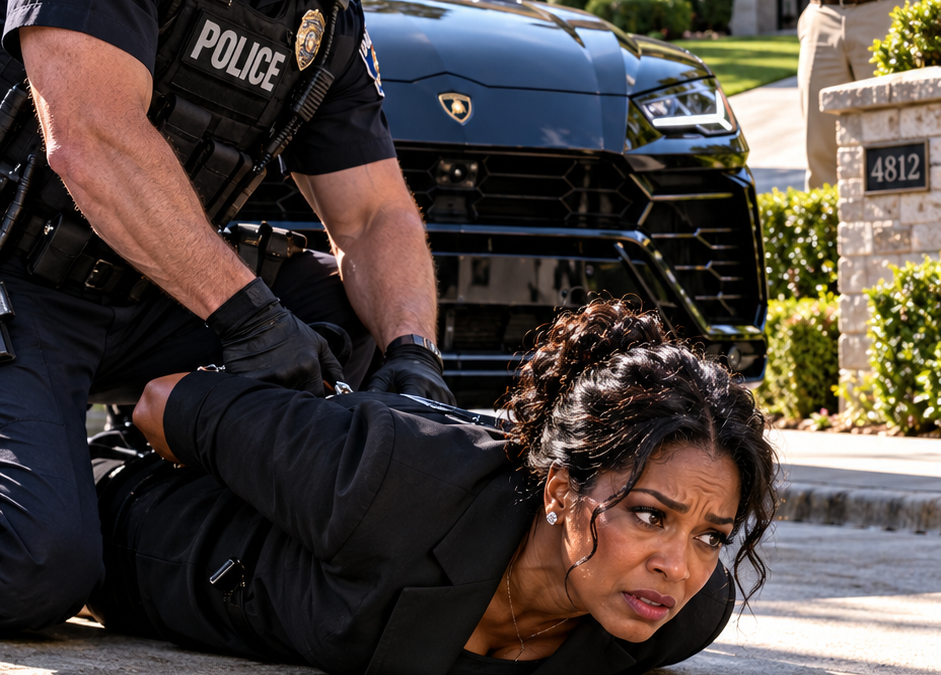
I dropped to my knees.
The concrete scraped through my slacks.
Then I lowered myself onto my stomach.
The pavement had already absorbed the morning heat.
Its rough surface pressed against my cheek.
An officer pulled my wrists behind my back.
Cold metal closed around them.
I heard the familiar clicking sound of handcuffs.
For a moment, the absurdity of what was happening almost overwhelmed me.
I had carried handcuffs for years.
I’d taught young officers how to apply them safely.
I’d reviewed complaints involving officers who tightened them unnecessarily.
Now I could feel the edges cutting into my own wrists.
Across the street, Douglas began walking toward us.
His expression was unmistakable.
He was delighted.
“I told you!” he shouted. “I’ve been warning everybody about her all week!”
He stopped near the edge of my lawn.
The officer beside me looked up.
Douglas pointed toward my Lamborghini.
“She just showed up Monday, driving that thing. Nobody knows who she is. She claims she lives here, but she refused to prove anything!”
I turned my head slightly.
“Officer, that man is my neighbor. He has no information indicating my car is stolen. You can verify the registration immediately.”
The officer tightened his grip on my arm.
“Stay still.”
Douglas stepped closer.
“People like her think they can just move in anywhere. That’s what’s wrong with neighborhoods these days.”
I closed my eyes.
For twenty years, I’d stood between frightened people and situations that threatened to destroy their lives.
I’d attended funerals for officers who never returned from patrol.
I’d comforted families after murders.
I’d testified in courtrooms where a single mistake could mean the difference between freedom and a prison sentence.
But lying on that driveway, listening to a stranger explain why someone like me couldn’t possibly own the house behind us, I felt a humiliation I hadn’t experienced in years.
Linda was filming everything.
I could hear her speaking from the sidewalk.
“See? I told everybody something wasn’t right.”
She moved closer to get a better angle.
Douglas folded his arms and smiled.
Six neighbors had emerged from their houses.
Some stood on porches.
Others watched from the ends of their driveways.
Several were holding phones.
Nobody asked whether the officers had verified the stolen vehicle report.
Nobody pointed out that I’d voluntarily offered to show them the registration.
Nobody asked Douglas how he knew my car was stolen.
I was lying face down on my own driveway, surrounded by people who had already decided what I deserved.
And the part that hurt most was their silence.
One of the officers crouched beside me.
“Ma’am, you’re being detained while we investigate a stolen vehicle report.”
“My name is Felicia Ashford,” I repeated. “This vehicle is registered to me. My home address is 4812 Ridgewood Drive. You can verify both through dispatch.”
He glanced toward his partner.
His partner shrugged.
“We’ll sort it out at the station.”
I felt my stomach tighten.
“Why would you transport me before checking the registration?”
“Ma’am, stop arguing.”
“I’m asking you to verify a readily available fact.”
He stood.
Then he reached for my upper arm.
For the first time that morning, I felt genuinely frightened.
Not because I doubted I would eventually establish my identity.
I knew what was inside my briefcase.
I knew Captain Tanner had attended my private appointment ceremony.
I knew the mayor had signed my official documents.
But I was looking at two officers who had already ignored every reasonable opportunity to verify my story.
I didn’t know how much further they would go before somebody forced them to stop.
Six miles away, Captain Richard Tanner was reviewing shift reports when the radio traffic caught his attention.
He later told me he hadn’t been listening closely until he heard my address.
“Female detained at 4812 Ridgewood Drive. Suspected stolen Lamborghini. Reporting party disputes ownership. Preparing for transport.”
Richard stopped what he was doing.
He knew my address.
Three weeks earlier, the department had distributed a confidential memorandum to a small group of senior officers.
It identified my residence and warned that the information wasn’t to be disclosed before the public announcement.
Richard checked the memorandum.
Then he called dispatch.
“Which unit is responding to the stolen vehicle report on Ridgewood Drive?”
Dispatch confirmed the units.
He requested the arresting officers’ status.
When he learned I was already handcuffed and officers were preparing to transport me, he grabbed his jacket and left the precinct.
He reached Ridgewood Drive just as one officer was opening the rear door of a cruiser.
The other was helping me off the pavement.
My wrists were still cuffed behind my back.
Douglas was giving an animated statement to another officer.
Linda was filming.
Preston stood near his mailbox, typing rapidly into his phone.
Richard’s unmarked sedan stopped in front of my house.
He stepped out.
“Stop!”
Every head turned.
He walked toward the officers.
“Release her immediately.”
The officer holding my arm looked confused.
“Captain, we have a stolen vehicle report.”
“I said remove the handcuffs.”
His voice was low and controlled.
I’d worked with Richard long enough to recognize that tone.
He used it when anger was no longer useful because a situation required immediate correction.
The officer hesitated.
“Sir, the reporting party—”
“Officer, that is a direct order.”
The handcuffs opened.
I slowly brought my hands forward.
Bright red marks circled both wrists.
I flexed my fingers, trying to restore feeling.
Richard looked at my face, then at the officers.
“What happened here?”
Nobody answered.
Douglas stepped forward.
“Captain, excuse me, but I’m the one who called. I’ve lived here for twenty-two years, and this woman—”
“Mr. Belmont, stop talking.”
Douglas blinked.
I almost smiled.
It was apparently an unfamiliar experience for him.
Richard turned back to the officers.
“Did either of you verify the registration?”
Silence.
“Did you run the plate?”
The younger officer swallowed.
“No, sir.”
“Did you check her identification?”
“No, sir.”
Richard’s jaw tightened.
Then he asked the question that changed the entire atmosphere.
“Do either of you know who this woman is?”
They looked at each other.
“No, Captain.”
Richard stepped beside me.
“This is Felicia Ashford.”
He let the name settle.
“She is the newly appointed police commissioner of this city. Her public swearing-in ceremony is tomorrow morning.”
The younger officer’s face went pale.
His partner stared at me.
Douglas stopped smiling.
Richard continued.
“She is your incoming commanding officer. And you’ve just placed her face down in handcuffs on her own property without verifying the allegation against her.”
Nobody moved.
The morning seemed to become unnaturally quiet.
Even the neighbors who had been whispering among themselves fell silent.
Douglas finally found his voice.
“That’s impossible.”
Richard turned toward him.
“Why?”
“She never said she was—”
“She shouldn’t have to.”
Those four words hung between us.
Richard looked directly at Douglas.
“A woman standing in her own driveway doesn’t need to announce a government title to avoid being treated like a criminal. She offered documentation, and these officers ignored it. Your suspicions aren’t evidence.”
I looked down at my wrists.
For several seconds, I couldn’t speak.
I’d spent my entire career telling officers that their responsibility was to protect everyone equally.
Now my own captain had been forced to explain that principle to officers who were about to work under my command.
I bent down and picked up my briefcase.
The brass lock opened with a small click.
Inside were the credentials that could have ended the encounter almost immediately.
My commissioner’s badge.
My official appointment letter.
My identification folder.
My photograph.
My title.
The mayor’s signature.
I removed the credentials and handed them to the two officers.
“This is who I am.”
The younger officer took them with visibly shaking hands.
I looked from him to his partner.
“And everything that happened here today will be reviewed.”
I wasn’t shouting.
I wasn’t threatening anybody.
But I had spent twenty years enforcing standards that officers were expected to follow regardless of who they encountered.
I wasn’t about to abandon those standards simply because I had become the victim.
Richard turned toward me.
“Commissioner, are you injured?”
“My wrists are bruised. I scraped my cheek.”
“We should get you examined.”
“I will.”
He looked toward Douglas.
“Please remain available to provide a complete statement.”
Douglas opened his mouth, then closed it again.
His wife slowly lowered her phone.
For the first time that morning, I saw uncertainty on her face.
She looked at the officers, then at my briefcase.
Then she glanced toward the neighbors who had spent the previous several minutes watching me on the ground.
One by one, they began retreating.
A man across the street disappeared into his garage.
Another neighbor lowered his phone and walked inside.
Curtains closed.
Porches emptied.
Within minutes, the same people who had gathered to watch my humiliation seemed desperate to pretend they had never witnessed it.
Preston vanished into his house so quickly that I barely saw him leave.
Douglas remained standing near my property line.
His hands trembled.
I watched him for a moment.
He had spent four days convincing himself that I didn’t belong on Ridgewood Drive.
He had demanded documents from me.
He had encouraged my neighbors to monitor me.
He had called the police and described me as dangerous.
And now that he knew my job title, he looked frightened.
Not ashamed.
Frightened.
I wondered whether he would have experienced even that much concern if I’d been an ordinary homeowner with no professional connections.
I returned my credentials to the briefcase.
Then I walked into my house and closed the door.
The moment I was alone, my composure began to unravel.
I stood in the front hallway, staring at the wall.
My hands were shaking.
The red marks on my wrists had already begun swelling.
There was a scrape across my cheek, and my knees hurt where they had struck the driveway.
But the physical discomfort wasn’t what overwhelmed me.
It was the memory of Douglas smiling while I lay on the pavement.
The sound of Linda’s voice behind her phone.
The neighbors watching without a word.
And the knowledge that the officers had only changed their behavior when they discovered who I was.
I pressed both palms against the wall.
I took a slow breath.
Then another.
I had worked twenty years to lead that department.
I had imagined the challenges that would greet me on my first day.
Budget problems.
Staffing shortages.
Public distrust.
Political pressure.
I hadn’t imagined that I would have to begin by investigating the officers who had handcuffed me in my own driveway.
I washed the gravel from my face, changed my shirt, and sat at the kitchen table.
For several minutes, I stared at the black leather briefcase.
Then I opened it and removed the speech I’d written for Friday.
The first paragraph thanked the department’s officers for their commitment to fairness and professionalism.
I looked at those words for a long time.
Then I picked up a pen.
I crossed them out.
I wouldn’t begin my tenure by delivering promises that had already been contradicted in front of half my neighborhood.
That afternoon, I drove to headquarters in a plain gray sedan.
I entered through the rear entrance and took the elevator to the fourth floor.
Richard was waiting outside the commissioner’s office.
He looked exhausted.
“I’m sorry, Felicia.”
I set my briefcase on the desk.
“Richard, I need you to understand something.”
He nodded.
“What happened this morning cannot be handled quietly because of who I am.”
“I understand.”
“And I don’t want these officers disciplined simply because they embarrassed the incoming commissioner.”
He pulled out a chair.
“Then how do you want to proceed?”
“The same way we should proceed if they did this to a woman nobody in this building knew.”
He looked at me carefully.
“An independent investigation?”
“Exactly.”
I requested that Internal Affairs open a formal misconduct investigation, with independent oversight because I was personally involved.
The officers’ body-camera recordings were to be preserved immediately.
The 911 call, dispatch logs, and radio communications were secured.
The investigators were instructed to identify every officer who had participated in the encounter and determine precisely what information had been available to them.
I wanted the investigation to answer questions that seemed almost too basic to need asking.
Why had officers accepted a neighbor’s accusation without verifying it?
Why had they approached me as though I posed an immediate threat?
Why had they ordered me onto the ground?
Why hadn’t they checked the vehicle registration when I repeatedly offered to show it?
And why had they been preparing to transport me to the station when a simple database inquiry could have established that the Lamborghini belonged to me?
I also contacted the city attorney’s office.
Douglas’s 911 call needed to be examined.
I asked attorneys to determine whether he had knowingly made a false criminal allegation and whether the coordinated harassment I’d experienced could support additional legal action.
Then I called Richard again.
“I need the original 911 recording.”
“I’ll have it delivered.”
“Unedited. With the complete dispatch log.”
“You’ll have it.”
By late morning the following day, the files were ready for review by the independent investigative team.
I listened to the call.
Douglas’s voice filled the room.
He was calm.
Confident.
Almost cheerful.
He told the dispatcher a Black woman had been driving a stolen Lamborghini through Ridgewood Estates.
He provided my address.
He claimed I had refused to show documentation.
Then he suggested I might be dangerous.
I closed my eyes.
I had been preparing to leave my house for a routine meeting.
I had been carrying car keys and a briefcase.
I had done absolutely nothing threatening.
Yet Douglas had used the word dangerous with enough certainty to influence how responding officers approached me.
I replayed the recording.
Then I replayed it again.
Each time, I heard the same deliberate sequence.
The accusation.
The racial description.
The unsupported suggestion of danger.
It was a remarkably efficient way to turn one man’s prejudice into an armed police response.
I forwarded the relevant records to the city attorney and the independent investigators.
Then I examined the body-camera footage.
The first recording began as the cruisers turned onto Ridgewood Drive.
The officers exited their vehicles.
They ordered me away from my car.
They ordered me onto the ground.
They placed me in handcuffs.
Ninety-three seconds.
That was how long it took.
In ninety-three seconds, I’d gone from a homeowner preparing to leave for work to a detained suspect lying on the pavement.
Not once during those ninety-three seconds had the officers verified the stolen vehicle report.
Not once had they asked dispatch to check the registration.
Not once had they asked to inspect the documents I repeatedly offered.
I watched myself lower my briefcase.
I watched my hands rise.
Then I watched myself kneel on the driveway.
Seeing the encounter from an officer’s perspective was more difficult than I’d expected.
I could hear my own voice.
Controlled.
Cooperative.
Careful.
I could also hear the fear beneath it.
I’d been afraid that morning.
I hadn’t fully admitted it until I watched the recording.
When the handcuffs closed around my wrists on the screen, I paused the video.
I looked down at the bruises on my actual wrists.
Then I imagined the same recording with a different woman.
A schoolteacher.
A nurse.
A student.
A mother on her way to work.
Somebody who didn’t have a captain racing across town because he recognized her home address.
Would those officers have listened to her?
Would they have bothered checking the registration before placing her inside the cruiser?
Would anybody have believed her if she’d filed a complaint afterward?
Those questions were far more important to me than the embarrassment of having been arrested.
The two principal officers were Nathan Corley, badge number 1143, and James Whitford, badge number 1187.
Both were placed on administrative suspension pending the investigation.
They surrendered their department-issued badges and service weapons in accordance with the suspension order.
Richard supervised the process.
He later told me that Corley appeared devastated.
Whitford said very little.
Both had been warned to preserve evidence and avoid discussing the incident outside authorized investigative and legal channels.
I felt no pleasure hearing that.
I had been a young patrol officer once.
I knew what it meant to make mistakes under pressure.
But mistakes made while exercising state authority could destroy other people’s lives.
The ability to acknowledge that responsibility was part of wearing a badge.
I hoped both officers would eventually understand it.
Meanwhile, investigators began examining what had happened in my neighborhood during the days preceding my detention.
The digital evidence surprised even me.
The twelve-household group chat contained three days of discussion about my house and vehicle.
There were Preston’s photographs of my license plate.
There were Douglas’s repeated warnings about an unfamiliar person moving into the neighborhood.
There were Linda’s messages encouraging neighbors to watch me.
And there was the message Preston had sent while I was handcuffed.
“They got her. Finally. Two cruisers. She’s on the ground.”
I stared at that sentence.
He had been celebrating.
A woman was lying restrained on her own driveway, and he had considered it good news.
Investigators also discovered a private message between Preston and Douglas.
Preston had contacted an acquaintance with access to state motor vehicle records.
According to the message, that person had looked up my license plate.
The records showed that the Lamborghini was registered to Felicia Ashford.
Preston had sent the information to Douglas.
Then he’d added a suggestion that the paperwork might be fraudulent or the vehicle might have been purchased through somebody else.
I read the message twice.
He had obtained the very information Douglas claimed he needed.
The vehicle was registered in my name.
But instead of accepting the result, Preston had invented another possible explanation.
The truth hadn’t resolved their suspicions.
It had simply forced them to create a new story.
I forwarded the material to the appropriate investigators.
Unauthorized access to protected vehicle records could violate state law and the federal Driver’s Privacy Protection Act.
The acquaintance who had accessed the database was identified and suspended from his position.
Preston was referred for investigation concerning his role in obtaining that information.
The consequences were no longer confined to Douglas’s neighborhood campaign.
By Thursday evening, the Belmont household had received formal notice that Douglas’s conduct was under investigation.
The notice advised him to retain legal counsel.
According to the subsequent investigative record, he reacted angrily.
He insisted that he had merely been protecting his neighborhood.
He claimed he had every right to call the police.
He argued that nobody had told him I was the incoming commissioner.
That last excuse became increasingly familiar.
Nobody had told him my title.
Nobody had told him I had a successful career.
Nobody had told him I could afford my Lamborghini.
Apparently, he’d believed he was entitled to make assumptions about all three.
But my position wasn’t relevant to whether his accusation had been supported by facts.
A citizen has the right to report a genuine concern.
That right does not include knowingly inventing criminal conduct or manipulating the police into detaining somebody because of racial prejudice.
Douglas had to confront the difference.
For the first time in twenty-two years, the neighborhood he’d treated as his personal territory began distancing itself from him.
He knocked on the Hendersons’ door.
Nobody answered.
He visited the Millers.
Mrs. Miller opened the door only a few inches and told him it would be best if he stayed away for a while.
He called Preston.
The calls went to voicemail.
He sent messages to other neighbors.
Most received no response.
The same people who’d encouraged his campaign against me were suddenly desperate to establish that they had never supported it.
I might have found the irony satisfying if it hadn’t been so depressing.
They had all watched what happened.
Some had participated.
Others had remained silent.
Now they wanted to withdraw from the consequences without acknowledging their part in creating them.
I returned home that evening to find the street almost completely dark.
Douglas’s lawn chairs were still arranged in a loose circle on his driveway.
Empty beer bottles stood beside them.
The chairs looked abandoned, as though everybody had fled in the middle of a conversation.
I parked in my garage.
For several minutes, I remained behind the steering wheel.
Then I looked at the faint scrape on my cheek in the rearview mirror.
It was healing.
The marks on my wrists would fade.
But the way I felt when I looked at my own driveway was more difficult to describe.
I had bought that house because I wanted somewhere safe.
Now, every time I stepped outside, I remembered an officer ordering me onto the ground.
I wondered how long it would take before I could sit on my porch without thinking about it.
At approximately nine o’clock that evening, somebody knocked on my back door.
I wasn’t expecting visitors.
I looked through the window.
An elderly woman stood on the step holding a small plate covered in aluminum foil.
She wore a cardigan despite the warm weather.
Her name was Margaret Collins.
She was eighty-one years old and lived alone at the end of Ridgewood Drive.
I’d seen her occasionally but hadn’t had an opportunity to introduce myself.
When I opened the door, she looked at me with red, swollen eyes.
“Miss Ashford?”
“Yes?”
“My name is Margaret Collins. I’m your neighbor.”
She raised the plate slightly.
“I brought you banana bread.”
Something about the tremor in her voice told me she hadn’t come simply to welcome me.
I stepped aside.
“Come in, Margaret.”
We sat at my kitchen table.
The banana bread remained between us, untouched.
Margaret folded her hands in her lap.
Then she began to cry.
“I saw everything.”
I waited.
“On Tuesday, I saw Douglas confront you in your driveway. Wednesday, I heard Linda talking to you on the sidewalk. I saw Preston taking pictures of your car.”
She wiped her cheeks.
“And this morning, I watched those officers put you on the ground.”
I said nothing.
Her voice grew smaller.
“I stood at my window and watched.”
She looked down.
“I didn’t do anything.”
For several seconds, the only sound was the low hum of the refrigerator.
“I was afraid,” she whispered. “Douglas has made life difficult for people who disagree with him. I told myself it wasn’t my business.”
She looked up at me.
“Then I watched you lying there, and I still didn’t come outside.”
Her face crumpled.
“What kind of neighbor does that?”
I reached across the table and placed my hand over hers.
She was trembling.
“Margaret, you came here tonight.”
She shook her head.
“That doesn’t make up for what I did.”
“No.”
I wasn’t going to lie to comfort her.
“But it’s a beginning.”
She began crying again.
I stood, found a box of tissues, and placed it beside her.
For a long time, we sat together.
Then Margaret started telling me about Ridgewood Drive.
She’d lived there for more than forty years.
She remembered when the houses were smaller, when families borrowed lawn equipment and people knew one another well enough to leave spare keys with their neighbors.
She remembered when Douglas moved in.
At first, he’d seemed helpful.
Then he’d gradually appointed himself the person who decided what was acceptable for everyone else.
Margaret admitted that many residents had become accustomed to letting him take charge simply because disagreeing with him required more effort.
“He makes people feel like they’re the problem when they question him,” she said.
I nodded.
“I noticed.”
She managed a small, embarrassed smile.
Then she looked at me again.
“I’m willing to tell investigators everything I saw.”
I squeezed her hand.
“That would help.”
She nodded firmly.
“Then I will.”
After she left, I stood at the kitchen window.
Across the street, Douglas’s house was dark.
The curtains were closed.
For the first time since I’d moved in, I wondered whether the neighborhood might eventually become somewhere I wanted to live.
Not because Douglas had been exposed.
Because one person had finally chosen to break the silence.
Friday morning arrived with the atmosphere of a verdict.
My public swearing-in ceremony was scheduled for ten o’clock.
The investigation into Douglas’s report had advanced quickly, and prosecutors had reviewed the initial evidence overnight.
By nine, his attorney had been informed that criminal proceedings were moving forward concerning the false report and the alleged harassment.
The attorney later advised him that investigators possessed the 911 recording, the group chat messages, and statements from multiple neighbors.
Douglas continued insisting that he’d been protecting Ridgewood Estates.
But the records contradicted the picture he had tried to create.
His campaign hadn’t been based on an actual theft report.
It had begun with the belief that a Black woman couldn’t reasonably own an expensive vehicle or a home in his neighborhood.
That assumption had shaped everything he did afterward.
Preston’s unauthorized access to motor vehicle records had also triggered a separate investigation.
The government employee who’d accessed my information faced disciplinary proceedings and potential criminal charges.
Preston retained an attorney.
Linda received notice that her recording would be preserved as evidence.
The video she’d taken while smiling at my detention showed Douglas’s statements, the officers’ actions, and the response of the watching neighbors.
She had documented nearly the entire encounter.
The irony wasn’t lost on me.
She had filmed the scene expecting to humiliate me.
Now that same footage would help establish what actually happened.
I didn’t watch her reaction when investigators requested the original recording.
I didn’t need to.
I had spent enough years examining evidence to know that a camera doesn’t care what its owner hoped to prove.
It records what happens in front of it.
The officers’ disciplinary hearings followed the next week.
An independent review panel examined their body-camera footage, their statements, the dispatch logs, and the department’s existing procedures.
They studied the ninety-three seconds between the first command and the application of handcuffs.
Corley had been the officer who directed the initial detention.
He had ordered me to the ground without first verifying the reported theft or establishing an adequate basis for that level of restraint.
Whitford had supported the detention and failed to correct the errors as the encounter progressed.
Both were responsible for decisions that violated departmental standards.
Corley was terminated for cause.
His record reflected the findings concerning excessive force, racial profiling, and failure to establish the legal basis for his actions.
Whitford received a substantial demotion and was required to complete an eighteen-month corrective training program covering de-escalation, constitutional policing, and unbiased decision-making.
Any further violation would place his employment at risk.
I read the findings after the independent review had concluded.
They were difficult to absorb.
I’d spent my entire career believing most officers entered the profession because they wanted to help people.
I still believed that.
But good intentions weren’t enough.
The public had a right to expect competence, restraint, and accountability from anyone authorized to carry a weapon and take away another person’s freedom.
The consequences of failure were too serious for anything less.
While those proceedings continued, my first public appearance as commissioner was approaching.
I’d chosen to hold the ceremony on the front lawn of my new house.
Some members of my staff initially questioned the location.
The city had several impressive buildings better suited to a formal event.
But I wanted the public introduction to take place where I’d been detained.
Not to embarrass the officers.
Not to humiliate Douglas.
And not because I wanted the cameras focused on my personal experience.
I wanted to make something clear from the beginning.
Police authority had to operate within the law, regardless of the neighborhood, the reporting party, or the identity of the person being questioned.
It seemed appropriate to begin that conversation on the very patch of ground where those principles had failed.
City employees arrived early Friday morning.
They erected a podium near the front walkway.
Microphones were tested.
Television crews positioned their cameras along the sidewalk.
News vans lined Ridgewood Drive.
The mayor’s office arranged chairs for invited officials and members of the city council.
By nine thirty, reporters were gathering near my lawn.
I stood upstairs, looking through my bedroom window.
Across the street, Douglas’s curtains were closed.
His driveway was empty except for the folding chairs from Wednesday’s gathering.
I wondered whether he was watching.
Then I turned away.
For four days, he’d occupied far too much space in my life.
I wasn’t going to let him dominate the morning I’d spent twenty years working toward.
I put on my commissioner’s dress uniform.
The dark navy jacket fit perfectly.
Gold braid lined the shoulders.
My badge rested over my heart.
I’d worn uniforms for most of my adult life.
But this one felt different.
It carried the authority to make decisions that would affect thousands of people.
It also carried responsibility for the behavior of every officer serving under my command.
I looked at myself in the mirror.
The scrape on my cheek had nearly disappeared.
My wrists were still bruised.
I adjusted the cuffs of my jacket so they covered the marks.
Then I picked up my prepared remarks and went downstairs.
At ten o’clock, the mayor stepped behind the podium.
He welcomed the reporters, acknowledged the city council members, and spoke briefly about the future of the police department.
I stood a few feet away, listening.
From where I was standing, I could see the exact place where I’d been forced onto the driveway the previous morning.
The concrete still bore a faint scuff mark.
I found myself staring at it.
Then the mayor introduced me.
“Please welcome our city’s newly appointed police commissioner, Felicia Ashford.”
I stepped forward.
Cameras flashed.
I took the oath.
I signed the official register.
I shook the mayor’s hand.
Then I approached the microphone.
For a moment, I looked across the assembled crowd.
Reporters.
City officials.
Police personnel.
Residents from nearby neighborhoods.
And beyond them, the quiet houses of Ridgewood Drive.
I knew people were watching through the curtains.
I knew some of those same people had stood outside the day before while I lay in handcuffs.
I adjusted the microphone.
“Thank you, Mayor.”
My voice carried clearly across the lawn.
“Twenty years ago, I entered law enforcement because I believed public service meant protecting people who needed help, even when doing so was difficult.”
I paused.
“I still believe that.”
I looked toward the cameras.
“But public trust is not something a department can demand. It is something we must earn through our conduct.”
The street was quiet.
“Yesterday morning, officers from this department responded to an allegation that my vehicle had been stolen. They detained me on my own property without adequately verifying the information they’d received.”
I let the statement stand.
No dramatic pause.
No raised voice.
Just the facts.
“The outcome changed when a senior officer arrived and recognized me. But that should not have been necessary.”
I thought of Margaret standing at her window.
I thought of the woman who’d crossed the street to avoid me.
I thought of Douglas describing me as dangerous because he couldn’t imagine I belonged in the neighborhood.
“Every person in this city deserves the same protection under the law. A person’s rights do not depend on their job title, the value of their home, the vehicle they drive, or the color of their skin.”
I turned a page.
“Today, we are beginning a review of how our department responds to third-party reports involving allegations of suspicious persons or stolen property. Reports that rely primarily on racial descriptions or unsupported assumptions will receive additional supervisory scrutiny. Officers will be trained to distinguish observable conduct from a reporting party’s personal prejudice.”
I glanced down at the podium.
For a moment, I could see myself lying on the concrete.
Then I looked up.
“No officer should treat a citizen as dangerous simply because somebody else is uncomfortable with that person’s presence. We will strengthen verification procedures, improve supervision, and ensure that complaints of misconduct are independently reviewed.”
I felt my voice grow firmer.
“The badge is a responsibility. It is not permission to disregard the rights of the people we serve.”
Camera shutters clicked.
A few people applauded.
I continued.
“Every resident has the right to stand on their own property without being subjected to an unjustified detention. And every officer has an obligation to understand that right before exercising the authority entrusted to them.”
I looked directly toward the reporters.
“This department will be judged by how it treats the person with the least influence, not by how quickly it recognizes someone with an important title.”
Then I stepped away from the microphone.
The applause grew louder.
I shook hands with the mayor and answered a few questions from reporters.
One asked whether my personal experience had influenced my reform proposals.
I told him that the problems were not new.
My experience had made their consequences impossible to ignore.
Another asked whether I believed the responding officers had treated me differently because I was Black.
I explained that the independent investigation would determine the official findings, but the lack of verification and the circumstances of the detention raised serious concerns that the department needed to address.
A third reporter asked whether I’d considered moving away from Ridgewood Estates.
I looked toward my house.
“No.”
The answer surprised even me.
But as soon as I said it, I knew it was true.
I had bought that house because I wanted a home.
I wasn’t going to surrender it simply because somebody else had decided I didn’t belong there.
When the ceremony ended, I walked back toward my front door.
The reporters continued talking behind me.
City employees began collecting chairs.
A few neighbors stood near the sidewalk, watching quietly.
Margaret Collins was among them.
She raised one hand.
I smiled and waved back.
Then I reached my driveway.
The scuff mark was still there.
I stopped beside it.
For several seconds, I looked at the place where my knees had hit the concrete.
I remembered the cold steel closing around my wrists.
I remembered Douglas’s smile.
I remembered the sound of Linda’s camera.
And I remembered the strange relief I’d felt when Richard arrived, followed almost immediately by the realization that relief shouldn’t have required somebody recognizing my name.
I bent slightly and touched the rough pavement.
It felt warm beneath my fingers.
The same concrete.
The same driveway.
The same house.
But something had changed.
Not because I was wearing a gold-trimmed uniform.
Not because television cameras had gathered outside my home.
And not because Douglas Belmont was finally confronting the consequences of what he’d done.
Something had changed because I understood that I didn’t need the approval of anyone on Ridgewood Drive to live the life I’d built.
I stood and walked toward my front door.
Across the street, Douglas’s house remained dark.
His curtains were closed.
The empty lawn chairs still occupied his driveway.
I couldn’t know what he was thinking behind those curtains.
I couldn’t know whether he regretted what he’d done or simply regretted discovering that I was somebody with the resources to challenge him.
That was no longer my responsibility.
The investigations and court proceedings would establish what consequences were legally appropriate.
My responsibility was to make sure the department I now led learned something from the incident.
I opened my front door.
Before stepping inside, I looked once more toward the street.
Margaret was still standing on the sidewalk.
She smiled.
For the first time since moving to Ridgewood Estates, I returned a neighbor’s smile without wondering what was hiding behind it.
Then I stepped into my house, placed my briefcase on the hallway table, and closed the door.
I had spent twenty years working toward the position I’d assumed that morning.
But the lesson I would carry into my new office had come from ninety-three seconds on my own driveway.
Authority meant very little unless it protected the people who had no authority of their own.
And if I was going to deserve the badge now resting over my heart, I intended to remember that every single day.








