𝗙𝗨𝗟𝗟 𝗦𝗧𝗢𝗥𝗬 The Major Thought My Silence Meant I Was Powerless, but He Never Asked Why I Kept Smiling
𝗙𝗨𝗟𝗟 𝗦𝗧𝗢𝗥𝗬
I held the silver eagle between two fingers.
“Sergeant, don’t.”
Sterling spun toward me.
“You do not command my men.”
“If you place that call, Sergeant Hayes, tell the MPs that Colonel Elena Vance of the Pentagon Inspector General’s office requires immediate assistance.”
Sterling laughed.
“You’re insane.”
“Possibly concussed,” I said. “Not insane.”
Hayes’s hand hovered near his radio.
Sweat appeared along his temple.
“Major Sterling,” I said, “this is your last opportunity to step away voluntarily.”
He raised his fist.
Leo made a strangled sound.
“Please don’t hit her again.”
Sterling turned on him.
“What?”
Leo shrank back.
I took one step forward.
Sterling noticed.
His fist lowered slightly.
Not from conscience.
Calculation.
“Sergeant!” he shouted. “Call the MPs.”
Hayes swallowed.
Then his radio crackled.
“Sir,” he said.
Sterling glared.
“What?”
“Someone already activated the silent alarm.”
Every head turned toward the kitchen.
Brenda stood beside the counter.
Her hands were shaking.
Her chin wasn’t.
Sterling stared at her.
“You.”
She swallowed.
“Yes.”
“You’re fired.”
Brenda’s face went pale.
“You’ll pack your things and be off this base by sundown.”
Before she could answer, the double doors opened.
“Military Police!”
Two corporals entered fast.
Hands near their sidearms.
Their eyes took in the room.
The spilled food.
My bruised face.
Sterling.
The frightened soldiers.
Sterling didn’t give them time to think.
“Corporal, detain this woman immediately. She’s impersonating a colonel and assaulted a superior officer.”
The lead MP looked at me.
I recognized the moment.
Young soldier.
Clear rank structure.
Conflicting information.
And one loud senior officer making certainty sound like truth.
I raised the eagle.
“My identification is in my right breast pocket. I am Colonel Elena Vance, Department of Defense Inspector General.”
The corporal froze.
“Don’t listen to her,” Sterling snapped. “That insignia is fake.”
The second MP looked uncertain.
“Ma’am,” the first said, “keep your hands where I can see them.”
“Of course.”
“Turn around.”
A murmur traveled through the room.
Sterling smiled.
I didn’t move immediately.
“Corporal, before you do this, look at my credentials.”
Sterling stepped between us.
“You will obey my direct order.”
The corporal looked from Sterling to me.
Fear chose for him.
“Ma’am, turn around.”
I did.
The handcuffs closed around my wrists.
Cold steel.
Too tight.
Sterling stepped closer.
“Make them tighter.”
The corporal hesitated.
Then adjusted one notch.
Pain pressed into the bone.
I breathed through it.
No protest.
No threat.
No angry speech.
Sterling needed to believe he had won.
That mattered now.
As they led me toward the doors, I passed Hayes.
His face had gone gray.
“Sergeant.”
He wouldn’t look at me.
“Keep Leo safe.”
His eyes lifted.
“For the next hour,” I said. “Do not leave him alone with Sterling.”
Sterling laughed behind us.
“You’re not coming back.”
I looked over my shoulder.
That was when he first saw the smile.
Not wide.
Not theatrical.
Just enough.
His laughter stopped.
The doors closed behind me.
Outside, the afternoon sun felt painfully bright.
The MPs put me in the back of their cruiser.
Wire partition.
Locked doors.
Hard plastic seat.
The bruise on my forehead pulsed with every heartbeat.
In the reflection of the window, I looked terrible.
Food in my hair.
Blood along my eyebrow.
Swelling across half my forehead.
And still I was smiling.
The two MPs noticed.
Neither asked why.
The ride to the Provost Marshal’s office took less than ten minutes.
It felt longer.
The corporal driving gripped the wheel with both hands.
His name strip read MILLER.
The passenger was SANTINO.
“You understand you’ve made a serious mistake,” I said.
Driver Miller stared ahead.
“The Major gave us a lawful order.”
“No. He gave you an order.”
Silence.
“Those aren’t always the same thing.”
Santino looked at me in the mirror.
“Are you really a Colonel?”
Miller snapped, “Don’t engage.”
I leaned back.
“Fifteen years in uniform.”
Neither answered.
“Multiple deployments. Investigations across four major commands. And enough experience with frightened people to know both of you are already wondering whether you should have checked my ID.”
Santino looked away.
Miller’s jaw tightened.
“We’re taking you to the Provost Marshal. Brass can sort it out.”
“That is the first sensible thing you’ve done.”
The building was a squat block of concrete near the center of the installation.
They pulled me from the cruiser.
Miller’s grip on my arm was harder than necessary, although his confidence was fading.
Inside, a senior desk sergeant looked up.
“What happened?”
“Impersonating an officer,” Miller said. “Major Sterling ordered her detained.”
The Sergeant studied my face.
“Who hit her?”
Miller hesitated.
“She resisted.”
I looked at him.
He looked away.
“She also claims she’s Pentagon OIG,” Santino added quietly.
The Sergeant stopped.
His eyes moved from the MPs to me.
“Did you check her credentials?”
“Major said they were fake.”
“That wasn’t my question.”
No answer.
I spoke calmly.
“My identification is in my right breast pocket. Colonel Elena Vance. Office of the Inspector General.”
The Sergeant stared at me for several seconds.
Experience was working behind his eyes.
Unlike the young corporals, he understood one simple fact.
People pretending to have power usually tried very hard to look powerful.
I looked like I’d lost a fight with lunch.
Yet I wasn’t pleading.
“Take the cuffs off,” he said.
Miller blinked.
“Sarge?”
“Now.”
“Major Sterling specifically—”
“I don’t care what Sterling specifically said. Remove them.”
The keys shook in Miller’s hand.
When the cuffs opened, red marks circled both wrists.
I reached slowly into my pocket.
Removed the black credential wallet.
Opened it.
The Department of Defense seal gleamed under the fluorescent light.
My photograph.
Name.
Rank.
Office.
Authorizing signature.
The room changed.
The Sergeant snapped to attention.
Miller went white.
Santino whispered something that sounded like a prayer.
“Ma’am,” the Sergeant said, “I apologize.”
I closed the wallet.
“I know why this happened.”
Miller stared straight ahead.
I stepped toward him.
“Corporal.”
“Ma’am.”
“You were presented with conflicting claims.”
“Yes, ma’am.”
“You chose rank over evidence.”
His throat moved.
“Yes, ma’am.”
“You didn’t verify identity. You didn’t ask witnesses. You didn’t examine my injury.”
“No, ma’am.”
“You obeyed the person you feared most.”
His eyes dropped.
I let that sit.
Then I turned.
“I need a secure line.”
The Sergeant moved immediately.
“Yes, ma’am.”
“And lock the front entrance.”
“Ma’am?”
“No one leaves until I say otherwise.”
He reached for the phone.
A secure connection took less than thirty seconds.
I listened for the encryption tones.
Then spoke.
“This is Vance. Code Red. Camp Vora.”
The response came immediately.
“Authenticate.”
I did.
“Status?”
“Physical assault by investigative target. Witnesses present. Command interference confirmed. Identity compromised.”
A pause.
Then:
“Do you require extraction?”
“I require Clean Sweep.”
The room seemed to get colder.
Even the desk Sergeant recognized the phrase.
Clean Sweep was the contingency we had prepared if the investigation escalated from administrative corruption to criminal obstruction.
“Confirm target.”
“Major Thomas Sterling. Immediate relief of authority and detention pending charges.”
“Secondary command?”
“Hold until my confirmation.”
“Team is already staged. Estimated arrival ten minutes.”
I looked at the clock.
“Send medical support.”
“For you?”
“Private Leo Miller. Nineteen. Acute distress.”
I paused.
“And send someone with enough authority to prevent anyone on this base from arguing jurisdiction.”
“Understood.”
I lowered my voice.
“There’s more here than the reports showed.”
“We suspected that.”
The line disconnected.
Three men stared at me.
“What happens now?” Santino asked.
I went to the small sink along the wall.
Cold water removed the gravy first.
Then the blood.
My forehead was already turning dark purple.
I looked into the mirror.
For three months, I had dressed small.
Moved small.
Spoken softly.
Made myself forgettable.
Now I straightened.
It surprised even me how quickly the disguise disappeared.
“I go back.”
Miller looked horrified.
“To the mess hall?”
“Yes.”
“Ma’am, Sterling—”
“Believes I’m in a cell.”
I dried my face.
“That confidence is useful.”
The return trip was silent.
No handcuffs this time.
I sat in the passenger area, not the cage.
As we approached the mess hall, Sterling’s voice carried through an open window.
“I want that floor spotless!”
There it was again.
The same man.
The same certainty.
“I see one piece of food left on that tile, you’re all running until dark!”
Miller parked.
I stepped out.
The two corporals followed.
Neither tried to walk beside me.
When I entered the cafeteria, Sterling had his back turned.
Several soldiers were scrubbing the floor.
Leo sat against a wall beside Hayes.
Hayes had kept his promise.
Good.
Sterling heard the doors.
“I told you—”
He turned.
Stopped.
His face emptied.
I walked toward him.
No cuffs.
No escorting hands.
The MPs remained behind me.
“What is this?”
I stopped at the same table where he’d slammed my face into the tray.
“Corporal!” he shouted. “Why isn’t she detained?”
No response.
His eyes narrowed.
“What did she tell you?”
I took out my phone.
“You remember when I said I was leaving?”
His breathing changed.
“Yes.”
“I didn’t say I was finished.”
I dialed.
He watched my face.
The line connected.
“Office of the Secretary of Defense.”
“This is Colonel Elena Vance. Camp Vora. Identity verified. Confirm relief-of-command action for Major Thomas Sterling.”
Sterling stepped back.
His shoe hit a wet patch.
He nearly slipped.
“No.”
I lowered the phone.
“You’re lying.”
His voice had changed completely.
The thunder was gone.
“This is some kind of setup.”
“It is an investigation.”
“You can’t do this.”
“I haven’t done anything yet.”
Outside, rotor blades began beating the air.
Windows rattled.
Several soldiers turned toward the sound.
Sterling looked toward the ceiling.
Then the doors.
Then me.
The helicopter descended onto the nearby parade field.
“You planned this,” he whispered.
“For three months.”
“You targeted me.”
“We investigated reports.”
“You came here looking for a reason.”
“No.”
I stepped closer.
“I came here hoping the reports were exaggerated.”
That part was true.
I had wanted them to be exaggerations.
I had wanted angry recruits.
Misunderstood orders.
Bad leadership that could be corrected.
Anything but what I found.
“You gave me the reason yourself.”
Boots thundered outside.
Sterling looked toward the exit.
“You don’t understand this place.”
“I’m beginning to.”
The doors burst open.
A federal tactical detachment entered with military investigators behind them.
The lead agent approached Sterling.
“Major Thomas Sterling?”
Sterling stared at me.
“You think this ends with me?”
The agent ordered him to place his hands where they could be seen.
Sterling’s confidence finally fractured.
“You don’t know who you’re dealing with.”
“Hands visible, Major.”
He obeyed.
As they secured him, he began laughing.
Not normally.
A strange, breathless sound.
His eyes shifted toward the administrative corridor behind the kitchen.
“You think I was running this place?”
My attention followed his gaze.
The corridor was dark.
“You think I’m the problem?”
He laughed again.
Then a man stepped from the shadows.
Every soldier in the room recognized him.
So did I.
Brigadier General Silas Thorne.
Base Commander.
Officially, Thorne was supposed to be in Washington.
His presence at Camp Vora changed everything.
He walked toward us with perfect composure.
Silver hair.
Immaculate uniform.
No visible urgency.
No surprise.
“Colonel Vance.”
I watched his hands.
His face.
His breathing.
Nothing.
“General.”
He glanced toward Sterling, who was being held by two investigators.
Then toward me.
“You’ve certainly created a memorable afternoon.”
“I wasn’t aware you were on base.”
“Clearly.”
“Your travel records say you’re in Washington.”
“My schedule changed.”
“No notification was filed.”
A faint smile.
“Not every decision a General makes requires your approval.”
“No.”
I looked toward Sterling.
“But some require documentation.”
Thorne’s smile thinned.
Sterling struggled against the investigators.
“Sir, tell them. Tell them she’s exceeded her authority.”
Thorne didn’t even glance at him.
“Stand still, Thomas.”
Sterling did.
Immediately.
That told me more than any report.
Thorne approached.
“You’ve built quite a case out of a cafeteria altercation.”
“No.”
I touched the bruise above my eye.
“This is merely the first thing that happened in front of enough witnesses.”
“The first?”
“The extortion complaints.”
Several soldiers shifted.
“The falsified disciplinary actions.”
Thorne’s eyes remained steady.
“The medical waivers ignored.”
Nothing.
“The three whistleblowers who allegedly went AWOL.”
There.
A tiny reaction.
Barely visible.
But real.
His pupils tightened.
“They deserted,” Thorne said.
“You signed those findings.”
“I did.”
“And you’re confident they’re accurate?”
“Completely.”
I took out my phone.
The investigation had begun long before I arrived at Vora.
Three soldiers disappearing after confidential complaints had never sat right with me.
The official timeline contained contradictions.
Vehicle logs missing.
Security footage overwritten during different maintenance windows.
No confirmed civilian sightings.
No financial activity.
No contact with relatives.
People who desert usually run somewhere.
Those three men had simply vanished.
“I made two calls today,” I said.
Thorne’s expression remained controlled.
“One brought the team you see here.”
“And the other?”
“A search unit.”
His face changed.
Not much.
Enough.
I turned the phone so he could see a location marker north of the main installation.
“Old ammunition storage area.”
Sterling closed his eyes.
That was confirmation before any words were spoken.
Thorne looked at him.
And for the first time, real anger appeared.
Not at me.
At Sterling.
“You idiot.”
Sterling recoiled.
“You told me it was sealed.”
Nobody moved.
I felt something cold settle into my stomach.
I hadn’t known what the search team would find.
We had coordinates from vehicle telemetry and partially recovered maintenance records.
We had suspicion.
Not certainty.
Now Sterling had given us both.
My phone vibrated.
A message appeared.
I read it once.
Then again.
Human remains located.
Three sites.
Thorne watched my face.
“You found something.”
I looked up.
“Three graves.”
Leo made a sound behind me.
Hayes put an arm around him.
Thorne breathed out slowly.
Then straightened.
“This is becoming absurd.”
“Is it?”
“You don’t know who those remains belong to.”
“Not yet.”
“You don’t know how long they’ve been there.”
“No.”
“You don’t know whether there is any connection to this command.”
“Also true.”
He nodded.
“There. At least some reason remains in Washington.”
I held his gaze.
“But Major Sterling apparently knew exactly where I meant when I said the area was sealed.”
Sterling stared at the floor.
Thorne finally lost patience.
“Shut up, Thomas.”
“I didn’t say anything.”
“You didn’t have to.”
A tactical agent stepped closer.
“General Thorne, we’re going to need you to remain here.”
Thorne looked at him.
The agent was experienced.
Still, I saw the hesitation.
A Brigadier General was not a Major.
Rank exerted gravity even among people trained to resist it.
Thorne noticed.
Of course he did.
“You’re going to detain a general officer,” he said, “because a concussed Colonel with food stains on her uniform has developed a theory?”
Nobody answered.
He looked at me.
“You have no idea what you’ve stepped into.”
“I have a reasonable idea.”
“No.”
His voice softened.
That made it more dangerous.
“This installation supports operations you are not cleared to understand.”
“Then those operations can survive lawful oversight.”
“Can they?”
“Yes.”
“You’re very certain.”
“I have to be.”
He moved closer.
“You think this is about hazing?”
“No.”
“Sterling?”
“No.”
“Three soldiers?”
I stared at him.
“Three soldiers are enough.”
His jaw tightened.
“They were liabilities.”
The entire room froze.
I don’t think he intended to say it.
Or perhaps he did.
Maybe men like Thorne spend so many years having their decisions treated as strategy that they forget ordinary people call some decisions crimes.
I lowered my voice.
“Liabilities?”
His eyes hardened.
“You’re twisting my words.”
“I don’t need to.”
“You don’t understand the scale of what happens here.”
“Explain it.”
He almost smiled.
“Millions of dollars move through this installation.”
There it was.
“Contractors. Logistics. Restricted shipments. Programs with oversight channels well above your pay grade.”
“Nothing is above criminal law.”
“That is an idealistic answer.”
“No. It’s a professional one.”
He moved close enough that the tactical agents shifted.
“You want my advice?”
“No.”
“Take it anyway.”
His voice became nearly conversational.
“Walk away.”
I said nothing.
“Write Sterling up. Destroy him if you like. He’s expendable.”
Sterling looked toward him in shock.
Thorne continued.
“Return to Washington. File your report. Claim reform. Receive your commendation. Let Camp Vora continue doing what Camp Vora exists to do.”
“You mean whatever operation required three whistleblowers to disappear?”
“You still cannot prove that.”
“Then why are you bargaining?”
Silence.
His eyes turned colder.
“I know people far above you.”
“That doesn’t surprise me.”
“Senators.”
“Fine.”
“Senior defense officials.”
“Fine.”
“People whose careers are built on keeping certain programs invisible.”
“Then they’re going to have unpleasant weeks.”
For the first time, Thorne looked at me as though he truly hated me.
“You’re a Colonel.”
“Yes.”
“Do not mistake that for power.”
“I don’t.”
I looked toward Leo.
Then Hayes.
Then Brenda, who had emerged from the kitchen and was standing beside the counter.
“That mistake belongs to you.”
His eyes narrowed.
“Rank isn’t power, General.”
I pointed toward the soldiers lining the wall.
“Fear is what you used instead.”
He turned.
“Sergeant Hayes.”
Hayes stiffened.
“Sir.”
“Detain Colonel Vance.”
Nobody breathed.
Hayes stared at him.
“Sir?”
“You heard me.”
Thorne’s voice snapped hard now.
“Detain her for insubordination, interference with classified operations, and attempted subversion of command.”
I said nothing.
This moment wasn’t mine anymore.
It belonged to Hayes.
Thorne pointed at me.
“If the military police interfere, treat them as acting outside lawful command authority.”
Hayes’s hand moved.
For one second, I didn’t know what he was going to do.
Then he walked toward Leo.
Placed one hand on the boy’s shoulder.
Pulled him gently to his feet.
He turned toward Thorne.
His face looked different.
Still afraid.
But no longer ashamed.
“Sir.”
Thorne waited.
Hayes inhaled.
“With all due respect, that’s not a lawful order.”
Thorne’s face darkened.
“I decide what is lawful on this installation.”
“No, sir.”
“Sergeant.”
Hayes stood straighter.
“No, sir.”
Thorne took a step forward.
“You have a family, don’t you?”
Hayes flinched.
I saw it.
So did everyone else.
Thorne knew exactly where to cut.
“A wife?”
Hayes’s jaw tightened.
“Two children?”
“Yes, sir.”
“You willing to throw away their future for her?”
Hayes looked toward me.
Then Leo.
Then Brenda.
Then all the soldiers who had spent months looking at the floor.
When he spoke again, his voice was quiet.
“I’m trying to make sure my kids never see me become the kind of man you wanted me to be.”
Thorne stared.
Hayes swallowed.
Then said the words that finally broke Camp Vora.
“I’m not arresting her.”
Sterling moved.
Fast.
His hand went toward his sidearm.
Three weapons from the tactical team tracked him instantly.
“DON’T.”
Sterling froze.
His fingertips hovered near the holster.
“Hands away.”
His eyes darted around the room.
There was nowhere left to go.
Slowly, he lifted both hands.
Then something inside him collapsed.
His shoulders sagged.
He sank to his knees.
The man who had terrorized an entire installation looked suddenly small.
Not harmless.
Never that.
Just ordinary.
That was the thing about bullies.
Their power often depended on everybody agreeing to keep giving it to them.
Thorne didn’t collapse.
He remained standing while agents approached.
“General Silas Thorne,” the lead investigator said, “you are being temporarily detained pending investigation into obstruction, conspiracy, and potential criminal conduct connected to the discovery north of this installation.”
Thorne extended his hands.
Almost politely.
When the cuffs closed, he looked directly at me.
“This isn’t over.”
“No.”
“You’ll wish it were.”
“Maybe.”
“You’ll have people calling your office by morning.”
“I expect them.”
“You’ll be investigated.”
“Probably.”
“Dragged into hearings.”
“Likely.”
“Your career may end.”
That one reached me.
Because it might have been true.
Careers at our level rarely died because of one decision.
They died under pressure.
Phone calls.
Questions about judgment.
Questions about procedure.
Questions from people who had never stood in the room where the decision was made.
Thorne saw the thought cross my face.
He smiled.
“You see?”
I stepped close.
“My career was never the point.”
His smile faded.
The agents led him away.
Sterling followed in restraints.
As he passed me, he stopped.
The same man who had shoved my face into a tray less than an hour earlier could barely look at me.
“This wasn’t supposed to happen.”
I studied him.
“What wasn’t?”
“You.”
That answer stayed with me.
Not because it was clever.
Because it revealed everything.
He had never imagined consequences arriving in an ordinary uniform.
Never imagined the person he humiliated might matter to someone powerful.
Which meant all the people he had hurt before me had seemed safe to hurt.
That was the ugliest part.
I leaned closer.
“You still don’t understand.”
He finally looked up.
“It shouldn’t have mattered who I was.”
The agents moved him forward.
The doors closed.
And for several seconds, nobody said anything.
Then someone started crying.
Not Leo.
A soldier near the back wall.
Another sat down and covered his face.
Brenda came around the counter.
She looked toward me.
“Colonel?”
“Yes?”
“Am I really fired?”
I laughed.
It hurt my head.
“No.”
She pressed her apron to her mouth.
Then she laughed too.
Sergeant Hayes walked toward me.
“Ma’am.”
“Sergeant.”
“I should have stopped him.”
His eyes went to my bruise.
“At the beginning.”
“Yes.”
He absorbed that.
I wasn’t going to comfort him with a lie.
“I was afraid.”
“I know.”
“I kept telling myself I had a family.”
“I know.”
“I thought surviving him meant protecting them.”
“That is how systems like this survive.”
His eyes were red.
He nodded toward Leo.
“But I failed them too, didn’t I?”
I followed his gaze.
Leo sat on the edge of a bench.
He looked exhausted.
Small.
Still nineteen.
“You failed before today,” I said.
Hayes looked at me.
“Today you stopped.”
He nodded once.
It was enough.
I walked toward Leo.
He stood quickly.
Too quickly.
His knees nearly buckled.
“At ease,” I said.
He tried.
Failed.
“I’m sorry.”
“For what?”
“The canteen.”
I stared at him.
“You think any of this happened because you dropped a canteen?”
His eyes filled again.
“He hit you because I—”
“No.”
I stepped closer.
“He hit me because he believed he was entitled to hurt people.”
Leo looked down.
“You didn’t cause that.”
“I should’ve just been more careful.”
“No.”
His face tightened.
That sentence had probably been living in him for months.
I should be quieter.
I should be faster.
I should be better.
I should never make him angry.
That is what abuse teaches.
Responsibility flows downward.
The person being hurt becomes responsible for preventing the person hurting them from becoming angry.
I reached into my pocket.
The silver eagle was still there.
The tiny insignia that had changed the temperature of the entire room.
I placed it in his palm.
Leo stared at it.
“Ma’am?”
“Keep it.”
His eyes widened.
“I can’t take this.”
“Yes, you can.”
“But it’s your rank.”
“No.”
I closed his fingers around the eagle.
“It’s metal.”
He looked confused.
“Rank is responsibility. That pin doesn’t make someone decent.”
I glanced toward the doors where Sterling had disappeared.
“And it certainly doesn’t make them untouchable.”
Leo looked down at his hand.
“What am I supposed to do with it?”
“Remember something.”
He waited.
“Next time someone powerful tells you that you are nothing, remember how wrong Sterling was about the person standing between him and you.”
A tear slipped down his cheek.
I continued.
“And remember he was just as wrong about you.”
Leo’s mouth tightened.
He nodded.
Behind us, the mess hall slowly came back to life.
Not normally.
Not yet.
Too much had happened.
Investigators were interviewing soldiers.
Medical personnel arrived.
Some soldiers began speaking to agents voluntarily.
Then more.
Once the first person talked, another followed.
A private described being forced to surrender part of his housing allowance.
A specialist produced messages threatening her promotion after she reported an injury.
An NCO identified false disciplinary records.
Brenda opened a drawer beneath the register and handed investigators a notebook she had kept for two years.
Dates.
Names.
Times.
Every incident she was afraid would otherwise disappear.
By sunset, the investigation had expanded beyond Sterling and Thorne.
Contracting offices were sealed.
Computers seized.
Financial accounts frozen.
The three bodies north of the installation were later identified as the missing soldiers.
That part took weeks.
Their families received answers that could never compensate for what had been taken from them.
The criminal investigation uncovered a procurement scheme hidden inside classified logistics contracts, with money diverted through shell vendors and falsified shipment records.
Sterling had been useful because fear made people quiet.
Thorne had been useful because rank discouraged questions.
Neither had built the system alone.
More arrests followed.
So did hearings.
Thorne had not been lying about one thing.
People called Washington.
A lot of people.
Some wanted to know whether I had exceeded authority.
Others wanted to know why an undercover Colonel had allowed herself to be assaulted.
One particularly irritated official asked why I hadn’t revealed my identity sooner.
My answer was simple.
“Because he needed to believe I was powerless.”
There was silence on the line.
Then I added:
“That’s who he attacked.”
My concussion healed.
The bruise faded from purple to yellow and finally disappeared.
The red marks around my wrists lasted longer than I expected.
So did certain sounds.
For months, the scrape of a metal tray against a cafeteria table could pull me backward into that moment.
Sterling’s hand on my neck.
Leo crying.
Hayes staring at the floor.
I don’t think courage is the absence of fear.
That afternoon proved the opposite.
Brenda was terrified when she pressed the alarm.
She did it anyway.
Hayes was afraid of losing his pension.
His home.
His children’s future.
He refused the order anyway.
Leo was barely able to stand, yet weeks later he testified in detail.
He did it while his hands shook.
People like Sterling misunderstand courage because they mistake fear for surrender.
They think shaking means weakness.
Silence means agreement.
Compliance means loyalty.
And sometimes they are right long enough to become dangerous.
Camp Vora received an interim commander before the week ended.
One of his first actions was creating a protected reporting channel outside the local chain of command.
The second was ordering an independent review of every disciplinary action Sterling had touched.
The third was asking Sergeant Hayes to serve temporarily as senior enlisted adviser during the transition.
Hayes called me before accepting.
“I don’t deserve that job,” he said.
“Probably not.”
There was a pause.
Then he laughed softly.
“That’s blunt.”
“You called the Inspector General. What did you expect?”
“I expected you to tell me I redeemed myself.”
“You made one correct decision after several wrong ones.”
“So that’s a no?”
“Redemption isn’t a promotion, Sergeant.”
He grew quiet.
“What is it?”
“Doing the next right thing when nobody promises to forgive the last wrong one.”
A week later, he accepted the position.
Brenda stayed in the mess hall.
Leo remained in service.
Months after the investigation ended, I received a photograph in my office.
No letter.
Just a picture.
Leo stood beside several other soldiers at Camp Vora.
He looked healthier.
A little older.
Still thin.
But he was smiling.
Pinned inside the cheap plastic frame surrounding the photograph was my silver eagle.
Below it, someone had written five words in black marker.
Rank is responsibility, not permission.
I kept that picture.
Not because I needed reminding that Sterling had been arrested.
Not because I wanted a souvenir from the case.
I kept it because investigations tend to become numbers after enough time passes.
Charges.
Counts.
Dollar amounts.
Years sentenced.
Names on legal documents.
But none of that was what I remembered when I thought about Camp Vora.
I remembered a metal canteen hitting the floor.
A nineteen-year-old boy closing his eyes.
A cafeteria full of trained soldiers too frightened to raise theirs.
And the moment a Major pressed my face into a tray because he believed nobody important was watching.
He was wrong.
But not for the reason he thought.
It wasn’t that he had accidentally assaulted a Colonel.
It wasn’t that I worked for the Inspector General.
It wasn’t that a helicopter was already waiting or that investigators had been preparing for weeks.
His real mistake was believing accountability only mattered when the victim had enough rank to demand it.
That belief was the disease beneath everything else.
The extortion.
The threats.
The silence.
The graves.
People became invisible to men like Sterling long before they became victims.
They became ranks on a chart.
Numbers on paperwork.
Young faces unlikely to be believed.
That’s how places like Camp Vora rot.
Quietly at first.
One person learns to look away.
Then another.
One frightened soldier says nothing.
One Sergeant decides retirement is more important than intervention.
One commander realizes nobody challenges him.
And eventually a monster starts believing the absence of resistance means permission.
I had spent three months investigating that silence.
In the end, it took less than an hour to break it.
Not because I was fearless.
I wasn’t.
When Sterling slammed my head downward, I didn’t know whether he would stop with one strike.
When the MPs closed the cuffs, I knew there were dozens of ways the operation could unravel.
When Thorne stepped from that hallway, I realized immediately that the corruption went farther than our original evidence suggested.
I was afraid more than once that afternoon.
But fear and helplessness are not the same thing.
Sterling never understood that.
Maybe that was why he couldn’t understand my smile.
He saw food on my uniform.
Blood on my face.
Handcuffs on my wrists.
He saw humiliation.
Defeat.
Someone stripped of control.
What he never saw was everything behind me.
Three months of evidence.
A secure team waiting for authentication.
Investigators already positioned beyond his reach.
A search unit moving toward the old ammunition bunkers.
A frightened cook finally willing to touch an alarm.
A Sergeant reaching the last boundary of what he could tolerate.
A young soldier who would eventually find his voice again.
Sterling thought the smile meant I was crazy.
It didn’t.
I was smiling because for the first time since I entered Camp Vora, he had stopped hiding.
He had shown everyone exactly who he was.
And once men like that are forced into the light, they discover something terrifying.
Power built entirely on fear disappears the moment people stop being afraid together.
That was what happened in that mess hall.
Not when the helicopter landed.
Not when Sterling was cuffed.
Not even when General Thorne was led away.
It happened a little earlier.
A frightened Sergeant looked at a frightened Private, remembered what his uniform was supposed to mean, and said no.
After that, Camp Vora was already changing.
The arrests merely made it official.
Years later, I still have a faint ridge above my eyebrow.
You have to look closely to notice it.
Most people never do.
Sometimes, when I catch it in the mirror, I remember Sterling’s hand forcing my head downward.
I remember the smell of gravy.
The fluorescent light.
The silence.
And the exact instant his expression changed when I stood back up.
He expected me to break.
Instead, I reached into my pocket.
And for the first time in a very long time, the man who had taught an entire military installation to fear him finally understood what fear felt like.
Have you finished reading the story and want to read it again?
The Major Thought My Silence Meant I Was Powerless, but He Never Asked Why I Kept Smiling
The first thing I tasted was blood.
The second thing I heard was a hundred soldiers forgetting how to breathe.
And the moment Major Thomas Sterling realized I was smiling, I knew he had finally made the mistake I had been waiting three months to see.
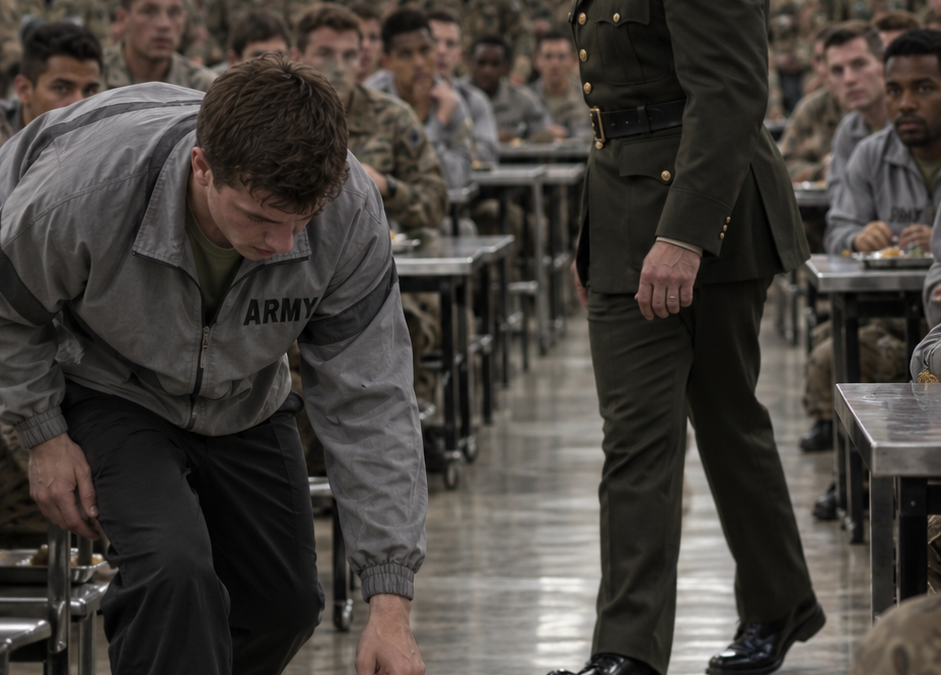
My face struck the metal food tray hard enough to send Salisbury steak, mashed potatoes, and brown gravy across the mess-hall table.
The sound was sharp.
Ugly.
Final.
For one instant, I saw nothing but white.
Then pain came rushing back through my forehead in a hot pulse, followed by the cold pressure of Sterling’s hand clamped against the back of my neck.
He kept me there.
Face down.
Like an animal being taught obedience.
“GET OUT!”
His voice exploded above me.
“You do not speak to me. You do not question me. You do not even look at me unless I tell you to. Do you understand?”
I said nothing.
Around us, the cafeteria had gone completely silent.
Less than thirty seconds earlier, there had been almost a hundred voices bouncing off the cinderblock walls. Forks scraping trays. Chairs dragging across the floor. Young soldiers arguing about weekend passes and bad coffee.
Now I could hear the buzz of a fluorescent light over the serving line.
That was how quiet they were.
That was how afraid they were.
And that fear was why I had come to Camp Vora.
Three months earlier, the Office of the Inspector General had received the first anonymous report.
The second came eleven days later.
Then five more.
Hazing.
Threats.
Payroll extortion.
Retaliation against soldiers who filed complaints.
Medical restrictions ignored as punishment.
Career-ending disciplinary actions created out of thin air.
Every report mentioned the same name.
Major Thomas Sterling.
But the allegations had a problem.
No witnesses would formally testify.
Statements were withdrawn.
Emails disappeared.
Young soldiers who had begged for help suddenly insisted nothing had happened.
Two requested emergency transfers.
Three others went absent without leave under circumstances that made no sense.
And whenever anyone above the installation asked questions, the answer was always the same.
Camp Vora maintained discipline.
Camp Vora produced results.
Camp Vora had no systemic problem.
So I stopped asking from Washington.
I removed the silver eagles from my collar, traded my tailored uniform for faded standard-issue fatigues, and entered the base under the identity of a newly transferred soldier waiting for assignment processing.
No rank.
No special treatment.
No visible authority.
Just another body moving through Sterling’s world.
My name is Colonel Elena Vance.
At that moment, however, Major Sterling believed I was nobody.
That was precisely why his hand was still pressing my face into a tray.
“You think you’re some kind of hero?” he demanded.
I felt his fingers tighten against the back of my neck.
“Walking into my mess hall, interfering with my soldiers?”
His soldiers.
That was how he always said it.
Not the Army’s soldiers.
Not the nation’s soldiers.
His.
Five minutes earlier, nineteen-year-old Private Leo Miller had dropped his canteen.
That was all.
His hands had been trembling badly enough that he had fumbled the cap after lunch. The metal bottle struck the floor, bounced once, and rolled underneath the table.
Sterling had been twenty feet away.
His head snapped around.
The room changed immediately.
Men stopped talking.
Someone lowered his fork.
Leo froze.
I had been watching him for two weeks.
He was thin, earnest, painfully young, and sent nearly every dollar he could spare to his mother, whose medical bills were swallowing the family whole.
He worked extra details without complaining.
He never caused trouble.
He flinched whenever Sterling entered a room.
When the canteen fell, Sterling crossed the cafeteria as though Leo had fired a weapon.
“You think this is a playground, Private?”
“No, sir.”
“Then why am I hearing garbage thrown across my mess hall?”
“It slipped, sir.”
“It slipped?”
Sterling leaned closer.
Leo’s shoulders drew inward.
“Yes, sir.”
Sterling smiled.
I had learned to hate that smile.
It meant he had found someone weaker.
“Pick it up.”
Leo bent down.
“Stop.”
He stopped halfway.
“Stand up.”
Leo straightened.
“Now pick it up.”
The boy looked confused.
Sterling waited.
Leo bent again.
“Did I tell you to move?”
A few soldiers stared at their trays.
Nobody laughed.
This wasn’t comedy.
It was conditioning.
Leo slowly stood again.
Sterling stepped closer until the boy’s back touched the edge of the table.
“You don’t know whether you’re supposed to stand or bend over without permission?”
“No, sir. I mean—yes, sir.”
“Which one?”
Leo’s breathing quickened.
“I—”
“LOUDER.”
“Sir, yes, sir.”
“To what?”
That was when I stood.
I did not raise my voice.
“He dropped a canteen, sir.”
Sterling turned.
I could still remember the expression on his face.
Not surprise.
Offense.
Not because I had insulted him.
Because I had interrupted the ritual.
“He dropped it by accident,” I continued. “There’s no need to escalate this.”
His eyes moved over my empty collar.
No rank.
No insignia.
No protection he could see.
“What did you just say to me?”
“I said there’s no need to escalate.”
“Who the hell are you?”
“Someone asking you not to humiliate a nineteen-year-old over a canteen.”
The room seemed to shrink.
Leo whispered, “Please.”
I wasn’t sure whether he was speaking to me or Sterling.
The Major moved closer until stale tobacco and coffee reached me on his breath.
“You don’t tell me how to discipline soldiers.”
I looked directly into his eyes.
“No, sir.”
For a moment, I thought he might regain control.
Then he saw something in my expression that enraged him more than defiance.
I wasn’t afraid.
Sterling understood fear.
He knew how to create it.
Measure it.
Exploit it.
What he could not tolerate was its absence.
His hand shot forward.
I had enough training to stop him.
I could have caught the wrist.
Turned.
Broken the grip.
Dropped him to the floor before half the room understood what was happening.
I didn’t.
The investigation needed proof that could not be explained away as aggressive leadership or disputed testimony.
I let the moment happen.
His palm struck the back of my head.
He drove me down.
My forehead smashed against the raised metal divider of the tray.
Pain burst through my skull.
Food sprayed across the table.
Someone gasped.
Leo cried out.
And Sterling held me there.
“You are dirt on my boots,” he snarled. “You understand me?”
Through the ringing in my ears, I heard him addressing the room as much as me.
This was never punishment.
It was theater.
He needed them watching.
“You come in here and play hero?”
His fingers dug into my neck.
“I will break you until you spend the rest of your career cleaning toilets. I will make sure no unit wants you. No commander trusts you. No promotion board ever forgets your name.”
Across the room, Sergeant Daniel Hayes shifted his weight.
Hayes had served ten years.
He knew regulations better than most officers.
He knew exactly what he was witnessing.
Our eyes had met several times during my undercover assignment.
I had seen discomfort in him before.
Shame, too.
But never action.
He had a wife.
Two children.
Twelve years left until retirement.
Sterling had already destroyed one NCO who challenged him.
Hayes looked down.
Behind the serving counter, Brenda Lawson covered her mouth with her apron.
She had worked in that cafeteria for two decades.
I had spoken to her several times.
She knew everybody.
Their birthdays.
Their divorces.
Who was homesick.
Who needed an extra sandwich after night duty.
She had also seen Sterling reduce grown men to trembling silence.
“Oh, Lord,” she whispered.
Sterling finally released me.
“Get up.”
I stayed still for a second.
Not because I was obeying him.
Because the room was spinning.
Then I pushed myself upright.
Gravy slid from my jaw.
Mashed potatoes clung to my cheek and hair.
Blood had begun to gather along the small split above my eyebrow.
My forehead throbbed so hard I could feel my pulse beneath the skin.
It was humiliating.
Sterling knew that.
He stepped back and adjusted his uniform.
He even looked down at one polished shoe and wiped away a spot of gravy.
Victory restored his posture.
He expected tears.
Maybe pleading.
What he received was a paper napkin.
I reached toward the dispenser.
Pulled one free.
Wiped my eyes.
Then my mouth.
I stood straight.
Rolled my shoulders once.
And looked at him.
His satisfaction faltered.
Only slightly.
But I saw it.
“You heard me,” he said. “Get out.”
I wiped another streak of food from my cheek.
Leo was crying quietly now.
I hated that more than the pain.
He thought this was his fault.
Hayes still wouldn’t raise his eyes.
That hurt too.
Not because I needed him to rescue me.
Because Sterling had trained a decent man to believe survival required cowardice.
I reached into my left breast pocket.
My fingers touched cold metal.
For the first time that afternoon, I smiled.
“I’ll leave, Major.”
He stared at me.
“But you’re coming with me.”
I opened my hand.
The silver eagle caught the fluorescent light.
Sterling blinked.
Once.
Twice.
The room stopped breathing again.
I held his gaze.
“Colonel Elena Vance. Department of Defense. Office of the Inspector General.”
The color drained from his face.
Then came back violently.
“Stolen valor.”
The words emerged almost as a whisper.
I expected denial.
I had seen powerful men confronted with evidence before.
Some tried explanation.
Some bargaining.
Some simply went quiet.
Sterling chose rage.
He stepped toward me.
“You bought that.”
“No.”
“You bought that pin at a surplus store.”
“No, Major.”
“You think I’m stupid?”
I almost laughed.
“That question is becoming increasingly relevant.”
His nostrils flared.
“I am going to destroy you.”
He pointed at me.
“You come onto a military installation impersonating a commissioned officer, interfere with command authority, assault a superior officer—”
Leo looked up.
Even Hayes did.
“Assault?” I asked.
Sterling scanned the cafeteria.
That was when I understood the full extent of what Camp Vora had become.
He didn’t care that dozens of people had seen everything.
He believed fear could rewrite reality.
“Did anyone here see me assault this woman?”
Silence.
He walked toward Leo.
The boy recoiled.
Sterling lowered his voice.
“Private Miller.”
Leo’s lips trembled.
“Sir.”
“Did she assault me?”
Leo looked toward me.
I gave him the smallest shake of my head.
Not because I wanted him to lie.
Because I didn’t want him sacrificing himself before he had protection.
His eyes filled with tears.
“I… I didn’t see anything, sir.”
Sterling smiled.
Then he turned toward the room.
“Anyone?”
Nobody moved.
Not one soldier.
My chest tightened.
These were people trained to run toward gunfire.
Yet one abusive officer had taught them to fear a personnel file more than bullets.
Sterling looked at me triumphantly.
“You see?”
“Yes,” I said.
His smile widened.
“I see exactly what you’ve done to them.”
The smile vanished.
“Sergeant Hayes!”
Hayes straightened.
“Sir.”
“Call the MPs. Tell them we have a civilian impersonating a senior officer.”
I held the silver eagle between two fingers.
“Sergeant, don’t.”
Sterling spun toward me.
“You do not command my men.”
“If you place that call, Sergeant Hayes, tell the MPs that Colonel Elena Vance of the Pentagon Inspector General’s office requires immediate assistance.”
Sterling laughed.
“You’re insane.”
“Possibly concussed,” I said. “Not insane.”
Hayes’s hand hovered near his radio.
Sweat appeared along his temple.
“Major Sterling,” I said, “this is your last opportunity to step away voluntarily.”
He raised his fist.
Leo made a strangled sound.
“Please don’t hit her again.”
Sterling turned on him.
“What?”
Leo shrank back.
I took one step forward.
Sterling noticed.
His fist lowered slightly.
Not from conscience.
Calculation.
“Sergeant!” he shouted. “Call the MPs.”
Hayes swallowed.
Then his radio crackled.
“Sir,” he said.
Sterling glared.
“What?”
“Someone already activated the silent alarm.”
Every head turned toward the kitchen.
Brenda stood beside the counter.
Her hands were shaking.
Her chin wasn’t.
Sterling stared at her.
“You.”
She swallowed.
“Yes.”
“You’re fired.”
Brenda’s face went pale.
“You’ll pack your things and be off this base by sundown.”
Before she could answer, the double doors opened.
“Military Police!”
Two corporals entered fast.
Hands near their sidearms.
Their eyes took in the room.
The spilled food.
My bruised face.
Sterling.
The frightened soldiers.
Sterling didn’t give them time to think.
“Corporal, detain this woman immediately. She’s impersonating a colonel and assaulted a superior officer.”
The lead MP looked at me.
I recognized the moment.
Young soldier.
Clear rank structure.
Conflicting information.
And one loud senior officer making certainty sound like truth.
I raised the eagle.
“My identification is in my right breast pocket. I am Colonel Elena Vance, Department of Defense Inspector General.”
The corporal froze.
“Don’t listen to her,” Sterling snapped. “That insignia is fake.”
The second MP looked uncertain.
“Ma’am,” the first said, “keep your hands where I can see them.”
“Of course.”
“Turn around.”
A murmur traveled through the room.
Sterling smiled.
I didn’t move immediately.
“Corporal, before you do this, look at my credentials.”
Sterling stepped between us.
“You will obey my direct order.”
The corporal looked from Sterling to me.
Fear chose for him.
“Ma’am, turn around.”
I did.
The handcuffs closed around my wrists.
Cold steel.
Too tight.
Sterling stepped closer.
“Make them tighter.”
The corporal hesitated.
Then adjusted one notch.
Pain pressed into the bone.
I breathed through it.
No protest.
No threat.
No angry speech.
Sterling needed to believe he had won.
That mattered now.
As they led me toward the doors, I passed Hayes.
His face had gone gray.
“Sergeant.”
He wouldn’t look at me.
“Keep Leo safe.”
His eyes lifted.
“For the next hour,” I said. “Do not leave him alone with Sterling.”
Sterling laughed behind us.
“You’re not coming back.”
I looked over my shoulder.
That was when he first saw the smile.
Not wide.
Not theatrical.
Just enough.
His laughter stopped.
The doors closed behind me.
Outside, the afternoon sun felt painfully bright.
The MPs put me in the back of their cruiser.
Wire partition.
Locked doors.
Hard plastic seat.
The bruise on my forehead pulsed with every heartbeat.
In the reflection of the window, I looked terrible.
Food in my hair.
Blood along my eyebrow.
Swelling across half my forehead.
And still I was smiling.
The two MPs noticed.
Neither asked why.
The ride to the Provost Marshal’s office took less than ten minutes.
It felt longer.
The corporal driving gripped the wheel with both hands.
His name strip read MILLER.
The passenger was SANTINO.
“You understand you’ve made a serious mistake,” I said.
Driver Miller stared ahead.
“The Major gave us a lawful order.”
“No. He gave you an order.”
Silence.
“Those aren’t always the same thing.”
Santino looked at me in the mirror.
“Are you really a Colonel?”
Miller snapped, “Don’t engage.”
I leaned back.
“Fifteen years in uniform.”
Neither answered.
“Multiple deployments. Investigations across four major commands. And enough experience with frightened people to know both of you are already wondering whether you should have checked my ID.”
Santino looked away.
Miller’s jaw tightened.
“We’re taking you to the Provost Marshal. Brass can sort it out.”
“That is the first sensible thing you’ve done.”
The building was a squat block of concrete near the center of the installation.
They pulled me from the cruiser.
Miller’s grip on my arm was harder than necessary, although his confidence was fading.
Inside, a senior desk sergeant looked up.
“What happened?”
“Impersonating an officer,” Miller said. “Major Sterling ordered her detained.”
The Sergeant studied my face.
“Who hit her?”
Miller hesitated.
“She resisted.”
I looked at him.
He looked away.
“She also claims she’s Pentagon OIG,” Santino added quietly.
The Sergeant stopped.
His eyes moved from the MPs to me.
“Did you check her credentials?”
“Major said they were fake.”
“That wasn’t my question.”
No answer.
I spoke calmly.
“My identification is in my right breast pocket. Colonel Elena Vance. Office of the Inspector General.”
The Sergeant stared at me for several seconds.
Experience was working behind his eyes.
Unlike the young corporals, he understood one simple fact.
People pretending to have power usually tried very hard to look powerful.
I looked like I’d lost a fight with lunch.
Yet I wasn’t pleading.
“Take the cuffs off,” he said.
Miller blinked.
“Sarge?”
“Now.”
“Major Sterling specifically—”
“I don’t care what Sterling specifically said. Remove them.”
The keys shook in Miller’s hand.
When the cuffs opened, red marks circled both wrists.
I reached slowly into my pocket.
Removed the black credential wallet.
Opened it.
The Department of Defense seal gleamed under the fluorescent light.
My photograph.
Name.
Rank.
Office.
Authorizing signature.
The room changed.
The Sergeant snapped to attention.
Miller went white.
Santino whispered something that sounded like a prayer.
“Ma’am,” the Sergeant said, “I apologize.”
I closed the wallet.
“I know why this happened.”
Miller stared straight ahead.
I stepped toward him.
“Corporal.”
“Ma’am.”
“You were presented with conflicting claims.”
“Yes, ma’am.”
“You chose rank over evidence.”
His throat moved.
“Yes, ma’am.”
“You didn’t verify identity. You didn’t ask witnesses. You didn’t examine my injury.”
“No, ma’am.”
“You obeyed the person you feared most.”
His eyes dropped.
I let that sit.
Then I turned.
“I need a secure line.”
The Sergeant moved immediately.
“Yes, ma’am.”
“And lock the front entrance.”
“Ma’am?”
“No one leaves until I say otherwise.”
He reached for the phone.
A secure connection took less than thirty seconds.
I listened for the encryption tones.
Then spoke.
“This is Vance. Code Red. Camp Vora.”
The response came immediately.
“Authenticate.”
I did.
“Status?”
“Physical assault by investigative target. Witnesses present. Command interference confirmed. Identity compromised.”
A pause.
Then:
“Do you require extraction?”
“I require Clean Sweep.”
The room seemed to get colder.
Even the desk Sergeant recognized the phrase.
Clean Sweep was the contingency we had prepared if the investigation escalated from administrative corruption to criminal obstruction.
“Confirm target.”
“Major Thomas Sterling. Immediate relief of authority and detention pending charges.”
“Secondary command?”
“Hold until my confirmation.”
“Team is already staged. Estimated arrival ten minutes.”
I looked at the clock.
“Send medical support.”
“For you?”
“Private Leo Miller. Nineteen. Acute distress.”
I paused.
“And send someone with enough authority to prevent anyone on this base from arguing jurisdiction.”
“Understood.”
I lowered my voice.
“There’s more here than the reports showed.”
“We suspected that.”
The line disconnected.
Three men stared at me.
“What happens now?” Santino asked.
I went to the small sink along the wall.
Cold water removed the gravy first.
Then the blood.
My forehead was already turning dark purple.
I looked into the mirror.
For three months, I had dressed small.
Moved small.
Spoken softly.
Made myself forgettable.
Now I straightened.
It surprised even me how quickly the disguise disappeared.
“I go back.”
Miller looked horrified.
“To the mess hall?”
“Yes.”
“Ma’am, Sterling—”
“Believes I’m in a cell.”
I dried my face.
“That confidence is useful.”
The return trip was silent.
No handcuffs this time.
I sat in the passenger area, not the cage.
As we approached the mess hall, Sterling’s voice carried through an open window.
“I want that floor spotless!”
There it was again.
The same man.
The same certainty.
“I see one piece of food left on that tile, you’re all running until dark!”
Miller parked.
I stepped out.
The two corporals followed.
Neither tried to walk beside me.
When I entered the cafeteria, Sterling had his back turned.
Several soldiers were scrubbing the floor.
Leo sat against a wall beside Hayes.
Hayes had kept his promise.
Good.
Sterling heard the doors.
“I told you—”
He turned.
Stopped.
His face emptied.
I walked toward him.
No cuffs.
No escorting hands.
The MPs remained behind me.
“What is this?”
I stopped at the same table where he’d slammed my face into the tray.
“Corporal!” he shouted. “Why isn’t she detained?”
No response.
His eyes narrowed.
“What did she tell you?”
I took out my phone.
“You remember when I said I was leaving?”
His breathing changed.
“Yes.”
“I didn’t say I was finished.”
I dialed.
He watched my face.
The line connected.
“Office of the Secretary of Defense.”
“This is Colonel Elena Vance. Camp Vora. Identity verified. Confirm relief-of-command action for Major Thomas Sterling.”
Sterling stepped back.
His shoe hit a wet patch.
He nearly slipped.
“No.”
I lowered the phone.
“You’re lying.”
His voice had changed completely.
The thunder was gone.
“This is some kind of setup.”
“It is an investigation.”
“You can’t do this.”
“I haven’t done anything yet.”
Outside, rotor blades began beating the air.
Windows rattled.
Several soldiers turned toward the sound.
Sterling looked toward the ceiling.
Then the doors.
Then me.
The helicopter descended onto the nearby parade field.
“You planned this,” he whispered.
“For three months.”
“You targeted me.”
“We investigated reports.”
“You came here looking for a reason.”
“No.”
I stepped closer.
“I came here hoping the reports were exaggerated.”
That part was true.
I had wanted them to be exaggerations.
I had wanted angry recruits.
Misunderstood orders.
Bad leadership that could be corrected.
Anything but what I found.
“You gave me the reason yourself.”
Boots thundered outside.
Sterling looked toward the exit.
“You don’t understand this place.”
“I’m beginning to.”
The doors burst open.
A federal tactical detachment entered with military investigators behind them.
The lead agent approached Sterling.
“Major Thomas Sterling?”
Sterling stared at me.
“You think this ends with me?”
The agent ordered him to place his hands where they could be seen.
Sterling’s confidence finally fractured.
“You don’t know who you’re dealing with.”
“Hands visible, Major.”
He obeyed.
As they secured him, he began laughing.
Not normally.
A strange, breathless sound.
His eyes shifted toward the administrative corridor behind the kitchen.
“You think I was running this place?”
My attention followed his gaze.
The corridor was dark.
“You think I’m the problem?”
He laughed again.
Then a man stepped from the shadows.
Every soldier in the room recognized him.
So did I.
Brigadier General Silas Thorne.
Base Commander.
Officially, Thorne was supposed to be in Washington.
His presence at Camp Vora changed everything.
He walked toward us with perfect composure.
Silver hair.
Immaculate uniform.
No visible urgency.
No surprise.
“Colonel Vance.”
I watched his hands.
His face.
His breathing.
Nothing.
“General.”
He glanced toward Sterling, who was being held by two investigators.
Then toward me.
“You’ve certainly created a memorable afternoon.”
“I wasn’t aware you were on base.”
“Clearly.”
“Your travel records say you’re in Washington.”
“My schedule changed.”
“No notification was filed.”
A faint smile.
“Not every decision a General makes requires your approval.”
“No.”
I looked toward Sterling.
“But some require documentation.”
Thorne’s smile thinned.
Sterling struggled against the investigators.
“Sir, tell them. Tell them she’s exceeded her authority.”
Thorne didn’t even glance at him.
“Stand still, Thomas.”
Sterling did.
Immediately.
That told me more than any report.
Thorne approached.
“You’ve built quite a case out of a cafeteria altercation.”
“No.”
I touched the bruise above my eye.
“This is merely the first thing that happened in front of enough witnesses.”
“The first?”
“The extortion complaints.”
Several soldiers shifted.
“The falsified disciplinary actions.”
Thorne’s eyes remained steady.
“The medical waivers ignored.”
Nothing.
“The three whistleblowers who allegedly went AWOL.”
There.
A tiny reaction.
Barely visible.
But real.
His pupils tightened.
“They deserted,” Thorne said.
“You signed those findings.”
“I did.”
“And you’re confident they’re accurate?”
“Completely.”
I took out my phone.
The investigation had begun long before I arrived at Vora.
Three soldiers disappearing after confidential complaints had never sat right with me.
The official timeline contained contradictions.
Vehicle logs missing.
Security footage overwritten during different maintenance windows.
No confirmed civilian sightings.
No financial activity.
No contact with relatives.
People who desert usually run somewhere.
Those three men had simply vanished.
“I made two calls today,” I said.
Thorne’s expression remained controlled.
“One brought the team you see here.”
“And the other?”
“A search unit.”
His face changed.
Not much.
Enough.
I turned the phone so he could see a location marker north of the main installation.
“Old ammunition storage area.”
Sterling closed his eyes.
That was confirmation before any words were spoken.
Thorne looked at him.
And for the first time, real anger appeared.
Not at me.
At Sterling.
“You idiot.”
Sterling recoiled.
“You told me it was sealed.”
Nobody moved.
I felt something cold settle into my stomach.
I hadn’t known what the search team would find.
We had coordinates from vehicle telemetry and partially recovered maintenance records.
We had suspicion.
Not certainty.
Now Sterling had given us both.
My phone vibrated.
A message appeared.
I read it once.
Then again.
Human remains located.
Three sites.
Thorne watched my face.
“You found something.”
I looked up.
“Three graves.”
Leo made a sound behind me.
Hayes put an arm around him.
Thorne breathed out slowly.
Then straightened.
“This is becoming absurd.”
“Is it?”
“You don’t know who those remains belong to.”
“Not yet.”
“You don’t know how long they’ve been there.”
“No.”
“You don’t know whether there is any connection to this command.”
“Also true.”
He nodded.
“There. At least some reason remains in Washington.”
I held his gaze.
“But Major Sterling apparently knew exactly where I meant when I said the area was sealed.”
Sterling stared at the floor.
Thorne finally lost patience.
“Shut up, Thomas.”
“I didn’t say anything.”
“You didn’t have to.”
A tactical agent stepped closer.
“General Thorne, we’re going to need you to remain here.”
Thorne looked at him.
The agent was experienced.
Still, I saw the hesitation.
A Brigadier General was not a Major.
Rank exerted gravity even among people trained to resist it.
Thorne noticed.
Of course he did.
“You’re going to detain a general officer,” he said, “because a concussed Colonel with food stains on her uniform has developed a theory?”
Nobody answered.
He looked at me.
“You have no idea what you’ve stepped into.”
“I have a reasonable idea.”
“No.”
His voice softened.
That made it more dangerous.
“This installation supports operations you are not cleared to understand.”
“Then those operations can survive lawful oversight.”
“Can they?”
“Yes.”
“You’re very certain.”
“I have to be.”
He moved closer.
“You think this is about hazing?”
“No.”
“Sterling?”
“No.”
“Three soldiers?”
I stared at him.
“Three soldiers are enough.”
His jaw tightened.
“They were liabilities.”
The entire room froze.
I don’t think he intended to say it.
Or perhaps he did.
Maybe men like Thorne spend so many years having their decisions treated as strategy that they forget ordinary people call some decisions crimes.
I lowered my voice.
“Liabilities?”
His eyes hardened.
“You’re twisting my words.”
“I don’t need to.”
“You don’t understand the scale of what happens here.”
“Explain it.”
He almost smiled.
“Millions of dollars move through this installation.”
There it was.
“Contractors. Logistics. Restricted shipments. Programs with oversight channels well above your pay grade.”
“Nothing is above criminal law.”
“That is an idealistic answer.”
“No. It’s a professional one.”
He moved close enough that the tactical agents shifted.
“You want my advice?”
“No.”
“Take it anyway.”
His voice became nearly conversational.
“Walk away.”
I said nothing.
“Write Sterling up. Destroy him if you like. He’s expendable.”
Sterling looked toward him in shock.
Thorne continued.
“Return to Washington. File your report. Claim reform. Receive your commendation. Let Camp Vora continue doing what Camp Vora exists to do.”
“You mean whatever operation required three whistleblowers to disappear?”
“You still cannot prove that.”
“Then why are you bargaining?”
Silence.
His eyes turned colder.
“I know people far above you.”
“That doesn’t surprise me.”
“Senators.”
“Fine.”
“Senior defense officials.”
“Fine.”
“People whose careers are built on keeping certain programs invisible.”
“Then they’re going to have unpleasant weeks.”
For the first time, Thorne looked at me as though he truly hated me.
“You’re a Colonel.”
“Yes.”
“Do not mistake that for power.”
“I don’t.”
I looked toward Leo.
Then Hayes.
Then Brenda, who had emerged from the kitchen and was standing beside the counter.
“That mistake belongs to you.”
His eyes narrowed.
“Rank isn’t power, General.”
I pointed toward the soldiers lining the wall.
“Fear is what you used instead.”
He turned.
“Sergeant Hayes.”
Hayes stiffened.
“Sir.”
“Detain Colonel Vance.”
Nobody breathed.
Hayes stared at him.
“Sir?”
“You heard me.”
Thorne’s voice snapped hard now.
“Detain her for insubordination, interference with classified operations, and attempted subversion of command.”
I said nothing.
This moment wasn’t mine anymore.
It belonged to Hayes.
Thorne pointed at me.
“If the military police interfere, treat them as acting outside lawful command authority.”
Hayes’s hand moved.
For one second, I didn’t know what he was going to do.
Then he walked toward Leo.
Placed one hand on the boy’s shoulder.
Pulled him gently to his feet.
He turned toward Thorne.
His face looked different.
Still afraid.
But no longer ashamed.
“Sir.”
Thorne waited.
Hayes inhaled.
“With all due respect, that’s not a lawful order.”
Thorne’s face darkened.
“I decide what is lawful on this installation.”
“No, sir.”
“Sergeant.”
Hayes stood straighter.
“No, sir.”
Thorne took a step forward.
“You have a family, don’t you?”
Hayes flinched.
I saw it.
So did everyone else.
Thorne knew exactly where to cut.
“A wife?”
Hayes’s jaw tightened.
“Two children?”
“Yes, sir.”
“You willing to throw away their future for her?”
Hayes looked toward me.
Then Leo.
Then Brenda.
Then all the soldiers who had spent months looking at the floor.
When he spoke again, his voice was quiet.
“I’m trying to make sure my kids never see me become the kind of man you wanted me to be.”
Thorne stared.
Hayes swallowed.
Then said the words that finally broke Camp Vora.
“I’m not arresting her.”
Sterling moved.
Fast.
His hand went toward his sidearm.
Three weapons from the tactical team tracked him instantly.
“DON’T.”
Sterling froze.
His fingertips hovered near the holster.
“Hands away.”
His eyes darted around the room.
There was nowhere left to go.
Slowly, he lifted both hands.
Then something inside him collapsed.
His shoulders sagged.
He sank to his knees.
The man who had terrorized an entire installation looked suddenly small.
Not harmless.
Never that.
Just ordinary.
That was the thing about bullies.
Their power often depended on everybody agreeing to keep giving it to them.
Thorne didn’t collapse.
He remained standing while agents approached.
“General Silas Thorne,” the lead investigator said, “you are being temporarily detained pending investigation into obstruction, conspiracy, and potential criminal conduct connected to the discovery north of this installation.”
Thorne extended his hands.
Almost politely.
When the cuffs closed, he looked directly at me.
“This isn’t over.”
“No.”
“You’ll wish it were.”
“Maybe.”
“You’ll have people calling your office by morning.”
“I expect them.”
“You’ll be investigated.”
“Probably.”
“Dragged into hearings.”
“Likely.”
“Your career may end.”
That one reached me.
Because it might have been true.
Careers at our level rarely died because of one decision.
They died under pressure.
Phone calls.
Questions about judgment.
Questions about procedure.
Questions from people who had never stood in the room where the decision was made.
Thorne saw the thought cross my face.
He smiled.
“You see?”
I stepped close.
“My career was never the point.”
His smile faded.
The agents led him away.
Sterling followed in restraints.
As he passed me, he stopped.
The same man who had shoved my face into a tray less than an hour earlier could barely look at me.
“This wasn’t supposed to happen.”
I studied him.
“What wasn’t?”
“You.”
That answer stayed with me.
Not because it was clever.
Because it revealed everything.
He had never imagined consequences arriving in an ordinary uniform.
Never imagined the person he humiliated might matter to someone powerful.
Which meant all the people he had hurt before me had seemed safe to hurt.
That was the ugliest part.
I leaned closer.
“You still don’t understand.”
He finally looked up.
“It shouldn’t have mattered who I was.”
The agents moved him forward.
The doors closed.
And for several seconds, nobody said anything.
Then someone started crying.
Not Leo.
A soldier near the back wall.
Another sat down and covered his face.
Brenda came around the counter.
She looked toward me.
“Colonel?”
“Yes?”
“Am I really fired?”
I laughed.
It hurt my head.
“No.”
She pressed her apron to her mouth.
Then she laughed too.
Sergeant Hayes walked toward me.
“Ma’am.”
“Sergeant.”
“I should have stopped him.”
His eyes went to my bruise.
“At the beginning.”
“Yes.”
He absorbed that.
I wasn’t going to comfort him with a lie.
“I was afraid.”
“I know.”
“I kept telling myself I had a family.”
“I know.”
“I thought surviving him meant protecting them.”
“That is how systems like this survive.”
His eyes were red.
He nodded toward Leo.
“But I failed them too, didn’t I?”
I followed his gaze.
Leo sat on the edge of a bench.
He looked exhausted.
Small.
Still nineteen.
“You failed before today,” I said.
Hayes looked at me.
“Today you stopped.”
He nodded once.
It was enough.
I walked toward Leo.
He stood quickly.
Too quickly.
His knees nearly buckled.
“At ease,” I said.
He tried.
Failed.
“I’m sorry.”
“For what?”
“The canteen.”
I stared at him.
“You think any of this happened because you dropped a canteen?”
His eyes filled again.
“He hit you because I—”
“No.”
I stepped closer.
“He hit me because he believed he was entitled to hurt people.”
Leo looked down.
“You didn’t cause that.”
“I should’ve just been more careful.”
“No.”
His face tightened.
That sentence had probably been living in him for months.
I should be quieter.
I should be faster.
I should be better.
I should never make him angry.
That is what abuse teaches.
Responsibility flows downward.
The person being hurt becomes responsible for preventing the person hurting them from becoming angry.
I reached into my pocket.
The silver eagle was still there.
The tiny insignia that had changed the temperature of the entire room.
I placed it in his palm.
Leo stared at it.
“Ma’am?”
“Keep it.”
His eyes widened.
“I can’t take this.”
“Yes, you can.”
“But it’s your rank.”
“No.”
I closed his fingers around the eagle.
“It’s metal.”
He looked confused.
“Rank is responsibility. That pin doesn’t make someone decent.”
I glanced toward the doors where Sterling had disappeared.
“And it certainly doesn’t make them untouchable.”
Leo looked down at his hand.
“What am I supposed to do with it?”
“Remember something.”
He waited.
“Next time someone powerful tells you that you are nothing, remember how wrong Sterling was about the person standing between him and you.”
A tear slipped down his cheek.
I continued.
“And remember he was just as wrong about you.”
Leo’s mouth tightened.
He nodded.
Behind us, the mess hall slowly came back to life.
Not normally.
Not yet.
Too much had happened.
Investigators were interviewing soldiers.
Medical personnel arrived.
Some soldiers began speaking to agents voluntarily.
Then more.
Once the first person talked, another followed.
A private described being forced to surrender part of his housing allowance.
A specialist produced messages threatening her promotion after she reported an injury.
An NCO identified false disciplinary records.
Brenda opened a drawer beneath the register and handed investigators a notebook she had kept for two years.
Dates.
Names.
Times.
Every incident she was afraid would otherwise disappear.
By sunset, the investigation had expanded beyond Sterling and Thorne.
Contracting offices were sealed.
Computers seized.
Financial accounts frozen.
The three bodies north of the installation were later identified as the missing soldiers.
That part took weeks.
Their families received answers that could never compensate for what had been taken from them.
The criminal investigation uncovered a procurement scheme hidden inside classified logistics contracts, with money diverted through shell vendors and falsified shipment records.
Sterling had been useful because fear made people quiet.
Thorne had been useful because rank discouraged questions.
Neither had built the system alone.
More arrests followed.
So did hearings.
Thorne had not been lying about one thing.
People called Washington.
A lot of people.
Some wanted to know whether I had exceeded authority.
Others wanted to know why an undercover Colonel had allowed herself to be assaulted.
One particularly irritated official asked why I hadn’t revealed my identity sooner.
My answer was simple.
“Because he needed to believe I was powerless.”
There was silence on the line.
Then I added:
“That’s who he attacked.”
My concussion healed.
The bruise faded from purple to yellow and finally disappeared.
The red marks around my wrists lasted longer than I expected.
So did certain sounds.
For months, the scrape of a metal tray against a cafeteria table could pull me backward into that moment.
Sterling’s hand on my neck.
Leo crying.
Hayes staring at the floor.
I don’t think courage is the absence of fear.
That afternoon proved the opposite.
Brenda was terrified when she pressed the alarm.
She did it anyway.
Hayes was afraid of losing his pension.
His home.
His children’s future.
He refused the order anyway.
Leo was barely able to stand, yet weeks later he testified in detail.
He did it while his hands shook.
People like Sterling misunderstand courage because they mistake fear for surrender.
They think shaking means weakness.
Silence means agreement.
Compliance means loyalty.
And sometimes they are right long enough to become dangerous.
Camp Vora received an interim commander before the week ended.
One of his first actions was creating a protected reporting channel outside the local chain of command.
The second was ordering an independent review of every disciplinary action Sterling had touched.
The third was asking Sergeant Hayes to serve temporarily as senior enlisted adviser during the transition.
Hayes called me before accepting.
“I don’t deserve that job,” he said.
“Probably not.”
There was a pause.
Then he laughed softly.
“That’s blunt.”
“You called the Inspector General. What did you expect?”
“I expected you to tell me I redeemed myself.”
“You made one correct decision after several wrong ones.”
“So that’s a no?”
“Redemption isn’t a promotion, Sergeant.”
He grew quiet.
“What is it?”
“Doing the next right thing when nobody promises to forgive the last wrong one.”
A week later, he accepted the position.
Brenda stayed in the mess hall.
Leo remained in service.
Months after the investigation ended, I received a photograph in my office.
No letter.
Just a picture.
Leo stood beside several other soldiers at Camp Vora.
He looked healthier.
A little older.
Still thin.
But he was smiling.
Pinned inside the cheap plastic frame surrounding the photograph was my silver eagle.
Below it, someone had written five words in black marker.
Rank is responsibility, not permission.
I kept that picture.
Not because I needed reminding that Sterling had been arrested.
Not because I wanted a souvenir from the case.
I kept it because investigations tend to become numbers after enough time passes.
Charges.
Counts.
Dollar amounts.
Years sentenced.
Names on legal documents.
But none of that was what I remembered when I thought about Camp Vora.
I remembered a metal canteen hitting the floor.
A nineteen-year-old boy closing his eyes.
A cafeteria full of trained soldiers too frightened to raise theirs.
And the moment a Major pressed my face into a tray because he believed nobody important was watching.
He was wrong.
But not for the reason he thought.
It wasn’t that he had accidentally assaulted a Colonel.
It wasn’t that I worked for the Inspector General.
It wasn’t that a helicopter was already waiting or that investigators had been preparing for weeks.
His real mistake was believing accountability only mattered when the victim had enough rank to demand it.
That belief was the disease beneath everything else.
The extortion.
The threats.
The silence.
The graves.
People became invisible to men like Sterling long before they became victims.
They became ranks on a chart.
Numbers on paperwork.
Young faces unlikely to be believed.
That’s how places like Camp Vora rot.
Quietly at first.
One person learns to look away.
Then another.
One frightened soldier says nothing.
One Sergeant decides retirement is more important than intervention.
One commander realizes nobody challenges him.
And eventually a monster starts believing the absence of resistance means permission.
I had spent three months investigating that silence.
In the end, it took less than an hour to break it.
Not because I was fearless.
I wasn’t.
When Sterling slammed my head downward, I didn’t know whether he would stop with one strike.
When the MPs closed the cuffs, I knew there were dozens of ways the operation could unravel.
When Thorne stepped from that hallway, I realized immediately that the corruption went farther than our original evidence suggested.
I was afraid more than once that afternoon.
But fear and helplessness are not the same thing.
Sterling never understood that.
Maybe that was why he couldn’t understand my smile.
He saw food on my uniform.
Blood on my face.
Handcuffs on my wrists.
He saw humiliation.
Defeat.
Someone stripped of control.
What he never saw was everything behind me.
Three months of evidence.
A secure team waiting for authentication.
Investigators already positioned beyond his reach.
A search unit moving toward the old ammunition bunkers.
A frightened cook finally willing to touch an alarm.
A Sergeant reaching the last boundary of what he could tolerate.
A young soldier who would eventually find his voice again.
Sterling thought the smile meant I was crazy.
It didn’t.
I was smiling because for the first time since I entered Camp Vora, he had stopped hiding.
He had shown everyone exactly who he was.
And once men like that are forced into the light, they discover something terrifying.
Power built entirely on fear disappears the moment people stop being afraid together.
That was what happened in that mess hall.
Not when the helicopter landed.
Not when Sterling was cuffed.
Not even when General Thorne was led away.
It happened a little earlier.
A frightened Sergeant looked at a frightened Private, remembered what his uniform was supposed to mean, and said no.
After that, Camp Vora was already changing.
The arrests merely made it official.
Years later, I still have a faint ridge above my eyebrow.
You have to look closely to notice it.
Most people never do.
Sometimes, when I catch it in the mirror, I remember Sterling’s hand forcing my head downward.
I remember the smell of gravy.
The fluorescent light.
The silence.
And the exact instant his expression changed when I stood back up.
He expected me to break.
Instead, I reached into my pocket.
And for the first time in a very long time, the man who had taught an entire military installation to fear him finally understood what fear felt like.








