𝗙𝗨𝗟𝗟 𝗦𝗧𝗢𝗥𝗬 The Line Beneath Their Clubhouse Had Been There Long Before Anyone Thought to Look for It
𝗙𝗨𝗟𝗟 𝗦𝗧𝗢𝗥𝗬
I read those words three times.
Ordinary neighbors say fence.
Property line.
Back lot.
People say parcel boundary when someone has been looking at documents.
I agreed to meet.
The following Tuesday, I drove to the clubhouse directly from my land.
Same work shirt.
Same boots.
Dust to my ankles.
I could have gone home and changed.
I chose not to.
Not because I wanted to make a statement.
I wanted information.
People reveal themselves most clearly when they believe they already understand who is standing in front of them.
The lobby smelled like eucalyptus and expensive cleaning products.
Three board members stood near a coffee station.
Sloan saw me.
Raised her voice.
“Well, the gentleman with the desert finally made it.”
Two people smiled.
One did not.
Heavyset man in a golf shirt.
Later I learned his name was Graham Keane.
Sloan led me into a conference room.
Long polished table.
Leather chairs.
She took the chair at the head.
Then gestured toward a small straight-backed chair near the door.
The sort of chair offices use for delivery drivers waiting for a signature.
That told me what kind of meeting this was.
I sat.
She opened a folder.
“Desert Crown is interested in acquiring approximately three acres along your eastern boundary.”
“For what?”
“A landscape buffer.”
She slid a paper toward me.
I had to lean forward to reach it.
The price was so low I checked for a missing zero.
Three acres.
The three acres nearest the paved access.
Nearest the clubhouse.
Nearest Desert Crown.
The most valuable portion of my parcel.
I looked at her.
“Four days ago you called the property dust and rattlesnakes.”
She smiled.
“I’m not sure I used those exact words.”
“You did.”
She said nothing.
“If it’s worthless, why do you need three acres?”
There.
A pause.
Tiny.
But real.
Then the smile returned.
“A buffer protects both sides.”
“From what?”
“Future incompatibility.”
“That means?”
“A property owner could put up metal buildings, storage, equipment, recreational vehicles. Development that doesn’t fit the character of Desert Crown.”
While saying character, she looked at my boots.
That answered more than her words.
She leaned back.
“You should consider the offer seriously.”
“I have.”
“You haven’t even been here long enough to understand this market.”
“I understand enough.”
“Nobody is competing for that type of property, Calvin. You’ll carry taxes on it until you eventually realize it is a liability.”
“No, thank you.”
The warmth disappeared instantly.
Not gradually.
One second it was there.
The next it was gone.
Sloan explained that Desert Crown had substantial influence in local planning matters.
The association had successfully opposed two nearby projects.
Any development application I filed would undergo intensive community review.
The access easement serving my parcel passed close to association landscaping.
Maintenance sometimes caused temporary access restrictions.
Nothing she said was a direct threat.
That was deliberate.
She was simply describing all the ways my life might become harder.
When she finished, I stood.
“If my land is worthless, you’re spending an extraordinary amount of time trying to control it.”
She did not answer.
On the way out, I stopped beside the corridor windows facing west.
Below them was the patio.
Pool.
Landscaping.
Decorative fence.
And beyond the fence, my property.
That was when I saw the concrete posts.
Two.
Old.
Gray.
Almost buried beneath decorative gravel and desert spoon plants.
Maybe six or seven feet west of the wrought-iron fence.
They did not match anything else.
No stucco.
No ornamental finish.
No landscape symmetry.
They were the kind of posts ranchers set decades ago because they needed a reference that lasted.
I stood there until the receptionist looked uncomfortable.
Then walked outside.
I spent twenty-two years around surveyors, title attorneys, and right-of-way agents.
One lesson survives every project.
A fence is not a boundary.
A fence is somebody’s belief about a boundary expressed in steel.
If it stays there long enough, people forget the difference.
Recorded monuments do not forget.
I sat in my truck for ten minutes.
Then called Nolan Pierce.
Registered land surveyor.
Fifty-eight.
Careful enough to irritate contractors.
I had worked with him on a water district project years earlier.
Once, Nolan delayed a pipeline eleven days because a tie sheet did not close properly.
Everybody complained.
He refused to certify it.
Eventually, they discovered an old control point had been misidentified.
That delay saved a relocation later.
“Nolan.”
“Calvin.”
“I bought some land.”
“Congratulations.”
“I need a boundary retracement.”
“Problem?”
“Not yet.”
“What are you looking for?”
“The actual line.”
He laughed once.
“That’s generally the idea.”
“No fence assumptions. No wall assumptions. Find the original monuments.”
He became serious.
“When?”
“As soon as you can.”
Nolan arrived Thursday with two crew members.
Before unloading equipment, he spread records across the hood of his truck.
Government survey.
Subdivision plat.
My deed.
Control information.
He explained his process even though I already understood most of it.
Ignore visual occupation.
Recover monuments.
Compare record geometry.
Then evaluate occupation against the line.
“Everything else is decoration,” he said.
By nine, the first problem appeared.
The record called for an iron pipe.
The crew found it beneath four inches of decorative gravel.
Not on my side of the pretty fence.
Inside Desert Crown’s landscape bed.
Nolan photographed it.
Measured.
Moved on.
Second monument.
Near an irrigation valve serving HOA landscaping.
Third.
Two hours with a metal detector.
Also inside ground Desert Crown had mowed, irrigated, lit, and maintained for four years.
Nolan stopped making casual conversation after that.
Around ten-thirty, Sloan arrived.
White SUV.
Fast walk.
She went to Nolan first.
“You are trespassing on association property.”
Nolan straightened.
Removed his hat.
“Do you have a recorded survey I can review?”
She blinked.
“A what?”
“A survey or deed description showing the association owns this ground.”
“Desert Crown has existed for years.”
“I understand.”
“The property lines have never been questioned.”
“I understand.”
“We don’t need outsiders with tripods explaining where our own land is.”
Nolan nodded.
“That’s fine.”
He put his hat on.
“I’ll continue retracing the description in my client’s deed.”
Then went back to work.
Sloan turned toward me.
“You’re actually paying for this?”
“Yes.”
“To measure sand?”
“No.”
She waited.
“To know exactly what I own.”
For once, she had no immediate response.
She called Desert Crown security.
A young officer arrived.
I handed him my deed.
Nolan gave him his business card.
The officer wisely concluded this was a civil boundary matter.
He left.
Sloan stayed another forty minutes.
Arms crossed.
Watching.
By three in the afternoon, Nolan had recovered two original government survey monuments predating Desert Crown entirely.
Both were intact.
Both fit the record.
The measured distance between them matched the legal calls to within a hundredth of a foot.
Clean.
Very clean.
And they did not support the decorative fence.
Nolan read the preliminary offset.
Then read it again.
He became quiet.
Not surprised quiet.
Concerned quiet.
He walked the eastern line.
Had his crew occupy the control points again.
Shot the line with satellite equipment.
Then checked it independently with the total station.
I watched.
“Nolan.”
“Give me a minute.”
“You don’t normally run three checks.”
“No.”
“So?”
He looked toward the clubhouse.
“I don’t say things like this from one setup.”
“Things like what?”
“If I’m right, it changes a lot.”
Near sunset, his crew began packing.
One lath with orange flagging stood about thirty feet west of the clubhouse patio.
Nolan looked at his data collector.
Then at the building.
Then back down.
“You should be here tomorrow.”
“Why?”
He pointed.
“Because tomorrow I think our line goes through the clubhouse.”
I arrived at 6:30 the next morning.
The crew worked carefully.
Stake by stake.
The first landed beyond the oleanders on landscaping Desert Crown treated as common property.
The second came beside the patio.
Close enough someone seated at one of the iron tables could touch the flag.
The third could not go into the ground.
A stucco wall occupied the calculated position.
The western wall of the clubhouse.
Nolan placed a small square of blue tape where the boundary intersected the structure.
That tiny piece of tape might have been the most expensive object on the property.
Residents started gathering.
Coffee cups.
Phones.
Whispers.
By nine, maybe fifteen people were watching.
At 9:30, Sloan arrived.
She went directly to the middle of the crowd.
“This needs to stop.”
Nolan continued organizing his paperwork.
“This performance,” she said, “is being conducted by a surveyor hired by an outside landowner attempting to manufacture a claim.”
Nolan did not argue.
He opened his folder on the truck tailgate.
Government survey.
Recorded Desert Crown subdivision plat.
My deed.
Monument photographs.
Bearing table.
Distance calculations.
Recorder stamps.
Then the plotted retracement.
He spoke for about four minutes.
Flat voice.
No drama.
His preliminary measurement showed the recorded line passing through developed portions of Desert Crown.
Not inches.
Approximately thirty-eight feet of the western clubhouse section.
A significant part of the patio.
And more than thirty marked parking spaces.
Someone behind Sloan whispered:
“Oh my God.”
Sloan laughed.
It sounded like the laugh from our first meeting.
But thinner.
“That is impossible.”
Nolan said nothing.
“Our site plan was approved.”
Still nothing.
“The county inspected this building.”
Nolan nodded.
“Yes, ma’am.”
“You’re telling me a nine-thousand-square-foot clubhouse passed every inspection while sitting on land somebody else owned?”
“I am telling you where the recovered monuments and record description place the boundary.”
She turned toward me.
“Buying cheap desert does not mean you own our clubhouse.”
I had not said I did.
So I answered:
“I haven’t said that.”
That frustrated her more than if I had demanded the keys.
As long as Sloan could describe me as an opportunist trying to steal an amenity, she had a story.
If I refused to play the role, all that remained was the survey.
Nolan then did something important.
He told everyone the field result was preliminary.
A responsible surveyor would not declare ownership from one morning’s staking.
He needed four additional things.
Complete review of the subdivision plat.
Association deed.
Full chain of title for both parcels.
Search for easements, licenses, boundary agreements, or recorded occupation rights.
Any of those might change the legal picture.
I told him to do everything.
Nine days later, Nolan called.
No easement.
No license.
No boundary agreement.
No recorded adjustment.
No document giving Desert Crown the right to occupy any portion of my parcel.
The clubhouse had been standing only four years.
Not decades.
Not generations.
Four years.
Whatever other legal theories somebody might eventually raise, this was not a fifty-year-old occupation everyone had forgotten.
Rumors moved faster than Nolan’s final report.
Sloan sent an association-wide message.
An “outside landowner” had commissioned a disputed survey.
Community assets were being targeted.
Residents were warned not to engage with unauthorized persons.
My name appeared once.
The word disputed appeared four times.
There were not two surveys.
There was one survey and one president who disliked it.
I did not respond.
No flyers.
No neighborhood email.
No social post.
I hired Mara Ellison.
Real estate and title lawyer.
Fifteen years’ experience.
Mara spoke slowly.
Read quickly.
Then reread everything.
She called me three days after receiving the file.
“I found how it happened.”
That sentence mattered.
Not who.
How.
When Desert Crown built the clubhouse four years earlier, the project team had worked from a site plan.
That plan used the existing fence and an old maintenance track as visual references along the west side.
The fence looked permanent.
It looked old.
It looked like the boundary.
But decades earlier, a ranch operator had apparently placed it where cattle management made sense.
Not where the legal boundary ran.
Nobody commissioned a boundary survey before construction.
The developer built to the site plan.
County inspectors inspected the building.
Structural.
Electrical.
Mechanical.
Fire.
Code compliance.
Inspectors do not generally establish private property boundaries for owners.
Then the developer conveyed the clubhouse parcel to the HOA using the legal description already of record.
The description did not fully contain the improvement standing on it.
One omitted survey.
A few thousand dollars saved.
Potentially millions in consequences.
Mara gave me rules.
No barriers.
No chains.
No blocking the clubhouse.
No interfering with parking.
No direct contact with residents.
And absolutely no public statement that I owned the clubhouse.
“You own land,” she said. “Do not confuse that with owning improvements someone else built. Those are separate questions.”
“What do we do?”
“Establish the boundary. Then solve the encroachment.”
Eleven days later, Sloan found me outside a hardware store.
No smile.
No jokes.
She told me Desert Crown had significant legal reserves.
A city firm on retainer.
They could litigate longer than I could afford.
It sounded rehearsed.
Then she offered me $25,000.
One signature.
Boundary line adjustment.
Move the recorded line to the decorative fence.
I held a bag of bolts in one hand.
“If Nolan’s survey is wrong, why do you need my signature?”
Sloan looked at me.
Long enough.
Then walked to her SUV.
No answer.
That told me she understood more than she was saying.
Mara ordered an appraisal.
The affected ground could no longer be valued as raw desert.
It sat beneath a major clubhouse amenity supporting an entire subdivision.
The preliminary value came back many times Sloan’s offer.
Mara set down the report.
“This isn’t primarily about compensation anymore.”
“What is it about?”
“Who knew.”
She requested the developer’s construction project file.
Three weeks later, four boxes arrived.
Emails.
Field notes.
Meeting summaries.
Design correspondence.
Near the bottom of box three, Mara found a routine preconstruction message from a field engineer.
Four years old.
No accusation.
No certainty.
Just two sentences.
The existing fence line might not correspond to the recorded parcel boundary.
Boundary verification recommended before construction.
Recipients listed at the top.
One name:
Sloan Whitaker.
At that time, Sloan was not HOA president.
She served on the clubhouse oversight committee coordinating with the developer.
The engineer had not said the building would encroach.
He had simply raised the exact question that should have led to a survey.
Nobody ordered one.
The project was behind schedule.
Pool shell already underway.
Opening date tied to sales commitments.
Stopping to verify a boundary could have moved the building.
So they continued.
Four years later, blue tape appeared on the wall.
The Desert Crown board scheduled a closed session.
Mara and Nolan were invited.
Sloan stood at the head of the same conference table.
Before we had even sat down, she said:
“This board will not allow an outsider to dictate terms to this community.”
I looked around.
Twelve or thirteen board members.
Mostly retirees.
People who bought into Desert Crown expecting swimming, landscaping, and quiet.
Now they were being told part of their clubhouse might sit on someone else’s parcel.
“I didn’t come to dictate anything.”
Sloan folded her arms.
“I came because the room we’re sitting in may be standing partly on my land.”
Silence.
Three seconds.
That was enough.
Nolan presented.
Aerial image on the screen.
Recorded line in red.
It crossed straight through the western wing.
Across the patio.
Through parking.
Graham Keane—the man who had refused to laugh at me in the lobby weeks earlier—asked the right question.
“Could this be measurement error?”
Nolan shook his head.
“Not at this magnitude.”
He showed the recovery photographs.
Record calls.
Control closure.
Satellite observations.
Total-station checks.
Independent setups.
Bearings.
Distances.
His signed surveyor’s report.
“I will testify to these numbers under oath.”
Sloan brought out the site plan.
Large-format sheet.
She opened it across the table.
“This is what the clubhouse was built from.”
“Correct,” Nolan said.
“It was approved.”
“Possibly.”
“Permitted.”
“Yes.”
“So explain that.”
Nolan leaned over the plan.
Looked for about six seconds.
Then rotated the sheet.
Lower-right corner.
Small capital letters.
SITE PLAN ONLY — NOT A BOUNDARY SURVEY.
Nolan pointed.
“That note is there specifically because this drawing was never intended to establish property boundaries.”
Nobody spoke.
Sloan had brought the document she believed defeated Nolan.
Instead, it carried its own disclaimer.
Mara asked for the screen.
She displayed the old field engineer email.
Highlighted the two sentences.
Then enlarged the recipient list.
SLOAN WHITAKER.
Every board member looked toward her.
Dorothy, the finance chair, finally asked:
“Did you know there was a boundary concern before the clubhouse was built?”
Sloan did not answer immediately.
That was new.
Eventually she said it had been one technical note among hundreds.
She was not a licensed surveyor.
She relied on the developer.
That may have been true.
Mara did not accuse her of fraud.
She did something smarter.
She stayed with what we could prove.
The association was occupying ground its deed did not describe.
The title insurer was notified.
They hired an independent surveyor.
Different firm.
No access to Nolan’s field notes.
Fresh retracement.
Two weeks.
Their result matched Nolan within a fraction of a foot.
The boundary was no longer arguable.
When I returned to the clubhouse, the little chair near the door was gone.
A place had been set for me at the conference table.
Water bottle.
Notepad.
Graham shook my hand.
Nobody called me the man with the sand.
Sloan proposed purchasing the affected land.
Her new offer was higher.
Still below appraisal.
I opened my folder.
Put her original $25,000 proposal on the table.
Then the appraisal beside it.
I looked at her.
“You told me nobody would ever want this land.”
She said nothing.
I glanced around at the clubhouse.
Pool beyond the glass.
Patio.
Parking.
“It seems Desert Crown wants it quite a bit.”
Nobody laughed.
One board member smiled at the table.
Sloan sat down.
I could have turned ugly then.
I could have demanded absurd money.
Threatened barriers.
Threatened the pool.
Demanded the building come down.
I did none of it.
Two hundred households had paid assessments to build that clubhouse.
They had not misplaced the boundary.
They had trusted professionals.
So through Mara, I offered three solutions.
Desert Crown could buy the affected footprint at independently appraised value.
Or sign a long-term ground lease at market rate.
Or execute a permanent boundary adjustment with fair compensation.
All three would be recordable.
Clean.
Defensible.
The board started negotiating.
Then Mara found another problem.
The clubhouse service drive.
Landscaping crews used it.
Pool chemical deliveries.
Waste collection.
Maintenance.
It ran along the rear of the clubhouse.
For much of its length, it crossed my parcel.
No access easement.
None.
The association had not only built part of the clubhouse across the line.
It did not possess a legal vehicular easement for part of the route servicing the building.
That was the moment the board stopped protecting Sloan and started protecting Desert Crown.
They reviewed everything.
Her community-wide statements calling me opportunistic.
Her quiet purchase offer before the survey became public.
Her comments about my future planning applications.
The old engineer warning.
The unauthorized $25,000 proposal apparently made without full board authorization.
None of that automatically made her a criminal.
She had stolen no money.
Mara kept reminding everyone of that.
But leadership is often judged by choices long before those choices become crimes.
Sloan came to my property alone one afternoon.
Same place we first met.
Same white SUV.
She did not laugh.
“Are you enjoying this?”
“No.”
She did not believe me.
“I think you are.”
“You know what I think about?”
She waited.
“The first day.”
“What about it?”
“You told me I didn’t understand real estate.”
She looked toward the clubhouse.
“You’re profiting from an honest construction mistake.”
“Mistakes happen.”
I meant it.
“They happen every day.”
“Then you understand.”
“Yes.”
I looked at her.
“But the way you treated me after you knew there might be a mistake wasn’t an accident.”
She said nothing.
“That part was a decision.”
She got into her vehicle.
Drove away.
We never spoke privately again.
Two weeks later, the board held a special session.
Four motions.
Remove Sloan from direct participation in the boundary dispute.
Retain new independent counsel.
Open formal negotiations with me.
Review leadership conduct related to the original clubhouse oversight process.
All passed.
Sloan sat through every vote.
The association’s new counsel sent an offer.
Large number.
I rejected it.
Not because the money was insufficient.
The terms were.
Mara revised the agreement.
I would convey the necessary clubhouse footprint at independently appraised value.
Desert Crown would pay reasonable legal and surveying expenses.
New monuments would be installed.
A permanent service-drive easement would be recorded with defined maintenance responsibilities.
The association would record a covenant confirming that it claimed no authority over the acreage I retained.
And Desert Crown would issue a correction to every household that had received Sloan’s message accusing me of attempting to seize community property.
Not an apology.
I did not want one.
A factual correction.
The independent surveys established that the clubhouse improvements extended beyond the association’s recorded parcel.
The matter had been resolved through a voluntary conveyance.
That was enough.
The board approved.
Sloan resigned before the next election.
Her letter cited personal commitments.
No police.
No arrest.
No dramatic courtroom destruction.
She simply lost the position from which she had believed she could pressure me into surrendering land cheaply.
Nolan returned in October.
Permanent monuments.
Brass caps in concrete.
Properly tied to control.
Recorded.
One went into the ground about twenty feet from where Sloan had first laughed at the twenty-seven acres of dust and rattlesnakes.
I watched Nolan set it.
“Think anyone will mistake the fence again?” I asked.
“Eventually.”
I laughed.
“That’s optimistic.”
“Give people fifty years and they’ll believe anything that’s been standing long enough.”
The clubhouse remains open.
Pool still runs.
Fitness center is crowded most mornings.
Parking still fills during community events.
Nobody lost an amenity.
Desert Crown now holds clean title to the ground beneath the improvements for the first time since construction.
That certainty was worth more to them than what they paid me.
I kept most of my twenty-seven acres.
And I started doing exactly what I had planned all along.
Solar canopy.
Modest equipment building.
Low-water landscaping along the frontage.
Permitted.
Zoned.
Uninteresting.
Sloan had warned residents that someone “not fitting the character” might build an industrial-looking mess against their wall.
Instead, I built something quieter than half the projects Desert Crown itself approved.
The irony stayed with me.
If Sloan had driven past that first afternoon and waved, I might never have investigated the fence.
If she had not mocked the land, I might not have reread my deed that night.
If she had not tried to buy three acres cheaply, I might not have wondered why she wanted them.
If she had not threatened planning opposition, I might never have hired Nolan.
Her pressure created the very investigation that uncovered the mistake.
Nolan and I stood near the last new monument one evening after the work was finished.
The sun was dropping behind the desert.
Everything turned red for a few minutes.
The clubhouse sat on the rise east of us.
White walls.
Glass catching the last light.
Smaller from that distance than it had ever seemed in the conference room.
Nolan looked at the brass cap.
“Did you ever think we’d find something like that?”
“No.”
“Me either.”
I looked down at the monument.
Then toward the decorative fence.
Still standing.
Still pretty.
Still not the boundary.
“That’s why you measure.”
He smiled.
“That’s generally the idea.”
For years, everybody at Desert Crown had looked at the fence and assumed it represented reality.
The developer assumed.
The contractor assumed.
The residents assumed.
Sloan assumed.
Eventually, assumption hardened into certainty.
Then certainty turned into arrogance.
And arrogance caused somebody to challenge the assumption.
That was the part Sloan never understood.
The survey did not take anything from Desert Crown.
It revealed something that had already been true.
The line had been there before the clubhouse.
Before the pool.
Before the special assessment.
Before Sloan became president.
Before I bought the parcel.
The line did not move when Nolan found the monuments.
People’s understanding moved.
That is a very different thing.
Sloan believed value came from what people could see.
Stucco.
Glass.
Pool water.
Landscaping.
A clubhouse that photographed beautifully against a desert sunset.
She looked at my side and saw nothing.
Sand.
Rocks.
An old truck.
A man in dusty boots.
But the desert held something her clubhouse did not.
The original monuments.
And in the end, those small pieces of iron and concrete mattered more than every expensive assumption built around them.
I still drive past Desert Crown.
Sometimes I see residents leaving the clubhouse.
Sometimes I see landscapers on the service drive, now using an easement everybody can actually find in the record.
Nobody pays much attention to the new brass monuments.
That is the way it should be.
Boundary markers are not monuments to conflict.
They are supposed to prevent it.
What happened at Desert Crown was never really about me beating Sloan Whitaker.
I did not take her clubhouse.
I did not drain her pool.
I did not punish her neighbors.
I did not need to.
The ground did something much simpler.
It kept being exactly where it had always been.
And eventually, somebody measured it.
Have you finished reading the story and want to read it again?
The Line Beneath Their Clubhouse Had Been There Long Before Anyone Thought to Look for It
Sloan Whitaker laughed when she found out I had bought twenty-seven acres of raw desert beside Desert Crown Estates.
Three months later, a survey crew started driving stakes through landscaping the HOA had treated as its own for years.
By the time the crew chief reached the clubhouse wall, nobody was laughing anymore.
My name is Calvin Reic.
I was fifty-two when a property line turned a neighborhood upside down.
For more than twenty years, I managed infrastructure projects.
That sounds cleaner than the work actually was.
Most of my career involved sitting at conference tables covered in drawings other people had stopped reading carefully, finding discrepancies everyone hoped were too small to matter, and explaining why a mistake measured in inches could eventually become a mistake measured in hundreds of thousands of dollars.
Pipe alignments.
Utility corridors.
Right-of-way limits.
Drainage easements.
Access roads.
Survey control.
The work taught me something early.
Expensive mistakes rarely announce themselves.
They usually sit quietly inside ordinary assumptions.
A contractor assumes the existing fence is the line.
An engineer assumes an old benchmark is correct.
A developer assumes somebody else verified the deed.
Everybody keeps moving.
Then years later, someone finally measures.
Three months before I met Sloan Whitaker, I bought twenty-seven acres of raw Arizona desert beside a gated subdivision called Desert Crown Estates.
Most people saw nothing valuable.
Flat ground.
Creosote.
Volcanic rock.
Dust the color of weak coffee.
A few washes cutting shallow lines through the parcel.
No house.
No utilities pulled to the interior.
No landscaping.
No shade except what the occasional palo verde could provide.
To somebody driving past on the county road, it looked like the sort of land a person buys because he does not understand what land costs.
That was roughly Sloan’s opinion.
I saw something else.
The county had already committed to widening the paved road along the parcel frontage.
The deed carried documented water rights.
Development pressure was moving west because mountains blocked expansion in the opposite direction.
My twenty-seven acres sat directly in that path.
I was not planning to build immediately.
That was part of the point.
I had spent enough years around development to know that impatience is expensive.
Sometimes the value is not the building.
It is the position.
The frontage.
The access.
The entitlement potential.
And the willingness to hold something while everyone around you insists it is useless.
The afternoon I first met Sloan, I was crouched near the eastern edge of the property.
I had found something metal beneath the gravel.
Maybe an old pin.
Maybe scrap.
I was clearing around it with my glove when a white SUV turned off the road hard enough to kick up a sheet of dust.
The Desert Crown emblem was printed on the door.
The woman driving stopped near my truck.
My truck was fifteen years old.
Cracked tailgate.
Sun-faded hood.
Reliable.
She looked at it before she looked at me.
Then at my boots.
Then at my rolled-up work sleeves.
“Are you working for the property owner?”
I stood.
Brushed dust from my hands.
“I am the property owner.”
She laughed.
Not nervously.
Not because she thought she had misunderstood.
She laughed because the answer genuinely amused her.
Then she introduced herself.
“Sloan Whitaker. President of Desert Crown Estates.”
“Calvin Reic.”
“Yes, I know.”
That caught my attention.
She said she wanted to welcome me to the area.
Then, still smiling, she described my purchase as “twenty-seven acres of dust and rattlesnakes.”
She said it warmly.
That was Sloan’s talent.
She could package contempt as advice.
Then she pointed toward the pale stucco building sitting on the rise just east of us.
“That,” she said, “is where the real value around here is.”
The Desert Crown clubhouse.
Nine thousand square feet.
Glass.
Stucco.
A resort pool.
Fitness wing.
Broad western patio.
Parking for more than a hundred vehicles.
Sloan explained that residents had funded it through a special assessment.
It had opened four years earlier.
According to her, property values throughout Desert Crown had risen after construction.
She spoke about it with parental pride.
I barely listened.
Because something else had caught my eye.
The clubhouse looked too close.
Not dramatically.
Maybe nobody without my background would have noticed.
But the western side sat nearer to what I remembered as my eastern deed line than I expected.
Once you spend decades looking at plans, proportional mistakes bother you before you know why.
Like a picture hanging slightly crooked.
You can ignore it until you notice it.
Then you cannot stop seeing it.
Sloan was still talking when she gave me another warning.
“Just so we’re clear, the clubhouse grounds are private community property.”
“Understood.”
“We’ve had issues before with people wandering over from undeveloped parcels.”
“I won’t wander.”
She smiled.
“Good.”
Then she drove away.
That night, I opened my closing packet.
I read the legal description aloud.
Bearings.
Distances.
Monument references.
Calls tied to an older government survey.
Then I opened the county parcel viewer.
Pulled the aerial photograph.
Compared the image to the legal description.
Something did not align.
I started again.
Slower.
There was a decorative wrought-iron fence separating Desert Crown’s clubhouse landscaping from my desert parcel.
Pretty thing.
Stucco columns.
Black metal.
Oleanders behind it.
Everything about it suggested boundary.
But my deed description placed the property line east of that fence.
Not a foot.
Not two.
Enough that I did not want to trust the number I was calculating at eleven o’clock at night.
I closed the laptop.
Opened it again.
Same result.
Four days later, Desert Crown sent me a letter.
Heavy cream paper.
Embossed logo.
Sloan wanted a meeting concerning what she called “a mutually beneficial arrangement regarding the parcel boundary.”
Parcel boundary.
I read those words three times.
Ordinary neighbors say fence.
Property line.
Back lot.
People say parcel boundary when someone has been looking at documents.
I agreed to meet.
The following Tuesday, I drove to the clubhouse directly from my land.
Same work shirt.
Same boots.
Dust to my ankles.
I could have gone home and changed.
I chose not to.
Not because I wanted to make a statement.
I wanted information.
People reveal themselves most clearly when they believe they already understand who is standing in front of them.
The lobby smelled like eucalyptus and expensive cleaning products.
Three board members stood near a coffee station.
Sloan saw me.
Raised her voice.
“Well, the gentleman with the desert finally made it.”
Two people smiled.
One did not.
Heavyset man in a golf shirt.
Later I learned his name was Graham Keane.
Sloan led me into a conference room.
Long polished table.
Leather chairs.
She took the chair at the head.
Then gestured toward a small straight-backed chair near the door.
The sort of chair offices use for delivery drivers waiting for a signature.
That told me what kind of meeting this was.
I sat.
She opened a folder.
“Desert Crown is interested in acquiring approximately three acres along your eastern boundary.”
“For what?”
“A landscape buffer.”
She slid a paper toward me.
I had to lean forward to reach it.
The price was so low I checked for a missing zero.
Three acres.
The three acres nearest the paved access.
Nearest the clubhouse.
Nearest Desert Crown.
The most valuable portion of my parcel.
I looked at her.
“Four days ago you called the property dust and rattlesnakes.”
She smiled.
“I’m not sure I used those exact words.”
“You did.”
She said nothing.
“If it’s worthless, why do you need three acres?”
There.
A pause.
Tiny.
But real.
Then the smile returned.
“A buffer protects both sides.”
“From what?”
“Future incompatibility.”
“That means?”
“A property owner could put up metal buildings, storage, equipment, recreational vehicles. Development that doesn’t fit the character of Desert Crown.”
While saying character, she looked at my boots.
That answered more than her words.
She leaned back.
“You should consider the offer seriously.”
“I have.”
“You haven’t even been here long enough to understand this market.”
“I understand enough.”
“Nobody is competing for that type of property, Calvin. You’ll carry taxes on it until you eventually realize it is a liability.”
“No, thank you.”
The warmth disappeared instantly.
Not gradually.
One second it was there.
The next it was gone.
Sloan explained that Desert Crown had substantial influence in local planning matters.
The association had successfully opposed two nearby projects.
Any development application I filed would undergo intensive community review.
The access easement serving my parcel passed close to association landscaping.
Maintenance sometimes caused temporary access restrictions.
Nothing she said was a direct threat.
That was deliberate.
She was simply describing all the ways my life might become harder.
When she finished, I stood.
“If my land is worthless, you’re spending an extraordinary amount of time trying to control it.”
She did not answer.
On the way out, I stopped beside the corridor windows facing west.
Below them was the patio.
Pool.
Landscaping.
Decorative fence.
And beyond the fence, my property.
That was when I saw the concrete posts.
Two.
Old.
Gray.
Almost buried beneath decorative gravel and desert spoon plants.
Maybe six or seven feet west of the wrought-iron fence.
They did not match anything else.
No stucco.
No ornamental finish.
No landscape symmetry.
They were the kind of posts ranchers set decades ago because they needed a reference that lasted.
I stood there until the receptionist looked uncomfortable.
Then walked outside.
I spent twenty-two years around surveyors, title attorneys, and right-of-way agents.
One lesson survives every project.
A fence is not a boundary.
A fence is somebody’s belief about a boundary expressed in steel.
If it stays there long enough, people forget the difference.
Recorded monuments do not forget.
I sat in my truck for ten minutes.
Then called Nolan Pierce.
Registered land surveyor.
Fifty-eight.
Careful enough to irritate contractors.
I had worked with him on a water district project years earlier.
Once, Nolan delayed a pipeline eleven days because a tie sheet did not close properly.
Everybody complained.
He refused to certify it.
Eventually, they discovered an old control point had been misidentified.
That delay saved a relocation later.
“Nolan.”
“Calvin.”
“I bought some land.”
“Congratulations.”
“I need a boundary retracement.”
“Problem?”
“Not yet.”
“What are you looking for?”
“The actual line.”
He laughed once.
“That’s generally the idea.”
“No fence assumptions. No wall assumptions. Find the original monuments.”
He became serious.
“When?”
“As soon as you can.”
Nolan arrived Thursday with two crew members.
Before unloading equipment, he spread records across the hood of his truck.
Government survey.
Subdivision plat.
My deed.
Control information.
He explained his process even though I already understood most of it.
Ignore visual occupation.
Recover monuments.
Compare record geometry.
Then evaluate occupation against the line.
“Everything else is decoration,” he said.
By nine, the first problem appeared.
The record called for an iron pipe.
The crew found it beneath four inches of decorative gravel.
Not on my side of the pretty fence.
Inside Desert Crown’s landscape bed.
Nolan photographed it.
Measured.
Moved on.
Second monument.
Near an irrigation valve serving HOA landscaping.
Third.
Two hours with a metal detector.
Also inside ground Desert Crown had mowed, irrigated, lit, and maintained for four years.
Nolan stopped making casual conversation after that.
Around ten-thirty, Sloan arrived.
White SUV.
Fast walk.
She went to Nolan first.
“You are trespassing on association property.”
Nolan straightened.
Removed his hat.
“Do you have a recorded survey I can review?”
She blinked.
“A what?”
“A survey or deed description showing the association owns this ground.”
“Desert Crown has existed for years.”
“I understand.”
“The property lines have never been questioned.”
“I understand.”
“We don’t need outsiders with tripods explaining where our own land is.”
Nolan nodded.
“That’s fine.”
He put his hat on.
“I’ll continue retracing the description in my client’s deed.”
Then went back to work.
Sloan turned toward me.
“You’re actually paying for this?”
“Yes.”
“To measure sand?”
“No.”
She waited.
“To know exactly what I own.”
For once, she had no immediate response.
She called Desert Crown security.
A young officer arrived.
I handed him my deed.
Nolan gave him his business card.
The officer wisely concluded this was a civil boundary matter.
He left.
Sloan stayed another forty minutes.
Arms crossed.
Watching.
By three in the afternoon, Nolan had recovered two original government survey monuments predating Desert Crown entirely.
Both were intact.
Both fit the record.
The measured distance between them matched the legal calls to within a hundredth of a foot.
Clean.
Very clean.
And they did not support the decorative fence.
Nolan read the preliminary offset.
Then read it again.
He became quiet.
Not surprised quiet.
Concerned quiet.
He walked the eastern line.
Had his crew occupy the control points again.
Shot the line with satellite equipment.
Then checked it independently with the total station.
I watched.
“Nolan.”
“Give me a minute.”
“You don’t normally run three checks.”
“No.”
“So?”
He looked toward the clubhouse.
“I don’t say things like this from one setup.”
“Things like what?”
“If I’m right, it changes a lot.”
Near sunset, his crew began packing.
One lath with orange flagging stood about thirty feet west of the clubhouse patio.
Nolan looked at his data collector.
Then at the building.
Then back down.
“You should be here tomorrow.”
“Why?”
He pointed.
“Because tomorrow I think our line goes through the clubhouse.”
I arrived at 6:30 the next morning.
The crew worked carefully.
Stake by stake.
The first landed beyond the oleanders on landscaping Desert Crown treated as common property.
The second came beside the patio.
Close enough someone seated at one of the iron tables could touch the flag.
The third could not go into the ground.
A stucco wall occupied the calculated position.
The western wall of the clubhouse.
Nolan placed a small square of blue tape where the boundary intersected the structure.
That tiny piece of tape might have been the most expensive object on the property.
Residents started gathering.
Coffee cups.
Phones.
Whispers.
By nine, maybe fifteen people were watching.
At 9:30, Sloan arrived.
She went directly to the middle of the crowd.
“This needs to stop.”
Nolan continued organizing his paperwork.
“This performance,” she said, “is being conducted by a surveyor hired by an outside landowner attempting to manufacture a claim.”
Nolan did not argue.
He opened his folder on the truck tailgate.
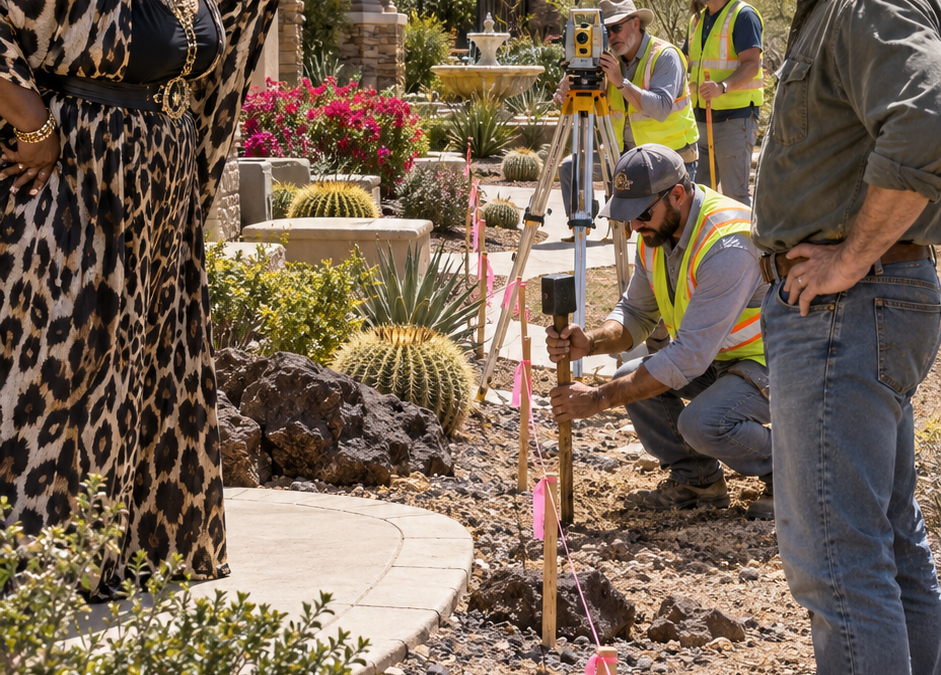
Government survey.
Recorded Desert Crown subdivision plat.
My deed.
Monument photographs.
Bearing table.
Distance calculations.
Recorder stamps.
Then the plotted retracement.
He spoke for about four minutes.
Flat voice.
No drama.
His preliminary measurement showed the recorded line passing through developed portions of Desert Crown.
Not inches.
Approximately thirty-eight feet of the western clubhouse section.
A significant part of the patio.
And more than thirty marked parking spaces.
Someone behind Sloan whispered:
“Oh my God.”
Sloan laughed.
It sounded like the laugh from our first meeting.
But thinner.
“That is impossible.”
Nolan said nothing.
“Our site plan was approved.”
Still nothing.
“The county inspected this building.”
Nolan nodded.
“Yes, ma’am.”
“You’re telling me a nine-thousand-square-foot clubhouse passed every inspection while sitting on land somebody else owned?”
“I am telling you where the recovered monuments and record description place the boundary.”
She turned toward me.
“Buying cheap desert does not mean you own our clubhouse.”
I had not said I did.
So I answered:
“I haven’t said that.”
That frustrated her more than if I had demanded the keys.
As long as Sloan could describe me as an opportunist trying to steal an amenity, she had a story.
If I refused to play the role, all that remained was the survey.
Nolan then did something important.
He told everyone the field result was preliminary.
A responsible surveyor would not declare ownership from one morning’s staking.
He needed four additional things.
Complete review of the subdivision plat.
Association deed.
Full chain of title for both parcels.
Search for easements, licenses, boundary agreements, or recorded occupation rights.
Any of those might change the legal picture.
I told him to do everything.
Nine days later, Nolan called.
No easement.
No license.
No boundary agreement.
No recorded adjustment.
No document giving Desert Crown the right to occupy any portion of my parcel.
The clubhouse had been standing only four years.
Not decades.
Not generations.
Four years.
Whatever other legal theories somebody might eventually raise, this was not a fifty-year-old occupation everyone had forgotten.
Rumors moved faster than Nolan’s final report.
Sloan sent an association-wide message.
An “outside landowner” had commissioned a disputed survey.
Community assets were being targeted.
Residents were warned not to engage with unauthorized persons.
My name appeared once.
The word disputed appeared four times.
There were not two surveys.
There was one survey and one president who disliked it.
I did not respond.
No flyers.
No neighborhood email.
No social post.
I hired Mara Ellison.
Real estate and title lawyer.
Fifteen years’ experience.
Mara spoke slowly.
Read quickly.
Then reread everything.
She called me three days after receiving the file.
“I found how it happened.”
That sentence mattered.
Not who.
How.
When Desert Crown built the clubhouse four years earlier, the project team had worked from a site plan.
That plan used the existing fence and an old maintenance track as visual references along the west side.
The fence looked permanent.
It looked old.
It looked like the boundary.
But decades earlier, a ranch operator had apparently placed it where cattle management made sense.
Not where the legal boundary ran.
Nobody commissioned a boundary survey before construction.
The developer built to the site plan.
County inspectors inspected the building.
Structural.
Electrical.
Mechanical.
Fire.
Code compliance.
Inspectors do not generally establish private property boundaries for owners.
Then the developer conveyed the clubhouse parcel to the HOA using the legal description already of record.
The description did not fully contain the improvement standing on it.
One omitted survey.
A few thousand dollars saved.
Potentially millions in consequences.
Mara gave me rules.
No barriers.
No chains.
No blocking the clubhouse.
No interfering with parking.
No direct contact with residents.
And absolutely no public statement that I owned the clubhouse.
“You own land,” she said. “Do not confuse that with owning improvements someone else built. Those are separate questions.”
“What do we do?”
“Establish the boundary. Then solve the encroachment.”
Eleven days later, Sloan found me outside a hardware store.
No smile.
No jokes.
She told me Desert Crown had significant legal reserves.
A city firm on retainer.
They could litigate longer than I could afford.
It sounded rehearsed.
Then she offered me $25,000.
One signature.
Boundary line adjustment.
Move the recorded line to the decorative fence.
I held a bag of bolts in one hand.
“If Nolan’s survey is wrong, why do you need my signature?”
Sloan looked at me.
Long enough.
Then walked to her SUV.
No answer.
That told me she understood more than she was saying.
Mara ordered an appraisal.
The affected ground could no longer be valued as raw desert.
It sat beneath a major clubhouse amenity supporting an entire subdivision.
The preliminary value came back many times Sloan’s offer.
Mara set down the report.
“This isn’t primarily about compensation anymore.”
“What is it about?”
“Who knew.”
She requested the developer’s construction project file.
Three weeks later, four boxes arrived.
Emails.
Field notes.
Meeting summaries.
Design correspondence.
Near the bottom of box three, Mara found a routine preconstruction message from a field engineer.
Four years old.
No accusation.
No certainty.
Just two sentences.
The existing fence line might not correspond to the recorded parcel boundary.
Boundary verification recommended before construction.
Recipients listed at the top.
One name:
Sloan Whitaker.
At that time, Sloan was not HOA president.
She served on the clubhouse oversight committee coordinating with the developer.
The engineer had not said the building would encroach.
He had simply raised the exact question that should have led to a survey.
Nobody ordered one.
The project was behind schedule.
Pool shell already underway.
Opening date tied to sales commitments.
Stopping to verify a boundary could have moved the building.
So they continued.
Four years later, blue tape appeared on the wall.
The Desert Crown board scheduled a closed session.
Mara and Nolan were invited.
Sloan stood at the head of the same conference table.
Before we had even sat down, she said:
“This board will not allow an outsider to dictate terms to this community.”
I looked around.
Twelve or thirteen board members.
Mostly retirees.
People who bought into Desert Crown expecting swimming, landscaping, and quiet.
Now they were being told part of their clubhouse might sit on someone else’s parcel.
“I didn’t come to dictate anything.”
Sloan folded her arms.
“I came because the room we’re sitting in may be standing partly on my land.”
Silence.
Three seconds.
That was enough.
Nolan presented.
Aerial image on the screen.
Recorded line in red.
It crossed straight through the western wing.
Across the patio.
Through parking.
Graham Keane—the man who had refused to laugh at me in the lobby weeks earlier—asked the right question.
“Could this be measurement error?”
Nolan shook his head.
“Not at this magnitude.”
He showed the recovery photographs.
Record calls.
Control closure.
Satellite observations.
Total-station checks.
Independent setups.
Bearings.
Distances.
His signed surveyor’s report.
“I will testify to these numbers under oath.”
Sloan brought out the site plan.
Large-format sheet.
She opened it across the table.
“This is what the clubhouse was built from.”
“Correct,” Nolan said.
“It was approved.”
“Possibly.”
“Permitted.”
“Yes.”
“So explain that.”
Nolan leaned over the plan.
Looked for about six seconds.
Then rotated the sheet.
Lower-right corner.
Small capital letters.
SITE PLAN ONLY — NOT A BOUNDARY SURVEY.
Nolan pointed.
“That note is there specifically because this drawing was never intended to establish property boundaries.”
Nobody spoke.
Sloan had brought the document she believed defeated Nolan.
Instead, it carried its own disclaimer.
Mara asked for the screen.
She displayed the old field engineer email.
Highlighted the two sentences.
Then enlarged the recipient list.
SLOAN WHITAKER.
Every board member looked toward her.
Dorothy, the finance chair, finally asked:
“Did you know there was a boundary concern before the clubhouse was built?”
Sloan did not answer immediately.
That was new.
Eventually she said it had been one technical note among hundreds.
She was not a licensed surveyor.
She relied on the developer.
That may have been true.
Mara did not accuse her of fraud.
She did something smarter.
She stayed with what we could prove.
The association was occupying ground its deed did not describe.
The title insurer was notified.
They hired an independent surveyor.
Different firm.
No access to Nolan’s field notes.
Fresh retracement.
Two weeks.
Their result matched Nolan within a fraction of a foot.
The boundary was no longer arguable.
When I returned to the clubhouse, the little chair near the door was gone.
A place had been set for me at the conference table.
Water bottle.
Notepad.
Graham shook my hand.
Nobody called me the man with the sand.
Sloan proposed purchasing the affected land.
Her new offer was higher.
Still below appraisal.
I opened my folder.
Put her original $25,000 proposal on the table.
Then the appraisal beside it.
I looked at her.
“You told me nobody would ever want this land.”
She said nothing.
I glanced around at the clubhouse.
Pool beyond the glass.
Patio.
Parking.
“It seems Desert Crown wants it quite a bit.”
Nobody laughed.
One board member smiled at the table.
Sloan sat down.
I could have turned ugly then.
I could have demanded absurd money.
Threatened barriers.
Threatened the pool.
Demanded the building come down.
I did none of it.
Two hundred households had paid assessments to build that clubhouse.
They had not misplaced the boundary.
They had trusted professionals.
So through Mara, I offered three solutions.
Desert Crown could buy the affected footprint at independently appraised value.
Or sign a long-term ground lease at market rate.
Or execute a permanent boundary adjustment with fair compensation.
All three would be recordable.
Clean.
Defensible.
The board started negotiating.
Then Mara found another problem.
The clubhouse service drive.
Landscaping crews used it.
Pool chemical deliveries.
Waste collection.
Maintenance.
It ran along the rear of the clubhouse.
For much of its length, it crossed my parcel.
No access easement.
None.
The association had not only built part of the clubhouse across the line.
It did not possess a legal vehicular easement for part of the route servicing the building.
That was the moment the board stopped protecting Sloan and started protecting Desert Crown.
They reviewed everything.
Her community-wide statements calling me opportunistic.
Her quiet purchase offer before the survey became public.
Her comments about my future planning applications.
The old engineer warning.
The unauthorized $25,000 proposal apparently made without full board authorization.
None of that automatically made her a criminal.
She had stolen no money.
Mara kept reminding everyone of that.
But leadership is often judged by choices long before those choices become crimes.
Sloan came to my property alone one afternoon.
Same place we first met.
Same white SUV.
She did not laugh.
“Are you enjoying this?”
“No.”
She did not believe me.
“I think you are.”
“You know what I think about?”
She waited.
“The first day.”
“What about it?”
“You told me I didn’t understand real estate.”
She looked toward the clubhouse.
“You’re profiting from an honest construction mistake.”
“Mistakes happen.”
I meant it.
“They happen every day.”
“Then you understand.”
“Yes.”
I looked at her.
“But the way you treated me after you knew there might be a mistake wasn’t an accident.”
She said nothing.
“That part was a decision.”
She got into her vehicle.
Drove away.
We never spoke privately again.
Two weeks later, the board held a special session.
Four motions.
Remove Sloan from direct participation in the boundary dispute.
Retain new independent counsel.
Open formal negotiations with me.
Review leadership conduct related to the original clubhouse oversight process.
All passed.
Sloan sat through every vote.
The association’s new counsel sent an offer.
Large number.
I rejected it.
Not because the money was insufficient.
The terms were.
Mara revised the agreement.
I would convey the necessary clubhouse footprint at independently appraised value.
Desert Crown would pay reasonable legal and surveying expenses.
New monuments would be installed.
A permanent service-drive easement would be recorded with defined maintenance responsibilities.
The association would record a covenant confirming that it claimed no authority over the acreage I retained.
And Desert Crown would issue a correction to every household that had received Sloan’s message accusing me of attempting to seize community property.
Not an apology.
I did not want one.
A factual correction.
The independent surveys established that the clubhouse improvements extended beyond the association’s recorded parcel.
The matter had been resolved through a voluntary conveyance.
That was enough.
The board approved.
Sloan resigned before the next election.
Her letter cited personal commitments.
No police.
No arrest.
No dramatic courtroom destruction.
She simply lost the position from which she had believed she could pressure me into surrendering land cheaply.
Nolan returned in October.
Permanent monuments.
Brass caps in concrete.
Properly tied to control.
Recorded.
One went into the ground about twenty feet from where Sloan had first laughed at the twenty-seven acres of dust and rattlesnakes.
I watched Nolan set it.
“Think anyone will mistake the fence again?” I asked.
“Eventually.”
I laughed.
“That’s optimistic.”
“Give people fifty years and they’ll believe anything that’s been standing long enough.”
The clubhouse remains open.
Pool still runs.
Fitness center is crowded most mornings.
Parking still fills during community events.
Nobody lost an amenity.
Desert Crown now holds clean title to the ground beneath the improvements for the first time since construction.
That certainty was worth more to them than what they paid me.
I kept most of my twenty-seven acres.
And I started doing exactly what I had planned all along.
Solar canopy.
Modest equipment building.
Low-water landscaping along the frontage.
Permitted.
Zoned.
Uninteresting.
Sloan had warned residents that someone “not fitting the character” might build an industrial-looking mess against their wall.
Instead, I built something quieter than half the projects Desert Crown itself approved.
The irony stayed with me.
If Sloan had driven past that first afternoon and waved, I might never have investigated the fence.
If she had not mocked the land, I might not have reread my deed that night.
If she had not tried to buy three acres cheaply, I might not have wondered why she wanted them.
If she had not threatened planning opposition, I might never have hired Nolan.
Her pressure created the very investigation that uncovered the mistake.
Nolan and I stood near the last new monument one evening after the work was finished.
The sun was dropping behind the desert.
Everything turned red for a few minutes.
The clubhouse sat on the rise east of us.
White walls.
Glass catching the last light.
Smaller from that distance than it had ever seemed in the conference room.
Nolan looked at the brass cap.
“Did you ever think we’d find something like that?”
“No.”
“Me either.”
I looked down at the monument.
Then toward the decorative fence.
Still standing.
Still pretty.
Still not the boundary.
“That’s why you measure.”
He smiled.
“That’s generally the idea.”
For years, everybody at Desert Crown had looked at the fence and assumed it represented reality.
The developer assumed.
The contractor assumed.
The residents assumed.
Sloan assumed.
Eventually, assumption hardened into certainty.
Then certainty turned into arrogance.
And arrogance caused somebody to challenge the assumption.
That was the part Sloan never understood.
The survey did not take anything from Desert Crown.
It revealed something that had already been true.
The line had been there before the clubhouse.
Before the pool.
Before the special assessment.
Before Sloan became president.
Before I bought the parcel.
The line did not move when Nolan found the monuments.
People’s understanding moved.
That is a very different thing.
Sloan believed value came from what people could see.
Stucco.
Glass.
Pool water.
Landscaping.
A clubhouse that photographed beautifully against a desert sunset.
She looked at my side and saw nothing.
Sand.
Rocks.
An old truck.
A man in dusty boots.
But the desert held something her clubhouse did not.
The original monuments.
And in the end, those small pieces of iron and concrete mattered more than every expensive assumption built around them.
I still drive past Desert Crown.
Sometimes I see residents leaving the clubhouse.
Sometimes I see landscapers on the service drive, now using an easement everybody can actually find in the record.
Nobody pays much attention to the new brass monuments.
That is the way it should be.
Boundary markers are not monuments to conflict.
They are supposed to prevent it.
What happened at Desert Crown was never really about me beating Sloan Whitaker.
I did not take her clubhouse.
I did not drain her pool.
I did not punish her neighbors.
I did not need to.
The ground did something much simpler.
It kept being exactly where it had always been.
And eventually, somebody measured it.








