𝗙𝗨𝗟𝗟 𝗦𝗧𝗢𝗥𝗬 The Lights Karen Buried Were Marking the One Place Her $5 Million Clubhouse Could Not Touch
𝗙𝗨𝗟𝗟 𝗦𝗧𝗢𝗥𝗬
Karen’s smile changed then.
It became still.
Not friendly. Not polite. Not even false.
Just still.
“We’ll see about that,” she said.
I looked at her carefully.
“Is that a threat?”
“No,” she said. “It is a reality.”
She turned and walked back to her SUV before I could answer.
I stood in the barn doorway watching her leave, feeling the old familiar pressure behind my ribs. It was the feeling I got whenever someone from Briarwood Ridge decided that a meeting, a map, or a title could push past a recorded boundary.
I walked down to the lights that evening.
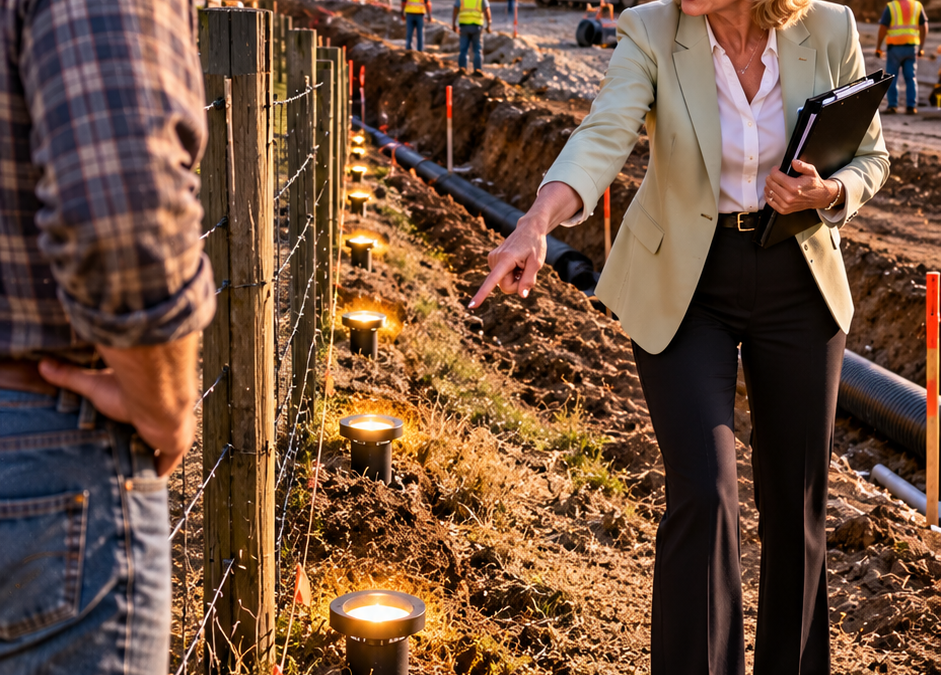
They came on one by one as the sun dropped, small amber circles glowing against the darkening soil. The line looked plain, even humble, compared to the construction lights blazing around the clubhouse site. Heavy equipment sat beyond the fence. Pallets of stone were stacked near the parking area. Rebar and forms marked where sidewalks would go. The shell of the clubhouse rose behind it all, expensive and unfinished.
I crouched beside the first light and brushed dirt from the metal rim.
My father had always said markers only help people who are willing to see them.
Karen had seen them.
She just did not respect what they meant.
Two days later, the construction crews arrived.
Not the regular crew working near the clubhouse foundation. This was a paving crew. They came early, before seven, while the morning was still gray and the air smelled wet. I heard engines before I saw trucks. When I walked outside, I found a line of equipment near the boundary—dump truck, roller, skid steer, and a small paving machine.
Karen stood near the front of the crew in a navy blazer and hard hat.
She looked almost pleased to see me.
“What are you doing?” I asked.
She glanced at the lights, then back at me.
“Completing approved site improvements.”
“On whose land?”
“On the approach area.”
“That’s not an answer.”
“It is the only answer I’m giving.”
A foreman stepped out of the nearest truck. He was a heavyset man with a sunburned neck and the expression of someone who had already been warned that the property owner might complain.
“Sir,” he said carefully, “we were told this work area was cleared.”
“It isn’t.”
Karen cut in.
“The HOA has authorization.”
I looked at her.
“From whom?”
“The board.”
“The board does not own my land.”
Her voice sharpened.
“This area has been incorporated into the clubhouse access plan.”
“By mistake.”
“That is your opinion.”
“No, Karen. That is my boundary.”
She gave the foreman a quick look.
“Begin.”
I stepped toward him.
“If you cover those lights, you’re damaging private markers.”
The foreman hesitated.
Karen said, “They have been deemed abandoned landscape fixtures.”
I almost laughed.
“Abandoned? They turn on every night.”
“They are obsolete.”
“To whom?”
“To the project.”
That was when I understood something important.
Karen had not come to negotiate.
She had come to create a fact on the ground.
If she could get the lights buried under fresh pavement, she thought the argument would be over. The ugly fixtures would disappear, the clubhouse entrance would look cleaner, and I would be left complaining about something no one could see.
I had learned long ago that when people are determined to do something foolish, you sometimes gain more by documenting than shouting.
So I pulled out my phone.
Karen noticed immediately.
“What are you doing?”
“Recording the work.”
“You do not have permission to record HOA contractors.”
“They are standing at my boundary.”
“This is harassment.”
“No. This is evidence.”
The foreman looked deeply uncomfortable now.
“Ma’am,” he said to Karen, “if there’s a property dispute, maybe we should pause.”
“There is no dispute,” Karen snapped. “Proceed.”
The crew began.
The skid steer moved first, scraping loose gravel and soil near the lights. I stood back at a safe distance, filming. The first bucket pass came close enough to one fixture that dirt jumped over its rim. The operator looked toward the foreman. The foreman looked toward Karen. Karen nodded.
The machine continued.
I took photographs from multiple angles.
The light line before burial.
The equipment position.
Karen standing beside the work area.
The trucks.
The crew.
The property marker near the oak stump.
The construction stakes.
The first load of asphalt arrived hot and steaming.
That smell filled the air—oil, heat, and fresh pavement. It took me back to road crews in summer, to city streets, to places where land gets covered and people assume what lies beneath has stopped mattering.
The first layer went down.
Three lights disappeared.
Not broken. Not removed.
Buried.
I photographed the dark asphalt sealing over them.
Karen watched me with a faint smile.
“You’re wasting your time,” she said.
“No,” I answered. “You’re wasting money.”
She did not understand.
The second layer came an hour later.
By then the full row was gone.
Every amber marker that had glowed along that boundary for years was now sealed beneath black pavement.
The roller passed over the surface again and again, flattening everything into a smooth strip that tied visually into the clubhouse approach. From Karen’s point of view, it probably looked beautiful.
Clean.
Expensive.
Controlled.
She walked to the edge of the new pavement after the crew finished and looked down at the place where the lights had been.
Then she turned to me.
“Problem solved.”
I put my phone back in my pocket.
“For you,” I said. “Maybe for about a day.”
Her eyes narrowed.
“What is that supposed to mean?”
“It means you should have asked why the lights were there.”
“They were there because you wanted to annoy the neighborhood.”
“No, Karen. They were there because something underneath that pavement matters.”
For the first time all morning, her confidence flickered.
Only briefly.
Then she recovered.
“If you had legitimate infrastructure concerns, you should have disclosed them.”
“They were disclosed in the recorded survey.”
“The HOA’s engineers reviewed the site.”
“Then they missed something.”
She stared at me.
I could see her deciding whether to ask.
Pride stopped her.
She lifted her clipboard and walked away.
I spent the rest of the day gathering records.
The survey was in my office, stored in the same fireproof file box where I kept every document that mattered. I laid it across the kitchen table and weighted the corners with coffee mugs. The paper was old but clean, copied from the recorded original. The boundary line ran along the edge near the clubhouse site, and beside it was the notation Karen had just made important.
Protected Underground Access Corridor
No permanent obstruction without recorded release
Surface markers installed along western boundary
There it was.
Plain.
Dry.
Boring.
Devastating.
The corridor had been established decades earlier, long before Briarwood Ridge existed, for access to buried infrastructure crossing part of the land. It was not something people used every day. In fact, years could pass without anyone needing to open it. That was why the visible markers mattered. They kept people from forgetting.
The corridor did not belong to the HOA.
The HOA had no right to obstruct it.
And if their clubhouse plans crossed it, then their project had a serious problem.
I pulled the file on the corridor.
There was an old access agreement, a county notation, survey references, and correspondence from years earlier when a utility inspection crew had verified the route. The lights were not decorative fixtures. They were surface markers tied to a recorded protection zone.
Karen had just paved over all of them.
I called an independent surveyor that afternoon.
His name was Gerald Fitch.
Gerald had worked boundary and easement disputes for more than thirty years, and he had the kind of voice that sounded unimpressed by everything because he had already seen worse. He had surveyed my land once before after Briarwood Ridge tried to claim a drainage swale as “community adjacent.” He was careful, blunt, and expensive.
Exactly what I needed.
He came out the next morning.
Gerald stepped from his truck wearing a faded canvas jacket, work boots, and a hat that had probably survived more weather than some houses. He carried a GPS receiver, a tripod, field notes, and the expression of a man who considered enthusiasm suspicious.
He looked at the fresh pavement.
“That new?”
“Yesterday.”
“Over the marker lights?”
“Yes.”
He grunted.
That was Gerald’s first professional opinion.
I handed him the survey and corridor documents.
He read them on the hood of his truck. Slowly. No wasted movement. No commentary until he reached the access corridor notation. Then he looked toward the clubhouse.
“They built close.”
“Too close?”
“We’ll see.”
For the next several hours, Gerald worked.
He located existing property monuments. He verified the boundary. He shot measurements along the old light line. He marked the underground corridor alignment with paint and flags. He compared the recorded survey to the HOA’s visible construction limits. Then he asked for any clubhouse site plans I had.
I had obtained a copy from the county permit file months earlier, because I did not trust the HOA to build quietly beside my property without overstepping. I had not expected the lights to become the issue, but caution has a way of paying for itself.
Gerald spread the clubhouse plan over a folding table.
He placed my survey beside it.
Then he took out a scale and began comparing.
I watched his face.
Gerald did not dramatize. That was not his way.
But when he stopped moving, I knew he had found it.
He looked from the plan to the pavement, then back to the survey.
“They built over the corridor.”
I felt a cold satisfaction settle in my chest.
Not joy.
Satisfaction.
There is a difference.
Joy would have meant I wanted this. I did not. I had warned Karen. The lights could have stayed where they were. The project could have been checked properly. The HOA could have avoided all of it by respecting the markers they hated so much.
Satisfaction meant the truth was exactly where I thought it was.
Gerald tapped the plan.
“The clubhouse structure may be clear by a narrow margin, depending on final as-built measurements. But this paved approach and part of the parking apron cross directly over the protected corridor. Landscaping too. Maybe electrical conduit for their lighting, if they installed it where the plan says.”
“What happens now?”
“That depends on the corridor terms and the inspector.”
“Can they leave it?”
Gerald looked at me like I had asked whether rain fell upward.
“Not if the access agreement says no permanent obstruction.”
“It does.”
“Then no.”
By late afternoon, Gerald had enough for a preliminary report.
I sent it to the county building department, the utility access office, my attorney, and the HOA’s management company. I included photographs of the lights before burial, the paving crew, Karen overseeing the work, the asphalt covering each fixture, and Gerald’s flagged alignment showing the corridor beneath the new construction.
Then I waited.
Not long.
The county inspector arrived the next morning.
His name was Daniel Brooks, and he did not look happy before he even got out of the truck. Inspectors do not like surprises on active projects, especially expensive ones with public filings, access agreements, and potential obstructions. He met Gerald near the pavement while I stood by with my documents.
Karen arrived ten minutes later in a white SUV, moving fast.
She had clearly been called.
Behind her came two board members, a project manager, and a man in a suit I assumed was the HOA attorney.
Karen walked straight toward Daniel.
“What is happening?”
Daniel did not match her urgency.
“We’re reviewing a reported obstruction of a recorded underground access corridor.”
Karen glanced at me.
“This is retaliation.”
I said nothing.
Daniel looked at her.
“Retaliation for what?”
“For the HOA correcting an eyesore.”
Daniel’s eyebrows lifted slightly.
Gerald, standing beside him, gave no expression at all.
Daniel said, “The issue is whether the recently paved area obstructs a protected corridor.”
Karen shook her head.
“That area is part of the approved clubhouse plan.”
“Approved plans still have to comply with recorded property restrictions.”
“Our engineers handled that.”
“Then they should be able to show their corridor clearance.”
Karen turned to the project manager.
He looked suddenly busy searching through a roll of plans.
The attorney stepped forward.
“Inspector, before any conclusion is reached, the association would like to understand the specific allegation.”
Daniel pointed toward the pavement.
“The allegation is that your paving crew covered visible surface markers and installed permanent pavement over a recorded underground access corridor.”
The attorney looked at Karen.
Karen looked away.
That was when I knew she had not told him about the lights.
Not fully.
Maybe she had described them as landscaping. Maybe she had said they were old fixtures. Maybe she had claimed they were outside the project area. But she had not told him she ordered crews to bury markers after being warned they marked something beneath the site.
The project manager finally unrolled the clubhouse plan on the hood of his truck.
Daniel reviewed it.
Gerald placed my survey beside it.
The conversation went quiet.
That kind of quiet has a specific sound.
Paper shifting. Breath held. Shoes scraping gravel. Someone realizing the line they trusted is not where it should be.
Daniel asked the project manager, “Did your team review the recorded corridor?”
The project manager said, “We reviewed the HOA-provided site documents.”
“That wasn’t my question.”
“I don’t recall this corridor being identified in the plan set.”
Gerald tapped my survey.
“It was recorded.”
The attorney asked, “Is there evidence that the lights were legally tied to the corridor?”
I handed Daniel the old survey note and the access documentation.
Daniel read it, then handed it to the attorney.
The attorney’s face changed.
It was subtle, but I saw it.
Lawyers spend their lives controlling facial expressions. The good ones do not react much in public. But when a document lands badly enough, something shifts around the eyes.
Karen noticed too.
“What?” she asked.
The attorney did not answer immediately.
Daniel said, “At this point, work in the affected area is suspended pending verification.”
Karen’s head snapped toward him.
“Suspended?”
“In the affected area.”
“You cannot shut down a five-million-dollar project over a few buried lights.”
“This is not about the lights.”
“It absolutely is.”
“No,” Daniel said. “It is about what the lights marked.”
Karen turned toward me.
“You set this up.”
That almost made me laugh.
“You buried them.”
“You knew this would happen.”
“I knew what they were. You didn’t care.”
“You could have warned us.”
“I did. I told you they marked my boundary and that something underneath mattered.”
“You were vague on purpose.”
I took one step closer, keeping my voice calm.
“Karen, you brought paving crews onto disputed ground two days after I told you those lights were not going anywhere. You buried them while I photographed the whole thing. You didn’t ask for the survey. You didn’t ask why they were aligned. You didn’t check the recorded corridor. You wanted them gone because they looked ugly next to your clubhouse.”
Her mouth opened.
Nothing came out.
Daniel turned to the project manager.
“We need the pavement opened enough to verify the markers and corridor location.”
The project manager looked like he had swallowed gravel.
“That means excavation.”
“Yes.”
Karen said, “Absolutely not.”
Daniel looked at her.
“The alternative is maintaining the stop-work area until documentation resolves it. Given the records presented, physical verification is the fastest path.”
The attorney leaned toward Karen and spoke quietly.
She looked furious.
But she stopped objecting.
That afternoon, the excavators arrived.
Not the same paving crew.
A different crew, hired under county observation, with a small excavator, saw-cut equipment, and utility-location gear. The clubhouse site transformed instantly from luxury development to damage control. Orange cones went up. Caution tape stretched across the new pavement. Workers marked cut lines in bright paint.
Residents gathered along the construction fence.
Word had spread quickly.
Nothing travels through an HOA faster than expensive trouble.
Karen stood near the edge of the site with her arms crossed, jaw locked, while the first saw cut into the fresh pavement. The sound was harsh and ugly. Dust rose in a pale cloud. The asphalt she had admired two days earlier was being sliced open in front of her board, her attorney, her contractors, and half the neighborhood.
I stood beside Gerald.
He watched like a man attending a routine appointment.
The first section of pavement came up in chunks.
Under it, compacted base.
Then darker soil.
Then the first light.
Its metal rim was scraped but intact, still seated exactly where it had been before the asphalt buried it.
One of the workers cleared around it with a hand tool.
Daniel crouched and photographed it.
Gerald checked the location against his marks.
“Matches,” he said.
Karen looked pale.
The second bucket exposed another light.
Then another.
Every one of them lay along the corridor line shown on my survey.
No guessing.
No exaggeration.
No misunderstanding.
The ugly lights had been exactly where the records said they would be.
As the excavation widened, the crew exposed the access corridor indicators beneath the surface—old protective fill, warning tape, and the edge of the access zone that had been documented long before Briarwood Ridge existed. It was not some imaginary technicality. It was physically there, buried beneath the brand-new pavement Karen had ordered over it.
The project manager muttered something I could not hear.
The attorney heard enough. He closed his folder slowly.
Karen walked toward Daniel.
“Can this be resolved without tearing up the entire approach?”
Daniel looked toward Gerald, then at the exposed corridor.
“That depends on the extent of obstruction and the access requirements. But this area cannot remain covered as built.”
“The clubhouse opening is scheduled in six weeks.”
Daniel did not react.
“Then you should speak with your engineer.”
Karen turned to me.
“This is going to cost the HOA hundreds of thousands of dollars.”
I looked at the torn pavement.
“You should have asked why the lights were there.”
She stepped closer, lowering her voice.
“You wanted this.”
“No. I wanted my lights left alone.”
“You knew it would damage the project.”
“Your project crossed the corridor before I said a word.”
“That is not fair.”
That word landed badly.
Fair.
I thought of her standing beside the paving crew, smiling as my lights disappeared. I thought of her saying problem solved like my boundary had been an inconvenience she had successfully buried. I thought of years of HOA letters treating my land like a flaw in their plans.
“Fair?” I said. “You paved over property markers you didn’t understand because they embarrassed your clubhouse.”
Her face tightened.
“You are being vindictive.”
“No, Karen. Vindictive would have been letting you finish the entire project before saying anything.”
She looked away first.
The excavation continued into evening.
By the time the crew stopped, the beautiful new approach looked like a wound. Asphalt torn open. Base material piled beside the cut. Landscape edging removed. Fresh sod peeled back. Decorative stone stacked awkwardly near the fence. The clubhouse still stood in the background, expensive and silent, but now the whole site looked uncertain.
That is what buried truth does when it comes back up.
It makes everything around it unstable.
The next week was a storm of meetings.
The HOA finally sat down with me, though sat down makes it sound calmer than it was. We met in a conference room at the county building because my attorney insisted on neutral ground. The HOA brought two attorneys, the project engineer, the construction manager, Karen, Paul from the board, and a stack of binders thick enough to hold a small trial.
I brought my attorney, Gerald’s report, the original survey, the access corridor documents, county records, and every photograph I had taken.
The first hour was exactly what I expected.
The HOA tried to make the issue sound like confusion.
A mapping discrepancy.
A coordination failure.
A visual-marker misunderstanding.
My attorney, Ellen Price, let them talk until they ran out of soft words.
Then she placed my photographs on the table.
One by one.
The lights visible before paving.
Karen present at the site.
The crew beginning work.
The first layer burying three lights.
The second layer covering the rest.
Karen standing over the finished pavement.
The excavation exposing the same lights exactly on the corridor line.
Ellen was not loud.
She did not need to be.
“Your client had notice that these fixtures were on Mr. Ward’s property and served a boundary purpose,” she said. “Your client proceeded to bury them. The recorded documents show the underground access corridor. The county has confirmed obstruction. We are not discussing aesthetics. We are discussing interference with protected property rights and recorded access conditions.”
The HOA attorney looked at Karen.
Karen looked at the table.
The engineer tried to explain that the corridor had not appeared on the plan set they received from the HOA.
That made the construction manager angry.
The construction manager said his team built according to the provided plans.
The project engineer said the HOA had supplied boundary assumptions.
The HOA attorney said no one was assigning blame yet.
Ellen said, “You should.”
The room went quiet.
I liked Ellen.
She did not waste words either.
The cost estimates came next.
Removing the pavement. Restoring the access corridor. Relocating the parking approach. Revising the landscaping. Redesigning the electrical runs for the clubhouse entry lighting. Delaying the clubhouse opening. Reinspecting the site. Legal review. Survey costs. Repairing my lights and markers. Reimbursing my professional fees.
The numbers climbed fast.
Far beyond the cost of leaving my ugly lights alone.
Karen kept insisting the clubhouse itself was not on my land.
Gerald calmly confirmed that the main structure appeared clear, but the access improvements and parking apron had obstructed the corridor.
That distinction mattered legally.
It did not save them financially.
They did not have to demolish the clubhouse.
But they did have to rip open the part of the project Karen had been most eager to beautify.
That was enough.
At one point, Karen leaned forward and said, “Mr. Ward has been hostile to this community from the beginning.”
I finally spoke.
“No, Karen. I have been hostile to your assumption that my property exists for your convenience.”
Her eyes flashed.
“The community has invested millions into improving this area.”
“And you invested part of it in the wrong place.”
Paul, sitting beside her, closed his eyes briefly.
That told me the board knew.
Whatever loyalty Karen still expected, it was thinning.
The final agreement took two weeks.
The HOA had to restore the access corridor according to county requirements. They had to remove all pavement and improvements obstructing the protected area. They had to relocate the affected portion of the clubhouse approach onto land they actually controlled. They had to reinstall and protect the surface markers, including my ground lights, at their expense. They had to reimburse my surveyor, attorney, and inspection-related costs. They had to sign an acknowledgment that the corridor existed, was protected, and could not be obstructed without proper recorded release.
They fought the wording.
Ellen fought harder.
The final version was exact.
That mattered.
Because vague language is where future trouble hides.
The restoration work began the following Monday.
Residents came to watch again.
By then, the story had spread through Briarwood Ridge in several versions. Some said I had discovered a secret utility line. Some said the HOA had built on my land. Some said Karen had ignored a warning. Some said the clubhouse opening was being delayed because of “technical issues.”
The truth was simpler.
The HOA had paved over markers it did not own because it thought ugly meant unimportant.
Now they were paying to undo it.
For days, machinery tore into their finished work.
The parking apron was cut back. The decorative approach was removed. Fresh sod came up in rolls. Irrigation lines had to be capped and moved. Newly planted shrubs were dug out and stacked in the shade, their roots wrapped in burlap like patients waiting for surgery.
The underground access corridor was cleared and verified.
Gerald inspected the alignment. Daniel signed off on the exposed section before restoration. The engineers revised the plans. The county required new as-built drawings. Every step took time. Every delay cost money.
Karen tried to blame me publicly.
I heard about it from a resident named Marcy Ellis, who stopped me near the feed store.
“Karen says you’re holding the clubhouse hostage,” she said.
I laughed once.
“Does she also mention who buried the lights?”
Marcy smiled slightly.
“She leaves that part out.”
“Most people leave out the part that explains everything.”
Marcy looked embarrassed.
“I used to think those lights were ugly too.”
“They are ugly.”
She blinked.
I shrugged.
“They’re not there to be pretty.”
She nodded slowly.
“I guess that’s the point.”
It was.
The most important things on land are not always beautiful.
Survey pins are not beautiful. Culverts are not beautiful. Access covers, drainage ditches, warning markers, fence lines, utility flags—none of them are installed to please people walking by with opinions. They exist because the land has rules beneath the surface, and ignoring those rules can be expensive.
Karen had to learn that in public.
The HOA board held a special meeting halfway through the restoration.
I did not attend, but the meeting minutes later became part of the record. Residents demanded explanations for the delay and cost. The board admitted that the clubhouse approach had been constructed over a recorded access corridor. They stated that corrective work was underway. They promised revised oversight procedures.
Then someone asked who authorized covering the ground lights.
The minutes summarized the answer as “site appearance concerns were raised by the board president.”
That was committee language.
But everyone knew what it meant.
Karen had pushed it.
Karen had won the small fight.
Karen had created the big one.
By the end of that month, her position was weakening. She still attended site meetings, but she spoke less. Contractors stopped looking to her first. The project manager began directing technical questions to the engineer. The attorney answered boundary issues. The county inspector handled compliance. Karen stood nearby, often silent, arms folded tightly against herself.
Authority drains quickly when everyone realizes it was never backed by knowledge.
One afternoon, as crews prepared to reinstall the lights, Karen approached me alone.
I was standing near the boundary with Gerald, reviewing the final marker placements. Gerald walked away to check a measurement when he saw Karen coming. He was tactful that way, though I suspected he stayed within earshot.
Karen stopped a few feet from me.
“The board wants this finished,” she said.
“So do I.”
“You’ve made your point.”
“My point was made before the pavement went down.”
Her face tightened.
“I’m trying to have a civil conversation.”
“Then start with a civil sentence.”
She looked toward the torn-up approach.
“This has been very damaging.”
“Yes.”
“To the community.”
“To the community’s budget,” I said. “To my property rights. To the project schedule. To the contractor’s trust in your site documents. To the county’s confidence in your filings. It has been damaging in several directions.”
Her mouth pressed into a line.
“You act like I did this alone.”
“You stood there when they paved over the lights.”
“The board approved the visual plan.”
“The board didn’t stand in front of me and say, ‘Problem solved.’ You did.”
That landed.
I could see it.
She looked away toward the clubhouse.
For a moment, I thought she might apologize.
Instead, she said, “They were ugly.”
I stared at her.
Then I laughed. I could not help it.
Even after everything—the stop-work order, the excavation, the attorney letters, the cost overruns, the public embarrassment—some part of Karen still wanted the original complaint to be valid.
They were ugly.
As if ugliness had jurisdiction.
“As soon as they’re reinstalled,” I said, “they’ll still be ugly.”
Her eyes came back to mine.
“And you’re proud of that?”
“No,” I said. “I’m proud that they do their job.”
She had no answer.
The lights went back in two days later.
Not exactly the same fixtures. The HOA had to pay for upgraded ones because several had been damaged during burial and excavation. I chose a model close to the old appearance—low, round, amber, simple. Nothing decorative. Nothing matching Briarwood Ridge’s luxury lighting plan.
Karen objected to the fixture style through her attorney.
Ellen responded with one sentence.
The replacement markers will be functionally equivalent to the markers your client unlawfully buried.
The objection disappeared.
Installation took most of the day.
The electrician reset the wiring. Gerald verified placement. Daniel inspected the corridor clearance. The ground around the lights was compacted and restored. The access corridor remained open and properly marked. No pavement crossed it. No landscaping blocked it. No decorative stone covered it.
The clubhouse approach had to curve awkwardly around the protected zone.
That curve became my favorite part of the entire project.
It was subtle, but anyone paying attention could see it. The expensive drive bent where Karen had wanted it straight. The landscaping shifted where she had wanted symmetry. The path adjusted because the land had told the plan no.
That evening, the lights came on.
One by one.
Amber circles glowing low against the ground, exactly where they belonged.
I stood on my porch and watched them.
They looked the same as before.
Plain.
Stubborn.
Necessary.
Across the boundary, a few residents had gathered near the construction fence. Nobody laughed at the lights that night. Nobody called them cheap. Nobody joked about motel runways or ugly fixtures. They just stood there looking at the small glowing line that had stopped a five-million-dollar project from pretending the underground corridor did not exist.
The clubhouse eventually opened.
Late.
Over budget.
With a redesigned entrance.
The HOA newsletter described the delay as the result of “site coordination revisions required during final access compliance review.”
That phrase was so polished it almost squeaked.
It did not mention Karen.
It did not mention the buried lights.
It did not mention the excavation.
It did not mention that the beautiful approach had been torn open because the HOA president thought an eyesore could be paved into silence.
But everyone knew.
The residents knew.
The contractors knew.
The board knew.
And Karen knew.
She resigned two months after the clubhouse opened.
The official announcement said she wanted to spend more time with family and pursue personal projects. I had heard that phrase enough times to know it meant the board had found a polite door and pointed toward it.
Paul, who replaced her temporarily, came by one afternoon with a folder.
Unlike Karen, he called first.
That already made him easier to tolerate.
He stood at my gate, not crossing onto my land until I invited him.
“I wanted to give you the updated site exhibit,” he said.
He handed me a copy.
The new map showed the clubhouse, parking area, landscaping, HOA boundary, and the protected underground access corridor. My ground lights were marked as visible corridor markers. The document included a note stating that no HOA construction, paving, landscaping, fencing, lighting, or underground work could obstruct the corridor or alter the markers without written authorization and recorded approval.
I read it twice.
“This should have existed before construction.”
Paul nodded.
“Yes.”
“That would have saved everyone money.”
“Yes.”
“And trouble.”
“Yes.”
I looked at him.
“You’re getting good at that word.”
He smiled faintly.
“We’ve had practice lately.”
I folded the exhibit.
“Does Karen agree with this?”
“She’s no longer involved.”
“That wasn’t my question.”
Paul sighed.
“No. I doubt she agrees. But the board does.”
That was enough.
For now.
After he left, I filed the updated exhibit with the rest of the documents. The folder had grown thick. Deed, survey, corridor agreement, photographs, Gerald’s report, county inspection notes, attorney letters, restoration agreement, replacement-light invoices, revised HOA site exhibit.
A full record of a fight that should never have happened.
That is the thing people rarely understand about property disputes. The visible conflict is only part of it. The real cost is the record you have to build afterward, the time you lose, the trust that disappears, the way you start looking at every truck near your boundary and wondering what someone has decided without asking.
Karen did not just bury lights.
She buried goodwill.
And like the lights, it took excavation to find what still remained underneath.
Over the next year, the clubhouse became exactly what Briarwood Ridge had wanted it to be. Residents held board meetings there, birthday parties, fitness classes, wine tastings, holiday events, and whatever else HOAs do when they build a room expensive enough to justify using it constantly.
From the road, it looked impressive.
Stone columns. Warm windows. Clean sidewalks. Curved approach. Perfect shrubs. Soft lighting.
And near the western edge, beyond the polished landscaping, my ground lights glowed every night.
Still low.
Still plain.
Still ugly, if that was the word people wanted.
But nobody crossed them.
Not one contractor. Not one landscaper. Not one resident with a golf cart. Not one board member carrying a clipboard.
The lights had become part of the neighborhood’s memory.
Not officially.
Officially, they were visible corridor markers.
Unofficially, they were the line Karen paved over and paid to uncover.
Sometimes children still asked about them.
One evening, while I was closing the barn, a boy from Briarwood Ridge stopped near the fence with his father. He pointed at the glowing markers.
“Dad, are those the expensive lights?”
His father looked embarrassed.
I almost laughed.
The expensive lights.
That was one way to describe them.
The fixtures themselves were not expensive.
Ignoring them had been.
His father said, “Those are Mr. Ward’s boundary markers.”
The boy asked, “Why are they so small?”
I walked closer to the fence.
“Because small things can still matter.”
The boy thought about that, then nodded with the seriousness only children can give to a sentence they do not fully understand yet.
His father gave me an apologetic wave and guided him back toward the sidewalk.
I watched them go, then looked down the line of amber light.
Small things can still matter.
A survey note in the corner of a page.
A recorded corridor nobody wants to read.
A row of fixtures people call ugly.
A photograph taken before asphalt hides the truth.
A question nobody asks because they think they already own the answer.
That was how the whole mess began.
Karen had believed importance had to look important. The clubhouse looked important. The board looked important. The renderings looked important. The project budget looked important. Her clipboard looked important.
My ground lights did not.
So she dismissed them.
That was her mistake.
Land does not care what looks important.
Records do not care what looks expensive.
A protected corridor remains protected whether it is marked by a brass plaque or a cheap amber ground light.
The final conversation I ever had with Karen happened almost a year after the paving incident.
I saw her outside the clubhouse after a community event. I had been driving past with feed in the truck bed, and traffic slowed near the entrance because residents were leaving all at once. She stood near the curb in a gray coat, no clipboard, no board badge, no cluster of people waiting for her instructions.
For a moment, we looked at each other.
She walked toward the truck.
I lowered the window halfway.
“Mr. Ward,” she said.
“Karen.”
Her eyes flicked toward the boundary lights.
“They’re still there.”
“They are.”
The corner of her mouth moved, not quite a smile.
“I suppose they always will be.”
“As long as the corridor needs marking.”
She looked at me.
“I made a mistake.”
I did not answer immediately.
Those four words had taken a year to travel from truth to her mouth.
When they arrived, they sounded tired.
Not rehearsed. Not dramatic. Not enough to fix what she had done. But real enough that I did not dismiss them.
“Yes,” I said. “You did.”
She nodded once.
“I thought they were just lights.”
“No,” I said. “You thought they were just mine.”
Her face tightened slightly.
Not from anger this time.
From recognition.
She looked away toward the clubhouse, bright and full of people, then back at the line of amber markers.
“Good evening,” she said.
“Good evening.”
She stepped back.
Traffic moved, and I drove on.
That was as close to an apology as Karen ever gave me.
I accepted it for what it was and nothing more.
The lights came on again that night, exactly at dusk.
I saw them from my kitchen window while washing a coffee mug. One, then the next, then the next, each small glow appearing in the grass like a quiet statement.
The clubhouse lights came on too—tall decorative posts, warm architectural fixtures, uplighting against stone, everything designed to look refined and expensive.
For once, I did not resent the contrast.
Let their lights be beautiful.
Mine were not there for beauty.
Mine were there to remember.
They remembered my father installing the first markers when this land was still quiet. They remembered surveyors walking the corridor with stakes and measuring rods. They remembered county crews warning that buried access must stay clear. They remembered every person who had almost crossed that line and stopped because a low amber glow told them not to.
And now they remembered Karen.
Her clipboard.
Her smile.
The asphalt.
The excavation.
The expression on her face when the first buried light came back into daylight.
People think warnings are supposed to be dramatic. Red signs. Locked gates. Heavy chains. Bold letters.
Sometimes a warning is quiet.
Sometimes it sits low to the ground for years, doing its job without praise, while people insult it because they do not understand what it protects.
That was the truth Karen learned too late.
The ground lights were not there to decorate my property.
They were not there to offend her clubhouse.
They were not there because I wanted to annoy the neighborhood.
They marked the place where Briarwood Ridge’s authority ended and something older, deeper, and legally protected began.
Karen thought she could pave over an eyesore.
Instead, she buried the warning that could have saved her project from delay, embarrassment, and a bill the HOA would not forget.
And when the excavators returned, the truth came up exactly where the lights had been all along.
𝗧𝗛𝗘 𝗘𝗡𝗗
The Lights Karen Buried Were Marking the One Place Her $5 Million Clubhouse Could Not Touch
Karen thought the little ground lights along my property line were nothing more than cheap plastic eyesores.
I knew they were the only warning still visible above something the HOA had no right to cover.
By the time the excavators returned, they were not digging up my lights—they were digging up her mistake.
Everyone in Briarwood Ridge called them ugly ground lights.
I had heard the jokes for years.
They were too low. Too plain. Too bright at night. Too cheap-looking beside the neighborhood’s polished stone walls, decorative lanterns, and imported landscaping. People walking their dogs would glance down at them like they were stepping around trash. Kids on bikes called them runway lights. One man from the HOA once told me they made the entrance look like the edge of a discount motel.
I never cared.
Those lights were not there to impress anyone.
They were there so people did not drive onto my property in the dark.
My land sat along the western edge of Briarwood Ridge, where the subdivision ended and my private acreage began. Before the HOA existed, that stretch had been rough country—old service tracks, oak scrub, a drainage line, and a narrow access corridor that crossed part of my property beneath the surface. Most people never noticed the corridor because there was almost nothing visible above it.
Except the lights.
Small, round, weatherproof ground lights set low in the soil, spaced in a straight line that looked strange if you did not know what it marked. They were not decorative. They were not ornamental. They were not part of any landscaping scheme.
They were markers.
My father installed the first version decades ago after a utility crew nearly drove equipment across the corridor without checking the survey. Later, after I inherited the land, I replaced them with sturdier fixtures and wired them to come on at dusk. They cast a low amber glow across the edge of the property, enough to show where the private boundary began and where vehicles should not go.
Those lights saved me trouble more than once.
A drunk driver avoided my fence because of them. A delivery van stopped short of the corridor during a storm because the driver saw the line of light through heavy rain. Even county workers had used them as visual reference points when inspecting buried access infrastructure beneath that part of the land.
To Briarwood Ridge, they were ugly.
To me, they were protection.
That difference became the beginning of a disaster the HOA built with its own money.
Briarwood Ridge had been expanding for years. Every time I thought the neighborhood had finished swallowing old farmland, another parcel disappeared under survey flags, earthmovers, and signs promising luxury living. Their newest dream was a clubhouse—five million dollars of glass, stone, cedar beams, fitness rooms, event space, a commercial kitchen, and a landscaped parking area that was supposed to make the HOA look like a private resort.
The project sat near my western boundary.
Too near, in my opinion.
From the first time I saw the construction stakes, I had a bad feeling. The clubhouse itself appeared to be on HOA land, but the parking expansion and decorative approach were close to the old underground access corridor. I had seen their early plans from a distance and noticed how confidently their engineers had drawn clean lines across complicated ground.
Clean lines make people careless.
Land is rarely clean.
It carries history under the surface—old access rights, utility paths, drainage agreements, buried pipes, abandoned easements, forgotten maintenance corridors. Developers love to pretend those things can be simplified into a colored map. But paper that ignores history does not erase history.
It only delays the consequences.
Karen Whitmore was the HOA president at the time.
She loved the clubhouse project as if she had designed it herself. Maybe she had. She walked the site almost every morning in a blazer and boots, pointing at dirt, speaking to contractors, and standing beside renderings that showed perfect trees, perfect stonework, perfect lighting, and perfect people drinking coffee on a perfect terrace.
She wanted everything polished.
My ground lights offended her.
I knew it before she said anything.
For weeks, I saw her looking at them. She would stop near the edge of the construction site, stare across the boundary, and make notes on her clipboard. Sometimes she brought board members with her. They would talk quietly, then look toward my lights with the same expression people use when discussing something unpleasant but removable.
I had been through enough HOA fights to recognize the pattern.
First they noticed.
Then they complained.
Then they pretended their complaint was policy.
Karen came to my door on a Wednesday morning.
I was in the barn sharpening a mower blade when I heard tires on the gravel. When I stepped out, she was already walking toward me with a clipboard tucked under one arm and sunglasses perched on her head like she had arrived at a site inspection.
She wore a white blouse, dark slacks, and a pale green jacket that looked completely unsuited for dust.
“Mr. Ward,” she called.
I wiped my hands on a rag.
“Karen.”
She looked past me toward the property line.
“We need to discuss those lights.”
I did not have to ask which lights.
Still, I did.
“What lights?”
Her mouth tightened. “The ground lights along the western approach.”
“My boundary lights.”
“That is not how the board refers to them.”
“I’m not on your board.”
“They are visible from the clubhouse entrance.”
“That was not an accident.”
“They are unattractive.”
“They are useful.”
“They ruin the luxury appearance of the neighborhood.”
I folded the rag slowly.
That phrase told me the whole conversation.
Luxury appearance.
Not safety. Not legal access. Not property records. Not boundary clarity.
Appearance.
Karen stepped closer.
“The clubhouse is a major investment. We cannot have cheap ground fixtures creating visual clutter next to a five-million-dollar community asset.”
“They’re on my land.”
“They affect our property values.”
“They mark my property line.”
“They look temporary.”
“They are permanent enough.”
She clicked her pen against the clipboard.
“Mr. Ward, I’m sure we can find a reasonable solution.”
“Good. Leave them alone.”
Her smile thinned.
“That is not a solution.”
“It is for me.”
“You do understand that your property borders a premium residential community.”
“I understood that when your premium residential community started building next to land it didn’t own.”
Her eyes hardened.
“These lights are completely unnecessary.”
“No, they are not.”
“They are cheap.”
“They work.”
“They are ugly.”
“They keep people from driving where they shouldn’t.”
She gave a small laugh, as if I had made a childish excuse.
“Nobody is driving onto your property.”
“People have tried.”
“That was before the clubhouse design formalized the area.”
I stared at her for a moment.
“Formalized?”
“The western approach is being improved.”
“My land is not part of your western approach.”
She lifted the clipboard.
“The HOA has reviewed the site.”
“I’m sure it has.”
“The board has determined that the lights conflict with the approved visual plan.”
“The board can determine whatever it wants inside its own boundary.”
“These lights interfere with the community aesthetic.”
“They are not going anywhere.”
Karen’s smile changed then.
It became still.
Not friendly. Not polite. Not even false.
Just still.
“We’ll see about that,” she said.
I looked at her carefully.
“Is that a threat?”
“No,” she said. “It is a reality.”
She turned and walked back to her SUV before I could answer.
I stood in the barn doorway watching her leave, feeling the old familiar pressure behind my ribs. It was the feeling I got whenever someone from Briarwood Ridge decided that a meeting, a map, or a title could push past a recorded boundary.
I walked down to the lights that evening.
They came on one by one as the sun dropped, small amber circles glowing against the darkening soil. The line looked plain, even humble, compared to the construction lights blazing around the clubhouse site. Heavy equipment sat beyond the fence. Pallets of stone were stacked near the parking area. Rebar and forms marked where sidewalks would go. The shell of the clubhouse rose behind it all, expensive and unfinished.
I crouched beside the first light and brushed dirt from the metal rim.
My father had always said markers only help people who are willing to see them.
Karen had seen them.
She just did not respect what they meant.
Two days later, the construction crews arrived.
Not the regular crew working near the clubhouse foundation. This was a paving crew. They came early, before seven, while the morning was still gray and the air smelled wet. I heard engines before I saw trucks. When I walked outside, I found a line of equipment near the boundary—dump truck, roller, skid steer, and a small paving machine.
Karen stood near the front of the crew in a navy blazer and hard hat.
She looked almost pleased to see me.
“What are you doing?” I asked.
She glanced at the lights, then back at me.
“Completing approved site improvements.”
“On whose land?”
“On the approach area.”
“That’s not an answer.”
“It is the only answer I’m giving.”
A foreman stepped out of the nearest truck. He was a heavyset man with a sunburned neck and the expression of someone who had already been warned that the property owner might complain.
“Sir,” he said carefully, “we were told this work area was cleared.”
“It isn’t.”
Karen cut in.
“The HOA has authorization.”
I looked at her.
“From whom?”
“The board.”
“The board does not own my land.”
Her voice sharpened.
“This area has been incorporated into the clubhouse access plan.”
“By mistake.”
“That is your opinion.”
“No, Karen. That is my boundary.”
She gave the foreman a quick look.
“Begin.”
I stepped toward him.
“If you cover those lights, you’re damaging private markers.”
The foreman hesitated.
Karen said, “They have been deemed abandoned landscape fixtures.”
I almost laughed.
“Abandoned? They turn on every night.”
“They are obsolete.”
“To whom?”
“To the project.”
That was when I understood something important.
Karen had not come to negotiate.
She had come to create a fact on the ground.
If she could get the lights buried under fresh pavement, she thought the argument would be over. The ugly fixtures would disappear, the clubhouse entrance would look cleaner, and I would be left complaining about something no one could see.
I had learned long ago that when people are determined to do something foolish, you sometimes gain more by documenting than shouting.
So I pulled out my phone.
Karen noticed immediately.
“What are you doing?”
“Recording the work.”
“You do not have permission to record HOA contractors.”
“They are standing at my boundary.”
“This is harassment.”
“No. This is evidence.”
The foreman looked deeply uncomfortable now.
“Ma’am,” he said to Karen, “if there’s a property dispute, maybe we should pause.”
“There is no dispute,” Karen snapped. “Proceed.”
The crew began.
The skid steer moved first, scraping loose gravel and soil near the lights. I stood back at a safe distance, filming. The first bucket pass came close enough to one fixture that dirt jumped over its rim. The operator looked toward the foreman. The foreman looked toward Karen. Karen nodded.
The machine continued.
I took photographs from multiple angles.
The light line before burial.
The equipment position.
Karen standing beside the work area.
The trucks.
The crew.
The property marker near the oak stump.
The construction stakes.
The first load of asphalt arrived hot and steaming.
That smell filled the air—oil, heat, and fresh pavement. It took me back to road crews in summer, to city streets, to places where land gets covered and people assume what lies beneath has stopped mattering.
The first layer went down.
Three lights disappeared.
Not broken. Not removed.
Buried.
I photographed the dark asphalt sealing over them.
Karen watched me with a faint smile.
“You’re wasting your time,” she said.
“No,” I answered. “You’re wasting money.”
She did not understand.
The second layer came an hour later.
By then the full row was gone.
Every amber marker that had glowed along that boundary for years was now sealed beneath black pavement.
The roller passed over the surface again and again, flattening everything into a smooth strip that tied visually into the clubhouse approach. From Karen’s point of view, it probably looked beautiful.
Clean.
Expensive.
Controlled.
She walked to the edge of the new pavement after the crew finished and looked down at the place where the lights had been.
Then she turned to me.
“Problem solved.”
I put my phone back in my pocket.
“For you,” I said. “Maybe for about a day.”
Her eyes narrowed.
“What is that supposed to mean?”
“It means you should have asked why the lights were there.”
“They were there because you wanted to annoy the neighborhood.”
“No, Karen. They were there because something underneath that pavement matters.”
For the first time all morning, her confidence flickered.
Only briefly.
Then she recovered.
“If you had legitimate infrastructure concerns, you should have disclosed them.”
“They were disclosed in the recorded survey.”
“The HOA’s engineers reviewed the site.”
“Then they missed something.”
She stared at me.
I could see her deciding whether to ask.
Pride stopped her.
She lifted her clipboard and walked away.
I spent the rest of the day gathering records.
The survey was in my office, stored in the same fireproof file box where I kept every document that mattered. I laid it across the kitchen table and weighted the corners with coffee mugs. The paper was old but clean, copied from the recorded original. The boundary line ran along the edge near the clubhouse site, and beside it was the notation Karen had just made important.
Protected Underground Access Corridor
No permanent obstruction without recorded release
Surface markers installed along western boundary
There it was.
Plain.
Dry.
Boring.
Devastating.
The corridor had been established decades earlier, long before Briarwood Ridge existed, for access to buried infrastructure crossing part of the land. It was not something people used every day. In fact, years could pass without anyone needing to open it. That was why the visible markers mattered. They kept people from forgetting.
The corridor did not belong to the HOA.
The HOA had no right to obstruct it.
And if their clubhouse plans crossed it, then their project had a serious problem.
I pulled the file on the corridor.
There was an old access agreement, a county notation, survey references, and correspondence from years earlier when a utility inspection crew had verified the route. The lights were not decorative fixtures. They were surface markers tied to a recorded protection zone.
Karen had just paved over all of them.
I called an independent surveyor that afternoon.
His name was Gerald Fitch.
Gerald had worked boundary and easement disputes for more than thirty years, and he had the kind of voice that sounded unimpressed by everything because he had already seen worse. He had surveyed my land once before after Briarwood Ridge tried to claim a drainage swale as “community adjacent.” He was careful, blunt, and expensive.
Exactly what I needed.
He came out the next morning.
Gerald stepped from his truck wearing a faded canvas jacket, work boots, and a hat that had probably survived more weather than some houses. He carried a GPS receiver, a tripod, field notes, and the expression of a man who considered enthusiasm suspicious.
He looked at the fresh pavement.
“That new?”
“Yesterday.”
“Over the marker lights?”
“Yes.”
He grunted.
That was Gerald’s first professional opinion.
I handed him the survey and corridor documents.
He read them on the hood of his truck. Slowly. No wasted movement. No commentary until he reached the access corridor notation. Then he looked toward the clubhouse.
“They built close.”
“Too close?”
“We’ll see.”
For the next several hours, Gerald worked.
He located existing property monuments. He verified the boundary. He shot measurements along the old light line. He marked the underground corridor alignment with paint and flags. He compared the recorded survey to the HOA’s visible construction limits. Then he asked for any clubhouse site plans I had.
I had obtained a copy from the county permit file months earlier, because I did not trust the HOA to build quietly beside my property without overstepping. I had not expected the lights to become the issue, but caution has a way of paying for itself.
Gerald spread the clubhouse plan over a folding table.
He placed my survey beside it.
Then he took out a scale and began comparing.
I watched his face.
Gerald did not dramatize. That was not his way.
But when he stopped moving, I knew he had found it.
He looked from the plan to the pavement, then back to the survey.
“They built over the corridor.”
I felt a cold satisfaction settle in my chest.
Not joy.
Satisfaction.
There is a difference.
Joy would have meant I wanted this. I did not. I had warned Karen. The lights could have stayed where they were. The project could have been checked properly. The HOA could have avoided all of it by respecting the markers they hated so much.
Satisfaction meant the truth was exactly where I thought it was.
Gerald tapped the plan.
“The clubhouse structure may be clear by a narrow margin, depending on final as-built measurements. But this paved approach and part of the parking apron cross directly over the protected corridor. Landscaping too. Maybe electrical conduit for their lighting, if they installed it where the plan says.”
“What happens now?”
“That depends on the corridor terms and the inspector.”
“Can they leave it?”
Gerald looked at me like I had asked whether rain fell upward.
“Not if the access agreement says no permanent obstruction.”
“It does.”
“Then no.”
By late afternoon, Gerald had enough for a preliminary report.
I sent it to the county building department, the utility access office, my attorney, and the HOA’s management company. I included photographs of the lights before burial, the paving crew, Karen overseeing the work, the asphalt covering each fixture, and Gerald’s flagged alignment showing the corridor beneath the new construction.
Then I waited.
Not long.
The county inspector arrived the next morning.
His name was Daniel Brooks, and he did not look happy before he even got out of the truck. Inspectors do not like surprises on active projects, especially expensive ones with public filings, access agreements, and potential obstructions. He met Gerald near the pavement while I stood by with my documents.
Karen arrived ten minutes later in a white SUV, moving fast.
She had clearly been called.
Behind her came two board members, a project manager, and a man in a suit I assumed was the HOA attorney.
Karen walked straight toward Daniel.
“What is happening?”
Daniel did not match her urgency.
“We’re reviewing a reported obstruction of a recorded underground access corridor.”
Karen glanced at me.
“This is retaliation.”
I said nothing.
Daniel looked at her.
“Retaliation for what?”
“For the HOA correcting an eyesore.”
Daniel’s eyebrows lifted slightly.
Gerald, standing beside him, gave no expression at all.
Daniel said, “The issue is whether the recently paved area obstructs a protected corridor.”
Karen shook her head.
“That area is part of the approved clubhouse plan.”
“Approved plans still have to comply with recorded property restrictions.”
“Our engineers handled that.”
“Then they should be able to show their corridor clearance.”
Karen turned to the project manager.
He looked suddenly busy searching through a roll of plans.
The attorney stepped forward.
“Inspector, before any conclusion is reached, the association would like to understand the specific allegation.”
Daniel pointed toward the pavement.
“The allegation is that your paving crew covered visible surface markers and installed permanent pavement over a recorded underground access corridor.”
The attorney looked at Karen.
Karen looked away.
That was when I knew she had not told him about the lights.
Not fully.
Maybe she had described them as landscaping. Maybe she had said they were old fixtures. Maybe she had claimed they were outside the project area. But she had not told him she ordered crews to bury markers after being warned they marked something beneath the site.
The project manager finally unrolled the clubhouse plan on the hood of his truck.
Daniel reviewed it.
Gerald placed my survey beside it.
The conversation went quiet.
That kind of quiet has a specific sound.
Paper shifting. Breath held. Shoes scraping gravel. Someone realizing the line they trusted is not where it should be.
Daniel asked the project manager, “Did your team review the recorded corridor?”
The project manager said, “We reviewed the HOA-provided site documents.”
“That wasn’t my question.”
“I don’t recall this corridor being identified in the plan set.”
Gerald tapped my survey.
“It was recorded.”
The attorney asked, “Is there evidence that the lights were legally tied to the corridor?”
I handed Daniel the old survey note and the access documentation.
Daniel read it, then handed it to the attorney.
The attorney’s face changed.
It was subtle, but I saw it.
Lawyers spend their lives controlling facial expressions. The good ones do not react much in public. But when a document lands badly enough, something shifts around the eyes.
Karen noticed too.
“What?” she asked.
The attorney did not answer immediately.
Daniel said, “At this point, work in the affected area is suspended pending verification.”
Karen’s head snapped toward him.
“Suspended?”
“In the affected area.”
“You cannot shut down a five-million-dollar project over a few buried lights.”
“This is not about the lights.”
“It absolutely is.”
“No,” Daniel said. “It is about what the lights marked.”
Karen turned toward me.
“You set this up.”
That almost made me laugh.
“You buried them.”
“You knew this would happen.”
“I knew what they were. You didn’t care.”
“You could have warned us.”
“I did. I told you they marked my boundary and that something underneath mattered.”
“You were vague on purpose.”
I took one step closer, keeping my voice calm.
“Karen, you brought paving crews onto disputed ground two days after I told you those lights were not going anywhere. You buried them while I photographed the whole thing. You didn’t ask for the survey. You didn’t ask why they were aligned. You didn’t check the recorded corridor. You wanted them gone because they looked ugly next to your clubhouse.”
Her mouth opened.
Nothing came out.
Daniel turned to the project manager.
“We need the pavement opened enough to verify the markers and corridor location.”
The project manager looked like he had swallowed gravel.
“That means excavation.”
“Yes.”
Karen said, “Absolutely not.”
Daniel looked at her.
“The alternative is maintaining the stop-work area until documentation resolves it. Given the records presented, physical verification is the fastest path.”
The attorney leaned toward Karen and spoke quietly.
She looked furious.
But she stopped objecting.
That afternoon, the excavators arrived.
Not the same paving crew.
A different crew, hired under county observation, with a small excavator, saw-cut equipment, and utility-location gear. The clubhouse site transformed instantly from luxury development to damage control. Orange cones went up. Caution tape stretched across the new pavement. Workers marked cut lines in bright paint.
Residents gathered along the construction fence.
Word had spread quickly.
Nothing travels through an HOA faster than expensive trouble.
Karen stood near the edge of the site with her arms crossed, jaw locked, while the first saw cut into the fresh pavement. The sound was harsh and ugly. Dust rose in a pale cloud. The asphalt she had admired two days earlier was being sliced open in front of her board, her attorney, her contractors, and half the neighborhood.
I stood beside Gerald.
He watched like a man attending a routine appointment.
The first section of pavement came up in chunks.
Under it, compacted base.
Then darker soil.
Then the first light.
Its metal rim was scraped but intact, still seated exactly where it had been before the asphalt buried it.
One of the workers cleared around it with a hand tool.
Daniel crouched and photographed it.
Gerald checked the location against his marks.
“Matches,” he said.
Karen looked pale.
The second bucket exposed another light.
Then another.
Every one of them lay along the corridor line shown on my survey.
No guessing.
No exaggeration.
No misunderstanding.
The ugly lights had been exactly where the records said they would be.
As the excavation widened, the crew exposed the access corridor indicators beneath the surface—old protective fill, warning tape, and the edge of the access zone that had been documented long before Briarwood Ridge existed. It was not some imaginary technicality. It was physically there, buried beneath the brand-new pavement Karen had ordered over it.
The project manager muttered something I could not hear.
The attorney heard enough. He closed his folder slowly.
Karen walked toward Daniel.
“Can this be resolved without tearing up the entire approach?”
Daniel looked toward Gerald, then at the exposed corridor.
“That depends on the extent of obstruction and the access requirements. But this area cannot remain covered as built.”
“The clubhouse opening is scheduled in six weeks.”
Daniel did not react.
“Then you should speak with your engineer.”
Karen turned to me.
“This is going to cost the HOA hundreds of thousands of dollars.”
I looked at the torn pavement.
“You should have asked why the lights were there.”
She stepped closer, lowering her voice.
“You wanted this.”
“No. I wanted my lights left alone.”
“You knew it would damage the project.”
“Your project crossed the corridor before I said a word.”
“That is not fair.”
That word landed badly.
Fair.
I thought of her standing beside the paving crew, smiling as my lights disappeared. I thought of her saying problem solved like my boundary had been an inconvenience she had successfully buried. I thought of years of HOA letters treating my land like a flaw in their plans.
“Fair?” I said. “You paved over property markers you didn’t understand because they embarrassed your clubhouse.”
Her face tightened.
“You are being vindictive.”
“No, Karen. Vindictive would have been letting you finish the entire project before saying anything.”
She looked away first.
The excavation continued into evening.
By the time the crew stopped, the beautiful new approach looked like a wound. Asphalt torn open. Base material piled beside the cut. Landscape edging removed. Fresh sod peeled back. Decorative stone stacked awkwardly near the fence. The clubhouse still stood in the background, expensive and silent, but now the whole site looked uncertain.
That is what buried truth does when it comes back up.
It makes everything around it unstable.
The next week was a storm of meetings.
The HOA finally sat down with me, though sat down makes it sound calmer than it was. We met in a conference room at the county building because my attorney insisted on neutral ground. The HOA brought two attorneys, the project engineer, the construction manager, Karen, Paul from the board, and a stack of binders thick enough to hold a small trial.
I brought my attorney, Gerald’s report, the original survey, the access corridor documents, county records, and every photograph I had taken.
The first hour was exactly what I expected.
The HOA tried to make the issue sound like confusion.
A mapping discrepancy.
A coordination failure.
A visual-marker misunderstanding.
My attorney, Ellen Price, let them talk until they ran out of soft words.
Then she placed my photographs on the table.
One by one.
The lights visible before paving.
Karen present at the site.
The crew beginning work.
The first layer burying three lights.
The second layer covering the rest.
Karen standing over the finished pavement.
The excavation exposing the same lights exactly on the corridor line.
Ellen was not loud.
She did not need to be.
“Your client had notice that these fixtures were on Mr. Ward’s property and served a boundary purpose,” she said. “Your client proceeded to bury them. The recorded documents show the underground access corridor. The county has confirmed obstruction. We are not discussing aesthetics. We are discussing interference with protected property rights and recorded access conditions.”
The HOA attorney looked at Karen.
Karen looked at the table.
The engineer tried to explain that the corridor had not appeared on the plan set they received from the HOA.
That made the construction manager angry.
The construction manager said his team built according to the provided plans.
The project engineer said the HOA had supplied boundary assumptions.
The HOA attorney said no one was assigning blame yet.
Ellen said, “You should.”
The room went quiet.
I liked Ellen.
She did not waste words either.
The cost estimates came next.
Removing the pavement. Restoring the access corridor. Relocating the parking approach. Revising the landscaping. Redesigning the electrical runs for the clubhouse entry lighting. Delaying the clubhouse opening. Reinspecting the site. Legal review. Survey costs. Repairing my lights and markers. Reimbursing my professional fees.
The numbers climbed fast.
Far beyond the cost of leaving my ugly lights alone.
Karen kept insisting the clubhouse itself was not on my land.
Gerald calmly confirmed that the main structure appeared clear, but the access improvements and parking apron had obstructed the corridor.
That distinction mattered legally.
It did not save them financially.
They did not have to demolish the clubhouse.
But they did have to rip open the part of the project Karen had been most eager to beautify.
That was enough.
At one point, Karen leaned forward and said, “Mr. Ward has been hostile to this community from the beginning.”
I finally spoke.
“No, Karen. I have been hostile to your assumption that my property exists for your convenience.”
Her eyes flashed.
“The community has invested millions into improving this area.”
“And you invested part of it in the wrong place.”
Paul, sitting beside her, closed his eyes briefly.
That told me the board knew.
Whatever loyalty Karen still expected, it was thinning.
The final agreement took two weeks.
The HOA had to restore the access corridor according to county requirements. They had to remove all pavement and improvements obstructing the protected area. They had to relocate the affected portion of the clubhouse approach onto land they actually controlled. They had to reinstall and protect the surface markers, including my ground lights, at their expense. They had to reimburse my surveyor, attorney, and inspection-related costs. They had to sign an acknowledgment that the corridor existed, was protected, and could not be obstructed without proper recorded release.
They fought the wording.
Ellen fought harder.
The final version was exact.
That mattered.
Because vague language is where future trouble hides.
The restoration work began the following Monday.
Residents came to watch again.
By then, the story had spread through Briarwood Ridge in several versions. Some said I had discovered a secret utility line. Some said the HOA had built on my land. Some said Karen had ignored a warning. Some said the clubhouse opening was being delayed because of “technical issues.”
The truth was simpler.
The HOA had paved over markers it did not own because it thought ugly meant unimportant.
Now they were paying to undo it.
For days, machinery tore into their finished work.
The parking apron was cut back. The decorative approach was removed. Fresh sod came up in rolls. Irrigation lines had to be capped and moved. Newly planted shrubs were dug out and stacked in the shade, their roots wrapped in burlap like patients waiting for surgery.
The underground access corridor was cleared and verified.
Gerald inspected the alignment. Daniel signed off on the exposed section before restoration. The engineers revised the plans. The county required new as-built drawings. Every step took time. Every delay cost money.
Karen tried to blame me publicly.
I heard about it from a resident named Marcy Ellis, who stopped me near the feed store.
“Karen says you’re holding the clubhouse hostage,” she said.
I laughed once.
“Does she also mention who buried the lights?”
Marcy smiled slightly.
“She leaves that part out.”
“Most people leave out the part that explains everything.”
Marcy looked embarrassed.
“I used to think those lights were ugly too.”
“They are ugly.”
She blinked.
I shrugged.
“They’re not there to be pretty.”
She nodded slowly.
“I guess that’s the point.”
It was.
The most important things on land are not always beautiful.
Survey pins are not beautiful. Culverts are not beautiful. Access covers, drainage ditches, warning markers, fence lines, utility flags—none of them are installed to please people walking by with opinions. They exist because the land has rules beneath the surface, and ignoring those rules can be expensive.
Karen had to learn that in public.
The HOA board held a special meeting halfway through the restoration.
I did not attend, but the meeting minutes later became part of the record. Residents demanded explanations for the delay and cost. The board admitted that the clubhouse approach had been constructed over a recorded access corridor. They stated that corrective work was underway. They promised revised oversight procedures.
Then someone asked who authorized covering the ground lights.
The minutes summarized the answer as “site appearance concerns were raised by the board president.”
That was committee language.
But everyone knew what it meant.
Karen had pushed it.
Karen had won the small fight.
Karen had created the big one.
By the end of that month, her position was weakening. She still attended site meetings, but she spoke less. Contractors stopped looking to her first. The project manager began directing technical questions to the engineer. The attorney answered boundary issues. The county inspector handled compliance. Karen stood nearby, often silent, arms folded tightly against herself.
Authority drains quickly when everyone realizes it was never backed by knowledge.
One afternoon, as crews prepared to reinstall the lights, Karen approached me alone.
I was standing near the boundary with Gerald, reviewing the final marker placements. Gerald walked away to check a measurement when he saw Karen coming. He was tactful that way, though I suspected he stayed within earshot.
Karen stopped a few feet from me.
“The board wants this finished,” she said.
“So do I.”
“You’ve made your point.”
“My point was made before the pavement went down.”
Her face tightened.
“I’m trying to have a civil conversation.”
“Then start with a civil sentence.”
She looked toward the torn-up approach.
“This has been very damaging.”
“Yes.”
“To the community.”
“To the community’s budget,” I said. “To my property rights. To the project schedule. To the contractor’s trust in your site documents. To the county’s confidence in your filings. It has been damaging in several directions.”
Her mouth pressed into a line.
“You act like I did this alone.”
“You stood there when they paved over the lights.”
“The board approved the visual plan.”
“The board didn’t stand in front of me and say, ‘Problem solved.’ You did.”
That landed.
I could see it.
She looked away toward the clubhouse.
For a moment, I thought she might apologize.
Instead, she said, “They were ugly.”
I stared at her.
Then I laughed. I could not help it.
Even after everything—the stop-work order, the excavation, the attorney letters, the cost overruns, the public embarrassment—some part of Karen still wanted the original complaint to be valid.
They were ugly.
As if ugliness had jurisdiction.
“As soon as they’re reinstalled,” I said, “they’ll still be ugly.”
Her eyes came back to mine.
“And you’re proud of that?”
“No,” I said. “I’m proud that they do their job.”
She had no answer.
The lights went back in two days later.
Not exactly the same fixtures. The HOA had to pay for upgraded ones because several had been damaged during burial and excavation. I chose a model close to the old appearance—low, round, amber, simple. Nothing decorative. Nothing matching Briarwood Ridge’s luxury lighting plan.
Karen objected to the fixture style through her attorney.
Ellen responded with one sentence.
The replacement markers will be functionally equivalent to the markers your client unlawfully buried.
The objection disappeared.
Installation took most of the day.
The electrician reset the wiring. Gerald verified placement. Daniel inspected the corridor clearance. The ground around the lights was compacted and restored. The access corridor remained open and properly marked. No pavement crossed it. No landscaping blocked it. No decorative stone covered it.
The clubhouse approach had to curve awkwardly around the protected zone.
That curve became my favorite part of the entire project.
It was subtle, but anyone paying attention could see it. The expensive drive bent where Karen had wanted it straight. The landscaping shifted where she had wanted symmetry. The path adjusted because the land had told the plan no.
That evening, the lights came on.
One by one.
Amber circles glowing low against the ground, exactly where they belonged.
I stood on my porch and watched them.
They looked the same as before.
Plain.
Stubborn.
Necessary.
Across the boundary, a few residents had gathered near the construction fence. Nobody laughed at the lights that night. Nobody called them cheap. Nobody joked about motel runways or ugly fixtures. They just stood there looking at the small glowing line that had stopped a five-million-dollar project from pretending the underground corridor did not exist.
The clubhouse eventually opened.
Late.
Over budget.
With a redesigned entrance.
The HOA newsletter described the delay as the result of “site coordination revisions required during final access compliance review.”
That phrase was so polished it almost squeaked.
It did not mention Karen.
It did not mention the buried lights.
It did not mention the excavation.
It did not mention that the beautiful approach had been torn open because the HOA president thought an eyesore could be paved into silence.
But everyone knew.
The residents knew.
The contractors knew.
The board knew.
And Karen knew.
She resigned two months after the clubhouse opened.
The official announcement said she wanted to spend more time with family and pursue personal projects. I had heard that phrase enough times to know it meant the board had found a polite door and pointed toward it.
Paul, who replaced her temporarily, came by one afternoon with a folder.
Unlike Karen, he called first.
That already made him easier to tolerate.
He stood at my gate, not crossing onto my land until I invited him.
“I wanted to give you the updated site exhibit,” he said.
He handed me a copy.
The new map showed the clubhouse, parking area, landscaping, HOA boundary, and the protected underground access corridor. My ground lights were marked as visible corridor markers. The document included a note stating that no HOA construction, paving, landscaping, fencing, lighting, or underground work could obstruct the corridor or alter the markers without written authorization and recorded approval.
I read it twice.
“This should have existed before construction.”
Paul nodded.
“Yes.”
“That would have saved everyone money.”
“Yes.”
“And trouble.”
“Yes.”
I looked at him.
“You’re getting good at that word.”
He smiled faintly.
“We’ve had practice lately.”
I folded the exhibit.
“Does Karen agree with this?”
“She’s no longer involved.”
“That wasn’t my question.”
Paul sighed.
“No. I doubt she agrees. But the board does.”
That was enough.
For now.
After he left, I filed the updated exhibit with the rest of the documents. The folder had grown thick. Deed, survey, corridor agreement, photographs, Gerald’s report, county inspection notes, attorney letters, restoration agreement, replacement-light invoices, revised HOA site exhibit.
A full record of a fight that should never have happened.
That is the thing people rarely understand about property disputes. The visible conflict is only part of it. The real cost is the record you have to build afterward, the time you lose, the trust that disappears, the way you start looking at every truck near your boundary and wondering what someone has decided without asking.
Karen did not just bury lights.
She buried goodwill.
And like the lights, it took excavation to find what still remained underneath.
Over the next year, the clubhouse became exactly what Briarwood Ridge had wanted it to be. Residents held board meetings there, birthday parties, fitness classes, wine tastings, holiday events, and whatever else HOAs do when they build a room expensive enough to justify using it constantly.
From the road, it looked impressive.
Stone columns. Warm windows. Clean sidewalks. Curved approach. Perfect shrubs. Soft lighting.
And near the western edge, beyond the polished landscaping, my ground lights glowed every night.
Still low.
Still plain.
Still ugly, if that was the word people wanted.
But nobody crossed them.
Not one contractor. Not one landscaper. Not one resident with a golf cart. Not one board member carrying a clipboard.
The lights had become part of the neighborhood’s memory.
Not officially.
Officially, they were visible corridor markers.
Unofficially, they were the line Karen paved over and paid to uncover.
Sometimes children still asked about them.
One evening, while I was closing the barn, a boy from Briarwood Ridge stopped near the fence with his father. He pointed at the glowing markers.
“Dad, are those the expensive lights?”
His father looked embarrassed.
I almost laughed.
The expensive lights.
That was one way to describe them.
The fixtures themselves were not expensive.
Ignoring them had been.
His father said, “Those are Mr. Ward’s boundary markers.”
The boy asked, “Why are they so small?”
I walked closer to the fence.
“Because small things can still matter.”
The boy thought about that, then nodded with the seriousness only children can give to a sentence they do not fully understand yet.
His father gave me an apologetic wave and guided him back toward the sidewalk.
I watched them go, then looked down the line of amber light.
Small things can still matter.
A survey note in the corner of a page.
A recorded corridor nobody wants to read.
A row of fixtures people call ugly.
A photograph taken before asphalt hides the truth.
A question nobody asks because they think they already own the answer.
That was how the whole mess began.
Karen had believed importance had to look important. The clubhouse looked important. The board looked important. The renderings looked important. The project budget looked important. Her clipboard looked important.
My ground lights did not.
So she dismissed them.
That was her mistake.
Land does not care what looks important.
Records do not care what looks expensive.
A protected corridor remains protected whether it is marked by a brass plaque or a cheap amber ground light.
The final conversation I ever had with Karen happened almost a year after the paving incident.
I saw her outside the clubhouse after a community event. I had been driving past with feed in the truck bed, and traffic slowed near the entrance because residents were leaving all at once. She stood near the curb in a gray coat, no clipboard, no board badge, no cluster of people waiting for her instructions.
For a moment, we looked at each other.
She walked toward the truck.
I lowered the window halfway.
“Mr. Ward,” she said.
“Karen.”
Her eyes flicked toward the boundary lights.
“They’re still there.”
“They are.”
The corner of her mouth moved, not quite a smile.
“I suppose they always will be.”
“As long as the corridor needs marking.”
She looked at me.
“I made a mistake.”
I did not answer immediately.
Those four words had taken a year to travel from truth to her mouth.
When they arrived, they sounded tired.
Not rehearsed. Not dramatic. Not enough to fix what she had done. But real enough that I did not dismiss them.
“Yes,” I said. “You did.”
She nodded once.
“I thought they were just lights.”
“No,” I said. “You thought they were just mine.”
Her face tightened slightly.
Not from anger this time.
From recognition.
She looked away toward the clubhouse, bright and full of people, then back at the line of amber markers.
“Good evening,” she said.
“Good evening.”
She stepped back.
Traffic moved, and I drove on.
That was as close to an apology as Karen ever gave me.
I accepted it for what it was and nothing more.
The lights came on again that night, exactly at dusk.
I saw them from my kitchen window while washing a coffee mug. One, then the next, then the next, each small glow appearing in the grass like a quiet statement.
The clubhouse lights came on too—tall decorative posts, warm architectural fixtures, uplighting against stone, everything designed to look refined and expensive.
For once, I did not resent the contrast.
Let their lights be beautiful.
Mine were not there for beauty.
Mine were there to remember.
They remembered my father installing the first markers when this land was still quiet. They remembered surveyors walking the corridor with stakes and measuring rods. They remembered county crews warning that buried access must stay clear. They remembered every person who had almost crossed that line and stopped because a low amber glow told them not to.
And now they remembered Karen.
Her clipboard.
Her smile.
The asphalt.
The excavation.
The expression on her face when the first buried light came back into daylight.
People think warnings are supposed to be dramatic. Red signs. Locked gates. Heavy chains. Bold letters.
Sometimes a warning is quiet.
Sometimes it sits low to the ground for years, doing its job without praise, while people insult it because they do not understand what it protects.
That was the truth Karen learned too late.
The ground lights were not there to decorate my property.
They were not there to offend her clubhouse.
They were not there because I wanted to annoy the neighborhood.
They marked the place where Briarwood Ridge’s authority ended and something older, deeper, and legally protected began.
Karen thought she could pave over an eyesore.
Instead, she buried the warning that could have saved her project from delay, embarrassment, and a bill the HOA would not forget.
And when the excavators returned, the truth came up exactly where the lights had been all along.








