𝗙𝗨𝗟𝗟 𝗦𝗧𝗢𝗥𝗬 The Letter My Brother Hid Was More Dangerous Than Every Lie He Told About Me
𝗙𝗨𝗟𝗟 𝗦𝗧𝗢𝗥𝗬
Not because I wanted revenge.
I had spent too many years thinking revenge would feel like fire and discovering that it usually felt like ash.
I agreed because a lie should not be allowed to keep profiting from the person it buried.
So my parents came to court expecting the weak, bitter daughter Luke had invented.
Then the prosecutor stood.
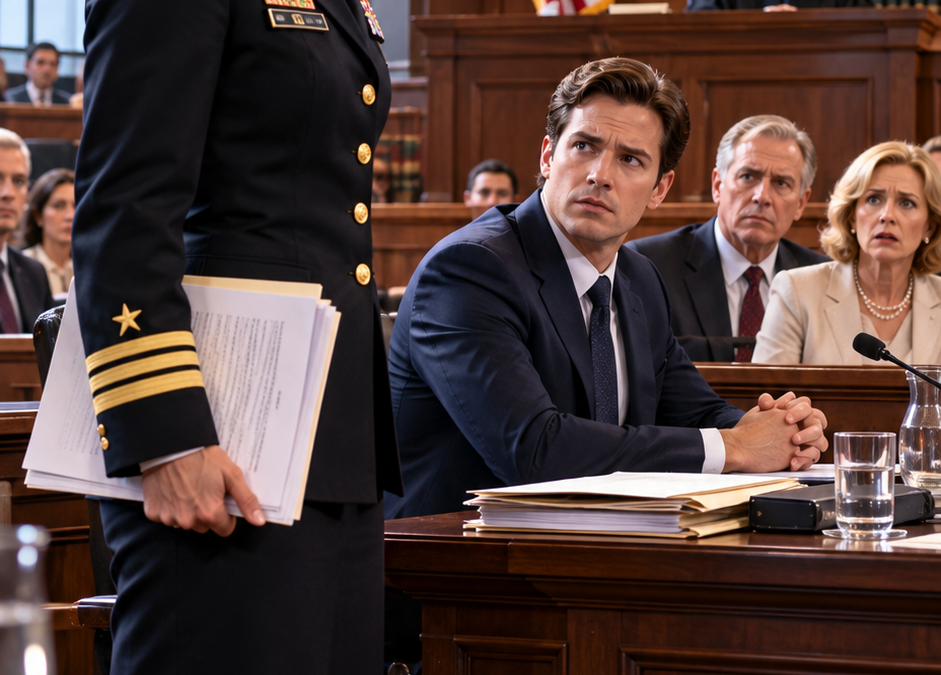
The rear doors opened.
My shoes struck the marble.
My ceremonial white uniform caught the courtroom light.
Mom’s purse slipped from her lap and hit the floor.
Dad half-stood.
Luke turned around.
He saw the uniform.
The medals.
The rank.
And for the first time in ten years, my brother looked afraid of me.
Assistant United States Attorney Daniel Mercer lifted a folder.
The courtroom went completely silent.
Then he turned toward the witness stand.
“Please state your full name and title for the record.”
I leaned toward the microphone.
“My name is Claire Elise Sterling. Commander, United States Navy.”
For one second, there was no sound except the soft mechanical hum of the courtroom ventilation.
Then the court reporter’s fingers began moving again.
I did not look at Luke.
Not immediately.
I had learned a long time ago that the hardest thing about telling the truth was resisting the urge to watch what it did to people.
Mercer stood a few feet from the witness box with a yellow legal pad resting on one palm.
“Commander Sterling, are you currently on active duty?”
“Yes.”
“And how long have you served?”
“Seventeen years.”
I heard my mother inhale behind Luke.
The sound was quiet.
But I knew it.
I had heard that exact breath when I was nine years old and fell from the old pear tree behind our grandfather’s house. I had heard it when Luke broke his arm playing baseball. I had heard it when doctors told her Dad’s heart procedure had gone well.
It was the sound she made when reality arrived before she was prepared to receive it.
Mercer continued.
“Did you complete your initial enlistment?”
“Yes.”
“Were you ever administratively separated for misconduct?”
“No.”
“Did you fail out of the Navy?”
“No.”
“Were you dishonorably discharged?”
“No.”
Luke’s attorney rose.
“Objection. Cumulative.”
Judge Helen Marrow looked over her glasses.
“Sustained. Mr. Mercer, move forward.”
“Yes, Your Honor.”
Mercer picked up a thin folder from the evidence table.
“Commander Sterling, I’m showing you Government Exhibit 42. Do you recognize this document?”
I accepted it.
I already knew what it was.
Still, seeing it inside a clear evidence sleeve caused something inside me to tighten.
The paper had once been powerful enough to separate me from my family.
Now it looked small.
Cheap, almost.
A few pages.
A copied seal.
A signature that was supposed to belong to an officer who had never met me.
A lie reduced to printer ink.
“It purports to be my discharge paperwork,” I said.
“Is it genuine?”
“No.”
“How can you tell?”
“The service number formatting is wrong for the period stated. The command listed in the separation block was not my command. The signature is attributed to an officer who was stationed overseas at the time. And, most importantly, I was still serving when this document claims I had already been discharged.”
Mercer nodded.
“Did you create it?”
“No.”
“Did you authorize anyone to create it?”
“No.”
“Had you seen this document before federal investigators showed it to you?”
That question carried me backward ten years.
Our parents’ dining room.
Dad standing beside the china cabinet.
Mom holding those same pages with trembling fingertips.
Luke by the window, quiet and grave, as though my downfall had wounded him personally.
I remembered reaching for the paperwork.
Dad pulling it away.
I remembered saying, “Call the Navy.”
And Luke answering before either of my parents could.
“She’s embarrassed, Dad. Don’t make this worse for her.”
My father had stared at me.
Then lowered the paper.
Not because he believed me.
Because he had decided he did not want to hear anymore.
“Yes,” I told Mercer. “I saw a copy at my parents’ home approximately ten years ago.”
“Under what circumstances?”
Luke’s attorney stood again.
“Your Honor, relevance?”
Mercer answered calmly. “Foundation for knowledge, prior existence of the forged document, and the defendant’s access to it.”
Judge Marrow considered that.
“Overruled. Keep it focused.”
Mercer turned back to me.
“Commander?”
“My brother had given the document to our parents and told them it showed I had been separated from the Navy.”
“Was that true?”
“No.”
“Did you tell your family it was false?”
“Yes.”
“And what happened?”
I looked at Mercer.
This was the part I had promised myself I would not dramatize.
There were no villains in memory as cleanly drawn as there are in stories.
My father had loved me.
My mother had loved me.
Luke had once loved me too, in whatever complicated way an older brother can love a younger sister he also needs to outshine.
That was what made the truth harder.
“They believed the document,” I said.
Behind Luke, a chair creaked.
Mercer allowed the answer to settle.
Then he moved on.
The government’s case was not about whether my parents had failed me.
It was about contracts.
Applications.
Certification requirements.
Electronic records.
Ownership structures.
Bank transfers.
The slow, ordinary machinery of fraud.
My testimony was only one part of it.
Mercer displayed a federal contracting application on a monitor.
“Do you recognize the service history described here?”
“Yes.”
“Whose is it?”
“Mine.”
“Please explain.”
I did.
Deployment dates.
Training periods.
A commendation.
A duty station.
Certain phrases from an old service biography that had once appeared on a Navy command website.
Luke had changed names and shortened dates, but he had not changed enough.
He had borrowed a life in pieces.
The most unsettling part was not seeing my history copied.
It was seeing how carefully he had selected which pieces made him money.
When I first reviewed Vance Shield Recovery’s storm-recovery contracts, I assumed the initial irregularity might be clerical.
Then investigators found a certification identifying a veteran-linked majority owner whose biographical details mirrored mine.
Then bank records showed funds routed through entities Luke controlled.
Then digital files revealed document templates.
Then came the signatures.
Mine.
My parents’.
People who believed they were guaranteeing loans for equipment purchases had, according to prosecutors, signed documents later attached to financing packages with different representations.
I had not known how much my parents stood to lose until two weeks before trial.
They had mortgaged the lake property.
Grandfather’s property.
The place Luke and I had spent summers skipping stones from the dock.
The place Dad still called “the one thing we’ll never sell.”
Mercer asked, “Did you authorize Vance Shield Recovery to use your military service for contracting preference?”
“No.”
“Did you own any portion of Vance Shield Recovery?”
“No.”
“Did you receive profits from these contracts?”
“No.”
“Did you ever sign this ownership certification?”
“No.”
He enlarged the signature.
It looked like mine.
Almost.
Whoever had copied it knew the shape.
The long first stroke of the C.
The compressed middle letters.
The slight upward angle I had used since college.
But it was too careful.
My real signature was fast.
That one looked practiced.
Mercer walked me through three more documents.
Then he stopped.
“Commander Sterling, did your brother ever have access to examples of your signature?”
“Yes.”
“How?”
“He was my brother.”
It was the simplest answer I gave all morning.
And somehow it was the one that hurt most.
Luke finally looked at me.
There was no hatred on his face.
That would have been easier.
There was exhaustion.
Something defensive.
And something I could not name.
When Mercer finished, Luke’s attorney approached.
Her name was Rebecca Hale. She was careful, precise, and considerably less theatrical than Luke had probably wanted when he hired her.
“Commander Sterling,” she said, “you and your brother have been estranged for approximately ten years?”
“Yes.”
“You have not spent holidays together?”
“No.”
“You have not regularly spoken?”
“No.”
“You have not personally observed the daily operations of Vance Shield Recovery?”
“No.”
“So you cannot tell this jury who completed every application at issue.”
“No.”
“You cannot testify from personal observation that Luke Sterling physically wrote your signature.”
“No.”
“You cannot say whether an outside consultant copied information from public sources.”
“Not from personal observation.”
Rebecca nodded.
She was doing her job.
I respected that.
Then she changed direction.
“Your relationship with your brother was already damaged before these contracts existed, correct?”
“Yes.”
“And your relationship with your parents was also damaged?”
“Yes.”
“Deeply?”
I hesitated.
“Yes.”
“So when federal investigators contacted you about your brother, you had significant unresolved family conflict.”
Mercer rose.
“Objection. Argumentative.”
“I’ll allow limited inquiry,” Judge Marrow said. “Ms. Hale, move toward a question.”
Rebecca looked at me.
“Did you resent your brother?”
There it was.
Not an accusation.
Not exactly.
A human question hidden inside a legal strategy.
I thought about answering no.
It would have sounded noble.
It also would have been false.
“Yes.”
Luke’s eyes lifted.
Rebecca seemed surprised by how quickly I answered.
“You resented him.”
“Yes.”
“For what you believed he had done to your reputation within your family?”
“For that, among other things.”
“So you came into this courtroom carrying anger toward him.”
“I came into this courtroom carrying history.”
“And anger?”
“Yes.”
Rebecca paused.
“Could that anger affect your interpretation of documents related to him?”
“No.”
“How can you be certain?”
I folded my hands in my lap.
“Because the dates of my deployments do not change based on how I feel about my brother. My service record does not change. My signature does not become authorized because I’m angry. And a document claiming I was discharged while I was serving aboard a ship in another part of the world is false regardless of whether Luke and I ever speak again.”
Nobody moved.
Rebecca gave one small nod.
Not agreement.
Recognition.
“No further questions.”
Judge Marrow called a recess shortly afterward.
I stepped down from the witness stand without looking at my parents.
That took more effort than anything else I had done.
In the hallway, Mercer caught up with me.
“You did well.”
“I answered questions.”
“That’s usually the preferred method.”
Despite myself, I smiled.
Daniel Mercer had the kind of humor that seemed to exist solely to release pressure from rooms.
He lowered his voice.
“You okay?”
“Yes.”
He studied me just long enough to communicate that he knew the answer was incomplete.
Then he nodded.
“There’s coffee around the corner. Allegedly.”
“I’ve had Navy coffee.”
“Then you’re overqualified.”
He walked away to speak with another prosecutor.
I remained beside the tall courthouse window.
Three floors below, traffic moved through the city. People crossed streets. A delivery truck stopped illegally. Someone in a red coat hurried toward the courthouse stairs.
Ordinary life.
For years, I had imagined what it would feel like if my parents ever learned the truth.
I had pictured vindication.
Relief.
Perhaps satisfaction.
Instead, I felt tired.
“Claire.”
My mother’s voice came from behind me.
I closed my eyes for half a second.
Then turned.
Celina Sterling stood ten feet away.
My father was beside her.
Neither moved closer.
Mom looked smaller than I remembered.
Not physically.
In certainty.
Her carefully arranged silver-brown hair had come loose near one temple. She still carried the handbag she had dropped in court.
Dad looked exactly like himself and completely unfamiliar.
Bernard Sterling had spent his entire life believing posture could solve almost anything.
Stand straight.
Speak carefully.
Show up prepared.
He had taught Luke and me to shake hands properly before we were twelve.
Now his shoulders had lost their usual certainty.
Mom looked at my uniform.
Then my face.
“You’re a commander.”
It was not a question.
“Yes.”
“How long?”
I could have made her work for every answer.
Seventeen years.
Three months.
Eleven days.
I could have told her about promotions she missed.
Ceremonies.
Transfers.
The photograph of me standing beside Admiral Stanton.
The night I called home after my first major commendation and hung up before the first ring finished because I remembered Luke had already told them I was out.
Instead I said, “A while.”
Her lips pressed together.
Dad’s gaze moved toward the ribbons above my left pocket.
“I tried to verify some of those,” he said quietly.
“When?”
“This morning.”
Something inside me hardened.
“This morning?”
He looked ashamed.
“We got here early.”
“And after ten years, you thought today might be a good day to check?”
“Claire,” Mom whispered.
I held up one hand.
Not angry.
Just unable to hear my name spoken like a plea.
Dad accepted the interruption.
“I don’t have an answer that makes that sound better.”
That stopped me.
My father had always had answers.
Even when the answer was wrong.
I looked at him properly for the first time.
“What did Luke tell you?”
Mom answered.
“That you had joined the reserves after you left active service. That you were allowed to wear the uniform at certain events.”
I stared at her.
“He told you that?”
“Yes.”
“And you believed him.”
Her eyes filled, but she did not cry.
“Yes.”
I looked toward the courtroom doors.
Of course Luke had prepared explanations.
For everything.
That was what I had underestimated.
Lies do not survive for ten years because people repeat the same sentence.
They survive because they adapt.
Every new fact is given a new explanation.
Every contradiction becomes another piece of the story.
Dad spoke quietly.
“He said you blamed him because he’d been the one who convinced us not to give you money.”
“I never asked for money.”
“I know that now.”
“No. You know I said that under oath twenty minutes ago.”
His face changed.
Only slightly.
Enough.
“That’s fair.”
Mom stepped forward, then stopped herself.
“What happened to us?”
The question was so soft I almost pretended not to hear it.
But I had asked myself the same thing for years.
“You believed the child who stayed close.”
Mom flinched.
I went on.
“You saw Luke every week. He helped Dad with the business accounts. He drove you to appointments after your surgery. He came for Thanksgiving. He knew the neighbors. He knew what was happening at home.”
“And you were away,” Dad said.
“Yes.”
There was no accusation in his voice.
Only realization.
Distance had become evidence.
Luke’s presence had become credibility.
My independence had become suspicious because it gave them fewer chances to see my life with their own eyes.
Mom looked toward the closed courtroom doors.
“Did he forge everything?”
“I don’t know.”
“You don’t?”
“No.”
That seemed to surprise both of them.
“I know what was forged in my name,” I said. “I know what investigators showed me. I know what records are authentic and which aren’t. I don’t know every decision Luke made or why he made it.”
Dad’s jaw tightened.
“He used our signatures.”
“The government believes some documents containing your signatures were altered or repurposed.”
“We signed loan guarantees.”
“I know.”
“For equipment.”
“I know.”
Dad looked suddenly older.
“Your grandfather’s place is tied to those loans.”
“I know.”
Mom turned toward him.
“Bernard.”
He did not answer her.
Apparently she had not known.
That hurt in an entirely different way.
“Dad,” I said, “you need your own lawyer if you don’t already have one.”
“We do.”
“Not Luke’s.”
His eyes met mine.
“No. Ours.”
Good.
At least something had changed.
The courtroom deputy opened the doors.
“Five minutes.”
Mom looked at me again.
There were ten years between us.
No hallway conversation could cross them.
“I kept your room,” she said.
The sentence landed strangely.
I almost laughed.
Not because it was funny.
Because it seemed impossible.
“You believed I was a disgrace.”
“I believed you were hurting.”
“That isn’t the same thing.”
“No.”
Her eyes lowered.
“No, it isn’t.”
I wanted her to apologize.
I also did not want an apology squeezed between a recess bell and a federal fraud trial.
“I have to go back.”
She nodded.
“Claire?”
I stopped.
“Were you happy?”
The question surprised me.
“In the Navy?”
“In your life.”
For the first time that morning, my throat tightened.
“Yes,” I said. “Not always. But yes.”
Mom closed her eyes.
A tear slipped down one cheek.
She wiped it away quickly.
“I’m glad.”
I returned to the courtroom.
The next two days were quieter.
Accountants testified.
A contracting officer explained eligibility rules.
A forensic document examiner discussed signature overlays and metadata.
An IT specialist showed that several disputed files had been created on a computer registered to Vance Shield Recovery’s finance office.
Luke’s name appeared constantly.
But something else did too.
A set of initials.
M.R.
The initials belonged to Marcus Reed, Luke’s former chief financial officer.
Marcus had joined Vance Shield seven years earlier and left eighteen months before the federal investigation became public. He had already pleaded guilty to a lesser charge.
On Thursday afternoon, he took the stand.
I sat behind the prosecution table now, permitted to observe because my testimony was complete.
Marcus looked ordinary.
Forty-something.
Thinning hair.
Glasses.
Gray suit.
He did not look like a man who had helped build a multimillion-dollar deception.
Perhaps that was the point.
Most bad choices do not arrive wearing warning signs.
Mercer asked how veteran certifications had been prepared.
“At first, outside consultants,” Marcus said. “Later, mostly internally.”
“Who directed that process?”
“Mr. Sterling.”
Luke stared straight ahead.
“Did there come a time when you questioned the veteran-linked ownership representation?”
“Yes.”
“When?”
“About four years ago.”
“What did you say?”
Marcus shifted.
“I told Luke the structure didn’t match the application.”
“And what did he say?”
“He said the beneficial interest was held through a family arrangement.”
“What family arrangement?”
“He said his sister had an interest.”
Every muscle in my body became still.
Mercer glanced at me.
Only once.
Then back at Marcus.
“Did you ever meet Commander Sterling?”
“No.”
“Did you ever speak with her?”
“No.”
“Did you see an agreement signed by her?”
“I saw a scanned ownership acknowledgment.”
“Did you later learn it was disputed?”
“Yes.”
“Why did you continue?”
Marcus looked down.
This was where people expected excuses.
He gave one.
But not a dramatic one.
“I wanted the company to survive.”
Mercer waited.
Marcus swallowed.
“We had a lot of people employed by then. Big payroll. Trucks. Leases. Crews. If we lost preferred status, we might lose contracts. Luke said it was temporary. That the company would transition away from those programs.”
“Did it?”
“No.”
“Did you benefit financially?”
“Yes.”
“How?”
“Bonuses.”
There it was.
Not greed on a movie scale.
No yacht.
No suitcase of cash.
A man with a mortgage accepting bonuses and choosing not to ask questions he already understood.
Mercer moved toward the family assets.
Marcus testified that Luke had struggled with liquidity after an aggressive expansion.
Banks wanted additional collateral.
Luke brought in guarantees.
Some from our parents.
Some tied to Sterling family property.
Then Marcus said something I had not heard before.
“There was also the trust distribution.”
Mercer stopped.
“What trust?”
Rebecca Hale rose immediately.
“Objection. Beyond the scope of the government’s disclosed direct.”
Mercer turned toward the judge.
“Your Honor, this testimony concerns funds already identified in admitted financial exhibits.”
After a brief sidebar, Judge Marrow allowed limited questioning.
Mercer faced Marcus again.
“What trust distribution?”
Marcus adjusted his glasses.
“A distribution from the Everett Sterling Family Trust.”
My grandfather’s name.
I looked at Dad.
His face had gone pale.
Mercer continued.
“To whom was it distributed?”
“To Luke Sterling, initially.”
“For what stated purpose?”
“Capital contribution.”
“How much?”
“Eight hundred and forty thousand dollars.”
Mom covered her mouth.
I knew enough about our family finances to understand why.
Grandfather had not been wealthy in the way strangers might imagine.
He owned land.
A small manufacturing company he eventually sold.
Investments.
He lived carefully.
Eight hundred and forty thousand dollars was not an incidental family gift.
Mercer asked, “Did you review the trust authorization?”
“Yes.”
“Was there anything unusual?”
Marcus looked toward Luke.
Luke finally turned.
Their eyes met.
Marcus looked away first.
“The authorization referenced consent from both Sterling grandchildren.”
I felt my pulse in my throat.
Mercer’s voice became very calm.
“Both?”
“Yes.”
“Luke Sterling and Claire Sterling?”
“Yes.”
“Did you see Commander Sterling’s consent?”
“A scanned copy.”
“Is it in evidence?”
Mercer walked to the prosecution table.
He found a document.
I knew what was coming before he lifted it.
Government Exhibit 118.
When it appeared on the courtroom monitor, I stopped breathing for a moment.
My name was on the bottom.
Claire E. Sterling.
The signature looked remarkably close to mine.
Closer than the contract signatures.
And above it, in plain language, was a consent authorizing release of trust funds for investment in Vance Shield Recovery.
I had never seen it.
Mercer looked at Marcus.
“Did Mr. Sterling tell you his sister had approved this distribution?”
“Yes.”
“Did you have reason to doubt him then?”
“No.”
“Do you now?”
“Yes.”
Rebecca objected to the final question.
Sustained.
But it no longer mattered.
I stared at the document.
Eight hundred and forty thousand dollars.
Grandfather’s trust.
Both grandchildren.
I had known nothing about it.
When court adjourned that afternoon, my father did not approach me.
He left with Mom and their attorney.
Luke remained at the defense table speaking with Rebecca.
For one brief instant, he looked over his shoulder.
At me.
This time I saw something clearly.
Not fear.
Regret.
That unsettled me more.
That evening, I sat in the hotel restaurant across from my oldest Navy friend, Elena Ruiz.
Elena had driven two hours after work because she had correctly predicted I would claim I wanted to be alone.
She pushed a breadbasket toward me.
“You haven’t eaten.”
“I had lunch.”
“Coffee isn’t lunch.”
“There was a muffin.”
“Commander, I am prepared to testify that half a blueberry muffin does not constitute a meal.”
I tore off a piece of bread.
“Better?”
“Slightly.”
Elena had known me before Luke’s lie.
Before the estrangement.
Before I learned how easy it was to build a successful life around a locked room in your heart.
I told her about the trust.
She listened without interrupting.
When I finished, she asked, “Did your grandfather ever talk about leaving you money?”
“Not exactly.”
“Not exactly?”
“He said the lake house was for both of us. He used to say he wanted Luke and me to have choices.”
“What kind of choices?”
I stared through the restaurant window.
“Grandfather hated debt. He said money was supposed to buy time, not things.”
“That sounds like him?”
“Yes.”
“So eight hundred forty thousand dollars being dumped into one grandchild’s company would be…”
“Not impossible.”
“But?”
“But he would have made us discuss it together.”
Elena leaned back.
“Then maybe Luke didn’t only steal your identity.”
I looked at her.
“What if he stole a conversation?”
That sentence stayed with me.
A conversation.
It sounded insignificant compared with fraud.
But families are built from conversations.
Who is asked.
Who is told.
Who is allowed to decide.
For ten years, I had thought Luke’s greatest deception was making our parents believe I had failed.
Now I wondered whether that lie had served another purpose.
If I was disgraced, estranged, and unreliable, nobody would expect me at a trust meeting.
Nobody would ask why I had not signed in person.
Nobody would call when money moved.
The false discharge story might not have been the beginning.
It might have been infrastructure.
The next morning, Dad called.
I almost let it ring out.
Then I answered.
“Hello.”
“Claire.”
His voice was rough.
“Did I wake you?”
“No.”
“Your mother found something.”
I sat up.
“What?”
“Your grandfather’s papers.”
“What papers?”
“Not the trust documents. Letters.”
I waited.
Dad continued.
“After he died, we packed most of his office into storage. Celina went through the boxes last night.”
“Why?”
“Because of what Marcus Reed said.”
I heard movement on his end.
Then Mom’s voice, farther away.
“Tell her the date.”
Dad exhaled.
“There’s an envelope addressed to you.”
I closed my eyes.
“What date?”
“Three weeks before the night you came home and confronted us.”
That made no sense.
Grandfather had died almost a year before that confrontation.
“Dad.”
“I know.”
“How could he write me three weeks before—”
“No. The envelope wasn’t written then. It was mailed then.”
Silence.
“By whom?”
“We don’t know.”
“Is it sealed?”
“No.”
My hand tightened around the phone.
“Then somebody opened it.”
“Yes.”
“What does it say?”
Dad did not answer immediately.
“Claire, I think you should see it yourself.”
“No. Read it.”
Another pause.
Paper shifted.
Then my father read.
“Claire, if you are reading this, I hope Bernard finally decided being stubborn is not a substitute for being wise.”
Despite everything, a small sound escaped me.
Almost a laugh.
That was Grandfather.
Dad continued.
“I have arranged things so you and Luke will each have the ability to make a meaningful choice when the time comes. Not the same choice. Your own choice. Do not let anyone tell you that one future is worth more because it looks better from the outside.”
My eyes burned.
Dad’s voice became less steady.
“There is more.”
“Keep reading.”
“Your service has never worried me. Your brother’s hunger to prove himself sometimes does. Be kind to him when you can, but never confuse kindness with surrendering your judgment.”
Dad stopped.
I heard Mom crying quietly in the background.
“Continue.”
“The trust attorney has instructions. When you are both ready, he is to meet with you separately before any joint decision involving principal funds. I insisted on this because I know my family.”
Dad stopped again.
“What else?”
“That’s the end.”
I stared at the hotel wall.
The trust attorney.
Separate meetings.
I had never been contacted.
“What was inside the envelope besides the letter?”
“There’s a business card.”
“Whose?”
Dad read the name.
“Arthur Bellamy.”
I knew it instantly.
Not because I had met him.
Because I had seen the name the day before.
Government Exhibit 118.
At the bottom of the trust authorization.
Witnessed by Arthur G. Bellamy, Esq.
I got out of bed.
“Where is he?”
“We don’t know.”
“Is he alive?”
“Our attorney is checking.”
“Send me photographs of everything. Envelope too. Front and back.”
“I will.”
“Dad.”
“Yes?”
“Who had access to Grandfather’s office after he died?”
Silence.
“Your mother and I.”
“And Luke?”
Another silence.
Then Dad said, “Yes.”
That afternoon, Mercer confirmed Arthur Bellamy was alive.
Retired.
Seventy-eight years old.
Living three counties away.
He had not been on the original witness list because investigators had been unable to locate older trust files associated with his former law office, which had closed after a merger.
But the government knew his name.
And now we had a letter.
Judge Marrow sent the jury home early while attorneys argued about whether Bellamy could be contacted and potentially called.
I waited in the hallway.
My parents sat on a wooden bench twenty feet away.
For once, none of us pretended not to see one another.
Mom held Grandfather’s letter in a protective sleeve.
She looked at me.
“I should have given this to you.”
“You didn’t know it existed.”
“I should have known more things existed.”
I sat at the opposite end of the bench.
Dad remained standing near the window.
Mom turned the letter over.
“I keep thinking about your room.”
I glanced at her.
“You mentioned that yesterday.”
“I told myself keeping it meant I hadn’t given up on you.”
I said nothing.
“But maybe I kept it because changing it would have required admitting you weren’t coming home.”
Her fingers rested on Grandfather’s handwriting.
“And if I admitted that, I would have had to ask why.”
Dad looked away.
Mom continued.
“Luke always had an answer before I finished asking.”
There was no anger in her voice.
Only grief.
I understood that grief, although ours was different.
“You trusted him.”
“Yes.”
“He also made himself useful.”
Dad spoke from the window.
“That’s not fair.”
I looked at him.
“To whom?”
“To Luke.”
“Why?”
“Because he was useful. He helped us. For years.”
“And that means what?”
Dad hesitated.
“That whatever else is true, not every decent thing he did was part of some scheme.”
I stared at him.
Then nodded.
“You’re right.”
He looked surprised.
So did Mom.
“Luke drove you after your surgery,” I said. “He helped Dad when the factory records were transferred. He checked on Grandfather before he died. Maybe he did those things because he cared.”
Dad’s shoulders lowered slightly.
“People aren’t only the worst thing they’ve done.”
“No.”
The courtroom doors opened.
Mercer stepped out.
“Commander Sterling.”
I stood.
He motioned me aside.
“Bellamy agreed to meet with investigators this evening.”
“Is he willing to testify?”
“Possibly.”
“Did you tell him why?”
“Generally.”
“What did he say?”
Mercer glanced toward my parents.
“He said he has wondered for years when someone would ask about your grandfather’s trust.”
My skin went cold.
“What does that mean?”
“We’re finding out.”
Arthur Bellamy arrived the following morning wearing a brown sport coat and carrying a leather briefcase polished from decades of use.
He walked with a cane.
Not dramatically.
Carefully.
As though each step deserved planning.
He had white hair, sharp blue eyes, and the weary expression of a man who had spent too much of his life watching families argue over what dead people meant.
When he saw Dad, he stopped.
“Bernard.”
Dad stood.
“Arthur.”
They shook hands.
“You look like Everett,” Bellamy said.
Dad gave a humorless smile.
“I’ve been told worse.”
Bellamy looked at Mom.
Then me.
His gaze settled.
“You’re Claire.”
“Yes.”
He studied my uniform.
A strange sadness crossed his face.
“You look exactly like the photograph.”
“What photograph?”
Before he could answer, Mercer appeared and guided him into a conference room.
An hour later, court resumed.
Bellamy was sworn.
Mercer began with ordinary foundation.
Name.
Occupation.
Former practice.
Relationship with Everett Sterling.
Then the trust.
“Mr. Bellamy, did you prepare the Everett Sterling Family Trust?”
“Yes.”
“Were Luke Sterling and Claire Sterling beneficiaries?”
“Yes.”
“Did the trust permit significant distributions to one grandchild for business investment?”
“Yes, under certain conditions.”
“What conditions?”
Bellamy folded his hands.
“Everett did not require identical distributions at identical times. He believed equal opportunity did not always mean equal timing. But any distribution exceeding two hundred thousand dollars for private business investment required an independent meeting with the requesting beneficiary and written notice to the other beneficiary.”
Mercer nodded.
“Why?”
“Because Everett knew his grandchildren.”
A faint smile.
“Luke was ambitious. Claire was cautious. Everett thought each trait could be useful and each could become a problem.”
I felt Grandfather in the room so suddenly it almost hurt.
Mercer showed Bellamy Exhibit 118.
“Do you recognize this document?”
Bellamy took his time.
Then frowned.
“Yes and no.”
“Explain.”
“This is based on a form my office used. My signature appears at the bottom.”
“Is it your signature?”
“No.”
A quiet rustle moved through the courtroom.
“Were you present when this document was signed?”
“No.”
“Did Commander Sterling ever consent before you to this distribution?”
“No.”
“Did you ever meet with her about the distribution?”
“No.”
“Did you attempt to contact her?”
Bellamy’s face changed.
“Yes.”
“How?”
“Telephone. Email. Certified mail.”
My heart began beating faster.
“Were you successful?”
“No.”
“Why not?”
“Her telephone number had been disconnected. Emails were returned. The certified letter was returned as undeliverable.”
I stared at him.
My number had not been disconnected.
My email had not changed.
Not then.
Mercer asked, “Where did you obtain the contact information?”
“From a family information update provided to my office.”
“By whom?”
Bellamy looked toward Luke.
“Luke Sterling.”
Luke closed his eyes.
Only for a moment.
There it was.
Not the whole truth.
But a doorway.
Mercer continued.
“What happened next?”
“Luke told me Claire was experiencing personal difficulties and did not want contact with the family.”
“Did he mention her military service?”
“Yes.”
“What did he tell you?”
“That she had separated under difficult circumstances and was embarrassed.”
I heard Mom quietly gasp.
Bellamy continued.
“He later told me she had authorized him to handle communications regarding the trust.”
“Did you accept that?”
“Not initially.”
“Why not?”
“Everett’s instructions were explicit.”
“What changed?”
Bellamy looked uncomfortable.
“I received an email purporting to be from Claire.”
Mercer displayed another exhibit.
It was brief.
Professional.
Cold.
Mr. Bellamy,
I do not wish to be contacted by my family regarding trust matters. Luke has my permission to proceed with discussions concerning his business investment. I waive any separate meeting and do not object to the proposed distribution.
Claire Sterling
I stared at the message.
I had never written it.
Mercer asked Bellamy whether he relied on it.
“Yes.”
“Was that enough to release funds?”
“Not alone.”
“What else did you receive?”
Bellamy looked toward the evidence table.
“A notarized authorization.”
Another document appeared.
Another signature.
Another version of me.
Mercer asked, “Did you later become concerned?”
“Yes.”
“When?”
“Several months later.”
“Why?”
“I received a Christmas card.”
I blinked.
So did the jurors.
Mercer smiled faintly.
“From whom?”
“Claire.”
I almost laughed.
“I sent you a Christmas card?”
Bellamy looked at me from the stand.
“Yes.”
I remembered.
Grandfather had kept an address book.
After he died, Mom had given me copies of several addresses because I had promised I would keep sending cards to his old friends.
Bellamy must have been among them.
“What about the card concerned you?” Mercer asked.
“The return address.”
Mercer waited.
“It was not the address Luke’s office had provided. The handwriting also did not resemble the authorization.”
My fingers went cold.
“What did you do?” Mercer asked.
“I called Bernard.”
Dad looked sharply toward him.
Bellamy’s face tightened.
“I left a message.”
Dad whispered, “I never got one.”
Rebecca Hale stood.
“Objection.”
Judge Marrow said, “The witness will testify only to his own actions.”
Bellamy nodded.
“I left a message asking Bernard to contact me regarding the trust. I did not hear back.”
“Did you call again?”
“Yes.”
“And?”
“A man returned the call.”
Dad leaned forward.
Bellamy continued.
“He identified himself as Bernard Sterling.”
Every person at the defense table became still.
Mercer spoke carefully.
“Was it Bernard Sterling?”
Bellamy looked directly at my father.
“No.”
Dad’s face emptied.
“Do you know who it was?”
“At the time, no.”
“And now?”
“I cannot say with certainty.”
Mercer nodded.
Fair.
Responsible.
No drama.
No accusation beyond memory.
Bellamy went on.
“The man told me Claire’s estrangement had become worse. He said the family did not want the matter pressed because she was unstable and threatening to challenge the estate if contacted.”
My mother began crying silently.
I did not look at Luke.
I could not.
Mercer asked one final question.
“Mr. Bellamy, if you had known Commander Sterling had not authorized the distribution, would the eight hundred and forty thousand dollars have been released?”
“No.”
Court adjourned before lunch.
Outside, my father walked past everyone and entered an empty conference room.
I followed.
Mom came behind me.
Dad stood with both palms on the table.
For nearly a minute, nobody spoke.
Then he said, “I remember that week.”
Mom wiped her face.
“What?”
“The week Bellamy says he called.”
Dad looked at us.
“I was in Charleston. Three days. Supplier meetings.”
“So?”
“Luke was staying at the house.”
Mom stared at him.
Dad’s face collapsed in a way I had never seen.
“He was taking care of the mail.”
No one said Luke had returned Bellamy’s call.
No one had to.
Possibility entered the room.
That was enough.
Mom sank into a chair.
“Why?”
Dad looked toward me.
I had spent ten years thinking I knew the answer.
Jealousy.
Money.
Pride.
Control.
Now all those words seemed too small.
“I don’t know,” I said.
For the first time, I meant it.
Late that afternoon, Rebecca Hale asked Mercer for a private discussion.
An hour later, Mercer requested to speak with me.
We sat in the same conference room where my father had finally begun to question a decade of certainty.
Mercer closed the door.
“Luke wants to change his plea on several counts.”
I stared at him.
“To guilty?”
“Yes.”
“Why?”
“He’s also offering cooperation regarding certain financial records.”
“What records?”
“He hasn’t fully proffered yet.”
I looked through the glass wall toward the hallway.
Luke stood beside Rebecca near the far window.
Alone.
Smaller than I remembered.
“What does he want?”
“Sentencing consideration. Nothing unusual.”
“That’s not what I mean.”
Mercer understood.
“What does he want from me?”
“As far as the government is concerned, nothing.”
I looked at Luke again.
Then Rebecca turned and saw me watching.
She spoke to Luke.
He looked up.
For a second, brother and sister faced each other through two panes of courthouse glass and ten years of absence.
Then Luke reached into his briefcase.
He removed a worn blue envelope.
My grandfather’s handwriting was visible even from across the hallway.
CLAIRE.
My name.
He held it against his chest for a moment.
Rebecca crossed the hall and entered our conference room.
She placed the envelope on the table.
“My client says this belongs to Commander Sterling.”
Mercer looked at her.
“Is it evidence?”
“Possibly.”
I did not touch it.
“Where did he get it?”
Rebecca glanced toward Luke.
“He says your grandfather gave it to him the week before he died.”
I finally picked up the envelope.
It was still sealed.
On the back, beneath the flap, Grandfather had written one sentence.
My hands began to tremble as I read it.
Luke — if Claire does not come home, this is the one thing you must make sure reaches her.
I looked through the glass wall.
Luke had turned away.
And suddenly the question was no longer only why my brother had spent ten years lying about me.
The question was why, through all those years, he had kept the one letter our grandfather had trusted him to deliver.
I opened the envelope carefully.
Inside were three folded pages and a photograph.
The photograph was old.
Luke and me at the lake, both sunburned, both barefoot, both grinning at something outside the frame. I was maybe eleven. Luke was fifteen. His arm was slung around my shoulders, not possessively, not competitively.
Protectively.
I had forgotten there had ever been a time when he stood beside me that way.
The letter began in Grandfather’s bold, slanted handwriting.
Claire,
If this reaches you late, forgive an old man for trusting your brother to do one simple thing and trusting you to be angry for the correct length of time before you read the rest.
A laugh escaped me before I could stop it.
Mercer looked at me.
I shook my head and kept reading.
I know you and Luke better than either of you realizes.
Luke wants to be seen as capable before he has done the hard work of becoming trustworthy.
You want to become so competent that needing people can no longer be used against you.
Both strategies will cost you if you let them harden.
I looked up.
Luke still stood by the window, facing away.
I kept reading.
I have left you both choices through the trust. Luke may build. You may serve. One path is not greater than the other. But any decision involving family property, principal funds, or the lake must be made with both voices in the room.
If anyone tells you otherwise, they are either confused or hoping you remain absent.
My throat tightened.
The second page was more personal.
Your father is proud and slower to apologize than a rusted gate. Your mother sees more than she says and then convinces herself silence is kindness. Do not let their weaknesses decide whether you tell the truth.
If Luke has treated you unfairly, confront him.
If you have stayed away too long, admit that too.
Families rot in the spaces where everyone is waiting for someone else to begin.
I had to stop reading.
The room blurred.
Mercer quietly stepped out, giving me privacy with a letter that had arrived ten years late.
When I finally reached the final page, I understood why Luke had kept it.
There was a paragraph addressed to him.
Luke,
If you are reading over her shoulder, stop it.
If you are reading because you failed to give this to her, then know this: whatever you think you are protecting, you are probably protecting your pride.
Your sister’s life is not your story to edit.
If she leaves, you do not get to explain her absence for her.
If she succeeds, you do not get to turn it into your failure.
If she comes home, open the door.
Do not stand in front of it.
I sat very still.
There it was.
Not legal evidence.
Not a financial document.
Something worse for Luke.
Proof that Grandfather had seen him clearly.
Not as a monster.
Not as a golden son.
As a boy who might grow into a dangerous man if nobody forced him to tell the truth.
I folded the letter.
Then I walked out of the conference room.
Mercer started to speak, but I shook my head.
Luke turned when he heard my steps.
For the first time since the trial began, we stood close enough to speak without microphones, lawyers, or exhibits.
I held up the envelope.
“Why?”
He looked at it.
Then at me.
His face crumpled—not completely, not theatrically, but enough that I saw the boy from the photograph before the man in the suit could hide him.
“I was going to send it.”
“When?”
He swallowed.
“When things calmed down.”
“That was ten years ago.”
“I know.”
“Why didn’t you?”
His eyes reddened.
“Because I had already told them you didn’t want contact.”
“So you hid Grandfather’s letter to protect your lie.”
“At first.”
I waited.
“And then?”
His voice dropped.
“Then I read it.”
My fingers tightened around the envelope.
“It was sealed.”
“I steamed it open.”
The honesty was so ugly it almost steadied me.
Luke continued.
“I read what he wrote to me. About not editing your life. About opening the door. And I hated him for knowing.”
I said nothing.
“I told myself you would use the trust to stop me. Then I told myself you didn’t need the money because you had the Navy. Then I told myself the company would succeed and I’d put everything back before anyone knew.”
“Did you believe that?”
He let out a breath.
“Some days.”
“And the other days?”
“The other days I knew exactly what I was doing.”
There are confessions that feel satisfying in imagination.
In real life, they often leave the room colder.
I looked at my brother.
For ten years, I had thought I wanted him to admit it.
Now that he had, I wished the truth were smaller.
“Why tell me now?” I asked.
His mouth twisted.
“Because Bellamy remembered. Marcus talked. The documents are out. I can’t save myself by hiding it anymore.”
That was the first honest answer.
Then he added, quieter, “And because I’m tired.”
I almost hated him for making me understand that.
“You erased me,” I said.
His eyes closed.
“I know.”
“You let our parents think I failed.”
“I know.”
“You used my service.”
“I know.”
“You took a conversation Grandfather meant for both of us and turned it into money.”
His face tightened.
“Yes.”
“And you kept the one thing he trusted you to give me.”
Luke opened his eyes.
“I’m sorry.”
I had waited ten years for those words.
They did not repair anything.
They did not return holidays.
They did not unforge signatures or free my parents from financial consequences or restore my grandfather’s instructions.
But the words entered the air.
At least they existed now.
“I believe you’re sorry,” I said.
His face shifted with fragile hope.
“But belief is not absolution.”
The hope disappeared.
Good.
Hope should not outrun accountability.
“I know,” he whispered.
“No,” I said. “You’re starting to.”
Mercer approached carefully.
Rebecca Hale stood a few feet behind Luke.
The courthouse hallway had gone quiet around us.
I looked at my brother one last time.
“Tell the whole truth.”
He nodded.
Then I walked away with Grandfather’s letter in my hand.
Luke changed his plea the next morning on multiple counts related to fraud, false statements, and unauthorized use of documents tied to the trust and veteran-preference certifications. His cooperation did not erase the harm, but it opened records investigators had not yet found.
The financial damage was worse than my parents had understood.
The lake property was entangled, but not lost beyond recovery. Civil proceedings would take time. Some assets were frozen. Some claims would be unwound. Some losses would remain losses.
That was the thing about truth.
It could stop the bleeding.
It could not always restore the blood.
After the plea hearing, my parents and I stood outside the courthouse under a gray sky.
No one spoke for a while.
Mom held Grandfather’s letter in both hands. Dad had read it that morning in a conference room, then sat alone for nearly twenty minutes.
Finally, he looked at me.
“I failed you.”
I did not rescue him from the sentence.
“Yes.”
His eyes filled.
“I wanted to believe Luke because believing him meant I hadn’t failed both my children.”
I looked toward the courthouse steps.
“But you did.”
He nodded.
“I know.”
Mom covered her mouth.
I turned to her.
“You too.”
Tears spilled down her cheeks.
“Yes.”
No excuses.
No defense.
For once, neither parent reached for the version that made them sound better.
Mom said, “I kept your room because I wanted to believe I was waiting for you.”
“And?”
“I think I was waiting for the daughter Luke told me you used to be. Not the woman you actually became.”
That one hurt.
But it was honest.
“What will you do with it?” I asked.
“My room?”
She gave a watery laugh.
“Your room.”
Mom looked at Dad.
Then back at me.
“I’d like to ask before changing anything. Not because it still belongs to you exactly. But because I should have asked more.”
The answer surprised me.
“You can change it.”
Her face tightened.
“You’re sure?”
“Yes. But keep the old wooden box on the dresser.”
“Your grandfather’s?”
“Yes.”
“Why?”
“Because I’m going to put a copy of his letter in it.”
Dad closed his eyes.
“That seems right,” he said.
Months passed before the sentencing.
During that time, my parents began the slow process of untangling themselves from the financial wreckage Luke had created. Their attorney recovered some documentation that helped protect the lake property from immediate sale. Not all of it. But enough.
Luke provided records that implicated consultants, shell entities, and internal practices at Vance Shield Recovery. Marcus Reed testified again in related proceedings. Arthur Bellamy gave sworn statements about the trust.
The government did its work.
The courts did theirs.
My family did something harder.
We told the truth in small, humiliating pieces.
Mom called me every Sunday evening.
At first, I answered out of discipline.
Then, eventually, because I wanted to.
Not every call was easy.
Some were terrible.
She asked once why I had not tried harder to prove my service.
I almost hung up.
Instead, I said, “Because I should not have needed to prove my life to my own mother after she chose a forged document over my face.”
She cried.
I let her.
Then she apologized.
Not perfectly.
But without adding a reason afterward.
Dad wrote letters.
That was how he could speak without needing posture to hold him together. He wrote about Grandfather. About Luke as a child. About the day I enlisted. About the morning after I left home ten years earlier, when he found the dining room chair still pulled out and realized I had really gone.
One letter contained a sentence I kept.
I mistook your silence for distance because admitting it might be pain would have required me to become your father instead of Luke’s defender.
I read that sentence three times.
Then I placed it beside Grandfather’s letter.
Luke wrote once from custody before sentencing.
I did not answer immediately.
His letter was not a plea for forgiveness.
That mattered.
He wrote about the first lie.
Not the forged paperwork.
An earlier one.
A small lie from childhood, when he broke Grandfather’s compass and told everyone I had borrowed it. I had forgotten the incident almost entirely. He had not.
I think I learned then that people would believe me if I sounded sorry enough, he wrote. I wish someone had stopped me when the stakes were still small.
I sat with that line for a long time.
Then I wrote back.
Someone should have. Later, you should have stopped yourself.
It was the only sentence I sent.
At sentencing, Luke stood before the judge and accepted responsibility in a way I had never heard from him before.
Not fluently.
Not beautifully.
But plainly.
He said he had used my absence as cover.
He said he had allowed our parents’ trust in him to become a tool.
He said he had turned Grandfather’s trust into capital and my military service into a credential because both were valuable and he believed he could control the story around them.
Then he looked back at me.
Only once.
“I stole more than money,” he said. “I stole time. I stole the chance for my sister to be believed. I stole decisions that belonged to both of us.”
I did not cry.
Mom did.
Dad stared at the floor.
The judge imposed the sentence.
Prison.
Restitution.
Forfeiture.
Supervised release.
Words that sounded clean and administrative for something that had torn through a family like weather.
When it ended, Luke was led away.
He did not look back again.
I was grateful.
A year after the first day of trial, I returned to the lake property.
The dock was older than I remembered.
The boards had warped slightly.
The water smelled of mud, sun-warmed wood, and summers I had spent trying to beat Luke at skipping stones.
My parents met me there.
Not for a holiday.
Not for a performance.
For a conversation.
The trust had been restructured under court supervision. The lake property remained in the family, but not as it had been. There were restrictions now. Oversight. Paperwork. Safeguards that Grandfather probably would have hated needing and respected anyway.
Mom brought sandwiches.
Dad brought coffee in a thermos.
I brought Grandfather’s letter.
We sat on the dock while late afternoon light moved across the water.
Dad said, “Your grandfather wanted both of you to have choices.”
“Yes.”
“I think we spent years acting like Luke’s choices were the family’s future and yours were the family’s loss.”
I looked at him.
That was the closest he had come to naming it exactly.
Mom touched the letter.
“He told Luke to open the door.”
“Yes.”
“And we helped him stand in front of it.”
The water moved beneath us.
No one argued.
No one defended.
The truth sat with us, heavy but no longer hidden.
“What do you want now?” Dad asked.
It was a question so late in coming that I almost did not recognize it.
“I want the lake kept for now,” I said. “Not because I’m sentimental about property. Because I don’t want every family wound converted into a transaction.”
Dad nodded.
“And after that?”
“I don’t know.”
He accepted it.
That was new.
Mom looked at me.
“And with us?”
I watched a dragonfly hover near the reeds.
“With us, I want slow.”
She nodded quickly.
“Slow is fine.”
“It may be uncomfortable.”
“I imagine we’ve earned uncomfortable.”
That sounded like something Grandfather would have said.
I smiled faintly.
That evening, before leaving, I walked alone to the end of the dock.
I pulled the old photograph from my pocket.
Luke and me as children at the lake.
Sunburned.
Barefoot.
Smiling.
I did not know what to do with the brother in that photograph.
I did not know what to do with the man who had forged my name.
Maybe both were real.
Maybe that was the cruelty of loving family after betrayal.
You do not get the mercy of a single version.
You remember the child.
You face the adult.
You grieve both.
I folded the photo carefully and placed it back inside Grandfather’s envelope.
Then I looked out across the water.
For ten years, Luke’s lie had followed me.
Into missed holidays.
Into silent birthdays.
Into promotions my parents never celebrated because they thought they were fake or exaggerated or borrowed from a life I had ruined.
I used to think that if the truth ever came out, it would return those years to me.
It did not.
Truth is not a time machine.
It is a door.
You still have to decide whether to walk through.
My parents were waiting by the house when I turned back.
For once, they did not call for me to hurry.
They simply waited.
I walked toward them slowly, the letter in my hand, the lake behind me, the old story finally broken open.
I was not the Navy failure Luke had invented.
I was not the daughter my parents misplaced.
I was not the witness who existed only to destroy him.
I was Claire Elise Sterling.
Commander, United States Navy.
Granddaughter of Everett Sterling.
Daughter of Bernard and Celina, whether healing came quickly or not.
Sister of Luke, whether forgiveness ever came fully or not.
And for the first time in ten years, my name belonged to me again.








