𝗙𝗨𝗟𝗟 𝗦𝗧𝗢𝗥𝗬 The Last Promise I Made My Daughter Was Still on My Mind When the Officer Drew His Gun
𝗙𝗨𝗟𝗟 𝗦𝗧𝗢𝗥𝗬
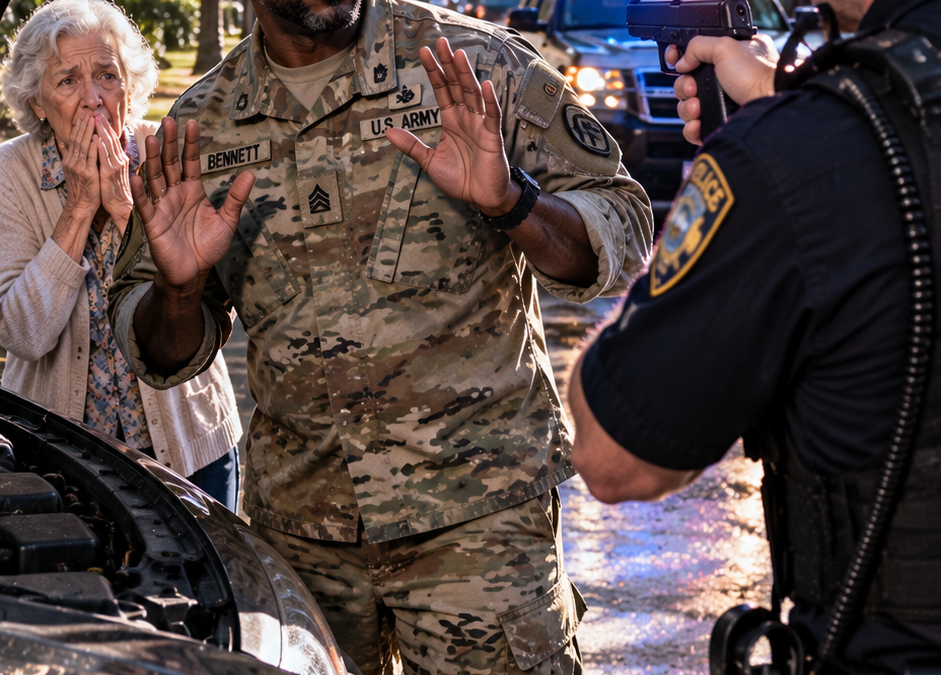
I released the sedan and moved back.
Evelyn immediately pointed toward me.
“He’s helping me. My engine died.”
Keller barely looked at her.
“Hands where I can see them.”
I raised both hands.
“Of course.”
He approached with his jaw clenched.
“Whose black SUV is that?”
“Mine. It’s parked behind your cruiser.”
“Turn around.”
I complied.
“I’m Staff Sergeant Marcus Bennett. United States Army. I’ve just come from a school presentation.”
He looked at my uniform.
“I don’t care what you’re wearing.”
I remember that sentence with remarkable clarity.
Not because I believed my uniform entitled me to special treatment.
It didn’t.
But I was standing in broad daylight with empty hands, beside an elderly woman who had already explained that I was helping her.
The officer hadn’t checked my identification.
He hadn’t asked Evelyn for a full account.
He hadn’t even looked at the license plate on my SUV.
Yet he was acting as though he’d already established that I was dangerous.
“Officer,” I said, “you can verify everything in thirty seconds.”
“I don’t need thirty seconds.”
“I haven’t done anything wrong.”
“You do exactly what I tell you, or I’ll put you on the ground myself.”
I took a slow breath.
The street around us suddenly seemed louder.
An engine accelerated past.
Somebody honked.
Evelyn kept insisting that I hadn’t done anything.
Officer Ramirez stepped closer to his partner.
“Ethan, we can just check.”
Keller ignored him.
I kept my hands raised.
Three miles away, my daughter was sitting inside her school auditorium.
I didn’t know that she was already watching the entrance, looking for me among the parents arriving for the ceremony.
I didn’t know Danielle had just adjusted one loose braid near her shoulder and told her I would be there.
And I didn’t know that Nia had answered, quietly, that I’d made the same promise before.
All I knew was that my telephone had started vibrating inside my cargo pocket.
I recognized the pattern immediately.
Nia.
I’d assigned her number a distinctive vibration so I could identify her calls without looking at the screen.
It buzzed once.
Then again.
I looked at Keller.
“Officer, my phone is ringing. It’s my daughter. I’m not reaching for it.”
“Keep your hands up.”
“They’re up.”
The phone vibrated again.
I shifted my shoulder slightly, a reflexive movement toward the sound.
Keller’s expression changed.
“Don’t move.”
I froze.
“My hands are visible.”
Officer Ramirez stepped forward.
“Ethan, he doesn’t have anything.”
Keller drew his pistol.
Everything inside me went cold.
I’ve been around firearms for most of my adult life.
I know how quickly a situation changes when somebody points one at another person.
The danger isn’t only the weapon.
It’s the person holding it, what they believe they’re seeing, and whether fear has already convinced them that violence is inevitable.
Keller’s arms were rigid.
His pistol was aimed directly at me.
Evelyn screamed.
“He is helping me!”
I held my hands high.
“Officer, I’m unarmed.”
“Turn around!”
I began rotating slowly.
I wanted him to see that my hands were empty.
I wanted to give him no movement he could reasonably interpret as a threat.
Leo stepped forward again.
“Ethan, lower the gun.”
I heard him clearly.
Then another voice came from somewhere near the intersection.
“Hey! What are you doing?”
A young pizza delivery driver had stopped his car.
His name was Tyler Brooks.
He was nineteen, skinny and freckled, wearing a red delivery cap with messy blond hair sticking out beneath it.
He raised his phone and began recording.
I didn’t look toward him.
I was still focused on Keller’s pistol.
I turned another few inches.
Leo shouted.
“Keller, don’t shoot!”
The gun fired.
For an instant, I felt nothing.
There was a violent pressure against my upper arm, followed by a sensation like somebody had struck me with a heated metal bar.
Then my right side erupted in pain.
My knees gave way.
I fell beside my SUV.
The pavement struck my shoulder.
I remember the terrible brightness of the afternoon sun.
Evelyn screaming.
Leo standing motionless.
The metallic smell of blood.
And my daughter calling again from the telephone inside my pocket.
Keller kept his gun aimed at me.
“Don’t move!”
I was already on the ground.
Blood was spreading through the fabric of my uniform.
My upper arm felt as if it were being torn apart from the inside.
But fifteen years of military training took over before I could surrender to panic.
I pressed my left hand against the wound.
Applied pressure.
Checked my breathing.
Tried to establish whether the bullet had damaged anything critical.
The pain along my ribs told me the projectile had grazed that area as well.
My right arm wasn’t responding properly.
I looked toward Keller.
“You just shot an unarmed man.”
His breathing was rapid.
His eyes moved between me, Leo, and Evelyn.
Then he raised his voice.
“He lunged at me!”
I stared at him.
“He made a sudden movement toward his waistband!”
Something in my stomach tightened more painfully than the gunshot wound.
I understood exactly what he was doing.
He wasn’t merely panicking.
He was beginning to construct an explanation.
An explanation in which the man bleeding on the pavement had somehow forced the officer to pull the trigger.
I looked toward Leo.
Our eyes met.
He’d seen everything.
And I could tell from his expression that he knew the words coming out of his partner’s mouth weren’t true.
Sirens approached.
The first supervisory vehicle stopped near my SUV.
Sergeant Harold Pike stepped out.
He was forty-nine, heavyset, with gray at his temples and a thick mustache.
He surveyed the scene with the practiced composure of a man accustomed to taking control when something went wrong.
Paramedics arrived.
Somebody knelt beside me.
A voice asked whether I could hear them.
I answered.
Another voice asked where I was hurt.
“Upper right arm. Possible rib injury.”
I was still applying pressure when the paramedics opened their equipment.
One of them looked at my uniform.
“Army?”
“Staff sergeant.”
“All right, Sergeant. We’re going to take care of you.”
I wanted to believe him.
I wanted to stop thinking.
But I couldn’t stop looking toward the two officers beside the cruiser.
Leo seemed stunned.
Keller was speaking urgently to Pike.
The paramedics lifted me onto a stretcher.
As they rolled me toward the ambulance, I heard Keller say something I would later remember with painful precision.
“My body cam malfunctioned.”
Pike glanced toward the scene.
Then he looked at Keller.
Leo lowered his eyes toward his own chest.
A small red light was blinking on his body camera.
It had never stopped recording.
I didn’t know that yet.
I wouldn’t learn it until much later.
At that moment, my entire world had narrowed to the ambulance doors, the pain in my shoulder, and the crushing realization that I was going to miss my daughter’s ceremony again.
When I woke properly, the world was white.
White ceiling.
White sheets.
Fluorescent lights.
A clear oxygen tube beneath my nose.
I could hear a monitor beeping somewhere beside me.
My mouth was dry, and pain seemed to pulse from my right shoulder all the way down my back.
I tried to move.
A sharp sensation tore through my arm.
“Don’t.”
Danielle’s voice.
I turned my head.
She was sitting beside the bed, both hands wrapped around my left hand.
She was still wearing the cream blouse and navy skirt she’d chosen for Nia’s ceremony.
Her mascara had smudged beneath her eyes.
One side of her carefully arranged hair had come loose.
I’d seen Danielle handle furious parents, frightened students, and families experiencing crises that would have overwhelmed most people.
But I’d never seen her look the way she looked at me that night.
As though she was afraid that if she blinked, I might disappear.
“Hey,” I whispered.
Her expression crumpled.
“Don’t you ever do that to me again.”
I tried to smile.
“I wasn’t planning on it.”
She shook her head.
Tears slipped down her cheeks.
I squeezed her hand.
“Where’s Nia?”
Danielle looked toward the doorway.
My daughter was standing just outside.
She was still wearing the dark green dress she’d chosen for her awards ceremony.
That hurt more than anything the surgeon had done to my arm.
“Hey, baby girl.”
She crossed the room.
Then she leaned over and hugged me so carefully that I almost wished she would squeeze harder.
For several seconds, she didn’t say anything.
I rested my good hand against her back.
“I’m sorry.”
She pulled away.
“What?”
“I promised I’d be there.”
Her eyes filled.
“Dad, you got shot.”
“I still promised.”
She looked at the thick bandage around my arm.
Then she looked at my face.
“Why did he shoot you?”
I opened my mouth.
Nothing came out.
I’d explained traumatic injuries to soldiers who were terrified of dying.
I’d taught young medics how to manage bleeding, shock, and airway emergencies.
I’d even helped men understand what happened to their bodies after they survived combat injuries.
But I couldn’t explain to my sixteen-year-old daughter why a police officer had shot me while I was helping an elderly woman.
“I don’t know,” I finally said.
Nia stared at me.
I hated that answer.
But it was the only honest one I had.
The surgeon explained that the bullet had missed my brachial artery by less than an inch.
It had torn through muscle in my upper arm and grazed my ribs.
I’d lost a significant amount of blood.
Twenty-three stitches held the damaged tissue together.
The surgeon told me repeatedly that I was fortunate.
I understood what he meant.
A slightly different trajectory could have changed everything.
But lying in that hospital bed, watching my wife and daughter try to hide their fear from me, I didn’t feel fortunate.
I felt angry.
Confused.
And profoundly exhausted.
Forty minutes later, we learned that the police department had already decided what happened on Magnolia Avenue.
A television mounted in the corner of my hospital room showed Sergeant Harold Pike standing behind the Savannah Police Department seal.
He spoke slowly and carefully.
“Officer Keller encountered an individual during an active investigation involving a potentially stolen vehicle. The individual failed to follow repeated commands and made a sudden movement consistent with reaching for a possible weapon.”
Danielle stared at the screen.
“He’s lying.”
Pike continued.
“Officer Keller responded to what he reasonably perceived as a potentially deadly threat.”
A preliminary incident summary appeared beneath his photograph.
According to the department, I’d behaved erratically.
I’d ignored multiple commands.
I’d moved suddenly toward my waistband.
And Keller had feared I was armed.
Then came the final statement.
Keller’s body camera had reportedly malfunctioned and failed to capture the shooting.
I stared at the television.
My pain seemed to recede for a moment.
Not because it was gone.
Because I was beginning to understand what was happening.
Danielle reached for the remote.
“Turn that off.”
“Wait.”
Pike was still speaking.
He assured reporters that the department would conduct a thorough investigation.
He asked the public not to rush to judgment.
He promised transparency.
I watched his face.
And I remembered hearing Keller tell him that his body camera had malfunctioned while paramedics were loading me into the ambulance.
Danielle finally turned off the television.
“They’re going to investigate, right?”
I stared at the dark screen.
“They’re building it.”
“Building what?”
“A version of what happened.”
She looked toward the hospital door.
Then back at me.
“What do we do?”
I thought about Evelyn.
I thought about Leo.
And I thought about the young delivery driver who’d raised his phone at the intersection.
“We make sure somebody remembers the truth.”
Across Savannah, Officer Leo Ramirez was discovering how expensive that decision could become.
I learned the details later.
Leo hadn’t slept after the shooting.
Every time he closed his eyes, he saw me falling beside the SUV.
He was twenty-six years old and had been on patrol for less than two years.
His father, Miguel Ramirez, had spent twenty-nine years in law enforcement before retiring.
Miguel had raised him to believe that police authority was borrowed from the public.
A badge wasn’t proof that a man was good.
It simply meant the damage could become much greater if he wasn’t.
The morning after the shooting, Pike summoned Leo to his office.
A typed statement was waiting on the desk.
“Read it. Sign it.”
Leo began reviewing the document.
He reached the third paragraph and stopped.
It said he’d observed me make a rapid movement toward my waistband immediately before Keller fired.
He looked up.
“I didn’t see that.”
Pike leaned back.
“You saw a fast movement.”
“I saw his shoulder move.”
“Toward his waistband.”
“No.”
Pike’s expression hardened.
“Keller has eleven years on this job. You’ve got twenty-two months.”
Leo didn’t answer.
“Don’t destroy your career over one second you think you remember differently.”
Leo looked down at the paper.
Then he pushed it back across the desk.
“I’m not signing that.”
He left without another word.
I wouldn’t learn about that conversation until later.
At the time, I was still in the hospital, watching the public debate about my shooting grow larger than anything I could control.
Tyler Brooks had uploaded his telephone video after his older sister persuaded him to preserve and share it.
The recording began too late to show Keller’s initial approach.
It showed his pistol already raised.
It showed Evelyn screaming.
It showed me turning.
It showed Leo stepping forward.
Then came the gunshot.
Forty seconds.
That was what millions of people watched.
Some immediately recognized that I’d been unarmed and cooperating.
Others argued that the recording didn’t show what happened before Keller drew his pistol.
Television commentators discussed whether he’d faced an immediate threat.
People who’d never met me began debating my character as if the moment I’d been shot had turned my entire life into a public question.
Reporters gathered outside our house.
Danielle returned home briefly to collect clothes and discovered microphones waiting near the driveway.
Flowers covered the porch.
Someone had left an American flag with a handwritten note thanking me for my service.
Another envelope contained a message calling me a criminal.
Danielle quietly handed it to the police without showing Nia.
I hated that my wife had to think about things like that.
But I hated even more that my daughter was beginning to discover how quickly strangers could turn a wounded man into whatever story suited them.
Our family wasn’t prepared for any of it.
Then an Army legal officer arrived at my hospital room.
Captain Olivia Chen.
She was thirty-two, slender, with straight black hair pulled tightly into a bun and rectangular glasses that made her already serious expression seem even sharper.
She introduced herself with a firm handshake.
“My job is to make sure nobody makes decisions about Staff Sergeant Bennett without somebody asking difficult questions.”
I liked her immediately.
She didn’t pretend the situation was simple.
She didn’t promise that the truth would automatically win.
She simply asked for a complete account of what happened, documented the information carefully, and began examining the official statements.
Meanwhile, Evelyn Parker decided she wasn’t going to let the police department erase the reason I’d been standing on Magnolia Avenue.
She appeared outside her home and told reporters that I’d stopped to help her move a disabled vehicle.
She explained that my hands had been visible.
That I hadn’t threatened anyone.
That I’d been cooperating when Keller drew his weapon.
Within hours, Pike’s office began privately characterizing her as an elderly witness who had been emotionally overwhelmed by the shooting.
When Olivia told me, I closed my eyes.
“They’re going after her too?”
“Her credibility,” Olivia answered. “They’re questioning whether she accurately understood what she saw.”
I looked at the bandage around my arm.
“She’s a retired nurse.”
“I know.”
“She’s spent more than thirty years recognizing emergencies.”
Olivia nodded.
“Which is why we’ll make sure her full statement is preserved.”
That same evening, Leo Ramirez logged into the department’s evidence portal.
His body-camera footage should have uploaded automatically after the shooting.
Instead, the system displayed a warning.
File corrupted. Playback unavailable.
Leo stared at the screen.
Then he remembered something.
His camera software created a temporary local cache during transfers.
He’d previously connected an encrypted backup drive while preparing a report.
He opened his personal laptop and searched the temporary files.
One remained.
He clicked it.
Magnolia Avenue appeared.
There I was beside Evelyn’s sedan.
My hands were raised.
Empty.
Keller drew his pistol.
And Leo heard his own voice shouting:
“Keller, don’t shoot!”
The gunshot followed.
Leo stopped the recording.
The official evidence file had been corrupted.
But a surviving copy preserved exactly what happened.
He sat staring at the image for a long time.
Then he shut the laptop.
He knew he couldn’t take the recording to Pike.
Not after the statement Pike had tried to make him sign.
And not after hearing Keller claim that his camera had malfunctioned.
Leo needed someone outside the department.
But first, he needed advice from the one person whose judgment he’d trusted all his life.
He drove to his father’s house.
Miguel was sixty-two, compact, with silver threaded through his dark hair and an old scar beneath his left ear.
Retirement had softened his appearance, but it hadn’t softened his standards.
When Leo was twelve, Miguel had once told him that a badge didn’t make somebody a good man.
It simply made the consequences worse when that person chose to become a bad one.
They sat together on the back porch.
Leo didn’t mention the surviving video.
He didn’t tell his father about Pike’s false statement.
He simply asked a question.
“What if telling the truth makes everybody you work with hate you?”
Miguel studied him for a long moment.
Then he answered.
“If they hate you because you told the truth, they were never your brothers. They were only people standing beside you.”
That night, Leo copied the surviving footage onto two encrypted drives.
Then he contacted the Georgia Bureau of Investigation.
Special Agent Rebecca Sloan met him privately.
She was forty-four, compact, with auburn hair cut near her jaw and the restrained expression of someone who didn’t waste time on unnecessary questions.
She’d spent fifteen years investigating officer-involved shootings and corruption complaints.
Leo explained what he’d witnessed.
He described Pike’s statement.
He told her the official body-camera file had been marked corrupted.
Then he handed her the drive.
Rebecca played it.
She watched me standing beside Evelyn’s sedan.
She watched Keller draw his pistol.
She heard Leo warn him.
Then she watched me fall.
When the video ended, she turned toward Leo.
“Does anybody at your department know you have this?”
“No.”
“Keep it that way for now.”
Eleven days after the shooting, I stood in a rehabilitation room at Memorial Health with my right hand wrapped around a rubber exercise ball.
“Go ahead,” my physical therapist said. “Squeeze.”
I tried.
My fingers trembled.
My shoulder burned.
The ball barely changed shape.
“Again.”
I took a breath and tried harder.
Pain shot through my upper arm.
I stopped.
For fifteen years, I’d used those hands to train soldiers in emergency medicine.
I’d demonstrated how to control catastrophic bleeding.
How to establish an airway.
How to start an IV while exhausted and frightened.
How to keep working when the person in front of you was depending on you to remain calm.
Now I could barely squeeze a rubber ball.
“Your nerves are intact,” the therapist reminded me. “The muscle needs time.”
I nodded like a soldier receiving instructions.
But inside, I was terrified.
Recovery might take months.
There was no guarantee my arm would regain its previous strength.
And I didn’t know what that meant for the career I’d spent my adult life building.
When I returned home, Danielle began helping me with things I’d once done without thinking.
Buttoning my shirt.
Putting on a jacket.
Opening certain containers.
I’d always prided myself on being physically capable.
Being dependent on somebody else for ordinary tasks was more difficult than I’d expected.
One morning, I struggled with a button until my shoulder began aching.
Danielle approached.
“Let me.”
“I’ve got it.”
“Marcus.”
“I said I’ve got it.”
She stepped back.
I stared at the button.
Then I dropped my hand.
“I’m sorry.”
She moved closer.
“I know you’re frustrated.”
I looked away.
“It’s a button.”
“It’s one button today.”
She gently took my good hand.
“You’re healing. That doesn’t mean you’ve stopped being yourself.”
I wanted to believe her.
But the man I’d been before Magnolia Avenue felt impossibly far away.
The next afternoon, Keller’s attorney appeared on television.
Grant Whitmore.
He was fifty-one, silver-haired, narrow-faced, and unusually skilled at making an accusation sound like a reasonable question.
He’d spent years defending officers involved in controversial shootings.
His strategy was immediately obvious.
He didn’t call me a criminal.
Instead, he reminded the public that I’d served in combat.
That I had extensive weapons training.
That I understood violence.
Then he suggested the public should consider whether my military background might have caused Keller to perceive my behavior as threatening.
I sat watching him from the living room.
He was turning my service into evidence against me.
Danielle took the remote and switched off the television.
“They’re putting you on trial before there is a trial.”
I stared at the sling across my chest.
“I don’t want revenge.”
“Good.”
She sat beside me.
“Because this stopped being about revenge a long time ago.”
I looked at her.
“If this had happened only to you,” she continued, “maybe we could heal and walk away. But it doesn’t look like it started with you.”
She was right.
Nia was discovering the same thing.
After the shooting, her media teacher, Hannah Cole, offered her a temporary break from the school journalism club.
Hannah had worked in television news for ten years before becoming a teacher.
She understood how easily complicated events could be compressed into a few seconds of footage and an argument about what viewers were supposed to believe.
“You don’t owe anyone a documentary about your father,” she told Nia.
My daughter shook her head.
“I don’t want to make one about him.”
“What do you want to make?”
“One about the thirty seconds before somebody decides you’re dangerous.”
She called the project 30 Seconds.
I worried when she told me.
She was sixteen.
She should have been thinking about school, friends, and the ordinary problems of being a teenager.
She shouldn’t have needed to understand police reports, public relations statements, or the difference between a partially edited video and a complete recording of a shooting.
“Baby, you don’t have to do this,” I told her.
“I know.”
“Your mother and I can handle the legal stuff.”
“I’m not trying to handle the legal stuff.”
“Then what are you doing?”
She looked at me.
“I’m asking people what happened to them when nobody was filming.”
That answer stayed with me.
Nia began interviewing delivery drivers, veterans, neighborhood residents, and people who had been stopped along Magnolia Avenue.
Three different people described encounters with Keller in which their vehicles had been searched without any citation being issued or a documented reason being provided.
Then she met Calvin Brooks.
He was forty-three, a Black Army veteran with a broad chest, a shaved head, and a prosthetic left leg hidden beneath his jeans.
He’d lost his leg in Afghanistan.
When he spoke, he did so with the measured patience of a man who had learned to choose his words carefully.
Keller had once drawn a gun on him during a traffic stop involving a temporary license plate.
“He kept asking where I stole my truck,” Calvin told Nia.
“Did you show him the paperwork?”
“I tried. He didn’t want to see it until another officer arrived.”
I watched the interview at our dining table.
Calvin’s expression barely changed as he described what happened.
That disturbed me more than anger would have.
He sounded like somebody discussing an unpleasant but familiar inconvenience.
Danielle stood beside me.
“She’s discovering a pattern,” she said.
I stared at the screen.
“I know.”
Olivia was finding additional discrepancies in Keller’s patrol history.
She reviewed his vehicle-stop reports from the previous eighteen months.
Seventeen had no matching dispatch call.
The stops existed on paper, but there was no corresponding radio record explaining why he’d initiated them.
Olivia spread the documents across our dining table.
“This doesn’t automatically establish corruption,” she said. “But it suggests repeated activity outside normal dispatch documentation.”
I looked at the locations.
Then at the dates.
Then at the officers involved.
Several stops had occurred outside Keller’s assigned patrol sector.
I didn’t yet understand why.
But I was beginning to suspect that what happened to me hadn’t started with an officer making a terrible split-second decision.
There was something underneath it.
Something that had brought him to Magnolia Avenue in the first place.
The following evening, Rebecca Sloan called Olivia and me to a secure conference room.
Leo Ramirez was already there.
He looked exhausted.
I hadn’t seen him since the shooting.
For several seconds, neither of us knew what to say.
Then he stood.
“Staff Sergeant Bennett.”
I nodded.
“Officer Ramirez.”
He looked at my sling.
“I’m sorry.”
I studied his face.
“You told him not to shoot.”
He lowered his eyes.
“I should have done more.”
Before I could answer, Rebecca approached the conference table.
“There’s something else on the recording.”
She activated the monitor.
Magnolia Avenue appeared again.
But this time, the footage began two minutes before Keller approached me.
We heard ordinary road noise.
Then Keller’s telephone connected through the patrol cruiser’s Bluetooth system.
A male voice spoke.
“The dark SUV just left Magnolia. Find it before somebody else does.”
Keller answered.
“Copy.”
Rebecca paused the video.
Leo leaned forward.
His expression changed.
“I know that voice.”
Rebecca looked at him.
“Who?”
“Sergeant Pike.”
The room became very quiet.
I stared at the screen.
For weeks, the department had claimed that Keller was responding to a possible stolen-vehicle alert.
But the recording told a different story.
He had received a direct telephone instruction from Pike.
An instruction to locate a dark SUV.
I looked toward Olivia.
My own vehicle had been parked behind Evelyn’s disabled sedan.
Dark paint.
Magnolia Avenue.
Exactly the description Pike had given Keller.
That night, Olivia spread a map of Savannah across my dining table.
She marked Keller’s assigned patrol zone.
Then she marked Magnolia Avenue.
The two locations were nearly four miles apart.
I traced the route backward with my finger.
“He wasn’t responding to the stolen-car call.”
Danielle stood beside me.
“Then why was he there?”
I looked at the photograph of my SUV clipped to the map.
“Because somebody sent him to find a vehicle.”
I paused.
“And he thought he’d found it.”
That realization frightened me in a different way.
Until then, I’d struggled to understand why Keller had approached me so aggressively.
Why he’d ignored Evelyn.
Why he’d been so interested in a dark SUV he hadn’t even checked.
Now the pieces were beginning to connect.
He’d been looking for something.
He’d seen a Black man standing near the kind of vehicle he’d been told to locate.
And he’d decided the search was over.
What he hadn’t done was establish whether I was the person he was actually looking for.
Rebecca Sloan stopped concentrating exclusively on Keller’s decision to fire.
She began examining Pike.
Olivia joined her in a secure records room where twelve months of property logs were spread across a steel table.
At first, the discrepancies looked like ordinary administrative errors.
Duplicate inventory numbers.
Weapons listed as destroyed without matching destruction certificates.
Transfer codes that didn’t correspond to identifiable receiving locations.
Then Olivia found item 19-4472.
A Glock 19.
It had been seized during a narcotics arrest three days before I was shot.
The weapon had been checked into the Savannah police evidence room.
Forty-eight hours later, it disappeared from the official records.
No theft report.
No supervisor notification.
No documented internal investigation.
Instead, the electronic entry had been changed twice.
First, the Glock was marked as transferred.
Then the record was changed again and classified as an inventory correction.
Rebecca examined the audit history.
“Who authorized those changes?”
Olivia looked at the screen.
“Harold Pike.”
The Georgia Bureau of Investigation expanded its inquiry.
Federal investigators from the FBI’s civil-rights and public-corruption teams joined the case.
Special Agent Nathan Cole arrived from Atlanta.
He’d spent eighteen years investigating public corruption and civil-rights violations.
Unlike many people involved in the local investigation, he had no long-standing professional relationships inside the Savannah Police Department.
That independence mattered.
Federal agents secured the evidence room under the appropriate authorizations.
Every visit required documented access.
Property transfers were examined against original records.
Before long, investigators discovered that the missing Glock wasn’t an isolated discrepancy.
Rifles.
Ammunition.
Seized cash.
Electronics.
Items had repeatedly disappeared from records before being explained away as clerical errors, transfers, destruction, or damaged property.
Some irregularities might have been mistakes.
But the larger pattern pointed toward deliberate theft.
Investigators began interviewing officers assigned to the evidence unit.
Two eventually requested attorneys and agreed to cooperate.
Officer Melissa Ward had worked in property control for four years.
She admitted altering inventory codes after Pike told her the changes were routine administrative cleanup.
Officer Grant Hayes, a fourteen-year veteran of the department, provided the missing connection.
According to Hayes, Keller had occasionally conducted unofficial traffic stops for Pike.
Pike called them ghost stops.
No dispatch.
No ordinary radio traffic.
No report unless something went wrong.
When investigators asked what those stops were intended to accomplish, Hayes described Pike’s use of Keller to intercept vehicles connected to his illegal transactions.
The missing Glock had been scheduled to move through Savannah in a dark SUV.
Pike wanted Keller to intercept it before a quarterly evidence audit exposed the theft.
That was why Keller had been sent to Magnolia Avenue.
He was looking for a weapon stolen from his own department’s evidence room.
Instead, he found me helping Evelyn Parker move her disabled sedan.
He saw my dark SUV.
He saw my skin color.
And he decided he had the right man.
He never checked the registration.
He never asked Evelyn what had happened.
He never established whether my vehicle had anything to do with the one Pike wanted.
Then he shot me.
The discovery changed the meaning of everything that had happened.
Keller hadn’t simply encountered me during an ordinary investigation and made a terrible judgment.
He’d been participating in an unofficial operation connected to Pike’s corruption.
And when his assumptions proved dangerously wrong, the people protecting that operation had attempted to rewrite the circumstances of my shooting.
While the investigators worked privately, Evelyn decided she’d had enough of being described as a confused elderly witness.
She’d refused most interview requests after the shooting.
But when she heard how Pike’s office was characterizing her account, she invited reporters to her home.
She stood before three television cameras wearing a pale blue blouse, her silver curls neatly arranged.
Her hands were shaking.
Her voice wasn’t.
“I spent more than three decades caring for frightened people,” she said. “I know what confusion looks like.”
She looked directly into the cameras.
“I was not confused.”
She paused.
“The only man protecting me that afternoon was the man the police shot.”
The recording spread rapidly.
For the first time, people who’d dismissed her testimony as unreliable were confronted with a woman who refused to let somebody else define what she’d witnessed.
Danielle watched the interview beside me.
“She’s tougher than all of them.”
I smiled faintly.
“She tried to tell Keller what happened before he ever drew his gun.”
My wife shook her head.
“And he wouldn’t listen.”
She was right.
That failure had become a recurring theme in the investigation.
People offering explanations.
Officers refusing to hear them.
Records being adjusted afterward to make those refusals appear justified.
Danielle began keeping a detailed evidence file of her own.
Every threatening voicemail.
Every anonymous email.
Every suspicious letter.
Every inappropriate reporter contact.
She recorded dates, times, and the circumstances surrounding each incident.
As a high school counselor, she’d spent years teaching students that documentation mattered when powerful adults denied what happened.
Now she was applying that lesson to our family.
Nia continued filming too.
During an interview for 30 Seconds, she met Raymond Ellis, a fifty-eight-year-old tow-truck operator with weathered hands and a gray beard.
He’d spent decades responding to crashes, breakdowns, and police requests.
Nia originally wanted to ask him about traffic stops.
Instead, he mentioned Sergeant Pike.
Raymond said he’d once seen officers searching a vehicle behind an abandoned warehouse.
When Pike discovered that he’d witnessed the encounter, he told Raymond to forget what he’d seen.
Nia asked whether Pike had threatened him.
Raymond hesitated.
Then he said Pike had reminded him that towing contracts could disappear.
My daughter let the camera keep rolling.
She didn’t interrupt.
She’d learned that sometimes the most important answer came after a witness had enough silence to decide whether to continue.
When Danielle showed me that interview, I felt a mixture of pride and dread.
Pride because Nia was developing into an extraordinary young filmmaker.
Dread because my sixteen-year-old daughter was discovering details about a corruption investigation involving the man who’d shot her father.
I wanted to protect her from it.
But I couldn’t pretend she hadn’t already been dragged into the consequences.
She’d stood beside my hospital bed in her awards-ceremony dress.
She’d listened to strangers suggest that I might have been dangerous.
She’d watched her mother document threats.
And she’d begun interviewing people who described experiences disturbingly similar to mine.
I couldn’t give her back the innocent version of that afternoon.
All I could do was make sure she knew she didn’t have to carry the entire investigation on her shoulders.
“Baby,” I told her one evening, “you can stop filming whenever you want.”
She looked up from her laptop.
“I know.”
“Your mom and I will be all right.”
She studied me.
Then she said, “I’m not doing this because I think you can’t handle it.”
“Then why?”
“Because everybody keeps arguing about the moment he fired.”
She turned the laptop toward me.
On the screen were images of ordinary hands.
A delivery driver holding car keys.
A veteran gripping a folded military discharge document.
A woman resting her fingers against a steering wheel.
“I want people to think about what happened before that.”
I looked at my daughter.
For a moment, I saw the little girl who used to follow me around the house with a toy camera, narrating every ordinary thing I did.
Now she was creating something I never could have imagined.
And I realized I wasn’t protecting her by pretending she should remain untouched by what happened to our family.
I was protecting her by making sure she knew the truth and had the freedom to decide what she wanted to do with it.
Leo Ramirez was paying a much more immediate price for telling the truth.
Someone inside the department learned he’d cooperated with investigators.
Officers stopped sitting beside him at roll call.
Conversations ended whenever he entered a room.
People who’d once treated him like a younger brother suddenly refused to meet his eyes.
One morning, he opened his locker and found three red letters written across the inside door.
RAT.
He stood staring at them.
His hands began shaking.
Two days later, I went to see him.
My right arm was still stiff.
Physical therapy had restored some movement, but reaching above shoulder height remained painful.
Leo looked at the sling I’d begun using less frequently.
“I should have stopped him.”
I shook my head.
“You told him not to shoot.”
“I should have done more.”
I studied him.
I knew that feeling.
I’d spent enough years training combat medics to understand what happens when somebody survives a terrible event and begins replaying every second, searching for the movement or decision that might have changed the outcome.
But guilt isn’t always a reliable measure of responsibility.
“You didn’t pull the trigger,” I told him.
He looked away.
“What matters now is what kind of officer you decide to be after knowing what happened.”
He looked back at me.
For several seconds, neither of us spoke.
Then he nodded.
That evening, Leo cleaned the word from his locker.
He couldn’t control what his colleagues thought of him.
But he could decide whether their approval was worth becoming the kind of officer his father had warned him about.
Forty-eight hours later, investigators secured the final piece of evidence connecting Keller to Pike’s operation.
Federal agents executed a search warrant at the home of Vernon Hail.
Vernon was fifty-three, an illegal gun broker with a shaved head, thick forearms, and a reputation for distrusting everybody he dealt with.
Inside a locked cabinet beneath his garage workbench, investigators found the missing Glock.
They also recovered his telephone.
One message had been sent shortly before I was shot.
Pike says Keller will handle the street side.
Rebecca read it carefully.
The message confirmed what the earlier evidence had suggested.
Keller hadn’t accidentally stumbled into Pike’s corruption.
He’d already been involved in it.
And on Magnolia Avenue, his assumptions had led him to target the wrong driver.
As the investigation moved toward prosecution, I found myself preparing for something I hadn’t anticipated.
I’d been shot.
I’d undergone surgery.
I’d endured weeks of rehabilitation.
And now I had to take the witness stand while Keller’s attorney tried to convince a jury that I might have been dangerous enough to justify the gunshot.
The federal courthouse in Savannah was crowded before sunrise on the first day of the trial.
Television cameras lined the steps.
Reporters gathered near the entrance.
By nine, nearly every seat in courtroom 3A was occupied.
I sat beside Assistant U.S. Attorney Rachel Monroe.
She was forty-two, with shoulder-length dark hair and the controlled patience of someone who preferred carefully established evidence to dramatic speeches.
Across the aisle, Keller wore a charcoal suit instead of his police uniform.
Without the badge, gun belt, and tactical vest, he looked smaller than I remembered.
Grant Whitmore sat beside him, reviewing his notes.
Danielle and Nia were in the gallery.
I glanced toward them before taking the stand.
My daughter gave me a small nod.
I returned it.
Then I raised my right hand as far as my recovering shoulder allowed and swore to tell the truth.
Whitmore’s strategy became clear almost immediately.
He didn’t begin with Magnolia Avenue.
He began with Afghanistan.
“Staff Sergeant Bennett, you’ve participated in combat operations.”
“Yes.”
“You have extensive training with rifles, pistols, knives, and close-quarters combat techniques.”
“Yes.”
“You’ve physically subdued armed men when necessary.”
“Yes.”
He walked slowly before the jury.
“And you’re capable of killing a man with your bare hands. Correct?”
I heard somebody shift in the gallery.
I knew what he was trying to do.
He wanted the jury to picture me not as a man helping an elderly woman, but as a trained combat soldier capable of extraordinary violence.
I looked directly at him.
“Possibly.”
He paused.
Several jurors shifted in their seats.
“So Officer Keller was facing a man capable of extraordinary violence.”
I remained still.
“Being capable of something and choosing to do it are different things.”
His smile faded slightly.
I continued.
“That’s something everybody carrying a weapon should understand.”
The courtroom became very quiet.
Whitmore changed direction.
He questioned why I’d shifted my shoulder.
Why my phone had been vibrating.
Why I’d continued speaking after Keller ordered me to stop.
I answered every question as accurately as I could.
My daughter had been calling.
I’d told Keller I wasn’t reaching for the phone.
My hands were visible.
I’d been turning slowly because he’d ordered me to turn.
I hadn’t threatened him.
I hadn’t reached for a weapon.
I hadn’t possessed a weapon.
And I’d been helping Evelyn move a disabled vehicle before his cruiser arrived.
When I stepped down from the witness stand, I felt physically exhausted.
My shoulder ached from sitting so long.
My throat was dry.
But I’d told the jury everything I remembered.
The next morning, Leo Ramirez walked into the courtroom wearing his dress uniform.
I watched him take the witness stand.
He looked nervous.
But his voice remained steady when Rachel began questioning him.
“Did Staff Sergeant Bennett comply with the commands you heard Officer Keller give?”
“Yes.”
“Were his hands visible?”
“Yes.”
“Did you observe a weapon?”
“No.”
She paused.
“At the moment Officer Keller fired, did Staff Sergeant Bennett present an immediate deadly threat?”
Leo swallowed.
Then he answered.
“No.”
Whitmore objected.
The judge allowed the testimony to stand.
Rachel continued.
“Did anyone later ask you to change your account of what you observed?”
“Yes.”
“Who?”
“Sergeant Harold Pike.”
A murmur moved through the courtroom.
I looked toward Keller.
He was staring at the defense table.
Then Rachel introduced the surviving body-camera recording.
Magnolia Avenue filled the large monitor.
I saw myself standing beside Evelyn’s sedan.
My Army uniform.
My empty hands.
Keller raising his pistol.
My body turning slightly.
Then Leo’s recorded voice filled the courtroom.
“Keller, don’t shoot!”
The gunshot followed.
Even though I’d seen the recording before, my body reacted.
My shoulder tightened.
My pulse accelerated.
For an instant, I was back on the pavement, pressing my left hand against the wound while Keller shouted that I’d lunged toward him.
Nia flinched in the gallery.
Danielle wrapped an arm around her.
When the recording ended, the courtroom remained silent.
There was no mysterious waistband movement.
No hidden weapon.
No sudden attack.
Just an unarmed man complying with police commands before being shot.
Rachel wasn’t finished.
The prosecution’s digital-forensics analyst presented the dispatch records associated with the supposed stolen-vehicle investigation.
Keller’s original report claimed he’d responded to a robbery-related alert in the Magnolia Avenue area.
The timestamp told a different story.
The alert had been entered at 4:48 p.m.
I’d been shot at 4:37.
Eleven minutes earlier.
Rachel projected both times onto the screen.
The alert Keller claimed had brought him to Magnolia Avenue hadn’t existed when he pulled the trigger.
Whitmore objected to the prosecution’s characterization.
But the evidence remained.
Investigators traced the late entry to credentials used from Pike’s office.
Combined with the recovered telephone message, the missing Glock records, the surviving body-camera footage, and testimony about Pike’s ghost stops, the actual reason for Keller’s presence became clear.
He hadn’t been investigating a legitimate stolen-vehicle report.
He’d been sent to intercept a dark SUV connected to stolen police evidence.
And when he saw me beside Evelyn’s sedan, he’d decided I was the person he wanted.
What happened afterward wasn’t a misunderstanding the department had been unable to explain.
It was a shooting followed by a fabricated explanation.
While the trial continued downtown, Nia completed her documentary.
She’d changed its name.
She no longer called it 30 Seconds.
The final title was Hands Visible.
She refused to make me the center of the film.
Instead, she brought together the people she’d interviewed.
Delivery drivers.
Veterans.
Nurses.
Mechanics.
Students.
Neighborhood residents.
People who’d been judged before anyone listened to their explanations.
Calvin Brooks appeared without dramatic music.
He sat before the camera and described Keller pointing a pistol at him over a temporary license plate.
Evelyn spoke about fear and the man who’d stopped to help her.
Raymond Ellis explained what happened when Pike pressured him to forget something he’d witnessed.
Between interviews, Nia used long shots of ordinary hands.
Hands holding grocery bags.
Hands resting on steering wheels.
Hands carrying car keys.
Hands holding military discharge papers.
The people weren’t presented as symbols.
They were simply people whose ordinary activities had become suspicious to someone who’d already decided what they must have done.
I watched the finished film from the last row of her high school auditorium.
Danielle sat beside me.
The same building where my daughter had received an award on the afternoon I was shot.
The same doors I’d promised to walk through.
When the credits appeared, the audience stood.
People applauded.
I remained seated for a moment because I couldn’t stop crying.
It was the first time Nia had seen me cry since the shooting.
Not because my arm hurt.
Not because the memory had overwhelmed me.
But because my daughter had taken the worst experience of our lives and created something that belonged to more than our family.
She’d made room for people whose stories had been ignored.
She’d shown their faces.
And she’d allowed them to speak for themselves.
Nia looked toward the back of the auditorium.
Our eyes met.
I stood.
Then I applauded until my recovering shoulder ached.
Three days later, the jury returned its verdict.
Guilty of unlawful use of force.
Guilty of falsifying an official report.
Guilty of conspiracy to obstruct the investigation.
Keller closed his eyes after the third verdict.
I didn’t feel the enormous rush of satisfaction I’d imagined I might.
I felt tired.
I felt relieved.
And I felt an almost overwhelming desire to go home with my family.
Pike’s corruption case had been separated from Keller’s trial.
Federal prosecutors announced new charges against him involving theft of evidence, illegal firearms trafficking, obstruction of justice, and conspiracy to falsify police records.
The cooperating officers continued helping investigators identify other questionable traffic stops and missing evidence.
The process wasn’t finished.
But Keller’s attempt to rewrite the shooting had failed.
Outside the courthouse, reporters gathered around me.
One shouted over the others.
“Staff Sergeant Bennett, do you feel like you won today?”
I stopped.
My right sleeve was rolled slightly above the scar where Keller’s bullet had entered my arm.
I looked at it for a moment.
Then I looked toward the cameras.
“Nobody wins when a man wearing a badge forgets why he was given it.”
I turned toward Danielle and Nia.
My daughter took my good hand.
My wife slipped her arm around my waist.
And we walked away from the courthouse together.
Eight months after the shooting, I stood in front of our bedroom mirror and raised my right arm above my head.
It still hurt.
The sharp pain that had once woken me in the middle of the night was gone, but a deep pulling sensation remained beneath the scar.
My doctors said I’d recovered nearly ninety percent of my strength.
The improvement had come slowly.
Physical therapy.
Repeated exercises.
Days when my arm responded almost normally.
Other days when a simple movement reminded me that damaged muscle didn’t care how determined I was.
The Army offered me a return to my previous position training combat medics.
I considered it seriously.
I’d loved that work.
Teaching young soldiers how to keep people alive had given meaning to every difficult experience I’d endured during my service.
But I also knew that I wasn’t exactly the same man who’d walked into that Savannah high school eight months earlier.
Magnolia Avenue had changed the way I thought about decision-making under pressure.
I’d always taught soldiers to control panic when another person’s life depended on their judgment.
Now I understood that lesson from a different perspective.
I’d been the person lying on the ground while someone else allowed fear and assumption to override discipline.
I declined the return to my former assignment.
But I didn’t leave the Army.
Walking away would have felt too much like allowing Keller’s decision to determine the rest of my life.
Instead, I accepted a new assignment developing training in trauma response and decision-making under extreme stress.
The work combined battlefield medicine with lessons about threat assessment, restraint, communication, and the responsibilities that come with carrying authority.
I never hid my scar.
Sometimes, when I spoke to a class, I’d roll up my sleeve and show it.
Then I’d explain that every person carrying a weapon needed to understand the difference between feeling threatened and confronting an actual threat.
Fear was real.
But it wasn’t evidence.
And uncertainty wasn’t permission to stop thinking.
Danielle noticed the changes in me before I did.
I started sleeping better.
I stopped checking the rearview mirror every time a police cruiser appeared behind us.
Some habits remained.
I still noticed exits in restaurants.
I still watched people’s hands.
Sometimes an unexpected loud noise made my shoulder tighten before my mind understood what I’d heard.
But the constant tension began loosening.
Danielle never demanded that I forget Magnolia Avenue.
She’d spent years counseling young people through experiences that changed how they understood the world.
She knew recovery didn’t mean pretending something terrible had never happened.
It meant reaching a point where the memory no longer controlled every decision afterward.
Nia was changing too.
Hands Visible had been selected for a statewide student film competition.
On a warm Saturday evening, we traveled to Atlanta for the awards ceremony.
Danielle and I took our seats in the front row.
Nia spotted us from the aisle.
She smiled.
Then she looked directly at me.
“You’re staying this time, right?”
I smiled back.
“Front row. Best seat in the house.”
She pointed toward my phone.
“No emergencies?”
I took it out.
A work message had just arrived.
For half a second, the old instinct returned.
Read it.
Respond.
Handle the problem.
Then I remembered the green dress she’d worn in the hospital.
The tears she’d tried to hide.
And the promise I’d been unable to keep.
I held down the power button until the screen went dark.
“Nothing’s making me miss this one.”
Danielle raised an eyebrow.
Then she smiled.
When Nia’s name was announced as the winner, I was on my feet before anyone else.
She walked toward the stage with tears already filling her eyes.
She accepted the award.
Then she looked into the audience.
And there I was.
Standing in the front row.
Applauding with both hands.
My right shoulder hurt.
I didn’t care.
When she saw me, she laughed through her tears.
For the first time in a long while, I felt something that had nothing to do with surviving the shooting.
I felt like a father who’d finally kept his promise.
Across Savannah, Leo Ramirez was keeping a different promise.
The official investigation had cleared him of misconduct and confirmed that preserving the body-camera footage had prevented crucial evidence from disappearing.
Some of his former colleagues eventually apologized for turning against him.
Others never did.
He learned he could live with that.
He transferred from patrol to the department’s training division.
On his first morning with a class of recruits, he placed a body camera on the desk.
The students stared at it.
“This isn’t your enemy,” he told them.
He allowed a moment of silence.
“If you do your job correctly, this might be the only witness in the world willing to prove it.”
Then he added something that would become central to the way he taught.
“And if you do your job wrong, it should prove that too.”
The department had changed because pretending nothing had happened was no longer possible.
Body-camera footage now uploaded automatically to an independent cloud system.
Supervisors could no longer personally classify recordings as corrupted or delete files without outside review.
Evidence-room transfers required dual authorization.
Traffic stops initiated outside dispatch procedures needed documented explanations.
The civilian review board received expanded access to complaints and disciplinary records.
And old cases connected to Keller and Pike were reopened.
Some produced no new findings.
Others did.
Several people who’d spent years being told their complaints lacked evidence finally received formal acknowledgments, settlements, or corrected records.
Those changes couldn’t undo what happened on Magnolia Avenue.
They couldn’t give me back the months I’d spent in pain.
They couldn’t erase the fear in my daughter’s face when she walked into my hospital room.
But they made it harder for the same misconduct to disappear beneath paperwork.
One Sunday afternoon, Nia and I were driving home after buying groceries.
Traffic slowed near Magnolia Avenue.
I recognized the intersection before she said anything.
The shoulder where Evelyn’s sedan had stalled.
The stretch of pavement where I’d fallen.
The place where my life had divided into everything before the gunshot and everything afterward.
Nia looked through the passenger window.
Then she turned toward me.
“Dad?”
“Yeah?”
“Do you hate him?”
I knew exactly who she meant.
For several seconds, I kept my eyes on the road.
“I did.”
“Not anymore?”
I thought about Keller.
About his gun.
About Pike’s false report.
About the pain in my arm and the months of rehabilitation.
Then I thought about the enormous amount of time I’d already spent living inside the consequences of one man’s decision.
“If I spend the rest of my life thinking about Keller,” I said, “then he still gets to take something from me.”
Nia studied my face.
“So what do you think about instead?”
I glanced toward her.
“The things he didn’t take.”
She waited.
“My family. My name. My future.”
Her expression softened.
The traffic light changed.
I drove forward.
A few weeks later, I returned to the same high school I’d visited on the afternoon everything began.
Nia sat among the students this time.
I stood onstage in uniform.
My scar was hidden beneath my sleeve, but I wasn’t pretending it didn’t exist.
The students asked questions about leadership, military service, and decision-making under pressure.
One asked whether the shooting had made me regret helping Evelyn.
“No,” I answered immediately.
“Why not?”
“Because she needed help.”
The student looked thoughtful.
“But you almost died.”
“I know.”
“Would you stop again if the same thing happened?”
I considered the question.
Then I looked toward my daughter.
“I’d still help someone in danger. I’d also hope that every person involved remembered their responsibility to keep the situation safe.”
Another student asked what I’d learned.
I thought about Keller.
About Leo.
About the moment my daughter walked into the hospital wearing her awards-ceremony dress.
Then I answered.
“Power isn’t proved by what you can do to someone weaker than you. It’s proved by what you choose not to do when you have the ability to hurt them.”
The room became quiet.
I looked across the rows of young faces.
“Anybody can become frightened. Anybody can make a mistake. But when somebody else’s life depends on your judgment, you don’t get to stop thinking just because you’re afraid.”
After the presentation, I walked into the parking lot.
Leo was there beside a patrol cruiser, finishing a workshop with student volunteers.
We spotted each other at almost the same moment.
For several seconds, neither of us spoke.
Then he approached and offered his hand.
I shook it.
There was no wounded man on the pavement.
No officer standing over him.
No gunshot.
Just two men who’d been trapped inside the same terrible moment and had refused to let it determine the rest of their lives.
Across the parking lot, Nia raised her camera.
I laughed.
“Not everything needs to be a documentary.”
She grinned and kept filming.
Danielle walked up beside me and slipped her hand into mine.
I looked at my daughter.
Then at my wife.
The afternoon sunlight fell across the quiet school parking lot.
For a moment, I remembered another afternoon.
A stalled silver sedan.
An elderly woman who needed help.
A police officer whose assumptions had been more dangerous than anything I’d done.
And a telephone vibrating in my pocket because my daughter was waiting for me.
I couldn’t change what had happened.
I couldn’t recover the ceremony I’d missed or erase the scar beneath my uniform.
But I could decide what happened next.
I opened the passenger door for Danielle.
Waited for Nia to climb into the back.
Then I took one last look across the parking lot.
No sirens followed us.
Nobody ordered me to raise my hands.
And when my daughter asked whether we could stop for lemon cake on the way home, I didn’t have to make a promise I wasn’t sure I could keep.
I simply smiled, started the engine, and took my family home.








