𝗙𝗨𝗟𝗟 𝗦𝗧𝗢𝗥𝗬 The Lakehouse Wasn’t Even Framed Before the HOA Decided My Deed Didn’t Matter
𝗙𝗨𝗟𝗟 𝗦𝗧𝗢𝗥𝗬
She stared at me.
The crew had gone quiet. Even the equipment seemed quieter, idling in the background while this woman tried to extend invisible lines across land she did not own.
My contractor stepped closer but did not speak. I appreciated that. This was not his argument to handle.
Karen lowered the clipboard.
“If you continue construction,” she said, “our attorneys will become involved.”
“Then they can bring recorded documents,” I said.
Her face flushed.
“You’re making this unnecessarily difficult.”
“No,” I said. “I’m making it accurate.”
For a moment, neither of us moved.
The lake behind her glittered in the late morning sun. Beyond the water, the HOA homes sat in neat rows, their windows flashing bright and blank. I wondered how many of those homeowners believed the association owned more than it did simply because Karen said so with confidence.
She stepped backward, still watching me.
“This is not over.”
“I didn’t start it,” I said.
She turned and walked back toward the white SUV.
Nobody spoke until she pulled away.
My contractor exhaled through his nose.
“Well,” he said. “That didn’t take long.”
“No,” I said. “It didn’t.”
“Want us to keep going?”
I looked down at the survey in my hands.
There are moments when life tests whether your confidence is real or just something you said when nobody was pushing back. I knew the documents. I knew the boundary. I knew the county had approved the preliminary work. But knowing all of that did not make the threat disappear. Lawyers cost money. Delays cost money. Stress has a way of making clear facts feel shaky if someone repeats a lie loudly enough.
I folded the survey and put it back in the folder.
“Keep going,” I said.
The crew returned to work.
I stayed on-site the rest of the day.
Not because I needed to supervise the clearing. My contractor knew his job. I stayed because the property suddenly felt vulnerable. One hour earlier, it had been a lakefront lot. Now it felt like a line in the sand.
That evening, after the crew left, I walked the perimeter alone.
The survey stakes stood in the ground like small declarations. The orange flags moved in the breeze. I stopped near the corner closest to the HOA boundary and looked toward the neighborhood. Someone across the way was watering a lawn already green enough to look artificial. A golf cart hummed along the private road. A man walking a small dog paused and looked in my direction for too long before moving on.
I could feel the machinery beginning behind the scenes.
Phone calls. Emails. Outrage. The familiar rhythm of people deciding that because they had gathered in a group, their preference had become law.
I went home and spread my documents across the kitchen table.
I read everything again.
The deed named the lot clearly. The county parcel map matched the survey. The title report listed no HOA membership. No architectural committee. No covenant tied to Lakeside Preserve. There was an easement noted near the shoreline, but it had appeared during my purchase review, and my surveyor had explained it carefully. It related to limited shoreline access and utility maintenance in a separate area. It did not cross the building site. It did not grant design control. It did not put my house under HOA approval.
Still, I read it all again.
That is what threats do. They force you to re-check what you already know.
The next morning, the attorneys arrived.
Two of them.
They pulled up in a black sedan, dressed as if they were walking into court rather than onto a muddy construction site. Both carried expensive leather folders. One had silver hair and a practiced smile. The other was younger, taller, and kept looking at his shoes as if he regretted wearing them.
Karen followed in her SUV and parked behind them.
That detail told me everything.
The lawyers were not there to discover the truth. They were there to give her confidence a legal costume.
I met them near the temporary driveway.
The older attorney extended his hand.
“I’m Richard Hale, counsel for Lakeside Preserve Homeowners Association.”
I shook his hand once.
The younger man nodded. “Matthew Price.”
Karen stood slightly behind them, arms folded.
Hale opened his folder.
“We understand you’ve begun construction-related activity on property adjacent to the Lakeside Preserve community.”
“On my property,” I said.
“Adjacent property that directly affects the Lakeside Preserve shoreline environment.”
“My property,” I repeated.
He gave a soft, professional laugh.
“I don’t think anyone is disputing that you purchased the parcel.”
“That’s generous,” I said. “Yesterday your HOA president ordered my crew to stop work.”
Karen’s eyes sharpened.
Hale raised one hand slightly, as if calming a child.
“We’re here to avoid escalation.”
“No,” I said. “You’re here because your client wants control over land she doesn’t control.”
The younger attorney finally looked up.
“Let’s keep this productive.”
“I would love that,” I said. “Identify the legal boundary you believe gives the HOA authority over my lot.”
Hale’s smile thinned.
“The association has long maintained regulatory interests around the lakefront.”
“Regulatory interests are not property rights,” I said.
He paused.
That pause mattered.
A person who has the document answers quickly. A person who has language instead of proof reaches for another sentence.
“The lake is a shared visual and environmental resource,” he said. “Construction along its edge affects every resident.”
“I’m not debating whether people can see the lake,” I said. “I’m asking where the HOA boundary is.”
I pulled my survey from the folder and held it out.
“Show me.”
Hale looked at it, but did not take it.
Price took it instead. He unfolded the survey across the hood of my truck, smoothing the corners with his palms. I watched his eyes move over the lines, parcel number, bearings, distances, and the marked HOA boundary to the west.
He knew.
I saw it before he said anything.
Hale stepped beside him. Karen did not move closer. She kept her distance, as though proximity to the survey might contaminate her argument.
“This is the recorded survey?” Price asked.
“Yes.”
“Prepared before closing?”
“Yes.”
“And this is the subdivision boundary?”
“That’s right.”
He said nothing for several seconds.
I pointed to the line.
“My lot is here. Lakeside Preserve ends there. If you believe that is wrong, show me the recorded document.”
Hale adjusted his cuffs.
“The association may challenge the scope of your proposed construction.”
“Based on what?”
“Community restrictions.”
“Which do not apply to my lot.”
“That is your position.”
“That is the recorded position,” I said. “There is a difference.”
Karen stepped forward then.
“You knew this property was beside our community when you bought it.”
“Yes,” I said. “Beside. Not inside.”
“The lakefront has always been protected.”
“Then protect what you own.”
Her face hardened.
Hale spoke before she could.
“We are not making an ownership claim at this time.”
“At this time,” I repeated.
His eyes flickered.
“That is not what I meant.”
“It sounded very careful,” I said. “So let’s be equally careful. Are you claiming Lakeside Preserve owns any portion of my building site?”
“No.”
“Are you claiming my parcel is included in the recorded HOA subdivision?”
He hesitated.
“No, not in the recorded subdivision as such.”
“As such,” I said.
Price looked uncomfortable.
Hale closed his folder.
“What we are saying is that restrictive standards may still apply based on the property’s relationship to the development and lakefront district.”
“Then show me where that obligation was recorded against my deed.”
Nobody answered.
It was a simple request. That was why it worked.
People can argue about taste forever. They can argue about community values, design harmony, scenic protection, tradition, precedent, and intent until everyone in the room forgets the original question. But property records are not supposed to be poetry. Either an obligation is recorded, or it is not. Either a boundary includes a parcel, or it does not. Either an easement grants rights, or it does not.
I looked at the two attorneys.
“I did my homework before I bought this lot,” I said. “The deed, the survey, and the county parcel map all show the same thing. My property is separate from the HOA development. So I’m going to ask one question.”
Hale’s face remained neutral.
“Show me where I’m wrong.”
The younger attorney looked down at the survey again.
Hale said, “We’ll need time to review the records more thoroughly.”
“You can review whatever you want.”
“During that review, we request that construction activity pause.”
“No.”
Karen’s head snapped toward me.
“No?” she said.
“No,” I said. “You don’t get to stop my project because you arrived unprepared.”
Hale’s voice lowered.
“You should consider the legal expense of proceeding in the face of a dispute.”
“And you should consider the legal expense of interfering with property you can’t prove you control.”
Silence spread across the site.
Behind us, a worker shifted his weight. Somewhere near the lake, a bird called from the reeds. The wind moved across the raw ground, carrying the smell of cut brush and damp soil.
Hale gathered the survey and handed it back.
“We’ll be in touch.”
“I expect you will.”
They left together.
Karen was the last to turn away. Before she got into her SUV, she looked back toward the marked foundation site as if the flags offended her personally.
I watched them drive off.
My contractor came over a minute later.
“That sounded expensive,” he said.
“It was supposed to.”
“You still want us working?”
I looked at the cleared site.
“Yes.”
The truth was, I did not feel fearless.
I felt angry.
There is a difference.
Fear makes you shrink from a threat. Anger makes you stand still long enough to inspect it. I had no interest in spending my savings on lawyers because an HOA president disliked being told no. I did not want months of delay. I did not want a legal cloud over my land before the foundation was even poured.
But I also knew what would happen if I gave them the pause they wanted.
A pause would become a review.
A review would become a committee.
A committee would become conditions.
Conditions would become concessions.
And one day I would wake up living under rules I had never agreed to because I had been polite enough to let someone trespass on my rights in small steps.
So the work continued.
The next day, the formal notice arrived.
It came by certified mail and email, because intimidation apparently wears both belt and suspenders.
The subject line read: NOTICE OF VIOLATION AND DEMAND TO CEASE CONSTRUCTION ACTIVITY.
I stood in my kitchen reading it with a cup of coffee going cold beside me.
The letter stated that my “ongoing development activity” violated Lakeside Preserve’s community restrictions, architectural standards, and lakefront preservation policies. It demanded that I stop all work immediately pending review by the HOA architectural committee. It warned that failure to comply could result in “further legal action, including but not limited to injunctive relief, damages, attorney’s fees, and all available remedies.”
It was written to sound final.
It was not.
I read it twice.
Then I set it beside my survey and read the survey again.
That became the pattern of those first days. Threat, then record. Noise, then fact. Claim, then line.
The letter used the word “community” eleven times. It used the word “preservation” seven times. It used the word “boundary” once, and only in a sentence vague enough to avoid admitting where the actual boundary was.
That told me what I needed to know.
I scanned the letter and sent it to the real estate attorney I had used during closing. Then I called my contractor.
“Any issue with today?” he asked before I could speak.
“No,” I said. “Keep going.”
“You got another letter?”
“Official demand.”
He was quiet for a second.
“You sure?”
“I’m sure.”
The crew resumed foundation preparation that morning.
By noon, the HOA’s notice had become just another piece of paper in my folder.
But paper has weight when it comes from lawyers. I would be lying if I said I did not feel it. Every sound on the property seemed sharper after that. Every passing vehicle made me look up. Every time Karen’s white SUV appeared on the neighborhood road, I felt my shoulders tighten.
She never came alone again at first.
Sometimes she parked across the HOA boundary and watched from inside the car. Sometimes a man I assumed was on the board stood beside her with his arms crossed. Once, two residents walked along the path across the lake and pointed toward my lot as if I were building a factory instead of a single house.
I wanted to shout across the water that nothing about my project touched them.
But that would have given them what they wanted: a scene.
So I said nothing.
I answered letters. I documented visits. I photographed the survey stakes. I kept copies of every county approval. I asked my contractor to record dates and times when anyone from the HOA approached the crew. I called the county planning office and confirmed again that my permit file was active and in order.
That call was the first moment I heard weariness in someone else’s voice.
The county representative listened while I explained the situation.
“What’s the parcel number?” she asked.
I gave it to her.
I heard typing.
Then more typing.
Then a pause.
“This parcel is not in Lakeside Preserve,” she said.
“I know.”
“There’s no HOA restriction in the county record attached to this parcel.”
“I know.”
“Then I’m not sure what they’re trying to enforce through our office.”
“That makes two of us.”
She sighed softly, not unprofessionally, but with the exhaustion of someone who had seen private disputes dressed up as public concerns before.
“Keep your approved documents available on-site,” she said. “If they file anything formally, we’ll review the records.”
“They’re already threatening legal action.”
“Threats aren’t records,” she said.
I wrote that down.
Threats are not records.
For the next week, I repeated that sentence in my head every time I opened another email from the HOA’s attorneys.
They wanted my full construction plans.
They wanted architectural renderings.
They wanted drainage studies.
They wanted to know exterior materials, roof pitch, landscaping concepts, dock intentions, lighting placement, and whether any trees would be removed within what they continued calling the Lake Preservation Area.
My attorney responded with a letter so clean and short that it almost made me smile.
He wrote that I was not a member of the association, that my parcel was not subject to its governing documents, that no recorded covenant gave the HOA design review authority over my property, and that any further attempt to obstruct lawful construction without a legal basis would be documented.
Karen did not like that letter.
I knew because the attorneys came back two days later with a new argument.
This time, they brought maps.
Not the glossy community map Karen had waved at me the first day. These were copies of old recorded documents, easement sketches, and plats with highlighted sections. Hale carried them in a flat portfolio. Price walked beside him holding a rolled survey tube. Karen followed behind them, but her confidence looked different now. Less open. More brittle.
My contractor saw them arrive and muttered, “Round three.”
I met them near the foundation forms.
By then, the site had changed.
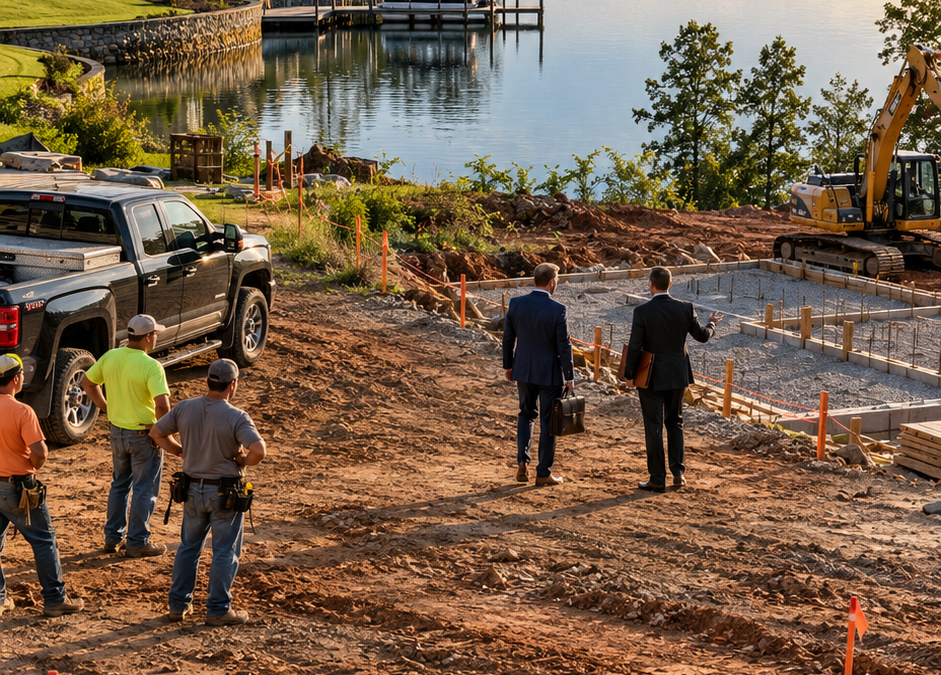
The future house was no longer theoretical. The ground had been cut and leveled. The foundation layout was visible. Gravel had been placed. The crew had set forms. Men in work boots moved with purpose, measuring, checking, preparing. The land had begun to transform from possibility into structure.
That seemed to bother Karen more than anything.
Hale opened without greeting.
“We’ve completed further review.”
“Good,” I said. “What did you find?”
He removed a document from the portfolio.
“There is a recorded easement affecting the shoreline area.”
I nodded.
“I know.”
His expression shifted slightly.
“You’re aware of it?”
“It was disclosed before closing.”
Karen looked startled, as if she had expected me to collapse at the word easement.
Hale recovered.
“Then you understand the association has rights connected to the lakefront.”
“I understand there is an easement. I don’t accept your interpretation of it.”
Price unrolled a map across the hood of his car this time. He weighted the corners with a tape measure, a folder, and two small stones from the driveway. The highlighted area followed part of the shoreline near the HOA side and extended along a strip of access land.
Hale pointed.
“This easement establishes ongoing interests in the shoreline corridor.”
I stepped closer.
“Show me my building site.”
Price hesitated, then pointed to my parcel.
“Here.”
“Show me the easement boundary.”
He traced the highlighted area.
“Here.”
“Does it cross the foundation?”
Neither lawyer spoke.
“Does it grant architectural control?”
Hale said, “The easement must be read in light of its purpose.”
“The recorded language controls,” I said. “Read me the part that gives your client authority to stop construction on the upland portion of my lot.”
Hale’s mouth tightened.
Karen interrupted.
“You’re trying to exploit a technicality.”
I turned to her.
“No. You’re trying to turn an easement into ownership.”
Her eyes flashed.
“That shoreline exists because this community protected it.”
“That shoreline exists because the lake exists,” I said. “You did not create the water.”
She stepped toward me.
“Without Lakeside Preserve, this entire area would have been developed irresponsibly.”
“And yet here you are, irresponsibly claiming rights you don’t have.”
Price looked down at the document.
The younger lawyer had become easier to read with each visit. Hale was polished enough to hide behind phrases. Price still reacted to facts. I could see the discomfort each time the paper failed to do what Karen wanted it to do.
I pointed to the easement description.
“This stops well before my building pad. It may affect limited shoreline access and maintenance, and I’m not interfering with that. But it does not put my lot under the HOA’s restrictions.”
Hale said, “That is a narrow reading.”
“It is the recorded reading.”
He leaned forward, lowering his voice.
“You are escalating a dispute that could be resolved cooperatively.”
“Cooperatively means I submit my plans to your client and pretend she has authority.”
“It means respecting the broader community.”
“No,” I said. “It means blurring the boundary until I pay for peace with rights I don’t owe you.”
For the first time, Hale looked irritated.
Not angry. Irritated.
There is a difference there, too. Anger is emotional. Irritation is what powerful people feel when a process that usually works suddenly does not.
He gathered the map.
“We may seek county review.”
“Please do,” I said. “Bring the recorded documents.”
Karen gave a short laugh.
“You keep saying that like documents are magic.”
“No,” I said. “I keep saying that because they are evidence.”
They left again.
This time, I did not wait.
I called the county records office directly from the site.
I gave the representative my parcel number. I asked her to verify the deed, subdivision boundary, and any recorded obligations tied to the lot. I asked about the easement by recording number. I asked whether the parcel was included in Lakeside Preserve. I asked whether the HOA had any recorded architectural control over my property.
She put me on hold twice.
Each time, I stood near the foundation forms looking across the lake while my future house existed only as lines, stakes, and stubbornness.
When she came back, her answer was clear.
“The parcel is separately recorded,” she said. “It is not included in the Lakeside Preserve subdivision.”
“And the HOA boundary?”
“Does not include your lot.”
“The easement?”
“It appears to affect a shoreline access area as described, but based on what I’m seeing, it does not make the parcel part of the association.”
“Does it give them design review authority?”
“I can’t provide legal advice,” she said carefully, “but I do not see a recorded document here granting that authority.”
That was enough.
I thanked her and asked how to obtain certified copies of the relevant records. She explained the process. I ordered them that afternoon.
When the certified copies arrived, I put them in a separate binder.
Not a folder.
A binder.
There was something satisfying about that. A folder can be shuffled, ignored, waved away. A binder has weight. A binder looks like preparation. I printed the deed, survey, parcel map, subdivision plat, easement, title report, permit approvals, and every letter from the HOA. I put tabs between sections. I made notes in the margins. I highlighted the boundary line in yellow and the edge of the easement in blue.
If they wanted to bury me in paper, I was going to learn the terrain.
The HOA changed tactics after that.
They stopped saying directly that my lot was inside the association. They stopped claiming, at least in writing, that construction violated binding neighborhood restrictions. They began using softer language.
Concern.
Compatibility.
Visual impact.
Lake character.
Environmental sensitivity.
It was almost impressive how quickly the argument mutated once the original claim could not survive contact with the record.
Karen sent an email through the attorneys stating that even if my parcel was “technically outside” the subdivision, my house would “materially affect the aesthetic expectations and property values of Lakeside Preserve residents.”
Technically outside.
I stared at those words for a long time.
Technically is a word people use when accuracy has become inconvenient.
You are technically outside the boundary.
You technically own the land.
The deed technically says that.
The survey technically shows this.
The law technically does not support us.
I forwarded the email to my attorney with one sentence: They’re admitting the boundary now.
He responded: Yes. Keep building.
So I did.
The foundation walls started taking shape along the lake.
Concrete changed everything.
Before concrete, a construction site can still look temporary. Stakes can be pulled. Flags can be removed. Dirt can be smoothed over. But once forms are set and concrete begins to cure, the project declares itself. It tells everyone watching that the idea has crossed into permanence.
I stood there the day the foundation walls were poured, listening to the truck, the crew calls, the scrape of tools, the thick sound of wet concrete settling into place. The lake behind us was calm. The sky was clear. Across the water, I saw two people standing on the HOA walking path, watching.
Karen arrived late that afternoon.
Alone this time.
She parked near the driveway but did not step fully onto the site. Maybe the letters from my attorney had finally made trespassing feel less casual. She stood beside her SUV, arms folded, looking at the foundation walls.
I walked toward her.
“Can I help you?”
She did not look at me at first.
“You’re really doing it.”
“Yes.”
“You could have worked with us.”
“I could have surrendered to you.”
She turned then.
“That’s not fair.”
“Neither was ordering my crew off my property.”
Her eyes moved past me to the walls.
“Do you understand what people paid to live here?”
“I understand what I paid to buy this lot.”
“This lake is the heart of our community.”
“It can be that without becoming your property.”
For a moment, something tired flickered across her face. Not regret. Not apology. Something closer to disbelief. As if she still could not understand why the world had not arranged itself around her expectation.
“We have standards,” she said.
“I know.”
“You may not care about that, but we do.”
“I care about standards,” I said. “That’s why I checked the records before I built.”
She laughed once, bitterly.
“You think this is just paperwork.”
“No,” I said. “I think paperwork is how people prove what they’re allowed to enforce.”
Her mouth pressed into a thin line.
“You’re going to make enemies here.”
“I didn’t buy the lot to make enemies.”
“But you’re willing to.”
“I’m willing not to be governed by people I never joined.”
That ended the conversation.
She got into her SUV and drove away.
I watched until she disappeared behind the curve of trimmed hedges at the neighborhood entrance.
I should have felt victorious.
Instead, I felt sad.
Not for Karen exactly. For what people become when authority goes unquestioned too long. She had probably started years earlier with ordinary neighborhood concerns. Maybe she cared about the lake. Maybe she had fought real problems before: careless dumping, bad drainage, irresponsible development, people who treated shared resources like disposable scenery. But somewhere along the way, stewardship had turned into possession. Protection had turned into control.
And control, once it becomes a habit, begins to feel like virtue.
The formal complaint came two weeks later.
By then, the foundation was complete, and framing materials had been delivered. The first floor system was scheduled to begin. My contractor called me before sunrise.
“You’re going to want to see your email.”
I opened it while standing barefoot in my kitchen.
There it was.
The HOA had filed a formal complaint with the county, alleging that my construction project violated lakefront development restrictions, conflicted with shoreline preservation goals, and should be halted pending review. They attached their development map, excerpts from their HOA guidelines, the easement document, photographs of my construction site taken from the neighborhood side, and a letter from Hale arguing that the county should consider the project’s impact on the broader lakefront community.
It was more polished than their earlier threats.
It was also weaker.
Because now they had to show their work.
My attorney called an hour later.
“They’re trying to move the dispute into a review setting,” he said.
“Can they stop construction?”
“Not automatically. But the county may inspect, verify records, and respond to the complaint.”
“So we give them everything.”
“Exactly. We don’t argue feelings. We give them the file.”
That became our strategy.
No outrage. No speeches. No insults.
Just the file.
Deed. Survey. Parcel map. Subdivision boundary. Easement. Permit approvals. Certified county records.
My attorney prepared a response that laid out the issue so plainly it almost looked boring. My parcel was outside the HOA boundary. The HOA restrictions were not recorded against my deed. The easement did not cross the building site and did not grant design review authority. My permits had been issued under county rules. The HOA’s aesthetic preferences were not enforceable property restrictions.
I read the response three times before approving it.
There is a strange comfort in boring truth.
Drama exhausts people. Precision steadies them.
The county scheduled a site review for the following Thursday.
That morning, I arrived before anyone else.
The lake was still covered in a thin silver mist. The foundation walls looked pale and solid in the early light. Stacks of lumber sat under tarps. The temporary fence around the work area rattled softly in the breeze.
I walked the boundary alone, stopping at each survey stake.
The ground was damp. My boots picked up mud. I crouched near the corner closest to the HOA and wiped dirt away from the base of the stake as though making it visible could make the whole truth harder to deny.
My contractor arrived at seven.
“You sleep?” he asked.
“Not much.”
“County’ll see it.”
“I know.”
But knowing did not calm everything.
By nine, the county officials arrived.
There were three of them: one from planning, one from building, and one from the records office. They wore practical clothes and carried clipboards, measuring equipment, and a rolled parcel map. They greeted me politely, then my contractor, then my attorney, who had arrived in a gray suit and boots that looked too new for mud.
Karen arrived with Hale and Price ten minutes later.
She looked composed. Hale looked prepared. Price looked resigned.
No one wasted much time on pleasantries.
The planning official, a woman with a calm voice and no interest in theater, explained the purpose of the review.
“We’re here to verify the parcel location, applicable recorded documents, permit status, and the relationship between the construction site, the HOA subdivision boundary, and the referenced easement.”
Karen opened her mouth.
The official raised one hand.
“Everyone will have an opportunity to provide information. We’re going to begin with the records.”
That single sentence changed the atmosphere.
Records first.
Not feelings. Not neighborhood expectations. Not who had lived there longer. Not who had printed the prettier map.
Records.
The county staff unrolled the parcel map on a folding table my contractor provided. My attorney placed our certified copies beside it. Hale placed his documents on the opposite side. Karen stood close enough to read everything but said nothing.
The records official confirmed the parcel number.
She confirmed the legal description.
She confirmed the subdivision boundary.
Then the planning official asked everyone to walk the line.
We moved across the uneven ground like a strange procession: county officials, lawyers, contractor, HOA president, and me. The building official checked the survey stakes against the recorded map. My contractor pointed out the foundation location. The planning official asked about setbacks. The building official confirmed the permitted site matched the approved plan.
Hale tried once to redirect the discussion.
“The association’s concern is that this construction has a direct visual and environmental impact on the lakefront district.”
The planning official looked at him.
“Is the lakefront district a recorded regulatory overlay adopted by the county?”
Hale paused.
“It is recognized in the association’s development materials.”
“That was not my question.”
Karen shifted her weight.
“No,” Hale said finally. “Not as a county overlay.”
The official made a note.
We continued to the easement area.
Price unfolded their map. My attorney unfolded ours. The county records official compared both to the recorded easement description.
The line did what it had always done.
It stopped short of the building site.
The planning official asked, “Is construction occurring within the easement area?”
The building official checked the measurements.
“No.”
“Is access obstructed?”
“No.”
“Are there permit violations visible today?”
“No.”
Karen could not stay quiet.
“This completely ignores the purpose of the lake preservation standards.”
The planning official turned to her.
“Are those standards recorded against this parcel?”
Karen looked at Hale.
Hale said, “Not directly against the parcel.”
“Are they county-adopted standards?”
“No.”
“Do they appear in the subdivision documents for Lakeside Preserve?”
“Yes,” Hale said.
The official looked toward my lot, then back to him.
“Is this parcel in that subdivision?”
Hale did not answer immediately.
That silence felt longer than every letter they had sent.
“No,” he said.
The official wrote something down.
Karen’s face changed.
For the first time since she had stepped onto my property in her white shirt with her clipboard, I saw the moment reach her. Not emotionally. Not morally. Factually. She understood where this was going.
The county officials returned to the folding table.
The planning official reviewed her notes.
Then she said the conclusion so plainly that it almost felt too small for the weight it carried.
“Based on the recorded documents reviewed today, this parcel is outside the recorded boundary of Lakeside Preserve Homeowners Association. The submitted HOA restrictions do not appear to be recorded against this parcel. The referenced easement does not include the current building site. At this time, the county has no basis to suspend the approved construction permit on the grounds presented in the complaint.”
No one spoke.
The lake moved quietly behind us.
My attorney gave a small nod, not triumphant, just satisfied.
My contractor looked down and smiled at the dirt.
Price closed his folder.
Hale’s expression became unreadable.
Karen stared at the planning official.
“So that’s it?” she said.
The official answered carefully.
“That is the county’s determination based on the records before us.”
“You’re allowing him to build whatever he wants?”
“We’re allowing work consistent with county permits and applicable regulations.”
“What about the community?”
The official’s voice stayed calm.
“The county cannot enforce private HOA standards against a parcel that is not subject to them.”
Karen looked at me then.
There was anger in her face, but beneath it something else. Humiliation, maybe. Or disbelief. She had brought lawyers, maps, complaints, and the full force of her title, and the answer had come down to a boundary line that had been there the whole time.
I did not smile.
I did not gloat.
I only held her gaze long enough for her to know I had heard every threat and would not pretend they had been harmless.
The county officials packed their documents.
Before leaving, the planning official handed both attorneys a card.
“If any new recorded documents are identified, submit them through the formal process,” she said. “Otherwise, this complaint is closed from our standpoint.”
Closed.
That word stayed with me all day.
After they left, the site felt different.
Not peaceful exactly. The conflict had gone too far for that. But the air felt clearer, as though a storm had finally broken and left everything wet, battered, and visible.
My contractor clapped me once on the shoulder.
“Framing starts Monday?”
I looked at the foundation.
“Monday.”
He grinned.
“Good.”
Karen and her lawyers were still near their cars. Hale spoke quietly to her. Price stood slightly apart, looking toward the lake. After a minute, Karen got into her SUV without looking back.
That was the last time she stepped onto my property.
The HOA did not disappear.
People like that rarely vanish all at once.
There were more emails, but they were softer. More cautious. They complained about construction noise during permitted hours. They questioned whether my exterior lights might shine across the water, though the lights had not been installed yet. They asked whether my landscaping would include “invasive visual elements,” a phrase so empty even my attorney did not bother responding to it in detail.
But the center of their argument was gone.
They could object.
They could dislike.
They could watch.
They could not control.
And that made all the difference.
The lakehouse rose slowly after that.
Framing changed the site faster than anything before it. One week there were foundation walls. The next, there were vertical lines, open rooms, window spaces, roof angles. I walked through the skeleton of the house with my contractor and saw where the morning light would hit the kitchen, where the hallway would narrow toward the bedrooms, where the living room would open toward the lake.
For months, I had defended an idea.
Now I could stand inside it.
The first time I stood where the porch doors would be, I felt my throat tighten unexpectedly.
Not because the house was large. It was not. Not because it was luxurious. It would be comfortable, solid, and simple. What moved me was the fact that it existed at all after so many people had tried to make me ask permission from the wrong authority.
The crew installed the roof before the first heavy rain of the season. Windows followed. Then siding. Then the slow interior work that makes a structure feel human: wiring, plumbing, insulation, drywall, trim.
From across the lake, the HOA homes remained what they had always been: polished, orderly, controlled.
My house looked different.
Not reckless. Not ugly. Not defiant in any cartoonish way.
Just different.
It faced the water honestly. It used natural colors that belonged to the slope and trees. It kept a respectful distance from the shoreline. It followed the county rules. It did not ask the HOA for approval because it did not need to.
That alone made it radical to them.
One afternoon, several months after the site review, I was standing near the unfinished porch when Karen’s white SUV slowed on the road beyond the boundary. She did not stop. She did not get out. She only looked toward the house as she passed.
For a second, I remembered the first day she had walked across my property with her clipboard and told us to stop. I remembered the way she had barely looked at my documents. I remembered the attorneys arriving with polished shoes and careful phrases. I remembered standing at my kitchen table late at night, reading the same records again and again because someone else’s certainty had tried to infect my own.
Then I looked at the house.
The walls were real.
The roof was real.
The windows were real.
The boundary was real.
And for the first time in months, I felt the anger leave me.
Not because Karen had apologized. She never did.
Not because the HOA admitted they were wrong. They never did that either.
The anger left because the land no longer needed me to defend it every minute. The record had held. The line had held. I had held.
By the time the lakehouse was finished, winter had settled softly over the water.
The first morning I woke up there, the rooms still smelled faintly of fresh wood, paint, and cold air. The furniture was sparse. Boxes sat along the hallway. The kitchen held one coffee maker, two mugs, and a stack of papers I had not yet filed away.
I made coffee before sunrise and carried it to the porch.
The lake was dark at first, then silver, then pale blue as the sun came up behind the trees. Mist lifted from the surface exactly the way it had the week after closing, before the arguments, before the letters, before the lawyers turned my quiet lot into a test of nerve.
Across the water, Lakeside Preserve began to wake. A garage door opened. A porch light clicked off. Somewhere, a dog barked once and stopped.
I stood barefoot on my own porch, on my own land, outside their boundary.
The house was not a monument to winning.
I did not build it to shame anyone. I did not build it to prove I was difficult. I built it because I wanted a place that belonged to me, and because the documents said I had the right to do that.
The HOA had sent its president, its maps, its attorneys, its notices, its complaint, and every polished version of the same demand.
Stop.
Submit.
Cooperate.
Respect the community.
But beneath all those words, they had been asking for something simpler.
They wanted me to treat their preference as power.
I did not.
That was the whole story in the end.
Not a dramatic courtroom victory. Not a shouting match. Not a final speech that made anyone clap. Just a man, a lakefront lot, a recorded boundary, and a house that rose exactly where the survey said it could.
Later that morning, I took the binder from the kitchen counter and carried it to the small office overlooking the water. I placed it on the bottom shelf of the bookcase.
Deed.
Survey.
Parcel map.
Subdivision plat.
Easement.
County determination.
Every document that had steadied me when threats tried to make the truth feel uncertain.
I kept them there not because I expected another fight, but because peace means more when you remember what it cost to protect it.
Then I went back outside.
The sun had cleared the trees. Light spread across the porch boards and warmed the railing beneath my hands. The lake moved gently below, touching my shoreline the same way it touched theirs, without caring about committees, letters, titles, or maps printed in friendly colors.
For the first time since buying the lot, no engine came up the drive. No lawyer stepped out carrying a folder. No clipboard crossed the boundary.
There was only the house, the water, and the quiet.
And that was all I had wanted from the beginning.








