𝗙𝗨𝗟𝗟 𝗦𝗧𝗢𝗥𝗬 The Lake Was Quiet Until Karen Brought a Clipboard to My Dock
𝗙𝗨𝗟𝗟 𝗦𝗧𝗢𝗥𝗬
I walked down the slope to the dock, untied my boat, and pushed off with one boot against the piling. The boat drifted free, light and familiar beneath me. I lowered the trolling motor and moved out past the shadow of the dock.
For the first hour, nothing existed except the rhythm of casting.
The reel clicked softly. The line whispered. The lure skipped once, then sank. I worked the edge of the weed line where bass liked to hide when the morning was cool. Twice, I felt a bite and missed it. The third time, I landed a small largemouth, admired its stubborn little flash of green, and released it back into the water.
I remember smiling.
It had been the kind of morning that makes you believe the world still knows how to behave.
Then I heard shouting.
At first, I thought it came from the public ramp on the far side. Sound can bend across water strangely. But when I turned, I saw three figures standing on my dock.
One of them wore a bright white blouse and dark slacks.
Karen.
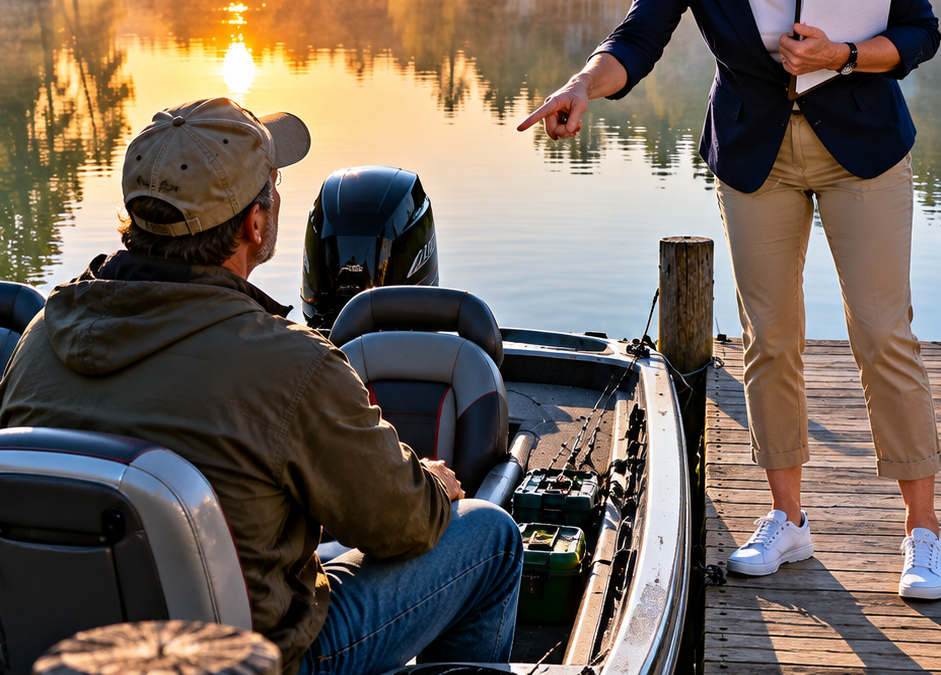
Even from fifty yards away, I recognized the posture. No one else stood like that on another person’s dock. She was stiff-backed, one arm raised, pointing directly at me like a prosecutor identifying a suspect.
Two people stood behind her.
I knew one of them vaguely, a tall man named Paul who had come with her before. The other was a woman in a navy cardigan, holding a folder against her chest and looking considerably less certain than Karen.
Karen’s voice cut across the water.
“Bring that boat in immediately!”
I stared at her.
For a second, I honestly considered pretending I had not heard her.
Then Paul cupped his hands around his mouth.
“Sir! You need to return to the dock!”
Sir.
That almost made me laugh.
I was on my lakefront, in my boat, in front of my dock, being summoned like a trespasser by people standing on my property.
I lifted one hand, not in greeting, but to show I had heard.
Then I slowly reeled in my line.
I did not hurry.
That was partly stubbornness, I admit. But mostly, I needed the time to calm down. A man can make mistakes when anger arrives faster than judgment. I knew Karen wanted a scene. People who bring witnesses and clipboards to private docks are not looking for understanding. They are looking for submission.
I eased the boat toward the dock.
Karen stepped closer to the edge as I approached, though she had enough sense not to come down the ladder. Her face was tight with triumph, as if she had already won because I was returning.
When I cut the motor and tied off, she spoke before my boot hit the dock.
“You are operating that boat without authorization.”
I stepped up slowly, one hand on the post.
“Good morning, Karen.”
“This is not a social visit.”
“I figured that out when you started yelling across the lake.”
Her eyes narrowed.
“You were instructed previously that lake use requires HOA approval.”
“No,” I said. “You mailed me something claiming that. I was not instructed.”
Paul lifted his clipboard. “The board has adopted water-use standards.”
“Then the board should use them on property it controls.”
Karen pointed toward my boat.
“That vessel is in violation.”
“Of what?”
“HOA lake access policy.”
“I’m not in your HOA.”
“You are using HOA-controlled water.”
I looked past her at the lake, then back at her.
“That lake was here before your HOA existed.”
“That does not answer the question.”
“It answers more than you think.”
The woman in the navy cardigan shifted uneasily.
Karen opened her clipboard and flipped to a page marked with colored tabs.
“Briarwood Landing controls the community lake area. All boating activity must be approved, registered, and compliant with safety and aesthetic standards.”
“Aesthetic standards for a fishing boat?”
“Yes.”
“You’re serious.”
“Very.”
I leaned against one of the dock posts.
“My boat is registered with the state. My dock is permitted. My property has recorded waterfront rights. I don’t need HOA permission.”
Karen’s expression sharpened when I said recorded.
She did not like words that belonged to an authority outside her boardroom.
“The HOA map clearly includes the lake.”
“Your map shows the lake,” I said. “That is not the same as owning it.”
Paul stepped in.
“The common understanding has always been that the lake is a Briarwood amenity.”
“Whose understanding?”
“The community’s.”
“That is not an answer.”
Karen’s voice rose. “The neighborhood was designed around lake access.”
“My property was recorded before the neighborhood was built.”
“You keep saying that as if it settles everything.”
“It does settle a lot.”
“No,” she said, tapping the clipboard. “The board settles HOA matters.”
“This is not an HOA matter.”
“You are creating a disturbance.”
I looked around.
The water was calm. My boat was still. The only people disturbing anything were the three standing on my dock.
“What disturbance?”
“Unauthorized boating.”
“On water I have the right to access.”
“You have not proven that.”
I stared at her.
Then I laughed once, very quietly.
Karen’s face flushed.
“Do not laugh at me.”
“I’m not laughing at you. I’m laughing at the idea that I have to prove my property rights to someone trespassing on my dock.”
The woman in navy looked down at her shoes.
Paul stiffened.
Karen did not move.
“I am not trespassing,” she said.
“You are standing on my dock without permission.”
“We are conducting HOA business.”
“Not here.”
That was the first moment her confidence cracked into anger.
“You have been difficult from the beginning,” she said.
“No, Karen. I’ve been accurate from the beginning. You just keep confusing the two.”
She took out her phone.
“Fine. We will let the lake ranger handle this.”
“That’s a good idea.”
She paused, phone in hand, as if my agreement bothered her.
“I am reporting an unauthorized boater.”
“Make sure you tell him whose dock you’re standing on.”
She turned away and dialed.
I stood there listening while she gave the ranger dispatch a version of events so polished it could have been written before she arrived.
An unregistered resident was operating a boat on HOA-controlled water.
The lake belonged to Briarwood Landing.
The boater had refused to comply.
The HOA board was present.
Immediate assistance was requested.
I crossed my arms and watched a dragonfly land on the dock rail.
It stayed there through most of her call, its wings bright as glass.
When Karen hung up, she looked satisfied.
“The ranger is on his way.”
“Good.”
“You may want to think carefully about your position before he arrives.”
“My position hasn’t changed.”
“It will.”
Paul muttered something under his breath.
I looked at him.
“What was that?”
He straightened. “I said this could have been avoided.”
“Yes,” I said. “You could have stayed off my dock.”
The woman in navy finally spoke.
“Maybe we should wait near the shore.”
Karen snapped, “We are fine here.”
The woman’s mouth closed.
I studied her for the first time. She was in her forties, maybe early fifties, with nervous hands and tired eyes. She did not look like someone eager for confrontation. She looked like someone who had been told this was routine and had started to realize it was not.
“What’s your name?” I asked her.
She hesitated. “Elaine Porter. HOA secretary.”
“Elaine, did you check the county property records before coming here?”
Karen answered for her.
“That is not relevant.”
Elaine looked at Karen, then at me.
“I reviewed the HOA map.”
“That’s not what I asked.”
Karen stepped between us slightly.
“Do not badger my board members.”
I almost smiled.
“You brought them to my dock.”
“They are here as witnesses.”
“Then they should witness the right things.”
For the next ten minutes, we waited in a silence sharp enough to cut rope.
I did not offer them chairs. I did not invite them up to the house. I did not continue fishing because I did not trust Karen near my boat while I was away from the dock. So we stood there with the lake behind us, the house above us, and a thin line of legal reality running unseen beneath all of it.
The ranger arrived in a green county truck with the lake authority emblem on the door.
His name was Ben Alvarez.
I had met him before during a dock inspection after a storm. He was calm, thorough, and not easily impressed by loud people. He stepped out wearing a tan uniform, sunglasses, and the expression of a man who had already heard too much over the phone.
Karen moved toward him before he fully closed the truck door.
“Ranger Alvarez, thank you for coming. I’m Karen Whitmore, president of the Briarwood Landing HOA. This man has been operating an unauthorized boat on our lake.”
Ben looked from her to me, then to my dock, then to the water.
“Morning,” he said.
“Morning,” I answered.
Karen continued.
“We have repeatedly explained that lake use is controlled by the association. He refuses to register his boat, refuses to follow our standards, and today he launched without approval.”
Ben nodded slowly, not agreeing, just allowing her to finish.
“Is anyone injured?”
“No.”
“Was the boat being operated unsafely?”
Karen hesitated. “That is not the main issue.”
“Was it being operated unsafely?”
“No, but—”
“Was there a collision, wake violation, intoxication concern, or restricted-zone issue?”
“No. The issue is authorization.”
Ben turned to me.
“Did you launch from this dock?”
“Yes.”
“Your dock?”
“Yes.”
Karen interrupted. “That is disputed.”
I looked at her.
“No, it isn’t.”
Ben lifted one hand slightly.
“I’m going to talk to everyone. One at a time.”
Karen pressed her lips together.
Ben looked back at me.
“Do you have documentation?”
“In the house.”
Karen smiled faintly, as if she thought that meant I was unprepared.
I said, “My deed and survey are in my office. I can get them.”
Ben nodded.
“Before you do, let me see what they brought.”
Karen immediately handed him the HOA map.
It was large, glossy, and color-coded. The lake was shaded blue. Briarwood Landing lots were outlined in yellow. Walking trails curved around the western edge. A legend in the corner described “community lake area” with a blue hatch pattern.
Karen pointed to the shaded water.
“As you can see, the lake is included.”
Ben studied the map for several seconds.
Then he asked a simple question.
“Where exactly is your property line?”
Karen pointed toward the lake.
“Here.”
Ben did not look up.
“That’s the water. Where is the recorded property line?”
Karen’s finger hovered.
“The community boundary follows the lake area.”
“According to this map?”
“Yes.”
“Is this a recorded plat?”
“It is the official HOA map.”
“That is not what I asked.”
Her confidence flickered.
Ben took out a tablet from his truck and opened the county GIS system. He zoomed in on the area, waited for the parcel layer to load, then looked back and forth between the screen and Karen’s map.
I watched his face.
It did not change much, but I saw the moment something stopped matching.
He zoomed closer.
The parcel lines appeared clearly.
Mine extended down to the waterfront boundary. The HOA’s common property stopped well short of my dock. The neighborhood’s walking trail curved along land that did not include my parcel. The blue shading on their HOA map had swallowed more than the legal boundary allowed.
Ben turned the tablet slightly.
“Mr. Ward, is this your parcel?”
“Yes.”
He pointed. “And this is your dock?”
“Yes.”
Karen leaned toward the screen.
“That cannot be right.”
Ben looked at her.
“It’s the county map.”
“Our map shows the lake as part of the community.”
“Your map is not controlling the county records.”
Paul stepped forward.
“There may be an overlay agreement.”
Ben looked at him.
“Do you have one?”
Paul looked at Karen.
Karen looked at Elaine.
Elaine looked at the dock boards.
No one answered.
Ben asked again, “Do you have an easement, license, covenant, court order, or recorded document giving the HOA authority over this parcel or this dock?”
Karen’s voice tightened.
“The neighborhood has always used the lake.”
“That is not what I asked.”
She swallowed.
“The lake is marketed as an amenity.”
“That is also not what I asked.”
I said nothing.
That was difficult.
There is a strong temptation, when someone who has been speaking over you finally runs out of words, to fill the silence with your own. I wanted to say plenty. I wanted to ask Karen how it felt to have her glossy map measured against real records. I wanted to ask Paul whether “common understanding” still sounded like ownership.
But I knew enough to keep quiet.
The truth was doing fine without my help.
“I’ll get my documents,” I said.
Ben nodded.
I walked up the slope to the house.
Behind me, I heard Karen speaking in a lower voice, then Ben answering with professional patience. I could not make out the words, but I knew the rhythm. She was trying to regain control. He was not giving it back.
Inside, I went straight to the fireproof file box in my office.
The deed was in a labeled folder. So was the survey. So was the dock permit, the last inspection report, and the letter from the county confirming the waterfront boundary after a minor mapping update two years earlier.
I had kept them because my father had once told me that a handshake is good, but paper survives bad memory.
I carried the folder back outside.
Karen was standing with her arms crossed now. Paul looked annoyed. Elaine looked worried. Ben waited beside his truck, tablet still in hand.
I handed him the documents.
He read the deed first.
Then the survey.
Then the county boundary letter.
The longer he read, the quieter Karen became.
He spread the survey across the hood of his truck and anchored one corner with his radio so the breeze would not lift it. The lines were clean and unmistakable. My property ran to the marked waterfront boundary. The dock location was indicated. The surveyor’s seal was visible.
Ben compared it to his tablet.
“They match,” he said.
I nodded.
Karen stepped closer, staring at the survey as if it were written in another language.
“That line can’t be correct.”
Ben looked at her.
“Why not?”
“Because the HOA has maintained lake access for years.”
“What access?”
“The neighborhood access.”
“Where?”
Karen pointed vaguely toward the far side.
“Along the trail and shoreline.”
Ben tapped the screen.
“The trail is over there. This dock and this parcel are here.”
“But the lake is connected.”
“Yes,” he said. “Water does that.”
Elaine made a tiny sound that might have been a swallowed laugh.
Karen shot her a look.
Ben continued, “Connected water does not mean connected ownership.”
Paul said, “But residents have used this lake for years.”
“From where?”
“The community side.”
“That may be allowed depending on access rights and lake rules. It does not give the HOA authority over Mr. Ward’s dock or his waterfront rights.”
Karen stiffened.
“No one is trying to take his dock.”
I turned my head slowly.
“You came here demanding that I get off the lake.”
“We asked you to comply with HOA policy.”
“You called the ranger and reported me as unauthorized.”
“Because you were unauthorized.”
Ben said, “Based on the documents in front of me, he is authorized to use his own waterfront access.”
Karen’s mouth tightened.
“You’re making a legal conclusion.”
“I’m making an enforcement decision based on the records available. I see no basis to remove him from the lake.”
That sentence landed hard.
Paul looked at Karen. “You said the records were clear.”
Karen did not answer.
Elaine spoke softly.
“Karen, did anyone check the county parcel map?”
Karen’s face reddened.
“We relied on the HOA boundary documents.”
“That map?” Elaine asked.
“It has been used for years.”
Ben said, “Then it may have been wrong for years.”
Karen looked at him, stunned by the bluntness.
I almost felt the air shift.
Not just around Karen. Around the whole situation.
Until that moment, she had been treating the disagreement like a matter of enforcement. She believed she had arrived with authority and was waiting for the ranger to apply it. But now the foundation under her claim had started to collapse. The more she tried to stand on it, the more obvious the cracks became.
Her own complaint had summoned the one person with access to the records she had failed to check.
Ben picked up the HOA map and held it beside the survey.
“This is a planning map,” he said. “Maybe an internal map. Maybe a marketing map. I don’t know. But it does not replace a recorded deed or survey.”
Karen said, “The board has operated under this understanding.”
“Then the board needs to correct its understanding.”
Paul rubbed the back of his neck.
Elaine looked at me.
“I’m sorry,” she said quietly.
Karen snapped, “Elaine.”
Elaine’s face flushed, but she did not take it back.
I appreciated that more than I expected.
Karen still had one argument left. I could see it forming before she spoke.
She pointed toward the water.
“Ranger Alvarez, with respect, the neighborhood has used the lake openly for years. Residents kayak here. They fish here. They walk along the shoreline. The HOA maintains safety rules. Doesn’t long-term use establish some kind of right?”
Ben did not rush his answer.
“That depends on specific facts and legal documents. But regular use is not proof that the HOA owns or controls someone else’s recorded waterfront.”
“The community depends on access.”
“To which access point?”
Karen hesitated again.
Ben pointed to the county map.
“This side belongs to Mr. Ward’s parcel. If residents are accessing the lake from HOA common land elsewhere, that is separate. If they are crossing private property, that is a problem. But nothing you have shown me gives you authority to order Mr. Ward off the water from his own dock.”
The finality in his voice was unmistakable.
Karen heard it.
So did Paul.
So did Elaine.
I looked at the lake.
A breeze had finally begun to move across the surface, breaking the reflection into thousands of small pieces. My boat bumped gently against the dock, rope pulling and easing with each little motion.
The morning had lost its peace, but not its clarity.
Ben gathered the documents and handed mine back carefully.
“Mr. Ward, you have the right to launch from this dock and operate in accordance with lake regulations.”
“Thank you.”
He turned to Karen.
“Do not interfere with his lawful use of this property.”
Karen’s eyes widened.
“Interfere?”
“You came onto his dock, demanded that he leave the lake, and called in a complaint that is not supported by the records.”
“We acted in good faith.”
“Good faith usually starts with checking the official boundary.”
Her face went hard.
“The HOA will review this.”
“That’s wise.”
“I mean with counsel.”
“Also wise.”
Ben slid his tablet under one arm.
“But until you produce legal authority to the contrary, you are not to order him off the lake, restrict his use of this dock, block his access, touch his boat, or represent to residents that this parcel is under HOA control.”
Each item struck like a hammer.
Order him off the lake.
Restrict his use.
Block his access.
Touch his boat.
Represent to residents.
Karen looked as if she wanted to object to each one, but could not find a safe place to begin.
Paul spoke carefully.
“Ranger, just to clarify, you’re saying the HOA map is inaccurate?”
“I’m saying it does not match the county parcel records for this location.”
“That’s a serious issue.”
“Yes,” Ben said. “It is.”
Paul looked at Karen again.
This time, his expression was not loyal.
It was questioning.
Elaine clutched her folder tighter.
“Karen,” she said, “we need to bring this to the board.”
Karen’s voice was cold.
“We will.”
I said, “And you need to remove any policy that claims authority over my dock or boat.”
Karen looked at me.
“This is not over.”
Ben turned his head slightly.
“It is over for today.”
The words settled everything.
Karen did not like it, but she had enough sense not to argue with the ranger after being warned in front of her own board members. She gathered her clipboard and turned toward the shore path that led back toward the neighborhood.
Paul followed, still looking troubled.
Elaine paused before leaving.
“I really am sorry,” she said.
Karen stopped several feet ahead but did not turn around.
I nodded once.
“Check the records next time.”
Elaine looked down.
“We should have.”
Then she followed the others off my property.
Ben stayed behind for a moment.
“You want an incident note?” he asked.
“Yes.”
“I thought so.”
He took down a short statement from me and recorded the document references. He photographed the dock, the parcel map on his tablet, and the HOA map Karen had shown him. He did not make the situation bigger than it needed to be, but he did not minimize it either.
That mattered.
Before he left, he looked toward the water.
“Good morning for fishing.”
“It was.”
He almost smiled.
“Still can be.”
Then he got into his truck and drove away.
For several minutes, I stood alone on the dock.
The quiet returned slowly.
Not all at once.
First the wind. Then the soft slap of water against the posts. Then a bird calling from the reeds. Then the far hum of a mower from somewhere across the ridge.
My boat rocked beside me.
My fishing rod lay where I had left it.
The tackle box was still open, a crankbait resting on the edge like nothing had happened.
I looked toward the path where Karen and the others had disappeared.
A strange feeling moved through me.
Not victory exactly.
Victory sounds too clean.
What I felt was relief mixed with anger, satisfaction mixed with exhaustion. I had been right, and the records had proven it, but I hated that proof had been necessary. I hated that a quiet morning had turned into a legal demonstration because someone could not tell the difference between a shaded blue shape on a neighborhood map and an actual property right.
I untied the boat.
Then I stopped.
Part of me wanted to go inside, make more coffee, and let the day recover without me. But another part of me knew that if I left the water now, Karen would still own a piece of the morning.
I was not going to give her that.
I stepped into the boat, lowered myself onto the seat, and pushed away from the dock.
The water opened around me.
I moved back toward the weed line, slower this time. My hands still carried a little tension. The first cast went too far left and landed near a patch of reeds. I reeled in, breathed out, and cast again.
Better.
A bass struck ten minutes later.
Not a big one, but strong.
It pulled hard enough to bend the rod and make the reel sing for a second. I worked it in, thumb steady on the line, and lifted it from the water. Green scales flashed in the sun. Its mouth opened wide around the lure, fierce and alive.
I held it for a moment.
Then I released it.
It vanished beneath the surface.
That was when I finally smiled.
By evening, I knew the story had spread.
Elaine called first.
I did not expect that.
She got my number from the county record, which annoyed me for about three seconds until I heard her voice.
“Mr. Ward, this is Elaine Porter from the HOA board. I wanted to tell you that an emergency board review has been scheduled.”
“All right.”
“I also wanted to say that I should have checked the records before coming to your dock.”
“Yes,” I said. “You should have.”
She accepted that without defense.
“You’re right.”
That surprised me.
She continued.
“Some of us relied on information that had been repeated for years. That was a mistake.”
“A costly one, potentially.”
“Yes.”
I waited.
She said, “I’m going to recommend that the HOA withdraw any lake policy language that applies beyond our actual property. I don’t know how the vote will go.”
“I appreciate you telling me.”
“There may be residents who think they have rights they don’t have.”
“I expect there are.”
“We need to correct that.”
“Yes,” I said. “You do.”
After the call ended, I sat at the kitchen table with my deed spread open in front of me.
I had read those documents before, but that night I read them differently. Every legal description, every reference point, every survey marker felt less like paperwork and more like a fence post driven deep into the ground.
People complain that property records are boring.
They are.
Until someone tries to erase you with a prettier map.
Two days later, a letter arrived from Briarwood Landing HOA.
It was not an apology.
Not really.
It said the board was “reviewing lake-use communications for clarity.” It said residents should “avoid accessing private waterfront parcels.” It said all questions about water access should be directed to the management office pending legal review.
It did not say Karen was wrong.
It did not say the HOA had overreached.
It did not say they had stood on my dock and tried to have me removed from my own water access.
But it said enough to reveal panic between the lines.
A week after that, I received a second letter.
This one was from the HOA’s attorney.
It acknowledged that my parcel was not part of Briarwood Landing. It acknowledged that the HOA did not hold title to my dock, shoreline, or waterfront boundary. It stated that the HOA’s lake-use policies applied only to property under association control and not to privately owned parcels outside the recorded HOA boundary.
The language was dry.
Beautifully dry.
I kept a copy in the same folder as my deed.
Karen’s name disappeared from the next board notice.
No one told me officially what happened, but Paul did. He came by one afternoon, not onto the dock, but to the edge of the driveway where he could be seen clearly from the house. That was wise.
I walked down to meet him.
“I’m not here to argue,” he said.
“Good.”
He held up both hands slightly.
“I wanted to tell you Karen stepped down as president.”
I watched his face.
“Voluntarily?”
He gave a humorless laugh.
“That depends on how generous you feel with the word.”
I said nothing.
He looked toward the lake.
“She was convinced the map gave us authority.”
“You were convinced enough to come with her.”
He nodded, accepting the hit.
“I was. And I was wrong.”
That mattered.
A little.
Not enough to erase the morning, but enough to make the conversation worth continuing.
“Why did she care so much?” I asked.
Paul exhaled.
“Residents have been complaining. They were sold a certain idea of lake living. Some thought the HOA controlled more shoreline than it did. Karen didn’t want to admit the original materials were misleading.”
“So she decided to enforce a lie.”
Paul looked down.
“When you say it plainly, yes.”
I respected that answer more than I expected.
He handed me an envelope.
“What’s this?”
“A corrected boundary notice. We’re sending it to residents, but I thought you should see it first.”
I opened it.
The notice was short. It included a revised map with the HOA boundary marked more accurately and private waterfront parcels clearly labeled. Mine was one of them. The language told residents not to enter or use private docks, shoreline, or access paths without owner permission.
It still sounded like a committee had sanded every sharp edge off the truth.
But the truth was there.
“That should have existed from the beginning,” I said.
“I know.”
Paul shifted his weight.
“I’m sorry.”
I looked at him for a long moment.
“Don’t apologize if the board plans to test the line again.”
“We don’t.”
“Then make sure your residents know that.”
“We will.”
He left soon after.
I watched him walk back toward the road, shoulders slightly hunched, like a man carrying more than an envelope.
The lake stayed quiet after that.
Not completely.
No place stays completely free of people testing limits.
Once, a teenager from Briarwood paddled too close to my dock and said he thought the water was open to everyone. I pointed him toward the corrected access area and told him not to tie off on private property. He apologized and left.
Another time, a woman walking two dogs stopped near the edge of my lot and asked whether the dock was “community adjacent.” I told her no. She nodded quickly and moved on.
But no one from the HOA came down with a clipboard again.
No one demanded to inspect my boat.
No one called the ranger on me.
Karen never returned.
I saw her only once after that morning, months later, at the gas station near the county road. She was standing beside a dark SUV, filling the tank, wearing sunglasses even though the day was cloudy. I came out with a bottle of water and a receipt in my hand.
She saw me.
For a second, her face tightened.
I expected her to look away, but she did not. She stared as if she still had arguments stored somewhere behind her teeth.
I gave her a small nod.
Not friendly.
Not hostile.
Just acknowledgment.
She turned back to the pump without a word.
That was enough.
I did not need her apology. I did not need a confession. I did not need her to admit that she had mistaken confidence for ownership.
The county map had done that for her.
Life returned to its rhythm.
Morning coffee. Weather reports. Dock repairs. Fishing line. The occasional bass. The low satisfaction of cleaning a reel at the kitchen table while rain tapped the windows. The lake kept changing in the ways water always changes, never repeating itself exactly, never caring who claimed to control it.
Some mornings, I still thought about my father.
I thought about the way he would sit silently in a boat, letting the water settle whatever the world had stirred up. He would have hated Karen’s clipboard. He would have hated the shouting. But he would have appreciated the documents.
He believed in keeping your word, minding your line, and knowing where your property ended before telling another man what to do with his.
One Saturday, not long after the HOA corrected its map, I took my boat out before dawn. The lake was darker than usual, the sky still heavy with night. I moved slowly, letting the trolling motor barely disturb the surface.
When the sun came up, it broke over the ridge behind Briarwood Landing.
For a moment, the neighborhood looked peaceful. Rooflines glowing. Windows catching light. Trees moving gently around the walking path.
From that distance, you could almost believe there had never been a dispute.
But I knew better.
Peace is not the absence of boundaries.
Sometimes peace exists because boundaries are finally respected.
I cut the motor in the middle of the cove and let the boat drift.
The corrected HOA notice was filed in my office. My deed was safe. My survey was safe. The ranger’s incident note was safe. The dock stood where it had always stood, weathered and plain, extending from land that belonged to me into water I had every right to access.
Nothing about the lake looked different.
Everything about it felt clearer.
I cast toward the shade line.
The lure landed softly.
Ripples spread outward, widening until they disappeared into the morning.
That was the thing Karen had never understood.
A map can be useful. A rule can be useful. A board can be useful when it remembers what it is and what it is not.
But none of those things can rewrite a deed.
None of them can move a property line because it looks convenient in a meeting.
None of them can turn someone else’s waterfront into a neighborhood amenity just because the brochure made buyers believe it.
Karen had arrived at my dock expecting the ranger to remove me.
Instead, her own complaint forced the truth into daylight.
The HOA map was just a map.
My deed was the record.
And when the argument ended, the lake was still there, quiet and wide beneath the morning sun, exactly where it had always been.
So was I.
𝗧𝗛𝗘 𝗘𝗡𝗗
The Lake Was Quiet Until Karen Brought a Clipboard to My Dock
The lake had been still enough to hold the sky when Karen stepped onto my dock with a clipboard in her hand.
She looked at my boat as if I had stolen something from her.
What she did not know was that the water beneath me had been settled on paper long before her HOA ever drew its first map.
I took my boat out that morning because I needed quiet.
Not excitement. Not company. Not one more argument with a neighbor who thought a rule printed in an HOA newsletter could reach farther than a recorded deed.
Just quiet.
The lake had always given me that.
At sunrise, the surface turned silver first, then blue, then a deep green where the tree line leaned over the water. Mist lifted from the coves in slow sheets. The cypress roots along the far bank looked like old knuckles breaking through the mud. Every sound carried differently out there. A heron lifting from the reeds sounded enormous. A lure hitting the water sounded deliberate. Even my breathing seemed to belong to the morning.
That was why I bought the place.
Not for the house, though it was sturdy enough. Not for the acreage, though I was proud of it. I bought it because the property ran all the way down to the waterfront, and the old survey showed private riparian rights along that stretch of lake.
The first time I stood on that dock, the realtor talked about square footage, taxes, utilities, and market growth. I barely heard him. I was watching the water.
My father used to take me fishing when I was a boy. He was not a talkative man, but he softened near water. He would sit with one hand resting on the handle of a rod and the other around a dented thermos, saying nothing for twenty minutes at a time. I used to think silence meant he had nothing to say. Later, after he died, I realized silence had been the place where he trusted me most.
So when I found that house by the lake, I did not just see a property.
I saw a place where my mind could stop running.
For eight years, that dock had been mine.
I maintained it. I replaced loose boards. I paid for permits when repairs required them. I cleared storm debris after heavy rain. I hired a surveyor once, not because anyone challenged me yet, but because I had lived long enough to know that land without records invites people with opinions.
The official documents were clean.
My parcel extended to the marked waterfront boundary. The dock sat inside it. My deed referenced the lake access. The county map matched. The survey matched. The legal description matched.
Everything that mattered matched.
Then Briarwood Landing built its neighborhood across the ridge.
At first, I did not care.
Developers came in with bright signs and smoother promises than the roads they paved. They turned old timber acreage into cul-de-sacs, installed stone monuments at the entrance, and named every street after trees they had cut down to build houses.
Maple Bend. Cedar Walk. Willow Crest.
People moved in fast.
They brought patio furniture, golf carts, matching mailboxes, and a homeowners association that seemed to gain confidence faster than it gained common sense.
The HOA did not bother me much in the beginning.
Their rules were their problem. My property was outside their boundary, and I liked it that way. I had seen what happened inside neighborhoods where paint colors needed approval and grown adults argued over trash cans. I wanted no part of it.
But HOAs have a habit of staring beyond their fences.
At first, it was small.
A letter arrived telling me my dock lights were “inconsistent with community ambiance.” I ignored it because I was not part of their community. Then someone complained that my boat cover was visible from the walking trail. I told them the trail was theirs and the boat was mine. Then one resident asked if I would consider allowing “shared lake access” because many homeowners had been told the neighborhood offered a lake lifestyle.
I told him they should take that up with whoever sold them the lifestyle.
The lake itself was complicated.
It was not a backyard swimming pool. It was an old managed lake with a mix of private waterfront parcels, regulated public access points, and conservation zones. The county maintained records. The lake authority handled water safety. Certain banks belonged to individual property owners. Others fell under shared or public use. You could not understand it by looking at a neighborhood brochure.
That was exactly the problem.
Briarwood Landing had a colorful HOA map showing the lake shaded in soft blue beside their neighborhood. To anyone who did not know better, it looked as if the entire body of water was part of their amenities.
But a marketing map is not a deed.
I knew that.
Karen Whitmore apparently did not.
Karen was the HOA president of Briarwood Landing.
I had met her twice before the dock confrontation. The first time, she came by with a board member named Paul and told me the HOA wanted to discuss “cooperative waterfront standards.” I told her there was nothing to discuss. The second time, she left a printed notice on my gate saying all boats visible from the community trail had to be registered with the HOA.
I mailed it back with three words written across the top.
Not your property.
That should have ended it.
It did not.
Because people like Karen do not hear no as an answer. They hear it as a delay.
The morning everything happened, I woke before six. The house was quiet. The air held that soft, damp coolness that comes before the heat settles in. I made coffee, packed a small tackle box, and stepped onto the back porch while the sky was still violet behind the trees.
The lake looked perfect.
No wind. No wake. No voices carrying from the far bank.
Just water.
I walked down the slope to the dock, untied my boat, and pushed off with one boot against the piling. The boat drifted free, light and familiar beneath me. I lowered the trolling motor and moved out past the shadow of the dock.
For the first hour, nothing existed except the rhythm of casting.
The reel clicked softly. The line whispered. The lure skipped once, then sank. I worked the edge of the weed line where bass liked to hide when the morning was cool. Twice, I felt a bite and missed it. The third time, I landed a small largemouth, admired its stubborn little flash of green, and released it back into the water.
I remember smiling.
It had been the kind of morning that makes you believe the world still knows how to behave.
Then I heard shouting.
At first, I thought it came from the public ramp on the far side. Sound can bend across water strangely. But when I turned, I saw three figures standing on my dock.
One of them wore a bright white blouse and dark slacks.
Karen.
Even from fifty yards away, I recognized the posture. No one else stood like that on another person’s dock. She was stiff-backed, one arm raised, pointing directly at me like a prosecutor identifying a suspect.
Two people stood behind her.
I knew one of them vaguely, a tall man named Paul who had come with her before. The other was a woman in a navy cardigan, holding a folder against her chest and looking considerably less certain than Karen.
Karen’s voice cut across the water.
“Bring that boat in immediately!”
I stared at her.
For a second, I honestly considered pretending I had not heard her.
Then Paul cupped his hands around his mouth.
“Sir! You need to return to the dock!”
Sir.
That almost made me laugh.
I was on my lakefront, in my boat, in front of my dock, being summoned like a trespasser by people standing on my property.
I lifted one hand, not in greeting, but to show I had heard.
Then I slowly reeled in my line.
I did not hurry.
That was partly stubbornness, I admit. But mostly, I needed the time to calm down. A man can make mistakes when anger arrives faster than judgment. I knew Karen wanted a scene. People who bring witnesses and clipboards to private docks are not looking for understanding. They are looking for submission.
I eased the boat toward the dock.
Karen stepped closer to the edge as I approached, though she had enough sense not to come down the ladder. Her face was tight with triumph, as if she had already won because I was returning.
When I cut the motor and tied off, she spoke before my boot hit the dock.
“You are operating that boat without authorization.”
I stepped up slowly, one hand on the post.
“Good morning, Karen.”
“This is not a social visit.”
“I figured that out when you started yelling across the lake.”
Her eyes narrowed.
“You were instructed previously that lake use requires HOA approval.”
“No,” I said. “You mailed me something claiming that. I was not instructed.”
Paul lifted his clipboard. “The board has adopted water-use standards.”
“Then the board should use them on property it controls.”
Karen pointed toward my boat.
“That vessel is in violation.”
“Of what?”
“HOA lake access policy.”
“I’m not in your HOA.”
“You are using HOA-controlled water.”
I looked past her at the lake, then back at her.
“That lake was here before your HOA existed.”
“That does not answer the question.”
“It answers more than you think.”
The woman in the navy cardigan shifted uneasily.
Karen opened her clipboard and flipped to a page marked with colored tabs.
“Briarwood Landing controls the community lake area. All boating activity must be approved, registered, and compliant with safety and aesthetic standards.”
“Aesthetic standards for a fishing boat?”
“Yes.”
“You’re serious.”
“Very.”
I leaned against one of the dock posts.
“My boat is registered with the state. My dock is permitted. My property has recorded waterfront rights. I don’t need HOA permission.”
Karen’s expression sharpened when I said recorded.
She did not like words that belonged to an authority outside her boardroom.
“The HOA map clearly includes the lake.”
“Your map shows the lake,” I said. “That is not the same as owning it.”
Paul stepped in.
“The common understanding has always been that the lake is a Briarwood amenity.”
“Whose understanding?”
“The community’s.”
“That is not an answer.”
Karen’s voice rose. “The neighborhood was designed around lake access.”
“My property was recorded before the neighborhood was built.”
“You keep saying that as if it settles everything.”
“It does settle a lot.”
“No,” she said, tapping the clipboard. “The board settles HOA matters.”
“This is not an HOA matter.”
“You are creating a disturbance.”
I looked around.
The water was calm. My boat was still. The only people disturbing anything were the three standing on my dock.
“What disturbance?”
“Unauthorized boating.”
“On water I have the right to access.”
“You have not proven that.”
I stared at her.
Then I laughed once, very quietly.
Karen’s face flushed.
“Do not laugh at me.”
“I’m not laughing at you. I’m laughing at the idea that I have to prove my property rights to someone trespassing on my dock.”
The woman in navy looked down at her shoes.
Paul stiffened.
Karen did not move.
“I am not trespassing,” she said.
“You are standing on my dock without permission.”
“We are conducting HOA business.”
“Not here.”
That was the first moment her confidence cracked into anger.
“You have been difficult from the beginning,” she said.
“No, Karen. I’ve been accurate from the beginning. You just keep confusing the two.”
She took out her phone.
“Fine. We will let the lake ranger handle this.”
“That’s a good idea.”
She paused, phone in hand, as if my agreement bothered her.
“I am reporting an unauthorized boater.”
“Make sure you tell him whose dock you’re standing on.”
She turned away and dialed.
I stood there listening while she gave the ranger dispatch a version of events so polished it could have been written before she arrived.
An unregistered resident was operating a boat on HOA-controlled water.
The lake belonged to Briarwood Landing.
The boater had refused to comply.
The HOA board was present.
Immediate assistance was requested.
I crossed my arms and watched a dragonfly land on the dock rail.
It stayed there through most of her call, its wings bright as glass.
When Karen hung up, she looked satisfied.
“The ranger is on his way.”
“Good.”
“You may want to think carefully about your position before he arrives.”
“My position hasn’t changed.”
“It will.”
Paul muttered something under his breath.
I looked at him.
“What was that?”
He straightened. “I said this could have been avoided.”
“Yes,” I said. “You could have stayed off my dock.”
The woman in navy finally spoke.
“Maybe we should wait near the shore.”
Karen snapped, “We are fine here.”
The woman’s mouth closed.
I studied her for the first time. She was in her forties, maybe early fifties, with nervous hands and tired eyes. She did not look like someone eager for confrontation. She looked like someone who had been told this was routine and had started to realize it was not.
“What’s your name?” I asked her.
She hesitated. “Elaine Porter. HOA secretary.”
“Elaine, did you check the county property records before coming here?”
Karen answered for her.
“That is not relevant.”
Elaine looked at Karen, then at me.
“I reviewed the HOA map.”
“That’s not what I asked.”
Karen stepped between us slightly.
“Do not badger my board members.”
I almost smiled.
“You brought them to my dock.”
“They are here as witnesses.”
“Then they should witness the right things.”
For the next ten minutes, we waited in a silence sharp enough to cut rope.
I did not offer them chairs. I did not invite them up to the house. I did not continue fishing because I did not trust Karen near my boat while I was away from the dock. So we stood there with the lake behind us, the house above us, and a thin line of legal reality running unseen beneath all of it.
The ranger arrived in a green county truck with the lake authority emblem on the door.
His name was Ben Alvarez.
I had met him before during a dock inspection after a storm. He was calm, thorough, and not easily impressed by loud people. He stepped out wearing a tan uniform, sunglasses, and the expression of a man who had already heard too much over the phone.
Karen moved toward him before he fully closed the truck door.
“Ranger Alvarez, thank you for coming. I’m Karen Whitmore, president of the Briarwood Landing HOA. This man has been operating an unauthorized boat on our lake.”
Ben looked from her to me, then to my dock, then to the water.
“Morning,” he said.
“Morning,” I answered.
Karen continued.
“We have repeatedly explained that lake use is controlled by the association. He refuses to register his boat, refuses to follow our standards, and today he launched without approval.”
Ben nodded slowly, not agreeing, just allowing her to finish.
“Is anyone injured?”
“No.”
“Was the boat being operated unsafely?”
Karen hesitated. “That is not the main issue.”
“Was it being operated unsafely?”
“No, but—”
“Was there a collision, wake violation, intoxication concern, or restricted-zone issue?”
“No. The issue is authorization.”
Ben turned to me.
“Did you launch from this dock?”
“Yes.”
“Your dock?”
“Yes.”
Karen interrupted. “That is disputed.”
I looked at her.
“No, it isn’t.”
Ben lifted one hand slightly.
“I’m going to talk to everyone. One at a time.”
Karen pressed her lips together.
Ben looked back at me.
“Do you have documentation?”
“In the house.”
Karen smiled faintly, as if she thought that meant I was unprepared.
I said, “My deed and survey are in my office. I can get them.”
Ben nodded.
“Before you do, let me see what they brought.”
Karen immediately handed him the HOA map.
It was large, glossy, and color-coded. The lake was shaded blue. Briarwood Landing lots were outlined in yellow. Walking trails curved around the western edge. A legend in the corner described “community lake area” with a blue hatch pattern.
Karen pointed to the shaded water.
“As you can see, the lake is included.”
Ben studied the map for several seconds.
Then he asked a simple question.
“Where exactly is your property line?”
Karen pointed toward the lake.
“Here.”
Ben did not look up.
“That’s the water. Where is the recorded property line?”
Karen’s finger hovered.
“The community boundary follows the lake area.”
“According to this map?”
“Yes.”
“Is this a recorded plat?”
“It is the official HOA map.”
“That is not what I asked.”
Her confidence flickered.
Ben took out a tablet from his truck and opened the county GIS system. He zoomed in on the area, waited for the parcel layer to load, then looked back and forth between the screen and Karen’s map.
I watched his face.
It did not change much, but I saw the moment something stopped matching.
He zoomed closer.
The parcel lines appeared clearly.
Mine extended down to the waterfront boundary. The HOA’s common property stopped well short of my dock. The neighborhood’s walking trail curved along land that did not include my parcel. The blue shading on their HOA map had swallowed more than the legal boundary allowed.
Ben turned the tablet slightly.
“Mr. Ward, is this your parcel?”
“Yes.”
He pointed. “And this is your dock?”
“Yes.”
Karen leaned toward the screen.
“That cannot be right.”
Ben looked at her.
“It’s the county map.”
“Our map shows the lake as part of the community.”
“Your map is not controlling the county records.”
Paul stepped forward.
“There may be an overlay agreement.”
Ben looked at him.
“Do you have one?”
Paul looked at Karen.
Karen looked at Elaine.
Elaine looked at the dock boards.
No one answered.
Ben asked again, “Do you have an easement, license, covenant, court order, or recorded document giving the HOA authority over this parcel or this dock?”
Karen’s voice tightened.
“The neighborhood has always used the lake.”
“That is not what I asked.”
She swallowed.
“The lake is marketed as an amenity.”
“That is also not what I asked.”
I said nothing.
That was difficult.
There is a strong temptation, when someone who has been speaking over you finally runs out of words, to fill the silence with your own. I wanted to say plenty. I wanted to ask Karen how it felt to have her glossy map measured against real records. I wanted to ask Paul whether “common understanding” still sounded like ownership.
But I knew enough to keep quiet.
The truth was doing fine without my help.
“I’ll get my documents,” I said.
Ben nodded.
I walked up the slope to the house.
Behind me, I heard Karen speaking in a lower voice, then Ben answering with professional patience. I could not make out the words, but I knew the rhythm. She was trying to regain control. He was not giving it back.
Inside, I went straight to the fireproof file box in my office.
The deed was in a labeled folder. So was the survey. So was the dock permit, the last inspection report, and the letter from the county confirming the waterfront boundary after a minor mapping update two years earlier.
I had kept them because my father had once told me that a handshake is good, but paper survives bad memory.
I carried the folder back outside.
Karen was standing with her arms crossed now. Paul looked annoyed. Elaine looked worried. Ben waited beside his truck, tablet still in hand.
I handed him the documents.
He read the deed first.
Then the survey.
Then the county boundary letter.
The longer he read, the quieter Karen became.
He spread the survey across the hood of his truck and anchored one corner with his radio so the breeze would not lift it. The lines were clean and unmistakable. My property ran to the marked waterfront boundary. The dock location was indicated. The surveyor’s seal was visible.
Ben compared it to his tablet.
“They match,” he said.
I nodded.
Karen stepped closer, staring at the survey as if it were written in another language.
“That line can’t be correct.”
Ben looked at her.
“Why not?”
“Because the HOA has maintained lake access for years.”
“What access?”
“The neighborhood access.”
“Where?”
Karen pointed vaguely toward the far side.
“Along the trail and shoreline.”
Ben tapped the screen.
“The trail is over there. This dock and this parcel are here.”
“But the lake is connected.”
“Yes,” he said. “Water does that.”
Elaine made a tiny sound that might have been a swallowed laugh.
Karen shot her a look.
Ben continued, “Connected water does not mean connected ownership.”
Paul said, “But residents have used this lake for years.”
“From where?”
“The community side.”
“That may be allowed depending on access rights and lake rules. It does not give the HOA authority over Mr. Ward’s dock or his waterfront rights.”
Karen stiffened.
“No one is trying to take his dock.”
I turned my head slowly.
“You came here demanding that I get off the lake.”
“We asked you to comply with HOA policy.”
“You called the ranger and reported me as unauthorized.”
“Because you were unauthorized.”
Ben said, “Based on the documents in front of me, he is authorized to use his own waterfront access.”
Karen’s mouth tightened.
“You’re making a legal conclusion.”
“I’m making an enforcement decision based on the records available. I see no basis to remove him from the lake.”
That sentence landed hard.
Paul looked at Karen. “You said the records were clear.”
Karen did not answer.
Elaine spoke softly.
“Karen, did anyone check the county parcel map?”
Karen’s face reddened.
“We relied on the HOA boundary documents.”
“That map?” Elaine asked.
“It has been used for years.”
Ben said, “Then it may have been wrong for years.”
Karen looked at him, stunned by the bluntness.
I almost felt the air shift.
Not just around Karen. Around the whole situation.
Until that moment, she had been treating the disagreement like a matter of enforcement. She believed she had arrived with authority and was waiting for the ranger to apply it. But now the foundation under her claim had started to collapse. The more she tried to stand on it, the more obvious the cracks became.
Her own complaint had summoned the one person with access to the records she had failed to check.
Ben picked up the HOA map and held it beside the survey.
“This is a planning map,” he said. “Maybe an internal map. Maybe a marketing map. I don’t know. But it does not replace a recorded deed or survey.”
Karen said, “The board has operated under this understanding.”
“Then the board needs to correct its understanding.”
Paul rubbed the back of his neck.
Elaine looked at me.
“I’m sorry,” she said quietly.
Karen snapped, “Elaine.”
Elaine’s face flushed, but she did not take it back.
I appreciated that more than I expected.
Karen still had one argument left. I could see it forming before she spoke.
She pointed toward the water.
“Ranger Alvarez, with respect, the neighborhood has used the lake openly for years. Residents kayak here. They fish here. They walk along the shoreline. The HOA maintains safety rules. Doesn’t long-term use establish some kind of right?”
Ben did not rush his answer.
“That depends on specific facts and legal documents. But regular use is not proof that the HOA owns or controls someone else’s recorded waterfront.”
“The community depends on access.”
“To which access point?”
Karen hesitated again.
Ben pointed to the county map.
“This side belongs to Mr. Ward’s parcel. If residents are accessing the lake from HOA common land elsewhere, that is separate. If they are crossing private property, that is a problem. But nothing you have shown me gives you authority to order Mr. Ward off the water from his own dock.”
The finality in his voice was unmistakable.
Karen heard it.
So did Paul.
So did Elaine.
I looked at the lake.
A breeze had finally begun to move across the surface, breaking the reflection into thousands of small pieces. My boat bumped gently against the dock, rope pulling and easing with each little motion.
The morning had lost its peace, but not its clarity.
Ben gathered the documents and handed mine back carefully.
“Mr. Ward, you have the right to launch from this dock and operate in accordance with lake regulations.”
“Thank you.”
He turned to Karen.
“Do not interfere with his lawful use of this property.”
Karen’s eyes widened.
“Interfere?”
“You came onto his dock, demanded that he leave the lake, and called in a complaint that is not supported by the records.”
“We acted in good faith.”
“Good faith usually starts with checking the official boundary.”
Her face went hard.
“The HOA will review this.”
“That’s wise.”
“I mean with counsel.”
“Also wise.”
Ben slid his tablet under one arm.
“But until you produce legal authority to the contrary, you are not to order him off the lake, restrict his use of this dock, block his access, touch his boat, or represent to residents that this parcel is under HOA control.”
Each item struck like a hammer.
Order him off the lake.
Restrict his use.
Block his access.
Touch his boat.
Represent to residents.
Karen looked as if she wanted to object to each one, but could not find a safe place to begin.
Paul spoke carefully.
“Ranger, just to clarify, you’re saying the HOA map is inaccurate?”
“I’m saying it does not match the county parcel records for this location.”
“That’s a serious issue.”
“Yes,” Ben said. “It is.”
Paul looked at Karen again.
This time, his expression was not loyal.
It was questioning.
Elaine clutched her folder tighter.
“Karen,” she said, “we need to bring this to the board.”
Karen’s voice was cold.
“We will.”
I said, “And you need to remove any policy that claims authority over my dock or boat.”
Karen looked at me.
“This is not over.”
Ben turned his head slightly.
“It is over for today.”
The words settled everything.
Karen did not like it, but she had enough sense not to argue with the ranger after being warned in front of her own board members. She gathered her clipboard and turned toward the shore path that led back toward the neighborhood.
Paul followed, still looking troubled.
Elaine paused before leaving.
“I really am sorry,” she said.
Karen stopped several feet ahead but did not turn around.
I nodded once.
“Check the records next time.”
Elaine looked down.
“We should have.”
Then she followed the others off my property.
Ben stayed behind for a moment.
“You want an incident note?” he asked.
“Yes.”
“I thought so.”
He took down a short statement from me and recorded the document references. He photographed the dock, the parcel map on his tablet, and the HOA map Karen had shown him. He did not make the situation bigger than it needed to be, but he did not minimize it either.
That mattered.
Before he left, he looked toward the water.
“Good morning for fishing.”
“It was.”
He almost smiled.
“Still can be.”
Then he got into his truck and drove away.
For several minutes, I stood alone on the dock.
The quiet returned slowly.
Not all at once.
First the wind. Then the soft slap of water against the posts. Then a bird calling from the reeds. Then the far hum of a mower from somewhere across the ridge.
My boat rocked beside me.
My fishing rod lay where I had left it.
The tackle box was still open, a crankbait resting on the edge like nothing had happened.
I looked toward the path where Karen and the others had disappeared.
A strange feeling moved through me.
Not victory exactly.
Victory sounds too clean.
What I felt was relief mixed with anger, satisfaction mixed with exhaustion. I had been right, and the records had proven it, but I hated that proof had been necessary. I hated that a quiet morning had turned into a legal demonstration because someone could not tell the difference between a shaded blue shape on a neighborhood map and an actual property right.
I untied the boat.
Then I stopped.
Part of me wanted to go inside, make more coffee, and let the day recover without me. But another part of me knew that if I left the water now, Karen would still own a piece of the morning.
I was not going to give her that.
I stepped into the boat, lowered myself onto the seat, and pushed away from the dock.
The water opened around me.
I moved back toward the weed line, slower this time. My hands still carried a little tension. The first cast went too far left and landed near a patch of reeds. I reeled in, breathed out, and cast again.
Better.
A bass struck ten minutes later.
Not a big one, but strong.
It pulled hard enough to bend the rod and make the reel sing for a second. I worked it in, thumb steady on the line, and lifted it from the water. Green scales flashed in the sun. Its mouth opened wide around the lure, fierce and alive.
I held it for a moment.
Then I released it.
It vanished beneath the surface.
That was when I finally smiled.
By evening, I knew the story had spread.
Elaine called first.
I did not expect that.
She got my number from the county record, which annoyed me for about three seconds until I heard her voice.
“Mr. Ward, this is Elaine Porter from the HOA board. I wanted to tell you that an emergency board review has been scheduled.”
“All right.”
“I also wanted to say that I should have checked the records before coming to your dock.”
“Yes,” I said. “You should have.”
She accepted that without defense.
“You’re right.”
That surprised me.
She continued.
“Some of us relied on information that had been repeated for years. That was a mistake.”
“A costly one, potentially.”
“Yes.”
I waited.
She said, “I’m going to recommend that the HOA withdraw any lake policy language that applies beyond our actual property. I don’t know how the vote will go.”
“I appreciate you telling me.”
“There may be residents who think they have rights they don’t have.”
“I expect there are.”
“We need to correct that.”
“Yes,” I said. “You do.”
After the call ended, I sat at the kitchen table with my deed spread open in front of me.
I had read those documents before, but that night I read them differently. Every legal description, every reference point, every survey marker felt less like paperwork and more like a fence post driven deep into the ground.
People complain that property records are boring.
They are.
Until someone tries to erase you with a prettier map.
Two days later, a letter arrived from Briarwood Landing HOA.
It was not an apology.
Not really.
It said the board was “reviewing lake-use communications for clarity.” It said residents should “avoid accessing private waterfront parcels.” It said all questions about water access should be directed to the management office pending legal review.
It did not say Karen was wrong.
It did not say the HOA had overreached.
It did not say they had stood on my dock and tried to have me removed from my own water access.
But it said enough to reveal panic between the lines.
A week after that, I received a second letter.
This one was from the HOA’s attorney.
It acknowledged that my parcel was not part of Briarwood Landing. It acknowledged that the HOA did not hold title to my dock, shoreline, or waterfront boundary. It stated that the HOA’s lake-use policies applied only to property under association control and not to privately owned parcels outside the recorded HOA boundary.
The language was dry.
Beautifully dry.
I kept a copy in the same folder as my deed.
Karen’s name disappeared from the next board notice.
No one told me officially what happened, but Paul did. He came by one afternoon, not onto the dock, but to the edge of the driveway where he could be seen clearly from the house. That was wise.
I walked down to meet him.
“I’m not here to argue,” he said.
“Good.”
He held up both hands slightly.
“I wanted to tell you Karen stepped down as president.”
I watched his face.
“Voluntarily?”
He gave a humorless laugh.
“That depends on how generous you feel with the word.”
I said nothing.
He looked toward the lake.
“She was convinced the map gave us authority.”
“You were convinced enough to come with her.”
He nodded, accepting the hit.
“I was. And I was wrong.”
That mattered.
A little.
Not enough to erase the morning, but enough to make the conversation worth continuing.
“Why did she care so much?” I asked.
Paul exhaled.
“Residents have been complaining. They were sold a certain idea of lake living. Some thought the HOA controlled more shoreline than it did. Karen didn’t want to admit the original materials were misleading.”
“So she decided to enforce a lie.”
Paul looked down.
“When you say it plainly, yes.”
I respected that answer more than I expected.
He handed me an envelope.
“What’s this?”
“A corrected boundary notice. We’re sending it to residents, but I thought you should see it first.”
I opened it.
The notice was short. It included a revised map with the HOA boundary marked more accurately and private waterfront parcels clearly labeled. Mine was one of them. The language told residents not to enter or use private docks, shoreline, or access paths without owner permission.
It still sounded like a committee had sanded every sharp edge off the truth.
But the truth was there.
“That should have existed from the beginning,” I said.
“I know.”
Paul shifted his weight.
“I’m sorry.”
I looked at him for a long moment.
“Don’t apologize if the board plans to test the line again.”
“We don’t.”
“Then make sure your residents know that.”
“We will.”
He left soon after.
I watched him walk back toward the road, shoulders slightly hunched, like a man carrying more than an envelope.
The lake stayed quiet after that.
Not completely.
No place stays completely free of people testing limits.
Once, a teenager from Briarwood paddled too close to my dock and said he thought the water was open to everyone. I pointed him toward the corrected access area and told him not to tie off on private property. He apologized and left.
Another time, a woman walking two dogs stopped near the edge of my lot and asked whether the dock was “community adjacent.” I told her no. She nodded quickly and moved on.
But no one from the HOA came down with a clipboard again.
No one demanded to inspect my boat.
No one called the ranger on me.
Karen never returned.
I saw her only once after that morning, months later, at the gas station near the county road. She was standing beside a dark SUV, filling the tank, wearing sunglasses even though the day was cloudy. I came out with a bottle of water and a receipt in my hand.
She saw me.
For a second, her face tightened.
I expected her to look away, but she did not. She stared as if she still had arguments stored somewhere behind her teeth.
I gave her a small nod.
Not friendly.
Not hostile.
Just acknowledgment.
She turned back to the pump without a word.
That was enough.
I did not need her apology. I did not need a confession. I did not need her to admit that she had mistaken confidence for ownership.
The county map had done that for her.
Life returned to its rhythm.
Morning coffee. Weather reports. Dock repairs. Fishing line. The occasional bass. The low satisfaction of cleaning a reel at the kitchen table while rain tapped the windows. The lake kept changing in the ways water always changes, never repeating itself exactly, never caring who claimed to control it.
Some mornings, I still thought about my father.
I thought about the way he would sit silently in a boat, letting the water settle whatever the world had stirred up. He would have hated Karen’s clipboard. He would have hated the shouting. But he would have appreciated the documents.
He believed in keeping your word, minding your line, and knowing where your property ended before telling another man what to do with his.
One Saturday, not long after the HOA corrected its map, I took my boat out before dawn. The lake was darker than usual, the sky still heavy with night. I moved slowly, letting the trolling motor barely disturb the surface.
When the sun came up, it broke over the ridge behind Briarwood Landing.
For a moment, the neighborhood looked peaceful. Rooflines glowing. Windows catching light. Trees moving gently around the walking path.
From that distance, you could almost believe there had never been a dispute.
But I knew better.
Peace is not the absence of boundaries.
Sometimes peace exists because boundaries are finally respected.
I cut the motor in the middle of the cove and let the boat drift.
The corrected HOA notice was filed in my office. My deed was safe. My survey was safe. The ranger’s incident note was safe. The dock stood where it had always stood, weathered and plain, extending from land that belonged to me into water I had every right to access.
Nothing about the lake looked different.
Everything about it felt clearer.
I cast toward the shade line.
The lure landed softly.
Ripples spread outward, widening until they disappeared into the morning.
That was the thing Karen had never understood.
A map can be useful. A rule can be useful. A board can be useful when it remembers what it is and what it is not.
But none of those things can rewrite a deed.
None of them can move a property line because it looks convenient in a meeting.
None of them can turn someone else’s waterfront into a neighborhood amenity just because the brochure made buyers believe it.
Karen had arrived at my dock expecting the ranger to remove me.
Instead, her own complaint forced the truth into daylight.
The HOA map was just a map.
My deed was the record.
And when the argument ended, the lake was still there, quiet and wide beneath the morning sun, exactly where it had always been.
So was I.








