𝗙𝗨𝗟𝗟 𝗦𝗧𝗢𝗥𝗬 The Lake Was Quiet Until I Found Nine Docks Waiting on My Shore
𝗙𝗨𝗟𝗟 𝗦𝗧𝗢𝗥𝗬
That time, I did laugh.
Quietly.
Once.
Karen’s eyes narrowed.
I reached into the folder I had brought from the truck. I had not expected to need it at the lake, but after weeks of estate work, I had been carrying copies of property documents almost everywhere. Deed. Survey. Parcel map. Tax description. The kind of records people ignore until they suddenly need them more than air.
I opened the survey on the nearest dock railing.
The paper fluttered in the wind.
“This is the inherited property boundary,” I said. “The lake sits entirely inside it. The shoreline is mine. The land under these docks is mine. If the HOA has a deed, easement, lease, license, or recorded agreement that says otherwise, show it to me.”
Karen’s expression changed.
Just slightly.
Enough.
She had expected anger. She had expected confusion. She had not expected paperwork.
“The HOA approved these improvements years ago,” she said.
“An HOA cannot approve construction on land it does not own.”
“These docks have been here for a long time.”
“Some of them are new.”
“That is maintenance.”
“That is construction.”
She looked toward the others, as if waiting for them to support her. A few stared at the survey but said nothing.
I tapped the boundary line with one finger.
“Show me the document.”
Karen’s voice rose. “We don’t have to prove community access to some stranger walking around our docks.”
“I’m not a stranger,” I said. “I’m the owner.”
That landed.
The group went quiet.
Karen recovered first, but not cleanly.
“If you inherited the ranch, then you inherited the existing lake use.”
“No,” I said. “I inherited the property. Any use still needs legal permission.”
A woman behind her spoke softly. “Karen, maybe we should check the files.”
Karen snapped, “We know what the files say.”
“Good,” I said. “Bring them.”
No one moved.
The lake behind us was perfectly still, as if it too were waiting.
I folded the survey, put it back in the folder, and walked away before Karen could turn the confrontation into theater.
That night, I did not sleep much.
I sat in the ranch office under the yellow light of my father’s old desk lamp and opened every file connected to the lake.
Deeds.
Surveys.
Water records.
Old tax maps.
Estate inventories.
Boundary descriptions.
Correspondence from decades earlier.
My father had kept records with obsessive care. He wrote notes in pencil on the edges of documents, labeled folders with dates, and saved copies of letters most people would have thrown away. As a child, I had mocked him for it. That night, I silently thanked him over and over.
Every document confirmed the same thing.
The lake and its shoreline were private.
The boundary wrapped around the entire water body. There was no recorded HOA easement. No dock agreement. No community access license. No lease. No shared maintenance document. No legal permission for nine docks.
Not one.
By two in the morning, I had spread the records across the floor in chronological order. The story was clear. Ridgeview Estates had been built near my family’s land, but not on it. At some point, residents had begun treating the lake like theirs. Maybe it started with a path. Then a fishing spot. Then one small dock. Then another. Then the HOA, seeing something residents liked, began calling it a community amenity.
That is how trespass often grows.
Not with one dramatic invasion.
With a thousand small assumptions left unchallenged.
By sunrise, I knew exactly what I was going to do.
I drove into town and had several signs made.
Nothing threatening.
Nothing emotional.
Just direct.
PRIVATE PROPERTY. NO UNAUTHORIZED ACCESS. NO BOATS OR DOCK USE WITHOUT WRITTEN PERMISSION OF OWNER.
I posted the first notice at the main trail leading from Ridgeview Estates.
The second near the old service road.
The third by the northern shoreline.
The fourth beside the cluster of docks.
Then I photographed each sign after installation.
By nine o’clock, Karen was back.
This time, she came in a golf cart with two HOA board members and a man carrying a binder. She climbed out before the cart fully stopped.
“What do you think you’re doing?” she demanded.
“Making the boundary clear.”
“You will remove those signs immediately.”
“No.”
“This is harassment.”
“No,” I said. “This is notice.”
She pointed at the sign. “You cannot restrict residents from community facilities.”
“Where is your legal permission to use my lake?”
Karen turned to the man with the binder. “Show him.”
The man opened it quickly.
Too quickly.
I watched him flip through pages with increasing discomfort.
HOA rules.
Meeting minutes.
Budget summaries.
Maintenance invoices.
Dock repair approvals.
Resident boat slip assignments.
A trail map.
A page showing dock numbers.
Not a deed.
Not an easement.
Not a lease.
Not a license.
He kept turning pages until there were no pages left.
Karen stared at him.
“Well?”
He swallowed. “I don’t see the deed copy in this binder.”
I almost admired the sentence. It was technically true and deeply evasive.
“Then bring the deed copy,” I said.
Karen glared at me. “This is not over.”
“I hope not,” I said. “I want it resolved properly.”
That was not what she wanted to hear.
She wanted fear. Or anger. Or a mistake.
I gave her documents.
The next step was a licensed surveyor.
His name was Owen Fletcher, and he had worked ranch boundaries in the county for nearly thirty years. He arrived with a survey truck, field equipment, and the kind of calm that comes from knowing land does not care who is loudest.
We walked the shoreline together.
He found old markers near the south pasture, checked the creek inlet, verified the west ridge line, and followed the boundary around the lake. He moved slowly and methodically, marking positions, taking measurements, comparing the current terrain against the inherited survey and county records.
Karen appeared halfway through with three residents behind her.
Owen did not even look up when she started talking.
“This survey is unnecessary,” she said.
Owen placed a marker near a dock approach. “Most surveys are unnecessary until they are not.”
Karen pointed at the dock. “That structure is HOA maintained.”
Owen looked at me. “Does she have a recorded instrument?”
“No.”
He went back to work.
By the end of the day, the preliminary result was obvious.
The lake sat inside my property.
The shoreline sat inside my property.
Every dock sat along land controlled by my property rights.
Some structures extended over water, but their landward connections, approaches, posts, and access points were all tied to my privately owned shoreline.
Karen stood near Dock 7, watching Owen place another marker.
For the first time, I saw something like fear move across her face.
Not fear of me.
Fear of consequences.
Because the survey markers made the lie visible.
Residents could argue about tradition. Karen could talk about community use. The HOA could wave repair receipts. But bright flags along the shore told a simpler story.
They had built on land they did not own.
The next day, Karen took the fight to the county office.
That was her third mistake.
She believed the county would validate the HOA because the docks had existed long enough to look official. People like Karen trust appearances until records turn against them.
I attended with my attorney, Marissa Cole, whom I had hired the moment I realized this was larger than a neighborly misunderstanding. Karen came with the HOA’s attorney, two board members, and a stack of community documents thick enough to impress anyone who forgot what kind of document mattered.
The county property official, Mr. Alvarez, met us in a small conference room.
He did not seem impressed by anyone.
That was reassuring.
Karen spoke first.
She described the lake as “historically shared.” She said residents had relied on access for years. She said the docks had been constructed as community improvements and maintained with HOA funds. She said my signs had created distress among homeowners who had purchased their homes believing lake access was part of the community.
Mr. Alvarez listened without interrupting.
Then he asked one question.
“Do you have a recorded easement or ownership interest?”
Karen’s attorney opened his folder.
He produced HOA rules.
Marina-style dock assignments.
Meeting minutes approving repair expenses.
A map used in homeowner welcome packets.
Mr. Alvarez reviewed each document briefly.
Then he looked up.
“These are internal association documents.”
The attorney said, “They show longstanding community use.”
“They do not show recorded property rights.”
Karen leaned forward. “But homeowners have used the lake for years.”
Mr. Alvarez turned to me. “Your deed?”
I handed it over.
Then the survey.
Then the parcel map.
Then Owen’s preliminary boundary report.
The room became very quiet as Mr. Alvarez compared my documents with the county’s property records on his screen. He checked parcel numbers, legal descriptions, tax maps, recorded plats, and prior conveyances.
Everything matched.
The lake was private.
The shoreline was private.
No HOA easement appeared in the county record.
No recorded dock license existed.
No document gave Ridgeview Estates the right to build nine docks on my land.
Mr. Alvarez finally folded his hands on the table.
“Based on the documents before me, the lake and shoreline are within Mr. Whitaker’s property. I do not see recorded authorization for the HOA docks.”
Karen’s mouth tightened. “That cannot be right.”
Mr. Alvarez did not react.
“The county records are consistent.”
“Our residents were told they had lake access.”
“By whom?”
Karen did not answer.
Marissa leaned slightly forward. “That is a question for the HOA.”
Karen shot her a look.
Mr. Alvarez continued. “The county will notify the association that the docks have no recorded authorization in the property records. Any continued access, use, repair, or occupancy should be addressed through the property owner and legal counsel.”
The HOA attorney’s face had gone pale.
Karen stared at the table.
Her argument had not faded slowly.
It had collapsed all at once.
After that meeting, the lake changed.
Not physically at first.
The docks still stood. The boats still floated. The water still moved under the same wind.
But the feeling was different.
The false certainty was gone.
Residents began removing boats within days. Some came quietly at dawn, untying lines and towing their boats away without looking toward the house. Others arrived angry, slamming truck doors and muttering about lawsuits. One man told me I was ruining something families had enjoyed for years.
I told him, “Your HOA should have asked permission before selling you access to someone else’s land.”
He had no answer for that.
Another resident, an older woman named Elaine, stopped near the shoreline while her son pulled a fishing boat from Dock 3. She looked embarrassed more than angry.
“We were told the docks were included,” she said.
“I believe you.”
“I paid extra for a lake-access lot.”
“I’m sorry.”
She looked at the water. “Karen told everyone the ranch owner had granted community use years ago.”
“There is no record of that.”
“I know that now.”
Her voice broke slightly on the last word.
That was the hardest part.
Not Karen.
Karen had earned whatever embarrassment came her way.
The hardest part was seeing ordinary residents realize they had been sold a story. Some had spent money on boats. Some had bought homes believing lake access increased their value. Some had brought children there for summers. They were wrong to use my property, but many had not known they were wrong.
That did not give them rights.
But it did make the situation sadder than simple trespass.
Karen, however, refused to give up.
She called another HOA meeting and tried to frame the county notice as “preliminary.” She told residents the board was exploring legal remedies. She suggested my family had “failed to object historically” and that this might support continued use. She even claimed the docks represented “community investment.”
Marissa attended that meeting with me.
When Karen finished, Marissa stood and read from the county notice.
Then she read from the deed.
Then she read from the surveyor’s report.
The room grew quieter with every sentence.
Finally, a resident asked the question Karen had been avoiding.
“Did the HOA ever have written permission?”
Karen said, “The prior understanding was—”
The resident interrupted. “Written permission.”
Karen looked toward the HOA attorney.
He did not save her.
“We have not located a recorded agreement,” he said.
That sentence broke something in the room.
Not loudly.
Not dramatically.
But I saw it.
People stopped looking at me as the threat and started looking at the board as the source of the problem.
Another homeowner stood. “Then why have we been paying dock maintenance fees?”
A second asked, “Who approved construction?”
A third said, “Were permits pulled?”
A fourth asked, “Did anyone verify ownership before assigning boat slips?”
Karen tried to keep control, but control had already moved to the documents.
The HOA attorney eventually advised the board to stop assigning dock access, suspend all lake-use representations, and begin negotiations with me regarding removal, remediation, and liability.
Karen looked as if he had betrayed her.
He had not.
He had simply read the room and the record at the same time.
The next several weeks were ugly.
There were letters.
Inspections.
Insurance questions.
Contractor estimates.
Arguments over who would pay to remove or modify the docks.
Debates over whether any structure could remain under a negotiated license.
Marissa advised me to be firm but not reckless. Removing nine docks from a lake was not as simple as tearing boards loose. There were environmental issues, water safety issues, structural concerns, and possible damage to the shoreline. Everything had to be done properly.
That suited me fine.
I did not want revenge.
I wanted my lake back.
The final agreement required the HOA to remove the unauthorized boats immediately, stop representing the lake as a community amenity, pay for a certified survey to be recorded with corrected HOA disclosures, and fund removal or lawful remediation of the nine docks under professional supervision.
Three docks were removed entirely.
Four were dismantled and hauled away after the boating season ended.
Two older structures near a shallow cove were temporarily left in place only long enough for environmental review, then modified into private ranch access points with all HOA markings removed and ownership acknowledged in writing.
The shoreline looked wounded during the work.
Piles of lumber sat where docks had stood. Contractors moved along the bank with equipment. Old posts came out of the mud with sucking sounds. Boats disappeared one by one. The numbered tags were removed. Solar lights came down. Storage boxes were emptied and hauled away.
Karen came once during the removal of Dock 5.
She stood at the edge of the work area in sunglasses, arms folded tightly.
“This did not have to happen,” she said.
I looked at the crew unbolting the walkway.
“You’re right,” I said. “It didn’t.”
She turned toward me. “You could have worked with us.”
“You could have asked before building nine docks.”
She shook her head. “People loved this lake.”
“So did my family.”
That stopped her.
For a moment, the anger on her face shifted into something more complicated. Maybe she had never thought of the lake that way. Maybe to her it had always been an amenity, a selling point, a feature on a neighborhood map. Something to manage. Something to control. Something to improve.
To me, it was where my father taught me to cast a line.
Where my mother once sat barefoot on a flat rock reading novels in July.
Where my grandfather’s ashes had been scattered beneath a sky so clear it looked endless.
Karen had turned that into dock numbers and boat assignments.
“I didn’t know,” she said finally.
“No,” I replied. “You didn’t check.”
She left without answering.
By the time the work finished, the lake looked different.
Quieter.
Cleaner.
Strangely larger.
Without the docks, the shoreline opened again. Reeds moved where walkways had been. The water reflected trees instead of boat covers. Deer came down near the north bank at dusk. Herons returned to the shallows where residents used to drag coolers and folding chairs.
For the first time since inheriting the ranch, I could stand by the lake and not feel like I was sharing it with someone else’s assumption.
That did not mean everything was simple.
The HOA had to correct its disclosures. Some residents pursued claims against prior board decisions. Karen resigned from her position before the end of the year, citing “community division” and “personal priorities.” The new board sent a formal letter acknowledging that the lake was private ranch property and that Ridgeview Estates had no recorded access rights.
I kept that letter in my father’s file cabinet.
Not because I trusted them.
Because records matter.
One evening, months after the last unauthorized dock came out, I walked down to the lake alone.
The sun was setting behind the western pasture. The water had turned copper near the shore and dark blue farther out. The old trail was quiet. No golf carts. No residents. No voices carrying across the water as if my land were a clubhouse extension.
Just wind.
Trees.
The low movement of water against stone.
I thought about how close I had come to inheriting someone else’s lie without noticing it. If I had not walked the shoreline that morning, if I had assumed the docks were part of some old agreement, if I had trusted Karen’s confidence more than my own deed, the trespass might have continued for another generation.
That is how land gets taken sometimes.
Not with fences cut in the night.
Not with dramatic theft.
But with repetition.
A dock built without permission.
A boat tied up.
A resident told access is included.
A board vote entered into minutes.
A trail map printed.
A lie repeated until it feels old enough to become true.
But it did not become true.
Because truth was still sitting in the deed.
The lake had always been private.
The shoreline had always been mine.
The HOA had built nine docks without permission, but boards and bolts could not defeat a recorded boundary.
I inherited more than acreage that year.
I inherited the obligation to defend it.
And by the time the lake went quiet again, I understood something my father had tried to teach me long before I was ready to hear it.
Land does not protect itself.
Someone has to know where the line is.
Someone has to keep the documents.
And when people like Karen point at your water and call it theirs, someone has to be willing to open the deed and prove otherwise.
𝗧𝗛𝗘 𝗘𝗡𝗗
The Lake Was Quiet Until I Found Nine Docks Waiting on My Shore
I inherited the ranch believing the lake was the one part of it no one could have touched without permission.
Then I walked down to the water and found nine boat docks built along my shoreline like someone had been waiting for me never to return.
Karen looked me in the eye and called me a trespasser before she realized I was holding the deed.
When I inherited the ranch, I thought I understood what had been left to me.
That was my first mistake.
The property had been in my family for generations, nearly 9,800 acres of pasture, timber, creek beds, old fence lines, and high open ground that turned gold in the evenings. It was not the kind of land a person could know from a single drive across it. It took years. Maybe a lifetime. There were draws hidden behind ridges, springs that only showed themselves after heavy rain, trails worn by cattle and deer, and sections of fence my grandfather had repaired so many times the wire looked like memory twisted into steel.
At the center of it all sat the lake.
Private, deep, and quiet.
It was the heart of the ranch, the place everyone in my family spoke about with a different kind of voice. My father used to say the lake was the one thing on the property that could make a tired man stop talking. I understood what he meant. The first time I walked down there after the funeral, I stood beneath the cottonwoods and watched the water move under the wind, and for a few minutes, grief stopped pressing so hard against my ribs.
I had inherited buildings, fields, equipment, debt, responsibility, and history.
But the lake felt like something more personal.
It felt like the last quiet room my family had left me.
For the first few weeks, I was overwhelmed by practical things. Attorneys. Tax documents. Old leases. Fence inspections. Cattle counts. Machinery titles. Insurance. Water rights. Boundary records. Every file cabinet in the ranch office seemed to contain another problem wrapped in dust and paper clips.
So I did not inspect the lake immediately.
I thought I already knew it.
That was my second mistake.
One morning, after signing yet another stack of estate documents, I decided I needed air. I took the old ranch truck down the south trail, the one that dipped through a stand of live oak before opening toward the lake. The road was rougher than I remembered, and branches scraped both sides of the truck as I passed. For a moment, it felt like the ranch was testing whether I still belonged there.
Then the trees opened.
The lake appeared below me, wide and blue under a clean sky.
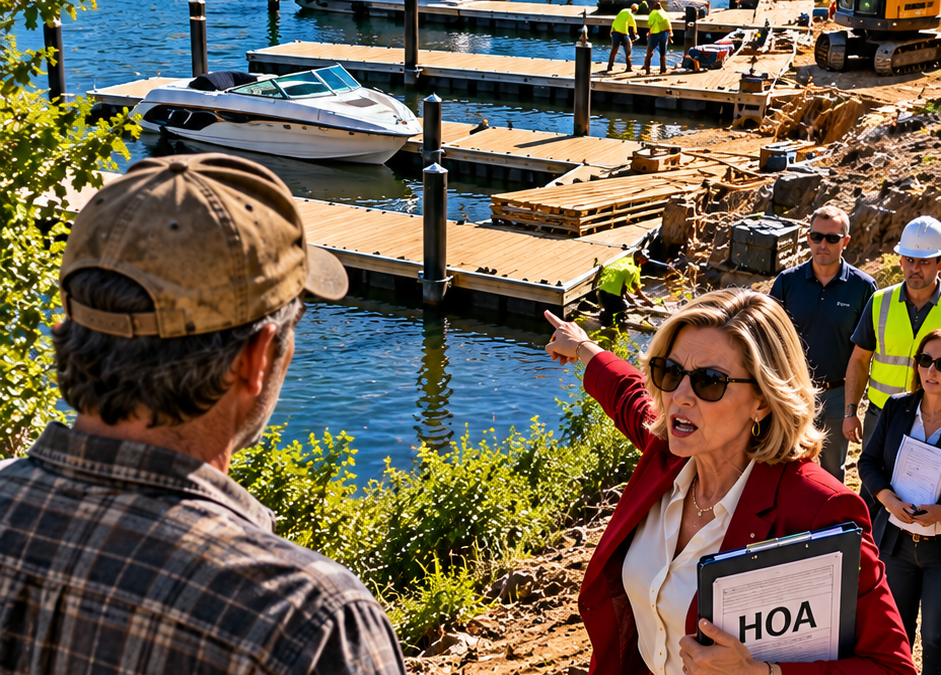
And along the shoreline, where there should have been nothing but reeds, rocks, and old family pasture, I saw docks.
Not one.
Not two.
Nine.
I stopped the truck so hard the tires slid in the dirt.
For several seconds, I simply sat there with my hands on the wheel, staring through the windshield.
The docks stretched along the northern and eastern banks in neat intervals. Wooden walkways extended from the shore. Metal posts stood in the shallows. Boats were tied to them—pontoon boats, fishing boats, polished runabouts with covers snapped tight over their seats. A few had coolers stacked near them. One dock even had solar lights mounted along the rails.
They looked established.
Comfortable.
Owned.
But not by me.
I got out slowly.
The air smelled like warm grass, lake water, and gasoline from one of the boats. Somewhere across the water, a bird called once and went silent. I walked toward the nearest dock, boots crunching over dry weeds and gravel, feeling anger rise before I fully understood what I was looking at.
These were not old structures left by some previous owner.
Some of the wood was new. Fresh cuts still showed pale beneath the stain. The hardware on two docks had not even rusted yet. Someone had spent serious money building along my shoreline, and they had done it without asking the owner.
Without asking me.
I walked the first dock from shore to end. The boards were solid. The boat tied beside it had a registration sticker from the previous year. A locked storage box sat near the railing. A laminated tag hung from one post with a number on it.
Dock 4.
That meant someone had organized this.
Someone had numbered them.
Someone had treated my lake like an amenity.
I walked the shoreline, counting.
One. Two. Three.
By the time I reached the fifth dock, my anger had turned cold.
By the ninth, I was already thinking like my father had taught me to think when dealing with land disputes.
Do not yell first.
Document first.
I pulled out my phone and began taking photos. Wide shots. Close shots. Dock numbers. Boats. Shoreline angles. Trail access points. Fresh construction marks. Every post driven into the bank. Every lock. Every sign. Every scrap of evidence that showed someone had entered private land and built as if permission were something they could invent later.
That was when Karen arrived.
I heard voices behind me before I saw her.
Then several people came walking down the trail from the subdivision side of the ridge.
Karen Whitcomb led them.
I knew who she was before she introduced herself because people like Karen have a way of arriving as if the ground has been expecting them. She wore white pants, a navy blouse, sunglasses too large for her face, and the unmistakable expression of someone who had already decided I was the problem.
Behind her were three men and two women, all dressed like lake homeowners enjoying a board-sanctioned confrontation.
Karen did not ask who I was.
She did not ask why I was there.
She pointed toward me and said, “You can’t be here.”
For a second, I thought I had heard her wrong.
Then she said it again.
“This is HOA property. You are trespassing.”
I almost laughed.
Not because it was funny.
Because it was so absurd my body did not know what else to do with it.
I looked at the lake. Then at the docks. Then back at her.
“Say that again.”
Karen lifted her chin. “This lake belongs to the neighborhood. These docks are for authorized residents only.”
I took one slow breath.
The neighborhood she meant was Ridgeview Estates, an expensive HOA development that bordered a small section of the ranch near the eastern hills. It had been built years after my family bought the land, long after the lake had been dug, deepened, fenced, and maintained by generations of my family. The subdivision had always acted like the ranch was an inconvenience beside its property line, but until that morning, I had not realized how far their imagination had stretched.
“The lake belongs to the neighborhood?” I asked.
“Yes,” Karen said. “Homeowners have enjoyed this lake for years.”
“That wasn’t my question.”
“It’s a community amenity.”
“No,” I said. “It is a private lake inside a private ranch.”
One of the men behind her scoffed. “Then why are our docks here?”
I looked at him. “That is exactly what I’m trying to find out.”
Karen stepped closer, her voice sharpening. “You need to leave before we call the sheriff.”
That time, I did laugh.
Quietly.
Once.
Karen’s eyes narrowed.
I reached into the folder I had brought from the truck. I had not expected to need it at the lake, but after weeks of estate work, I had been carrying copies of property documents almost everywhere. Deed. Survey. Parcel map. Tax description. The kind of records people ignore until they suddenly need them more than air.
I opened the survey on the nearest dock railing.
The paper fluttered in the wind.
“This is the inherited property boundary,” I said. “The lake sits entirely inside it. The shoreline is mine. The land under these docks is mine. If the HOA has a deed, easement, lease, license, or recorded agreement that says otherwise, show it to me.”
Karen’s expression changed.
Just slightly.
Enough.
She had expected anger. She had expected confusion. She had not expected paperwork.
“The HOA approved these improvements years ago,” she said.
“An HOA cannot approve construction on land it does not own.”
“These docks have been here for a long time.”
“Some of them are new.”
“That is maintenance.”
“That is construction.”
She looked toward the others, as if waiting for them to support her. A few stared at the survey but said nothing.
I tapped the boundary line with one finger.
“Show me the document.”
Karen’s voice rose. “We don’t have to prove community access to some stranger walking around our docks.”
“I’m not a stranger,” I said. “I’m the owner.”
That landed.
The group went quiet.
Karen recovered first, but not cleanly.
“If you inherited the ranch, then you inherited the existing lake use.”
“No,” I said. “I inherited the property. Any use still needs legal permission.”
A woman behind her spoke softly. “Karen, maybe we should check the files.”
Karen snapped, “We know what the files say.”
“Good,” I said. “Bring them.”
No one moved.
The lake behind us was perfectly still, as if it too were waiting.
I folded the survey, put it back in the folder, and walked away before Karen could turn the confrontation into theater.
That night, I did not sleep much.
I sat in the ranch office under the yellow light of my father’s old desk lamp and opened every file connected to the lake.
Deeds.
Surveys.
Water records.
Old tax maps.
Estate inventories.
Boundary descriptions.
Correspondence from decades earlier.
My father had kept records with obsessive care. He wrote notes in pencil on the edges of documents, labeled folders with dates, and saved copies of letters most people would have thrown away. As a child, I had mocked him for it. That night, I silently thanked him over and over.
Every document confirmed the same thing.
The lake and its shoreline were private.
The boundary wrapped around the entire water body. There was no recorded HOA easement. No dock agreement. No community access license. No lease. No shared maintenance document. No legal permission for nine docks.
Not one.
By two in the morning, I had spread the records across the floor in chronological order. The story was clear. Ridgeview Estates had been built near my family’s land, but not on it. At some point, residents had begun treating the lake like theirs. Maybe it started with a path. Then a fishing spot. Then one small dock. Then another. Then the HOA, seeing something residents liked, began calling it a community amenity.
That is how trespass often grows.
Not with one dramatic invasion.
With a thousand small assumptions left unchallenged.
By sunrise, I knew exactly what I was going to do.
I drove into town and had several signs made.
Nothing threatening.
Nothing emotional.
Just direct.
PRIVATE PROPERTY. NO UNAUTHORIZED ACCESS. NO BOATS OR DOCK USE WITHOUT WRITTEN PERMISSION OF OWNER.
I posted the first notice at the main trail leading from Ridgeview Estates.
The second near the old service road.
The third by the northern shoreline.
The fourth beside the cluster of docks.
Then I photographed each sign after installation.
By nine o’clock, Karen was back.
This time, she came in a golf cart with two HOA board members and a man carrying a binder. She climbed out before the cart fully stopped.
“What do you think you’re doing?” she demanded.
“Making the boundary clear.”
“You will remove those signs immediately.”
“No.”
“This is harassment.”
“No,” I said. “This is notice.”
She pointed at the sign. “You cannot restrict residents from community facilities.”
“Where is your legal permission to use my lake?”
Karen turned to the man with the binder. “Show him.”
The man opened it quickly.
Too quickly.
I watched him flip through pages with increasing discomfort.
HOA rules.
Meeting minutes.
Budget summaries.
Maintenance invoices.
Dock repair approvals.
Resident boat slip assignments.
A trail map.
A page showing dock numbers.
Not a deed.
Not an easement.
Not a lease.
Not a license.
He kept turning pages until there were no pages left.
Karen stared at him.
“Well?”
He swallowed. “I don’t see the deed copy in this binder.”
I almost admired the sentence. It was technically true and deeply evasive.
“Then bring the deed copy,” I said.
Karen glared at me. “This is not over.”
“I hope not,” I said. “I want it resolved properly.”
That was not what she wanted to hear.
She wanted fear. Or anger. Or a mistake.
I gave her documents.
The next step was a licensed surveyor.
His name was Owen Fletcher, and he had worked ranch boundaries in the county for nearly thirty years. He arrived with a survey truck, field equipment, and the kind of calm that comes from knowing land does not care who is loudest.
We walked the shoreline together.
He found old markers near the south pasture, checked the creek inlet, verified the west ridge line, and followed the boundary around the lake. He moved slowly and methodically, marking positions, taking measurements, comparing the current terrain against the inherited survey and county records.
Karen appeared halfway through with three residents behind her.
Owen did not even look up when she started talking.
“This survey is unnecessary,” she said.
Owen placed a marker near a dock approach. “Most surveys are unnecessary until they are not.”
Karen pointed at the dock. “That structure is HOA maintained.”
Owen looked at me. “Does she have a recorded instrument?”
“No.”
He went back to work.
By the end of the day, the preliminary result was obvious.
The lake sat inside my property.
The shoreline sat inside my property.
Every dock sat along land controlled by my property rights.
Some structures extended over water, but their landward connections, approaches, posts, and access points were all tied to my privately owned shoreline.
Karen stood near Dock 7, watching Owen place another marker.
For the first time, I saw something like fear move across her face.
Not fear of me.
Fear of consequences.
Because the survey markers made the lie visible.
Residents could argue about tradition. Karen could talk about community use. The HOA could wave repair receipts. But bright flags along the shore told a simpler story.
They had built on land they did not own.
The next day, Karen took the fight to the county office.
That was her third mistake.
She believed the county would validate the HOA because the docks had existed long enough to look official. People like Karen trust appearances until records turn against them.
I attended with my attorney, Marissa Cole, whom I had hired the moment I realized this was larger than a neighborly misunderstanding. Karen came with the HOA’s attorney, two board members, and a stack of community documents thick enough to impress anyone who forgot what kind of document mattered.
The county property official, Mr. Alvarez, met us in a small conference room.
He did not seem impressed by anyone.
That was reassuring.
Karen spoke first.
She described the lake as “historically shared.” She said residents had relied on access for years. She said the docks had been constructed as community improvements and maintained with HOA funds. She said my signs had created distress among homeowners who had purchased their homes believing lake access was part of the community.
Mr. Alvarez listened without interrupting.
Then he asked one question.
“Do you have a recorded easement or ownership interest?”
Karen’s attorney opened his folder.
He produced HOA rules.
Marina-style dock assignments.
Meeting minutes approving repair expenses.
A map used in homeowner welcome packets.
Mr. Alvarez reviewed each document briefly.
Then he looked up.
“These are internal association documents.”
The attorney said, “They show longstanding community use.”
“They do not show recorded property rights.”
Karen leaned forward. “But homeowners have used the lake for years.”
Mr. Alvarez turned to me. “Your deed?”
I handed it over.
Then the survey.
Then the parcel map.
Then Owen’s preliminary boundary report.
The room became very quiet as Mr. Alvarez compared my documents with the county’s property records on his screen. He checked parcel numbers, legal descriptions, tax maps, recorded plats, and prior conveyances.
Everything matched.
The lake was private.
The shoreline was private.
No HOA easement appeared in the county record.
No recorded dock license existed.
No document gave Ridgeview Estates the right to build nine docks on my land.
Mr. Alvarez finally folded his hands on the table.
“Based on the documents before me, the lake and shoreline are within Mr. Whitaker’s property. I do not see recorded authorization for the HOA docks.”
Karen’s mouth tightened. “That cannot be right.”
Mr. Alvarez did not react.
“The county records are consistent.”
“Our residents were told they had lake access.”
“By whom?”
Karen did not answer.
Marissa leaned slightly forward. “That is a question for the HOA.”
Karen shot her a look.
Mr. Alvarez continued. “The county will notify the association that the docks have no recorded authorization in the property records. Any continued access, use, repair, or occupancy should be addressed through the property owner and legal counsel.”
The HOA attorney’s face had gone pale.
Karen stared at the table.
Her argument had not faded slowly.
It had collapsed all at once.
After that meeting, the lake changed.
Not physically at first.
The docks still stood. The boats still floated. The water still moved under the same wind.
But the feeling was different.
The false certainty was gone.
Residents began removing boats within days. Some came quietly at dawn, untying lines and towing their boats away without looking toward the house. Others arrived angry, slamming truck doors and muttering about lawsuits. One man told me I was ruining something families had enjoyed for years.
I told him, “Your HOA should have asked permission before selling you access to someone else’s land.”
He had no answer for that.
Another resident, an older woman named Elaine, stopped near the shoreline while her son pulled a fishing boat from Dock 3. She looked embarrassed more than angry.
“We were told the docks were included,” she said.
“I believe you.”
“I paid extra for a lake-access lot.”
“I’m sorry.”
She looked at the water. “Karen told everyone the ranch owner had granted community use years ago.”
“There is no record of that.”
“I know that now.”
Her voice broke slightly on the last word.
That was the hardest part.
Not Karen.
Karen had earned whatever embarrassment came her way.
The hardest part was seeing ordinary residents realize they had been sold a story. Some had spent money on boats. Some had bought homes believing lake access increased their value. Some had brought children there for summers. They were wrong to use my property, but many had not known they were wrong.
That did not give them rights.
But it did make the situation sadder than simple trespass.
Karen, however, refused to give up.
She called another HOA meeting and tried to frame the county notice as “preliminary.” She told residents the board was exploring legal remedies. She suggested my family had “failed to object historically” and that this might support continued use. She even claimed the docks represented “community investment.”
Marissa attended that meeting with me.
When Karen finished, Marissa stood and read from the county notice.
Then she read from the deed.
Then she read from the surveyor’s report.
The room grew quieter with every sentence.
Finally, a resident asked the question Karen had been avoiding.
“Did the HOA ever have written permission?”
Karen said, “The prior understanding was—”
The resident interrupted. “Written permission.”
Karen looked toward the HOA attorney.
He did not save her.
“We have not located a recorded agreement,” he said.
That sentence broke something in the room.
Not loudly.
Not dramatically.
But I saw it.
People stopped looking at me as the threat and started looking at the board as the source of the problem.
Another homeowner stood. “Then why have we been paying dock maintenance fees?”
A second asked, “Who approved construction?”
A third said, “Were permits pulled?”
A fourth asked, “Did anyone verify ownership before assigning boat slips?”
Karen tried to keep control, but control had already moved to the documents.
The HOA attorney eventually advised the board to stop assigning dock access, suspend all lake-use representations, and begin negotiations with me regarding removal, remediation, and liability.
Karen looked as if he had betrayed her.
He had not.
He had simply read the room and the record at the same time.
The next several weeks were ugly.
There were letters.
Inspections.
Insurance questions.
Contractor estimates.
Arguments over who would pay to remove or modify the docks.
Debates over whether any structure could remain under a negotiated license.
Marissa advised me to be firm but not reckless. Removing nine docks from a lake was not as simple as tearing boards loose. There were environmental issues, water safety issues, structural concerns, and possible damage to the shoreline. Everything had to be done properly.
That suited me fine.
I did not want revenge.
I wanted my lake back.
The final agreement required the HOA to remove the unauthorized boats immediately, stop representing the lake as a community amenity, pay for a certified survey to be recorded with corrected HOA disclosures, and fund removal or lawful remediation of the nine docks under professional supervision.
Three docks were removed entirely.
Four were dismantled and hauled away after the boating season ended.
Two older structures near a shallow cove were temporarily left in place only long enough for environmental review, then modified into private ranch access points with all HOA markings removed and ownership acknowledged in writing.
The shoreline looked wounded during the work.
Piles of lumber sat where docks had stood. Contractors moved along the bank with equipment. Old posts came out of the mud with sucking sounds. Boats disappeared one by one. The numbered tags were removed. Solar lights came down. Storage boxes were emptied and hauled away.
Karen came once during the removal of Dock 5.
She stood at the edge of the work area in sunglasses, arms folded tightly.
“This did not have to happen,” she said.
I looked at the crew unbolting the walkway.
“You’re right,” I said. “It didn’t.”
She turned toward me. “You could have worked with us.”
“You could have asked before building nine docks.”
She shook her head. “People loved this lake.”
“So did my family.”
That stopped her.
For a moment, the anger on her face shifted into something more complicated. Maybe she had never thought of the lake that way. Maybe to her it had always been an amenity, a selling point, a feature on a neighborhood map. Something to manage. Something to control. Something to improve.
To me, it was where my father taught me to cast a line.
Where my mother once sat barefoot on a flat rock reading novels in July.
Where my grandfather’s ashes had been scattered beneath a sky so clear it looked endless.
Karen had turned that into dock numbers and boat assignments.
“I didn’t know,” she said finally.
“No,” I replied. “You didn’t check.”
She left without answering.
By the time the work finished, the lake looked different.
Quieter.
Cleaner.
Strangely larger.
Without the docks, the shoreline opened again. Reeds moved where walkways had been. The water reflected trees instead of boat covers. Deer came down near the north bank at dusk. Herons returned to the shallows where residents used to drag coolers and folding chairs.
For the first time since inheriting the ranch, I could stand by the lake and not feel like I was sharing it with someone else’s assumption.
That did not mean everything was simple.
The HOA had to correct its disclosures. Some residents pursued claims against prior board decisions. Karen resigned from her position before the end of the year, citing “community division” and “personal priorities.” The new board sent a formal letter acknowledging that the lake was private ranch property and that Ridgeview Estates had no recorded access rights.
I kept that letter in my father’s file cabinet.
Not because I trusted them.
Because records matter.
One evening, months after the last unauthorized dock came out, I walked down to the lake alone.
The sun was setting behind the western pasture. The water had turned copper near the shore and dark blue farther out. The old trail was quiet. No golf carts. No residents. No voices carrying across the water as if my land were a clubhouse extension.
Just wind.
Trees.
The low movement of water against stone.
I thought about how close I had come to inheriting someone else’s lie without noticing it. If I had not walked the shoreline that morning, if I had assumed the docks were part of some old agreement, if I had trusted Karen’s confidence more than my own deed, the trespass might have continued for another generation.
That is how land gets taken sometimes.
Not with fences cut in the night.
Not with dramatic theft.
But with repetition.
A dock built without permission.
A boat tied up.
A resident told access is included.
A board vote entered into minutes.
A trail map printed.
A lie repeated until it feels old enough to become true.
But it did not become true.
Because truth was still sitting in the deed.
The lake had always been private.
The shoreline had always been mine.
The HOA had built nine docks without permission, but boards and bolts could not defeat a recorded boundary.
I inherited more than acreage that year.
I inherited the obligation to defend it.
And by the time the lake went quiet again, I understood something my father had tried to teach me long before I was ready to hear it.
Land does not protect itself.
Someone has to know where the line is.
Someone has to keep the documents.
And when people like Karen point at your water and call it theirs, someone has to be willing to open the deed and prove otherwise.








