𝗣𝗔𝗥𝗧 𝟮 The K9 Everyone Had Written Off Was Waiting for a Command Only I Could Give
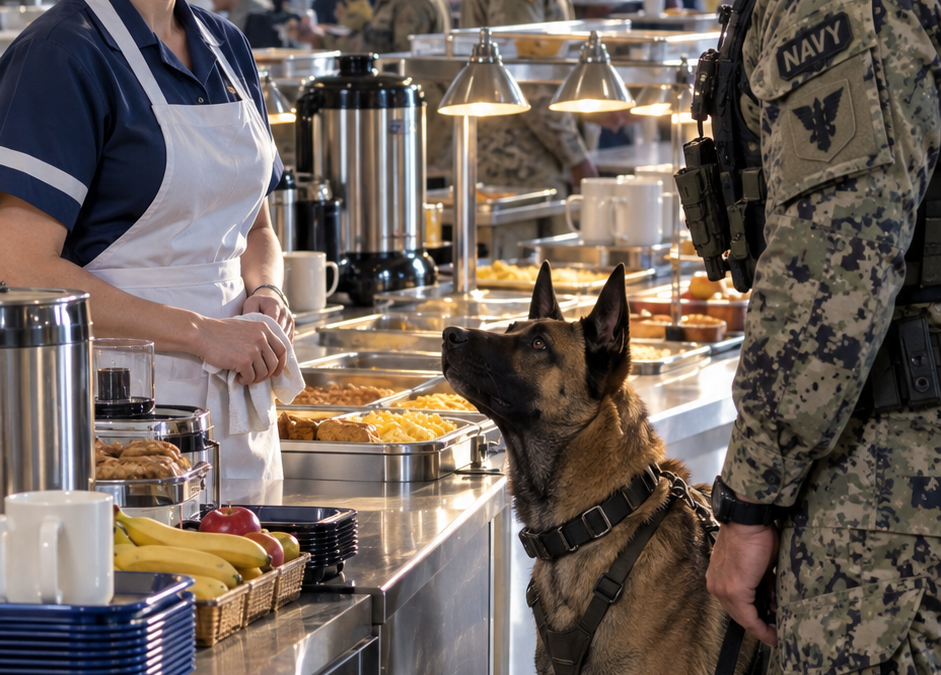
𝗣𝗔𝗥𝗧 𝟮
I came toward him with a tourniquet already in my hand.
Bishop moved over Dean’s body and stopped me eight feet away.
I stepped left.
He shifted left.
I stepped right.
He moved right.
“Bishop,” I said.
Nothing.
I tried the handler’s release command.
Nothing.
Dean was on the ground, pale from pain and still somehow laughing.
“Doc,” he said, “we may have identified a small design flaw.”
“Tell your dog to move.”
“I did.”
“Tell him better.”
Dean tried.
Bishop did exactly what he had been trained to do.
Protect the downed operator.
From everyone.
Including me.
I stared at the dog.
Then at Dean.
“If you start bleeding seriously one day, your own dog is going to keep me from saving you.”
Dean stopped smiling.
That afternoon, behind a shipping container, we built something that was never written into any manual.
We needed a signal Bishop would recognize as separate from every standard command he knew.
Something that could not be confused with a handler’s whistle.
Something that meant only one thing.
Dean suggested three notes.
Two short.
One long.
I practiced it until Dean stopped making fun of how bad my first attempts sounded.
Then we taught Bishop.
Two short notes.
One long.
I approach.
Bishop yields access.
Not a recall.
Not a heel.
Not a release from duty.
Just permission.
Let her in.
She’s the one who fixes people.
Three days.
That was all Bishop needed.
After that, he never got it wrong.
I used the signal four times over the next two deployments.
The fifth time was the last.
There are memories your mind preserves in impossible detail.
Not because you want them.
Because something inside you decides you may need to survive them again.
I remember the color of the dust.
I remember a broken section of wall.
I remember somebody yelling from my left.
I remember my knees hitting the ground hard enough to bruise.
I remember Dean lying in the courtyard.
And Bishop standing over him.
Perfectly.
Exactly as trained.
Facing outward.
Protecting him.
Holding a perimeter around a man who was already beyond anything a perimeter could protect him from.
I knew the moment I saw Dean.
Medics know.
That does not mean we stop.
I put two fingers to my lips.
Two short notes.
One long.
Bishop turned.
He saw me.
Then he stepped aside.
I went in.
For eleven minutes, I did everything I knew how to do.
Every procedure.
Every decision.
Every desperate sequence I had been trained to execute while refusing to think about whose face was underneath my hands.
Bishop remained beside us.
He watched the approaches.
He protected both of us now.
Dean never came back.
The review later found nothing I could have done differently.
People think that sentence is supposed to provide comfort.
It does not.
There is a difference between being told you are not responsible and being able to convince your body to believe it.
I stayed in another fourteen months.
Then I left.
Not because I blamed myself.
At least that was what I told everyone.
The truth was more complicated.
For years, my working life had narrowed around two constants.
Dean.
And Bishop.
Dean was dead.
Bishop disappeared into a transfer system I had no legal access to.
Officially, I had never been part of his handling record.
I was the medic.
Dean was the handler.
Bishop belonged to the program.
When Dean died, Bishop became an asset needing reassignment.
I became a person asking questions she did not technically have standing to ask.
I filed my first request less than three weeks after leaving.
No releasable information.
I filed another.
Same answer.
Then another.
Six requests in eight months.
Every one of them came back with some version of the same language.
No releasable information.
Restricted.
Unavailable.
Not authorized.
After the sixth, I stopped filing.
But I did not stop looking.
That spring, I saw the canteen position.
Bad hours.
Poor pay.
No benefits worth mentioning.
Across the road from a canine facility known to receive transfers from programs across the country.
I applied that day.
I accepted before the supervisor had finished explaining the schedule.
My mother asked why I wanted to serve eggs after everything I had done before.
I told her I needed something simple.
That was not entirely a lie.
A friend helped me move.
She asked why I had chosen an apartment so close to base.
I told her I liked the area.
Another partial truth.
I told nobody about Bishop.
Hope becomes dangerous when you have already lost enough.
I knew the odds.
There were hundreds of military and government dogs moving through different systems.
Dozens of Malinois could pass through that facility.
Bishop could have been retired.
Transferred overseas.
Reassigned to another agency.
Injured.
Dead.
I understood all of it.
But I also understood something else.
People talk over breakfast.
Especially handlers.
If an unusual dog ever came through that compound, eventually somebody would sit at my counter and complain about him.
So I waited.
Five in the morning.
Day after day.
Week after week.
Month after month.
I poured coffee.
I cleared plates.
I listened.
Seven hundred mornings can teach you how quietly a person can carry one question.
Then, three months before everything changed, the handlers began talking about a dog.
A Belgian Malinois.
Transfer.
Incomplete records.
Unclear previous assignment.
He was failing everything.
At first, I barely listened.
Dogs fail programs all the time.
A transfer can look good on paper and collapse under a new environment.
They said this one would not track.
Would not hold a bite.
Would not run certain obstacles.
Sometimes he stopped in the middle of open ground and simply froze.
No obvious trigger.
No clear pattern.
He would stand there, facing outward, and refuse every attempt to move him.
The first time I heard that, my hand tightened around a dish towel.
But I said nothing.
Then Reeves mentioned the gunfire problem.
“Dog practically shuts down when we run live-noise scenarios.”
That bothered me.
A Malinois with obvious advanced conditioning should not have been surprised by gunfire.
“Some of them come back wrong,” another handler said.
I kept wiping the counter.
A week later, Sergeant Vance sat down with Kessler.
“I saw him last night,” Vance said.
“Saw what?”
“Clearing the kennel run.”
Kessler laughed.
“What?”
“Corners. Sight lines. Every time somebody walked past, he checked the approach before he moved.”
“Maybe he’s bored.”
“That’s not boredom.”
I looked down at the cup I was filling.
Protective conditioning does not disappear because a dog gets transferred.
Sometimes it becomes more obvious when nobody understands what they are watching.
Still, I refused to let myself believe.
There are many well-trained Malinois.
Many unusual transfers.
Many dogs with quirks from assignments nobody talks about.
Hope had cost me too much already.
For twelve weeks, I listened.
They called him stubborn.
Confused.
Damaged.
Badly transferred.
Finally, they started calling him a washout.
Only Vance resisted.
“Something’s wrong with the evaluation,” he said one morning.
Reeves shook his head.
“We’ve been evaluating him for three months.”
“Exactly.”
“And?”
“And he keeps doing the same weird things.”
“Because he’s failing.”
“Or because we don’t know what we’re asking him.”
Reeves laughed.
“He’s a dog, Vance. We’re not translating ancient Greek.”
I turned away so they would not see my expression.
The date was a Thursday in October.
Cold enough that everyone entering the canteen brought outside air with them.
Vance was halfway through breakfast.
Reeves sat two stools down.
Another handler was complaining about paperwork.
I was refilling coffee.
Vance said, “If Hollis signs the washout on Bishop tomorrow, that’s it.”
The coffee stopped pouring.
For two years, I had imagined the possibility of hearing that name.
I had imagined I would drop something.
Cry.
Say something.
Instead, my body simply stopped.
My hand froze with the pot tilted above Vance’s cup.
Bishop.
No one seemed to notice at first.
Vance kept talking.
“They haven’t even figured out what he was originally trained for.”
Reeves sighed.
“Let it go.”
“He clears corners at night and forgets recalls in daylight. That isn’t normal.”
“Some dogs come back broken.”
My arm began to tremble.
I lowered the coffee pot carefully.
Set it on the warmer.
Untied my apron.
Vance looked at me.
“Olivia?”
I folded the apron once.
Placed it beside the register.
Then I walked out.
No explanation.
No permission.
I crossed the canteen.
Opened the door.
Cold air hit my face.
Behind me, somebody called my name.
I kept walking.
The K9 complex sat across the road and roughly two hundred yards down.
I had looked at that fence almost every working day for two years.
Sometimes I could hear dogs barking through the morning traffic.
Sometimes I saw handlers running drills.
I had never entered the training yard.
Not once.
That morning the main gate was open for rotation.
I crossed the road.
Passed through it.
Walked past a supply shed.
Past transport vehicles.
Past two kennel technicians who both turned to stare.
My heart had begun beating so hard that everything around it felt strangely quiet.
The training yard opened ahead.
There were handlers.
Instructors.
A kennel tech.
Commander Ellis Hollis stood near the fence with a clipboard.
And in the middle of the range, twenty feet from a set of hurdles, stood a Belgian Malinois.
He was motionless.
I stopped breathing.
He was thinner.
Older.
There was gray beginning around parts of his muzzle I remembered as black.
A scar ran along his left flank.
I had never seen it before.
But recognition does not happen one detail at a time.
It happens all at once.
Bishop.
Not a similar dog.
Not hope.
Not resemblance.
Bishop.
A piece of a life I had spent two years trying not to mourn as dead.
An instructor shouted.
“Ma’am! Stop!”
I kept walking.
Hollis turned.
Someone else began moving toward me.
I barely saw them.
Bishop was staring somewhere past the obstacles, body rigid, feet planted, head positioned exactly the way I remembered.
He was holding.
My throat closed.
For twelve weeks, they had watched him do his job and called it failure.
“Ma’am!”
Footsteps behind me.
A hand caught my arm.
I stopped.
Not because he had stopped me.
Because I was close enough.
Twenty feet.
Maybe a little more.
I raised my free hand.
Two fingers to my lips.
The first note came clean.
Short.
The second followed.
Then the long note.
A sound I had not made in almost two years crossed the cold training yard.
For one terrible fraction of a second, nothing happened.
Then Bishop’s head came up.
His ears drove forward.
His weight shifted.
I saw the exact moment recognition moved through him.
Not curiosity.
Not simple reaction to noise.
Recognition.
His eyes found me.
The years between us vanished.
He ran.
Straight across the yard.
Past the obstacles.
Past two instructors.
Past everything those men had spent three months trying to teach him.
He came at me so fast that the man holding my arm released me and stepped away.
Bishop stopped against my legs.
Pressed his whole body into me.
And stayed there.
The yard became silent.
I put my hand on the back of his neck.
His fur felt different.
Rougher.
His shoulders were bonier than I remembered.
But when I touched the place behind his ears, he leaned into my palm exactly the way he used to after long movements when Dean finally gave him permission to stop working.
My vision blurred.
“Hey,” I whispered.
Bishop closed his eyes.
That nearly broke me.
I had imagined finding him.
I had imagined not finding him.
I had never imagined what it would feel like when his body remembered me before I had found words.
Commander Hollis reached us.
He did not raise his voice.
He looked at Bishop.
Then at me.
“Who are you?”
I kept my hand on the dog’s neck.
There were many answers I could not give him.
Program names.
Locations.
Operational designations.
Unit relationships.
There were exactly four useful words I was allowed to say.
“I was his medic.”
Hollis stared at me.
“Whose medic?”
“Bishop’s team.”
“What unit?”
I said nothing.
“Which program?”
Nothing.
“Who was his handler?”
That answer belonged to the public record.
“Petty Officer Marcus Dean.”
Something changed in Hollis’s expression.
Not recognition exactly.
Professional attention.
“When?”
“I can’t answer that.”
“Where?”
“I can’t answer that either.”
Reeves had reached the group by then.
Vance stood behind him.
Everyone was looking at me.
I hated being looked at.
I had spent two years becoming invisible.
Hollis glanced at Bishop again.
“You’re telling me you served with this dog.”
“Yes, sir.”
“You have documentation?”
“Not that you’ll be able to access.”
That was not the answer a commander wants from an unauthorized civilian standing on his restricted range.
I knew it.
He knew it.
Still, he did not treat me like a liar.
He sent someone for records.
The next eleven minutes were some of the longest of my life.
Bishop refused to leave my side.
Every time someone moved closer, he tracked them.
Not aggressively.
Evaluating.
Vance stayed nearby.
Reeves whispered with another handler.
The instructors pretended to check equipment while watching us.
When the records returned, they were exactly what I expected.
Marcus Dean existed.
Rank.
Birth date.
Service entry.
Date of death.
The location of his death was replaced by a control number.
His operational history was sealed.
Then they searched me.
Nothing.
No useful service record.
No unit.
No separation history visible at Hollis’s clearance level.
I watched the technician scroll the screen twice.
He looked embarrassed.
Hollis looked frustrated.
The system showed him a civilian canteen employee claiming nine years of military experience that apparently did not exist.
Reeves finally spoke.
“Sir, dogs react to whistles.”
Nobody answered.
He continued.
“Novel sound. Familiar environment. High-drive breed. It could be stimulus response.”
I looked at him.
He was not being cruel.
That almost made it harder.
He believed what he was saying.
If the alternative is admitting an ordinary-looking woman behind a lunch counter knows something you do not, coincidence can feel very attractive.
“He’s right about one thing,” Hollis said.
He looked at me.
“This isn’t proof.”
I nodded.
He seemed surprised.
“You’re not going to argue?”
“No.”
“Why?”
“Because if I were standing where you are, I wouldn’t accept it either.”
That softened something in his face.
Then he gave me the information that turned relief into fear.
“Bishop’s washout process has already started.”
My hand tightened against Bishop’s fur.
“How far?”
“Eleven days.”
Vance looked away.
Hollis continued.
“We have documented failure across twelve weeks. One unusual response doesn’t erase that.”
“What happens if it’s completed?”
“Removal from this program.”
“And after that?”
He hesitated.
“Civilian placement, if suitable.”
“If not?”
Another pause.
I did not need him to answer.
I had seen the flags.
Gunfire response.
Noncompliance.
Freezing.
Possible unpredictable behavior.
A dog with that record was not guaranteed a peaceful retirement.
I crouched in front of Bishop.
Put both hands against his face.
His eyes stayed on mine.
“I’m sorry,” I whispered.
For Dean.
For the two lost years.
For not getting there sooner.
For every command Bishop had obeyed while people wrote down that he was failing.
Hollis asked me to leave.
I did.
I walked back across the yard.
Across the road.
Into the canteen.
Put my apron back on.
Finished the shift.
I cut sandwiches.
Refilled napkins.
Ran the register.
I did all of it with hands that did not feel connected to my body.
Through the window, I could see part of the kennel fence.
Later, Vance told me Bishop had stood there watching the canteen door long after I disappeared inside.
At four that afternoon, the lunch rush was over.
The room had gone quiet.
I was cleaning the coffee machine when Sergeant Vance sat on the stool across from me.
He did not order anything.
I poured him coffee anyway.
“What is he?” he asked.
I looked at him.
“Bishop.”
“You know what I mean.”
I turned the cup so the handle faced him.
“What exactly are you allowed to know?”
“Whatever saves that dog.”
I studied his face.
For three months, he had been the only one defending Bishop without understanding why.
That mattered.
“He wasn’t trained for patrol.”
Vance waited.
“He wasn’t trained for detection either.”
His forehead tightened.
“What was he trained for?”
“Protective hold.”
He went still.
I explained.
Downed operator.
Position over casualty.
Face outward.
Deny access.
Wait.
Not for any handler.
For the correct person.
Vance’s eyes slowly changed.
I could see twelve weeks of observations reorganizing themselves inside his head.
“The freezing.”
“He isn’t freezing.”
His mouth opened.
Then closed.
“He stops in open ground,” he said.
“Where?”
“Usually midway through the drill.”
“Orientation?”
“What?”
“Where is his body pointed?”
Vance thought.
“Outward.”
“Does he keep scanning?”
Another pause.
“Yes.”
“He isn’t shutting down.”
Vance leaned back.
“Oh, God.”
“He’s holding.”
The words seemed to land harder than I expected.
Vance looked toward the canteen windows as if he could somehow see across the road.
“We’ve been marking it as refusal.”
“I know.”
“We’ve been correcting him.”
“I know.”
“Jesus.”
“He doesn’t understand why you’re punishing him.”
Vance put one hand over his mouth.
I remembered Bishop in that courtyard.
Dean beneath him.
The dust.
The eleven minutes.
My whistle.
“Bishop was trained around one certainty,” I said. “If a man goes down, he holds until access is granted. The handler who built his world died while Bishop was doing exactly that.”
Vance stared at me.
I continued.
“Then somebody transferred him without the context. You put him into open-space drills. His conditioning activates, but there’s no casualty and no release structure that makes sense to him. So he assumes position and waits.”
“For who?”
That was the question.
I looked down at my hands.
“Maybe Dean.”
Vance said nothing.
“Maybe me.”
Silence stretched between us.
Eventually he asked, “Can we prove it?”
“Yes.”
“How?”
I hated the answer.
Because proving Bishop was still fully trained meant asking him to revisit the job associated with the worst moment of his life.
“We put a man down.”
Vance’s expression changed.
“Simulated casualty.”
“Yes.”
“No commands?”
“None.”
“No cues?”
“Nothing.”
“And if you’re right?”
“He’ll go into protective hold.”
Vance leaned forward.
“And then?”
“I give the access signal.”
He understood.
“If he releases only for your whistle…”
“It proves the first response wasn’t random.”
Vance exhaled slowly.
“If you’re wrong?”
I looked at him.
“Then Hollis has what he needs to sign the paperwork.”
That evening, Vance took the proposal to Commander Hollis.
I learned later Hollis rejected it twice.
A civilian-designed protocol.
An already stressed dog.
A live demonstration involving deliberate casualty simulation.
Every objection was legitimate.
Then Hollis reopened Marcus Dean’s file.
This time, he did not stop at the sealed sections.
He studied the fragments that remained.
Buried among specialty codes was a canine handling certification Hollis had encountered only twice in nineteen years.
Protective hold.
He called Vance back.
The test was approved.
Seven the next morning.
Same range.
Witnesses.
I barely slept.
I lay awake thinking about Dean.
The last courtyard.
The possibility that Bishop might remember it too clearly.
The possibility that he would refuse.
The possibility that he would perform perfectly.
I was not sure which frightened me more.
By six-thirty, word had spread.
When I arrived, there were more people at the fence than usual.
Handlers.
Both instructors.
The kennel technician.
Reeves.
Kessler.
Hollis.
A few others pretending they had business nearby.
No one joked.
No one wanted coffee.
Hollis met me at the gate.
“You understand this proves behavior, not history.”
“Yes, sir.”
“And if the test becomes unsafe, I stop it.”
“Immediately.”
“What do you need?”
“Two things.”
He waited.
“No one signals him.”
“Done.”
“And I stay at the fence until the hold is established.”
He nodded.
“No chance someone says I cued him.”
Hollis looked toward the yard.
“I don’t think anyone is looking for an excuse anymore.”
Vance entered the training area.
Walked roughly eighty feet from the release point.
Then lay down flat on his back.
No protective equipment beyond what Hollis required.
No movement.
No speaking.
Just a man on the ground.
Bishop waited behind the release gate.
Even from where I stood, I could see the tension in his body.
The gate opened.
Nobody spoke.
For half a heartbeat, Bishop stayed still.
Then he saw Vance.
Everything changed.
He moved.
Not the frantic sprint of an excited dog.
Low.
Fast.
Efficient.
Purposeful.
The way he used to cross dangerous spaces when every unnecessary movement cost time.
He covered eighty feet in seconds.
Reached Vance.
Did not sniff.
Did not circle.
Did not bark.
He stepped over him.
Centered his body above Vance’s torso.
Planted all four feet.
Turned outward.
Held.
A sound escaped someone behind me.
Not a word.
Just breath.
I could not move.
For an instant, the training yard disappeared.
I saw dust.
Stone.
Blood.
Dean.
Bishop.
The last time I had seen that posture.
My hands went cold.
Kessler started forward.
He had been instructed to approach naturally.
No threat display.
No sudden movement.
At fifteen feet, Bishop tracked him.
At ten, Bishop shifted his weight.
One step.
That was all.
Not a growl.
Not exposed teeth.
No uncontrolled aggression.
He simply placed more of himself between Kessler and Vance.
The message was unmistakable.
You do not have access.
Kessler stopped.
He later told me his body made that decision before his mind did.
He lifted his hands slightly.
Backed away.
Bishop returned his attention outward.
Holding.
Waiting.
Three months of reports said the dog froze under pressure.
Every person at that fence was now watching what that “freeze” actually was.
Discipline.
Then Hollis looked at me.
He did not need to say anything.
My lips were already trembling.
I raised two fingers.
The first short whistle came out weak.
I stopped.
Closed my eyes.
Dean’s voice returned from years earlier.
Come on, Doc. You’re murdering the notes.
I almost laughed.
Almost cried.
Then I tried again.
Two short notes.
One long.
Perfect.
Bishop’s ears came forward.
His head turned toward me.
And he stepped off Vance.
Clean.
Immediate.
No hesitation.
He moved to Vance’s side.
Sat.
Waited.
Access granted.
The correct person had arrived.
Nobody spoke.
I walked through the gate.
Every step felt impossibly long.
Bishop watched me approach but did not move from position.
I reached Vance.
Dropped to one knee.
Put my hand against his shoulder as if beginning an assessment.
Bishop settled beside me.
The demonstration was complete.
Vance sat up slowly.
He looked at Bishop.
Then at me.
“I owe this dog an apology.”
His voice was rough.
“You were the one who kept trying.”
“Trying isn’t the same as understanding.”
“No.”
He looked toward the other handlers.
“But it mattered.”
Commander Hollis walked into the yard.
He stood several feet away from Bishop, studying him in silence.
Finally, he said, “Stop the washout.”
No one moved at first.
Hollis looked at the administrative tech.
“Now.”
“Yes, sir.”
Reeves stood against the fence.
His face had gone pale.
The man who had called the first whistle coincidence did not say a word.
He did not need to.
Everyone had seen the same thing.
Bishop had never been failing.
They had simply been examining a specialist with the wrong test.
For twelve weeks, they had asked why he would not behave like a patrol dog.
No one had stopped to ask what kind of dog he actually was.
That distinction saved his life.
After the range cleared, I sat on a low concrete wall outside the kennel building.
Bishop lay across my boots.
Not beside them.
Across them.
The same inconvenient habit he had always had.
I ran my fingers through the fur along his shoulders.
Up close, I could see every sign of time I had missed.
The scar on his flank.
A notch in one ear.
A thin patch of fur near his shoulder.
I wondered where he had been.
What had happened after Dean died.
Who had handled him.
Who had transferred him.
Whether he had spent those months searching for a signal nobody around him knew existed.
Vance sat down beside me.
For a while, he said nothing.
Then he asked, “Why did you wait?”
I knew what he meant.
“Two years,” he said. “You were right across the road.”
“I didn’t know he was here.”
“You never told anyone you were looking.”
“I couldn’t.”
“You couldn’t tell us you used to work with military dogs?”
“Not enough to matter.”
He looked at me.
“You could’ve told me.”
“Could I?”
That stopped him.
I looked across the road toward the canteen.
“For eight months after Dean died, I filed requests.”
“How many?”
“Six.”
“And?”
“‘No releasable information.’ Every time.”
Vance looked down.
“I wasn’t Bishop’s handler. Officially, I wasn’t even attached to his file. My own record was sealed. Imagine me walking into your office two years ago saying I’m a former combat medic you can’t verify, searching for a classified transfer dog I can’t prove I worked with from a program I can’t name.”
He winced.
“Yeah.”
“You would’ve called security.”
“Probably.”
“I know.”
Bishop shifted his head against my ankle.
I rested my palm over his neck.
“Some things you carry quietly,” I said.
Vance waited.
“Because carrying them loudly isn’t an option.”
He nodded.
We sat there until Bishop fell asleep.
Three days later, Reeves came into the canteen just after six.
He stood at the counter instead of sitting.
I reached for the coffee pot.
He stopped me.
“Olivia.”
I looked at him.
“I was wrong.”
I said nothing.
He swallowed.
“I kept calling him broken.”
“Yes.”
“I didn’t know.”
“No.”
“That’s not an excuse.”
That surprised me.
Most apologies arrive with an explanation attached like a receipt.
Reeves did not offer one.
He simply said, “I’m sorry.”
I poured his coffee.
“Thank you.”
He started to leave.
Then turned back.
“For what it’s worth, I wasn’t trying to get him put down.”
“I know.”
He nodded.
A month earlier, I might have wanted him to feel worse.
Now I did not.
Ignorance had nearly destroyed Bishop.
But ignorance was not the same thing as cruelty.
And Reeves had finally learned the difference between observing behavior and understanding it.
Commander Hollis went further.
He made calls.
The kind that require people to step into secure offices and close doors.
He pushed Bishop’s transfer history upward through channels until it reached somebody with enough authority to look behind the control numbers.
Then he did the same with my name.
Nineteen days later, an envelope arrived at my apartment.
Official stationery.
No return information beyond a government office designation.
I sat at my kitchen table for almost ten minutes before opening it.
Inside were two documents.
The first was a corrected service summary.
Minimal.
Carefully worded.
Most details still redacted.
But it acknowledged that I had served in an operational medical capacity attached to a joint program during specified dates.
My service existed again.
At least enough of it.
The second page was shorter.
It confirmed my medical attachment to the team of Petty Officer Marcus Dean on the date of his death.
His name.
My name.
On the same piece of paper.
Officially.
For the first time since that courtyard.
I read the sentence twice.
Then a third time.
My eyes burned.
I had spent so long believing I wanted proof.
Standing at that table, I realized the paper could not give me what I actually missed.
It could not bring Dean back.
It could not restore the months Bishop had spent being misunderstood.
It could not undo eleven minutes in a courtyard.
Still, I touched Dean’s printed name with one finger.
“Your dog made it,” I whispered.
The apartment was silent.
I folded the document.
Put it back in the envelope.
Then placed it in a kitchen drawer.
Because somewhere along the way, the thing I had been chasing had stopped being paperwork.
Bishop had already answered the question.
He remembered.
That was enough.
Within the month, Hollis had Bishop redesignated.
No more patrol evaluation.
No more forced tracking sequences unrelated to his training.
No more documenting protective holds as refusal behavior.
Vance became his handler.
It was not effortless.
Bishop had spent too long operating without context.
He had developed stress behaviors.
Sometimes certain drills took him somewhere else mentally.
Sometimes a loud metallic impact made his body stiffen.
Sometimes he searched behind Vance as though expecting someone who was no longer there.
We adjusted.
That word mattered.
We did not punish.
We did not force him into somebody else’s definition of normal.
We built the training around what he actually knew.
Hollis asked me to help.
At first, unofficially.
I stood beside Vance and explained how Dean had structured transitions.
How Bishop responded to casualty posture.
How he interpreted access.
How his body shifted before a protective escalation.
The little signs.
The things a file never captures.
Eventually Hollis asked me to write it down.
“What exactly?”
“Everything.”
“I can’t write everything.”
“Everything you’re allowed to.”
So I did.
A training protocol.
Protective-hold recognition.
Transfer intake questions.
Behavioral indicators.
Warnings against misclassifying stationary protection as refusal.
Methods for testing legacy signals without contaminating results.
We built something the facility had never had before.
Six weeks later, I was offered a contract.
Specialized transfer assessment.
My job was simple to describe and difficult to perform.
Dogs arrived from sealed or discontinued programs with incomplete records.
Before someone labeled them defective, I was supposed to figure out what they had actually been trained to do.
I almost laughed when Hollis explained it.
“What?”
“Nothing.”
“Something is funny.”
“I spent two years serving breakfast so I could listen for one dog.”
“And now?”
“Now you’re paying me to listen for all of them.”
Hollis smiled.
“Apparently we needed someone who knew how.”
I accepted.
I kept several morning shifts at the canteen anyway.
Part habit.
Part attachment.
Maybe part fear that if I stopped showing up at five in the morning, the whole strange chain of events would somehow prove temporary.
The handlers reacted differently after they knew.
Some became awkward.
Suddenly people who had talked around me for years were afraid of saying the wrong thing.
Kessler once addressed me as “ma’am” three times in thirty seconds.
I finally told him, “If you call me ma’am again, your oatmeal is going in the trash.”
Things became more normal after that.
Reeves apologized a second time several weeks later.
This one was quieter.
He stayed after breakfast while I was cleaning the counter.
“I’ve been thinking about something.”
“That sounds dangerous.”
He smiled briefly.
Then became serious.
“We did exactly what we’re trained not to do.”
“What?”
“Assume behavior equals explanation.”
I kept wiping the counter.
“We saw the result and decided we knew the cause.”
“People do that.”
“Not just with dogs.”
I looked at him.
“No.”
He stared into his coffee.
“We do it with people too.”
That sentence stayed with me.
Because he was right.
For two years, everyone at that base looked at me and saw a canteen worker.
They were not wrong.
I was a canteen worker.
But they believed that explained me.
That was the mistake.
The same one they made with Bishop.
They saw a dog standing still and decided he had failed.
Nobody asked what standing still meant to him.
During my first four months as a transfer consultant, two more dogs came through with incomplete backgrounds.
One was labeled environmentally unstable because she repeatedly returned to elevated platforms during open-field exercises.
She had previously been trained for overwatch positioning.
The other was called distracted because he kept checking ventilation points instead of following a patrol path.
Detection specialization.
Different target odor.
Different doctrine.
Neither animal was failing.
Both had simply been placed inside the wrong question.
Bishop became something close to himself again.
Not the same.
Nothing truly returns unchanged after loss.
Vance did not try to become Dean.
That was why Bishop eventually trusted him.
He gave the dog room to understand that a new handler did not erase the old one.
Sometimes I watched them work from the fence.
Vance would go down.
Bishop would cover.
An evaluator would approach.
Bishop would hold.
Then came the access signal.
At first, I gave it.
Two short.
One long.
Eventually we introduced a second authorized signal tied to Vance’s new medical support team.
That was necessary.
Bishop could not spend the rest of his career waiting for me.
The first time he yielded to the new signal, I expected grief.
Instead, I felt relief.
Dean had trained him to survive change.
I think neither of us understood that at the time.
One morning, several months after the demonstration, I came through the K9 gate carrying a cup of coffee for Vance.
Bishop was at the far end of the yard.
He had not seen me yet.
Vance noticed me and grinned.
“Watch.”
He said nothing to the dog.
I walked toward the fence.
Bishop turned.
His entire body changed.
Ears forward.
Head high.
Then he trotted over.
Not the desperate sprint from the first morning.
Something calmer.
Certain.
He stopped in front of me.
I crouched.
“Morning, Bishop.”
He pushed his nose against my shoulder.
Vance laughed.
“Still thinks you’re in charge.”
“No.”
I rubbed Bishop’s neck.
“He knows better.”
“Could’ve fooled me.”
I looked at the dog.
“No. He just remembers.”
There is a difference.
Memory is not the same as being trapped in the past.
For a long time, I had confused the two.
I thought carrying Dean meant I had failed to move forward.
I thought searching for Bishop meant some part of me refused to accept what happened.
Maybe there was some truth in that.
But Bishop taught me something I should have understood sooner.
You can remember the person who taught you the work and still learn to work with someone new.
You can hold the old signal and still accept another.
You can grieve what disappeared without believing your own life has to disappear beside it.
On the anniversary of Dean’s death, I woke before my alarm.
Four-ten.
The apartment was dark.
For years, that date had arrived like an ambush.
I usually spent the morning avoiding people.
This time, I drove to base.
Not to the canteen.
To the training yard.
Vance was already there.
He knew the date.
I had never told him.
Maybe Hollis had.
Maybe he had learned it from the corrected record.
He did not mention it.
Bishop sat beside him.
Vance handed me a lead.
“He’s yours this morning.”
I stared at it.
“I don’t handle.”
“Today you do.”
I took the lead.
Bishop looked up at me.
For one second, I was back behind the shipping container with Dean.
He was laughing because I could not whistle correctly.
Bishop was younger.
So were we.
The world had not happened yet.
Then the memory moved through me instead of closing around me.
I walked Bishop onto the yard.
We did not run combat drills.
No protective holds.
No gunfire.
No casualty simulation.
We simply walked.
One lap around the perimeter.
Then another.
Cold morning air.
Distant engines.
Boots against pavement.
Bishop matching my pace.
At the far corner of the range, I stopped.
The sun had just started clearing the buildings.
I put my hand on his head.
“You did good,” I said.
His ears moved.
“You know that?”
He looked at me.
I smiled.
“Dean would be unbearable about this.”
Vance called from across the yard.
“What?”
“Nothing.”
I looked back toward Bishop.
“He’d say he trained everyone correctly.”
Bishop sat.
I crouched beside him.
For a few moments, neither of us moved.
I had spent years remembering Dean’s last eleven minutes.
That morning, for the first time in a long time, I remembered everything before them.
His awful jokes.
The way he talked to Bishop as though the dog was an underperforming junior sailor.
The shipping container.
The whistle.
Coffee brewed too strong.
Arguments over field medicine.
A man alive.
Not a casualty.
I had allowed the final image to swallow all the others.
Bishop had not.
Dogs do not understand memorials.
They do not understand sealed records.
They do not understand why humans sometimes turn one terrible moment into the definition of an entire life.
Bishop remembered work.
Trust.
Signals.
People.
He carried Dean without turning Dean into only a death.
I wanted to learn how to do that.
Before I returned the lead to Vance, I gave one soft whistle.
Two short notes.
One long.
Bishop’s ears lifted.
He stepped toward me.
Not because anyone needed saving.
Not because a man was down.
Not because a perimeter had to be held.
Just because he knew the sound.
I pressed my forehead briefly against his.
“Good boy.”
When I stood, Vance was looking away, pretending to examine a clipboard.
I appreciated that.
Some things deserve witnesses.
Others deserve privacy.
Life on base eventually moved on.
New handlers arrived who knew me first as a consultant rather than the woman behind the counter.
They heard the Bishop story from other people and usually got half the details wrong.
According to one version, I had walked onto the range and given a classified verbal command that made Bishop attack a target.
Another claimed Bishop broke through a fence to reach me.
My favorite involved me having raised him from a puppy, which would have made Dean deeply offended.
I corrected almost none of them.
The truth did not need embellishment.
A dog was misunderstood.
A system nearly discarded him.
One person recognized what everyone else was seeing but could not interpret.
That was enough.
Hollis eventually posted a new intake policy.
Transfers with restricted histories could no longer be pushed directly into standard patrol evaluation when behavioral indicators suggested advanced or specialty conditioning.
The assessor had to document what the dog consistently attempted to do before recording what he refused to do.
That sentence mattered to me.
What he attempts before what he refuses.
A surprisingly useful rule.
For dogs.
For people.
For grief.
For almost everything.
The canteen still opened at five.
I still arrived early sometimes.
I still made coffee.
But things had changed.
Handlers asked questions now.
Some asked too many.
I answered what I could.
When I could not, I simply said so.
They learned not to press.
One morning, a young handler I barely knew watched me pour coffee and said, “Is it true you waited two years because you thought Bishop might eventually come through here?”
I looked at him.
He seemed embarrassed after asking.
“You don’t have to answer.”
“It’s true.”
“How did you know?”
“I didn’t.”
That confused him.
“You didn’t know?”
“No.”
“Then how could you wait that long?”
I set his mug in front of him.
“Knowing and hoping aren’t the same thing.”
He considered that.
“Seems miserable.”
“It was.”
“Was it worth it?”
Across the road, I could see Vance entering the training yard.
Bishop trotted beside him.
The dog stopped suddenly.
Turned toward the canteen windows.
Even through the glass and distance, I knew when he found me.
His ears rose.
His posture changed.
I smiled.
“Yes,” I said.
The handler followed my eyes.
Bishop remained still for another moment.
Then Vance called him and he went back to work.
That was enough.
People sometimes ask what I think saved Bishop.
They expect me to say the whistle.
It makes a good story.
One woman.
One signal.
One impossible recognition.
But the whistle did not save him.
The whistle only opened the door.
Vance saved him by refusing to accept an explanation that did not fit what he was observing.
Hollis helped save him by being willing to admit the evaluation might be wrong.
The demonstration saved him because it forced everyone to see the difference between disobedience and specialization.
And Bishop saved himself every single day he continued performing the work he understood even while humans punished him for it.
He never forgot what he had been built to do.
We were the ones who forgot to ask.
Years later, I still remember the first morning clearly.
Not the paperwork.
Not the meeting.
Not even the moment Hollis stopped the washout.
I remember walking across that yard without my apron.
I remember someone grabbing my arm.
I remember putting two fingers to my lips.
I remember the cold air.
Two short notes.
One long.
And I remember Bishop lifting his head.
There are moments when recognition feels almost physical.
When something lost returns so suddenly that the body reacts before the mind can defend itself.
That was what happened between us.
He came across the yard as though the missing years were only distance.
When he pressed himself against my legs, I understood something I had not been able to understand through all the sealed requests, unanswered questions, and quiet mornings behind the counter.
Bishop had not forgotten me.
More importantly, he had not forgotten himself.
Everyone around him had been telling him, in the only language training can use, that he was wrong.
Wrong to stop.
Wrong to hold.
Wrong to watch the perimeter.
Wrong to wait.
And still, somewhere underneath all that correction, he had kept the original truth.
Protect the fallen.
Hold your position.
Wait for the right person.
For three months, they called that failure.
For nearly two years, I called my own waiting foolishness.
We were both wrong about the same thing.
Waiting is not always the absence of movement.
Sometimes waiting is the work.
Sometimes holding your ground is the only honest thing left to do.
And sometimes, after everyone else has decided you have forgotten what you were made for, one familiar signal is enough to remind the whole world that you never did.
Bishop spent years being trained to protect people who could no longer protect themselves.
In the end, all he needed was for someone to do the same for him.
I like to think Dean would have found that funny.
He would have leaned against a wall, scratched Bishop behind the ears, and ruined the moment with one of his terrible jokes.
Then he would have looked at me with that crooked grin and said he knew the dog had it handled all along.
Maybe he did.
I never got the chance to ask him.
But every morning Bishop sees me near the training yard, his head still comes up.
Not in panic.
Not in desperation.
Recognition.
Then he returns to Vance and goes back to work.
The first few times, watching him walk away hurt.
Now it does not.
Because walking away from me means he has somewhere else to go.
Someone else to trust.
A job that finally makes sense again.
That was all I ever wanted for him.
And maybe, without understanding it at first, it was what I needed for myself too.
For years, I thought I had taken that canteen job to find Bishop.
I know better now.
I found him.
But somewhere between the coffee counter, the training yard, Dean’s old signal, and a dog standing over a fallen man exactly as he had been taught, I found the part of myself I had sealed away with everything else.
The medic.
The teammate.
The woman who knew what she was looking at even when no record could prove she had earned the right to know.
Bishop was never a washout.
He was never broken.
He was never waiting to be taught how to work.
He was waiting for someone to understand the work he had never stopped doing.
And on that cold October morning, when I finally crossed the road I had stared at for two years, he looked at me as if no time had passed at all.
Maybe to him, it hadn’t.
Maybe loyalty measures time differently.
All I know is that I gave the signal.
Two short notes.
One long.
And Bishop came home.








