𝗙𝗨𝗟𝗟 𝗦𝗧𝗢𝗥𝗬 The Insult That Finally Made Me Stop Protecting Him The first time my husband called me a pack mule, he did it in front of a judge.
𝗙𝗨𝗟𝗟 𝗦𝗧𝗢𝗥𝗬
The slap of rain against cardboard boxes at four in the morning.
The scrape of metal shelves as I rearranged storage before a health inspection.
The sound of Daniel crying upstairs while I reviewed invoices at the kitchen table because Victor said he could not make the numbers work.
The soft beep of a satellite phone overseas when I called a produce supplier from a military base because Hale House was about to lose its account.
The hiss of the gas line seventeen years earlier.
The rush of heat.
The smell of burned skin.
Victor had called me many things during our marriage.
Stubborn.
Difficult.
Cold.
Impossible.
Too military.
Never pack mule.
Maybe that was why it did not break me.
It clarified him.
Judge Bell turned toward me. “Mrs. Hale, would you like to respond?”
Victor smirked.
“Go ahead, Evelyn,” he said. “Tell everyone how mopping floors made you a business owner.”
Grace’s hand touched my arm, not stopping me, only reminding me that silence was still an option.
I did not choose silence.
I stood.
I unbuttoned my civilian blazer and removed it slowly. The room shifted as people realized I was not wearing the blouse Victor expected underneath.
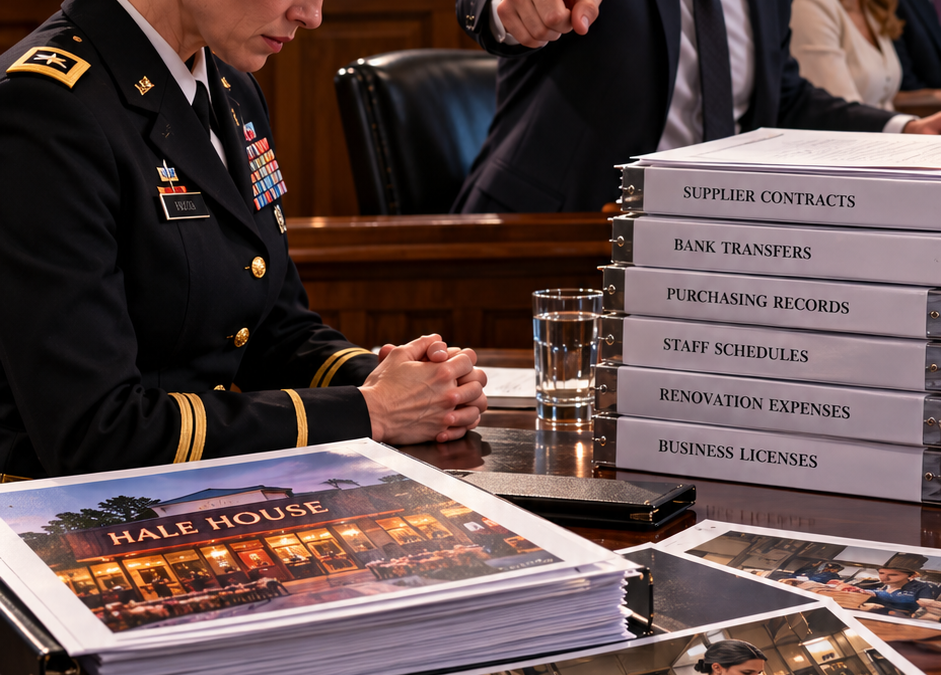
I was in my U.S. Army service uniform.
That morning, before court, I had attended a command retirement function. I had not changed because for the first time in years I decided I did not owe Victor the comfort of seeing me reduced before I entered his world.
The silver eagles on my shoulders caught the courtroom light.
Colonel.
Twenty-three years.
Victor’s smile disappeared.
I folded the blazer over the back of my chair.
“You told everyone I was just your wife,” I said.
My voice sounded calmer than I felt. That was training too. You could feel the ground collapse under you and still give the order clearly.
I rolled up my left sleeve.
A long burn scar ran down my forearm, pale and uneven against my skin. It had healed badly in places because I returned to work before I should have. At the time, we told ourselves there had been no choice.
Then I touched the side of my uniform jacket, just below my ribs.
“There’s another scar here,” I said. “Surgical. From the same accident.”
Melissa stopped smiling entirely.
Judge Bell leaned forward. “You were injured at the restaurant?”
“Yes, Your Honor.”
Victor snapped upright. “That has nothing to do with this divorce.”
For the first time that day, I smiled.
“Oh,” I said, looking directly at him. “It has everything to do with it.”
Grace stood.
She walked to the evidence table and lifted a thick blue folder. She placed it before the judge with both hands, as if setting down something breakable.
It was not breakable.
It was twenty years of paper.
Medical records.
Payroll sheets.
Supplier contracts.
Bank transfers.
Emails.
Tax filings.
Insurance correspondence.
Witness statements.
Internal labor records.
Documents I had kept without fully knowing why. Documents Margaret Hale had apparently kept because she knew exactly why.
Grace opened the folder.
“Your Honor,” she said, “Mr. Hale has repeatedly claimed Colonel Hale had no substantial role in the restaurant. The records say otherwise.”
Victor’s attorney stopped leaning back.
Grace lifted the first page. “This payroll worksheet places Colonel Hale on internal labor records during Hale House’s first year.”
She placed another document beside it. “This supplier contract lists her as an authorized purchasing contact.”
Another page.
“These transfers show Colonel Hale repeatedly sending military income into the restaurant during documented financial shortfalls.”
Victor looked toward Leonard.
Leonard no longer looked calm.
Grace lifted a different set of papers.
“These records concern an industrial kitchen injury Colonel Hale suffered while working at Hale House seventeen years ago. The insurance correspondence indicates that the matter was handled through the business.”
Victor’s face changed.
It was small. Anyone who had not been married to him might have missed it.
I did not.
His eyes moved too quickly. His mouth tightened. He looked not angry now, but afraid.
“She wasn’t officially employed,” Victor said.
Grace turned toward him with an expression so mild it almost seemed kind.
“Interesting.”
She lifted another sheet.
“Then perhaps you can explain why this staff compensation worksheet, bearing your signature, includes her name.”
The silence that followed did more than any speech could have done.
Judge Bell took the document.
She read it carefully.
Then she looked at Victor. “Mr. Hale?”
Victor opened his mouth.
Closed it.
Looked at Leonard again.
His confidence had not vanished all at once. Men like Victor did not surrender a lifetime of performance easily. But for the first time, the room had stopped accepting him as the narrator.
Grace continued.
“We also have records concerning payroll classification, insurance reporting, tax treatment, capital contributions, and the circumstances surrounding Colonel Hale’s workplace injury.”
Judge Bell rested both hands on the bench.
“This may be considerably larger than a property division dispute.”
That was the exact moment Victor understood.
He had walked into court believing humiliation was his strongest weapon.
He had forgotten that for twenty-three years I had served in the United States Army. I had made decisions under pressure. I had walked into rooms where powerful people used volume to hide weakness. I had learned not to panic because someone wanted me small.
His insult did not break me.
It gave me permission to stop protecting him.
Grace closed the folder.
“We have more, Your Honor.”
Victor stared at it.
Then at me.
And finally understood the worst part.
I had brought copies.
Judge Bell did not rule that afternoon.
That seemed to surprise Victor more than anything else. He had expected ceremony. He had expected a clean proceeding where the house would be discussed, the accounts divided, and the restaurant left untouched because his name was on the door.
Instead, Judge Bell ordered additional financial disclosures and instructed both sides to preserve all business records.
“Nothing is to be altered, destroyed, replaced, or removed,” she said.
Leonard nodded immediately.
Victor did not.
The judge’s gaze settled on him.
“Mr. Hale?”
His voice was smaller than before. “I understand.”
I put my blazer back on.
The strange thing was, after all those years in uniform, I had never thought of it as dramatic. A uniform was work. Responsibility. Expectations. Long hours. People counting on you to know what came next even when you were still figuring it out yourself.
But in that courtroom, it had become something else.
Not a weapon.
A correction.
Victor had spent years reducing me to whatever role made his life easier to explain.
Wife.
Helper.
Army officer when he wanted to boast at charity dinners.
Invisible labor when he wanted credit for the restaurant.
Absent mother when he resented my deployments.
Convenient source of cash when the freezer failed, when payroll was tight, when winter reservations slowed.
I had allowed those categories because I thought protecting a marriage sometimes meant refusing to keep score.
Now I was learning there was a difference between refusing to keep score and allowing someone else to rewrite the game.
Outside the courtroom, the hallway smelled like floor polish and old paper. Grace waited until we were past the elevators before speaking.
“You did well.”
“I stood up and took off a jacket.”
“You didn’t take the bait. That’s what mattered.”
I looked back at the courtroom doors. “Did you see his face when you mentioned the insurance records?”
“Yes.”
“He knew.”
Grace stopped. “What did he know?”
I hesitated.
“That I never filed a complaint.”
She studied me. “You told me that.”
“I know.”
“But you’re saying there’s more.”
The hallway suddenly seemed too bright.
Seventeen years earlier, when I was burned in the Hale House kitchen, Victor told me the insurer would handle everything. We had been married three years by then. The restaurant was still struggling. The dining room had mismatched chairs, and we had painted the walls ourselves because hiring painters felt irresponsible.
I was home on leave for eleven days.
On the third morning, one of the old gas lines failed while I was helping prep for lunch service. There was a burst of heat, a shout, the smell of burned cloth, then pain so sharp and complete that the world narrowed to white.
The injury required surgery. Weeks of restricted movement. Months before the scar stopped pulling when I raised my arm.
Victor had been attentive then.
Almost tender.
He drove me to appointments. Changed dressings when I could not comfortably reach them. Sat beside me at night and talked about how frightened he had been.
And because Hale House was barely surviving, I agreed when he said a formal workplace claim could make insurance premiums impossible.
“We’re married,” he told me. “What’s mine is yours anyway.”
At thirty-two, exhausted and in love, I believed that sentence meant something permanent.
I told Grace, “Victor said the insurance company denied it because I wasn’t an employee.”
Grace’s eyes narrowed. “The correspondence we have doesn’t say that.”
“What does it say?”
“It says the matter was resolved through the business.”
A chill passed through me.
“Resolved how?”
“That’s what I’m trying to determine.”
Before I could answer, the elevator doors opened.
My son Daniel stood inside.
He was thirty-one, tall like Victor, with my habit of pushing his glasses up with one finger whenever he was nervous. He saw my uniform beneath the blazer and gave me a tired smile.
“Mom.”
I had not known he was coming.
For a second, I simply stared at him.
Then he stepped out and hugged me.
I held him longer than I usually would.
“You didn’t tell me,” I said.
“I wasn’t sure I could get away from work.”
Daniel was an architect in Philadelphia. For months, he had tried not to take sides in the divorce, a position I understood even when it hurt.
“Anna told me Dad was being difficult,” he said.
“That is a diplomatic description.”
He glanced at Grace. “Is it over?”
Grace answered gently. “Not today.”
Daniel looked relieved and disappointed at the same time.
Then the courtroom doors opened.
Victor came out with Leonard and Melissa.
Daniel’s shoulders stiffened.
Victor stopped when he saw him. “Danny.”
Our son hated being called Danny.
Victor knew that.
Daniel gave him a restrained nod. “Dad.”
Melissa stayed several steps back, suddenly fascinated by her phone.
Victor looked at me.
“Can I speak to you?”
Grace immediately said, “Through counsel.”
Victor gave her an irritated glance. “I’m asking my wife.”
“Your wife has counsel.”
“Grace,” I said quietly.
She looked at me.
“I’ll be five feet away.”
After a moment, she nodded.
Victor and I moved toward the windows overlooking the courthouse parking lot. He did not look outside.
“You embarrassed me in there,” he said.
I almost laughed.
Not because it was funny.
Because even then, after everything, embarrassment was the injury he understood best.
“You called me a pack mule in open court.”
“I was angry.”
“And I showed the court records.”
“You showed up in uniform.”
“I came from a command retirement function this morning.”
That was true.
He blinked. “You could have changed.”
“Why?”
“You knew how it would look.”
I considered that.
Maybe he was right.
Part of me had known.
But there was another truth too.
“I spent years changing clothes before I walked into your world,” I said. “I took off the uniform before restaurant events because you said customers found rank intimidating. I stopped talking about deployments because you said people wanted a relaxed dinner. I let interviews call me Victor Hale’s supportive wife even when I had written half the purchasing procedures they were praising you for.”
“That’s not fair.”
“No,” I said. “It isn’t.”
He looked away.
Daniel stood near Grace, pretending not to listen.
Victor lowered his voice. “Those records can create problems for the restaurant.”
There it was.
The old argument.
Not us.
Not me.
The restaurant.
Always a living thing between us, hungry and demanding, requiring sacrifice while somehow belonging mostly to him.
“The restaurant employs forty-two people,” he said.
“I know how many people work there.”
“Then why would you risk their jobs?”
“I’m not risking their jobs by telling the truth.”
He stared at me.
For the first time in years, I saw how tired he looked. Not old. Just tired. The gray at his temples was thicker than it had been six months earlier. His expensive tie sat slightly crooked. He had probably dressed without the mirror check I used to give him before charity events.
I felt something inconvenient then.
Not tenderness.
Recognition.
This was still the man who had once sat beside my hospital bed. The man who drove four hours through a snowstorm because Daniel left a school project in our garage. The man who remembered exactly how I took my coffee and brought it to me for fifteen years without asking.
People do not become strangers all at once.
That is part of what makes leaving difficult.
Victor said, “We should settle.”
“Then make a fair offer.”
“I have.”
“You offered me the house and said the restaurant was yours.”
“You never wanted the restaurant.”
“That isn’t the point.”
“It is to me.”
I looked at him carefully. “Why?”
“Why what?”
“Why is it so important that everyone believe I had nothing to do with building it?”
His expression hardened again, but not quickly enough.
Before the defensiveness returned, I saw something else.
Fear.
Not fear of losing money.
Fear of losing the story.
He stepped back. “I have to go.”
“Victor.”
But he was already turning toward Leonard.
Melissa followed him without looking at me.
Daniel watched them disappear around the corner.
Then he walked over. “What was that about?”
“Twenty years of marriage compressed into ninety seconds.”
He gave a humorless laugh. “That sounds efficient.”
Grace touched my arm.
“I need to go through the insurance material again,” she said. “And I want copies of every military pay transfer you can locate.”
“You already have most of them.”
“I want all of them.”
Something in her tone made me ask, “What are you thinking?”
“I don’t know yet.” She closed her briefcase. “But when records don’t make sense, you don’t guess. You keep reading.”
That had been Army doctrine in another form.
Observe.
Verify.
Do not fill gaps with what you hope happened.
I nodded. “I’ll find them.”
Daniel drove me home.
For most of the trip, neither of us mentioned the hearing. He talked about a hotel renovation his firm was working on, an old train station being converted into offices, and a coworker who had accidentally ordered eighteen conference tables instead of eight.
I understood what he was doing.
Normal conversation was sometimes mercy.
At the house, he carried my garment bag upstairs while I changed out of uniform. When I returned to the kitchen in jeans and a sweater, Daniel had made coffee.
He stood at the refrigerator, staring at an old photograph.
It had been taken when Hale House turned ten. Victor stood in the center wearing a white chef’s coat even though he had never been the chef. I stood beside him in a red dress. Anna, then twelve, held the cake knife. Daniel, sixteen, had his arm around his sister.
All four of us were laughing.
Real laughter.
That mattered.
I did not want the divorce to turn every good memory into evidence for a lie.
Daniel tapped the photo. “I remember this.”
“So do I.”
“Dad let me drink half a glass of champagne.”
“I know.”
He turned. “You knew?”
“Of course I knew.”
He smiled faintly.
Then his face changed.
“Mom, was it really that bad?”
I knew what he meant.
The marriage.
I also knew what he feared.
That if I said yes, every childhood memory would become suspect.
So I gave him the truth.
“No.”
He looked surprised.
“It wasn’t always bad,” I said.
“Then what happened?”
I sat across from him.
“I don’t know that there was one thing.”
“Melissa?”
“She came later.”
Victor and Melissa admitted their relationship only after I found enough evidence that denying it became pointless. By then, the marriage had already become a set of parallel schedules. Melissa had not destroyed us. She had entered a building with cracks.
“Your father and I became good at functioning,” I said, “and bad at speaking honestly.”
“About what?”
“Money. Work. My deployments. His resentment. My resentment. The restaurant. Everything.”
Daniel turned his mug between his hands.
“He told me you never wanted to be involved.”
I felt the words like a small shift in gravity.
“When?”
“A few times.”
“What exactly did he say?”
“That you hated the restaurant. That you only helped because he asked. That once it became successful, you wanted nothing to do with it.”
I stared at him.
Some of that was almost true.
I had hated the restaurant at times. I had hated missing sleep to solve vendor problems. I had hated returning from field exercises and spending leave reviewing invoices. I had hated the smell of fryer oil on my clothes.
But I had also chosen it.
More than once.
“I did want distance eventually,” I said. “After I made lieutenant colonel, my responsibilities changed. I couldn’t keep doing both at the same level.”
Daniel nodded slowly. “He said that proved it was always his.”
“No.”
My answer came out sharper than intended.
I softened my voice.
“No. It proved I trusted him.”
He was quiet.
Then he asked, “Why didn’t you ever tell us any of this?”
That question hurt more than Victor’s insult.
Because Daniel was right.
I had complained occasionally about being tired, but never explained the money, the contracts, the early years. Part of that had been loyalty. Part had been pride. And part had been my own mistake.
“I thought protecting your father protected you and Anna.”
“From what?”
“From feeling like you had to judge between us.”
Daniel looked out the window.
“I think maybe it just meant we got his version.”
There was no accusation in his voice.
That made it worse.
“I’m sorry,” I said.
He nodded, but did not immediately say it was all right.
I respected him for that.
Anna arrived that evening carrying soup.
Not because anyone was sick.
Anna believed soup was appropriate for all emotional emergencies.
She was twenty-seven, a speech therapist with her grandmother’s sharp eyes and my habit of walking into a room already asking the hardest question.
She set the container on the stove, hugged me, then turned to Daniel.
“You came.”
“That sounds welcoming.”
“You ignored three texts.”
“I was driving.”
“You ignored one yesterday.”
“I was emotionally driving.”
For the first time all day, I laughed.
They looked at me.
Then they laughed too.
For several minutes, we were simply a family standing in a kitchen.
No court.
No lawyers.
No girlfriend.
No evidence folders.
Just three people who knew the same old jokes.
That evening mattered more than I understood at the time.
Because divorce changes the geometry of a family.
Everyone starts wondering where to stand.
At dinner, Anna asked about the hearing.
I gave them the simple version.
“The judge wants more records.”
“Dad was awful,” Anna said.
Daniel looked at her. “You were there?”
“I sat in the back.”
“You didn’t say hello.”
“You were late.”
“I have a job.”
“So do I.”
“Children,” I said.
They both stopped.
Daniel laughed. “We’re thirty-one and twenty-seven.”
“You’re still children when you argue in my kitchen.”
Anna pointed her spoon at me. “Colonel voice.”
“I retired three hours ago. I’m allowed residual authority.”
The warmth lasted through dinner.
Then Anna said something that changed the evening.
“Mom, there’s something you should see.”
She reached into her bag and pulled out a small envelope. Inside was a photograph.
Not a recent one.
Hale House, probably during its second year. The restaurant looked embarrassingly plain then. The awning had not been replaced. The front sign was hand-painted.
I was standing on a ladder fixing Christmas lights.
Victor stood below, holding the ladder.
On the back, someone had written:
Evelyn & Victor, December 2007. Still building.
I turned it over twice.
“Where did you get this?”
“Grandma Hale’s apartment.”
Victor’s mother, Margaret, had died six months earlier after a short illness. Whatever else had happened between Victor and me, losing Margaret had been painful. She loved her son fiercely, sometimes blindly, but she had also loved me.
After the funeral, Victor packed most of her belongings into storage. Anna had been helping sort through boxes.
“There are more,” she said.
“Pictures?”
“Papers.”
Daniel frowned. “What kind of papers?”
Anna looked at me. “I’m not sure.”
She opened a photo on her phone.
It was a handwritten ledger page.
My name appeared several times.
Evelyn — $4,200.
Evelyn — $2,750.
Evelyn deployment transfer — $6,000.
The dates were from the restaurant’s first three years.
My chest tightened.
“Where is that ledger?”
“In Grandma’s storage box.”
“Why did she have it?”
“I don’t know.”
Daniel took the phone. “What is it?”
“I think it’s money I gave the restaurant.”
Anna said, “There are pages and pages.”
The room went quiet.
I remembered Margaret sitting in a corner booth every Sunday afternoon during Hale House’s early years, a calculator beside her and coffee growing cold while she went through receipts. Victor liked to say he had done the bookkeeping himself. That had never been completely true.
His mother had helped.
I had forgotten how much.
“Did you take the box?” I asked.
Anna shook her head. “It’s still at the storage unit.”
“Who has access?”
“Dad. Me. Uncle Robert, I think.”
Robert was Victor’s older brother. They had not been close in years.
“Do not move anything,” I said.
Anna raised her eyebrows. “Why?”
“Because there’s a preservation order now. Grace needs to handle it correctly.”
Daniel looked troubled. “Are we really talking about using Grandma’s papers against Dad?”
“No,” I said.
Both of them looked at me.
“We’re talking about finding out what they are.”
That distinction mattered over the next week.
Grace arranged for the materials to be documented and copied with everyone properly notified. Victor objected at first, then withdrew the objection when Leonard advised cooperation.
The box contained no dramatic confession.
No secret second set of books.
No letter announcing a grand deception.
Reality was quieter.
More complicated.
Margaret had kept records.
Receipts.
Notes.
Old vendor statements.
Copies of checks.
And among them, a spiral-bound notebook spanning the restaurant’s first six years.
Her handwriting was neat and compressed. Each page contained dates, amounts, purposes, and initials.
E.H.
V.H.
M.H.
I sat with Grace in her office while we reviewed scanned copies.
Grace pointed to one entry.
“Do you recognize this?”
April 14 — Evelyn emergency funds, produce account, $3,100.
“Yes.”
“How?”
“I was at Fort Bragg. Victor called and said the supplier was going to stop deliveries.”
Another entry.
August 9 — Evelyn, payroll, $5,800. Victor to repay after festival.
I stared at it.
“I forgot that.”
“You transferred almost six thousand dollars and forgot?”
“I was deployed a month later.”
Grace turned the page. “Did he repay you?”
“We were married. I didn’t think of it that way.”
Margaret apparently had.
That realization sat strangely in me.
Victor’s mother had kept track of the money I contributed even when I had not.
Why?
Grace kept reading.
Then she stopped.
“What?”
She angled the page toward me.
At the bottom, beneath a list of expenses, Margaret had written:
Talked to V again. Evelyn must be put properly into ownership paperwork. This is not right otherwise.
I read it twice.
Then a third time.
Grace said nothing.
The next page, three months later, read:
V says later, when debt refinanced. E trusting him. I told him promises should be written.
My throat tightened.
Margaret had known.
Not everything.
But enough.
“She never said anything to me.”
“Maybe she thought she had,” Grace said.
“What does that mean?”
Grace turned another page.
There was a note dated the following year.
Evelyn signed papers before Germany rotation. V says partnership issue handled.
I sat completely still.
“What papers?”
Grace looked at me. “Do you remember signing documents before a Germany rotation?”
I almost laughed. “I signed fifty documents before every rotation.”
“Restaurant-related.”
I closed my eyes.
A memory surfaced slowly.
Victor at our dining room table.
Stacks of paper.
Daniel asleep upstairs.
Anna still a toddler.
Victor saying the bank needed signatures for refinancing.
Me signing where he marked yellow tabs because I had a 5:00 a.m. flight.
“I signed loan documents,” I said.
“Anything else?”
“I don’t know.”
Grace leaned back. “Do you have copies?”
“No.”
“Would Margaret?”
We searched the scans again.
Nothing.
That night, I called Robert Hale.
Victor’s brother answered on the fourth ring.
“Evelyn.”
“Hi, Robert.”
A pause.
“I heard things are complicated.”
“That is another diplomatic description.”
He laughed quietly.
Robert had always been different from Victor. Less polished. Less ambitious. He owned a small hardware store outside Lancaster and seemed perfectly content to close at six every evening.
“I’m calling about some papers your mother kept,” I said.
The silence changed.
“What papers?”
“A notebook.”
“Oh.”
“You knew about it?”
“I knew she wrote everything down.”
“Did she ever speak to you about Hale House?”
“Many times.”
“What did she say?”
“That my brother was lucky.”
Despite myself, I smiled. “That sounds like Margaret.”
“She also worried.”
“About what?”
“Victor confusing being the face of something with being the only person who built it.”
I looked down at the photograph Anna had given me.
“Did she ever mention ownership paperwork?”
Another pause.
“Evelyn, I don’t want to be in the middle of your divorce.”
“I understand.”
“I love my brother.”
“I know.”
“And I loved you as my sister-in-law.”
“I know that too.”
He sighed.
“Then I’ll tell you what I remember. Mom asked me once whether I thought you knew Victor had changed the incorporation plan.”
My hand tightened around the phone.
“What incorporation plan?”
“I don’t know.”
“When?”
“Long time ago. Maybe fifteen years.”
“What exactly did she say?”
“She said Victor told her you were supposed to be included when the restaurant reorganized. Then later he said it was cleaner not to put you on the papers because of your military career.”
My heartbeat became very loud.
“That doesn’t make sense.”
“I know.”
“Did she believe him?”
“At first.”
“And later?”
“She stopped talking to me about it.”
I swallowed.
“Robert, did she ever say I signed anything?”
“Yes.”
The word landed quietly.
“What?”
“She said you had signed something before going overseas. She thought it was connected to the business structure.”
“Did you see it?”
“No.”
“Did she?”
“I assumed so.”
After we hung up, I sat alone in the kitchen.
Outside, rain tapped gently against the windows. The house had been too quiet since Victor moved out. For months I had resented the silence.
That night, I was grateful for it.
I needed room to think.
There was an obvious interpretation.
Victor had cheated me.
But I was not ready to accept the obvious interpretation simply because it fit my anger.
People remembered things badly. Margaret could have misunderstood. Robert could have forgotten details. The paperwork might have been routine. There could be an explanation.
I had spent my career making decisions under incomplete information.
One principle had saved me from more mistakes than any other.
Do not fall in love with your first theory.
So I did not.
The next morning, I told Grace everything.
She listened, made notes, then said, “We’ll request the old corporate files.”
“From Victor?”
“From everybody. The bank. Former accountant. State filings. Any attorney involved.”
“What if they don’t exist anymore?”
“Then we find what does.”
The search took nearly three weeks.
During that time, life continued with insulting normality.
I attended my formal retirement ceremony.
Daniel came.
Anna came.
Robert came unexpectedly and stood near the back.
Victor did not.
He sent flowers.
The card read:
Twenty-three years is an extraordinary achievement. Congratulations. — V.
I stared at it for a long time.
Then I put it beside the other flowers.
Anna saw. “That’s all?”
“What should I do?”
“I don’t know. Throw them away?”
“They’re flowers. They didn’t do anything.”
She laughed. “You are impossible.”
At the ceremony, my commanding general spoke about service, steadiness, and the countless decisions officers make that never appear in citations.
I found myself thinking about marriage.
Most marriages were probably built the same way.
Not in anniversaries or photographs.
In unnoticed decisions.
Who got up with a sick child.
Who postponed a plan.
Who said, Don’t worry, I’ve got it.
Who forgave.
Who remembered.
Who stopped asking.
Afterward, Daniel found me near the reception table.
“Mom?”
“Yes?”
“Can I ask something weird?”
“Always.”
“Are you happy you married Dad?”
I looked at my son.
There was no answer I could give casually.
“If I hadn’t married your father, I wouldn’t have you and your sister.”
“That’s not what I asked.”
“No.”
He waited.
I looked across the room at Anna laughing with one of my former colleagues.
“I’m glad for much of the life we had,” I said. “And I’m sad about what we became. Both can be true.”
Daniel nodded.
“I think I needed to hear that.”
“So did I.”
Two days later, Victor called.
Not his attorney.
Victor.
I almost let it go to voicemail.
Then I answered.
“Hello.”
“Evelyn.”
He sounded tired.
“Yes.”
“Can we talk somewhere?”
“About the case?”
“About us.”
I looked at the clock.
“Victor, there isn’t an us anymore in the way you mean.”
“I know.”
That caught me off guard.
“I’m not asking you to come back,” he said.
“What are you asking?”
“To talk.”
We met the next afternoon at a small coffee shop halfway between my house and the restaurant.
Not Hale House.
That was his suggestion.
He arrived first. No suit. No jacket. Just a blue shirt with the sleeves rolled up.
For one strange second, he looked like the man I had married.
He stood when I approached.
“Coffee?”
“I’ll get it.”
“You still take—”
“Black. I know.”
He stopped.
I bought my own.
When I sat down, he looked at the cup.
“I wasn’t trying to make a point,” I said.
“I know.”
For several seconds, neither of us spoke.
Then Victor said, “I was wrong in court.”
I waited.
He seemed to expect something.
When I gave him nothing, he continued.
“What I said about you.”
“The pack mule?”
His face tightened. “Yes.”
“Why did you say it?”
“I was angry.”
“You said that already.”
“I felt cornered.”
“So you tried to make me small.”
He looked down.
“Yes.”
It was the first unqualified admission I had heard from him in months.
I did not forgive him.
But I listened.
He rubbed a hand over his face.
“I’ve been telling the story of Hale House the same way for so long that I don’t think I noticed when it stopped being accurate.”
“That’s generous.”
“I’m not asking you to go easy on me.”
“Aren’t you?”
He considered that.
“Maybe part of me is.”
At least he was honest.
I said, “Why did you leave me out of the ownership?”
His gaze lifted immediately.
So he knew what I meant.
“We’re still looking at records,” he said.
“Victor.”
“I was going to fix it.”
“When?”
He looked toward the window.
“After the first refinance.”
“That was eighteen years ago.”
“I know.”
“What happened?”
“The bank wanted simplicity.”
“That is not an answer.”
He leaned back.
“At first, the restaurant was drowning. Every loan application felt like life or death. The accountant said it would be cleaner if one person held the operating interest.”
“Which accountant?”
“Martin Cole.”
I remembered him.
He had retired years ago.
“And you chose yourself.”
“I was there every day.”
“So was I whenever the Army allowed it.”
“I know.”
“Do you?”
He closed his eyes briefly.
“Yes.”
“Then why didn’t you tell me?”
“I told myself I would.”
That answer was so ordinary I almost hated it more than a clever lie.
“I kept waiting for the right time,” he said. “Then the restaurant started doing well. Then we opened the second dining room. Then you made major. Then there was always something.”
“That explains delay. Not secrecy.”
He looked at me.
“I liked being the one who built it.”
There it was.
No courtroom performance.
No Melissa.
No attorneys.
Just a man admitting something small and ugly and human.
“I liked people seeing me that way,” he said. “After a while, if I changed the story, I would have to admit it had never been only mine.”
Anger rose in me.
But beneath it was grief.
“You could have had the story and still given me what was mine.”
“I know.”
“No. You know now.”
He nodded slowly. “Yes.”
I asked, “What did I sign before Germany?”
His entire body became still.
That was the moment I knew there was something more.
“What did Margaret keep?” he asked.
I said nothing.
Victor looked away.
“Mom should have thrown those notebooks out.”
“She thought I should have been in the ownership documents.”
“She thought a lot of things.”
“She wrote that you told her it had been handled.”
He stared at the table.
“Victor.”
“It was supposed to be.”
“What did I sign?”
He took a long breath.
“An agreement.”
“What agreement?”
“A preliminary partnership agreement.”
My heartbeat quickened.
“Meaning?”
“Meaning at one point we planned to restructure Hale House with you holding an interest.”
“How much?”
He did not answer immediately.
“Victor.”
“Forty percent.”
I stared at him.
Forty percent.
Not a token share.
Not a courtesy acknowledgment.
Forty percent.
“What happened to it?”
“It was never finalized.”
“Why?”
He looked miserable.
“Because I didn’t file it.”
The sounds of the coffee shop seemed to recede.
Cups.
Conversation.
The steam wand at the counter.
All far away.
“You had me sign an agreement.”
“Yes.”
“And then you did nothing with it.”
“Yes.”
“Did I know it wasn’t finalized?”
“No.”
I looked at him for a long time.
Then I stood.
“Evelyn.”
“I need to leave.”
“I’m trying to tell you the truth.”
“Seventeen years late.”
“I know.”
“Do you have the agreement?”
“No.”
“Who does?”
“I don’t know.”
“Did you destroy it?”
His head came up.
“No.”
I believed him.
That was the infuriating part.
Victor had many flaws. He was vain, defensive, and capable of making himself the hero of every story. But I knew the expressions that came with his lies.
That answer had been true.
I picked up my coat.
“Why tell me now?”
He looked at me with an exhaustion that seemed to have taken years to reach the surface.
“Because Daniel asked me yesterday whether anything he knew about our family was true.”
I stopped.
Victor swallowed.
“I didn’t know what to say to him.”
That hurt us both.
I left without another word.
Grace was furious when I told her I had met Victor alone.
“You know better.”
“Yes.”
“He could have—”
“He admitted the agreement.”
She stopped.
Then she slowly sat down.
“What agreement?”
I told her.
Her anger vanished into concentration.
“Forty percent?”
“That’s what he said.”
“And he says it was never finalized?”
“Yes.”
“Signed by you?”
“Yes.”
“Signed by him?”
I hesitated.
“I didn’t ask.”
Grace stared at me.
“Evelyn.”
“I know.”
“You spent twenty-three years asking better questions than that.”
“I was busy discovering my husband misplaced forty percent of my life.”
That ended the lecture.
The question became simple.
Did the agreement still exist?
Martin Cole, the old accountant, had died eight years earlier. His firm had merged twice. The attorney who prepared Hale House’s early documents had retired to Arizona. The bank had changed ownership.
We found fragments.
Emails referring to “proposed Hale restructuring.”
A billing entry for “spousal equity documents.”
A bank memo stating, “Ownership change postponed pending debt consolidation.”
But not the agreement itself.
Then, on a Thursday afternoon in November, Grace called.
“Can you come in?”
“What did you find?”
“Just come.”
Her voice made my stomach tighten.
An hour later, I was sitting in her conference room.
Grace placed a single photocopied page in front of me.
At the top were the words:
HALE HOUSE RESTAURANT GROUP — EQUITY RESTRUCTURING SUMMARY.
Below that:
Victor Hale — 60%
Evelyn Hale — 40%
My signature appeared at the bottom.
Victor’s too.
I looked at Grace. “Where?”
“The retired attorney.”
“He had it?”
“He had part of the file in archived storage.”
“Part?”
“The final executed agreement isn’t there.”
My hope dropped.
“But,” she said, “this summary was attached to a letter.”
She slid another page toward me.
The letter was addressed to Victor. Dated seventeen years earlier.
I read slowly.
Per your request, we will hold the fully executed equity agreement pending your confirmation after refinancing. Evelyn has completed her signature pages. Please advise whether you wish us to proceed with filing and corporate updates.
My hands went cold.
Grace watched me.
“That’s what Victor described,” she said.
“Yes.”
“So he was telling the truth.”
“About that part.”
There was something disorienting about discovering that a person had lied to you for years and then, finally, told you the truth.
Grace tapped the letter.
“The attorney’s archive also contains a notation that the original agreement was returned to the client file after no further instruction.”
“Victor?”
“Presumably.”
“Then he should have had it.”
“Possibly.”
I thought of the storage unit.
Margaret’s boxes.
The restaurant office.
The old green filing cabinet Victor had moved from our first apartment to Hale House and refused to discard because, as he always said, “It has history.”
“Where are the original incorporation records now?” I asked.
“Victor produced the corporate binder.”
“Not the binder.”
Grace looked at me.
“The old green filing cabinet.”
“What filing cabinet?”
I stood.
“It was in the basement office for years. Victor kept old personal records in it.”
“Is it still there?”
“I don’t know.”
Under the preservation order, we could not simply go searching ourselves.
Grace contacted Leonard.
To his credit, Leonard responded immediately. By the following morning, arrangements were made for both attorneys and a neutral records professional to inspect archived business files at Hale House.
I did not attend.
I did not want to.
Instead, I went for a walk.
For three hours.
Past the river.
Past the library.
Past the park where Victor and I once pushed Daniel and Anna on swings.
I had spent so long believing strength meant staying present for difficult things. That morning, I discovered sometimes strength meant allowing professionals to do their jobs while you bought a sandwich and sat on a cold park bench trying to imagine who you might be when nobody needed you to hold anything together.
Grace called at 1:17.
“We found the cabinet.”
I stood immediately. “And?”
“Mostly old invoices.”
My shoulders fell. “Okay.”
“And a sealed envelope.”
I stopped breathing.
“What envelope?”
“Marked E.H. — Personal.”
“Open it.”
“We need to document chain of custody first.”
“Grace.”
“I know,” she said softly. “I know.”
Two hours later, I was back in her office.
The envelope was yellowed at the edges. My initials were written across the front in Margaret Hale’s handwriting.
E.H. — PERSONAL.
Below that, smaller:
If Victor has still not done what he promised, give this to Evelyn.
I stared at the words.
Grace sat across from me.
“Do you want me to open it?”
“No.”
My fingers were strangely steady.
I opened it myself.
Inside were three things.
A copy of the signed forty-percent equity agreement.
A handwritten note from Margaret.
And a cashier’s-check receipt from seventeen years earlier.
I looked at the agreement first.
There it was.
My signature.
Victor’s.
Witnessed.
Dated.
Forty percent.
Not filed.
Not implemented.
But real.
Then I unfolded Margaret’s note.
Evelyn,
I hope you never need this.
Victor says he will complete the paperwork after the bank matter is finished. I have told him that allowing you to believe it is finished when it is not would be wrong.
You have both sacrificed for this place. Maybe in different ways, but sacrifice is sacrifice.
I am keeping a copy because my son is proud, and pride sometimes makes people postpone doing what they already know is right.
If you are reading this, then perhaps I waited too long to speak plainly.
I am sorry for that.
— Margaret
I had to put the page down.
Not because I was crying.
Not yet.
Because seventeen years disappeared in an instant.
Margaret at Sunday tables with her calculator.
Margaret bringing casseroles when I deployed.
Margaret telling Victor, “Your wife is not one of your employees. Stop giving her instructions in my kitchen.”
Margaret squeezing my hand at her hospital bedside six months earlier and saying, “You did more than enough, Evelyn.”
At the time, I thought she meant the family.
Maybe she had meant everything.
Grace waited.
Finally, I picked up the cashier’s-check receipt.
The amount was large.
Much larger than anything I remembered transferring.
$48,000.
Payable to Hale House Restaurant Group.
Purchaser:
Evelyn Marie Hale.
I stared at it.
“I never gave him forty-eight thousand dollars at once.”
Grace leaned forward. “Are you sure?”
“Yes.”
The date was shortly before my Germany rotation.
“I didn’t have forty-eight thousand sitting around.”
Grace studied the receipt. “Could it have come from a joint account?”
“No. We didn’t have that much.”
“Investment account?”
“No.”
Then I saw the notation at the bottom.
Funds originated from Hale Family Trust distribution.
I looked up.
“What family trust?”
Grace frowned. “Victor’s family?”
“No.”
Margaret and her husband had never been wealthy. My parents certainly had not been.
Then a memory surfaced.
My grandfather.
After he died, there had been a small inheritance. Not forty-eight thousand. At least, I had not thought so.
My father handled the estate.
He died five years later.
I had been stationed overseas during much of probate.
“I need to call my sister,” I said.
My younger sister, Claire, lived in Virginia. We were close in the way adult sisters sometimes are after spending twenty years on opposite schedules—deeply familiar, intermittently present.
When I told her about the receipt, she went silent.
Then she said, “Evelyn, I thought you knew.”
My skin prickled. “Knew what?”
“Granddad left us more than Dad originally estimated.”
“How much more?”
“He sold the land.”
“What land?”
“The acreage behind the old house.”
I gripped the phone. “Claire.”
“Dad split the proceeds between us. My share was about fifty thousand after taxes.”
I looked again at the receipt.
“And mine?”
“The same.”
The room tilted slightly.
“I never received it.”
Another silence.
Then Claire said very carefully, “You did.”
“No.”
“Ev, Dad sent the paperwork to Victor because you were overseas.”
I closed my eyes.
“What paperwork?”
“He said Victor was handling the deposit for you.”
Grace was already writing.
I asked, “Did Dad know it was going into the restaurant?”
“I don’t know.”
“Claire.”
“I really don’t.”
Her voice shook.
“I assumed you chose to invest it. Victor told us you wanted the money working instead of sitting in an account.”
I sat down.
For seventeen years, I believed my grandfather’s estate had amounted to several sentimental pieces of furniture and a modest check I used to replace the roof.
Victor had known otherwise.
Or appeared to.
Yet even as anger rose, another question formed.
The receipt did not show Victor simply taking the money.
It showed my money going into Hale House.
And attached to the same envelope was an agreement promising me forty percent ownership.
Grace saw it at the same moment I did.
“This may have been your capital contribution,” she said.
I nodded slowly.
“Which means Margaret wasn’t just keeping track of what I did.”
“No,” Grace said, looking at the signed agreement. “She may have been keeping proof of what you bought.”
The discovery should have made the case feel simpler.
It did not.
Because now I faced a truth more difficult than the one I had expected.
Victor had not merely allowed me to help.
At one point, he had apparently intended to make me a formal partner. He had accepted money connected to that partnership. We had both signed documents.
Then something happened.
Something that made him stop.
The obvious answer was greed.
Maybe that was all.
But the paper trail suggested hesitation, delay, refinancing, postponed filings.
And Margaret’s note said Victor had promised to finish.
I remembered the coffee shop.
I liked being the one who built it.
That was true.
But perhaps it was not the entire truth.
“There’s something missing,” I told Grace.
“The final instruction,” she said.
“To the attorney.”
“Yes.”
“Why didn’t he file?”
“We know what Victor says.”
“He wanted the story.”
“Maybe.”
I stared at the check receipt.
“Forty-eight thousand dollars was a lot of money for us then.”
“Enormous.”
“He wouldn’t have forgotten it.”
“No.”
“So what happened after this?”
Grace pulled the timeline closer.
The date of the cashier’s check.
The signed agreement.
The refinancing.
My Germany rotation.
Then, six weeks later—
My kitchen accident.
I stopped.
Grace saw it too.
The injury had occurred after I came home early from the rotation because of a family scheduling change. Seventeen years ago, all within the same season.
My money entered the restaurant.
We signed a forty-percent equity agreement.
Victor delayed filing it.
Then I was injured at Hale House.
Afterward, he told me not to worry about a workplace claim because I was not officially an employee.
I looked at Grace.
“What did the insurance company pay?”
“We still don’t know the exact disposition.”
“That’s why he panicked in court.”
“Possibly.”
“What if the claim required him to describe my status at the restaurant?”
Grace’s expression sharpened.
“That could matter.”
“If he said I was an owner, it could complicate one thing. If he said I was an employee, another.”
“And if he said you were neither—”
“He could keep the business records simple.”
Grace did not answer.
She did not need to.
I thought of Victor beside my hospital bed, holding my hand.
We’re married. What’s mine is yours anyway.
Maybe he had loved me.
Maybe he had also chosen the restaurant.
Human beings were capable of both.
That was what made betrayal so difficult to understand.
The phone on Grace’s desk rang.
She answered.
Listened.
Her expression changed.
“Yes,” she said. “Send it securely.”
She hung up.
“What?”
“The insurer finally located archived correspondence.”
I stood. “And?”
“They found a settlement record.”
“To me?”
Grace shook her head.
“To Hale House.”
She opened her computer. An email arrived. She read silently. Then she looked at me.
“This is not what I expected.”
“What does it say?”
Grace turned the screen toward me.
The insurance file listed the injured worker as:
Evelyn Hale.
Employment status:
Managing partner — pending ownership registration.
I stared at the words.
“Managing partner?”
“Yes.”
“Victor told them that?”
Grace scrolled.
“There’s a statement signed by him.”
I could barely hear my own voice.
“What statement?”
She read it carefully.
“Mrs. Hale has contributed capital and management services to the business and has executed documents for a forty-percent ownership interest currently awaiting formal registration.”
For several seconds, neither of us spoke.
The question was no longer whether Victor knew what I contributed.
He had told the insurance company himself.
Seventeen years earlier.
Before spending the next decade and a half telling everyone Hale House had always been his alone.
I looked at the screen.
“What happened to the settlement?”
Grace scrolled farther.
Then stopped.
“It was paid.”
“How much?”
She told me.
I looked at her.
“That can’t be right.”
The amount was substantial.
Enough to cover my medical expenses.
Enough to compensate for months of recovery.
Enough that I would have remembered receiving it.
I had not received it.
Grace read the payment line again.
The check had not been issued to me personally. It had been issued to Hale House Restaurant Group under an indemnification agreement connected to my injury and ownership claim.
“Where did the money go?” I asked.
“I don’t know yet.”
For the first time, the mystery was no longer only about what Victor had hidden.
It was about why.
Why had a man who once acknowledged me as a forty-percent owner later erased that fact?
Why had an insurance payment connected to my injury gone into the business?
Why had the ownership papers never been filed afterward?
And why had Margaret hidden copies specifically for me?
Grace closed the laptop.
“We don’t assume,” she said.
I looked at her.
She had learned that phrase from me.
A faint smile crossed her face.
“We keep reading.”
We kept reading for two more months.
There are betrayals that explode.
There are betrayals that arrive in clean envelopes, old emails, bank records, and photocopied checks.
Victor’s did both.
The final answer came from a retired claims adjuster named Paul Brenner, who had handled the original insurance file. He lived in Delaware now and sounded irritated that anyone had found him.
“I don’t remember every case,” he told Grace on a recorded call.
Then she read him the file number.
He went quiet.
“That one,” he said.
I was sitting beside Grace when he said it.
My hands were folded in my lap.
I had learned long ago that you cannot grip the truth hard enough to make it hurt less.
Paul remembered the case because it had been complicated. I was injured while performing work at Hale House. Victor had described me as a managing partner awaiting registration. The ownership documents had been signed but not filed. The business had cash-flow problems. The claim involved medical expenses, potential lost earnings, and a question about whether payment should go directly to me or through Hale House because I was also a capital contributor.
Grace asked the question carefully.
“Who instructed that the settlement be paid to the business?”
Paul sighed.
“Victor Hale.”
“Did Colonel Hale sign that instruction?”
“No.”
“Was she present?”
“No.”
“Was she notified?”
A pause.
“I assumed she was. Mr. Hale represented that he had authority to resolve it on behalf of the business and the marital household.”
I felt something inside me go cold and still.
That was the part that finally hurt worse than the money.
Not the theft.
The authority.
Victor had taken my trust and used it as a signature.
The settlement funds, we later discovered, went into the restaurant during the months after my injury. They paid down urgent debt, covered payroll, stabilized supplier accounts, and helped secure refinancing that allowed Hale House to survive long enough to become profitable.
In a cruel way, Victor had told the truth at every banquet.
Hale House had been saved by sacrifice.
He had just forgotten to say whose.
The next hearing did not feel like the first one.
There was no smirk when Victor entered the courtroom. No relaxed ankle over knee. No whispered joke to Melissa, who did not appear at all that day.
He looked thinner.
Or maybe smaller.
Leonard Price looked like a man who had spent the previous night telling his client things he did not want to hear.
Judge Bell reviewed the filings for a long time before she spoke.
Her voice was level.
“This court is not here to punish either party for the failure of a marriage. It is here to identify and divide marital property in accordance with the law and the evidence.”
Victor stared forward.
Judge Bell continued.
“The evidence before the court strongly supports that Colonel Hale contributed substantial labor, management services, military income, and inherited funds to Hale House Restaurant Group. It also supports that documents were executed reflecting a forty-percent ownership interest in her favor, that those documents were not completed or filed, and that insurance representations made after Colonel Hale’s workplace injury acknowledged her status as a managing partner pending registration.”
Every sentence landed like a stone.
Not thrown.
Placed.
Grace sat beside me, perfectly still.
Judge Bell looked toward Victor.
“Mr. Hale, the credibility concerns in this matter are significant.”
Victor swallowed.
The word significant seemed to strike him harder than accusation would have.
Grace presented our proposed resolution.
Forty percent valuation of Hale House Restaurant Group as a marital and equitable interest, adjusted for documented contributions, the diverted insurance settlement, and the unfiled ownership agreement. Additional reimbursement for the inherited funds. Protective provisions for the employees. A payment structure that would not force the restaurant to close.
I had insisted on that last part.
Grace had argued with me.
“You do not have to save him from the consequences,” she said.
“I’m not saving him.”
“That sounds exactly like saving him.”
“No. I’m saving forty-two people from becoming collateral damage.”
She studied me.
“You still care about the restaurant.”
I did not deny it.
I hated what Victor had done.
But I had built Hale House too.
There were people there who had worked for us for fifteen years. Cooks whose children I had watched grow up. Servers who sent me Christmas cards. A dishwasher named Luis who once fixed our back steps without being asked because he said Mrs. Hale should not fall while carrying stock.
I would not let Victor’s lie destroy their lives if there was another way.
So the agreement we proposed allowed Victor to keep operational control only if he bought out my interest under strict terms. Independent valuation. Installment payments secured by a lien. Immediate repayment of the documented inheritance contribution. A separate sum for the insurance proceeds connected to my injury. Full correction of prior tax and employment records where required. No nondisclosure clause preventing me from telling my children the truth.
Victor’s attorney asked for a recess.
Judge Bell granted it.
In the hallway, Victor approached me alone.
Grace moved closer.
Victor stopped a respectful distance away.
“I’m not going to argue,” he said.
“That would be wise,” Grace replied.
He looked at me.
“I didn’t think of it as stealing then.”
I almost closed my eyes.
But I made myself look at him.
“What did you think it was?”
His mouth worked for a moment before he answered.
“Survival.”
The word hung between us.
There it was.
The lie men tell themselves when they want the comfort of necessity.
“I needed the restaurant to make it,” he said. “After your accident, everything was falling apart. Debt. Insurance. Payroll. I told myself I would fix the ownership later, once things were stable.”
“And when things became stable?”
His eyes reddened, but no tears fell.
“Then I was afraid of what fixing it would say about me.”
“That you needed your wife?”
“That I had built my life on a half-truth.”
I thought of all the years he had let me stand beside him while people praised his sacrifice.
All the years he had taken my silence as permission.
All the times he had watched me walk into Hale House and become a guest in a place I had paid for with money, skin, sleep, and time.
“You could have told me,” I said.
“I know.”
“No,” I said quietly. “You could have told me when you needed the money. You could have told me after the accident. You could have told me when Hale House became profitable. You could have told me when Daniel asked. You could have told me when Anna started working there summers and asked why my name wasn’t on anything. You could have told me when your mother died. You could have told me before you sat in court and called me a pack mule.”
His face folded.
“I know.”
That was all he had left.
For years, I had imagined that justice would feel loud.
It did not.
It felt like standing in a courthouse hallway with a man I had loved and realizing there was no sentence he could say that would return me to the woman who believed him.
Leonard called him back.
Victor looked at me once more.
“I’m sorry, Evelyn.”
I had waited years to hear that.
When it came, it was not enough.
But it was not nothing.
“I know,” I said.
We returned to the courtroom.
By the end of the day, the settlement terms were placed on the record. Victor agreed to the buyout. He agreed to reimburse the inherited funds. He agreed to resolve the insurance-related payment. He agreed to cooperate with corrected filings and independent oversight until the financial terms were complete.
Judge Bell asked him directly, “Mr. Hale, do you understand these terms?”
Victor stood.
“Yes, Your Honor.”
“Are you entering into this agreement voluntarily?”
He looked at me.
Then back at the judge.
“Yes.”
“Do you understand that failure to comply may result in enforcement proceedings?”
“Yes.”
Then the judge turned to me.
“Colonel Hale?”
I stood.
“Yes, Your Honor.”
“Do you believe this resolution adequately protects your interests?”
I thought of the scars on my arm and ribs.
I thought of Margaret’s note.
I thought of Daniel asking whether anything he knew about our family was true.
I thought of Anna carrying soup into my kitchen like love could be ladled into bowls.
I thought of twenty-three years in uniform and twenty years of marriage, both ending in the same season, leaving me with a house that no longer sounded like my life.
“Yes,” I said. “It does.”
Judge Bell nodded.
“Then the court will accept the agreement.”
The gavel did not strike like thunder.
It was a small sound.
A final one.
Outside the courthouse, Daniel and Anna were waiting.
Anna hugged me first.
“Is it over?”
I looked at Grace.
She smiled faintly.
“The legal war is over,” I said.
Daniel asked, “And the rest?”
“The rest will take longer.”
He nodded as if that answer made sense.
Because it did.
Victor came out a few minutes later.
Alone.
No Melissa.
No performance.
He stopped several feet away from the children.
Daniel looked at him. Anna did too.
For a moment, nobody spoke.
Then Victor said, “I’m sorry.”
Not to the room.
Not to his attorney.
To them.
Daniel’s jaw tightened.
Anna crossed her arms.
Victor continued, “I told you a version of our family that made me look better than I was. Your mother deserved more credit than I gave her. More than credit.”
His voice broke slightly.
“She deserved honesty.”
Anna wiped her cheek quickly, irritated with the tear for existing.
Daniel looked down at the courthouse steps.
“I don’t know what to do with that,” he said.
Victor nodded.
“I understand.”
“No,” Daniel said, lifting his head. “You don’t get to understand it yet.”
Victor flinched.
Good, I thought.
Not cruelly.
Truthfully.
Some pain should not be managed too quickly.
Victor accepted it.
For once, he did not defend himself.
He looked at me.
I knew that look.
It asked whether I would soften the moment. Whether I would translate him to our children. Whether I would protect him one more time from the full weight of what he had done.
I did not.
I stood beside Daniel and Anna and said nothing.
That was my final act of marriage.
Not revenge.
Refusal.
Six months later, the first payment arrived.
I did not feel triumphant when I saw the deposit.
I felt tired.
Then practical.
I paid off the remaining mortgage on the house. I created education funds for Daniel’s future children and Anna’s. I donated quietly to a veterans’ legal clinic that helped military spouses untangle financial abuse, business disputes, and the kind of paperwork people sign when they are exhausted and trusting someone they love.
I kept Margaret’s note in a frame in my study.
Not because she had saved me.
She had not, not in time.
But because she had tried in the imperfect way people sometimes do when loyalty and fear pull them in opposite directions.
One afternoon, nearly a year after the first hearing, I drove past Hale House.
I did not plan to stop.
But the light turned red, and there it was.
The awning had been replaced again. The windows were bright. A young hostess opened the door for an elderly couple. Through the glass, I could see movement, warmth, tables being set for dinner.
For years, the sight of that restaurant had filled me with a complicated mixture of pride and resentment.
That day, it felt different.
It looked like a place.
Not a wound.
My phone buzzed.
A message from Anna.
Soup tonight? Emotional emergency level: mild.
I smiled.
Then Daniel texted beneath it.
I’m bringing bread. Not emotionally. Just bread.
I laughed so suddenly the driver beside me glanced over.
When the light changed, I kept driving.
At home, I changed out of the blazer I had worn to a consulting meeting and stood for a moment in front of my closet.
My uniforms hung in garment bags.
Pressed.
Preserved.
Finished.
For a long time, I had known who I was by what I carried.
Rank.
Marriage.
Children.
Deployments.
Restaurant debts.
Victor’s ambition.
Everyone’s emergencies.
The strange thing about freedom is that at first it can feel like empty hands.
That night, Daniel and Anna came over. Anna brought soup. Daniel brought bread. We ate at the kitchen table beneath the same photograph from Hale House’s tenth anniversary.
I had not taken it down.
I had decided I would not let Victor’s lies steal the true parts too.
In the photo, we were laughing.
That laughter had been real.
So was the betrayal.
So was the rebuilding.
All of it belonged to me.
After dinner, Daniel asked if I was going to keep the last name Hale.
Anna looked at him as if he had thrown a grenade into the soup.
“What?” he said. “I’m just asking.”
I looked toward the dark kitchen window, where my reflection stared back at me.
Colonel Evelyn Hale.
Mrs. Victor Hale.
Mom.
Pack mule.
Partner.
Plaintiff.
Survivor.
Names had power, but only if you allowed other people to define them.
“Yes,” I said at last.
Anna looked surprised. “Really?”
“For now.”
“Why?”
I touched the rim of my coffee cup.
“Because I carried that name through war zones, courtrooms, hospitals, kitchens, and every place I was told to make myself smaller. If I change it someday, it will be because I choose something new. Not because he made the old one unbearable.”
Daniel smiled.
Anna reached across the table and squeezed my hand.
The house was not quiet anymore.
Not that night.
Later, after they left, I stood alone in the kitchen and rolled up my sleeve.
The scar on my forearm caught the light.
For years, I had hidden it under jackets, under explanations, under the belief that love meant absorbing pain quietly so other people could keep their stories intact.
I did not hate the scar anymore.
It was proof.
Not only of what happened to me.
Of what healed.
Victor had thought humiliating me would make me look small.
Instead, his insult opened the door to every truth I had buried to keep peace.
And when the truth finally entered the room, it did not shout.
It stood straight.
It removed its blazer.
It showed its scars.
And it stopped carrying what was never mine to carry alone.








