𝗙𝗨𝗟𝗟 𝗦𝗧𝗢𝗥𝗬 The Injured Mother Dog Wouldn’t Leave the Roadside, and I Was Terrified of What She Was Protecting
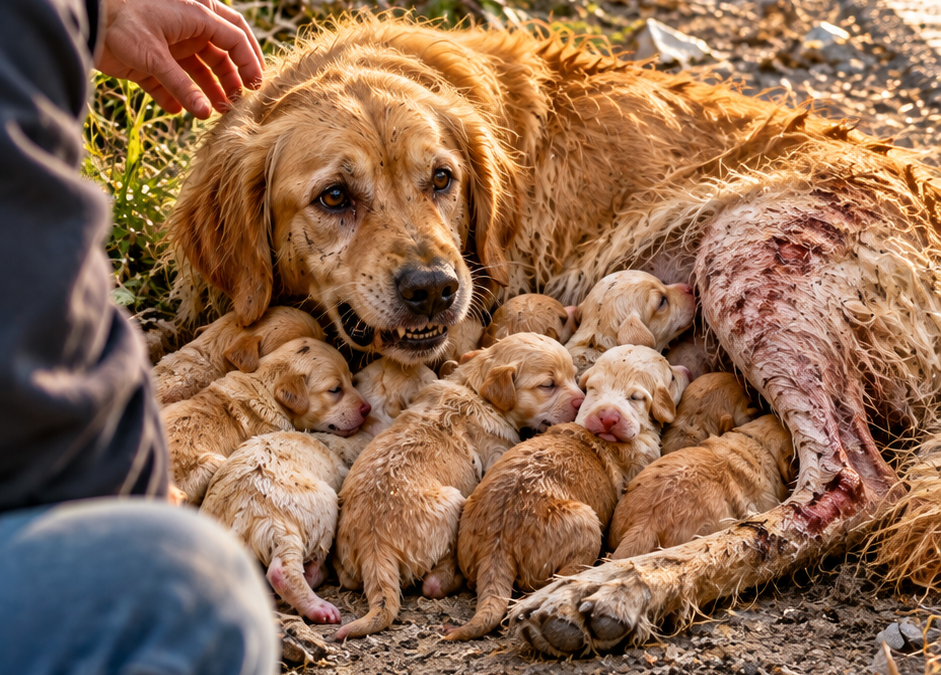
𝗙𝗨𝗟𝗟 𝗦𝗧𝗢𝗥𝗬
Then a little closer still.
Her body remained tense, but she no longer growled each time I shifted.
I wondered whether she was beginning to trust me or simply lacked the energy to resist.
I wanted to believe it was trust.
I didn’t yet have the right to assume that.
My colleague prepared a warm carrier for the puppies while I stayed beside their mother.
We couldn’t afford to let them become chilled during the transfer.
Newborn puppies depend heavily on warmth, and these ten had survived by remaining close to a mother who could barely care for herself.
I placed one hand against the blanket beside her.
She watched me.
“Your babies are coming with you,” I promised.
I knew she couldn’t understand the sentence.
I hoped she could understand my voice.
The first puppy was so small that I could support its entire body in one hand.
I moved carefully, keeping it close to the mother’s face.
She immediately stretched her neck toward it.
I paused and allowed her to sniff the puppy.
Then I placed it in the prepared carrier.
The mother tried to rise.
A sharp tremor moved through her body.
She sank back onto the ground.
My heart lurched.
“No, no. Don’t try to get up.”
I touched the blanket near her shoulder.
She stared at the carrier.
My colleague turned it so she could see inside.
The puppy gave a tiny cry.
The mother answered with a low, strained whine.
It was the first sound she’d made that didn’t seem intended as a warning.
I looked away for a moment because I couldn’t bear the expression on her face.
She was terrified that we’d taken one of her babies.
“We’re keeping them together,” I told her. “I promise.”
We moved the remaining puppies one at a time, allowing her to see what we were doing.
There were moments when she grew restless.
When that happened, we stopped.
We let her sniff our hands.
We brought the carrier closer.
We waited until she settled.
By the time the tenth puppy was safely inside, the mother was breathing hard.
I knew we’d already asked too much of her.
But there was still the most difficult part.
We had to move her.
My colleague and I positioned a blanket beneath her as gently as possible, taking particular care around her injured leg.
When we first tried to lift her, she cried out.
The sound went straight through me.
We stopped immediately and adjusted our hold.
She looked toward the carrier.
Not toward her injured leg.
Not toward the road.
Toward the puppies.
“Right here,” my colleague whispered, bringing them close. “They’re right here.”
We lifted again.
This time, the mother allowed us to place her into the vehicle.
As soon as she was settled, we positioned the puppies securely beside her, keeping them warm and protected during the journey.
One by one, they began moving toward her.
She lowered her head and sniffed them.
Then she started licking the nearest puppy.
My colleague closed the vehicle door.
I stood outside for several seconds, looking at the empty patch of dirt where the family had been lying.
It was difficult to believe that something so important had been happening in such an ordinary place.
A few minutes earlier, ten puppies had been relying on the warmth of a mother who couldn’t stand.
Now all eleven of them were finally on their way to safety.
I climbed into the vehicle.
The mother watched me settle beside her.
“We’re going somewhere better,” I said.
She lowered her head.
I hoped she would live long enough to discover that I meant it.
The drive to the veterinary clinic felt longer than it actually was.
Every bump in the road made me glance toward her injured leg.
Every time the puppies cried, I checked to make certain they were warm and breathing normally.
My colleague drove carefully while I sat beside the carrier.
For most of the journey, the mother kept her head resting near her puppies.
Occasionally, she lifted it to look around.
The movement of the vehicle seemed to confuse her.
She had probably never experienced anything like this.
I wondered whether the last time she’d been inside a vehicle had ended badly.
Then I stopped myself.
We knew she’d suffered an accident.
We didn’t know the circumstances, and I didn’t want to invent another frightening memory for her simply because her condition was heartbreaking.
What mattered was what we could do now.
I offered her a little water when it was safe.
She accepted it.
At one point, one of the puppies began crying louder than the others.
Its mother immediately tried to turn.
The movement pulled at her injured leg.
She stiffened.
I reached toward the puppy and carefully shifted it closer to her.
She sniffed its head.
The crying stopped.
“You’re doing such a good job,” I whispered.
She closed her eyes.
For a moment, I thought she had fallen asleep.
Then another puppy moved, and she opened them again.
I realized she wasn’t allowing herself to rest.
Not completely.
She was still watching every tiny movement in that carrier.
I had no idea how many nights she’d spent doing exactly that.
By the time we arrived at the clinic, I was desperate to see her somewhere quiet, clean, and safe.
The veterinary staff were waiting.
We explained her condition before moving her.
“Ten puppies,” I repeated as we prepared the transfer.
The veterinarian looked at the carrier.
“All alive?”
“All ten.”
He nodded.
“Let’s get Mom comfortable first.”
Those words stayed with me.
Mom.
Not the injured stray.
Not the roadside dog.
Not another unfortunate case.
Mom.
For reasons I couldn’t explain, hearing someone call her that made me feel as though we’d taken the first real step toward restoring something she had lost.
The staff examined the puppies while we remained close enough for their mother to see them.
They checked that each one was warm and responsive.
They carefully assessed the litter and arranged a safe space where the puppies could remain together.
Then they turned their attention to her.
I stood beside the examination area, watching the veterinarian evaluate the injured hind leg.
Up close, the damage looked even worse.
It was clear she’d gone far too long without treatment.
The injury required careful cleaning, medical management, and continued monitoring. Her prolonged exposure outdoors had also complicated her condition.
She needed more than a single examination and a comfortable place to sleep.
She needed sustained veterinary care.
She needed enough nourishment to rebuild her strength while continuing to feed ten growing puppies.
She needed rest.
And she needed time.
The veterinarian looked at me.
“She’s been through a lot.”
I nodded.
“Do you think she’ll walk again?”
He didn’t answer immediately.
He examined the leg once more.
“We need to stabilize her condition and see how she responds to treatment. Recovery won’t happen overnight.”
I looked at the mother.
She was searching for her puppies again.
“What about nursing?”
“We’ll monitor her nutrition and the puppies closely. Keeping her comfortable and supporting the whole family are both important.”
I nodded, trying to absorb everything.
It was a practical explanation.
Exactly what I needed.
But underneath it was a reality I didn’t want to confront.
We had brought her to safety.
We had not yet saved her.
That evening, after the initial examinations and treatment, we moved the family into a quiet recovery space.
Clean bedding covered the floor.
Fresh water sat within easy reach.
Food was available without requiring the mother to drag herself away from her babies.
The puppies were warm.
For the first time since I had found her, she didn’t have to lie on dirt.
I sat nearby while she investigated her new surroundings.
She sniffed the blanket.
Then the food.
Then the puppies.
Finally, she lowered her head.
It rested against the bedding, but her eyes remained open.
I watched her for a long time.
There was something painfully familiar about the way she kept waiting for another problem.
Even in a quiet room, surrounded by people trying to help her, she couldn’t seem to believe that she was allowed to rest.
I had seen the same expression in animals rescued from neglect.
Some of them were frightened by open doors because they’d lived in confinement.
Others flinched at raised hands, even when those hands were holding food.
And some were so accustomed to hunger that they continued guarding empty bowls long after their meals were finished.
This mother seemed to be waiting for the entire room to disappear.
I moved my chair a little closer.
“You’re safe tonight,” I told her.
She looked at me.
I couldn’t promise that her recovery would be easy.
I couldn’t promise that her leg would heal completely.
I couldn’t even promise how quickly she would learn to trust us.
But I could promise that she wouldn’t have to protect her puppies on the side of a road again.
We needed a name for her.
For days, she had been described only by her circumstances.
The injured dog.
The mother.
The stray with ten puppies.
None of those names seemed big enough for what she had accomplished.
I looked at her lying beside the sleeping litter.
“Hope,” I said quietly.
My colleague glanced toward me.
“What?”
“That’s what I want to call her.”
She looked at the dog.
Then at the ten puppies curled against her belly.
“Hope.”
The name settled into the room.
I wasn’t thinking about miracles or dramatic transformations.
I was thinking about the fact that she’d kept ten newborn puppies alive when she had barely enough strength to lift her own head.
And now, after everything she’d survived, she was finally somewhere we could help her.
“Hi, Hope,” I whispered.
She blinked.
It was the only response I received.
It was enough.
The first few days of her recovery were exhausting.
There is a kind of helplessness that comes with caring for an animal who cannot understand why treatment sometimes causes discomfort.
Hope knew how to endure pain.
She had already proved that.
What she didn’t know was why strangers kept approaching her injured leg, why she was no longer beside the road, and whether we intended to separate her from her puppies.
Every examination required patience.
Every attempt to move her had to be done carefully.
Sometimes she stiffened before anyone touched her.
Sometimes she watched our hands so closely that I could see the tension building through her shoulders.
We learned to recognize the warning signs.
We slowed down.
We spoke gently.
And whenever possible, we allowed her to remain close to the puppies while her treatment continued.
The staff cleaned and cared for the damaged tissue, monitored her condition, and developed a rehabilitation plan that could progress as she healed.
Meanwhile, her nutritional needs were enormous.
She was recovering from a serious injury while nursing ten puppies.
I had known that supporting a nursing mother required additional food and water.
Watching Hope made that knowledge feel entirely different.
She ate with the concentration of an animal who had learned that a meal might be her last opportunity for hours.
At first, she seemed surprised when we brought more.
I would place a bowl beside her, move backward, and watch her begin eating.
When she finished, she often looked at the empty bowl.
Then at me.
The first time it happened, I almost cried.
“There’s more,” I told her.
I brought another portion according to the feeding plan established by the veterinary team.
She stared at it for a moment.
Then she ate again.
In the days that followed, her appetite became one of the most encouraging parts of our routine.
The dullness in her eyes slowly began to lift.
Her body no longer looked quite so defeated.
She was still thin.
Still badly injured.
Still reluctant to trust unfamiliar people.
But she was no longer trying to survive on whatever scraps she could find.
And for the first time, she had people making sure the needs of her puppies didn’t leave her own body forgotten.
The nights were quieter than I expected.
I had imagined ten newborn puppies would make the recovery area constantly noisy.
Instead, they spent most of their time sleeping, nursing, and shifting against one another in a tiny, breathing pile.
Hope kept them clean.
She repositioned herself when they searched for milk.
If one crawled too far from the others, she followed it with her eyes until we brought it closer.
Her mothering was instinctive, but it was also exhausting.
There were moments when she looked as though she could barely keep her eyes open.
I would sit beside her and listen to the small sounds of the litter feeding.
Then I would watch her head gradually lower.
Sometimes she fell asleep for only a few minutes before a puppy disturbed her.
Sometimes she startled awake when a door opened.
We tried to make the environment as predictable as possible.
The same quiet voices.
The same gentle approach.
The same care routines.
The same warm bedding.
Nothing about those things seemed extraordinary to us.
To Hope, I suspect they were entirely new.
One evening, I was finishing a check when she did something I hadn’t expected.
She rested her head on the blanket while I sat beside her.
Then she closed her eyes.
She didn’t immediately open them when I shifted in my chair.
She didn’t lift her head when a puppy climbed across her foreleg.
She simply slept.
I stayed very still.
I knew she was recovering physically, but this felt like a different kind of progress.
For the first time since I’d met her, she seemed willing to believe that someone else could remain awake while she rested.
I watched her breathing settle.
Ten puppies slept against her.
And for a little while, nothing was required of her.
Not vigilance.
Not endurance.
Not another struggle to find food.
She was simply allowed to be tired.
I had never been so grateful to see a dog sleep.
Trust returned slowly.
That was one of the hardest lessons Hope taught me.
People sometimes imagine that a rescued animal understands the moment its circumstances change.
We bring it inside, provide food, offer a soft bed, and expect gratitude to arrive almost immediately.
But an animal doesn’t forget fear simply because the danger has ended.
Hope had survived by being cautious.
She couldn’t abandon that caution just because I wanted her to feel safe.
The first time I tried to stroke her head, she pulled away.
I stopped.
“That’s all right.”
The next day, she let me sit a little closer.
A few days later, she sniffed my hand without growling.
Eventually, she allowed me to rest my fingers lightly against her shoulder.
It lasted perhaps two seconds.
Then she moved away.
I smiled.
“Fair enough.”
We didn’t force her.
Whenever she became uncomfortable, we gave her space.
The goal wasn’t to make her tolerate everything we wanted to do.
It was to help her understand that not every approaching hand represented a threat.
Regular meals helped.
A quiet environment helped.
Consistent handling helped.
Most importantly, time helped.
As the days passed, she began looking toward us when we entered the recovery area.
At first, I assumed she was anticipating food.
Then one morning, I arrived without a bowl.
She lifted her head anyway.
Her tail moved against the blanket.
Just once.
I stopped in the doorway.
“Did you just wag at me?”
She stared.
I crouched beside her.
“Hope?”
Her tail moved again.
It was such a small thing.
A movement that most dog owners see dozens of times every day.
But I stood there grinning like an idiot.
I had watched her struggle to drink water beside the road.
I’d seen her tremble when we moved her puppies.
I’d heard her cry when we lifted her injured body.
And now she had enough confidence to greet someone.
I reached out.
This time, she leaned slightly toward my hand.
I stroked the side of her face.
Her eyes softened.
Then a puppy began squeaking beneath her front leg, and she immediately turned away from me.
I laughed.
“Of course. Mom first.”
Her priorities hadn’t changed.
The difference was that she was beginning to have a little comfort of her own.
While Hope’s leg slowly responded to treatment, her puppies began changing almost every day.
In the beginning, they had seemed impossibly fragile.
Ten little bodies with closed eyes, tiny paws, and voices barely loud enough to fill a room.
They knew their mother through warmth, scent, and the instinctive search for nourishment.
They slept in a tangled pile, sometimes crawling over one another without appearing to notice.
Then the first pair of eyes began opening.
I was there that morning.
One puppy had been unusually restless, lifting its head and wobbling across the blanket.
When it finally turned toward me, I noticed that its eyes were beginning to open.
I leaned closer.
“Well, hello.”
The puppy blinked.
Then it lost its balance and tumbled sideways into a sibling.
Hope immediately sniffed both of them.
The sight made me laugh so unexpectedly that my colleague appeared in the doorway.
“What happened?”
“Look.”
She crouched beside me.
“Oh, my goodness.”
We watched the tiny puppy attempt another journey across the blanket.
It managed only a short distance before collapsing into a sleepy heap.
But it was the beginning of something wonderful.
Over the next several days, more eyes opened.
Their movements became stronger.
They began lifting their heads for longer periods.
Soon they were exploring the edges of their bedding, bumping into one another, and discovering that their legs could carry them farther than the space directly beneath their mother’s body.
Hope watched every expedition.
Whenever a puppy moved too far away, she became alert.
Sometimes she stretched her neck toward it.
Other times, she gave a soft sound that seemed to bring the little wanderer back into the pile.
I often found myself sitting beside the recovery area longer than necessary, watching the puppies discover a world that had almost never belonged to them.
One would climb over a sleeping sibling.
Another would become fascinated by a fold in the blanket.
A third would attempt to follow the first two and end up walking directly into its mother’s leg.
They weren’t graceful.
They weren’t coordinated.
And they had absolutely no understanding of the terrible circumstances surrounding their birth.
They only knew that they were warm, fed, and surrounded by one another.
That innocence affected me more than I expected.
Their mother had suffered so much to keep them alive.
Yet they were growing up in a world where food arrived regularly and the ground beneath them was soft.
I wanted them to remain unaware of everything she’d endured.
I wanted their earliest memories, whatever form those memories might take, to be safe ones.
One afternoon, I watched a particularly determined puppy make its way across the bedding and climb onto Hope’s front paw.
It stood there for a moment, balancing with extraordinary seriousness.
Then it sneezed and fell over.
Hope lowered her head and licked its face.
I laughed.
She looked toward me.
Her tail moved.
It felt, for a moment, as though we were sharing the same joke.
Her rehabilitation was less entertaining.
Healing a badly injured leg is rarely a straight line.
Hope had made it through the immediate rescue and the first stage of treatment, but she still faced weeks of careful medical care.
The veterinary team monitored her progress and introduced rehabilitation exercises as her condition allowed.
Some days, she tolerated the work well.
Other days, she seemed tired before we even began.
There were times when she tried to shift her weight and immediately withdrew from the effort.
I would crouch beside her while the veterinary staff worked.
“Easy, sweetheart.”
She would look at me, then toward the puppies.
The puppies were usually far more interested in nursing or sleeping than in their mother’s rehabilitation.
They had no idea how hard she was working.
Sometimes I wondered whether that was a blessing.
Hope had already spent so long enduring pain that the idea of asking her to make another difficult effort felt almost cruel.
But I understood why the rehabilitation mattered.
Without appropriate treatment and gradually restored movement, her injured leg could continue limiting her life long after the puppies became independent.
We weren’t simply trying to help her survive the next few days.
We wanted her to have a future in which she could move comfortably, explore safely, and live without the constant exhaustion that had defined her life beside the road.
So we kept going.
Carefully.
Patiently.
At the pace her veterinary team considered appropriate.
There was no dramatic breakthrough at first.
No miraculous moment when she suddenly stood and raced across the room.
Her recovery was measured in smaller things.
A little more comfort.
A little less hesitation.
A change in the way she positioned her injured leg.
A willingness to try again after resting.
A few seconds of increased stability.
I learned to appreciate progress that would have seemed insignificant before I met her.
One morning, during a routine session, she shifted her weight slightly differently.
The veterinarian noticed.
“Good girl.”
I looked at him.
“Was that better?”
“It’s encouraging.”
Hope lowered her head, apparently unimpressed by our excitement.
I smiled.
“You have no idea how proud we are of you.”
She blinked.
Then she reached toward the food reward waiting nearby.
The veterinarian laughed.
“She may understand more than you think.”
As the puppies grew stronger, Hope’s personality began emerging from beneath the exhaustion.
Until then, most of what I knew about her had been connected to survival.
She was protective.
Cautious.
Patient.
Determined.
But those qualities didn’t tell me what kind of dog she might have been if she’d never experienced hunger or injury.
Gradually, I began discovering the answer.
She was gentle.
Not immediately with strangers, and not in a way that meant she enjoyed every interaction.
But once she trusted someone, she seemed to appreciate quiet companionship.
She liked having her ears stroked.
She enjoyed lying where she could watch her puppies while remaining close to the people caring for her.
And she developed an unmistakable interest in the sound of food being prepared.
I could enter the room carrying clean towels without attracting much attention.
But if I arrived with her meal, her head came up immediately.
Sometimes her tail began moving before I reached her.
“Good morning to you, too,” I would say.
Her enthusiasm made me think about the first time I’d seen her eating beside the road.
Back then, every mouthful had seemed urgent.
Now she could enjoy a meal without searching for danger between bites.
Her coat began to improve as well.
The dull, neglected fur that had been so noticeable on the day of her rescue gradually looked healthier.
She had more energy.
Her eyes appeared brighter.
She began responding to familiar voices instead of shrinking whenever someone entered the room.
And as the puppies grew, she no longer seemed quite so overwhelmed by their constant demands.
Of course, ten puppies were still ten puppies.
They developed an extraordinary ability to make a mess out of absolutely nothing.
Clean blankets were apparently a challenge they felt compelled to defeat.
Water bowls attracted curious paws.
Siblings became obstacles to climb, tug, and chase.
I occasionally arrived to discover that one puppy had managed to fall asleep in the least comfortable position imaginable, while another appeared determined to wake everyone else.
Hope watched them with an expression that I could only interpret as maternal exhaustion.
One morning, I found her lying quietly while three puppies crawled over her back and another attempted to nibble her ear.
She looked toward me.
I put down the clean bedding.
“Don’t look at me. They’re your children.”
Her tail thumped.
I burst out laughing.
It was the first time I had looked at her and seen something other than the injured mother beside the road.
I saw an ordinary dog dealing with an extraordinary number of unruly puppies.
And that felt like progress.
There were difficult days, too.
I don’t want to remember her recovery as a sequence of beautiful moments interrupted only by the occasional inconvenience.
She had suffered a serious injury.
Her healing required sustained care.
And there were days when the distance between where she was and where we wanted her to be felt painfully large.
Sometimes she grew tired during rehabilitation.
Sometimes the veterinary team needed to adjust the pace of her exercises.
Sometimes she seemed uncertain about placing weight through her injured leg.
On those days, I had to remind myself that recovery belonged to her, not to my expectations.
I wanted her to stand.
I wanted her to walk.
I wanted her to run beside the puppies when they were old enough to explore outside.
But wanting something badly didn’t make it happen faster.
Once, after a particularly difficult day, I sat beside her recovery area long after the evening checks were finished.
She was lying on her side, watching the puppies sleep.
I looked at her injured leg.
“I’m sorry,” I whispered.
She lifted her head.
I wasn’t sure exactly what I was apologizing for.
Not finding her sooner, perhaps.
Not knowing she’d been suffering beside that road.
Or simply belonging to the same species as the people who had passed her without understanding how urgently she needed help.
She looked at me for several seconds.
Then she shifted closer.
I placed my hand against her shoulder.
She rested her head on my leg.
I didn’t move.
I sat there while the room grew quiet around us.
Her breathing settled.
The puppies slept.
And for the first time in days, I stopped measuring her progress against an imagined perfect outcome.
She was alive.
Her puppies were alive.
She had food, medical care, shelter, and people who knew her name.
Those things didn’t erase what had happened to her.
But they mattered.
And the next morning, we would begin again.
As the weeks passed, the puppies became increasingly independent.
They no longer spent all their time pressed against Hope.
They explored.
They played.
They discovered their own voices and seemed delighted by every opportunity to use them.
Some were bold.
Others preferred to remain near their mother.
A few appeared convinced that every unfamiliar object existed for the sole purpose of being investigated with their mouths.
They were healthy, growing young dogs under veterinary supervision.
Watching them develop became one of the great rewards of working with their family.
But as much as I loved the puppies, I remained most concerned about their mother.
It would have been easy for people to focus entirely on the ten adorable babies and overlook the dog who had kept them alive.
Puppies attract attention effortlessly.
A quiet adult dog recovering from a serious injury can disappear into the background of an otherwise joyful rescue.
I didn’t want that to happen to Hope.
Every milestone the puppies reached reminded me of another milestone their mother was still working toward.
They learned to stand.
She worked to regain her strength.
They began walking.
She continued rehabilitation.
They discovered how to play.
She was still learning that movement didn’t always have to be associated with pain.
I sometimes watched the puppies stumble through the recovery area and wondered whether Hope would ever be able to join them comfortably.
Then I looked at her face.
The fear that had dominated her expression beside the road was fading.
She had begun enjoying the small routines of her new life.
She trusted familiar caregivers.
She accepted affection.
And when the puppies became particularly energetic, she sometimes watched them with an alertness that reminded me of the determined mother I’d first encountered.
She hadn’t lost her will to protect them.
She simply no longer had to do it alone.
That difference changed everything.
There was a morning when I arrived to find her resting while the puppies played nearby.
One of them stumbled toward me.
I crouched to greet it.
Hope watched without becoming distressed.
I lifted the puppy carefully and held it close enough for her to see.
She sniffed its face.
Then she settled back onto the bedding.
It was a tiny moment.
But I remembered the roadside rescue, when moving even one puppy had caused her to struggle desperately against her injured body.
Now she trusted me enough to let me hold one of her babies.
I kissed the top of the puppy’s head.
“Your mom is getting better,” I whispered.
Hope looked at me.
For once, I thought she might actually believe it.
By the time we approached the hundredth day of her recovery, the change in Hope was unmistakable.
Her coat was healthier.
Her appetite was reliable.
She had regained energy that had once seemed impossible for her exhausted body.
And her relationship with the people caring for her had changed from cautious tolerance to genuine comfort.
She still had moments of uncertainty.
Occasionally, an unfamiliar sound made her lift her head too quickly.
An unexpected movement might cause her to withdraw.
But those reactions no longer defined every waking moment.
She could relax.
She could enjoy attention.
She could rest while people moved around her.
Her rehabilitation had also progressed.
The veterinary staff continued working with her, monitoring the injured leg and carefully supporting improvements in mobility.
I had learned not to celebrate prematurely.
I had also learned not to dismiss small gains.
Every bit of strength mattered.
Every carefully completed exercise mattered.
Every moment of increased confidence mattered.
Then came the day I will never forget.
It was approximately 110 days after we’d found her beside the road.
I arrived at the clinic expecting an ordinary day of feeding, cleaning, and helping with her established care routine.
Hope was awake.
She watched me enter.
Her tail moved.
“Good morning, beautiful.”
I crouched beside her.
She shifted slightly.
Then she placed her front paws more firmly beneath herself.
I stopped talking.
The veterinary staff had been working toward improved mobility for months, and Hope had gradually become stronger and more stable.
But that morning, something about her movements looked different.
She seemed determined to reposition herself without waiting for help.
“Easy, Hope.”
She adjusted her front legs.
Then she carefully brought her hindquarters beneath her.
My heart began pounding.
She rose.
Not with a sudden burst of energy.
Not gracefully.
But she stood.
On her own.
I covered my mouth.
For a moment, I couldn’t make a sound.
The mother dog who had lain beside the road, unable to stand without terrible difficulty, was holding herself upright.
Her legs trembled.
She looked toward me.
I wanted to rush forward and wrap my arms around her.
Instead, I remained still.
“That’s it,” I whispered. “You’re doing it.”
She shifted her weight.
Then she took a step.
One careful, deliberate step.
I felt tears begin running down my face.
She paused.
Another step followed.
Then another.
She was walking.
I heard my colleague behind me.
“Oh, Hope.”
The veterinarian approached, watching her closely.
We made sure she had a safe space and allowed her to move at her own pace.
There was nothing hurried about her progress.
She took a few steps, stopped, and looked around.
Then she moved again.
I had imagined that if she ever walked independently, I would shout.
I thought I might laugh, clap, or start calling everyone who had been involved in her rescue.
Instead, I stood there crying so hard that I could barely speak.
Because all I could see was the animal I’d found beside the road.
The mother who had dragged her injured body into a protective curl.
The dog who had been too frightened to let us touch her puppies.
The exhausted creature who could barely lift her head after giving birth.
And now she was walking toward me.
I lowered myself to my knees.
She took another careful step.
Then she reached me.
Her nose touched my hand.
I placed my palm against her cheek.
“You did it,” I whispered.
She leaned into my touch.
I don’t know whether dogs experience pride in the way people do.
I don’t know what Hope understood about the months of treatment that had brought her to that moment.
But she stood beside me while I cried, and she didn’t try to move away.
The veterinarian smiled.
“This is a wonderful milestone.”
I nodded.
I couldn’t trust myself to speak.
Hope looked toward the area where her puppies were resting.
Then she looked back at me.
I laughed through my tears.
“Of course. You want to see your babies.”
She took another careful step.
And for the first time since we’d met, she was able to move toward them without relying on someone to carry her.
That was the moment I finally allowed myself to believe that she had a different future waiting for her.
Not a perfect one.
Her injury had been serious, and rehabilitation had required months of sustained care. Walking again didn’t mean every problem had disappeared or that she would never need further attention.
But something fundamental had changed.
She could move independently.
She could explore her surroundings.
She could approach the people she trusted.
She could begin living as something more than a patient recovering from an injury.
I watched her make her way toward the puppies and felt an overwhelming gratitude toward everyone who had helped her reach that day.
The rescue team that had responded to the call.
The colleague who had helped carry her from the roadside.
The veterinary professionals who had carefully treated her injuries.
The caregivers who had fed her, cleaned her bedding, and allowed her to regain confidence at her own pace.
No single person had performed a miracle.
The transformation had been the result of many ordinary acts of care, repeated consistently for months.
And yet, watching her walk, it was difficult not to feel that something miraculous had happened.
The puppies, of course, showed little appreciation for the importance of the occasion.
They were busy being puppies.
One had discovered a toy.
Another was trying to steal it.
Two more were wrestling with the kind of enthusiasm that suggested neither had ever experienced a moment of genuine hardship.
When Hope approached, several rushed toward her.
She lowered her head to greet them.
I watched them crowd around her, climbing over one another in their excitement.
She stood quietly for a moment.
Then she settled into a comfortable position while they gathered around.
I smiled.
Even after everything, they still believed she belonged entirely to them.
Perhaps, in some ways, she always would.
The months after her rescue had changed all eleven dogs.
When I looked at Hope, I no longer saw the dull-coated, frightened stray who’d once been too exhausted to drink unless I moved the water within reach.
I saw a healthier, more confident mother with bright eyes and a gentle personality.
Her coat had regained its appearance of health.
Her energy had returned.
She had learned to accept affection and seemed increasingly comfortable around familiar people.
And her puppies had become healthy, playful young dogs.
They no longer resembled the tiny, helpless newborns we’d carried away from the roadside.
They had personalities now.
They had opinions about food, toys, and sleeping arrangements.
They had learned to explore the world without treating every unfamiliar sound as a reason to panic.
Watching them was joyful.
But every time I saw the entire family together, I remembered the original litter of ten curled beneath a single exhausted mother.
I wondered what would have happened if nobody had reported them.
If we’d arrived too late.
If Hope had been forced to remain outdoors with a severe injury while trying to feed ten rapidly growing puppies.
Those questions were painful, and I tried not to dwell on them.
The family was safe.
Hope had received the treatment she needed.
The puppies were thriving.
There was no reason to spend every happy moment imagining the tragedy we’d managed to avoid.
Still, the memory stayed with me.
One afternoon, long after Hope had begun walking independently, I sat nearby while she rested.
She lifted her head when I approached.
Her tail began moving.
“Hello, beautiful.”
I crouched and stroked her ears.
She leaned into my hand with the easy trust that had once seemed impossible.
I thought about our first meeting.
The warning growl.
The injured hind leg.
The way she had curled around her newborn puppies and watched me as though I might take away everything she had left.
I wondered what she would have done if she could have understood me that day.
If I could have told her that soon she would have regular meals, warm bedding, medical care, and people who would never ask her to abandon her babies.
If I could have explained that months of rehabilitation lay ahead, but that one day she would stand again.
Would she have believed me?
Probably not.
I hadn’t entirely believed it myself.
But there she was, standing beside me and accepting another gentle scratch behind the ears.
A small movement nearby caught her attention.
One of the young dogs had wandered toward us.
Hope immediately looked up.
The puppy approached, pressed against her, and settled down.
She lowered her head to sniff it.
Then she returned her attention to me.
I smiled.
“Still taking care of everybody, aren’t you?”
Her tail moved.
I sat with her for a while, listening to the quiet sounds of the recovery area.
There was nothing dramatic happening.
No emergency.
No frantic calls.
No urgent decisions.
Just a healthy, growing family resting in a safe place.
It was the ending I had hoped for from the beginning.
Not because every hardship had vanished from memory, but because hardship no longer controlled every part of their lives.
Hope had been injured.
She had gone hungry.
She had given birth beside a road and fought to keep ten puppies alive with a body that was already struggling to survive.
None of those things could be undone.
But they no longer defined her future.
The frightened mother had become a dog who could rest without constantly watching for danger.
The ten newborn puppies had become playful young dogs.
And I had become someone who would never again look at an injured stray beside a road and see only another rescue case.
I would see Hope.
I would remember the first time she allowed me to touch her.
The first meal she ate without keeping one anxious eye on the road.
The first night she slept while someone else stayed awake.
The first puppy opening its eyes.
The first time her tail moved when I entered the room.
And, above all, the morning she rose to her feet and walked toward me.
One evening, I found her lying comfortably while her puppies played nearby.
The light coming through the windows rested against her healthy coat.
She looked up as I entered, then lowered her head again.
She wasn’t frightened.
She wasn’t searching for food.
She wasn’t trying to hide her babies beneath an injured body.
She was simply resting.
I sat beside her and placed my hand against her shoulder.
“You don’t have to fight anymore, Hope,” I whispered.
She closed her eyes.
And this time, she believed she was safe enough to sleep.








