𝗙𝗨𝗟𝗟 𝗦𝗧𝗢𝗥𝗬 The Hotel Manager Mistook My Silence for Helplessness While My Son Begged Me to Save Him
𝗙𝗨𝗟𝗟 𝗦𝗧𝗢𝗥𝗬
He turned to Rosa.
“Cancel the check-in and contact card security.”
Rosa remained motionless.
“Mr. Hail, I already spoke with the bank. The verification code matches. Mrs. Langston confirmed the reservation this morning, and the payment is fully authorized.”
I watched Preston’s expression tighten.
“Then you exceeded your authority.”
Rosa lowered her eyes.
I had managed hotels for long enough to recognize an employee who was afraid of contradicting her supervisor. Her reaction troubled me almost as much as Preston’s behavior.
Angela placed her driver’s license and credit card on the counter.
“Here. The card is mine. The reservation is mine. Call the number on the back, and I’ll verify everything again.”
Preston barely glanced at the documents.
“Fraud operations frequently use women to make questionable transactions appear respectable.”
Micah stepped forward.
“She’s my mother.”
Preston turned toward him.
“Did I speak to you?”
I moved half a step in front of my son.
“Don’t address him that way.”
Several guests had begun watching us. A couple near the elevators stopped talking, and a bellman froze beside his luggage cart.
Preston seemed to notice the attention.
His posture straightened.
“Sir, your family is attempting to enter a private resort using a reservation we cannot authenticate. Your increasingly aggressive behavior is only making the situation worse.”
I kept my voice steady.
“Your own employee authenticated the reservation before you walked over here. I heard her confirm it.”
“She is not authorized to make that determination.”
“Then this isn’t about the credit card.”
For the first time, his confidence faltered.
Then he said something I would remember for the rest of my life.
“You people always make it about something else.”
Angela inhaled sharply.
“What people?”
He ignored her.
He lifted two fingers toward the security guards near the main entrance.
A broad-shouldered man approached, followed by a younger guard. His name was Thomas Keane. He looked to be in his forties, with a shaved head and a radio attached to his uniform.
Preston pointed toward our luggage.
“Suspected payment fraud. Secure their belongings while I contact the bank.”
Angela pulled Nia’s suitcase closer.
“You do not have permission to search our things.”
“If you’ve done nothing wrong, you shouldn’t object,” Preston answered.
I looked directly at Thomas.
“You’re private security. There’s no emergency, no evidence of a crime, and you do not have our consent. Do not touch my family or our belongings.”
Thomas hesitated.
Preston leaned toward him.
“Do your job.”
Thomas reached for Micah’s backpack.
My son stepped backward.
“That’s mine!”
“Let it go, son,” I said.
Micah looked at me in disbelief.
“But, Dad—”
“I know. Let it go.”
I thought that surrendering the bag might keep the confrontation from escalating. I knew the difference between preserving our legal rights and placing my family in immediate physical danger.
But Thomas grabbed the backpack with more force than necessary.
One strap caught on the luggage cart, pulling it forward. Nia’s suitcase toppled, its zipper split open, and her clothes spilled across the polished marble.
Her stuffed turtle fell beneath the cart.
“Mommy!”
Angela crouched to gather our daughter’s belongings.
Meanwhile, Thomas emptied Micah’s backpack onto the reception counter.
Headphones. A paperback novel. A phone charger. His sketchbook. An inhaler he carried for asthma.
And a sealed envelope containing eighty dollars his grandmother had given him for the trip.
Preston picked up the envelope.
“Cash.”
Micah stared at him.
“It’s eighty dollars. My grandmother gave it to me for the boardwalk.”
“We’ll let the police determine where it came from.”
Micah reached for the envelope.
Thomas seized his wrist.
“Don’t touch the evidence.”
My body went rigid.
“Release my son.”
For an instant, Thomas appeared uncertain.
Then Preston spoke.
“He just attempted to recover potential evidence.”
Micah pulled against the guard’s grip.
It was an instinctive movement, the natural reaction of a frightened child whose wrist was being twisted by a grown man.
Thomas turned him around.
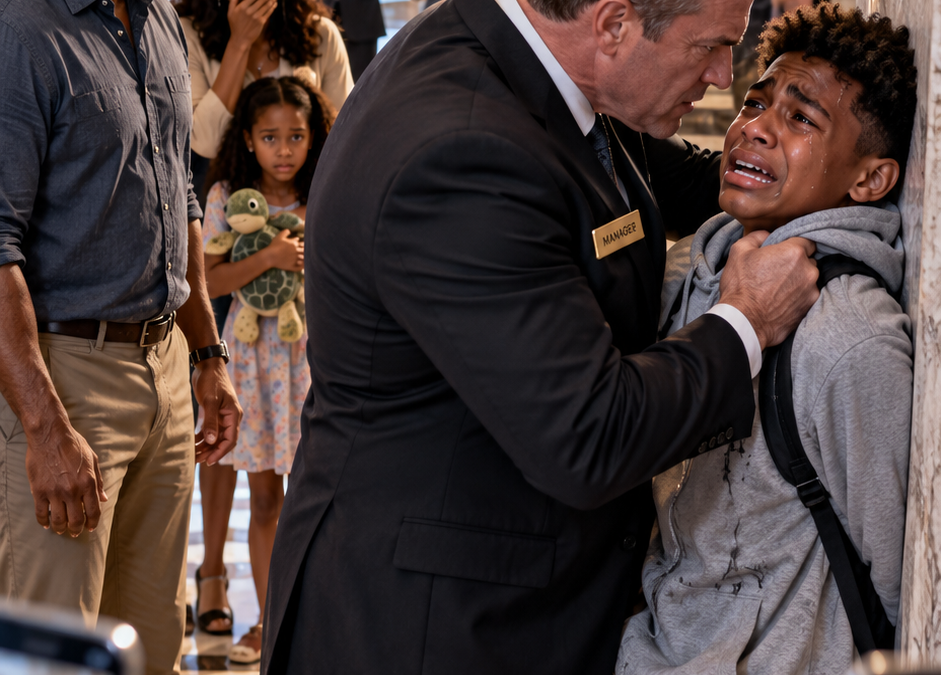
And before I could reach them, he shoved my fourteen-year-old son against a marble column.
His forearm pressed between Micah’s shoulder blades.
My son’s cheek struck the stone.
His inhaler fell to the floor.
Angela screamed.
“MICAH!”
Nia began sobbing.
I stepped forward.
The second guard immediately blocked my path.
“Dad!”
Micah’s voice cracked.
“Dad, I didn’t do anything!”
There are moments when anger becomes something so powerful that it seems to separate you from your own body.
I wanted to pull that man away from my son. I wanted to take every ounce of terror I saw in Micah’s eyes and turn it against the people responsible.
But I looked at the second guard.
I looked at the phones being raised throughout the lobby.
And I saw my daughter crying beside an open suitcase.
I understood how quickly they could turn a Black father trying to protect his child into an alleged attacker.
I could already imagine the official report: Aggressive guest assaulted security personnel during suspected fraud investigation.
So I forced my hands to remain at my sides.
I looked directly at Thomas.
“My son’s hands are empty. His backpack is open. You have no report of a crime. Release him.”
Thomas tightened his jaw.
Preston stepped closer.
“Are you threatening my security officer?”
“No.”
My voice was quieter than I expected.
“I’m giving you your last clear warning.”
Rosa came out from behind the reception desk.
She picked up Micah’s inhaler and held it carefully.
“Mr. Hail, there is no fraud alert from the bank. Mrs. Langston’s payment is verified.”
Preston turned on her.
“Go back to your station.”
“The reservation is completely valid.”
“I said go back!”
The lobby became eerily quiet.
I could hear Nia crying. Somewhere near the bar, a piano continued playing as though nothing extraordinary was happening.
Thomas finally released my son.
Micah stumbled backward, rubbing his wrist.
A red mark had appeared across his cheek.
I pulled him toward me and placed my hand on the back of his neck.
“Look at me, buddy.”
His eyes were wet.
“Are you hurt?”
He shook his head, but I could see him struggling to hold himself together.
I wanted to embrace him properly. I wanted to tell him that he was safe.
But I couldn’t honestly promise that while we were still standing in that lobby.
I turned toward Preston.
“Give my wife her identification, her card, and all our property.”
He pushed the credit card across the counter but kept Angela’s driver’s license beneath his fingers.
“You’ll leave the resort grounds first.”
Angela stared at him.
“You’re withholding my driver’s license?”
“It will be returned at the gate after security confirms your departure.”
I took out my phone.
I photographed the identification beneath his hand, the broken key, the contents of Micah’s backpack, and the security camera above the reception desk.
Preston’s smile vanished.
“Photography is prohibited in guest service areas.”
“Preserve every camera recording from twelve thirty onward,” I told him. “Lobby, entrance, reception desk, elevators, and gate. Preserve your internal messages, reservation records, and access logs.”
He laughed.
“And I’m the governor.”
I slipped my phone into my pocket.
“No. You’re a hotel manager who has just made a very expensive decision.”
He stared at me, then returned Angela’s license.
We collected our belongings while dozens of strangers watched.
Some looked embarrassed. Others were still holding their phones.
Rosa helped Nia retrieve her turtle from beneath the luggage cart.
“I’m so sorry, sweetheart.”
Nia held the stuffed animal against her chest.
Then she asked a question so quietly that only Rosa, Angela, and I heard it.
“Did we come through the wrong door?”
Rosa closed her eyes.
“No, sweetheart. You didn’t do anything wrong.”
I felt something inside me break.
Outside, the afternoon sky had darkened. Rain began falling as we approached our rented SUV.
Thomas followed at a distance but didn’t touch us again.
Preston remained beneath the resort’s white columns.
“You are now banned from this property!” he called. “If you return, you’ll be arrested for trespassing!”
I opened the rear door for Nia.
“We’ll be back.”
He folded his arms.
“Not through those doors.”
I looked at the building my company was scheduled to purchase in less than forty-eight hours.
“Especially through those doors.”
I didn’t raise my voice.
He had no idea what I meant.
The rain grew heavier as we drove toward the highway. Angela sat rigidly beside me, staring through the windshield. Behind us, Nia held her turtle against her chest while Micah kept one hand pressed against his swollen cheek.
Nobody spoke for several miles.
Then I pulled into a pharmacy parking lot and turned off the engine.
“Micah, let me see your wrist.”
“I’m fine, Dad.”
“Please.”
He reluctantly lowered his hand.
A red band circled his wrist where Thomas had gripped him. His cheek had begun swelling, and there was another tender spot near his shoulder.
Angela climbed into the back seat to examine him.
Nia leaned against her brother.
“I thought they were taking you away.”
Micah stared through the window.
“They probably would have if Dad had fought them.”
I looked at him in the rearview mirror.
He was right.
That realization hurt more than I could explain.
I had spent my adult life building a business that employed thousands of people. I could negotiate with banks, lenders, investors, and corporate executives. I could walk into a boardroom and command the attention of everyone present.
Yet when a grown man pinned my child against a column, I had been forced to calculate whether defending him physically would make our situation more dangerous.
“We’re going to urgent care,” I said. “Then we’ll find somewhere else to stay.”
Angela met my eyes.
“And Monday?”
I knew exactly what she meant.
Micah looked between us.
“What happens Monday?”
I had planned to keep the acquisition confidential until the paperwork was signed.
That plan no longer mattered.
“My company is buying the Montlair Crown.”
Micah stared at me.
“What?”
“The ownership transfer is scheduled for Monday morning.”
Nia lifted her head.
“So you’re going to be that man’s boss?”
“Yes, sweetheart.”
Micah looked down at his injured wrist.
“Then why didn’t you tell him?”
I turned around in my seat.
“Because you shouldn’t need a powerful father to be treated like a human being.”
Micah didn’t answer immediately.
Then he looked at me.
“But we did.”
I had no response that could make his words hurt any less.
At urgent care, a nurse photographed Micah’s injuries and documented the swelling on his cheek, the bruising around his wrist, and the tenderness in his shoulder. She asked him what had happened.
He looked at me before answering.
I wished he hadn’t felt the need to.
“A security guard pushed me against a wall,” he said. “They thought my mom stole a credit card.”
“Did you threaten anyone?”
“No, ma’am.”
His voice had become so quiet that I almost couldn’t hear him.
A county deputy arrived to take our statements. I gave him the photographs and the contact information of a guest who had approached us outside the resort and offered to share her recording.
By the time we left the clinic, a forty-two-second video of the confrontation had already appeared online.
It showed Thomas pinning Micah against the column. It showed Nia crouching beside our open suitcase. And it captured Rosa clearly telling Preston that the bank had verified Angela’s card.
The video had twelve thousand views before we reached a modest hotel twenty miles inland.
Angela ordered soup for everyone. Nia ate two spoonfuls and pushed her bowl away. Micah sat on the sofa with an ice pack against his cheek, staring at the blank television.
I stepped into the bedroom and called Gabrielle Ross, our company’s lead attorney.
“Gabrielle, something happened at the Crown.”
I told her everything.
When I finished, there was a long silence.
“David, is Micah all right?”
“Physically, he’ll recover.”
“And you?”
I looked through the doorway at my son.
“I don’t know.”
We immediately arranged a conference call with Arthur Bellamy.
I had spent months negotiating with him. He was charming when he wanted something, gracious when circumstances favored him, and exceptionally skilled at making uncomfortable subjects disappear beneath complicated business language.
His first words sounded appropriately concerned.
“David, I just heard. What an unfortunate situation.”
“Your general manager assaulted my son after the reservation was verified.”
“Preston can be rigid about our security procedures.”
“Your security officer pinned a fourteen-year-old boy against a column.”
“David, I understand your anger, but Preston protects a particular clientele. The atmosphere at a property like the Crown requires careful management.”
I stared at my phone.
“My family isn’t a threat to your atmosphere.”
“That’s not what I meant.”
“Then explain what you meant.”
He didn’t.
I looked at Gabrielle’s name on the conference screen.
“Preserve every security recording, guest record, employee communication, and incident report connected to our arrival. Nothing gets deleted or altered.”
Arthur sighed.
“Surely we can resolve a lobby misunderstanding without jeopardizing a major transaction.”
“Watch the video.”
“I intend to.”
“Then call me after you’ve watched it.”
Gabrielle issued a formal preservation demand that evening. She also stopped the release of our closing funds pending the resort’s cooperation and the protection of employees who might provide evidence.
I had no intention of buying a business while allowing its current owners to destroy evidence of what had happened inside it.
At 8:43 that evening, Gabrielle called again.
“Someone tried to delete the lobby recordings.”
My stomach dropped.
“Did they succeed?”
“No. The preservation notice reached the outside video server three minutes before the attempted deletion. Six recordings were marked for removal at eight forty, using Preston’s administrator account. The commands were blocked.”
I looked toward the living room.
Micah had fallen asleep beneath a blanket. His face was turned toward the sofa cushions, the ice pack resting on the coffee table beside him.
“Save everything,” I said.
“We are.”
I stood there listening to my son’s uneven breathing.
Until that moment, part of me had wondered whether Preston would eventually recognize what he had done and attempt to apologize.
The attempted deletion answered that question.
By midnight, the lobby video had been viewed more than half a million times. The resort issued a statement suggesting that a juvenile guest had resisted a legitimate fraud investigation and that security had responded according to established procedures.
It didn’t mention that Angela’s payment had been verified.
It didn’t mention the broken room key.
And it certainly didn’t mention the attempt to destroy the security footage.
At one thirty in the morning, my phone rang.
The caller was Rosa Delgado.
I stepped into the hallway so I wouldn’t wake the children.
“Mr. Langston, I hope I’m not calling too late.”
“No. Are you safe?”
“I’m sitting in my car. I didn’t want to call from the hotel.”
She sounded frightened.
“I didn’t know who you were when your family arrived.”
“That shouldn’t have mattered.”
“I know. That’s why I’m calling.”
She took a breath.
Then she told me something that changed the entire situation.
There had never been an alert from Angela’s bank. Preston had personally entered a fraud flag eleven seconds after seeing us walk into the lobby.
The code was V4.
“Visual verification,” Rosa explained. “That’s what he calls it.”
“What does it mean?”
“It’s what he uses when he believes certain guests might make the wrong people uncomfortable.”
I leaned against the hallway wall.
“Certain guests?”
She hesitated.
“Families he thinks don’t belong. Sometimes it’s the way people are dressed. Sometimes it’s their names or where they come from.”
I closed my eyes.
“How do you know?”
“Because there’s another arrival sheet.”
The resort maintained two versions of its guest records. The public version contained ordinary reservation information. The private version included handwritten codes identifying guests who should receive additional scrutiny, be delayed at check-in, or be told that their reserved rooms were unexpectedly unavailable.
A gold star beside certain wealthy guests meant any complaint involving them should be handled without creating a formal report.
“Is my wife’s name on that sheet?”
“Yes.”
“Do you have it?”
“Today’s sheet is in my locker.”
I considered asking her to retrieve it immediately, but I could hear how frightened she was.
“Don’t remove anything yourself. I’ll have Gabrielle arrange for someone independent to collect it with your permission.”
“There’s something else.”
“What?”
“The weekly shredding truck comes Monday afternoon.”
After we ended the call, I stood in that empty hallway for a long time.
I had arrived at the Montlair Crown expecting to inspect a hotel.
Instead, I had discovered the possibility of a hidden system designed to decide which guests deserved respect and which could be pressured into leaving.
Before dawn, Gabrielle arranged for an independent records specialist to collect and safeguard the coded arrival sheet with Rosa’s cooperation.
But we still didn’t know how far back the records went.
The answer came Sunday morning.
A knock sounded at our hotel room door just after breakfast.
An older man stood outside holding a clear plastic bag. Inside were Micah’s sketchbook and inhaler.
“My name is Samuel Reed,” he said. “I’m the banquet captain at the Crown.”
Micah appeared behind me.
“My sketchbook!”
Samuel handed it to him.
“I found these after your family left. I thought you should have them.”
“Thank you, sir.”
Samuel looked at my son’s bruised cheek and seemed to lose his composure for a moment.
“May I speak with your father?”
Angela took the children into the adjoining room.
Samuel sat at our small dining table, turning a worn brass key between his fingers.
He had worked at the Crown for nineteen years. Twelve years earlier, his daughter had been employed there when a wealthy guest assaulted her in a service elevator.
She had reported what happened.
Preston accused her of stealing the guest’s watch and claimed the security camera had malfunctioned.
Samuel had believed him.
Fearing that both he and his daughter would lose their jobs and the income their family depended on, he had persuaded her to sign a false statement and leave quietly.
His voice broke as he told me.
“I thought I was protecting her.”
I didn’t interrupt.
“Years later, I found out the camera was working.”
He placed the brass key on the table.
“There’s a room behind the west ballroom. The staff calls it the Gold Archive. Preston keeps old recordings and complaints there. Some files protect wealthy guests. Others give him something to use against them.”
“Does Arthur know about it?”
Samuel gave me a tired look.
“I’ve worked in that building nineteen years, Mr. Langston. Men like Preston don’t stay in power that long unless somebody benefits.”
I stared at the key.
“Why bring this to me now?”
He looked toward the doorway through which Micah had disappeared.
“Because yesterday I watched that man do to your boy what he did to my daughter. And I stood there remembering how I helped him get away with it.”
I thought about the guilt Samuel must have carried for twelve years.
“We’re going to protect those records,” I said.
“I can open the room.”
“No. Not yourself. If something goes missing, they’ll blame you. We’ll have an independent team secure it.”
He nodded, although I could see his disappointment at being asked to wait.
Micah came back into the room to thank Samuel again.
He noticed the older man’s expression.
“Is your daughter okay?”
Samuel looked at him for several seconds.
“She built a good life,” he said. “But being okay and being unharmed aren’t always the same thing.”
After Samuel left, I called Gabrielle.
We now had a second witness, a possible archive of concealed complaints, and an urgent deadline before the ownership transfer.
Arthur appeared on a video call an hour later.
This time, he dispensed with the pleasantries.
“Preston will apologize. The security guard will be dismissed. Your family will receive generous compensation. We can close tomorrow under the original agreement and handle the rest privately.”
I felt Angela’s hand settle on my shoulder.
“You’re offering to pay my son for his silence.”
“I’m offering to protect the value of the property you’re purchasing.”
“The people your management hurt are part of that property’s value too.”
Arthur’s expression hardened.
“You cannot save every dissatisfied employee or every guest offended by a policy.”
Gabrielle stopped writing.
“What policy?” she asked.
Arthur blinked.
“A figure of speech.”
I leaned toward the camera.
“Then you won’t object to preserving the coded arrival sheets and the room behind the west ballroom.”
Something passed across his face.
It wasn’t surprise.
It was recognition.
“I know nothing about any room.”
“You reacted before I described it.”
Arthur muted the call.
When the sound returned, his attorney was speaking.
The negotiations that followed were considerably shorter than the previous four months of acquisition discussions.
If Arthur wanted the transaction to proceed, the archive would be sealed immediately. Employees who cooperated with the investigation would be protected from retaliation. A substantial portion of the purchase proceeds would remain frozen to address legitimate claims from victims.
If he refused, I was prepared to abandon the acquisition and have Gabrielle seek a court order preventing the destruction of relevant records.
Arthur stared into the camera.
“You’ll destroy the Crown.”
“No,” I said. “I’m separating it from the people who already did.”
Around noon, a second video appeared online.
This recording began before Preston broke our room key and included his comment about “you people.”
Within hours, corporate guests began canceling events.
Arthur accepted our conditions that afternoon.
The archive was sealed. The coded sheet was secured. His attorney confirmed that the weekly shredding service had been canceled.
Forty minutes later, Rosa called me.
“There’s a truck at the service entrance.”
I sat upright.
“What kind of truck?”
“White. Unmarked. Two men are loading boxes from the storage area.”
I immediately called Gabrielle, who contacted the records specialist stationed at the resort.
I later watched the loading-dock footage.
Preston’s assistant was pushing a cart stacked with sealed boxes toward the truck. The driver carried a work order describing the job as emergency destruction due to potential water damage.
The afternoon was dry.
So were the boxes.
The records specialist arrived with two county deputies before the first load could leave.
One damaged box had split along its corner. Inside were gray-striped folders matching those Rosa had described.
She identified them immediately.
“Those are complaint files.”
Preston’s assistant tried to move the box out of sight.
The deputies stopped him.
Inside were complaints marked resolved in the public system, including one from a family told their reserved ocean suite had flooded even though someone else had occupied it that night.
Another described security surrounding a Black couple during dinner because Preston decided their clothing didn’t match the suite they claimed to have booked.
The deputies secured the truck and the boxes while the records team documented everything.
Then Gabrielle discovered something even more troubling.
The unmarked disposal company had an address connected to a storage business owned by Arthur’s cousin.
I called Arthur again.
“You assured me the shredding service was canceled.”
“It was.”
“Then who sent another truck?”
“Preston controls local vendors.”
Gabrielle displayed the work order on the screen.
“Does he also control your cousin’s company?”
Arthur ended the call.
At the resort, Preston refused to surrender his management access card. He locked himself inside his office and ordered Thomas to remove the records team.
Thomas looked through the glass toward the deputies standing near the loading dock.
“We can’t do that.”
Preston reminded him that the ownership transfer wasn’t scheduled until the following morning.
Then, according to Thomas’s later statement, Preston stepped closer.
“You touched the boy. Remember that before you grow a conscience.”
Thomas removed his access card and placed it on the desk.
“I remember exactly what I did.”
He walked out.
Preston apparently understood that his position was becoming desperate. Later that evening, he used a second phone to send Arthur a message.
If the Gold Archive opens, we both go down.
I didn’t know about the message yet.
But by Sunday night, I understood that our confrontation at the reception desk had exposed something much larger than one manager’s prejudice.
Angela and I sat together after the children went to bed.
She was looking at a photograph of Micah taken the previous summer. He was standing barefoot on a beach with Nia on his shoulders, both of them laughing.
“He hasn’t laughed like that since Saturday,” she whispered.
I looked at the photograph.
“I know.”
She turned toward me.
“Promise me something.”
“Anything.”
“Don’t get so involved in punishing these people that you forget what our son needs.”
I looked toward the children’s bedroom.
“You’re right.”
“He needs to know that we see him. Not just his injuries or what happened at that hotel.”
I reached for her hand.
“I’ll talk to him.”
Later that night, I sat on the edge of Micah’s bed. He was awake, staring at his sketchbook.
“Can I ask you something, buddy?”
He shrugged.
“Were you scared?”
He looked at his wrist.
“Yeah.”
I swallowed.
“So was I.”
He seemed surprised.
“You didn’t look scared.”
“I was terrified.”
“Why didn’t you hit that guy?”
I considered the question carefully.
“Because there were two security guards between us, and your sister was standing right there. I couldn’t risk them hurting you more or turning against your mother.”
Micah stared at the ceiling.
“I felt like everybody was looking at me.”
“I know.”
“Like I was some criminal.”
“You didn’t do anything wrong.”
He turned toward me.
“Then why did they act like I did?”
There was no explanation that would make what happened acceptable.
“Because that manager judged us before he knew anything about us. And because the people around him allowed him to.”
Micah lowered his eyes.
“Are we really going back tomorrow?”
“Only if you want to.”
He thought for a moment.
Then he closed his sketchbook.
“He said we weren’t allowed through those doors.”
“I remember.”
“I want to walk through them.”
I looked at my son, at the bruise on his cheek, and at the determination struggling through his fear.
“Then we’ll walk through them together.”
Monday morning arrived bright and windless.
At eight fifty, our black sedan stopped beneath the Montlair Crown’s white columns. Angela stepped out beside me. Micah and Nia followed, holding hands.
Nia stopped at the entrance.
“Is this still the wrong door?”
Angela knelt beside her.
“It was never the wrong door, sweetheart.”
Micah held out his uninjured hand.
“Come on. We’re going inside.”
They walked through the entrance together.
I followed, close enough to protect them but far enough to allow them to reclaim something that had been taken away two days earlier.
The lobby looked almost exactly as it had on Saturday. The marble floors still gleamed. Sunlight still poured through the enormous glass dome. The Atlantic remained visible beyond the windows.
But now employees watched us with cautious expressions, and reporters waited outside behind the deputies stationed near the entrance.
Rosa stood at the reception desk.
When she saw us, she straightened.
“Welcome to the Montlair Crown. May I have the name on your reservation?”
Angela understood what she was doing.
“Angela Langston.”
Rosa checked her computer.
“Two adjoining ocean suites for three nights. Everything is confirmed.”
She encoded two new keys and placed them inside an envelope.
Then she handed the envelope to Micah.
“Your rooms are ready.”
My son looked at her.
“Thank you.”
His bruised wrist was clearly visible.
Before we could reach the elevators, Preston emerged from his office with two attorneys.
He was wearing the same navy suit, although his manager’s badge was gone.
He pointed toward us.
“This family is banned from the property!”
Nobody moved.
He turned toward the deputies.
“Their presence is an intentional provocation.”
Gabrielle entered behind me carrying a black binder.
“The ownership transfer was recorded at nine this morning,” she announced. “Your employer has suspended you and revoked your management authority. You’re here only because your attorney requested supervised access to retrieve your belongings.”
Preston stared at her.
Then he looked at Rosa.
“Call security.”
She remained behind the counter.
“Thomas!” he shouted.
Nobody answered.
I walked toward him and stopped beside the reception desk.
Gabrielle opened the binder and placed the certified transfer documents on the marble.
“On Saturday, you wanted me to prove that my family belonged here.”
Preston glanced at the paperwork.
“This proves my company owns the building,” I continued. “It doesn’t prove my family deserved respect. We deserved that before my signature appeared on any contract.”
His face reddened.
“You deliberately concealed your identity to trap me.”
“My wife booked these rooms under her real name, using her own credit card.”
“You came here dressed like—”
He stopped.
I waited.
“Like what?”
Angela moved beside me.
“Finish your sentence, Mr. Hail.”
One of his attorneys touched his arm, but Preston pulled away.
“This resort has standards. You will discover that not everybody who can afford a room belongs in every environment.”
I looked at Gabrielle.
“Have we confirmed the false incident report and the attempted deletion of the recordings?”
“Yes.”
“Then terminate his employment for cause and refer all relevant evidence to the investigators.”
Preston laughed, but there was panic beneath the sound.
“You think you can fire me and turn this place into some kind of social experiment?”
“Our guests will receive exceptional service,” I answered. “They won’t be permitted to purchase the right to humiliate other people.”
“You don’t understand this business.”
“I understand it well enough to know you’re finished managing my hotel.”
His expression darkened.
“You have no idea what’s behind these walls.”
I held his gaze.
“That’s why you’re so afraid to leave.”
The deputies escorted him toward his former office.
He walked between them with the rigid dignity of a man who still expected somebody more powerful to intervene.
Nobody did.
Rosa approached Gabrielle carrying a clear evidence sleeve.
Inside were the two halves of the room key Preston had broken on Saturday.
“I retrieved these from the trash after your family left. Mr. Hail told me to throw them away.”
The electronic records confirmed that the key had been valid when he destroyed it.
Micah studied the broken plastic.
“Can I keep it when everything’s over?”
“Why?” I asked.
“For the new employee training. So people remember what happened.”
I looked at my son.
He wasn’t asking for revenge.
He wanted the people who worked in that building to remember that a small act of cruelty could become something devastating when everyone else allowed it to continue.
Gabrielle secured the evidence.
Before we opened the hidden archive, I gathered the available employees for a brief meeting.
I didn’t ask anyone to describe painful experiences in public. I didn’t promise that every employee would keep their position. We had serious operational and financial problems to address, and an investigation that might implicate people throughout the organization.
But I made one commitment.
“Anyone who destroys records, falsifies complaints, or retaliates against somebody for telling the truth will be held accountable. Employees who cooperate with the investigation will be protected while the facts are reviewed.”
Then I dismissed the group and asked Rosa and Samuel to accompany Gabrielle and me to the ballroom.
Samuel led us toward the west wall.
The room was still decorated for a wedding reception that had been canceled earlier that morning. White flowers stood on empty tables, and unused champagne glasses caught the light from enormous windows.
Samuel stopped in front of an elaborate decorative panel.
“Here.”
He pressed one of the gilded leaves.
A narrow seam opened in the wall.
Behind it was a service passage leading to a locked steel door.
Samuel’s brass key opened the first entrance. The records specialist examined the seal placed on the inner door the previous evening and confirmed it hadn’t been disturbed.
Then she entered the emergency access code.
A red light flashed.
Access denied.
She tried a second authorized code.
The same message appeared.
“Somebody changed the electronic lock.”
“When?” I asked.
She checked the access history.
“Six thirteen this morning.”
Preston had been inside the building at that time.
Gabrielle contacted the deputies supervising him. During a documented inspection of the items he was collecting, they found a small electronic device capable of changing the archive’s access settings remotely.
Preston claimed it was equipment associated with the wine cellar.
Samuel shook his head.
“The wine cellar uses a brass key.”
The specialist reset the lock.
A green light appeared.
The steel door opened.
Cold air flowed into the passage.
Inside, black storage drives lined metal shelves. Three large filing cabinets occupied the far wall. Each drawer contained hundreds of folders marked with dates, names, and colored stripes.
Gold meant protect the guest.
Gray meant pressure the complainant.
Red meant retain leverage.
The public incident system contained fewer than two hundred complaints from the previous seven years.
The hidden cabinets held hundreds more.
I stood in the doorway, struggling to understand what I was seeing.
This wasn’t an improvised collection of files maintained by one anxious hotel manager.
Someone had invested time, money, and organizational resources into creating a private system designed to conceal complaints and preserve damaging information.
Rosa approached one of the gray-striped cabinets.
“This is what happened after people left the reception desk,” she whispered.
Samuel searched the shelves until he found the year his daughter had worked at the resort.
He stopped in front of a storage drive.
“Her incident number is on that.”
The specialist confirmed it.
Samuel closed his eyes.
“Can I see the recording?”
Gabrielle spoke gently.
“Your daughter should decide whether she wants to view it or use it as evidence. We’ll contact her through an advocate.”
Samuel lowered his hand.
“You’re right. Preston took enough choices away from her.”
Before the inventory could continue, Arthur Bellamy arrived with two attorneys.
He marched through the ballroom and into the service passage, demanding that the archive be closed immediately.
“The transfer doesn’t give you ownership of my private correspondence!”
“Which correspondence?” I asked.
“Executive communications. Personal recordings. The contents of the red cabinet.”
The corridor became silent.
Nobody had told Arthur what the red stripe represented.
I watched him realize his mistake.
“Yesterday, you said you didn’t know this room existed.”
“I knew there was secure storage. I didn’t personally supervise its operation.”
“Then why are you specifically concerned about the red cabinet?”
“Preston contacted me this morning.”
Gabrielle looked up.
“How?”
Arthur hesitated.
We already had Preston’s second phone secured with the other evidence.
Before Arthur could explain, an electronic tone sounded inside the archive.
The records specialist turned toward a monitor mounted above the shelves.
A remote backup had begun.
The progress indicator showed twelve percent.
Then fourteen.
“Where are those files going?” I asked.
The specialist worked quickly at the control panel.
“An external destination.”
Arthur began moving toward the ballroom.
A deputy stopped him and asked him to remain while the attempted transfer was investigated.
The specialist disconnected the archive from the network.
The progress indicator froze at seventeen percent.
Gabrielle photographed the screen and obtained the system logs.
The destination account belonged to Bellamy Group headquarters.
Arthur called it a routine backup.
Rosa pointed to the system schedule.
“Routine backups run at two in the morning. They always have.”
Arthur looked directly at her.
“You should be careful what you claim to remember.”
I recognized the threat.
“She no longer works for you, Arthur. And everybody here heard what you said.”
His attorney quickly intervened.
The deputies secured the relevant devices, and the records specialist began creating verified copies of the archive. The original drives would remain protected, and the private contents would be reviewed only through the appropriate investigative process.
I wasn’t interested in turning someone else’s humiliation into public entertainment.
I wanted the evidence preserved.
By late afternoon, Gabrielle had identified three documents that explained what had happened to my family.
The first was Angela’s coded arrival sheet.
Beside her name, Preston had written V4, probable card proxy, and family optics.
The timestamp confirmed he had created the fraud flag eleven seconds after we entered the lobby.
The second was an email Preston had sent Arthur complaining that online reservations made it difficult to control the appearance of the resort’s premium spaces.
Arthur’s reply was brief.
Use verification, avoid writing.
The third document was a presentation titled Crown Assurance.
It divided guests and complainants according to how much resistance management expected them to offer. Employment, wealth, immigration status, race, and local influence were converted into a so-called resistance score.
People with few resources could be delayed, intimidated, threatened, or quietly compensated to leave.
Wealthy guests with legal representation received careful treatment, even when somebody accused them of misconduct.
The final slide contained a sentence that made me feel physically sick.
Preserve the guest worth more to the brand.
I read it twice.
“Preston designed this?”
Gabrielle shook her head.
“Arthur presented it to his executives three years ago. The Crown was the first property to adopt it.”
I looked through the glass wall at Arthur, sitting with his attorneys in the adjoining conference room.
Preston had enforced the system.
Arthur had created it.
My son hadn’t simply encountered a prejudiced manager. He had been processed by a method designed to calculate how much suffering a family could be forced to accept before somebody important intervened.
Angela stood beside me, reading her name on the coded sheet.
“They chose us because they thought we were easy.”
Gabrielle nodded.
“They chose the wrong family.”
Micah had entered the room a few minutes earlier. He had been quiet while we examined the evidence.
Now he spoke.
“No.”
We turned toward him.
“There wasn’t a right family.”
I looked at my son’s bruised wrist.
He was fourteen years old, and he had understood something that powerful executives had spent years deliberately ignoring.
The following morning, reporters filled the resort’s ballroom.
I announced that our initial review had uncovered a coded guest-screening system, concealed complaint files, and attempts to delete and transfer records after preservation had been required.
The Montlair Crown would temporarily close while the investigation proceeded. Employees would continue receiving their wages during the shutdown.
We would not publicly identify victims or disclose private recordings.
A reporter asked whether Preston would have treated my family differently if he had known who I was.
“Probably.”
“Then was your wealth the reason this situation became a criminal investigation?”
“My position made the records harder to bury,” I answered. “It didn’t make my family innocent. We were innocent when we walked through the front doors.”
Another reporter asked whether I had purchased the resort to take revenge.
“The acquisition began four months before my son was assaulted. I’m not interested in using ownership to hurt people because I’m angry. I’m interested in protecting evidence and making sure people who don’t have my resources can finally be heard.”
Micah had been standing beside Angela.
He whispered something to her, then approached the lectern.
I lowered the microphone.
“You don’t have to say anything, buddy.”
“I know.”
He stepped forward.
The bruise on his wrist remained visible.
“People keep saying that manager chose the wrong family.”
The ballroom became quiet.
“But that makes it sound like another family would’ve been the right one.”
He swallowed.
“There was no right family to do that to.”
Then he stepped away.
I put my arm around his shoulders.
That brief statement traveled farther than the original lobby video.
Later that afternoon, Thomas voluntarily met with investigators.
He admitted that Preston had reviewed the coded sheet before approaching our family and instructed him to apply friction because he believed we would eventually leave.
The expression had a specific meaning.
Security was supposed to stand uncomfortably close to selected guests, touch their luggage, mention the police, and make their arrival unpleasant enough that they would decide their reservation wasn’t worth the humiliation.
When investigators asked Thomas why he obeyed, he didn’t offer a complicated excuse.
He admitted that he had valued his job more than doing what he knew was right.
Then, when Micah reached for his own money, he had made the decision to use force.
His testimony confirmed that my son had not been restrained because he presented a danger.
The pressure had been planned before we even reached the reception desk.
The investigation continued for nine months.
During that time, Arthur gave a television interview from his coastal home. He characterized the resistance scoring system as an ordinary customer-service tool and claimed the hidden archive was merely a security backup.
He accused me of exploiting a family dispute to renegotiate the acquisition.
Preston adopted a similar defense. He claimed Rosa misunderstood the V4 code, that Thomas had acted independently, and that I had used my wealth to transform an ordinary security incident into a criminal case.
For several weeks, people argued about those explanations.
Then Samuel’s daughter agreed to examine the recording from the service elevator.
She arrived at the temporary investigation office on a rainy Thursday. Samuel waited outside with me while an advocate accompanied her into the viewing room.
We sat together for nearly twenty minutes without speaking.
When the door finally opened, she emerged holding a copy of the statement she had been pressured to sign twelve years earlier.
“The camera was working,” she told her father.
Samuel stood.
His face crumpled.
“They knew I was telling the truth before you asked me to lie.”
He looked at the floor.
“I thought I was protecting our family.”
“I know.”
“I’m so sorry.”
She folded the old statement.
“Then help me make their lie visible.”
She agreed to provide evidence.
The hidden file contained the original video, an internal note acknowledging that her complaint was credible, and Arthur’s approval of a payment intended to keep the matter quiet.
The official record had falsely stated that no video existed.
Rosa faced pressure of her own.
An attorney associated with Bellamy Group suggested she had improperly taken company information. Another representative offered her a substantial settlement if she would describe the coded arrival sheet as her personal misunderstanding of Preston’s notes.
She brought both communications to investigators.
When Gabrielle asked whether she had considered the money, Rosa didn’t pretend the choice had been easy.
“For about ten minutes,” she admitted. “It would’ve paid for my mother’s house.”
“What changed your mind?”
Rosa looked toward Nia’s stuffed turtle, which my daughter had accidentally left on a chair during an earlier visit.
“I heard her ask whether she came through the wrong door. I’ve watched families ask that same question without saying it for six years.”
She refused the settlement and provided a detailed statement describing both sets of guest records.
By the time investigators completed their work, they had identified the same Crown Assurance system at three other Bellamy properties.
The documents used different codes, but the underlying purpose remained the same.
Preston had enforced a system Arthur had deliberately expanded.
Once the evidence became impossible to dismiss, the two men began blaming each other.
Thomas pleaded guilty to assault and making a false report. His cooperation resulted in a reduced sentence, but it didn’t erase what he had done to Micah.
Arthur was charged with obstruction, conspiracy, and fraud connected to the complaints he had concealed from lenders and prospective buyers.
Facing his own presentation, the attempted archive transfer, and matching records from other hotels, he pleaded guilty before Preston’s trial began.
He also agreed to surrender the frozen sale proceeds to a compensation fund for victims.
Preston chose to go to trial.
His defense rested on the argument that Micah had made a sudden movement when he reached for the envelope containing his grandmother’s money and that Thomas had responded to a perceived threat.
His attorney also argued that the coded arrival sheet was being presented without its normal business context.
The prosecution focused on three chains of evidence.
Rosa explained how she had verified Angela’s credit card, issued the room keys, and watched Preston break one after personally creating the V4 alert.
There had never been a warning from the bank.
Thomas admitted taking Micah’s backpack, gripping his wrist, and pinning him against the column.
He acknowledged that Preston had instructed him to apply pressure before there was any allegation of criminal conduct.
Finally, investigators presented the attempted deletion of the lobby recordings, the false statements Preston had tried to obtain, his unauthorized changes to the archive lock, and the message he had sent Arthur from his second phone.
I testified as well.
Preston’s attorney questioned me about my anger that afternoon.
“Were you angry when security restrained your son?”
“Yes.”
“Extremely angry?”
“My fourteen-year-old child had his face pressed against a marble column.”
“You moved toward the security officer.”
“I took a step.”
“And you were stopped.”
“Yes.”
“Because you were about to attack him?”
I looked directly at the attorney.
“Because I knew what Mr. Hail wanted me to become.”
“What do you mean?”
“An excuse.”
He paused.
Then he held up a copy of the acquisition agreement.
“You knew that within forty-eight hours, you could control every job in that building.”
“My company had already negotiated the purchase.”
“So when you told Mr. Hail that he had made an expensive decision, you were threatening his career.”
“I told him to preserve the security footage.”
“Because you knew your name would bring powerful lawyers through those doors.”
I didn’t avoid the question.
“My name brought attention. That’s the problem.”
The attorney looked toward the jury.
“Without your wealth and influence, there might never have been a trial, would there?”
I thought about Samuel’s daughter. About Rosa. About the hundreds of hidden complaints and the families whose names had been marked with codes.
“Without my influence,” I answered, “there still would have been wrongdoing. You’re asking us to confuse being unseen with being innocent.”
The jury deliberated for four hours.
When they returned, Preston stood between his attorneys.
He was convicted of false imprisonment, assault, evidence tampering, and conspiracy to falsify records.
At sentencing, he argued that the Crown had demanded impossible standards and that he had sacrificed his career to protect its reputation.
The judge rejected that explanation.
He received a prison sentence and was permanently barred from management or security work in public accommodations.
Arthur received a longer sentence for designing the system, spreading it to other properties, and attempting to remove evidence after agreeing to preserve it.
The compensation fund provided restitution to former employees and guests.
For Samuel’s daughter, one of the most significant outcomes was the formal withdrawal of the theft accusation that had followed her for twelve years.
Her corrected employment record acknowledged that she had reported an assault and that management had knowingly concealed the recording supporting her account.
The Montlair Crown remained closed for ten weeks.
During that period, we rebuilt its guest protection procedures.
No employee could create a fraud warning based on a guest’s appearance. Additional identity checks required documented discrepancies and independent review. Security personnel were prohibited from searching personal belongings without consent or an immediate safety justification.
Any use of force triggered an automatic preservation and independent review of the relevant security recordings.
The two arrival sheets were replaced with one transparent reservation system.
Rosa accepted responsibility for the new guest protection team. Samuel joined the employee council.
The hidden archive was dismantled after investigators preserved the necessary evidence and arrangements were made to protect or return private materials to the people entitled to them.
Before the renovated lobby reopened, I asked Micah whether he wanted the marble column removed.
He stood in front of it for a long time.
Then he shook his head.
“Move the desk instead.”
We relocated the reception counter to the center of the lobby, away from the tinted office where Preston had watched arriving families and decided which ones deserved to be humiliated.
The column remained visible.
I understood why my son wanted it that way.
Removing the place where he had been hurt wouldn’t erase what happened. Changing the way the hotel operated might prevent it from happening to someone else.
One year after that first terrible visit, our family returned to the Crown.
Nia carried the same stuffed sea turtle, now with a slightly worn fin. Micah had grown three inches and had begun smiling more often, although he still became noticeably quiet whenever we entered a crowded hotel lobby.
The physical marks on his wrist and cheek were gone.
I knew the memories would take longer.
Our reservation was once again under Angela’s name.
Nobody announced my arrival. Nobody introduced me as the owner.
The new security officer greeted us politely and stepped aside.
Rosa looked up from the reception desk.
“Welcome to the Montlair Crown. May I have the name on your reservation?”
Angela smiled.
“Angela Langston.”
Rosa checked her identification, confirmed our adjoining suites, and handed Micah the room keys.
Only after completing the ordinary check-in did she come around the counter to hug Nia.
“You still have your turtle!”
Nia held him up proudly.
“He knows the right door now.”
I looked toward the marble counter.
Inside a small display were the two halves of the room key Preston had snapped the previous year.
There was no photograph of me and no plaque celebrating the acquisition.
Only one sentence appeared beneath the broken plastic.
A valid key should never require a powerful name.
Micah read it quietly.
Then he looked toward the column where Thomas had restrained him.
“Does it feel different to you?” I asked.
He thought about it.
“It feels like everybody can see what happens here.”
“That was the idea.”
As we stood there, another family approached the reception desk.
A Black father, a tired mother, and two children carrying mismatched suitcases.
The father couldn’t immediately locate the credit card used to secure their reservation.
I noticed Micah stop walking.
Rosa asked for the man’s identification and offered two alternative ways to confirm his booking. A second employee checked the information, and the reservation was verified within minutes.
Rosa returned the family’s documents, handed over their room keys, and showed the youngest child the aquarium near the elevators.
No security guard approached.
No suitcase was opened.
Nobody suggested that their clothing made them suspicious or that their children needed to prove they belonged.
The family thanked Rosa and walked toward the elevators.
Micah watched them disappear behind the closing doors.
“That’s it?”
I looked at him.
“That’s it.”
“That’s what should’ve happened to us.”
I put my hand on his shoulder.
“Yes, son. It is.”
He stood quietly for a moment.
Then Nia tugged him toward the desk, eager to show Rosa the new seashells she had collected on the beach.
Before following his sister, Micah looked back toward the main entrance.
Another family was walking through the white columns, carrying too many bags and laughing as the ocean breeze followed them into the lobby.
My son smiled.
“They came in,” he said, “and nothing bad happened.”
I looked at the broken room key one last time.
For twenty-eight years, I had believed the measure of a successful hotel was the experience it created for its guests. That weekend had taught me to ask a more important question: what happened to the people who weren’t powerful enough to demand that experience?
I had purchased an extraordinary building, but owning it had never been enough to repair what happened inside.
That required listening to people who had been silenced, protecting evidence that powerful men wanted destroyed, and giving employees the freedom to do what was right without fearing for their livelihoods.
Most of all, it required understanding something my fourteen-year-old son had said with a bruised wrist and more courage than anyone should have to summon at his age.
There was no right family to treat that way.
And as I watched Micah walk toward his sister, laughing again beneath the enormous glass dome, I realized that the moment I had wanted so desperately to give him wasn’t the day Preston went to prison or the day my name appeared on the resort’s ownership documents.
It was this ordinary afternoon, when another family walked through the front doors and nobody thought to question whether they belonged.








