𝗙𝗨𝗟𝗟 𝗦𝗧𝗢𝗥𝗬 The Hose Under My Fence Led to the Secret Karen Thought Nobody Would Ever Trace
𝗙𝗨𝗟𝗟 𝗦𝗧𝗢𝗥𝗬
She sighed, as if I had brought her a petty inconvenience.
“I’m sure that can be discussed.”
“Discussed? Your pool equipment is connected to my water.”
“You’re making it sound intentional.”
“Was it not?”
She looked away toward the street.
“The previous owners had arrangements.”
“With whom?”
“I don’t know all the history.”
“You’ve lived here eight years.”
“And your point?”
“My point is that someone connected a hose from my spigot to your pool.”
She smiled then.
A small, insulting smile.
“Maybe you should check your own system before accusing people.”
“I did.”
“Then perhaps you have a leak.”
“The hose was running last night. When I shut off my spigot, the water stopped.”
For the first time, her face changed.
Only slightly.
A flicker around the eyes.
Then she laughed.
Not because anything was funny.
Because laughter can be used like a door slammed in someone’s face.
“This is absurd.”
“What’s absurd is using my water and acting like I’m rude for noticing.”
She stepped back toward her doorway.
“I have a meeting in fifteen minutes.”
“Karen.”
She paused.
“The hose needs to be disconnected today.”
“I’ll have someone look into it.”
“No. It needs to be disconnected.”
Her expression hardened.
“You do not give me orders on my property.”
“You connected to mine.”
She stared at me.
Then she said, “Take it up with the HOA if you’re that upset.”
And she closed the door.
I stood on her porch for several seconds, looking at the door, feeling anger rise in a slow, controlled wave.
That was Karen’s mistake.
She thought sending me to the HOA would exhaust me.
Instead, it gave me a process.
I called the HOA office as soon as I got home.
The manager, a woman named Denise, answered. I explained the situation clearly: unauthorized hose connected to my water supply, routed under the fence, feeding Karen’s pool equipment, water bills doubled, photographs available.
Denise sounded concerned.
“I’ll open a matter for review.”
“What does that mean?”
“We’ll notify the board and determine whether an inspection is warranted.”
“An inspection is warranted now.”
“I understand your concern.”
“Do you?”
“Yes, Mr. Harper.”
“My water is being used.”
“I’ll mark it urgent.”
Urgent in HOA language often means nobody wants to deal with it until the next meeting.
Days passed.
Nothing happened.
Meanwhile, Karen’s pool equipment kept running.
I shut off my spigot and removed the hose from my side once. By the next evening, it had been reattached with a different connector. That was when the situation moved from suspicious to deliberate.
I did not confront her again.
Not yet.
I started documenting everything.
Every morning before work, I photographed the hose.
Every evening, I photographed it again.
I took pictures of the meter readings. I wrote down times, dates, weather conditions, and whether the pool equipment was running. I recorded short videos showing water flowing when the hose was connected and stopping when I shut the valve. I kept both water bills in a folder and highlighted the usage increase.
Rachel watched me build the file at the kitchen table.
“You look like you’re preparing for trial,” she said.
“I might be.”
She sat across from me, worried.
“Do you think Karen did it herself?”
“I think she knows.”
“That’s not the same thing.”
“No,” I said. “It’s worse in some ways.”
Because an accident can be corrected.
Knowledge becomes choice.
One afternoon, I came home early and found Karen standing near the fence.
She was on her side, but visible through a gap between boards where the wood had warped. She was crouched near the hose connection, wearing gardening gloves, adjusting something behind the pool equipment screen.
I stepped closer on my side.
“Karen.”
She froze.
Then she stood slowly and turned her head.
For one second, we looked directly at each other through the fence gap.
Her face went blank.
Not innocent.
Blank.
Then she turned away and walked toward her patio without saying a word.
That reaction told me everything I needed.
I sent the full evidence packet to the HOA board that night.
Not just Denise.
Every board member whose email address was listed on the community website.
Subject line: Unauthorized Water Connection From My Property to Karen Whitmore’s Pool Equipment
I attached photographs, videos, meter readings, bills, and a written timeline. I included the dates I had contacted the HOA and noted that no inspection had occurred. I requested immediate formal inspection, reimbursement for documented excess water usage, and confirmation that unauthorized utility connections between properties were prohibited.
Then I waited.
This time, the response came quickly.
Denise called the next morning.
“Mr. Harper, the board has reviewed your materials. We are scheduling an inspection tomorrow at nine.”
“Good.”
“Karen has been notified.”
“I’m sure she loved that.”
Denise paused.
“We’ll have two representatives present.”
“I want the connection documented before anything is removed.”
“That is the purpose of the inspection.”
“Good,” I said again.
The next morning, two HOA representatives arrived at my property.
Denise came with a man named Robert Chen, the board treasurer. I had met Robert at a community meeting once. He was quiet, careful, and seemed less impressed by HOA drama than most. He carried a clipboard, but unlike Karen, he looked like he intended to use it for notes rather than intimidation.
Karen came outside before they even reached my back gate.
She was already angry.
“This is completely unnecessary,” she said, walking across her patio in designer sunglasses and a linen shirt. “He’s exaggerating a minor misunderstanding.”
Denise kept her voice neutral.
“Karen, we need to inspect the reported connection.”
“There is no connection.”
I looked at her.
“Then this should be quick.”
Her jaw tightened.
We started on my side.
I showed them the outdoor spigot, the hose route, the mulch disturbed along the fence, and the gap where the line passed underneath. Denise photographed everything. Robert crouched to examine the hose and connection.
“Is this your hose?” he asked me.
“No.”
“Did you install it?”
“No.”
“Did you authorize anyone to attach it?”
“No.”
Karen called from the other side of the fence.
“This is ridiculous. It could have been left by a landscaper.”
Robert looked up.
“Your landscaper?”
“I don’t know.”
Denise said, “We need to follow it.”
We walked around to Karen’s side through the common path.
Karen tried to block the gate.
“I don’t consent to people wandering through my yard.”
Denise looked at her.
“The HOA has inspection authority for reported exterior violations and utility concerns under the governing documents. You were notified yesterday.”
“This is harassment.”
“It is an inspection.”
Karen stepped aside, furious.
Her backyard looked like something from a magazine. Travertine pavers, trimmed hedges, outdoor kitchen, blue pool, raised spa, decorative stone wall, expensive lounge chairs arranged as if a photographer had just left.
And there, tucked low behind the pool equipment screen, was the hose from my property.
It ran into a cluster of valves and fittings near the pool’s fill system.
Robert’s face changed.
Denise stopped walking for a moment.
Karen started talking immediately.
“That was there when we bought the house.”
Robert looked at her.
“You told us there was no connection.”
“I said there was no unauthorized connection.”
Denise stepped closer to the equipment.
“Karen, this hose comes from his yard.”
“That doesn’t mean I installed it.”
“You’ve owned this property for eight years.”
“It could be historical.”
“Then why are there recent fittings?” Robert asked.
He pointed to a bright brass connector, clean PVC, fresh thread seal tape, and newer brackets securing part of the line. The surrounding mulch had been recently disturbed. A small section of soil still showed tool marks.
Karen’s lips parted.
No answer came.
Robert took photos.
Denise compared the equipment layout with property records and the pool modification file the HOA had on record.
“This connection isn’t shown in the approved pool renovation documents,” she said.
Karen crossed her arms.
“Pool contractors make field adjustments.”
“Not by connecting to a neighbor’s water supply,” Robert said.
Karen turned on him.
“You’re not a plumber.”
“No,” he said. “But I can see a hose crossing a property line.”
That was the first moment Karen seemed to understand the board was not automatically on her side.
Denise called the HOA’s maintenance consultant, who arrived thirty minutes later with a licensed plumber named Paul Reyes.
Paul did not take long.
He traced the line, checked the valves, examined the connection point, and shook his head.
“This is not appropriate,” he said.
Karen snapped, “What does that mean?”
“It means this setup should not exist.”
“It was temporary.”
That was the first time she used that word.
Temporary.
Denise caught it immediately.
“You said it was there when you bought the house.”
Karen froze.
Then she recovered badly.
“I meant the general arrangement.”
Paul looked at the connection again.
“This is recent. The fittings are recent. The line is not part of the permitted pool system.”
Robert wrote something down.
I stood quietly, letting them work.
That was difficult.
I wanted to say everything. I wanted to ask Karen why she laughed when I confronted her. I wanted to ask how many gallons she thought she could take before I noticed. I wanted to ask whether the luxury appearance of her backyard depended on someone else paying the utility bill.
But I had learned something during the last few weeks.
Evidence speaks best when you stop interrupting it.
Paul followed the connection deeper into the pool system and frowned.
“There’s another issue.”
Karen’s head turned quickly.
“What issue?”
He pointed near the auxiliary fill line.
“This is tied in at a bad location. There’s no proper backflow protection here.”
Denise’s face tightened.
“Is that a safety concern?”
“Yes,” Paul said. “Potentially. You don’t connect an unapproved outside water source into pool fill equipment like this. Depending on pressure conditions, contamination risk, and valve configuration, this needs professional evaluation before the system runs again.”
Karen’s anger changed shape.
Now it had fear inside it.
“My pool cannot be shut down,” she said.
Paul looked at her.
“It should be shut down until this is evaluated.”
“No.”
Denise turned to Robert.
Robert nodded.
Denise faced Karen.
“Karen, the unauthorized connection must be disconnected immediately. Your pool system is to be shut down pending professional evaluation. You will be responsible for documented excess water usage if the board confirms the connection drew from Mr. Harper’s supply.”
Karen stared at her.
“You cannot order that.”
“The board can require correction of unauthorized exterior utility modifications and unsafe connections.”
“I am on the architectural committee.”
“Not for this inspection,” Robert said.
That sentence hit harder than he probably intended.
Karen looked at him like he had betrayed her.
Then she stormed toward the pool equipment.
“Everyone needs to leave.”
Paul stepped back.
“I’m not touching anything until I document the current configuration.”
“You will leave now.”
Denise’s voice sharpened.
“Karen, do not interfere with the inspection.”
Karen stopped.
The yard went quiet except for the pool pump humming behind the equipment screen.
Paul took more photographs. He tagged the line. He shut the relevant valves. Then, with Denise and Robert watching, he disconnected the hose from the unauthorized setup and capped the connection temporarily for safety.
On my side, my spigot was finally free.
For the first time in weeks, I felt something loosen in my chest.
Not relief exactly.
Proof.
Relief would come later.
That evening, I received an email from the HOA board.
It confirmed that the inspection had identified an unauthorized water connection from my property to Karen Whitmore’s pool equipment. It confirmed that the connection was not shown in approved neighborhood records or pool renovation documents. It confirmed that recent modifications were observed. It confirmed that Karen had been ordered to disconnect the setup, stop using the affected pool fill system, and cooperate with further professional evaluation.
For the first time, someone in the HOA had written the truth in official language.
I printed the email and put it in my folder.
Rachel read it over my shoulder.
“They finally listened,” she said.
“Yes.”
“Do you feel better?”
I looked through the kitchen window toward the dark backyard.
“Not yet.”
Because the story was not over.
The inspection had exposed the hose.
But the hose was only the visible part.
Over the next week, the HOA discovered more problems connected to Karen’s pool setup.
The first was the permit.
Or rather, the missing permit.
When the board requested the full pool renovation file, the documents did not match the system in Karen’s yard. The approved plans showed a standard autofill connection tied to her own service line. They did not show the auxiliary line. They did not show the valve assembly Paul photographed. They did not show any connection near the fence.
The second problem was water accounting.
Using my meter readings, bills, photographs, and the estimated flow rate through the hose, the HOA’s consultant calculated that a substantial amount of water had likely been drawn from my property over several weeks, possibly longer. The exact number was difficult to prove down to the gallon, but the pattern was clear. My spike lined up with the line being active.
The third problem was worse.
Paul’s follow-up evaluation found that Karen’s pool system had been modified after the original renovation in a way that bypassed the approved fill setup. The unauthorized line did not simply top off the pool through a loose hose. It fed into equipment in a way that could affect pressure, filtration, and backflow protection.
That moved the issue beyond neighbor misconduct.
It became a safety and compliance problem.
The HOA notified the city water department.
Karen exploded.
I knew because she came to my door two days later.
Rachel was home when it happened. We were eating dinner when the doorbell rang hard enough to sound angry.
I opened the door.
Karen stood there, face flushed, eyes bright with fury.
“You called the city?”
“No.”
“You gave them information.”
“I gave the HOA evidence.”
“And now the water department is involved.”
“Sounds like they should be.”
“You are trying to ruin me.”
I stepped onto the porch and closed the door behind me.
“My water bill doubled because your pool equipment was connected to my spigot.”
She looked past me toward the front windows, as if checking whether Rachel was watching.
“This could have been handled privately.”
“I tried that. You laughed.”
Her jaw tightened.
“You don’t understand how complicated pool systems are.”
“I understand whose meter the water ran through.”
She lowered her voice.
“If this becomes a formal violation, it could affect my standing with the board.”
“Karen, you stole water.”
“I did not steal anything.”
“What do you call using water from my property without permission?”
“A misunderstanding.”
“No. A misunderstanding is when someone uses the wrong trash bin. This was a hose under a fence.”
Her face hardened.
“You had no right to photograph my yard.”
“I photographed the hose connected to my property.”
“You made me look like a criminal.”
“No,” I said. “You made yourself look like a criminal. I just kept records.”
For a second, she looked like she might slap me.
Then she took a step back.
“You’ll regret this.”
That sentence brought Rachel to the door behind me.
She opened it and looked at Karen.
“Are you threatening my husband?”
Karen’s expression shifted instantly.
“No.”
Rachel held her gaze.
“Then leave.”
Karen looked from her to me.
Then she turned and walked down the steps.
Rachel waited until Karen reached the sidewalk before closing the door.
Inside, she leaned back against it and exhaled.
“I hate this neighborhood,” she said.
I almost laughed.
“So do I right now.”
The water department inspection happened three days later.
A city technician named Marcus Bell arrived with Denise, Robert, and Paul. Karen’s pool contractor also came, though he seemed eager to make clear he had not installed the unauthorized line.
Marcus was calm and direct. He inspected my meter, my spigot, the fence route, Karen’s equipment, and the capped connection. He reviewed photographs of the setup before disconnection. He asked who had installed it.
Karen said she did not know.
Marcus looked at the fresh fittings.
“When was the last pool work performed?”
Karen hesitated.
“Maintenance is ongoing.”
“That’s not a date.”
Her contractor spoke carefully.
“We completed the permitted renovation last year. This connection was not part of our work.”
Karen turned on him.
“You can’t possibly know what every technician did.”
He held up both hands.
“I know what my company installed.”
Marcus wrote that down.
Then he issued his determination.
The unauthorized connection had to remain disconnected. Karen’s pool fill system had to be corrected by a licensed plumber. Backflow protection had to be inspected and brought into compliance. The HOA would need to submit confirmation before the pool equipment could be fully returned to service.
Karen looked stunned.
“You’re shutting down my pool?”
Marcus answered plainly.
“I’m requiring unsafe and unauthorized water connections to remain out of service until corrected.”
“My pool is not unsafe.”
“Then your licensed professional can document that after correction.”
“It’s the middle of summer.”
“That does not change the requirement.”
Karen looked at Denise.
“This is outrageous.”
Denise did not rescue her.
“The board will issue a formal notice after reviewing the city’s report.”
Karen’s pool sat quiet after that.
No pump humming at night. No waterfall. No spa spillover. No constant autofill. Just still water behind expensive stonework.
For someone like Karen, that silence must have been humiliating.
Her backyard had always been part of her identity. She hosted wine nights, committee socials, charity planning meetings, and poolside brunches where people pretended not to notice that everyone was being ranked. The pool was not just a pool. It was a stage.
Now the stage was shut down because of a hose under my fence.
The formal HOA findings arrived two weeks later.
The board determined that Karen had maintained an unauthorized connection between properties. It found the connection had drawn water from my supply. It found the modification was not approved and created compliance concerns. It ordered Karen to reimburse me for the documented excess water usage, pay for my plumber consultation, cover the HOA inspection costs, and submit proof of corrected pool plumbing.
The letter also suspended Karen from the architectural committee pending board review.
That part surprised me.
Not because it was undeserved.
Because HOAs usually protect their insiders until not protecting them becomes cheaper.
Karen had made protection expensive.
I received a reimbursement check ten days later.
It covered the excess usage calculated from the meter data and the billing difference for the disputed period. It was not life-changing money, but it was mine. More importantly, the memo line said: Water usage reimbursement.
Written record.
Again.
That mattered more than the amount.
Karen did not hand it to me herself. Of course she did not. It came through the HOA management office in a plain envelope with a copy of the board’s determination.
Rachel stood beside me while I opened it.
“Is it enough?” she asked.
“It covers the documented amount.”
“That’s not what I meant.”
I looked at the check.
No, it was not enough.
It did not pay for the irritation of checking meters every morning. It did not pay for the feeling of being laughed at on Karen’s porch. It did not pay for the hours spent documenting what should never have happened. It did not pay for the way Rachel started locking the side gate even in daylight. It did not pay for the fact that I now looked at every shared fence line differently.
But it was a start.
The board meeting came the following Thursday.
I attended because my name was on the agenda.
The clubhouse meeting room was nearly full. Word had spread, as it always did. Some people came because they cared about utility violations. Most came because Karen was finally in trouble and they wanted to see how she handled being on the other side of enforcement.
She sat near the front with her husband, arms folded, lips pressed tight.
Denise presented the findings without drama. She summarized the unauthorized connection, inspection results, water usage analysis, city involvement, and required corrective actions. Robert spoke next, explaining the financial reimbursement and committee suspension.
Then residents began asking questions.
“Was this connected to his meter?”
“Yes,” Robert said.
“Did she know?”
Denise chose her words carefully.
“The board found sufficient evidence that the connection was maintained after Mr. Harper objected.”
That was careful, but clear enough.
“Was this theft?” someone asked.
The HOA attorney, seated at the side table, leaned toward the microphone.
“The board is not making criminal findings. The matter before the association concerns unauthorized exterior modification, improper utility connection, reimbursement, and compliance.”
That was legal language for we are handling what we can handle.
I understood it.
Karen stood when they allowed her to speak.
She looked around the room, trying to collect sympathy.
“This has been exaggerated beyond reason,” she began. “A temporary hose connection related to pool maintenance was misrepresented as some kind of conspiracy.”
A few people shifted.
She continued.
“We live in a community. Neighbors should communicate. Instead, Mr. Harper documented, escalated, and embarrassed my family.”
That got my attention.
I stood before I planned to.
Denise looked at me.
“Mr. Harper, you’ll have a chance—”
“No,” I said, keeping my voice steady. “I need to respond to that now.”
The room quieted.
I turned toward Karen.
“I knocked on your door first. I told you the hose was connected to my water. You laughed and told me to take it up with the HOA.”
Karen’s face tightened.
“I did not laugh.”
“You did.”
I looked at the board.
“I contacted the HOA. Nothing happened. The hose was reattached after I removed it. Karen was seen at the connection. My water bill doubled. The connection was unauthorized, recent, and unsafe enough that the system had to be shut down. That is not a neighborly misunderstanding.”
A man in the back said, “He’s right.”
Karen’s head snapped toward him.
He did not back down.
Another woman raised her hand.
“Didn’t Karen serve on the architectural committee approving other people’s pool equipment?”
The room stirred.
That question did more damage than mine.
Robert looked uncomfortable.
“Yes,” he said. “Karen served on the committee.”
The woman continued.
“So she enforced rules on everyone else while having an unauthorized connection herself?”
Nobody on the board answered immediately.
They did not have to.
The silence did it for them.
Karen sat down.
Her husband stared at the table.
That was when the room shifted against her.
Not with shouting. Not with outrage. With recognition.
People began remembering.
A resident named Marcy said Karen had fined her for a visible garden hose left out overnight. Another man said Karen once forced him to repaint a pool equipment screen because it did not match the approved trim. Someone else said Karen had delayed their spa repair for three weeks over paperwork.
Each story landed beside mine like another stone on the scale.
Karen had made rules her weapon.
Now the rules were reading back to her.
By the end of the meeting, the board voted to remove her permanently from the architectural committee. They also opened a review of all committee approvals and enforcement actions Karen had influenced during the previous year.
Karen left before the meeting ended.
No dramatic speech.
No apology.
No final threat.
She simply stood, gathered her purse, and walked out while people watched.
For once, nobody followed her lead.
The next month was quieter.
Her pool remained out of service while licensed work was completed. Trucks came and went. The improper line was removed entirely. The section under the fence was pulled out. My spigot received a locking cover, which Karen paid for as part of the corrective resolution. Her pool system was replumbed to connect only to her own approved supply, with proper protection and documentation.
The city signed off.
The HOA signed off.
I signed nothing until my side was restored.
Only after the hose route was filled, the mulch replaced, and the reimbursement cleared did I consider the matter resolved.
Karen avoided me after that.
If she saw me walking to the mailbox, she turned away. If I was outside near the fence, her patio stayed empty. The pool parties stopped for the rest of the summer. Her backyard lights still came on at night, but the waterfall remained off more often than not.
The neighborhood changed too.
People who had barely spoken to me before began stopping by with cautious comments.
“Glad they figured that out.”
“Can’t believe someone would do that.”
“Good thing you documented it.”
That last one always made me nod.
Yes.
Good thing.
Because without documentation, Karen would have called it confusion. She would have called it historical. She would have called it temporary. She would have called it neighborly. She would have called it anything except what it was.
Water taken through a hose hidden under a fence.
That is the thing about quiet neighborhoods.
They are not always peaceful.
Sometimes they are only quiet because people have learned not to challenge the ones who make noise expensive.
I had not wanted a fight. I wanted my bill corrected and my water left alone. But Karen forced the fight into records, inspections, board findings, city reports, and public meetings. And once that happened, her version could not survive.
Late one evening, after everything was finished, I walked out to the backyard alone.
The air was warm. The pool lights glowed soft blue under the surface. The filter hummed normally. Our water meter had stopped its strange silent movement. The fence stood where it always had, ordinary and still.
I crouched near the place where the hose had disappeared under the boards.
The soil had been smoothed over. The mulch replaced. If you did not know where to look, you would never see that anything had happened there.
That bothered me.
Not because I wanted a scar in the yard.
Because it reminded me how easy it had been to hide.
A hose under a fence. A connection behind equipment. A neighbor with enough confidence to laugh when confronted. A board slow enough to ignore the first complaint. A system that only worked once the evidence became too complete to dismiss.
Rachel came outside and stood beside me.
“You okay?” she asked.
“Yes.”
“You sure?”
I looked toward Karen’s side of the fence.
“I’m just thinking.”
“About what?”
“How many things people get away with because nobody wants to be difficult.”
Rachel
𝗧𝗛𝗘 𝗘𝗡𝗗
The Hose Under My Fence Led to the Secret Karen Thought Nobody Would Ever Trace
At first, I thought my pool had sprung a leak somewhere deep underground.
Then I heard water running beside the fence long after every faucet in my house had been shut off.
By the time I followed the hose to Karen’s backyard, I understood that my quiet HOA neighborhood had been hiding something much uglier than a plumbing problem.
I used to think our neighborhood was peaceful because people respected the rules.
That was what Briarwood Ridge sold itself as: quiet streets, clean lawns, matching mailboxes, tidy fences, and neighbors who cared enough about property values to behave like adults. When my wife and I bought the house, the HOA packet was thick enough to stop a door. Paint colors, fence heights, approved mailbox styles, trash-bin schedules, landscaping rules, pool equipment noise limits, exterior lighting restrictions, holiday decoration dates—everything had a rule.
At the time, I did not mind.
I told myself rules kept things simple.
If everyone knew the boundaries, then nobody had to argue. Nobody had to guess what was allowed. Nobody could turn a peaceful street into chaos because the documents were already clear.
That was what I believed.
Then my water bill doubled.
The first month, I stared at the number and assumed it was a mistake.
The bill had always been predictable. We had a backyard pool, but I knew what it cost to maintain. I knew how often I topped it off in the summer. I knew when the irrigation ran. I knew what changed during hot weeks, rainy weeks, and when we had guests staying over.
That month, nothing had changed.
No long showers. No new landscaping. No extra pool filling. No broken sprinkler heads that I knew of. No running toilets. No outdoor faucet left open by accident.
But the number on the bill looked like we had been filling a second pool.
I stood at the kitchen counter with the paper in my hand, reading it over and over while my coffee went cold.
My wife, Rachel, looked up from the table.
“What is it?”
“The water bill.”
“How bad?”
I turned it toward her.
Her eyebrows lifted.
“That can’t be right.”
“That’s what I thought.”
“Did the pool leak?”
“That’s the first thing I’m going to check.”
Our backyard pool sat behind the house, bordered by stone pavers, a low retaining wall, and a wooden privacy fence that separated us from Karen Whitmore’s property. The pool was one of the reasons we had bought the place. Not because it was luxurious, but because it made the backyard feel like somewhere we could breathe after work.
I went outside that morning expecting to find something obvious.
Water level too low. Wet soil around the filter pad. Dripping valves. A cracked pipe. A malfunctioning auto-fill. Anything.
But everything looked normal.
The pump hummed steadily. The filter pressure was where it should have been. The auto-fill valve was not stuck open. The equipment pad was dry. The pavers around the pool were not sinking or wet. The waterline looked exactly where it usually did.
I checked the irrigation controller.
Normal.
I checked the hose bibs.
Off.
I checked the toilets inside, added dye to the tanks, waited, and found no leak into the bowls.
Nothing.
That should have made me feel better.
Instead, it made me uneasy.
A visible problem can be fixed. A hidden problem keeps growing while you sleep.
For the next few days, I checked the water meter every morning before work and every evening when I came home. At first, the readings confused me. The meter moved when we were using water, of course. But sometimes it moved when it should not have been moving at all.
Not constantly.
Not dramatically.
Just enough.
Enough to make me stand there with my hands on my hips, staring at the small spinning indicator under the meter cover, wondering what I was missing.
Rachel thought I was becoming obsessive.
Maybe I was.
But bills do not double for no reason.
The second bill proved it.
It came even higher.
That was when irritation turned into something harder.
I came home late that evening after a long day at work. Rachel had taken our daughter to a school meeting, so the house was quiet. I changed clothes, walked outside to check the pool again, and stood near the equipment pad listening.
Nothing unusual.
The pump cycled softly. Crickets chirped beyond the fence. Somewhere down the street, a garage door closed.
Then I heard water.
Not from my pool.
Not from my equipment.
From near the fence.
At first, the sound was so faint I thought I imagined it. A thin rushing noise, like water moving through a hose under pressure. I turned my head and stood still.
There it was again.
I walked toward the fence between my yard and Karen’s.
Karen Whitmore lived directly behind us, though her property angled slightly, so our back corners touched along one stretch of wooden fence. She was the kind of neighbor everyone knew even if they did not want to. She hosted pool parties with white umbrellas and catered trays. She served on the HOA architectural committee. She complained about visible trash bins, barking dogs, and children leaving bikes too close to sidewalks.
Her backyard pool was enormous.
Not just a normal residential pool. It looked like something from a boutique resort—wide, curved, with a raised spa, stone waterfall, built-in lighting, and a cluster of pool equipment that seemed big enough to run a small hotel fountain.
When she renovated it the year before, the construction noise lasted months.
The HOA approved everything, of course.
Karen had a talent for getting approval.
I moved closer to the fence.
The sound grew louder.
Water was running somewhere near the bottom boards.
I crouched down.
In the dim light, I saw something dark crossing the soil near the fence line. At first, I thought it was a root or a piece of irrigation tubing. Then I touched it.
A hose.
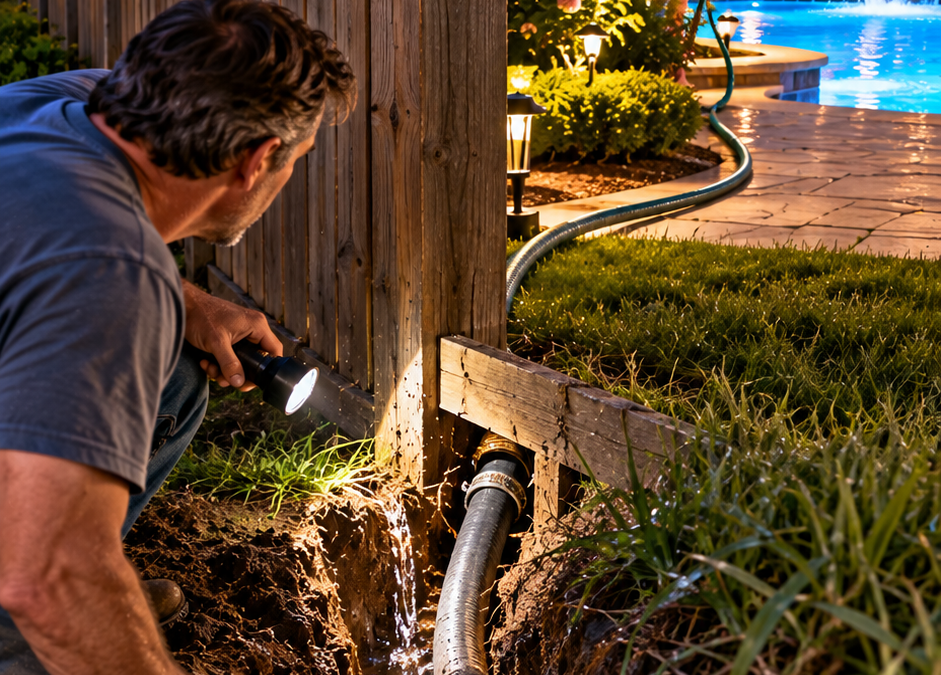
A black hose, thick enough to carry real volume, disappeared underneath a gap at the base of the wooden fence.
My stomach tightened.
I followed it with my eyes.
On my side, it ran behind a row of shrubs, half-hidden under mulch, toward the corner where an old outdoor spigot sat near the pool equipment area. I had not used that spigot in weeks. It was mostly there for washing down the pavers.
The hose was connected to it.
My spigot.
My water.
Running under the fence.
I stood up slowly.
For a moment, I did not move.
There are certain discoveries that your mind resists because they are too simple. You expect the explanation to be complicated: a hidden leak, a broken underground line, a faulty meter, a pool problem. You do not expect the answer to be a hose under a fence stealing water like something a child might set up, except cleaner, quieter, and far more deliberate.
I turned the spigot off.
The water sound stopped.
The sudden silence felt enormous.
I took out my phone and photographed everything.
The hose connected to my spigot. The route behind the shrubs. The section disappearing under the fence. The meter reading after I shut it off. The time stamp.
Then I walked around the side yard, through my gate, and down the sidewalk toward Karen’s driveway.
Her backyard gate was not locked.
That did not give me permission to enter.
So I stayed outside and looked through the gap between the gate and the post.
The hose emerged on her side and ran neatly along the base of her landscaping. It connected to equipment serving her pool—some kind of auxiliary fill or supply line feeding into the system near a set of valves.
This was not an accident.
This was not a garden hose dragged over for one emergency fill and forgotten.
Someone had routed it.
Someone had hidden it.
Someone had used my water long enough to double my bill.
I stood there in the dark, gripping my phone so tightly my knuckles hurt.
Karen’s backyard lights glowed across the pool surface. The water shimmered blue and perfect under the expensive fixtures. Everything on her side looked polished, peaceful, and paid for.
Except it had not all been paid for by her.
The next morning, I knocked on her front door.
Karen opened it wearing workout clothes and a white zip-up jacket, holding a glass of green juice like she had been interrupted on her way to a wellness retreat.
She smiled.
Not warmly.
Karen never smiled warmly.
“Good morning,” she said. “Is something wrong?”
“Yes.”
Her eyebrows lifted with practiced concern.
“What happened?”
“There’s a hose connected to my outdoor spigot running under the fence into your pool equipment.”
The concern vanished.
Not shock.
Not confusion.
Just concern, gone.
She took a small sip from her glass.
“Oh.”
That one syllable told me plenty.
“Oh?” I repeated.
She stepped onto the porch and pulled the door halfway closed behind her.
“The shared water access situation back there is complicated.”
“No, it isn’t.”
“It is, actually. The properties were originally landscaped with certain shared utility assumptions.”
“My water bill isn’t complicated, Karen. It doubled.”
She sighed, as if I had brought her a petty inconvenience.
“I’m sure that can be discussed.”
“Discussed? Your pool equipment is connected to my water.”
“You’re making it sound intentional.”
“Was it not?”
She looked away toward the street.
“The previous owners had arrangements.”
“With whom?”
“I don’t know all the history.”
“You’ve lived here eight years.”
“And your point?”
“My point is that someone connected a hose from my spigot to your pool.”
She smiled then.
A small, insulting smile.
“Maybe you should check your own system before accusing people.”
“I did.”
“Then perhaps you have a leak.”
“The hose was running last night. When I shut off my spigot, the water stopped.”
For the first time, her face changed.
Only slightly.
A flicker around the eyes.
Then she laughed.
Not because anything was funny.
Because laughter can be used like a door slammed in someone’s face.
“This is absurd.”
“What’s absurd is using my water and acting like I’m rude for noticing.”
She stepped back toward her doorway.
“I have a meeting in fifteen minutes.”
“Karen.”
She paused.
“The hose needs to be disconnected today.”
“I’ll have someone look into it.”
“No. It needs to be disconnected.”
Her expression hardened.
“You do not give me orders on my property.”
“You connected to mine.”
She stared at me.
Then she said, “Take it up with the HOA if you’re that upset.”
And she closed the door.
I stood on her porch for several seconds, looking at the door, feeling anger rise in a slow, controlled wave.
That was Karen’s mistake.
She thought sending me to the HOA would exhaust me.
Instead, it gave me a process.
I called the HOA office as soon as I got home.
The manager, a woman named Denise, answered. I explained the situation clearly: unauthorized hose connected to my water supply, routed under the fence, feeding Karen’s pool equipment, water bills doubled, photographs available.
Denise sounded concerned.
“I’ll open a matter for review.”
“What does that mean?”
“We’ll notify the board and determine whether an inspection is warranted.”
“An inspection is warranted now.”
“I understand your concern.”
“Do you?”
“Yes, Mr. Harper.”
“My water is being used.”
“I’ll mark it urgent.”
Urgent in HOA language often means nobody wants to deal with it until the next meeting.
Days passed.
Nothing happened.
Meanwhile, Karen’s pool equipment kept running.
I shut off my spigot and removed the hose from my side once. By the next evening, it had been reattached with a different connector. That was when the situation moved from suspicious to deliberate.
I did not confront her again.
Not yet.
I started documenting everything.
Every morning before work, I photographed the hose.
Every evening, I photographed it again.
I took pictures of the meter readings. I wrote down times, dates, weather conditions, and whether the pool equipment was running. I recorded short videos showing water flowing when the hose was connected and stopping when I shut the valve. I kept both water bills in a folder and highlighted the usage increase.
Rachel watched me build the file at the kitchen table.
“You look like you’re preparing for trial,” she said.
“I might be.”
She sat across from me, worried.
“Do you think Karen did it herself?”
“I think she knows.”
“That’s not the same thing.”
“No,” I said. “It’s worse in some ways.”
Because an accident can be corrected.
Knowledge becomes choice.
One afternoon, I came home early and found Karen standing near the fence.
She was on her side, but visible through a gap between boards where the wood had warped. She was crouched near the hose connection, wearing gardening gloves, adjusting something behind the pool equipment screen.
I stepped closer on my side.
“Karen.”
She froze.
Then she stood slowly and turned her head.
For one second, we looked directly at each other through the fence gap.
Her face went blank.
Not innocent.
Blank.
Then she turned away and walked toward her patio without saying a word.
That reaction told me everything I needed.
I sent the full evidence packet to the HOA board that night.
Not just Denise.
Every board member whose email address was listed on the community website.
Subject line: Unauthorized Water Connection From My Property to Karen Whitmore’s Pool Equipment
I attached photographs, videos, meter readings, bills, and a written timeline. I included the dates I had contacted the HOA and noted that no inspection had occurred. I requested immediate formal inspection, reimbursement for documented excess water usage, and confirmation that unauthorized utility connections between properties were prohibited.
Then I waited.
This time, the response came quickly.
Denise called the next morning.
“Mr. Harper, the board has reviewed your materials. We are scheduling an inspection tomorrow at nine.”
“Good.”
“Karen has been notified.”
“I’m sure she loved that.”
Denise paused.
“We’ll have two representatives present.”
“I want the connection documented before anything is removed.”
“That is the purpose of the inspection.”
“Good,” I said again.
The next morning, two HOA representatives arrived at my property.
Denise came with a man named Robert Chen, the board treasurer. I had met Robert at a community meeting once. He was quiet, careful, and seemed less impressed by HOA drama than most. He carried a clipboard, but unlike Karen, he looked like he intended to use it for notes rather than intimidation.
Karen came outside before they even reached my back gate.
She was already angry.
“This is completely unnecessary,” she said, walking across her patio in designer sunglasses and a linen shirt. “He’s exaggerating a minor misunderstanding.”
Denise kept her voice neutral.
“Karen, we need to inspect the reported connection.”
“There is no connection.”
I looked at her.
“Then this should be quick.”
Her jaw tightened.
We started on my side.
I showed them the outdoor spigot, the hose route, the mulch disturbed along the fence, and the gap where the line passed underneath. Denise photographed everything. Robert crouched to examine the hose and connection.
“Is this your hose?” he asked me.
“No.”
“Did you install it?”
“No.”
“Did you authorize anyone to attach it?”
“No.”
Karen called from the other side of the fence.
“This is ridiculous. It could have been left by a landscaper.”
Robert looked up.
“Your landscaper?”
“I don’t know.”
Denise said, “We need to follow it.”
We walked around to Karen’s side through the common path.
Karen tried to block the gate.
“I don’t consent to people wandering through my yard.”
Denise looked at her.
“The HOA has inspection authority for reported exterior violations and utility concerns under the governing documents. You were notified yesterday.”
“This is harassment.”
“It is an inspection.”
Karen stepped aside, furious.
Her backyard looked like something from a magazine. Travertine pavers, trimmed hedges, outdoor kitchen, blue pool, raised spa, decorative stone wall, expensive lounge chairs arranged as if a photographer had just left.
And there, tucked low behind the pool equipment screen, was the hose from my property.
It ran into a cluster of valves and fittings near the pool’s fill system.
Robert’s face changed.
Denise stopped walking for a moment.
Karen started talking immediately.
“That was there when we bought the house.”
Robert looked at her.
“You told us there was no connection.”
“I said there was no unauthorized connection.”
Denise stepped closer to the equipment.
“Karen, this hose comes from his yard.”
“That doesn’t mean I installed it.”
“You’ve owned this property for eight years.”
“It could be historical.”
“Then why are there recent fittings?” Robert asked.
He pointed to a bright brass connector, clean PVC, fresh thread seal tape, and newer brackets securing part of the line. The surrounding mulch had been recently disturbed. A small section of soil still showed tool marks.
Karen’s lips parted.
No answer came.
Robert took photos.
Denise compared the equipment layout with property records and the pool modification file the HOA had on record.
“This connection isn’t shown in the approved pool renovation documents,” she said.
Karen crossed her arms.
“Pool contractors make field adjustments.”
“Not by connecting to a neighbor’s water supply,” Robert said.
Karen turned on him.
“You’re not a plumber.”
“No,” he said. “But I can see a hose crossing a property line.”
That was the first moment Karen seemed to understand the board was not automatically on her side.
Denise called the HOA’s maintenance consultant, who arrived thirty minutes later with a licensed plumber named Paul Reyes.
Paul did not take long.
He traced the line, checked the valves, examined the connection point, and shook his head.
“This is not appropriate,” he said.
Karen snapped, “What does that mean?”
“It means this setup should not exist.”
“It was temporary.”
That was the first time she used that word.
Temporary.
Denise caught it immediately.
“You said it was there when you bought the house.”
Karen froze.
Then she recovered badly.
“I meant the general arrangement.”
Paul looked at the connection again.
“This is recent. The fittings are recent. The line is not part of the permitted pool system.”
Robert wrote something down.
I stood quietly, letting them work.
That was difficult.
I wanted to say everything. I wanted to ask Karen why she laughed when I confronted her. I wanted to ask how many gallons she thought she could take before I noticed. I wanted to ask whether the luxury appearance of her backyard depended on someone else paying the utility bill.
But I had learned something during the last few weeks.
Evidence speaks best when you stop interrupting it.
Paul followed the connection deeper into the pool system and frowned.
“There’s another issue.”
Karen’s head turned quickly.
“What issue?”
He pointed near the auxiliary fill line.
“This is tied in at a bad location. There’s no proper backflow protection here.”
Denise’s face tightened.
“Is that a safety concern?”
“Yes,” Paul said. “Potentially. You don’t connect an unapproved outside water source into pool fill equipment like this. Depending on pressure conditions, contamination risk, and valve configuration, this needs professional evaluation before the system runs again.”
Karen’s anger changed shape.
Now it had fear inside it.
“My pool cannot be shut down,” she said.
Paul looked at her.
“It should be shut down until this is evaluated.”
“No.”
Denise turned to Robert.
Robert nodded.
Denise faced Karen.
“Karen, the unauthorized connection must be disconnected immediately. Your pool system is to be shut down pending professional evaluation. You will be responsible for documented excess water usage if the board confirms the connection drew from Mr. Harper’s supply.”
Karen stared at her.
“You cannot order that.”
“The board can require correction of unauthorized exterior utility modifications and unsafe connections.”
“I am on the architectural committee.”
“Not for this inspection,” Robert said.
That sentence hit harder than he probably intended.
Karen looked at him like he had betrayed her.
Then she stormed toward the pool equipment.
“Everyone needs to leave.”
Paul stepped back.
“I’m not touching anything until I document the current configuration.”
“You will leave now.”
Denise’s voice sharpened.
“Karen, do not interfere with the inspection.”
Karen stopped.
The yard went quiet except for the pool pump humming behind the equipment screen.
Paul took more photographs. He tagged the line. He shut the relevant valves. Then, with Denise and Robert watching, he disconnected the hose from the unauthorized setup and capped the connection temporarily for safety.
On my side, my spigot was finally free.
For the first time in weeks, I felt something loosen in my chest.
Not relief exactly.
Proof.
Relief would come later.
That evening, I received an email from the HOA board.
It confirmed that the inspection had identified an unauthorized water connection from my property to Karen Whitmore’s pool equipment. It confirmed that the connection was not shown in approved neighborhood records or pool renovation documents. It confirmed that recent modifications were observed. It confirmed that Karen had been ordered to disconnect the setup, stop using the affected pool fill system, and cooperate with further professional evaluation.
For the first time, someone in the HOA had written the truth in official language.
I printed the email and put it in my folder.
Rachel read it over my shoulder.
“They finally listened,” she said.
“Yes.”
“Do you feel better?”
I looked through the kitchen window toward the dark backyard.
“Not yet.”
Because the story was not over.
The inspection had exposed the hose.
But the hose was only the visible part.
Over the next week, the HOA discovered more problems connected to Karen’s pool setup.
The first was the permit.
Or rather, the missing permit.
When the board requested the full pool renovation file, the documents did not match the system in Karen’s yard. The approved plans showed a standard autofill connection tied to her own service line. They did not show the auxiliary line. They did not show the valve assembly Paul photographed. They did not show any connection near the fence.
The second problem was water accounting.
Using my meter readings, bills, photographs, and the estimated flow rate through the hose, the HOA’s consultant calculated that a substantial amount of water had likely been drawn from my property over several weeks, possibly longer. The exact number was difficult to prove down to the gallon, but the pattern was clear. My spike lined up with the line being active.
The third problem was worse.
Paul’s follow-up evaluation found that Karen’s pool system had been modified after the original renovation in a way that bypassed the approved fill setup. The unauthorized line did not simply top off the pool through a loose hose. It fed into equipment in a way that could affect pressure, filtration, and backflow protection.
That moved the issue beyond neighbor misconduct.
It became a safety and compliance problem.
The HOA notified the city water department.
Karen exploded.
I knew because she came to my door two days later.
Rachel was home when it happened. We were eating dinner when the doorbell rang hard enough to sound angry.
I opened the door.
Karen stood there, face flushed, eyes bright with fury.
“You called the city?”
“No.”
“You gave them information.”
“I gave the HOA evidence.”
“And now the water department is involved.”
“Sounds like they should be.”
“You are trying to ruin me.”
I stepped onto the porch and closed the door behind me.
“My water bill doubled because your pool equipment was connected to my spigot.”
She looked past me toward the front windows, as if checking whether Rachel was watching.
“This could have been handled privately.”
“I tried that. You laughed.”
Her jaw tightened.
“You don’t understand how complicated pool systems are.”
“I understand whose meter the water ran through.”
She lowered her voice.
“If this becomes a formal violation, it could affect my standing with the board.”
“Karen, you stole water.”
“I did not steal anything.”
“What do you call using water from my property without permission?”
“A misunderstanding.”
“No. A misunderstanding is when someone uses the wrong trash bin. This was a hose under a fence.”
Her face hardened.
“You had no right to photograph my yard.”
“I photographed the hose connected to my property.”
“You made me look like a criminal.”
“No,” I said. “You made yourself look like a criminal. I just kept records.”
For a second, she looked like she might slap me.
Then she took a step back.
“You’ll regret this.”
That sentence brought Rachel to the door behind me.
She opened it and looked at Karen.
“Are you threatening my husband?”
Karen’s expression shifted instantly.
“No.”
Rachel held her gaze.
“Then leave.”
Karen looked from her to me.
Then she turned and walked down the steps.
Rachel waited until Karen reached the sidewalk before closing the door.
Inside, she leaned back against it and exhaled.
“I hate this neighborhood,” she said.
I almost laughed.
“So do I right now.”
The water department inspection happened three days later.
A city technician named Marcus Bell arrived with Denise, Robert, and Paul. Karen’s pool contractor also came, though he seemed eager to make clear he had not installed the unauthorized line.
Marcus was calm and direct. He inspected my meter, my spigot, the fence route, Karen’s equipment, and the capped connection. He reviewed photographs of the setup before disconnection. He asked who had installed it.
Karen said she did not know.
Marcus looked at the fresh fittings.
“When was the last pool work performed?”
Karen hesitated.
“Maintenance is ongoing.”
“That’s not a date.”
Her contractor spoke carefully.
“We completed the permitted renovation last year. This connection was not part of our work.”
Karen turned on him.
“You can’t possibly know what every technician did.”
He held up both hands.
“I know what my company installed.”
Marcus wrote that down.
Then he issued his determination.
The unauthorized connection had to remain disconnected. Karen’s pool fill system had to be corrected by a licensed plumber. Backflow protection had to be inspected and brought into compliance. The HOA would need to submit confirmation before the pool equipment could be fully returned to service.
Karen looked stunned.
“You’re shutting down my pool?”
Marcus answered plainly.
“I’m requiring unsafe and unauthorized water connections to remain out of service until corrected.”
“My pool is not unsafe.”
“Then your licensed professional can document that after correction.”
“It’s the middle of summer.”
“That does not change the requirement.”
Karen looked at Denise.
“This is outrageous.”
Denise did not rescue her.
“The board will issue a formal notice after reviewing the city’s report.”
Karen’s pool sat quiet after that.
No pump humming at night. No waterfall. No spa spillover. No constant autofill. Just still water behind expensive stonework.
For someone like Karen, that silence must have been humiliating.
Her backyard had always been part of her identity. She hosted wine nights, committee socials, charity planning meetings, and poolside brunches where people pretended not to notice that everyone was being ranked. The pool was not just a pool. It was a stage.
Now the stage was shut down because of a hose under my fence.
The formal HOA findings arrived two weeks later.
The board determined that Karen had maintained an unauthorized connection between properties. It found the connection had drawn water from my supply. It found the modification was not approved and created compliance concerns. It ordered Karen to reimburse me for the documented excess water usage, pay for my plumber consultation, cover the HOA inspection costs, and submit proof of corrected pool plumbing.
The letter also suspended Karen from the architectural committee pending board review.
That part surprised me.
Not because it was undeserved.
Because HOAs usually protect their insiders until not protecting them becomes cheaper.
Karen had made protection expensive.
I received a reimbursement check ten days later.
It covered the excess usage calculated from the meter data and the billing difference for the disputed period. It was not life-changing money, but it was mine. More importantly, the memo line said: Water usage reimbursement.
Written record.
Again.
That mattered more than the amount.
Karen did not hand it to me herself. Of course she did not. It came through the HOA management office in a plain envelope with a copy of the board’s determination.
Rachel stood beside me while I opened it.
“Is it enough?” she asked.
“It covers the documented amount.”
“That’s not what I meant.”
I looked at the check.
No, it was not enough.
It did not pay for the irritation of checking meters every morning. It did not pay for the feeling of being laughed at on Karen’s porch. It did not pay for the hours spent documenting what should never have happened. It did not pay for the way Rachel started locking the side gate even in daylight. It did not pay for the fact that I now looked at every shared fence line differently.
But it was a start.
The board meeting came the following Thursday.
I attended because my name was on the agenda.
The clubhouse meeting room was nearly full. Word had spread, as it always did. Some people came because they cared about utility violations. Most came because Karen was finally in trouble and they wanted to see how she handled being on the other side of enforcement.
She sat near the front with her husband, arms folded, lips pressed tight.
Denise presented the findings without drama. She summarized the unauthorized connection, inspection results, water usage analysis, city involvement, and required corrective actions. Robert spoke next, explaining the financial reimbursement and committee suspension.
Then residents began asking questions.
“Was this connected to his meter?”
“Yes,” Robert said.
“Did she know?”
Denise chose her words carefully.
“The board found sufficient evidence that the connection was maintained after Mr. Harper objected.”
That was careful, but clear enough.
“Was this theft?” someone asked.
The HOA attorney, seated at the side table, leaned toward the microphone.
“The board is not making criminal findings. The matter before the association concerns unauthorized exterior modification, improper utility connection, reimbursement, and compliance.”
That was legal language for we are handling what we can handle.
I understood it.
Karen stood when they allowed her to speak.
She looked around the room, trying to collect sympathy.
“This has been exaggerated beyond reason,” she began. “A temporary hose connection related to pool maintenance was misrepresented as some kind of conspiracy.”
A few people shifted.
She continued.
“We live in a community. Neighbors should communicate. Instead, Mr. Harper documented, escalated, and embarrassed my family.”
That got my attention.
I stood before I planned to.
Denise looked at me.
“Mr. Harper, you’ll have a chance—”
“No,” I said, keeping my voice steady. “I need to respond to that now.”
The room quieted.
I turned toward Karen.
“I knocked on your door first. I told you the hose was connected to my water. You laughed and told me to take it up with the HOA.”
Karen’s face tightened.
“I did not laugh.”
“You did.”
I looked at the board.
“I contacted the HOA. Nothing happened. The hose was reattached after I removed it. Karen was seen at the connection. My water bill doubled. The connection was unauthorized, recent, and unsafe enough that the system had to be shut down. That is not a neighborly misunderstanding.”
A man in the back said, “He’s right.”
Karen’s head snapped toward him.
He did not back down.
Another woman raised her hand.
“Didn’t Karen serve on the architectural committee approving other people’s pool equipment?”
The room stirred.
That question did more damage than mine.
Robert looked uncomfortable.
“Yes,” he said. “Karen served on the committee.”
The woman continued.
“So she enforced rules on everyone else while having an unauthorized connection herself?”
Nobody on the board answered immediately.
They did not have to.
The silence did it for them.
Karen sat down.
Her husband stared at the table.
That was when the room shifted against her.
Not with shouting. Not with outrage. With recognition.
People began remembering.
A resident named Marcy said Karen had fined her for a visible garden hose left out overnight. Another man said Karen once forced him to repaint a pool equipment screen because it did not match the approved trim. Someone else said Karen had delayed their spa repair for three weeks over paperwork.
Each story landed beside mine like another stone on the scale.
Karen had made rules her weapon.
Now the rules were reading back to her.
By the end of the meeting, the board voted to remove her permanently from the architectural committee. They also opened a review of all committee approvals and enforcement actions Karen had influenced during the previous year.
Karen left before the meeting ended.
No dramatic speech.
No apology.
No final threat.
She simply stood, gathered her purse, and walked out while people watched.
For once, nobody followed her lead.
The next month was quieter.
Her pool remained out of service while licensed work was completed. Trucks came and went. The improper line was removed entirely. The section under the fence was pulled out. My spigot received a locking cover, which Karen paid for as part of the corrective resolution. Her pool system was replumbed to connect only to her own approved supply, with proper protection and documentation.
The city signed off.
The HOA signed off.
I signed nothing until my side was restored.
Only after the hose route was filled, the mulch replaced, and the reimbursement cleared did I consider the matter resolved.
Karen avoided me after that.
If she saw me walking to the mailbox, she turned away. If I was outside near the fence, her patio stayed empty. The pool parties stopped for the rest of the summer. Her backyard lights still came on at night, but the waterfall remained off more often than not.
The neighborhood changed too.
People who had barely spoken to me before began stopping by with cautious comments.
“Glad they figured that out.”
“Can’t believe someone would do that.”
“Good thing you documented it.”
That last one always made me nod.
Yes.
Good thing.
Because without documentation, Karen would have called it confusion. She would have called it historical. She would have called it temporary. She would have called it neighborly. She would have called it anything except what it was.
Water taken through a hose hidden under a fence.
That is the thing about quiet neighborhoods.
They are not always peaceful.
Sometimes they are only quiet because people have learned not to challenge the ones who make noise expensive.
I had not wanted a fight. I wanted my bill corrected and my water left alone. But Karen forced the fight into records, inspections, board findings, city reports, and public meetings. And once that happened, her version could not survive.
Late one evening, after everything was finished, I walked out to the backyard alone.
The air was warm. The pool lights glowed soft blue under the surface. The filter hummed normally. Our water meter had stopped its strange silent movement. The fence stood where it always had, ordinary and still.
I crouched near the place where the hose had disappeared under the boards.
The soil had been smoothed over. The mulch replaced. If you did not know where to look, you would never see that anything had happened there.
That bothered me.
Not because I wanted a scar in the yard.
Because it reminded me how easy it had been to hide.
A hose under a fence. A connection behind equipment. A neighbor with enough confidence to laugh when confronted. A board slow enough to ignore the first complaint. A system that only worked once the evidence became too complete to dismiss.
Rachel came outside and stood beside me.
“You okay?” she asked.
“Yes.”
“You sure?”
I looked toward Karen’s side of the fence.
“I’m just thinking.”
“About what?”
“How many things people get away with because nobody wants to be difficult.”
Rachel








