𝗙𝗨𝗟𝗟 𝗦𝗧𝗢𝗥𝗬 The HOA Turned My Three Private Ponds Into a Fishing Resort—Then I Found Their Tournament Records
𝗣𝗔𝗥𝗧 𝟮
For several seconds, I thought I had misunderstood what I was looking at.
Then I unfolded the page completely.
There was a map.
North Pond and Middle Pond were both shown.
Beside them was a label:
HOA COMMUNITY WATER ACCESS.
I looked up.
“Hershel.”
“Yeah?”
“Have they been fishing my ponds?”
He scratched his jaw.
“I’ve seen trailers headed in there the last couple summers.”
“Through where?”
“Your west fence, far as I can tell.”
“You ever see a gate?”
“That’s why I brought this.”
I folded the newsletter along its existing crease.
“How long have you known?”
“That they were holding something? A while. That they were calling the ponds theirs? Today.”
I nodded.
“Thank you.”
He studied me.
“You going over there?”
“I’m going to look at my fence.”
The next morning I drove the western boundary.
I found the gate approximately where Hershel had described it.
Tubular steel.
Padlocked.
Installed in a gap cut through a cedar-post fence that had stood there longer than Cedarwood Shores.
I got out of the truck and stared at it.
Whoever had installed the gate had done a professional job.
Posts set square.
Hinges welded clean.
Gravel packed beneath the opening.
Someone had spent money.
Beyond it was a gravel path wide enough for a pickup towing a bass boat.
I followed the fence on foot until I could enter from my own side, then walked down the path.
The cedars opened near North Pond.
That was where I found the ramp.
Concrete.
Proper slope.
Wide enough to launch a fishing boat.
Near it stood a painted wooden sign.
CEDARWOOD SHORES COMMUNITY FISHING AREA
HOA MEMBERS ONLY
Green lettering.
White background.
Pressure-treated post.
Driven into my ground.
I did not tear it down.
I did not touch the gate.
I did not block the ramp.
I took out my phone.
Photograph of the gate.
Photograph of the hinges.
Photograph of the cut fence.
Photograph of the gravel road.
Photograph of the ramp.
Photograph of the sign.
Photograph of tire tracks.
Photograph of the corner pin.
Then another photograph showing the pin relative to the gate.
Dad had taught me that anger was useful for making you move.
It was terrible for making you think.
“If you might need to explain it later,” he used to say, “document it while it’s still boring.”
So I made it boring.
Then I called Warren Giles.
Warren was a Knoxville attorney who worked in land-use and property disputes.
A friend had hired him three years earlier during a boundary fight, and I remembered the way my friend described him.
He doesn’t get excited about things that are obvious.
I explained what I had found.
Warren asked two questions.
“You have your deed?”
“Yes.”
“Have you or anyone before you signed anything granting Cedarwood Shores access to those ponds?”
“No.”
“You sure?”
“I have every property file going back to my grandfather.”
“Good. Then don’t touch their gate.”
That surprised me.
“It’s on my property.”
“I know.”
“So why leave it?”
“Because right now it’s evidence.”
I understood immediately.
“Don’t remove the sign either,” he said. “Don’t block anybody. Don’t get into an argument with an HOA member. Let me pull the record first.”
Four days later, the HOA sent me its own evidence.
Certified mail.
The letter came from Diane Coulter.
President, Cedarwood Shores Homeowners Association.
It accused me of “unauthorized interference with community water access.”
It stated that the three ponds were subject to community-use provisions.
It warned me against restricting resident access.
What it did not include was more interesting.
No deed reference.
No easement number.
No plat notation.
No recorded agreement.
No statute.
No signed license.
Nothing identifying how Cedarwood Shores had supposedly acquired rights to my ponds.
The letter did not prove they had a right.
It merely repeated that they believed they had one.
I read it twice.
Then I placed it in a new folder.
CEDARWOOD SHORES — CORRESPONDENCE.
The second letter arrived ten days later.
This one was from an attorney at Merit & Associates in Chattanooga.
The language was more polished.
The problem was the same.
The HOA claimed community access to the ponds and demanded that I cease any effort to interfere with residents.
The letter specifically instructed me not to install locks, barriers, or private-property signs.
I had done none of those things.
I forwarded the letter to Warren.
He called that evening.
“Well,” he said, “this is good.”
“Getting threatened by somebody else’s lawyer is good?”
“They put their claim in writing.”
“That was my thought.”
“Now we make them prove it.”
The following morning, Warren requested a complete title review from the Harmon County Register of Deeds.
He wanted everything affecting the Aldrich tract.
Chain of title.
Western boundary.
Easements.
Licenses.
Restrictions.
Covenants.
Agreements involving Cedarwood Shores.
Agreements involving Garfield Properties.
Anything that could possibly give the HOA access.
It took eleven days.
Warren called when the search was complete.
“There isn’t one.”
“One what?”
“Anything.”
I leaned back in my chair.
“No easement?”
“No.”
“License?”
“No.”
“Recorded access agreement?”
“No.”
“Nothing from Dad?”
“Nothing.”
“Granddad?”
“Nothing.”
“Me?”
“You’d probably remember.”
I smiled.
“Probably.”
Warren’s voice became serious again.
“Caleb, the ponds are wholly within the Aldrich tract. So is the access road they constructed. So is the ramp. So is the sign. The title record shows no legal right of entry for Cedarwood Shores.”
I looked out my office window toward the distant ridge.
The HOA had not misunderstood some complicated shared easement.
They had no easement.
They had simply been using my land.
“How long do you want me to think about this?”
“A day.”
“Why?”
“Because you’re angry.”
“I’m not that angry.”
“You’re quiet. That’s usually worse.”
He knew me better than I thought.
So I waited.
The next day, I called him.
“Proceed.”
A county plat arrived soon afterward in a large envelope.
I spread it across the kitchen table.
That same table had held Hershel’s newsletter.
The Aldrich boundary appeared in solid lines.
Cedarwood Shores was separately platted to the west.
I traced the boundary clockwise.
The gate the HOA installed was approximately 340 feet south of the northwest corner pin.
Their road crossed directly through my boundary.
Their boat ramp terminated entirely inside the Aldrich tract.
Nothing overlapped.
Nothing was unclear.
Land records are not emotional documents.
That is one reason I trust them.
A survey line does not become offended when someone ignores it.
It simply remains where it is.
By then, I had also learned more about the tournament.
The HOA had advertised it for three years.
Registration lists had been published.
Entry fees were collected.
Sponsors were thanked.
Prize amounts were announced.
Photographs of contestants holding bass at North Pond appeared in newsletters.
There were weigh-in results.
Volunteer schedules.
Every year, Cedarwood Shores had documented its own commercial use of my property.
Warren reviewed the records.
Then he called.
“You know what’s interesting?”
“What?”
“They made money.”
“How much?”
“Fourteen thousand two hundred dollars in tournament entry revenue across the three events, based on their published numbers.”
I was quiet.
The number itself was not enormous.
That was not the point.
The point was that Cedarwood Shores had taken private property it did not own, branded it as a community amenity, charged people to use it, and then sent me a cease-and-desist letter when I noticed.
That was a different category of problem.
Warren filed suit in Harmon County Circuit Court on a Monday in November.
The complaint sought three things.
First, quiet title—a judicial determination confirming my ownership and eliminating any claim the HOA might assert.
Second, relief for trespass.
Third, an injunction preventing Cedarwood Shores from entering or using the property without permission.
Attached were my deed, the county plat, the title-search results, the HOA letters, the Merit & Associates letter, photographs of the gate and improvements, and the tournament records showing $14,200 in collected entry fees.
Twenty-one days later, the HOA responded.
Their position had changed.
They no longer relied entirely on vague “community water access.”
Now they argued that Cedarwood Shores residents had used the ponds openly and continuously for approximately three years and that this history created a basis for access rights.
Warren read the response.
Then he called me.
“They’re trying to turn trespass into adverse use.”
“Can they?”
“Not after three fishing seasons.”
He explained that Tennessee law required a far longer period and substantially more than occasional tournament use to establish the kind of property right they were trying to suggest.
Three years did not come close.
He filed the response.
The court scheduled the hearing for the second week of February.
Winter settled over the ponds while we waited.
North Pond iced along the edges.
Middle Pond became nearly invisible through bare timber.
Aldrich Deep stayed dark in the center even on the coldest mornings.
I walked the western line more often than usual.
The HOA gate remained.
So did the sign.
Warren had told me to leave everything untouched pending the case.
Every time I saw that green-and-white sign, I felt the same irritation.
CEDARWOOD SHORES COMMUNITY FISHING AREA.
It was remarkable how easily three painted words could attempt to erase four generations of ownership.
But I kept my hands off it.
February came.
I drove to the Harmon County Courthouse in my usual truck.
No suit.
No performance.
Clean jeans.
Work boots.
The same winter coat I used while checking fences.
Warren was already in the courtroom with a banker’s box of documents.
Across the aisle sat Diane Coulter.
She wore a dark green blazer.
The attorney from Merit & Associates sat beside her.
Diane looked toward me once.
I nodded.
She did not return it.
Judge Patricia Stowe entered.
She had served fourteen years on the Harmon County bench.
She sat down, reviewed several pages, and then looked directly at the HOA’s attorney.
“Counsel, before we get into the equitable arguments, I want to clarify something.”
“Yes, Your Honor.”
“Can you identify any recorded instrument granting Cedarwood Shores Homeowners Association access to the Aldrich property?”
Silence.
It lasted perhaps three seconds.
In a courtroom, three seconds can feel long.
The attorney stood.
“No recorded instrument, Your Honor, but—”
Judge Stowe raised one hand slightly.
“So the answer is no?”
“Yes, Your Honor.”
I watched Diane’s shoulders stiffen.
The attorney continued.
He argued that the HOA had believed in good faith that the ponds were available as community amenities.
He pointed to three years of uninterrupted access.
He argued reliance.
Investment.
Community expectation.
The expense of building the road and ramp.
Judge Stowe listened.
Then she asked:
“Who authorized those improvements?”
The attorney glanced down.
“The association board.”
“I understand who voted. I’m asking who authorized the association to build on Mr. Aldrich’s property.”
Another pause.
“There was no express written authorization.”
That sentence mattered.
Not because it told us anything new.
Because now it was in the court record.
Warren stood when his turn came.
He began with the deed.
“Caleb Aldrich holds title to approximately 4,400 acres described in this recorded instrument transferred to him in 2009.”
He submitted the certified copy.
Next came the plat.
“This is the western boundary.”
He traced it for the court.
“This is Cedarwood Shores.”
Then he indicated the gate.
“The association cut through Mr. Aldrich’s fence here.”
The gravel lane.
“They constructed this access route.”
The boat ramp.
“They poured this improvement on the bank of North Pond.”
The sign.
“They labeled the property as an HOA community fishing area.”
Then the title report.
“There is no easement.”
No flourish.
“No license.”
He turned another page.
“No covenant.”
Another.
“No access agreement.”
Then the tournament records.
“For three consecutive years, the association collected registration fees for fishing tournaments held on property it did not own and had no recorded right to enter.”
The total appeared on the summary.
$14,200.
The HOA attorney objected to Warren’s characterization of the revenue as damages.
Judge Stowe allowed him to continue.
Warren then addressed the claim based on continuous use.
Three years of recreational entry, he argued, could not suddenly transform unauthorized fishing into ownership or an easement.
Open use was not enough.
Repeated trespass did not automatically create a property right merely because nobody caught it immediately.
He finished in twenty-two minutes.
Then he sat beside me.
I leaned slightly toward him.
“That’s it?”
“That’s it.”
Judge Stowe looked through the documents.
I expected her to take the case under advisement.
She did not.
She ruled from the bench.
“The deed and survey evidence establish the plaintiff’s title to the disputed property.”
My hands remained flat on the table.
“The defendant has produced no recorded easement, license, covenant, or other instrument granting Cedarwood Shores Homeowners Association access to the Aldrich tract or its ponds.”
Diane did not move.
“The association’s gate, gravel access, boat ramp, signage, and tournament operations were placed or conducted upon private property without authorization from the owner.”
Judge Stowe turned a page.
“Judgment on the quiet-title claim is entered in favor of the plaintiff.”
That was the moment that mattered most.
Everything else followed.
The HOA was ordered to remove its gate, sign, tournament structures, and boat-access improvements within sixty days at its own expense.
It was prohibited from representing North Pond, Middle Pond, or Aldrich Deep as community amenities.
It was prohibited from entering the Aldrich tract without permission.
Then Judge Stowe addressed damages.
After receiving written notice disputing its authority, Cedarwood Shores had continued asserting access rights despite having no recorded basis for them.
The court awarded $14,200.
The amount corresponding to tournament revenue generated through unauthorized use of the property.
Court costs followed.
I heard Warren exhale beside me.
Across the aisle, Diane remained completely still.
The expression she had worn the morning she told me I lacked authority over my own ponds had disappeared.
There was no dramatic breakdown.
No shouting.
No apology.
Just stillness.
Sometimes that is what losing certainty looks like.
The Merit attorney closed his binder.
Diane looked down at the table.
I looked at Warren.
He whispered, “Now you can touch the gate.”
For the first time that morning, I laughed.
Three weeks after the ruling, Cedarwood Shores held a special board meeting.
I did not attend.
Hershel somehow learned the details before I did.
He drove over the following afternoon.
“Four to one.”
I was replacing a hydraulic hose on a tractor.
“What’s four to one?”
“The vote.”
“What vote?”
“To remove Diane Coulter as president.”
I stopped working.
“Seriously?”
He nodded.
“What reason?”
“Failure to verify the legal foundation of HOA property claims before committing association money.”
That sounded exactly like HOA language.
“Anything else?”
“Oh, you’re going to like this part.”
“I doubt that.”
“Merit’s legal bill was twenty-three thousand four hundred.”
I stared at him.
He continued.
“With damages and court costs, they’re saying the whole mess cost the reserve fund about forty thousand two hundred.”
I leaned against the tractor.
Forty thousand two hundred dollars.
All because nobody had checked who owned the ponds before someone cut a gate into my fence.
“That’s expensive fishing,” Hershel said.
I shook my head.
“It didn’t need to cost anything.”
That was what bothered me most.
Cedarwood Shores could have asked.
Years earlier, someone from the HOA could have knocked on Dad’s door.
Later, they could have called me.
Could residents fish occasionally?
Could we arrange access?
Could the HOA lease limited fishing rights?
Could we discuss a tournament?
Maybe I would have said no.
Maybe I would have said yes under conditions.
But asking would have acknowledged the one fact the entire dispute was built around.
The ponds belonged to somebody.
Instead, the HOA behaved as though voting made ownership unnecessary.
The gate came down during the fourth week after the ruling.
A crew of three men arrived with a flatbed truck.
I stood far enough away not to interfere.
They unbolted the steel gate.
Cut the hardware.
Pulled the posts.
Loaded everything onto the trailer.
Then they removed the green-and-white sign from North Pond.
The words HOA MEMBERS ONLY disappeared into the back of the truck.
The weigh-in station went next.
The ramp was last.
That took most of the day.
A jackhammer broke the concrete into pieces.
Chunks were lifted into a trailer and hauled away.
The sound echoed across the water.
I hated the noise.
But I liked what it meant.
By late afternoon, only disturbed gravel and bare soil remained.
The following weekend, I repaired the fence.
I had several pieces of old-growth cedar stored in the barn.
I had saved them for years because cedar like that is too good to waste.
I cut two posts.
Set them plumb.
Tamped the soil.
Installed three boards.
The work took most of Saturday.
I did not hurry.
Dad had taught me how to set fence.
Dad learned from Thomas.
That simple chain of knowledge mattered more to me that afternoon than the court order folded inside my office.
When the last board was fastened, I stepped back.
The western fence line was whole again.
No gate.
No HOA road.
No community-access sign.
Just cedar.
Pasture.
Timber.
Water.
A pair of mallards moved across North Pond in the late afternoon.
They had no idea a homeowners association had lost forty thousand dollars arguing about who owned the water beneath them.
I envied them.
People sometimes expect a legal victory to feel like triumph.
Mine did not.
I did not want Diane humiliated.
I did not care who held office at Cedarwood Shores.
I did not want 340 households paying more dues because their board had made an expensive mistake.
I wanted one thing.
My boundary respected.
What I felt when the fence was repaired was not victory.
It was completion.
Like fixing a broken water line.
Or replacing a damaged gate.
Something had been wrong.
Now it was right.
A few evenings later, I drove down to North Pond by myself.
The weather looked almost exactly like the morning Diane confronted me there.
Gray sky.
Cold air.
Pewter water.
I stood near the shoreline where the HOA sign had been.
You could still see the disturbed patch of earth where its post had stood.
Farther away, scars from the removed ramp marked the bank.
Those would disappear eventually.
Rain would soften them.
Grass would return.
Cattails would reclaim part of the shoreline.
The land is better at forgetting human arrogance than humans are.
I thought about Granddad.
Thomas Aldrich never trusted shortcuts.
That was true in timber.
True in buying land.
True in maintaining equipment.
And especially true in paperwork.
Every time he bought a parcel, he checked the legal description.
Every time a boundary was surveyed, he saved the record.
He knew where the pins were.
Dad did the same.
I used to think that habit was excessive.
Three copies of a deed.
Old plats.
Survey notes.
Maps.
Receipts from things that had happened before I was born.
Then Cedarwood Shores labeled my ponds as community property.
Suddenly every old piece of paper had a voice.
People sometimes talk about deeds as though they are symbolic.
To me, they are almost the opposite.
A deed is useful because it does not depend on symbolism.
It names.
Describes.
Records.
Connects ownership to a specific piece of earth.
It is not impressed by blazers.
It does not care about newsletters.
It does not change because a board votes unanimously.
A community map does not move a boundary.
A tournament flyer does not create an easement.
A concrete ramp does not establish ownership simply because somebody spent money pouring it.
And using another person’s land for three years does not make it yours because you eventually became accustomed to doing so.
That was what Cedarwood Shores learned.
They had mistaken repetition for permission.
Then they mistook confidence for authority.
Finally, they mistook money already spent for a legal right to continue.
The court corrected all three.
My title remained what it had been.
4,400 acres.
Three ponds.
One western boundary adjoining Cedarwood Shores.
Nothing more complicated than that.
I kept every document from the case.
Diane’s first letter.
The Merit letter.
The title search.
The plat.
The tournament newsletter Hershel brought me.
Photographs of the gate.
The green-and-white sign.
Registration records.
The $14,200 revenue calculation.
The complaint.
The judgment.
They all went into one thick folder.
I wrote the label myself.
CEDARWOOD SHORES — POND ACCESS DISPUTE.
Then I placed it beside the other property records in my office.
Not because I expected another fight.
Because Thomas Aldrich taught our family that good records are most useful before you know why you are going to need them.
Spring came late that year.
By April, bass were moving into the shallows.
I walked North Pond one morning and saw three of them suspended beneath the surface near a fallen oak limb.
No tournament boats.
No trailers.
No weigh-in station.
No engines.
Just water.
I stood there longer than necessary.
There had been a time when I might have thought privacy meant nobody else being present.
I understood it differently now.
Privacy was not silence.
It was choice.
The right to decide who entered.
The right to decide what happened on your property.
The right to say yes.
And therefore, necessarily, the right to say no.
Cedarwood Shores had tried to remove that choice by pretending it had already been made.
That was why I had gone to court.
Not because I hated fishing tournaments.
I fish.
Granddad fished.
Dad fished.
The largest bass I ever caught came out of Aldrich Deep when I was seventeen.
The problem was never fishing.
The problem was ownership without consent.
Had Cedarwood Shores approached me honestly, the entire story might have been different.
Instead, Diane came to my pond and told me I had no authority to interfere.
I still think about that sentence.
Of everything she said, it was the part that revealed the most.
She did not tell me she believed the HOA had access.
She told me I lacked authority.
On my land.
That is what unchecked assumptions eventually become.
First someone believes they are allowed.
Then they behave as though they are allowed.
Then, after enough time passes, they begin believing you are the intruder for questioning them.
Fortunately, land records do not develop habits.
The iron pins along my western boundary had remained exactly where the surveyors placed them.
The county deed had remained exactly where it had been filed.
The legal description remained unchanged while houses rose next door, boards were elected, newsletters were published, and tournament boats crossed my water.
The documents had waited.
Then, when someone finally asked who owned what, they answered.
I walked toward the cedar fence.
The new boards had already begun fading toward the gray of the older ones.
In a few years, you would barely be able to tell where the HOA gate had been.
I put my hand on the top board.
Beyond it, somewhere through the timber, Cedarwood Shores residents were beginning their morning.
They were still my neighbors.
Nothing about the lawsuit changed that.
Their homes were theirs.
Their streets were theirs.
Their clubhouse was theirs.
Their HOA could regulate whatever its governing documents lawfully allowed it to regulate.
But North Pond was not theirs.
Middle Pond was not theirs.
Aldrich Deep was not theirs.
The gravel beneath my boots was not theirs.
The cedars were not theirs.
The fence was not theirs.
And after the court ruling, there was no longer room for anyone to pretend otherwise.
I reached the pond just as the sun came over the ridge.
Mist hovered over the water.
A bass broke the surface once near the reeds and disappeared again.
The circles spread outward.
Then the pond became still.
Granddad would have liked that morning.
He would have called it a keeping day.
This time, I understood exactly what he meant.
Some things are worth keeping because they are beautiful.
Some because they were given to you by people who trusted you to protect them.
And some because the moment you stop knowing where your boundary lies, there will always be someone willing to decide it for you.
Thomas Aldrich had spent twenty-three years assembling this land.
Raymond Aldrich had honored his father’s instruction not to divide it.
Then it came to me.
All 4,400 acres.
All three ponds.
Every cedar ridge.
Every fence line.
Every spring.
I had inherited more than property.
I had inherited responsibility.
And the morning Diane Coulter told me I had no authority beside my own pond, that responsibility became very simple.
Know what is yours.
Know what the record says.
And when someone crosses the line, make sure the line is still there when they are gone.
Have you finished reading the story and want to read it again?
The HOA Turned My Three Private Ponds Into a Fishing Resort—Then I Found Their Tournament Records
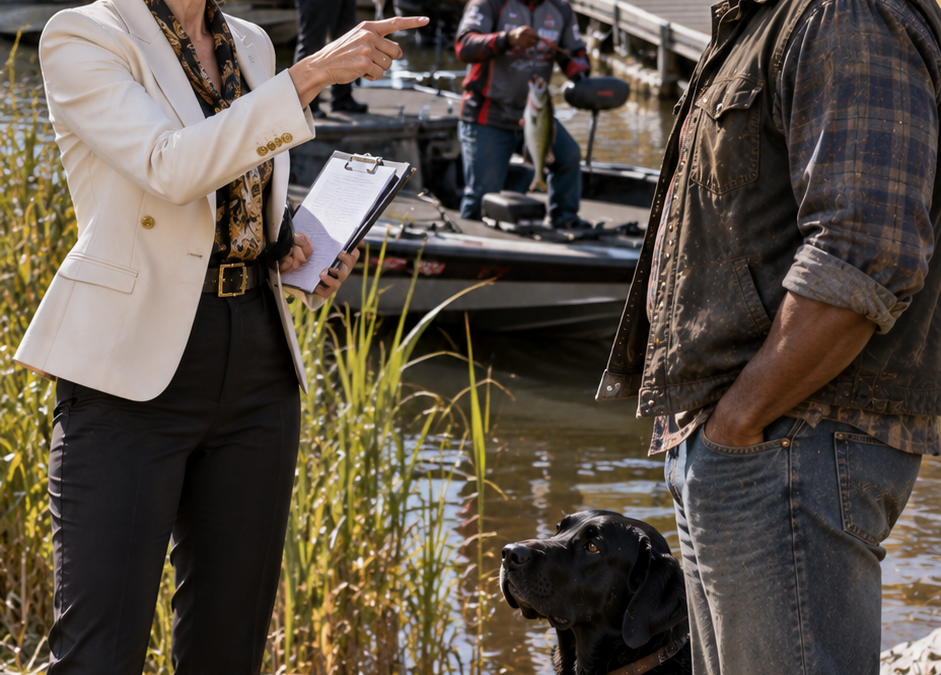
The president of Cedarwood Shores HOA stood beside my private pond and told me I had no authority to interfere with the fishing tournament her association had been running on my family’s land.
Behind her, a bass boat idled through cattails my grandfather had protected for decades, while trailers, tournament signs, and a concrete launch ramp sat on property nobody from the HOA had ever purchased, leased, or received permission to use.
I could have thrown everyone out that morning—but once I realized exactly how much the HOA had put in writing, I decided there was a far more effective way to answer them.
“You need to shut down whatever you’ve got going on out here.”
Diane Coulter said it without hesitation.
No introduction.
No question.
No indication that she was standing on land belonging to someone else.
“We’ve had complaints,” she continued, “and frankly, the Cedarwood Shores Fishing Classic is a sanctioned HOA event. You do not have the authority to interfere with it.”
She held a clipboard against one hip.
Her blazer was pressed sharply enough to look out of place beside the muddy bank of North Pond.
I was fifty-three years old that morning, and I had spent most of my life around men who worked timber, cattle, water, fences, and machinery.
You learn to recognize different kinds of confidence.
There is the confidence of someone who knows exactly what he is doing.
Then there is the confidence of someone who has never been forced to prove that he knows.
Diane’s belonged to the second kind.
I looked past her.
A bass boat was moving slowly through the shallows.
Two men wearing matching tournament shirts were standing near the stern, one steering while the other checked something inside a livewell.
Farther down the bank, volunteers had set folding tables beneath a green canopy.
A white trailer bearing the Cedarwood Shores logo sat near the launch ramp.
All of it was on my land.
The boat was on my water.
The ramp had been poured into my shoreline.
The road those trailers had used crossed my property.
Even the cattails brushing against the hull belonged to a pond that had been included in my family’s deed long before Cedarwood Shores existed.
I looked back at Diane.
“What exactly am I interfering with?”
Her expression tightened slightly.
“Community access.”
“Community access to what?”
“The ponds.”
“My ponds?”
She gave me the patient look people sometimes reserve for someone they believe is deliberately being difficult.
“The ponds have been used by Cedarwood Shores residents for years.”
That did not answer my question.
So I asked another.
“Who gave Cedarwood Shores permission?”
For the first time, she paused.
Not long.
Maybe two seconds.
But I noticed.
“The ponds are recognized community water access.”
“Recognized by whom?”
“The association.”
That almost made me smile.
Instead, I looked across North Pond.
The October morning was cold enough that the water had taken on the dull pewter color it always carried before winter.
My grandfather, Thomas Aldrich, used to call mornings like that keeping days.
Days worth remembering.
I had no idea yet how right he would have been about this one.
My name is Caleb Aldrich.
The 4,400 acres surrounding Diane Coulter that morning had been assembled by my grandfather between 1951 and 1974.
Thomas Aldrich was a timber contractor.
He was not wealthy.
He never inherited money.
He did not speculate in land because he expected subdivisions or shopping centers to arrive later.
He bought ground because he understood ground.
His first purchase was eight hundred acres.
He had saved for eleven years to afford it, working timber contracts across four states and sleeping in the cab of his truck more often than my grandmother ever liked to remember.
When neighboring acreage became available at a fair price, he bought that too.
Then another parcel.
Then another.
He acquired the land slowly enough that he knew exactly what each piece was worth before he signed anything.
By the time he died in 1987, the Aldrich tract covered 4,400 acres in rural East Tennessee.
It contained timber ridges, open pasture, creek bottoms, cedar scrub, old logging roads, and three spring-fed ponds.
North Pond.
Middle Pond.
And Aldrich Deep.
Aldrich Deep reached thirty-one feet at its deepest point and held largemouth bass big enough to surprise experienced fishermen.
Granddad never stocked those ponds for tourists.
They were part of the land.
He maintained them.
Protected them.
Fished them occasionally.
Mostly he left them alone.
When he died, the property passed to my father, Raymond Aldrich.
Granddad’s will contained one instruction written more plainly than anything else.
Do not subdivide it.
Dad did not.
He ran cattle across the eastern pasture.
He managed timber on the northern ridge through carefully rotated harvests.
He kept the ponds private.
When he died in 2009, the entire property came to me.
The deed was recorded in Harmon County on March 14 of that year.
I kept one certified copy in a fireproof box.
Another sat in the top drawer of my desk.
The county kept the one that mattered most.
That one was public record.
Cedarwood Shores had arrived five years before Dad died.
In 2004, Garfield Properties purchased roughly two hundred acres adjoining our western boundary from a neighboring farm.
The developer built 340 houses over three phases.
Cedarwood Shores had paved streets, landscaped entrances, community events, a clubhouse, newsletters, dues, committees, regulations, and eventually Diane Coulter.
What Cedarwood Shores did not have was ownership of the Aldrich tract.
Its land touched mine.
That was all.
No recorded easement connected them.
No access agreement.
No license.
No covenant.
No deed restriction.
No document signed by my grandfather.
Nothing signed by Dad.
Nothing signed by me.
Our western boundary had been surveyed in 1962 and surveyed again in 1991.
The iron pins were still there.
But somewhere between the construction of Cedarwood Shores and that October morning, someone had stopped treating that boundary as a boundary.
A steel gate had appeared in my fence.
A gravel lane had been cut through the cedar scrub.
A concrete boat ramp had been poured at North Pond.
Then the HOA apparently began using North Pond and Middle Pond for fishing events.
Not informal fishing.
Organized tournaments.
The Cedarwood Shores Fishing Classic.
Entry fees.
Prize money.
Registration.
Weigh-ins.
Volunteers.
Trailers.
The whole operation.
And nobody asked me.
The strangest part was that I might not have discovered it as soon as I did if Hershel Puit had not come to my kitchen one afternoon in early September.
Hershel ran cattle north of me.
He had lived in Harmon County for sixty years and seemed to know everything that happened within twenty miles of his fence before the people involved knew it themselves.
He walked into my kitchen carrying a folded sheet of paper.
“Thought you might want to see this.”
He laid it on the table.
It was a page printed from the Cedarwood Shores newsletter.
Across the top was a headline.
THIRD ANNUAL FISHING CLASSIC — NORTH AND MIDDLE PONDS — REGISTRATION NOW OPEN.
For several seconds, I thought I had misunderstood what I was looking at.
Then I unfolded the page completely.
There was a map.
North Pond and Middle Pond were both shown.
Beside them was a label:
HOA COMMUNITY WATER ACCESS.
I looked up.
“Hershel.”
“Yeah?”
“Have they been fishing my ponds?”
He scratched his jaw.
“I’ve seen trailers headed in there the last couple summers.”
“Through where?”
“Your west fence, far as I can tell.”
“You ever see a gate?”
“That’s why I brought this.”
I folded the newsletter along its existing crease.
“How long have you known?”
“That they were holding something? A while. That they were calling the ponds theirs? Today.”
I nodded.
“Thank you.”
He studied me.
“You going over there?”
“I’m going to look at my fence.”
The next morning I drove the western boundary.
I found the gate approximately where Hershel had described it.
Tubular steel.
Padlocked.
Installed in a gap cut through a cedar-post fence that had stood there longer than Cedarwood Shores.
I got out of the truck and stared at it.
Whoever had installed the gate had done a professional job.
Posts set square.
Hinges welded clean.
Gravel packed beneath the opening.
Someone had spent money.
Beyond it was a gravel path wide enough for a pickup towing a bass boat.
I followed the fence on foot until I could enter from my own side, then walked down the path.
The cedars opened near North Pond.
That was where I found the ramp.
Concrete.
Proper slope.
Wide enough to launch a fishing boat.
Near it stood a painted wooden sign.
CEDARWOOD SHORES COMMUNITY FISHING AREA
HOA MEMBERS ONLY
Green lettering.
White background.
Pressure-treated post.
Driven into my ground.
I did not tear it down.
I did not touch the gate.
I did not block the ramp.
I took out my phone.
Photograph of the gate.
Photograph of the hinges.
Photograph of the cut fence.
Photograph of the gravel road.
Photograph of the ramp.
Photograph of the sign.
Photograph of tire tracks.
Photograph of the corner pin.
Then another photograph showing the pin relative to the gate.
Dad had taught me that anger was useful for making you move.
It was terrible for making you think.
“If you might need to explain it later,” he used to say, “document it while it’s still boring.”
So I made it boring.
Then I called Warren Giles.
Warren was a Knoxville attorney who worked in land-use and property disputes.
A friend had hired him three years earlier during a boundary fight, and I remembered the way my friend described him.
He doesn’t get excited about things that are obvious.
I explained what I had found.
Warren asked two questions.
“You have your deed?”
“Yes.”
“Have you or anyone before you signed anything granting Cedarwood Shores access to those ponds?”
“No.”
“You sure?”
“I have every property file going back to my grandfather.”
“Good. Then don’t touch their gate.”
That surprised me.
“It’s on my property.”
“I know.”
“So why leave it?”
“Because right now it’s evidence.”
I understood immediately.
“Don’t remove the sign either,” he said. “Don’t block anybody. Don’t get into an argument with an HOA member. Let me pull the record first.”
Four days later, the HOA sent me its own evidence.
Certified mail.
The letter came from Diane Coulter.
President, Cedarwood Shores Homeowners Association.
It accused me of “unauthorized interference with community water access.”
It stated that the three ponds were subject to community-use provisions.
It warned me against restricting resident access.
What it did not include was more interesting.
No deed reference.
No easement number.
No plat notation.
No recorded agreement.
No statute.
No signed license.
Nothing identifying how Cedarwood Shores had supposedly acquired rights to my ponds.
The letter did not prove they had a right.
It merely repeated that they believed they had one.
I read it twice.
Then I placed it in a new folder.
CEDARWOOD SHORES — CORRESPONDENCE.
The second letter arrived ten days later.
This one was from an attorney at Merit & Associates in Chattanooga.
The language was more polished.
The problem was the same.
The HOA claimed community access to the ponds and demanded that I cease any effort to interfere with residents.
The letter specifically instructed me not to install locks, barriers, or private-property signs.
I had done none of those things.
I forwarded the letter to Warren.
He called that evening.
“Well,” he said, “this is good.”
“Getting threatened by somebody else’s lawyer is good?”
“They put their claim in writing.”
“That was my thought.”
“Now we make them prove it.”
The following morning, Warren requested a complete title review from the Harmon County Register of Deeds.
He wanted everything affecting the Aldrich tract.
Chain of title.
Western boundary.
Easements.
Licenses.
Restrictions.
Covenants.
Agreements involving Cedarwood Shores.
Agreements involving Garfield Properties.
Anything that could possibly give the HOA access.
It took eleven days.
Warren called when the search was complete.
“There isn’t one.”
“One what?”
“Anything.”
I leaned back in my chair.
“No easement?”
“No.”
“License?”
“No.”
“Recorded access agreement?”
“No.”
“Nothing from Dad?”
“Nothing.”
“Granddad?”
“Nothing.”
“Me?”
“You’d probably remember.”
I smiled.
“Probably.”
Warren’s voice became serious again.
“Caleb, the ponds are wholly within the Aldrich tract. So is the access road they constructed. So is the ramp. So is the sign. The title record shows no legal right of entry for Cedarwood Shores.”
I looked out my office window toward the distant ridge.
The HOA had not misunderstood some complicated shared easement.
They had no easement.
They had simply been using my land.
“How long do you want me to think about this?”
“A day.”
“Why?”
“Because you’re angry.”
“I’m not that angry.”
“You’re quiet. That’s usually worse.”
He knew me better than I thought.
So I waited.
The next day, I called him.
“Proceed.”
A county plat arrived soon afterward in a large envelope.
I spread it across the kitchen table.
That same table had held Hershel’s newsletter.
The Aldrich boundary appeared in solid lines.
Cedarwood Shores was separately platted to the west.
I traced the boundary clockwise.
The gate the HOA installed was approximately 340 feet south of the northwest corner pin.
Their road crossed directly through my boundary.
Their boat ramp terminated entirely inside the Aldrich tract.
Nothing overlapped.
Nothing was unclear.
Land records are not emotional documents.
That is one reason I trust them.
A survey line does not become offended when someone ignores it.
It simply remains where it is.
By then, I had also learned more about the tournament.
The HOA had advertised it for three years.
Registration lists had been published.
Entry fees were collected.
Sponsors were thanked.
Prize amounts were announced.
Photographs of contestants holding bass at North Pond appeared in newsletters.
There were weigh-in results.
Volunteer schedules.
Every year, Cedarwood Shores had documented its own commercial use of my property.
Warren reviewed the records.
Then he called.
“You know what’s interesting?”
“What?”
“They made money.”
“How much?”
“Fourteen thousand two hundred dollars in tournament entry revenue across the three events, based on their published numbers.”
I was quiet.
The number itself was not enormous.
That was not the point.
The point was that Cedarwood Shores had taken private property it did not own, branded it as a community amenity, charged people to use it, and then sent me a cease-and-desist letter when I noticed.
That was a different category of problem.
Warren filed suit in Harmon County Circuit Court on a Monday in November.
The complaint sought three things.
First, quiet title—a judicial determination confirming my ownership and eliminating any claim the HOA might assert.
Second, relief for trespass.
Third, an injunction preventing Cedarwood Shores from entering or using the property without permission.
Attached were my deed, the county plat, the title-search results, the HOA letters, the Merit & Associates letter, photographs of the gate and improvements, and the tournament records showing $14,200 in collected entry fees.
Twenty-one days later, the HOA responded.
Their position had changed.
They no longer relied entirely on vague “community water access.”
Now they argued that Cedarwood Shores residents had used the ponds openly and continuously for approximately three years and that this history created a basis for access rights.
Warren read the response.
Then he called me.
“They’re trying to turn trespass into adverse use.”
“Can they?”
“Not after three fishing seasons.”
He explained that Tennessee law required a far longer period and substantially more than occasional tournament use to establish the kind of property right they were trying to suggest.
Three years did not come close.
He filed the response.
The court scheduled the hearing for the second week of February.
Winter settled over the ponds while we waited.
North Pond iced along the edges.
Middle Pond became nearly invisible through bare timber.
Aldrich Deep stayed dark in the center even on the coldest mornings.
I walked the western line more often than usual.
The HOA gate remained.
So did the sign.
Warren had told me to leave everything untouched pending the case.
Every time I saw that green-and-white sign, I felt the same irritation.
CEDARWOOD SHORES COMMUNITY FISHING AREA.
It was remarkable how easily three painted words could attempt to erase four generations of ownership.
But I kept my hands off it.
February came.
I drove to the Harmon County Courthouse in my usual truck.
No suit.
No performance.
Clean jeans.
Work boots.
The same winter coat I used while checking fences.
Warren was already in the courtroom with a banker’s box of documents.
Across the aisle sat Diane Coulter.
She wore a dark green blazer.
The attorney from Merit & Associates sat beside her.
Diane looked toward me once.
I nodded.
She did not return it.
Judge Patricia Stowe entered.
She had served fourteen years on the Harmon County bench.
She sat down, reviewed several pages, and then looked directly at the HOA’s attorney.
“Counsel, before we get into the equitable arguments, I want to clarify something.”
“Yes, Your Honor.”
“Can you identify any recorded instrument granting Cedarwood Shores Homeowners Association access to the Aldrich property?”
Silence.
It lasted perhaps three seconds.
In a courtroom, three seconds can feel long.
The attorney stood.
“No recorded instrument, Your Honor, but—”
Judge Stowe raised one hand slightly.
“So the answer is no?”
“Yes, Your Honor.”
I watched Diane’s shoulders stiffen.
The attorney continued.
He argued that the HOA had believed in good faith that the ponds were available as community amenities.
He pointed to three years of uninterrupted access.
He argued reliance.
Investment.
Community expectation.
The expense of building the road and ramp.
Judge Stowe listened.
Then she asked:
“Who authorized those improvements?”
The attorney glanced down.
“The association board.”
“I understand who voted. I’m asking who authorized the association to build on Mr. Aldrich’s property.”
Another pause.
“There was no express written authorization.”
That sentence mattered.
Not because it told us anything new.
Because now it was in the court record.
Warren stood when his turn came.
He began with the deed.
“Caleb Aldrich holds title to approximately 4,400 acres described in this recorded instrument transferred to him in 2009.”
He submitted the certified copy.
Next came the plat.
“This is the western boundary.”
He traced it for the court.
“This is Cedarwood Shores.”
Then he indicated the gate.
“The association cut through Mr. Aldrich’s fence here.”
The gravel lane.
“They constructed this access route.”
The boat ramp.
“They poured this improvement on the bank of North Pond.”
The sign.
“They labeled the property as an HOA community fishing area.”
Then the title report.
“There is no easement.”
No flourish.
“No license.”
He turned another page.
“No covenant.”
Another.
“No access agreement.”
Then the tournament records.
“For three consecutive years, the association collected registration fees for fishing tournaments held on property it did not own and had no recorded right to enter.”
The total appeared on the summary.
$14,200.
The HOA attorney objected to Warren’s characterization of the revenue as damages.
Judge Stowe allowed him to continue.
Warren then addressed the claim based on continuous use.
Three years of recreational entry, he argued, could not suddenly transform unauthorized fishing into ownership or an easement.
Open use was not enough.
Repeated trespass did not automatically create a property right merely because nobody caught it immediately.
He finished in twenty-two minutes.
Then he sat beside me.
I leaned slightly toward him.
“That’s it?”
“That’s it.”
Judge Stowe looked through the documents.
I expected her to take the case under advisement.
She did not.
She ruled from the bench.
“The deed and survey evidence establish the plaintiff’s title to the disputed property.”
My hands remained flat on the table.
“The defendant has produced no recorded easement, license, covenant, or other instrument granting Cedarwood Shores Homeowners Association access to the Aldrich tract or its ponds.”
Diane did not move.
“The association’s gate, gravel access, boat ramp, signage, and tournament operations were placed or conducted upon private property without authorization from the owner.”
Judge Stowe turned a page.
“Judgment on the quiet-title claim is entered in favor of the plaintiff.”
That was the moment that mattered most.
Everything else followed.
The HOA was ordered to remove its gate, sign, tournament structures, and boat-access improvements within sixty days at its own expense.
It was prohibited from representing North Pond, Middle Pond, or Aldrich Deep as community amenities.
It was prohibited from entering the Aldrich tract without permission.
Then Judge Stowe addressed damages.
After receiving written notice disputing its authority, Cedarwood Shores had continued asserting access rights despite having no recorded basis for them.
The court awarded $14,200.
The amount corresponding to tournament revenue generated through unauthorized use of the property.
Court costs followed.
I heard Warren exhale beside me.
Across the aisle, Diane remained completely still.
The expression she had worn the morning she told me I lacked authority over my own ponds had disappeared.
There was no dramatic breakdown.
No shouting.
No apology.
Just stillness.
Sometimes that is what losing certainty looks like.
The Merit attorney closed his binder.
Diane looked down at the table.
I looked at Warren.
He whispered, “Now you can touch the gate.”
For the first time that morning, I laughed.
Three weeks after the ruling, Cedarwood Shores held a special board meeting.
I did not attend.
Hershel somehow learned the details before I did.
He drove over the following afternoon.
“Four to one.”
I was replacing a hydraulic hose on a tractor.
“What’s four to one?”
“The vote.”
“What vote?”
“To remove Diane Coulter as president.”
I stopped working.
“Seriously?”
He nodded.
“What reason?”
“Failure to verify the legal foundation of HOA property claims before committing association money.”
That sounded exactly like HOA language.
“Anything else?”
“Oh, you’re going to like this part.”
“I doubt that.”
“Merit’s legal bill was twenty-three thousand four hundred.”
I stared at him.
He continued.
“With damages and court costs, they’re saying the whole mess cost the reserve fund about forty thousand two hundred.”
I leaned against the tractor.
Forty thousand two hundred dollars.
All because nobody had checked who owned the ponds before someone cut a gate into my fence.
“That’s expensive fishing,” Hershel said.
I shook my head.
“It didn’t need to cost anything.”
That was what bothered me most.
Cedarwood Shores could have asked.
Years earlier, someone from the HOA could have knocked on Dad’s door.
Later, they could have called me.
Could residents fish occasionally?
Could we arrange access?
Could the HOA lease limited fishing rights?
Could we discuss a tournament?
Maybe I would have said no.
Maybe I would have said yes under conditions.
But asking would have acknowledged the one fact the entire dispute was built around.
The ponds belonged to somebody.
Instead, the HOA behaved as though voting made ownership unnecessary.
The gate came down during the fourth week after the ruling.
A crew of three men arrived with a flatbed truck.
I stood far enough away not to interfere.
They unbolted the steel gate.
Cut the hardware.
Pulled the posts.
Loaded everything onto the trailer.
Then they removed the green-and-white sign from North Pond.
The words HOA MEMBERS ONLY disappeared into the back of the truck.
The weigh-in station went next.
The ramp was last.
That took most of the day.
A jackhammer broke the concrete into pieces.
Chunks were lifted into a trailer and hauled away.
The sound echoed across the water.
I hated the noise.
But I liked what it meant.
By late afternoon, only disturbed gravel and bare soil remained.
The following weekend, I repaired the fence.
I had several pieces of old-growth cedar stored in the barn.
I had saved them for years because cedar like that is too good to waste.
I cut two posts.
Set them plumb.
Tamped the soil.
Installed three boards.
The work took most of Saturday.
I did not hurry.
Dad had taught me how to set fence.
Dad learned from Thomas.
That simple chain of knowledge mattered more to me that afternoon than the court order folded inside my office.
When the last board was fastened, I stepped back.
The western fence line was whole again.
No gate.
No HOA road.
No community-access sign.
Just cedar.
Pasture.
Timber.
Water.
A pair of mallards moved across North Pond in the late afternoon.
They had no idea a homeowners association had lost forty thousand dollars arguing about who owned the water beneath them.
I envied them.
People sometimes expect a legal victory to feel like triumph.
Mine did not.
I did not want Diane humiliated.
I did not care who held office at Cedarwood Shores.
I did not want 340 households paying more dues because their board had made an expensive mistake.
I wanted one thing.
My boundary respected.
What I felt when the fence was repaired was not victory.
It was completion.
Like fixing a broken water line.
Or replacing a damaged gate.
Something had been wrong.
Now it was right.
A few evenings later, I drove down to North Pond by myself.
The weather looked almost exactly like the morning Diane confronted me there.
Gray sky.
Cold air.
Pewter water.
I stood near the shoreline where the HOA sign had been.
You could still see the disturbed patch of earth where its post had stood.
Farther away, scars from the removed ramp marked the bank.
Those would disappear eventually.
Rain would soften them.
Grass would return.
Cattails would reclaim part of the shoreline.
The land is better at forgetting human arrogance than humans are.
I thought about Granddad.
Thomas Aldrich never trusted shortcuts.
That was true in timber.
True in buying land.
True in maintaining equipment.
And especially true in paperwork.
Every time he bought a parcel, he checked the legal description.
Every time a boundary was surveyed, he saved the record.
He knew where the pins were.
Dad did the same.
I used to think that habit was excessive.
Three copies of a deed.
Old plats.
Survey notes.
Maps.
Receipts from things that had happened before I was born.
Then Cedarwood Shores labeled my ponds as community property.
Suddenly every old piece of paper had a voice.
People sometimes talk about deeds as though they are symbolic.
To me, they are almost the opposite.
A deed is useful because it does not depend on symbolism.
It names.
Describes.
Records.
Connects ownership to a specific piece of earth.
It is not impressed by blazers.
It does not care about newsletters.
It does not change because a board votes unanimously.
A community map does not move a boundary.
A tournament flyer does not create an easement.
A concrete ramp does not establish ownership simply because somebody spent money pouring it.
And using another person’s land for three years does not make it yours because you eventually became accustomed to doing so.
That was what Cedarwood Shores learned.
They had mistaken repetition for permission.
Then they mistook confidence for authority.
Finally, they mistook money already spent for a legal right to continue.
The court corrected all three.
My title remained what it had been.
4,400 acres.
Three ponds.
One western boundary adjoining Cedarwood Shores.
Nothing more complicated than that.
I kept every document from the case.
Diane’s first letter.
The Merit letter.
The title search.
The plat.
The tournament newsletter Hershel brought me.
Photographs of the gate.
The green-and-white sign.
Registration records.
The $14,200 revenue calculation.
The complaint.
The judgment.
They all went into one thick folder.
I wrote the label myself.
CEDARWOOD SHORES — POND ACCESS DISPUTE.
Then I placed it beside the other property records in my office.
Not because I expected another fight.
Because Thomas Aldrich taught our family that good records are most useful before you know why you are going to need them.
Spring came late that year.
By April, bass were moving into the shallows.
I walked North Pond one morning and saw three of them suspended beneath the surface near a fallen oak limb.
No tournament boats.
No trailers.
No weigh-in station.
No engines.
Just water.
I stood there longer than necessary.
There had been a time when I might have thought privacy meant nobody else being present.
I understood it differently now.
Privacy was not silence.
It was choice.
The right to decide who entered.
The right to decide what happened on your property.
The right to say yes.
And therefore, necessarily, the right to say no.
Cedarwood Shores had tried to remove that choice by pretending it had already been made.
That was why I had gone to court.
Not because I hated fishing tournaments.
I fish.
Granddad fished.
Dad fished.
The largest bass I ever caught came out of Aldrich Deep when I was seventeen.
The problem was never fishing.
The problem was ownership without consent.
Had Cedarwood Shores approached me honestly, the entire story might have been different.
Instead, Diane came to my pond and told me I had no authority to interfere.
I still think about that sentence.
Of everything she said, it was the part that revealed the most.
She did not tell me she believed the HOA had access.
She told me I lacked authority.
On my land.
That is what unchecked assumptions eventually become.
First someone believes they are allowed.
Then they behave as though they are allowed.
Then, after enough time passes, they begin believing you are the intruder for questioning them.
Fortunately, land records do not develop habits.
The iron pins along my western boundary had remained exactly where the surveyors placed them.
The county deed had remained exactly where it had been filed.
The legal description remained unchanged while houses rose next door, boards were elected, newsletters were published, and tournament boats crossed my water.
The documents had waited.
Then, when someone finally asked who owned what, they answered.
I walked toward the cedar fence.
The new boards had already begun fading toward the gray of the older ones.
In a few years, you would barely be able to tell where the HOA gate had been.
I put my hand on the top board.
Beyond it, somewhere through the timber, Cedarwood Shores residents were beginning their morning.
They were still my neighbors.
Nothing about the lawsuit changed that.
Their homes were theirs.
Their streets were theirs.
Their clubhouse was theirs.
Their HOA could regulate whatever its governing documents lawfully allowed it to regulate.
But North Pond was not theirs.
Middle Pond was not theirs.
Aldrich Deep was not theirs.
The gravel beneath my boots was not theirs.
The cedars were not theirs.
The fence was not theirs.
And after the court ruling, there was no longer room for anyone to pretend otherwise.
I reached the pond just as the sun came over the ridge.
Mist hovered over the water.
A bass broke the surface once near the reeds and disappeared again.
The circles spread outward.
Then the pond became still.
Granddad would have liked that morning.
He would have called it a keeping day.
This time, I understood exactly what he meant.
Some things are worth keeping because they are beautiful.
Some because they were given to you by people who trusted you to protect them.
And some because the moment you stop knowing where your boundary lies, there will always be someone willing to decide it for you.
Thomas Aldrich had spent twenty-three years assembling this land.
Raymond Aldrich had honored his father’s instruction not to divide it.
Then it came to me.
All 4,400 acres.
All three ponds.
Every cedar ridge.
Every fence line.
Every spring.
I had inherited more than property.
I had inherited responsibility.
And the morning Diane Coulter told me I had no authority beside my own pond, that responsibility became very simple.
Know what is yours.
Know what the record says.
And when someone crosses the line, make sure the line is still there when they are gone.








