𝗙𝗨𝗟𝗟 𝗦𝗧𝗢𝗥𝗬 The HOA Tried to Seize My $3 Million Private Island—Then I Put My Sheriff’s Badge Beside the Deed
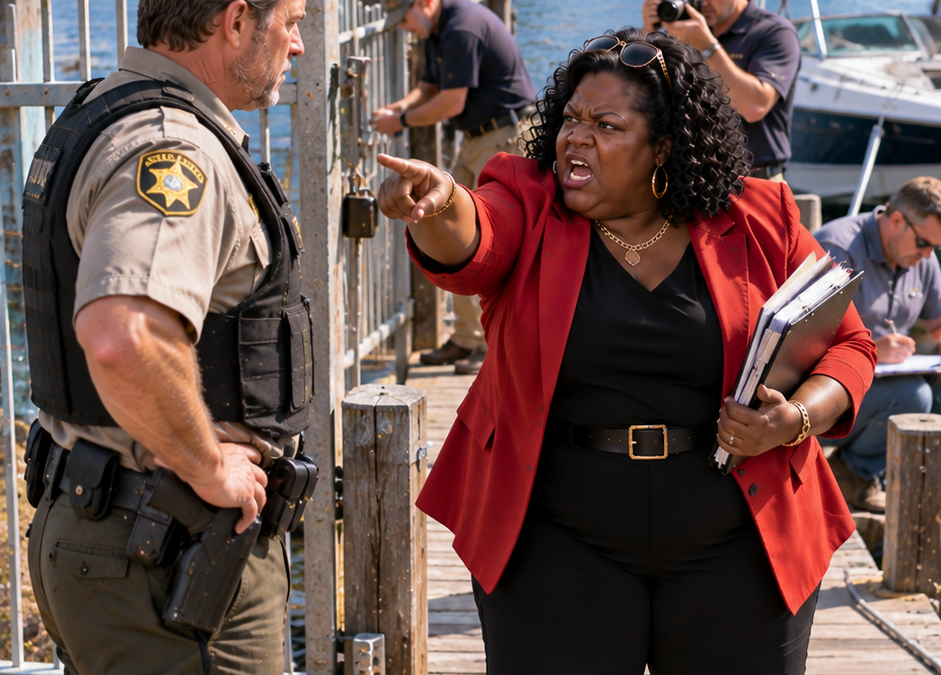
PART2
Lakehaven Ridge had been built around a man-made lake roughly fifteen years earlier.
Ninety-six houses.
Walking path.
Clubhouse.
Small marina.
Landscaped entrance.
The usual suburban promise:
Peace.
Standards.
Property values.
Community.
For the first several years, the HOA behaved like most associations.
Trash schedules.
Fence colors.
Pool maintenance.
Noise complaints.
Boring.
Boring is good when it comes to governance.
Then Karen Norbury became president.
The previous president, Tom Bennett, resigned after a fight over fence stain.
I wish I were exaggerating.
He had used a brown stain slightly darker than the approved sample.
Karen photographed it.
Measured color values from the manufacturer’s chart.
Filed a formal complaint against him while sitting on the same board.
Tom eventually put his board badge on the table during a meeting and left.
When nominations opened, one homeowner announced he would challenge Karen.
A week later, he received $3,200 in landscaping fines.
His crime was a decorative river-rock border along his driveway.
He withdrew.
Karen ran unopposed.
That was six years before she stood on my dock.
After she took over, Lakehaven slowly became a neighborhood where people watched their mailboxes.
A retired couple on Birchwood Lane installed a wheelchair ramp after the wife underwent her second hip surgery.
They filed the application.
The board delayed voting eleven months.
Then denied it.
Retroactively.
Karen’s board assessed fines covering nearly the entire period the application sat unresolved.
Twelve thousand dollars.
The couple paid.
Not because they believed Karen was right.
Because attorneys cost money.
And they were in their seventies.
Another family had a car towed from their driveway.
Not street.
Driveway.
Karen said the vehicle sat six inches outside an “approved parking alignment.”
No painted line existed.
The line existed in Karen’s notebook.
Tow cost:
$890.
They paid.
Then there was Margaret Ellis.
Retired schoolteacher.
Twelve years in Lakehaven.
No prior enforcement history.
Karen’s board accused her of repeated landscaping deficiencies.
Margaret challenged the notices.
The association attorney sent her a letter threatening something called “administrative receivership.”
The board claimed it could take over maintenance control of her property and bill her for the work.
The power did not exist in the form they described.
But Margaret did not know that.
She sold within four months.
She was the woman I had seen walking her dog while Karen left my dock.
I understood her expression now.
She had watched my story begin the same way hers ended.
Only Karen had chosen a different homeowner this time.
I bought Parcel 7A eight years earlier.
The island existed long before Lakehaven Ridge.
That detail mattered.
Lot 7A had its own parcel number.
Separate deed.
Separate tax account.
I paid the county directly.
Every year.
The HOA had never billed me.
Never sent dues.
Never mailed a voting packet for the island.
Never included it in association tax disclosures.
Never insured it.
Never maintained it.
Never repaired the dock.
Never trimmed a tree.
For eight years, everybody treated the island as what the records said it was.
Private property.
Until Karen apparently decided otherwise.
Her legal theory rested on Section Fourteen.
The declaration referred to certain “contiguous properties located within the development boundary.”
Karen decided the island was contiguous because it sat in the lake bordered by Lakehaven Ridge.
That was the problem with reading property language conversationally.
“Near” is not a legal description.
“Adjacent” can mean something specific.
“Contiguous” means something more specific.
And most importantly:
The declaration had exhibits.
Boundary exhibits.
People like Karen loved the paragraph.
People in my profession learned to read the attachments.
I drove home after the dock incident without calling anybody.
Not my undersheriff.
Not county counsel.
Not the prosecutor.
I was personally involved.
That mattered.
If this became criminal, I would have nothing to do with the investigation.
No deputy under my command was going to become my private muscle in a property dispute.
I would hand it outside if necessary.
But first, I wanted to know exactly what Karen believed she had.
Eleven days later, certified mail arrived.
NOTICE OF ASSESSMENT LIEN.
PARCEL 7A.
Eight years of assessments:
$47,000.
Administrative processing:
$4,200.
Total:
$51,200.
Thirty days to pay.
Then lien.
Ninety days after lien filing:
Foreclosure proceedings.
I stood at my kitchen counter reading the letter twice.
Karen had put a dollar amount on my island.
Then scheduled a path to take it.
I photographed every page.
Kept the envelope.
Logged the delivery.
Then called the HOA secretary.
“I want speaking time at the next meeting.”
There was a pause.
“Regarding what?”
“Parcel 7A.”
Another pause.
“I’ll need to check with President Norbury.”
“That’s fine.”
She put me on hold twice.
Eventually:
“Three minutes.”
“I’ll take them.”
The clubhouse meeting room was nearly full.
Thirty homeowners.
Seven directors.
Karen centered behind the table.
HOA attorney on her left.
Legal pad.
Expensive pen.
Expression carefully neutral.
Karen summarized the case before allowing me to speak.
Parcel 7A was contiguous.
The declaration applied.
Eight years of dues remained unpaid.
Board counsel had confirmed the legal interpretation.
“Sound,” Karen called it.
Three directors nodded.
Two stared at the table.
One watched me.
Then Karen said:
“Mr. Mercer, three minutes.”
I walked forward.
No notes.
No folder.
I asked one question.
“Has association counsel reviewed the original certified plat for Lot 7A and Exhibit C attached to the recorded declaration?”
The attorney looked up.
Karen answered for him.
“Our counsel has reviewed all relevant documents.”
“That includes the original plat?”
“Yes.”
“And Exhibit C?”
“I said all relevant documents.”
I looked at the attorney.
He did not answer.
“I’d like a copy of the legal opinion supporting your assessment.”
Karen slid one across the table.
Prepared.
Waiting.
I picked it up.
“Thank you.”
Then sat down.
That was it.
Karen looked almost irritated.
She had expected a speech.
People like Karen prefer emotional opponents.
Anger is easy to dismiss.
Specific questions are harder.
I read the attorney’s letter at home.
It cited the contiguous-property clause.
Then a court case.
I recognized the case name.
That was interesting.
The precedent had been overturned eighteen months earlier.
I knew because a related matter had appeared in county litigation during my term.
The appellate decision had changed how that particular provision could be relied upon.
Apparently, the HOA attorney’s research file had not caught up.
Now I had two questions.
Did he fail to review Exhibit C?
And did he know his main precedent was dead?
I called the county recorder.
Requested certified copies of:
Original plat for Parcel 7A.
Full Lakehaven declaration.
Every attached exhibit.
Then Margaret caught me outside after the meeting.
She held a manila folder against her chest.
“She did this to four families.”
“Did what?”
“Not islands.”
Her voice was quiet.
“Threats. Liens. Things she didn’t have authority to do.”
“Do you have records?”
Margaret nodded.
“A box.”
“Keep everything.”
“I already did.”
“Can I see it?”
She studied me.
“Why?”
“Because if there’s a pattern, one set of papers is a complaint.”
I looked toward the front of the room where Karen was laughing with two directors.
“Several sets become something else.”
The next afternoon, Margaret opened her front door before I knocked.
Cardboard box on the hall table.
“I kept everything.”
First words out of her mouth.
Four years of notices.
Attorney letters.
Emails.
Board warnings.
One email described Margaret as being placed under “enhanced compliance monitoring.”
That phrase appeared nowhere in the bylaws.
Then she showed me a voice memo.
Karen.
Recorded after a board meeting.
“If you contest this ruling, I will make your life in this neighborhood impossible.”
Pause.
“I’ve done it before. Ask around.”
Margaret looked ashamed.
“I should have fought.”
“No.”
She looked at me.
“You kept it.”
“So?”
“That matters.”
She gave me permission to copy everything.
Word spread.
A young couple came to my house.
Tow receipt.
$890.
Letter warning that contesting the tow might trigger a full property compliance audit.
An elderly man came next.
Seventy-one.
Owned his home twenty-two years.
He placed one paper on my kitchen table.
Settlement agreement.
$8,500.
Waiver of appeal rights.
In exchange, HOA agreed not to proceed toward foreclosure.
“What started this?”
“Vegetable garden.”
I looked up.
“Sorry?”
“Tomatoes.”
Original fine:
$640.
He had grown a small garden near his rear fence.
Karen escalated.
Eight thousand five hundred dollars later, he bought peace.
“I couldn’t risk my house over tomatoes.”
He said it flatly.
No self-pity.
That made it worse.
I copied the settlement.
Told him to keep the original.
Friday morning, the certified plat arrived.
I cleared the kitchen table.
Spread everything out.
Parcel 7A recorded:
March 14, 1987.
Lakehaven Ridge declaration recorded:
October 3, 1993.
Six years later.
I traced the parcel entry.
At the bottom:
SEE EXHIBIT C—OUTER BOUNDARY DELINEATION.
I opened Exhibit C.
Old hand-drawn map.
Lake.
Development footprint.
Boundary line.
Solid.
Clear.
Running along the eastern shoreline.
Parcel 7A sat west of the line.
Outside.
Not near the line.
Not arguably intersecting.
Outside.
I searched every amendment filed since 1993.
No later instrument ever attached the island to the HOA.
Not once.
Karen’s theory collapsed on one page.
The island had existed as a standalone county parcel six years before Lakehaven Ridge existed.
The HOA declaration specifically drew a boundary excluding it.
No subsequent covenant annexed it.
The island had never been subject to Lakehaven authority.
Not for one day.
Then I checked the meeting minutes from the seizure vote.
Four directors present.
Seven seats total.
State law and the governing documents required five members for extraordinary enforcement action.
Lien initiation.
Possession action.
Property seizure.
Four people had voted.
The action was void before Karen ever reached my dock.
I sat back.
No anger.
Just organization.
Plat.
Exhibit.
Dates.
Attendance.
Statute.
Legal opinion.
Overturned precedent.
Margaret’s recording.
Settlement.
Tow receipt.
All labeled.
Then Karen heard I was talking to neighbors.
I still don’t know who told her.
The next thing she did was file the lien.
Thursday afternoon.
By Friday morning, the county index showed:
LAKEHAVEN RIDGE HOA.
CLAIM OF LIEN.
PARCEL 7A.
$51,200.
That mattered.
A lien contaminates title.
Anyone searching the property would see it.
Sale?
Stopped.
Refinance?
Problem.
Transfer?
Problem.
Karen understood pressure.
This was not about $51,200.
It was about putting a loaded piece of paper into the island’s public identity.
My personal attorney called within an hour.
Not county counsel.
My own attorney.
She had been monitoring the filing.
“It’s there.”
“I saw.”
“Ready to challenge it?”
“Not yet.”
Silence.
“You want them to keep moving?”
“For a little longer.”
She knew me well enough not to argue.
Two days later, a television reporter called.
Local station.
She said she was preparing a story about a “longtime delinquent homeowner refusing to pay eight years of fair HOA assessments on a luxury private island.”
Karen had gone public.
The reporter asked for comment.
“Have you reviewed the 1987 plat?”
“No.”
“Exhibit C?”
“No.”
“The HOA declaration?”
“We have portions.”
“You should read the complete filing before you broadcast.”
“Are you denying the assessments?”
“I’m telling you to check the documents.”
She sounded less confident when we hung up.
I logged the call.
Reporter.
Time.
Date.
Exact wording she attributed to Karen:
“Longtime HOA delinquent refuses to pay fair community assessments while ordinary homeowners carry the load.”
Useful.
Not because I planned a defamation case.
Because Karen was now confident enough to commit her interpretation publicly.
Confidence makes people careless.
Saturday morning, I went to the dock.
New lock.
Not mine.
Heavy combination padlock.
White sticker:
HOA ADMINISTRATION
AUTHORIZED ACCESS ONLY.
My original padlock sat on the dock boards.
Again.
For a few seconds, I simply stood there.
Then I photographed everything.
Front.
Back.
Shackle.
Sticker.
Gate.
My lock.
Hinge.
Dock.
I did not cut it.
Did not touch it.
Did not kick the gate.
Then I noticed somebody at the far end of the dock.
Board member.
HOA lanyard.
Name badge visible.
Watching me.
I took two photographs.
He walked away.
That was the moment the dispute changed categories.
A lien—even a defective one—is paper.
A lawsuit is paper.
A notice is paper.
Putting a lock on somebody else’s gate without a court order is physical occupation.
Whatever Karen imagined the lien gave her, it did not give possession.
I returned to my truck.
Sent the photographs to my attorney.
Then made a call.
Not to anyone in my own chain of command.
To the state investigative liaison who handled conflicts involving county officials.
I identified myself as the complainant.
Not sheriff.
Property owner.
I explained that because I was personally involved, I wanted any criminal review handled outside my office.
That mattered to me.
I had spent my career telling deputies that power is easiest to abuse when you convince yourself your reason is special.
My reason was not special.
My property rights were the same as Margaret’s.
The same as the man with the tomato garden.
The same as the young family whose car had been towed.
I was not going to use a badge as a shortcut.
If Karen had committed trespass, somebody neutral could decide.
Monday, Lakehaven residents received another notice.
MANDATORY EMERGENCY SESSION.
“Mandatory” had no legal meaning for homeowner attendance.
Karen had used the word for years.
People believed it.
The meeting packed the clubhouse.
Karen had a projector.
Handouts.
A professionally designed trifold brochure.
On the front:
Parcel 7A outlined in orange.
CURRENTLY DELINQUENT.
Inside:
Eight-year assessment history.
$47,000 bold.
On the back:
A rendering.
My island.
Transformed.
Community dock.
Kayak launch.
Picnic pavilion.
Small amphitheater.
Walking path.
Someone had paid for the design.
That bothered me.
Not because it was good.
Because it showed Karen had been planning beyond collection.
This was not simply “pay your dues.”
She had already imagined what Lakehaven would do after taking the island.
Karen opened at seven.
“Transparency.”
“Community stewardship.”
“Fairness.”
She held up the attorney opinion.
Told ninety-six households the island would eventually be returned to community use.
Returned.
As if it had once belonged to them.
People in the front rows nodded.
Someone asked about the kayak launch.
Another asked whether dogs would be permitted.
I watched.
Margaret raised her hand.
Karen acknowledged her reluctantly.
“I want to speak about prior enforcement conduct by this board.”
Karen smiled.
“This meeting concerns Parcel 7A.”
“It concerns how this board uses enforcement authority.”
“If you have a complaint, there’s a process.”
“I used it four years ago.”
Karen’s smile hardened.
“We’re not reopening unrelated matters tonight.”
Margaret sat.
That old silence returned.
People remembering what happened when they challenged Karen.
Then I raised my hand.
Karen looked at me.
“You have a question?”
“Yes.”
I stayed seated.
“Did your attorney verify Parcel 7A’s recording date?”
A pause.
“Our attorney has reviewed all relevant records.”
“So yes?”
“This matter is settled.”
“Then you won’t mind if the county assessor and sheriff’s department review the supporting documents.”
The room changed.
Karen laughed.
Good laugh.
Easy.
Dismissive.
She turned toward the audience.
“The sheriff?”
A few people smiled.
Karen continued.
“He’s going to call the sheriff over an HOA property dispute.”
Then:
“That’s adorable.”
Some laughter from the front.
I nodded.
Said nothing.
Karen thanked the audience.
Said she expected the island to open as a community amenity within the year.
Meeting adjourned.
Outside, the island was a dark shape across the water.
Karen had used “the sheriff” as a punchline.
I let her.
The next meeting took place several days later.
By then, word had spread that the lien was being challenged.
People came carrying folders.
That interested me.
Fear isolates.
Paper brings people together when they realize theirs isn’t the only copy.
I arrived forty minutes early.
The room was empty.
I placed a manila folder in front of my seat.
Waited.
Karen arrived five minutes before seven.
Attorney beside her.
She barely looked at me.
The clubhouse filled.
Margaret.
Young couple.
Tomato-garden owner.
Others.
Folders everywhere.
Karen opened.
Her attorney began.
Contiguous-property clause.
Association authority.
Lien enforcement.
Next stage.
He spoke ten minutes.
Then stopped.
I opened my folder.
Placed my sheriff’s identification and badge on the table.
Not raised.
Not flashed.
Not pointed at anybody.
Just placed.
The attorney looked at it.
Then me.
Then back at it.
Two directors exchanged glances.
Karen stared.
I spoke first.
“I want to be clear.”
The room quieted.
“I am not here in an official law-enforcement capacity.”
I pointed toward the badge.
“I am here as Daniel Mercer, owner of Parcel 7A.”
Nobody moved.
“But at the last meeting, President Norbury said she would welcome the sheriff’s department reviewing the documents.”
A few heads turned toward Karen.
“I thought I could at least save everyone the trip.”
Nobody laughed.
I moved the badge aside.
Important.
Then I placed the certified plat in the center.
“This matters more.”
I turned it toward the board.
“Parcel 7A.”
I pointed at the stamp.
“Recorded March 14, 1987.”
Then the declaration.
“Lakehaven Ridge HOA created October 3, 1993.”
I let the dates sit.
“Six years later.”
The attorney leaned closer.
I opened Exhibit C.
“This is not my map.”
I looked around the room.
“This is the HOA’s recorded boundary exhibit.”
Solid line.
Development perimeter.
Island outside it.
“That line is the covenant boundary.”
Karen spoke.
“The declaration contains a contiguous-properties clause.”
“Yes.”
“And the island is contiguous.”
“No.”
I kept my voice level.
“The specific legal exhibit controls the boundary description. Parcel 7A is outside it.”
Her attorney was already reading.
I continued.
“No amendment after 1993 ever annexed Parcel 7A.”
I placed a certified search statement beside the plat.
“This confirms no later covenant attachment exists.”
Karen shook her head.
“Our counsel said—”
Her attorney raised one hand slightly.
Not toward me.
Toward her.
“Let him finish.”
That was new.
I slid the lien vote minutes forward.
“Four directors present.”
Karen’s jaw tightened.
“Extraordinary enforcement required five.”
A board member picked up the minutes.
Read.
Then looked at Karen.
“The vote was void.”
The attorney closed his eyes briefly.
Then I put down the state statutory section governing enforcement and possession.
“A lien claim does not grant physical possession.”
I pointed toward the photographs.
“This is the lock placed on my gate.”
Then the board member’s image.
“This is one of the people present.”
Karen’s face changed.
Slightly.
I continued.
“The criminal component has been referred outside my department because I’m personally involved.”
That mattered.
I wanted every person in the room to understand it.
“I have not ordered an investigation.”
I looked toward Karen.
“I will not use my office to settle a private dispute.”
Then I tapped Exhibit C.
“I don’t need to.”
Silence.
“The county records are enough.”
The attorney stared at the plat.
I placed one more document down.
The email chain.
Karen.
Two directors.
Planning the island’s conversion.
Discussing community amenities.
Assessment timeline.
Rendering.
All dated before the first formal assessment notice reached me.
The attorney read the first email.
Then another.
His face emptied.
He placed the pages face down.
Squared his legal pad.
Then turned toward Karen.
“I need to speak with you outside.”
She didn’t move.
“Now.”
Karen looked at the badge.
Then the plat.
Then the emails.
“You’re using your position to intimidate this board.”
“No.”
I moved the badge farther away.
“If I were using my position, this would be a different meeting.”
I pointed toward the map.
“I’m using your declaration.”
From the back, Margaret stood.
She did not raise her hand.
“I’d like to speak.”
Karen opened her mouth.
Margaret continued anyway.
Four years of notices.
Administrative receivership threat.
Enhanced compliance monitoring.
Then she played the recording.
Karen’s voice filled the clubhouse.
“If you contest this ruling, I will make your life in this neighborhood impossible.”
The room did not move.
“I’ve done it before. Ask around.”
The recording ended.
Margaret lowered the phone.
“That’s why I sold my house.”
The young couple stood next.
Tow receipt.
$890.
Then the elderly man.
He held up his $8,500 settlement agreement.
Didn’t say a word.
He didn’t need to.
Other people stood.
Not chaos.
Not shouting.
One by one.
The physical geometry of fear reversing.
People who had sat small for years were suddenly upright.
Karen looked around.
“You cannot turn this into some kind of mob proceeding.”
Nobody answered.
Her attorney stood.
He gathered his folder.
Then said:
“For the record, I am withdrawing from representation effective immediately pending review of potential conflicts and factual discrepancies.”
Karen turned.
“What?”
He did not repeat himself.
He left the email chain on the table.
Picked up the rest.
Walked out.
Door closed.
That was the loudest sound in the room.
Karen remained at the center table.
For six years, that chair had meant authority.
Now it was just furniture.
The badge was still off to my side.
The deed and plat were in front of her.
That was the point.
She had spent weeks assuming my position mattered because I was sheriff.
It didn’t.
My deed would have belonged to a plumber exactly the same way.
A teacher.
Nurse.
Retired mechanic.
Anyone.
Property rights did not get stronger because I wore a badge.
My familiarity with process helped.
That was all.
Karen finally spoke.
“This association acted in good faith.”
Margaret laughed once.
Not cruelly.
Exhausted.
Karen looked toward me.
“You could have told us who you were.”
“I told you exactly who I was.”
Her eyes narrowed.
“When?”
“The deed says owner.”
I tapped the plat.
“That was enough.”
The meeting ended without a formal adjournment.
People simply stopped recognizing Karen’s control of the room.
The following weeks were quieter.
That was how consequences arrived.
Not explosions.
Documents.
My attorney filed to remove the lien.
Certified plat.
Exhibit C.
Recording-date history.
Missing annexation.
Quorum defect.
Within nine business days, the lien was expunged.
Parcel 7A’s title became clean again.
The $51,200 vanished because there had never been a valid HOA assessment behind it.
The unauthorized gate lock became a separate matter.
Because I had a conflict, the criminal review stayed outside my department.
The state investigative unit and county prosecutor handled it.
Karen retained new counsel.
Her lawyer argued the lock had been placed during a good-faith enforcement action.
My attorney responded with:
Photographs.
Boundary records.
No court order.
No possession authority.
No covenant jurisdiction.
Eventually, Karen’s side acknowledged in writing that the lock had been installed “in error.”
That phrase made me smile.
Not because it was funny.
Because “in error” was doing incredible work.
A week later, the state HOA oversight body opened a formal review.
Improper lien authority.
Defective quorum.
Coercive enforcement.
Prior settlements.
Margaret’s recording.
Tow incident.
The elderly man’s agreement.
Karen’s public statements to the television reporter.
The abandoned receivership threat.
The deeper they looked, the worse the pattern became.
The association’s legal-defense reserve was temporarily frozen for certain matters while investigators determined whether board funds had been improperly used.
That changed Karen’s world.
For six years, every threat had been backed by money collected from the very homeowners she threatened.
Now she had to defend her individual conduct without automatically reaching into that same pool.
An emergency board election was scheduled thirty-one days after the meeting.
Karen received four votes.
Four.
Three were from the same front-row regulars who had laughed when she called my sheriff comment adorable.
The fourth remained a mystery.
Every director who participated in the seizure vote lost a seat.
Margaret won.
The young couple whose car had been towed won another.
A man who had lived in Lakehaven eleven years and never attended a meeting because he feared becoming a target won the third.
The first thing the new board did was rescind the old “administrative receivership” threat against Margaret.
Four years late.
Still mattered.
They wrote:
The prior enforcement action lacked sufficient legal basis and procedural authority.
Signed by every current director.
Entered into the minutes.
Margaret framed it.
She told me later.
I said:
“Good.”
The oversight review found something else.
The quorum defect was not isolated.
Karen’s board had repeatedly taken certain extraordinary enforcement actions without enough directors present.
Some fines remained valid.
Many did not.
Several homeowners reopened old disputes.
The tomato-garden owner filed to recover money from his $8,500 settlement.
The young family pursued reimbursement for the tow.
Others retained their own lawyers.
I did not become the neighborhood’s attorney.
Or investigator.
Or sheriff.
I gave people public records when appropriate.
Names of lawyers.
Copies of meeting minutes.
Then stepped back.
Their disputes belonged to them.
That mattered.
One morning roughly six weeks after the final meeting, I went to the dock before sunrise.
The HOA padlock was still hanging there.
The criminal investigators had already documented it.
My attorney confirmed I could remove it.
I brought bolt cutters.
One cut.
Metal snapped.
I dropped the lock into a plastic evidence-style storage bin—not an official evidence container, just habit—and put it in my truck until the attorneys agreed it could be discarded.
Then I replaced my own padlock.
I walked down the dock.
Untied my boat.
Crossed the water.
The lake was black and smooth.
Morning fog low over the surface.
Parcel 7A emerged as a dark line of trees.
My island.
Just mine.
Not because I was sheriff.
Not because Karen lost an election.
Not because a room finally turned against her.
Because March 14, 1987, existed.
Because somebody recorded a parcel.
Because somebody drew a boundary.
Because no one later changed it.
I tied up.
Sat at the end of the island dock.
Across the water, lights began coming on in Lakehaven homes.
One.
Then another.
Coffee makers.
Showers.
Children getting ready for school.
Ordinary life.
That was what people like Karen often forgot.
HOAs are supposed to support ordinary life.
They are not kingdoms.
A board president is not a mayor.
Not a judge.
Not a sheriff.
Not a taxing authority.
Not a title company.
A board receives specific powers from specific documents and applicable law.
No more.
Karen’s biggest mistake was not misunderstanding one clause.
It was believing authority expanded every time nobody stopped her.
Fence stain.
River rocks.
Wheelchair ramp.
Car tow.
Vegetable garden.
Margaret.
Then the island.
Each victory made the next step feel normal.
By the time she stapled a seizure notice to my dock, she no longer seemed capable of asking whether she had authority.
She only asked whether anyone would resist.
For years, the answer had been no.
Then she picked Parcel 7A.
People later told the story wrong.
They said Karen tried to seize the sheriff’s island.
That made it sound like my job was the twist that saved me.
It wasn’t.
If I had been a carpenter, Karen still would have been wrong.
The plat would still have excluded the island.
The lien vote would still have lacked quorum.
The lock would still have been unauthorized.
The declaration would still have been recorded six years after Parcel 7A.
The email chain would still have existed.
The difference was that I knew how to wait.
I knew that when somebody is manufacturing authority, interrupting too early can help them repair the paperwork.
So I let Karen write.
Let her sign.
Let her file.
Let her talk.
Let her install the lock.
Not because I wanted damage.
Because every escalation exposed exactly what she believed she could do.
And because once the conduct crossed from bad civil claims into physical trespass, I removed myself from the law-enforcement side completely.
That was one lesson I cared about more than the island.
Power means nothing if you cannot restrain yourself from using it when it benefits you personally.
I had signed seizure warrants.
Served warrants.
Supervised deputies executing orders that removed people from homes.
Those moments were never casual.
They were never based on a board vote and a colorful notice.
They required legal authority.
Review.
Procedure.
Documentation.
Karen treated possession like a confidence trick.
If she could make people believe she already owned the ground, maybe eventually they would behave as if she did.
That worked on frightened homeowners.
It did not work on the recorder’s office.
Paper does not care who sounds confident.
The orange seizure notice remained preserved with the investigative file for months.
Eventually, I got a certified copy back.
I keep it now.
Folded.
Staple holes at the top.
NOTICE OF SEIZURE.
The first time I saw it, it looked like a threat.
Now it looks almost small.
One piece of orange paper pretending to overrule a deed.
Margaret visited the island once after everything ended.
I invited her.
She arrived in the morning carrying coffee and her dog.
We sat on the dock.
She looked across the water toward the house she used to own.
“Funny.”
“What?”
“I lived over there twelve years and never came here.”
“Most residents haven’t.”
“She told everyone it belonged to us.”
“Eventually.”
Margaret shook her head.
“I believed her.”
“You had no reason to check.”
“I should have.”
I looked at her.
“No.”
She waited.
“The board should have.”
That quieted her.
People like Margaret always carried too much responsibility for being deceived.
Karen had access to the same county records I did.
Her attorney did too.
Every director did.
No secret file.
No hidden map.
No special sheriff database.
Public records.
Karen simply preferred the sentence that gave her more power.
Margaret’s dog stretched out on the boards.
She looked toward the trees.
“What are you going to do with this place?”
“Nothing.”
“Nothing?”
“That’s the plan.”
She laughed.
“Three-million-dollar island and you’re doing nothing?”
“I might replace the dock boards.”
“That’s disappointing.”
“Maybe a fire pit.”
“Now we’re talking.”
I smiled.
Karen’s rendering had shown picnic shelters, kayaks, amphitheater.
A whole community recreation plan built on property that never belonged to them.
My plan remained simpler.
Trees.
Cabin.
Dock.
Silence.
The new board later approached me about possible limited community access.
Respectfully.
Formal request.
No assumptions.
I declined.
Not because I wanted revenge.
Because the island was private.
That was allowed.
The board accepted it.
No lawsuit.
No orange paper.
No threats.
Just:
“We understand.”
It was amazing how easy property disputes became when everybody acknowledged the deed first.
Lakehaven changed after Karen.
Not into some perfect place.
People still argued.
Fence colors still irritated somebody.
Parking disputes still filled meeting agendas.
But the new board started citing authority.
Every major enforcement notice included:
Rule.
Section.
Vote date.
Appeal procedure.
No vague “administrative authority.”
No mandatory meetings that weren’t mandatory.
No invented receiverships.
No pretending a lien meant possession.
The wheelchair-ramp couple got a formal apology.
Their fines were reviewed.
Some money returned.
The young family received reimbursement connected to the tow after settlement.
Margaret’s records became part of a broader reform package.
Her box of papers—the one she almost threw away more than once—ended up mattering.
That stayed with me.
People often think evidence is dramatic.
Gun.
Fingerprint.
Video.
Most of the time, evidence is boring.
An email.
Receipt.
Meeting attendance column.
A line on a map.
A date.
A signature.
The island dispute turned on four boring things.
Exhibit C.
Four directors.
That was it.
Parcel existed first.
HOA later.
Boundary excluded island.
Vote lacked quorum.
Everything Karen built afterward rested on nothing.
Months later, I crossed to the island alone.
Early evening.
Water gold from sunset.
I walked the perimeter.
One acre isn’t much when you’re on it.
Feels larger from the shore.
There was an old pine near the center I had been meaning to remove because lightning split the top.
I stood beside it and looked back toward Lakehaven.
Somewhere over there was the clubhouse.
The table.
The seat where Karen had spent six years believing the neighborhood bent when she spoke.
She had lost the presidency.
Lost the board.
Lost the island claim.
Faced investigations.
Spent money on lawyers.
People expected me to feel triumphant.
I didn’t.
Triumph is loud.
What I felt was relief.
Quiet.
The same kind of quiet that settles after a warrant is executed properly and everybody goes home.
Something was resolved.
That was enough.
Karen moved out of Lakehaven the following year.
I heard from Margaret.
House sold.
No farewell.
No board appearance.
No letter.
I never saw her again.
That felt appropriate.
I had never wanted a personal war.
The island stayed where it had been since 1987.
The boundary stayed where someone drew it decades before Karen knew Lakehaven existed.
My deed stayed in my name.
The dock remained private.
Sometimes I think about the first morning.
Karen standing beside the orange notice.
“I’m glad you’re not making this difficult.”
At the time, she thought difficulty meant yelling.
Lawyers.
Police.
Confrontation.
She did not understand that the hardest thing she could face was a quiet owner who knew exactly which records mattered.
She thought my silence was surrender.
It was patience.
She thought the clipboard was authority.
It was stationery.
She thought the lien was possession.
It was a defective claim.
She thought the lock made the dock hers.
It made the trespass physical.
And she thought calling the sheriff ridiculous would embarrass me.
That part still makes me smile.
Because when the badge finally appeared, it was almost irrelevant.
I set it beside the deed deliberately.
Two objects.
One represented my office.
The other represented my rights as a private citizen.
Only one mattered to Parcel 7A.
The deed.
That was the lesson I carried away from all of it.
A badge does not make your property more yours.
A title does not make your argument stronger.
A clipboard does not create jurisdiction.
A board vote does not move a boundary.
Authority has a source.
If somebody cannot show you the source, all the confidence in the world does not replace it.
Karen had six years of confidence.
Parcel 7A had a line drawn in 1987.
The line won.
One autumn morning, long after everything ended, I found myself on the island dock before sunrise again.
Same still lake.
Same trees.
Same lights blinking on across the water.
I had the orange seizure notice with me.
Not intentionally.
It had been in an old folder I brought over to sort through.
I unfolded it.
Read the first line.
NOTICE OF SEIZURE.
Then the last.
ACKNOWLEDGMENT OF RECEIPT.
I laughed quietly.
Karen had wanted my signature at the bottom.
Proof that I had accepted her authority.
I never signed.
Instead, the notice ended up cataloged as the first document showing exactly how far her board had gone.
I folded it again.
Put it back in the folder.
The sun began clearing the trees.
Light moved across the water toward the island.
I watched it reach the dock.
The property was still mine.
No community pavilion.
No kayak launch.
No amphitheater.
No HOA lock.
Just the cabin.
Boat.
Trees.
One acre.
Three million dollars on an appraiser’s report.
Worth considerably more to me because nobody else got to decide what happened there.
That morning, I stayed until the sun was fully up.
Then untied the boat.
Before pushing off, I looked once toward Lakehaven Ridge.
Ninety-six homes.
A new board.
People who had finally learned that “no” was a complete sentence when the other side could not produce authority.
Margaret had once told me she wished she had met me four years earlier.
I eventually understood that she didn’t really need me four years earlier.
She needed one person to challenge the premise.
One person to ask for the document.
One person to make everybody else realize that Karen’s certainty could be checked.
This time, that person happened to own an island.
And happened to be the sheriff.
But neither fact was what defeated Karen.
The truth had been sitting in the county recorder’s office since 1987.
All somebody had to do was read it.
Have you finished reading the story and want to read it again?
The HOA Tried to Seize My $3 Million Private Island—Then I Put My Sheriff’s Badge Beside the Deed
They stapled a seizure notice to my dock and told me I had seventy-two hours to surrender my island.
Then the HOA filed a $51,200 lien and changed the lock on my own gate.
What Karen didn’t know was that the man she was trying to remove from his property was the county sheriff—and I had no intention of using my badge when her own paperwork could destroy her first.
My name is Daniel Mercer.
I arrived at my dock on a Tuesday morning and found three strangers already working on it.
Not standing beside it.
Not inspecting it from the shoreline.
Working on it.
The gate latch had been zip-tied open.
My padlock was lying on the boards.
A bright orange paper had been stapled to the main dock post.
NOTICE OF SEIZURE.
HOA ADMINISTRATIVE AUTHORITY.
I stopped fifteen feet away.
For a moment, I simply watched.
One man was photographing my boat.
Not generally.
Systematically.
Stern.
Registration markings.
Mooring lines.
Path leading toward the island.
The second man was crouched near the gate hinge with a tape measure.
Writing dimensions into a notebook.
Then Karen Norbury turned toward me.
President of Lakehaven Ridge HOA.
Six years in the position.
Clipboard against her chest.
The expression of someone arriving at the final stage of a process she believed had already been decided.
“Mr. Mercer.”
No apology.
No explanation for why three people were standing on my property.
She held out the clipboard.
“Under Section Fourteen of the declaration, Delinquent Assessment Authority, Parcel 7A is being placed under HOA administration effective today.”
I looked past her toward the orange notice.
“You’re placing my island under what?”
“Association administration.”
“For what reason?”
“Eight years of unpaid assessments.”
I almost smiled.
Almost.
Karen continued.
“You have seventy-two hours to remove all personal property not approved for community use and surrender dock access.”
I looked toward the man photographing my boat.
“That includes the vessel?”
“It will be inventoried.”
“My boat?”
“All assets physically associated with Parcel 7A will be documented.”
The words were polished.
Somebody had practiced them.
I stepped closer.
Read the notice.
Lakehaven Ridge letterhead.
Section Fourteen citation.
Eight consecutive years of alleged delinquency.
Forty-seven thousand dollars in unpaid assessments.
Administrative action.
At the bottom was a signature line for me.
ACKNOWLEDGMENT OF RECEIPT.
I didn’t touch it.
“I’d like to see the court order.”
Karen frowned.
“What court order?”
“The one authorizing physical seizure of private property.”
Her face remained composed.
“Our board has reviewed this thoroughly.”
“That wasn’t my question.”
She pulled the clipboard back.
“The HOA declaration covers all contiguous property within the development boundary. The island qualifies.”
That sentence interested me.
Contiguous property.
It meant she had found one clause.
And stopped reading.
Karen continued.
“I’m not required to justify association authority to a delinquent owner standing on association-managed property.”
I reached into my jacket.
Took out my phone.
Started photographing.
Orange notice.
Zip tie.
My removed padlock.
The board member photographing my boat.
His face.
The man measuring my gate.
Karen beside the seizure notice.
She watched me.
Didn’t step away.
Instead, she smiled.
“I’m glad you’re not making this difficult.”
“I haven’t decided whether it’s difficult yet.”
“We’ll complete the inventory by Friday.”
“What happens after that?”
“The board will determine an appropriate community-use plan.”
I looked across the water toward the island.
One acre.
Pines.
Rock shoreline.
Small cabin.
Private dock.
Land I had owned for eight years.
Appraised value just over three million dollars because lakefront property in our county had become absurd.
Karen was already speaking about it like the transfer had happened.
She turned away.
“Someone from management will contact you.”
The other two followed.
I let them walk.
There are moments when anger helps.
This was not one of them.
I had spent most of my adult life around warrants, seizures, evidence inventories, foreclosures, and property disputes.
Not because I was an attorney.
Because I had been in law enforcement for thirty years.
The last eleven as sheriff.
And if there was one thing I knew about taking property, it was this:
Real seizures are painfully documented.
Authority first.
Order second.
Execution third.
Not a woman with a clipboard stapling orange paper to somebody’s dock.
Karen did not know what I did for a living.
Most people around Lakehaven knew I worked for the county.
That was what I told them when they asked.
I did not use the island for political events.
Didn’t campaign there.
Didn’t decorate the driveway with department vehicles.
When I was there, I wanted to be a property owner.
Not Sheriff Mercer.
Karen had apparently never bothered to ask further.
That suited me.
I waited until all three reached the shoreline path.
Then I removed the seizure notice carefully.
Kept the staples.
Folded the paper along the existing crease.
Placed it inside my jacket.
I had a feeling somebody would eventually want the original.
Across the path, an older woman had stopped walking her dog.
I recognized her vaguely.
Retired teacher.
Former resident.
Margaret Ellis.
She watched Karen disappear toward the subdivision.
Then looked at me.
She shook her head slowly.
Not disbelief.
Recognition.
That expression bothered me more than Karen’s threat.
Because it meant I wasn’t first.
And if I wasn’t first, there were probably boxes of papers sitting in houses around that lake.
People who had been too scared, tired, or broke to fight.
I looked back at the orange notice in my hand.
Karen believed she had begun taking my island.
What she had actually done was create Exhibit One.
PART2
Lakehaven Ridge had been built around a man-made lake roughly fifteen years earlier.
Ninety-six houses.
Walking path.
Clubhouse.
Small marina.
Landscaped entrance.
The usual suburban promise:
Peace.
Standards.
Property values.
Community.
For the first several years, the HOA behaved like most associations.
Trash schedules.
Fence colors.
Pool maintenance.
Noise complaints.
Boring.
Boring is good when it comes to governance.
Then Karen Norbury became president.
The previous president, Tom Bennett, resigned after a fight over fence stain.
I wish I were exaggerating.
He had used a brown stain slightly darker than the approved sample.
Karen photographed it.
Measured color values from the manufacturer’s chart.
Filed a formal complaint against him while sitting on the same board.
Tom eventually put his board badge on the table during a meeting and left.
When nominations opened, one homeowner announced he would challenge Karen.
A week later, he received $3,200 in landscaping fines.
His crime was a decorative river-rock border along his driveway.
He withdrew.
Karen ran unopposed.
That was six years before she stood on my dock.
After she took over, Lakehaven slowly became a neighborhood where people watched their mailboxes.
A retired couple on Birchwood Lane installed a wheelchair ramp after the wife underwent her second hip surgery.
They filed the application.
The board delayed voting eleven months.
Then denied it.
Retroactively.
Karen’s board assessed fines covering nearly the entire period the application sat unresolved.
Twelve thousand dollars.
The couple paid.
Not because they believed Karen was right.
Because attorneys cost money.
And they were in their seventies.
Another family had a car towed from their driveway.
Not street.
Driveway.
Karen said the vehicle sat six inches outside an “approved parking alignment.”
No painted line existed.
The line existed in Karen’s notebook.
Tow cost:
$890.
They paid.
Then there was Margaret Ellis.
Retired schoolteacher.
Twelve years in Lakehaven.
No prior enforcement history.
Karen’s board accused her of repeated landscaping deficiencies.
Margaret challenged the notices.
The association attorney sent her a letter threatening something called “administrative receivership.”
The board claimed it could take over maintenance control of her property and bill her for the work.
The power did not exist in the form they described.
But Margaret did not know that.
She sold within four months.
She was the woman I had seen walking her dog while Karen left my dock.
I understood her expression now.
She had watched my story begin the same way hers ended.
Only Karen had chosen a different homeowner this time.
I bought Parcel 7A eight years earlier.
The island existed long before Lakehaven Ridge.
That detail mattered.
Lot 7A had its own parcel number.
Separate deed.
Separate tax account.
I paid the county directly.
Every year.
The HOA had never billed me.
Never sent dues.
Never mailed a voting packet for the island.
Never included it in association tax disclosures.
Never insured it.
Never maintained it.
Never repaired the dock.
Never trimmed a tree.
For eight years, everybody treated the island as what the records said it was.
Private property.
Until Karen apparently decided otherwise.
Her legal theory rested on Section Fourteen.
The declaration referred to certain “contiguous properties located within the development boundary.”
Karen decided the island was contiguous because it sat in the lake bordered by Lakehaven Ridge.
That was the problem with reading property language conversationally.
“Near” is not a legal description.
“Adjacent” can mean something specific.
“Contiguous” means something more specific.
And most importantly:
The declaration had exhibits.
Boundary exhibits.
People like Karen loved the paragraph.
People in my profession learned to read the attachments.
I drove home after the dock incident without calling anybody.
Not my undersheriff.
Not county counsel.
Not the prosecutor.
I was personally involved.
That mattered.
If this became criminal, I would have nothing to do with the investigation.
No deputy under my command was going to become my private muscle in a property dispute.
I would hand it outside if necessary.
But first, I wanted to know exactly what Karen believed she had.
Eleven days later, certified mail arrived.
NOTICE OF ASSESSMENT LIEN.
PARCEL 7A.
Eight years of assessments:
$47,000.
Administrative processing:
$4,200.
Total:
$51,200.
Thirty days to pay.
Then lien.
Ninety days after lien filing:
Foreclosure proceedings.
I stood at my kitchen counter reading the letter twice.
Karen had put a dollar amount on my island.
Then scheduled a path to take it.
I photographed every page.
Kept the envelope.
Logged the delivery.
Then called the HOA secretary.
“I want speaking time at the next meeting.”
There was a pause.
“Regarding what?”
“Parcel 7A.”
Another pause.
“I’ll need to check with President Norbury.”
“That’s fine.”
She put me on hold twice.
Eventually:
“Three minutes.”
“I’ll take them.”
The clubhouse meeting room was nearly full.
Thirty homeowners.
Seven directors.
Karen centered behind the table.
HOA attorney on her left.
Legal pad.
Expensive pen.
Expression carefully neutral.
Karen summarized the case before allowing me to speak.
Parcel 7A was contiguous.
The declaration applied.
Eight years of dues remained unpaid.
Board counsel had confirmed the legal interpretation.
“Sound,” Karen called it.
Three directors nodded.
Two stared at the table.
One watched me.
Then Karen said:
“Mr. Mercer, three minutes.”
I walked forward.
No notes.
No folder.
I asked one question.
“Has association counsel reviewed the original certified plat for Lot 7A and Exhibit C attached to the recorded declaration?”
The attorney looked up.
Karen answered for him.
“Our counsel has reviewed all relevant documents.”
“That includes the original plat?”
“Yes.”
“And Exhibit C?”
“I said all relevant documents.”
I looked at the attorney.
He did not answer.
“I’d like a copy of the legal opinion supporting your assessment.”
Karen slid one across the table.
Prepared.
Waiting.
I picked it up.
“Thank you.”
Then sat down.
That was it.
Karen looked almost irritated.
She had expected a speech.
People like Karen prefer emotional opponents.
Anger is easy to dismiss.
Specific questions are harder.
I read the attorney’s letter at home.
It cited the contiguous-property clause.
Then a court case.
I recognized the case name.
That was interesting.
The precedent had been overturned eighteen months earlier.
I knew because a related matter had appeared in county litigation during my term.
The appellate decision had changed how that particular provision could be relied upon.
Apparently, the HOA attorney’s research file had not caught up.
Now I had two questions.
Did he fail to review Exhibit C?
And did he know his main precedent was dead?
I called the county recorder.
Requested certified copies of:
Original plat for Parcel 7A.
Full Lakehaven declaration.
Every attached exhibit.
Then Margaret caught me outside after the meeting.
She held a manila folder against her chest.
“She did this to four families.”
“Did what?”
“Not islands.”
Her voice was quiet.
“Threats. Liens. Things she didn’t have authority to do.”
“Do you have records?”
Margaret nodded.
“A box.”
“Keep everything.”
“I already did.”
“Can I see it?”
She studied me.
“Why?”
“Because if there’s a pattern, one set of papers is a complaint.”
I looked toward the front of the room where Karen was laughing with two directors.
“Several sets become something else.”
The next afternoon, Margaret opened her front door before I knocked.
Cardboard box on the hall table.
“I kept everything.”
First words out of her mouth.
Four years of notices.
Attorney letters.
Emails.
Board warnings.
One email described Margaret as being placed under “enhanced compliance monitoring.”
That phrase appeared nowhere in the bylaws.
Then she showed me a voice memo.
Karen.
Recorded after a board meeting.
“If you contest this ruling, I will make your life in this neighborhood impossible.”
Pause.
“I’ve done it before. Ask around.”
Margaret looked ashamed.
“I should have fought.”
“No.”
She looked at me.
“You kept it.”
“So?”
“That matters.”
She gave me permission to copy everything.
Word spread.
A young couple came to my house.
Tow receipt.
$890.
Letter warning that contesting the tow might trigger a full property compliance audit.
An elderly man came next.
Seventy-one.
Owned his home twenty-two years.
He placed one paper on my kitchen table.
Settlement agreement.
$8,500.
Waiver of appeal rights.
In exchange, HOA agreed not to proceed toward foreclosure.
“What started this?”
“Vegetable garden.”
I looked up.
“Sorry?”
“Tomatoes.”
Original fine:
$640.
He had grown a small garden near his rear fence.
Karen escalated.
Eight thousand five hundred dollars later, he bought peace.
“I couldn’t risk my house over tomatoes.”
He said it flatly.
No self-pity.
That made it worse.
I copied the settlement.
Told him to keep the original.
Friday morning, the certified plat arrived.
I cleared the kitchen table.
Spread everything out.
Parcel 7A recorded:
March 14, 1987.
Lakehaven Ridge declaration recorded:
October 3, 1993.
Six years later.
I traced the parcel entry.
At the bottom:
SEE EXHIBIT C—OUTER BOUNDARY DELINEATION.
I opened Exhibit C.
Old hand-drawn map.
Lake.
Development footprint.
Boundary line.
Solid.
Clear.
Running along the eastern shoreline.
Parcel 7A sat west of the line.
Outside.
Not near the line.
Not arguably intersecting.
Outside.
I searched every amendment filed since 1993.
No later instrument ever attached the island to the HOA.
Not once.
Karen’s theory collapsed on one page.
The island had existed as a standalone county parcel six years before Lakehaven Ridge existed.
The HOA declaration specifically drew a boundary excluding it.
No subsequent covenant annexed it.
The island had never been subject to Lakehaven authority.
Not for one day.
Then I checked the meeting minutes from the seizure vote.
Four directors present.
Seven seats total.
State law and the governing documents required five members for extraordinary enforcement action.
Lien initiation.
Possession action.
Property seizure.
Four people had voted.
The action was void before Karen ever reached my dock.
I sat back.
No anger.
Just organization.
Plat.
Exhibit.
Dates.
Attendance.
Statute.
Legal opinion.
Overturned precedent.
Margaret’s recording.
Settlement.
Tow receipt.
All labeled.
Then Karen heard I was talking to neighbors.
I still don’t know who told her.
The next thing she did was file the lien.
Thursday afternoon.
By Friday morning, the county index showed:
LAKEHAVEN RIDGE HOA.
CLAIM OF LIEN.
PARCEL 7A.
$51,200.
That mattered.
A lien contaminates title.
Anyone searching the property would see it.
Sale?
Stopped.
Refinance?
Problem.
Transfer?
Problem.
Karen understood pressure.
This was not about $51,200.
It was about putting a loaded piece of paper into the island’s public identity.
My personal attorney called within an hour.
Not county counsel.
My own attorney.
She had been monitoring the filing.
“It’s there.”
“I saw.”
“Ready to challenge it?”
“Not yet.”
Silence.
“You want them to keep moving?”
“For a little longer.”
She knew me well enough not to argue.
Two days later, a television reporter called.
Local station.
She said she was preparing a story about a “longtime delinquent homeowner refusing to pay eight years of fair HOA assessments on a luxury private island.”
Karen had gone public.
The reporter asked for comment.
“Have you reviewed the 1987 plat?”
“No.”
“Exhibit C?”
“No.”
“The HOA declaration?”
“We have portions.”
“You should read the complete filing before you broadcast.”
“Are you denying the assessments?”
“I’m telling you to check the documents.”
She sounded less confident when we hung up.
I logged the call.
Reporter.
Time.
Date.
Exact wording she attributed to Karen:
“Longtime HOA delinquent refuses to pay fair community assessments while ordinary homeowners carry the load.”
Useful.
Not because I planned a defamation case.
Because Karen was now confident enough to commit her interpretation publicly.
Confidence makes people careless.
Saturday morning, I went to the dock.
New lock.
Not mine.
Heavy combination padlock.
White sticker:
HOA ADMINISTRATION
AUTHORIZED ACCESS ONLY.
My original padlock sat on the dock boards.
Again.
For a few seconds, I simply stood there.
Then I photographed everything.
Front.
Back.
Shackle.
Sticker.
Gate.
My lock.
Hinge.
Dock.
I did not cut it.
Did not touch it.
Did not kick the gate.
Then I noticed somebody at the far end of the dock.
Board member.
HOA lanyard.
Name badge visible.
Watching me.
I took two photographs.
He walked away.
That was the moment the dispute changed categories.
A lien—even a defective one—is paper.
A lawsuit is paper.
A notice is paper.
Putting a lock on somebody else’s gate without a court order is physical occupation.
Whatever Karen imagined the lien gave her, it did not give possession.
I returned to my truck.
Sent the photographs to my attorney.
Then made a call.
Not to anyone in my own chain of command.
To the state investigative liaison who handled conflicts involving county officials.
I identified myself as the complainant.
Not sheriff.
Property owner.
I explained that because I was personally involved, I wanted any criminal review handled outside my office.
That mattered to me.
I had spent my career telling deputies that power is easiest to abuse when you convince yourself your reason is special.
My reason was not special.
My property rights were the same as Margaret’s.
The same as the man with the tomato garden.
The same as the young family whose car had been towed.
I was not going to use a badge as a shortcut.
If Karen had committed trespass, somebody neutral could decide.
Monday, Lakehaven residents received another notice.
MANDATORY EMERGENCY SESSION.
“Mandatory” had no legal meaning for homeowner attendance.
Karen had used the word for years.
People believed it.
The meeting packed the clubhouse.
Karen had a projector.
Handouts.
A professionally designed trifold brochure.
On the front:
Parcel 7A outlined in orange.
CURRENTLY DELINQUENT.
Inside:
Eight-year assessment history.
$47,000 bold.
On the back:
A rendering.
My island.
Transformed.
Community dock.
Kayak launch.
Picnic pavilion.
Small amphitheater.
Walking path.
Someone had paid for the design.
That bothered me.
Not because it was good.
Because it showed Karen had been planning beyond collection.
This was not simply “pay your dues.”
She had already imagined what Lakehaven would do after taking the island.
Karen opened at seven.
“Transparency.”
“Community stewardship.”
“Fairness.”
She held up the attorney opinion.
Told ninety-six households the island would eventually be returned to community use.
Returned.
As if it had once belonged to them.
People in the front rows nodded.
Someone asked about the kayak launch.
Another asked whether dogs would be permitted.
I watched.
Margaret raised her hand.
Karen acknowledged her reluctantly.
“I want to speak about prior enforcement conduct by this board.”
Karen smiled.
“This meeting concerns Parcel 7A.”
“It concerns how this board uses enforcement authority.”
“If you have a complaint, there’s a process.”
“I used it four years ago.”
Karen’s smile hardened.
“We’re not reopening unrelated matters tonight.”
Margaret sat.
That old silence returned.
People remembering what happened when they challenged Karen.
Then I raised my hand.
Karen looked at me.
“You have a question?”
“Yes.”
I stayed seated.
“Did your attorney verify Parcel 7A’s recording date?”
A pause.
“Our attorney has reviewed all relevant records.”
“So yes?”
“This matter is settled.”
“Then you won’t mind if the county assessor and sheriff’s department review the supporting documents.”
The room changed.
Karen laughed.
Good laugh.
Easy.
Dismissive.
She turned toward the audience.
“The sheriff?”
A few people smiled.
Karen continued.
“He’s going to call the sheriff over an HOA property dispute.”
Then:
“That’s adorable.”
Some laughter from the front.
I nodded.
Said nothing.
Karen thanked the audience.
Said she expected the island to open as a community amenity within the year.
Meeting adjourned.
Outside, the island was a dark shape across the water.
Karen had used “the sheriff” as a punchline.
I let her.
The next meeting took place several days later.
By then, word had spread that the lien was being challenged.
People came carrying folders.
That interested me.
Fear isolates.
Paper brings people together when they realize theirs isn’t the only copy.
I arrived forty minutes early.
The room was empty.
I placed a manila folder in front of my seat.
Waited.
Karen arrived five minutes before seven.
Attorney beside her.
She barely looked at me.
The clubhouse filled.
Margaret.
Young couple.
Tomato-garden owner.
Others.
Folders everywhere.
Karen opened.
Her attorney began.
Contiguous-property clause.
Association authority.
Lien enforcement.
Next stage.
He spoke ten minutes.
Then stopped.
I opened my folder.
Placed my sheriff’s identification and badge on the table.
Not raised.
Not flashed.
Not pointed at anybody.
Just placed.
The attorney looked at it.
Then me.
Then back at it.
Two directors exchanged glances.
Karen stared.
I spoke first.
“I want to be clear.”
The room quieted.
“I am not here in an official law-enforcement capacity.”
I pointed toward the badge.
“I am here as Daniel Mercer, owner of Parcel 7A.”
Nobody moved.
“But at the last meeting, President Norbury said she would welcome the sheriff’s department reviewing the documents.”
A few heads turned toward Karen.
“I thought I could at least save everyone the trip.”
Nobody laughed.
I moved the badge aside.
Important.
Then I placed the certified plat in the center.
“This matters more.”
I turned it toward the board.
“Parcel 7A.”
I pointed at the stamp.
“Recorded March 14, 1987.”
Then the declaration.
“Lakehaven Ridge HOA created October 3, 1993.”
I let the dates sit.
“Six years later.”
The attorney leaned closer.
I opened Exhibit C.
“This is not my map.”
I looked around the room.
“This is the HOA’s recorded boundary exhibit.”
Solid line.
Development perimeter.
Island outside it.
“That line is the covenant boundary.”
Karen spoke.
“The declaration contains a contiguous-properties clause.”
“Yes.”
“And the island is contiguous.”
“No.”
I kept my voice level.
“The specific legal exhibit controls the boundary description. Parcel 7A is outside it.”
Her attorney was already reading.
I continued.
“No amendment after 1993 ever annexed Parcel 7A.”
I placed a certified search statement beside the plat.
“This confirms no later covenant attachment exists.”
Karen shook her head.
“Our counsel said—”
Her attorney raised one hand slightly.
Not toward me.
Toward her.
“Let him finish.”
That was new.
I slid the lien vote minutes forward.
“Four directors present.”
Karen’s jaw tightened.
“Extraordinary enforcement required five.”
A board member picked up the minutes.
Read.
Then looked at Karen.
“The vote was void.”
The attorney closed his eyes briefly.
Then I put down the state statutory section governing enforcement and possession.
“A lien claim does not grant physical possession.”
I pointed toward the photographs.
“This is the lock placed on my gate.”
Then the board member’s image.
“This is one of the people present.”
Karen’s face changed.
Slightly.
I continued.
“The criminal component has been referred outside my department because I’m personally involved.”
That mattered.
I wanted every person in the room to understand it.
“I have not ordered an investigation.”
I looked toward Karen.
“I will not use my office to settle a private dispute.”
Then I tapped Exhibit C.
“I don’t need to.”
Silence.
“The county records are enough.”
The attorney stared at the plat.
I placed one more document down.
The email chain.
Karen.
Two directors.
Planning the island’s conversion.
Discussing community amenities.
Assessment timeline.
Rendering.
All dated before the first formal assessment notice reached me.
The attorney read the first email.
Then another.
His face emptied.
He placed the pages face down.
Squared his legal pad.
Then turned toward Karen.
“I need to speak with you outside.”
She didn’t move.
“Now.”
Karen looked at the badge.
Then the plat.
Then the emails.
“You’re using your position to intimidate this board.”
“No.”
I moved the badge farther away.
“If I were using my position, this would be a different meeting.”
I pointed toward the map.
“I’m using your declaration.”
From the back, Margaret stood.
She did not raise her hand.
“I’d like to speak.”
Karen opened her mouth.
Margaret continued anyway.
Four years of notices.
Administrative receivership threat.
Enhanced compliance monitoring.
Then she played the recording.
Karen’s voice filled the clubhouse.
“If you contest this ruling, I will make your life in this neighborhood impossible.”
The room did not move.
“I’ve done it before. Ask around.”
The recording ended.
Margaret lowered the phone.
“That’s why I sold my house.”
The young couple stood next.
Tow receipt.
$890.
Then the elderly man.
He held up his $8,500 settlement agreement.
Didn’t say a word.
He didn’t need to.
Other people stood.
Not chaos.
Not shouting.
One by one.
The physical geometry of fear reversing.
People who had sat small for years were suddenly upright.
Karen looked around.
“You cannot turn this into some kind of mob proceeding.”
Nobody answered.
Her attorney stood.
He gathered his folder.
Then said:
“For the record, I am withdrawing from representation effective immediately pending review of potential conflicts and factual discrepancies.”
Karen turned.
“What?”
He did not repeat himself.
He left the email chain on the table.
Picked up the rest.
Walked out.
Door closed.
That was the loudest sound in the room.
Karen remained at the center table.
For six years, that chair had meant authority.
Now it was just furniture.
The badge was still off to my side.
The deed and plat were in front of her.
That was the point.
She had spent weeks assuming my position mattered because I was sheriff.
It didn’t.
My deed would have belonged to a plumber exactly the same way.
A teacher.
Nurse.
Retired mechanic.
Anyone.
Property rights did not get stronger because I wore a badge.
My familiarity with process helped.
That was all.
Karen finally spoke.
“This association acted in good faith.”
Margaret laughed once.
Not cruelly.
Exhausted.
Karen looked toward me.
“You could have told us who you were.”
“I told you exactly who I was.”
Her eyes narrowed.
“When?”
“The deed says owner.”
I tapped the plat.
“That was enough.”
The meeting ended without a formal adjournment.
People simply stopped recognizing Karen’s control of the room.
The following weeks were quieter.
That was how consequences arrived.
Not explosions.
Documents.
My attorney filed to remove the lien.
Certified plat.
Exhibit C.
Recording-date history.
Missing annexation.
Quorum defect.
Within nine business days, the lien was expunged.
Parcel 7A’s title became clean again.
The $51,200 vanished because there had never been a valid HOA assessment behind it.
The unauthorized gate lock became a separate matter.
Because I had a conflict, the criminal review stayed outside my department.
The state investigative unit and county prosecutor handled it.
Karen retained new counsel.
Her lawyer argued the lock had been placed during a good-faith enforcement action.
My attorney responded with:
Photographs.
Boundary records.
No court order.
No possession authority.
No covenant jurisdiction.
Eventually, Karen’s side acknowledged in writing that the lock had been installed “in error.”
That phrase made me smile.
Not because it was funny.
Because “in error” was doing incredible work.
A week later, the state HOA oversight body opened a formal review.
Improper lien authority.
Defective quorum.
Coercive enforcement.
Prior settlements.
Margaret’s recording.
Tow incident.
The elderly man’s agreement.
Karen’s public statements to the television reporter.
The abandoned receivership threat.
The deeper they looked, the worse the pattern became.
The association’s legal-defense reserve was temporarily frozen for certain matters while investigators determined whether board funds had been improperly used.
That changed Karen’s world.
For six years, every threat had been backed by money collected from the very homeowners she threatened.
Now she had to defend her individual conduct without automatically reaching into that same pool.
An emergency board election was scheduled thirty-one days after the meeting.
Karen received four votes.
Four.
Three were from the same front-row regulars who had laughed when she called my sheriff comment adorable.
The fourth remained a mystery.
Every director who participated in the seizure vote lost a seat.
Margaret won.
The young couple whose car had been towed won another.
A man who had lived in Lakehaven eleven years and never attended a meeting because he feared becoming a target won the third.
The first thing the new board did was rescind the old “administrative receivership” threat against Margaret.
Four years late.
Still mattered.
They wrote:
The prior enforcement action lacked sufficient legal basis and procedural authority.
Signed by every current director.
Entered into the minutes.
Margaret framed it.
She told me later.
I said:
“Good.”
The oversight review found something else.
The quorum defect was not isolated.
Karen’s board had repeatedly taken certain extraordinary enforcement actions without enough directors present.
Some fines remained valid.
Many did not.
Several homeowners reopened old disputes.
The tomato-garden owner filed to recover money from his $8,500 settlement.
The young family pursued reimbursement for the tow.
Others retained their own lawyers.
I did not become the neighborhood’s attorney.
Or investigator.
Or sheriff.
I gave people public records when appropriate.
Names of lawyers.
Copies of meeting minutes.
Then stepped back.
Their disputes belonged to them.
That mattered.
One morning roughly six weeks after the final meeting, I went to the dock before sunrise.
The HOA padlock was still hanging there.
The criminal investigators had already documented it.
My attorney confirmed I could remove it.
I brought bolt cutters.
One cut.
Metal snapped.
I dropped the lock into a plastic evidence-style storage bin—not an official evidence container, just habit—and put it in my truck until the attorneys agreed it could be discarded.
Then I replaced my own padlock.
I walked down the dock.
Untied my boat.
Crossed the water.
The lake was black and smooth.
Morning fog low over the surface.
Parcel 7A emerged as a dark line of trees.
My island.
Just mine.
Not because I was sheriff.
Not because Karen lost an election.
Not because a room finally turned against her.
Because March 14, 1987, existed.
Because somebody recorded a parcel.
Because somebody drew a boundary.
Because no one later changed it.
I tied up.
Sat at the end of the island dock.
Across the water, lights began coming on in Lakehaven homes.
One.
Then another.
Coffee makers.
Showers.
Children getting ready for school.
Ordinary life.
That was what people like Karen often forgot.
HOAs are supposed to support ordinary life.
They are not kingdoms.
A board president is not a mayor.
Not a judge.
Not a sheriff.
Not a taxing authority.
Not a title company.
A board receives specific powers from specific documents and applicable law.
No more.
Karen’s biggest mistake was not misunderstanding one clause.
It was believing authority expanded every time nobody stopped her.
Fence stain.
River rocks.
Wheelchair ramp.
Car tow.
Vegetable garden.
Margaret.
Then the island.
Each victory made the next step feel normal.
By the time she stapled a seizure notice to my dock, she no longer seemed capable of asking whether she had authority.
She only asked whether anyone would resist.
For years, the answer had been no.
Then she picked Parcel 7A.
People later told the story wrong.
They said Karen tried to seize the sheriff’s island.
That made it sound like my job was the twist that saved me.
It wasn’t.
If I had been a carpenter, Karen still would have been wrong.
The plat would still have excluded the island.
The lien vote would still have lacked quorum.
The lock would still have been unauthorized.
The declaration would still have been recorded six years after Parcel 7A.
The email chain would still have existed.
The difference was that I knew how to wait.
I knew that when somebody is manufacturing authority, interrupting too early can help them repair the paperwork.
So I let Karen write.
Let her sign.
Let her file.
Let her talk.
Let her install the lock.
Not because I wanted damage.
Because every escalation exposed exactly what she believed she could do.
And because once the conduct crossed from bad civil claims into physical trespass, I removed myself from the law-enforcement side completely.
That was one lesson I cared about more than the island.
Power means nothing if you cannot restrain yourself from using it when it benefits you personally.
I had signed seizure warrants.
Served warrants.
Supervised deputies executing orders that removed people from homes.
Those moments were never casual.
They were never based on a board vote and a colorful notice.
They required legal authority.
Review.
Procedure.
Documentation.
Karen treated possession like a confidence trick.
If she could make people believe she already owned the ground, maybe eventually they would behave as if she did.
That worked on frightened homeowners.
It did not work on the recorder’s office.
Paper does not care who sounds confident.
The orange seizure notice remained preserved with the investigative file for months.
Eventually, I got a certified copy back.
I keep it now.
Folded.
Staple holes at the top.
NOTICE OF SEIZURE.
The first time I saw it, it looked like a threat.
Now it looks almost small.
One piece of orange paper pretending to overrule a deed.
Margaret visited the island once after everything ended.
I invited her.
She arrived in the morning carrying coffee and her dog.
We sat on the dock.
She looked across the water toward the house she used to own.
“Funny.”
“What?”
“I lived over there twelve years and never came here.”
“Most residents haven’t.”
“She told everyone it belonged to us.”
“Eventually.”
Margaret shook her head.
“I believed her.”
“You had no reason to check.”
“I should have.”
I looked at her.
“No.”
She waited.
“The board should have.”
That quieted her.
People like Margaret always carried too much responsibility for being deceived.
Karen had access to the same county records I did.
Her attorney did too.
Every director did.
No secret file.
No hidden map.
No special sheriff database.
Public records.
Karen simply preferred the sentence that gave her more power.
Margaret’s dog stretched out on the boards.
She looked toward the trees.
“What are you going to do with this place?”
“Nothing.”
“Nothing?”
“That’s the plan.”
She laughed.
“Three-million-dollar island and you’re doing nothing?”
“I might replace the dock boards.”
“That’s disappointing.”
“Maybe a fire pit.”
“Now we’re talking.”
I smiled.
Karen’s rendering had shown picnic shelters, kayaks, amphitheater.
A whole community recreation plan built on property that never belonged to them.
My plan remained simpler.
Trees.
Cabin.
Dock.
Silence.
The new board later approached me about possible limited community access.
Respectfully.
Formal request.
No assumptions.
I declined.
Not because I wanted revenge.
Because the island was private.
That was allowed.
The board accepted it.
No lawsuit.
No orange paper.
No threats.
Just:
“We understand.”
It was amazing how easy property disputes became when everybody acknowledged the deed first.
Lakehaven changed after Karen.
Not into some perfect place.
People still argued.
Fence colors still irritated somebody.
Parking disputes still filled meeting agendas.
But the new board started citing authority.
Every major enforcement notice included:
Rule.
Section.
Vote date.
Appeal procedure.
No vague “administrative authority.”
No mandatory meetings that weren’t mandatory.
No invented receiverships.
No pretending a lien meant possession.
The wheelchair-ramp couple got a formal apology.
Their fines were reviewed.
Some money returned.
The young family received reimbursement connected to the tow after settlement.
Margaret’s records became part of a broader reform package.
Her box of papers—the one she almost threw away more than once—ended up mattering.
That stayed with me.
People often think evidence is dramatic.
Gun.
Fingerprint.
Video.
Most of the time, evidence is boring.
An email.
Receipt.
Meeting attendance column.
A line on a map.
A date.
A signature.
The island dispute turned on four boring things.
Exhibit C.
Four directors.
That was it.
Parcel existed first.
HOA later.
Boundary excluded island.
Vote lacked quorum.
Everything Karen built afterward rested on nothing.
Months later, I crossed to the island alone.
Early evening.
Water gold from sunset.
I walked the perimeter.
One acre isn’t much when you’re on it.
Feels larger from the shore.
There was an old pine near the center I had been meaning to remove because lightning split the top.
I stood beside it and looked back toward Lakehaven.
Somewhere over there was the clubhouse.
The table.
The seat where Karen had spent six years believing the neighborhood bent when she spoke.
She had lost the presidency.
Lost the board.
Lost the island claim.
Faced investigations.
Spent money on lawyers.
People expected me to feel triumphant.
I didn’t.
Triumph is loud.
What I felt was relief.
Quiet.
The same kind of quiet that settles after a warrant is executed properly and everybody goes home.
Something was resolved.
That was enough.
Karen moved out of Lakehaven the following year.
I heard from Margaret.
House sold.
No farewell.
No board appearance.
No letter.
I never saw her again.
That felt appropriate.
I had never wanted a personal war.
The island stayed where it had been since 1987.
The boundary stayed where someone drew it decades before Karen knew Lakehaven existed.
My deed stayed in my name.
The dock remained private.
Sometimes I think about the first morning.
Karen standing beside the orange notice.
“I’m glad you’re not making this difficult.”
At the time, she thought difficulty meant yelling.
Lawyers.
Police.
Confrontation.
She did not understand that the hardest thing she could face was a quiet owner who knew exactly which records mattered.
She thought my silence was surrender.
It was patience.
She thought the clipboard was authority.
It was stationery.
She thought the lien was possession.
It was a defective claim.
She thought the lock made the dock hers.
It made the trespass physical.
And she thought calling the sheriff ridiculous would embarrass me.
That part still makes me smile.
Because when the badge finally appeared, it was almost irrelevant.
I set it beside the deed deliberately.
Two objects.
One represented my office.
The other represented my rights as a private citizen.
Only one mattered to Parcel 7A.
The deed.
That was the lesson I carried away from all of it.
A badge does not make your property more yours.
A title does not make your argument stronger.
A clipboard does not create jurisdiction.
A board vote does not move a boundary.
Authority has a source.
If somebody cannot show you the source, all the confidence in the world does not replace it.
Karen had six years of confidence.
Parcel 7A had a line drawn in 1987.
The line won.
One autumn morning, long after everything ended, I found myself on the island dock before sunrise again.
Same still lake.
Same trees.
Same lights blinking on across the water.
I had the orange seizure notice with me.
Not intentionally.
It had been in an old folder I brought over to sort through.
I unfolded it.
Read the first line.
NOTICE OF SEIZURE.
Then the last.
ACKNOWLEDGMENT OF RECEIPT.
I laughed quietly.
Karen had wanted my signature at the bottom.
Proof that I had accepted her authority.
I never signed.
Instead, the notice ended up cataloged as the first document showing exactly how far her board had gone.
I folded it again.
Put it back in the folder.
The sun began clearing the trees.
Light moved across the water toward the island.
I watched it reach the dock.
The property was still mine.
No community pavilion.
No kayak launch.
No amphitheater.
No HOA lock.
Just the cabin.
Boat.
Trees.
One acre.
Three million dollars on an appraiser’s report.
Worth considerably more to me because nobody else got to decide what happened there.
That morning, I stayed until the sun was fully up.
Then untied the boat.
Before pushing off, I looked once toward Lakehaven Ridge.
Ninety-six homes.
A new board.
People who had finally learned that “no” was a complete sentence when the other side could not produce authority.
Margaret had once told me she wished she had met me four years earlier.
I eventually understood that she didn’t really need me four years earlier.
She needed one person to challenge the premise.
One person to ask for the document.
One person to make everybody else realize that Karen’s certainty could be checked.
This time, that person happened to own an island.
And happened to be the sheriff.
But neither fact was what defeated Karen.
The truth had been sitting in the county recorder’s office since 1987.
All somebody had to do was read it.








