𝗣𝗔𝗥𝗧 𝟮 The HOA Towed My Farm Truck From My Own Lot—Then Their Vendor Contract Blew Up the Whole Scheme
𝗣𝗔𝗥𝗧 𝟮
The gravel yard sat on the eastern side of my ranch, close enough to Silver Pines that aerial photographs could make the relationship look deceptively simple.
The subdivision’s clubhouse stood across the swale.
Paved parking.
Painted lines.
Decorative trees.
Concrete sidewalks.
Light poles.
Beyond that sat the pool.
My side looked nothing like it.
Crushed gravel.
Loading shed.
Scale pad.
Feed pallets.
Equipment racks.
An open turning radius large enough for agricultural delivery trucks.
No striped spaces.
No curbs.
No pedestrian lighting.
No reason for anyone standing in the yard to mistake it for a recreational parking lot.
Apparently, standing there was the key phrase.
Lauren had not made her decision standing there.
She had made it looking at a map.
By noon, I was inside the farmhouse pulling records.
Gravel invoices going back more than a decade.
A grading bill from when I had resurfaced the yard.
Photographs of feed deliveries.
Maintenance records.
Equipment receipts.
A farm-insurance inspection showing the loading shed and yard.
None of those documents alone decided a property-rights question.
But together, they established something simple.
The yard had been continuously used as part of my agricultural operation.
I had maintained it.
Silver Pines had not.
Then my email notification chimed.
PARKING VIOLATION — COMMERCIAL VEHICLE
I opened it.
My flatbed was identified as an unauthorized commercial vehicle parked in a permit-controlled overflow area associated with the Silver Pines clubhouse.
I laughed once.
Not because it was funny.
Because the HOA had just converted a ridiculous morning into a documented position.
This was no longer:
Maybe the tow driver went to the wrong place.
Silver Pines itself was asserting parking-control authority over my loading yard.
I downloaded every attachment.
Their published parking program covered the clubhouse lot.
Pool lot.
Guest spaces.
Fire lanes.
Certain marked street areas.
Resident permits.
Event passes.
Tow procedures.
Nowhere did it mention my farm.
No eastern gravel yard.
No agricultural overflow parcel.
No loading shed.
Nothing.
Yet outside my window, the new HOA tow signs were still standing.
The next morning, I walked the entire yard before sunrise.
One sign stood near the loading shed.
Another near the gravel scale pad.
The third beside the swale.
They were not sitting at some ambiguous roadside shoulder where somebody could plausibly misunderstand a boundary.
Lauren’s people had distributed them throughout the working yard.
I photographed each sign with permanent features visible behind it.
Then my phone rang.
It was one of my feed suppliers.
“Morning. You still want that pallet delivery today?”
“Yes.”
“Driver says there are tow-away signs at your east yard.”
I closed my eyes.
“They don’t apply to you.”
“He doesn’t want his truck hooked while he’s unloading.”
“I don’t blame him.”
“So what do you want to do?”
I moved the delivery to another time.
Small disruption.
Maybe forty minutes of inconvenience.
But the implication irritated me more than the delay.
If those signs remained, every supplier arriving at my ranch had to decide whether an HOA could tow commercial vehicles from my property.
That affected the operation.
Not theoretically.
Practically.
I photographed the empty patch where my flatbed normally sat.
Then I pulled out the towing receipt.
North Valley Recovery.
Dispatch number.
Tow time.
Storage location.
Requesting account.
Silver Pines HOA.
And a site code I did not recognize.
I called North Valley.
A woman in client services answered.
“I need the full authorization record for a tow performed yesterday.”
She asked for the vehicle information.
I gave it.
“You are the registered owner?”
“Yes.”
“Are you disputing the tow?”
“Yes.”
“What is the basis?”
“The vehicle was removed from private property that is not controlled by the client who ordered the tow.”
There was a pause.
“That would be a property dispute between you and the requesting party.”
“Maybe. But your company has records showing where the driver physically removed the truck.”
“Yes.”
“I want those.”
“Which records specifically?”
“Dispatch location. Driver photographs. Property-zone information. Requesting account. Site code. Any documents identifying the property associated with that enforcement zone.”
Another pause.
Then:
“I can submit a records request.”
“Please.”
I also sent Silver Pines written notice.
Short.
No dramatic threats.
I stated that the loading yard was private ranch property.
I disputed the towing authority.
I disputed the parking violation.
I requested preservation of all parking maps, vendor instructions, account changes, board materials, and contractor communications connected to the yard.
And I left the signs where they were.
That surprised one of my neighbors.
He stopped by that afternoon.
“You’re really leaving those up?”
“For now.”
“I’d have ripped them out.”
“I thought about it.”
“Then why didn’t you?”
“Because right now they’re evidence of how far Silver Pines says its authority reaches.”
He looked at the sign.
Then at me.
“You always this much fun?”
“Only when people tow my truck.”
North Valley responded before the HOA did.
The company did not admit error.
That would have been too easy.
Instead, it provided the vehicle packet.
The driver photographs were excellent.
My flatbed sat beside my loading shed.
The gravel scale pad appeared behind it.
Part of my equipment building was visible in another frame.
There was no Silver Pines pavement anywhere.
Then came the GPS record.
The tow operator’s dispatch system stored the coordinate where he marked the vehicle before removal.
I plotted it.
Inside my yard.
Not near the line.
Not in the swale.
Inside.
That answered where.
It did not answer why.
The packet included a screenshot.
The same red zone I’d seen on the driver’s tablet.
Clubhouse.
Pool.
Then east across the swale.
Over my yard.
The label read:
SILVER PINES — ZONE C
I searched the HOA parking policy.
No Zone C.
Meeting minutes.
No Zone C.
Public notices.
No Zone C.
Pool parking maps.
Nothing.
I called North Valley again.
“What is Zone C?”
The client-services representative sounded confused.
“It appears to be an operational sub-zone under the Silver Pines account.”
“What does that mean?”
“It’s a dispatch designation.”
“Is it a separately approved property?”
“I’d have to look at the account.”
“Please do.”
That request took longer.
Meanwhile, Silver Pines decided the first violation had not been sufficiently ridiculous.
A second notice arrived.
Continued commercial use of overflow parking may result in additional towing.
I read it at my kitchen table.
Then looked through the window at my feed shed.
Apparently feeding livestock was now repeated abuse of HOA overflow parking.
Things became even more interesting when Silver Pines announced its upcoming summer community event.
Renovated pool.
Food trucks.
Outdoor music.
Large attendance expected.
Parking notice attached.
Expanded guest capacity.
Temporary overflow.
My yard wasn’t named.
But three directional signs appeared a few days later on the HOA side.
One arrow pointed directly toward the swale.
And my loading yard.
I photographed that too.
Now there was motive.
Parking shortage.
Convenient gravel next door.
Tow control already added.
I still needed documents.
North Valley finally sent the account-enrollment packet.
That was where Lauren’s confidence began having structural problems.
The master services agreement between North Valley Recovery and Silver Pines was legitimate.
The HOA really did have a towing vendor.
The agreement was almost two years old.
Silver Pines had hired North Valley after repeated complaints about unauthorized vehicles near the clubhouse and pool.
Attached was a site-enrollment schedule.
Each approved location had:
Site name.
Address.
Photographs.
Diagram.
Property-control certification.
Authorized contacts.
The clubhouse lot was listed.
The pool lot.
Two small visitor lots.
My loading yard?
Nothing.
Zone C?
Nothing.
I read the contract carefully.
Then again.
The agreement separated approved properties from operational maps.
That distinction was everything.
North Valley used digital geofences to help drivers identify enforcement areas.
Makes sense.
A condominium could change guest-space configuration.
A clubhouse might temporarily close a row of parking.
A client could adjust operating zones inside property it already controlled.
But adding a new property was different.
The contract required additional enrollment.
And additional enrollment required written proof that the client owned, leased, managed, or otherwise had authority to control parking there.
Silver Pines had completed that process for its real lots.
No such file existed for my yard.
I sat back.
There it was.
A red polygon was operational.
Property authority was legal and contractual.
Lauren had apparently confused the first with the second.
I compared site codes.
The code on my tow receipt shared the same prefix as the clubhouse.
Different ending.
That suggested somebody had not created a new approved site.
They had created a sub-zone beneath an existing Silver Pines account.
I requested the change history.
North Valley initially declined.
“Internal client information.”
I responded with a preservation demand tied to a vehicle removed from the disputed zone.
I asked them to preserve every record connected to the creation, expansion, or modification of Zone C.
That changed the conversation.
While waiting, I went through Silver Pines board packets.
A surprising amount was publicly available.
Pool renovation.
Attendance projections.
Parking-capacity concerns.
Summer event planning.
Temporary overflow discussions.
One worksheet mentioned:
adjacent gravel area
No parcel number.
No owner.
No rental cost.
No permission.
Just adjacent gravel.
I stared at that phrase.
That was how administrative overreach often started.
Not with someone writing:
Let’s steal our neighbor’s property.
Too obvious.
Instead:
We need parking.
There’s gravel nearby.
Let’s show it on the map.
And somewhere in that progression, nobody asks the question that matters.
Do we control it?
I searched everything.
Email.
Voicemail.
Mail.
Old HOA notices.
Business correspondence.
No request from Silver Pines.
No lease proposal.
No event-parking agreement.
No temporary license.
No call asking whether residents could park in the yard.
Nothing.
Lauren had gone straight from convenience to control.
Three days later, North Valley sent the driver’s photographs in full resolution.
One frame caught something I had missed.
Behind the flatbed, one HOA tow-away sign was already standing.
Timestamp?
Before the dispatch was completed.
That sequence mattered.
First, the digital zone.
Then signs.
Then tow request.
Then my truck removed.
Not random.
A procedure.
I finally recovered the flatbed after North Valley agreed to release it while the site-control review remained open.
I photographed the truck in their yard before driving away.
A shallow scrape marked the lower edge of the rear mud guard.
Minor.
But new.
I had maintenance photographs from two weeks earlier.
So I documented it.
Then I drove home.
Normally, I would have parked beside the loading shed.
Instead, I backed the flatbed inside my equipment building.
That irritated me more than the tow invoice.
Lauren had changed my behavior on my own land.
Not because she had legal authority.
Because she had introduced enough uncertainty that I no longer trusted the system not to send another tow truck.
That ended when North Valley’s compliance department called.
The manager’s name was Trevor.
He sounded like a man who had spent the morning realizing his company’s software had just become part of somebody else’s property dispute.
“We need to identify the location precisely.”
“I can provide my deed and tax parcel.”
“Please.”
“I’m not asking you to determine title.”
“I understand.”
“I’m asking whether the location your driver used matches a property that Silver Pines actually enrolled under your contract.”
He paused.
“That is a question we can review.”
Exactly.
I sent:
Deed information.
Parcel record.
Aerial photo.
Ground photographs.
GPS tow point.
Temporary signs.
Trevor compared them against North Valley’s account documents.
Two days later, the audit export arrived.
Nineteen days before my flatbed was towed, someone logged into the Silver Pines client portal.
The old enforcement boundary stopped inside the paved HOA property.
Then the user edited the eastern edge.
Dragged it across the swale.
Expanded it over my gravel yard.
Saved revision.
Date.
Time.
Account.
Revision number.
Administrator:
LAUREN PIKE
I read the name twice.
Not because I was surprised.
Because direct evidence always feels different from suspicion.
Lauren had personally modified the digital enforcement area.
Still, I did not jump ahead.
She was HOA president.
She was authorized to administer some vendor functions.
Editing a map wasn’t automatically wrongdoing.
The problem came in the next column.
Associated property-control update: NONE
No new site enrollment.
No certification.
No lease.
No owner consent.
No management agreement.
No supporting document.
No vendor compliance approval for a new property.
The digital boundary moved.
The legal paperwork stayed exactly where it had been.
Trevor explained the portal by phone.
“Clients can make operational adjustments.”
“Inside approved properties.”
“Yes.”
“So if the clubhouse restripes parking, they can move a tow zone.”
“Correct.”
“If they change guest areas—”
“Correct.”
“But the tool doesn’t grant the client authority over land it doesn’t already control.”
“Absolutely not.”
“Then why did your driver tow from my yard?”
He sighed.
“Because from the driver’s perspective, he received an active dispatch inside a live enforcement polygon attached to a valid client account.”
“So every step after the map change worked normally.”
“Yes.”
“The failure happened earlier.”
“That appears to be what we’re reviewing.”
That was the story.
Not a rogue driver.
Not a broken tablet.
Not a random address mistake.
The system did what it had been told.
Lauren told it my land belonged inside her enforcement world.
The system never asked whether she had the right.
North Valley’s contract did.
She skipped that part.
I hired Nina Morales.
Property attorney.
Sharp.
Direct.
And allergic to inflated claims.
When I handed her the file, she said:
“What do you want from me?”
“Answer one question.”
“Which?”
“Does Silver Pines have any recorded or contractual right to regulate parking in my loading yard?”
“Good question.”
She started with title.
Not the towing app.
Not Lauren’s map.
Property.
My parcel included the yard.
No parking easement.
No HOA control agreement.
No lease.
No management contract.
No temporary event license.
Nothing.
Then she reviewed Silver Pines documents.
Nothing.
Then North Valley’s master agreement.
She smiled slightly.
“This is useful.”
“What?”
“The towing company built its own safeguard.”
“Site enrollment.”
“Yes.”
“The HOA used the portal to bypass it.”
“Careful.”
She raised a finger.
“We know Lauren changed the geofence without adding property-control documentation.”
“That’s what I meant.”
“Then say that.”
I nodded.
“You attorneys take all the fun out of adjectives.”
“We bill extra for adjectives.”
She laid out the logic.
Silver Pines had a valid towing contract.
North Valley had a valid dispatch system.
Lauren had valid access to some administrative tools.
None of those facts gave Silver Pines property rights.
“The portal controls workflow,” Nina said.
“The deed controls the dirt.”
I liked that.
She pointed to the new-site clause.
“If Silver Pines wanted to add your yard, this contract required documentation showing why it could lawfully control vehicles there.”
“And there is none.”
“None we’ve found.”
“So the red polygon—”
“Is not a deed.”
“Lauren may be disappointed.”
“I suspect Lauren is going to become disappointed in stages.”
North Valley’s compliance department reached the same operational conclusion.
Trevor sent a formal notice.
The company could not verify required property-control documentation for Zone C.
Towing activity in the disputed area was immediately frozen.
Then North Valley expanded the review.
Every Silver Pines enforcement zone would be checked against approved site records.
That was bigger than my truck.
The HOA could still argue with me.
Could hire counsel.
Could ask to rent my yard.
Could dispute damages.
What it could not do anymore was send North Valley back into my loading area under the existing account.
The red polygon disappeared from the driver system.
The temporary signs were suddenly just plastic signs stuck in gravel.
No operational authority behind them.
Nina sent Silver Pines a demand.
Withdraw both parking violations.
Remove the signs.
Reimburse towing and storage.
Pay for documented truck damage.
Cover the disrupted delivery.
Reimburse title-review costs and a reasonable portion of legal expenses.
And confirm in writing that Silver Pines claimed no parking-enforcement authority over the yard absent a future lawful agreement.
No criminal accusations.
No threat to call the FBI because somebody moved a polygon.
Just documents.
Lauren responded through the management company.
Her position?
Silver Pines had acted in good faith to manage event-related parking around the clubhouse.
I read that twice.
Then called Nina.
“Good faith?”
“Expected.”
“They towed my flatbed.”
“Also true.”
“She personally edited the map.”
“Also true.”
“Without property documents.”
“Yes.”
“So what does good faith change?”
“It may affect how they frame intent.”
“Does it move the property line?”
“No.”
“Then I’m comfortable.”
The board began its own special review.
That produced another important document.
Silver Pines had a vendor-administration policy.
The president and property manager could make “routine operational adjustments” without full board approval.
Parking hours.
Guest zones.
Temporary restrictions.
Contact numbers.
That policy explained how Lauren had made the map change without a dramatic board vote.
The system was designed for efficiency.
Within HOA property.
It had not been designed for a president who thought “adjacent” meant “available.”
Meeting minutes filled in the motive.
Pool renovation finished.
Attendance expected to rise.
Summer events needed parking.
Roadside options had safety concerns.
Remote parking was inconvenient.
My gravel yard was close.
Open.
Flat.
A management worksheet called it:
Preferred overflow solution
No negotiation line.
No cost estimate.
No ownership note.
Preferred.
Because free things are often preferred when they belong to somebody else.
Then the HOA produced an event-parking diagram.
My yard was shaded.
Like the vendor map.
No signature from me.
No lease.
No title.
No temporary license.
Just an internal planning sheet.
I showed it to Nina.
“They really liked coloring my property.”
“Maps are emotionally persuasive.”
“Can I color their clubhouse and declare it my calf barn?”
“No.”
“Worth asking.”
North Valley formally suspended Silver Pines’s direct map-editing privileges.
That was the first consequence Lauren could not explain as a misunderstanding with me.
Her own vendor no longer trusted the HOA account enough to let one administrator alter enforcement zones.
All existing sites had to be reverified.
The board attorney took notice.
Lauren’s parking violations against me vanished from the online portal.
Status:
WITHDRAWN
The signs came down two days later.
Two maintenance employees arrived.
I met them in the yard.
One pointed toward the first sign.
“We were told to remove these.”
“Go ahead.”
“Want them left with you?”
“No.”
He looked relieved.
They pulled all three.
The gravel underneath was slightly darker where the sign bases had blocked dust.
That was the only evidence left.
For the first time in weeks, the yard looked like mine again.
But I still had a flatbed scrape.
Tow expenses.
Storage.
Delivery delay.
Title work.
Attorney bills.
And North Valley still had to decide how its part would be handled.
The company reversed the tow and storage charges through its dispute procedure.
That happened quickly after compliance finished the site review.
The mud-guard scrape went through a separate damage claim.
North Valley’s insurer accepted the repair estimate.
Silver Pines’s insurance carrier became involved in the remaining losses.
The numbers were not dramatic.
This wasn’t the kind of case where somebody walked away with a mansion because a truck got towed for forty-eight hours.
I did not need drama.
I needed the people who created the problem to pay the cost of correcting it.
Then came the board meeting.
Silver Pines held it in the clubhouse.
Nina asked whether I wanted to attend.
“Yes.”
“Why?”
“I want to hear how Lauren explains the polygon.”
“Do not argue from the audience.”
“I know.”
“Do not interrupt.”
“I know.”
“Do not say ‘my deed controls the dirt’ unless invited.”
“That was your line.”
“Exactly. It’s licensed.”
The room was fuller than usual.
The summer event was approaching.
Parking had become a community issue.
Lauren sat at the head table.
Crimson blazer.
By then, I wondered whether she bought them wholesale.
She opened the meeting.
Routine business first.
Pool maintenance.
Landscaping.
Noise complaints.
Then parking.
Lauren described the towing dispute as “an unfortunate misunderstanding involving the eastern overflow area.”
I raised one eyebrow.
Nina looked at me.
I stayed silent.
A board member named Daniel Ross asked:
“Do we have control over the eastern yard?”
Lauren replied:
“The area has historically functioned as overflow space.”
I nearly spoke.
Nina’s shoe touched mine under the chair.
Daniel asked again.
“Do we own it?”
Lauren paused.
“The issue is under legal review.”
The board attorney, sitting near the end of the table, leaned toward his microphone.
“The title review is complete.”
Lauren looked at him.
He continued.
“Silver Pines does not own the agricultural parcel containing the gravel loading yard.”
The room shifted.
Residents began whispering.
Daniel looked at Lauren.
“Do we lease it?”
“No,” the attorney said.
“Do we have a parking easement?”
“No.”
“Management agreement?”
“No.”
“Then why was it added to the towing map?”
Silence.
Lauren answered.
“We were trying to address a serious parking shortage associated with the pool renovation.”
“That isn’t what I asked.”
Her jaw tightened.
“The vendor portal permits authorized administrators to make adjustments.”
The attorney intervened.
“Within approved sites.”
Lauren looked at him.
He did not look away.
Daniel continued.
“So the contract did not allow us to add neighboring property simply by expanding the map.”
“No,” counsel said.
A woman in the audience whispered:
“Oh my God.”
Lauren’s shoulders stiffened.
“The loading yard is directly adjacent to our common area.”
I could not help myself.
I raised my hand.
The chair recognized me.
I stood.
“Lauren, my cattle are also directly adjacent to Silver Pines.”
Several people laughed.
I continued.
“I assume we’re not adding them to the pool inventory.”
Even Daniel laughed.
Lauren did not.
“This isn’t amusing.”
“No. It wasn’t amusing when my truck disappeared.”
The board attorney stepped in before it became theater.
He summarized North Valley’s findings.
Valid towing contract.
Valid approved HOA sites.
Unauthorized expansion into an unenrolled property.
Missing property-control documentation.
Map revision performed through Lauren’s administrator account.
No corresponding site approval.
Then he said the sentence that ended the argument.
“The digital map did not create parking-control authority.”
There it was.
Simple.
No jargon.
Lauren said:
“I relied on the tools provided by the vendor.”
North Valley’s representative had provided a written response for the board.
Daniel read part of it aloud.
The mapping tool was intended for operational adjustments within locations already under client control.
Any new property required enrollment.
Proof of control.
Compliance approval.
Lauren stared ahead.
Daniel asked:
“Did you submit any of those?”
“No.”
“Did you contact the property owner?”
“No.”
“Did management?”
The property manager answered.
“No.”
“Did the board approve a lease?”
“No.”
“Then what made you think we could tow vehicles there?”
Lauren looked toward me.
I knew that look.
She wanted me to become the problem again.
I didn’t.
Finally she said:
“We needed overflow parking.”
Daniel leaned back.
“That isn’t authority.”
Exactly.
A second director spoke.
“Were we told the yard belonged to Silver Pines?”
Lauren replied:
“It was represented on the event map.”
“Who prepared the event map?”
Management staff answered:
“Under direction from the president’s office.”
The room became quieter.
Then somebody asked whether the HOA could be sued.
The attorney gave the responsible answer.
“Potential liability already exists. We are working toward resolution.”
Not dramatic.
Accurate.
Another resident asked:
“Why was his own farm truck considered unauthorized?”
Lauren answered:
“Because once the zone was created, the parking rules applied.”
I finally spoke again.
“No, Lauren.”
Everyone looked at me.
“The parking rules appeared in your system.”
I pointed toward the table.
“They never appeared in my deed.”
Silence.
That was enough.
I sat down.
The board voted that night to remove Lauren’s unilateral authority over towing-vendor administration.
Effective immediately.
Any future modification required a second authorized reviewer.
Any boundary expansion required property-control documentation.
Any new site required board-level confirmation.
Lauren remained president for the moment.
But the tool that created the problem was taken out of her hands.
That mattered more to me than some theatrical recall.
Take away the mechanism.
Fix the process.
Prevent repetition.
The next item was the summer event.
Silver Pines still had a real problem.
Not enough parking.
The board considered options.
Restrict attendance.
Roadside parking.
Shuttle.
Remote commercial lot.
One resident asked:
“What about negotiating with the ranch?”
Every head turned toward me.
I said:
“You can ask.”
That was apparently a revolutionary concept.
Daniel smiled.
“All right. Would you rent the loading yard for event parking?”
“No.”
Lauren almost smiled.
I continued.
“It’s a working area. Feed deliveries and equipment movements continue on weekends.”
Daniel nodded.
“Fair.”
“There’s a commercial lot two miles south that sits empty on Saturdays.”
Management said they’d already contacted the owner.
The cost was higher.
Of course it was.
Permission tends to cost more than assumption.
Silver Pines rented it.
Then hired a shuttle.
Lauren opposed the expense.
Daniel answered:
“It’s still cheaper than another property dispute.”
The motion passed.
A few days before the event, I watched temporary signs appear.
This time, every arrow remained inside Silver Pines.
One sign said:
EVENT PARKING SHUTTLE →
Nothing pointed toward my yard.
Beautiful.
The financial settlement came next.
Tow charges reversed.
Storage charges removed.
Mud-guard repair paid.
Delivery disruption reimbursed.
Title-review expenses covered.
Part of Nina’s legal fees paid.
Both HOA violations formally withdrawn.
And, most importantly, one paragraph:
Silver Pines Homeowners Association acknowledges that it has no parking-enforcement, towing, management, or occupancy authority over the agricultural loading yard located on the owner’s parcel absent a future written agreement or other lawful property-control interest.
I read that paragraph twice.
Then signed.
No lottery.
No giant punitive payout.
No courtroom fireworks.
Just something better.
A clean written boundary.
Event Saturday arrived clear and warm.
By nine in the morning, Silver Pines was busy.
Cars filled the clubhouse lot.
Pool lot.
Guest spaces.
Then the remote lot.
A small shuttle bus moved up and down the county road.
Volunteers wore reflective vests.
Families carried coolers.
Kids dragged pool bags.
The system worked.
Was it more complicated than drawing a red shape over my yard?
Absolutely.
Was it legal?
Also yes.
I had a feed delivery scheduled at eleven.
The truck driver called from the county road.
“Still good to use the east yard?”
“Come on in.”
“No HOA signs?”
“Not unless they’ve learned how to grow back.”
He laughed.
The truck entered.
Backed across the gravel.
Stopped beside the loading shed.
No permit.
No guest pass.
No tow truck.
No Lauren.
We unloaded feed.
Then I used the flatbed to move mineral tubs toward the barn.
Across the swale, the shuttle continued carrying Silver Pines residents from property the HOA had actually rented.
That was the entire solution.
Permission.
Amazing technology.
Late that afternoon, I stood beside the flatbed tightening straps.
The community event continued.
Music drifted faintly from the clubhouse.
Children shouted near the pool.
Nobody entered my yard.
Nobody needed to.
My neighbor stopped by.
He looked across the swale.
“Shuttle seems to work.”
“Apparently civilization survived.”
“You know Lauren hated paying for that lot.”
“I assumed.”
“Said it was inefficient.”
I laughed.
“Using my property for free was definitely more efficient.”
He grinned.
“Think she’ll run again?”
“No idea.”
She did.
But not for president.
By the next annual election, Lauren stepped down from the top position.
Her official statement said she wanted to reduce her administrative commitments.
Silver Pines elected Daniel Ross president.
One of his first actions was to order a full vendor review.
Not just towing.
Landscaping.
Security.
Pool maintenance.
Temporary events.
Any contract where Silver Pines staff could direct people onto physical property.
Their new rule was painfully simple.
Before an HOA vendor could work on land, someone had to verify the HOA controlled it.
I heard that and almost asked whether they planned to patent the idea.
Daniel called me once after taking over.
“I wanted to thank you.”
“For getting my truck towed?”
He laughed.
“No.”
“For not turning this into something uglier than it needed to be.”
“You had documents.”
“So did you.”
“Yes.”
“And you used them.”
“That is generally why people keep them.”
He paused.
“You know, some residents still think you were being difficult.”
“Some residents think cattle smell surprising.”
“Fair.”
“What do you think?”
“I think we should have asked permission.”
“That would’ve saved everybody money.”
“Yes.”
Another pause.
“Lauren thought the map was enough.”
“I know.”
“She keeps saying the portal let her do it.”
“The portal also lets you type whatever password you want. Doesn’t mean the password becomes property law.”
Daniel laughed.
“I’m stealing that.”
“Invoice is coming.”
Months passed.
My loading yard went back to being boring.
Which was exactly what I wanted.
Feed trucks entered.
Flatbed parked beside the shed.
Fencing material stacked along the north edge.
Nobody cared.
Then, one afternoon, a North Valley tow truck stopped on the county shoulder.
I happened to be outside.
The driver walked toward me.
Different man from the first tow.
He held a clipboard.
“You the ranch owner?”
“Yes.”
“We’re reverifying Silver Pines sites.”
“All right.”
He pointed across the swale.
“Our new map ends there.”
I looked.
His tablet showed red over the clubhouse.
Pool.
Visitor areas.
Stopped cleanly on the HOA side.
My yard was gray.
Unassigned.
Normal.
He turned the tablet slightly.
“Does that match your understanding?”
“Yes.”
“Great.”
I smiled.
“You have no idea how much I enjoy seeing gray.”
He looked confused.
“Long story.”
North Valley had learned its own lesson.
A driver-facing map could make operations efficient.
But efficiency depends on the data being true.
The company changed its system so material boundary expansions triggered a compliance review instead of immediately appearing as enforceable space.
I hadn’t demanded that.
They did it because they understood the business risk.
One bad zone had already sent a truck onto land outside their client’s authority.
They didn’t want a second.
That’s how useful consequences work.
They change incentives.
Not just emotions.
My flatbed eventually got a new mud guard.
The scrape was minor enough that part of me considered leaving it.
A reminder.
Then I decided I didn’t need my truck becoming a museum exhibit.
I repaired it.
North Valley paid.
The old damaged guard went into the scrap pile.
Nina asked once whether I wanted copies of everything boxed permanently.
“Keep digital.”
“What about the tow packet?”
“I’ll keep that.”
“The audit trail?”
“That too.”
“Lauren’s violation notices?”
“Yes.”
She smiled.
“I thought you wanted to move on.”
“I do.”
“You have an unusual definition.”
“Farmers keep receipts.”
“So do lawyers.”
“That’s why we get along.”
The most interesting conversation happened almost a year later.
I ran into Lauren at a county supply store.
No crimson blazer.
Jeans.
Dark sweater.
She looked ordinary.
Which was strange after months of seeing her only as the person standing beside a tow truck.
We reached for the same box of shop towels.
She pulled her hand back.
“Go ahead.”
“Thanks.”
Silence.
Then:
“How’s the truck?”
“Fine.”
She nodded.
“And the yard?”
“Still a yard.”
Her mouth tightened slightly.
“I’ve thought about that situation.”
I waited.
“We had a serious parking problem.”
“I know.”
“I wasn’t trying to take your property.”
“I believe you.”
That surprised her.
She looked directly at me.
“I thought you believed I was.”
“No.”
“What did you think?”
“I think you saw something convenient and skipped the step where you asked whether it was yours to control.”
She crossed her arms.
“The aerial maps made the areas look connected.”
“So does Google Earth make my pasture look connected to the mountains. I don’t own the mountains.”
“You know what I mean.”
“Yes.”
She exhaled.
“The vendor system allowed the change.”
“There it is again.”
“What?”
“The software.”
She looked irritated.
“What about it?”
“You keep saying the portal allowed it.”
“It did.”
“It allowed you to draw.”
She said nothing.
I continued.
“It didn’t authorize you to tow.”
“The distinction wasn’t obvious at the time.”
“It was in the contract.”
She looked away.
That was probably harsher than I needed to be.
But true.
Finally, she said:
“I should have checked.”
“Yes.”
“I also should have contacted you.”
“Yes.”
“Would you have said no?”
“Yes.”
She laughed despite herself.
“So we would’ve had the same parking problem.”
“Correct.”
“But not the towing problem.”
“Now you’re getting it.”
For a second, neither of us spoke.
Then she shook her head.
“You really enjoyed pulling that contract.”
“I enjoyed the new-site section.”
“I know.”
“How?”
“You underlined it three times in the copy your attorney sent.”
I smiled.
“Good clause.”
She almost smiled back.
Then picked up another package of shop towels.
“Take care.”
“You too.”
That was the last real conversation we had.
No screaming.
No humiliation.
No dramatic confession.
She had made a bad decision.
Then defended it too long.
Eventually, the records cornered the mistake.
That was enough.
The following summer, Silver Pines held the event again.
Same remote parking arrangement.
Same shuttle.
By then, nobody complained.
A temporary inconvenience had become the normal procedure.
Funny how quickly “impossible” becomes ordinary once people stop assuming someone else’s property is free.
I had another feed delivery that morning.
The driver backed into the yard.
We unloaded.
Then he asked:
“Wasn’t this the place the HOA tried to use for parking?”
“Yep.”
“What happened?”
“They found another lot.”
“That easy?”
“Eventually.”
He looked toward the subdivision.
“People are strange.”
“No argument.”
I drove the flatbed across the yard later that afternoon.
No signs.
No red zone.
No amber lights.
Just gravel under the tires.
I thought about the first day.
Lauren in red.
Tow operator.
My truck hanging off the ground.
The tablet.
That bright enforcement polygon covering space the HOA had never enrolled, leased, purchased, or been given.
At the time, the screen looked powerful.
It had a boundary.
Color.
Account name.
Dispatch system.
It looked official.
That was the trick.
Official-looking systems make people forget to ask what authority sits underneath them.
The driver saw red and assumed enforcement.
Lauren saw an editing tool and assumed control.
The HOA saw a parking problem and assumed proximity.
But none of those assumptions changed one physical fact.
The yard belonged to my agricultural parcel.
The contract knew that could matter.
That’s why it required property-control documentation.
Lauren skipped the boring page.
The boring page won.
I eventually framed one thing.
Not the towing receipt.
Not the violation.
Not even a photograph of Lauren.
I printed the relevant section of North Valley’s master agreement.
The paragraph requiring documented property authority before a new site could be enrolled.
Under it, I placed a small brass label:
RED ON A SCREEN IS NOT OWNERSHIP.
Nina saw it once.
“You mocked me for being dramatic.”
“You’re a lawyer. You’re paid to be dramatic in twelve-point font.”
“And this?”
“Educational.”
“Of course.”
The frame hangs inside the farm office now.
Most people don’t notice it.
That’s fine.
I notice it.
Every time a contractor brings me a map.
Every time a supplier wants temporary access.
Every time someone says:
“The system shows…”
I ask one more question.
What document put it there?
That question would have saved Silver Pines a lot of trouble.
Because the truth was never complicated.
Silver Pines owned its parking lots.
North Valley could enforce them.
Lauren could administer the account.
Residents could be required to display permits where the HOA actually had authority.
Nobody disputed any of that.
But authority is not contagious.
It does not jump across a drainage swale because the nearest gravel looks useful.
A towing contract can regulate an approved site.
It cannot annex the farm next door.
A geofence can guide a driver.
It cannot transfer land.
An event plan can shade a parking area.
It cannot substitute for the owner’s signature.
And an HOA president can click SAVE on a digital map.
That does not make the pixels become property.
The final irony was that Silver Pines ended up with a better parking system after all of this.
Remote lot.
Shuttle.
Clear signs.
Verified towing boundaries.
Two-person approval for material vendor-zone changes.
Current site records.
Drivers knew exactly where they could enforce.
Residents knew where they could park.
My yard stayed mine.
Nothing collapsed.
Property values did not implode.
The pool did not close.
Civilization survived the loss of free access to my gravel.
One evening near the end of summer, I parked the flatbed in its usual spot beside the loading shed.
Exactly where it had been the morning Lauren ordered it towed.
I shut off the engine.
For a moment, I stayed in the cab.
Across the swale, the Silver Pines clubhouse lights came on.
Cars moved through the paved lot.
A North Valley tow truck passed along the county road without turning toward me.
I smiled.
Then climbed down.
Fourteen years earlier, when I built up that gravel pad, I never imagined I would someday need a lawyer, a vendor audit trail, a towing contract, and several weeks of paperwork to prove I could park my own farm truck beside my own loading shed.
But if Lauren taught me anything, it was this:
The most dangerous kind of overreach isn’t always someone kicking down a gate.
Sometimes it’s a person sitting behind a screen, dragging a line a few inches farther than it belongs.
On her monitor, that move probably took seconds.
On the ground, it sent a tow truck across a property boundary.
It stopped a feed delivery.
It produced fake parking violations.
It created signs.
It cost money.
It involved lawyers.
It triggered a vendor-wide compliance review.
And in the end, it cost Lauren the one thing she had assumed was unquestionable.
Control.
Not because I shouted louder.
Not because I chased the tow truck.
Not because I ripped the signs out.
I let the system preserve its own trail.
Dispatch record.
GPS coordinate.
Driver photographs.
Account code.
Geofence history.
User login.
Vendor contract.
Missing site certification.
Every step told the same story.
Silver Pines had authority on one side of the swale.
Lauren moved the red line.
The paperwork didn’t move with it.
That was her mistake.
And once I pulled the vendor contract, she couldn’t color over it.
Have you finished reading the story and want to read it again?
The HOA Towed My Farm Truck From My Own Lot—Then Their Vendor Contract Blew Up the Whole Scheme
The HOA towed my farm truck from land it had never owned.
Their president had already turned my private loading yard into a red enforcement zone on the towing company’s map.
Then I pulled the vendor contract and found the one document she should have read before touching my truck.
The tow truck had my flatbed halfway off the ground when I turned into the gravel yard.
One rear tire hung above the stone.
Amber lights pulsed against the side of my loading shed.
The wheel lift was already under the axle, and a black tow strap had been secured across the front.
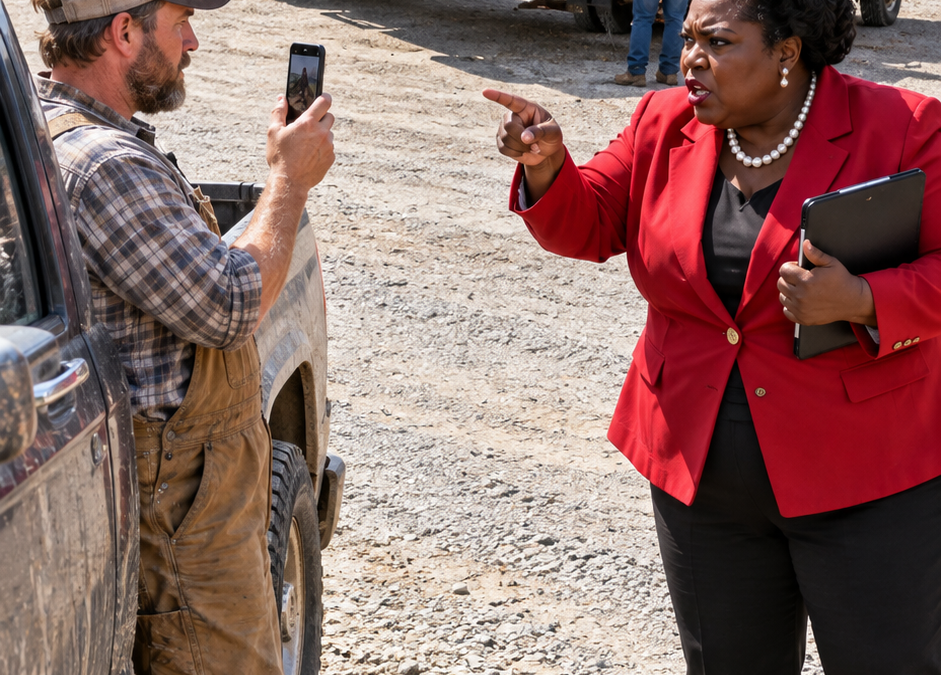
Beside the truck stood Lauren Pike, president of the Silver Pines Homeowners Association, wearing a crimson-red blazer and holding a tablet against her chest as though she were supervising the removal of abandoned equipment from association land.
The problem was simple.
It wasn’t association land.
It was mine.
I stopped my pickup near the entrance and stayed behind the wheel for several seconds.
I had owned that yard for fourteen years.
Feed trucks used it.
Seed suppliers used it.
My fertilizer deliveries came through it.
I unloaded fencing wire there, stacked posts there, and parked the flatbed there whenever I wasn’t hauling something too large for an ordinary pickup.
The gravel wasn’t decorative.
The loading shed wasn’t a clubhouse.
The scale pad wasn’t visitor parking.
It was working ground.
And that morning, Lauren Pike had apparently decided it belonged to her HOA.
I took out my phone before I stepped from the truck.
First photograph: tow company name.
NORTH VALLEY RECOVERY.
Second photograph: my flatbed hanging from the wheel lift.
Third: three temporary signs positioned around the gravel yard.
Each sign displayed the Silver Pines logo.
PERMIT-CONTROLLED OVERFLOW PARKING
UNAUTHORIZED VEHICLES SUBJECT TO TOW
I had never seen any of them before.
Lauren watched me taking pictures.
“You can document it all you want,” she said. “The vehicle is still being removed.”
I ignored that.
The tow operator returned to his cab.
His tablet was mounted beside the steering wheel, screen bright enough that I could see the map from several feet away.
The Silver Pines clubhouse lot appeared in red.
So did the pool lot.
Then the red boundary crossed the landscaped drainage swale separating the subdivision from my ranch.
And spread across my gravel yard.
I stared at the screen.
On the ground, there was a fence line, a swale, a change from asphalt to farm gravel, and a loading shed with feed pallets stacked against it.
On the tablet, there was simply one continuous red enforcement zone.
My private farmyard had been turned into HOA parking with a digital paintbrush.
Lauren stepped closer.
“You received notice.”
“No.”
“You’ve been repeatedly warned about unauthorized commercial vehicle parking.”
“On my own property?”
She gave me the look HOA presidents reserve for people who insist that facts remain involved in the conversation.
“This is overflow parking for the clubhouse and pool.”
“No, Lauren. This is where I unload feed.”
“The board expanded the parking-management area.”
“The board can’t expand into my deed.”
She folded her arms.
“The mapping says otherwise.”
That sentence was interesting.
Not the deed.
Not a lease.
Not an easement.
The mapping.
I looked at the operator.
“Did she request this tow?”
He hesitated.
Lauren answered for him.
“The HOA did.”
“From this location?”
“Yes.”
I pointed at the loading shed.
“This exact yard?”
“Yes.”
“Good.”
Her eyebrows tightened.
“Good?”
“Just making sure.”
The operator finished securing my truck.
I did not grab the chain.
I did not stand behind the tow vehicle.
I did not try to climb into my flatbed.
I had spent enough years running a farm to know the difference between stopping something emotionally and stopping it effectively.
My truck could be recovered.
The paperwork behind the tow was more valuable while everyone still believed it was correct.
The operator climbed into the cab.
Lauren remained beside him as he pulled away.
By then, I had photographed the signs, the dispatch tablet, the truck number, the condition of my flatbed, the loading shed, the gravel pad, the swale, and the entrance road.
The amber lights disappeared toward the county highway.
Lauren stayed long enough to supervise installation of one more temporary sign near the yard entrance.
Then she turned toward me.
“This will keep happening if you continue ignoring parking rules.”
I looked at the empty place where my flatbed had been.
Then back at her.
“Lauren, I think we’re about to find out whose rules actually reach this side of the swale.”
She smiled.
Confident.
Almost amused.
That was fine.
Because by then, I wasn’t thinking about the tow bill anymore.
I was thinking about the red polygon on that tablet.
A driver could make a mistake.
A towing company could misunderstand an address.
But a mapped enforcement zone, matching signs, an HOA dispatch, and the association president standing there in person?
That required a system.
Somebody had built paperwork behind what happened.
And systems have records.
PART2
The gravel yard sat on the eastern side of my ranch, close enough to Silver Pines that aerial photographs could make the relationship look deceptively simple.
The subdivision’s clubhouse stood across the swale.
Paved parking.
Painted lines.
Decorative trees.
Concrete sidewalks.
Light poles.
Beyond that sat the pool.
My side looked nothing like it.
Crushed gravel.
Loading shed.
Scale pad.
Feed pallets.
Equipment racks.
An open turning radius large enough for agricultural delivery trucks.
No striped spaces.
No curbs.
No pedestrian lighting.
No reason for anyone standing in the yard to mistake it for a recreational parking lot.
Apparently, standing there was the key phrase.
Lauren had not made her decision standing there.
She had made it looking at a map.
By noon, I was inside the farmhouse pulling records.
Gravel invoices going back more than a decade.
A grading bill from when I had resurfaced the yard.
Photographs of feed deliveries.
Maintenance records.
Equipment receipts.
A farm-insurance inspection showing the loading shed and yard.
None of those documents alone decided a property-rights question.
But together, they established something simple.
The yard had been continuously used as part of my agricultural operation.
I had maintained it.
Silver Pines had not.
Then my email notification chimed.
PARKING VIOLATION — COMMERCIAL VEHICLE
I opened it.
My flatbed was identified as an unauthorized commercial vehicle parked in a permit-controlled overflow area associated with the Silver Pines clubhouse.
I laughed once.
Not because it was funny.
Because the HOA had just converted a ridiculous morning into a documented position.
This was no longer:
Maybe the tow driver went to the wrong place.
Silver Pines itself was asserting parking-control authority over my loading yard.
I downloaded every attachment.
Their published parking program covered the clubhouse lot.
Pool lot.
Guest spaces.
Fire lanes.
Certain marked street areas.
Resident permits.
Event passes.
Tow procedures.
Nowhere did it mention my farm.
No eastern gravel yard.
No agricultural overflow parcel.
No loading shed.
Nothing.
Yet outside my window, the new HOA tow signs were still standing.
The next morning, I walked the entire yard before sunrise.
One sign stood near the loading shed.
Another near the gravel scale pad.
The third beside the swale.
They were not sitting at some ambiguous roadside shoulder where somebody could plausibly misunderstand a boundary.
Lauren’s people had distributed them throughout the working yard.
I photographed each sign with permanent features visible behind it.
Then my phone rang.
It was one of my feed suppliers.
“Morning. You still want that pallet delivery today?”
“Yes.”
“Driver says there are tow-away signs at your east yard.”
I closed my eyes.
“They don’t apply to you.”
“He doesn’t want his truck hooked while he’s unloading.”
“I don’t blame him.”
“So what do you want to do?”
I moved the delivery to another time.
Small disruption.
Maybe forty minutes of inconvenience.
But the implication irritated me more than the delay.
If those signs remained, every supplier arriving at my ranch had to decide whether an HOA could tow commercial vehicles from my property.
That affected the operation.
Not theoretically.
Practically.
I photographed the empty patch where my flatbed normally sat.
Then I pulled out the towing receipt.
North Valley Recovery.
Dispatch number.
Tow time.
Storage location.
Requesting account.
Silver Pines HOA.
And a site code I did not recognize.
I called North Valley.
A woman in client services answered.
“I need the full authorization record for a tow performed yesterday.”
She asked for the vehicle information.
I gave it.
“You are the registered owner?”
“Yes.”
“Are you disputing the tow?”
“Yes.”
“What is the basis?”
“The vehicle was removed from private property that is not controlled by the client who ordered the tow.”
There was a pause.
“That would be a property dispute between you and the requesting party.”
“Maybe. But your company has records showing where the driver physically removed the truck.”
“Yes.”
“I want those.”
“Which records specifically?”
“Dispatch location. Driver photographs. Property-zone information. Requesting account. Site code. Any documents identifying the property associated with that enforcement zone.”
Another pause.
Then:
“I can submit a records request.”
“Please.”
I also sent Silver Pines written notice.
Short.
No dramatic threats.
I stated that the loading yard was private ranch property.
I disputed the towing authority.
I disputed the parking violation.
I requested preservation of all parking maps, vendor instructions, account changes, board materials, and contractor communications connected to the yard.
And I left the signs where they were.
That surprised one of my neighbors.
He stopped by that afternoon.
“You’re really leaving those up?”
“For now.”
“I’d have ripped them out.”
“I thought about it.”
“Then why didn’t you?”
“Because right now they’re evidence of how far Silver Pines says its authority reaches.”
He looked at the sign.
Then at me.
“You always this much fun?”
“Only when people tow my truck.”
North Valley responded before the HOA did.
The company did not admit error.
That would have been too easy.
Instead, it provided the vehicle packet.
The driver photographs were excellent.
My flatbed sat beside my loading shed.
The gravel scale pad appeared behind it.
Part of my equipment building was visible in another frame.
There was no Silver Pines pavement anywhere.
Then came the GPS record.
The tow operator’s dispatch system stored the coordinate where he marked the vehicle before removal.
I plotted it.
Inside my yard.
Not near the line.
Not in the swale.
Inside.
That answered where.
It did not answer why.
The packet included a screenshot.
The same red zone I’d seen on the driver’s tablet.
Clubhouse.
Pool.
Then east across the swale.
Over my yard.
The label read:
SILVER PINES — ZONE C
I searched the HOA parking policy.
No Zone C.
Meeting minutes.
No Zone C.
Public notices.
No Zone C.
Pool parking maps.
Nothing.
I called North Valley again.
“What is Zone C?”
The client-services representative sounded confused.
“It appears to be an operational sub-zone under the Silver Pines account.”
“What does that mean?”
“It’s a dispatch designation.”
“Is it a separately approved property?”
“I’d have to look at the account.”
“Please do.”
That request took longer.
Meanwhile, Silver Pines decided the first violation had not been sufficiently ridiculous.
A second notice arrived.
Continued commercial use of overflow parking may result in additional towing.
I read it at my kitchen table.
Then looked through the window at my feed shed.
Apparently feeding livestock was now repeated abuse of HOA overflow parking.
Things became even more interesting when Silver Pines announced its upcoming summer community event.
Renovated pool.
Food trucks.
Outdoor music.
Large attendance expected.
Parking notice attached.
Expanded guest capacity.
Temporary overflow.
My yard wasn’t named.
But three directional signs appeared a few days later on the HOA side.
One arrow pointed directly toward the swale.
And my loading yard.
I photographed that too.
Now there was motive.
Parking shortage.
Convenient gravel next door.
Tow control already added.
I still needed documents.
North Valley finally sent the account-enrollment packet.
That was where Lauren’s confidence began having structural problems.
The master services agreement between North Valley Recovery and Silver Pines was legitimate.
The HOA really did have a towing vendor.
The agreement was almost two years old.
Silver Pines had hired North Valley after repeated complaints about unauthorized vehicles near the clubhouse and pool.
Attached was a site-enrollment schedule.
Each approved location had:
Site name.
Address.
Photographs.
Diagram.
Property-control certification.
Authorized contacts.
The clubhouse lot was listed.
The pool lot.
Two small visitor lots.
My loading yard?
Nothing.
Zone C?
Nothing.
I read the contract carefully.
Then again.
The agreement separated approved properties from operational maps.
That distinction was everything.
North Valley used digital geofences to help drivers identify enforcement areas.
Makes sense.
A condominium could change guest-space configuration.
A clubhouse might temporarily close a row of parking.
A client could adjust operating zones inside property it already controlled.
But adding a new property was different.
The contract required additional enrollment.
And additional enrollment required written proof that the client owned, leased, managed, or otherwise had authority to control parking there.
Silver Pines had completed that process for its real lots.
No such file existed for my yard.
I sat back.
There it was.
A red polygon was operational.
Property authority was legal and contractual.
Lauren had apparently confused the first with the second.
I compared site codes.
The code on my tow receipt shared the same prefix as the clubhouse.
Different ending.
That suggested somebody had not created a new approved site.
They had created a sub-zone beneath an existing Silver Pines account.
I requested the change history.
North Valley initially declined.
“Internal client information.”
I responded with a preservation demand tied to a vehicle removed from the disputed zone.
I asked them to preserve every record connected to the creation, expansion, or modification of Zone C.
That changed the conversation.
While waiting, I went through Silver Pines board packets.
A surprising amount was publicly available.
Pool renovation.
Attendance projections.
Parking-capacity concerns.
Summer event planning.
Temporary overflow discussions.
One worksheet mentioned:
adjacent gravel area
No parcel number.
No owner.
No rental cost.
No permission.
Just adjacent gravel.
I stared at that phrase.
That was how administrative overreach often started.
Not with someone writing:
Let’s steal our neighbor’s property.
Too obvious.
Instead:
We need parking.
There’s gravel nearby.
Let’s show it on the map.
And somewhere in that progression, nobody asks the question that matters.
Do we control it?
I searched everything.
Email.
Voicemail.
Mail.
Old HOA notices.
Business correspondence.
No request from Silver Pines.
No lease proposal.
No event-parking agreement.
No temporary license.
No call asking whether residents could park in the yard.
Nothing.
Lauren had gone straight from convenience to control.
Three days later, North Valley sent the driver’s photographs in full resolution.
One frame caught something I had missed.
Behind the flatbed, one HOA tow-away sign was already standing.
Timestamp?
Before the dispatch was completed.
That sequence mattered.
First, the digital zone.
Then signs.
Then tow request.
Then my truck removed.
Not random.
A procedure.
I finally recovered the flatbed after North Valley agreed to release it while the site-control review remained open.
I photographed the truck in their yard before driving away.
A shallow scrape marked the lower edge of the rear mud guard.
Minor.
But new.
I had maintenance photographs from two weeks earlier.
So I documented it.
Then I drove home.
Normally, I would have parked beside the loading shed.
Instead, I backed the flatbed inside my equipment building.
That irritated me more than the tow invoice.
Lauren had changed my behavior on my own land.
Not because she had legal authority.
Because she had introduced enough uncertainty that I no longer trusted the system not to send another tow truck.
That ended when North Valley’s compliance department called.
The manager’s name was Trevor.
He sounded like a man who had spent the morning realizing his company’s software had just become part of somebody else’s property dispute.
“We need to identify the location precisely.”
“I can provide my deed and tax parcel.”
“Please.”
“I’m not asking you to determine title.”
“I understand.”
“I’m asking whether the location your driver used matches a property that Silver Pines actually enrolled under your contract.”
He paused.
“That is a question we can review.”
Exactly.
I sent:
Deed information.
Parcel record.
Aerial photo.
Ground photographs.
GPS tow point.
Temporary signs.
Trevor compared them against North Valley’s account documents.
Two days later, the audit export arrived.
Nineteen days before my flatbed was towed, someone logged into the Silver Pines client portal.
The old enforcement boundary stopped inside the paved HOA property.
Then the user edited the eastern edge.
Dragged it across the swale.
Expanded it over my gravel yard.
Saved revision.
Date.
Time.
Account.
Revision number.
Administrator:
LAUREN PIKE
I read the name twice.
Not because I was surprised.
Because direct evidence always feels different from suspicion.
Lauren had personally modified the digital enforcement area.
Still, I did not jump ahead.
She was HOA president.
She was authorized to administer some vendor functions.
Editing a map wasn’t automatically wrongdoing.
The problem came in the next column.
Associated property-control update: NONE
No new site enrollment.
No certification.
No lease.
No owner consent.
No management agreement.
No supporting document.
No vendor compliance approval for a new property.
The digital boundary moved.
The legal paperwork stayed exactly where it had been.
Trevor explained the portal by phone.
“Clients can make operational adjustments.”
“Inside approved properties.”
“Yes.”
“So if the clubhouse restripes parking, they can move a tow zone.”
“Correct.”
“If they change guest areas—”
“Correct.”
“But the tool doesn’t grant the client authority over land it doesn’t already control.”
“Absolutely not.”
“Then why did your driver tow from my yard?”
He sighed.
“Because from the driver’s perspective, he received an active dispatch inside a live enforcement polygon attached to a valid client account.”
“So every step after the map change worked normally.”
“Yes.”
“The failure happened earlier.”
“That appears to be what we’re reviewing.”
That was the story.
Not a rogue driver.
Not a broken tablet.
Not a random address mistake.
The system did what it had been told.
Lauren told it my land belonged inside her enforcement world.
The system never asked whether she had the right.
North Valley’s contract did.
She skipped that part.
I hired Nina Morales.
Property attorney.
Sharp.
Direct.
And allergic to inflated claims.
When I handed her the file, she said:
“What do you want from me?”
“Answer one question.”
“Which?”
“Does Silver Pines have any recorded or contractual right to regulate parking in my loading yard?”
“Good question.”
She started with title.
Not the towing app.
Not Lauren’s map.
Property.
My parcel included the yard.
No parking easement.
No HOA control agreement.
No lease.
No management contract.
No temporary event license.
Nothing.
Then she reviewed Silver Pines documents.
Nothing.
Then North Valley’s master agreement.
She smiled slightly.
“This is useful.”
“What?”
“The towing company built its own safeguard.”
“Site enrollment.”
“Yes.”
“The HOA used the portal to bypass it.”
“Careful.”
She raised a finger.
“We know Lauren changed the geofence without adding property-control documentation.”
“That’s what I meant.”
“Then say that.”
I nodded.
“You attorneys take all the fun out of adjectives.”
“We bill extra for adjectives.”
She laid out the logic.
Silver Pines had a valid towing contract.
North Valley had a valid dispatch system.
Lauren had valid access to some administrative tools.
None of those facts gave Silver Pines property rights.
“The portal controls workflow,” Nina said.
“The deed controls the dirt.”
I liked that.
She pointed to the new-site clause.
“If Silver Pines wanted to add your yard, this contract required documentation showing why it could lawfully control vehicles there.”
“And there is none.”
“None we’ve found.”
“So the red polygon—”
“Is not a deed.”
“Lauren may be disappointed.”
“I suspect Lauren is going to become disappointed in stages.”
North Valley’s compliance department reached the same operational conclusion.
Trevor sent a formal notice.
The company could not verify required property-control documentation for Zone C.
Towing activity in the disputed area was immediately frozen.
Then North Valley expanded the review.
Every Silver Pines enforcement zone would be checked against approved site records.
That was bigger than my truck.
The HOA could still argue with me.
Could hire counsel.
Could ask to rent my yard.
Could dispute damages.
What it could not do anymore was send North Valley back into my loading area under the existing account.
The red polygon disappeared from the driver system.
The temporary signs were suddenly just plastic signs stuck in gravel.
No operational authority behind them.
Nina sent Silver Pines a demand.
Withdraw both parking violations.
Remove the signs.
Reimburse towing and storage.
Pay for documented truck damage.
Cover the disrupted delivery.
Reimburse title-review costs and a reasonable portion of legal expenses.
And confirm in writing that Silver Pines claimed no parking-enforcement authority over the yard absent a future lawful agreement.
No criminal accusations.
No threat to call the FBI because somebody moved a polygon.
Just documents.
Lauren responded through the management company.
Her position?
Silver Pines had acted in good faith to manage event-related parking around the clubhouse.
I read that twice.
Then called Nina.
“Good faith?”
“Expected.”
“They towed my flatbed.”
“Also true.”
“She personally edited the map.”
“Also true.”
“Without property documents.”
“Yes.”
“So what does good faith change?”
“It may affect how they frame intent.”
“Does it move the property line?”
“No.”
“Then I’m comfortable.”
The board began its own special review.
That produced another important document.
Silver Pines had a vendor-administration policy.
The president and property manager could make “routine operational adjustments” without full board approval.
Parking hours.
Guest zones.
Temporary restrictions.
Contact numbers.
That policy explained how Lauren had made the map change without a dramatic board vote.
The system was designed for efficiency.
Within HOA property.
It had not been designed for a president who thought “adjacent” meant “available.”
Meeting minutes filled in the motive.
Pool renovation finished.
Attendance expected to rise.
Summer events needed parking.
Roadside options had safety concerns.
Remote parking was inconvenient.
My gravel yard was close.
Open.
Flat.
A management worksheet called it:
Preferred overflow solution
No negotiation line.
No cost estimate.
No ownership note.
Preferred.
Because free things are often preferred when they belong to somebody else.
Then the HOA produced an event-parking diagram.
My yard was shaded.
Like the vendor map.
No signature from me.
No lease.
No title.
No temporary license.
Just an internal planning sheet.
I showed it to Nina.
“They really liked coloring my property.”
“Maps are emotionally persuasive.”
“Can I color their clubhouse and declare it my calf barn?”
“No.”
“Worth asking.”
North Valley formally suspended Silver Pines’s direct map-editing privileges.
That was the first consequence Lauren could not explain as a misunderstanding with me.
Her own vendor no longer trusted the HOA account enough to let one administrator alter enforcement zones.
All existing sites had to be reverified.
The board attorney took notice.
Lauren’s parking violations against me vanished from the online portal.
Status:
WITHDRAWN
The signs came down two days later.
Two maintenance employees arrived.
I met them in the yard.
One pointed toward the first sign.
“We were told to remove these.”
“Go ahead.”
“Want them left with you?”
“No.”
He looked relieved.
They pulled all three.
The gravel underneath was slightly darker where the sign bases had blocked dust.
That was the only evidence left.
For the first time in weeks, the yard looked like mine again.
But I still had a flatbed scrape.
Tow expenses.
Storage.
Delivery delay.
Title work.
Attorney bills.
And North Valley still had to decide how its part would be handled.
The company reversed the tow and storage charges through its dispute procedure.
That happened quickly after compliance finished the site review.
The mud-guard scrape went through a separate damage claim.
North Valley’s insurer accepted the repair estimate.
Silver Pines’s insurance carrier became involved in the remaining losses.
The numbers were not dramatic.
This wasn’t the kind of case where somebody walked away with a mansion because a truck got towed for forty-eight hours.
I did not need drama.
I needed the people who created the problem to pay the cost of correcting it.
Then came the board meeting.
Silver Pines held it in the clubhouse.
Nina asked whether I wanted to attend.
“Yes.”
“Why?”
“I want to hear how Lauren explains the polygon.”
“Do not argue from the audience.”
“I know.”
“Do not interrupt.”
“I know.”
“Do not say ‘my deed controls the dirt’ unless invited.”
“That was your line.”
“Exactly. It’s licensed.”
The room was fuller than usual.
The summer event was approaching.
Parking had become a community issue.
Lauren sat at the head table.
Crimson blazer.
By then, I wondered whether she bought them wholesale.
She opened the meeting.
Routine business first.
Pool maintenance.
Landscaping.
Noise complaints.
Then parking.
Lauren described the towing dispute as “an unfortunate misunderstanding involving the eastern overflow area.”
I raised one eyebrow.
Nina looked at me.
I stayed silent.
A board member named Daniel Ross asked:
“Do we have control over the eastern yard?”
Lauren replied:
“The area has historically functioned as overflow space.”
I nearly spoke.
Nina’s shoe touched mine under the chair.
Daniel asked again.
“Do we own it?”
Lauren paused.
“The issue is under legal review.”
The board attorney, sitting near the end of the table, leaned toward his microphone.
“The title review is complete.”
Lauren looked at him.
He continued.
“Silver Pines does not own the agricultural parcel containing the gravel loading yard.”
The room shifted.
Residents began whispering.
Daniel looked at Lauren.
“Do we lease it?”
“No,” the attorney said.
“Do we have a parking easement?”
“No.”
“Management agreement?”
“No.”
“Then why was it added to the towing map?”
Silence.
Lauren answered.
“We were trying to address a serious parking shortage associated with the pool renovation.”
“That isn’t what I asked.”
Her jaw tightened.
“The vendor portal permits authorized administrators to make adjustments.”
The attorney intervened.
“Within approved sites.”
Lauren looked at him.
He did not look away.
Daniel continued.
“So the contract did not allow us to add neighboring property simply by expanding the map.”
“No,” counsel said.
A woman in the audience whispered:
“Oh my God.”
Lauren’s shoulders stiffened.
“The loading yard is directly adjacent to our common area.”
I could not help myself.
I raised my hand.
The chair recognized me.
I stood.
“Lauren, my cattle are also directly adjacent to Silver Pines.”
Several people laughed.
I continued.
“I assume we’re not adding them to the pool inventory.”
Even Daniel laughed.
Lauren did not.
“This isn’t amusing.”
“No. It wasn’t amusing when my truck disappeared.”
The board attorney stepped in before it became theater.
He summarized North Valley’s findings.
Valid towing contract.
Valid approved HOA sites.
Unauthorized expansion into an unenrolled property.
Missing property-control documentation.
Map revision performed through Lauren’s administrator account.
No corresponding site approval.
Then he said the sentence that ended the argument.
“The digital map did not create parking-control authority.”
There it was.
Simple.
No jargon.
Lauren said:
“I relied on the tools provided by the vendor.”
North Valley’s representative had provided a written response for the board.
Daniel read part of it aloud.
The mapping tool was intended for operational adjustments within locations already under client control.
Any new property required enrollment.
Proof of control.
Compliance approval.
Lauren stared ahead.
Daniel asked:
“Did you submit any of those?”
“No.”
“Did you contact the property owner?”
“No.”
“Did management?”
The property manager answered.
“No.”
“Did the board approve a lease?”
“No.”
“Then what made you think we could tow vehicles there?”
Lauren looked toward me.
I knew that look.
She wanted me to become the problem again.
I didn’t.
Finally she said:
“We needed overflow parking.”
Daniel leaned back.
“That isn’t authority.”
Exactly.
A second director spoke.
“Were we told the yard belonged to Silver Pines?”
Lauren replied:
“It was represented on the event map.”
“Who prepared the event map?”
Management staff answered:
“Under direction from the president’s office.”
The room became quieter.
Then somebody asked whether the HOA could be sued.
The attorney gave the responsible answer.
“Potential liability already exists. We are working toward resolution.”
Not dramatic.
Accurate.
Another resident asked:
“Why was his own farm truck considered unauthorized?”
Lauren answered:
“Because once the zone was created, the parking rules applied.”
I finally spoke again.
“No, Lauren.”
Everyone looked at me.
“The parking rules appeared in your system.”
I pointed toward the table.
“They never appeared in my deed.”
Silence.
That was enough.
I sat down.
The board voted that night to remove Lauren’s unilateral authority over towing-vendor administration.
Effective immediately.
Any future modification required a second authorized reviewer.
Any boundary expansion required property-control documentation.
Any new site required board-level confirmation.
Lauren remained president for the moment.
But the tool that created the problem was taken out of her hands.
That mattered more to me than some theatrical recall.
Take away the mechanism.
Fix the process.
Prevent repetition.
The next item was the summer event.
Silver Pines still had a real problem.
Not enough parking.
The board considered options.
Restrict attendance.
Roadside parking.
Shuttle.
Remote commercial lot.
One resident asked:
“What about negotiating with the ranch?”
Every head turned toward me.
I said:
“You can ask.”
That was apparently a revolutionary concept.
Daniel smiled.
“All right. Would you rent the loading yard for event parking?”
“No.”
Lauren almost smiled.
I continued.
“It’s a working area. Feed deliveries and equipment movements continue on weekends.”
Daniel nodded.
“Fair.”
“There’s a commercial lot two miles south that sits empty on Saturdays.”
Management said they’d already contacted the owner.
The cost was higher.
Of course it was.
Permission tends to cost more than assumption.
Silver Pines rented it.
Then hired a shuttle.
Lauren opposed the expense.
Daniel answered:
“It’s still cheaper than another property dispute.”
The motion passed.
A few days before the event, I watched temporary signs appear.
This time, every arrow remained inside Silver Pines.
One sign said:
EVENT PARKING SHUTTLE →
Nothing pointed toward my yard.
Beautiful.
The financial settlement came next.
Tow charges reversed.
Storage charges removed.
Mud-guard repair paid.
Delivery disruption reimbursed.
Title-review expenses covered.
Part of Nina’s legal fees paid.
Both HOA violations formally withdrawn.
And, most importantly, one paragraph:
Silver Pines Homeowners Association acknowledges that it has no parking-enforcement, towing, management, or occupancy authority over the agricultural loading yard located on the owner’s parcel absent a future written agreement or other lawful property-control interest.
I read that paragraph twice.
Then signed.
No lottery.
No giant punitive payout.
No courtroom fireworks.
Just something better.
A clean written boundary.
Event Saturday arrived clear and warm.
By nine in the morning, Silver Pines was busy.
Cars filled the clubhouse lot.
Pool lot.
Guest spaces.
Then the remote lot.
A small shuttle bus moved up and down the county road.
Volunteers wore reflective vests.
Families carried coolers.
Kids dragged pool bags.
The system worked.
Was it more complicated than drawing a red shape over my yard?
Absolutely.
Was it legal?
Also yes.
I had a feed delivery scheduled at eleven.
The truck driver called from the county road.
“Still good to use the east yard?”
“Come on in.”
“No HOA signs?”
“Not unless they’ve learned how to grow back.”
He laughed.
The truck entered.
Backed across the gravel.
Stopped beside the loading shed.
No permit.
No guest pass.
No tow truck.
No Lauren.
We unloaded feed.
Then I used the flatbed to move mineral tubs toward the barn.
Across the swale, the shuttle continued carrying Silver Pines residents from property the HOA had actually rented.
That was the entire solution.
Permission.
Amazing technology.
Late that afternoon, I stood beside the flatbed tightening straps.
The community event continued.
Music drifted faintly from the clubhouse.
Children shouted near the pool.
Nobody entered my yard.
Nobody needed to.
My neighbor stopped by.
He looked across the swale.
“Shuttle seems to work.”
“Apparently civilization survived.”
“You know Lauren hated paying for that lot.”
“I assumed.”
“Said it was inefficient.”
I laughed.
“Using my property for free was definitely more efficient.”
He grinned.
“Think she’ll run again?”
“No idea.”
She did.
But not for president.
By the next annual election, Lauren stepped down from the top position.
Her official statement said she wanted to reduce her administrative commitments.
Silver Pines elected Daniel Ross president.
One of his first actions was to order a full vendor review.
Not just towing.
Landscaping.
Security.
Pool maintenance.
Temporary events.
Any contract where Silver Pines staff could direct people onto physical property.
Their new rule was painfully simple.
Before an HOA vendor could work on land, someone had to verify the HOA controlled it.
I heard that and almost asked whether they planned to patent the idea.
Daniel called me once after taking over.
“I wanted to thank you.”
“For getting my truck towed?”
He laughed.
“No.”
“For not turning this into something uglier than it needed to be.”
“You had documents.”
“So did you.”
“Yes.”
“And you used them.”
“That is generally why people keep them.”
He paused.
“You know, some residents still think you were being difficult.”
“Some residents think cattle smell surprising.”
“Fair.”
“What do you think?”
“I think we should have asked permission.”
“That would’ve saved everybody money.”
“Yes.”
Another pause.
“Lauren thought the map was enough.”
“I know.”
“She keeps saying the portal let her do it.”
“The portal also lets you type whatever password you want. Doesn’t mean the password becomes property law.”
Daniel laughed.
“I’m stealing that.”
“Invoice is coming.”
Months passed.
My loading yard went back to being boring.
Which was exactly what I wanted.
Feed trucks entered.
Flatbed parked beside the shed.
Fencing material stacked along the north edge.
Nobody cared.
Then, one afternoon, a North Valley tow truck stopped on the county shoulder.
I happened to be outside.
The driver walked toward me.
Different man from the first tow.
He held a clipboard.
“You the ranch owner?”
“Yes.”
“We’re reverifying Silver Pines sites.”
“All right.”
He pointed across the swale.
“Our new map ends there.”
I looked.
His tablet showed red over the clubhouse.
Pool.
Visitor areas.
Stopped cleanly on the HOA side.
My yard was gray.
Unassigned.
Normal.
He turned the tablet slightly.
“Does that match your understanding?”
“Yes.”
“Great.”
I smiled.
“You have no idea how much I enjoy seeing gray.”
He looked confused.
“Long story.”
North Valley had learned its own lesson.
A driver-facing map could make operations efficient.
But efficiency depends on the data being true.
The company changed its system so material boundary expansions triggered a compliance review instead of immediately appearing as enforceable space.
I hadn’t demanded that.
They did it because they understood the business risk.
One bad zone had already sent a truck onto land outside their client’s authority.
They didn’t want a second.
That’s how useful consequences work.
They change incentives.
Not just emotions.
My flatbed eventually got a new mud guard.
The scrape was minor enough that part of me considered leaving it.
A reminder.
Then I decided I didn’t need my truck becoming a museum exhibit.
I repaired it.
North Valley paid.
The old damaged guard went into the scrap pile.
Nina asked once whether I wanted copies of everything boxed permanently.
“Keep digital.”
“What about the tow packet?”
“I’ll keep that.”
“The audit trail?”
“That too.”
“Lauren’s violation notices?”
“Yes.”
She smiled.
“I thought you wanted to move on.”
“I do.”
“You have an unusual definition.”
“Farmers keep receipts.”
“So do lawyers.”
“That’s why we get along.”
The most interesting conversation happened almost a year later.
I ran into Lauren at a county supply store.
No crimson blazer.
Jeans.
Dark sweater.
She looked ordinary.
Which was strange after months of seeing her only as the person standing beside a tow truck.
We reached for the same box of shop towels.
She pulled her hand back.
“Go ahead.”
“Thanks.”
Silence.
Then:
“How’s the truck?”
“Fine.”
She nodded.
“And the yard?”
“Still a yard.”
Her mouth tightened slightly.
“I’ve thought about that situation.”
I waited.
“We had a serious parking problem.”
“I know.”
“I wasn’t trying to take your property.”
“I believe you.”
That surprised her.
She looked directly at me.
“I thought you believed I was.”
“No.”
“What did you think?”
“I think you saw something convenient and skipped the step where you asked whether it was yours to control.”
She crossed her arms.
“The aerial maps made the areas look connected.”
“So does Google Earth make my pasture look connected to the mountains. I don’t own the mountains.”
“You know what I mean.”
“Yes.”
She exhaled.
“The vendor system allowed the change.”
“There it is again.”
“What?”
“The software.”
She looked irritated.
“What about it?”
“You keep saying the portal allowed it.”
“It did.”
“It allowed you to draw.”
She said nothing.
I continued.
“It didn’t authorize you to tow.”
“The distinction wasn’t obvious at the time.”
“It was in the contract.”
She looked away.
That was probably harsher than I needed to be.
But true.
Finally, she said:
“I should have checked.”
“Yes.”
“I also should have contacted you.”
“Yes.”
“Would you have said no?”
“Yes.”
She laughed despite herself.
“So we would’ve had the same parking problem.”
“Correct.”
“But not the towing problem.”
“Now you’re getting it.”
For a second, neither of us spoke.
Then she shook her head.
“You really enjoyed pulling that contract.”
“I enjoyed the new-site section.”
“I know.”
“How?”
“You underlined it three times in the copy your attorney sent.”
I smiled.
“Good clause.”
She almost smiled back.
Then picked up another package of shop towels.
“Take care.”
“You too.”
That was the last real conversation we had.
No screaming.
No humiliation.
No dramatic confession.
She had made a bad decision.
Then defended it too long.
Eventually, the records cornered the mistake.
That was enough.
The following summer, Silver Pines held the event again.
Same remote parking arrangement.
Same shuttle.
By then, nobody complained.
A temporary inconvenience had become the normal procedure.
Funny how quickly “impossible” becomes ordinary once people stop assuming someone else’s property is free.
I had another feed delivery that morning.
The driver backed into the yard.
We unloaded.
Then he asked:
“Wasn’t this the place the HOA tried to use for parking?”
“Yep.”
“What happened?”
“They found another lot.”
“That easy?”
“Eventually.”
He looked toward the subdivision.
“People are strange.”
“No argument.”
I drove the flatbed across the yard later that afternoon.
No signs.
No red zone.
No amber lights.
Just gravel under the tires.
I thought about the first day.
Lauren in red.
Tow operator.
My truck hanging off the ground.
The tablet.
That bright enforcement polygon covering space the HOA had never enrolled, leased, purchased, or been given.
At the time, the screen looked powerful.
It had a boundary.
Color.
Account name.
Dispatch system.
It looked official.
That was the trick.
Official-looking systems make people forget to ask what authority sits underneath them.
The driver saw red and assumed enforcement.
Lauren saw an editing tool and assumed control.
The HOA saw a parking problem and assumed proximity.
But none of those assumptions changed one physical fact.
The yard belonged to my agricultural parcel.
The contract knew that could matter.
That’s why it required property-control documentation.
Lauren skipped the boring page.
The boring page won.
I eventually framed one thing.
Not the towing receipt.
Not the violation.
Not even a photograph of Lauren.
I printed the relevant section of North Valley’s master agreement.
The paragraph requiring documented property authority before a new site could be enrolled.
Under it, I placed a small brass label:
RED ON A SCREEN IS NOT OWNERSHIP.
Nina saw it once.
“You mocked me for being dramatic.”
“You’re a lawyer. You’re paid to be dramatic in twelve-point font.”
“And this?”
“Educational.”
“Of course.”
The frame hangs inside the farm office now.
Most people don’t notice it.
That’s fine.
I notice it.
Every time a contractor brings me a map.
Every time a supplier wants temporary access.
Every time someone says:
“The system shows…”
I ask one more question.
What document put it there?
That question would have saved Silver Pines a lot of trouble.
Because the truth was never complicated.
Silver Pines owned its parking lots.
North Valley could enforce them.
Lauren could administer the account.
Residents could be required to display permits where the HOA actually had authority.
Nobody disputed any of that.
But authority is not contagious.
It does not jump across a drainage swale because the nearest gravel looks useful.
A towing contract can regulate an approved site.
It cannot annex the farm next door.
A geofence can guide a driver.
It cannot transfer land.
An event plan can shade a parking area.
It cannot substitute for the owner’s signature.
And an HOA president can click SAVE on a digital map.
That does not make the pixels become property.
The final irony was that Silver Pines ended up with a better parking system after all of this.
Remote lot.
Shuttle.
Clear signs.
Verified towing boundaries.
Two-person approval for material vendor-zone changes.
Current site records.
Drivers knew exactly where they could enforce.
Residents knew where they could park.
My yard stayed mine.
Nothing collapsed.
Property values did not implode.
The pool did not close.
Civilization survived the loss of free access to my gravel.
One evening near the end of summer, I parked the flatbed in its usual spot beside the loading shed.
Exactly where it had been the morning Lauren ordered it towed.
I shut off the engine.
For a moment, I stayed in the cab.
Across the swale, the Silver Pines clubhouse lights came on.
Cars moved through the paved lot.
A North Valley tow truck passed along the county road without turning toward me.
I smiled.
Then climbed down.
Fourteen years earlier, when I built up that gravel pad, I never imagined I would someday need a lawyer, a vendor audit trail, a towing contract, and several weeks of paperwork to prove I could park my own farm truck beside my own loading shed.
But if Lauren taught me anything, it was this:
The most dangerous kind of overreach isn’t always someone kicking down a gate.
Sometimes it’s a person sitting behind a screen, dragging a line a few inches farther than it belongs.
On her monitor, that move probably took seconds.
On the ground, it sent a tow truck across a property boundary.
It stopped a feed delivery.
It produced fake parking violations.
It created signs.
It cost money.
It involved lawyers.
It triggered a vendor-wide compliance review.
And in the end, it cost Lauren the one thing she had assumed was unquestionable.
Control.
Not because I shouted louder.
Not because I chased the tow truck.
Not because I ripped the signs out.
I let the system preserve its own trail.
Dispatch record.
GPS coordinate.
Driver photographs.
Account code.
Geofence history.
User login.
Vendor contract.
Missing site certification.
Every step told the same story.
Silver Pines had authority on one side of the swale.
Lauren moved the red line.
The paperwork didn’t move with it.
That was her mistake.
And once I pulled the vendor contract, she couldn’t color over it.








