𝗙𝗨𝗟𝗟 𝗦𝗧𝗢𝗥𝗬 The HOA Told Me My Family Ranch Had Belonged to Them for Years, but One Old Survey Marker Said Otherwise
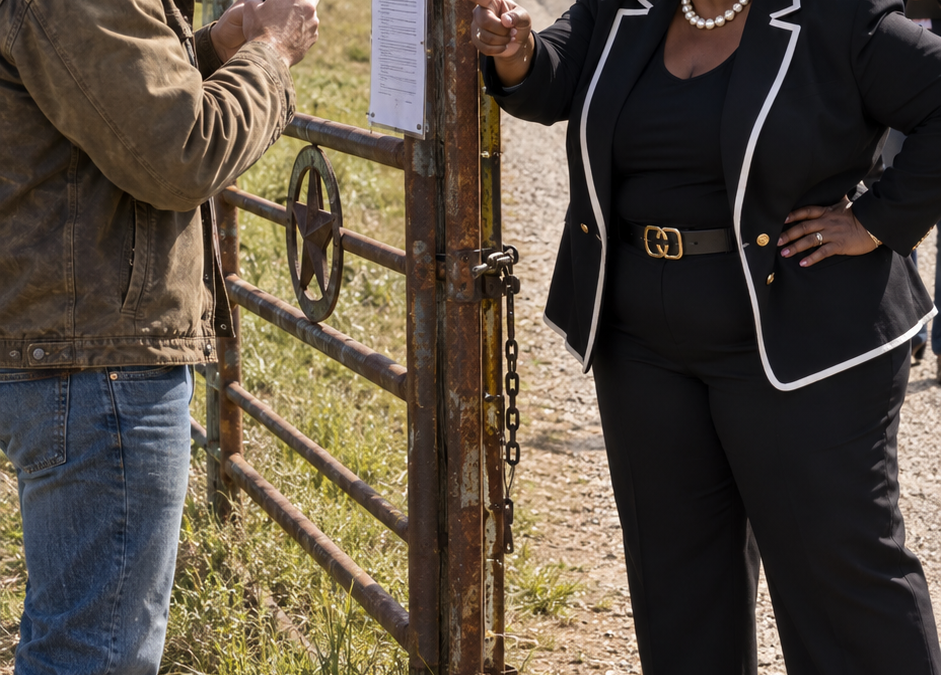
𝗙𝗨𝗟𝗟 𝗦𝗧𝗢𝗥𝗬
Nobody accidentally converts a drainage filing into a land merger without doing something deliberate along the way.
The following morning, I drove to the county records office.
I did not identify myself as a federal employee.
There was no reason.
At that point, I was Isaiah Hollis.
Son of the deceased owner.
Sorting estate paperwork.
The clerk helping me was Ruth Garner.
She had worked there for decades.
I remembered her vaguely from high school.
She remembered my father immediately.
“Walter Hollis.”
“Yes.”
She removed her glasses.
“I’m sorry.”
“Thank you.”
“What are you looking for?”
“Everything.”
She smiled.
“That’s dangerous.”
“I know.”
We began with the official parcel map.
Hollis Ridge sat exactly where it had always sat.
Entirely outside Silver Pines Estates.
Not partly.
Not ambiguously.
Completely outside.
Then Ruth pulled the digital map Silver Pines had submitted with several recent planning documents.
That map told a different story.
Its boundary pushed west.
Deep into Hollis Ridge.
Roughly sixty-four acres of our land appeared inside an HOA expansion zone.
I put the maps side by side.
Official county plat.
HOA exhibit.
The lines were not even close.
Clerical errors happen.
Survey conversions create small discrepancies.
Old bearings can produce minor shifts.
You do not accidentally absorb sixty-four acres.
Ruth brought out three boxes of deeds and archival scans.
I started in 1912.
Worked forward.
Parcel descriptions.
Family transfers.
Mortgage releases.
Probate deeds.
Agricultural easements.
Every legitimate Hollis Ridge filing used the same parcel lineage.
The survey descriptions evolved slightly as equipment improved, but the boundaries remained consistent.
Then I compared the association documents.
Wrong recording numbers.
Missing cross-references.
Dates that did not line up.
Documents referencing exhibits never entered into the official index.
At one point Ruth brought me a folder containing a document titled:
VOLUNTARY MERGER CONSENT.
Walter Hollis.
His signature sat near the bottom.
I knew that signature.
I had watched my father make it thousands of times.
Hard W.
Long tail on the H.
And always a small ink smear near the end because Walter signed too fast and dragged the side of his hand.
The signature on the merger consent had the smear.
But the smear was wrong.
It sat several millimeters lower than the line.
Not natural.
Copied.
Placed.
I enlarged the scan.
The signature edges looked subtly different from the surrounding document.
I felt something shift in me.
Then I noticed the expansion map.
CROWN MEADOW RESERVE.
Future development.
Luxury homes.
Riding arena.
Artificial lake.
Forty-two initial lots.
One road connected it to the county highway.
That road crossed Hollis Ridge.
Right through our pasture.
Now the motive had shape.
Silver Pines did not simply want extra land.
They needed a transportation corridor.
Without Hollis Ridge, Crown Meadow Reserve had no practical primary access.
My father’s death had created an opportunity.
Owner dead.
Son living elsewhere.
Estate unsettled.
Push hard.
Claim old paperwork.
Force sale.
Move development forward.
That night, I sat on Walter’s porch after dark.
The ranch was quiet.
Then headlights appeared along the east fence.
A survey truck.
Silver Pines markings.
Men got out with stakes.
Orange flags.
They crossed through a gap.
Entered my property.
I did not approach.
I filmed.
They worked past midnight.
At one point, a map inside the truck became visible under the cab light.
I zoomed in.
PHASE 4
ACQUISITION COMPLETE
My ranch was already being treated as acquired.
Before any court.
Before any sale.
Before my father’s estate even closed.
I sent copies of the video to myself.
Then to secure storage.
The next HOA meeting was three days later.
I attended.
Silver Pines clubhouse looked less like an HOA room and more like a small hotel conference center.
Vivien sat at the center table.
Audrey beside her.
Grant Duval sat near the presentation screen.
I knew the name.
Developer.
Land investor.
Crown Meadow project partner.
Vivien introduced me to the room.
Not as Walter Hollis’s son.
Not as owner of Hollis Ridge.
As:
“The gentleman currently occupying the western parcel.”
That was deliberate.
She told residents my family had benefited from Silver Pines drainage, roads, and infrastructure for decades without paying assessments.
That we owed nearly $287,000.
That the board had exhausted informal remedies.
When my turn came, I asked:
“Can you produce the original recorded merger agreement?”
Audrey answered.
“Certain documents are protected association legal material.”
“A recorded property transfer isn’t privileged.”
Vivien leaned toward the microphone.
“This is exactly the kind of procedural obstruction we’ve dealt with from the Hollis parcel for years.”
I looked at the residents.
“Then show them the deed.”
Vivien interrupted.
“Mr. Hollis, you are not here to lecture the board on property law.”
I let that pass.
Grant Duval stood.
He unveiled a scale model.
Crown Meadow Reserve.
Tiny villas.
Decorative trees.
Riding facility.
Artificial water feature.
Stone entrance.
And sitting beneath it all was Hollis Ridge.
My father’s pasture had become miniature landscaping.
Grant spoke about opportunity.
Modernization.
Community expansion.
Then he offered me what he called a final negotiated buyout.
Far below the ranch’s real value.
I asked:
“If Silver Pines already owns Hollis Ridge, why are you offering to buy it from me?”
Silence.
Not long.
Long enough.
Several residents looked toward Vivien.
One older man said from the aisle:
“And where did the watershed money go?”
Vivien’s eyes snapped toward him.
Then back to me.
“Perhaps we should continue privately.”
“No.”
She stiffened.
“I’m happy to leave. But I think I’ll be taking a closer look at Silver Pines.”
Vivien ended the meeting.
Security escorted me outside.
In the parking lot, a woman hurried after me.
Lydia Sloan.
She folded a document and pushed it into my hand.
“I think you should see this.”
Then she walked away.
It was part of Crown Meadow’s financing package.
One line mattered.
$18 million construction facility.
Collateral:
Forty-two lots.
Phase 4.
The same lots sitting on my family’s ranch.
Grant Duval had borrowed against property he did not own.
That changed things.
A land dispute is one thing.
Loan collateral built on questionable title is another.
Over the next several days, I began reviewing Silver Pines from a different angle.
Not as an heir.
As an auditor.
Public sources only.
Grant databases.
County infrastructure records.
Funding notices.
Environmental filings.
Silver Pines had received approximately $4.6 million through a federally supported watershed protection and erosion-control program.
The grant application claimed the association controlled a seventy-eight-acre conservation corridor along Willow Creek.
Most of that corridor sat on Hollis Ridge.
I stared at the map.
Then at the federal award file.
That was the moment my personal dispute crossed into my professional world.
If an applicant knowingly claimed control over private land in order to obtain federal money, that could involve false statements and grant fraud.
But I had a conflict.
A very large one.
So I called Naomi Vance.
My supervisor.
Meticulous.
Fair.
Almost impossible to impress.
I explained everything.
The ranch.
My father.
Silver Pines.
The eviction notice.
The maps.
The federal grant.
When I finished, Naomi was quiet.
Then she said:
“You cannot lead this.”
“I know.”
“You cannot direct interviews.”
“I know.”
“You cannot make audit judgments involving your own land.”
“I know.”
“But you can be a witness.”
“Yes.”
“And you can explain historical title records as a technical resource if the team requests it.”
“That’s what I expected.”
She opened an independent review.
That distinction mattered to me more than almost anything that followed.
I did not want federal authority turned into a weapon in a private land fight.
If Silver Pines had done nothing wrong, an independent team needed to be able to say that.
If they had, the findings needed to survive without depending on my anger.
Naomi’s auditors began pulling records.
Payment ledgers.
Grant invoices.
Contractors.
Bank transfers.
Subrecipient documentation.
Almost immediately, one vendor stood out.
Crowell Infrastructure Group.
Nearly $1 million in grant-related payments.
I searched the company registry.
Registered address:
A residence two counties away.
Owned by Vivien Crowell.
Her vacation home.
The next layer was worse.
Grant invoices showed completed erosion structures.
Vegetative stabilization.
Creek restoration.
Drainage improvements.
Satellite imagery from the relevant periods showed several of those projects did not exist.
One reported wetland restoration worth more than $600,000 appeared nowhere on the ground.
The grant application contained photographs.
At first glance, they showed Willow Creek.
But landscape details were wrong.
I recognized one road crossing.
Four miles away.
Different parcel.
Different creek segment.
The application had been assembled professionally.
Someone understood what reviewers wanted.
Wetland language.
Erosion risk.
Public benefit.
Habitat protection.
Emergency need.
Boxes checked precisely.
This was not a volunteer treasurer making a sloppy filing on Sunday night.
Somebody knew how to make the application pass.
Naomi’s team kept going.
Vivien sensed pressure before she knew where it came from.
The HOA citations against me multiplied.
Fence color.
Equipment shed.
Truck location.
Irrigation.
Vegetation height.
Every notice assumed HOA jurisdiction that did not exist.
I filed them.
Did not argue.
One afternoon, an association maintenance crew shut a valve feeding part of the ranch irrigation system.
They claimed the line belonged to Silver Pines.
I filmed them.
Recorded plates.
Then switched to the old backup well Walter had drilled decades earlier.
That evening, Vivien released an edited video.
It showed me holding my federal credentials and telling association personnel to leave.
The clip removed the part where they were standing on Hollis Ridge.
It made me look like a federal employee using his badge in a neighborhood dispute.
The video spread.
Town changed.
People who had known me as Walter’s son began looking at me as something else.
At the diner, conversations got shorter.
A man from high school stopped me near the hardware store.
“True you threatened some widow with federal agents over a fence?”
“No.”
He laughed.
“That’s what everyone’s saying.”
I could not explain the active audit.
Naomi had warned me.
One wrong public statement and Silver Pines could argue the federal review was retaliation.
So I stayed quiet.
That silence cost me.
More than I expected.
Then one evening, while cleaning Walter’s equipment shed, I found an envelope wedged behind an old steel toolbox.
Photographs.
Survey stakes.
Vehicles near the fence.
Copies of letters Walter had sent Vivien.
And a notebook.
My father’s handwriting.
Dates.
Plate numbers.
Measurements.
On the final page:
They moved east marker 43 ft.
Below it:
Do not trust new map.
I sat on the shed floor.
For the first time, I understood my father had been fighting this before I came home.
For years, maybe.
Quietly.
Alone.
He had known something was wrong.
And he had never called me.
That hurt in a way the eviction notice never could.
I found Dean Calder.
Retired surveyor.
He had originally surveyed the boundary between Hollis Ridge and the land that later became Silver Pines.
Dean wanted nothing to do with the dispute.
“I don’t have the money for lawsuits.”
“I’m not asking you to testify today.”
“You people are already fighting.”
“I’m asking you to look at a photograph.”
I placed Walter’s picture on his kitchen table.
Dean stared.
His face changed.
“That’s my marker.”
“You’re sure?”
“I set it.”
We drove to the ranch.
Walter’s photograph showed a bronze marker set in a concrete footing.
The current marker stood forty-three feet west.
We searched the original point.
Under turf and packed soil, Dean found the old concrete base.
He knelt.
Ran his thumb over chisel marks.
“I cut these.”
He stood slowly.
“Someone moved the line.”
The relocated marker had done more than steal acreage.
It made several Silver Pines structures appear legitimate.
Part of the main entrance.
A section of road.
A portion of clubhouse improvements.
Without the shift, some of them encroached on Hollis land.
Dean admitted Vivien had approached him years earlier about “updating” the boundary.
She had been unusually specific.
She wanted the line moved in one direction.
He refused.
Silver Pines hired another firm.
We pulled that firm’s survey.
Professional seal.
Certification.
Then Naomi’s team checked the seal.
The engineer whose seal appeared on the document had died six months before the survey date.
A dead man’s professional seal had been used to authenticate a false boundary.
That same night, somebody entered my equipment shed.
No confrontation.
I was inside the ranch house.
The filing cabinet had been opened.
Only boundary documents were missing.
Tools remained.
Cash remained.
Equipment remained.
Whoever came wanted paper.
Fortunately, I had scanned everything earlier that afternoon.
The barn security camera captured a Silver Pines maintenance vehicle leaving after midnight.
I sent the footage to Naomi.
Then did nothing else.
The independent audit team arrived at the Silver Pines office the following week.
Naomi issued a formal preservation notice.
Emails.
Invoices.
Maps.
Meeting minutes.
Payment records.
Grant files.
No deletion.
No alteration.
No destruction.
Vivien remained confident in public.
She blamed contractors.
Outside consultants.
Clerical staff.
Audrey tried withholding several grant records under attorney-client privilege.
That failed.
Grant administration records are not made privileged merely because an attorney has seen them.
The invoices told their own story.
One stretch of road appeared to have been paid for three times.
Once through resident assessments.
Again through county support.
Again through the federal watershed grant.
Same work.
Different funding descriptions.
The supposed wetland restoration had never been built.
Residents began comparing old Silver Pines statements.
Lydia Sloan gathered letters.
Mason Greer joined her.
Watershed fees charged for projects nobody could find.
Then Naomi’s team pulled the complete Crown Meadow financing package.
$18 million.
Forty-two lots as collateral.
All dependent on land title.
All sitting on Hollis Ridge.
If our ownership was correct, the bank’s collateral had a massive defect.
Now Vivien’s urgency made sense.
She did not merely want Crown Meadow.
She needed title cleaned up before the lender checked closely.
Less than forty-eight hours before an outside loan review, Vivien called an emergency HOA session.
The board considered a forced sale of Hollis Ridge based on the supposed $287,000 delinquency.
Audrey produced another document.
A deed transfer.
Walter Hollis.
Eastern portion of ranch granted to Silver Pines.
Not the earlier copied signature.
This one looked real.
I knew it immediately.
My father’s handwriting.
Every movement.
Every angle.
For the first time, I doubted myself.
What if Walter had signed something?
What if he had gotten into financial trouble?
What if he had sold acreage without telling me because he knew I would object?
Fraud elsewhere would not erase a genuine deed.
Naomi reminded me of that.
“The federal audit and your ownership case are separate.”
“I know.”
“If the deed is valid, it is valid.”
“I know.”
That night, I went through Walter’s notebook again.
Page by page.
Halfway through, one note caught my eye.
Temporary fire access.
I searched the barn.
Boxes.
Old files.
Insurance papers.
Eventually I found a carbon copy.
TEMPORARY EMERGENCY ACCESS AUTHORIZATION.
Wildfire season.
Walter had allowed fire department vehicles to cross part of the ranch for temporary emergency access.
There was his signature.
Same signature.
Same smear.
Then I compared the signature page to Vivien’s transfer deed.
It was the same page.
Not similar.
The same.
Staple holes did not match the supposed deed.
Fax transmission marks belonged to the fire authorization.
Typefaces differed.
Page aging differed.
Someone had taken the signature page from Walter’s legitimate emergency permit and attached it to a fabricated land transfer.
The listed witness worked for Grant Duval.
Then I checked the notary.
Her seal appeared on the deed.
I drove to her office.
Small storefront between a bakery and dry cleaner.
She pulled her physical ledger.
Turned page after page.
“No Walter Hollis.”
“Could it be missing?”
She frowned.
“I don’t skip entries.”
She checked again.
“I never notarized this.”
She signed a sworn statement.
That turned the disputed deed into something much harder to defend.
Someone had used Walter’s genuine signature.
A notary seal without a matching log entry.
A witness tied to the developer.
A document assembled from unrelated paper.
For me, that was the lowest point.
Not because I thought we would lose.
Because they had tried to rewrite my father.
Walter had spent his final years protecting the ranch.
Now Vivien wanted a court to believe he had voluntarily surrendered it.
That made the fight feel different.
Personal in a way I had spent weeks trying to avoid.
Naomi completed her preliminary findings.
Then Vivien announced Silver Pines would auction Hollis Ridge the next morning.
Despite the court stay.
Despite unresolved title.
Despite the audit.
She apparently believed the association’s internal enforcement authority still gave her power to proceed.
The auction was scheduled inside the Silver Pines clubhouse.
The same building that now appeared to partially encroach onto Hollis property.
Vivien arrived in a white suit.
Grant Duval sat in the front row.
Beside him was a representative from the lending bank.
Residents filled the room.
I entered carrying one certified folder.
Naomi came behind me.
With her were representatives from the county recorder’s office, the state surveying board, and counsel connected to the federal fraud review.
Nobody shouted.
Nobody threatened anyone.
The presentation began with the simplest fact.
County recorder:
Hollis Ridge had never been conveyed to Silver Pines.
Never.
Not in 2011.
Not in 2018.
Not at any time.
The original chain of title remained intact.
Then the survey findings.
The eastern marker had been relocated forty-three feet.
The newer map relied on a professional seal belonging to an engineer who had already died.
The original footing still existed.
Dean Calder’s historic field records matched Walter’s photographs.
Then the deed.
Walter’s real signature had been taken from a temporary fire access authorization and attached to another document.
The notary seal had no corresponding ledger entry.
Then Naomi addressed federal funding.
The seventy-eight-acre conservation corridor claimed by Silver Pines included land the association did not own.
Several reported projects were nonexistent.
Photographs in the grant application depicted other locations.
Road work had been billed through multiple funding sources.
Payments flowed to Crowell Infrastructure Group.
Corporate records connected that entity to Vivien.
Nearly $1.9 million in questioned transfers and related payments were tied to companies connected to Vivien and Grant.
The exact final amount would require continued investigation.
Then Crown Meadow.
Forty-two proposed lots used to secure an $18 million construction loan.
No valid title.
No valid control.
No legal collateral interest in Hollis Ridge.
The bank representative closed his folder.
He did not wait for the rest.
He stood.
Walked out.
Grant Duval went pale.
Behind me, someone began crying.
Later I learned she had paid nearly $6,000 in watershed assessments over three years.
She was hearing for the first time that some of the work she believed she funded had never existed.
Vivien tried to blame Grant.
Then Audrey.
Then contractors.
Naomi read an internal email.
Vivien’s words.
The Hollis family needed to be removed before anyone compared the new development maps with the original boundary records.
That ended it.
Residents stood.
Questions came from every direction.
The auction was suspended.
The board convened that afternoon.
Vivien’s executive authority was suspended.
Every HOA claim against Hollis Ridge was withdrawn pending final legal disposition.
Grant received a call before leaving the parking lot.
His lender froze the $18 million construction facility pending collateral review.
A week earlier, Vivien had told me my family would be off the ranch before the next month began.
Instead, Crown Meadow was collapsing in the same room where she had displayed its miniature houses.
I had options after that.
Aggressive ones.
Our attorney told me the boundary findings potentially gave Hollis Ridge claims against Silver Pines for encroachments.
Road.
Gate.
Parts of other improvements.
We could demand immediate removal.
Seek damages.
Restrict access.
Litigate everything.
I thought about the residents.
Most had done nothing.
They bought houses.
Paid dues.
Trusted maps.
Trusted statements.
Trusted officers.
They were victims too.
So we negotiated.
Silver Pines permanently acknowledged the historic Hollis Ridge boundary.
Dean Calder’s restored control points became the reference for corrective survey work.
The entrance gate and encroaching portions of access infrastructure would be relocated at association expense.
Silver Pines would hire independent auditors for five years.
Financial records would be made available to residents.
Large contracts would receive outside review.
The board would pursue responsible individuals and insurers instead of shifting every loss directly to homeowners.
In return, I granted a temporary, narrow access easement so families could continue reaching their homes while the road relocation work was completed.
I never wanted ordinary residents trapped between my ranch and Vivien’s fraud.
Lydia told me several people cried when those terms were announced.
Not because they loved me.
Because they finally understood I wasn’t trying to destroy their neighborhood.
Mason Greer shook my hand outside.
“I believed her.”
“I know.”
“Everything she said about your family.”
“I know.”
“I’m sorry.”
I believed him.
The federal recovery work focused where it should.
Insurance.
Fraudulent vendors.
Personal assets tied to responsible parties.
Misused accounts.
Not innocent residents where avoidable.
Vivien, Grant, and Audrey were referred for further state and federal investigation.
I stayed out of that process as much as possible.
I had done enough.
Months later, criminal charges were filed involving false statements, fraud-related offenses, forged documents, and misuse of public funds.
People expected me to enjoy that.
I didn’t.
The day Vivien was taken from the clubhouse after one later proceeding, I watched from the side of the room.
No speech.
No celebration.
No satisfaction.
Before she left, I placed a certified copy of the 1912 Hollis deed on the table.
“You told me something true the first morning.”
She stared at me.
“You said recorded documents matter.”
I tapped the deed.
“They do.”
That was all.
By the following spring, the Silver Pines gate had been moved.
The access road had been corrected.
The bronze survey reference Dean and I located was restored.
A new board was elected.
Lydia Sloan headed a financial transparency committee.
Mason Greer joined a contract oversight group.
Crown Meadow Reserve was canceled before permanent construction began on Hollis land.
Willow Creek’s conservation corridor finally received legitimate protection work based on the actual property boundaries.
Dean Calder came to the ranch one afternoon.
No invitation.
He parked near the east fence.
Walked to the restored marker.
Stood looking at it.
“First one.”
“What?”
“First boundary job I ever did that got stolen and then put back before I died.”
He smiled slightly.
“I didn’t know how much that bothered me until now.”
A significant portion of questioned funds was eventually pursued through companies, accounts, insurance, and assets connected to the people responsible.
I did not follow every dollar.
I didn’t need to.
Hollis Ridge stayed intact.
All one hundred sixty-four acres.
I refused offers afterward.
There were several.
Developers assumed that after everything, I might finally want to cash out.
I didn’t.
Money was not what the ranch had become.
I rehung Walter’s wooden sign at the front gate.
HOLLIS RIDGE RANCH.
The letters were faded.
One corner had split.
I repaired it but refused to repaint the whole thing.
Behind the sign, inside a small weather-resistant frame, I placed a copy of the last note from his notebook.
They moved east marker 43 ft.
Do not trust new map.
Not for visitors.
For me.
Some summer evenings, I sat on the porch holding that notebook.
I thought about Walter noticing survey crews.
Writing down plates.
Taking photographs.
Sending warning letters nobody seemed interested in reading.
I wondered why he had not called me.
Maybe pride.
Maybe he did not want to pull me away from work.
Maybe he believed he could handle it.
Maybe he thought there would be more time.
That last possibility hurt the most.
There wasn’t.
I had spent years assuming the ranch would wait.
Land gives you that illusion.
Houses age.
People age.
Fences fall.
But a pasture looks almost the same from one summer to another.
You begin believing permanence belongs to the ground.
It doesn’t.
Walter ran out of time.
That does not mean he lost.
I understand that now.
He documented enough.
Photos.
Measurements.
Notebook.
Letters.
Old permits.
He left the trail.
I happened to have the profession that taught me how to follow it.
Before returning to my federal job, I walked to the highest rise on the ranch.
From there, I could see Silver Pines.
Roofs.
Clubhouse.
Road.
Willow Creek.
The new boundary work.
The place where Crown Meadow had been planned.
I remembered Vivien standing at my gate.
White SUV.
Attorney beside her.
Eviction notice in hand.
Seven days.
She was so certain.
Certain my family were squatters.
Certain old paperwork meant nothing.
Certain I would be intimidated by stamped language.
Certain a grieving man in work clothes with an aging truck would never be able to challenge a board, developer, attorney, lender, and years of manufactured records.
Her biggest mistake was not that she underestimated my job.
It was that she misunderstood what paperwork does.
Paper does not create truth simply because somebody puts a seal on it.
A forged deed is still false.
A moved survey marker does not move legal ownership.
A fabricated map does not annex land.
A grant application cannot turn private property into public conservation acreage by describing it confidently enough.
A loan document cannot make nonexistent collateral real.
Paper has power when it records something legitimate.
When it doesn’t, it becomes evidence.
That was what destroyed Vivien’s scheme.
Not my title.
Not Washington.
Not a dramatic confrontation.
Her own documents.
Wrong instrument numbers.
Copied signatures.
A dead engineer’s seal.
A notary entry that didn’t exist.
Triple-billed road work.
Invoices for wetlands nobody could find.
Maps inconsistent with recorded surveys.
Collateral tied to land the borrower did not own.
Emails showing intent.
Every lie required another document.
Eventually the pile became too large to hide.
I returned to federal service a few weeks later.
Naomi closed my role as a witness and conflict-disclosed technical resource.
I never received special praise for the case.
I didn’t want any.
At work, it became one more audit among many.
At home, it changed everything.
I visit the ranch more often now.
Not because I’m afraid Silver Pines will take it.
Because I finally understand how much time I assumed I had with it.
The cattle still graze the north field.
Willow Creek still goes low in August.
The east fence still needs more work than I want to admit.
Every spring, cottonwood seeds cover the pasture like snow.
The restored bronze marker sits where Dean originally established it.
Forty-three feet can look like nothing when you’re standing in one hundred sixty-four acres.
That is another thing I learned.
Small numbers can carry enormous consequences.
Move a boundary forty-three feet and suddenly a road is legal.
A clubhouse is legal.
A development map works.
A federal corridor fits.
A lender sees clean collateral.
A neighborhood can claim it owns what it does not.
Put the forty-three feet back where they belong and an entire structure of deals begins to collapse.
That was why Walter wrote the number down.
Not because forty-three feet mattered by itself.
Because it was the first visible place where the lie touched the ground.
I think about Vivien sometimes.
Not with anger anymore.
Mostly as an example of what happens when institutional confidence goes untested too long.
She had spent years surrounded by people who treated her certainty like proof.
Residents trusted the board.
Contractors trusted authorization letters.
Lenders trusted recorded exhibits.
Grant reviewers trusted certifications.
Even Audrey, who should have known better, eventually became part of protecting the story instead of testing it.
Systems fail that way.
Not always because everyone is corrupt.
Sometimes because enough people assume someone else verified the thing underneath.
The title.
The boundary.
The signature.
The invoice.
The photograph.
The collateral.
My work taught me never to start with the conclusion.
Start with the source.
That is what I did at Hollis Ridge.
Vivien said merger.
I checked the recording number.
Drainage easement.
She said boundary.
I checked the original survey.
Wrong line.
She said Walter signed.
I checked the signature source.
Emergency access permit.
She said notarized.
I checked the ledger.
No entry.
She said federal conservation land.
I checked ownership.
Hollis Ridge.
She said completed projects.
We checked imagery.
Not built.
She said Crown Meadow had collateral.
We checked title.
It didn’t.
One question after another.
What document?
What date?
What parcel?
What source?
Who signed?
Where is the original?
That is not genius.
It is discipline.
And disciplined questions are devastating to people whose authority depends on nobody asking them.
The last summer evening before I returned east for work, I sat on Walter’s porch after sunset.
The ranch was quiet except for insects near the creek.
His notebook rested beside me.
I opened to the final page again.
They moved east marker 43 ft.
I ran my thumb over the writing.
For months, I had thought I finished my father’s fight.
That wasn’t right.
He had already done the hardest part.
He had refused to accept the new map simply because somebody official-looking told him it was correct.
He measured.
Photographed.
Recorded.
Questioned.
He preserved enough truth for somebody else to continue.
I just happened to be the somebody.
Vivien Crowell once taped an eviction notice to my gate and told me my family had been occupying community land for thirty years.
In the end, Silver Pines had to move its own gate.
Its own road.
Its own boundary.
Not mine.
The ranch never moved.
The deed never moved.
The original survey never moved.
Only the marker did.
And once we put that marker back where it belonged, everything built on the lie began falling into its proper place.
That is what I tell people when they ask how one ranch survived an HOA, a developer, forged documents, an $18 million loan, and a federal grant scheme.
I don’t tell them I defeated anyone.
I didn’t.
I tell them my father kept records.
I checked them.
And eventually, everybody else had to check them too.
Vivien thought paperwork could erase four generations of my family from Hollis Ridge.
She was wrong about one thing that should have been obvious to someone who trusted documents as much as she claimed to.
Good paperwork remembers longer than people lie.
Have you finished reading the story and want to read it again?
The HOA Told Me My Family Ranch Had Belonged to Them for Years, but One Old Survey Marker Said Otherwise
Vivien Crowell gave me seven days to leave the ranch my family had owned since 1912.
She called us squatters and taped an eviction notice to the same gate my father had repaired by hand for forty years.
I photographed the forged seal at the bottom, because the woman ordering me off my own land had no idea what I did for a living.
My name is Isaiah Hollis.
Four months before that morning, my father died.
Walter Hollis was seventy-three years old, and for almost all of those years, Hollis Ridge Ranch had been the fixed point around which the rest of his life turned.
One hundred sixty-four acres.
Rolling grassland.
Cottonwoods following Willow Creek.
Two old equipment sheds.
A barn that leaned slightly east because the foundation had settled before I was born.
Fences patched so many times that some sections contained four generations of wire.
My great-grandfather bought the first portion of the property in 1912.
The acreage expanded over the following years until the family held the entire parcel my father eventually inherited.
Walter knew every rise and drainage swale.
He could tell you where water would stand after a three-inch rain before the first cloud appeared.
He knew which corner post had limestone beneath it and which one would never stay straight no matter how carefully you tamped the soil.
When I was a boy, he taught me those things as though they were simply part of being alive.
Then I left.
College first.
Then federal service.
My work eventually took me into land records, grant compliance, infrastructure funding, title documentation, and financial audits tied to federally supported land programs.
I became the person agencies called when a map, deed, invoice, easement, or grant claim did not fit the facts on the ground.
I spent years reading property descriptions other people found unbearable.
Metes and bounds.
Chain-of-title abstracts.
Grant exhibits.
Survey certifications.
Environmental covenants.
Funding certifications.
Lien priority.
Parcel history.
I could look at a stack of land records and usually tell within an hour where the story stopped making sense.
That skill took me all over the country.
It also kept me away from home more than I like to admit.
I always assumed my father understood.
Maybe he did.
That does not mean I stopped regretting it after he died.
I came home on three weeks of leave to settle his estate.
That was all I thought I was doing.
Inventory equipment.
Meet the bank.
Transfer accounts.
Check cattle leases.
Deal with probate.
Repair whatever Walter had left half-finished because he assumed there would be another spring.
The first morning, I was replacing broken fence boards along the east boundary when a white SUV came up the ranch road.
It did not stop at the house.
It came straight toward me.
Vivien Crowell stepped out.
I knew who she was by reputation.
Silver Pines Estates sat east of the ranch.
It was one of those developments that appeared gradually enough that people stopped remembering the land had once been pasture.
Stone entrance monument.
Curved streets.
Large houses.
Private clubhouse.
Decorative pond.
Association newsletter full of words like community vision and enhancement.
Vivien had been HOA president for years.
She wore a pale jacket, expensive boots, and the expression of someone arriving to supervise people she assumed were waiting for instructions.
Beside her was Audrey Pike, an attorney.
Two association employees came behind them carrying clipboards.
Nobody introduced themselves.
Nobody asked who I was.
Vivien looked at the fence.
“Work needs to stop.”
I set the hammer down.
“Why?”
“Because you’re altering association-controlled property.”
I almost smiled.
Almost.
“This is Hollis Ridge.”
“I’m aware.”
“My family’s land.”
“Not according to the current records.”
That got my attention.
She opened a folder.
According to Vivien, Hollis Ridge had been formally merged into Silver Pines Estates in 2011.
My father, she claimed, had signed a voluntary consent bringing the ranch under HOA jurisdiction.
Annual assessments had gone unpaid.
Then late fees.
Penalties.
Legal costs.
Infrastructure assessments.
Interest.
She gave me the total with remarkable confidence.
$286,742.
“And you are?”
“Isaiah Hollis.”
Her eyes changed slightly.
“Walter’s son.”
“Yes.”
“I’m sorry for your loss.”
The sentence had all the warmth of boilerplate.
Then she continued.
“The association has been patient for years. Now that the estate is being settled, we need the property brought into compliance.”
“My father never joined Silver Pines.”
Vivien laughed.
Not loudly.
That polite little laugh people use when they believe someone has said something understandable but irrelevant.
“Men who inherit old property often put too much faith in family paperwork.”
I looked at Audrey.
She said nothing.
Vivien continued.
“Recorded documents control.”
“On that, we agree.”
She reached into the folder.
Pulled out a notice.
Walked to my front gate.
Taped it directly to the post.
FORMAL NOTICE TO VACATE AND SURRENDER ASSOCIATION PROPERTY.
Seven days.
Failure to comply would trigger what the letter called possession enforcement and collection procedures.
A seal had been stamped at the bottom.
It was designed to look official.
County-style.
Embossed image.
File number.
Recording reference.
I did not argue.
That surprised Vivien.
I think she expected anger.
Maybe shouting.
Instead, I removed my phone.
Photographed the notice where she had placed it.
Then took close photographs of the seal.
File number.
Signature.
Date.
I wrote down the time.
10:17 a.m.
Then I said:
“Please leave the property.”
Vivien tilted her head.
“Mr. Hollis—”
“This is private property. You have delivered your notice. You can leave now.”
“You have seven days.”
“I heard you.”
Audrey touched Vivien’s arm.
They returned to the SUV.
As the vehicle turned around, Vivien looked back through the window.
She smiled.
Like the difficult part had already been finished.
I peeled the notice from the gate.
Folded it once.
Put it in my truck.
Then I finished repairing the fence.
That afternoon, I sat at my father’s kitchen table and read the notice slowly.
The ranch house had the same scarred oak table I remembered from childhood.
Walter had done taxes there.
Veterinary records.
Seed invoices.
My homework.
Now I spread Vivien’s eviction notice across it.
The alleged merger filing referenced a county instrument number.
I knew the format.
Pulled my laptop over.
Opened the public index.
Entered it.
The number existed.
But it was not a merger document.
It was a 1998 drainage easement.
Twelve-foot strip.
Utility maintenance.
No HOA.
No Silver Pines.
Nothing about ownership transfer.
I sat back.
Then checked again.
Same result.
Vivien Crowell had taped an eviction notice to my gate using a drainage easement as the legal foundation for taking a ranch.
That was not merely careless.
Nobody accidentally converts a drainage filing into a land merger without doing something deliberate along the way.
The following morning, I drove to the county records office.
I did not identify myself as a federal employee.
There was no reason.
At that point, I was Isaiah Hollis.
Son of the deceased owner.
Sorting estate paperwork.
The clerk helping me was Ruth Garner.
She had worked there for decades.
I remembered her vaguely from high school.
She remembered my father immediately.
“Walter Hollis.”
“Yes.”
She removed her glasses.
“I’m sorry.”
“Thank you.”
“What are you looking for?”
“Everything.”
She smiled.
“That’s dangerous.”
“I know.”
We began with the official parcel map.
Hollis Ridge sat exactly where it had always sat.
Entirely outside Silver Pines Estates.
Not partly.
Not ambiguously.
Completely outside.
Then Ruth pulled the digital map Silver Pines had submitted with several recent planning documents.
That map told a different story.
Its boundary pushed west.
Deep into Hollis Ridge.
Roughly sixty-four acres of our land appeared inside an HOA expansion zone.
I put the maps side by side.
Official county plat.
HOA exhibit.
The lines were not even close.
Clerical errors happen.
Survey conversions create small discrepancies.
Old bearings can produce minor shifts.
You do not accidentally absorb sixty-four acres.
Ruth brought out three boxes of deeds and archival scans.
I started in 1912.
Worked forward.
Parcel descriptions.
Family transfers.
Mortgage releases.
Probate deeds.
Agricultural easements.
Every legitimate Hollis Ridge filing used the same parcel lineage.
The survey descriptions evolved slightly as equipment improved, but the boundaries remained consistent.
Then I compared the association documents.
Wrong recording numbers.
Missing cross-references.
Dates that did not line up.
Documents referencing exhibits never entered into the official index.
At one point Ruth brought me a folder containing a document titled:
VOLUNTARY MERGER CONSENT.
Walter Hollis.
His signature sat near the bottom.
I knew that signature.
I had watched my father make it thousands of times.
Hard W.
Long tail on the H.
And always a small ink smear near the end because Walter signed too fast and dragged the side of his hand.
The signature on the merger consent had the smear.
But the smear was wrong.
It sat several millimeters lower than the line.
Not natural.
Copied.
Placed.
I enlarged the scan.
The signature edges looked subtly different from the surrounding document.
I felt something shift in me.
Then I noticed the expansion map.
CROWN MEADOW RESERVE.
Future development.
Luxury homes.
Riding arena.
Artificial lake.
Forty-two initial lots.
One road connected it to the county highway.
That road crossed Hollis Ridge.
Right through our pasture.
Now the motive had shape.
Silver Pines did not simply want extra land.
They needed a transportation corridor.
Without Hollis Ridge, Crown Meadow Reserve had no practical primary access.
My father’s death had created an opportunity.
Owner dead.
Son living elsewhere.
Estate unsettled.
Push hard.
Claim old paperwork.
Force sale.
Move development forward.
That night, I sat on Walter’s porch after dark.
The ranch was quiet.
Then headlights appeared along the east fence.
A survey truck.
Silver Pines markings.
Men got out with stakes.
Orange flags.
They crossed through a gap.
Entered my property.
I did not approach.
I filmed.
They worked past midnight.
At one point, a map inside the truck became visible under the cab light.
I zoomed in.
PHASE 4
ACQUISITION COMPLETE
My ranch was already being treated as acquired.
Before any court.
Before any sale.
Before my father’s estate even closed.
I sent copies of the video to myself.
Then to secure storage.
The next HOA meeting was three days later.
I attended.
Silver Pines clubhouse looked less like an HOA room and more like a small hotel conference center.
Vivien sat at the center table.
Audrey beside her.
Grant Duval sat near the presentation screen.
I knew the name.
Developer.
Land investor.
Crown Meadow project partner.
Vivien introduced me to the room.
Not as Walter Hollis’s son.
Not as owner of Hollis Ridge.
As:
“The gentleman currently occupying the western parcel.”
That was deliberate.
She told residents my family had benefited from Silver Pines drainage, roads, and infrastructure for decades without paying assessments.
That we owed nearly $287,000.
That the board had exhausted informal remedies.
When my turn came, I asked:
“Can you produce the original recorded merger agreement?”
Audrey answered.
“Certain documents are protected association legal material.”
“A recorded property transfer isn’t privileged.”
Vivien leaned toward the microphone.
“This is exactly the kind of procedural obstruction we’ve dealt with from the Hollis parcel for years.”
I looked at the residents.
“Then show them the deed.”
Vivien interrupted.
“Mr. Hollis, you are not here to lecture the board on property law.”
I let that pass.
Grant Duval stood.
He unveiled a scale model.
Crown Meadow Reserve.
Tiny villas.
Decorative trees.
Riding facility.
Artificial water feature.
Stone entrance.
And sitting beneath it all was Hollis Ridge.
My father’s pasture had become miniature landscaping.
Grant spoke about opportunity.
Modernization.
Community expansion.
Then he offered me what he called a final negotiated buyout.
Far below the ranch’s real value.
I asked:
“If Silver Pines already owns Hollis Ridge, why are you offering to buy it from me?”
Silence.
Not long.
Long enough.
Several residents looked toward Vivien.
One older man said from the aisle:
“And where did the watershed money go?”
Vivien’s eyes snapped toward him.
Then back to me.
“Perhaps we should continue privately.”
“No.”
She stiffened.
“I’m happy to leave. But I think I’ll be taking a closer look at Silver Pines.”
Vivien ended the meeting.
Security escorted me outside.
In the parking lot, a woman hurried after me.
Lydia Sloan.
She folded a document and pushed it into my hand.
“I think you should see this.”
Then she walked away.
It was part of Crown Meadow’s financing package.
One line mattered.
$18 million construction facility.
Collateral:
Forty-two lots.
Phase 4.
The same lots sitting on my family’s ranch.
Grant Duval had borrowed against property he did not own.
That changed things.
A land dispute is one thing.
Loan collateral built on questionable title is another.
Over the next several days, I began reviewing Silver Pines from a different angle.
Not as an heir.
As an auditor.
Public sources only.
Grant databases.
County infrastructure records.
Funding notices.
Environmental filings.
Silver Pines had received approximately $4.6 million through a federally supported watershed protection and erosion-control program.
The grant application claimed the association controlled a seventy-eight-acre conservation corridor along Willow Creek.
Most of that corridor sat on Hollis Ridge.
I stared at the map.
Then at the federal award file.
That was the moment my personal dispute crossed into my professional world.
If an applicant knowingly claimed control over private land in order to obtain federal money, that could involve false statements and grant fraud.
But I had a conflict.
A very large one.
So I called Naomi Vance.
My supervisor.
Meticulous.
Fair.
Almost impossible to impress.
I explained everything.
The ranch.
My father.
Silver Pines.
The eviction notice.
The maps.
The federal grant.
When I finished, Naomi was quiet.
Then she said:
“You cannot lead this.”
“I know.”
“You cannot direct interviews.”
“I know.”
“You cannot make audit judgments involving your own land.”
“I know.”
“But you can be a witness.”
“Yes.”
“And you can explain historical title records as a technical resource if the team requests it.”
“That’s what I expected.”
She opened an independent review.
That distinction mattered to me more than almost anything that followed.
I did not want federal authority turned into a weapon in a private land fight.
If Silver Pines had done nothing wrong, an independent team needed to be able to say that.
If they had, the findings needed to survive without depending on my anger.
Naomi’s auditors began pulling records.
Payment ledgers.
Grant invoices.
Contractors.
Bank transfers.
Subrecipient documentation.
Almost immediately, one vendor stood out.
Crowell Infrastructure Group.
Nearly $1 million in grant-related payments.
I searched the company registry.
Registered address:
A residence two counties away.
Owned by Vivien Crowell.
Her vacation home.
The next layer was worse.
Grant invoices showed completed erosion structures.
Vegetative stabilization.
Creek restoration.
Drainage improvements.
Satellite imagery from the relevant periods showed several of those projects did not exist.
One reported wetland restoration worth more than $600,000 appeared nowhere on the ground.
The grant application contained photographs.
At first glance, they showed Willow Creek.
But landscape details were wrong.
I recognized one road crossing.
Four miles away.
Different parcel.
Different creek segment.
The application had been assembled professionally.
Someone understood what reviewers wanted.
Wetland language.
Erosion risk.
Public benefit.
Habitat protection.
Emergency need.
Boxes checked precisely.
This was not a volunteer treasurer making a sloppy filing on Sunday night.
Somebody knew how to make the application pass.
Naomi’s team kept going.
Vivien sensed pressure before she knew where it came from.
The HOA citations against me multiplied.
Fence color.
Equipment shed.
Truck location.
Irrigation.
Vegetation height.
Every notice assumed HOA jurisdiction that did not exist.
I filed them.
Did not argue.
One afternoon, an association maintenance crew shut a valve feeding part of the ranch irrigation system.
They claimed the line belonged to Silver Pines.
I filmed them.
Recorded plates.
Then switched to the old backup well Walter had drilled decades earlier.
That evening, Vivien released an edited video.
It showed me holding my federal credentials and telling association personnel to leave.
The clip removed the part where they were standing on Hollis Ridge.
It made me look like a federal employee using his badge in a neighborhood dispute.
The video spread.
Town changed.
People who had known me as Walter’s son began looking at me as something else.
At the diner, conversations got shorter.
A man from high school stopped me near the hardware store.
“True you threatened some widow with federal agents over a fence?”
“No.”
He laughed.
“That’s what everyone’s saying.”
I could not explain the active audit.
Naomi had warned me.
One wrong public statement and Silver Pines could argue the federal review was retaliation.
So I stayed quiet.
That silence cost me.
More than I expected.
Then one evening, while cleaning Walter’s equipment shed, I found an envelope wedged behind an old steel toolbox.
Photographs.
Survey stakes.
Vehicles near the fence.
Copies of letters Walter had sent Vivien.
And a notebook.
My father’s handwriting.
Dates.
Plate numbers.
Measurements.
On the final page:
They moved east marker 43 ft.
Below it:
Do not trust new map.
I sat on the shed floor.
For the first time, I understood my father had been fighting this before I came home.
For years, maybe.
Quietly.
Alone.
He had known something was wrong.
And he had never called me.
That hurt in a way the eviction notice never could.
I found Dean Calder.
Retired surveyor.
He had originally surveyed the boundary between Hollis Ridge and the land that later became Silver Pines.
Dean wanted nothing to do with the dispute.
“I don’t have the money for lawsuits.”
“I’m not asking you to testify today.”
“You people are already fighting.”
“I’m asking you to look at a photograph.”
I placed Walter’s picture on his kitchen table.
Dean stared.
His face changed.
“That’s my marker.”
“You’re sure?”
“I set it.”
We drove to the ranch.
Walter’s photograph showed a bronze marker set in a concrete footing.
The current marker stood forty-three feet west.
We searched the original point.
Under turf and packed soil, Dean found the old concrete base.
He knelt.
Ran his thumb over chisel marks.
“I cut these.”
He stood slowly.
“Someone moved the line.”
The relocated marker had done more than steal acreage.
It made several Silver Pines structures appear legitimate.
Part of the main entrance.
A section of road.
A portion of clubhouse improvements.
Without the shift, some of them encroached on Hollis land.
Dean admitted Vivien had approached him years earlier about “updating” the boundary.
She had been unusually specific.
She wanted the line moved in one direction.
He refused.
Silver Pines hired another firm.
We pulled that firm’s survey.
Professional seal.
Certification.
Then Naomi’s team checked the seal.
The engineer whose seal appeared on the document had died six months before the survey date.
A dead man’s professional seal had been used to authenticate a false boundary.
That same night, somebody entered my equipment shed.
No confrontation.
I was inside the ranch house.
The filing cabinet had been opened.
Only boundary documents were missing.
Tools remained.
Cash remained.
Equipment remained.
Whoever came wanted paper.
Fortunately, I had scanned everything earlier that afternoon.
The barn security camera captured a Silver Pines maintenance vehicle leaving after midnight.
I sent the footage to Naomi.
Then did nothing else.
The independent audit team arrived at the Silver Pines office the following week.
Naomi issued a formal preservation notice.
Emails.
Invoices.
Maps.
Meeting minutes.
Payment records.
Grant files.
No deletion.
No alteration.
No destruction.
Vivien remained confident in public.
She blamed contractors.
Outside consultants.
Clerical staff.
Audrey tried withholding several grant records under attorney-client privilege.
That failed.
Grant administration records are not made privileged merely because an attorney has seen them.
The invoices told their own story.
One stretch of road appeared to have been paid for three times.
Once through resident assessments.
Again through county support.
Again through the federal watershed grant.
Same work.
Different funding descriptions.
The supposed wetland restoration had never been built.
Residents began comparing old Silver Pines statements.
Lydia Sloan gathered letters.
Mason Greer joined her.
Watershed fees charged for projects nobody could find.
Then Naomi’s team pulled the complete Crown Meadow financing package.
$18 million.
Forty-two lots as collateral.
All dependent on land title.
All sitting on Hollis Ridge.
If our ownership was correct, the bank’s collateral had a massive defect.
Now Vivien’s urgency made sense.
She did not merely want Crown Meadow.
She needed title cleaned up before the lender checked closely.
Less than forty-eight hours before an outside loan review, Vivien called an emergency HOA session.
The board considered a forced sale of Hollis Ridge based on the supposed $287,000 delinquency.
Audrey produced another document.
A deed transfer.
Walter Hollis.
Eastern portion of ranch granted to Silver Pines.
Not the earlier copied signature.
This one looked real.
I knew it immediately.
My father’s handwriting.
Every movement.
Every angle.
For the first time, I doubted myself.
What if Walter had signed something?
What if he had gotten into financial trouble?
What if he had sold acreage without telling me because he knew I would object?
Fraud elsewhere would not erase a genuine deed.
Naomi reminded me of that.
“The federal audit and your ownership case are separate.”
“I know.”
“If the deed is valid, it is valid.”
“I know.”
That night, I went through Walter’s notebook again.
Page by page.
Halfway through, one note caught my eye.
Temporary fire access.
I searched the barn.
Boxes.
Old files.
Insurance papers.
Eventually I found a carbon copy.
TEMPORARY EMERGENCY ACCESS AUTHORIZATION.
Wildfire season.
Walter had allowed fire department vehicles to cross part of the ranch for temporary emergency access.
There was his signature.
Same signature.
Same smear.
Then I compared the signature page to Vivien’s transfer deed.
It was the same page.
Not similar.
The same.
Staple holes did not match the supposed deed.
Fax transmission marks belonged to the fire authorization.
Typefaces differed.
Page aging differed.
Someone had taken the signature page from Walter’s legitimate emergency permit and attached it to a fabricated land transfer.
The listed witness worked for Grant Duval.
Then I checked the notary.
Her seal appeared on the deed.
I drove to her office.
Small storefront between a bakery and dry cleaner.
She pulled her physical ledger.
Turned page after page.
“No Walter Hollis.”
“Could it be missing?”
She frowned.
“I don’t skip entries.”
She checked again.
“I never notarized this.”
She signed a sworn statement.
That turned the disputed deed into something much harder to defend.
Someone had used Walter’s genuine signature.
A notary seal without a matching log entry.
A witness tied to the developer.
A document assembled from unrelated paper.
For me, that was the lowest point.
Not because I thought we would lose.
Because they had tried to rewrite my father.
Walter had spent his final years protecting the ranch.
Now Vivien wanted a court to believe he had voluntarily surrendered it.
That made the fight feel different.
Personal in a way I had spent weeks trying to avoid.
Naomi completed her preliminary findings.
Then Vivien announced Silver Pines would auction Hollis Ridge the next morning.
Despite the court stay.
Despite unresolved title.
Despite the audit.
She apparently believed the association’s internal enforcement authority still gave her power to proceed.
The auction was scheduled inside the Silver Pines clubhouse.
The same building that now appeared to partially encroach onto Hollis property.
Vivien arrived in a white suit.
Grant Duval sat in the front row.
Beside him was a representative from the lending bank.
Residents filled the room.
I entered carrying one certified folder.
Naomi came behind me.
With her were representatives from the county recorder’s office, the state surveying board, and counsel connected to the federal fraud review.
Nobody shouted.
Nobody threatened anyone.
The presentation began with the simplest fact.
County recorder:
Hollis Ridge had never been conveyed to Silver Pines.
Never.
Not in 2011.
Not in 2018.
Not at any time.
The original chain of title remained intact.
Then the survey findings.
The eastern marker had been relocated forty-three feet.
The newer map relied on a professional seal belonging to an engineer who had already died.
The original footing still existed.
Dean Calder’s historic field records matched Walter’s photographs.
Then the deed.
Walter’s real signature had been taken from a temporary fire access authorization and attached to another document.
The notary seal had no corresponding ledger entry.
Then Naomi addressed federal funding.
The seventy-eight-acre conservation corridor claimed by Silver Pines included land the association did not own.
Several reported projects were nonexistent.
Photographs in the grant application depicted other locations.
Road work had been billed through multiple funding sources.
Payments flowed to Crowell Infrastructure Group.
Corporate records connected that entity to Vivien.
Nearly $1.9 million in questioned transfers and related payments were tied to companies connected to Vivien and Grant.
The exact final amount would require continued investigation.
Then Crown Meadow.
Forty-two proposed lots used to secure an $18 million construction loan.
No valid title.
No valid control.
No legal collateral interest in Hollis Ridge.
The bank representative closed his folder.
He did not wait for the rest.
He stood.
Walked out.
Grant Duval went pale.
Behind me, someone began crying.
Later I learned she had paid nearly $6,000 in watershed assessments over three years.
She was hearing for the first time that some of the work she believed she funded had never existed.
Vivien tried to blame Grant.
Then Audrey.
Then contractors.
Naomi read an internal email.
Vivien’s words.
The Hollis family needed to be removed before anyone compared the new development maps with the original boundary records.
That ended it.
Residents stood.
Questions came from every direction.
The auction was suspended.
The board convened that afternoon.
Vivien’s executive authority was suspended.
Every HOA claim against Hollis Ridge was withdrawn pending final legal disposition.
Grant received a call before leaving the parking lot.
His lender froze the $18 million construction facility pending collateral review.
A week earlier, Vivien had told me my family would be off the ranch before the next month began.
Instead, Crown Meadow was collapsing in the same room where she had displayed its miniature houses.
I had options after that.
Aggressive ones.
Our attorney told me the boundary findings potentially gave Hollis Ridge claims against Silver Pines for encroachments.
Road.
Gate.
Parts of other improvements.
We could demand immediate removal.
Seek damages.
Restrict access.
Litigate everything.
I thought about the residents.
Most had done nothing.
They bought houses.
Paid dues.
Trusted maps.
Trusted statements.
Trusted officers.
They were victims too.
So we negotiated.
Silver Pines permanently acknowledged the historic Hollis Ridge boundary.
Dean Calder’s restored control points became the reference for corrective survey work.
The entrance gate and encroaching portions of access infrastructure would be relocated at association expense.
Silver Pines would hire independent auditors for five years.
Financial records would be made available to residents.
Large contracts would receive outside review.
The board would pursue responsible individuals and insurers instead of shifting every loss directly to homeowners.
In return, I granted a temporary, narrow access easement so families could continue reaching their homes while the road relocation work was completed.
I never wanted ordinary residents trapped between my ranch and Vivien’s fraud.
Lydia told me several people cried when those terms were announced.
Not because they loved me.
Because they finally understood I wasn’t trying to destroy their neighborhood.
Mason Greer shook my hand outside.
“I believed her.”
“I know.”
“Everything she said about your family.”
“I know.”
“I’m sorry.”
I believed him.
The federal recovery work focused where it should.
Insurance.
Fraudulent vendors.
Personal assets tied to responsible parties.
Misused accounts.
Not innocent residents where avoidable.
Vivien, Grant, and Audrey were referred for further state and federal investigation.
I stayed out of that process as much as possible.
I had done enough.
Months later, criminal charges were filed involving false statements, fraud-related offenses, forged documents, and misuse of public funds.
People expected me to enjoy that.
I didn’t.
The day Vivien was taken from the clubhouse after one later proceeding, I watched from the side of the room.
No speech.
No celebration.
No satisfaction.
Before she left, I placed a certified copy of the 1912 Hollis deed on the table.
“You told me something true the first morning.”
She stared at me.
“You said recorded documents matter.”
I tapped the deed.
“They do.”
That was all.
By the following spring, the Silver Pines gate had been moved.
The access road had been corrected.
The bronze survey reference Dean and I located was restored.
A new board was elected.
Lydia Sloan headed a financial transparency committee.
Mason Greer joined a contract oversight group.
Crown Meadow Reserve was canceled before permanent construction began on Hollis land.
Willow Creek’s conservation corridor finally received legitimate protection work based on the actual property boundaries.
Dean Calder came to the ranch one afternoon.
No invitation.
He parked near the east fence.
Walked to the restored marker.
Stood looking at it.
“First one.”
“What?”
“First boundary job I ever did that got stolen and then put back before I died.”
He smiled slightly.
“I didn’t know how much that bothered me until now.”
A significant portion of questioned funds was eventually pursued through companies, accounts, insurance, and assets connected to the people responsible.
I did not follow every dollar.
I didn’t need to.
Hollis Ridge stayed intact.
All one hundred sixty-four acres.
I refused offers afterward.
There were several.
Developers assumed that after everything, I might finally want to cash out.
I didn’t.
Money was not what the ranch had become.
I rehung Walter’s wooden sign at the front gate.
HOLLIS RIDGE RANCH.
The letters were faded.
One corner had split.
I repaired it but refused to repaint the whole thing.
Behind the sign, inside a small weather-resistant frame, I placed a copy of the last note from his notebook.
They moved east marker 43 ft.
Do not trust new map.
Not for visitors.
For me.
Some summer evenings, I sat on the porch holding that notebook.
I thought about Walter noticing survey crews.
Writing down plates.
Taking photographs.
Sending warning letters nobody seemed interested in reading.
I wondered why he had not called me.
Maybe pride.
Maybe he did not want to pull me away from work.
Maybe he believed he could handle it.
Maybe he thought there would be more time.
That last possibility hurt the most.
There wasn’t.
I had spent years assuming the ranch would wait.
Land gives you that illusion.
Houses age.
People age.
Fences fall.
But a pasture looks almost the same from one summer to another.
You begin believing permanence belongs to the ground.
It doesn’t.
Walter ran out of time.
That does not mean he lost.
I understand that now.
He documented enough.
Photos.
Measurements.
Notebook.
Letters.
Old permits.
He left the trail.
I happened to have the profession that taught me how to follow it.
Before returning to my federal job, I walked to the highest rise on the ranch.
From there, I could see Silver Pines.
Roofs.
Clubhouse.
Road.
Willow Creek.
The new boundary work.
The place where Crown Meadow had been planned.
I remembered Vivien standing at my gate.
White SUV.
Attorney beside her.
Eviction notice in hand.
Seven days.
She was so certain.
Certain my family were squatters.
Certain old paperwork meant nothing.
Certain I would be intimidated by stamped language.
Certain a grieving man in work clothes with an aging truck would never be able to challenge a board, developer, attorney, lender, and years of manufactured records.
Her biggest mistake was not that she underestimated my job.
It was that she misunderstood what paperwork does.
Paper does not create truth simply because somebody puts a seal on it.
A forged deed is still false.
A moved survey marker does not move legal ownership.
A fabricated map does not annex land.
A grant application cannot turn private property into public conservation acreage by describing it confidently enough.
A loan document cannot make nonexistent collateral real.
Paper has power when it records something legitimate.
When it doesn’t, it becomes evidence.
That was what destroyed Vivien’s scheme.
Not my title.
Not Washington.
Not a dramatic confrontation.
Her own documents.
Wrong instrument numbers.
Copied signatures.
A dead engineer’s seal.
A notary entry that didn’t exist.
Triple-billed road work.
Invoices for wetlands nobody could find.
Maps inconsistent with recorded surveys.
Collateral tied to land the borrower did not own.
Emails showing intent.
Every lie required another document.
Eventually the pile became too large to hide.
I returned to federal service a few weeks later.
Naomi closed my role as a witness and conflict-disclosed technical resource.
I never received special praise for the case.
I didn’t want any.
At work, it became one more audit among many.
At home, it changed everything.
I visit the ranch more often now.
Not because I’m afraid Silver Pines will take it.
Because I finally understand how much time I assumed I had with it.
The cattle still graze the north field.
Willow Creek still goes low in August.
The east fence still needs more work than I want to admit.
Every spring, cottonwood seeds cover the pasture like snow.
The restored bronze marker sits where Dean originally established it.
Forty-three feet can look like nothing when you’re standing in one hundred sixty-four acres.
That is another thing I learned.
Small numbers can carry enormous consequences.
Move a boundary forty-three feet and suddenly a road is legal.
A clubhouse is legal.
A development map works.
A federal corridor fits.
A lender sees clean collateral.
A neighborhood can claim it owns what it does not.
Put the forty-three feet back where they belong and an entire structure of deals begins to collapse.
That was why Walter wrote the number down.
Not because forty-three feet mattered by itself.
Because it was the first visible place where the lie touched the ground.
I think about Vivien sometimes.
Not with anger anymore.
Mostly as an example of what happens when institutional confidence goes untested too long.
She had spent years surrounded by people who treated her certainty like proof.
Residents trusted the board.
Contractors trusted authorization letters.
Lenders trusted recorded exhibits.
Grant reviewers trusted certifications.
Even Audrey, who should have known better, eventually became part of protecting the story instead of testing it.
Systems fail that way.
Not always because everyone is corrupt.
Sometimes because enough people assume someone else verified the thing underneath.
The title.
The boundary.
The signature.
The invoice.
The photograph.
The collateral.
My work taught me never to start with the conclusion.
Start with the source.
That is what I did at Hollis Ridge.
Vivien said merger.
I checked the recording number.
Drainage easement.
She said boundary.
I checked the original survey.
Wrong line.
She said Walter signed.
I checked the signature source.
Emergency access permit.
She said notarized.
I checked the ledger.
No entry.
She said federal conservation land.
I checked ownership.
Hollis Ridge.
She said completed projects.
We checked imagery.
Not built.
She said Crown Meadow had collateral.
We checked title.
It didn’t.
One question after another.
What document?
What date?
What parcel?
What source?
Who signed?
Where is the original?
That is not genius.
It is discipline.
And disciplined questions are devastating to people whose authority depends on nobody asking them.
The last summer evening before I returned east for work, I sat on Walter’s porch after sunset.
The ranch was quiet except for insects near the creek.
His notebook rested beside me.
I opened to the final page again.
They moved east marker 43 ft.
I ran my thumb over the writing.
For months, I had thought I finished my father’s fight.
That wasn’t right.
He had already done the hardest part.
He had refused to accept the new map simply because somebody official-looking told him it was correct.
He measured.
Photographed.
Recorded.
Questioned.
He preserved enough truth for somebody else to continue.
I just happened to be the somebody.
Vivien Crowell once taped an eviction notice to my gate and told me my family had been occupying community land for thirty years.
In the end, Silver Pines had to move its own gate.
Its own road.
Its own boundary.
Not mine.
The ranch never moved.
The deed never moved.
The original survey never moved.
Only the marker did.
And once we put that marker back where it belonged, everything built on the lie began falling into its proper place.
That is what I tell people when they ask how one ranch survived an HOA, a developer, forged documents, an $18 million loan, and a federal grant scheme.
I don’t tell them I defeated anyone.
I didn’t.
I tell them my father kept records.
I checked them.
And eventually, everybody else had to check them too.
Vivien thought paperwork could erase four generations of my family from Hollis Ridge.
She was wrong about one thing that should have been obvious to someone who trusted documents as much as she claimed to.
Good paperwork remembers longer than people lie.








