𝗙𝗨𝗟𝗟 𝗦𝗧𝗢𝗥𝗬 The HOA President Wanted One Red Hydrant Gone, but Nobody Had Told Her What the Neighborhood Was Built Around
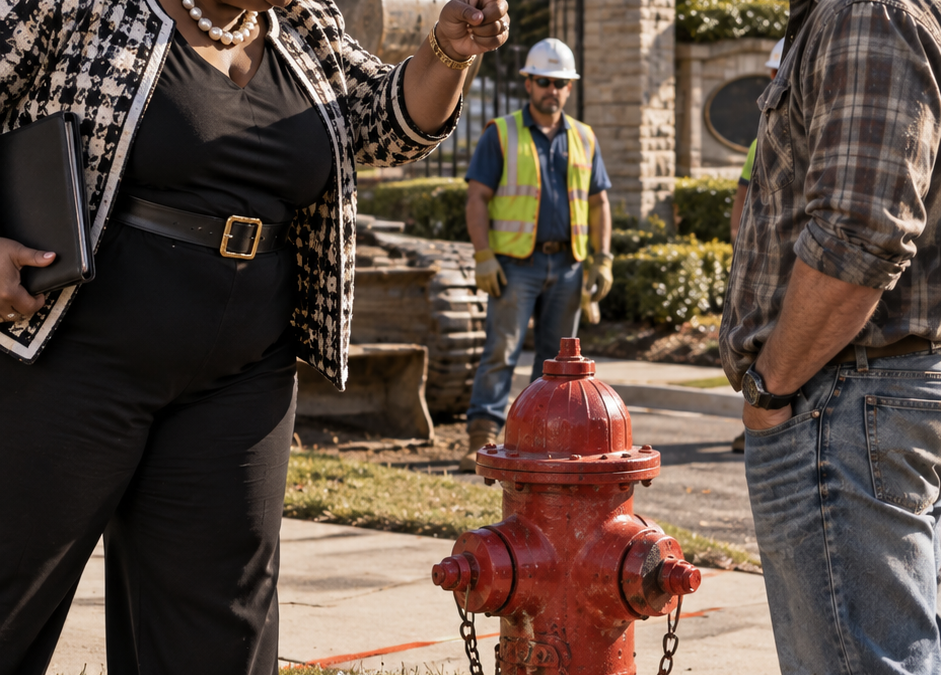
𝗣𝗔𝗥𝗧 𝟮
It took me maybe twenty seconds.
No lecture.
No confrontation.
Just information.
Blythe looked me up and down.
I’d spent the afternoon repairing a neighbor’s damaged fence, so I was wearing work jeans, old boots, and a shirt with a tear near one elbow.
“Calvin,” she said, “fixing fences doesn’t make you an engineer.”
The room laughed.
Not everybody.
But enough.
I felt the heat reach my face.
There was a version of me twenty years younger who would have answered immediately.
He would have listed credentials.
He would have explained pressure zones and branch valves and distribution mains until nobody was laughing anymore.
But age had taught me something useful.
A man who leads with his résumé usually looks like he’s trying to win respect.
A man who leads with a permit number usually doesn’t have to.
So I nodded.
Sat down.
And said nothing else.
What Blythe didn’t know was that before I retired, I had spent nineteen years working for a municipal water system.
The last seven of those years I had been a field operations supervisor coordinating work between water utilities, private developers, contractors, inspectors, and fire-prevention officials.
Projects exactly like this one had been my job.
I knew how utility easements worked.
I knew how hydrants were inventoried.
I knew how fire-flow models were calculated.
I knew how a seemingly insignificant change on a landscape drawing could become a life-safety problem three pages later.
But Blythe hadn’t asked what I knew.
She had looked at my clothes and decided.
That was her first mistake.
The next morning, I walked outside at 6:15 to pick up the newspaper.
I was wearing slippers.
Coffee in one hand.
The sun wasn’t fully up yet.
That’s when I saw the paint.
White markings surrounded the hydrant.
A clean circle.
Offset marks.
An arrow.
Then more lines extending toward the street.
I stopped walking.
White paint means proposed excavation.
Anyone who spends enough years around buried utilities develops an almost involuntary reaction to markings like those.
Red.
Electric.
Yellow.
Gas.
Blue.
Water.
White.
Dig here.
I followed the markings with my eyes.
They didn’t stop around the hydrant barrel.
They extended toward the main.
That bothered me.
Moving a decorative object is one thing.
Opening ground around a live public water main is another.
That requires planning.
Shutdown coordination.
Licensed personnel.
Authority approval.
And because this was a fire hydrant, notification to the fire district before the supply point was taken offline.
My coffee went cold while I stood there.
I didn’t call Blythe.
I didn’t send an angry email.
I went inside.
Put on boots.
And waited.
At eight o’clock, a white pickup with a magnetic contractor sign pulled up near the entrance.
A man climbed out carrying a clipboard.
His name was Nolan Beckett.
He owned the landscaping and hardscape company the HOA had hired.
Nolan was in his early fifties.
Sun-browned skin.
Work boots.
A contractor’s posture—the slight forward lean of someone whose back had spent too many years lifting things younger men should have lifted.
I’d seen his company’s work around the county.
It was good work.
That told me he probably wasn’t reckless by nature.
I walked down.
“Morning.”
He looked up.
“Morning.”
“Calvin Rhodes. That’s my property.”
I pointed behind the easement.
“Nolan Beckett.”
We shook hands.
I nodded toward the hydrant.
“You have authorization from the water authority to work on that?”
His eyes moved to the hydrant.
Then back to me.
There was a pause.
Not long.
But long enough.
He lifted his clipboard.
“The association handled approvals.”
“Can I see what you’re working under?”
He hesitated again.
Then handed me a single-page work order.
Redwood Crest letterhead.
Project description:
REMOVAL AND RELOCATION OF EXISTING HYDRANT OBSTRUCTION — ENTRANCE IMPROVEMENT PHASE ONE.
At the bottom was one signature.
Blythe Carrington.
President.
That was it.
No water-authority permit.
No utility case number.
No fire-district authorization.
No shutdown coordination number.
Not even a place on the form where those approvals should have been listed.
“Nolan.”
“Yeah?”
“There isn’t a permit number on this.”
“I was told everything was handled on their side.”
“What exactly are you doing?”
“Excavating around it.”
“And then?”
He looked toward the markings.
“Remove the unit.”
“Relocate it where?”
He flipped through the pages beneath the work order.
Then he said something that made my stomach tighten.
“Plan says cut and cap existing stub.”
I looked at him.
“That’s not relocation.”
He looked at the paper again.
His expression changed.
Because he knew I was right.
Relocation means another approved location.
New connection.
Testing.
Clearances.
Flow verification.
Cut and cap meant something much simpler.
Remove the hydrant.
Seal the branch.
Make it disappear.
Nolan rubbed his thumb across the clipboard edge.
“I just build what’s on the plans.”
“I understand.”
And I did.
Contractors rely on owners all the time for permits outside their scope.
But this was the moment when relying stopped being comfortable.
I handed the work order back.
“You might want to verify this yourself.”
He didn’t argue.
An hour later, I found Blythe near the entrance.
She stood beside the landscape architect studying rolled drawings.
When she saw me approaching, her entire posture changed.
Shoulders straight.
Chin slightly higher.
Her body prepared for the argument before I had spoken.
“Blythe.”
“Calvin.”
“The hydrant is on a public main.”
“We’ve discussed this.”
“No. You dismissed it.”
The architect looked down at the drawing.
I continued.
“That utility easement isn’t under association control. That hydrant is part of a municipal system. Removing it without authorization affects fire-flow coverage.”
She waited until I finished.
Then she said, “I run this association. You just live in it.”
I almost laughed.
Not because it was funny.
Because it was such a complete statement of how she saw authority.
“I own the property behind that easement.”
“The entrance is common area.”
“Not all of it.”
Her eyes narrowed.
“Part of my frontage predates the common-area conveyance. But that doesn’t matter anyway. The water authority’s easement does. Neither you nor I own what’s under it.”
“The board approved the project.”
“The board can’t approve removing public infrastructure.”
“The professionals working on this project disagree with you.”
“Then ask them for the permit number.”
She looked at Nolan.
Then at me.
Her voice became colder.
“The community has waited long enough for an entrance that reflects the quality of these homes. I will not allow the schedule to be held hostage because one resident has an opinion.”
“It isn’t an opinion.”
“Remove that hydrant,” she said.
She wasn’t talking to me anymore.
She was talking to Nolan.
Loudly.
“I want it gone before Friday.”
The architect stayed very still.
Nolan looked uncomfortable.
I could have made a scene.
Could have stood in front of equipment.
Could have called her reckless.
Could have told everyone within earshot exactly who I used to be.
I didn’t.
I walked home.
Got my phone.
And documented everything.
The white excavation markings.
The county identification tag bolted to the hydrant bonnet.
The work order with Blythe’s signature.
The stake line.
The main alignment.
The location relative to the entrance.
Everything.
That evening, I sat at my kitchen table and enlarged the photograph of the work order.
One line caught my attention.
CAP EXISTING STUB.
Not relocation.
Removal.
I slept badly.
The next morning, Wednesday, I sent an email.
To Blythe.
The full board.
Graham Pike, our community manager.
Nolan Beckett.
Six sentences.
No anger.
No adjectives.
I stated that the hydrant was public infrastructure located within a recorded easement.
I stated that I had seen no authorization allowing the HOA to remove or deactivate it.
I stated that any such action could affect the subdivision’s approved fire-protection configuration.
Then I asked for the permit number.
Attached were three photographs.
I sent it at 7:40 a.m.
Then saved a copy.
Blythe never answered the question.
Instead, on Thursday afternoon, Redwood Crest residents received a community notice.
It said the entrance project was being delayed by interference from a resident.
It claimed the resident had harassed contractors.
It claimed that resident was obstructing lawful common-area work and spreading unfounded allegations about permitting.
The letter warned that approximately eleven thousand dollars in project deposits could be placed at risk and that additional costs might eventually be borne by homeowners.
She never used my name.
She didn’t need to.
Everybody knew which resident lived beside the hydrant.
Two days later, I received an HOA violation notice.
Four hundred dollars.
Reason:
Interference with association vendors and contractors.
I read it twice.
Four hundred dollars because I asked whether somebody had a permit before cutting into a public water system.
That one hurt more than I expected.
Not financially.
The amount was irritating, but manageable.
What bothered me was how easily a piece of paper could reverse the moral positions of two people.
I had tried to stop damage.
She now had a letter making me look like the person causing trouble.
At the April meeting, nearly every chair was occupied.
People love meetings when someone else is being publicly disciplined.
Blythe opened with the entrance rendering.
Then moved to what she called “the compliance matter.”
She actually read part of my email aloud.
Slowly.
Performing the technical phrases as though they were evidence of arrogance.
When she reached my reference to the approved fire-protection system, she lowered the page.
“Apparently,” she said, “Mr. Rhodes now believes he’s the fire department.”
There was laughter.
Less than in March.
But enough.
I waited.
Eventually public comment opened.
I stood.
Blythe looked ready.
She probably expected a speech.
I gave her one sentence.
“Give me the permit number.”
The room went silent.
She blinked.
“Excuse me?”
“The permit authorizing removal of that hydrant. Give me the number.”
She looked toward Graham.
Graham studied his tablet.
Then she smiled.
“Permitting is an administrative matter handled by management and the contractor. We are not turning a board meeting into a paperwork seminar.”
And just like that, I knew.
There was no permit.
Not delayed.
Not sitting in someone’s inbox.
Not approved but misplaced.
It didn’t exist.
Blythe immediately moved on to the next agenda item.
Holiday wreaths on garage doors.
I sat there while people debated artificial greenery and understood that she planned to remove a public hydrant using momentum as a substitute for authority.
That weekend, I went to the county records office.
I pulled the original Redwood Crest subdivision file.
Twenty-three years old.
Nine hundred forty dollars by the time I had everything copied and certified that I wanted.
Buried behind plats, grading drawings, stormwater calculations, and utility sheets was the original approved fire-protection plan.
And there was the hydrant.
Mine, as everybody casually called it.
Except it wasn’t mine.
It had a designation.
A location.
A modeled service area.
Most importantly, it had been counted as an existing public fire-supply point when Redwood Crest was approved.
I traced the coverage map with my finger.
Then I understood why its removal mattered even more than I had thought.
Because the developer had been allowed to count that existing hydrant toward required coverage, fewer additional hydrants had been installed along one portion of the interior loop.
Remove this one and the model changed.
Inside its affected zone were the clubhouse.
Fitness center.
Pool mechanical building.
Association office.
And part of an active clubhouse expansion.
I sat alone in my truck afterward with the file on the passenger seat.
For the first time, I felt afraid.
Not for myself.
For how casually this had happened.
One person wanted symmetry.
One signature turned that preference into a work order.
And suddenly part of a neighborhood’s fire-protection plan was being treated like unwanted landscaping.
I made copies.
Then I stopped warning people.
There comes a point when repeatedly telling someone not to touch a hot surface begins to feel like helping them pretend they didn’t understand the first warning.
Friday morning, the excavator arrived at 7:05.
Four men.
Traffic cones.
Mini excavator.
Pickup trucks.
Quick-set concrete.
Tools.
At 7:20, Blythe’s white SUV appeared.
She parked almost directly opposite my mailbox.
The landscape architect arrived next.
Someone unfolded a small table.
Someone else brought pastries.
It looked absurdly close to a groundbreaking celebration.
I walked down.
Nolan was setting up a grade laser.
“Last chance,” I said.
He stopped.
“Do you have authorization from the district?”
He rubbed the back of his neck.
Then, to his credit, he told me the truth.
“The association provided written direction saying they have private infrastructure authority within the entry common area.”
I stared at him.
“Private infrastructure authority?”
“That’s what I was given.”
“Over a public main?”
“They said the hydrant was part of the landscape zone and outside agencies had no jurisdiction over decorative frontage.”
There are phrases so wrong they become impressive.
Private infrastructure authority was one of them.
I didn’t argue.
Nolan wasn’t inventing it.
He was repeating what somebody had told him.
Blythe crossed the grass.
Her heels sank slightly into the damp soil.
“This,” she said loudly, “is what happens when a man who doesn’t understand ownership decides he’s smarter than the attorneys.”
Two neighbors walking dogs slowed down.
The architect pretended to study his drawings.
I looked at Blythe.
“I hope your attorneys have seen the fire-flow map.”
Something flickered across her face.
Tiny.
Less than a second.
But I saw it.
Then she turned away.
“Nolan. Proceed.”
At eight, they started digging.
I sat on my porch.
That sounds passive.
It didn’t feel passive.
Every bucket of dirt the excavator lifted made something inside me tighten.
I had spent almost twenty years around utility crews.
I knew exactly what I was watching.
They exposed the hydrant barrel.
Found the branch deeper than expected.
Needed different tools.
Sent someone for a torque wrench.
Worked around the flange.
Around 11:40, the connection finally broke free.
They isolated the branch at the auxiliary valve.
Lifted the hydrant with a strap.
Red iron rose slowly from the excavation.
Then they placed it on the grass beside my driveway.
It looked strangely helpless lying on its side.
Red paint scratched.
Bonnet tilted toward the road.
County asset tag still bolted in place.
They capped the stub.
Backfilled with gravel.
Tamped the opening.
Blythe stood beside the architect looking at the new empty space.
She smiled.
Not cruelly.
That would almost have been easier.
She smiled with relief.
Like the problem had finally been solved.
I took one photograph.
The hydrant lying sideways.
Identification tag visible.
Capped branch behind it.
Timestamp:
11:52 a.m.
Then I went inside.
At 12:09, I emailed the county fire-prevention division.
Subject:
UNAUTHORIZED REMOVAL OF PUBLIC HYDRANT — REDWOOD CREST EAST ENTRANCE.
Four sentences.
Address.
Asset number.
Date.
I attached the photograph.
Blythe’s signed work order.
The original approved fire-protection plan.
And the coverage overlay.
Then I closed the laptop.
At 3:40 that afternoon, a white county SUV entered Redwood Crest.
Fire Marshal Everett Sloan stepped out.
He was close to sixty.
Gray hair at the temples.
Pressed uniform shirt.
Badge.
Reading glasses hanging from his collar.
No lights.
No siren.
No dramatic entrance.
Just a man carrying a clipboard and measuring wheel.
He stood near the entrance for several seconds.
Looked at the fresh gravel.
Then looked at the hydrant lying in the grass.
The crew went quiet.
Everett walked to the excavation.
Crouched.
Placed one palm against the compacted gravel.
Looked at the capped branch.
Then stood.
“Who authorized this hydrant to be taken out of service?”
Blythe moved quickly.
“I’m Blythe Carrington, president of the Redwood Crest Homeowners Association.”
She extended her hand.
Everett shook it once.
“We’re completing a board-approved entrance improvement,” she said. “The hydrant was located within the common-area design footprint and is being relocated.”
“Permit number?”
Her rhythm broke.
“I’m sorry?”
“The authorization number for taking the hydrant out of service.”
“Our community manager handles project documentation.”
Everett turned.
Graham Pike had appeared from the office carrying his tablet.
“Mr. Pike?”
Graham began scrolling.
Nobody spoke.
The silence stretched.
One contractor shut off the compactor.
Suddenly I could hear a sprinkler running somewhere down the street.
A truck passing on the county road.
Birds.
Everything except a permit number.
Everett turned toward Nolan.
“What are you working under?”
Nolan handed him the HOA work order.
Everett put on his glasses.
Read the entire page.
Turned it over.
The back was blank.
He looked at Blythe.
“This is authorization from a homeowners association.”
“Yes.”
“Where is the fire-district authorization?”
Blythe looked toward Nolan.
“The contractor represented that permitting was included in his scope.”
Nolan’s jaw tightened.
It happened instantly.
Six weeks of authority disappeared in one sentence.
Blythe had ordered him forward.
Now an official was asking questions, and suddenly the contractor was responsible.
Nolan spoke carefully.
“I was given written direction from the association stating it held authority over improvements within the entrance common area and that outside approval wasn’t required.”
Everett wrote something.
No reaction.
No judgment.
Just notes.
I stood near my driveway with my hands in my pockets.
That was harder than it sounds.
There is an enormous temptation to narrate your own vindication.
To say, I told you.
To point.
To explain.
I didn’t.
Everett walked the site.
Measured.
Photographed the hydrant.
The capped branch.
The easement area.
Valve box.
Road position.
Then he pulled out a tablet.
Compared what he saw to something on the screen.
Made a call.
Thirty minutes later, a regional water-authority truck arrived.
A woman in a reflective vest and hard hat stepped out carrying a laptop bag.
Dana Holloway.
She was a utility engineer.
She and Everett spread drawings across the hood.
Talked quietly.
Then Dana walked over to the excavation.
She stood there for several seconds.
I knew that expression.
I’d worn it myself years before.
It was the look utility people get when they find something in the ground that shouldn’t have happened.
Blythe approached.
“The board approved a relocation as part of—”
Dana interrupted.
“This hydrant belongs to the municipal distribution system.”
Blythe stopped.
Dana pointed toward the capped branch.
“That main is a public asset. The hydrant is inventoried in the authority’s system. The valve is ours. The branch is ours. The easement is recorded for utility access.”
“The surrounding area is HOA common property.”
“That doesn’t transfer ownership of infrastructure.”
Blythe opened her mouth.
Dana continued.
“Your association does not own the hydrant, the barrel, the branch, the valve, or the main.”
Then she said it plainly.
“You had no authority to remove it.”
Blythe turned her head.
Her eyes found me.
For maybe three seconds, neither of us moved.
I could see the realization forming.
Municipal main.
Recorded easement.
Fire-flow coverage.
The exact phrases I had been using for weeks.
At the board meeting.
In writing.
Beside the excavation markings.
To the contractor.
She had dismissed those words because they came from me.
Now they were coming from a county fire marshal and utility engineer.
That was the moment Blythe finally understood I hadn’t been guessing.
I thought Everett would simply order the hydrant restored.
He didn’t.
What he did was worse.
He turned to Graham.
“How many structures are currently operating under this subdivision’s approved fire-compliance plan?”
Graham frowned.
“I don’t understand.”
I did.
Everett explained.
When Redwood Crest had been approved, its hydrants, water availability, access lanes, and calculated fire flow had formed part of a single protection plan.
Certain buildings had been allowed to operate because that approved protection system existed.
Remove a primary supply point and the underlying conditions changed.
Not because a box was missing on paperwork.
Because the water source represented by that box was physically unavailable.
Dana brought up the coverage overlay.
She placed it on the truck hood.
Traced the affected zone.
Clubhouse.
Fitness center.
Pool mechanical building.
HOA office.
And the partially completed clubhouse expansion.
Everyone leaned closer.
Blythe stared at the drawing.
Then she said the sentence I remember better than almost anything else.
“You can’t shut down an entire project over one hydrant.”
Everett looked at her.
“I’m not shutting anything down over a hydrant, ma’am.”
His voice was calm.
“You removed an approved component from the fire-protection system your buildings were certified under. I’m responding to the condition that exists now.”
No anger.
No satisfaction.
Just cause and effect.
He issued a stop-work order for the entrance project.
No more excavation.
No footing.
No stonework.
No vertical construction.
He suspended the clubhouse expansion permit pending restoration of the fire-supply point.
Then he informed Graham that the clubhouse, fitness center, and association office couldn’t continue normal occupancy unless either the hydrant was restored or an approved temporary measure was put in place.
He gave them options.
A coordinated temporary supply arrangement.
Or a documented fire watch during occupied hours.
At association expense.
What he didn’t do was equally important.
He didn’t order residents out of their homes.
He didn’t condemn houses.
He clearly explained that residential properties served along public streets were different from the assembly and business occupancies being reviewed under this specific certification.
I watched homeowners nearby visibly relax.
And I watched Blythe realize she couldn’t portray him as irrational.
His response was narrow.
Documented.
Proportional.
Then Everett looked toward me.
“You filed the report?”
“Yes.”
“Walk this with me.”
We started along the frontage.
I showed him the main alignment.
The auxiliary valve.
Explained why the branch isolation mattered.
Based on the valve location, the hydrant could be restored without shutting down the entire eastern loop.
I mentioned the original system design.
How Redwood Crest had been allowed to count the existing hydrant toward coverage and therefore had fewer interior hydrants than someone might otherwise expect.
Then I gave him the asset number from memory.
He stopped.
Looked at me.
“You’ve done this before.”
“Some.”
“How much?”
“Nineteen years.”
Behind us, nobody spoke.
“I was a field operations supervisor for a municipal water system.”
Everett’s eyebrows lifted.
“The last seven years I coordinated developer work with water operations and fire prevention.”
I heard movement behind me.
But I didn’t turn.
There was nothing dramatic about my history.
I wasn’t secretly a commissioner.
I didn’t own the utility.
I had simply spent a large part of my adult life standing between drawings and physical infrastructure, explaining why one couldn’t always be forced to match the other.
Architects would say a wall needed to sit here.
I’d explain why a valve needed access there.
Developers wanted a driveway shifted three feet.
Fire prevention needed a turning radius maintained.
My job was rarely telling people no.
It was helping them find the version that worked.
Four years earlier, I had retired sooner than expected.
Back surgery and a funeral happened in the same month.
After that, I was tired in a way sleep didn’t fix.
So I moved toward a quieter life.
A little consulting.
Repair work.
Helping neighbors.
No crews.
No emergency calls at two in the morning.
No meetings where everybody stared at a utility map while something expensive leaked underground.
I never announced any of that in Redwood Crest.
Nobody asked.
I wore jeans.
Owned tools.
Fixed fences.
People filled in the rest themselves.
Dana Holloway suddenly looked at me more closely.
“Rhodes?”
I looked at her.
She named a pump-station rehabilitation project from almost a decade earlier.
I laughed.
“That was me.”
“You’re the bypass-sequencing guy.”
“You’re still angry about that?”
“It was January.”
“It worked.”
“It nearly froze my crew.”
We both laughed.
Thirty seconds.
Maybe less.
Then Dana went back to her laptop.
But I saw Blythe.
That tiny exchange hurt her position more than any speech I could have given.
She walked toward me.
This time her voice was quieter.
“If you knew all of this, why didn’t you explain it clearly from the beginning?”
I looked at her.
I had spent six weeks swallowing anger.
Suddenly I didn’t feel angry anymore.
“I did.”
“No, Calvin, you—”
“I told you at the March meeting.”
She stopped.
“You told the room fixing fences didn’t make me an engineer.”
Her face tightened.
“I told you again when the excavation markings appeared.”
“I don’t remember—”
“You told me you ran the association and I just lived in it.”
She looked away.
“I emailed the full board Wednesday morning. Photographs attached. Asked for the permit number.”
“That email was unnecessarily—”
“You answered by accusing me of harassment and fining me four hundred dollars.”
She said nothing.
“I asked Nolan twice.”
Nolan stood a few yards away listening.
“The second time was less than half an hour before his crew broke the flange.”
I took one breath.
“I said it every way a person can say it.”
Blythe looked at me.
“You didn’t need better information,” I said. “You needed the information not to come from me.”
That one landed.
She didn’t answer.
For six weeks, Graham Pike had mostly survived by staring at his tablet whenever conflict began.
That afternoon, he finally lifted his head.
“I’ll provide the county with the complete project correspondence.”
Blythe turned toward him.
“Graham—”
“The complete file.”
He said it calmly.
Everett requested it formally.
By that evening, the county had it.
By two days later, the board had it.
And buried in those emails was the line that ended every excuse Blythe had left.
Eleven days before the excavator arrived, Graham had emailed her:
The hydrant appears on county mapping rather than association asset records. We should verify with the fire district first.
Blythe replied nine minutes later.
We don’t need another bureaucrat telling us where to put our entrance.
There it was.
Written warning.
Written refusal.
Signed work order.
Same project.
Same president.
She hadn’t been surprised by the possibility of outside jurisdiction.
She had been warned.
She had consciously chosen not to check.
Everett then asked for the entire entrance file.
Design drawings.
Original plans.
Revisions.
Landscape package.
Change orders.
Vendor scope.
Everything.
When an inspector asks for everything, it usually means he no longer believes the problem is isolated.
Four days later, we learned he was right.
The hydrant wasn’t the only problem.
The revised entrance design had moved both stone pillars inward.
The change made the monument composition tighter and more symmetrical.
It also reduced the clear entrance width to eighteen feet three inches.
Required fire-apparatus access was twenty feet.
Then there was the curve.
Immediately beyond the pillars, the road bent.
That meant turning radius mattered.
A ladder truck is not impressed by architectural symmetry.
It’s long.
Heavy.
And governed by geometry.
Under the revised entrance layout, the county’s apparatus could not reliably make the turn without risking contact with a pillar.
These weren’t lightweight decorative columns either.
They were cut limestone on reinforced footings.
If the entrance had been completed according to the revised design, Redwood Crest would have created a permanent restriction at its primary emergency access point.
The irony was painful.
The hydrant had been removed because it interfered with the eastern pillar.
The eastern pillar had been pulled inward because Blythe wanted symmetry.
And the same redesign that required the hydrant to disappear also narrowed the fire-access lane below the required width.
Everything traced back to the same decision.
Appearance first.
Verification later.
At the emergency meeting, the landscape architect produced his original drawing.
In that version, the entrance throat was twenty-two feet wide.
The pillars were farther apart.
And the hydrant was still there.
The landscape bed simply curved around it.
A protective bollard sat on the traffic side.
The design worked.
“What changed?” a board member asked.
The architect looked uncomfortable.
“I was directed to improve visual symmetry and monument prominence.”
“By whom?”
His eyes moved toward Blythe.
“The president.”
“Were you told the hydrant could be removed?”
“Yes.”
“By whom?”
“The association.”
Blythe leaned toward her microphone.
“We were working from the understanding that the issue would be resolved separately.”
The word resolved hung in the room.
We all knew what it meant now.
The entire entrance contract was worth about one hundred eighty thousand dollars.
All of it stopped.
Nolan submitted costs for demobilization.
Standby time.
Restocking.
Materials already cut for the revised configuration.
The hydrant restoration required an approved utility contractor.
New excavation.
Inspection.
Pressure testing.
Flow testing.
Coordination.
Meanwhile, the clubhouse expansion permit remained suspended.
The HOA chose to maintain limited occupancy through a licensed fire watch.
Two people.
Hourly documented patrols.
Every hour the clubhouse or fitness center was open.
For nineteen days.
Every resident walking through the clubhouse doors saw them.
Two adults with radios and log sheets standing there because the president had removed a hydrant after being told not to.
That did more to change neighborhood opinion than anything I ever said.
Graham stopped defending Blythe during the first week.
He didn’t attack her.
I respected that.
He simply began answering questions completely.
With documents attached.
It turned out that was enough.
A week after the shutdown, I was leaving the clubhouse when Blythe confronted me in the parking lot.
About a dozen people were nearby.
“You did all of this because you hate this association.”
I looked at her.
“No.”
“You’ve fought us at every step.”
“I asked for a permit.”
“You knew calling the county would stop the project.”
“I knew removing a public hydrant without authorization was a problem.”
“You wanted this.”
That hurt.
Because I hadn’t.
I didn’t want contractors losing work.
I didn’t want the HOA paying for fire watch.
I didn’t want residents watching dues disappear into legal review.
I didn’t want Nolan eating costs on materials ordered from a plan he had been told was approved.
“I did it,” I said, “because somebody who doesn’t own a water main shouldn’t be ordering it cut.”
Everett Sloan was ten feet away putting paperwork into his county SUV.
He heard me.
Didn’t look up.
Didn’t comment.
A minute later, he walked to the entrance and attached a bright orange stop-work notice to the temporary construction fence.
Directly beneath the foam-board rendering of Blythe’s perfect entrance.
The rendering stayed there.
So did the orange notice.
For eleven days.
Every morning, I passed the two together.
One showed what somebody wanted the world to look like.
The other showed what happened when reality wasn’t consulted.
The full emergency board meeting took place on a Thursday evening.
The clubhouse was open only because the fire watch was stationed inside.
Nobody missed the symbolism.
Every resident entering the meeting walked past a person carrying a radio and log sheet.
The room felt nothing like the March meeting.
Nobody laughed when I entered.
A woman I barely knew saved me a chair.
Graham presented the financial impact.
Hydrant restoration.
Utility inspection.
Pressure testing.
Fire-flow verification.
Revised entrance engineering.
New plan review.
Contractor demobilization.
Material restocking.
Fire watch.
Legal consultation.
Additional project management.
The number had grown far beyond the eleven-thousand-dollar deposit Blythe had once warned residents I was endangering.
But money wasn’t what made the room angry.
The authorization trail did.
A homeowner asked whether the board had voted to remove the hydrant.
Graham answered.
“No.”
“Did the board vote on the revised pillar locations?”
“No.”
“Did we vote to narrow the entrance?”
“No.”
“Who approved the change order?”
Graham took a breath.
“President Carrington, under delegated project authority.”
That was the real problem.
The board had approved an entrance renovation.
It had not approved every later design choice.
Blythe had treated delegated authority as ownership.
Another resident stood.
“So one person changed the design, moved the pillars, ordered public infrastructure removed, and exposed us to all of these costs?”
Blythe leaned toward the microphone.
“That is a gross oversimplification.”
“What part is wrong?”
She began talking about project management.
Professional consultants.
Administrative discretion.
The complexity of board governance.
Then she turned toward me.
“This entire situation was escalated by a resident with a longstanding personal grievance who bypassed appropriate channels rather than bringing his concerns constructively to the association.”
That was when I stood.
I didn’t say anything at first.
I walked to the projector.
Placed one sheet beneath the document camera.
My email appeared on the screen.
Wednesday.
7:40 a.m.
Full board.
Community manager.
Contractor.
Photographs attached.
Fourth sentence:
Please provide the applicable permit or authorization number before any work affecting the hydrant or service branch proceeds.
Then I placed beside it the photograph of the hydrant lying on the grass.
Timestamp:
11:52 a.m.
Nine days later.
I turned toward the room.
“You can dislike the way I talk to you.”
Nobody moved.
“You can think I’m difficult.”
I looked at Blythe.
“But you cannot say nobody warned you.”
Then I sat down.
No speech.
Nothing else was necessary.
That night, the board voted.
First, Blythe’s unilateral authority over project change orders and vendor work orders involving common-area infrastructure was revoked.
Going forward, such changes required a recorded board majority.
Second, the board authorized an internal review of every entrance-project document signed during the current term.
Third, my four-hundred-dollar violation was rescinded.
Unanimously.
Fourth, the association was required to issue a correction to the notice that had accused me of obstructing lawful work and harassing contractors.
That mattered more than I expected.
I’d spent weeks pretending the accusation didn’t bother me.
It did.
Not because everyone believed it.
Because some did.
You can live beside people for eleven years, help repair their fences, lend tools, watch their dogs, jump-start their cars, and one official-looking notice can make them wonder whether they ever understood you.
The correction couldn’t fully undo that.
But it helped.
Nobody arrested Blythe.
Nobody escorted her from the clubhouse.
There were no flashing lights.
No handcuffs.
No dramatic resignation speech.
She simply sat in a folding chair at the same long table where she had spent two terms controlling meetings and watched authority move away from her by recorded vote.
Quietly.
Procedurally.
The same mechanisms she had used against me now limited her.
I expected to feel satisfaction.
Instead, I felt something closer to sadness.
Because none of this had needed to happen.
The hydrant was restored five weeks later.
This time, everything happened correctly.
A qualified water contractor excavated the branch.
Removed the cap.
Installed the updated barrel and breakaway assembly.
Coordinated the valve operation.
Pressure tested the connection.
Flushed it.
Dana Holloway performed the required flow testing.
The eastern zone met the approved model again.
She signed the report.
Everett returned after the restoration.
Checked access clearance.
Reviewed documentation.
Released the clubhouse-expansion suspension.
A crew painted the hydrant afterward.
Fresh municipal red.
The kind of red designed to clash with everything around it.
That’s the point.
Fire hydrants are not supposed to disappear into landscaping.
The entrance project resumed.
But not according to Blythe’s revised plan.
The pillars went back outward.
The finished throat measured twenty-two feet six inches.
The monument wall moved behind them rather than squeezing between them.
The ornamental pear rows were shortened.
Seven trees per side instead of nine.
The road had room.
The truck had room.
The hydrant had room.
It stood in a shallow river-rock bed with a low protective bollard beside it.
Almost exactly where the architect had placed it in his original drawing.
The first design.
The one that had worked before somebody decided perfect symmetry mattered more than everything else.
And here’s the part that would have irritated Blythe most.
The entrance looked better.
The wider spacing gave the stone monument more presence.
The landscaping had room to breathe.
Drivers could actually see farther through the approach.
More than one homeowner said the same thing.
Nobody said it to Blythe.
I went down the morning after the hydrant received its final coat of paint.
Coffee in hand.
Just like the morning when I first found the excavation markings.
The red was almost embarrassingly bright.
I stood there looking at it.
A piece of iron.
Bolts.
Valve.
Barrel.
Paint.
Something I had somehow spent months defending.
For a second, I felt ridiculous.
Then I remembered what it supplied.
What it represented.
Not symbolically.
Literally.
Water.
Pressure.
Time.
The difference between firefighters arriving with one usable supply point and discovering somebody had removed it because it interfered with a stone column.
“You look pleased with yourself.”
I turned.
Blythe had come out of the association office.
No architect.
No drawings.
No contractors following her.
She looked older than she had in March.
Not dramatically.
Just tired.
I looked back at the hydrant.
“No.”
“You’ve been waiting for this.”
“For the hydrant to be restored?”
“For me to be proven wrong.”
There was a time when I might have enjoyed answering that.
I didn’t anymore.
“I like things that matter being where they belong.”
She gave a humorless little laugh.
“That’s very noble.”
“Nothing noble about it.”
“You humiliated me.”
I looked at her then.
There was genuine pain in her face.
And for the first time, I wondered whether she really understood the difference between being contradicted and being humiliated.
“I tried to tell you privately.”
She folded her arms.
“You could have told me who you were.”
“I did.”
“No. You didn’t.”
“I told you what the hydrant was.”
She didn’t answer.
“That was the part that mattered.”
“You let me think you were just—”
She stopped herself.
“Just what?”
Her eyes dropped.
I knew.
The maintenance guy.
Mr. Fix-It.
The man in dirty jeans.
The neighbor who repaired fences.
Someone useful enough when a gate sagged but not important enough to understand infrastructure.
“I shouldn’t have needed nineteen years of experience for you to check a permit,” I said.
She looked toward the entrance.
“I had professionals.”
“So did I when I worked in utilities.”
I took a sip of coffee.
“Good professionals still verify things.”
She said nothing.
“The moment Graham told you the hydrant appeared on county mapping, all you had to do was make one phone call.”
Her jaw tightened.
“I was trying to finish what I’d promised people.”
“I know.”
That surprised her.
“And once you’ve promised people something, every obstacle starts feeling personal.”
Her eyes met mine.
“I understand that.”
For a moment, neither of us spoke.
Cars entered through the new gateway.
Twenty-two feet six inches of clear access.
The hydrant stood untouched beside them.
Finally Blythe said, “You think I cared more about a monument than safety.”
“I think you cared so much about the monument that you stopped asking whether the people disagreeing with you might know something.”
She absorbed that quietly.
Then she walked to her car.
At the next election, Blythe did not run again.
Her name disappeared from the president’s placard.
Nobody forced her out in disgrace.
Nobody held a celebration.
Her term ended.
That was enough.
The new president was a retired schoolteacher named Marjorie.
Marjorie reads everything twice.
Sometimes three times.
She calls county departments about questions that are nowhere close to becoming problems.
People joke about it.
I don’t.
I like Marjorie.
Nolan came by after the project closed.
He stood beside the restored hydrant with his hands in his pockets.
“I should’ve stopped.”
“You were given a signed work order.”
“I still should’ve stopped.”
“You asked questions.”
“Not enough.”
He looked at the hydrant.
“I knew cut and cap didn’t sound right.”
I nodded.
“That part was yours.”
He accepted it.
That mattered.
Responsibility is a strange thing.
The people least willing to accept it usually have the longest explanations.
Nolan’s explanation took six words.
I should have checked it myself.
We shook hands.
He has done work in Redwood Crest since.
Good work.
And I’ve noticed something.
Whenever one of his crews arrives near utility markings, somebody has a permit folder in the truck.
Graham stayed as community manager.
For several months our conversations were awkward.
Then one afternoon, he stopped at my house.
He handed me an envelope.
Inside was the formal rescission of the fine and the association’s corrected notice.
“I should have pushed harder,” he said.
“You warned her.”
“Once.”
“You had a job.”
“That doesn’t mean I couldn’t have done it better.”
I looked at him.
“You know what the dangerous word in that sentence is?”
“What?”
“Could.”
He smiled.
“What should I have done?”
“Next time somebody tells you they don’t need another bureaucrat asking questions, call the bureaucrat.”
That got a real laugh.
He left.
Life in Redwood Crest returned to its normal level of ridiculousness.
Parking complaints.
Pool rules.
Fence colors.
Someone started a three-week argument about whether solar pathway lights counted as permanent exterior illumination.
The world survived.
I went back to repairing things.
I still take occasional consulting work.
Still help neighbors.
Still own too many tools.
And every evening when I sit on my porch, I can see the entrance.
Limestone catches the late sun.
The pear trees are filling out.
The bronze letters shine when the light hits them.
And beside all of it stands a bright red hydrant on a strip of ground that doesn’t belong to Blythe.
Doesn’t belong to the HOA.
Technically doesn’t belong to me either.
It belongs to the public system that keeps water available when somebody’s worst day arrives.
Sometimes I think about why the whole thing became such a fight.
It wasn’t really because Blythe hated hydrants.
It wasn’t because I hated the HOA.
It wasn’t even about a stone pillar.
The problem was how Blythe understood power.
She believed authority meant being able to issue an instruction and watch other people carry it out.
She was president.
She had a budget.
She had a contractor.
She had a board mandate.
Therefore, in her mind, she had authority.
But real authority has edges.
Always.
Property lines.
Easements.
Permits.
Codes.
Jurisdiction.
Recorded votes.
Delegated powers.
You don’t become weaker by knowing where your authority ends.
You become safer.
I spent nineteen years learning that.
There were hundreds of times when somebody asked me to approve something and my answer had to be, “That’s not mine to authorize.”
Sometimes they were irritated.
Sometimes they called another department.
Sometimes a project slowed down.
But nobody woke up one morning to discover we’d removed something we didn’t own because I was afraid of sounding powerless.
Blythe never learned that distinction until it cost everybody money.
The frustrating part is that she had been one phone call away from avoiding all of it.
The architect’s original entrance was already compliant.
The hydrant could stay.
The pillars could stay.
The monument could be built.
The trees could be planted.
The board could have had almost everything it wanted.
Nobody had to lose.
But once Blythe framed the hydrant as an obstacle, every person who defended it became an obstacle too.
First the utility.
Then me.
Then Graham.
Then the contractor’s hesitation.
Then eventually the fire marshal himself.
By the time someone with enough official authority told her no, she had already spent weeks training herself not to hear the word.
That is what I remember most.
Not the stop-work placard.
Not the emergency meeting.
Not seeing my fine erased.
Not even the look on her face when Dana Holloway told her the HOA didn’t own the hydrant.
I remember standing beside that excavator before any of it happened.
White markings on the grass.
Blythe in front of me.
Nolan holding the work order.
And knowing the entire disaster could still disappear if one person asked one question.
Have we actually checked?
Nobody did.
So the machine started.
Now the hydrant is still there.
The entrance is finished around it.
The clubhouse expansion is complete.
The fire-access lane is wider than the version Blythe wanted.
Residents barely notice the hydrant anymore.
Children ride bicycles past it.
Delivery trucks pass it.
People walk dogs beside it.
Most days, it is exactly what good infrastructure is supposed to be.
Ignored.
Until needed.
A few months after everything ended, I was sitting on my porch near sunset when a fire engine turned into Redwood Crest.
No siren.
Routine call.
Medical response somewhere farther inside the subdivision.
The engine slowed at the entrance.
Cleared the new pillars easily.
Made the turn.
And continued down the road.
I watched it disappear between the houses.
Then I looked toward the hydrant.
For a moment, I thought about the version of the entrance Blythe had wanted.
Eighteen feet three inches.
Stone pillars crowding the throat.
No hydrant.
Perfect symmetry.
Beautiful on a rendering.
Wrong in the real world.
I stayed there until the light faded.
Then I carried my empty coffee mug inside.
The next morning, the hydrant was still standing where it had stood before Redwood Crest existed.
Bright red.
Impossible to hide.
Exactly where it belonged.








