𝗙𝗨𝗟𝗟 𝗦𝗧𝗢𝗥𝗬 The HOA President Threatened to Erase Me From the Neighborhood Without Knowing I Owned the Ground Beneath Her Restaurant
𝗣𝗔𝗥𝗧 𝟮
I stood there with my mail in one hand.
And something familiar settled in my chest.
Not anger.
Recognition.
I had watched people confuse position with ownership for most of my career.
They mistake the ability to complicate someone else’s life for the legal authority to control it.
Cynthia had a gavel.
A mailing list.
A board majority.
A laminated badge during community events.
And somewhere in the first ninety seconds of meeting me, she had decided I was a man she could train.
At the next monthly meeting, I raised my hand during open comments.
About forty residents.
Uneven folding chairs.
Three board members at the front.
“I’ve received four notices in six weeks.”
Cynthia watched me.
“I’d like the board to explain how violations are selected for enforcement when similar conditions exist throughout the neighborhood without notices.”
I didn’t name anyone.
Didn’t point fingers.
Didn’t accuse.
I asked for the standard.
The room became quiet.
Not hostile.
Interested.
That particular silence happens when one person finally says the sentence twenty people have been carrying privately.
Cynthia smiled.
“Some people need time to learn how to live in a community with standards.”
Nobody laughed.
Treasurer Elliot Vance looked down.
Vice President Marissa Grant wrote something on her pad.
I stood there.
Let the silence work.
Then I turned toward the secretary.
“Would you enter President Whitmore’s statement into the minutes verbatim?”
Cynthia’s smile stalled.
Barely.
But I saw it.
She had expected argument.
Argument would have helped her.
She could have been composed.
I could have been difficult.
Instead, I had asked to preserve her words.
There is a difference between a fight and a file.
A fight disappears after everyone cools down.
A file waits.
By the end of those weeks, I had three hundred fifty dollars in fines and an expanding folder filled with photographs, certified mail receipts, notices, covenant pages, and meeting minutes.
I labeled the folder:
CYNTHIA WHITMORE.
Not out of drama.
Out of organization.
Then Cynthia made the decision that changed everything.
It started with fourteen parking spaces.
One Tuesday morning, I drove past the commercial entrance.
Along the rear side of Whitmore & Rye, six black-and-gold signs had appeared.
WHITMORE & RYE
VALET PARKING
RESERVED
Fourteen spaces had been freshly striped.
New wheel stops.
Landscape lights.
Three large planters.
Fresh mulch.
A hedge had been removed.
Someone had spent real money.
And every inch of it sat on land Cynthia did not lease.
The parcel also did not belong to the HOA.
It belonged to Colbridge Properties LLC.
The managing member of Colbridge Properties was me.
I parked.
Got out.
Stood in the cold.
For maybe ten seconds, I imagined pulling those signs straight out of the ground.
It would have felt wonderful.
And stupid.
The moment I damaged them, the story would change.
Nobody would be asking why Cynthia installed private restaurant improvements on someone else’s land.
They would be discussing the angry homeowner who ripped up a restaurant’s signs.
So I took photographs.
Wide shots.
Building and boundary context.
Wheel stops.
Lighting trench.
Planters.
Striping.
Signs.
I printed the parcel map that evening.
I knew exactly what it showed before opening it.
But certainty without verification is how professionals embarrass themselves.
The parcel was mine.
Still.
No conveyance.
No amendment.
No easement granting Cynthia control.
At the next HOA meeting, I submitted a question in advance.
I kept it neutral.
Who authorized the commercial signage and parking improvements installed on the parcel behind the commercial building, and under what authority?
No restaurant name.
No accusation.
No mention of ownership.
The secretary read it aloud.
Forty heads turned.
I stood.
“There are fourteen newly striped spaces and new commercial improvements behind the entrance building. Who approved that?”
Cynthia barely reacted.
“The association controls that area.”
“The association?”
“Yes.”
“And you’re certain?”
That word got her.
Certain.
She heard challenge.
Not warning.
She laughed.
“Darius, you’ve lived here for two years. I’ve been in Brier Glen for seventeen.”
A few people chuckled.
“I think I know who Brier Glen belongs to.”
Elliot Vance looked up sharply.
That interested me.
I said only:
“I think you should know.”
Then sat down.
Four days later, I got three new violations.
The following week, more.
By mid-May:
Eleven citations.
$1,475.
Then came the letter threatening a lien.
Continued noncompliance could lead to legal action.
Attorney fees.
Possible foreclosure remedies.
One sentence was underlined.
I kept that letter.
Still have it.
Because after the parking question, the pattern changed.
Before that meeting, the enforcement had been petty.
After it, it became strategic.
Then Cynthia sent a tow truck.
Saturday morning.
Flatbed.
Young driver.
Clipboard.
He was halfway up my driveway when I walked out.
“Can I help you?”
“I have an unauthorized commercial vehicle.”
He pointed at my truck.
“Where?”
“This address.”
I asked to see the work order.
There it was.
My truck.
My address.
LOCATION: COMMON AREA / ADJACENT RIGHT OF WAY.
I brought out the plat.
Placed it on his hood.
My truck sat eighteen feet inside my property.
The driver studied the drawing.
Then the concrete.
Then the truck.
“Sir, I’m not touching this.”
“Appreciate that.”
He got into the flatbed.
Called dispatch.
As he pulled away, I heard him say:
“No. Absolutely not.”
Cynthia was standing at the far end of the street.
Watching.
When the flatbed left empty, she turned around.
Walked away.
That night, I sat at my kitchen table.
Opened the Cynthia folder.
Built a timeline.
Not insults.
Escalations.
Four early notices.
Parking question asked publicly.
Four days later: multiple violations.
Then fines.
Lien threat.
Tow attempt.
False code complaint.
The pattern was obvious.
This wasn’t about my fence.
Cynthia wanted the parking question dead.
Which meant those fourteen spaces mattered far more than fourteen spaces should.
The next morning, I called Rebecca Sloan.
Rebecca had managed Colbridge’s commercial portfolio for nine years.
Forty-five.
Former paralegal.
Possibly the most precise person I had ever employed.
She never guessed.
“Rebecca.”
“Morning.”
“I need the full Whitmore & Rye lease.”
Pause.
“Problem?”
“Maybe.”
“What do you need?”
“Original lease. Assignments. Amendments. Exhibits. Site plans. Tenant correspondence. Everything.”
Another pause.
“What do they think they’re renting?”
That was Rebecca.
She understood the question immediately.
“I’ll have it tonight.”
The file arrived electronically.
One hundred forty pages.
I sat at my kitchen table until after midnight.
The lease was clear.
Whitmore & Rye leased the building.
6,200 square feet.
Two floors.
Specific loading area.
And twenty-six parking spaces identified by number on Exhibit B.
Twenty-six.
Not forty.
The fourteen new valet spaces behind the building were not part of the premises.
Not in the original lease.
Not in any amendment.
The site plan specifically identified that ground as:
LANDLORD RETAINED LAND.
Reserved for future development or disposition.
Then Section 14.
No tenant could install signs, improvements, lighting, fixtures, or structures outside the leased premises without prior written landlord consent.
No use of excluded property without written consent.
Violation constituted lease default.
I read it again.
Six posts.
Fourteen striped spaces.
Wheel stops.
Landscape lights.
Planters.
Mulch bed.
Valet stand.
All physically installed on landlord-retained land.
No consent.
No request.
No phone call.
Nothing.
I could have stopped it immediately.
Rebecca could have sent a default notice the next morning.
Signs removed.
Parking closed.
Done.
I didn’t.
Because something bothered me.
Nobody spent that kind of money merely to solve occasional overflow.
Those fourteen spaces looked permanent.
Designed.
Financed.
Purposeful.
So I hired a surveyor.
Frank Delra.
Sixty-three.
Had worked on three acquisitions for me.
I asked him to survey the boundary between Whitmore & Rye’s leased premises and the retained parcel.
Plot every new improvement.
Prepare a certified exhibit.
We met at 7:15 Wednesday morning.
Forty minutes into the work, Cynthia burst through the restaurant’s side door.
She crossed the gravel quickly.
Went straight to Frank.
“You need to stop.”
Frank looked up.
“Morning.”
“Who authorized you to survey this property?”
“My client.”
“He has no authority here.”
She pointed toward me.
“He is a resident. He is not on the HOA board. He is not on any committee. He has no standing on this commercial parcel.”
Frank glanced at me.
Professional glance.
Waiting for instruction.
Cynthia continued.
“This is harassment.”
I said, “So I have no rights here?”
“None.”
“Not one?”
“Not one inch.”
She spoke quickly now.
“This is my restaurant. This is my property. The association manages this entire frontage. You and your hired man need to leave in five minutes or I’m calling the sheriff.”
Frank kept looking at me.
I gave him the smallest shake of my head.
Keep working.
“We’ll be done this afternoon,” I said.
Cynthia stared.
The threat had failed to move anything.
That confused her.
She went back inside.
Nine days later, Frank delivered the certified survey.
Every improvement was on landlord-retained land.
All fourteen spaces.
Six signposts.
Lighting circuit.
Planters.
Mulch bed.
Valet stand.
Nearest encroachment:
Eleven feet.
Farthest:
Sixty-three.
That same week, Rebecca called early.
“Darius, I found something.”
She had gone beyond what I asked.
Of course she had.
A lender had recently sent an estoppel package concerning proposed restaurant expansion financing.
Inside was a site plan Whitmore & Rye had submitted.
Restaurant.
Kitchen expansion.
Covered patio.
Expanded occupancy.
New upstairs bar.
And forty parking spaces.
Twenty-six belonged to the lease.
Fourteen belonged to me.
Municipal records completed the picture.
Four months earlier, Whitmore & Rye had applied for a conditional-use modification and building permit.
Approximate project value:
$1.18 million.
Occupancy increase:
140 seats to 235.
Parking mattered.
At the higher occupancy, the zoning calculation required substantially more spaces.
Even with credits and reductions, the application needed around thirty-eight.
The restaurant controlled twenty-six.
Add my fourteen:
Forty.
Suddenly, every violation notice made sense.
Those fourteen spaces weren’t decorative.
They were the difference between an expansion getting financed and potentially dying.
And I had stood in a public HOA meeting and asked who authorized them.
If the answer entered the minutes—
The bank could find it.
The city could find it.
The application could collapse.
Cynthia didn’t need me persuaded.
She needed me quiet.
I still refused to call it fraud.
Being wrong about a boundary isn’t fraud.
People make mistakes.
Even experienced ones.
But a signed lender submission was different.
That required more care.
Then Elliot Vance approached me.
First at the mailboxes.
Weather.
Small talk.
Then:
“You asked a fair question.”
Three days later, he called.
Asked if I would take a walk.
We walked through Brier Glen after dark.
For almost a mile, he talked about his late wife’s garden.
Then:
“I want to tell you about some invoices.”
Elliot had been treasurer for four years.
Careful man.
Retired accountant.
He wasn’t naturally confrontational.
That made what he brought more useful.
The HOA had paid:
$8,400 for commercial-area signs, coded as community wayfinding.
$6,100 for lighting, coded as entrance beautification.
$3,100 for landscaping.
And $1,100 a month for security patrol.
For three years.
Elliot had pulled patrol route sheets.
More than half of the nighttime patrol hours occurred around the commercial strip between nine p.m. and one a.m.
Whitmore & Rye’s closing hours.
No other businesses there stayed open remotely that late.
Roughly thirty-five thousand dollars in association money had supported improvements or services primarily benefiting the president’s private restaurant.
“I’m not saying she stole anything,” Elliot said.
“Good.”
He looked surprised.
“Don’t.”
“But—”
“Don’t say fraud. Don’t say theft. Don’t conclude anything.”
He stared at me.
“What do I do?”
“Pull the invoices.”
“All of them?”
“All.”
“Then?”
“Chronological order. Coding. Signature. Vendor scope.”
“And then?”
“Show people.”
He frowned.
“That’s it?”
“Documents don’t need help.”
Cynthia called a special meeting.
The notice named me personally.
Not merely my address.
Purpose:
Enhanced penalties and engagement of counsel regarding the pattern of noncompliance by Darius Cole.
Mailed to approximately two hundred forty households.
I almost admired it.
She had created the best evidence imaginable of targeted enforcement and distributed it herself.
The clubhouse overflowed.
About ninety people.
Cynthia stood at the front.
Then she said the part I had been waiting for.
“The association has resources.”
She looked directly at me.
“Legal proceedings can become very expensive and very lengthy.”
Silence.
“Some people don’t understand what fighting a community can cost them.”
Then:
“I would hate for anyone to learn that the hard way.”
Everybody understood.
She was telling my neighbors she could financially destroy me.
She had looked at my truck.
My clothes.
My quietness.
And concluded I couldn’t afford to test her.
I raised my hand.
She recognized me.
“What happens if you’re wrong about the fourteen parking spaces?”
Irritation crossed her face.
“I’m not.”
“What if the HOA doesn’t own them?”
Her hand hit the folder.
“You should be worrying about your house instead of my restaurant.”
I sat down.
The enhanced-penalty resolution passed.
Eleven votes for.
Four against.
A large number of abstentions.
Around 9:15, people spilled into the parking lot.
Whitmore & Rye was glowing forty feet away.
Copper awning.
Gold sign.
Valet running keys toward the rear lot.
My rear lot.
Cynthia caught me between a minivan and a hedge.
Marissa Grant was behind her.
Elliot remained near the clubhouse.
Several residents were still outside.
“I want to make sure you heard me in there.”
“I heard you.”
“I don’t think you did.”
She stepped closer.
“You think you can embarrass me in my own neighborhood?”
I said nothing.
“I’ve made men more difficult than you leave Brier Glen.”
She smiled.
“One took eighteen months.”
Another step.
“One took nine.”
Then quieter:
“Neither understood what was happening until they were signing closing papers.”
The smile stayed.
“So let me make this simple.”
She looked straight into my face.
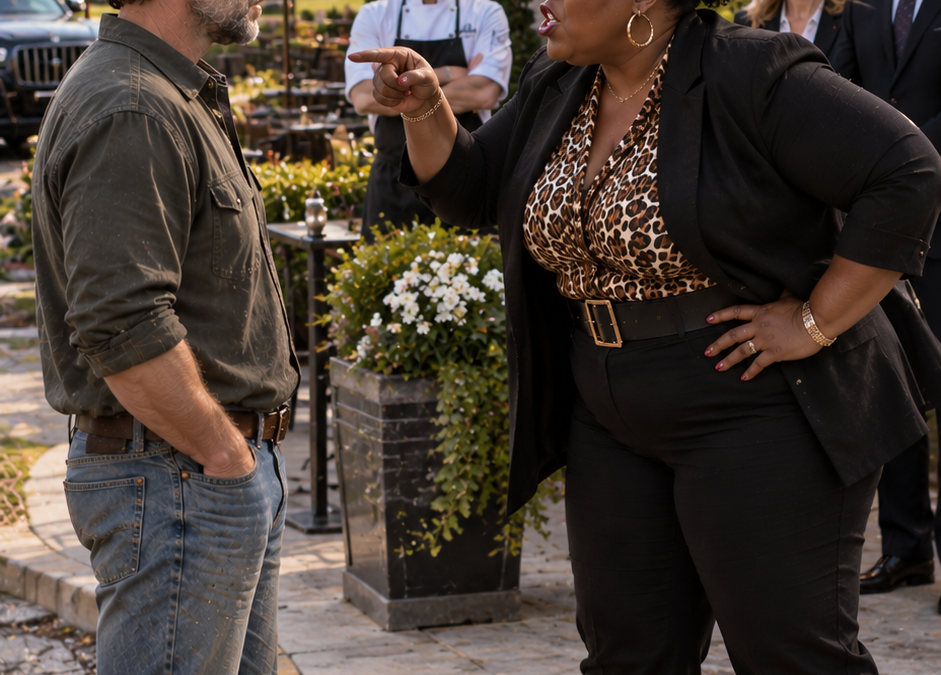
“I’ll make you disappear.”
Behind her, the Whitmore & Rye sign glowed.
For several seconds, I looked at it.
People later asked what I was thinking.
Mounting brackets.
That’s the truth.
The sign had been installed into the brick without the facade approval required by the lease.
I had noticed it years earlier.
The installation was competent.
Tenant paid on time.
Rebecca and I let it go.
Six years of small landlord accommodations were standing behind Cynthia while she threatened to take my home.
She had no idea.
I looked back at her.
“Cynthia.”
“What?”
“Have you ever actually read your restaurant’s lease?”
She laughed.
Out loud.
“You can’t afford to eat here once a week.”
Marissa said quietly:
“Cynthia.”
She ignored her.
“Don’t lecture me about my restaurant.”
I took out my phone.
Called Rebecca.
She answered on the second ring.
“Rebecca.”
“Yes?”
“Go ahead.”
I ended the call.
Got into my pickup.
Drove home.
At 7:40 the next morning, Cynthia’s attorney emailed Rebecca.
Gerald Wilks.
Sixties.
Experienced.
His message described Cynthia as the owner of Whitmore & Rye.
It accused a Brier Glen resident of interfering with restaurant operations.
Requested a meeting at eleven.
At the restaurant.
His client expected the resident to sign an acknowledgement agreeing not to interfere with parking and expansion improvements.
Cynthia wanted me to sit inside my own building and sign a document promising not to interfere with her occupation of my land.
Rebecca called.
“Should I explain this on the phone?”
“No.”
Pause.
“In person?”
“In person.”
“You’re sure?”
“Yes.”
Then I added:
“Be gentle.”
Rebecca was quiet.
“Why?”
“Because this will be worse for her than she’s imagining.”
I called Nolan Price.
My real-estate attorney.
Fifty.
Economical with words.
I explained.
He said:
“Deed. LLC certificate. Operating agreement. Lease. Exhibits. Survey. Default schedule.”
“Yes.”
“Eleven.”
He hung up.
We arrived at 10:50.
Whitmore & Rye wasn’t open yet.
Dining room half lit.
Some chairs upside down.
Vacuum running near the bar.
The meeting was in the private room where Brier Glen had spent thousands over the years hosting association events.
Cynthia sat at the head.
Gray suit.
Gerald Wilks beside her.
Coffee.
Legal pad.
A single sheet of paper facedown at the chair prepared for me.
Rebecca entered first.
Cynthia recognized her.
Of course she did.
Rebecca had handled the restaurant lease for years.
Roof repair.
Parking-lot resurfacing.
Operating expense reconciliations.
Annual notices.
To Cynthia, Rebecca was simply “property management.”
A voice working for some faceless investment company.
“Ms. Sloan?”
Cynthia looked confused.
“Is there a scheduling issue?”
Rebecca set down her accordion file.
“You requested a meeting about the rear parcel.”
“Yes.”
“That’s why I’m here.”
Cynthia nodded impatiently.
“Good.”
Rebecca sat.
“So is the landlord.”
Nolan entered.
Then me.
Wilks looked at Nolan.
Nolan slid over a business card.
Wilks read it.
Put his pen down.
Cynthia still didn’t understand.
“Where is the landlord?”
Rebecca didn’t answer.
Nolan opened his file.
Three documents.
First:
Recorded deed.
Second:
Certificate of organization for Colbridge Properties LLC.
Third:
Operating agreement.
He opened to the signature page.
Turned it toward Cynthia.
DARIUS COLE
MANAGING MEMBER
My signature below.
Silence.
The vacuum stopped in the dining room.
A refrigeration compressor kicked on somewhere behind the kitchen.
Cynthia read the page.
Again.
Third time.
Then looked at Rebecca.
Rebecca said nothing.
Cynthia looked at Wilks.
His face had gone gray.
Then she looked at me.
I didn’t smile.
There was no satisfaction in that moment.
People assume there must have been.
There wasn’t.
I had been underestimated plenty of times.
The moment someone realizes they were wrong isn’t triumph.
It’s just the moment their misunderstanding gets expensive.
“You were right about one thing,” I said.
Cynthia stared.
“This is your restaurant.”
A beat.
“But the building it sits in is mine.”
Her mouth opened.
Nothing.
“The loading area is mine.”
I kept my voice level.
“The parcel behind the restaurant is mine.”
Her eyes moved toward the window.
“And the fourteen spaces you’ve been calling valet parking since April are mine.”
Wilks placed one hand flat on the table.
“Cynthia.”
Quiet.
“Do not say anything else.”
She ignored him.
“You bought this to get back at me.”
The words came fast.
“This is a vendetta.”
“No.”
“You moved into my neighborhood and didn’t like being held accountable, so you bought my property—”
Rebecca reached into her file.
Removed one document.
Placed it down.
Purchase and sale agreement.
Settlement statement.
Recorded deed.
Cynthia looked at the date.
Six years and four months earlier.
I said:
“You were already my tenant before you knew my name.”
That hurt her more than ownership.
I could see it.
Because revenge would have protected her pride.
If I had purchased the building to punish her, then she could still be important enough to have caused the situation.
But I hadn’t.
I bought it as part of a four-property portfolio from a family trust.
Good structure.
Stable tenant.
Underutilized rear land.
Numbers worked.
Whitmore & Rye already had eleven years remaining on an assigned lease.
I had never needed to meet Cynthia.
That’s normal in commercial real estate.
Good property manager.
Rent comes in.
Repairs handled.
Ownership stays invisible.
Nolan opened the lease.
“Section fourteen.”
He read.
No signage, structure, lighting, fixture, or improvement outside the demised premises without prior written consent.
No occupation of excluded land.
Any such action constituted default.
He set down Frank’s survey.
“Six signposts.”
Another finger.
“Fourteen striped spaces.”
Then:
“Six lighting fixtures.”
“Three planters.”
“Landscape bed.”
“Valet stand.”
“All located on landlord-retained property.”
He looked at Wilks.
“Nearest encroachment eleven feet inside the boundary.”
Cynthia stared at the table.
“Farthest sixty-three.”
Then Nolan placed down the lender plan.
“This document represents forty parking spaces available to the restaurant.”
He pointed.
“Twenty-six are leased.”
Then toward the rear.
“Fourteen are not.”
He looked at Wilks.
“You should determine who relied on that representation.”
Wilks closed his legal pad.
Then Nolan added:
“Lease term expires in seven months.”
Cynthia looked up.
“Renewal option requires exercise no later than one hundred eighty days before expiration.”
She knew what came next.
“Option is conditioned on tenant not being in default.”
Seven uncured defaults.
Renewal window closing within weeks.
For the first time, Cynthia stopped performing.
Her hand reached toward the water glass.
Shook.
She put it down.
“The bank has the plans.”
Nobody answered.
“The contractor is scheduled.”
Her voice was softer.
“I have thirty-one people on payroll.”
That was the first time I heard Cynthia Whitmore sound like a person instead of a title.
And that mattered.
Because I could have ended the restaurant.
Legally.
Seven defaults.
Unapproved encroachments.
Potential lender issue.
Lease nearing expiration.
No obligation to renew.
Nolan could have sent default notices that afternoon.
Seven months later, the building could have been empty.
That would have been easy.
It also would have put thirty-one people out of work.
Cooks.
Servers.
Dishwashers.
Managers.
Bartenders.
People who had never taped a violation notice to my door.
Power is not proven by using every ounce of it.
Sometimes it is proven by knowing what not to destroy.
So I gave Cynthia five conditions.
I read them myself.
“First, Whitmore & Rye stops using the fourteen spaces immediately.”
She looked at me.
“Second, every improvement on landlord-retained property gets removed at the restaurant’s expense within thirty days.”
Silence.
“Third, if the restaurant wants additional parking for the expansion, we negotiate properly.”
I leaned back.
“Market rent. Written agreement. Ordinary commercial terms. I’m willing to discuss it in good faith.”
Something in her face relaxed slightly.
“Fourth, the HOA and restaurant separate completely.”
Her expression hardened again.
“No association funds spent at Whitmore & Rye.”
“That’s ridiculous.”
“No association events automatically booked here. No using HOA authority to solve restaurant problems.”
She started to speak.
Wilks stopped her with a hand.
“Fifth.”
I looked directly at her.
“Every association dollar already spent on assets or services benefiting the restaurant goes through an independent audit.”
Her eyes narrowed.
“Selected by the membership.”
“Absolutely not.”
“The findings get presented publicly.”
She stared at me.
Then I said the one sentence I had prepared.
“I don’t need you to disappear, Cynthia.”
The room stayed quiet.
“I just need you to stop taking things that don’t belong to you.”
For maybe four seconds, I thought she would agree.
Then the president came back.
“The audit isn’t happening.”
“Cynthia,” Wilks said.
“The board does not audit itself because one homeowner demands it.”
She looked at me.
“I have eleven votes in that room.”
There it was.
“You may own the building.”
She stood.
“Congratulations.”
Then:
“You still don’t own Brier Glen.”
She walked out.
By the time she reached home, Elliot Vance and Marissa Grant had already filed a request for a special association meeting.
One agenda item.
Review of HOA expenditures at the commercial entrance.
Elliot’s binder eventually reached 206 pages.
The meeting moved to an elementary school cafeteria because the clubhouse was too small.
I sat in the fourth row.
Said nothing for the first hour.
Elliot presented the records.
Slowly.
Like an accountant.
No accusation.
Invoice date.
Amount.
Expense coding.
Approval signature.
Vendor scope.
$8,400.
COMMUNITY WAYFINDING.
Vendor description:
Whitmore & Rye valet signage.
$6,100.
ENTRANCE BEAUTIFICATION.
Lighting installed on land the association didn’t own.
$3,100 landscaping.
Then security.
$39,600 across three years.
Route logs projected on the cafeteria wall.
Sixty-two percent of late-night hours at the commercial strip.
Nine p.m. to one a.m.
Whitmore & Rye’s closing window.
Then Elliot displayed Frank’s survey.
Then the deed.
Then sat down.
Nobody needed commentary.
The membership and board began voting.
All eleven citations against me:
Voided.
Enhanced penalty resolution:
Rescinded.
Then Marissa Grant made a motion.
Remove Cynthia Whitmore as HOA president.
Cynthia sat completely still.
Ten days earlier, she had told me she controlled eleven votes.
Two of those eleven voted to remove her.
Others who had always followed her were simply gone.
Fear-based loyalty is durable only while the feared person keeps winning.
The motion passed.
Cynthia was allowed to speak.
She stood in front of nearly two hundred people.
Said the entire event had been orchestrated.
Said I had planned it.
“A man doesn’t buy a commercial property across from a neighborhood by accident.”
I stood.
Only time that night.
“I didn’t write those invoices.”
Silence.
“I didn’t install those signs.”
She looked at me.
“And I didn’t ask you to threaten me in a parking lot in front of fifteen witnesses.”
Then I sat down.
There was nothing else to say.
The restaurant expansion collapsed.
Without the fourteen spaces, the parking numbers didn’t work.
The lender withdrew.
The conditional-use application was pulled before hearing.
The contractor released the schedule.
Cynthia never accepted my five conditions.
Never cured the defaults.
The renewal option deadline passed.
Then the lease expired.
But Whitmore & Rye didn’t simply disappear overnight.
Three weeks after the HOA vote, two people came to my house.
Paul Fenner.
Executive chef.
Nine years in that kitchen.
Dana Kersh.
General manager.
Six years running the floor.
They sat beneath the oak trees on my porch.
Paul looked uncomfortable.
Dana did the talking.
“We have thirty-one employees.”
“I know.”
“And December bookings.”
“I know.”
“What happens when the lease ends?”
I looked at both of them.
“What do you want to happen?”
They weren’t expecting that.
Eventually they formed a company.
Raised capital.
I financed part of the purchase on ordinary seller terms.
They bought the operating business.
Equipment.
Goodwill.
Staff operation.
Then their new company negotiated a five-year lease with Colbridge.
Rebecca handled it.
Market rent.
6,200-square-foot building.
Loading area.
Twenty-six original spaces.
And fourteen additional rear spaces.
Separate parking agreement.
Separate rent line.
They pay for those fourteen spaces.
That is the entire difference.
Cynthia nearly destroyed herself trying to take something by force that two employees obtained in an afternoon by asking.
The restaurant got a new name.
The Oak & Ash.
Simple black steel sign.
White lettering.
Correct mounting.
Written approval.
No unapproved facade penetrations.
No valet occupying unauthorized property.
No HOA-funded security patrol.
No board dinners automatically routed into the private room.
It remained busy.
Some of the same staff stayed.
Paul kept the kitchen.
Dana ran operations.
People in Brier Glen still eat there.
So do I.
Occasionally.
And yes, I can afford it.
Cynthia remained in the neighborhood for a while.
I saw her sometimes.
Never had another real conversation.
The fines ended.
The tow threats ended.
The selective enforcement investigation produced changes in HOA procedures.
Vendor payments involving a board member’s financial interest required disclosure and board approval.
Association contracts became easier for members to inspect.
The community didn’t collapse.
No one needed Cynthia’s style of control nearly as much as she had convinced everyone they did.
That’s another thing power gets wrong.
People in authority often believe the organization functions because they are holding it together.
Sometimes the organization works better when their hands come off it.
I drove past The Oak & Ash one cold morning months later.
Coffee in the holder.
Bag of screws on the passenger seat.
For years, I had slowed at that building.
I still did.
The brick looked the same.
The parking geometry looked better.
The fourteen rear spaces were legally documented now.
There was a proper landscape buffer.
Lighting had been placed according to an approved plan.
I thought about Cynthia standing in the parking lot.
“I’ll make you disappear.”
At the time, she meant financially.
Emotionally.
Legally.
She had apparently done it to people before.
Pressure notices.
Fines.
Lien threats.
Legal bills.
Make life expensive enough and eventually a homeowner sells.
The threat had frightened me more than I admitted.
Not because I thought she could actually take my house.
Because anyone with enough procedural control can make your life unpleasant even when they’re wrong.
That is the ugly part of small institutions.
You don’t need ultimate authority to hurt somebody.
You only need control of enough steps between the question and the answer.
Cynthia controlled the letters.
The meetings.
The enforcement referrals.
The board agenda.
She thought that meant she controlled outcomes.
She had spent years watching people decide that paying a fine was easier than resisting.
That creates a dangerous kind of confidence.
Because eventually you stop asking whether you have the right to impose a cost.
You only ask whether the other person can afford to resist it.
She looked at me and answered that question incorrectly.
But the more important truth is that my money didn’t defeat her.
Neither did owning the building.
If I had revealed ownership the first week, Cynthia would have behaved differently around me.
That’s obvious.
She would have been polite.
Maybe careful.
Maybe flattering.
Nothing would have been learned.
The parking issue might have been quietly fixed.
And the next resident she considered powerless would have gotten the same treatment.
What changed Brier Glen was not discovering I had more leverage than Cynthia thought.
It was discovering what she did when she believed I had none.
The violation notices.
Tow order.
Lien threat.
HOA-funded improvements.
Invoices.
Meeting minutes.
Public threat.
All of that happened before anyone knew who Colbridge’s managing member was.
I didn’t create that record.
She did.
That is why I never regretted staying quiet.
People sometimes ask if I set a trap.
No.
A trap requires bait.
I never asked Cynthia to fine me.
Never asked her to misuse association money.
Never asked her to install valet parking on my parcel.
Never asked her to threaten my home.
Never asked her to tell fifteen people she would make me disappear.
I simply didn’t interrupt her assumptions.
There’s a difference.
Frank Delra once told me something while surveying another acquisition years earlier.
“Most boundary fights aren’t really about lines.”
“What are they about?”
“Somebody needing the line to be somewhere else.”
Cynthia needed the parking boundary somewhere else.
Her financing depended on it.
Her restaurant expansion depended on it.
Her self-image depended on being able to make the obstacle move.
The physical line refused.
Eleven feet.
Sixty-three feet.
Those measurements didn’t care that she had lived in Brier Glen seventeen years.
Didn’t care she was president.
Didn’t care her restaurant sign was prettier than my truck.
Real property is wonderfully indifferent to social hierarchy.
A surveyor puts the instrument over a point.
You either own the dirt or you don’t.
That doesn’t make ownership morally superior.
It just makes it factual.
The same thing happened inside the HOA.
Eventually, Elliot’s invoices became the equivalent of survey stakes.
This expense went here.
This signature approved it.
This vendor performed that work.
This service benefited that property.
One by one.
No adjective required.
That was why I told Elliot not to say fraud.
The second you label evidence, people start arguing about the label.
Present the evidence and let them argue with the dates.
I learned that as an appraiser.
Values can be debated.
Comparable sales cannot be wished away.
You build from what is verifiable.
Everything else comes afterward.
Rebecca later asked whether I would have offered Cynthia the fourteen spaces if she had approached me before installing them.
Probably.
That’s the strange part.
Commercial land exists to produce value.
If Whitmore & Rye had said:
“We want to expand.”
“We need fourteen more spaces.”
“Would Colbridge lease them?”
I would have looked at the zoning.
Traffic.
Drainage.
Market rent.
Development plans for the rear parcel.
Maybe we would have agreed.
Maybe not.
But the conversation would have been ordinary.
Instead, Cynthia couldn’t tolerate asking.
Asking would have meant acknowledging that someone else had the right to say no.
That was the same flaw she brought to the HOA.
She didn’t dislike rules.
She loved rules.
As long as she was the person interpreting them.
My refusal to submit an unnecessary fence application wasn’t offensive because of the fence.
It was offensive because I asked her to identify the provision.
My parking question wasn’t dangerous because of paint stripes.
It was dangerous because I asked who authorized them.
Cynthia’s authority worked best when nobody asked where it came from.
Once you understand that, her entire behavior makes sense.
The threat in the parking lot wasn’t random anger.
“I’ll make you disappear.”
That was how she solved challenges.
Turn governance into pressure.
Pressure into expense.
Expense into surrender.
Then point to the surrender later as proof she had been right.
What she couldn’t do was pressure a deed.
She couldn’t fine Colbridge into giving her fourteen spaces.
Couldn’t tow a survey.
Couldn’t threaten Section 14 with foreclosure.
And the moment her HOA power collided with property law and lease law, the difference became visible.
I still have the expanding folder.
It got too thick eventually.
I replaced it with two binders.
The first contains HOA matters.
The second contains the restaurant.
Every notice.
Photograph.
Receipt.
Survey.
Lease provision.
Invoice.
Meeting minute.
I don’t keep them because I expect another fight.
I keep them because documentation outlives mood.
One evening, about a year after Cynthia lost the presidency, I sat at the bar at The Oak & Ash.
Paul came out of the kitchen.
Still wearing his apron.
Set a plate in front of me.
“I didn’t order this.”
“New special.”
“That doesn’t make it free.”
“It is tonight.”
“Why?”
He leaned against the bar.
“Because you could’ve closed us.”
I looked at the plate.
“I could’ve closed the lease.”
“Same thing from where we were standing.”
“No.”
He gave me a skeptical look.
“The lease was Cynthia’s problem.”
“The jobs were yours.”
He nodded.
Then said:
“You know most landlords would’ve used it.”
“Used what?”
“The leverage.”
I thought about that.
“Most good ones wouldn’t.”
He laughed.
“You’re destroying the profession’s reputation.”
Then went back to the kitchen.
That exchange mattered more to me than watching Cynthia lose the gavel.
Thirty-one people kept working.
The building remained occupied.
Rent kept coming in.
Brier Glen got a restaurant that no longer depended on association money.
The rear parcel produced legitimate rent.
Everyone ended up with something better than the arrangement Cynthia had been trying to force.
Except Cynthia.
And even then, I don’t know that she ended with nothing.
Maybe losing power taught her something.
Maybe not.
That part stopped being my business.
Marissa Grant later became president for a short period.
Then someone else.
Brier Glen continued.
Lawns got cut.
Pool opened.
Mailbox arguments survived.
People still complained about trash cans.
Civilization endured.
My truck remained in my driveway.
Same dent.
Eventually the transmission failed.
When the replacement truck arrived, Elliot walked past while I was washing it.
“Commercial vehicle?”
I looked at him.
“Don’t start.”
He laughed harder than I’d ever heard him laugh at a board meeting.
He had changed too.
Once people learn that an official title isn’t a substitute for scrutiny, they don’t forget easily.
The greatest change in Brier Glen was simple.
People started asking:
“Where is that written?”
Not angrily.
Just routinely.
It is one of the healthiest questions any organization can learn.
Where is that written?
Who approved it?
What authority applies?
Was it voted?
Is there a conflict?
Can members see the record?
Questions don’t weaken legitimate authority.
They strengthen it.
Only invented authority fears them.
I sometimes wonder what Cynthia thought when she first looked at the Colbridge operating agreement.
Not the deed.
Not the survey.
My name.
Darius Cole.
Managing Member.
The man she had assumed couldn’t afford dinner at her restaurant.
The man she had threatened with legal expenses.
The man whose pickup she’d tried to tow.
I hope, in the long run, the lesson wasn’t that she should have treated me better because I had money.
That would be the wrong lesson.
I hope the lesson was that she should have treated me correctly when she believed I didn’t.
Anybody can respect someone powerful.
Character is how you behave toward the person you think cannot hurt you.
Cynthia failed that test long before she knew who owned the restaurant.
I almost failed a different one afterward.
I had the legal ability to destroy something she cared about.
For a few minutes in that private room, part of me wanted to.
I won’t pretend otherwise.
Months of being talked down to accumulate.
The fines.
The tow truck.
The threats.
“I’ll make you disappear.”
And suddenly I was sitting across from her with the lease clock ticking.
It would have been easy to say:
Seven defaults.
No renewal.
Good luck.
That would have felt powerful.
For about five minutes.
Then thirty-one people would have carried the consequences of my satisfaction.
That’s not justice.
It’s collateral damage wearing a suit.
So I chose the narrower correction.
Stop using my property.
Pay if you want it.
Separate private business from association governance.
Audit community money.
Nothing extraordinary.
Just boundaries.
Cynthia rejected them.
That was her decision.
The restaurant’s final transition came later.
The Oak & Ash sign went up in February.
I approved the mounting drawings.
Proper flashing.
Correct fasteners.
No damage to the brick.
Rebecca laughed when I asked whether the details were in the file.
“Darius.”
“What?”
“You approved the whole package.”
“Checking.”
“You are the reason people hate landlords.”
“Document it.”
She hung up on me.
I smiled for about ten minutes.
The parking spaces behind the restaurant look ordinary now.
That’s the funniest part.
Fourteen rectangles of asphalt.
Nobody walking past would know they once nearly destroyed an HOA presidency, killed a million-dollar expansion, triggered an audit, and changed ownership of an operating restaurant.
Land is like that.
The most consequential square feet rarely look important.
A loading easement.
A strip behind a building.
A utility corridor.
Fourteen parking spaces.
What matters is the legal right attached to them.
Cynthia understood appearances.
She was excellent at them.
Warm lighting.
Copper awning.
Landscaping.
Community standards.
A polished meeting.
A threat delivered with a smile.
But she underestimated the boring infrastructure beneath appearances.
Lease clauses.
Survey lines.
Operating agreements.
Invoices.
Recorded deeds.
Those things have no charisma.
They don’t need it.
Several years later, Brier Glen’s board asked me to join the finance committee.
I declined.
Elliot said:
“You’d enjoy it.”
“That is the least believable thing you’ve ever told me.”
“We could use someone difficult.”
“I prefer selective.”
He smiled.
“Still no?”
“Still no.”
I had no interest in governing Brier Glen.
That was another thing Cynthia never understood.
Challenging authority doesn’t mean you want the authority.
Sometimes you just want the person holding it to stay within the lines.
I already had enough responsibility.
Properties.
Tenants.
Taxes.
Maintenance.
Insurance.
I didn’t need a gavel too.
I still live in the same house.
The oak trees still drop acorns across the walk.
My fence was repaired without an architectural application because, as the covenants said from the beginning, like-for-like maintenance didn’t require one.
No one cares now.
Which is how it should have been.
The entire fight could have disappeared if Cynthia had accepted three ordinary realities.
My truck wasn’t commercial.
The fence repair didn’t require her permission.
And her restaurant’s lease ended where Exhibit B said it ended.
Instead, every challenge became personal.
She escalated until the dispute finally reached something bigger than her title.
Not me.
The record.
That distinction matters.
People sometimes tell the story as though I defeated Cynthia because I secretly owned her restaurant building.
That’s entertaining.
It’s also incomplete.
If ownership alone were the story, I could have ended everything with one phone call in April.
The real story is what happened before she knew.
She believed I had no leverage.
So she showed everyone exactly how she treated someone she believed had none.
That’s what removed her.
Not my deed.
Her own conduct.
The deed only prevented her from rewriting the parking issue too.
I drove past The Oak & Ash recently.
Cold morning.
The kind where sunlight makes everything look sharper.
I had coffee.
A bag of screws in the passenger seat.
For some reason, that reminded me of the morning I first met Cynthia.
Level in one hand.
Coffee in the other.
She had looked me over and assumed I was working on someone else’s house.
That small mistake had never really gone away.
For months afterward, every decision she made was built on the same assumption.
That I was somebody else’s employee.
Somebody else’s subordinate.
Somebody with less standing.
Less money.
Less understanding.
Less right to ask.
She never bothered checking.
That was her real weakness.
Not arrogance by itself.
Arrogance combined with incuriosity.
The most dangerous combination I know.
Because when you are certain you already know what someone is, evidence about them stops reaching you.
I had told her to read the lease.
She laughed.
Frank had been surveying for my benefit.
She called me a resident with no standing.
I asked about parking.
She threatened my house.
Every warning sounded to her like insolence because she could not imagine I knew something she didn’t.
By the time Rebecca walked into that private room, the answer had been sitting in the county records for more than six years.
Cynthia’s attorney went pale because he understood immediately what Cynthia had not allowed herself to consider.
The man across the table wasn’t trying to interfere with her landlord.
He was the landlord.
And the land wasn’t newly acquired revenge.
It was older than the conflict.
Older than my house in Brier Glen.
Older than Cynthia knowing my name.
That’s why her accusation collapsed.
There was no conspiracy.
No setup.
No purchase made to hurt her.
There was only a fact she never checked because checking it required accepting that the man she had dismissed might know more than she did.
The Oak & Ash was busy that morning.
Cars in the twenty-six original spaces.
Several in the fourteen rented rear spaces.
All lawful.
All documented.
Someone walked across the lot carrying a bakery box.
A delivery truck backed toward the loading area.
Nothing dramatic.
Exactly what good commercial property should look like.
Useful.
Boring.
Clear.
I slowed my truck.
Looked at the building.
Then kept driving.
Cynthia had promised to make me disappear from Brier Glen.
My name is still on the deed to my house.
Still on the ownership records behind the commercial parcel.
Still on documents that were there before her threat and remained after her title disappeared from the board roster.
But I don’t think of that as winning anymore.
Winning suggests two people fighting over the same prize.
I never wanted hers.
Not her restaurant.
Not her board seat.
Not her standing in the neighborhood.
I wanted her to stop reaching across boundaries that did not move simply because she wanted them to.
Property boundary.
Lease boundary.
HOA authority.
Community money.
Other people’s dignity.
Those lines were there all along.
In the end, all anyone had to do was read them.
Cynthia’s problem was that she believed titles made boundaries flexible.
President.
Owner.
Leader.
Her restaurant.
Her neighborhood.
Her board.
Then one morning in the private room of Whitmore & Rye, she finally sat across from a document that didn’t care what she called herself.
It had one name printed under managing member.
Mine.
And for the first time since the day she lowered her car window and looked at me standing in my own driveway, Cynthia Whitmore had to consider something she had never once bothered to ask.
Who exactly was the man she had decided she could erase?








