𝗣𝗔𝗥𝗧 𝟮 The HOA President Thought One 911 Call Would Erase Me From My Own Property
𝗣𝗔𝗥𝗧 𝟮
The guard looked at me.
Vivien didn’t.
She opened the clipboard and removed a map.
“Everything inside the gates falls under association authority.”
I studied the map.
There are habits you don’t switch off simply because it’s Saturday.
My eyes went to the parcel outlines.
Then the road.
Then the fence.
Something was wrong.
The HOA boundary on her map ran behind my house.
But I knew from Margaret’s records that the historic boundary stopped east of the property.
More importantly, one of the original survey stakes was still visible fifteen feet behind Vivien.
It did not match her paper.
I didn’t tell her that.
Instead, I went inside and returned with a copy of my deed.
She accepted it reluctantly.
“This parcel isn’t subject to your association,” I said.
Vivien looked at the first page for maybe three seconds.
Then she handed it back.
“Old documents don’t always reflect current community arrangements.”
“Then show me the newer document.”
She smiled.
“Men like you often think reading a few pieces of paper makes them experts.”
I looked at her.
“Men like me?”
“People who don’t understand how managed communities operate.”
The security guard shifted slightly.
I folded my deed.
“What exactly are you asking me to do?”
That seemed to please her.
She began listing things.
The flagpole near the porch had to come down.
My fence needed replacing.
The house required repainting in an approved color.
My pickup, which she called an “eyesore,” could not remain visible from the road.
The shed needed architectural approval.
The porch repair needed architectural approval.
Even the motion light over the workshop door apparently required review.
When she finished, I asked one question.
“What recorded covenant gives your HOA authority over this parcel?”
Vivien’s expression cooled.
“You’ll receive formal notice.”
Then she turned away.
At the driveway, she stopped.
“You should understand something, Mr. Keen. People who make themselves difficult around here tend to discover that independence can become very expensive.”
Then she left.
The security guard followed.
I watched them disappear behind the Kingsley Ridge stone entrance.
I didn’t feel angry.
Not yet.
Mostly I felt curious.
The next morning, I got my answer.
A bright red envelope had been taped to my front door.
It contained an HOA account statement.
Amount due:
$18,700.
According to Kingsley Ridge, my aunt had accumulated years of unpaid association dues, late fees, compliance penalties, and administrative charges.
I stood on the porch reading it twice.
Margaret had been many things.
Disorganized was not one of them.
She kept receipts for appliances she’d thrown away twenty years earlier.
There was no world in which she’d ignored almost twenty thousand dollars in HOA debt without mentioning it.
I carried the envelope inside.
Then I went to the hall closet.
Margaret’s property files filled three cardboard boxes.
I spread them across the kitchen table.
By lunchtime, the table looked like one of my conference rooms at work.
Deeds.
Survey maps.
Tax assessments.
Letters.
Receipts.
County notices.
I approached them exactly the way I would have approached evidence belonging to a stranger.
No assumptions.
Chronology first.
Margaret bought the property in 1978.
The original deed made no reference to any HOA.
That wasn’t surprising.
Kingsley Ridge didn’t exist.
A 1981 county survey confirmed the parcel boundaries.
In 1996, when the HOA was formally organized, a subdivision map clearly excluded Margaret’s land.
Her tax records remained independent afterward.
There were no HOA dues.
No association assessments.
No architectural agreements.
Nothing.
In an old survey folder, I found an addendum showing the Kingsley Ridge boundary stopping exactly where I’d expected.
Short of Margaret’s gate.
I photographed everything.
Then I made copies.
One set stayed with me.
The other went into a certified letter addressed to the Kingsley Ridge board.
My request was simple.
Rescind all fees.
Correct the membership records.
Confirm in writing that my property was not subject to HOA governance.
Vivien appeared at my house two days after delivery.
This time she came alone.
I found her on the porch when I returned from the hardware store.
“You sent a legal threat to my board.”
“No. I sent records.”
“You’ve made this unnecessarily adversarial.”
I unlocked the front door but didn’t invite her in.
“You sent me an $18,700 bill.”
“Because that’s what the account reflects.”
“There shouldn’t be an account.”
“The property was absorbed into Kingsley Ridge years ago.”
That was new.
“Absorbed how?”
“An agreement.”
“Signed by whom?”
“Your aunt.”
“What year?”
Vivien hesitated.
“Late nineties.”
“Do you have it?”
“Our records department does.”
“Send me a copy.”
She folded her arms.
“You really think you’re going to outsmart everyone here because you dug through a few dusty files?”
“No.”
I looked directly at her.
“I think whichever document is valid will answer the question.”
Her eyes hardened.
“You have no idea who you’re dealing with.”
That sentence usually sounds more impressive to the person saying it.
Vivien Harrington came from a family whose name carried weight in the county.
Harrington shopping centers.
Harrington office parks.
Harrington Development.
Her father had built a substantial portion of the commercial property along the eastern corridor.
Her brother sat on two nonprofit boards.
Her cousin ran an investment group.
People knew the name.
Maybe that had taught Vivien something dangerous.
That reputation could substitute for evidence.
“I don’t need to know who I’m dealing with,” I told her.
“I need to know what document you’re relying on.”
“You’ll get it.”
Before she left, she turned.
“And while this gets sorted out, you’ll comply with association standards.”
“No.”
Her expression sharpened.
“No?”
“My position hasn’t changed.”
She stepped closer.
“People who fight Kingsley Ridge tend to lose more than they expect.”
I let that hang there.
Then I opened the door.
“Have a good afternoon.”
The supposed merger agreement arrived three days later.
At first glance, it looked legitimate.
Two pages.
Dated June 14, 1998.
Margaret Keen supposedly agreed to incorporate her parcel into Kingsley Ridge and accept all association covenants.
The final page contained her signature.
A notary stamp sat beneath it.
I stared at that signature for a long time.
It looked like hers.
That bothered me more than if it had looked obviously fake.
Then I looked at the date again.
June 14, 1998.
And I remembered where Margaret had been.
I was nineteen that summer.
My mother and I had driven nearly seven hundred miles to visit her during treatment.
Margaret had spent most of 1998 in another state undergoing a prolonged series of surgeries and oncology treatments.
She hadn’t been in Asheford County.
Not that week.
Not that month.
For much of that year, not even in the same time zone.
I still had letters she’d mailed from the hospital.
Medical billing statements.
Temporary housing receipts.
My mother had photographs.
If that merger agreement had supposedly been notarized locally while Margaret was hundreds of miles away, there were only a few explanations.
None of them were good.
Still, I didn’t call Vivien.
I didn’t accuse her.
An accusation tells the other side what you know.
Sometimes silence tells you what they know.
I hired an attorney.
Lydia Hart’s office was above an old bank building downtown.
She specialized in land records, title disputes, and real-estate litigation.
She was small, precise, and almost aggressively unimpressed by dramatic people.
I liked her immediately.
She read the merger agreement without comment.
Then she compared it to the original deed.
The survey.
Tax records.
HOA correspondence.
Finally, she leaned back.
“Your aunt was out of state when this was signed?”
“I can document it.”
“Good documentation?”
“Hospital records. Letters. Travel receipts. Family photographs.”
Lydia tapped the agreement.
“Don’t confront them yet.”
“That was my thought.”
She smiled slightly.
“You actually listen to lawyers?”
“Only the competent ones.”
She gave me a look.
Then returned to the page.
“This document bothers me.”
“Besides the signature?”
“Several things.”
“Such as?”
“The formatting doesn’t look like a document created in 1998.”
That caught my attention.
“What do you mean?”
“I don’t know yet.”
She lifted the page toward the light.
“But I intend to find out.”
The fines accelerated.
Door color.
$350.
Grass allegedly above permitted height.
$500.
Ladder visible from the street.
$750.
Unapproved workshop light.
$1,200.
Exterior storage violation.
$2,000.
Each notice went into a folder.
Each envelope was photographed.
Each delivery date recorded.
Association security vehicles started appearing outside my gate.
Sometimes at six in the morning.
Sometimes close to midnight.
Men photographed my house.
They photographed my pickup.
They photographed me carrying lumber.
I installed additional cameras.
Not hidden cameras.
Visible ones.
Vivien responded by accusing me of creating a hostile surveillance environment.
I saved that letter, too.
Then one morning, I discovered a heavy padlock on my rear service gate.
The gate was entirely inside my parcel.
There was no easement across it.
No association access.
Someone had simply bolted it shut.
I positioned my phone on the fence post.
Recorded the gate.
Recorded the property marker.
Recorded myself cutting the lock.
Then I placed the severed lock in an evidence bag and wrote the date on it.
That evening, Vivien emailed the entire HOA board.
The message described me as “an increasingly hostile male resident who has demonstrated open contempt for female authority.”
I read the sentence several times.
It was clever.
My legal objections were becoming a personality defect.
My refusal to pay invalid fines was aggression.
My request for documents was intimidation.
Vivien wasn’t trying to win only on paper.
She was creating a character.
A dangerous man.
Angry.
Unstable.
Someone the board should fear before they ever met him.
That concerned me more than the money.
A few nights later, someone knocked on my door.
The man outside was in his late sixties.
Thin.
Silver hair.
He kept looking toward the road.
“My name’s Russell Dayne.”
“I know the house. Two streets over.”
He looked surprised.
“You’ve been paying attention.”
“Occupational habit.”
I let him inside.
He refused coffee.
Instead, he sat at the kitchen table and lowered his voice.
“Vivien has done this before.”
“What exactly?”
“The fines.”
He looked toward the window again.
“She picks people who don’t have much fight left.”
Russell told me about a widow who’d been hit with nearly thirty thousand dollars in compliance charges after her husband died.
A retired teacher who suddenly received years of alleged landscaping violations.
A young couple whose gate privileges were restricted after they disputed a special assessment.
Some eventually sold.
Often below market value.
Then, according to Russell, several of those properties resurfaced under LLCs connected to people close to the Harrington family.
“Can you prove that?”
“No.”
“Then don’t state it as fact to anyone else.”
He studied me.
“You’re a lawyer?”
“No.”
“What are you?”
“A homeowner.”
That wasn’t the whole answer.
It was the only relevant one.
A woman named Mara Benton came to see me several days later.
She had similar concerns.
Board meetings held without proper notice.
Votes that appeared in minutes she didn’t remember happening.
Contracts awarded with little discussion.
Residents discouraged from asking questions.
I listened.
Then I told both Mara and Russell the same thing.
“I cannot use my job to investigate this.”
Mara frowned.
“Your job?”
I hadn’t told them before.
“I’m a state investigator.”
Russell stared at me.
Mara went quiet.
I continued.
“Which means I have to be more careful, not less. I cannot turn a private property dispute into an official investigation because I’m personally involved.”
“So what do we do?”
“You preserve records. You tell the truth. If there’s evidence of a crime, it goes through independent channels.”
That night, I notified my supervisor that I had become involved in a private dispute that could potentially overlap with conduct normally within our office’s jurisdiction.
I documented the conflict.
I requested that I be excluded from any official matter involving Kingsley Ridge, Vivien Harrington, or associated entities.
Then I let Lydia handle my side.
That decision mattered later.
Vivien was preparing to accuse me of abusing government authority.
I wanted the record established before she ever tried.
The most disturbing evidence arrived accidentally.
One afternoon, my porch camera captured Dean Falner, Kingsley Ridge’s head of security, near my gate.
He was on the phone.
The camera microphone wasn’t perfect, but his voice carried.
“I know.”
Pause.
“No, I understand.”
Another pause.
Then clearly:
“She wants us to make him look dangerous enough that the cops remove him.”
I listened twice.
Then a third time.
Lydia listened without moving.
When the recording ended, she said, “Back this up in three places.”
“I already did.”
“Of course you did.”
The Saturday Vivien finally called 911 began with a leaking water pump.
I had attended an early morning work meeting across town and drove directly to the house afterward.
Because I was still technically on call, I had my state-issued service pistol with me.
It remained holstered beneath my jacket.
I had carried for years.
It wasn’t something I thought about constantly.
A firearm, properly handled, is a responsibility, not a personality.
By nine-thirty, I was in the shed replacing a valve.
I heard the service gate open.
Dean walked in.
Two security officers followed.
None of them knocked.
None asked permission.
They simply entered.
I stepped out of the shed.
“Dean.”
He stopped.
“This is private property.”
“We need access to inspect an association safety violation.”
“You don’t have access.”
He looked toward the other men.
“We have authorization.”
“Show it to me.”
He didn’t.
Instead, he started toward the back of the property.
“Stop.”
He turned.
My hands were visible.
My voice was level.
“You need to leave.”
One of the other guards looked uncomfortable.
Dean didn’t.
“We’re not leaving until the inspection is complete.”
“Then you’re trespassing.”
That’s when I saw Vivien.
She stood on the other side of the fence with her phone raised.
Recording.
Not the whole scene.
Only me.
The angle excluded Dean and the two guards who had entered my land.
I understood instantly.
“Vivien.”
She didn’t answer.
I reached toward my toolbox to set down the wrench.
The edge of my jacket caught on a metal handle.
It lifted maybe three inches.
Enough to expose the bottom of my holster.
Vivien’s face changed.
There are moments when you watch someone discover an opportunity in real time.
This was one.
She lowered her phone.
Then immediately dialed.
“911?”
Her voice became louder.
Urgent.
“There is an armed man inside Kingsley Ridge.”
I stared at her.
She turned slightly away.
“He’s trespassing near an abandoned house. He’s threatening our security officers.”
Dean looked at me.
Even he seemed surprised.
The dispatcher must have asked a question.
Vivien said, “Yes, I can see the gun.”
Another question.
“He reached toward it.”
That was false.
Completely false.
I hadn’t touched the weapon.
The dispatcher asked something else.
Vivien said, “Please hurry.”
I looked at Dean.
“This is what you wanted?”
He said nothing.
I went inside the shed.
Placed the wrench on the bench.
Then I stepped back outside where everyone could see my hands.
Within minutes I heard sirens.
Not one vehicle.
Several.
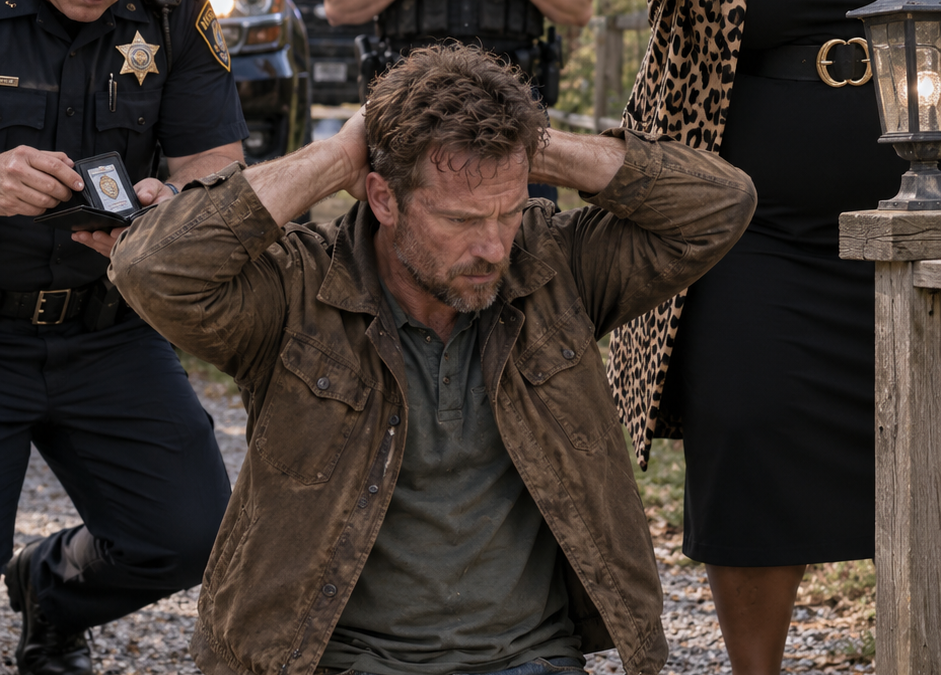
Three patrol cars entered Brier Hollow from different directions.
One stopped at the eastern end.
Another blocked the intersection.
The third rolled toward my property.
Officers emerged cautiously.
Hands near their weapons.
One shouted.
“Sir! Don’t move!”
I didn’t.
“Show me your hands!”
I raised them.
“Turn around!”
I turned.
“Get on your knees!”
Gravel pressed through my jeans.
I lowered myself slowly.
“Weapon?”
“Holstered on my right side beneath my jacket.”
“Do not reach for it.”
“I won’t.”
“Identification?”
“Wallet, rear left pocket. You can retrieve it.”
Behind the officers, Vivien stood with her arms crossed.
She was smiling.
Not broadly.
Just enough.
As if the morning had finally produced the image she’d been trying to create for weeks.
Noah Keen.
On his knees.
Police surrounding him.
Armed.
Dangerous.
Removed.
One young deputy approached from behind.
“I’m going to secure the firearm.”
“Understood.”
His hands were controlled but tense.
He lifted my jacket and removed the pistol.
“Any other weapons?”
“Pocketknife in the toolbox. Nothing on me.”
Another officer took my wallet.
Vivien spoke loudly enough for me to hear.
“Some men only understand authority when it’s finally enforced.”
I looked straight ahead.
The driveway gravel hurt my knees.
A mockingbird called somewhere behind the shed.
Engines idled.
I could hear one officer speaking into his radio.
It was strange how quickly a peaceful morning could become dangerous when one person lied convincingly enough.
That was what angered me.
Not being on my knees.
I’d been in worse positions.
It was the risk.
One wrong movement from me.
One frightened officer misunderstanding a gesture.
One hand disappearing behind my jacket too quickly.
Vivien had introduced a gun into everyone’s mind before police arrived.
She had transformed three officers approaching a homeowner into three officers approaching an armed intruder.
People could die because of lies like that.
A fourth vehicle arrived.
County sheriff.
The door opened.
Wade Callaway stepped out.
I knew Wade.
Years earlier, I’d worked a corruption case involving falsified evidence inside a county department.
Wade had been a lieutenant then.
He’d cooperated when cooperation was difficult and unpopular.
I respected him.
He didn’t recognize me immediately from the kneeling position.
He spoke briefly with the patrol officers.
Then one handed him my wallet.
Wade opened it.
Saw the driver’s license.
Then the badge tucked behind it.
He stopped.
His eyes came up.
“Noah?”
I looked at him.
“Morning, Wade.”
Vivien’s smile weakened.
Wade walked closer.
“What the hell is going on?”
“Keep your body camera running.”
His expression changed again.
Not recognition this time.
Understanding.
“Absolutely.”
“And handle me exactly like you would anyone else.”
He nodded.
Then turned toward the officers.
“Has anyone established a threat?”
One deputy answered.
“Reporting party said he displayed or reached for a firearm.”
“Did anyone witness that?”
“No, sir.”
“Who owns the property?”
“We’re checking.”
Wade looked at me.
“This yours?”
“County record will show it.”
Then he turned toward Vivien.
“Ma’am, who did he threaten?”
She blinked.
“Our security team.”
“Which person?”
“All of them.”
“How?”
“He was aggressive.”
“What did he say?”
“He told them to leave.”
Wade waited.
“Anything else?”
“He was armed.”
“So are my deputies.”
Vivien stiffened.
“That’s different.”
“Did he draw the weapon?”
“He reached toward it.”
Dean looked at the ground.
Wade noticed.
“Mr. Falner?”
Dean looked up.
“Did he draw the firearm?”
“No.”
Vivien snapped toward him.
“Dean.”
Wade raised one hand.
“Let him answer.”
Dean swallowed.
“No. He never drew it.”
“Did he touch it?”
A pause.
“No.”
“What did he do?”
“He told us to leave.”
“Why were you on his property?”
“We were conducting an HOA inspection.”
“Do you have permission to enter?”
Dean didn’t answer.
Wade looked toward me.
“Camera footage?”
“Porch, driveway, shed exterior.”
Vivien’s posture changed.
Only slightly.
But I saw it.
The first realization that the morning might not end the way she’d intended.
A deputy called from the patrol car.
“Sheriff.”
Wade walked over.
The county property record was open on the laptop.
He read it.
Then looked toward the house.
Back to the screen.
“Noah Keen is the recorded owner.”
Vivien stepped forward.
“The HOA has jurisdiction over the property.”
“That’s a separate issue.”
“It absolutely isn’t.”
“For the purpose of determining whether he’s an intruder in his own house, it is.”
The words landed hard.
Neighbors had started gathering.
A few stood behind fences.
Others watched from porches.
Wade returned to me.
“Stand up.”
I did.
He returned my wallet.
Then the badge.
The pistol came last after the scene was fully secured.
Wade handed it to me carefully.
“Sorry, Noah.”
“No apology needed from you.”
Vivien stared at the badge.
“What is that?”
I put it back into my wallet.
“Identification.”
Wade looked at her.
“He’s a state investigator.”
For the first time since I’d met Vivien Harrington, she seemed unable to find a sentence.
Then she recovered.
“So he deliberately concealed that from us.”
I almost smiled.
“Concealed?”
“You allowed me to believe you were some kind of handyman.”
“I was repairing my house.”
“You were setting us up.”
“For what?”
“This.”
I looked around at the patrol cars.
“You called them.”
Her face flushed.
“You knew exactly what you were doing.”
“No. I knew exactly what I wasn’t doing.”
I stepped toward my gate.
“I wasn’t trespassing.”
I pointed toward Dean.
“They were.”
“I wasn’t threatening anyone.”
I pointed toward my holster.
“And I never touched that.”
Wade looked at Vivien.
“Do you have evidence otherwise?”
She said nothing.
My porch camera answered for her.
Within twenty minutes, the officers watched the footage.
Dean and the other guards opening my gate.
Entering.
Me telling them to leave.
My hands visible.
The jacket snagging on the toolbox.
Vivien lifting her phone.
No reaching.
No threat.
No aggressive movement.
Nothing remotely resembling what she’d told dispatch.
Wade listened to the 911 recording from his unit.
When it ended, he stood quietly.
Then he asked Vivien, “Why did you call him an intruder if you’d been corresponding with him by name for weeks?”
“I meant he was intruding into the community.”
“At his own house?”
“The property is disputed.”
“Did you tell dispatch that?”
“No.”
“Did you tell them he was the homeowner?”
“No.”
“Did you tell them your security personnel had entered his property?”
Her face hardened.
“I was afraid.”
Wade nodded once.
“That may be. But fear doesn’t change what was said.”
Dean and the other two guards were ordered off my property.
Dean received a trespass citation pending further review.
Vivien wasn’t arrested.
I didn’t ask Wade to arrest her.
I didn’t ask him for any professional favor.
The last thing I wanted was for my job to become the story.
Wade pulled me aside.
“Because of who you are and what you do, I’m forwarding the false-report issue to an independent prosecutor.”
“Good.”
“You okay with that?”
“That’s how it should be.”
He looked toward Vivien.
“She has no idea how bad that call sounds.”
“I think she’s beginning to.”
Wade gave me a tired smile.
“Twenty-five years wearing a badge, and I’ve rarely watched an innocent person revise their story that fast.”
By sunset, Vivien had already created a new version.
Every Kingsley Ridge homeowner received an email.
The subject line said:
URGENT COMMUNITY SAFETY NOTICE.
According to Vivien, an armed government agent had used his official position to intimidate HOA representatives.
The email included a photograph.
Me on my knees.
Police around me.
No context.
The image stopped before Wade returned my badge.
Before the officers reviewed the cameras.
Before they confirmed I owned the property.
Before Vivien’s story began falling apart.
It was a good photograph for her purposes.
Fear rarely needs a complete frame.
Vivien scheduled an emergency HOA meeting.
She proposed barring me from the subdivision’s internal roads and claimed she was protecting residents from an armed and unstable outsider.
Some neighbors believed her.
For several days, people who had previously waved stopped looking at me.
I overheard whispers at the mailbox.
“That’s him.”
“Government agent.”
“Had a gun.”
“Police had him on the ground.”
All true in isolation.
All misleading together.
It bothered me more than I expected.
Not because strangers misunderstood me.
That happens.
What bothered me was how efficiently Vivien turned fragments of truth into a lie.
I had been armed.
Police had ordered me down.
I did carry a government badge.
The manipulation lived entirely in what she omitted.
That is often how sophisticated dishonesty works.
Lydia called.
“Don’t respond emotionally.”
“I wasn’t planning to.”
“Good. Because that’s exactly what she wants.”
“What do you recommend?”
“One statement.”
We posted a short notice.
No insults.
No accusations.
It listed the police incident number and informed residents that the public report could be requested through normal channels.
That was all.
Vivien responded by increasing my alleged HOA balance to more than $42,000.
Then Graham Wexler, the association attorney, sent notice that Kingsley Ridge intended to place a lien on my property within thirty days.
I read the letter at my kitchen table.
Forty-two thousand dollars.
On property that had never belonged to the HOA.
Lydia studied the notice.
“They’re escalating because they’re losing.”
“Or because they think pressure still works.”
“Same thing.”
Mara and Russell started asking their own questions.
Quietly at first.
They compared old fines with neighbors.
Requested board minutes.
Looked at billing statements.
People who had once assumed their own penalties were unique began noticing identical wording.
Identical escalation.
Identical threats.
Then Preston Bellamy called me.
Preston had served as HOA treasurer for almost nine years.
I’d met him once briefly.
He sounded frightened.
“Mr. Keen?”
“Noah is fine.”
“I need to show you something.”
“Is it related to your duties as treasurer?”
“Yes.”
“Then don’t bring it to me first.”
Silence.
I continued.
“If you believe a crime occurred, you need an independent attorney or law enforcement. I can’t investigate something I’m personally involved in.”
“I don’t know who to trust.”
“Call Lydia Hart. She represents me privately, but she’ll tell you where to go.”
He called her.
What Preston eventually produced was far larger than my property dispute.
For years, Kingsley Ridge had paid substantial sums to Crownstead Community Management.
Management fees.
Security charges.
Administrative charges.
Legal coordination fees.
Emergency services.
Special consulting.
The invoices appeared legitimate until someone asked what services had actually been provided.
Preston had started asking.
Crownstead was publicly described as independent.
It wasn’t.
Corporate filings linked it to a longtime Harrington family business partner.
Dean’s security operation was effectively being compensated through both the HOA and Crownstead for overlapping work.
Some shifts appeared twice.
Several invoices corresponded to dates on which no HOA security activity could be documented at all.
Then there were the fines.
Residents paid penalties into an escrow structure that should have fed association reserves.
A significant portion didn’t.
Money moved elsewhere.
Preston admitted something worse.
Vivien sometimes gave him meeting minutes already prepared.
Votes recorded.
Decisions approved.
The problem was that Preston had no memory of some of those meetings occurring.
“I signed some,” he told Lydia.
“Why?”
“Because she said I’d forgotten.”
His voice cracked.
“After enough years, you start wondering if maybe you’re the one who’s confused.”
I understood that.
Institutional intimidation doesn’t always shout.
Sometimes it convinces you not to trust your own memory.
Lydia began tracing property sales.
Several homes Russell had mentioned had indeed moved through LLCs connected indirectly to a Harrington family investment operation.
That didn’t automatically prove wrongdoing.
But combined with the fine patterns, it justified questions.
Then Dean broke.
Maybe it was the trespass citation.
Maybe it was the camera recording.
Maybe he realized Vivien would sacrifice him before taking responsibility herself.
Whatever the reason, he contacted Lydia.
He had text messages.
Lots of them.
One from Vivien read:
MAKE HIM REACT.
Another:
WE NEED ENOUGH OF AN INCIDENT THAT POLICE REMOVE HIM.
And another:
ONCE HE’S OUT, WE CONTROL ACCESS UNTIL THE BOARD HEARING.
I read that one twice.
There it was.
Not fear.
Planning.
Still, the most damaging evidence came from the merger document.
Lydia had it professionally examined.
The notary listed on the 1998 agreement had not been commissioned until 2001.
That alone was catastrophic.
Then someone checked the property description.
The document referenced Harrington Crest Drive.
County naming records showed Harrington Crest didn’t receive that name until 2004.
Six years after the supposed agreement.
Then came the signature.
Margaret’s signature was genuine.
Just not genuine to that document.
A forensic comparison matched it to a 1995 roofing authorization preserved in my aunt’s records.
Someone appeared to have lifted the signature from an older document and grafted it onto a later page.
Lydia demanded the original merger agreement.
Graham Wexler replied that it had been destroyed in a flood at an off-site storage facility.
Lydia requested the insurance claim.
There wasn’t one.
She requested a fire or emergency report.
Nothing.
She requested documentation that the facility had ever flooded.
None existed.
“He’s either been lied to,” Lydia said, “or he’s becoming part of the problem.”
Despite everything, Vivien scheduled a formal board hearing.
Her stated purpose was to confirm my delinquent membership status, approve the lien, and restrict my access through Kingsley Ridge.
I agreed to attend.
On one condition.
Every minute of the hearing had to be recorded and made available afterward without edits.
Vivien accepted.
Of course she did.
She still believed an audience favored her.
Two days before the hearing, Preston received another document.
Minutes from a supposed 1998 board meeting.
According to those minutes, the board had unanimously approved Margaret’s voluntary merger into Kingsley Ridge.
There was one problem among many.
The document was fresh.
Preston could tell.
Vivien wanted him to sign a certification stating the copy reflected archived association records.
He refused.
Then he drove directly to the independent prosecutor assigned to the matter.
The prosecutor’s name was Clare Witkin.
By that evening, Clare had issued a formal preservation notice instructing Kingsley Ridge, Crownstead, Vivien Harrington, and several related parties not to destroy, modify, or remove records relevant to the developing investigation.
The hearing went ahead anyway.
The clubhouse was packed.
Every folding chair was occupied.
Residents lined the walls.
A large Kingsley Ridge banner hung behind the board table.
Vivien sat at the center.
Perfect hair.
Dark blue jacket.
Pearl earrings.
Graham sat beside her with several binders.
Lydia and I sat at a separate table.
Wade stood near the side wall after being subpoenaed as a witness regarding the 911 response.
Clare was there, too.
Not participating.
Watching.
That alone should have concerned Vivien.
It didn’t.
Graham opened the hearing.
He described me as a delinquent homeowner engaged in an escalating campaign of intimidation against association leadership.
Then the projector displayed the photograph.
Me on my knees.
Three patrol vehicles behind me.
An officer near my holstered weapon.
Several people shifted in their seats.
Vivien spoke.
“I want everyone here to understand what I faced.”
She looked toward the audience.
“I was forced to make an emergency decision when an armed man became threatening inside our community.”
Noah Keen.
The dangerous man.
The same story again.
Lydia waited until Vivien finished.
Then she stood.
“May we play the complete body-camera footage?”
Graham hesitated.
“We don’t believe that’s necessary.”
“The photograph came from the same incident.”
Vivien leaned toward her microphone.
“I have nothing to hide.”
Lydia nodded.
“Excellent.”
The video began.
Nobody spoke.
The screen showed officers approaching.
My hands going up.
Me giving the exact location of the weapon.
Me asking them to retrieve my wallet themselves.
Me kneeling.
Calm.
No argument.
No reaching.
No threat.
Then Wade arriving.
Opening the wallet.
Seeing my badge.
Recognizing me.
But the moment that mattered wasn’t recognition.
It came afterward.
Wade questioning the officers.
No one had witnessed a threat.
No one had seen the gun drawn.
No one had seen me touch it.
Then Dean admitting it.
“He never drew it.”
On screen, Vivien tried to interrupt.
Wade stopped her.
The room became very still.
The video continued.
County records confirmed my ownership.
My porch footage showed Dean’s team entering through my gate.
Then came Wade returning my pistol and wallet.
The cropped photograph suddenly looked very different.
Lydia turned off the video.
“This is the event your association described as an armed government agent threatening residents?”
No one answered.
Then she played the 911 call.
Vivien’s own voice filled the room.
“There’s an armed intruder inside Kingsley Ridge.”
Several residents turned toward her.
On the recording, the dispatcher asked whether she knew who the man was.
Vivien evaded.
Asked whether she’d seen me reach for the weapon.
She claimed she had.
The body camera and porch footage showed otherwise.
Asked whether anyone was injured.
No.
Asked whose house I was near.
Vivien called it abandoned.
A woman in the audience whispered, “Oh my God.”
Lydia stopped the recording.
Wade took the microphone.
“I want to be precise.”
His voice carried without effort.
“Mr. Keen did not draw his firearm. He did not place a hand on it. He complied with every command issued by responding officers.”
He looked toward Vivien.
“The information provided to dispatch caused officers to respond believing they were approaching an armed trespasser threatening civilians.”
A resident called out.
“But it was his house.”
Wade nodded.
“County records confirmed he was the owner.”
The room stirred.
Vivien leaned toward her microphone.
“I acted based on the information available at the moment.”
I watched Wade.
He had that same expression I’d seen years earlier during difficult interviews.
Patient.
Unmoved.
“Mrs. Harrington, you had been mailing Mr. Keen association notices addressed by name to that house for weeks.”
Vivien didn’t answer.
Wade continued.
“So describing him to dispatch as an unknown intruder was not consistent with the information you possessed.”
The room became quieter.
Then Lydia moved to the property documents.
She projected the 1978 deed.
The 1981 survey.
The 1996 Kingsley Ridge boundary map.
Each showed the same thing.
Margaret’s property outside the association.
Then she displayed the supposed 1998 merger agreement.
“This is the document Kingsley Ridge relies upon to claim jurisdiction over Mr. Keen’s parcel.”
Graham nodded.
“Correct.”
Lydia changed the slide.
The notary commissioning record appeared.
“The notary whose seal appears on this document did not receive a commission until 2001.”
Someone near the back muttered.
Graham shuffled papers.
Lydia continued.
The next slide showed the document’s property description.
“Harrington Crest Drive is referenced here.”
Another slide.
County road records.
“The road did not receive that name until 2004.”
Vivien leaned toward Graham.
He whispered something.
Lydia displayed Margaret’s medical records showing treatment out of state during June 1998.
Travel records.
Letters.
A dated hospital photograph.
“My client’s aunt was hundreds of miles away on the day Kingsley Ridge claims she signed this document locally.”
Then the signature comparison.
The room was absolutely silent.
Margaret’s signature from the alleged merger appeared beside her 1995 roofing authorization.
Same pressure points.
Same unusual upward stroke.
Same tiny hesitation before the final letter.
Not similar.
Identical.
Lydia spoke quietly.
“The signature appears to have been copied from an unrelated document.”
Vivien finally interrupted.
“That’s an accusation.”
“It’s a forensic finding.”
“You have no original.”
“We requested it.”
Graham spoke.
“The original was lost due to water damage.”
Lydia changed slides again.
“No insurance claim.”
Another.
“No emergency report.”
Another.
“No documented flood.”
Graham stopped talking.
Then Preston stood.
His hands shook.
He walked toward Clare Witkin carrying a folder.
Vivien stared at him.
“Preston, sit down.”
He didn’t.
“Sit down.”
For years, according to what I later learned, those words would have been enough.
Not that night.
Preston reached Clare and handed her the papers.
“These are minutes Mrs. Harrington gave me two nights ago.”
Vivien went pale.
Preston looked toward the residents.
“She wanted me to certify that they were old board records.”
He swallowed.
“They aren’t.”
Vivien slammed one hand against the table.
“That is completely false.”
Preston turned toward her.
“No.”
His voice was quiet.
But it didn’t shake this time.
“I’ve been signing things for you for years.”
The room erupted.
Questions.
Angry voices.
People standing.
Clare raised her voice.
“Everyone remain seated.”
Slowly, the noise settled.
Preston continued.
He described prewritten minutes.
Duplicate invoices.
Crownstead.
Unexplained transfers.
Fines missing from reserve accounts.
Payments approved for work he couldn’t verify.
Then Lydia projected financial summaries.
Hundreds of thousands of dollars.
Payments from Kingsley Ridge to Crownstead.
Payments from Crownstead to related vendors.
Ownership links.
Overlapping security bills.
Dean Falner was called next.
He looked like he hadn’t slept.
Graham objected.
Vivien objected louder.
Neither stopped him.
Dean confirmed that some security reports had been created after the fact to match invoices.
Then he confirmed the texts.
Vivien telling him to make me react.
To create an incident.
To give police a reason to remove me.
The messages appeared on the projector.
People read them in silence.
MAKE HIM REACT.
WE NEED ENOUGH OF AN INCIDENT THAT POLICE REMOVE HIM.
One sentence can look very small on a screen.
Sometimes it carries years of behavior inside it.
Russell stood near the back.
He held up one of his old violation letters.
Mara held another.
Same language.
Same threat structure.
Same escalating penalties.
A woman near the front stood.
She looked to be in her seventies.
Her voice trembled.
“My landscaping fines tripled after I complained about the Crownstead contract.”
Vivien tried to respond.
Another resident stood.
Then another.
A younger couple said they had sold their first Kingsley Ridge home after fines and restricted gate access made staying impossible.
A man near the side wall asked why a property management company connected to Vivien’s family associates had never been disclosed.
Someone else demanded an audit.
Another resident asked for all lien records to be reviewed.
Vivien had spent years controlling the room by deciding who was permitted to speak.
Now everyone was speaking.
She struck the table with her palm.
“Enough!”
The room quieted.
She looked at me.
“This has always been about him.”
I had barely spoken all night.
Now I stood.
“No.”
My voice sounded quieter than hers.
The room listened anyway.
“This started because I asked you for the document giving your HOA authority over my aunt’s house.”
Vivien stared at me.
“I gave you one.”
“You gave me a document dated three years before its notary was licensed and six years before one of the roads written into it had that name.”
I let that sit.
“My badge didn’t make me the owner of that house.”
I pointed toward the original deed on the screen.
“That did.”
Then toward the image of the 911 transcript.
“And the badge didn’t make you tell dispatch I was an armed intruder.”
I looked directly at her.
“Your own voice did that.”
Her mouth opened.
Nothing came out.
“The first day you met me, you looked at my pickup, my boots, and my toolbox and decided you knew what kind of man was standing in front of you.”
I paused.
“You thought I wouldn’t understand the paperwork.”
No one moved.
“You thought enough fines would make me leave.”
Another pause.
“When that didn’t work, you tried to make police do it for you.”
Vivien pushed back her chair.
“Turn the cameras off.”
No one moved.
“I said turn them off.”
Clare Witkin stepped forward.
“No.”
Vivien looked at her.
Clare’s expression was flat.
“All records related to this proceeding are subject to the preservation notice already served.”
“This is an HOA meeting.”
“That does not override a preservation order.”
Vivien looked toward Graham.
He wouldn’t meet her eyes.
That may have been the moment she finally understood she was alone.
A board member named Thomas Avery made a motion to suspend Vivien Harrington from all presidential authority pending investigation.
Mara wasn’t on the board.
Russell wasn’t either.
The people who voted were the same people Vivien had expected to protect her.
The vote was overwhelming.
Every hand except hers.
Vivien remained seated while the result was entered.
For the first time since I’d known her, she looked small.
Not physically.
The illusion around her had simply collapsed.
The title.
The clipboard.
The private security.
The letters.
The lawyers.
The certainty.
None of it could make the records say something they didn’t.
Residents began leaving slowly.
Some stopped near me.
Most didn’t know what to say.
I didn’t need apologies.
Not that night.
Clare pulled me aside.
“We have enough for warrants on several locations.”
“Because of what came out here?”
“Partly. Preston’s evidence filled important gaps.”
“When?”
“Morning.”
I nodded.
“Do you need anything from me?”
“Only what we’d ask from any witness.”
That was exactly what I wanted to hear.
Investigators arrived at the Kingsley Ridge offices shortly after sunrise.
Another team went to Crownstead.
There were no sirens.
No dramatic arrests in the parking lot.
No one running through back doors.
Financial cases rarely look exciting from the outside.
Boxes.
Hard drives.
Phones sealed in evidence bags.
Accounting ledgers.
Server images.
Bank records.
The slow collection of things people once assumed no one would ever compare.
The preliminary audit identified approximately $684,000 in questionable or diverted association funds across six years.
Some payments were routed through inflated management fees.
Others appeared tied to duplicate security charges.
Still others went through legal and consulting structures connected to Harrington business interests.
The investigation uncovered something even more personal.
The digital file containing my aunt’s supposed 1998 merger agreement had been created only weeks after I first told Vivien I was taking possession of the property.
Not in 1998.
Not from an old archive.
Weeks earlier.
Someone had fabricated it specifically for my dispute.
Recovered messages made the motive hard to misunderstand.
In one exchange, Vivien wrote that I was:
JUST A HANDYMAN WITH AN OLD TRUCK.
Another:
HE DOESN’T HAVE THE MONEY TO FIGHT THIS FOR LONG.
Then:
KEEP THE PRESSURE UP. HE’LL SELL TO MAKE IT STOP.
That line affected me more than I expected.
Not because she had insulted me.
I’d been called worse things by more dangerous people.
It was the casual certainty.
The assumption that ordinary appearance meant limited resources.
That quiet meant weak.
That a worn jacket meant stupid.
And beneath all of that, the belief that property rights belonged most securely to the person wealthy enough to defend them.
Graham Wexler withdrew from representing Vivien after investigators recovered communications that potentially made him a witness.
I never learned everything he knew at each stage, and I didn’t pretend to.
That’s what investigations and courts are for.
Vivien was later charged in connection with several alleged offenses, including the false emergency report, document forgery, financial fraud, and misappropriation of association funds.
The charges were accusations to be resolved through the legal process.
But even before the criminal case reached its conclusion, the practical structure she had built around Kingsley Ridge began coming apart.
A court temporarily froze disputed liens issued during her administration.
Homeowners were permitted to seek individual review.
Independent accountants took over the association’s books.
Crownstead’s contracts were suspended.
Dean entered a cooperation agreement tied to the records and messages he provided.
Preston cooperated fully.
He carried guilt about the documents he had signed over the years.
I understood why.
One afternoon, he came to my house.
We sat on the porch.
“I should have stopped her earlier.”
“Probably.”
He looked surprised by the answer.
I wasn’t going to insult him with a lie.
Then I continued.
“But you did stop.”
“Too late.”
“For some things.”
He stared toward the road.
“For this one, you came forward when doing it could actually cost you something.”
He nodded slowly.
“Courage usually feels late to the person using it.”
That was all I said.
I saw Vivien only once after the hearing.
It happened in the courthouse hallway.
Lydia and I were leaving a procedural hearing when Vivien came around the corner with her attorney.
She stopped when she saw me.
For a few seconds we simply looked at each other.
Then she said, “You think you won because the sheriff recognized your badge.”
Her voice still carried that brittle edge of superiority.
Maybe she needed to believe that version.
It was easier than the alternative.
“No.”
She waited.
“Wade recognized my badge in seconds.”
I looked toward the courtroom door.
“You spent years creating the evidence.”
Her face tightened.
“You destroyed this community.”
“I asked who owned my house.”
She laughed without humor.
“You knew exactly what you were doing.”
“Eventually.”
“What does that mean?”
“It means when you first walked onto my porch, I thought you were an HOA president who hadn’t checked a boundary map.”
I paused.
“Then you kept showing me documents.”
I walked away.
Six months later, Kingsley Ridge held new board elections.
The new bylaws limited consecutive terms for the president.
Large fines required review by a rotating resident committee.
Meeting minutes had to be published within a fixed period.
Contracts above a specified threshold required multiple bids and written conflict disclosures.
An independent financial audit became mandatory every year.
No single reform made abuse impossible.
Nothing does.
But power had more friction around it now.
That mattered.
My property was formally confirmed as separate from Kingsley Ridge.
No membership.
No dues.
No fines.
No lien.
No fabricated merger.
The service gate remained mine.
The fence remained mine.
The porch remained mine.
Russell eventually recovered money from several improperly assessed penalties after his records were reviewed.
Mara joined the audit committee.
Someone encouraged her to run for president.
She refused.
When she told me why, she smiled.
“I’ve seen what happens when one person starts enjoying the chair too much.”
Preston stayed long enough to help reconstruct several years of financial records.
Then he resigned.
He told me he wanted to attend a neighborhood event where no one handed him a ledger.
I understood.
Lydia finished my title corrections and obtained written confirmation that every Kingsley Ridge claim against the property had been withdrawn.
She handed me the final folder in her office.
“Keep this.”
“I keep everything.”
“I know.”
For the first time since we’d met, she laughed.
I went home and put the folder in Margaret’s old file cabinet.
Then I went outside and painted the porch.
The same pale gray my aunt had always used.
Not because Vivien hated it.
Not because the HOA approved or disapproved.
Because Margaret liked it.
That distinction had become important to me.
Wade stopped by one afternoon while I was repairing the fence.
He leaned against his cruiser holding a coffee.
“You know,” he said, “you could put a sign out front.”
“What kind?”
“‘Noah Keen owns this house.'”
“The county recorder already has one.”
He grinned.
“Not quite as visible.”
“Apparently visibility wasn’t the problem.”
He watched me drive a screw into the new rail.
Then his expression changed.
“You ever regret not showing her the badge that first day?”
“No.”
The answer came easily.
“Not even a little?”
I set down the drill.
“A badge isn’t supposed to settle arguments about private property.”
Wade nodded.
“If I’d pulled it out because someone was rude to me, I’d have become part of the problem.”
“She would’ve backed off.”
“Maybe.”
“And you could’ve saved yourself six months.”
“Maybe.”
I looked toward the house.
“But then what happens to the next person who doesn’t have one?”
Wade didn’t answer.
He didn’t need to.
That was the part that stayed with me.
If the only reason Vivien had stopped was because she discovered I had government credentials, nothing meaningful would have changed.
She would simply have learned to choose weaker targets.
The deed had to matter before the badge.
The camera footage had to matter before the badge.
The forged record had to matter.
Russell’s letters had to matter.
Mara’s questions had to matter.
Preston’s decision to tell the truth had to matter.
Otherwise, everything we’d exposed would have reduced to a simple story about one powerful person encountering someone slightly more powerful.
That wasn’t the story.
At least, it wasn’t the one I wanted.
The months after the investigation were strangely ordinary.
No security vehicles idled outside my gate.
No red envelopes appeared on the door.
No one photographed my truck.
I could leave a ladder beside the porch without receiving a $750 notice.
Sometimes I would catch myself noticing the absence.
Silence feels different after harassment.
Before, it had been something I took for granted.
Afterward, it felt earned.
Neighbors slowly changed, too.
A few who had avoided me during the armed-intruder rumors started waving again.
Some apologized.
Most were awkward about it.
I didn’t make them suffer.
Fear does strange things to otherwise decent people.
Vivien had understood that extremely well.
She knew that if she could define someone first, most people would hesitate long enough for the label to take hold.
Dangerous.
Difficult.
Hostile.
Unstable.
Troublemaker.
Once enough people accept the word, they stop asking what actually happened.
Russell came over one Sunday with a jar of peach preserves his wife had made.
He stood on the porch holding it like a peace offering.
“I should’ve spoken up sooner.”
“You spoke up.”
“Not soon enough.”
“Maybe not.”
He frowned.
I took the jar.
“But you still did it.”
That seemed to matter to him.
Mara visited sometimes with audit questions.
She had become relentless about numbers.
“Do you know how much we paid Crownstead for snow removal one July?”
“No.”
“Eleven thousand dollars.”
“That’s impressive snow.”
She laughed.
The community was learning something painful.
Systems don’t become corrupt in one dramatic moment.
They usually decay through small permissions.
One unexplained invoice no one challenges.
One meeting nobody attends.
One resident everyone assumes must have done something wrong.
One president granted discretion because reviewing every decision feels exhausting.
Then one day, someone looks at the records and realizes the exception has become the system.
My case circulated beyond Kingsley Ridge.
Lydia told me attorneys elsewhere had started referencing the document issues while challenging Crownstead contracts in other communities.
I didn’t follow those cases closely.
They weren’t mine.
That was another discipline my job had taught me.
You can care without making everything your jurisdiction.
I focused on the house.
I rebuilt the porch railing.
Replaced the failing section of shed roof.
Repaired the water pump that had started the whole Saturday confrontation.
I refinished Margaret’s old kitchen table.
One evening, while sanding the edge, I found a tiny set of initials underneath.
M.K.
She must have carved them decades ago.
I sat there for a while with the sander unplugged.
Margaret never knew any of this would happen.
She had simply protected her records.
Kept copies.
Paid taxes.
Stored surveys.
Saved letters.
Ordinary things.
Those papers had outlived her.
And because they had, someone couldn’t rewrite her decisions after she was gone.
That moved me more than I expected.
People sometimes think documentation is cold.
Impersonal.
A deed is only paper.
A receipt is only paper.
A letter is only paper.
Until someone tries to take something from you.
Then paper becomes memory with a timestamp.
Evidence that a person existed.
Evidence of what they agreed to.
Evidence of what they refused.
Vivien had understood the power of paper, too.
That’s why she tried to manufacture her own.
In the end, that choice hurt her more than anything I could have said.
If she had simply been arrogant, this might have remained a boundary dispute.
If she had sent a few improper fines, perhaps the board would have corrected them.
If she’d called police out of genuine confusion and then admitted her mistake, perhaps the morning would have ended with apologies.
But every time she reached an exit, she chose escalation.
A fake merger.
More fines.
Security patrols.
A padlock.
A manufactured incident.
A false emergency call.
Cropped photographs.
Fabricated meeting minutes.
Each decision existed because the previous lie needed another lie to support it.
That was why the whole structure eventually collapsed.
Not because I was smarter.
Not because I had a badge.
Because false stories require maintenance.
Truth usually just waits.
One evening late that summer, I sat on the porch after finishing the last section of railing.
The sun dropped behind the trees.
Someone was mowing a lawn several streets over.
Children rode bicycles near the Kingsley Ridge entrance.
A dog barked once and stopped.
Normal neighborhood sounds.
I thought about the morning with the patrol cars.
Vivien smiling while I knelt on the gravel.
At the time, she had believed she was watching the final scene.
Police had arrived.
The armed handyman was down.
Authority had restored order.
Except the image had never meant what she thought it meant.
I had complied because that is what responsible people do when armed officers enter a confused situation.
I had stayed calm because officers deserved the chance to determine the facts without another person adding chaos.
The badge in my wallet didn’t create my credibility.
It only made Wade recognize me faster.
The evidence did everything else.
Sometimes people asked me whether I felt humiliated being ordered onto my knees on my own property.
I didn’t.
Humiliation requires you to accept someone else’s interpretation of what’s happening.
I knew why I was kneeling.
I knew who owned the ground under me.
I knew where the gun had remained.
I knew what the cameras had recorded.
Vivien was the one smiling at a photograph she hadn’t yet realized would become evidence against her.
Months later, Wade told me something I’d never forgotten.
“You were calmer than I would’ve been.”
I shook my head.
“No, I wasn’t.”
“You looked calm.”
“That’s different.”
I had been angry.
More than angry.
For several seconds, kneeling in the gravel, I had imagined every possible consequence of Vivien’s lie.
An officer sees the holster and fires.
A neighbor comes outside at the wrong time.
One of Dean’s guards decides to embellish.
Someone gets hurt.
A family receives a phone call.
All because a woman wanted leverage in an HOA dispute.
That anger stayed with me.
I just didn’t hand it to her.
There is a difference between controlling anger and not feeling it.
My mother had taught me that before I knew how valuable it would become.
“Don’t let someone else choose who you become in their presence,” she used to say.
Vivien wanted an angry man.
I gave her a record.
She wanted threats.
I gave her certified mail.
She wanted a confrontation.
I gave her camera footage.
She wanted police to see an armed intruder.
They found a homeowner.
She wanted the board to see a dangerous outsider.
They saw invoices, forged documents, fake minutes, and their own money disappearing.
That was enough.
I still keep my badge in the same place.
Most weekends, it stays inside the house while I work.
I wear the same old jeans.
The same canvas jacket, although Lydia keeps telling me it should have been retired years ago.
My pickup still has scratches down the passenger side.
I never replaced it with something more “appropriate to the neighborhood.”
Sometimes I think Vivien’s first mistake happened before she ever opened her mouth.
She looked at all of those things and translated them into weakness.
Old truck.
Work boots.
Toolbox.
Small house.
Quiet man.
She thought status had a uniform.
She thought authority looked expensive.
She thought anyone worth taking seriously would announce himself before she had a chance to disrespect him.
I never corrected that misunderstanding.
I didn’t need to.
One autumn afternoon, almost a year after the first red envelope appeared, I finished repairing the original wooden sign at the edge of the property.
The photograph of Margaret beside it had been taken sometime in the early eighties.
The letters were barely visible anymore.
KEEN FAMILY LAND.
I sanded the board carefully.
Repainted the letters.
Set the sign back into the ground.
No HOA approval.
No architectural committee.
No form.
Just my hands and the same boundary Margaret had defended quietly for decades.
When I finished, I stepped back.
The house behind it wasn’t large.
The porch wasn’t perfect.
The fence would need another repair eventually.
None of that mattered.
This place had never been valuable because other people considered it prestigious.
It mattered because Margaret had chosen it.
Because she had lived there on her own terms.
Because she had left it to me.
And because when someone tried to turn her quiet little house into a line item on a development plan, the truth had survived long enough to stop them.
I went inside as evening came down over Brier Hollow.
On the kitchen table sat the old red envelope that had started everything.
$18,700.
I had kept it.
Not from anger.
As a reminder.
The first false claim had looked official.
Letterhead.
Account number.
Due date.
Threat of penalties.
All the visual signals people are trained to obey.
And every word that mattered had been wrong.
I slid it back into the file cabinet.
Above it was the final title record confirming the property stood independent of Kingsley Ridge.
Beside that was the police report.
The forensic document analysis.
Lydia’s closing paperwork.
Everything in order.
I closed the drawer.
Outside, the street was quiet.
No security truck.
No flashing lights.
No woman at the fence deciding what kind of man lived behind it.
Just my old pickup beneath the maple tree and the porch light glowing against the house.
For months, people had treated the moment Sheriff Wade Callaway recognized my badge as the turning point.
I understood why.
It’s the kind of moment people remember.
The sheriff looks into a wallet.
His expression changes.
The arrogant HOA president realizes the man she has accused is not who she assumed.
But Wade recognizing me never changed who owned the property.
It never changed what the cameras showed.
It never changed the date on the notary’s commission.
It never changed the money moving through Crownstead.
It never changed Vivien’s texts.
The badge only exposed how badly she had judged me.
Her own decisions did the rest.
That was the lesson I carried from Brier Hollow.
Not that powerful people should fear hidden badges.
Not that you need a government title to defend your home.
Something simpler.
When someone wants anger from you, evidence is often more dangerous.
When someone keeps changing the story, keep the original.
When someone tells you their authority is too obvious to require proof, ask for the document anyway.
And when a person decides you’re weak because you’re quiet, sometimes the smartest thing you can do is let them keep talking.
Vivien Harrington had wanted police to remove an armed stranger from her neighborhood.
Instead, she gave three patrol cars, a sheriff, a room full of residents, and eventually an independent prosecutor a reason to look closely at everything she had spent years assuming nobody would question.
I never needed to raise my voice.
I never needed to wave the badge.
I only needed to stay where I belonged long enough for the record to catch up with the lie.
And the little house at the end of Brier Hollow was still standing exactly where my aunt left it.
Quiet.
Separate.
Mine.








