𝗣𝗔𝗥𝗧 𝟮 The HOA President Thought My Bridge Belonged to Her Neighborhood, but She Never Read the Plan That Built Those 28 Houses
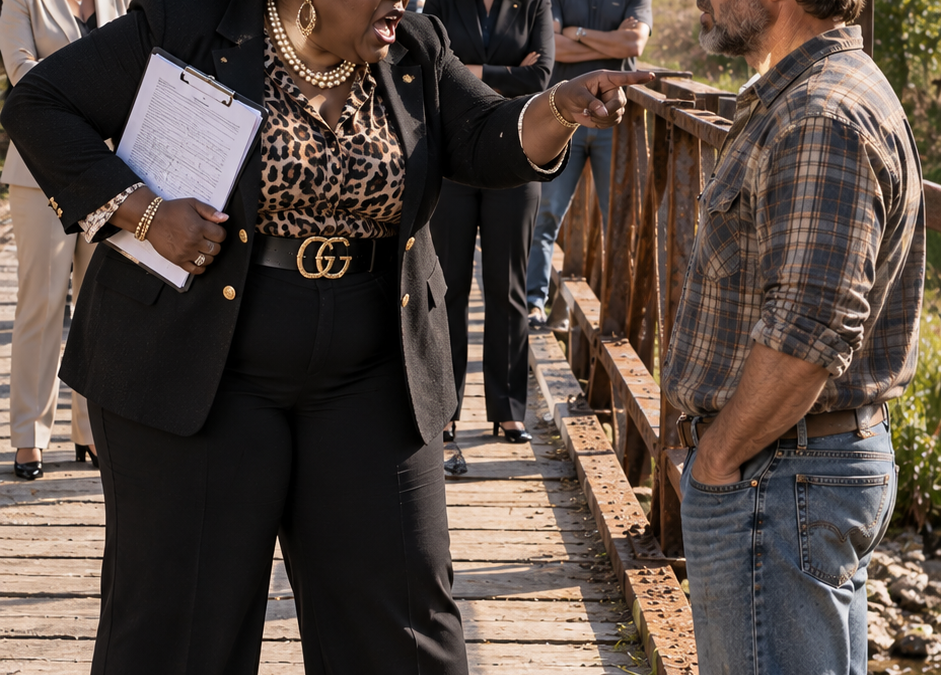
𝗣𝗔𝗥𝗧 𝟮
The neighborhood changed.
My boundaries did not.
That was enough for me.
I figured the worst I would get was more headlights in the evening and somebody’s dog eventually wandering into my hayfield.
Then one Tuesday morning, I was filling the coffee pot when I heard tires crossing timber.
If you live beside an old bridge long enough, you know its sounds.
A pickup has one rhythm.
A trailer has another.
A heavy vehicle makes the deck speak differently.
This was a normal passenger vehicle.
I looked out the kitchen window.
A silver SUV came across my bridge from the subdivision side.
It reached the county road.
Turned left.
Drove away.
I stared after it.
Then another SUV crossed.
Then a third.
Three vehicles in less than two minutes.
That bridge had averaged maybe four crossings a day for twenty years.
I set the coffee pot down.
Put my boots on.
Walked outside.
At the northern end of the bridge stood a sign.
A good sign, too.
Not temporary.
Not handwritten.
A routed cedar board mounted on two pressure-treated posts.
Green background.
Gold lettering.
CEDAR HOLLOW ESTATES
RESIDENT ACCESS
Below that:
PRIVATE COMMUNITY
GUESTS PLEASE REGISTER
The posts were set in concrete.
On my land.
Roughly eleven feet inside my property line.
Someone had entered my parcel with a post-hole digger.
Mixed concrete.
Set posts.
Mounted a sign.
And gone home believing they had every right to do it.
I stood there longer than I probably needed to.
Not because I was confused.
Because I was trying to understand how many decisions had to happen before somebody installs a permanent entrance sign on land they don’t own.
I walked the bridge.
Fresh tire scuffs marked the deck.
Two new gouges crossed boards near midspan.
Something heavy had shifted.
I took photographs.
Close shots.
Wide shots.
The sign.
Concrete around the posts.
Bridge.
County road behind it.
I have always believed photographs without context become arguments waiting to happen.
Then I went home and started making phone calls.
The old permit notice gave me the developer’s number.
The developer sent me to a management company.
The management company gave me the contact information for Cedar Hollow Estates HOA.
That was how I met Lenora Vance.
She answered on the second ring.
Her voice was bright.
Professional.
Polished.
I introduced myself.
Explained where I lived.
Told her association residents were crossing a private bridge on my parcel.
Then I told her an HOA sign had been installed on my land without permission.
The brightness disappeared.
“The board has reviewed the mapping.”
“What mapping?”
“The development mapping.”
“That doesn’t answer my question.”
“The crossing serves Cedar Hollow now.”
“That’s my bridge.”
She paused.
Then her tone changed into something more managerial.
Like she had moved from conversation to correction.
“Mr. Rowan, these matters were already resolved at the development level.”
“What does that mean?”
“The site development level.”
That phrase meant nothing.
I asked again.
“Do you have an easement across my property?”
“The maps establish community access.”
“Recorded easement?”
“The board is confident in its position.”
“Then send it to me.”
Another pause.
“Send what?”
“The recorded easement granting Cedar Hollow Estates vehicular access across my parcel. Book and page number is fine.”
Her tone became colder.
“Mr. Rowan, this bridge now serves nearly thirty households. You need to start thinking like part of a community instead of one man with a driveway.”
There it was.
I remember looking out the window toward the bridge while she said it.
“I’m not a member of your association.”
“That doesn’t change the practical use.”
“It changes your authority.”
She gave a small laugh.
“Have you ever worked in land development?”
“No.”
“I thought so.”
She said documents like these could be difficult to understand without professional exposure.
I let that sit.
The mistake people make in conversations like that is trying to establish their intelligence.
I didn’t need Lenora to think I was smart.
I needed her to produce a legal right.
“Send me the easement.”
“We’ve reviewed the maps.”
“I didn’t ask about maps.”
“You don’t have the right to deny access to infrastructure serving a residential community.”
“Send me the recorded easement.”
She ended the call soon after.
I wrote down everything while it was fresh.
Two days later, I received a letter.
I expected an attorney’s argument.
Maybe a claim that long use had created access rights.
Maybe an offer to negotiate.
Instead, the envelope contained something called a NOTICE OF REQUIRED INFRASTRUCTURE REMEDIATION.
It was addressed to me.
OWNER OF RECORD — ROWAN CROSSING.
The letter stated that the bridge deck, rails, and structural members required upgrades to accommodate the traffic volume associated with twenty-eight residences.
Attached was a four-page contractor estimate.
New decking.
Structural reinforcement.
Guardrail modification.
Engineering.
Mobilization.
Traffic control.
Total:
$186,400.
The letter directed me to pay or arrange financing within sixty days.
I read it twice.
Then again.
Not because it was complicated.
Because the arrogance was almost elegant.
They had begun using my bridge without permission.
Then they had decided I should pay to upgrade it for their use.
My response was four sentences.
Certified mail.
Return receipt.
I stated that my parcel was not part of Cedar Hollow Estates.
The HOA had no authority to impose assessments, fines, or maintenance obligations against my property.
The crossing was private property.
And I again requested the recorded easement authorizing the association’s use.
I added one final sentence.
Until such documentation was produced, continued use of the crossing by association residents, contractors, and agents would be treated as unpermitted use subject to further review.
No threats.
No insults.
Paper is stronger than shouting when the paper is good.
A week later, Lenora escalated.
The HOA issued an “infrastructure violation.”
It had a case number.
Daily penalties.
$250 per day.
The notice cited association bylaws and covenants.
None applied to me.
Then came the part that told me what Lenora was really doing.
The notice threatened a lien against my property.
That was not a woman confused about access.
That was a woman trying to manufacture an administrative history.
If she sent enough notices, issued enough fines, and used enough official language, eventually the association could point backward and say my bridge had always been part of the community’s infrastructure and I had always been responsible for it.
That mattered.
A private bridge they could use for free was valuable.
A private bridge whose owner could be forced to pay for repairs was even better.
Deck replacement.
Inspections.
Railings.
Future structural work.
Eventually a complete rebuild.
Twenty-eight homes could use it.
One man could pay for it.
That was efficient.
For them.
I filed the violation notice with everything else.
Meanwhile, traffic grew.
Moving trucks came through.
Landscaping crews pulled dual-axle trailers loaded with sod.
Delivery vans crossed several times a day.
One afternoon, a boom truck drove over the bridge to install a streetlight.
The entire span vibrated beneath it.
I started keeping a notebook beside the kitchen window.
Date.
Time.
Vehicle.
Plate number when visible.
Two weeks later, I had more than three hundred entries.
Then I installed two weatherproof cameras on the corner of my shop.
Both had a clear view of the approach.
Lenora came to my house one afternoon in April.
She parked in my gravel turnaround without asking.
I was in the shop cutting steel stock for a handrail.
I saw her through the open bay door.
She stood there until I shut the saw off.
Then she started.
“You’re holding an entire neighborhood hostage.”
I pulled down my hearing protection.
“Am I?”
“Families live back there.”
“I know.”
“Children.”
“I know.”
“This has become about one man needing to prove he’s important.”
I let her continue.
She warned me about attorneys.
Told me the association had resources.
Suggested litigation costs could become more than a man like me could afford.
I had learned over the years that people often reveal the useful part of what they believe near the end of a speech, once they think they’ve established control.
When she finished, I asked one question.
“If my bridge is essential to Cedar Hollow, why did you build twenty-eight houses without securing the right to use it?”
Lenora opened her mouth.
Nothing came out.
Just for a moment.
But I saw it.
Not confusion.
Calculation.
She was deciding how much I knew.
That was the moment I stopped believing this had begun as a mistake.
“The board will communicate through counsel from now on,” she said.
Then she left.
The following Monday, I was at the county records office twenty minutes after opening.
The land records counter was on the second floor of an old government building with terrible carpet and excellent air conditioning.
A clerk named Marin Sloan helped me.
Mid-thirties.
Reading glasses pushed into her hair.
The kind of person who genuinely liked finding the correct document.
“I need everything touching my parcel,” I told her. “Survey, easements, rights-of-way. Then I need the full Cedar Hollow development file.”
“The whole development file?”
“Every page.”
“That’ll take a while.”
I raised my thermos.
“I planned for that.”
My parcel came first.
The survey showed exactly what I remembered.
Both abutments were mine.
The bridge was mine.
The approaches were mine.
Roughly ninety feet of gravel beyond the north end sat inside my property.
No roadway easement.
No public right-of-way.
No private access agreement.
Nothing granting Cedar Hollow a vehicular crossing.
There was one recorded easement near the northern edge.
Twenty feet wide.
Dated 1981.
Marin pulled it.
EASEMENT FOR ELECTRIC DISTRIBUTION AND WATER MAIN.
The operative language authorized installation, maintenance, repair, and replacement of utility infrastructure.
No vehicles.
No road.
No residential access.
I asked Marin a question.
“Could someone mistake this for a road easement?”
She studied me.
“Someone could.”
“And a board with an attorney?”
She chose her words carefully.
“They generally should not.”
Then she showed me why.
On an old reduced composite map, the utility easement appeared as a hatched corridor running toward the county road.
At a small scale, if you badly wanted it to be an access route, you could pretend.
But the actual recorded document made that impossible.
I ordered certified copies.
Then Marin brought out the Cedar Hollow file.
It was nearly four inches thick.
We spread it across a table.
I started with the oldest pages.
The beginning matters.
That is usually when everyone is still telling the same story.
The preliminary plat was dated a little over three years earlier.
One sheet was titled ACCESS AND CIRCULATION.
I found the note within minutes.
PERMANENT PRIMARY ACCESS BRIDGE — DEVELOPER RESPONSIBILITY.
An arrow pointed to a proposed crossing of Cedar Creek about half a mile downstream from my bridge.
Entirely on developer property.
Two lanes.
Pedestrian walkway.
Designed for emergency vehicles.
I leaned back.
There it was.
Cedar Hollow had never been approved around my bridge.
Their bridge was supposed to exist somewhere else.
Then I found the northern route.
Falls Grade Road.
TEMPORARY CONSTRUCTION ACCESS.
A permit condition stated that the temporary route had to remain open and maintained until the permanent primary bridge was completed and formally accepted.
It could not be closed first.
That was not a suggestion.
It was part of the approval.
I worked through the file.
Amended plans.
Inspections.
Correspondence.
No permanent bridge completion.
No acceptance.
No as-built plans.
Nothing.
Then I found the budget estimate.
Design.
Permitting.
Abutments.
Span.
Road approaches.
Creek stabilization.
Estimated cost:
$1.7 million.
That number explained a lot.
Twenty-eight homes had been built around infrastructure costing almost two million dollars.
Infrastructure that had never been constructed.
Marin stood beside me.
“That’s still an open condition.”
“Looks that way.”
She nodded.
Then I kept reading.
Early HOA transition materials mentioned the future bridge repeatedly.
Newsletter.
Upcoming infrastructure.
Permanent access project.
Future community entrance.
Then about fourteen months earlier, the references began disappearing.
A month later, they stopped entirely.
That timing nearly matched Lenora Vance becoming president.
I wrote one word beside it.
COINCIDENCE?
I try not to make evidence prove more than it proves.
Then I turned another page.
An amended landscaping and circulation exhibit.
Filed five months earlier.
Buried in small print was a note.
EXISTING ROWAN CROSSING TO SERVE AS PERMANENT RESIDENTIAL ACCESS.
I read it once.
Then again.
Then twice more.
My name.
My bridge.
My private parcel.
Presented in a county filing as Cedar Hollow’s permanent entrance.
No signature from me.
No easement.
No sale.
No agreement.
No recorded transfer.
That was when the back of my neck went cold.
They hadn’t misunderstood the old utility easement.
They had substituted my bridge for the $1.7 million bridge they were supposed to build.
And they were counting on nobody checking.
Once I knew what to look for, the marketing records made the intent even clearer.
Cedar Hollow sales brochures described an “exclusive historic bridge entrance.”
One included a photograph.
My bridge.
Autumn trees behind it.
Taken from the county road.
There was no mistaking it.
The brochure had been distributed months before the first certificate of occupancy.
Before any resident moved in.
Before any legitimate right existed to use my property.
No agreement with me existed then.
No agreement existed now.
The bridge had been marketed as an amenity they did not own.
I hired an engineer.
Grant Hensley.
Heavyset.
Fifties.
Slow speaker.
Fast note-taker.
He spent most of a day on the bridge.
Measured midspan deflection.
Inspected stringers.
Checked bearings.
Examined abutments.
Photographed deck members.
Measured cracks.
Tested structural components.
At the end of the day, he sat on my tailgate.
“Bridge is basically sound for what it was designed for.”
“For personal use.”
“Exactly.”
“And for what it’s being used for?”
He looked back at the span.
“That’s another conversation.”
His report identified deformation in two steel stringers.
A settlement crack and rotation at the east abutment.
Six deck timbers crushed near bearing points.
The pattern was consistent with repeated overload.
Not normal passenger-car wear.
“Can you establish when heavy traffic started?” he asked.
“I have cameras.”
“How far back?”
“Two years.”
Grant looked at me.
“Let’s watch.”
We spent two evenings reviewing stored footage.
Near the end of the construction phase, we found it.
Concrete mixers.
Project markings visible.
A tandem dump truck hauling base rock.
Flatbeds.
A tanker.
A lowboy carrying an excavator.
They were crossing my bridge months before residents moved in.
Grant froze a frame showing one loaded mixer.
He estimated the vehicle weight.
“That’s more than three times what this bridge should have been carrying.”
The developer had been using my bridge as a shortcut while its approved temporary access route existed to the north.
That discovery reversed the entire maintenance claim.
Lenora wanted me to pay $186,400 to repair damage caused largely by project traffic tied to her own development.
I looked at the violation notice sitting beside the engineer’s report.
Grant noticed.
“You know what this looks like?”
“What?”
“In my experience, when somebody moves this quickly to assign you liability, it’s usually because they know where the liability really belongs.”
That stayed with me.
Then he told me something I did not want to hear.
“I cannot recommend unrestricted residential traffic continue until we do a formal load rating.”
I knew what that meant.
Twenty-eight houses.
One currently functioning exit.
Families.
Children.
Maybe elderly residents.
Someone with medical needs.
Closing the bridge immediately might have made my legal point.
It also might have created a dangerous situation for people who had bought homes believing everything was legitimate.
They weren’t the ones who had made the decision.
I would not trap them to punish Lenora.
So I did it slowly.
I sent Grant’s report to county planning.
Public works.
The fire district.
The developer.
The HOA.
I stated that I intended to restrict unauthorized use of the private bridge because of documented structural concerns.
But I would not do so until an alternative access route was active.
I formally requested that the Falls Grade temporary construction entrance be reopened as an interim route.
I gave everyone time.
A date.
Engineering.
Notice.
Nobody could later claim surprise.
Lenora learned about my county request within days.
Her response told me how serious she knew the problem was.
She called an emergency HOA meeting.
Then she invited me.
Hand-delivered notice.
The meeting was framed as an attempt to resolve the bridge dispute with residents present.
I knew what she wanted.
Twenty-eight households staring at me.
One outsider.
One bridge.
Children.
Emergency access.
Pressure works better when it has an audience.
I went.
The Cedar Hollow clubhouse was nicer than ours had ever needed to be.
Stone fireplace.
High ceiling.
About fifty folding chairs.
Nearly forty people attended.
I sat near the back.
A canvas bag beside me.
Lenora took the podium.
She reached my name in less than three minutes.
She described me as a difficult neighboring property owner who had recently begun challenging access residents had relied upon since move-in.
She said the board had tried to solve everything amicably.
Then she made the argument I knew she had been preparing.
Because Cedar Hollow residents had used the bridge continuously since they moved in, and because the bridge functioned as the neighborhood entrance, I had an obligation to maintain it safely.
Heads nodded.
A man near the front mentioned children.
Another said ambulances needed access.
Lenora agreed.
“The owner is refusing to maintain infrastructure the community depends upon.”
That was good framing.
If I had arrived with nothing but anger, I would have lost that room.
When she asked whether I wanted to respond, I stood.
“Yes.”
She waited.
I asked one question.
“Show them the easement.”
The room went quiet.
Lenora smiled.
“The board has reviewed the relevant maps.”
“That’s not what I asked.”
I walked toward the front.
“Book and page. Recorded easement. Show everyone the document giving Cedar Hollow residents a right to drive across my land.”
She turned on the projector.
A composite map appeared.
The old one.
Twenty-foot hatched strip.
She pointed.
“This is the access corridor.”
I reached into my bag.
Placed the certified 1981 instrument on the table.
Then my certified survey.
“This first document is what she just pointed to.”
I turned the title toward the audience.
EASEMENT FOR ELECTRIC DISTRIBUTION AND WATER MAIN.
I read the operative language.
Install.
Maintain.
Repair.
Replace utility facilities.
Nothing about residential traffic.
Then I held up the survey.
“This shows the bridge, both abutments, and the approach inside my property. No road easement.”
I looked at Lenora.
“Please show everyone the part of your document that authorizes vehicles.”
She stared down at the paper.
A woman in the third row spoke.
“That’s a water-line easement.”
Someone beside her whispered something.
The room shifted.
You could feel it.
People who had arrived believing this was a stubborn neighbor refusing to maintain a shared entrance were suddenly looking at a board president whose evidence said something different.
Then Wade Hollis stood.
Cedar Hollow’s treasurer.
Retired freight operations manager.
Gray mustache.
Quiet manner.
“I have a budget question.”
Lenora looked irritated.
“Wade—”
He continued.
“In three years of financial documents, I have never seen a reserve allocation for the permanent bridge listed in the approved development plan.”
Silence.
I looked at him.
He looked at Lenora.
“The cost estimate is approximately $1.7 million. Why is that not in our reserve schedule?”
Lenora recovered.
“The development found a more efficient solution.”
“What solution?”
“The existing access has proven adequate.”
Wade’s eyes moved toward me.
Then back to her.
“And the planned bridge?”
“Redundant infrastructure would have placed an unnecessary financial burden on homeowners.”
I let one second pass.
Then I asked:
“So the efficient solution was taking my bridge for free?”
Nobody laughed.
That mattered.
The sentence was funny in shape.
But nobody found it funny.
Lenora looked toward the back wall.
“The board will take the issue under advisement.”
She adjourned.
Wade found me in the parking lot.
It was dark.
I was beside my truck.
He carried a manila envelope.
“I’ve spent forty years around freight contracts and liability,” he said. “I know what this looks like.”
He handed me the envelope.
“These came from the association management account. I have authorized access as treasurer.”
Inside were email printouts.
Lenora.
Everett Callaway from the developer.
Most were ordinary.
Two were not.
The first discussed the cost of building the permanent bridge.
Lenora asked whether the temporary Falls Grade route could simply be closed after occupancy and whether the association could rely on existing access instead.
Then I read the second.
One sentence.
If Rowan objects, the association can apply pressure through maintenance liability.
I read it again.
Wade watched me.
“That was written fifteen months ago.”
Before the repair bill.
Before the fines.
Before Lenora came to my shop and accused me of holding families hostage.
Maintenance liability had been the pressure tactic from the beginning.
“Will you testify this came from the association account?”
“Yes.”
“You understand what that means for you?”
“I do.”
I looked at him.
“Thank you.”
He nodded.
“I’m not doing it for you.”
“I know.”
“I’m doing it because twenty-eight families were told something that wasn’t true.”
That was enough.
The county scheduled a joint meeting.
Planning.
Public works.
Fire district.
Developer.
HOA.
Me.
It was not formally called a hearing.
It felt like one.
Lenora arrived with an attorney and a leather folio.
I arrived with a banker’s box and a tabbed binder.
Her attorney spoke first.
He argued that Cedar Hollow had relied on the bridge continuously since occupancy.
That no other usable access currently existed.
That public safety favored maintaining the status quo.
And that the private bridge had functionally become part of the local transportation network.
It was a respectable argument.
If you started the clock on the day the first family moved in.
That was why I started three years earlier.
I opened my binder.
Deed.
“My ownership.”
Survey.
“Bridge, abutments, and approach entirely inside my parcel.”
Certified 1981 easement.
“Utilities only. No vehicular access.”
Approved plat.
“Permanent primary bridge. Developer responsibility.”
Permit condition.
“Temporary northern route remains open until permanent bridge completion and acceptance.”
Marketing brochure.
“My bridge advertised as Cedar Hollow’s historic entrance before any legal access right existed.”
Engineering report.
“Damage consistent with repeated overload.”
Video stills.
“Developer vehicles crossing during construction.”
Then Lenora’s email.
If Rowan objects, the association can apply pressure through maintenance liability.
Her attorney immediately asked where the message came from.
Wade spoke.
“I provided it from the association’s records.”
The attorney leaned toward Lenora.
Whispered something.
She did not answer.
The planning director took the permit sheet.
Read it.
Then read it again.
Grant Hensley was there in his county role.
He leaned forward.
And in less than a minute, he changed the entire frame.
“This dispute is being described backwards.”
Everybody looked at him.
“Mr. Rowan is not depriving Cedar Hollow of approved access.”
He tapped the development plan.
“The development failed to complete the access it was required to construct.”
Then the permit condition.
“The residents’ current dependence on a private bridge is not a status quo created by Mr. Rowan. It is the result of an unfulfilled approval condition.”
That was it.
Everything Lenora had built collapsed under the correct starting point.
The county did not need to force my private bridge into public service.
It needed to enforce the plan Cedar Hollow had already agreed to.
The public works director turned to Everett Callaway.
“When was the Falls Grade construction route closed?”
“At the end of the construction phase.”
“Who authorized closure?”
Everett hesitated.
“I’d have to review the file.”
The planning director already had.
“There is no closure approval in our file.”
No answer.
Then she asked something I had not expected.
“What is the status of the performance bond?”
Everett’s expression changed.
So did Lenora’s.
The developer had posted financial security when the project was approved.
That security existed to guarantee required infrastructure would actually be completed.
The bond had never been released.
Why?
Because the permanent bridge had never been completed.
The county still held leverage.
A lot of leverage.
Everett started talking about value engineering.
Changed conditions.
Alternative access.
The planning director interrupted.
“Show me the approved amendment.”
Silence.
“No amendment?”
Everett looked toward his attorney.
There wasn’t one.
There had only been that tiny line on a landscaping exhibit claiming my crossing would become permanent access.
A statement nobody with authority had properly approved.
A statement I had never signed.
The county’s response came quickly.
Falls Grade Road had to be reopened.
Thirty days.
The temporary construction access would become interim residential access until the permanent bridge was completed.
The fire district would inspect turning radii, width, surface, and emergency access.
That decision removed almost all Lenora’s leverage.
Once Cedar Hollow had another route, nobody could argue that my private bridge had to remain open because residents would otherwise be trapped.
Then came the second consequence.
The county moved to enforce the original permanent bridge condition.
$1.7 million in promised infrastructure.
Developer responsibility.
Financial security still held.
And then the third consequence.
Grant’s engineering report tied much of the damage on my bridge to overloaded construction vehicles belonging to the project.
Meaning the repair bill did not run from Cedar Hollow to me.
It ran the other direction.
Lenora had entered the meeting trying to make me responsible for her community’s entrance.
She left having reminded the county that the developer still owed a two-lane bridge and had used my property while failing to build it.
Word spread.
Residents began stopping near my gate.
Not to threaten me.
To ask questions.
Most were angry.
Just not at me.
One woman named Priscilla Vaughn showed me notes from her home closing.
She had specifically asked about access.
The sales representative told her the historic bridge entrance was included with the subdivision.
Another resident had a brochure.
Another had an email.
They had bought homes based on representations that access was settled.
A $400,000 or $500,000 house is one thing.
A house with no legal permanent entrance is another.
At the next HOA meeting, Wade presented a timeline.
No speeches.
Just dates.
Original approval.
Required bridge.
Temporary Falls Grade access.
Lenora becoming president.
References to the new bridge disappearing from newsletters.
Email asking about closing the temporary route.
Landscaping exhibit substituting the Rowan crossing.
Violation notice against me.
$186,400 repair demand.
$250 daily penalties.
Then the email.
If Rowan objects, the association can apply pressure through maintenance liability.
Projected on the wall.
Full screen.
Nobody needed interpretation.
Lenora still tried.
“Everything I did was intended to protect members from an unnecessary expense.”
Nobody answered.
“If Mr. Rowan had been willing to cooperate, none of this would have cost the community anything.”
I was sitting near the back.
I didn’t stand.
“Cooperation doesn’t mean I hand you my bridge.”
That was all.
Ray would have made a speech.
Lenora probably expected one.
I didn’t have anything else to say.
The board removed her that night.
Four to one.
Lenora cast the only vote against removal.
Wade became interim president until the next election.
Within a month, Cedar Hollow hired new counsel.
The first thing the new attorney did was send me a letter formally withdrawing every violation, fine, assessment, and maintenance demand ever issued against my parcel.
I put it in the fireproof box.
The developer entered negotiations with the county.
By midsummer, it had committed to designing and constructing the permanent two-lane bridge identified in the original approved plan.
The temporary Falls Grade route remained open.
Exactly as the permit had always required.
Nobody was being punished.
That point mattered to me.
The county wasn’t inventing a new obligation.
It was enforcing the old one.
The one everybody had signed before the first house went up.
My bridge became a separate matter.
The developer and its insurer accepted responsibility for damage tied to construction traffic.
The settlement paid for repairs documented by Grant.
Two steel stringers were repaired and reinforced.
The east abutment was stabilized.
Damaged bearing surfaces were corrected.
The deck was replaced.
Guardrails restored.
The settlement could have been broader.
An attorney told me I had arguments for unauthorized use, trespass, and additional damages.
I believed him.
I asked for three things.
No new easement.
No HOA traffic.
No HOA sign on my property.
That was it.
People asked why I didn’t take more money.
The answer was not virtue.
It was clarity.
If I demanded a huge settlement, Lenora could spend the rest of her life telling everyone I had turned a technical property dispute into a payday.
I wanted no ambiguity.
My property had been used.
My bridge had been damaged.
The responsible party repaired it.
Cedar Hollow built its own entrance.
The boundary remained exactly where it had always been.
That was enough.
My father would have understood.
He wasn’t much for theatrical victories either.
He believed the cleanest argument was the one that still looked clean ten years later.
Construction on Cedar Hollow’s permanent bridge began that fall.
I could hear pile-driving downstream on still mornings.
It did not bother me.
The project sat where it had been designed to sit from the beginning.
On their property.
Their frontage.
Their responsibility.
My own bridge was repaired first.
New oak deck.
Tight boards.
Repaired steel.
Fresh primer and dark green paint.
Same profile I had always maintained.
The east abutment no longer showed movement.
The old HOA sign disappeared.
A maintenance contractor removed the cedar posts.
Dug out the concrete.
I raked the holes smooth.
Spread seed.
By autumn, grass covered the entire spot.
I installed a gate at the beginning of my approach.
Simple steel swing gate.
Nothing elaborate.
A small sign.
PRIVATE DRIVE.
Some people assumed I put it there out of spite.
I didn’t.
I put it there because invisible boundaries are easy for people to reinterpret.
Visible ones are harder.
Paper protects a boundary.
A gate reminds people the paper exists.
Lenora came by one last time in September.
She had gone to the clubhouse to collect association records left behind after her removal.
On the way out, she parked on the shoulder near my property.
I was checking something near the new gate.
She walked toward it.
Stopped before crossing.
That was progress, I suppose.
For a while, she looked at the repaired bridge.
The oak deck was still pale from fresh installation.
Steel looked new under the paint.
Finally, she said:
“In the end, you got a nearly new bridge for free.”
Her voice had lost the sweetness.
I thought about answering quickly.
Didn’t.
Precision matters.
“No, Lenora.”
She looked at me.
“I got back the bridge you broke.”
Her mouth tightened.
Neither of us spoke.
Downstream, a crane was lifting one of the first girders for the new Cedar Hollow bridge.
We could both see it above the trees.
A structure that had existed on paper for years was finally becoming real.
Twenty-eight houses were finally getting the legal entrance they had been promised.
I still owned every square foot I had bought.
Lenora walked back to her car.
That was the last real conversation we ever had.
The new bridge opened months later.
Two lanes.
Pedestrian shoulder.
Rated for fire apparatus.
Modern guardrails.
Nothing historic about it.
Nothing charming.
But it belonged exactly where it belonged.
After that, traffic on my bridge returned to what it had always been.
My truck.
Service vehicles.
Friends.
Occasional delivery.
The deck stopped shuddering beneath moving vans and construction equipment.
The mornings became quiet again.
Sometimes I stood near the creek with coffee and watched fog move under the steel.
Everything looked almost like it had before Cedar Hollow existed.
Almost.
The subdivision was still there.
Twenty-eight houses across the water.
Families.
Children.
Dogs.
Patio lights.
Life.
I never blamed the residents.
That mattered to me.
They had not stolen access.
They had purchased homes from people who told them access was settled.
That distinction was the reason I never closed the bridge without warning.
Why I insisted Falls Grade reopen first.
Why I worked through the county instead of blocking the approach with equipment one morning just to prove that I could.
Ownership gives you rights.
It doesn’t require you to stop caring what happens to innocent people.
Lenora confused restraint with weakness.
That was another mistake.
She saw one man on eleven acres.
No lawyer beside me.
No board.
No management company.
No developer.
And she assumed that meant there was nobody on my side of the table.
But the deed was on my side.
The survey was on my side.
The recorded easement was on my side.
The original development plan was on my side.
The permit conditions were on my side.
The engineering was on my side.
And eventually, the association’s own records were on my side too.
None of those documents shouted.
None needed to.
That whole dispute began because Lenora believed use could quietly become ownership if everybody behaved as though it had.
Residents crossed the bridge.
A sign went up.
The HOA issued notices.
Then fines.
Then a repair assessment.
Each action was designed to make the next one look more normal.
That is how a lot of bad decisions survive.
Not because the first one is convincing.
Because enough later decisions are stacked on top until people stop asking what the first one was based on.
But there was never a recorded access right.
There had always been a different entrance plan.
There had always been a bridge the developer owed.
And once I found that original plan, every later claim had to answer to it.
The most important line in the whole file was not dramatic.
PERMANENT PRIMARY ACCESS BRIDGE — DEVELOPER RESPONSIBILITY.
That was all.
Five words of consequence buried inside an old plan.
That line told the truth before anybody had reason to disguise it.
Cedar Hollow had been approved with its own bridge.
My crossing was never theirs.
It was never supposed to become theirs.
And no amount of traffic, signage, HOA letterhead, or confidence from Lenora Vance could change that after the fact.
She once stood on my bridge with twenty-eight houses behind her and handed me a bill for nearly two hundred thousand dollars.
She believed she was assigning responsibility.
What she was really doing was drawing my attention to a question nobody in Cedar Hollow wanted me to ask.
If this bridge belongs to me, where is yours?
The answer cost the developer $1.7 million.
It cost the association thousands more.
It cost Lenora her position.
And it restored my bridge without costing me the repair bill she tried to put in my hands.
I never needed to take her chair.
I never wanted her neighborhood.
I never wanted their money.
I wanted one thing.
For everybody involved to respect the same line that had been sitting on my survey from the day I bought the property.
That line never moved.
People’s assumptions did.
Their maps did.
Their marketing language did.
Their explanations did.
The boundary stayed exactly where it was.
And in the end, that was enough.
Lenora once told me one man with a driveway needed to start thinking like part of a community.
Maybe she was right in a way she never intended.
A community works only when people respect what belongs to one another.
When promises made to buyers are honest.
When developers build what they agreed to build.
When boards understand the difference between managing shared property and taking private property.
And when a man can look at his own bridge and know that “private” still means something even after twenty-eight houses appear on the other side.
Cedar Hollow eventually got its entrance.
I kept mine.
And the final arrangement looked almost exactly like the original plan had shown before anyone decided they were clever enough to ignore it.
Have you finished reading the story and want to read it again?
The HOA President Thought My Bridge Belonged to Her Neighborhood, but She Never Read the Plan That Built Those 28 Houses
Lenora Vance stood in the middle of my bridge and handed me a repair bill for $186,400.
Behind her were twenty-eight expensive new houses whose residents had suddenly begun using my property as their only way to the county road.
She smiled because she thought I had inherited their problem, while I was already holding the document that proved the problem had been theirs from the beginning.
My name is Isaiah Rowan.
I was forty-eight when Cedar Hollow Estates decided that the bridge on my property belonged to everybody except me.
I owned eleven acres on the south side of Cedar Creek.
There was an old farmhouse on the land, a metal shop I rebuilt over three summers, a stand of cottonwoods along the creek, and one narrow bridge connecting my driveway to Ridgeline County Road.
The bridge had been there since the 1960s.
A rancher built it so he could move a tractor across the creek without making a four-mile detour.
It was simple.
Steel beams.
Timber deck.
Single lane.
No decorative stone.
No ornamental railings.
Nothing anybody would put on the front page of a real estate brochure.
But it was solid.
I replaced the deck about twelve years after I bought the place.
I kept the steel painted.
Checked the bearings.
Watched the abutments.
Rust is patient.
Water is more patient.
I learned a long time ago that if you own an old bridge, you pay attention before either one gets ambitious.
The bridge was meant for personal vehicles, pickup trucks, light equipment, and the occasional service vehicle.
That was what crossed it for years.
My truck.
My welding trailer.
The propane delivery truck twice every winter.
Friends.
A lost fisherman every now and then.
Maybe four crossings a day.
Sometimes fewer.
My parcel did not belong to an HOA.
That wasn’t my interpretation.
It was recorded fact.
Cedar Hollow Estates did not exist when I bought the property.
No declaration had ever been attached to my deed.
No covenant had ever encumbered my land.
No association assessment had ever been paid because none had ever been owed.
I had the deed.
The survey.
The title policy.
All of it sat in a fireproof box in my hallway closet.
My father believed paperwork outlived arguments.
He was right about that.
For most of the time I lived there, none of it mattered because the property on the other side of my line was three hundred acres of pasture.
Cattle.
Hay.
A few old fence lines.
In October, fog would sit low over Cedar Creek until the sun reached the water.
Some mornings I would drink coffee near the shop and hear the steel under the bridge tick as it warmed.
I liked how quiet the place was.
Then the cattle operation folded.
A development company from the city bought the pasture.
Not long afterward, a notice went up announcing plans for twenty-eight upscale houses.
People later assumed I must have opposed the development from the beginning.
I didn’t.
I drove to the county planning office when the application became public.
I sat with a planner.
I read the site plan.
Every page.
That plan showed a northern access route from Falls Grade Road.
It also showed a permanent two-lane bridge to be constructed about half a mile downstream from mine.
The bridge would sit on the developer’s frontage.
Their land.
Their design.
Their expense.
The plan specified room for emergency apparatus and pedestrians.
Nothing touched my parcel.
I remember driving home almost relieved.
Somebody had thought ahead.
For nearly two years, what I saw matched the approved plan.
Construction traffic entered from the north.
Concrete trucks.
Lumber haulers.
Excavators on lowboys.
Dump trucks.
They all used Falls Grade Road.
From my porch, I could see dust hanging above the temporary access route.
I watched streets appear across the former pasture.
Ren Hollow Lane.
Silver Birch Court.
Stone-faced houses with three-car garages.
Streetlights.
Sidewalks.
Mailboxes.
The neighborhood changed.
My boundaries did not.
That was enough for me.
I figured the worst I would get was more headlights in the evening and somebody’s dog eventually wandering into my hayfield.
Then one Tuesday morning, I was filling the coffee pot when I heard tires crossing timber.
If you live beside an old bridge long enough, you know its sounds.
A pickup has one rhythm.
A trailer has another.
A heavy vehicle makes the deck speak differently.
This was a normal passenger vehicle.
I looked out the kitchen window.
A silver SUV came across my bridge from the subdivision side.
It reached the county road.
Turned left.
Drove away.
I stared after it.
Then another SUV crossed.
Then a third.
Three vehicles in less than two minutes.
That bridge had averaged maybe four crossings a day for twenty years.
I set the coffee pot down.
Put my boots on.
Walked outside.
At the northern end of the bridge stood a sign.
A good sign, too.
Not temporary.
Not handwritten.
A routed cedar board mounted on two pressure-treated posts.
Green background.
Gold lettering.
CEDAR HOLLOW ESTATES
RESIDENT ACCESS
Below that:
PRIVATE COMMUNITY
GUESTS PLEASE REGISTER
The posts were set in concrete.
On my land.
Roughly eleven feet inside my property line.
Someone had entered my parcel with a post-hole digger.
Mixed concrete.
Set posts.
Mounted a sign.
And gone home believing they had every right to do it.
I stood there longer than I probably needed to.
Not because I was confused.
Because I was trying to understand how many decisions had to happen before somebody installs a permanent entrance sign on land they don’t own.
I walked the bridge.
Fresh tire scuffs marked the deck.
Two new gouges crossed boards near midspan.
Something heavy had shifted.
I took photographs.
Close shots.
Wide shots.
The sign.
Concrete around the posts.
Bridge.
County road behind it.
I have always believed photographs without context become arguments waiting to happen.
Then I went home and started making phone calls.
The old permit notice gave me the developer’s number.
The developer sent me to a management company.
The management company gave me the contact information for Cedar Hollow Estates HOA.
That was how I met Lenora Vance.
She answered on the second ring.
Her voice was bright.
Professional.
Polished.
I introduced myself.
Explained where I lived.
Told her association residents were crossing a private bridge on my parcel.
Then I told her an HOA sign had been installed on my land without permission.
The brightness disappeared.
“The board has reviewed the mapping.”
“What mapping?”
“The development mapping.”
“That doesn’t answer my question.”
“The crossing serves Cedar Hollow now.”
“That’s my bridge.”
She paused.
Then her tone changed into something more managerial.
Like she had moved from conversation to correction.
“Mr. Rowan, these matters were already resolved at the development level.”
“What does that mean?”
“The site development level.”
That phrase meant nothing.
I asked again.
“Do you have an easement across my property?”
“The maps establish community access.”
“Recorded easement?”
“The board is confident in its position.”
“Then send it to me.”
Another pause.
“Send what?”
“The recorded easement granting Cedar Hollow Estates vehicular access across my parcel. Book and page number is fine.”
Her tone became colder.
“Mr. Rowan, this bridge now serves nearly thirty households. You need to start thinking like part of a community instead of one man with a driveway.”
There it was.
I remember looking out the window toward the bridge while she said it.
“I’m not a member of your association.”
“That doesn’t change the practical use.”
“It changes your authority.”
She gave a small laugh.
“Have you ever worked in land development?”
“No.”
“I thought so.”
She said documents like these could be difficult to understand without professional exposure.
I let that sit.
The mistake people make in conversations like that is trying to establish their intelligence.
I didn’t need Lenora to think I was smart.
I needed her to produce a legal right.
“Send me the easement.”
“We’ve reviewed the maps.”
“I didn’t ask about maps.”
“You don’t have the right to deny access to infrastructure serving a residential community.”
“Send me the recorded easement.”
She ended the call soon after.
I wrote down everything while it was fresh.
Two days later, I received a letter.
I expected an attorney’s argument.
Maybe a claim that long use had created access rights.
Maybe an offer to negotiate.
Instead, the envelope contained something called a NOTICE OF REQUIRED INFRASTRUCTURE REMEDIATION.
It was addressed to me.
OWNER OF RECORD — ROWAN CROSSING.
The letter stated that the bridge deck, rails, and structural members required upgrades to accommodate the traffic volume associated with twenty-eight residences.
Attached was a four-page contractor estimate.
New decking.
Structural reinforcement.
Guardrail modification.
Engineering.
Mobilization.
Traffic control.
Total:
$186,400.
The letter directed me to pay or arrange financing within sixty days.
I read it twice.
Then again.
Not because it was complicated.
Because the arrogance was almost elegant.
They had begun using my bridge without permission.
Then they had decided I should pay to upgrade it for their use.
My response was four sentences.
Certified mail.
Return receipt.
I stated that my parcel was not part of Cedar Hollow Estates.
The HOA had no authority to impose assessments, fines, or maintenance obligations against my property.
The crossing was private property.
And I again requested the recorded easement authorizing the association’s use.
I added one final sentence.
Until such documentation was produced, continued use of the crossing by association residents, contractors, and agents would be treated as unpermitted use subject to further review.
No threats.
No insults.
Paper is stronger than shouting when the paper is good.
A week later, Lenora escalated.
The HOA issued an “infrastructure violation.”
It had a case number.
Daily penalties.
$250 per day.
The notice cited association bylaws and covenants.
None applied to me.
Then came the part that told me what Lenora was really doing.
The notice threatened a lien against my property.
That was not a woman confused about access.
That was a woman trying to manufacture an administrative history.
If she sent enough notices, issued enough fines, and used enough official language, eventually the association could point backward and say my bridge had always been part of the community’s infrastructure and I had always been responsible for it.
That mattered.
A private bridge they could use for free was valuable.
A private bridge whose owner could be forced to pay for repairs was even better.
Deck replacement.
Inspections.
Railings.
Future structural work.
Eventually a complete rebuild.
Twenty-eight homes could use it.
One man could pay for it.
That was efficient.
For them.
I filed the violation notice with everything else.
Meanwhile, traffic grew.
Moving trucks came through.
Landscaping crews pulled dual-axle trailers loaded with sod.
Delivery vans crossed several times a day.
One afternoon, a boom truck drove over the bridge to install a streetlight.
The entire span vibrated beneath it.
I started keeping a notebook beside the kitchen window.
Date.
Time.
Vehicle.
Plate number when visible.
Two weeks later, I had more than three hundred entries.
Then I installed two weatherproof cameras on the corner of my shop.
Both had a clear view of the approach.
Lenora came to my house one afternoon in April.
She parked in my gravel turnaround without asking.
I was in the shop cutting steel stock for a handrail.
I saw her through the open bay door.
She stood there until I shut the saw off.
Then she started.
“You’re holding an entire neighborhood hostage.”
I pulled down my hearing protection.
“Am I?”
“Families live back there.”
“I know.”
“Children.”
“I know.”
“This has become about one man needing to prove he’s important.”
I let her continue.
She warned me about attorneys.
Told me the association had resources.
Suggested litigation costs could become more than a man like me could afford.
I had learned over the years that people often reveal the useful part of what they believe near the end of a speech, once they think they’ve established control.
When she finished, I asked one question.
“If my bridge is essential to Cedar Hollow, why did you build twenty-eight houses without securing the right to use it?”
Lenora opened her mouth.
Nothing came out.
Just for a moment.
But I saw it.
Not confusion.
Calculation.
She was deciding how much I knew.
That was the moment I stopped believing this had begun as a mistake.
“The board will communicate through counsel from now on,” she said.
Then she left.
The following Monday, I was at the county records office twenty minutes after opening.
The land records counter was on the second floor of an old government building with terrible carpet and excellent air conditioning.
A clerk named Marin Sloan helped me.
Mid-thirties.
Reading glasses pushed into her hair.
The kind of person who genuinely liked finding the correct document.
“I need everything touching my parcel,” I told her. “Survey, easements, rights-of-way. Then I need the full Cedar Hollow development file.”
“The whole development file?”
“Every page.”
“That’ll take a while.”
I raised my thermos.
“I planned for that.”
My parcel came first.
The survey showed exactly what I remembered.
Both abutments were mine.
The bridge was mine.
The approaches were mine.
Roughly ninety feet of gravel beyond the north end sat inside my property.
No roadway easement.
No public right-of-way.
No private access agreement.
Nothing granting Cedar Hollow a vehicular crossing.
There was one recorded easement near the northern edge.
Twenty feet wide.
Dated 1981.
Marin pulled it.
EASEMENT FOR ELECTRIC DISTRIBUTION AND WATER MAIN.
The operative language authorized installation, maintenance, repair, and replacement of utility infrastructure.
No vehicles.
No road.
No residential access.
I asked Marin a question.
“Could someone mistake this for a road easement?”
She studied me.
“Someone could.”
“And a board with an attorney?”
She chose her words carefully.
“They generally should not.”
Then she showed me why.
On an old reduced composite map, the utility easement appeared as a hatched corridor running toward the county road.
At a small scale, if you badly wanted it to be an access route, you could pretend.
But the actual recorded document made that impossible.
I ordered certified copies.
Then Marin brought out the Cedar Hollow file.
It was nearly four inches thick.
We spread it across a table.
I started with the oldest pages.
The beginning matters.
That is usually when everyone is still telling the same story.
The preliminary plat was dated a little over three years earlier.
One sheet was titled ACCESS AND CIRCULATION.
I found the note within minutes.
PERMANENT PRIMARY ACCESS BRIDGE — DEVELOPER RESPONSIBILITY.
An arrow pointed to a proposed crossing of Cedar Creek about half a mile downstream from my bridge.
Entirely on developer property.
Two lanes.
Pedestrian walkway.
Designed for emergency vehicles.
I leaned back.
There it was.
Cedar Hollow had never been approved around my bridge.
Their bridge was supposed to exist somewhere else.
Then I found the northern route.
Falls Grade Road.
TEMPORARY CONSTRUCTION ACCESS.
A permit condition stated that the temporary route had to remain open and maintained until the permanent primary bridge was completed and formally accepted.
It could not be closed first.
That was not a suggestion.
It was part of the approval.
I worked through the file.
Amended plans.
Inspections.
Correspondence.
No permanent bridge completion.
No acceptance.
No as-built plans.
Nothing.
Then I found the budget estimate.
Design.
Permitting.
Abutments.
Span.
Road approaches.
Creek stabilization.
Estimated cost:
$1.7 million.
That number explained a lot.
Twenty-eight homes had been built around infrastructure costing almost two million dollars.
Infrastructure that had never been constructed.
Marin stood beside me.
“That’s still an open condition.”
“Looks that way.”
She nodded.
Then I kept reading.
Early HOA transition materials mentioned the future bridge repeatedly.
Newsletter.
Upcoming infrastructure.
Permanent access project.
Future community entrance.
Then about fourteen months earlier, the references began disappearing.
A month later, they stopped entirely.
That timing nearly matched Lenora Vance becoming president.
I wrote one word beside it.
COINCIDENCE?
I try not to make evidence prove more than it proves.
Then I turned another page.
An amended landscaping and circulation exhibit.
Filed five months earlier.
Buried in small print was a note.
EXISTING ROWAN CROSSING TO SERVE AS PERMANENT RESIDENTIAL ACCESS.
I read it once.
Then again.
Then twice more.
My name.
My bridge.
My private parcel.
Presented in a county filing as Cedar Hollow’s permanent entrance.
No signature from me.
No easement.
No sale.
No agreement.
No recorded transfer.
That was when the back of my neck went cold.
They hadn’t misunderstood the old utility easement.
They had substituted my bridge for the $1.7 million bridge they were supposed to build.
And they were counting on nobody checking.
Once I knew what to look for, the marketing records made the intent even clearer.
Cedar Hollow sales brochures described an “exclusive historic bridge entrance.”
One included a photograph.
My bridge.
Autumn trees behind it.
Taken from the county road.
There was no mistaking it.
The brochure had been distributed months before the first certificate of occupancy.
Before any resident moved in.
Before any legitimate right existed to use my property.
No agreement with me existed then.
No agreement existed now.
The bridge had been marketed as an amenity they did not own.
I hired an engineer.
Grant Hensley.
Heavyset.
Fifties.
Slow speaker.
Fast note-taker.
He spent most of a day on the bridge.
Measured midspan deflection.
Inspected stringers.
Checked bearings.
Examined abutments.
Photographed deck members.
Measured cracks.
Tested structural components.
At the end of the day, he sat on my tailgate.
“Bridge is basically sound for what it was designed for.”
“For personal use.”
“Exactly.”
“And for what it’s being used for?”
He looked back at the span.
“That’s another conversation.”
His report identified deformation in two steel stringers.
A settlement crack and rotation at the east abutment.
Six deck timbers crushed near bearing points.
The pattern was consistent with repeated overload.
Not normal passenger-car wear.
“Can you establish when heavy traffic started?” he asked.
“I have cameras.”
“How far back?”
“Two years.”
Grant looked at me.
“Let’s watch.”
We spent two evenings reviewing stored footage.
Near the end of the construction phase, we found it.
Concrete mixers.
Project markings visible.
A tandem dump truck hauling base rock.
Flatbeds.
A tanker.
A lowboy carrying an excavator.
They were crossing my bridge months before residents moved in.
Grant froze a frame showing one loaded mixer.
He estimated the vehicle weight.
“That’s more than three times what this bridge should have been carrying.”
The developer had been using my bridge as a shortcut while its approved temporary access route existed to the north.
That discovery reversed the entire maintenance claim.
Lenora wanted me to pay $186,400 to repair damage caused largely by project traffic tied to her own development.
I looked at the violation notice sitting beside the engineer’s report.
Grant noticed.
“You know what this looks like?”
“What?”
“In my experience, when somebody moves this quickly to assign you liability, it’s usually because they know where the liability really belongs.”
That stayed with me.
Then he told me something I did not want to hear.
“I cannot recommend unrestricted residential traffic continue until we do a formal load rating.”
I knew what that meant.
Twenty-eight houses.
One currently functioning exit.
Families.
Children.
Maybe elderly residents.
Someone with medical needs.
Closing the bridge immediately might have made my legal point.
It also might have created a dangerous situation for people who had bought homes believing everything was legitimate.
They weren’t the ones who had made the decision.
I would not trap them to punish Lenora.
So I did it slowly.
I sent Grant’s report to county planning.
Public works.
The fire district.
The developer.
The HOA.
I stated that I intended to restrict unauthorized use of the private bridge because of documented structural concerns.
But I would not do so until an alternative access route was active.
I formally requested that the Falls Grade temporary construction entrance be reopened as an interim route.
I gave everyone time.
A date.
Engineering.
Notice.
Nobody could later claim surprise.
Lenora learned about my county request within days.
Her response told me how serious she knew the problem was.
She called an emergency HOA meeting.
Then she invited me.
Hand-delivered notice.
The meeting was framed as an attempt to resolve the bridge dispute with residents present.
I knew what she wanted.
Twenty-eight households staring at me.
One outsider.
One bridge.
Children.
Emergency access.
Pressure works better when it has an audience.
I went.
The Cedar Hollow clubhouse was nicer than ours had ever needed to be.
Stone fireplace.
High ceiling.
About fifty folding chairs.
Nearly forty people attended.
I sat near the back.
A canvas bag beside me.
Lenora took the podium.
She reached my name in less than three minutes.
She described me as a difficult neighboring property owner who had recently begun challenging access residents had relied upon since move-in.
She said the board had tried to solve everything amicably.
Then she made the argument I knew she had been preparing.
Because Cedar Hollow residents had used the bridge continuously since they moved in, and because the bridge functioned as the neighborhood entrance, I had an obligation to maintain it safely.
Heads nodded.
A man near the front mentioned children.
Another said ambulances needed access.
Lenora agreed.
“The owner is refusing to maintain infrastructure the community depends upon.”
That was good framing.
If I had arrived with nothing but anger, I would have lost that room.
When she asked whether I wanted to respond, I stood.
“Yes.”
She waited.
I asked one question.
“Show them the easement.”
The room went quiet.
Lenora smiled.
“The board has reviewed the relevant maps.”
“That’s not what I asked.”
I walked toward the front.
“Book and page. Recorded easement. Show everyone the document giving Cedar Hollow residents a right to drive across my land.”
She turned on the projector.
A composite map appeared.
The old one.
Twenty-foot hatched strip.
She pointed.
“This is the access corridor.”
I reached into my bag.
Placed the certified 1981 instrument on the table.
Then my certified survey.
“This first document is what she just pointed to.”
I turned the title toward the audience.
EASEMENT FOR ELECTRIC DISTRIBUTION AND WATER MAIN.
I read the operative language.
Install.
Maintain.
Repair.
Replace utility facilities.
Nothing about residential traffic.
Then I held up the survey.
“This shows the bridge, both abutments, and the approach inside my property. No road easement.”
I looked at Lenora.
“Please show everyone the part of your document that authorizes vehicles.”
She stared down at the paper.
A woman in the third row spoke.
“That’s a water-line easement.”
Someone beside her whispered something.
The room shifted.
You could feel it.
People who had arrived believing this was a stubborn neighbor refusing to maintain a shared entrance were suddenly looking at a board president whose evidence said something different.
Then Wade Hollis stood.
Cedar Hollow’s treasurer.
Retired freight operations manager.
Gray mustache.
Quiet manner.
“I have a budget question.”
Lenora looked irritated.
“Wade—”
He continued.
“In three years of financial documents, I have never seen a reserve allocation for the permanent bridge listed in the approved development plan.”
Silence.
I looked at him.
He looked at Lenora.
“The cost estimate is approximately $1.7 million. Why is that not in our reserve schedule?”
Lenora recovered.
“The development found a more efficient solution.”
“What solution?”
“The existing access has proven adequate.”
Wade’s eyes moved toward me.
Then back to her.
“And the planned bridge?”
“Redundant infrastructure would have placed an unnecessary financial burden on homeowners.”
I let one second pass.
Then I asked:
“So the efficient solution was taking my bridge for free?”
Nobody laughed.
That mattered.
The sentence was funny in shape.
But nobody found it funny.
Lenora looked toward the back wall.
“The board will take the issue under advisement.”
She adjourned.
Wade found me in the parking lot.
It was dark.
I was beside my truck.
He carried a manila envelope.
“I’ve spent forty years around freight contracts and liability,” he said. “I know what this looks like.”
He handed me the envelope.
“These came from the association management account. I have authorized access as treasurer.”
Inside were email printouts.
Lenora.
Everett Callaway from the developer.
Most were ordinary.
Two were not.
The first discussed the cost of building the permanent bridge.
Lenora asked whether the temporary Falls Grade route could simply be closed after occupancy and whether the association could rely on existing access instead.
Then I read the second.
One sentence.
If Rowan objects, the association can apply pressure through maintenance liability.
I read it again.
Wade watched me.
“That was written fifteen months ago.”
Before the repair bill.
Before the fines.
Before Lenora came to my shop and accused me of holding families hostage.
Maintenance liability had been the pressure tactic from the beginning.
“Will you testify this came from the association account?”
“Yes.”
“You understand what that means for you?”
“I do.”
I looked at him.
“Thank you.”
He nodded.
“I’m not doing it for you.”
“I know.”
“I’m doing it because twenty-eight families were told something that wasn’t true.”
That was enough.
The county scheduled a joint meeting.
Planning.
Public works.
Fire district.
Developer.
HOA.
Me.
It was not formally called a hearing.
It felt like one.
Lenora arrived with an attorney and a leather folio.
I arrived with a banker’s box and a tabbed binder.
Her attorney spoke first.
He argued that Cedar Hollow had relied on the bridge continuously since occupancy.
That no other usable access currently existed.
That public safety favored maintaining the status quo.
And that the private bridge had functionally become part of the local transportation network.
It was a respectable argument.
If you started the clock on the day the first family moved in.
That was why I started three years earlier.
I opened my binder.
Deed.
“My ownership.”
Survey.
“Bridge, abutments, and approach entirely inside my parcel.”
Certified 1981 easement.
“Utilities only. No vehicular access.”
Approved plat.
“Permanent primary bridge. Developer responsibility.”
Permit condition.
“Temporary northern route remains open until permanent bridge completion and acceptance.”
Marketing brochure.
“My bridge advertised as Cedar Hollow’s historic entrance before any legal access right existed.”
Engineering report.
“Damage consistent with repeated overload.”
Video stills.
“Developer vehicles crossing during construction.”
Then Lenora’s email.
If Rowan objects, the association can apply pressure through maintenance liability.
Her attorney immediately asked where the message came from.
Wade spoke.
“I provided it from the association’s records.”
The attorney leaned toward Lenora.
Whispered something.
She did not answer.
The planning director took the permit sheet.
Read it.
Then read it again.
Grant Hensley was there in his county role.
He leaned forward.
And in less than a minute, he changed the entire frame.
“This dispute is being described backwards.”
Everybody looked at him.
“Mr. Rowan is not depriving Cedar Hollow of approved access.”
He tapped the development plan.
“The development failed to complete the access it was required to construct.”
Then the permit condition.
“The residents’ current dependence on a private bridge is not a status quo created by Mr. Rowan. It is the result of an unfulfilled approval condition.”
That was it.
Everything Lenora had built collapsed under the correct starting point.
The county did not need to force my private bridge into public service.
It needed to enforce the plan Cedar Hollow had already agreed to.
The public works director turned to Everett Callaway.
“When was the Falls Grade construction route closed?”
“At the end of the construction phase.”
“Who authorized closure?”
Everett hesitated.
“I’d have to review the file.”
The planning director already had.
“There is no closure approval in our file.”
No answer.
Then she asked something I had not expected.
“What is the status of the performance bond?”
Everett’s expression changed.
So did Lenora’s.
The developer had posted financial security when the project was approved.
That security existed to guarantee required infrastructure would actually be completed.
The bond had never been released.
Why?
Because the permanent bridge had never been completed.
The county still held leverage.
A lot of leverage.
Everett started talking about value engineering.
Changed conditions.
Alternative access.
The planning director interrupted.
“Show me the approved amendment.”
Silence.
“No amendment?”
Everett looked toward his attorney.
There wasn’t one.
There had only been that tiny line on a landscaping exhibit claiming my crossing would become permanent access.
A statement nobody with authority had properly approved.
A statement I had never signed.
The county’s response came quickly.
Falls Grade Road had to be reopened.
Thirty days.
The temporary construction access would become interim residential access until the permanent bridge was completed.
The fire district would inspect turning radii, width, surface, and emergency access.
That decision removed almost all Lenora’s leverage.
Once Cedar Hollow had another route, nobody could argue that my private bridge had to remain open because residents would otherwise be trapped.
Then came the second consequence.
The county moved to enforce the original permanent bridge condition.
$1.7 million in promised infrastructure.
Developer responsibility.
Financial security still held.
And then the third consequence.
Grant’s engineering report tied much of the damage on my bridge to overloaded construction vehicles belonging to the project.
Meaning the repair bill did not run from Cedar Hollow to me.
It ran the other direction.
Lenora had entered the meeting trying to make me responsible for her community’s entrance.
She left having reminded the county that the developer still owed a two-lane bridge and had used my property while failing to build it.
Word spread.
Residents began stopping near my gate.
Not to threaten me.
To ask questions.
Most were angry.
Just not at me.
One woman named Priscilla Vaughn showed me notes from her home closing.
She had specifically asked about access.
The sales representative told her the historic bridge entrance was included with the subdivision.
Another resident had a brochure.
Another had an email.
They had bought homes based on representations that access was settled.
A $400,000 or $500,000 house is one thing.
A house with no legal permanent entrance is another.
At the next HOA meeting, Wade presented a timeline.
No speeches.
Just dates.
Original approval.
Required bridge.
Temporary Falls Grade access.
Lenora becoming president.
References to the new bridge disappearing from newsletters.
Email asking about closing the temporary route.
Landscaping exhibit substituting the Rowan crossing.
Violation notice against me.
$186,400 repair demand.
$250 daily penalties.
Then the email.
If Rowan objects, the association can apply pressure through maintenance liability.
Projected on the wall.
Full screen.
Nobody needed interpretation.
Lenora still tried.
“Everything I did was intended to protect members from an unnecessary expense.”
Nobody answered.
“If Mr. Rowan had been willing to cooperate, none of this would have cost the community anything.”
I was sitting near the back.
I didn’t stand.
“Cooperation doesn’t mean I hand you my bridge.”
That was all.
Ray would have made a speech.
Lenora probably expected one.
I didn’t have anything else to say.
The board removed her that night.
Four to one.
Lenora cast the only vote against removal.
Wade became interim president until the next election.
Within a month, Cedar Hollow hired new counsel.
The first thing the new attorney did was send me a letter formally withdrawing every violation, fine, assessment, and maintenance demand ever issued against my parcel.
I put it in the fireproof box.
The developer entered negotiations with the county.
By midsummer, it had committed to designing and constructing the permanent two-lane bridge identified in the original approved plan.
The temporary Falls Grade route remained open.
Exactly as the permit had always required.
Nobody was being punished.
That point mattered to me.
The county wasn’t inventing a new obligation.
It was enforcing the old one.
The one everybody had signed before the first house went up.
My bridge became a separate matter.
The developer and its insurer accepted responsibility for damage tied to construction traffic.
The settlement paid for repairs documented by Grant.
Two steel stringers were repaired and reinforced.
The east abutment was stabilized.
Damaged bearing surfaces were corrected.
The deck was replaced.
Guardrails restored.
The settlement could have been broader.
An attorney told me I had arguments for unauthorized use, trespass, and additional damages.
I believed him.
I asked for three things.
No new easement.
No HOA traffic.
No HOA sign on my property.
That was it.
People asked why I didn’t take more money.
The answer was not virtue.
It was clarity.
If I demanded a huge settlement, Lenora could spend the rest of her life telling everyone I had turned a technical property dispute into a payday.
I wanted no ambiguity.
My property had been used.
My bridge had been damaged.
The responsible party repaired it.
Cedar Hollow built its own entrance.
The boundary remained exactly where it had always been.
That was enough.
My father would have understood.
He wasn’t much for theatrical victories either.
He believed the cleanest argument was the one that still looked clean ten years later.
Construction on Cedar Hollow’s permanent bridge began that fall.
I could hear pile-driving downstream on still mornings.
It did not bother me.
The project sat where it had been designed to sit from the beginning.
On their property.
Their frontage.
Their responsibility.
My own bridge was repaired first.
New oak deck.
Tight boards.
Repaired steel.
Fresh primer and dark green paint.
Same profile I had always maintained.
The east abutment no longer showed movement.
The old HOA sign disappeared.
A maintenance contractor removed the cedar posts.
Dug out the concrete.
I raked the holes smooth.
Spread seed.
By autumn, grass covered the entire spot.
I installed a gate at the beginning of my approach.
Simple steel swing gate.
Nothing elaborate.
A small sign.
PRIVATE DRIVE.
Some people assumed I put it there out of spite.
I didn’t.
I put it there because invisible boundaries are easy for people to reinterpret.
Visible ones are harder.
Paper protects a boundary.
A gate reminds people the paper exists.
Lenora came by one last time in September.
She had gone to the clubhouse to collect association records left behind after her removal.
On the way out, she parked on the shoulder near my property.
I was checking something near the new gate.
She walked toward it.
Stopped before crossing.
That was progress, I suppose.
For a while, she looked at the repaired bridge.
The oak deck was still pale from fresh installation.
Steel looked new under the paint.
Finally, she said:
“In the end, you got a nearly new bridge for free.”
Her voice had lost the sweetness.
I thought about answering quickly.
Didn’t.
Precision matters.
“No, Lenora.”
She looked at me.
“I got back the bridge you broke.”
Her mouth tightened.
Neither of us spoke.
Downstream, a crane was lifting one of the first girders for the new Cedar Hollow bridge.
We could both see it above the trees.
A structure that had existed on paper for years was finally becoming real.
Twenty-eight houses were finally getting the legal entrance they had been promised.
I still owned every square foot I had bought.
Lenora walked back to her car.
That was the last real conversation we ever had.
The new bridge opened months later.
Two lanes.
Pedestrian shoulder.
Rated for fire apparatus.
Modern guardrails.
Nothing historic about it.
Nothing charming.
But it belonged exactly where it belonged.
After that, traffic on my bridge returned to what it had always been.
My truck.
Service vehicles.
Friends.
Occasional delivery.
The deck stopped shuddering beneath moving vans and construction equipment.
The mornings became quiet again.
Sometimes I stood near the creek with coffee and watched fog move under the steel.
Everything looked almost like it had before Cedar Hollow existed.
Almost.
The subdivision was still there.
Twenty-eight houses across the water.
Families.
Children.
Dogs.
Patio lights.
Life.
I never blamed the residents.
That mattered to me.
They had not stolen access.
They had purchased homes from people who told them access was settled.
That distinction was the reason I never closed the bridge without warning.
Why I insisted Falls Grade reopen first.
Why I worked through the county instead of blocking the approach with equipment one morning just to prove that I could.
Ownership gives you rights.
It doesn’t require you to stop caring what happens to innocent people.
Lenora confused restraint with weakness.
That was another mistake.
She saw one man on eleven acres.
No lawyer beside me.
No board.
No management company.
No developer.
And she assumed that meant there was nobody on my side of the table.
But the deed was on my side.
The survey was on my side.
The recorded easement was on my side.
The original development plan was on my side.
The permit conditions were on my side.
The engineering was on my side.
And eventually, the association’s own records were on my side too.
None of those documents shouted.
None needed to.
That whole dispute began because Lenora believed use could quietly become ownership if everybody behaved as though it had.
Residents crossed the bridge.
A sign went up.
The HOA issued notices.
Then fines.
Then a repair assessment.
Each action was designed to make the next one look more normal.
That is how a lot of bad decisions survive.
Not because the first one is convincing.
Because enough later decisions are stacked on top until people stop asking what the first one was based on.
But there was never a recorded access right.
There had always been a different entrance plan.
There had always been a bridge the developer owed.
And once I found that original plan, every later claim had to answer to it.
The most important line in the whole file was not dramatic.
PERMANENT PRIMARY ACCESS BRIDGE — DEVELOPER RESPONSIBILITY.
That was all.
Five words of consequence buried inside an old plan.
That line told the truth before anybody had reason to disguise it.
Cedar Hollow had been approved with its own bridge.
My crossing was never theirs.
It was never supposed to become theirs.
And no amount of traffic, signage, HOA letterhead, or confidence from Lenora Vance could change that after the fact.
She once stood on my bridge with twenty-eight houses behind her and handed me a bill for nearly two hundred thousand dollars.
She believed she was assigning responsibility.
What she was really doing was drawing my attention to a question nobody in Cedar Hollow wanted me to ask.
If this bridge belongs to me, where is yours?
The answer cost the developer $1.7 million.
It cost the association thousands more.
It cost Lenora her position.
And it restored my bridge without costing me the repair bill she tried to put in my hands.
I never needed to take her chair.
I never wanted her neighborhood.
I never wanted their money.
I wanted one thing.
For everybody involved to respect the same line that had been sitting on my survey from the day I bought the property.
That line never moved.
People’s assumptions did.
Their maps did.
Their marketing language did.
Their explanations did.
The boundary stayed exactly where it was.
And in the end, that was enough.
Lenora once told me one man with a driveway needed to start thinking like part of a community.
Maybe she was right in a way she never intended.
A community works only when people respect what belongs to one another.
When promises made to buyers are honest.
When developers build what they agreed to build.
When boards understand the difference between managing shared property and taking private property.
And when a man can look at his own bridge and know that “private” still means something even after twenty-eight houses appear on the other side.
Cedar Hollow eventually got its entrance.
I kept mine.
And the final arrangement looked almost exactly like the original plan had shown before anyone decided they were clever enough to ignore it.








