𝗣𝗔𝗥𝗧 𝟮 The HOA President Thought My 200-Year-Old Oak Was Just Blocking Her View
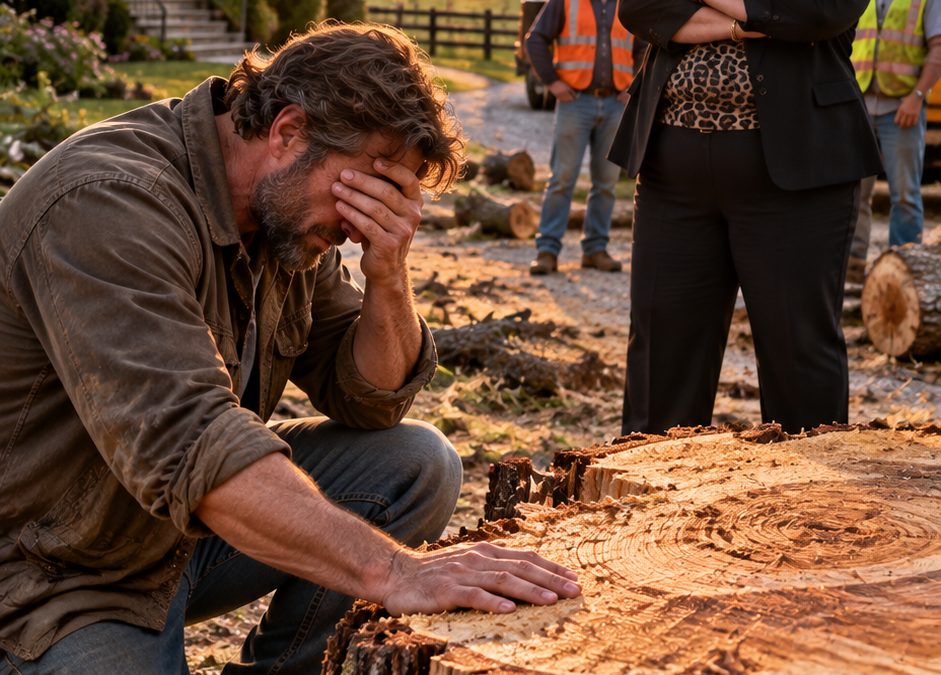
𝗣𝗔𝗥𝗧 𝟮
That morning, though, she had crossed a line no conversation could soften.
I walked toward her.
She saw me.
Didn’t flinch.
“Who authorized this?”
My voice sounded strange to me.
Flat.
Marjorie looked toward the stump.
“The association addressed a longstanding hazard.”
“My tree.”
“It was affecting the clubhouse sightline.”
I looked at her.
She corrected herself.
“And there were safety concerns.”
“What safety concerns?”
“A tree that size was obviously dangerous.”
“Who said that?”
“The board reviewed it.”
“That wasn’t my question.”
She smiled slightly.
“Mason, don’t make a scene over an old tree.”
Behind her, one of the crew members stopped moving.
Another man shut down a chainsaw.
The sudden quiet made her words carry farther.
I looked at the stump again.
Then at her.
“You entered my property.”
“The association controls landscape conditions adjacent to common amenities.”
“No.”
She sighed.
The way a patient person sighs when someone is forcing them to explain something simple.
“Men who live alone on oversized properties tend to become overly attached to things that don’t serve anyone anymore.”
I stared at her.
She continued.
“You don’t need two hundred years of shade, Mason. And frankly, the lake view from the clubhouse has been compromised for years.”
There it was.
The first honest sentence.
Not hazard.
View.
I stepped closer.
“The tree was more than thirty feet inside my boundary.”
Marjorie held up a laminated work order.
“The board approved removal.”
I didn’t take it.
I looked.
No arborist report.
No permit number.
No environmental assessment.
No recorded authority.
Then I noticed something else.
The parcel identifier printed on the form wasn’t mine.
It belonged to a small common parcel near the walking trail.
I reached for my phone.
Not the work order.
My phone.
Started recording.
Stump.
Sawdust.
Truck plates.
Chipper.
Fence.
Workers.
Marjorie.
She laughed.
“Record all you want.”
I kept filming.
“The board voted.”
I said nothing.
“One man doesn’t get to stand against an entire homeowners association.”
I turned toward the crew foreman.
“No one does anything else.”
Marjorie stepped forward.
“They’re under contract.”
“Not on my property anymore.”
Then I called the sheriff’s department.
After that, I sent the photographs to Laya Hartwell.
Laya had handled property and conservation cases for most of her legal career.
She was sharp.
Calm.
Almost impossible to rattle.
She called me within three minutes.
“Mason.”
“I’m here.”
“Has anyone ground the stump?”
I looked toward the crew.
“No.”
“Do not let them.”
“Why?”
“Don’t let anyone touch it.”
“The sheriff is coming.”
“Fine. Document it first.”
“What are you thinking?”
A pause.
“I don’t know yet.”
Then:
“But if that tree is where I think it is, that stump may be more important than the tree itself right now.”
That got my attention.
“What does that mean?”
“It means preserve everything.”
She was already driving toward me.
The deputy arrived about forty minutes later.
He handled it like a civil dispute.
Which, at that point, was reasonable.
He photographed the scene.
Got names.
Looked at Marjorie’s work order.
Took my statement.
Took hers.
Nobody was arrested.
Marjorie treated that as vindication.
By then, neighbors had begun gathering on the far side of the fence.
She addressed them openly.
The tree had become dangerous.
The association had acted to protect the clubhouse.
Protect the walking trail.
Protect residents.
She talked about dead branches.
Neglect.
Liability.
I let her finish.
Then I opened my phone.
“Two months ago, Everett Shaw inspected the tree.”
Marjorie barely looked at me.
“Who?”
“Certified arborist.”
I pulled up the report.
Everett had spent more than three decades evaluating mature trees.
His report said:
Healthy trunk.
Stable root plate.
No significant decay.
Minor deadwood consistent with age.
No evidence of imminent structural failure.
Projected lifespan of multiple additional decades with normal care.
I held the screen out.
Marjorie didn’t read it.
“People can hire professionals to say almost anything.”
One of the neighbors looked at her.
I lowered the phone.
“Then who did you hire?”
She ignored the question.
Instead, she looked at my truck.
Then my faded work shirt.
“Bellamy House would probably be better maintained by someone interested in contributing to the neighborhood rather than resisting everything.”
I felt the anger rise.
Hot.
Useful only if controlled.
“Get your crew off my property.”
The foreman looked between us.
Then I asked him directly.
“Who told you the HOA controlled this land?”
He pointed toward Marjorie.
“She provided the property map.”
“Can I see it?”
He handed me a copy from the cab.
The map was stamped.
But the boundary line had been altered.
Not professionally.
A darker line had been drawn by hand.
Shifted.
Just enough to place the oak inside what looked like HOA common land.
I lifted my phone.
Marjorie reached out.
Took the map from the foreman’s hand.
“You’re not entitled to association documents.”
But I had seen enough.
Laya arrived less than an hour later.
She wasn’t alone.
A surveyor named Daniel Mercer came with her.
He unloaded equipment.
Set control.
Pulled the recorded legal description.
Within an hour, fresh stakes stood in the ground.
The stump was more than thirty feet inside my parcel.
No ambiguity.
Not touching the boundary.
Not near it.
Private land.
Then Laya asked Daniel to overlay another map.
The original conservation exhibit from Alder Creek’s subdivision approval.
That was when the case changed.
The oak stood inside a recorded natural conservation corridor.
Not merely near one.
Inside it.
Laya turned toward Marjorie.
“This area is subject to a recorded conservation restriction.”
Marjorie crossed her arms.
“Our attorney handles these issues.”
“This one predates your HOA rules.”
“We have counsel.”
“You entered protected private land and removed a mature tree.”
“The board acted for safety.”
“Then produce the hazard assessment.”
Marjorie smiled.
“You’re trying to frighten volunteers.”
“No.”
Laya looked at the stump.
“I’m trying to make sure nobody destroys evidence.”
The crew foreman had become visibly uncomfortable.
He told his men to begin packing.
Marjorie objected.
He shook his head.
“Not until somebody sorts this out.”
Before leaving, he approached me.
“I was told you were away.”
I looked at him.
“What?”
He pulled several pages from his clipboard.
“Work instructions.”
He handed them to me.
Marjorie’s email was attached.
One line mattered immediately.
COMPLETE REMOVAL BEFORE MONDAY. LANDOWNER IS TRAVELING AND WILL NOT BE AVAILABLE TO INTERFERE.
I read it twice.
Then handed it to Laya.
This wasn’t an emergency.
It wasn’t a mistake made after a storm.
They had timed the work around my absence.
Marjorie had known enough about my schedule to make sure I wouldn’t be there.
Laya looked at her.
Marjorie said nothing.
The crew left.
We stayed.
Over the following days, Everett Shaw examined the stump.
He counted rings.
Measured diameter.
Reviewed old photographs.
Studied limb sections the crew had left behind.
His estimate:
Between 190 and 220 years old.
One of the oldest documented oaks in that part of the state.
But age wasn’t the only issue.
The tree stabilized the slope above the creek.
Its root system held soil across a wide area.
Its canopy intercepted heavy rainfall.
Its shade moderated temperature along part of a habitat corridor.
The subdivision’s original conservation documents specifically referenced mature canopy protection along that section.
I knew some of that.
Not all.
To me, the oak had mostly been family.
There was a photograph of my grandmother standing under it at sixteen.
Another of my father leaning against the trunk while holding me as a baby.
My grandfather refused multiple offers to sell that strip.
When developers assembled the land surrounding us, he insisted that the oak and creek buffer remain protected.
I had always thought that was sentimental stubbornness.
Turns out he had put it into the paperwork.
Laya found the conservation addendum buried in the original plat file.
It was explicit.
No mature tree inside the designated buffer could be removed by any organization operating within the subdivision without:
An environmental impact assessment.
A restoration plan.
Regulatory approval where applicable.
None existed.
No assessment.
No restoration filing.
No tree permit.
No emergency declaration.
Nothing.
Laya looked at me across my kitchen table.
“This is no longer just trespass.”
“How bad?”
“That depends on intent.”
She began listing possible consequences.
Environmental penalties.
Mandatory restoration.
Erosion monitoring.
Replacement canopy requirements.
Watershed mitigation.
Professional oversight.
Damages for the tree itself.
Private-property claims.
Potential individual liability if the decision was deliberate and outside board authority.
I asked the question anyone would ask.
“What if they just plant another oak?”
Everett shook his head.
“You cannot replace two hundred years with a five-gallon container.”
He pointed toward the creek.
“A sapling doesn’t hold this slope.”
Then toward the open sky.
“Doesn’t intercept the same water.”
“Doesn’t create the same habitat.”
He looked back at the stump.
“Replacement isn’t really the word.”
Laya formally reported the removal to the state environmental agency.
Marjorie’s response was to send me a fine.
Eighteen thousand five hundred dollars.
HOA citation.
Obstructing contractor operations.
Failure to remove debris.
Failure to grind hazardous stump.
Aesthetic damage from sawdust.
Creating a hazard near an alleged shared walking path that didn’t even cross my parcel.
I read the notice at my kitchen counter.
Almost laughed.
Not because it was funny.
Because I could see what she was building.
If she could create paperwork showing I had neglected the site, then later the association might claim the removal was a response to my failure.
Laya sent a preservation letter immediately.
Every email.
Meeting minute.
Map.
Invoice.
Vote.
Contract.
Text message.
No deletions.
No alteration.
No destruction.
That same evening, Nolan Pierce called.
State environmental investigator.
Veteran.
He would inspect the property personally.
Before his visit, Marjorie called me.
Her voice was unexpectedly gentle.
“Mason, this has gotten out of hand.”
“I agree.”
“The association would like to resolve it.”
“How?”
“Five thousand dollars.”
I stayed quiet.
“In exchange, you acknowledge the tree had visible disease and decline.”
I looked toward the stump outside.
“No.”
“Think about legal costs.”
“No.”
“You’re going to spend far more than five thousand dollars protecting sentimental memories.”
Still no.
Then she made the mistake.
“Mason, everyone knew the tree was healthy enough to stand for years. That isn’t really the point.”
I stopped breathing for a second.
She kept talking.
The view.
Potential liability.
Board discretion.
I barely heard the rest.
Our state permitted one-party recording.
The entire call was saved.
When it ended, I sent it to Laya.
Her response was three words.
Keep the original.
For the first time since seeing the empty sky, grief made room for certainty.
Nolan arrived with a soil scientist and watershed officer.
No dramatic entrance.
No speeches.
He wanted documents.
Deed.
Survey.
Conservation map.
Everett’s arborist report.
Removal contract.
Permit records.
Board minutes.
Photographs.
Names.
Marjorie arrived with HOA counsel.
She immediately claimed emergency hazard authority.
Nolan asked:
“Who made the hazard determination?”
“The board.”
“Which qualified professional?”
Silence.
“Arborist?”
No answer.
“Engineer?”
Nothing.
“Forester?”
Nothing.
“What structure was threatened?”
“The clubhouse.”
Nolan measured.
Reviewed the topography.
The tree couldn’t have reached the clubhouse without crossing the creek and a substantial open area first.
The geometry alone contradicted the emergency story.
Then Nolan examined the ground.
Truck compaction inside the protected buffer.
Disturbed soil.
Large limbs pushed close to the creek.
Drainage disrupted.
He documented everything.
Marjorie blamed the contractor.
Nolan stayed calm.
“The contractor’s conduct will be reviewed.”
Then:
“So will whoever provided the map and authorized the work.”
Judith Rowe lived across the entrance road.
She came over later that afternoon carrying a small drive.
Security footage.
Her camera covered part of my property.
The video showed Marjorie arriving before the crew.
Pointing at the oak.
Directing them toward the trunk.
One worker suggested waiting until I returned.
Marjorie answered:
“He won’t be back until Monday. Do it now.”
Then another moment.
A worker asked whether the stump should remain.
Marjorie said:
“Grind it when you’re finished. I don’t want him making a historic-tree argument after the fact.”
The grinder later broke.
That mechanical failure may have preserved the best evidence in the case.
Nolan watched the clip twice.
Then issued a stop-work directive covering the buffer.
The HOA had seven days to produce its complete file.
Marjorie responded by attacking me personally.
She told Nolan I was emotionally unstable over the tree.
Claimed I was manipulating environmental regulations for money.
Nolan barely looked up.
“Mr. Bellamy’s motives do not change the survey.”
Then:
“Or the conservation map.”
Then:
“Or your email.”
That ended that line of argument.
The next day, Marjorie emailed every resident in Alder Creek.
She warned that my “selfish lawsuit” might force a large special assessment.
For several days, the tactic worked.
A few neighbors called me greedy.
Someone left a note in my mailbox telling me to “think about families.”
One man confronted me near the county road.
“You’re going to bankrupt people over a tree?”
I asked him one question.
“Why did the HOA cut a tree thirty feet inside land it didn’t own?”
He didn’t have an answer.
Neither did Marjorie.
And once residents started asking that question publicly, the narrative began breaking.
Then Conrad Beck called.
Longtime treasurer.
Late fifties.
Retired accountant.
Quiet.
Careful.
He asked to meet with Laya and me.
Conrad arrived carrying a banker box.
His first sentence was:
“The board never approved this.”
Laya stopped writing.
“What?”
“The removal.”
He opened the box.
There had been a board meeting.
Seven members.
Three opposed the tree removal.
Two uncertain.
Marjorie and Vice President Darlene Fitch wanted immediate action.
The vote never passed.
Conrad had an audio recording.
Original draft minutes.
Final circulated minutes.
They were different.
The final version stated:
UNANIMOUS BOARD APPROVAL.
False.
Marjorie had edited the minutes after the meeting.
Then Conrad produced an email from the HOA’s outside attorney.
Weeks before the removal.
It said:
The oak appeared to stand outside association property.
The HOA had no legal basis to enter Bellamy land.
No removal should occur without Mason’s written consent.
Negotiation was recommended.
Marjorie had received it.
Then proceeded anyway.
Conrad wasn’t finished.
There was a $42,000 contractor payment authorization.
His signature appeared at the bottom.
“I didn’t sign this.”
Laya looked at him.
“You’re sure?”
“I know my own signature.”
Digital metadata later showed the document originated from Marjorie’s account.
Then came the internal emails.
And finally, the motive.
The clubhouse was being marketed for weddings and private events.
An event company had suggested the lake view could command a significantly higher rental rate if the oak no longer interrupted panoramic photographs.
Marjorie wanted the improved view completed before event season.
And before the next board election.
In one email to Darlene, she wrote:
Mason is the kind of man who lives in dirt and thinks family memories matter more than property value.
Then:
Cut it while he’s away. He doesn’t have the resources to fight the association.
I sat quietly after Laya read it.
That sentence hurt differently than the tree.
Not more.
Differently.
For weeks I had tried to understand how someone could look at property belonging to another person and decide ownership didn’t matter.
There it was.
She had looked at me and calculated capacity.
Old truck.
Work clothes.
One man living alone.
Not worth worrying about.
Laya explained what the new evidence meant.
Insurance matters.
Board indemnification matters.
Good faith matters.
An honest mistake can sometimes remain covered.
Even negligent decisions can sometimes be insured.
But ignoring legal advice.
Changing minutes.
Altering a boundary map.
Using a signature you weren’t authorized to use.
Timing work around the owner’s absence.
Trying to erase the stump.
Those things look very different to an insurer.
Conrad looked sick.
“Can they come after me personally?”
Laya didn’t lie.
“You knew the minutes were wrong.”
He looked down.
“Yes.”
“And you didn’t correct them.”
“No.”
“That matters.”
He swallowed.
“I was afraid of Marjorie.”
“I understand.”
Laya closed the folder.
“But fear doesn’t erase a duty.”
Conrad nodded.
I told him:
“What you do now matters too.”
He looked at me.
“If you tell the truth completely, I’ll remember that.”
He did.
Marjorie did the opposite.
She hired a public-relations firm using association money.
The messaging portrayed me as a landowner attempting to extract millions from ordinary families.
I made an early settlement proposal anyway.
Formal acknowledgement.
Full restoration.
Public release of records.
Removal of people directly responsible.
No special assessment against uninvolved homeowners.
I specifically wanted residents protected where possible.
Marjorie rejected it.
Her written response ended with:
NO BOARD SHOULD BOW TO A MAN WHO CRIES OVER AN OLD TREE.
By then, the state had already issued a warning.
That timing mattered.
From that point forward, resistance was knowing.
Not mistaken.
Nolan’s preliminary findings came next.
Removal of a mature protected tree.
Unauthorized entry into regulated buffer.
Soil compaction.
Erosion risk.
Improper plant-debris placement.
Failure to conduct environmental assessment.
Failure to file restoration plan.
Continued interference after notice.
The remediation requirements were extensive.
Stabilize soil.
Restore buffer.
Plant native canopy.
Plant understory.
Establish ground cover.
Monitor survival.
Inspect erosion after major rainfall.
Fund ten years of oversight.
Everett’s valuation of the lost oak added another layer.
Age.
Diameter.
Health.
Ecological service.
Landscape value.
Historical context.
Replacement horizon.
By the time fines, restoration, monitoring, consulting, legal exposure, and property damage were combined, potential liability exceeded $2.4 million.
That was the first number that changed Marjorie’s voice.
She still said insurance would pay.
“The HOA carries three million dollars in coverage.”
Laya contacted the carrier.
Then supplied:
Attorney warning.
Internal emails.
Altered minutes.
Forged authorization.
Changed boundary map.
Recorded settlement call.
Judith’s video.
The insurer opened its own investigation.
Its preliminary position was brutal.
Coverage might be excluded for people who knowingly acted outside authority or intentionally falsified records.
Marjorie then tried to use association reserves to hire personal defense counsel.
Conrad blocked the payment.
Then informed the board.
That was when panic truly started.
Board members who had assumed the removal was approved discovered their names listed in minutes as voting yes.
People who had never voted at all were suddenly shown as unanimous participants.
Darlene Fitch began protecting herself.
At an emergency closed meeting, Marjorie pressed the remaining board members to adopt one story:
The tree was an imminent hazard.
Everyone believed it.
Emergency conditions justified action.
Darlene recorded the meeting.
Marjorie could be heard saying:
“If everybody tells the same story, they can’t prove who knew what.”
Darlene took the recording to her own attorney.
Within days, the coalition collapsed.
Residents kept contacting me.
Some angry.
Some frightened.
Some begging me to stop.
I understood why.
They were hearing numbers like two million dollars.
They imagined assessments.
Retirees losing savings.
Families unable to pay.
So I stated publicly:
I would not seek personal recovery from ordinary homeowners who had not participated in the decision.
If the HOA turned over records and cooperated, I would support a settlement structure designed to place responsibility where it belonged.
The mood shifted.
Fast.
People stopped asking me to drop the complaint.
Started asking Marjorie to resign.
She refused.
Said only she was strong enough to protect Alder Creek from my vendetta.
Then the insurer issued its final determination.
Coverage denied for five board members whose conduct fell within the intentional-action and dishonesty exclusions under the policy.
Not every director.
Five.
Marjorie among them.
Darlene too.
Alder Creek called an emergency membership meeting.
The clubhouse couldn’t hold everyone comfortably.
Marjorie arrived dressed as though she were hosting a gala.
Expensive dress.
Association flag behind her chair.
She took the center seat.
I came in wearing the same kind of work shirt she had mocked.
Drove the same faded truck.
No reason to change either.
Marjorie opened.
“Mason Bellamy intends to bankrupt families over a dead tree.”
I said nothing.
Nolan spoke first.
Technical findings.
Tree healthy before removal.
Entirely outside HOA property.
Protected corridor.
No qualifying emergency.
No permit.
No professional hazard determination.
Prior warnings existed.
Everett followed.
Growth-ring photographs.
Health report.
Age estimate.
Ecological function.
Judith’s security footage played.
There was Marjorie.
On screen.
Pointing.
Ordering.
Rejecting the crew’s suggestion to wait.
Ordering the stump ground.
Nobody needed interpretation.
Then Conrad read the original board minutes.
Not unanimous.
No valid authorization.
Laya displayed the original survey.
Then the altered map.
Side by side.
Original boundary.
Hand-shifted boundary.
Next:
Attorney’s written warning.
Next:
Internal emails about the clubhouse view.
Next:
The forged payment authorization.
Next:
Insurance denial.
Next:
My settlement offer.
Then Marjorie’s rejection.
The room became very quiet.
Marjorie finally accused me of orchestrating the entire thing.
Bribing witnesses.
Manipulating regulators.
Turning people against her.
When I was invited to speak, I stood.
I didn’t talk about money first.
I talked about the oak.
It had been there before Alder Creek.
Before the clubhouse.
Before the paved road.
Before anyone in that room was born.
My family had protected it for generations.
But I told them the case wasn’t ultimately about nostalgia.
It was about ownership.
And contempt.
I read Marjorie’s email.
Mason is the kind of man who lives in dirt.
Then the line about family memories.
Then:
He doesn’t have the resources to fight us.
I looked toward her.
“You didn’t cut that tree because it was dangerous.”
No response.
“You cut it because you decided the person who owned it didn’t matter enough to stop you.”
The room stayed silent.
“That is the part I want everybody here to understand.”
I sat down.
Residents demanded an immediate recall process.
Marjorie tried to delay.
The remaining directors refused.
She was removed from the presidency by an overwhelming vote.
Darlene and several others were suspended pending review.
Then came the part Marjorie still hadn’t accepted.
She told the board the association would indemnify her.
Conrad opened the bylaws.
Read the indemnification clause aloud.
Protection applied to directors acting in good faith and within the scope of authority.
The room already knew what the insurer had concluded about good faith.
Marjorie’s face changed.
Slowly.
For months, the HOA had been her shield.
That evening, she finally understood the shield had conditions.
And she had broken every one that mattered.
The state issued its final ruling weeks later.
Administrative penalties.
Environmental restoration.
Monitoring.
Professional oversight.
Soil stabilization.
Creek-buffer rehabilitation.
Lost ecological-resource value.
Legal costs.
Property damage.
The total obligation was enormous.
But the final settlement was structured carefully.
The association carried a portion for institutional oversight failures.
The contractor carried a portion for failing to verify the boundary and authorization before entering private land.
Board members who had opposed the removal and cooperated were protected from personal claims.
Those who had participated in falsification or concealment were not.
Five people carried direct personal exposure.
Marjorie carried the largest share.
Not because she was president.
Because the evidence showed she had organized the work.
Altered the record.
Ignored counsel.
Directed the crew.
Used the false map.
Tried to destroy the stump.
Then tried to create a false disease narrative afterward.
Marjorie eventually sold her Alder Creek home.
She also sold a coastal condominium.
Her luxury vehicle.
Several investments.
And her interest in the event-planning venture connected to the clubhouse expansion.
Darlene liquidated property too.
Two other board members eventually entered personal bankruptcy proceedings after they couldn’t satisfy their allocated obligations.
I took no pleasure in that.
People expect me to say I did.
I didn’t.
Financial ruin is ugly even when someone helped create it.
There is no satisfying music playing when a family starts selling things.
No cinematic moment.
Just paperwork.
Appraisals.
Transfers.
Lawyers.
Numbers.
That isn’t why I kept going.
The alternative would have been letting people learn that destroying private property intentionally was survivable as long as they sat on the right board.
That lesson would have been worse.
Marjorie tried to sue me for reputational harm.
The case went nowhere.
Emails.
Video.
Recordings.
Public filings.
The statements I had made were supported.
The event company withdrew from its arrangement with Alder Creek.
The clubhouse expansion died.
The enhanced rental plan vanished with it.
The lake view Marjorie had wanted finally existed.
Ironically.
But nobody wanted to advertise it anymore.
The new board passed reforms.
No entry onto private land without written consent.
Independent review for large projects.
Conflict-of-interest disclosures.
Recorded meetings.
Permanent archives.
Stronger access to financial records.
Environmental review requirements around protected areas.
No single officer could authorize significant physical work alone.
Ordinary governance.
The kind that feels excessive only after someone proves why it exists.
I declined a formal board position.
They later asked me to join a conservation committee.
I declined that title too.
But I agreed to advise.
Watershed management.
Mature trees.
Drainage.
Buffer protection.
Those were things I actually understood.
I didn’t need a seat at the front of a clubhouse.
Restoration started that fall.
No single tree could replace the oak.
So Nolan’s team approved a broader ecological plan.
Three young white oaks.
Different maturity stages.
Native understory trees.
Shrubs.
Ground cover.
Erosion-resistant planting.
Creek stabilization.
Expanded buffer.
Ten years of monitoring.
The original stump stayed.
Everett treated it to slow deterioration.
Not forever.
Nothing lasts forever.
But long enough for the growth rings to remain visible.
Long enough to show what had been lost.
I placed one small marker near it.
No monument.
No accusation.
Just the estimated age.
Approximate germination period.
Date of unlawful removal.
That was enough.
Judith came to planting day.
Conrad too.
Several neighbors.
Nobody wore matching shirts.
No photographer from the HOA newsletter.
No banner.
No speeches.
People carried shovels.
Moved mulch.
Set trees.
Watered roots.
It felt better that way.
Conrad apologized while we worked.
“I should have spoken earlier.”
“Yes.”
He looked surprised by the direct answer.
I leaned on the shovel.
“But you spoke.”
“I let those minutes circulate.”
“You did.”
“I knew they were wrong.”
“Yes.”
He looked toward the stump.
“I’m sorry.”
“I believe you.”
Then I told him something I had learned from the whole case.
“People like Marjorie rarely get that far alone.”
He nodded.
“They need decent people to keep deciding today isn’t the day to object.”
His face tightened.
“I know.”
“That doesn’t make you the same as her.”
“No.”
“But silence still has consequences.”
“I know.”
We finished planting.
That was enough for me.
Months later, Marjorie stopped near my property before leaving Alder Creek permanently.
Her home had sold.
The young trees were beginning to leaf out.
She stood near the fence.
Looked toward them.
“They’ll never look like the old one.”
“No.”
“Not in our lifetime.”
“Probably not.”
She almost laughed.
Bitterly.
“So what was the point?”
I looked at her.
“The point was never pretending we could replace it.”
She stared toward the restoration zone.
“Then all those fines. All that money.”
“Those weren’t the purchase price for the tree.”
She looked at me.
“You can’t pay enough money and make destroying something irreplaceable acceptable.”
She folded her arms.
“Do you enjoy this?”
“What?”
“Watching me lose everything.”
I thought before answering.
“No.”
She didn’t believe me.
I could see that.
So I explained.
“What gives me peace is knowing you can’t decide anymore whose property matters and whose doesn’t.”
Her jaw tightened.
“You destroyed the board over a tree.”
“No.”
I shook my head.
“You destroyed your board when you decided the law only applied to people you respected.”
She looked away.
Then walked back to her car.
I watched her leave.
No victory.
Just distance.
A year passed.
The restoration zone turned green.
Not the deep shade I remembered.
Not yet.
The new oaks were narrow.
Young.
Their shadows barely covered enough ground for one chair.
But their roots were taking hold.
The creek bank stabilized.
Native plants returned.
Survival rates were better than expected.
Nolan visited for a monitoring check.
Walked the site.
Looked at the young canopy.
“You’re ahead of target.”
“Good.”
He checked the soil.
Then the buffer markers.
I stood beside the old stump.
For months, I’d hated looking at it.
Eventually the feeling changed.
The stump wasn’t only proof of what had been destroyed.
It was also proof that Marjorie’s attempt to erase the evidence failed.
She wanted it ground.
Gone.
No rings.
No age estimate.
No physical record.
The broken grinder prevented that.
Sometimes accountability depends on surprisingly ordinary failures.
A machine breaks.
A camera points the right direction.
Someone saves an email.
A treasurer keeps an invoice.
A secretary records a meeting.
A contractor refuses to keep working.
None of them alone changes everything.
Together, they become a record.
After the investigation closed, part of the oak’s wood was returned to me.
I kept several long boards.
A woodworker I knew dried them properly.
Months later, he built a table.
Long.
Heavy.
Simple.
It sits in the library at Bellamy House.
Underneath, where almost nobody sees it, I had one sentence carved.
POWER DOES NOT MAKE A WRONG THING RIGHT.
Nothing else.
No name.
No date.
No Marjorie.
The tree deserved more dignity than becoming a permanent monument to her.
The new HOA board eventually released the case records to residents.
Minutes.
Findings.
Insurance decision.
Environmental order.
Not every private legal detail.
Enough that future directors would understand.
Association dues stabilized.
Alder Creek survived.
That’s worth saying.
The neighborhood didn’t collapse because one board failed.
Communities are larger than the people temporarily holding titles.
The clubhouse still stands.
Still overlooks the lake.
People still hold birthday parties there.
Graduation dinners.
Occasional weddings.
But the ground where the oak stood is now conservation space.
Protected.
Marked.
Monitored.
No panoramic event lawn.
No patio extension.
No decorative overlook.
Just habitat.
I like that more.
I still drive the same old truck.
Dented tailgate.
Faded paint.
I still do field work.
Still come home with mud on my boots.
After everything, I never felt any urge to buy a luxury vehicle so people like Marjorie would stop making assumptions.
Let them assume.
My dignity was never stored in a parking lot.
That’s the thing she misunderstood.
She believed appearance determined resistance.
Old truck meant no money.
Work shirt meant no influence.
Living alone meant no one would care.
Quiet meant weak.
She built the entire plan on those assumptions.
Finish before Mason comes home.
Alter the map.
Call it unanimous.
Tell residents it’s safety.
If he complains, fine him.
If regulators arrive, blame the contractor.
If insurance asks, call it emergency action.
If the board gets nervous, give everyone one story.
Every step depended on believing I would either disappear or become too emotional to document what happened.
I did neither.
I grieved.
And documented.
Those things can exist together.
Some mornings, even now, I walk outside expecting shade.
For one second.
Then I remember.
The empty sky still bothers me most at sunrise.
The old canopy used to break the light into moving pieces across the porch.
Now the young trees barely interrupt it.
Maybe in thirty years, they’ll cast real shade.
Maybe in eighty, someone will sit beneath them and never know my name.
I hope so.
That would mean the restoration worked.
My family protected one tree for generations.
I couldn’t protect that one in the end.
But I could protect the land after it was gone.
That’s what environmental restoration taught me long before this case.
You don’t always get the original system back.
Sometimes damage is permanent.
You stabilize what remains.
Rebuild function.
Protect recovery.
Then let time do work no engineer can accelerate.
I think that lesson applies to communities too.
Alder Creek lost trust.
Couldn’t replace it with one election.
People had watched records altered.
Money misused.
Neighbors pressured.
It took time.
New procedures.
Public minutes.
Questions.
Residents who had once avoided meetings began attending.
Not because they wanted conflict.
Because they understood silence differently.
Judith once told me:
“I used to think the HOA was something other people handled.”
“Most people do.”
“Until it handles you.”
That was exactly right.
I never became anti-HOA.
People sometimes expect that conclusion.
Associations can maintain roads.
Pools.
Drainage.
Common areas.
Insurance.
Landscaping.
All the things a shared neighborhood needs.
The problem isn’t organization.
The problem is authority without friction.
A system where one confident person can convert preference into policy because everyone else assumes someone checked.
Nobody checked the tree.
That was the failure.
Marjorie called it dangerous.
No arborist.
She called the land common.
No survey.
She called the vote unanimous.
No vote.
She called the map official.
Altered line.
She called the removal necessary.
Email said lake view.
At every stage, one ordinary act of verification could have stopped the next.
Show the deed.
Read the conservation addendum.
Call the attorney.
Check the minutes.
Confirm the signature.
Hire the arborist.
Ask Mason.
That last one would have been easiest.
Ask me.
If the clubhouse wanted improved sightlines, maybe there were selective pruning options.
Maybe vegetation elsewhere could have been managed.
Maybe the event company could photograph from another angle.
Maybe I would have said no to everything.
That was my right too.
Marjorie couldn’t tolerate the possibility of no.
So she skipped the question.
That was the original mistake.
Not environmental law.
Not insurance.
Not public relations.
Refusing to ask because asking meant acknowledging another person’s authority over their own property.
One afternoon, Nolan returned during the second year of monitoring.
The young trees had grown enough that one cast a thin patch of shade across part of the old stump.
We stood under it.
Not much shade.
But real.
Nolan looked up.
“Give it time.”
“I know.”
He walked around the stump.
“You ever think about removing this eventually?”
“No.”
“Fair.”
“It bothers me less now.”
“Why?”
I looked at the growth rings.
“Because she wanted it gone.”
He nodded.
That was enough.
The stump stayed.
Not as revenge.
As evidence turned into history.
I sometimes run my hand across the surface.
You can still see the rings.
Drought years narrow.
Wet years wider.
Storm damage.
Recovery.
Nearly two centuries recorded without language.
Then one abrupt cut.
Human beings like to believe permanence belongs to us.
It doesn’t.
But responsibility does.
That oak survived droughts, lightning, insects, ice, and generations of my family.
It didn’t survive one woman with a title and a contractor willing to trust her map.
That truth is uncomfortable.
It should be.
Marjorie once told me one man couldn’t stand against an entire homeowners association.
She was right in a way she never understood.
I didn’t.
I didn’t need to.
Judith brought video.
Conrad brought records.
Everett brought expertise.
Daniel brought the survey.
Laya brought the law.
Nolan brought regulatory authority.
Residents eventually brought votes.
Even Darlene, too late and for self-protection, brought the recording that exposed the attempt at coordinated denial.
Nobody had to become a hero.
They only had to stop protecting the lie.
That’s how the board fell apart.
Not because I defeated a community.
Because the community stopped confusing one president with itself.
That distinction gave me more peace than the money ever could.
Yes, the settlement was large.
Yes, Marjorie lost property.
Yes, some board members entered bankruptcy.
Those are facts.
They are not the ending I remember.
I remember the planting day.
Mud.
Shovels.
Judith carrying water.
Conrad kneeling beside a young white oak.
Children from two houses nearby asking whether they could help.
Nobody posing for a picture.
Nobody claiming credit.
Just people repairing ground.
That’s the closest thing to justice I found in the entire experience.
Justice wasn’t making Marjorie lose what she had.
It was making sure she could not leave the land worse and walk away calling herself successful.
The restoration forced responsibility to remain after the headlines were gone.
Ten years.
That was the monitoring period.
Longer than Marjorie’s presidency.
Longer than most board terms.
Longer than almost anyone involved wanted to think about.
Exactly right.
Environmental damage doesn’t care about election cycles.
Neither does soil.
You compact a protected buffer in one afternoon.
It may take years to rebuild function.
You remove a two-century root system in hours.
No check can restore it tomorrow.
That is why the penalties were so high.
People heard millions and assumed punishment.
Much of it was restoration cost stretched across time.
Professionals.
Monitoring.
Native plants.
Erosion control.
Replacement failures.
Replanting.
Reporting.
Regulatory oversight.
The real expense wasn’t government anger.
It was the cost of trying to repair something Marjorie had treated as disposable.
The new board understands that now.
Before any work near the creek, they check.
Before removing mature trees, they check.
Before a contractor crosses a private line, they check.
It takes longer.
Good.
Some processes should.
Speed was Marjorie’s advantage.
Finish before Monday.
Owner away.
Cut first.
Paper later.
The new system reverses that.
Paper first.
Authority first.
Work afterward.
Boring.
Safe.
Years after the cutting, I found one photograph in my grandmother’s old cedar box that I had never noticed before.
Black and white.
Bellamy House in the background.
The oak much smaller.
Still enormous.
A little girl sat on one of the lower roots.
My grandmother.
Maybe seven.
On the back, somebody had written in pencil:
SUMMER 1936.
I sat at the library table made from that same tree and looked at the photograph for a long time.
No lawsuit could price that correctly.
No environmental formula could.
That’s okay.
Law doesn’t have to measure everything perfectly to recognize that destruction has consequences.
Some losses stay personal.
Other parts can be quantified.
Restoration.
Property value.
Ecological services.
Legal costs.
Both can be true.
Marjorie’s greatest error was treating anything she couldn’t personally value as worthless.
Shade.
Memory.
Habitat.
Private ownership.
A man’s attachment to family land.
She understood a lake view because a lake view could be marketed.
She understood clubhouse revenue because it fit in a budget.
She didn’t understand why an old tree mattered.
So she assumed it didn’t.
That assumption cost more than anything the oak could ever have earned for her.
I still live alone at Bellamy House.
Still like it that way.
The porch is quieter than before.
Hotter in summer too.
A two-hundred-year canopy leaves a larger absence than people imagine.
But the young oaks are growing.
Every season, the shadow stretches a little farther.
The tallest one now reaches high enough that its leaves move against the second-floor window when the wind comes from the west.
I noticed that last spring.
Stopped on the porch.
Watched it for a while.
Small thing.
Maybe nothing to anyone else.
To me, it felt like the land beginning to speak in a familiar voice again.
The old oak won’t come back.
Marjorie was right about that when she stood looking at the saplings before leaving Alder Creek.
They will never be the same tree.
They aren’t supposed to be.
Their job is not to erase what happened.
Their job is to continue after it.
And maybe that’s why I never replaced the old PRIVATE PROPERTY sign with anything bigger.
No warning about trespass.
No mention of the lawsuit.
No cameras advertised.
No threat.
The boundary markers are enough.
The conservation markers are enough.
The record is enough.
I know where the line is.
So does Alder Creek.
That was all I ever needed.
Marjorie once stood beside a six-foot stump and told me not to make a scene over an old tree.
She thought the cut ended the argument because the thing I cared about was already gone.
What she never understood was that destroying the tree didn’t destroy its history.
The rings remained.
The conservation record remained.
The deed remained.
Her emails remained.
The board recording remained.
The lawyer’s warning remained.
The altered map remained.
Judith’s video remained.
And because the stump remained, Everett could still read nearly two hundred years of life in the wood she had ordered ground away.
In the end, the evidence was not dramatic.
It was patient.
Soil.
Paper.
Video.
Measurements.
Dates.
Signatures.
Exactly the kind of things people dismiss when they believe power will speak louder.
It didn’t.
Years from now, Marjorie Voss’s name will probably mean nothing to whoever lives in Alder Creek.
Mine might not either.
That’s fine.
But the conservation corridor will still be recorded.
The creek will still run.
The restoration zone will still be protected.
And if the young oaks are lucky, one of them may someday be old enough that another family thinks of its shade as something permanent.
I hope whoever owns Bellamy House then knows better than I once did.
Nothing living is permanent.
But that doesn’t make it disposable.
And no title, board vote, expensive attorney, polished meeting, or confident woman holding a laminated work order gets to change that simply because the person standing in the way looks too ordinary to fight back.
The last time Nolan came by, we stood beside the largest of the new oaks.
Its shadow reached the edge of the old stump.
He looked at the canopy.
Then at me.
“Pretty good survival rate.”
I nodded.
“Better than projected.”
He started toward his vehicle.
I stayed.
Sat down in the thin shade.
Not much.
A narrow patch across my boots.
Nothing like what I had lost.
But it moved softly with the leaves.
And I realized I no longer looked at that small shadow and saw only the empty sky Marjorie had left behind.
I saw time.
The same thing she had thought she could cut down in a morning.
The old oak was gone.
The land remembered anyway.
Have you finished reading the story and want to read it again?
The HOA President Thought My 200-Year-Old Oak Was Just Blocking Her View
I came home at dawn and found an empty piece of sky where my family’s oak had stood for two hundred years.
Marjorie Voss was still beside the work crew when she told me not to make a scene over an old tree.
She had no idea the stump at her feet sat inside a recorded conservation corridor that could turn one morning with a chainsaw into the most expensive decision her board had ever made.
My name is Mason Bellamy.
I had been away for seven days when they cut the oak.
Not on vacation.
I had been working two counties over on a watershed-restoration project, the kind of work I had moved into after leaving a more conventional civil-engineering job.
I spent most of that week walking creek banks, reviewing erosion controls, checking culverts, measuring sediment movement, and talking with landowners about things that usually went unnoticed until water started moving where nobody wanted it.
Quiet work.
Technical work.
The kind I preferred.
By Friday evening, I was tired enough that all I wanted was to get home, sleep in my own bed, wake before sunrise, make coffee, and sit on the porch while the old oak threw its shadow across the gravel drive.
It had done that every morning for as long as I could remember.
The oak stood west of Bellamy House.
Six feet across near the base.
Limbs wide enough that two men could have sat side by side on the lower ones when they were boys.
My grandmother had photographs of it from before the county road was paved.
There was another photograph from the early 1900s showing my great-grandfather beside the same tree when it was already mature.
Nobody knew exactly when it sprouted.
Later, an arborist would put the age somewhere between 190 and 220 years.
To me, it had simply always been there.
I owned eighteen acres around Bellamy House.
The house itself had been built by my great-grandfather from river stone pulled from the creek below the ridge.
It wasn’t grand.
Thick walls.
Deep porch.
Original chimney.
Uneven floors in two upstairs rooms.
The kind of place where every repair teaches you something about the person who built it.
I had owned the property for eighteen years.
Long enough to replace the roof twice.
Rebuild the springhouse door.
Repair the stone wall after a truck slid into it one winter.
Long enough to stop thinking of the oak as a feature of the property.
It felt more permanent than the house.
So when I turned into the drive after sunrise that Saturday, I knew something was wrong before I understood what.
The light was wrong.
That was the first thing.
Sunlight came straight across the gravel.
Hard.
Bright.
Unfiltered.
I slowed.
Then stopped.
The oak was gone.
Not damaged.
Not trimmed.
Gone.
Where the trunk had stood was a raw stump almost six feet across.
Fresh wood pale in the middle.
Dark growth rings around it.
Sawdust covered the grass like yellow snow.
Large limbs were stacked near the eastern fence.
A chipper sat twenty yards away.
Heavy truck tires had cut curved scars through the ground.
My PRIVATE PROPERTY sign lay facedown in mud.
One section of fence had been dismantled so equipment could enter.
I stayed in the truck.
Both hands on the steering wheel.
There are losses the mind understands before emotion arrives.
You register facts.
Stump.
Tracks.
Fence.
Machines.
People.
Then some deeper part of you catches up.
I got out.
Marjorie Voss stood near the crew.
President of the Alder Creek Estates Homeowners Association.
Pressed slacks.
Gold bracelet.
Phone in one hand.
She was reviewing photographs.
She looked satisfied.
Alder Creek Estates wrapped around most of what had once been my grandfather’s farm.
My family had sold parcels over the decades.
Not all at once.
First a timber lot.
Then pasture.
Later, after my grandfather died, a developer purchased a larger tract from an uncle who wanted out.
The subdivision grew around Bellamy House without ever absorbing it.
My eighteen acres remained separate.
Private.
Outside the HOA.
That distinction had never created serious trouble before Marjorie became president.
The neighborhood had a clubhouse near the lake.
Walking paths.
Landscaped entrance.
About a hundred and twenty houses.
Most residents were ordinary people.
Teachers.
Contractors.
Retirees.
Nurses.
Accountants.
People with families and mortgages.
I had no feud with them.
Marjorie was different.
She had been president for four years by then.
She cared deeply about how Alder Creek looked.
She used words like cohesion, prestige, visual continuity, and brand identity to describe a residential neighborhood.
We had disagreed before.
Mostly about small things.
She hated my gravel drive.
Thought my truck looked “industrial.”
Once suggested Bellamy House should be painted lighter because the river stone made the entrance corridor feel “heavy.”
I usually let her talk.
She had no jurisdiction over my property.
I didn’t need to win an argument that the deed had already settled.
That morning, though, she had crossed a line no conversation could soften.
I walked toward her.
She saw me.
Didn’t flinch.
“Who authorized this?”
My voice sounded strange to me.
Flat.
Marjorie looked toward the stump.
“The association addressed a longstanding hazard.”
“My tree.”
“It was affecting the clubhouse sightline.”
I looked at her.
She corrected herself.
“And there were safety concerns.”
“What safety concerns?”
“A tree that size was obviously dangerous.”
“Who said that?”
“The board reviewed it.”
“That wasn’t my question.”
She smiled slightly.
“Mason, don’t make a scene over an old tree.”
Behind her, one of the crew members stopped moving.
Another man shut down a chainsaw.
The sudden quiet made her words carry farther.
I looked at the stump again.
Then at her.
“You entered my property.”
“The association controls landscape conditions adjacent to common amenities.”
“No.”
She sighed.
The way a patient person sighs when someone is forcing them to explain something simple.
“Men who live alone on oversized properties tend to become overly attached to things that don’t serve anyone anymore.”
I stared at her.
She continued.
“You don’t need two hundred years of shade, Mason. And frankly, the lake view from the clubhouse has been compromised for years.”
There it was.
The first honest sentence.
Not hazard.
View.
I stepped closer.
“The tree was more than thirty feet inside my boundary.”
Marjorie held up a laminated work order.
“The board approved removal.”
I didn’t take it.
I looked.
No arborist report.
No permit number.
No environmental assessment.
No recorded authority.
Then I noticed something else.
The parcel identifier printed on the form wasn’t mine.
It belonged to a small common parcel near the walking trail.
I reached for my phone.
Not the work order.
My phone.
Started recording.
Stump.
Sawdust.
Truck plates.
Chipper.
Fence.
Workers.
Marjorie.
She laughed.
“Record all you want.”
I kept filming.
“The board voted.”
I said nothing.
“One man doesn’t get to stand against an entire homeowners association.”
I turned toward the crew foreman.
“No one does anything else.”
Marjorie stepped forward.
“They’re under contract.”
“Not on my property anymore.”
Then I called the sheriff’s department.
After that, I sent the photographs to Laya Hartwell.
Laya had handled property and conservation cases for most of her legal career.
She was sharp.
Calm.
Almost impossible to rattle.
She called me within three minutes.
“Mason.”
“I’m here.”
“Has anyone ground the stump?”
I looked toward the crew.
“No.”
“Do not let them.”
“Why?”
“Don’t let anyone touch it.”
“The sheriff is coming.”
“Fine. Document it first.”
“What are you thinking?”
A pause.
“I don’t know yet.”
Then:
“But if that tree is where I think it is, that stump may be more important than the tree itself right now.”
That got my attention.
“What does that mean?”
“It means preserve everything.”
She was already driving toward me.
The deputy arrived about forty minutes later.
He handled it like a civil dispute.
Which, at that point, was reasonable.
He photographed the scene.
Got names.
Looked at Marjorie’s work order.
Took my statement.
Took hers.
Nobody was arrested.
Marjorie treated that as vindication.
By then, neighbors had begun gathering on the far side of the fence.
She addressed them openly.
The tree had become dangerous.
The association had acted to protect the clubhouse.
Protect the walking trail.
Protect residents.
She talked about dead branches.
Neglect.
Liability.
I let her finish.
Then I opened my phone.
“Two months ago, Everett Shaw inspected the tree.”
Marjorie barely looked at me.
“Who?”
“Certified arborist.”
I pulled up the report.
Everett had spent more than three decades evaluating mature trees.
His report said:
Healthy trunk.
Stable root plate.
No significant decay.
Minor deadwood consistent with age.
No evidence of imminent structural failure.
Projected lifespan of multiple additional decades with normal care.
I held the screen out.
Marjorie didn’t read it.
“People can hire professionals to say almost anything.”
One of the neighbors looked at her.
I lowered the phone.
“Then who did you hire?”
She ignored the question.
Instead, she looked at my truck.
Then my faded work shirt.
“Bellamy House would probably be better maintained by someone interested in contributing to the neighborhood rather than resisting everything.”
I felt the anger rise.
Hot.
Useful only if controlled.
“Get your crew off my property.”
The foreman looked between us.
Then I asked him directly.
“Who told you the HOA controlled this land?”
He pointed toward Marjorie.
“She provided the property map.”
“Can I see it?”
He handed me a copy from the cab.
The map was stamped.
But the boundary line had been altered.
Not professionally.
A darker line had been drawn by hand.
Shifted.
Just enough to place the oak inside what looked like HOA common land.
I lifted my phone.
Marjorie reached out.
Took the map from the foreman’s hand.
“You’re not entitled to association documents.”
But I had seen enough.
Laya arrived less than an hour later.
She wasn’t alone.
A surveyor named Daniel Mercer came with her.
He unloaded equipment.
Set control.
Pulled the recorded legal description.
Within an hour, fresh stakes stood in the ground.
The stump was more than thirty feet inside my parcel.
No ambiguity.
Not touching the boundary.
Not near it.
Private land.
Then Laya asked Daniel to overlay another map.
The original conservation exhibit from Alder Creek’s subdivision approval.
That was when the case changed.
The oak stood inside a recorded natural conservation corridor.
Not merely near one.
Inside it.
Laya turned toward Marjorie.
“This area is subject to a recorded conservation restriction.”
Marjorie crossed her arms.
“Our attorney handles these issues.”
“This one predates your HOA rules.”
“We have counsel.”
“You entered protected private land and removed a mature tree.”
“The board acted for safety.”
“Then produce the hazard assessment.”
Marjorie smiled.
“You’re trying to frighten volunteers.”
“No.”
Laya looked at the stump.
“I’m trying to make sure nobody destroys evidence.”
The crew foreman had become visibly uncomfortable.
He told his men to begin packing.
Marjorie objected.
He shook his head.
“Not until somebody sorts this out.”
Before leaving, he approached me.
“I was told you were away.”
I looked at him.
“What?”
He pulled several pages from his clipboard.
“Work instructions.”
He handed them to me.
Marjorie’s email was attached.
One line mattered immediately.
COMPLETE REMOVAL BEFORE MONDAY. LANDOWNER IS TRAVELING AND WILL NOT BE AVAILABLE TO INTERFERE.
I read it twice.
Then handed it to Laya.
This wasn’t an emergency.
It wasn’t a mistake made after a storm.
They had timed the work around my absence.
Marjorie had known enough about my schedule to make sure I wouldn’t be there.
Laya looked at her.
Marjorie said nothing.
The crew left.
We stayed.
Over the following days, Everett Shaw examined the stump.
He counted rings.
Measured diameter.
Reviewed old photographs.
Studied limb sections the crew had left behind.
His estimate:
Between 190 and 220 years old.
One of the oldest documented oaks in that part of the state.
But age wasn’t the only issue.
The tree stabilized the slope above the creek.
Its root system held soil across a wide area.
Its canopy intercepted heavy rainfall.
Its shade moderated temperature along part of a habitat corridor.
The subdivision’s original conservation documents specifically referenced mature canopy protection along that section.
I knew some of that.
Not all.
To me, the oak had mostly been family.
There was a photograph of my grandmother standing under it at sixteen.
Another of my father leaning against the trunk while holding me as a baby.
My grandfather refused multiple offers to sell that strip.
When developers assembled the land surrounding us, he insisted that the oak and creek buffer remain protected.
I had always thought that was sentimental stubbornness.
Turns out he had put it into the paperwork.
Laya found the conservation addendum buried in the original plat file.
It was explicit.
No mature tree inside the designated buffer could be removed by any organization operating within the subdivision without:
An environmental impact assessment.
A restoration plan.
Regulatory approval where applicable.
None existed.
No assessment.
No restoration filing.
No tree permit.
No emergency declaration.
Nothing.
Laya looked at me across my kitchen table.
“This is no longer just trespass.”
“How bad?”
“That depends on intent.”
She began listing possible consequences.
Environmental penalties.
Mandatory restoration.
Erosion monitoring.
Replacement canopy requirements.
Watershed mitigation.
Professional oversight.
Damages for the tree itself.
Private-property claims.
Potential individual liability if the decision was deliberate and outside board authority.
I asked the question anyone would ask.
“What if they just plant another oak?”
Everett shook his head.
“You cannot replace two hundred years with a five-gallon container.”
He pointed toward the creek.
“A sapling doesn’t hold this slope.”
Then toward the open sky.
“Doesn’t intercept the same water.”
“Doesn’t create the same habitat.”
He looked back at the stump.
“Replacement isn’t really the word.”
Laya formally reported the removal to the state environmental agency.
Marjorie’s response was to send me a fine.
Eighteen thousand five hundred dollars.
HOA citation.
Obstructing contractor operations.
Failure to remove debris.
Failure to grind hazardous stump.
Aesthetic damage from sawdust.
Creating a hazard near an alleged shared walking path that didn’t even cross my parcel.
I read the notice at my kitchen counter.
Almost laughed.
Not because it was funny.
Because I could see what she was building.
If she could create paperwork showing I had neglected the site, then later the association might claim the removal was a response to my failure.
Laya sent a preservation letter immediately.
Every email.
Meeting minute.
Map.
Invoice.
Vote.
Contract.
Text message.
No deletions.
No alteration.
No destruction.
That same evening, Nolan Pierce called.
State environmental investigator.
Veteran.
He would inspect the property personally.
Before his visit, Marjorie called me.
Her voice was unexpectedly gentle.
“Mason, this has gotten out of hand.”
“I agree.”
“The association would like to resolve it.”
“How?”
“Five thousand dollars.”
I stayed quiet.
“In exchange, you acknowledge the tree had visible disease and decline.”
I looked toward the stump outside.
“No.”
“Think about legal costs.”
“No.”
“You’re going to spend far more than five thousand dollars protecting sentimental memories.”
Still no.
Then she made the mistake.
“Mason, everyone knew the tree was healthy enough to stand for years. That isn’t really the point.”
I stopped breathing for a second.
She kept talking.
The view.
Potential liability.
Board discretion.
I barely heard the rest.
Our state permitted one-party recording.
The entire call was saved.
When it ended, I sent it to Laya.
Her response was three words.
Keep the original.
For the first time since seeing the empty sky, grief made room for certainty.
Nolan arrived with a soil scientist and watershed officer.
No dramatic entrance.
No speeches.
He wanted documents.
Deed.
Survey.
Conservation map.
Everett’s arborist report.
Removal contract.
Permit records.
Board minutes.
Photographs.
Names.
Marjorie arrived with HOA counsel.
She immediately claimed emergency hazard authority.
Nolan asked:
“Who made the hazard determination?”
“The board.”
“Which qualified professional?”
Silence.
“Arborist?”
No answer.
“Engineer?”
Nothing.
“Forester?”
Nothing.
“What structure was threatened?”
“The clubhouse.”
Nolan measured.
Reviewed the topography.
The tree couldn’t have reached the clubhouse without crossing the creek and a substantial open area first.
The geometry alone contradicted the emergency story.
Then Nolan examined the ground.
Truck compaction inside the protected buffer.
Disturbed soil.
Large limbs pushed close to the creek.
Drainage disrupted.
He documented everything.
Marjorie blamed the contractor.
Nolan stayed calm.
“The contractor’s conduct will be reviewed.”
Then:
“So will whoever provided the map and authorized the work.”
Judith Rowe lived across the entrance road.
She came over later that afternoon carrying a small drive.
Security footage.
Her camera covered part of my property.
The video showed Marjorie arriving before the crew.
Pointing at the oak.
Directing them toward the trunk.
One worker suggested waiting until I returned.
Marjorie answered:
“He won’t be back until Monday. Do it now.”
Then another moment.
A worker asked whether the stump should remain.
Marjorie said:
“Grind it when you’re finished. I don’t want him making a historic-tree argument after the fact.”
The grinder later broke.
That mechanical failure may have preserved the best evidence in the case.
Nolan watched the clip twice.
Then issued a stop-work directive covering the buffer.
The HOA had seven days to produce its complete file.
Marjorie responded by attacking me personally.
She told Nolan I was emotionally unstable over the tree.
Claimed I was manipulating environmental regulations for money.
Nolan barely looked up.
“Mr. Bellamy’s motives do not change the survey.”
Then:
“Or the conservation map.”
Then:
“Or your email.”
That ended that line of argument.
The next day, Marjorie emailed every resident in Alder Creek.
She warned that my “selfish lawsuit” might force a large special assessment.
For several days, the tactic worked.
A few neighbors called me greedy.
Someone left a note in my mailbox telling me to “think about families.”
One man confronted me near the county road.
“You’re going to bankrupt people over a tree?”
I asked him one question.
“Why did the HOA cut a tree thirty feet inside land it didn’t own?”
He didn’t have an answer.
Neither did Marjorie.
And once residents started asking that question publicly, the narrative began breaking.
Then Conrad Beck called.
Longtime treasurer.
Late fifties.
Retired accountant.
Quiet.
Careful.
He asked to meet with Laya and me.
Conrad arrived carrying a banker box.
His first sentence was:
“The board never approved this.”
Laya stopped writing.
“What?”
“The removal.”
He opened the box.
There had been a board meeting.
Seven members.
Three opposed the tree removal.
Two uncertain.
Marjorie and Vice President Darlene Fitch wanted immediate action.
The vote never passed.
Conrad had an audio recording.
Original draft minutes.
Final circulated minutes.
They were different.
The final version stated:
UNANIMOUS BOARD APPROVAL.
False.
Marjorie had edited the minutes after the meeting.
Then Conrad produced an email from the HOA’s outside attorney.
Weeks before the removal.
It said:
The oak appeared to stand outside association property.
The HOA had no legal basis to enter Bellamy land.
No removal should occur without Mason’s written consent.
Negotiation was recommended.
Marjorie had received it.
Then proceeded anyway.
Conrad wasn’t finished.
There was a $42,000 contractor payment authorization.
His signature appeared at the bottom.
“I didn’t sign this.”
Laya looked at him.
“You’re sure?”
“I know my own signature.”
Digital metadata later showed the document originated from Marjorie’s account.
Then came the internal emails.
And finally, the motive.
The clubhouse was being marketed for weddings and private events.
An event company had suggested the lake view could command a significantly higher rental rate if the oak no longer interrupted panoramic photographs.
Marjorie wanted the improved view completed before event season.
And before the next board election.
In one email to Darlene, she wrote:
Mason is the kind of man who lives in dirt and thinks family memories matter more than property value.
Then:
Cut it while he’s away. He doesn’t have the resources to fight the association.
I sat quietly after Laya read it.
That sentence hurt differently than the tree.
Not more.
Differently.
For weeks I had tried to understand how someone could look at property belonging to another person and decide ownership didn’t matter.
There it was.
She had looked at me and calculated capacity.
Old truck.
Work clothes.
One man living alone.
Not worth worrying about.
Laya explained what the new evidence meant.
Insurance matters.
Board indemnification matters.
Good faith matters.
An honest mistake can sometimes remain covered.
Even negligent decisions can sometimes be insured.
But ignoring legal advice.
Changing minutes.
Altering a boundary map.
Using a signature you weren’t authorized to use.
Timing work around the owner’s absence.
Trying to erase the stump.
Those things look very different to an insurer.
Conrad looked sick.
“Can they come after me personally?”
Laya didn’t lie.
“You knew the minutes were wrong.”
He looked down.
“Yes.”
“And you didn’t correct them.”
“No.”
“That matters.”
He swallowed.
“I was afraid of Marjorie.”
“I understand.”
Laya closed the folder.
“But fear doesn’t erase a duty.”
Conrad nodded.
I told him:
“What you do now matters too.”
He looked at me.
“If you tell the truth completely, I’ll remember that.”
He did.
Marjorie did the opposite.
She hired a public-relations firm using association money.
The messaging portrayed me as a landowner attempting to extract millions from ordinary families.
I made an early settlement proposal anyway.
Formal acknowledgement.
Full restoration.
Public release of records.
Removal of people directly responsible.
No special assessment against uninvolved homeowners.
I specifically wanted residents protected where possible.
Marjorie rejected it.
Her written response ended with:
NO BOARD SHOULD BOW TO A MAN WHO CRIES OVER AN OLD TREE.
By then, the state had already issued a warning.
That timing mattered.
From that point forward, resistance was knowing.
Not mistaken.
Nolan’s preliminary findings came next.
Removal of a mature protected tree.
Unauthorized entry into regulated buffer.
Soil compaction.
Erosion risk.
Improper plant-debris placement.
Failure to conduct environmental assessment.
Failure to file restoration plan.
Continued interference after notice.
The remediation requirements were extensive.
Stabilize soil.
Restore buffer.
Plant native canopy.
Plant understory.
Establish ground cover.
Monitor survival.
Inspect erosion after major rainfall.
Fund ten years of oversight.
Everett’s valuation of the lost oak added another layer.
Age.
Diameter.
Health.
Ecological service.
Landscape value.
Historical context.
Replacement horizon.
By the time fines, restoration, monitoring, consulting, legal exposure, and property damage were combined, potential liability exceeded $2.4 million.
That was the first number that changed Marjorie’s voice.
She still said insurance would pay.
“The HOA carries three million dollars in coverage.”
Laya contacted the carrier.
Then supplied:
Attorney warning.
Internal emails.
Altered minutes.
Forged authorization.
Changed boundary map.
Recorded settlement call.
Judith’s video.
The insurer opened its own investigation.
Its preliminary position was brutal.
Coverage might be excluded for people who knowingly acted outside authority or intentionally falsified records.
Marjorie then tried to use association reserves to hire personal defense counsel.
Conrad blocked the payment.
Then informed the board.
That was when panic truly started.
Board members who had assumed the removal was approved discovered their names listed in minutes as voting yes.
People who had never voted at all were suddenly shown as unanimous participants.
Darlene Fitch began protecting herself.
At an emergency closed meeting, Marjorie pressed the remaining board members to adopt one story:
The tree was an imminent hazard.
Everyone believed it.
Emergency conditions justified action.
Darlene recorded the meeting.
Marjorie could be heard saying:
“If everybody tells the same story, they can’t prove who knew what.”
Darlene took the recording to her own attorney.
Within days, the coalition collapsed.
Residents kept contacting me.
Some angry.
Some frightened.
Some begging me to stop.
I understood why.
They were hearing numbers like two million dollars.
They imagined assessments.
Retirees losing savings.
Families unable to pay.
So I stated publicly:
I would not seek personal recovery from ordinary homeowners who had not participated in the decision.
If the HOA turned over records and cooperated, I would support a settlement structure designed to place responsibility where it belonged.
The mood shifted.
Fast.
People stopped asking me to drop the complaint.
Started asking Marjorie to resign.
She refused.
Said only she was strong enough to protect Alder Creek from my vendetta.
Then the insurer issued its final determination.
Coverage denied for five board members whose conduct fell within the intentional-action and dishonesty exclusions under the policy.
Not every director.
Five.
Marjorie among them.
Darlene too.
Alder Creek called an emergency membership meeting.
The clubhouse couldn’t hold everyone comfortably.
Marjorie arrived dressed as though she were hosting a gala.
Expensive dress.
Association flag behind her chair.
She took the center seat.
I came in wearing the same kind of work shirt she had mocked.
Drove the same faded truck.
No reason to change either.
Marjorie opened.
“Mason Bellamy intends to bankrupt families over a dead tree.”
I said nothing.
Nolan spoke first.
Technical findings.
Tree healthy before removal.
Entirely outside HOA property.
Protected corridor.
No qualifying emergency.
No permit.
No professional hazard determination.
Prior warnings existed.
Everett followed.
Growth-ring photographs.
Health report.
Age estimate.
Ecological function.
Judith’s security footage played.
There was Marjorie.
On screen.
Pointing.
Ordering.
Rejecting the crew’s suggestion to wait.
Ordering the stump ground.
Nobody needed interpretation.
Then Conrad read the original board minutes.
Not unanimous.
No valid authorization.
Laya displayed the original survey.
Then the altered map.
Side by side.
Original boundary.
Hand-shifted boundary.
Next:
Attorney’s written warning.
Next:
Internal emails about the clubhouse view.
Next:
The forged payment authorization.
Next:
Insurance denial.
Next:
My settlement offer.
Then Marjorie’s rejection.
The room became very quiet.
Marjorie finally accused me of orchestrating the entire thing.
Bribing witnesses.
Manipulating regulators.
Turning people against her.
When I was invited to speak, I stood.
I didn’t talk about money first.
I talked about the oak.
It had been there before Alder Creek.
Before the clubhouse.
Before the paved road.
Before anyone in that room was born.
My family had protected it for generations.
But I told them the case wasn’t ultimately about nostalgia.
It was about ownership.
And contempt.
I read Marjorie’s email.
Mason is the kind of man who lives in dirt.
Then the line about family memories.
Then:
He doesn’t have the resources to fight us.
I looked toward her.
“You didn’t cut that tree because it was dangerous.”
No response.
“You cut it because you decided the person who owned it didn’t matter enough to stop you.”
The room stayed silent.
“That is the part I want everybody here to understand.”
I sat down.
Residents demanded an immediate recall process.
Marjorie tried to delay.
The remaining directors refused.
She was removed from the presidency by an overwhelming vote.
Darlene and several others were suspended pending review.
Then came the part Marjorie still hadn’t accepted.
She told the board the association would indemnify her.
Conrad opened the bylaws.
Read the indemnification clause aloud.
Protection applied to directors acting in good faith and within the scope of authority.
The room already knew what the insurer had concluded about good faith.
Marjorie’s face changed.
Slowly.
For months, the HOA had been her shield.
That evening, she finally understood the shield had conditions.
And she had broken every one that mattered.
The state issued its final ruling weeks later.
Administrative penalties.
Environmental restoration.
Monitoring.
Professional oversight.
Soil stabilization.
Creek-buffer rehabilitation.
Lost ecological-resource value.
Legal costs.
Property damage.
The total obligation was enormous.
But the final settlement was structured carefully.
The association carried a portion for institutional oversight failures.
The contractor carried a portion for failing to verify the boundary and authorization before entering private land.
Board members who had opposed the removal and cooperated were protected from personal claims.
Those who had participated in falsification or concealment were not.
Five people carried direct personal exposure.
Marjorie carried the largest share.
Not because she was president.
Because the evidence showed she had organized the work.
Altered the record.
Ignored counsel.
Directed the crew.
Used the false map.
Tried to destroy the stump.
Then tried to create a false disease narrative afterward.
Marjorie eventually sold her Alder Creek home.
She also sold a coastal condominium.
Her luxury vehicle.
Several investments.
And her interest in the event-planning venture connected to the clubhouse expansion.
Darlene liquidated property too.
Two other board members eventually entered personal bankruptcy proceedings after they couldn’t satisfy their allocated obligations.
I took no pleasure in that.
People expect me to say I did.
I didn’t.
Financial ruin is ugly even when someone helped create it.
There is no satisfying music playing when a family starts selling things.
No cinematic moment.
Just paperwork.
Appraisals.
Transfers.
Lawyers.
Numbers.
That isn’t why I kept going.
The alternative would have been letting people learn that destroying private property intentionally was survivable as long as they sat on the right board.
That lesson would have been worse.
Marjorie tried to sue me for reputational harm.
The case went nowhere.
Emails.
Video.
Recordings.
Public filings.
The statements I had made were supported.
The event company withdrew from its arrangement with Alder Creek.
The clubhouse expansion died.
The enhanced rental plan vanished with it.
The lake view Marjorie had wanted finally existed.
Ironically.
But nobody wanted to advertise it anymore.
The new board passed reforms.
No entry onto private land without written consent.
Independent review for large projects.
Conflict-of-interest disclosures.
Recorded meetings.
Permanent archives.
Stronger access to financial records.
Environmental review requirements around protected areas.
No single officer could authorize significant physical work alone.
Ordinary governance.
The kind that feels excessive only after someone proves why it exists.
I declined a formal board position.
They later asked me to join a conservation committee.
I declined that title too.
But I agreed to advise.
Watershed management.
Mature trees.
Drainage.
Buffer protection.
Those were things I actually understood.
I didn’t need a seat at the front of a clubhouse.
Restoration started that fall.
No single tree could replace the oak.
So Nolan’s team approved a broader ecological plan.
Three young white oaks.
Different maturity stages.
Native understory trees.
Shrubs.
Ground cover.
Erosion-resistant planting.
Creek stabilization.
Expanded buffer.
Ten years of monitoring.
The original stump stayed.
Everett treated it to slow deterioration.
Not forever.
Nothing lasts forever.
But long enough for the growth rings to remain visible.
Long enough to show what had been lost.
I placed one small marker near it.
No monument.
No accusation.
Just the estimated age.
Approximate germination period.
Date of unlawful removal.
That was enough.
Judith came to planting day.
Conrad too.
Several neighbors.
Nobody wore matching shirts.
No photographer from the HOA newsletter.
No banner.
No speeches.
People carried shovels.
Moved mulch.
Set trees.
Watered roots.
It felt better that way.
Conrad apologized while we worked.
“I should have spoken earlier.”
“Yes.”
He looked surprised by the direct answer.
I leaned on the shovel.
“But you spoke.”
“I let those minutes circulate.”
“You did.”
“I knew they were wrong.”
“Yes.”
He looked toward the stump.
“I’m sorry.”
“I believe you.”
Then I told him something I had learned from the whole case.
“People like Marjorie rarely get that far alone.”
He nodded.
“They need decent people to keep deciding today isn’t the day to object.”
His face tightened.
“I know.”
“That doesn’t make you the same as her.”
“No.”
“But silence still has consequences.”
“I know.”
We finished planting.
That was enough for me.
Months later, Marjorie stopped near my property before leaving Alder Creek permanently.
Her home had sold.
The young trees were beginning to leaf out.
She stood near the fence.
Looked toward them.
“They’ll never look like the old one.”
“No.”
“Not in our lifetime.”
“Probably not.”
She almost laughed.
Bitterly.
“So what was the point?”
I looked at her.
“The point was never pretending we could replace it.”
She stared toward the restoration zone.
“Then all those fines. All that money.”
“Those weren’t the purchase price for the tree.”
She looked at me.
“You can’t pay enough money and make destroying something irreplaceable acceptable.”
She folded her arms.
“Do you enjoy this?”
“What?”
“Watching me lose everything.”
I thought before answering.
“No.”
She didn’t believe me.
I could see that.
So I explained.
“What gives me peace is knowing you can’t decide anymore whose property matters and whose doesn’t.”
Her jaw tightened.
“You destroyed the board over a tree.”
“No.”
I shook my head.
“You destroyed your board when you decided the law only applied to people you respected.”
She looked away.
Then walked back to her car.
I watched her leave.
No victory.
Just distance.
A year passed.
The restoration zone turned green.
Not the deep shade I remembered.
Not yet.
The new oaks were narrow.
Young.
Their shadows barely covered enough ground for one chair.
But their roots were taking hold.
The creek bank stabilized.
Native plants returned.
Survival rates were better than expected.
Nolan visited for a monitoring check.
Walked the site.
Looked at the young canopy.
“You’re ahead of target.”
“Good.”
He checked the soil.
Then the buffer markers.
I stood beside the old stump.
For months, I’d hated looking at it.
Eventually the feeling changed.
The stump wasn’t only proof of what had been destroyed.
It was also proof that Marjorie’s attempt to erase the evidence failed.
She wanted it ground.
Gone.
No rings.
No age estimate.
No physical record.
The broken grinder prevented that.
Sometimes accountability depends on surprisingly ordinary failures.
A machine breaks.
A camera points the right direction.
Someone saves an email.
A treasurer keeps an invoice.
A secretary records a meeting.
A contractor refuses to keep working.
None of them alone changes everything.
Together, they become a record.
After the investigation closed, part of the oak’s wood was returned to me.
I kept several long boards.
A woodworker I knew dried them properly.
Months later, he built a table.
Long.
Heavy.
Simple.
It sits in the library at Bellamy House.
Underneath, where almost nobody sees it, I had one sentence carved.
POWER DOES NOT MAKE A WRONG THING RIGHT.
Nothing else.
No name.
No date.
No Marjorie.
The tree deserved more dignity than becoming a permanent monument to her.
The new HOA board eventually released the case records to residents.
Minutes.
Findings.
Insurance decision.
Environmental order.
Not every private legal detail.
Enough that future directors would understand.
Association dues stabilized.
Alder Creek survived.
That’s worth saying.
The neighborhood didn’t collapse because one board failed.
Communities are larger than the people temporarily holding titles.
The clubhouse still stands.
Still overlooks the lake.
People still hold birthday parties there.
Graduation dinners.
Occasional weddings.
But the ground where the oak stood is now conservation space.
Protected.
Marked.
Monitored.
No panoramic event lawn.
No patio extension.
No decorative overlook.
Just habitat.
I like that more.
I still drive the same old truck.
Dented tailgate.
Faded paint.
I still do field work.
Still come home with mud on my boots.
After everything, I never felt any urge to buy a luxury vehicle so people like Marjorie would stop making assumptions.
Let them assume.
My dignity was never stored in a parking lot.
That’s the thing she misunderstood.
She believed appearance determined resistance.
Old truck meant no money.
Work shirt meant no influence.
Living alone meant no one would care.
Quiet meant weak.
She built the entire plan on those assumptions.
Finish before Mason comes home.
Alter the map.
Call it unanimous.
Tell residents it’s safety.
If he complains, fine him.
If regulators arrive, blame the contractor.
If insurance asks, call it emergency action.
If the board gets nervous, give everyone one story.
Every step depended on believing I would either disappear or become too emotional to document what happened.
I did neither.
I grieved.
And documented.
Those things can exist together.
Some mornings, even now, I walk outside expecting shade.
For one second.
Then I remember.
The empty sky still bothers me most at sunrise.
The old canopy used to break the light into moving pieces across the porch.
Now the young trees barely interrupt it.
Maybe in thirty years, they’ll cast real shade.
Maybe in eighty, someone will sit beneath them and never know my name.
I hope so.
That would mean the restoration worked.
My family protected one tree for generations.
I couldn’t protect that one in the end.
But I could protect the land after it was gone.
That’s what environmental restoration taught me long before this case.
You don’t always get the original system back.
Sometimes damage is permanent.
You stabilize what remains.
Rebuild function.
Protect recovery.
Then let time do work no engineer can accelerate.
I think that lesson applies to communities too.
Alder Creek lost trust.
Couldn’t replace it with one election.
People had watched records altered.
Money misused.
Neighbors pressured.
It took time.
New procedures.
Public minutes.
Questions.
Residents who had once avoided meetings began attending.
Not because they wanted conflict.
Because they understood silence differently.
Judith once told me:
“I used to think the HOA was something other people handled.”
“Most people do.”
“Until it handles you.”
That was exactly right.
I never became anti-HOA.
People sometimes expect that conclusion.
Associations can maintain roads.
Pools.
Drainage.
Common areas.
Insurance.
Landscaping.
All the things a shared neighborhood needs.
The problem isn’t organization.
The problem is authority without friction.
A system where one confident person can convert preference into policy because everyone else assumes someone checked.
Nobody checked the tree.
That was the failure.
Marjorie called it dangerous.
No arborist.
She called the land common.
No survey.
She called the vote unanimous.
No vote.
She called the map official.
Altered line.
She called the removal necessary.
Email said lake view.
At every stage, one ordinary act of verification could have stopped the next.
Show the deed.
Read the conservation addendum.
Call the attorney.
Check the minutes.
Confirm the signature.
Hire the arborist.
Ask Mason.
That last one would have been easiest.
Ask me.
If the clubhouse wanted improved sightlines, maybe there were selective pruning options.
Maybe vegetation elsewhere could have been managed.
Maybe the event company could photograph from another angle.
Maybe I would have said no to everything.
That was my right too.
Marjorie couldn’t tolerate the possibility of no.
So she skipped the question.
That was the original mistake.
Not environmental law.
Not insurance.
Not public relations.
Refusing to ask because asking meant acknowledging another person’s authority over their own property.
One afternoon, Nolan returned during the second year of monitoring.
The young trees had grown enough that one cast a thin patch of shade across part of the old stump.
We stood under it.
Not much shade.
But real.
Nolan looked up.
“Give it time.”
“I know.”
He walked around the stump.
“You ever think about removing this eventually?”
“No.”
“Fair.”
“It bothers me less now.”
“Why?”
I looked at the growth rings.
“Because she wanted it gone.”
He nodded.
That was enough.
The stump stayed.
Not as revenge.
As evidence turned into history.
I sometimes run my hand across the surface.
You can still see the rings.
Drought years narrow.
Wet years wider.
Storm damage.
Recovery.
Nearly two centuries recorded without language.
Then one abrupt cut.
Human beings like to believe permanence belongs to us.
It doesn’t.
But responsibility does.
That oak survived droughts, lightning, insects, ice, and generations of my family.
It didn’t survive one woman with a title and a contractor willing to trust her map.
That truth is uncomfortable.
It should be.
Marjorie once told me one man couldn’t stand against an entire homeowners association.
She was right in a way she never understood.
I didn’t.
I didn’t need to.
Judith brought video.
Conrad brought records.
Everett brought expertise.
Daniel brought the survey.
Laya brought the law.
Nolan brought regulatory authority.
Residents eventually brought votes.
Even Darlene, too late and for self-protection, brought the recording that exposed the attempt at coordinated denial.
Nobody had to become a hero.
They only had to stop protecting the lie.
That’s how the board fell apart.
Not because I defeated a community.
Because the community stopped confusing one president with itself.
That distinction gave me more peace than the money ever could.
Yes, the settlement was large.
Yes, Marjorie lost property.
Yes, some board members entered bankruptcy.
Those are facts.
They are not the ending I remember.
I remember the planting day.
Mud.
Shovels.
Judith carrying water.
Conrad kneeling beside a young white oak.
Children from two houses nearby asking whether they could help.
Nobody posing for a picture.
Nobody claiming credit.
Just people repairing ground.
That’s the closest thing to justice I found in the entire experience.
Justice wasn’t making Marjorie lose what she had.
It was making sure she could not leave the land worse and walk away calling herself successful.
The restoration forced responsibility to remain after the headlines were gone.
Ten years.
That was the monitoring period.
Longer than Marjorie’s presidency.
Longer than most board terms.
Longer than almost anyone involved wanted to think about.
Exactly right.
Environmental damage doesn’t care about election cycles.
Neither does soil.
You compact a protected buffer in one afternoon.
It may take years to rebuild function.
You remove a two-century root system in hours.
No check can restore it tomorrow.
That is why the penalties were so high.
People heard millions and assumed punishment.
Much of it was restoration cost stretched across time.
Professionals.
Monitoring.
Native plants.
Erosion control.
Replacement failures.
Replanting.
Reporting.
Regulatory oversight.
The real expense wasn’t government anger.
It was the cost of trying to repair something Marjorie had treated as disposable.
The new board understands that now.
Before any work near the creek, they check.
Before removing mature trees, they check.
Before a contractor crosses a private line, they check.
It takes longer.
Good.
Some processes should.
Speed was Marjorie’s advantage.
Finish before Monday.
Owner away.
Cut first.
Paper later.
The new system reverses that.
Paper first.
Authority first.
Work afterward.
Boring.
Safe.
Years after the cutting, I found one photograph in my grandmother’s old cedar box that I had never noticed before.
Black and white.
Bellamy House in the background.
The oak much smaller.
Still enormous.
A little girl sat on one of the lower roots.
My grandmother.
Maybe seven.
On the back, somebody had written in pencil:
SUMMER 1936.
I sat at the library table made from that same tree and looked at the photograph for a long time.
No lawsuit could price that correctly.
No environmental formula could.
That’s okay.
Law doesn’t have to measure everything perfectly to recognize that destruction has consequences.
Some losses stay personal.
Other parts can be quantified.
Restoration.
Property value.
Ecological services.
Legal costs.
Both can be true.
Marjorie’s greatest error was treating anything she couldn’t personally value as worthless.
Shade.
Memory.
Habitat.
Private ownership.
A man’s attachment to family land.
She understood a lake view because a lake view could be marketed.
She understood clubhouse revenue because it fit in a budget.
She didn’t understand why an old tree mattered.
So she assumed it didn’t.
That assumption cost more than anything the oak could ever have earned for her.
I still live alone at Bellamy House.
Still like it that way.
The porch is quieter than before.
Hotter in summer too.
A two-hundred-year canopy leaves a larger absence than people imagine.
But the young oaks are growing.
Every season, the shadow stretches a little farther.
The tallest one now reaches high enough that its leaves move against the second-floor window when the wind comes from the west.
I noticed that last spring.
Stopped on the porch.
Watched it for a while.
Small thing.
Maybe nothing to anyone else.
To me, it felt like the land beginning to speak in a familiar voice again.
The old oak won’t come back.
Marjorie was right about that when she stood looking at the saplings before leaving Alder Creek.
They will never be the same tree.
They aren’t supposed to be.
Their job is not to erase what happened.
Their job is to continue after it.
And maybe that’s why I never replaced the old PRIVATE PROPERTY sign with anything bigger.
No warning about trespass.
No mention of the lawsuit.
No cameras advertised.
No threat.
The boundary markers are enough.
The conservation markers are enough.
The record is enough.
I know where the line is.
So does Alder Creek.
That was all I ever needed.
Marjorie once stood beside a six-foot stump and told me not to make a scene over an old tree.
She thought the cut ended the argument because the thing I cared about was already gone.
What she never understood was that destroying the tree didn’t destroy its history.
The rings remained.
The conservation record remained.
The deed remained.
Her emails remained.
The board recording remained.
The lawyer’s warning remained.
The altered map remained.
Judith’s video remained.
And because the stump remained, Everett could still read nearly two hundred years of life in the wood she had ordered ground away.
In the end, the evidence was not dramatic.
It was patient.
Soil.
Paper.
Video.
Measurements.
Dates.
Signatures.
Exactly the kind of things people dismiss when they believe power will speak louder.
It didn’t.
Years from now, Marjorie Voss’s name will probably mean nothing to whoever lives in Alder Creek.
Mine might not either.
That’s fine.
But the conservation corridor will still be recorded.
The creek will still run.
The restoration zone will still be protected.
And if the young oaks are lucky, one of them may someday be old enough that another family thinks of its shade as something permanent.
I hope whoever owns Bellamy House then knows better than I once did.
Nothing living is permanent.
But that doesn’t make it disposable.
And no title, board vote, expensive attorney, polished meeting, or confident woman holding a laminated work order gets to change that simply because the person standing in the way looks too ordinary to fight back.
The last time Nolan came by, we stood beside the largest of the new oaks.
Its shadow reached the edge of the old stump.
He looked at the canopy.
Then at me.
“Pretty good survival rate.”
I nodded.
“Better than projected.”
He started toward his vehicle.
I stayed.
Sat down in the thin shade.
Not much.
A narrow patch across my boots.
Nothing like what I had lost.
But it moved softly with the leaves.
And I realized I no longer looked at that small shadow and saw only the empty sky Marjorie had left behind.
I saw time.
The same thing she had thought she could cut down in a morning.
The old oak was gone.
The land remembered anyway.








