𝗣𝗔𝗥𝗧 𝟮 The HOA President Thought Her New Wall Mattered More Than the One Document She Refused to Read
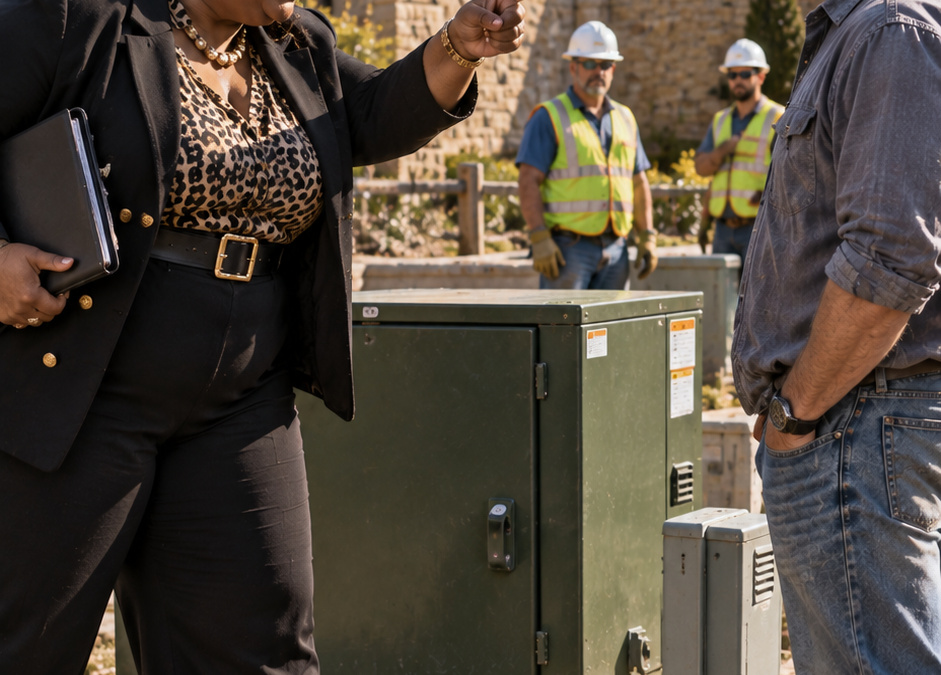
𝗣𝗔𝗥𝗧 𝟮
I rested both hands on the digger.
“I am the owner.”
She stopped.
Her eyes went past me.
Toward my house.
Then my pickup.
The truck had nearly 190,000 miles on it and looked every bit of them.
She looked back at me.
“I always thought this land belonged to Cedar Hollow.”
“It doesn’t.”
She didn’t ask my name.
Didn’t ask to see a deed.
Didn’t ask where the boundary ran.
Instead, she gave me hers.
“Blair Witcom. HOA president.”
“Malcolm Reic.”
She barely acknowledged it.
“We’re starting some improvements at the entrance.”
“All right.”
“It’s going to look much better.”
“Glad to hear it.”
Her gaze moved toward the utility equipment.
Then back to the subdivision entrance.
“I imagine we’ll need some cooperation from you.”
“What kind?”
“We’re still finalizing everything.”
That was all she said.
She returned to her car.
But before she got in, she looked back at the green transformer.
Not at me.
The transformer.
I remember that because it told me something.
She had already decided it was a problem.
She just hadn’t decided yet how she intended to remove it.
Three weeks later, an envelope arrived.
Cedar Hollow Homeowners Association.
Dark green crest.
Heavy paper.
Formal enough to make an uninformed person nervous.
The heading read:
NOTICE OF VIOLATION: UNAUTHORIZED UTILITY EQUIPMENT.
I laughed.
Actually laughed.
Alone beside my mailbox.
At first, I assumed someone had made an administrative mistake.
The letter described an “unapproved exterior utility structure” near the Cedar Hollow entrance that failed to comply with community architectural standards.
Then I reached the final paragraph.
Removal required within ten days.
I stopped laughing.
The transformer wasn’t mine.
The HOA knew, or should have known, that the equipment served its own neighborhood.
Yet I was being ordered to remove it.
I called the office.
Voicemail.
I emailed the address on the letterhead.
Automated response.
Two days later, Blair called personally.
“Mr. Reic, I’d like to meet at the entrance tomorrow.”
“What about?”
“The violation notice.”
“You mean the transformer?”
“Among other things.”
“Four o’clock?”
“That will work.”
Her tone suggested she had approved my appointment rather than requested it.
I arrived at four.
Blair stood beside a folding table with architectural renderings held down by metal clips.
A young man wearing a landscaping-company jacket stood beside her.
The plans were impressive.
A curved dry-stacked stone wall.
Black wrought-iron gates.
Bronze lettering.
Uplighting.
Maple trees.
Planters.
Irrigation.
The entire entrance would be rebuilt.
“Three hundred twenty thousand dollars,” Blair said.
“It’s ambitious.”
“It’s necessary.”
She pointed to the rendering.
“Cedar Hollow has been neglected.”
Then she turned toward the green transformer across the road.
“That has to go.”
I looked at her.
“The transformer?”
“Yes.”
“You want me to remove a utility transformer?”
“It’s on your property.”
“The land is mine. The transformer isn’t.”
She folded her arms.
“Then tell them to move it.”
“That’s not how this works.”
She smiled.
It was the smile adults sometimes give children who are explaining imaginary rules.
I knew that smile.
I had seen it from contractors who later spent six figures moving concrete.
“Silver Ridge owns the equipment,” I said. “It sits inside a recorded utility easement. I don’t have authority to touch it.”
“You’re the property owner.”
“Correct.”
“So authorize the relocation.”
“I can’t.”
Her smile disappeared.
“It’s physically on your land.”
“Inside their easement.”
“Which is on your land.”
“An easement gives them a legal property interest in that corridor.”
She waved that away.
“I manage a two-hundred-home community, Mr. Reic. I’m familiar with property documents.”
“Then read the recorded easement.”
Her expression changed.
Not dramatically.
Just enough.
I had challenged not her interpretation but her competence.
That was personal to her.
“I’ve reviewed what I need to review.”
“Then you know I can’t remove that transformer.”
“I’m asking you to do the simple thing.”
There it was.
The sentence that defined the next several months.
The simple thing.
Not the lawful thing.
Not the safe thing.
Not the technically possible thing.
The simple thing she wanted.
I looked toward the green box.
“If the HOA wants it relocated, contact Silver Ridge. They’ll engineer it.”
“That shouldn’t be necessary.”
“It is.”
“We’re not going to redesign an entire entrance because one adjacent landowner refuses to cooperate.”
“This has nothing to do with cooperation.”
“Everything has to do with cooperation.”
“No. Some things have to do with recorded rights.”
She gathered the renderings.
“We’ll follow up.”
She did.
Three days later.
Another envelope.
This one assessed a fine.
Two hundred fifty dollars per day.
Failure to remove unauthorized equipment.
Retroactive to the end of the original compliance period.
Continued noncompliance could result in a lien against my property.
I sat on my porch reading it while my coffee went cold.
The absurdity wasn’t funny anymore.
Blair was billing me every day because I refused to remove regulated utility equipment that belonged to someone else.
Worse, she was threatening a lien.
That changed the nature of the situation.
I stopped calling.
Stopped trying to persuade.
Started collecting records.
The next morning, I drove to the county recorder’s office.
A clerk named Priscilla recognized me.
She had known my father.
“Trouble?”
“HOA.”
She winced.
“Say no more.”
I spent two and a half hours pulling documents.
My deed.
My father’s deed.
My grandfather’s conveyance.
The 1996 boundary survey.
The 1997 utility easement.
Cedar Hollow’s subdivision plat.
Declaration of covenants.
Every recorded amendment.
By noon, the facts were cleaner than I had expected.
Silver Ridge’s easement predated Cedar Hollow by seven years.
The later subdivision plat expressly acknowledged it.
The easement wasn’t hidden.
It was printed directly onto the recorded map.
More importantly, Cedar Hollow’s declaration defined HOA jurisdiction using specific lots and blocks.
My parcel wasn’t one of them.
Not originally.
Not in any amendment.
Not ever.
I read that section four times.
Then I looked at Priscilla.
“I think they may have a bigger problem than the transformer.”
She raised one eyebrow.
“How much bigger?”
“They’ve been fining property they don’t govern.”
She pushed a certified-copy request form toward me.
“Then I suggest you take good copies.”
I did.
Multiple sets.
That afternoon, I called Silver Ridge Electric.
Eventually I reached Evan Price, regional operations manager.
I gave him the asset number from the transformer.
The circuit identifier.
My parcel number.
Then I explained what Cedar Hollow had demanded.
Silence.
“Say that again.”
“The HOA issued me a violation notice ordering me to remove your transformer.”
Another pause.
“They’re fining you?”
“Two hundred fifty dollars a day.”
He muttered something I won’t repeat.
“Don’t touch anything.”
“I had no intention of it.”
“I’m pulling the easement.”
“I have a certified copy in front of me.”
“Give me twenty minutes.”
He called back in nineteen.
Everything matched.
Silver Ridge owned the transformer.
Owned the sectionalizer.
Owned the junction cabinet.
The easement required continuous access.
No private owner.
No HOA.
No contractor.
Nobody had authority to relocate, enclose, obstruct, bury around, or otherwise interfere with the equipment without Silver Ridge’s approval.
Then Evan told me something I hadn’t known.
“Cedar Hollow has already contacted us.”
“When?”
“About two weeks ago.”
“About relocation?”
“Yes.”
“What did you tell them?”
“That engineering would have to price it.”
That interested me.
“Did they get the estimate?”
“I’d have to check whether it was finalized.”
“Who contacted you?”
He paused.
“Blair Witcom.”
So Blair had known the transformer wasn’t mine to move before she ever fined me.
I emailed her that afternoon.
Attached the easement.
Survey.
Subdivision plat.
Silver Ridge contact information.
I wrote one paragraph.
The equipment is owned by Silver Ridge Electric and occupies a recorded utility easement predating Cedar Hollow. My parcel is not subject to Cedar Hollow HOA jurisdiction. I will not interfere with utility property. Please rescind the violation and all associated fines.
Her response arrived the next morning.
Two sentences.
“Old easements cannot hold a growing community hostage forever. I trust that all parties can be reasonable.”
I stared at the email.
It wasn’t an argument.
It wasn’t law.
It wasn’t engineering.
It was a feeling wearing legal clothes.
And I realized something important.
Blair did not merely disagree with me.
She resented being corrected by me.
The man in the old truck.
The man digging fence posts in muddy work clothes.
The man she had decided could be ordered around before learning his last name.
That was when I stopped expecting reason to change her course.
Nine days later, Blair ordered me to attend a board meeting.
Her email actually used the word required.
I went.
Not because she had authority to require anything from me.
Because I wanted witnesses.
The clubhouse conference room held four people.
Blair at the head.
Grant Holloway, vice president, to her left.
He was a semi-retired insurance adjuster with tired eyes.
Celeste Marlo, treasurer, to Blair’s right.
She kept notes in a large paper ledger.
At the far end sat Dana Kellard, the professional community manager.
Dana looked like someone who had already advised against whatever was about to happen.
Blair began.
“Mr. Reic has repeatedly refused reasonable requests regarding the Cedar Hollow entrance improvement.”
I didn’t interrupt.
“He does not live within the community yet is currently obstructing a project serving two hundred families.”
Grant gave a weak nod.
Celeste kept writing.
Dana stared at the table.
“The board has attempted to resolve the matter informally,” Blair continued, “but Mr. Reic appears determined to prevent progress.”
When she finished, I asked one question.
“If I don’t live inside your association, why are you fining me under your association’s rules?”
Silence.
Four seconds.
Maybe five.
Celeste’s pen stopped.
Grant looked at Blair.
Dana finally lifted her eyes.
Blair said, “The fine is a separate administrative issue.”
“Based on what jurisdiction?”
“We need to stay focused on the equipment.”
“That’s my question.”
She ignored it.
“Removal must occur within seventy-two hours.”
“Whose removal?”
“Yours.”
“It’s not my equipment.”
“Mr. Reic—”
“Do you have any recorded instrument placing my parcel under this HOA?”
“We’re not relitigating community boundaries.”
“We’ve never litigated them.”
Blair’s jaw tightened.
She slid a paper across the table.
72 HOURS TO COMPLY.
Legal referral.
Lien threat.
Escalation.
I folded it.
Put it in my jacket.
Then I looked at every person at that table.
“Do not build anything around that equipment.”
Blair leaned back.
“You worry about your property.”
I stood.
“I am.”
Monday morning, diesel engines woke me at 6:10.
I looked through the window.
Two skid steers.
Mini excavator.
Flatbed.
Pallets of stone.
I pulled on a jacket and walked outside with coffee.
The crew was from Katon Ridge Landscaping.
A foreman was marking the ground with orange paint.
The proposed stone wall crossed beyond the property pin.
Then curved dangerously close to the utility pad.
I watched him spray a line across land he had no right to touch.
I took out my phone.
Started recording.
Date.
Time.
Location.
Property pin.
Equipment pad.
Paint marks.
Contractor trucks.
Then the crew started removing sections of my old chain-link fence.
I filmed that too.
The posts my father and I had set.
One by one.
Coming out of the ground.
I didn’t confront the laborers.
They were working from plans someone else had approved.
I called Evan.
Voicemail.
Then the utility dispatch center.
“Active excavation inside a recorded utility easement. Access to energized distribution equipment may be obstructed.”
That got attention.
Evan called eleven minutes later.
“I’m coming.”
He arrived shortly after nine.
White utility pickup.
Hazards flashing.
He walked the corridor without speaking to me.
Looked at the orange lines.
Measured from the property pin.
Inspected the excavation.
Studied the wall layout.
His expression changed.
He called the foreman.
“Stop work, please.”
The foreman immediately shut down the equipment.
Then called his office.
Four minutes later, Blair arrived.
She crossed the road quickly.
“Who authorized this stoppage?”
Evan introduced himself.
“Silver Ridge Electric.”
“This is an HOA project.”
“You’re excavating inside our easement.”
“We’ve already discussed relocation.”
“Relocation isn’t approved.”
“The equipment needs to move.”
“That’s a separate project.”
She pointed at the excavation.
“We have a schedule.”
Evan remained calm.
“I need you to understand three things.”
Blair folded her arms.
“Go ahead.”
“We need continuous vehicle access to the pad.”
Silence.
“We need operating clearance around the equipment.”
Another pause.
“And we need room to remove or replace any of these assets under emergency conditions.”
“The wall won’t prevent maintenance.”
“It will.”
“We can provide gate access.”
“A line truck doesn’t negotiate decorative gates during a fault at two in the morning.”
Her face tightened.
Evan pointed at the excavation.
“This footing is inside the recorded easement.”
“I’ve been told otherwise.”
“By whom?”
She didn’t answer.
He continued.
“Your current design eliminates the required approach.”
“This can be worked around.”
“No.”
She looked at me.
“This is exactly the resistance I’ve been dealing with.”
Evan looked between us.
Then back at her.
“I’m not here because of Mr. Reic’s opinion.”
That irritated her more.
He went to his truck.
Returned with a folder.
“Have you given the board the relocation estimate?”
Blair cut him off.
“Cedar Hollow’s financial matters are not Mr. Reic’s business.”
I hadn’t asked anything.
Evan glanced at me.
Then at her.
“I asked whether the board had reviewed it.”
She didn’t answer.
He opened the folder.
For half a second, I saw the cover sheet.
$486,000.
There it was.
Everything clicked.
Three hundred twenty thousand dollars for Blair’s entrance project.
Nearly half a million more to relocate the electrical equipment her design conflicted with.
She knew.
She had known before the fines.
Before the threats.
Before the seventy-two-hour notice.
Relocation wasn’t impossible.
It was expensive.
So instead of telling her board the true cost, she had decided the cheaper solution was forcing me to make someone else’s utility disappear.
I looked at her.
“You’ve had the estimate.”
Her eyes flashed.
“This doesn’t concern you.”
“It’s sitting on my land.”
“Exactly.”
“Inside their easement.”
“You seem to enjoy watching this community struggle.”
“No.”
“You’ve made that very clear.”
“I’ve been trying to stop you from creating a larger problem.”
She laughed.
“Men like you always think they’re the smartest person in the room.”
I didn’t answer.
There are accusations designed entirely to make you defend your ego.
The moment you do, you’ve left the useful conversation.
So I kept my hands in my jacket and said nothing.
Evan returned with a formal notice.
Silver Ridge letterhead.
Recorded instrument number.
Specific requirements.
Remove all obstructions.
Restore vehicle access.
Cease excavation within the easement.
Deadline: 5:00 p.m. two days later.
Then the important line.
Failure to restore compliant access could result in the affected section of distribution circuit being removed from service until safe operating conditions were restored.
Evan handed it directly to Blair.
“Please read this.”
She folded it once.
Put it under her arm.
Evan left.
I stayed.
Not because I intended to argue.
I wanted to see what she did.
Blair stood beside the trench for fifteen seconds.
Looked at the wall rendering.
The pallets.
The crew.
Then at the utility notice under her arm.
Finally she turned to the foreman.
“Continue.”
He hesitated.
“Ma’am, should we wait until our office speaks with Silver Ridge?”
“The contract has been executed.”
“Yes, but—”
“I expect the schedule maintained.”
He looked at his crew.
Then put his hard hat back on.
The excavator started.
That sound stayed with me.
Not because it was loud.
Because it was the sound of a decision becoming evidence.
Thursday morning, Silver Ridge returned.
Not one truck.
A convoy.
Two line trucks.
Supervisor’s pickup.
Bucket unit.
Portable light tower.
Evan led.
A field engineer rode beside him.
They coned off the shoulder and inspected the corridor.
Photographs.
Measurements.
Clearances.
Drainage.
Access.
Twenty minutes later, Blair appeared.
She walked toward the open equipment area quickly enough that one lineman stepped between her and the cabinet.
“Ma’am, please stay back.”
“I’m the HOA president.”
“Still need you behind the cones.”
Evan approached.
“Blair, this needs to be resolved today.”
“The work is nearly complete.”
“That’s the problem.”
She stared at him.
He listed the requirements.
Construction stops.
Obstructing wall section removed.
Access restored.
She rejected all three.
“The wall is structural.”
“Then part of it needs redesign.”
“We have a signed construction contract.”
“That’s between you and your contractor.”
“The board approved the project.”
Evan asked, “Did the board see the written warning I gave you Tuesday?”
“The board delegates operational authority to the president.”
He wrote something on his clipboard.
“That’s a yes?”
“I handled it.”
He wrote again.
I stood near my driveway.
Close enough to hear.
Far enough to stay out of it.
The field engineer returned from the pad.
He spoke quietly with Evan for about ninety seconds.
Then both men looked toward the new construction.
I knew that body language.
Something had gotten worse.
The footing had been poured hard against the equipment side.
The new grading directed runoff toward the pad.
Stone pallets occupied the turnout.
The contractor had reduced working clearance around energized equipment.
Not theoretical clearance.
Real clearance.
The space a lineman might need while switching live distribution equipment.
Evan looked at Blair.
“We can’t operate this safely in the present condition.”
“Nothing has happened.”
“That’s not the standard.”
“The equipment is functioning.”
“That isn’t the issue.”
“Then what is?”
“My crews have to be able to work it safely.”
She crossed her arms.
“Your company is not going to shut off electricity to two hundred homes because of a wall.”
Evan looked at her for a long time.
“I sincerely hope we don’t have to.”
She smiled.
She thought that meant he had blinked.
Then she said the one thing I still can’t believe she said.
“Then remove the transformer.”
Silence.
Even the contractor foreman looked at her.
Evan put his clipboard on the hood.
“If you want relocation, that’s a capital project.”
“We know.”
“It requires engineered design.”
“We know.”
“County permitting.”
“Yes.”
“A scheduled outage.”
She said nothing.
“And a deposit.”
Her face changed.
He continued.
“Your office already has the preliminary number.”
She looked at me.
“This conversation is confidential.”
Evan shook his head.
“No. Today isn’t about relocation.”
He pointed toward the new wall.
“Today is about a safety condition created in the last seventy-two hours.”
Blair walked away.
At 7:18 that evening, Cedar Hollow went dark.
I was on my porch.
The first thing I noticed was the streetlight across from my house.
It vanished.
Then the two lamps on the entrance columns.
Then the illuminated Cedar Hollow sign.
Then windows.
One row.
Then another.
The entire neighborhood dropped into darkness almost simultaneously.
The clubhouse fountain slowed.
Its pump made a descending mechanical groan.
Then stopped.
The gate lights were gone.
The control cabinet lost normal service.
Backup operation on the entrance gate didn’t behave the way everyone expected, and several residents discovered quickly that the system did not simply glide open during an outage.
For a few moments, there was almost complete silence.
Then a dog started barking somewhere deep inside the subdivision.
A garage door alarm chirped.
Doors opened.
Voices.
Flashlights.
Phones.
Two hundred households suddenly had the same question.
What happened?
A man named Nolan Barrett appeared at my fence about twenty minutes later carrying a flashlight.
I’d seen him for years.
Big guy.
Quiet voice.
Owned a plumbing-supply company.
He always waved when he passed.
“Malcolm?”
“Yeah?”
“You know what’s going on?”
I looked toward the stone wall.
“Yes.”
He followed my eyes.
“What?”
“The utility shut down the section because they couldn’t maintain safe access to the equipment.”
His flashlight moved toward the transformer.
“Because of the entrance project?”
“That’s what they warned would happen.”
Nolan stood there silently.
Then my phone buzzed.
Blair.
Three words.
All capitals.
YOU DID THIS
I looked at the message.
Then at the black windows behind her gate.
I took a screenshot.
Saved it.
Didn’t respond.
Some messages aren’t requests for information.
They’re the first draft of somebody’s defense.
By six the next morning, Blair had finished hers.
Every Cedar Hollow household received an emergency email.
It explained that the outage resulted from “an adjacent landowner refusing to cooperate with the association and utility concerning equipment situated on his property.”
She didn’t name me.
She didn’t have to.
There was one adjacent landowner.
My house was beside the entrance.
By eight, cars were slowing near my driveway.
One person took a photograph.
Another did the same twenty minutes later.
I made breakfast.
Then I printed three bound copies of everything.
Deed.
Survey.
Easement.
Subdivision declaration.
Fine notices.
Emails.
Utility warning.
Photographs.
Timeline.
Forty-one pages.
At 9:45, Blair came to my gate.
She wore a dark wool coat.
No clipboard.
That was new.
“Call Silver Ridge.”
“For what?”
“Tell them to restore service.”
“I don’t control Silver Ridge.”
“The equipment is on your property.”
“Eleven days ago you said the property belonged to your association.”
Her face tightened.
“This isn’t funny.”
“I didn’t say it was.”
“Two hundred families are without power.”
“I know.”
“You can fix this.”
“No. The HOA can.”
“How?”
“Remove the obstruction.”
“The wall is nearly complete.”
“Then uncomplete part of it.”
She stared.
“You are playing paper games while families are suffering.”
“No.”
“You think a few old documents make you powerful?”
I looked at her.
“They don’t make me powerful.”
I pointed toward my house.
“They make me the owner.”
For one second, I saw something change in her eyes.
The realization was there.
Not acceptance.
But recognition.
She knew what she’d done.
Then it disappeared.
She pushed it away.
“Our attorney will contact you.”
“I’m sure he will.”
She turned.
Walked back to the sedan.
She was correct about the attorney.
Just not in the way she expected.
There is something uniquely motivating about losing electricity because of somebody else’s secret decision.
Two hundred adults suddenly had plenty of time to ask questions.
Nolan returned that afternoon.
This time, four neighbors came with him.
They weren’t angry at me.
They were confused.
One woman had written questions on the back of an envelope.
I respected that.
I invited them inside.
Placed one bound copy on the kitchen table.
And walked through it.
No commentary.
No insults.
Just documents.
1977—
“No,” I corrected myself.
“1997. Utility easement.”
The recorded description.
The subdivision plat.
The HOA declaration.
My parcel missing from the HOA lot schedule.
The fine.
The relocation issue.
A woman named Rachel, an elementary-school administrator, turned back several pages.
“Did the board know moving the transformer would cost money?”
“I don’t know what the board knew.”
“But there was an estimate?”
“I saw the cover sheet.”
“How much?”
“Four hundred eighty-six thousand dollars.”
The room went silent.
Nolan leaned back.
“Half a million?”
“Close.”
Rachel wrote it down.
“We were told the entrance project was fully budgeted.”
“I can’t speak to what you were told.”
“But Blair knew?”
“Evan asked her about the estimate in front of me. She clearly knew it existed.”
Nobody said anything for a while.
That evening, Celeste Marlo called.
7:10 p.m.
Her voice sounded tight.
“I’m calling as a homeowner, not treasurer.”
“That’s fine.”
“I’m in my car.”
“Okay.”
“I don’t want this on the association line.”
I picked up a pen.
“For both our purposes, I’m noting the time.”
“Please do.”
She took a breath.
“The board never saw a four-hundred-eighty-six-thousand-dollar estimate.”
I stopped writing.
“Never?”
“Not once.”
“What about Silver Ridge’s warnings?”
“I’ve spent the afternoon going through eight months of minutes.”
“In the dark?”
“By flashlight and candle.”
Despite everything, I almost smiled.
“No reference?”
“Nothing.”
“Any vote authorizing work inside the utility easement?”
“No.”
“Did you know my parcel wasn’t in Cedar Hollow?”
Another pause.
“I assumed it was.”
“That’s different from knowing.”
“I understand that now.”
Then she said something that mattered.
“Dana Kellard told Blair we needed legal review before issuing the first fine.”
“Do you have that in writing?”
“I don’t know yet.”
“Find out.”
“I will.”
The emergency community meeting began at eight.
The clubhouse was powered by two portable generators.
The smell of diesel hung outside.
Inside, temporary work lights crossed the ceiling.
Every folding chair was occupied.
Dozens of people stood against the walls.
Nolan saved me a seat.
Blair stood behind the podium.
Dana Kellard beside her.
Grant and Celeste at the board table.
A man I didn’t recognize sat near the back with a laptop.
Blair opened.
“The association is pursuing every remedy available following the actions of an adjacent property owner who has repeatedly obstructed reasonable community improvements.”
My name followed.
Twice.
“Mr. Malcolm Reic has declined cooperation at every stage.”
Someone called from the back.
“Why did the utility send you warnings?”
The room erupted.
Grant raised his hands.
“Please. One at a time.”
Blair continued.
“This outage is the direct consequence of one individual’s refusal to participate constructively.”
Grant looked toward me.
“Mr. Reic, would you like to address that?”
“Yes.”
I carried a thin folder to the front.
No speech.
Speeches are dangerous in rooms like that.
Speeches are opinions.
Opinions can be argued with.
Documents are harder.
I faced Blair.
“Three questions.”
She folded her arms.
“Did you receive my email on April eleventh containing the recorded utility easement and survey?”
“Yes, but—”
“Thank you.”
Murmurs.
“Second. Did you personally receive written notice from Silver Ridge two days before power was interrupted?”
“It was a technical opinion, not a court order.”
“Did you receive it?”
“Yes.”
“Third.”
The room went quiet.
“Did you receive a relocation estimate for approximately four hundred eighty-six thousand dollars?”
Blair looked toward Grant.
Then Celeste.
Then the audience.
“This meeting is being manipulated.”
I waited.
“The association’s finances are a board matter.”
Celeste leaned toward her microphone.
“I’m on the board.”
Every head turned.
Her voice was steady.
“I have never seen that estimate.”
The room changed.
Not gradually.
At once.
Like the lights.
People started talking.
“How much?”
“Half a million?”
“She didn’t show the board?”
“Who approved this?”
Grant stood.
“Order, please.”
Blair gripped the podium.
“I had executive authority to negotiate—”
“Four hundred eighty-six thousand?” someone shouted.
“Was that included in the budget?”
Blair raised her voice.
“The entrance project was fully authorized.”
Celeste said, “Not with that cost.”
Then Evan Price arrived.
8:20.
He had come at Silver Ridge’s request to explain the outage.
I suspect he would rather have been anywhere else.
He stood at the front.
Hands clasped behind his back.
No drama.
No blame.
Facts.
“The equipment serving this area is owned and operated by Silver Ridge Electric.”
He explained the easement.
Its age.
Its access provisions.
He explained that construction had obstructed the operating corridor after multiple warnings.
He explained that the footing, grading, materials, and wall location created conditions his field crews could not safely work around.
Then he explained why power had been isolated.
A resident interrupted.
“Did Malcolm ask you to shut it off?”
“No.”
Another.
“Did he do anything to the transformer?”
“No.”
“Did he block your trucks?”
“No.”
“Did he cause the outage?”
Evan looked toward me.
Then toward the room.
“No.”
He seemed to understand they needed more.
So he gave them more.
“Mr. Reic did not request an interruption.”
Silence.
“He did not alter our equipment.”
Silence.
“He did not obstruct our access.”
More silence.
“He notified us when third-party construction entered the easement and provided documentation supporting the recorded boundary.”
He looked toward Blair.
“He also warned the association in advance.”
Blair’s grip tightened.
Then Evan added something nobody had asked.
“Silver Ridge sent three written communications to the association concerning this conflict.”
Celeste looked up.
“Three?”
“Yes.”
“Dates?”
Evan gave them.
Celeste opened the association laptop.
Dana Kellard shifted in her chair.
For several minutes, Celeste searched the shared administrative account.
Then she found them.
“First warning received three weeks before the outage.”
Murmurs.
“Relocation estimate received nineteen days before the outage.”
The room got louder.
“Final service warning received two days before the outage.”
Grant stared at Blair.
“Why didn’t we see these?”
Blair said, “I was handling an ongoing negotiation.”
Celeste kept reading.
Then she stopped.
Her face changed.
“What?”
Grant leaned closer.
Celeste looked toward Blair.
“I found an internal message.”
Blair’s expression became hard.
“Celeste.”
Celeste read it anyway.
“From the president’s account to Dana Kellard. Eleven days before the outage.”
Dana closed her eyes briefly.
Celeste read:
“Do not put the relocation cost on the agenda. I will handle Reic first.”
The generator outside suddenly sounded very loud.
Grant looked toward Blair.
“You intentionally withheld it?”
“I was negotiating.”
“With whom?”
“Mr. Reic.”
I spoke from beside the table.
“She never offered me anything.”
Blair pointed at me.
“That’s not true.”
“What did you offer?”
Her mouth opened.
Closed.
I reached into the folder.
Pulled out the HOA assessment.
Two hundred fifty dollars per day.
“Is the association’s attorney here?”
The man in the quarter-zip stood.
“Wesley Boone.”
“Mr. Boone, can Cedar Hollow legally fine my parcel?”
Blair cut in.
“This isn’t the appropriate forum—”
Wesley raised a hand.
“Let me answer after I check.”
He came forward.
I gave him the parcel number.
Street address.
He opened his laptop.
Pulled the recorded declaration.
Subdivision plat.
Read quietly for about ninety seconds.
A hundred people watched.
Then he removed his glasses.
“Mr. Reic’s parcel does not appear to be part of Cedar Hollow.”
Silence.
Blair turned.
“What?”
Wesley looked again.
“The declaration identifies specific lots and blocks.”
He pointed at the screen.
“His parcel isn’t included.”
“That strip has always been treated as community property.”
“Treatment isn’t annexation.”
“The entrance is built there.”
“That doesn’t change title.”
He looked toward the room.
“To be clear, based on the recorded documents I’m reviewing, Mr. Reic’s parcel was never annexed into the association.”
No one spoke.
“He does not appear to be a member.”
Another pause.
“And the HOA covenants would not apply to his property.”
The sentence landed harder than the outage.
Blair stared at him.
“You represent the association.”
“Correct.”
“Then act like it.”
A few people gasped.
Wesley’s expression didn’t change.
“I am.”
He looked at the fine in my hand.
“Did the board obtain a jurisdictional opinion before issuing that?”
Grant looked at Blair.
Celeste did too.
Dana Kellard answered.
“No.”
Every head turned toward her.
Blair said sharply, “Dana.”
Dana continued.
“I recommended legal review before enforcement.”
“That is not what happened.”
“I have the email.”
The room erupted again.
I didn’t need anything else.
I slid the fine back into my folder.
Closed it.
Looked at Blair.
“Three weeks ago, I asked you to read the deed.”
That was all.
I returned to my seat.
Nolan moved his jacket.
I sat.
Grant called for a motion.
The board voted that night.
Blair Witcom was suspended from executive authority pending legal review.
Four votes.
No opposition.
One abstention.
Blair’s.
Grant was authorized to coordinate directly with Silver Ridge.
Wesley Boone was instructed to prepare a legal opinion on the association’s exposure.
Celeste received authority to preserve and distribute the full email chain.
And every fine issued against my property was vacated immediately.
Not reduced.
Not negotiated.
Vacated.
The board also approved a written acknowledgment that Cedar Hollow possessed no governing authority over my parcel.
They moved quickly.
Dark neighborhoods produce efficient committees.
By ten the next morning, Katon Ridge Landscaping had returned.
This time Grant stood beside the crew with a printed copy of the easement.
Silver Ridge marked required clearances in blue paint.
The offending wall section came apart.
Stone by stone.
The pallets were removed from the turnout.
The trench was backfilled.
Drainage restored.
Compacted road base replaced.
A line-truck route reopened.
The field engineer inspected everything.
At 5:42 that evening, Cedar Hollow began coming back.
A porch light.
Then another.
Kitchen windows glowing.
Streetlights.
The clubhouse sign.
The fountain coughed.
Stopped.
Coughed again.
Then water climbed into the basin.
Somewhere up the hill, a garage door opened.
Nobody cheered.
They were too tired.
Two hundred households returned to ordinary Saturday life.
And most of them probably never again thought seriously about the green steel equipment near the entrance.
That was perfect.
Infrastructure is most successful when nobody has to think about it.
I sat on my porch until full darkness.
The neighborhood lights looked different after two nights without them.
I slept well.
The story wasn’t finished.
Four days later, Grant called.
“Malcolm, can Wesley meet with you?”
“About?”
“The entrance.”
“I thought we resolved the easement.”
“The easement, yes.”
He paused.
“We found another issue.”
We met at my house.
Wesley brought as-built drawings.
Grant brought survey notes.
The new construction hadn’t only entered the utility easement.
It had crossed my property line.
A section of irrigation main.
Part of the bronze entrance-sign footing.
Two raised planter beds.
All physically located on my parcel outside any HOA-owned land.
Roughly nineteen thousand dollars in permanent improvements.
Built on property Cedar Hollow did not own.
Wesley laid out the drawings.
“You could demand removal.”
“I know.”
“You would likely prevail.”
“I know.”
Grant rubbed one hand over his face.
“We’d like to find another solution.”
Two days later, Blair came to see me.
I suspected she’d been instructed to.
She had no clipboard.
No folder.
No violation notice.
Just a wool coat and tired eyes.
“Can we resolve this reasonably?”
I almost laughed.
Instead I said, “I’ve been trying to do that since April.”
She looked toward the entrance.
The wall was beautiful where it remained.
Stone.
Bronze sign.
Young trees.
Irrigation.
Then the open utility access corridor cut cleanly through the design.
“You could force us to tear the whole thing out.”
“Wesley told you that?”
“Yes.”
“And?”
“I’m asking you not to.”
There was no apology.
I realized I didn’t need one anymore.
Somewhere between the outage and the board meeting, an apology from Blair had stopped carrying value.
What mattered was what happened next.
I thought about Nolan.
Rachel.
Celeste.
The hundreds of households that hadn’t sent me fines.
The families who’d sat in dark homes because of decisions they didn’t know were being made.
Tearing out the entire entrance might have punished Blair emotionally.
But Blair wouldn’t personally pay for it.
The residents would.
So I told Grant and Wesley I’d consider a limited agreement.
My attorney drafted it.
Cedar Hollow received a revocable license covering the sign footing, irrigation line, and planter encroachments.
Not an easement.
Not ownership.
Not adverse possession.
A license.
The association assumed all maintenance and restoration costs.
Nothing in the agreement transferred title.
Nothing could ripen into a permanent property right.
No future modification without my written consent.
No obstruction of Silver Ridge’s corridor.
Violation of those conditions terminated the license.
Grant read the agreement twice.
Then signed it.
There was one point I refused to compromise on.
The wall section across the utility approach did not return.
Ever.
A week later, I sat on my porch with coffee and watched two workers remove its final course.
Stone by stone.
Placed on a pallet.
Loaded away.
By afternoon, there was nothing left between the road and the transformer except compacted gravel and blue utility marks.
Exactly as there should have been.
Blair resigned two days before a recall vote.
She left the board completely.
Grant became acting president through the end of the year.
Cedar Hollow adopted new rules.
Any correspondence received from a utility, municipality, regulator, engineer, or attorney had to be distributed to every board member within forty-eight hours.
No presidential discretion.
No private withholding.
They commissioned a full survey of association property and recorded easements.
A framed copy went up in the clubhouse.
I heard Celeste insisted on that.
The entrance project was redesigned around the utility corridor.
Ironically, it finished under budget once the board stopped pretending the transformer could be made somebody else’s problem.
The transformer stayed.
Of course it stayed.
Same concrete pad.
Same green steel enclosure.
Same recorded easement.
Grant eventually asked my opinion about landscaping.
“You know anything that can hide this without upsetting Silver Ridge?”
“Don’t hide it.”
He laughed.
“Screen it.”
We chose serviceberry shrubs set far enough back to preserve access and working clearance.
Silver Ridge approved the plan.
The shrubs softened the view.
The utility still had a straight truck approach.
No walls.
No locked gate.
No negotiation at two in the morning.
Everybody got what they actually needed.
Months later, I ran into Nolan near the entrance.
He nodded toward the transformer.
“Guess the ugly green box won.”
I smiled.
“The box didn’t win.”
“What did?”
“The paperwork.”
He thought about that.
Then laughed.
“That’s probably worse for Blair.”
He was right.
You can argue with a person.
You can insult him.
Pressure him.
Talk over him.
Question his motives.
A recorded instrument doesn’t care.
It doesn’t get offended.
Doesn’t get tired.
Doesn’t panic when threatened with a lien.
It sits in the county archive and waits for somebody to read it.
I wasn’t richer than Blair.
I wasn’t louder.
I didn’t control a board.
Didn’t have an HOA budget.
Didn’t have community letterhead.
Didn’t have two hundred households behind me.
At the beginning, I was one man standing beside a half-acre strip of grass.
And if I had treated the conflict as a contest of personality, I probably would have lost.
Blair wanted that contest.
She wanted me angry.
She wanted the story to become one stubborn neighboring landowner sabotaging a community project.
Every time I refused to give her that version, she had to escalate.
First the notice.
Then the fine.
Then the lien threat.
Then the seventy-two-hour demand.
Then the wall.
Then ignoring Silver Ridge.
Then hiding the relocation estimate.
Then blaming me for the outage.
Each decision felt small to her because she believed she would control the next step.
She never seemed to understand that decisions accumulate.
So do documents.
So do witnesses.
By the time Cedar Hollow went dark, I barely had to explain anything.
She had created the timeline herself.
I still look at that transformer sometimes.
Most evenings, it disappears behind the serviceberries.
You can see only a strip of green steel if you know where to look.
And every night, somewhere around dusk, Cedar Hollow wakes up electrically.
Streetlights flicker on.
Garage lights.
Kitchen windows.
Porch lamps.
Two hundred houses connected through equipment most residents will never touch.
I think about the first afternoon at the rendering table.
Blair pointing across the road.
“Remove that transformer.”
The command had sounded so simple.
That was what made it dangerous.
A lot of bad decisions begin with someone deciding complexity is merely disobedience.
I had told her relocation required design.
Permits.
Outage planning.
Engineering.
Money.
She heard excuses.
I told her the easement controlled what could be built there.
She heard resistance.
Silver Ridge gave her written requirements.
She heard threats.
Evan explained the safety problem.
She heard a bluff.
And the moment she said they would never turn off power over a wall, she made the same mistake I’ve watched people make on construction sites my entire career.
She thought confidence changed constraints.
It doesn’t.
Electricity does not care how many votes you received.
A line truck does not become narrower because a contractor has a schedule.
Working clearance does not expand because you’ve already poured the footing.
Recorded rights do not evaporate because a landscaping rendering looks better without them.
Physics is exceptionally rude to ego.
So is property law.
A few weeks after everything settled, Celeste stopped by.
She brought back one of the bound document copies I’d loaned to the board.
“You were right.”
“About what?”
She looked toward the entrance.
“All of it.”
“That happens occasionally.”
She smiled.
Then became serious.
“I should have asked more questions.”
“Probably.”
She looked surprised.
People often expect comfort when what they need is accuracy.
Then I added, “You asked them eventually.”
She nodded.
“I’ve been thinking about that first meeting.”
“Which part?”
“When you asked why we were fining you if you weren’t in the HOA.”
“I remember.”
“I knew something was wrong.”
“But?”
“I didn’t want the fight.”
That was probably the most honest sentence anybody involved ever gave me.
I understood it.
Most systems survive bad leadership not because everyone agrees.
They survive because disagreement is inconvenient.
Grant was tired of being outvoted.
Celeste didn’t want conflict.
Dana had offered professional advice and been ignored.
Contractors wanted to finish their contract.
Residents assumed the board knew what it was doing.
Nobody made the entire problem happen.
But enough people stepped around small warning signs that Blair could keep moving.
Until the lights went out.
Darkness made the invisible visible.
Two hundred families could suddenly see the cost of all the conversations they’d never been included in.
Months later, Cedar Hollow hosted its annual summer picnic.
I didn’t attend.
Not because I was angry.
I simply wasn’t a member.
That distinction still mattered.
Nolan came by afterward carrying a paper plate covered in foil.
“Rachel said you technically saved the neighborhood half a million dollars.”
“Rachel needs a calculator.”
“She used one.”
“I didn’t save them anything.”
“You stopped the relocation.”
“I told Blair who owned the transformer.”
“Same difference.”
“No.”
I put the plate on the porch table.
“If the community had wanted to move it and knowingly voted to spend the money, that would have been their decision.”
He considered that.
“So what did you stop?”
“Someone hiding the cost and trying to make the decision for them.”
Nolan nodded.
“Fair enough.”
That was the heart of it.
The dispute was never really about whether the transformer could be moved.
It could.
Almost anything can be moved if you spend enough money.
The real issue was who had the right to decide.
Blair had decided that because the transformer interfered with her project, somebody else should absorb the cost.
When Silver Ridge told her the actual number, she hid it.
When my deed complicated her plan, she pretended the HOA governed me.
When the easement complicated her wall, she treated it like old paperwork.
When the utility warned her, she treated safety as negotiation.
Every obstacle became another person’s problem.
Until eventually the problem became everybody’s.
I kept the original $250-per-day assessment.
It’s in a folder in my office.
Sometimes clients notice the Cedar Hollow crest sticking out and ask about it.
I don’t tell the whole story.
Usually I just say, “That’s why you check title before final design.”
They laugh.
Then I make them check title.
The lessons people remember best are often the ones that cost somebody else a lot of money.
One afternoon the following spring, Evan Price stopped by while inspecting the serviceberry growth.
He walked the turnout.
Checked clearances.
Looked satisfied.
“You know,” he said, “this is actually nicer than the original setup.”
“The bushes?”
“Yeah.”
“Grant’s idea.”
“I thought you picked them.”
“I recommended them. He picked the size.”
Evan laughed.
Then looked toward the remaining stone entrance.
“Funny how easy this could have been.”
“Most expensive problems are.”
He nodded.
“If she’d called us before the design was final, we could’ve worked around everything.”
“I know.”
“No outage.”
“I know.”
“No wall demolition.”
“I know.”
“No relocation estimate.”
“That one would’ve still existed.”
“Fair.”
He turned toward me.
“You really never considered paying the fine just to make them stop?”
“No.”
“Not even the first one?”
“No.”
“Why?”
I thought about it.
“Because paying it would have meant accepting the premise.”
“What premise?”
“That they had authority.”
He nodded.
“And they didn’t.”
“No.”
That sounds obvious now.
It wasn’t obvious when the first letter arrived.
That’s how pressure works.
It doesn’t always need to convince you someone is right.
Sometimes it only needs to convince you resistance costs more than surrender.
Two hundred fifty dollars a day sounds absurd.
Then it becomes seven hundred fifty.
Then fifteen hundred.
Then several thousand.
Then someone mentions a lien.
A person with a mortgage, kids, and a full-time job may decide paying is easier.
I don’t judge that.
Blair depended on it.
She assumed I’d calculate my inconvenience and fold.
What she hadn’t understood was that I had spent decades working on projects where one bad assumption buried underground could become a million-dollar mistake six months later.
You learn not to accept a bad premise simply because correcting it is uncomfortable.
The same rule applied here.
By fall, Cedar Hollow had mostly returned to normal.
Mailboxes.
Garbage cans.
Lawn complaints.
Ordinary HOA business.
Grant didn’t run for a full presidential term.
Rachel did.
She won.
One of her first decisions was to put the association’s utility correspondence into a shared digital archive accessible to the whole board.
Celeste remained treasurer.
Dana Kellard stayed on as professional manager, although I heard her contract was amended so written compliance warnings could not be overridden without a recorded board vote.
Blair moved out of Cedar Hollow the following year.
I didn’t know until Nolan told me.
“House sold.”
“Good for her.”
“That’s all you’ve got?”
“What do you want me to say?”
He shrugged.
“I figured you’d feel something.”
I thought about it.
“I hope she reads the title documents on the next place.”
Nolan laughed so hard he had to lean against the fence.
That was enough.
I never hated Blair.
Anger, yes.
Frustration, absolutely.
There were moments during the outage when I thought about families with medical equipment.
Freezers.
Heating systems.
Children scared by the dark.
People trying to get vehicles through a gate that wasn’t behaving correctly.
I was furious that all of them had been pulled into a conflict that should have ended with one email and one survey map.
But hatred would have given her more space in my life than she deserved.
She made decisions.
Those decisions had consequences.
Eventually, other people saw them.
That was enough.
My grandfather used to say land teaches patience.
When I was young, I thought he meant farming.
Weather.
Fences.
Trees.
Now I think he meant something else.
Land doesn’t care who is impatient.
The boundary remains where the survey says it is.
The easement remains where the recorder says it is.
People come and go around those facts.
Presidents.
Boards.
Developers.
Contractors.
Consultants.
Owners.
Eventually, all of us leave.
The documents remain.
There’s something humbling about that.
The night Cedar Hollow lost power, Blair sent me three words.
YOU DID THIS.
For a while, I considered printing the message and putting it beside the final board resolution.
I didn’t.
There was no reason.
By then I understood what the message really represented.
It wasn’t an accusation.
It was panic.
The moment a person realizes consequences have arrived and desperately needs them to belong to somebody else.
But the outage wasn’t mine.
The wall wasn’t mine.
The hidden estimate wasn’t mine.
The ignored utility notices weren’t mine.
The unauthorized fines weren’t mine.
I had spent months doing one thing.
Saying no.
No, I won’t remove equipment I don’t own.
No, I won’t pretend your HOA governs land it doesn’t.
No, I won’t authorize construction across somebody else’s utility rights.
No, I won’t accept a false fine because fighting it is inconvenient.
No is not sabotage.
Sometimes it’s the last warning before somebody else’s bad decision reaches its natural conclusion.
One evening near the end of that year, I stood beside the entrance as dusk settled.
The new serviceberries had begun filling in.
Through the branches, I could still see the transformer.
Ugly?
Maybe.
Depends on what you value.
To Blair, it had been an eyesore.
To me, it was equipment.
To Evan, it was an asset requiring safe access.
To two hundred households, it was part of the invisible chain that kept their refrigerators cold and their porch lights glowing.
Its appearance had never been the important thing.
Its function was.
That’s another problem with people obsessed with appearances.
Eventually they forget that some ugly things are carrying the load.
The streetlights clicked on.
One.
Two.
Then all the way down Cedar Hollow.
Warm windows appeared behind them.
The bronze entrance sign lit up.
The remaining stone wall looked good.
Better, honestly, with the open corridor breaking it rather than the original design closing everything in.
A truck could reach the transformer without touching a stone.
A crew could work.
A fault could be isolated.
The neighborhood could stay lit.
Nolan was walking past and stopped beside me.
He looked at the green enclosure.
“Still here.”
“Still here.”
He smiled.
“Blair spent three hundred twenty grand trying to hide that thing.”
“She spent three hundred twenty thousand improving an entrance.”
“You know what I mean.”
“I do.”
He shoved his hands into his coat pockets.
“I still say the box won.”
“And I still say it didn’t.”
“The paperwork.”
“The paperwork.”
He shook his head.
“You really are an exciting guy, Malcolm.”
“I’ve been told.”
He walked home.
I stayed another minute.
Sometimes victories are loud.
Court rulings.
Applause.
People being escorted from rooms.
This one wasn’t.
It was two hundred houses glowing quietly behind an open utility corridor.
That was enough for me.
Blair had thought authority meant being the person who issued the order.
Remove the transformer.
Pay the fine.
Move the equipment.
Continue the work.
Ignore the warning.
But authority has limits.
A board can govern what its documents give it power to govern.
A property owner can control what his deed gives him the right to control.
A utility can protect the infrastructure its easement gives it the right and obligation to maintain.
Problems begin when somebody decides those lines exist only until they become inconvenient.
I never needed to defeat Blair.
I only needed to refuse to cross the line with her.
She did the rest herself.
One ignored document at a time.
One hidden estimate.
One unauthorized fine.
One wall built exactly where professionals told her not to build it.
And finally, one dark neighborhood full of two hundred families who suddenly had every reason in the world to start asking questions.
The transformer never moved.
Neither did the easement.
Neither did my property line.
The fines disappeared.
The wall section disappeared.
Blair’s presidency disappeared.
And every evening, when Cedar Hollow lights up behind that gate, the same green transformer sits where it has sat since 1997, doing the job it was always supposed to do.
Quietly.
Reliably.
Without needing anyone’s permission.
All Blair ever had to do was read the deed.








