𝗙𝗨𝗟𝗟 𝗦𝗧𝗢𝗥𝗬 The HOA President Put Her Lock on My Farm Gate, Never Expecting Anyone to Ask Who Owned the Road
𝗣𝗔𝗥𝗧 𝟮
The notice cited Willow Ridge’s covenants.
Article Nine.
Section Four.
Community access corridors.
It was addressed to Nolan Pike.
My address.
Correct spelling.
There was no clerical mistake.
The HOA knew exactly who I was and exactly where I lived.
That bothered me more than an accidental letter would have.
I wasn’t a Willow Ridge member.
Never had been.
My land wasn’t platted into the subdivision.
I paid no dues.
Used none of their amenities.
Had no voting rights.
Was bound by none of their covenants.
Willow Ridge hadn’t even existed when Ward’s farm was originally surveyed.
Yet there it was.
A four-item compliance demand.
Agricultural equipment visible from the “community access corridor” had to be screened.
My gate had to be repainted in an approved finish.
My PRIVATE ROAD sign had to be replaced with association-standard signage.
And I owed an annual road-maintenance assessment of four hundred eighty dollars.
Retroactive for two years.
At the bottom was a perforated payment stub.
That was the part that made me laugh.
A scissors icon.
As though cutting along the line would transform somebody else’s rulebook into jurisdiction over my land.
I drove to the Willow Ridge management office two days later.
The building was brick.
Clean.
Little brass bell on the door.
Wrapped mints at the counter.
Cynthia sat in a conference room with two other board members.
One was Dale Pettigrew, a nervous-looking man who kept touching his glasses.
The other was a woman behind a laptop.
I placed the notice on the table.
“You sent this to the wrong property.”
Cynthia glanced down.
“No.”
She didn’t pick it up.
“This went to the correct property.”
“I don’t belong to Willow Ridge.”
“This isn’t about membership.”
“Your letter cites your covenants.”
“Juniper Cut is a community access corridor.”
“Juniper Cut is my road.”
“The association is responsible for maintaining safe and appropriate access serving Willow Ridge.”
“That doesn’t make the road yours.”
“Responsibility necessarily carries a degree of authority.”
Necessarily.
She used the word twice.
I looked at Dale.
He studied the ceiling.
I said, “A right to cross someone’s land isn’t the same thing as owning it.”
Cynthia folded her hands.
“Reading parcel numbers off a plat doesn’t make you an attorney, Mr. Pike.”
There were about six responses available to me.
None would have helped.
So I chose the useful one.
“Send me the document showing Willow Ridge owns Juniper Cut.”
“Our counsel can provide a summary.”
“I don’t want a summary.”
Her expression cooled.
“I want the recorded instrument.”
Silence.
Then she closed the folder in front of her.
“This is exactly the difficulty created when outside properties adjoin communities with shared standards.”
I drove home with my windows down.
Dust curled behind the truck.
Somewhere around the culvert, I realized the dispute wasn’t about paint.
Cynthia wanted something more valuable than compliance.
She wanted precedent.
One letter saying Willow Ridge controlled my gate.
One invoice paid.
One sign replaced.
One contractor allowed.
One owner who obeyed.
Stack enough of those on top of each other and eventually someone says, “We’ve always controlled this road.”
I had seen that happen on public projects.
Temporary practice becomes assumed authority.
Nobody remembers why it started.
The assumption hardens.
Then somebody records the assumption in a meeting minute and suddenly people point at the minute as proof.
Two weeks later, my sign disappeared.
I noticed before sunrise.
The truck headlights caught the post.
My PRIVATE ROAD sign was gone.
The bolt holes remained.
In its place:
WILLOW RIDGE EMERGENCY ACCESS
ASSOCIATION AUTHORIZED VEHICLES ONLY.
Association crest at the top.
Professionally printed aluminum.
They had used my post.
My bolts.
My road.
I sat behind the wheel for almost a minute.
Ten years earlier, I would have ripped it off immediately.
I didn’t.
I got my phone.
Four photographs.
Wide.
Close.
Post.
Road.
Timestamp.
Then I opened the notebook I kept in my glove compartment.
Date.
Time.
Weather.
Observed replacement of private road sign by Willow Ridge signage.
I had carried notebooks like that through nineteen years of inspections.
When contractors dispute whether reinforcement was present before concrete placement, memory becomes worthless very quickly.
A note made on the same day isn’t perfect.
But it’s harder to argue with than a story remembered six months later.
If Cynthia wanted a record, I could make one too.
Mine would have dates.
The following Saturday, I found a contractor measuring my gate.
Marked van.
Tape stretched across the steel frame.
Clipboard.
He looked surprised when I approached.
“Morning.”
“Morning.”
“Who hired you?”
“Willow Ridge HOA.”
He handed me the work order.
No hesitation.
That told me he thought everything was legitimate.
Customer:
WILLOW RIDGE HOMEOWNERS ASSOCIATION.
Scope:
GATE SECURITY CONVERSION.
I photographed that too.
That night I sent an email.
Association board.
Management company.
Contractor.
Short.
I stated that Juniper Cut and the gate were on my private parcel.
No contractor had my authorization to enter or alter the gate.
Any work would be treated as unauthorized entry and property damage.
No threats.
No sarcasm.
No capital letters.
I had seen too many legitimate disputes damaged by the one angry sentence somebody couldn’t resist writing.
Four days later, Willow Ridge sent a “Final Notice of Access Control.”
The board claimed authority under another section of its covenants covering secondary emergency access.
Hardware upgrades would proceed.
Then I reached the paragraph that made me sit down.
Beginning the following week, commercial vehicles wishing to enter or use the corridor would require advance coordination with the Willow Ridge management office during business hours.
Commercial vehicles.
My dump trailer.
My skid steer.
Customers.
Deliveries.
Equipment coming to my own barn.
They were proposing that I schedule permission to use my own driveway.
I called Cynthia.
She answered quickly.
“Mr. Pike.”
“The commercial vehicle paragraph.”
“Yes.”
“That’s my road to my house.”
Pause.
Maybe two seconds.
Then she said, “That’s one way of looking at it.”
Of everything Cynthia ever said to me, that sentence was the one that stayed.
Ownership as perspective.
Deeds as one interpretation among many.
Your road.
Our corridor.
Your land.
Our community interest.
Whichever phrase appeared on better stationery was apparently supposed to win.
I hung up.
Went inside.
Pulled the fireproof document box from the hall closet.
I hadn’t opened it since buying the farm.
Warranty deed.
Survey.
Title commitment.
County parcel map.
Recorded documents from Ward’s ownership.
I spread everything across the kitchen table.
The survey was clear.
Juniper Cut lay entirely inside my property.
Not partly.
Not shared.
At the closest point, the Willow Ridge boundary was more than sixty feet away.
I should have relaxed.
Instead, one line in the title commitment caught my eye.
SUBJECT TO EMERGENCY ACCESS AGREEMENT, INSTRUMENT 2008-4176.
I remembered seeing it at closing.
The title agent had described it casually.
“Fire department can come through if needed.”
I had accepted that.
Ward had never mentioned more.
For eleven years, that one sentence had been enough.
Now Cynthia kept using the words emergency access like they gave her a skeleton key to my property.
And I hadn’t read the actual instrument.
That bothered me.
A reference is not the document.
So I ordered a certified copy from the recorder.
Full instrument.
All exhibits.
The automated response said older files could take up to five business days.
That night I stood on the porch looking down Juniper Cut.
For the first time since the dispute began, I wasn’t completely certain what the paperwork would say.
Maybe Ward had granted more than I knew.
Maybe Cynthia had a real argument.
Not ownership.
But control.
I hated not knowing.
The association held a public meeting the next Tuesday.
I went.
Around fifty residents.
Folding chairs.
Board table.
A woman named Laurel Beck taking minutes.
Cynthia ran the meeting efficiently.
That’s important.
She wasn’t irrational.
She wasn’t disorganized.
Her motions were proper.
Agenda moved.
People waited their turn.
Competent people can misuse authority just as easily as incompetent people.
Sometimes more effectively.
The item appeared as CORRIDOR SAFETY.
Cynthia stood.
“The board has spent several months addressing a persistent obstacle affecting Willow Ridge’s designated secondary emergency access.”
Several people turned toward me.
“No individual property preference can be allowed to compromise the safety of one hundred eighty households.”
I stood.
“I own the road.”
Cynthia looked over her reading glasses.
“I have maintained it for eleven years. I have never blocked emergency access.”
“Mr. Pike, you are not a member of this association and therefore do not have speaking privileges during member business.”
“But you’re holding member business about my property.”
A low murmur moved through the room.
Cynthia moved to the next agenda item.
But the question had escaped.
Afterward, in the parking lot, a woman approached me.
“Is that road actually yours?”
“Yes.”
“Then why does the newsletter call it ours?”
I looked toward the clubhouse.
“That is an excellent question.”
The following Monday answered something else.
I was heading to an early culvert job.
Six in the morning.
Frost on the pasture.
When I came around the final bend, the gate was shut.
I got out.
Put my key into the padlock.
It didn’t fit.
I looked closer.
My old brass lock was gone.
The one with the yellow paint mark.
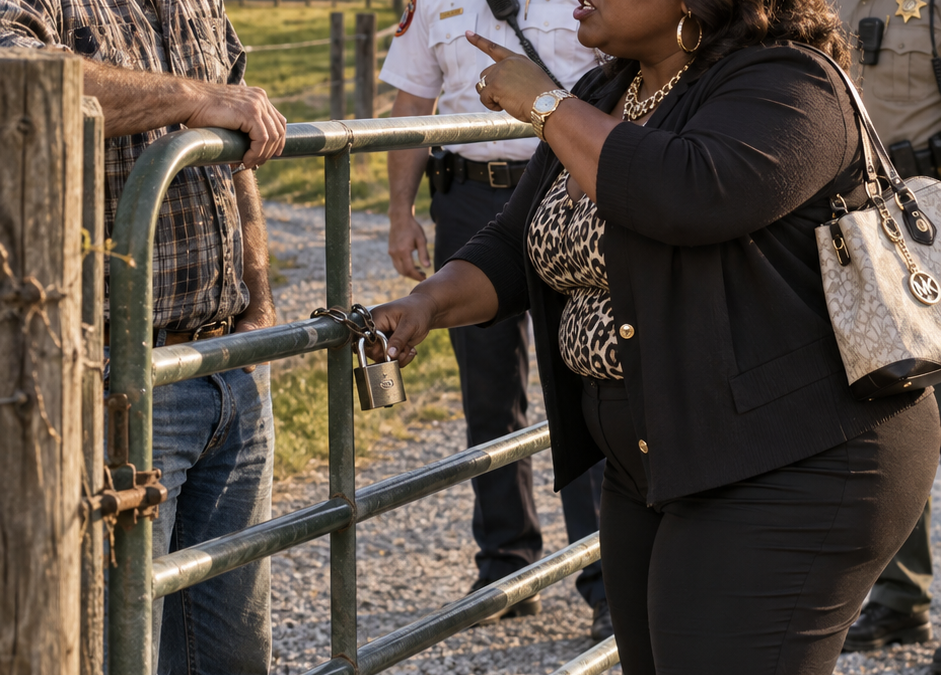
In its place hung a large hardened-steel lock.
Powder coated.
Small Willow Ridge crest on the face.
I stood with my own key in my hand, locked inside my own property.
There is a particular violation in that.
Not physical pain.
Something more intimate.
Someone had entered while I was away.
Removed my lock.
Installed theirs.
Then left me to discover that access to my own house was now apparently conditional.
My client expected me in sixteen minutes.
I called.
Moved the appointment to nine.
Then called Cynthia.
She arrived eleven minutes later.
White sedan.
Wool coat.
Travel mug.
Not surprised.
No apology.
“The security conversion was completed over the weekend.”
“You replaced my lock.”
“We upgraded corridor security.”
“My road.”
“Mr. Pike—”
“You locked me inside my property.”
“We secured an access point.”
“On my property.”
She looked almost tired.
“You keep returning to that phrase as though it resolves everything.”
Then she looked at my reflective work jacket.
The torn cuff.
My boots.
“Nolan, I understand you are accustomed to moving heavy equipment whenever and however you like. A residential community operates differently.”
There it was.
The hierarchy.
Not spoken crudely.
That would have been easier.
Delivered politely.
She was the president managing infrastructure.
I was the man with equipment who needed help understanding procedure.
For one second, I wanted to tell her everything.
Nineteen years inspecting roads.
Utility projects.
Approval conditions.
Emergency access.
Drainage.
Public construction.
I wanted to explain that I had rejected projects more expensive than every car in her parking lot combined because somebody missed four inches of subgrade.
I swallowed it.
Instead, I took out my phone.
“I am recording.”
She glanced at the screen.
I filmed the gate.
Lock.
HOA crest.
Replacement sign.
Then turned the camera toward her.
“Is it correct that Willow Ridge replaced the locking hardware on this gate?”
She looked directly into the lens.
“Absolutely.”
No hesitation.
“The board acted pursuant to its safety responsibility.”
Then she got into her car.
Drove through my property.
Left.
I walked to the shed.
Took down my bolt cutters.
Held them.
I could have opened the gate in thirty seconds.
I didn’t.
Because by afternoon, the story would become:
Angry farmer destroys HOA emergency hardware.
Cynthia would have photographs.
A contractor invoice.
A letter.
A broken lock.
I put the cutters back.
Then I drove out by the rough field track.
Twenty extra minutes.
Tires cutting into pasture I had reseeded.
I reached the client two minutes before nine.
When I got home, the recorder’s email was waiting.
Instrument 2008-4176.
Twenty-two pages.
Attached exhibits.
The first page named three parties.
Ward Trellis.
Willow Ridge Development Company.
And the County Fire Protection District.
That got my attention.
Then I read the phrase:
NON-EXCLUSIVE EMERGENCY APPARATUS ACCESS.
Non-exclusive.
Not ownership.
Not possession.
Not management.
Access.
For fire apparatus.
I exhaled for the first time in weeks.
Then my phone buzzed.
County emergency alert.
BRUSH FIRE — WEST OF WILLOW RIDGE ESTATES.
I stepped onto the porch.
A column of gray smoke was climbing beyond the western ridge.
Within minutes, gray became brown.
Then tan.
Wind leaned it toward Willow Ridge.
The back row of homes sat closest to the open ground.
Sirens rose from the highway.
I drove to the gate.
Cynthia was already there.
So was Trevor, a young employee from the management company.
Cynthia stood in the middle of Juniper Cut holding a clipboard.
A wildfire burning less than a thousand yards away.
Clipboard in hand.
Giving instructions.
I parked off the road.
Said nothing.
There wasn’t anything I could say that mattered more than what was about to happen.
The first engine turned off the highway.
Before it completely stopped, a captain stepped down.
He walked straight to the old black steel box on my post.
Ward’s box.
The one I had spent eleven years avoiding.
The captain inserted a key.
Opened it.
Removed a brass key on a ring.
Then walked to the gate.
He put the brass key against the Willow Ridge lock.
Stopped.
Wrong keyway.
He looked at the lock.
Then at the key.
Then back at the box.
I watched the problem arrive on his face.
Cynthia stepped forward.
“I am the HOA president. We have access authorization.”
“Key?”
She turned to Trevor.
Trevor took out his phone.
“I have the access information.”
The captain pointed at the gate.
“There is no keypad.”
Trevor scrolled faster.
“The new system is mechanical.”
“Where are the keys?”
“Management office.”
“How far?”
“Normally eleven minutes.”
The captain looked toward the smoke.
Traffic was already backing up because emergency vehicles were entering.
Cynthia said, “This is a temporary administrative gap.”
Four minutes.
That’s how long the delay lasted.
A little more, depending on where you start counting.
I will never exaggerate it.
No house burned because of those four minutes.
Nobody died.
The fire was eventually contained.
But stand beside a locked gate with smoke moving toward homes and four minutes becomes a physical thing.
Long enough for a second engine to arrive.
Long enough for another crew to start finding an alternate route.
Long enough for a command vehicle to pull in.
The man who stepped out wore a white helmet.
About fifty-eight.
Unhurried.
His name was Everett Sloan.
He walked to the gate.
Looked at the Willow Ridge lock.
Looked at the open fire department key box.
Looked at the useless brass key.
Then at the association sign on my post.
Then at me.
Then Cynthia.
Cynthia spoke first.
Of course she did.
“We recently upgraded this gate because the adjacent landowner has been creating ongoing access issues.”
Smooth.
Controlled.
A wildfire was burning behind her and she was still framing the meeting.
I said nothing.
Everett looked toward me.
“Who is the landowner?”
I raised one hand.
“I am.”
Cynthia interrupted.
“The road serves Willow Ridge.”
Everett didn’t acknowledge that.
He looked at the lock again.
Then asked:
“Who owns this access road?”
“I do.”
Cynthia gave a small sound.
“He disputes that.”
I almost laughed.
I wasn’t disputing anything.
I was answering.
I opened the deed and survey on my phone.
Held them out.
Everett took the phone.
Looked at the plat.
Maybe six seconds.
Handed it back.
“Who changed the lock?”
Cynthia answered immediately.
“The association did.”
There are moments when confidence becomes evidence.
That was one.
Everett looked at her.
“Who authorized the association to modify access hardware on a designated fire apparatus route?”
For the first time since September, Cynthia Vale had no sentence ready.
Nothing.
Behind us, crews were calling for hose.
A pump ran.
Smoke carried the smell of scorched wood.
Then Everett turned toward his crew.
“Remove it.”
Two firefighters brought a hydraulic cutter.
The HOA lock lasted less than a minute.
Metal snapped.
The gate swung open.
One engine.
Then another.
Then a command truck.
All of them rolling down Juniper Cut.
My gravel.
My ditch.
My bend.
The final engine clipped the elderberry bush I had been meaning to cut since August.
I stood beside the mangled HOA lock with an almost absurd sense of relief.
Everett returned before leaving.
He carried a small notebook.
“I need a few things.”
“Okay.”
“Your recorded deed.”
I gave him the recording reference.
“The emergency access agreement.”
“Instrument 2008-4176.”
“Association registered contact and management company.”
I gave him both.
“And who directed the lock replacement?”
I looked toward Cynthia.
“So far as I have been told, President Vale.”
Cynthia approached.
“This is an administrative misunderstanding.”
Everett wrote.
“I would be happy to provide clarification through counsel.”
“That will be fine.”
He wrote her name too.
He reached his command vehicle.
Then stopped.
Turned around.
“Mr. Pike.”
“Yes?”
“Do you know why Willow Ridge was allowed to build its third phase?”
“No.”
He looked down Juniper Cut.
Dust still floating where the engines had gone.
“You probably ought to find out.”
Then he drove toward the fire.
I went home.
Printed all twenty-two pages of instrument 2008-4176.
Then the attached approval conditions.
Spread everything across my kitchen table.
The next person I called was Grant Hollis.
Grant was sixty-one.
Land attorney.
Office above a hardware store in the county seat.
File cabinets from another geological era.
I had hired him once for a boundary issue.
He had billed forty minutes and solved the problem in twenty.
“Bring everything,” he said.
“What counts as everything?”
“Even the envelopes.”
That told me he had done this before.
We spent most of Thursday morning reading.
In 2008, Willow Ridge’s developer wanted approval for a third phase.
Around forty additional homes on the western side.
The fire district objected.
Too many homes.
Terrain constraints.
One primary route wasn’t enough.
The development needed secondary apparatus access.
There was only one practical route.
Juniper Cut.
Ward Trellis’s road.
So the developer negotiated with Ward.
Grant read the agreement aloud.
Title to the road remained with the owner of the burdened parcel at all times.
That meant Ward then.
Me now.
The agreement granted the fire protection district a non-exclusive right of emergency apparatus access.
Willow Ridge was identified as a beneficiary of continued emergency access.
Not an owner.
Not a possessor.
Not an operator.
Then Grant reached page nineteen.
“This.”
He tapped the paper.
Read the condition.
Any gate, barrier, or locking mechanism installed on the corridor had to remain compatible with the fire district’s approved access system.
No modification affecting the corridor or access hardware could occur without prior written consent from both:
The burdened property owner.
And the fire protection district.
Grant removed his glasses.
“Do you understand what she did?”
“Yes.”
But I needed to say it.
“She changed emergency access hardware on my land without my permission.”
“And without the district’s.”
“She had neither.”
“Correct.”
I looked at the document.
For months, I had thought this old emergency access agreement weakened me.
Every time Cynthia said emergency corridor, part of me wondered whether she had found the clause that gave Willow Ridge power over my road.
The truth was nearly the opposite.
That document was the reason forty homes existed.
Willow Ridge’s third phase had been approved because the county believed fire engines would always be able to use Juniper Cut.
And that reliability depended on two things.
The district’s access system.
And the private owner not interfering with it.
I had done neither.
I had maintained the road for eleven years.
Cynthia had changed the lock.
Grant leaned back.
“She didn’t strengthen the HOA’s position.”
He tapped the page.
“She documented interference with a required emergency route the association doesn’t own.”
He looked at me.
“And according to you, she admitted the lock replacement on video?”
“Looking straight at the camera.”
“Keep that file in three places.”
Then I asked the question bothering me.
“Why?”
Grant frowned.
“Why what?”
“Why start this now?”
Ward never got HOA violation letters.
I went nine years without one.
Then suddenly:
Fine.
Sign.
Contractor.
Lock.
Control.
Grant looked at the documents.
“Boards get petty.”
He shook his head.
“But they don’t usually get this expensive without a reason.”
“What do I look for?”
“Spring.”
“Why?”
“Find out what changed before she started needing this road.”
Four days later, at eleven at night, an email arrived from an address I didn’t recognize.
No greeting.
No explanation.
One line.
Ask what Cynthia told the insurance inspector in May.
At the bottom were two initials.
Then:
Please do not forward my name.
Attached was a PDF.
Six pages.
Insurance renewal questionnaire for Willow Ridge’s general liability policy.
Completed by Cynthia.
Most questions were ordinary.
Pool fencing.
Roof age.
Sidewalk inspections.
Maintenance.
Then page four.
EMERGENCY ACCESS AND EGRESS.
Question:
Does the association hold secured legal access for all designated secondary emergency routes?
Typed response:
WILLOW RIDGE HOMEOWNERS ASSOCIATION MAINTAINS EXCLUSIVE OPERATIONAL CONTROL OF THE JUNIPER CUT EMERGENCY ACCESS CORRIDOR.
I read it three times.
Exclusive operational control.
Not access rights.
Not shared responsibility.
Not coordination with a private owner.
Exclusive control.
The statement wasn’t true.
More importantly, it wasn’t accidentally vague.
It was precise.
And Cynthia had certified it.
Everything rearranged.
The violation letter.
The association sign.
The gate contractor.
The new lock.
She wasn’t merely trying to win a disagreement after September.
She had made a representation in May.
Then spent autumn trying to make reality conform to it.
If she could establish a pattern of HOA control, the statement would start looking less false.
Willow Ridge orders maintenance.
Willow Ridge posts signs.
Willow Ridge controls commercial entry.
Willow Ridge changes locks.
Willow Ridge decides who passes.
Then “exclusive operational control” becomes something she can point to.
The anonymous sender turned out to be Laurel Beck.
The woman who kept board minutes.
We met at a coffee shop two towns away.
Her idea.
She wore a raincoat.
Keys already in hand.
Looked like she might leave at any second.
“I believed her at first.”
“I think most people did.”
“When your HOA president says there’s a safety problem with an emergency corridor, you don’t pull deed records.”
“No.”
“You think she’s handling it.”
“What changed?”
“The minutes.”
In August, Cynthia had asked Laurel to revise a draft.
Original:
The board discussed maintenance concerns regarding the Juniper Cut corridor.
Cynthia’s requested replacement:
The board reaffirmed its continued longstanding operational control of the Juniper Cut corridor.
“Did the board reaffirm that?”
“No.”
“Was there any vote?”
“No.”
“Any discussion using those words?”
“No.”
Laurel looked ashamed.
“I changed it.”
“Why?”
“She told me the first draft wasn’t precise enough.”
“But you kept the original.”
She nodded.
“I keep everything.”
That made me like her immediately.
Then Laurel explained May.
The insurance carrier had increased the renewal premium and listed deficiencies.
One concerned uncertainty surrounding the secondary emergency route.
Cynthia told the board she would answer the carrier personally.
Nobody reviewed her completed response afterward.
Not until Everett Sloan started asking who owned Juniper Cut.
Then Laurel went looking.
The whole machinery became visible.
Insurance carrier asks difficult question.
HOA president doesn’t want to tell one hundred eighty homeowners that part of their emergency access depends on private land owned by a man outside the HOA.
Maybe the insurer raises rates.
Maybe demands a rider.
Maybe asks for annual documentation.
Maybe homeowners start asking why.
So Cynthia writes the cleanest answer.
Exclusive operational control.
Once written and certified, that sentence becomes dangerous.
She can correct it.
Or try to make it true.
She chose the second.
The September violation wasn’t about my tractor.
It created documentation of regulatory authority.
The replacement sign wasn’t just decoration.
It put Willow Ridge’s name physically on Juniper Cut.
The contractor measurement wasn’t simple security work.
It established association control over the gate.
And the HOA padlock was the final piece.
If the association controlled the lock, it controlled entry.
She had almost made the sentence true.
Then the fire started.
Everett Sloan called me the following Wednesday.
His tone was careful.
Official.
“The gate matter has been referred to the fire marshal.”
“All right.”
“The district is reviewing the corridor file, 2008 approval conditions, and third-phase documentation.”
I wrote what he said next in my notebook.
“What interests me is not your dispute with the homeowners association.”
I waited.
“What interests me is that a mapped apparatus-access route had its hardware changed by a party that does not own it, and the district was not notified. We had a known access condition. Somebody changed that condition without authorization.”
That was the moment Cynthia lost the ability to call this a neighbor dispute.
I wasn’t the issue anymore.
Neither was my tractor.
A required fire route serving forty homes had been modified without authorization.
Ten days after the fire, a law-firm envelope arrived.
Heavy stock.
Three names across the top.
It demanded that I not interfere with the emergency corridor.
Not alter the gate.
Not obstruct association access.
It warned of liability if emergency response were impaired.
I read it twice.
Then took it to Grant.
He wrote one page.
Nothing emotional.
He asked Willow Ridge’s attorneys to provide:
Any recorded document proving the association held ownership or possessory interest in Juniper Cut.
And the fire district’s written approval authorizing Willow Ridge’s modification of the gate hardware, as required by instrument 2008-4176.
Upon receipt of both, his client would reconsider.
There was no first document.
There was no second.
The second absence was worse.
Nineteen days later, their law firm responded.
Three sentences.
No documents.
Three days after that, Willow Ridge received a county notice.
NOTICE OF FIRE ACCESS DEFICIENCY.
Within a week, practically everyone in the neighborhood knew.
The next association meeting overflowed.
Seventy people, maybe more.
Some standing against walls.
I wore a clean shirt.
Brought a folder.
Sat in the second row.
Grant had given me one instruction.
“Don’t perform.”
“What?”
“Let the paperwork perform.”
Cynthia opened the meeting.
Calm.
Composed.
She described the controversy as an adjacent landowner exploiting a fire incident to pursue a personal grievance.
Someone in the back called out.
“Is this about the road?”
Cynthia said counsel was reviewing it.
Then tried moving to landscaping bids.
Laurel spoke from the end of the board table.
“The fire marshal’s notice should be read into the record first.”
Cynthia looked toward her.
“It is routine administrative correspondence.”
“It was addressed to the board.”
“The matter is being handled.”
“The board hasn’t seen it.”
Silence.
Three seconds.
Maybe four.
Dale Pettigrew picked up the notice.
Started reading.
His voice shook at first.
Then steadied.
Restore the approved emergency access method within fifteen days.
Do not install, alter, or remove access hardware without written consent from both the underlying property owner and fire protection district.
Produce records identifying the party who authorized the gate modification.
Submit an updated third-phase emergency access plan for district review.
Dale finished.
Put the paper down.
A woman near the aisle spoke without being recognized.
“Does Willow Ridge own that road or not?”
Cynthia answered.
“Ownership in that corridor is complicated.”
I stood.
Nobody told me to sit down this time.
“No.”
I placed my deed on the table.
“That part isn’t complicated.”
Recorded deed.
Legal description.
My name.
Survey.
Juniper Cut entirely inside my property.
More than sixty feet from Willow Ridge’s boundary at the closest point.
Then instrument 2008-4176.
Page nineteen flagged.
Consent provision underlined.
Photograph of their sign on my post.
Contractor work order.
Management company invoice.
Finally, my phone.
I placed it on the table.
Played eleven seconds.
My voice:
“Is it correct that the association replaced the lock on this gate?”
Cynthia on video:
“Absolutely.”
The room stayed quiet after the clip ended.
Cynthia finally spoke.
“This is a technical legal game.”
Nobody moved.
“Mr. Pike has been hostile toward the community from the beginning. A man who leaves agricultural machinery visible from residential areas is hardly the ideal custodian of critical safety infrastructure.”
Every sentence I had swallowed since August rose at once.
I used none.
I looked at her.
“You put a lock on my gate, Cynthia.”
She stared back.
“All I did was read the document that says whose land the gate sits on.”
Then Laurel spoke.
No drama.
No speech.
“In August, President Vale directed me to revise meeting minutes to state that the board had reaffirmed longstanding operational control of Juniper Cut.”
Several board members turned.
“That statement did not reflect what occurred in the meeting.”
Cynthia went still.
Laurel turned her laptop.
“I retained the original draft.”
Two versions.
Side by side.
Dates.
Metadata.
I watched the board’s attention leave me.
Until that moment, their worst possible interpretation was overreach.
A president got aggressive.
Misunderstood a boundary.
Changed a lock.
Now there was a pattern.
Insurance statement.
Revised minutes.
Association signage.
Compliance letters.
Contractor order.
Padlock.
Each dated.
Each moving in the same direction.
A board member asked the association attorney a question.
“If Mr. Pike owns Juniper Cut, can he close it to residents?”
The attorney paused.
“As a convenience route?”
“Yes.”
“Very likely.”
The room stirred.
“What about emergency access?”
“No.”
He glanced toward me.
“The fire district’s right is protected by the 2008 agreement.”
That was what the document had said all along.
I could stop ordinary subdivision traffic.
I could not stop emergency apparatus.
Cynthia said nothing.
That night, for the first time, I considered doing exactly that.
Closing Juniper Cut to every Willow Ridge resident.
Legally, I had a strong argument.
Forty homes would still have emergency access.
But people using the road to shorten their drive to the highway would need to go around.
Part of me wanted that.
Not forever.
Maybe just long enough for everyone to understand.
Then I sat on my porch.
Thought about the woman who had quietly asked whether the road was really mine.
About Dale reading the fire notice out loud.
About Laurel keeping an original draft before she knew it would matter.
About one hundred eighty households.
Cynthia was one person.
Punishing all of them to punish her would make me exactly the man she had spent months describing.
So Grant and I wrote a proposal.
Eight points.
Fire district retains unrestricted emergency apparatus access forever under the existing recorded agreement.
District-approved key box.
District-compatible lock.
Inspected by the fire district.
No future gate modification without written consent from both me and the district.
No general resident shortcut through my pasture.
Willow Ridge removes all HOA signage from my property.
Association pays restoration costs for the gate conversion.
All violation notices against me withdrawn.
Retroactive road assessment voided.
Formal written acknowledgment that my parcel is outside HOA jurisdiction.
Future issues concerning the emergency corridor come directly to me in writing.
That was my revenge.
Two pages.
Grant looked at the draft.
“This is the least vindictive settlement demand I’ve written in thirty years.”
“Good.”
“That’s why they’ll accept it.”
Cynthia resisted anyway.
At the special board session, she said I was exploiting an administrative mistake to make myself important.
That sentence finally deserved an answer I had rehearsed.
“No, Cynthia.”
The room quieted.
“I just want you to stop behaving as though I need your permission to drive home.”
For one second, something moved across her face.
Not anger.
Recognition.
The room no longer belonged to her.
She had built the entire strategy around an assumption.
Eventually I would tire.
Or become embarrassed.
Or run out of money.
Or receive enough formal-looking letters to stop asking questions.
Because men with dump trailers don’t usually hire land attorneys.
Because men in torn reflective jackets don’t usually read recorded approval conditions.
Because the man shoveling gravel must be the help.
She had never considered that reading documents had once been part of my job.
The board went into closed session.
Fifty minutes.
When they returned, four motions came up.
Withdraw all HOA violation notices issued to Nolan Pike.
Void the retroactive assessment.
Unanimous.
Accept the proposed emergency-access terms.
Unanimous.
Reimburse gate-restoration costs and my recording and legal expenses.
Passed with one abstention.
Open formal review of the president’s conduct concerning statements made to the association’s insurer and representations regarding Juniper Cut.
Passed.
Cynthia recused herself.
Perfectly.
Procedurally.
Even at the end, she knew Robert’s Rules better than anybody else in the room.
Then came one final motion.
Cynthia Vale would no longer represent Willow Ridge in any matter concerning Juniper Cut.
She sat in the same chair where months earlier she had told me I wasn’t allowed to speak while the board discussed my property.
Now her own neighbors decided she could no longer speak for them about it.
No shouting.
No applause.
The chair thanked everyone.
Meeting adjourned.
I walked outside carrying my folder.
My ears were ringing slightly from the adrenaline.
Everett Sloan was leaning against a fire district pickup.
Off duty.
Fleece jacket.
Hands in pockets.
“I thought you’d be gone.”
“Wanted to catch you.”
“Problem?”
“No.”
I braced anyway.
He looked toward the dark line of Juniper Cut.
“If she hadn’t changed that lock, nobody would have opened this file for another twenty years.”
“What do you mean?”
“The third phase conditions were approved in 2008.”
He nodded toward the road.
“We had a key in a box. Every time somebody checked, access worked.”
“Not often.”
“Not often enough.”
He shrugged.
“Plan said secondary access. Box said route was functional. Road stayed passable. Nobody had a reason to trace ownership.”
I thought about that.
Then he looked at me.
“You were the reason it worked.”
“What?”
“You maintained it.”
“It’s my road.”
“Exactly.”
He smiled faintly.
“Forty houses depended on a condition of approval crossing your property, and nobody in the district knew your name.”
That bothered me in a strange way.
For eleven years, I had spread gravel.
Cleared ditches.
Removed limbs.
Rebuilt culverts.
Not as a favor to Willow Ridge.
Because Juniper Cut was mine.
But by maintaining my road, I had quietly maintained emergency access for forty households I’d never met.
And nobody had thought about it because the arrangement worked.
Cynthia didn’t discover a broken system.
She broke a working one.
Then her attempt to seize control made everyone finally examine why the system had worked at all.
If she had done nothing, Willow Ridge would have kept everything.
Emergency access.
Free road maintenance.
No annual contribution.
No dispute.
No county review.
No insurance correction.
No legal fees.
No angry meetings.
Nothing.
Her problem was not that Juniper Cut failed.
Her problem was that it worked without depending on her.
Three weeks before a recall vote scheduled for February, Cynthia resigned.
Two paragraphs.
Personal commitments.
Family demands.
The board thanked her for four years of service.
I thought that was appropriate.
I never needed public humiliation.
There was no prosecution.
No dramatic lawsuit.
Nobody lost a house.
Willow Ridge corrected the insurance filing.
Corrected its emergency-access description with the county.
Their insurance renewal came back more expensive.
There was a rider requiring documented secondary-access compliance.
Residents paid about eleven dollars more per month.
That part didn’t make me happy.
They hadn’t written Cynthia’s answer.
But consequences rarely land only on the person who created them.
In March, a young man from the management company came to remove the Willow Ridge sign from my post.
He used a socket wrench.
Carefully kept the aluminum from scratching the wood.
“Want the bolts?”
“Yes.”
He handed them over.
I put up a new sign.
Simple.
Green background.
White letters.
JUNIPER CUT ROAD
PRIVATE PROPERTY
EMERGENCY ACCESS AUTHORIZED
No HOA crest.
No hostility.
Just truth.
Next to it, the fire district installed a new red key box.
Their hardware.
Their lock.
Their key.
A captain tested everything while I watched.
Open box.
Key out.
Lock open.
Gate swings.
Gate closes.
Lock seated.
Key returned.
Done.
The old black box came off after twelve years.
Four rusty circles remained in the post where the bolts had been.
I left them.
Something about those marks felt honest.
I never wanted the road closed.
I wanted the sign to tell the truth.
Spring arrived.
I reseeded the field track I’d torn up driving around Cynthia’s lock.
Brought eleven tons of rock into the low section of Juniper Cut.
Trimmed the elderberry the fire engine had clipped.
The culvert behaved better than usual.
No Willow Ridge cars cut through the pasture.
No green-crested envelopes appeared in my mailbox.
Eventually, a new HOA president wrote.
His name was Otis Marlow.
Retired shop teacher.
His letter thanked me for cooperating on the access agreement.
Then he asked whether Willow Ridge could contribute money toward annual gravel.
No condition.
No new right.
No control.
Just contribute.
My first response was:
No, thank you.
I mailed it.
Then thought about it for two weeks.
Sent another letter.
Actually, yes. Half.
They’ve paid half every spring since.
No fight.
No ownership claim.
No compliance notice.
They send a check.
I send a receipt.
A functioning relationship is astonishingly boring.
I saw Cynthia once the following fall.
Hardware store beneath Grant’s office.
She had paint samples.
I was buying chain.
We saw each other.
Neither spoke.
I expected vindication to feel bigger.
For almost a year, part of me had imagined the moment Cynthia finally saw me as someone she had underestimated.
When the moment arrived, I didn’t need it.
The person I had really needed to convince was myself.
The version of me standing at the kitchen counter in September holding that first violation letter.
The man who, for maybe thirty seconds, had considered paying four hundred eighty dollars simply because official-looking paper makes decent people wonder whether resistance is worth the trouble.
That man needed to learn the lesson.
Not Cynthia.
Nearly a year after the fire, Everett Sloan came up Juniper Cut for a routine access verification.
Cold October morning.
Frost along the shoulder.
He parked near the gate.
Walked to the red box.
Opened it.
Removed the district key.
Inserted it into the approved lock.
Gate opened.
He swung it fully.
Closed it.
Locked it.
Returned the key.
Closed the box.
Eleven seconds.
He stood looking down the road.
“This is all it was ever supposed to be.”
I stood beside him.
Looked too.
My gravel.
My culvert.
The bend around the hill.
The tree line where Willow Ridge began.
For a long time, I thought Cynthia wanted my gate.
That wasn’t quite right.
The gate was only useful because it represented something more important.
The ability to decide who needed permission.
That was what she wanted.
Standing.
Authority.
The right to make me ask.
Everything else could have been solved with one conversation.
She could have called.
“Nolan, our emergency-access records are messy. Can we review the agreement?”
I would have opened the fireproof box.
Found the instrument reference.
Ordered the document.
Probably discovered the same thing without ever meeting a lawyer.
The district would still have access.
Willow Ridge would still have its third phase.
I would still own the road.
Maybe we would have agreed on gravel sharing years earlier.
Instead, she needed the record to show something else.
Compliance notice.
Association sign.
Revised minutes.
Work order.
Padlock.
Each step was designed to produce evidence that the HOA exercised control.
And each step produced evidence of something else instead.
That they didn’t.
I eventually learned why Ward had never made a larger point of the 2008 agreement.
A few months after everything settled, I found his daughter through an old closing document.
Ward was in assisted living by then.
I called.
Asked if he remembered signing it.
His daughter put him on speakerphone.
“Oh, sure.”
“You never mentioned how important it was.”
“It lets the fire trucks through.”
“Yes.”
“That important enough?”
I laughed.
“Did you know it was tied to Willow Ridge’s third phase approval?”
“Developer told me something like that.”
“Why agree?”
There was a long pause.
Then he said, “Because if somebody’s house is burning, Nolan, I don’t care whose road the truck uses.”
That was Ward.
Three years of legal consequence reduced to one sentence.
“Did the HOA ever try controlling the road?”
“No.”
“Did they use it?”
“Sometimes.”
“Did you care?”
“Not unless they were stupid about it.”
I leaned back in my chair.
“What’s stupid?”
“Acting like something’s yours because somebody was nice enough not to stop you.”
I wrote that down afterward.
It explained more than any attorney had.
Access and ownership are different.
Permission and possession are different.
Responsibility and authority are different.
Willow Ridge had a genuine interest in Juniper Cut.
Forty homes needed it for emergency response.
That interest mattered.
But importance does not manufacture ownership.
The association didn’t need to own my road for the emergency plan to work.
It only needed me to honor the agreement.
I had.
For eleven years.
Cynthia looked at that arrangement and saw weakness.
Something informal.
Something she could improve by placing it under association control.
She never recognized that the absence of control was part of the design.
The road remained private.
The fire district held access rights.
Both facts were supposed to coexist.
The agreement had been written that way intentionally.
I came away from the whole fight with a strange respect for old documents.
Not because paper is magical.
Paper can lie.
Cynthia proved that.
Minutes can be revised.
Insurance questionnaires can contain false statements.
Association signs can announce rights that don’t exist.
What matters is how documents connect to authority.
A recorded deed signed by the people who actually owned the land.
A fire-access agreement identifying the parties.
An approval condition specifying consent.
A survey putting boundaries on the ground.
Those documents had roots.
Cynthia’s paperwork had letterhead.
There is a difference.
I also learned something about titles.
HOA president.
Inspector.
Attorney.
Fire chief.
Landowner.
Contractor.
Those titles can matter.
But each comes with limits.
When I worked as an inspector, I couldn’t redesign a contractor’s project because I disliked it.
I could enforce the approved plan.
Grant couldn’t move my boundary because he was an attorney.
He could explain the law.
Everett couldn’t give Willow Ridge ownership.
He could enforce fire-access requirements.
And I couldn’t use my deed to block emergency apparatus rights I had purchased the land subject to.
Owning the road didn’t make me king of Juniper Cut.
It made me owner subject to a recorded obligation.
That’s less dramatic.
More accurate.
And accuracy turned out to be enough.
Willow Ridge eventually stopped treating me like an extension of its common area.
Most residents never had any argument with me.
A few even apologized.
One older man came up while I was spreading gravel one Saturday.
“I’ve used this road for years.”
“I know.”
“Never knew it was yours.”
“Most people didn’t.”
“Should I not use it now?”
“As a shortcut? No.”
He nodded.
“Fair enough.”
Then he looked at the dump trailer.
“You need another set of hands?”
I let him help for two hours.
We never discussed Cynthia.
That became the normal relationship.
Clear boundary.
Normal neighbor.
No drama.
The fire district checks the key box periodically.
The association contributes half the gravel cost.
I maintain Juniper Cut because it remains my road.
Nobody sends me paint standards.
Nobody asks me to hide my tractor.
The gate has my lock and the district-compatible access system specified in the agreement.
The arrangement finally looks like the document that created it.
Sometimes I think back to the fire.
Not because the flames came especially close.
They didn’t, in the end.
Crews contained it before it became a major structural event.
I remember the gate.
The captain holding the wrong key.
The tiny black box hanging open.
Cynthia explaining there had been an “administrative gap.”
Four minutes.
Four minutes was enough to expose months of manufactured authority.
That is the irony Cynthia never escaped.
She kept describing herself as the person protecting community safety.
But the first time the emergency route was actually needed during an emergency, her intervention was the only thing stopping it from working exactly as designed.
Before her lock:
Fire department box.
Correct key.
Private gate.
Maintained road.
Working system.
After her “security upgrade”:
Wrong key.
No district approval.
No owner approval.
Delay.
Sometimes improvement is just interference wearing a professional name.
Cynthia once told me a man like me should understand how a community operates.
I do understand it better now.
Communities work because different rights overlap without swallowing each other.
A homeowner owns a lot.
The utility owns infrastructure beneath an easement.
The county controls its road.
The fire district holds emergency rights.
An HOA governs property actually subject to its declaration.
My pasture doesn’t become association property because association residents benefit from something crossing it.
Their need doesn’t erase my title.
My title doesn’t erase their legitimate emergency easement.
Both can be true.
That’s the part Cynthia never accepted.
She thought somebody had to dominate the arrangement.
If she didn’t control Juniper Cut, then she believed Willow Ridge was vulnerable.
So she tried to control it.
And that attempt created the vulnerability.
The road has been quiet for years now.
No Willow Ridge shortcut traffic.
Emergency access only.
Occasional district inspection.
My own truck.
Tractor.
Deliveries.
The things that actually belong there.
The road still washes at the low spot after hard rain.
Elderberry still grows faster than seems reasonable.
The culvert still waits until I have somewhere else to be before collecting debris.
Nothing about ownership made maintenance romantic.
Every spring I order stone and wonder whether gravel has become a precious metal.
But sometimes when I’m grading Juniper Cut, I look toward the new red fire box.
Then at the rust circles underneath it.
Old hardware.
New hardware.
Same road.
Those marks remind me how little had to change once everyone stopped pretending ownership was negotiable.
Near the gate, the sign Ward used to have has been restored almost exactly.
JUNIPER CUT ROAD.
PRIVATE PROPERTY.
EMERGENCY ACCESS AUTHORIZED.
Three lines.
No accusation.
No HOA name.
No claim of exclusivity.
Nobody needs a twenty-two-page instrument to understand the sign.
But the twenty-two-page instrument is still in my fireproof box.
So is Cynthia’s violation notice.
The contractor’s work order.
Photographs.
Her recorded admission.
The insurance questionnaire.
Laurel’s two versions of the meeting minutes.
Grant once asked why I kept everything after the dispute ended.
“Habit.”
He laughed.
“Inspector habit?”
“Something like that.”
But it is more than habit.
My father died before any of this happened.
His truck is the one still missing the tailgate.
He spent his life doing mechanical work and could distrust official paper with an almost artistic intensity.
Yet he kept every deed he ever received.
Every receipt tied to property.
Every vehicle title.
When I asked why once, he said, “Because paper is useless until the day it isn’t.”
That is Juniper Cut in one sentence.
For eleven years, instrument 2008-4176 was almost useless to me.
A reference in a title file.
A key sitting in a black steel box.
Then someone replaced one padlock.
Suddenly twenty-two pages written years earlier mattered more than every HOA notice Cynthia could print.
I do not think Cynthia was evil.
I know that disappoints people who like clean endings.
She wasn’t stupid either.
She was competent.
Organized.
Confident.
Very good at making decisions.
Her failure was narrower.
She could not tolerate uncertainty in her own authority.
When the insurance company asked whether Willow Ridge controlled Juniper Cut, the truthful answer was awkward.
“No. The route crosses private land under a recorded emergency-access agreement controlled in part by the fire district and requiring coordination with the owner.”
That answer would have created questions.
So she wrote the cleaner one.
Exclusive operational control.
From then on, reality had to be forced into shape around her answer.
That was the beginning.
Not the gate.
Not my tractor.
Not the sign.
One sentence written because the truth felt administratively inconvenient.
Everything afterward was maintenance on that sentence.
She was willing to put an HOA sign on someone else’s post.
Issue rules to a nonmember.
Rewrite meeting minutes.
Hire contractors.
Replace locks.
Because admitting the first sentence was wrong became more painful than making the next action worse.
That is how small authority problems grow.
Not usually through one giant act.
Through a sequence of smaller decisions designed to protect the last one.
I sometimes wonder what would have happened without the fire.
Maybe Grant was right.
Maybe the fight would eventually have reached court.
Maybe the board would have uncovered the insurance issue anyway.
Maybe I would have cut the lock after the next letter and given Cynthia exactly the photograph she wanted.
Or maybe the association would have slowly built enough internal paperwork that a future board genuinely believed it owned the corridor.
The fire forced the right person to ask the right question early.
Who owns this access road?
Not who uses it.
Not who benefits.
Not who thinks they should control it.
Who owns it?
Once that question entered the conversation, every other document had to organize itself around the answer.
Me.
Subject to the recorded emergency access.
That was the legal reality before Cynthia.
During Cynthia.
After Cynthia.
The road never moved.
Only the story did.
One October morning, Everett completed another access check.
Same routine.
Box.
Key.
Lock.
Gate.
Eleven seconds.
He handed me the key briefly while he wrote down the test time.
I looked at the little piece of brass.
“So this is what started everything.”
“No.”
He shook his head.
“This is what was working before everybody started helping.”
I laughed.
He took the key.
Returned it to the box.
Then drove away.
I stayed by the gate.
Frost covered the ditch grass.
The Willow Ridge roofs were just visible through bare trees.
Juniper Cut stretched down through my pasture exactly where it had when Ward walked it with me eleven years earlier.
Same land.
Same bend.
Same road.
I closed the gate.
Turned the approved lock until it seated.
Put my own key back into my pocket.
Then walked toward the truck.
Cynthia Vale once told me a man like me needed to learn how a community worked.
In the end, Willow Ridge learned something much simpler.
A right to cross my land was never a right to own it.
And no amount of letterhead could make my gate theirs.








