𝗙𝗨𝗟𝗟 𝗦𝗧𝗢𝗥𝗬 The HOA President Never Asked Why My Family Had Kept Redwood Spur Open for Forty Years
𝗣𝗔𝗥𝗧 𝟮
The board sent my father a Christmas card every year.
After he died, they sent one to me.
It wasn’t friendship.
It was courtesy supported by institutional memory.
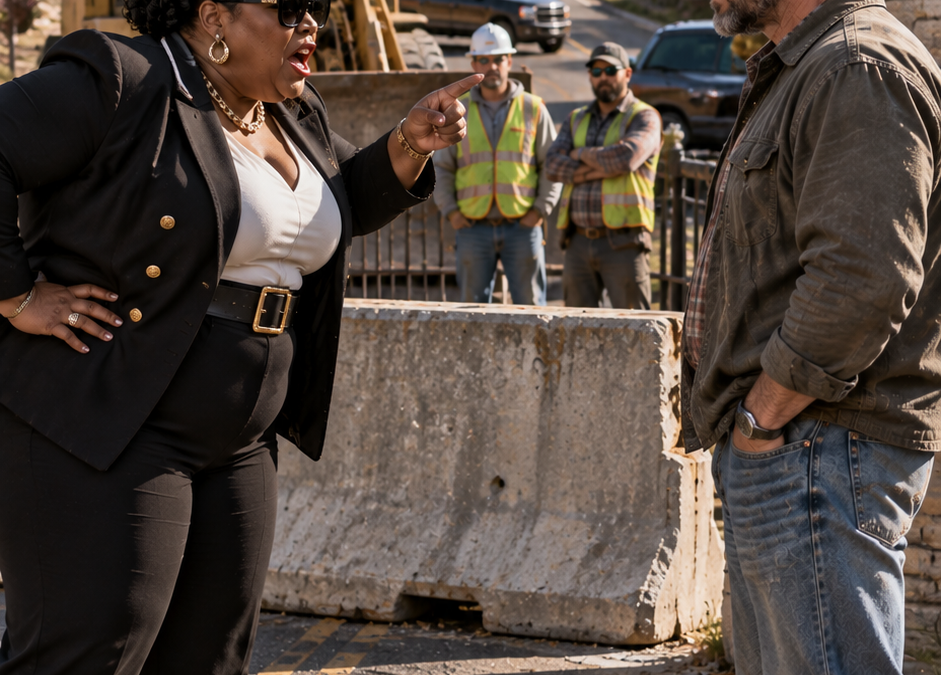
Then Vanessa Halbrook became HOA president.
She was forty-five.
Always immaculate.
Tailored jackets.
Perfect hair.
Clipboard tucked beneath one arm.
She spoke in short, clipped sentences that sounded less like conversation than decisions being announced.
Her campaign phrase had been “Cleaning Up Stonebridge.”
Within a month, homeowners were receiving letters about mailbox colors.
Trash cans.
Garage doors.
Pickup trucks.
House numbers.
Landscaping.
Within three months, two families had sold and left.
None of that directly concerned me.
My parcel was outside Stonebridge Ridge.
I paid no dues.
Received no services.
Was not listed anywhere in the declaration.
My deed predated the subdivision.
I wasn’t a difficult HOA member.
I wasn’t an HOA member at all.
For some reason, that seemed to bother Vanessa more than anything else about me.
The first letter arrived in a cream envelope.
Stonebridge Ridge HOA letterhead.
My name spelled correctly.
My address described as a lot number that didn’t exist.
The association ordered me to repaint my mailbox in one of three approved colors.
Move my enclosed utility trailer.
Remove two mature oak trees near Redwood Spur.
And submit my fence repairs for architectural approval.
At the bottom was a deadline.
Below that, a fine schedule.
I read the whole thing at my kitchen table.
Then I wrote one sentence.
My property is not governed by Stonebridge Ridge Homeowners Association.
I printed it.
Signed it.
Sent it certified.
Then I placed the receipt in a folder.
That may sound overly formal for a mailbox argument.
Nineteen years in construction disputes teaches you something else.
Start the record before the other side realizes there will be one.
Four days later, a silver sedan pulled into my driveway.
Vanessa stepped out.
She had the clipboard with her but never looked at it.
Instead, she inspected my house.
Roof.
Trailer.
Porch.
Fence.
Then me.
She made sure I noticed.
“You may technically be outside Stonebridge, Calvin.”
She emphasized technically.
“But everyone entering our community has to look at this property.”
She said property like she meant stain.
Behind her, a landscaping crew was cleaning the curb along Redwood Spur.
That road existed because my father had signed one piece of paper decades earlier.
“Then tell them to keep their eyes on the road.”
I wasn’t loud.
I wasn’t rude.
I simply answered.
Vanessa’s expression changed.
There is a particular moment when someone accustomed to compliance discovers the person in front of them doesn’t require their approval.
Some people process that as information.
Vanessa processed it as disrespect.
She tapped the clipboard against her leg.
Twice.
Then turned toward her car.
At the driver’s door, she looked over the roof at me.
“Everybody around here eventually learns who controls access.”
Then she drove away.
Her tires traveled over nine hundred feet of my family’s land before reaching Stonebridge.
I watched her go.
Of every word she could have chosen, she had picked the one word that should have worried her most.
Access.
The next phase was slower.
More deliberate.
Vanessa stopped arguing openly that my land belonged to Stonebridge.
Instead, she began creating the appearance that the association already controlled it.
That’s a common way property disputes evolve.
Not through one dramatic deed.
Through small physical facts.
A sign.
A camera.
A maintenance truck.
A fence.
A gate.
Twenty little things appear on the ground until somebody looks ridiculous for producing paperwork saying they shouldn’t exist.
I’d watched developers do it to farmers.
Municipalities do it to churches.
Now it was happening outside my kitchen window.
So I photographed everything.
The first move was a landscaping truck.
Stonebridge’s contractor started parking a white flatbed across the mouth of my driveway.
Not completely blocking it.
Just enough to make backing my pickup out difficult.
I asked the driver to move ten feet.
He apologized but told me the property manager had assigned that staging area.
I called the property manager.
Grant Holloway.
Soft-spoken.
Middle-aged.
Always seemed slightly exhausted.
“The shoulder is association right-of-way,” he explained.
“According to what?”
Silence.
“What document gives the association that right-of-way?”
Another pause.
“I’ll have to look.”
“Please do.”
Two weeks later, a sign appeared.
Green metal.
Professionally fabricated.
Set in fresh concrete about forty feet inside my property line.
PRIVATE ROAD
STONEBRIDGE RIDGE HOA
NO THROUGH TRAFFIC
Below it was a smaller towing notice.
I stood beside that sign with coffee in my hand for several minutes.
Then I smiled.
It was almost generous.
A sign is a claim made physical.
People can later deny conversations.
They can claim emails were misunderstood.
They can forget who said what.
A professionally installed sign sitting in concrete on somebody else’s property is harder to forget.
I photographed it.
Property marker visible.
Date stamp on.
Wide shot.
Close shot.
Footing.
Road.
Mailbox.
Then came a camera.
Gray weatherproof housing mounted on the streetlight at the bend.
It wasn’t pointed toward Stonebridge’s monument.
It wasn’t pointed toward the mailboxes.
It was aimed down Redwood Spur directly toward my driveway, my gate, and the two oak trees Vanessa had ordered me to remove.
I called Grant.
“It’s for community security.”
“Is the pole HOA property?”
“Yes.”
“Is the area it’s recording HOA property?”
Silence.
“I’d have to check.”
“Please do.”
That was the third time I’d asked him a question he couldn’t answer.
By then, I suspected Grant had started keeping notes of his own.
I sent one email to the entire board.
Copied their attorney.
I requested removal of the sign.
Reorientation of the camera.
And identification of the recorded instrument under which Stonebridge claimed ownership or regulatory control over the roadway crossing parcel 7B.
I was careful.
I did not threaten to close the road.
I did not tell residents they couldn’t use it.
They could.
I knew that better than Vanessa did.
I asked only that the association stop claiming ownership it didn’t possess.
I gave them fourteen days.
Vanessa responded within an hour.
Not through the attorney.
From her personal account.
“Stonebridge has maintained that road for years. You don’t get to suddenly pretend it belongs to you.”
I read the sentence three times.
It interested me because she was answering an accusation I hadn’t made.
I wasn’t trying to take residents’ access away.
I was telling her access wasn’t ownership.
But Vanessa seemed unable to imagine a property right that wasn’t control.
To her, if Stonebridge used the road, Stonebridge must own the road.
And if Stonebridge owned the road, she controlled it.
That mistake would eventually put more than two hundred homes behind six pieces of concrete.
The quarterly HOA meeting came the following Tuesday.
I attended during public comment.
About seventy residents sat in folding chairs.
Six board members faced them from a long table.
An agenda was projected onto the wall.
A plate of supermarket cookies sat untouched beside the coffee urn.
When my name came up, Vanessa looked at the timer.
“Three minutes.”
I stood.
“I own parcel 7B at the east entrance. A permanent HOA sign has been installed inside my property boundary. An association camera has been positioned toward my residence. A contractor has been staging across my driveway. The recorded instrument governing Redwood Spur gives Stonebridge maintenance and access rights. It does not transfer ownership or general control.”
Vanessa stared at me.
“I have no intention of interfering with any resident’s right to come or go,” I continued. “I’m asking this board to review its own recorded documents before taking further action.”
I mentioned parcel 7B.
Vanessa interrupted.
“Calvin, this is a homeowners association meeting, not one of your little construction arguments.”
A few people laughed.
Not maliciously.
Nervously.
That reflex people have when the person with the microphone makes the joke.
Vanessa smiled.
Then added, “Maybe leave property law to people who actually understand it.”
My timer still showed eleven seconds.
I could have answered.
There were several answers I would have enjoyed.
I chose none of them.
Instead, I reached into my folder.
Removed certified copies.
Walked forward.
Placed them directly in front of the board.
County recorder stamp visible.
“Then I assume your attorney has already reviewed parcel 7B.”
That ended my three minutes.
Vanessa’s mouth kept the same smile.
Her eyes didn’t.
For one second, the room became very quiet.
Then she straightened her stack of papers.
“We’re done here. Next item.”
I returned to my seat.
The meeting moved on to pool furniture.
But before leaving, I looked back.
The association attorney, Elliot Crane, had pulled my documents toward himself.
Elliot was in his sixties.
Tired face.
Gray hair.
The expression of a man who had spent too much of his career reading contracts written by people who believed punctuation was optional.
He was staring at the first page.
He wasn’t laughing.
Three days later, I received a certified letter from his firm.
Four pages.
The letter accused me of interfering with residents’ access.
Creating an unsafe condition.
Placing materials near the easement.
None of the allegations included dates or measurements.
Then came the real purpose.
I had seventy-two hours to sign an attached acknowledgement stating that Stonebridge Ridge HOA possessed the right to control, manage, gate, and regulate Redwood Spur across parcel 7B.
If I refused, the association would take “corrective action to secure community ingress and egress.”
I sat at my kitchen table while evening sunlight turned orange across the floor.
Read the final sentence once.
Again.
Then a third time.
Something in me became very still.
Until then, I’d been worried about a lawsuit.
A quiet-title action.
Years of legal fees.
Depositions.
Competing surveyors.
A judge eventually deciding something neither side liked.
Instead, Vanessa had put in writing that she intended physical action against the road.
Before a court ruling.
Before a permit.
Before anyone had established Stonebridge’s claimed authority.
She wasn’t building a case against me anymore.
She was building mine.
I replied to the entire board, Elliot, and Grant.
“Please specify the corrective action Stonebridge Ridge intends to take and identify all permits and approvals obtained for that action.”
Elliot didn’t respond.
Grant didn’t respond.
Vanessa did.
Twenty-two minutes later.
“Whatever is necessary to secure our community.”
I saved it.
Printed it.
Filed it.
Then I went into the back bedroom.
Moved a chair.
Opened the floor safe my grandfather installed in 1981.
Inside was the folder my father had told me never to lose.
The 1978 deed.
Stonebridge plat.
Development agreement.
Recorded modifications.
Emergency-access map.
I carried everything to the kitchen.
Spread it across the table.
There were truths in those papers Vanessa still didn’t understand.
She thought they protected me.
In reality, the most important provisions protected Stonebridge.
Every family behind that entrance.
Every child on those school buses.
Every elderly resident.
Every person who might someday have to leave that hillside with smoke coming over the ridge.
I made two calls.
The first was to Mara Ellison.
Mara was a county traffic engineer I’d worked beside on three projects.
She was about my age, barely over five feet tall, wore her hair pulled back, and could destroy an irresponsible roadway plan using three measurements and a pencil.
I explained what Stonebridge was threatening.
Asked one question about the emergency designation.
She was silent.
Then said a word I won’t repeat.
The second call involved a record search.
I gave a parcel number.
That was enough.
The next morning, diesel engines woke me shortly after six.
I knew before I looked outside.
A lowboy trailer sat across Redwood Spur.
Six Jersey barriers were strapped to it.
Each roughly ten feet long.
Gray.
Water-stained.
About four thousand pounds.
An excavator was coming down the trailer ramp.
Vanessa stood beside it in a camel-colored coat holding coffee.
Her hair was perfect at six in the morning.
Grant stood nearby with a clipboard against his chest.
Two workers placed cones.
I pulled on boots.
Turned on my phone camera.
Walked down.
“What are you doing?”
My voice was flat.
Vanessa took a drink.
“Protecting association property.”
“You’ve decided this is association property?”
She smiled.
“We gave you three days. You didn’t respond appropriately.”
I pointed toward the centerline beneath her shoes.
“You’re certain you own this roadway?”
She laughed.
Actually laughed.
Then glanced toward Grant as though inviting him to share the joke.
Grant looked at his clipboard.
“Please don’t embarrass yourself again, Calvin.”
She gestured toward the barriers.
“You had your three minutes.”
I turned toward the foreman.
“Do you have a county traffic-control permit for closing this connector?”
He looked uncertain.
“The HOA provided written authorization.”
“Fire district notified?”
“I was told it’s private.”
“Certified traffic-control plan?”
He hesitated.
“We’re installing barriers at the location provided.”
He was an honest man repeating what he’d been told.
I looked at Vanessa.
“Call your attorney before that first block comes off the trailer.”
Her smile stayed.
“I’m serious.”
“For my sake?”
“No.”
I looked at the concrete barriers.
“For yours.”
She had an exit right there.
All she needed to do was make one phone call.
Instead, she looked at the work crew.
Then at Grant.
Then at me.
An audience.
She chose the performance.
“Block his access road.”
Clear.
Loud.
My phone caught every word.
Then she smiled.
“Maybe spending a few days asking permission to get home will finally teach him how communities work.”
The excavator hydraulics whined.
The first barrier rose.
Swung over the pavement.
Dropped into the eastbound lane.
Concrete met asphalt with a heavy grinding thud.
I didn’t move.
People later asked why.
Why didn’t I call the sheriff?
Stand in front of the machine?
Scream about my deed?
There was a reason.
If I stopped the work, the story remained an argument.
One man says the HOA has no authority.
The HOA says it does.
Lawyers exchange letters.
Everybody claims the other side misunderstood.
If I allowed Vanessa to carry out the decision she had already documented in writing and on video, the argument became physical evidence.
Either the barrier existed or it didn’t.
Either the permit existed or it didn’t.
Either the emergency corridor had been closed or it hadn’t.
I wasn’t going to place my body in front of four thousand pounds of concrete to save Vanessa from making her own decision.
I walked back uphill.
Started my pickup.
Moved it completely clear.
Then returned with my phone visible in my hand.
For the next fifty minutes, I recorded everything.
Truck plates.
Contractor name.
Cone placement.
Barrier locations.
No advance warning signs.
No detour signage.
No permit posting.
The third barrier came down.
I called toward the foreman.
“Make sure you photograph where she told you to put those.”
He looked at me.
Then Vanessa.
Then took out his phone.
That was smart.
The fourth block came down.
Then the fifth.
Then the sixth was placed diagonally across the shoulder.
When the excavator shut off, nothing wider than a bicycle could get through.
Redwood Spur was sealed.
The same road that had carried ambulances, school buses, garbage trucks, moving vans, and residents for decades.
Six blocks.
No county approval.
No fire-district coordination.
No traffic plan.
Vanessa headed toward her car.
At the door she looked back.
“Good luck getting your groceries.”
Then she drove into Stonebridge.
The contractor packed up.
I stood alone beside the barriers.
Then called Mara.
“They did it.”
“All of it?”
“Six barriers.”
“Permit?”
“None posted.”
“Notice?”
“No.”
“President personally gave the instruction?”
“On video.”
Silence.
Then:
“Don’t touch anything.”
“I wasn’t going to.”
“I’m coming.”
The first resident reached the wall at 7:51.
A woman driving a minivan.
Two kids in booster seats.
She came around the curve, saw concrete across the roadway, and braked hard enough that I heard tires bark.
She got out.
Walked toward the barrier.
Put one hand on it.
As though touching the concrete might make it make sense.
Then she looked toward my house.
I could see the question on her face.
Over the next forty minutes, eleven vehicles repeated some version of the same ritual.
Stop.
Stare.
Look for an opening.
Turn around.
A work van driver walked the entire barrier line.
A landscaping trailer had to reverse hundreds of feet before finding enough room to turn.
Then came the school bus.
That was the moment the story stopped feeling like paperwork to me.
The bus came around the bend.
Braked.
Yellow lights flashing.
Children filled the windows.
The driver sat there for several seconds before attempting a slow multi-point turn on a narrow grade.
I stood on my porch watching kids press their faces to the glass.
My stomach tightened.
I knew this was Vanessa’s decision.
I knew why I hadn’t stopped the crew.
Still, watching that bus turn around hurt.
At 8:40, Stonebridge sent a mass email.
It advised residents that Redwood Spur was “temporarily unavailable” and directed all traffic to North Service Lane.
That single instruction proved Vanessa had never seriously examined Stonebridge’s access system.
North Service Lane appeared on maps like a second exit.
It wasn’t.
The road ran from the northwest corner of the subdivision along a drainage swale and eventually toward a rural county road.
But thirty feet from the junction sat a locked chain-link gate.
No resident keypad.
No transponder.
No emergency knockdown fitting.
The combination belonged to the maintenance contractor and property manager.
So dozens of residents who followed Vanessa’s instructions reached North Service Lane and stopped behind a padlock.
Grant arrived at 9:15.
Unlocked it manually.
Propped the gate open.
Then stood beside it while cars squeezed out one at a time.
By ten, another problem appeared.
The lane was about sixteen feet wide.
A delivery truck heading in met a propane tanker heading out.
Neither could pass.
They sat nose-to-nose for twenty-two minutes.
Eventually, the delivery truck backed more than a thousand feet.
Its rear wheel slipped off the soft shoulder.
A tow truck was called.
The tow truck couldn’t reach it.
By then, Stonebridge had learned an important distinction.
A line on a map is not necessarily a road.
At 11:40, a county pickup arrived at Redwood Spur.
Amber light bar.
Transportation department emblem.
Mara Ellison climbed out carrying a folded plan set.
She didn’t talk to me first.
Didn’t talk to Vanessa.
Didn’t talk to Grant.
She walked the barrier line.
Measured.
Photographed.
Recorded manufacturer markings.
Only after completing the physical inspection did she ask:
“Who authorized this closure?”
Grant answered quietly.
“The board president.”
Vanessa stepped forward.
“The association exercised its authority over a private roadway.”
Mara looked at her.
“Traffic-control permit?”
Silence.
“Certified closure plan?”
Nothing.
“Fire-district notification?”
“Residents were notified by email.”
Mara wrote that down.
I knew immediately that Vanessa had just made things worse.
An email to residents does not substitute for emergency-access coordination.
Mara unfolded a county map across her tailgate.
Pointed at Redwood Spur.
The designation was printed in small capitals.
PRIMARY EMERGENCY EGRESS — STONEBRIDGE RIDGE.
Then she pointed toward North Service Lane.
NON-PUBLIC MAINTENANCE ACCESS.
Vanessa leaned closer.
“That can’t be right.”
Mara didn’t react.
“It has been the recorded emergency routing since subdivision approval.”
“North Lane is an exit.”
“No.”
“We used it this morning.”
“Use does not make it an approved egress route.”
Vanessa looked toward Grant.
Grant looked sick.
Mara continued.
“As of the closure this morning, two hundred fourteen dwelling units have no approved emergency egress.”
Two hundred fourteen.
That number traveled through Stonebridge faster than any HOA email ever had.
Two hundred fourteen homes.
Roughly six hundred people.
An elementary-school bus route.
An assisted-living duplex.
Families.
Children.
And acres of dry hillside at the end of summer.
Vanessa had believed she was closing my road.
She hadn’t.
My house had direct frontage on my own land.
If absolutely necessary, I could cross my field and reach the county highway.
The people she had trapped were her own residents.
She had tried to slap one neighbor.
Instead, she’d cut an artery.
Two fire-district vehicles arrived.
Then Chief Warren Pike.
Heavyset.
Gray-haired.
Slow-moving.
He drove North Service Lane before saying anything.
Twenty-five minutes later, he returned.
Took out a measuring wheel.
Checked the turning radius.
Checked the width.
Looked at the shoulders.
Then said, almost to himself:
“My aerial can’t use this.”
Grant swallowed.
Chief Pike looked at him.
“Inside radius is under forty feet. My apparatus needs fifty.”
He pointed toward the north gate.
“No district key. No emergency knockdown hardware.”
Then the roadway.
“Your running width won’t allow simultaneous inbound and outbound traffic.”
He looked toward the swale.
“And I wouldn’t put seventy-five thousand pounds on that shoulder when it’s wet.”
Vanessa stepped forward.
“This is temporary.”
Chief Pike let her finish.
Then he looked at Grant rather than her.
“If we get a wildfire evacuation order tonight with northeast wind, how do two hundred homes leave?”
Nobody answered.
A sprinkler clicked somewhere beyond the stone monument.
The six concrete barriers sat in the heat.
That silence told me the dispute had changed permanently.
Vanessa had wanted to become the unquestioned center of Stonebridge.
By noon, she had succeeded.
At 4:15, another community email went out.
Subject:
UPDATE REGARDING ACCESS DISRUPTION.
Residents were told that the Redwood Spur closure resulted from an “unresolved property dispute with an adjacent landowner.”
The board, the email said, was working diligently to protect community interests.
For roughly thirty hours, that version worked.
People blamed me.
My phone rang from unfamiliar numbers.
A car slowed near my house late at night.
Someone shined a flashlight toward my porch.
A woman who had waved to me at the mailboxes for six years rolled up her window when she saw me.
That was the part that actually hurt.
I didn’t blame them.
If somebody told me one man had intentionally cut off the route my family depended on, I’d be angry too.
Thursday evening, Dean Foster came to my house.
Dean had lived in Stonebridge for nineteen years.
Retired high-school principal.
Bad knee.
He had been one of Vanessa’s strongest supporters.
He stood on my porch holding his cap.
“Why are you doing this?”
“I’m not.”
“My daughter has a newborn on North Loop.”
His voice tightened.
“An ambulance can’t get through that maintenance road properly. You want to explain that?”
I could have argued.
Instead, I pulled out a chair.
“Sit down.”
He hesitated.
Then sat.
I brought my laptop outside.
First, the photograph.
Timestamped.
Geolocated.
Vanessa beside the excavator.
Concrete barrier hanging from the lifting hook.
Dean stared.
“That doesn’t prove what she was saying.”
“Correct.”
I pressed play.
Fifty-one seconds.
The foreman asking where the barrier should go.
Vanessa answering.
Then:
“Block his access road.”
Dean stopped breathing for a second.
“Maybe spending a few days asking permission to get home will finally teach him how communities work.”
Clear audio.
No ambiguity.
When the clip ended, Dean kept looking at the frozen image.
I showed him the seventy-two-hour letter.
Then my email asking what corrective action Stonebridge intended to take.
Then Vanessa’s reply.
Whatever is necessary to secure our community.
Dean read it twice.
Then a third time.
“She told us it was you.”
“I know.”
“I told people it was you.”
I said nothing.
“I told the Yarboroughs at the mailbox.”
His hands shook.
For a retired principal, discovering you’d repeated someone else’s lie around a neighborhood had hit him hard.
Then he asked:
“Who else has seen that video?”
“Nobody in Stonebridge.”
“The county?”
“They know the barriers were ordered by the association. I haven’t distributed this.”
Dean stood.
Put his cap back on.
“You’re bringing that laptop to Saturday’s meeting.”
“I’m not a member.”
“The bylaws give adjacent owners public comment.”
“Vanessa may not call on me.”
Dean’s jaw tightened.
“She will.”
The emergency meeting drew almost 170 residents.
They opened both clubhouse doors.
Brought chairs from the pool area.
People stood three deep along the back wall.
Vanessa came prepared.
Projector.
Slides.
Printed packets.
Elliot Crane sat beside her.
That surprised me.
Until I saw his face.
Vanessa spoke for eleven minutes.
She called the situation a longstanding boundary ambiguity.
A good-faith attempt to protect community infrastructure.
An unfortunate dispute.
Then she said Stonebridge had acted on the advice of counsel.
Elliot quietly moved his chair several inches away from her.
People noticed.
Then Vanessa reached the centerpiece of her argument.
“An adjacent property owner has manipulated an obscure easement provision to create leverage against this community.”
Dean stood.
“Point of order.”
Vanessa glared.
“Sit down, Dean.”
“The bylaws give adjacent owners three minutes at an open meeting. Mr. Reic signed the sheet.”
“This isn’t appropriate.”
Rachel Knox, a normally quiet board member, leaned toward her microphone.
“Article Four says he’s entitled to comment.”
The room murmured.
I carried my laptop forward.
Vanessa watched every step.
When I reached the front, she leaned toward the microphone.
“You’ve been waiting for this, haven’t you?”
“No.”
She smirked.
“I’ve been warning you against it.”
Her smile disappeared.
“Nine times in writing since February.”
I looked toward the residents.
“Eleven days ago I asked one question. What recorded document gives Stonebridge authority to control Redwood Spur?”
Nobody spoke.
“I asked again through your attorney.”
I looked at Elliot.
“No answer.”
Then back toward Vanessa.
“Thirty seconds before the first concrete block left the trailer, I told her to call her attorney.”
Vanessa shook her head.
“You expect these people to believe one man in that old house controls access for an entire planned community?”
She said it perfectly.
The absurd image.
One stubborn man.
One old house.
Two hundred families.
“No.”
I let the room settle.
“I don’t control access.”
Then I opened the certified deed.
“The recorded documents do.”
I turned the laptop around.
“And this is who ordered the road closed.”
I pressed play.
Vanessa’s voice filled the room.
Block his access road.
Several people visibly recoiled.
Maybe spending a few days asking permission to get home will finally teach him how communities work.
The clip ended.
Nobody laughed.
Nobody defended her.
The meeting never fully recovered.
Elliot called me Monday.
He had spent the weekend inside Stonebridge’s storage unit reading boxes of old records.
He asked if I would come to his office.
I brought my file.
He brought four boxes.
After an hour, he pushed back from the conference table.
“Calvin, do you know why Stonebridge doesn’t have a second public exit?”
“I have a theory.”
“I have the developer file.”
He opened it.
Stonebridge’s original county approval required two public egress points.
Not suggested.
Required.
Redwood Spur would serve the eastern side under my father’s perpetual easement.
A second road was supposed to leave the northwest side and connect to the rural county route.
That second road was never completed.
The developer hit a recession.
Then failed to purchase permanent right-of-way from the neighboring ranch.
So he installed what was supposed to be temporary maintenance access instead.
Sixteen feet wide.
Chip seal.
Minimal drainage.
No county dedication.
Crossing ranch property under a limited license.
On subdivision sales maps, it looked enough like a road that buyers probably never questioned it.
The developer finished the subdivision.
Sold the lots.
Dissolved.
The second public road remained unfinished.
The maintenance license expired in 2009.
Seventeen years before Vanessa ordered the barriers.
Elliot put his hand on the page.
“So for seventeen years, this community has had one lawful public emergency route.”
“Correct.”
“Redwood Spur.”
“Correct.”
“And you knew?”
“Yes.”
He stared at me.
“Why didn’t your father say something?”
“He did.”
“What?”
“He told every board president to maintain the road and leave the corridor alone.”
Elliot leaned back.
I continued.
“Nobody needed the entire history when everybody respected the agreement.”
That was why previous presidents had been polite.
Not because my father threatened them.
Because they understood mutual dependence.
Stonebridge residents possessed a permanent right to travel across our land.
We possessed title to the ground.
Neither side benefited from pretending one right erased the other.
Rachel Knox found another record.
Minutes from Vanessa’s third board meeting.
Grant had briefed her on Redwood Spur.
The minutes reflected her response.
Previous boards had, in her words, allowed the association to be taken advantage of by an adjacent owner.
She intended to establish “clear association control” over the entrance.
Then came something worse.
Six months before the barriers, Grant had submitted a written recommendation regarding proposed entrance improvements.
One sentence was bolded.
DO NOT INSTALL GATE OR OBSTRUCTION AT REDWOOD SPUR WITHOUT FULL TITLE REVIEW AND COUNTY CONSULTATION.
Beside it, handwritten in blue ink.
Vanessa’s initials.
A date.
Two words.
NOT NECESSARY.
That ended the last charitable explanation.
She hadn’t been unaware.
She had been warned.
She didn’t investigate and reach a different conclusion.
She simply decided the warning didn’t matter.
Because she was certain.
Certain previous boards were weak.
Certain my family had somehow manipulated Stonebridge.
Certain an old-house owner at the edge of the development wouldn’t fight.
Certain authority belonged to whoever sounded most confident.
Elliot closed the folder.
“She knew enough to stop.”
“Yes.”
I had grounds to sue.
More than enough.
Unauthorized entry.
Improper signage.
Potential interference with property rights.
Documented obstruction.
Contractor activity.
I didn’t file.
Not because I had suddenly become saintly.
Because something larger had already started.
Seven days after the barriers went in, Stonebridge received a joint county and fire-district notice.
Mara Ellison signed for transportation.
Chief Warren Pike for the fire district.
The notice went to the association.
Each board member individually.
Registered agent.
I received a courtesy copy as fee owner.
Six pages.
The findings were clinical.
Redwood Spur constituted the sole approved emergency egress for Stonebridge Ridge.
The barrier installation had eliminated approved egress for 214 dwelling units.
No traffic-control permit existed.
No certified closure plan.
No fire-district coordination.
The route Stonebridge instructed residents to use failed minimum emergency-access standards for width, turning radius, load capacity, and lawful public status.
Then came the directives.
Remove the barriers within forty-eight hours.
Restore roadway, shoulders, and surface at association expense.
Produce all contractor agreements, board minutes, traffic-control records, and communications concerning the closure within ten business days.
And within sixty days, submit a complete plan for a second permanent emergency egress meeting current standards.
The final page was the one every homeowner cared about.
Until Stonebridge submitted an approved emergency-access plan, the county would place holds on new building, grading, and improvement permits inside the subdivision.
Additions.
Garage conversions.
Pool permits.
Eleven undeveloped lots.
Anything requiring county approval could stall.
Suddenly every resident had a financial reason to understand Redwood Spur.
Vanessa tried one final maneuver.
Elliot called.
He sounded embarrassed before he spoke.
“The association is prepared to remove the barriers immediately, restore the road, cover the cost, and execute a mutual release.”
“What’s the catch?”
A pause.
“They want you to acknowledge Stonebridge’s right to manage and regulate the Redwood Spur corridor.”
“No.”
I said it before he finished explaining.
“Calvin—”
“No.”
He sighed.
“I assumed.”
“It’s the same paper they wanted me to sign before the barriers.”
“I know.”
“They’re still trying to get control.”
“Yes.”
I respected Elliot for admitting it.
“If I sign that,” I said, “the next president inherits something saying Vanessa was right.”
“I understand.”
“Then there’s nothing to discuss.”
Vanessa called me personally that afternoon.
No greeting.
“You’re enjoying this.”
“No.”
“You’ve been sitting in that house for eight months waiting.”
“No.”
“You knew what would happen.”
“I knew what the documents said.”
“You could have stopped the crew.”
“Yes.”
The admission silenced her for a moment.
“You could’ve stopped them with one sentence.”
“I tried.”
“No. You could have shown them whatever magic document you’ve been hiding.”
“I told you to call your attorney.”
“You let this happen.”
“No, Vanessa.”
I looked toward the barriers from my porch.
“You made it happen.”
“Everyone is going to see what kind of man watches two hundred families lose their road and does nothing.”
I was tired.
More than angry.
“You’re still trying to make this about me.”
Then I hung up.
The barriers came down Thursday.
Same contractor.
Same lowboy.
Same excavator.
But Vanessa wasn’t standing in the roadway.
She parked near the shoulder.
Stayed beside her sedan.
Grant worked with the contractor.
Actually worked.
Easement drawing in hand.
Mara photographed the removal.
Chief Pike watched from his red pickup.
Residents lined both sides of Redwood Spur.
More than a hundred.
Parents.
Children.
Teenagers on bicycles.
Dean Foster stood near the front holding his cap.
The minivan mother was there.
Rachel Knox had a folder under her arm.
Nobody shouted.
That silence is what I remember.
A hundred people watching six pieces of concrete come off their only lawful way home.
The excavator lifted them one by one.
Gray block.
Swing.
Trailer.
Gray block.
Swing.
Trailer.
Beneath each was a pale rectangle where sunlight hadn’t reached the asphalt.
When the final barrier rose, the operator held it a second longer than necessary.
Maybe I imagined that.
Then he set it on the trailer.
Grant removed the cones.
Mara inspected the pavement.
Chief Pike started his truck.
Drove out Redwood Spur to the county highway.
Turned around.
Drove back through.
As he passed, he leaned out.
“Open.”
One word.
The fire district had its primary route again.
The first civilian car was a gray sedan.
The driver stopped briefly.
Rolled down his window.
Lifted a hand toward the people standing along the shoulders.
Then drove through.
Pickup behind him.
Minivan.
Within ten minutes, Redwood Spur looked ordinary.
That’s the strange thing about important infrastructure.
Once it works again, it disappears.
By noon, the only evidence left was six pale rectangles.
Vanessa left before the equipment did.
The special meeting took place the following Tuesday at the elementary-school gymnasium.
The clubhouse wasn’t large enough.
Hundreds attended.
Vanessa still intended to remain president.
That surprised outsiders.
It didn’t surprise me.
People who build their identity around authority rarely interpret losing authority as evidence they should release it.
Usually they interpret it as evidence they need to fight harder.
Vanessa read a prepared statement.
She called the incident a procedural misunderstanding.
Historical records were ambiguous.
The association had acted in good faith.
The barriers had been promptly removed once the county clarified requirements.
She encouraged residents to move forward rather than assign blame.
Rachel Knox requested the microphone.
“Did you order the barriers?”
Vanessa straightened.
“I authorized temporary traffic management.”
Rachel didn’t move.
“Did you order concrete barriers placed across Redwood Spur?”
“I acted within presidential authority to protect association infrastructure.”
Dean Foster stood.
He held one sheet of paper.
No microphone.
He didn’t need one.
Retired principals learn projection.
He read the timestamp.
Then the transcript.
“Block his access road.”
The gymnasium became completely still.
“Maybe spending a few days asking permission to get home will finally teach him how communities work.”
The sound that followed wasn’t outrage.
It was an exhale.
Hundreds of people releasing the last excuse they had been carrying for her.
A woman near the back quietly said, “Oh, come on.”
Someone else shook his head.
Vanessa sat straight.
Hands flat on the table.
For the first time, I think she understood the room wasn’t hers.
Then Rachel called my name.
I hadn’t asked to speak.
She looked toward me.
“Mr. Reic, what do you want?”
The room braced.
Money?
Lawsuit?
Road closure?
Punishment?
I stood.
“Three things.”
Nobody spoke.
“First, Stonebridge formally records an acknowledgment of the ownership and easement exactly as they already appear in county records.”
Rachel nodded.
“Second, the governing documents must state plainly that Redwood Spur cannot be obstructed by the HOA, by me, or by any future owner without the written approvals required in the recorded instrument.”
Another nod.
“Third.”
I looked around the gym.
“Build the second exit.”
Murmurs.
“The second egress required by the original subdivision approval should finally be built to current public standards, dedicated properly, and kept permanently available.”
I sat down.
I didn’t ask for money.
I could have.
But money would have changed the story.
It would have become Calvin Reic versus Stonebridge.
I never wanted that.
The board voted.
Seven to one.
Vanessa was removed as president.
Her vote was the only one against.
No police.
No security escort.
No shouting.
She gathered her folder.
Stood.
Walked through the center of the gymnasium.
Hundreds of neighbors watched.
Nobody said anything.
That silence was harsher than anything I could have said.
In the parking lot, Elliot caught me.
The gym lights were shutting off behind us.
He carried his jacket over one arm.
He looked exhausted.
“I’ve got a question.”
“Go ahead.”
“Not as their attorney.”
“All right.”
“Why didn’t you end this in March?”
I looked at him.
He continued.
“The maintenance agreement.”
So he’d found that too.
The easement across Redwood Spur was permanent.
Neither side could cancel it.
Residents would always have the right to travel.
My family would always own the underlying ground.
But there was another agreement.
Separate.
Renewable.
Signed by my father in 1991.
It covered areas outside the traveled roadway.
Stormwater inlets.
A culvert carrying runoff from the eastern section of Stonebridge.
A winter snow-staging area.
A utility pad.
Communications equipment.
Maintenance turnout.
Things the neighborhood depended on but that were not covered by the access easement.
The agreement renewed every five years.
Both parties had to sign.
It came up for renewal in March.
Three weeks after Vanessa sent her first violation letter.
Two weeks after she came to my property and told me everyone entering Stonebridge had to look at my house.
I could have refused renewal.
Legally.
Easily.
No lawsuit.
No court.
No argument.
Just don’t sign.
Stonebridge then would have had ninety days to relocate everything outside my property.
Storm drainage.
Utility facilities.
Communications.
Snow storage.
Turnout.
Hundreds of thousands of dollars.
Probably more once design and emergency work were included.
A special assessment to every household.
And during heavy rain, the East Loop drainage would have become an immediate engineering problem.
So I signed.
One-year temporary renewal.
No announcement.
No leverage.
Grant countersigned.
Filed it.
Routine.
Nobody thanked me.
They didn’t know there was anything to thank me for.
I explained that to Elliot in the parking lot.
He stood there silently.
Finally he said:
“She spent eight months telling everyone you were trying to take their road.”
I nodded.
“And the same month she started, you renewed the agreement keeping half their infrastructure on your land.”
“Yes.”
“Why?”
“Because they weren’t the ones sending me the letters.”
Dean asked me the same question later.
He came to my porch.
Same chair he’d used when he accused me of trapping his daughter and newborn granddaughter.
“Why didn’t you tell us?”
I thought about it before answering.
Because he deserved the real answer.
The second I used the maintenance agreement as a threat, I would become the man Vanessa said I was.
Every Stonebridge family would drive past my house wondering what else Calvin Reic could take away if somebody annoyed him.
A protection isn’t much of a protection if you keep reminding people you can withdraw it.
So I gave Dean the shorter version.
“Doing the right thing doesn’t require an audience.”
He looked toward Redwood Spur.
Then nodded.
Four months later, the road was properly restored.
Not patched.
Milled and resurfaced.
Fresh centerline.
New edge lines.
A reflective chevron on the bend.
Mara had insisted on real restoration.
The fake PRIVATE ROAD sign disappeared.
Grant removed it himself.
Jackhammer.
Wheelbarrow.
Concrete footing and all.
The camera on the streetlight was redirected toward Stonebridge’s actual entrance instead of my house.
At each end of Redwood Spur, a small white sign went up.
Approved by the fire district.
Six words.
EMERGENCY ACCESS.
DO NOT BLOCK.
The second exit finally entered design.
Stonebridge approved the assessment by an overwhelming vote.
The neighboring ranch eventually agreed to sell the necessary right-of-way.
That surprised people.
It didn’t surprise me.
A properly engineered public road with drainage benefited the ranch too.
The new plan called for full public width.
County dedication.
Proper shoulders.
Fire-apparatus turning geometry.
No residential padlock.
Emergency hardware where necessary.
Two lawful routes.
Thirty-seven years late.
Rachel Knox became interim president.
She read everything.
Within a month, all four old boxes of development records were scanned.
Indexed.
Searchable.
She began giving every board member a quarterly one-page summary of Stonebridge’s road, access, easement, and utility obligations.
Even when nobody asked.
Meetings were recorded.
Recordings were kept.
The HOA still issued violation notices.
Of course it did.
Trash cans.
Parking.
Normal things.
It stopped trying to reinvent property law.
Vanessa still lived on West Loop.
Nobody drove her out.
Nobody vandalized her house.
As far as I know, residents remained civil.
She simply didn’t have authority anymore.
I suspect that was harder for her than any judgment would have been.
She attended occasional meetings.
Sat near the back.
Rarely spoke.
One November morning, I was repairing two fence posts along my north line.
I heard a car slow.
Vanessa’s sedan.
She stopped.
Rolled down the window.
Didn’t get out.
She looked at the fence.
Then me.
Then the road behind her.
Two cars passed while she sat there.
“You could’ve warned me what would happen.”
I set the post down.
Waited until I knew my voice would be even.
“I did.”
She started to answer.
Stopped.
I could almost see her replaying everything.
Nine written communications.
The certified documents at the board meeting.
My response to the seventy-two-hour demand.
Grant’s written warning.
The words she’d marked not necessary.
And the morning the barriers arrived.
“You might want to call your attorney before that first block comes off the trailer.”
I had said it thirty seconds before the excavator lifted the concrete.
“I warned you,” I said. “You just decided a warning from me wasn’t worth hearing.”
Vanessa didn’t answer.
She rolled up the window.
Drove away.
Down Redwood Spur.
Across nine hundred feet of my grandfather’s ground.
A road she had the legal right to use.
A right she would continue to have for as long as she lived there.
No matter what she thought of me.
That’s what she had never understood.
Rights can coexist.
I owned the ground.
She had the right to cross it.
Stonebridge had the obligation to maintain it.
The county and fire district had emergency rights.
Nobody needed to defeat anybody for the arrangement to work.
It had worked for decades before Vanessa decided every right had to have a winner.
I finished setting the fence post.
Around three that afternoon, the school buses came.
Two of them.
One behind the other.
Down through the hillside cut.
Around the new chevron.
Air brakes hissing.
Maybe forty children on each bus.
They crossed the same nine hundred feet Vanessa had ordered blocked.
Entered a neighborhood of 214 homes.
Nobody on those buses knew why the road mattered.
They shouldn’t have to.
That’s what good infrastructure looks like.
It simply works.
Vanessa wanted to close Redwood Spur to prove I had no power.
Instead, in less than three hours, she showed more than two hundred families exactly what had quietly protected their way home for decades.
It wasn’t me.
It wasn’t the HOA president.
It wasn’t a clipboard.
It was an agreement signed before many of those families had ever heard the name Stonebridge Ridge.
And the strangest part was that I never wanted control over that road.
Neither did my grandfather.
Neither did my father.
My grandfather bought the hillside because he wanted land, not leverage.
My father refused to sell the road corridor because he understood that ownership and access could coexist without one swallowing the other.
He spent years keeping that relationship peaceful.
So did I.
When Vanessa first attacked my property, I could have weaponized every dependency Stonebridge had on our land.
I didn’t.
When she insulted me in front of seventy people, I could have stood up and told them what the maintenance agreement allowed me to do.
I didn’t.
When she put a sign in concrete on my parcel, I could have started billing the HOA.
I didn’t.
When she pointed a camera toward my house, I could have filed first and talked later.
I didn’t.
Even on the morning she ordered six concrete barriers across Redwood Spur, I didn’t close anything.
I moved my own truck.
I stood aside.
I recorded her decision.
That distinction mattered to me.
I did not want two hundred families trapped.
I wanted the people claiming authority over their only legal exit to understand the document governing it.
Vanessa had eight months to do that.
She never did.
She saw my old house and decided it meant I lacked influence.
Saw my work clothes and decided they meant I lacked education.
Saw my restraint and decided it meant I lacked courage.
Saw my father’s courtesy to prior boards and decided it meant my family had been exploiting them.
Every interpretation pointed in the same direction.
The one that made her the strongest person in the story.
That was why no warning could reach her.
Accepting one would have required accepting that someone she considered beneath her understood something she didn’t.
By the time the first barrier came off the trailer, the dispute had stopped being about a road.
It was about whether her certainty could overpower a fact.
It couldn’t.
Facts are stubborn that way.
I still live in the same low brown house.
Same metal roof.
Same oaks.
Same trailer.
Redwood Spur still crosses the same ground.
Some mornings I stand by the fence with coffee and watch traffic move through.
Parents leaving for work.
Delivery vans.
Garbage truck on Thursdays.
School buses.
Occasionally a fire engine.
Most drivers never look at me.
Good.
I didn’t spend months defending Redwood Spur so people would think about Calvin Reic every time they drove it.
I defended the arrangement so they wouldn’t have to think about it at all.
The easement is still perpetual.
I cannot block Stonebridge.
Stonebridge cannot take ownership from me.
The county and fire district retain emergency rights.
The maintenance agreement remains separate and clearly documented.
The second exit is no longer a line on an old developer plan.
It is becoming an actual road.
That is how the story should have ended thirty-seven years ago.
Sometimes Nolan—one of the residents who got involved after the closure—stops beside my fence.
One afternoon he looked down Redwood Spur.
“Funny.”
“What?”
“Vanessa wanted everybody to know who controlled the road.”
I smiled.
“Nobody controls it.”
“That’s not a very satisfying answer.”
“It’s the correct one.”
He laughed.
I pointed toward the pavement.
“I own the dirt.”
Then toward Stonebridge.
“They own the right to travel.”
Then toward the county highway.
“Emergency services have rights too.”
“So everybody has a piece.”
“Exactly.”
“And that’s why nobody gets to put six concrete blocks across it.”
“Now you’re learning.”
He laughed again.
After he left, I stayed near the fence.
Late light came through the oaks.
Cars moved along Redwood Spur.
No one stopped.
No one asked permission.
No one needed to.
That was the point.
Vanessa had once told me everybody eventually learned who controlled access.
She was right about one thing.
Stonebridge learned.
So did she.
The answer wasn’t Vanessa Halbrook.
It wasn’t the HOA.
And it wasn’t Calvin Reic.
It was the recorded agreement all of us were bound to respect.
She had tried to block my road because she believed making one quiet man ask permission would prove who held the power.
Instead, more than two hundred families woke up to the fact that the road she’d treated as a weapon was the only lawful route protecting them.
Her concrete barriers are gone.
Her sign is gone.
Her authority is gone.
Redwood Spur remains open.
And every afternoon when those school buses come down through the cut, turn past my fence, and carry those children safely home, I’m reminded of the only thing I ever wanted from that road.
Not control.
Not revenge.
Not gratitude.
Just for nobody to block it again.








