𝗙𝗨𝗟𝗟 𝗦𝗧𝗢𝗥𝗬 The HOA President Never Asked Why I Put 5,000 Gallons of Water Behind My Garage
𝗣𝗔𝗥𝗧 𝟮
The driveway was wide enough for apparatus.
The pad sat far enough back to allow turning clearance.
I didn’t put those things there because I expected a fire.
I put them there because if a fire ever came, I did not want to discover what I needed while watching smoke.
The county issued the permit.
The setback was verified.
Everything was legal.
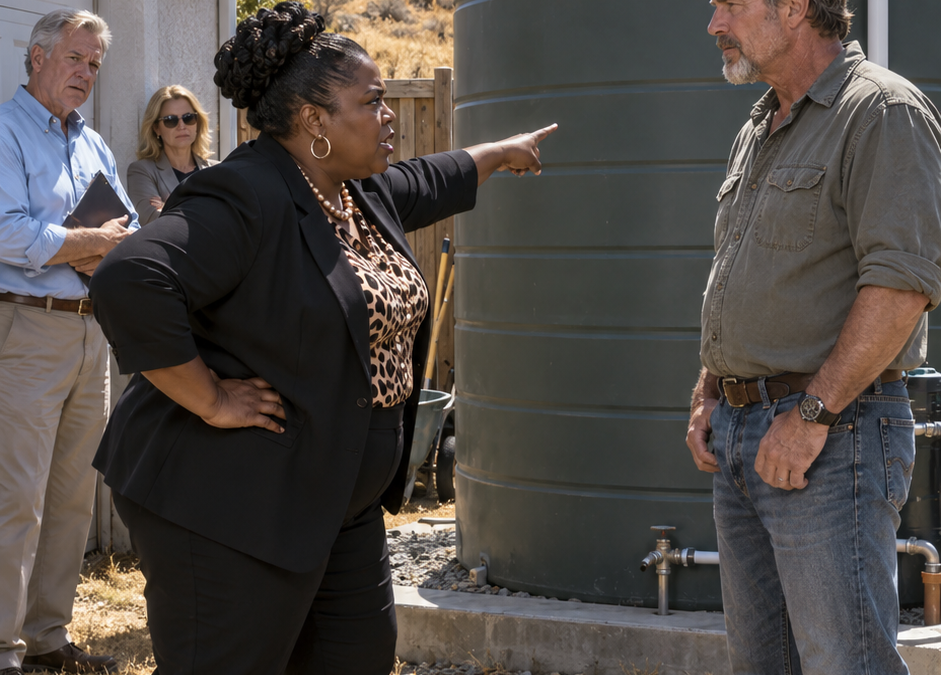
And on the final afternoon of installation, Celeste Whitmore walked up my driveway.
Celeste was fifty-two.
She was the president of the Cedar Hollow Homeowners Association and one of those people who had mastered the art of sounding pleasant while making it perfectly clear that she considered disagreement a personal defect.
Cream slacks.
Flat shoes.
Leather folder against her chest.
She stopped at the edge of the concrete pad.
Looked up at the tank.
Then looked at me.
“You were actually planning to leave that there?”
The crew went quiet.
I wiped my hands.
“That’s generally what happens after you install one.”
She didn’t smile.
“What is it?”
“Emergency water storage.”
“For what?”
“Fire protection, among other things.”
She let out a small laugh.
“Darius, this is Cedar Hollow. It isn’t a farm.”
“I know where I live.”
“That looks industrial.”
“The county approved it.”
Her eyes moved toward me.
“The county doesn’t live in our neighborhood.”
I remember that sentence.
Not because it was clever.
Because she said it with absolute confidence.
I told her I had checked the setback and permit requirements before ordering the tank.
She looked back at the steel shell.
Then she said something I don’t think she understood the weight of until much later.
“People who work with their hands sometimes put practicality ahead of presentation. I understand that. But communities like this have to maintain standards.”
One of the installers looked at me.
I didn’t answer immediately.
Anger is expensive if you spend it early.
Finally I said, “Good afternoon, Celeste.”
She frowned.
“I think we should discuss this.”
“I think we’re finished for today.”
I walked with her toward the driveway.
She got into her car.
Before pulling away, she looked at the tank again through her rearview mirror.
Two days later, the first fine arrived.
Five hundred dollars.
Unauthorized exterior structure visible from common property.
I read the citation four times.
Then I pulled out the Cedar Hollow covenants.
The relevant section prohibited unapproved exterior structures visible from association common property.
It was vague.
“Structure” wasn’t defined.
Neither was the sightline.
And Cedar Hollow’s actual common property consisted mostly of an entrance island, a mail kiosk, and a narrow landscaped strip on the north curve.
You could not see my tank from any of them.
You could see part of it from one point on the service lane.
The service lane belonged to the county.
Not the HOA.
So I put paper against paper.
Certified mail.
Photographs from six locations.
Two taken directly from HOA common areas showing nothing but my oak trees.
County permit.
Site plan.
Setback verification.
Manufacturer specifications.
Tank dimensions.
Valve arrangement.
Everything.
I didn’t write an emotional letter.
I didn’t argue about beauty.
I simply gave them facts.
Celeste’s response came three days later.
She never challenged the permit.
Never challenged the setback.
Never identified the common property from which the tank was supposedly visible.
Instead, she wrote:
Compliance with county requirements does not exempt an owner from Cedar Hollow aesthetic standards.
Aesthetic standards.
That phrase can mean almost anything when the person enforcing it gets to define both the problem and the solution.
A hearing was scheduled for the second week of September.
The community room sat behind the fire station on Milford Road.
Eleven items were on the agenda.
Nine involved exterior paint.
One involved a fence.
Then there was me.
Homeowners before me walked up, showed sample colors or photographs, answered a question, and sat down.
Two minutes each.
When my name was called, Celeste read the citation aloud.
She emphasized the words “unauthorized” and “industrial.”
Then she folded her hands.
“Perhaps,” she said, “you aren’t familiar with how a community like this operates.”
The room changed.
Very slightly.
A woman in the second row shifted.
Grant Ellison, another board member, looked down.
I let the silence stretch.
Then I asked, “What kind of community do you mean?”
Celeste smiled.
“A community with standards.”
Nobody needed me to explain what I heard underneath that sentence.
I had spent most of my life around men and women who could build things, repair things, move things, and keep systems alive after people in clean offices went home.
I had also spent enough time around certain executives to recognize the look Celeste had given me since the day she first saw the tank.
Boots.
Old truck.
Hands with cuts across the knuckles.
She had decided what category I belonged to.
And once she made that decision, she never asked what I knew.
Grant cleared his throat.
“Maybe we should have counsel review whether the language specifically applies to a permitted utility installation.”
Celeste waved one hand.
“The language is sufficient. We reviewed it.”
“Did the attorney?”
“I don’t think we need to spend association money every time a homeowner refuses a straightforward standard.”
Grant stopped.
Celeste turned back to me.
“You have fourteen days to remove the tank.”
“And if I don’t?”
“One hundred dollars per day.”
“After that?”
“A lien may be recorded.”
“And then?”
“The association can arrange removal and assess all contractor costs against your property.”
She read the consequences as calmly as somebody explaining recycling pickup.
Then she said, “Thank you.”
I stayed standing.
“I won’t be removing it.”
Celeste’s eyes sharpened.
“Then you understand the consequences.”
“Yes.”
I sat down.
She interpreted my answer as stubbornness.
That mistake drove almost everything that followed.
Outside, in the parking lot, a man named Elliot Vance caught up to me.
Elliot was sixty-three.
Retired accountant.
Lived two houses down and one lot back.
In six years, we’d probably spoken forty sentences to each other.
Mostly weather.
Trash day.
Whether the county was going to repave Milford.
That evening, he looked over his shoulder toward the community-room door.
“Darius.”
“Yeah?”
“Why do you really need five thousand gallons of water?”
I opened my truck door.
Then stopped.
“I hope we never find out.”
He studied me.
I told him about my old work.
Water systems.
Suppression.
Remote sites.
Low-pressure conditions.
I didn’t tell him about the county assessment.
Not yet.
He listened.
Then nodded slowly.
“That makes more sense than what we heard in there.”
“Most things do when somebody asks a question first.”
Over the next three weeks, the violation fees climbed.
Celeste began photographing my property.
Sometimes from the service lane.
Sometimes through her car window.
Once she walked several feet onto my gravel to get a better angle past the trees.
I came around the garage.
She lowered her phone.
“Good morning.”
“You’re on my property.”
“I’m documenting compliance.”
“You can document from public ground.”
Her smile didn’t change.
She stepped backward.
Emails arrived every few days.
My “refusal” was creating unnecessary administrative costs.
My “continued noncompliance” threatened neighborhood standards.
My “failure to cooperate” could force the association to act.
Then one Saturday morning, while I was changing oil in my pickup, Celeste drove up.
She waited until I stood.
Then held out a statement between two fingers.
Three thousand dollars.
She watched me read it.
“You seem like the kind of man who believes he knows more than everybody else.”
I folded the paper and put it in my pocket.
“No, ma’am.”
She raised her eyebrows.
“Just more than you about this particular water tank.”
For two seconds, the expression disappeared from her face.
No smile.
No patient tilt of the head.
Nothing.
Then she recovered.
“The association will proceed as outlined.”
Four days later, I learned what “proceed” meant.
I was buying pipe compound at a hardware store on Milford when the clerk said, casually, “How do you feel about losing that tank?”
I stopped.
“What?”
“A guy from Harper Site Services was in here. Said he was pricing crane access for a removal at Cedar Hollow.”
“What address?”
He told me.
Mine.
I drove home thinking.
No removal date had been formally noticed.
I had seen no board vote authorizing a contractor.
Nothing in the posted minutes.
The next Monday, I stepped outside with coffee shortly after seven.
Two men stood near my rear gate.
A white Harper Site Services truck idled on the service lane.
One man held a tape.
The other was photographing the gap between my oak trees and the tank pad.
I walked toward them.
“Can I help you?”
The older man smiled.
“We’re doing a removal survey.”
“For what?”
“The tank.”
“Who authorized you to enter?”
“The homeowners association.”
“Show me.”
He checked his clipboard.
“I’ve got a work order.”
“From the property owner?”
“The HOA.”
“I’m the property owner.”
He looked at his partner.
“I didn’t know that.”
“Now you do.”
He showed me the work order.
Address.
Basic scope.
No homeowner permission.
No court order.
No legal authorization to enter my fenced rear property.
I handed it back.
“You gentlemen need to leave.”
They did.
No argument.
Contractors understand property access better than most board presidents because they’re the ones who end up standing in somebody’s yard when paperwork is wrong.
Celeste called forty minutes later.
“Darius, you’re turning a small problem into something very large.”
“You sent contractors onto my property.”
“We are protecting community value.”
“No.”
I looked through the window toward the tank.
“You’re protecting your ability to decide things.”
Silence.
Then she said, “You have been given every opportunity to comply.”
“And you’ve been given every document showing I don’t have to.”
“This is exactly the attitude I’m talking about.”
That phone call changed the dispute.
Before then, there had at least been a layer of covenants and architecture over it.
Afterward, I understood something clearly.
The tank was no longer the issue.
I had said no to Celeste.
Twice.
In front of other people.
And I had been difficult to intimidate.
Later, Grant told me what happened during a closed board discussion.
He asked Celeste to have the HOA attorney confirm their right to physically remove the tank before anybody entered my property again.
He asked twice.
Celeste refused.
She said involving counsel would slow things down and increase expenses.
Then she said:
“If the association backs off one homeowner, everyone will do whatever they want.”
That sentence explained more than anything else.
She wasn’t defending a standard.
She was defending the idea that her authority couldn’t survive an exception.
A few days later, Elliot came to my house carrying an old newsletter.
Four years old.
Near the bottom of page two was a small paragraph.
The board, it said, was reviewing county recommendations concerning secondary emergency water planning for Cedar Hollow’s northern section.
I stared at it.
“Where’d you find this?”
“Closet.”
“Do you remember this being discussed?”
“No.”
“Anything ever happen?”
“Not that I remember.”
That paragraph changed my understanding of what Celeste knew.
Until then, I had considered the possibility that the county assessment simply never reached the association.
Wrong email.
Old president.
Lost attachment.
Things happen.
But somebody had read enough of the assessment to mention secondary emergency water planning in the newsletter.
Then the subject disappeared.
The following Friday, I came home and found a plastic sleeve taped to my garage.
Large letters.
72 HOURS UNTIL ENFORCEMENT ACTION.
The final paragraph said that after the deadline, the water-storage structure could be removed without further consent.
I stood alone in my driveway and read that sentence aloud.
“Without further consent.”
The second day of those seventy-two hours arrived brutally hot.
I woke at 5:30 because the house was already warm.
At noon, it was 107 degrees.
A west wind pushed hard across the ridge.
Leaves on the live oaks turned their pale undersides toward the sky.
At 11:40, every phone in Cedar Hollow received a red-flag warning.
Extreme fire weather.
Single-digit humidity.
Wind gusts approaching thirty-five miles per hour.
That afternoon, I checked the tank.
Full to within four inches.
I exercised the main valve.
Smooth.
No leakage.
I removed the cap from the fire connection.
Checked the threads.
Cleaned the gasket seat.
Reinstalled the cap hand-tight.
Then I walked the driveway like I would have walked an industrial fire lane.
Trash can moved.
Garden hose removed from the turning radius.
Nothing loose.
Nothing that would interfere with an engine.
Twenty minutes of boring preparation.
The kind nobody notices.
Celeste drove down the service lane while I was tightening the cap.
She stopped.
Rolled down her window.
“Preparing for the end of the world?”
I wiped my hands on a rag.
“No, ma’am.”
I looked at the tank.
“I just don’t like preparing after it’s too late.”
She glanced at the plastic notice on my garage.
“The contractor will handle this tomorrow.”
Then she drove away.
The first smoke reached us around four.
At first, it was only smell.
Dry.
Burned.
A faint bitter sweetness beneath the dust.
I noticed it.
Then ignored it.
Then noticed it again.
The light changed.
People who haven’t lived around wildfire often expect the sky to turn dramatically orange.
Sometimes it doesn’t.
Sometimes everything becomes flat.
Brassy.
Shadows disappear.
Colors lose depth.
Your own hands look strange.
I walked toward the road.
Five or six miles west, a column of smoke rose over the ridge.
White near the bottom.
Brown-gray above.
Wind bent it east.
At 5:12, my phone sounded.
PREPARE TO EVACUATE.
I looked at the message.
Then at the water tank.
Then at the removal notice on my garage.
An hour later, power failed.
The house clicked into silence.
Air conditioning died.
Refrigerator stopped.
And without those background sounds, I could finally hear the wind.
Then something beneath it.
Sirens.
Several.
Coming north on Milford.
At roughly 6:30, the main fire was still west of us.
It never arrived in Cedar Hollow as a towering wall.
What happened was more ordinary and, in some ways, more dangerous.
Embers traveled ahead.
Two spot fires started in heavy vegetation behind the north curve.
One was maybe sixty feet from a wood fence.
Houses sat another twenty feet beyond that.
Mine was fourth from the end.
Individually, those fires weren’t large.
A good crew with good water could knock them down quickly.
But they were burning in dry fuel under thirty-mile-an-hour wind.
And the next thirty minutes mattered more than anything that had happened in our HOA meeting room all year.
The first engine came up the service lane.
A second stopped farther down.
I stayed behind my rear gate.
Out of their way.
Firefighters stretched supply line.
One removed the cap from the north-curve hydrant.
The hydrant opened.
I watched the line.
Watched the operator.
Saw his head rise when he checked the gauge.
I knew before anybody said anything.
Water.
Not enough pressure.
A firefighter ran toward the next hydrant.
Opened it.
Same problem.
The neighborhood power was out.
The booster station supporting our pressure zone depended on that grid.
Cedar Hollow was already at the far end of the system.
Now two engines were pulling from it.
Meanwhile, frightened homeowners had garden hoses running on roofs, fences, shrubs, and driveways.
Nobody was doing anything irrational.
They were afraid.
But every gallon mattered.
Water tenders were coming from other stations.
Eleven miles.
Nineteen miles.
Other incidents were competing for the same resources.
Help was coming.
The crew behind my house needed water now.
I opened my side gate.
Wedged it against the wind.
Then stepped back.
A battalion officer came up the driveway holding a radio.
His eyes swept the property.
Then stopped on the tank.
“How much?”
“Five thousand gallons.”
“Full?”
“As of two hours ago.”
His entire posture changed.
“Fire connection?”
I pointed.
“Driveway side.”
He crossed the pad.
Put a hand on the manifold.
Unscrewed the cap.
Then looked over at me.
“Are you kidding me?”
“No, sir.”
He keyed his radio.
I heard my address.
Then:
“Static water supply available. Five thousand gallons. Fire department connection.”
A response came back.
He asked for the chief.
About ninety seconds later, Celeste appeared.
Homeowners had gathered near the mail kiosk.
She came down the service lane quickly.
She saw firefighters around my tank.
And somehow, with smoke behind the houses and engines in the lane, her mind went directly back to HOA enforcement.
Chief Warren Beckett had just arrived.
Fifty-nine.
Gray mustache.
Sleeves rolled.
He moved with the slow economy of someone who had spent decades learning that panic wastes motion.
He and the battalion officer were looking at my driveway.
Tank.
Gate.
Supply line.
Celeste stepped toward them.
“Excuse me.”
Beckett turned.
“That tank is in violation of our homeowners association covenants.”
I could hardly believe she was saying it.
She continued.
“We have a removal scheduled tomorrow morning. I don’t want anyone under the impression that it’s authorized to remain here.”
Beckett looked at her.
“Removal?”
“Yes.”
He glanced at the two weak supply lines along the road.
Then at my tank.
Then at the manifold.
Then back at Celeste.
“Nobody touches that tank.”
She began, “Our board policy—”
“Ma’am.”
His voice wasn’t loud.
That made everyone hear it.
“Right now, that tank is part of my water supply. Step back behind the engine.”
Celeste stopped.
Firefighters moved.
The engine repositioned down my driveway.
A firefighter walked the rear bumper.
Brake set.
Connection made.
Valve opened.
Then the pump caught.
I hadn’t heard that particular sound in years.
A crew pulled line through my side gate and hit the closer spot fire.
Celeste stood maybe eight feet from Warren Beckett and watched the object she had called an embarrassment feed a fire engine.
The work after that wasn’t cinematic.
Real firefighting rarely is.
It was communication.
Hose movement.
Pump adjustment.
Wind checks.
Men and women doing a hundred small things correctly under pressure.
They knocked the closer spot down in about eleven minutes.
The second fire was farther east, in heavier vegetation.
The hydrants contributed what they could.
My tank didn’t supply unlimited water.
Five thousand gallons disappears quickly at fireground flow rates.
The operator used it carefully.
Hydrant water between hard pushes.
Tank reserve when the crew needed volume.
That is what static supply is for.
Not magic.
Margin.
Thirty-one minutes.
That’s how long the tank supported operations before the first three-thousand-gallon water tender reached the service lane.
Thirty-one minutes sounds small when you’re sitting safely at a kitchen table.
Thirty-one minutes with embers moving through dry brush sixty feet from a wood fence is enormous.
By nine that night, the wind had eased.
Two hundred feet of fence burned.
The Ostranders lost a small shed and a row of oleanders.
About half an acre behind the lane was black.
No homes burned.
Nobody was injured.
By eleven, crews were in mop-up.
I sat on my back step with a flashlight and a warm beer listening to hand tools working through hot ground.
Neighbors drifted toward the service lane.
That was when I heard Celeste talking.
“The association has always supported emergency preparedness in Cedar Hollow.”
I almost stood up.
Then I decided not to.
Some statements are better left in the open where witnesses can inspect them.
Elliot Vance was standing near her wearing a bathrobe over slacks, garden hose still in his hand.
“You fined him three thousand dollars for it.”
Celeste stopped.
A woman named Pat Dunle spoke from behind him.
“I voted for that citation because we were told it was an unpermitted structure.”
She looked at Celeste.
“I want to see the permit.”
“This is not the time,” Celeste said.
For once, I agreed with her.
She walked away.
Later, a firefighter crossed my driveway.
He stopped in front of the garage.
The seventy-two-hour removal notice was still taped there.
He read it.
Then read it again.
He turned toward me.
“Seriously?”
I shrugged.
He laughed the exhausted laugh of a man who had been working too long.
Then pulled the sleeve off the door.
“You might want to keep this one.”
He handed it to me.
Around 10:30, Chief Beckett came over.
Helmet under one arm.
Bottle of water in his hand.
He stood looking at the tank.
“Who designed the connection?”
“I did.”
“Placement too?”
“Yes.”
He nodded.
“Height’s right.”
He pointed.
“Valve orientation is right. Pad is far enough off the turn that my operator didn’t have to improvise.”
Then he looked at me.
“This isn’t a homeowner setup.”
“I worked water supply and fire suppression for twenty-two years.”
“What kind?”
“Industrial. Commercial. Rural. Four years mostly on sites without municipal mains.”
That led to the easiest conversation I’d had in two months.
Pump demand.
Valve selection.
Pad loading.
Fill configuration.
Manifold sizing.
No one explaining aesthetics.
No one talking down to anybody.
Just two men discussing equipment.
Halfway through, I looked toward the road.
Celeste was standing there.
I hadn’t seen her approach.
She wasn’t angry.
She wasn’t smiling.
She looked still.
For two months, she had spoken to me as though practical knowledge was something unfortunate I carried because I lacked better taste.
Now she was listening to the county fire chief ask for my opinion.
The next afternoon, the incident was mostly contained.
Power came back.
Roads reopened.
Residents spent the morning doing what people do after being frightened together.
Standing in small groups.
Retelling the same story.
Looking at the blackened ground.
Around one in the afternoon, County Fire Marshal Naomi Pierce arrived.
Forty-six.
Clipboard.
Tablet.
Pen she clicked whenever she was thinking.
She had come to document the water-supply issue on the north curve.
She inspected both hydrants.
Photographed them.
Took notes.
Then walked toward my house.
Celeste intercepted her.
Of course she did.
“We’re very glad you’re here,” she said. “The board will be looking at incorporating Mr. Cole’s tank into the community emergency plan.”
I was standing ten feet away.
I waited.
Then asked, “You’re going to incorporate the thing you were fining me to remove?”
Silence.
Naomi stopped clicking her pen.
She looked at Celeste.
Then me.
“Could somebody explain that?”
I went inside.
Came back with my folder.
Permit.
Site plan.
Setback approval.
Tank specifications.
First five-hundred-dollar citation.
Hearing notice.
Fourteen-day removal order.
Daily fine notices.
Three-thousand-dollar statement.
Emails.
The contractor work order I’d copied.
The seventy-two-hour removal notice.
Naomi read everything.
Slowly.
Then she walked around the tank.
Photographed the manifold.
Measured the distance to the driveway.
Looked toward the service lane.
Finally she asked me, “Why here?”
“Because this location was identified as the most practical static-water point for this side of the neighborhood.”
Celeste turned sharply.
Naomi looked at me.
“Identified by who?”
“The county.”
Naomi sat on my tailgate.
Opened her tablet.
Searched.
Then nodded.
“Four years ago.”
By then, several neighbors had gathered nearby.
Grant Ellison was there.
Elliot.
Pat.
Others.
Naomi started reading.
The Cedar Hollow wildfire mitigation assessment.
Elevated interface risk.
Unmanaged northern vegetation.
Marginal hydrant flow.
Booster dependency.
Single access concern.
Then the recommendations.
Auxiliary or static water.
Flow-improvement study.
Vegetation management.
Naomi was careful.
“These were recommendations,” she said. “Not orders.”
She repeated that.
“The county could not force the association to build a tank.”
Grant nodded.
“I’ve never seen this.”
Naomi looked at him.
“You’re on the board?”
“Three years.”
“You’ve never received it?”
“No.”
Grant looked toward Celeste.
“I asked about brush removal twice.”
Celeste’s face remained composed.
“I don’t recall this report.”
Naomi clicked her pen once.
Then searched the transmittal record.
“October ninth, four years ago.”
She read the association email address.
“Follow-up sent two weeks later.”
A pause.
“Acknowledgment of receipt returned the same day.”
Grant asked, “By who?”
Naomi looked at her screen.
“Celeste Whitmore.”
Nobody said anything.
Celeste finally answered.
“I don’t remember every email from four years ago.”
That was when the old newsletter mattered.
Elliot went home.
Returned ten minutes later.
He opened the fall issue to page two.
The paragraph about reviewing recommendations for secondary emergency water planning.
Naomi read it.
Grant read it.
Then Grant looked at Celeste.
“So we did receive it.”
Celeste said, “Apparently.”
“You received it.”
“Yes.”
“And the board?”
“We had other priorities.”
“What happened to the recommendations?”
“They were advisory.”
Grant’s voice hardened.
“That isn’t what I asked.”
For the first time, I saw Celeste experience the same thing she had done to me at the hearing.
A simple question.
No place to hide inside tone.
The truth was not that Cedar Hollow had been ordered to build a tank and refused.
That would have been easier.
The truth was more ordinary.
The county identified a risk.
Celeste received the assessment.
The association mentioned emergency-water planning once.
Then the issue vanished.
During the following years, Cedar Hollow spent money on landscaping, an illuminated entrance monument, a repaved kiosk apron, and other visual projects.
None of those expenditures were inherently wrong.
But the risk remained.
Then a homeowner installed the exact type of resource the assessment recommended.
With his own money.
On his own property.
Under a county permit.
And Celeste decided it was ugly.
Nine days later, Cedar Hollow called an emergency membership meeting.
The room behind the fire station looked completely different.
At my hearing, fourteen people had been there.
This time there were sixty or seventy.
Extra chairs came out of the fire bay.
People stood along the back wall.
Naomi Pierce sat in the second row.
The HOA attorney, Doug Pella, sat at the board table with a legal pad.
Celeste was in the center chair.
But she no longer controlled the room.
Grant opened.
“Why was the county assessment never presented to the full board?”
Celeste answered calmly.
“It was advisory.”
“We know.”
“We had multiple competing priorities that year.”
“Why wasn’t it presented?”
“Our practice was to elevate actionable items.”
Grant leaned forward.
“Marginal hydrant flow wasn’t actionable?”
“The report was not binding.”
Naomi spoke only when asked.
That made what she said more effective.
She confirmed the report was advisory.
She confirmed the county could not require a private HOA to implement the recommendations.
Then she clarified something else.
“Documented risk and speculative risk are not the same thing.”
The room remained quiet.
“The conditions described in that assessment were documented.”
She reviewed them.
Then Grant asked about my tank.
Naomi looked down at her notes.
“The installation is county permitted.”
She continued.
“The setback is compliant.”
“The site is appropriate for static-water access.”
“The fire department connection is usable.”
“The tank was employed as an active fireground water source at the direction of the incident command structure.”
She looked toward the board.
“And a homeowners association does not have authority to declare a county-permitted water-storage installation unsafe or noncompliant with fire standards.”
Doug Pella went next.
He had spent the previous week reviewing the covenants, minutes, and correspondence.
He numbered his conclusions.
First, the tank sat inside a rear utility area.
Second, the covenant section used against me did not clearly define a permitted utility installation as an architectural structure subject to the cited restriction.
Third, the HOA had received my county approval documents and never challenged their validity.
Fourth, and most seriously, the association had not followed its own enforcement procedures.
No written architectural determination.
No required compliance conference.
No recorded board authorization for escalating daily penalties.
No recorded authorization for physical removal.
No approval for hiring Harper Site Services.
And no lawful consent allowing a contractor to enter my private rear property.
Doug set his pen down.
“In my opinion, the association has substantial exposure concerning the attempted physical entry.”
Nobody moved.
Then he added:
“I recommend immediate suspension of all fines.”
A woman in the fourth row stood.
“Then why did Mr. Cole have to pay three thousand dollars?”
Technically, I had not paid it.
But everyone understood what she meant.
Why had I been assessed it?
No one answered.
Celeste stared ahead.
Elliot spoke from near the aisle.
“Because she didn’t like looking at it.”
Nine words.
That was all.
And something in the room shifted.
Grant made a motion.
Five parts.
Void every fine against my property retroactively.
Reimburse my documented legal-consultation expenses.
Adopt a policy prohibiting HOA agents or contractors from entering private property without written owner consent or lawful court authority.
Commission an independent review of enforcement actions initiated during Celeste’s presidency.
Request a new emergency-preparedness evaluation from the county fire district.
The motion passed.
Not quietly.
People said yes before the formal count was finished.
Celeste remained in the center chair.
Once, she tried to say the board had acted in what it believed was Cedar Hollow’s best interest.
Grant interrupted gently.
“The motion is already on the floor.”
That was the end of it.
She found me afterward in the parking lot.
One of the overhead lights was burned out.
She stood between my truck and the fence.
No folder.
No board seated behind her.
No audience except me.
“Darius, can we talk?”
I put my keys back in my pocket.
“Okay.”
She spoke for several minutes.
Property values.
Complaints.
Pressure from residents.
Consistency.
The retaining-wall problem that had occupied the board the year the assessment arrived.
Too many priorities.
She said enforcement had gotten away from her.
Then she said:
“I think we misunderstood each other.”
I looked at her.
“Do you remember what you said the first day you saw the tank?”
She looked down.
“You told me people who work with their hands think practical matters more than presentation.”
“I didn’t mean—”
“At the hearing, you said I might not understand how a community like Cedar Hollow operates.”
“I was trying to explain—”
“No.”
I wasn’t angry.
That surprised me.
“You looked at my boots.”
She became very still.
“You looked at my truck.”
I continued.
“And you made a decision about what kind of man you were talking to.”
She started to answer.
I didn’t let her escape into explanation.
“You never asked me what the tank was designed to do.”
Silence.
“You never asked what the fitting was.”
Silence.
“You never asked why the pad was where it was.”
I looked at her.
“In two months, you never asked me one technical question.”
Her voice was quieter.
“I’m sorry about the fines.”
“The fines weren’t the real problem.”
She looked up.
“The tank wasn’t the real problem either.”
“What do you mean?”
“What bothered you was that I wouldn’t do what you told me.”
She said nothing.
I unlocked my truck.
Before getting in, I looked back at her.
“You spent four years protecting what Cedar Hollow looked like from a report about what Cedar Hollow actually needed.”
Then I left.
I expected to feel satisfaction.
I didn’t.
Mostly I felt tired.
And, strangely, a little sorry for her.
Celeste resigned three weeks later.
Her letter cited personal reasons.
There was no lawsuit.
No police investigation.
No dramatic final confrontation.
She still lives in Cedar Hollow.
Sometimes I see her at the mail kiosk.
We nod.
That’s all.
Grant Ellison became acting president through the winter.
He turned out to be better at the job than I think even he expected.
The HOA voided every dollar of my fines.
Its enforcement process was rewritten.
Written determinations became mandatory.
Compliance conferences had to occur before fines.
Any financial penalty required a recorded board vote.
Contractors were prohibited from entering private property without written consent or proper legal authority.
The county fire district conducted a new preparedness review.
This time, the association mailed the report to all ninety homes.
The board funded annual vegetation clearing along the northern boundary.
It opened a utility study.
And it began examining options for a permanent community emergency-water reserve near the north curve.
I found that last part almost funny.
After everything.
Now they were comparing tank sizes.
In November, Warren Beckett stopped by my house off duty.
Flannel shirt.
Coffee in hand.
We stood in the driveway looking at the tank.
“The HOA called us about putting a plaque on it,” he said.
“What plaque?”
“Cedar Hollow Emergency Water Reserve.”
I stared at him.
“On my tank?”
“Brushed aluminum, apparently.”
“No.”
He laughed.
“That was fast.”
“It doesn’t need a name.”
Beckett took a drink.
“Good.”
He looked up at the steel.
“Water usually doesn’t.”
In December, I received one final proposal.
This one was different.
No threat.
No fine.
No presumption.
The association asked whether I would voluntarily allow my tank to be listed as a secondary static-water source on the fire district’s pre-incident plan.
I agreed.
Three conditions.
First, Cedar Hollow acquired no ownership interest in the tank.
Second, emergency access belonged to the county fire district only.
Third, all maintenance, inspection, and repair remained under my control.
The board accepted every condition.
No revisions.
No argument.
It took nine days.
They had spent nearly two months trying the other method.
By early spring, the blackened half acre behind the service lane had gone green.
Burned ground does that.
New growth comes back almost offensively bright.
Two of my oaks had scorched along one side but survived.
One evening I stood outside watering them.
The sun was low behind the ridge.
Copper light reflected off the tank.
Elliot came down the lane carrying his mail.
He stopped.
Looked up at nine feet of gray-green steel.
“Still embarrassing?”
I followed his gaze.
“Apparently only when there’s no fire.”
He laughed.
So did I.
Then he went home.
I finished watering the trees.
For a long time afterward, people told the story as though the fire had somehow proved I was right.
I never liked that version.
A fire isn’t a debate.
Nobody wins because one happens.
I would have preferred every dollar I spent on that tank to be wasted forever.
I would have been perfectly happy to die an old man with five thousand gallons of emergency water behind my garage that no firefighter ever touched.
The tank wasn’t installed to make a point.
It wasn’t bait.
It wasn’t an argument against Celeste.
It was preparation.
Nothing more dramatic than that.
I had read the same risk indicators people in my profession are trained to read.
Dry fuels.
Elevation.
Pressure limitations.
Booster dependency.
Limited access.
I had the ability to reduce one small part of that risk on property I controlled.
So I did.
What turned the tank into a fight was never its function.
It was what Celeste thought it represented.
To her, it was ugly.
Industrial.
Something installed by a man in work boots who clearly didn’t understand what belonged in a neighborhood like hers.
She decided all of that before asking a single question.
And once she made that judgment, every document I showed her became an obstacle rather than information.
The permit didn’t change her mind.
The setback didn’t change her mind.
The engineering specifications didn’t matter.
My refusal to remove it only made her more determined because by then the argument wasn’t about compliance.
It was about obedience.
The strangest part is that she had once possessed the exact document that might have made her understand.
Four years before she walked up my driveway, the county had warned Cedar Hollow about the combination of dry vegetation, limited upper-zone water pressure, and restricted northern access.
Celeste acknowledged receiving it.
Then life went on.
Meetings happened.
Budgets got approved.
Stone was installed.
Landscaping was refreshed.
The report disappeared.
Until the afternoon the power went out.
Then an engine stopped beside a weak hydrant.
A firefighter looked at a gauge.
A crew needed water.
And behind the garage of the man Celeste had spent two months treating like an amateur sat five thousand gallons with the right fitting pointed toward a driveway built wide enough for a fire engine.
She had wanted it gone the next morning.
Instead, before the deadline expired, Warren Beckett stood in front of it and said the only thing that needed to be said.
Nobody touches that tank.
Not because I had won.
Not because Celeste had lost.
Because there was smoke behind eleven houses.
There were crews on the ground.
There wasn’t enough pressure.
And water doesn’t care what something looks like.
Water doesn’t care who is president of an HOA.
It doesn’t care whether the steel holding it matches the landscaping.
It doesn’t care whether the man who installed the valve wears expensive shoes.
It only matters when you need it.
And sometimes the difference between unnecessary and indispensable is thirty-one minutes.
Have you finished reading the story and want to read it again?
The HOA President Never Asked Why I Put 5,000 Gallons of Water Behind My Garage
Celeste Whitmore called my water tank an embarrassment.
She fined me thousands of dollars and scheduled a contractor to remove it.
What she never asked was why I had installed it in the first place.
My name is Darius Cole.
I had lived in Cedar Hollow Estates for six years by the time Celeste Whitmore decided the most dangerous thing in the neighborhood was a gray-green steel tank behind my garage.
Cedar Hollow isn’t the kind of place most people imagine when they hear the word “Estates.”
There are no stone gates imported from Italy.
No guards behind tinted glass.
No fountains changing colors after sunset.
It’s ninety homes arranged along four curving streets pressed against a line of dry foothills where sage, scrub oak, and waist-high brush grow thick enough to hide a deer until it is almost standing beside you.
Most years, the hills are beautiful.
That particular year, they looked like tinder.
The winter had been weak.
Spring rain barely came.
By March, the seasonal creek behind the service lane was shrinking.
By early summer, it was gone.
Mud became cracked clay.
Grass along the northern boundary turned yellow weeks earlier than normal.
Brush that usually carried some green into July went gray and brittle.
Every afternoon, wind came down from the west and pushed through it.
I watched those hills differently from most of my neighbors.
Not because I was smarter.
Because of the work I had done for twenty-two years.
Before moving to Cedar Hollow, I built and serviced water-supply and fire-suppression systems.
Warehouses.
Cold-storage facilities.
Industrial sites.
Commercial buildings.
Rural operations where the nearest municipal main was miles away.
I had installed sprinkler loops large enough to swallow thousands of gallons before anybody outside knew a fire had started.
I had worked on dry systems in freezing climates, standpipes in unfinished buildings, private mains across industrial yards, pumps, valves, hydrants, and storage tanks.
And I had spent enough time on remote sites to learn one lesson that never leaves you once you’ve watched it happen in real life.
A fire engine without water is just a very expensive truck.
I had seen crews arrive ready to work and discover that supply was insufficient.
I had watched operators stare at pressure gauges that refused to give them what they needed.
There is a particular expression people get when training, equipment, and courage are all present but the one physical resource they require is not.
I never forgot it.
Cedar Hollow had hydrants.
Six of them.
They were painted correctly.
Inspected.
Spaced properly according to the subdivision plan.
Nothing about them looked alarming.
But within my first year there, I noticed something.
The two hydrants nearest the north curve seemed soft.
Not dead.
Not obviously defective.
Just soft.
Pressure at that elevation did not feel like what I expected.
It was the kind of thing a mechanic hears in a bearing before anyone else hears noise.
I never made a fuss.
A private suspicion isn’t evidence.
And I had no interest in becoming the new resident who attended an HOA meeting and announced that he knew more about the neighborhood’s infrastructure than everyone else.
So I kept it to myself.
Then came the dry summer.
One afternoon in August, a county utility crew was working at a manhole near the top of the service lane.
It was 104 degrees.
I carried two cold bottles of water over.
One of the technicians thanked me, and we talked for maybe fifteen minutes while another man worked below.
The conversation was ordinary.
That’s what made it useful.
He told me the north half of Cedar Hollow sat near the end of an older transmission line.
One booster station roughly a mile and a half west supported the pressure zone.
Our elevation ate into whatever pressure margin remained.
Under normal household demand, nobody would notice.
Then he shrugged and said something like, “It’s just the end of the line up here.”
He wasn’t warning me.
He wasn’t issuing a technical report.
He was making conversation.
But I understood what he was describing.
The following week, I made a few calls.
Then I filed a county public-records request.
I asked for old flow information, pressure-zone mapping, and any fire-planning documents associated with Cedar Hollow.
Eleven dollars in copy fees.
Nine days later, I received forty-one pages.
Most of it was exactly what I expected.
Valve schedules.
Utility maps.
Old flow tests.
Pressure data.
Then, buried in the packet, I found something I had not expected.
A wildfire mitigation assessment prepared four years earlier.
Cedar Hollow had been included among eleven communities identified as having elevated wildland-urban-interface exposure.
Three items were listed for our neighborhood.
Continuous unmanaged vegetation along the northern boundary.
Marginal hydrant performance in the upper pressure zone, with specific reference to booster dependency.
Limited access serving the north curve.
And then came the recommendations.
Consider an auxiliary or static water supply for the northern section.
Pursue a utility flow-improvement study.
Establish recurring vegetation management along the boundary.
None of those recommendations were mandatory.
I understood that.
The county had not ordered Cedar Hollow to install a tank.
The document was advisory.
But I sat at my kitchen table that night and read the same phrases twice.
Marginal hydrant flow.
Booster dependency.
Static water supply.
I looked through the window toward the hills.
I could not redesign the county water system.
I could not rebuild the booster station.
I could not legally clear vegetation on land that wasn’t mine.
What I could do was protect my own house.
So I called a contractor I had worked with before.
By late August, we poured a reinforced pad behind my garage and installed a five-thousand-gallon steel water tank.
Nine feet high.
Gray-green paint.
Inside the legal rear setback.
Screened by live oaks from almost every public angle.
The fill line was accessible.
The tank had a proper gate valve.
And on the driveway side, I installed a two-and-a-half-inch fire department connection on a short manifold positioned at a height an engine operator could actually use.
The driveway was wide enough for apparatus.
The pad sat far enough back to allow turning clearance.
I didn’t put those things there because I expected a fire.
I put them there because if a fire ever came, I did not want to discover what I needed while watching smoke.
The county issued the permit.
The setback was verified.
Everything was legal.
And on the final afternoon of installation, Celeste Whitmore walked up my driveway.
Celeste was fifty-two.
She was the president of the Cedar Hollow Homeowners Association and one of those people who had mastered the art of sounding pleasant while making it perfectly clear that she considered disagreement a personal defect.
Cream slacks.
Flat shoes.
Leather folder against her chest.
She stopped at the edge of the concrete pad.
Looked up at the tank.
Then looked at me.
“You were actually planning to leave that there?”
The crew went quiet.
I wiped my hands.
“That’s generally what happens after you install one.”
She didn’t smile.
“What is it?”
“Emergency water storage.”
“For what?”
“Fire protection, among other things.”
She let out a small laugh.
“Darius, this is Cedar Hollow. It isn’t a farm.”
“I know where I live.”
“That looks industrial.”
“The county approved it.”
Her eyes moved toward me.
“The county doesn’t live in our neighborhood.”
I remember that sentence.
Not because it was clever.
Because she said it with absolute confidence.
I told her I had checked the setback and permit requirements before ordering the tank.
She looked back at the steel shell.
Then she said something I don’t think she understood the weight of until much later.
“People who work with their hands sometimes put practicality ahead of presentation. I understand that. But communities like this have to maintain standards.”
One of the installers looked at me.
I didn’t answer immediately.
Anger is expensive if you spend it early.
Finally I said, “Good afternoon, Celeste.”
She frowned.
“I think we should discuss this.”
“I think we’re finished for today.”
I walked with her toward the driveway.
She got into her car.
Before pulling away, she looked at the tank again through her rearview mirror.
Two days later, the first fine arrived.
Five hundred dollars.
Unauthorized exterior structure visible from common property.
I read the citation four times.
Then I pulled out the Cedar Hollow covenants.
The relevant section prohibited unapproved exterior structures visible from association common property.
It was vague.
“Structure” wasn’t defined.
Neither was the sightline.
And Cedar Hollow’s actual common property consisted mostly of an entrance island, a mail kiosk, and a narrow landscaped strip on the north curve.
You could not see my tank from any of them.
You could see part of it from one point on the service lane.
The service lane belonged to the county.
Not the HOA.
So I put paper against paper.
Certified mail.
Photographs from six locations.
Two taken directly from HOA common areas showing nothing but my oak trees.
County permit.
Site plan.
Setback verification.
Manufacturer specifications.
Tank dimensions.
Valve arrangement.
Everything.
I didn’t write an emotional letter.
I didn’t argue about beauty.
I simply gave them facts.
Celeste’s response came three days later.
She never challenged the permit.
Never challenged the setback.
Never identified the common property from which the tank was supposedly visible.
Instead, she wrote:
Compliance with county requirements does not exempt an owner from Cedar Hollow aesthetic standards.
Aesthetic standards.
That phrase can mean almost anything when the person enforcing it gets to define both the problem and the solution.
A hearing was scheduled for the second week of September.
The community room sat behind the fire station on Milford Road.
Eleven items were on the agenda.
Nine involved exterior paint.
One involved a fence.
Then there was me.
Homeowners before me walked up, showed sample colors or photographs, answered a question, and sat down.
Two minutes each.
When my name was called, Celeste read the citation aloud.
She emphasized the words “unauthorized” and “industrial.”
Then she folded her hands.
“Perhaps,” she said, “you aren’t familiar with how a community like this operates.”
The room changed.
Very slightly.
A woman in the second row shifted.
Grant Ellison, another board member, looked down.
I let the silence stretch.
Then I asked, “What kind of community do you mean?”
Celeste smiled.
“A community with standards.”
Nobody needed me to explain what I heard underneath that sentence.
I had spent most of my life around men and women who could build things, repair things, move things, and keep systems alive after people in clean offices went home.
I had also spent enough time around certain executives to recognize the look Celeste had given me since the day she first saw the tank.
Boots.
Old truck.
Hands with cuts across the knuckles.
She had decided what category I belonged to.
And once she made that decision, she never asked what I knew.
Grant cleared his throat.
“Maybe we should have counsel review whether the language specifically applies to a permitted utility installation.”
Celeste waved one hand.
“The language is sufficient. We reviewed it.”
“Did the attorney?”
“I don’t think we need to spend association money every time a homeowner refuses a straightforward standard.”
Grant stopped.
Celeste turned back to me.
“You have fourteen days to remove the tank.”
“And if I don’t?”
“One hundred dollars per day.”
“After that?”
“A lien may be recorded.”
“And then?”
“The association can arrange removal and assess all contractor costs against your property.”
She read the consequences as calmly as somebody explaining recycling pickup.
Then she said, “Thank you.”
I stayed standing.
“I won’t be removing it.”
Celeste’s eyes sharpened.
“Then you understand the consequences.”
“Yes.”
I sat down.
She interpreted my answer as stubbornness.
That mistake drove almost everything that followed.
Outside, in the parking lot, a man named Elliot Vance caught up to me.
Elliot was sixty-three.
Retired accountant.
Lived two houses down and one lot back.
In six years, we’d probably spoken forty sentences to each other.
Mostly weather.
Trash day.
Whether the county was going to repave Milford.
That evening, he looked over his shoulder toward the community-room door.
“Darius.”
“Yeah?”
“Why do you really need five thousand gallons of water?”
I opened my truck door.
Then stopped.
“I hope we never find out.”
He studied me.
I told him about my old work.
Water systems.
Suppression.
Remote sites.
Low-pressure conditions.
I didn’t tell him about the county assessment.
Not yet.
He listened.
Then nodded slowly.
“That makes more sense than what we heard in there.”
“Most things do when somebody asks a question first.”
Over the next three weeks, the violation fees climbed.
Celeste began photographing my property.
Sometimes from the service lane.
Sometimes through her car window.
Once she walked several feet onto my gravel to get a better angle past the trees.
I came around the garage.
She lowered her phone.
“Good morning.”
“You’re on my property.”
“I’m documenting compliance.”
“You can document from public ground.”
Her smile didn’t change.
She stepped backward.
Emails arrived every few days.
My “refusal” was creating unnecessary administrative costs.
My “continued noncompliance” threatened neighborhood standards.
My “failure to cooperate” could force the association to act.
Then one Saturday morning, while I was changing oil in my pickup, Celeste drove up.
She waited until I stood.
Then held out a statement between two fingers.
Three thousand dollars.
She watched me read it.
“You seem like the kind of man who believes he knows more than everybody else.”
I folded the paper and put it in my pocket.
“No, ma’am.”
She raised her eyebrows.
“Just more than you about this particular water tank.”
For two seconds, the expression disappeared from her face.
No smile.
No patient tilt of the head.
Nothing.
Then she recovered.
“The association will proceed as outlined.”
Four days later, I learned what “proceed” meant.
I was buying pipe compound at a hardware store on Milford when the clerk said, casually, “How do you feel about losing that tank?”
I stopped.
“What?”
“A guy from Harper Site Services was in here. Said he was pricing crane access for a removal at Cedar Hollow.”
“What address?”
He told me.
Mine.
I drove home thinking.
No removal date had been formally noticed.
I had seen no board vote authorizing a contractor.
Nothing in the posted minutes.
The next Monday, I stepped outside with coffee shortly after seven.
Two men stood near my rear gate.
A white Harper Site Services truck idled on the service lane.
One man held a tape.
The other was photographing the gap between my oak trees and the tank pad.
I walked toward them.
“Can I help you?”
The older man smiled.
“We’re doing a removal survey.”
“For what?”
“The tank.”
“Who authorized you to enter?”
“The homeowners association.”
“Show me.”
He checked his clipboard.
“I’ve got a work order.”
“From the property owner?”
“The HOA.”
“I’m the property owner.”
He looked at his partner.
“I didn’t know that.”
“Now you do.”
He showed me the work order.
Address.
Basic scope.
No homeowner permission.
No court order.
No legal authorization to enter my fenced rear property.
I handed it back.
“You gentlemen need to leave.”
They did.
No argument.
Contractors understand property access better than most board presidents because they’re the ones who end up standing in somebody’s yard when paperwork is wrong.
Celeste called forty minutes later.
“Darius, you’re turning a small problem into something very large.”
“You sent contractors onto my property.”
“We are protecting community value.”
“No.”
I looked through the window toward the tank.
“You’re protecting your ability to decide things.”
Silence.
Then she said, “You have been given every opportunity to comply.”
“And you’ve been given every document showing I don’t have to.”
“This is exactly the attitude I’m talking about.”
That phone call changed the dispute.
Before then, there had at least been a layer of covenants and architecture over it.
Afterward, I understood something clearly.
The tank was no longer the issue.
I had said no to Celeste.
Twice.
In front of other people.
And I had been difficult to intimidate.
Later, Grant told me what happened during a closed board discussion.
He asked Celeste to have the HOA attorney confirm their right to physically remove the tank before anybody entered my property again.
He asked twice.
Celeste refused.
She said involving counsel would slow things down and increase expenses.
Then she said:
“If the association backs off one homeowner, everyone will do whatever they want.”
That sentence explained more than anything else.
She wasn’t defending a standard.
She was defending the idea that her authority couldn’t survive an exception.
A few days later, Elliot came to my house carrying an old newsletter.
Four years old.
Near the bottom of page two was a small paragraph.
The board, it said, was reviewing county recommendations concerning secondary emergency water planning for Cedar Hollow’s northern section.
I stared at it.
“Where’d you find this?”
“Closet.”
“Do you remember this being discussed?”
“No.”
“Anything ever happen?”
“Not that I remember.”
That paragraph changed my understanding of what Celeste knew.
Until then, I had considered the possibility that the county assessment simply never reached the association.
Wrong email.
Old president.
Lost attachment.
Things happen.
But somebody had read enough of the assessment to mention secondary emergency water planning in the newsletter.
Then the subject disappeared.
The following Friday, I came home and found a plastic sleeve taped to my garage.
Large letters.
72 HOURS UNTIL ENFORCEMENT ACTION.
The final paragraph said that after the deadline, the water-storage structure could be removed without further consent.
I stood alone in my driveway and read that sentence aloud.
“Without further consent.”
The second day of those seventy-two hours arrived brutally hot.
I woke at 5:30 because the house was already warm.
At noon, it was 107 degrees.
A west wind pushed hard across the ridge.
Leaves on the live oaks turned their pale undersides toward the sky.
At 11:40, every phone in Cedar Hollow received a red-flag warning.
Extreme fire weather.
Single-digit humidity.
Wind gusts approaching thirty-five miles per hour.
That afternoon, I checked the tank.
Full to within four inches.
I exercised the main valve.
Smooth.
No leakage.
I removed the cap from the fire connection.
Checked the threads.
Cleaned the gasket seat.
Reinstalled the cap hand-tight.
Then I walked the driveway like I would have walked an industrial fire lane.
Trash can moved.
Garden hose removed from the turning radius.
Nothing loose.
Nothing that would interfere with an engine.
Twenty minutes of boring preparation.
The kind nobody notices.
Celeste drove down the service lane while I was tightening the cap.
She stopped.
Rolled down her window.
“Preparing for the end of the world?”
I wiped my hands on a rag.
“No, ma’am.”
I looked at the tank.
“I just don’t like preparing after it’s too late.”
She glanced at the plastic notice on my garage.
“The contractor will handle this tomorrow.”
Then she drove away.
The first smoke reached us around four.
At first, it was only smell.
Dry.
Burned.
A faint bitter sweetness beneath the dust.
I noticed it.
Then ignored it.
Then noticed it again.
The light changed.
People who haven’t lived around wildfire often expect the sky to turn dramatically orange.
Sometimes it doesn’t.
Sometimes everything becomes flat.
Brassy.
Shadows disappear.
Colors lose depth.
Your own hands look strange.
I walked toward the road.
Five or six miles west, a column of smoke rose over the ridge.
White near the bottom.
Brown-gray above.
Wind bent it east.
At 5:12, my phone sounded.
PREPARE TO EVACUATE.
I looked at the message.
Then at the water tank.
Then at the removal notice on my garage.
An hour later, power failed.
The house clicked into silence.
Air conditioning died.
Refrigerator stopped.
And without those background sounds, I could finally hear the wind.
Then something beneath it.
Sirens.
Several.
Coming north on Milford.
At roughly 6:30, the main fire was still west of us.
It never arrived in Cedar Hollow as a towering wall.
What happened was more ordinary and, in some ways, more dangerous.
Embers traveled ahead.
Two spot fires started in heavy vegetation behind the north curve.
One was maybe sixty feet from a wood fence.
Houses sat another twenty feet beyond that.
Mine was fourth from the end.
Individually, those fires weren’t large.
A good crew with good water could knock them down quickly.
But they were burning in dry fuel under thirty-mile-an-hour wind.
And the next thirty minutes mattered more than anything that had happened in our HOA meeting room all year.
The first engine came up the service lane.
A second stopped farther down.
I stayed behind my rear gate.
Out of their way.
Firefighters stretched supply line.
One removed the cap from the north-curve hydrant.
The hydrant opened.
I watched the line.
Watched the operator.
Saw his head rise when he checked the gauge.
I knew before anybody said anything.
Water.
Not enough pressure.
A firefighter ran toward the next hydrant.
Opened it.
Same problem.
The neighborhood power was out.
The booster station supporting our pressure zone depended on that grid.
Cedar Hollow was already at the far end of the system.
Now two engines were pulling from it.
Meanwhile, frightened homeowners had garden hoses running on roofs, fences, shrubs, and driveways.
Nobody was doing anything irrational.
They were afraid.
But every gallon mattered.
Water tenders were coming from other stations.
Eleven miles.
Nineteen miles.
Other incidents were competing for the same resources.
Help was coming.
The crew behind my house needed water now.
I opened my side gate.
Wedged it against the wind.
Then stepped back.
A battalion officer came up the driveway holding a radio.
His eyes swept the property.
Then stopped on the tank.
“How much?”
“Five thousand gallons.”
“Full?”
“As of two hours ago.”
His entire posture changed.
“Fire connection?”
I pointed.
“Driveway side.”
He crossed the pad.
Put a hand on the manifold.
Unscrewed the cap.
Then looked over at me.
“Are you kidding me?”
“No, sir.”
He keyed his radio.
I heard my address.
Then:
“Static water supply available. Five thousand gallons. Fire department connection.”
A response came back.
He asked for the chief.
About ninety seconds later, Celeste appeared.
Homeowners had gathered near the mail kiosk.
She came down the service lane quickly.
She saw firefighters around my tank.
And somehow, with smoke behind the houses and engines in the lane, her mind went directly back to HOA enforcement.
Chief Warren Beckett had just arrived.
Fifty-nine.
Gray mustache.
Sleeves rolled.
He moved with the slow economy of someone who had spent decades learning that panic wastes motion.
He and the battalion officer were looking at my driveway.
Tank.
Gate.
Supply line.
Celeste stepped toward them.
“Excuse me.”
Beckett turned.
“That tank is in violation of our homeowners association covenants.”
I could hardly believe she was saying it.
She continued.
“We have a removal scheduled tomorrow morning. I don’t want anyone under the impression that it’s authorized to remain here.”
Beckett looked at her.
“Removal?”
“Yes.”
He glanced at the two weak supply lines along the road.
Then at my tank.
Then at the manifold.
Then back at Celeste.
“Nobody touches that tank.”
She began, “Our board policy—”
“Ma’am.”
His voice wasn’t loud.
That made everyone hear it.
“Right now, that tank is part of my water supply. Step back behind the engine.”
Celeste stopped.
Firefighters moved.
The engine repositioned down my driveway.
A firefighter walked the rear bumper.
Brake set.
Connection made.
Valve opened.
Then the pump caught.
I hadn’t heard that particular sound in years.
A crew pulled line through my side gate and hit the closer spot fire.
Celeste stood maybe eight feet from Warren Beckett and watched the object she had called an embarrassment feed a fire engine.
The work after that wasn’t cinematic.
Real firefighting rarely is.
It was communication.
Hose movement.
Pump adjustment.
Wind checks.
Men and women doing a hundred small things correctly under pressure.
They knocked the closer spot down in about eleven minutes.
The second fire was farther east, in heavier vegetation.
The hydrants contributed what they could.
My tank didn’t supply unlimited water.
Five thousand gallons disappears quickly at fireground flow rates.
The operator used it carefully.
Hydrant water between hard pushes.
Tank reserve when the crew needed volume.
That is what static supply is for.
Not magic.
Margin.
Thirty-one minutes.
That’s how long the tank supported operations before the first three-thousand-gallon water tender reached the service lane.
Thirty-one minutes sounds small when you’re sitting safely at a kitchen table.
Thirty-one minutes with embers moving through dry brush sixty feet from a wood fence is enormous.
By nine that night, the wind had eased.
Two hundred feet of fence burned.
The Ostranders lost a small shed and a row of oleanders.
About half an acre behind the lane was black.
No homes burned.
Nobody was injured.
By eleven, crews were in mop-up.
I sat on my back step with a flashlight and a warm beer listening to hand tools working through hot ground.
Neighbors drifted toward the service lane.
That was when I heard Celeste talking.
“The association has always supported emergency preparedness in Cedar Hollow.”
I almost stood up.
Then I decided not to.
Some statements are better left in the open where witnesses can inspect them.
Elliot Vance was standing near her wearing a bathrobe over slacks, garden hose still in his hand.
“You fined him three thousand dollars for it.”
Celeste stopped.
A woman named Pat Dunle spoke from behind him.
“I voted for that citation because we were told it was an unpermitted structure.”
She looked at Celeste.
“I want to see the permit.”
“This is not the time,” Celeste said.
For once, I agreed with her.
She walked away.
Later, a firefighter crossed my driveway.
He stopped in front of the garage.
The seventy-two-hour removal notice was still taped there.
He read it.
Then read it again.
He turned toward me.
“Seriously?”
I shrugged.
He laughed the exhausted laugh of a man who had been working too long.
Then pulled the sleeve off the door.
“You might want to keep this one.”
He handed it to me.
Around 10:30, Chief Beckett came over.
Helmet under one arm.
Bottle of water in his hand.
He stood looking at the tank.
“Who designed the connection?”
“I did.”
“Placement too?”
“Yes.”
He nodded.
“Height’s right.”
He pointed.
“Valve orientation is right. Pad is far enough off the turn that my operator didn’t have to improvise.”
Then he looked at me.
“This isn’t a homeowner setup.”
“I worked water supply and fire suppression for twenty-two years.”
“What kind?”
“Industrial. Commercial. Rural. Four years mostly on sites without municipal mains.”
That led to the easiest conversation I’d had in two months.
Pump demand.
Valve selection.
Pad loading.
Fill configuration.
Manifold sizing.
No one explaining aesthetics.
No one talking down to anybody.
Just two men discussing equipment.
Halfway through, I looked toward the road.
Celeste was standing there.
I hadn’t seen her approach.
She wasn’t angry.
She wasn’t smiling.
She looked still.
For two months, she had spoken to me as though practical knowledge was something unfortunate I carried because I lacked better taste.
Now she was listening to the county fire chief ask for my opinion.
The next afternoon, the incident was mostly contained.
Power came back.
Roads reopened.
Residents spent the morning doing what people do after being frightened together.
Standing in small groups.
Retelling the same story.
Looking at the blackened ground.
Around one in the afternoon, County Fire Marshal Naomi Pierce arrived.
Forty-six.
Clipboard.
Tablet.
Pen she clicked whenever she was thinking.
She had come to document the water-supply issue on the north curve.
She inspected both hydrants.
Photographed them.
Took notes.
Then walked toward my house.
Celeste intercepted her.
Of course she did.
“We’re very glad you’re here,” she said. “The board will be looking at incorporating Mr. Cole’s tank into the community emergency plan.”
I was standing ten feet away.
I waited.
Then asked, “You’re going to incorporate the thing you were fining me to remove?”
Silence.
Naomi stopped clicking her pen.
She looked at Celeste.
Then me.
“Could somebody explain that?”
I went inside.
Came back with my folder.
Permit.
Site plan.
Setback approval.
Tank specifications.
First five-hundred-dollar citation.
Hearing notice.
Fourteen-day removal order.
Daily fine notices.
Three-thousand-dollar statement.
Emails.
The contractor work order I’d copied.
The seventy-two-hour removal notice.
Naomi read everything.
Slowly.
Then she walked around the tank.
Photographed the manifold.
Measured the distance to the driveway.
Looked toward the service lane.
Finally she asked me, “Why here?”
“Because this location was identified as the most practical static-water point for this side of the neighborhood.”
Celeste turned sharply.
Naomi looked at me.
“Identified by who?”
“The county.”
Naomi sat on my tailgate.
Opened her tablet.
Searched.
Then nodded.
“Four years ago.”
By then, several neighbors had gathered nearby.
Grant Ellison was there.
Elliot.
Pat.
Others.
Naomi started reading.
The Cedar Hollow wildfire mitigation assessment.
Elevated interface risk.
Unmanaged northern vegetation.
Marginal hydrant flow.
Booster dependency.
Single access concern.
Then the recommendations.
Auxiliary or static water.
Flow-improvement study.
Vegetation management.
Naomi was careful.
“These were recommendations,” she said. “Not orders.”
She repeated that.
“The county could not force the association to build a tank.”
Grant nodded.
“I’ve never seen this.”
Naomi looked at him.
“You’re on the board?”
“Three years.”
“You’ve never received it?”
“No.”
Grant looked toward Celeste.
“I asked about brush removal twice.”
Celeste’s face remained composed.
“I don’t recall this report.”
Naomi clicked her pen once.
Then searched the transmittal record.
“October ninth, four years ago.”
She read the association email address.
“Follow-up sent two weeks later.”
A pause.
“Acknowledgment of receipt returned the same day.”
Grant asked, “By who?”
Naomi looked at her screen.
“Celeste Whitmore.”
Nobody said anything.
Celeste finally answered.
“I don’t remember every email from four years ago.”
That was when the old newsletter mattered.
Elliot went home.
Returned ten minutes later.
He opened the fall issue to page two.
The paragraph about reviewing recommendations for secondary emergency water planning.
Naomi read it.
Grant read it.
Then Grant looked at Celeste.
“So we did receive it.”
Celeste said, “Apparently.”
“You received it.”
“Yes.”
“And the board?”
“We had other priorities.”
“What happened to the recommendations?”
“They were advisory.”
Grant’s voice hardened.
“That isn’t what I asked.”
For the first time, I saw Celeste experience the same thing she had done to me at the hearing.
A simple question.
No place to hide inside tone.
The truth was not that Cedar Hollow had been ordered to build a tank and refused.
That would have been easier.
The truth was more ordinary.
The county identified a risk.
Celeste received the assessment.
The association mentioned emergency-water planning once.
Then the issue vanished.
During the following years, Cedar Hollow spent money on landscaping, an illuminated entrance monument, a repaved kiosk apron, and other visual projects.
None of those expenditures were inherently wrong.
But the risk remained.
Then a homeowner installed the exact type of resource the assessment recommended.
With his own money.
On his own property.
Under a county permit.
And Celeste decided it was ugly.
Nine days later, Cedar Hollow called an emergency membership meeting.
The room behind the fire station looked completely different.
At my hearing, fourteen people had been there.
This time there were sixty or seventy.
Extra chairs came out of the fire bay.
People stood along the back wall.
Naomi Pierce sat in the second row.
The HOA attorney, Doug Pella, sat at the board table with a legal pad.
Celeste was in the center chair.
But she no longer controlled the room.
Grant opened.
“Why was the county assessment never presented to the full board?”
Celeste answered calmly.
“It was advisory.”
“We know.”
“We had multiple competing priorities that year.”
“Why wasn’t it presented?”
“Our practice was to elevate actionable items.”
Grant leaned forward.
“Marginal hydrant flow wasn’t actionable?”
“The report was not binding.”
Naomi spoke only when asked.
That made what she said more effective.
She confirmed the report was advisory.
She confirmed the county could not require a private HOA to implement the recommendations.
Then she clarified something else.
“Documented risk and speculative risk are not the same thing.”
The room remained quiet.
“The conditions described in that assessment were documented.”
She reviewed them.
Then Grant asked about my tank.
Naomi looked down at her notes.
“The installation is county permitted.”
She continued.
“The setback is compliant.”
“The site is appropriate for static-water access.”
“The fire department connection is usable.”
“The tank was employed as an active fireground water source at the direction of the incident command structure.”
She looked toward the board.
“And a homeowners association does not have authority to declare a county-permitted water-storage installation unsafe or noncompliant with fire standards.”
Doug Pella went next.
He had spent the previous week reviewing the covenants, minutes, and correspondence.
He numbered his conclusions.
First, the tank sat inside a rear utility area.
Second, the covenant section used against me did not clearly define a permitted utility installation as an architectural structure subject to the cited restriction.
Third, the HOA had received my county approval documents and never challenged their validity.
Fourth, and most seriously, the association had not followed its own enforcement procedures.
No written architectural determination.
No required compliance conference.
No recorded board authorization for escalating daily penalties.
No recorded authorization for physical removal.
No approval for hiring Harper Site Services.
And no lawful consent allowing a contractor to enter my private rear property.
Doug set his pen down.
“In my opinion, the association has substantial exposure concerning the attempted physical entry.”
Nobody moved.
Then he added:
“I recommend immediate suspension of all fines.”
A woman in the fourth row stood.
“Then why did Mr. Cole have to pay three thousand dollars?”
Technically, I had not paid it.
But everyone understood what she meant.
Why had I been assessed it?
No one answered.
Celeste stared ahead.
Elliot spoke from near the aisle.
“Because she didn’t like looking at it.”
Nine words.
That was all.
And something in the room shifted.
Grant made a motion.
Five parts.
Void every fine against my property retroactively.
Reimburse my documented legal-consultation expenses.
Adopt a policy prohibiting HOA agents or contractors from entering private property without written owner consent or lawful court authority.
Commission an independent review of enforcement actions initiated during Celeste’s presidency.
Request a new emergency-preparedness evaluation from the county fire district.
The motion passed.
Not quietly.
People said yes before the formal count was finished.
Celeste remained in the center chair.
Once, she tried to say the board had acted in what it believed was Cedar Hollow’s best interest.
Grant interrupted gently.
“The motion is already on the floor.”
That was the end of it.
She found me afterward in the parking lot.
One of the overhead lights was burned out.
She stood between my truck and the fence.
No folder.
No board seated behind her.
No audience except me.
“Darius, can we talk?”
I put my keys back in my pocket.
“Okay.”
She spoke for several minutes.
Property values.
Complaints.
Pressure from residents.
Consistency.
The retaining-wall problem that had occupied the board the year the assessment arrived.
Too many priorities.
She said enforcement had gotten away from her.
Then she said:
“I think we misunderstood each other.”
I looked at her.
“Do you remember what you said the first day you saw the tank?”
She looked down.
“You told me people who work with their hands think practical matters more than presentation.”
“I didn’t mean—”
“At the hearing, you said I might not understand how a community like Cedar Hollow operates.”
“I was trying to explain—”
“No.”
I wasn’t angry.
That surprised me.
“You looked at my boots.”
She became very still.
“You looked at my truck.”
I continued.
“And you made a decision about what kind of man you were talking to.”
She started to answer.
I didn’t let her escape into explanation.
“You never asked me what the tank was designed to do.”
Silence.
“You never asked what the fitting was.”
Silence.
“You never asked why the pad was where it was.”
I looked at her.
“In two months, you never asked me one technical question.”
Her voice was quieter.
“I’m sorry about the fines.”
“The fines weren’t the real problem.”
She looked up.
“The tank wasn’t the real problem either.”
“What do you mean?”
“What bothered you was that I wouldn’t do what you told me.”
She said nothing.
I unlocked my truck.
Before getting in, I looked back at her.
“You spent four years protecting what Cedar Hollow looked like from a report about what Cedar Hollow actually needed.”
Then I left.
I expected to feel satisfaction.
I didn’t.
Mostly I felt tired.
And, strangely, a little sorry for her.
Celeste resigned three weeks later.
Her letter cited personal reasons.
There was no lawsuit.
No police investigation.
No dramatic final confrontation.
She still lives in Cedar Hollow.
Sometimes I see her at the mail kiosk.
We nod.
That’s all.
Grant Ellison became acting president through the winter.
He turned out to be better at the job than I think even he expected.
The HOA voided every dollar of my fines.
Its enforcement process was rewritten.
Written determinations became mandatory.
Compliance conferences had to occur before fines.
Any financial penalty required a recorded board vote.
Contractors were prohibited from entering private property without written consent or proper legal authority.
The county fire district conducted a new preparedness review.
This time, the association mailed the report to all ninety homes.
The board funded annual vegetation clearing along the northern boundary.
It opened a utility study.
And it began examining options for a permanent community emergency-water reserve near the north curve.
I found that last part almost funny.
After everything.
Now they were comparing tank sizes.
In November, Warren Beckett stopped by my house off duty.
Flannel shirt.
Coffee in hand.
We stood in the driveway looking at the tank.
“The HOA called us about putting a plaque on it,” he said.
“What plaque?”
“Cedar Hollow Emergency Water Reserve.”
I stared at him.
“On my tank?”
“Brushed aluminum, apparently.”
“No.”
He laughed.
“That was fast.”
“It doesn’t need a name.”
Beckett took a drink.
“Good.”
He looked up at the steel.
“Water usually doesn’t.”
In December, I received one final proposal.
This one was different.
No threat.
No fine.
No presumption.
The association asked whether I would voluntarily allow my tank to be listed as a secondary static-water source on the fire district’s pre-incident plan.
I agreed.
Three conditions.
First, Cedar Hollow acquired no ownership interest in the tank.
Second, emergency access belonged to the county fire district only.
Third, all maintenance, inspection, and repair remained under my control.
The board accepted every condition.
No revisions.
No argument.
It took nine days.
They had spent nearly two months trying the other method.
By early spring, the blackened half acre behind the service lane had gone green.
Burned ground does that.
New growth comes back almost offensively bright.
Two of my oaks had scorched along one side but survived.
One evening I stood outside watering them.
The sun was low behind the ridge.
Copper light reflected off the tank.
Elliot came down the lane carrying his mail.
He stopped.
Looked up at nine feet of gray-green steel.
“Still embarrassing?”
I followed his gaze.
“Apparently only when there’s no fire.”
He laughed.
So did I.
Then he went home.
I finished watering the trees.
For a long time afterward, people told the story as though the fire had somehow proved I was right.
I never liked that version.
A fire isn’t a debate.
Nobody wins because one happens.
I would have preferred every dollar I spent on that tank to be wasted forever.
I would have been perfectly happy to die an old man with five thousand gallons of emergency water behind my garage that no firefighter ever touched.
The tank wasn’t installed to make a point.
It wasn’t bait.
It wasn’t an argument against Celeste.
It was preparation.
Nothing more dramatic than that.
I had read the same risk indicators people in my profession are trained to read.
Dry fuels.
Elevation.
Pressure limitations.
Booster dependency.
Limited access.
I had the ability to reduce one small part of that risk on property I controlled.
So I did.
What turned the tank into a fight was never its function.
It was what Celeste thought it represented.
To her, it was ugly.
Industrial.
Something installed by a man in work boots who clearly didn’t understand what belonged in a neighborhood like hers.
She decided all of that before asking a single question.
And once she made that judgment, every document I showed her became an obstacle rather than information.
The permit didn’t change her mind.
The setback didn’t change her mind.
The engineering specifications didn’t matter.
My refusal to remove it only made her more determined because by then the argument wasn’t about compliance.
It was about obedience.
The strangest part is that she had once possessed the exact document that might have made her understand.
Four years before she walked up my driveway, the county had warned Cedar Hollow about the combination of dry vegetation, limited upper-zone water pressure, and restricted northern access.
Celeste acknowledged receiving it.
Then life went on.
Meetings happened.
Budgets got approved.
Stone was installed.
Landscaping was refreshed.
The report disappeared.
Until the afternoon the power went out.
Then an engine stopped beside a weak hydrant.
A firefighter looked at a gauge.
A crew needed water.
And behind the garage of the man Celeste had spent two months treating like an amateur sat five thousand gallons with the right fitting pointed toward a driveway built wide enough for a fire engine.
She had wanted it gone the next morning.
Instead, before the deadline expired, Warren Beckett stood in front of it and said the only thing that needed to be said.
Nobody touches that tank.
Not because I had won.
Not because Celeste had lost.
Because there was smoke behind eleven houses.
There were crews on the ground.
There wasn’t enough pressure.
And water doesn’t care what something looks like.
Water doesn’t care who is president of an HOA.
It doesn’t care whether the steel holding it matches the landscaping.
It doesn’t care whether the man who installed the valve wears expensive shoes.
It only matters when you need it.
And sometimes the difference between unnecessary and indispensable is thirty-one minutes.








