𝗣𝗔𝗥𝗧 𝟮 The HOA President Kept Driving Across My Farm—Then Police Asked Why Her SUV Was Sinking in My Drainage Trench
𝗣𝗔𝗥𝗧 𝟮
My family owned that ground before Milbrook Estates had a name.
My uncle farmed it first.
Soybeans across the middle acreage. Corn closer to the creek. Timber running along the north ridge where the soil grew thinner and the roots held the slope together.
I bought the forty-two acres from him eleven years earlier.
The deed was clean.
No access rights.
No utility easements.
No footpaths.
No shared boundary agreements.
The county plat showed one uninterrupted parcel stretching from the western road to the eastern access lane.
When Milbrook Estates appeared beside us eight years ago, I did not object.
The subdivision brought new fences, construction noise, delivery trucks, weekend lawn equipment, and summer evenings filled with children shouting around the pool.
That was the cost of living beside change.
You learned which noises mattered and which ones disappeared if you allowed time to pass.
Most of the residents were decent people.
They waved from the road. Some stopped at my farm stand. A few brought their children to see calves in spring.
I never believed living beside ninety-three houses gave me authority over their backyards.
Karen apparently believed the reverse arrangement applied.
She had become HOA president four years before our porch confrontation.
Her methods were not theatrical.
That was what made them effective.
Violation notices arrived with the relevant bylaw already highlighted. Fine schedules reset monthly. Compliance photographs were attached. Saturday inspections occurred when residents were home and unable to claim they had missed her.
She cited section numbers before explaining the alleged offense.
A mailbox painted the wrong shade of black became an architectural violation.
A fence two inches too high became a threat to neighborhood uniformity.
A vehicle parked overnight on a driveway instead of inside a garage became a community appearance issue.
Residents learned that a three-hundred-dollar fine was cheaper than taking a day off work, hiring an attorney, attending meetings, and enduring whatever additional inspection might follow.
Karen understood that math.
Her authority grew from the assumption that everyone else would eventually get tired.
For a long time, she was usually right.
The crossing began under different circumstances.
A water main failed beneath Milbrook’s primary entrance road.
The break was serious enough to close one lane for six weeks. During construction hours, traffic alternated through the remaining lane, creating long morning backups.
At the rear of the subdivision, a wooden fence panel had pulled loose.
Someone discovered that a vehicle could pass through the gap, cross the northeast corner of my field, and reach the county road.
At first, several residents used it.
I saw the cars.
I also saw the traffic jam at the main entrance.
I said nothing.
The situation was temporary, and neighbors sometimes needed room to solve temporary problems.
I did not want to be the man installing chains and signs while families were struggling to get children to school and themselves to work.
When repairs ended, the traffic stopped.
The loose fence panel was secured.
The tire tracks began filling with grass.
Every resident returned to the normal road.
Everyone except Karen.
The first few times she continued crossing, I assumed habit would fade.
It did not.
Her blue SUV followed the same diagonal line, entering through a gap near the back perimeter and leaving by the county access road.
The shortcut saved three minutes.
Maybe five if traffic was unusually bad.
That was the value Karen had assigned to my land.
Three minutes of her morning were worth more than my right to decide who drove across forty-two acres I paid taxes on.
As weeks became months, the tracks deepened.
Rainwater followed them, widening the damage. The northeast corner had always drained poorly, and her tires created two channels that held water exactly where I needed it to move away.
Karen began telling residents that I had granted informal permission.
She spoke casually, as though we had discussed it years earlier over coffee.
A few neighbors believed her and used the path.
Most stopped quickly.
Perhaps driving through someone else’s field felt wrong once they were actually doing it.
Karen had no such instinct.
She crossed two or three times most weeks.
The regularity gave the route the appearance of legitimacy. Tire tracks can resemble a road when the same person follows them often enough.
Three months before the morning on my porch, I went to her house.
I knocked.
Karen opened the door carrying her phone, as if she expected every conversation to become evidence against someone else.
“I need you to stop crossing my farm.”
She blinked once.
“The access path?”
“It isn’t an access path. It is a pair of tire ruts on private property.”
“It has been in active use for years.”
“Because the main road was closed.”
“The road reopened more than two years ago.”
“I’m aware.”
“Then you also know there is no reason to keep using my field.”
Karen smiled.
“I’ll review the community guidelines.”
“The HOA guidelines have no authority over my land.”
“I appreciate you bringing this to my attention.”
“I’m not asking for a review. I’m revoking whatever permission you believe you have.”
Her expression cooled.
“There may be longstanding use considerations.”
“There is no easement.”
“I said I’ll look into it.”
Four days later, her SUV crossed again.
Then again.
I returned to her house the following Tuesday.
This time, I used language that could not be mistaken for a neighborly suggestion.
“The crossing stops now.”
Karen remained inside the doorway.
“I don’t think you understand the situation.”
“I understand my deed.”
“We have ninety-three homes. That path has become an established access route.”
“For you.”
“Informal rights develop over time. I’m sure you’re aware of that.”
I was.
She did not realize how aware.
“If you try to interfere,” she continued, “the board may ask our attorney to formalize a right-of-way. That process can become expensive for a property owner.”
She delivered the threat like free legal advice.
“There is no easement over my land.”
“That is your interpretation.”
“It is the county recorder’s interpretation.”
“We’ll see.”
I looked at her for another moment.
Then I left.
That afternoon, I installed two trail cameras overlooking the northeast corner.
The doctrine Karen was reaching toward was a prescriptive easement.
In simple terms, a person who openly uses another person’s property without permission and without effective objection for the required number of years may eventually claim a permanent right to continue.
The law varies by jurisdiction.
In ours, a complete claim generally required five years of qualifying use.
Karen had been crossing for half that period.
She did not yet have a complete claim, but she had enough history to begin manufacturing an argument.
That was why documentation mattered.
Permission could defeat the hostile nature of a prescriptive claim.
Formal objection could interrupt the clock.
Evidence showing that one person used a path for personal convenience could undermine an assertion of broad community reliance.
Karen believed silence was consent.
The law was more careful.
Three days after our second conversation, the HOA board met.
I was not invited.
I did not belong to Milbrook Estates and had no obligation to attend its meetings.
Deb Harper, who lived in the last row of homes near my fence, told me what happened.
Karen presented the path as a community asset.
According to her, the route had existed for years and benefited residents. Formalizing it would protect the neighborhood from future disruption.
One board member asked whether I had ever granted permission.
Karen answered, “He never formally objected.”
That was false.
The board member looked uncomfortable.
Karen moved forward before anyone could examine the statement.
A narrow vote authorized the HOA attorney to send an inquiry.
The letter arrived eight days later.
It described the northeast route as a longstanding community path and suggested its history might support a formal access arrangement.
The HOA hoped I would cooperate in reaching an amicable resolution.
The letter cited no correct statute.
It named no complete legal theory.
It was intimidation formatted into paragraphs and printed on expensive paper.
I placed it beside my deed.
One document carried the county recorder’s seal and decades of title history.
The other carried Karen’s signature.
That evening, I checked the cameras.
Four crossings in six days.
Same SUV.
Same diagonal route.
Two occurred after I had personally ordered her to stop.
I printed the photographs and timestamps.
Then I placed them behind the HOA letter.
From that point forward, conversation was finished.
Everything would happen through records.
The county land office occupied the ground floor of an older building whose hallways smelled faintly of dust and toner.
The clerk wore half glasses on a beaded chain. She had assisted me when I bought the farm from my uncle and again when I updated my mailing address.
I told her what I needed.
Full deed history.
Plat map.
Every easement, right-of-way, access agreement, encumbrance, and recorded interest ever attached to the parcel.
She typed for eleven minutes.
Then she turned the monitor slightly.
“Nothing.”
“Nothing at all?”
“No easements recorded against this parcel.”
“Not even an old farm lane?”
“No.”
The plat showed the northeast corner as solid, unencumbered farmland from the fence to the county road.
I requested certified copies.
She stamped each document, logged the request, and placed the records in a manila envelope.
That envelope went into my growing folder.
Deb spoke to me again later that week.
She came to the fence while I changed a trail-camera battery.
“Karen’s been telling people you approved the path.”
“How long?”
“At least a year. Maybe longer.”
“What exactly does she say?”
“That you and she worked it out. That you don’t mind residents crossing.”
“Do people believe her?”
“I did.”
I wrote down her name, date, and statement.
Another resident, Carl, contacted me separately.
Karen had told him the path was approved. He drove across twice, felt uneasy, and stopped.
“I should have asked you.”
“You stopped.”
“I still crossed.”
“I appreciate you telling me.”
He apologized again.
I added his statement to the file.
Twenty-two days of camera footage gave me cleaner evidence.
Karen crossed eleven times.
Another vehicle appeared twice.
It entered the field, traveled halfway across, then reversed and left.
That car never returned.
Karen’s entire “community route” consisted mainly of Karen.
Eleven documented crossings by her.
Two hesitant attempts by someone else.
Four of Karen’s crossings occurred after my direct verbal objection.
I printed the summary and prepared a formal notice.
Her vehicle was entering private property without authorization.
No easement existed.
Any prior tolerance was revoked.
All entry had to stop immediately.
I had the notice notarized and sent it by certified mail with return receipt requested.
The postal service attempted delivery twice.
Karen refused both attempts.
The envelope returned bearing one word in red:
REFUSED.
She may have thought declining the envelope prevented notice.
It did the opposite.
A person cannot defeat service merely by refusing to take the document waiting at the door.
I filed the returned envelope.
Now Karen could not credibly claim ignorance.
Every crossing after that date would occur after formal written notice.
I called Roy Palmer that Friday.
Roy had handled grading and water management projects on my farm before.
“The northeast corner?” he asked when I described the work.
“That’s the one.”
“I’ve been telling you to drain it for five years.”
“I’ve been busy.”
“You’ve been stubborn.”
“That too.”
He came the following Tuesday and walked the low ground with a level rod.
Water had always collected there.
Karen’s ruts made it worse, but they had not created the underlying problem.
The corner needed a proper drainage channel following the natural grade toward the county ditch.
Roy marked the route.
“This will recover part of the field,” he said. “You might actually plant it next spring.”
“What will the county require?”
“Standard agricultural drainage permit. Site plan. Nothing unusual.”
I called the permitting office.
The woman explained the process.
Deed.
Location.
Dimensions.
Direction of flow.
Review time: three to five business days.
Straightforward.
While I prepared that application, a real law firm sent me a letter on behalf of the HOA.
The tone had changed.
Milbrook Estates was reviewing the northeast path for possible recognition as a prescriptive easement.
The letter correctly identified the doctrine.
It listed the elements the association intended to establish: open use, continuous use, notorious use, and use lasting beyond the statutory threshold.
It instructed me not to alter the path while the review remained pending.
For the first time, Karen had moved beyond threatening legal action and involved someone who knew what the words meant.
I called Gaines Mercer, a property attorney at the county seat.
My uncle had used him during a boundary disagreement years earlier.
Gaines’s office smelled of old files and coffee that had been heated since breakfast.
He read the HOA letter.
Then he reviewed my deed, plat, photographs, trail-camera summaries, and returned certified notice.
“This isn’t frivolous,” he said.
I appreciated that he did not tell me what he thought I wanted to hear.
“The use occurred openly,” he continued. “The duration is real. Two and a half years doesn’t meet the full statutory period, but it gives their lawyer facts to discuss.”
I placed the returned envelope in front of him.
“When did you send this?”
I gave him the date.
He examined the red stamp.
“This interrupts their clock.”
“That’s what I thought.”
“Refusal does not protect her. The law treats her as notified. Any use after this date is documented trespass.”
He tapped the envelope.
“Their attorney may not know this exists.”
“Or he hopes I don’t know what it means.”
“That too.”
Gaines drafted a one-page opinion.
Plain language.
Formal objection made.
Notice served.
Prescriptive period interrupted.
Subsequent crossings unauthorized.
I placed the opinion in the folder.
Four days after the HOA attorney instructed me not to disturb the path, Karen drove across again.
The trail camera recorded her at 8:11 in the morning.
I watched the footage twice.
That crossing changed something inside me.
I was no longer wondering whether Karen misunderstood.
She understood enough.
She simply believed no consequence would reach her.
I completed the drainage application that evening.
The drainage project was real.
The northeast corner had flooded for years.
Every autumn, water pooled for weeks, drowned roots, softened the topsoil, and made the ground useless until winter froze it solid.
I had postponed the work because it was inconvenient and expensive.
Karen’s crossing did not invent my need for drainage.
It finally made me stop postponing it.
The site plan placed the channel along the natural low grade.
That route happened to intersect the diagonal track she used.
There was no legal reason to preserve an unauthorized path across my land so a trespasser could continue avoiding three minutes of road.
I attached the deed and survey.
The county approved the permit Thursday.
Roy scheduled his crew for Monday.
I did not send Karen an announcement.
I did not place a warning in the HOA newsletter.
The permit was public.
The work occurred in daylight.
The required placard would be posted at the access point.
Anyone with a legal reason to enter the property would use my driveway and see the work.
Anyone looking from the subdivision could watch the machinery.
Roy arrived at 6:45 Monday morning with three workers and a compact excavator.
By 7:15, the machine was cutting earth.
The channel followed the northeast boundary at roughly a two-percent grade toward the county ditch.
The crew checked depth and slope repeatedly.
This was farm maintenance, not theater.
Residents watched through their back windows.
A man stopped with his dog.
Nobody asked for an explanation.
On the second day, Karen passed the field.
Her SUV slowed near the repaired gap in the HOA fence.
She looked at the excavator.
Then at the soil piles.
Then at the fresh channel crossing the route she had used.
For a moment, I thought she understood.
She continued driving.
Apparently, the idea that work on my farm might affect her unauthorized shortcut never fully formed.
That evening, Karen updated the board.
Deb attended.
According to Karen, the easement review was advancing on schedule. My silence showed that I understood the strength of the HOA’s position.
One board member asked whether I had answered the attorney.
Karen said anyone with a genuine objection would respond quickly and clearly.
I almost admired the efficiency of the lie.
She had refused my certified notice, ignored my verbal objections, and then cited my supposed silence as consent.
The trench was finished Wednesday afternoon.
Roy walked the grade with me.
The ditch was shallow enough to remain ordinary agricultural drainage and deep enough to handle significant water.
Compacted banks supported the edges.
The flow discharged properly into the county system.
From a distance, the dark soil blended with the field.
The permit placard remained fixed to the fence post in clear view.
Roy shook my hand.
“First hard rain will tell us how well it works.”
The rain began Thursday evening.
It was a slow autumn storm.
By Friday afternoon, the northeast corner looked the way it always looked after heavy rain.
Gray.
Saturated.
Soft.
The difference was beneath the surface.
Instead of sitting in Karen’s tire ruts, water entered the new channel and moved east.
The ditch filled with muddy runoff until its edges blended into the surrounding ground.
Anyone walking from the legal entrance could see the posted permit and drainage work.
From the subdivision fence, the field simply looked wet.
I knew Karen’s schedule.
The trail-camera timestamps placed most Saturday crossings between eight and eight-thirty.
I set my alarm for six-thirty.
Not because I intended to lure her.
The project had been completed.
The permit was posted.
The trespass notice had been served.
Whether Karen entered my property again was her decision.
Still, I suspected she would.
People who mistake repetition for ownership rarely reconsider simply because the landscape changes.
I made coffee and sat on the porch.
The farm was quiet after the storm.
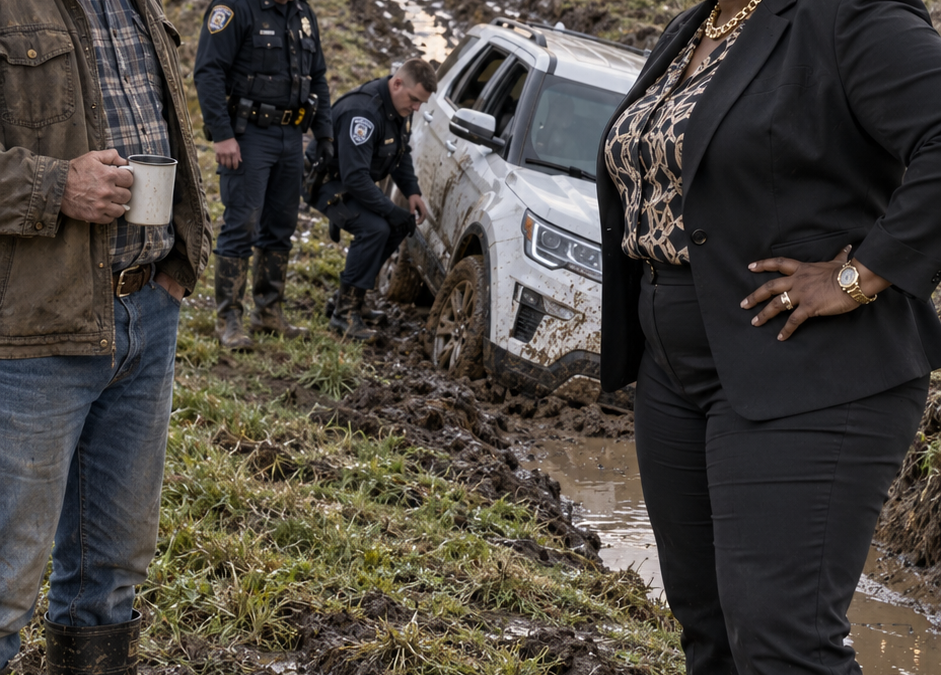
At 8:06, Karen’s SUV appeared near the northeast corner.
She approached the field at the same speed she always used.
No hesitation.
No inspection.
The old tire ruts had been filled and graded during construction, but she followed their remembered line.
Her front wheels reached the trench.
For half a second, nothing happened.
Then the SUV’s nose dropped.
Not violently.
There was no dramatic crash.
The front end sank with the slow certainty of weight finding ground that could no longer support it.
Muddy water rose around the wheel wells.
Karen accelerated.
The rear tires spun across saturated soil.
Mud sprayed behind the vehicle.
The tires dug deeper.
The undercarriage settled against the far edge of the channel, leaving the SUV angled forward with its front wheels buried.
The engine stopped.
I remained on the porch.
The driver’s door opened.
Karen stepped into ankle-deep mud.
She was not injured.
She looked at the SUV.
Then at the ditch.
Then at me.
“You did this on purpose!”
Her voice carried forty yards across the field.
I took a sip of coffee.
“You built a trap!”
“It’s a drainage ditch.”
“I’m calling the police.”
“That would be helpful.”
Karen pulled out her phone.
I went inside, retrieved my folder, and returned to the porch.
I did not need to photograph her vehicle.
The trail camera had recorded the entire crossing with an automatic timestamp.
Two patrol cars arrived twenty-three minutes later.
One stopped on the county road.
The other entered through the subdivision.
The officers spoke with Karen first.
She remained beside the SUV, boots coated in mud, gesturing toward my porch and the drainage channel.
After several minutes, one officer walked toward me.
“Is this your property?”
I handed him the certified deed.
He checked my name and the county seal.
“Yes.”
The plat followed.
The northeast corner showed no easement or access lane.
He looked toward the stranded SUV.
“What is the ditch?”
I gave him the drainage permit.
County-issued.
Approved site plan attached.
Route and direction of flow clearly marked.
The permit date predated construction.
The officer read it.
“This was filed three weeks ago?”
“Yes.”
“And the work finished Wednesday?”
“Yes.”
“The placard?”
I pointed toward the fence post.
It remained visible.
He called the second officer.
They reviewed the deed, plat, permit, and contractor information.
One walked the entire channel.
He examined the grade markers and the drainage outlet.
Then he returned to the porch.
“Has anyone been granted access across this parcel?”
“No.”
“Has the HOA claimed an easement?”
“They began reviewing one. It has not been granted.”
I opened the folder.
The formal trespass notice came next.
Then the returned certified envelope marked REFUSED.
The officer read Karen’s name on the delivery line.
“She declined this?”
“Twice.”
“Six weeks ago?”
“Yes.”
Behind it were the trail-camera summaries.
Eleven crossings.
Same vehicle.
Same route.
Dates and times printed on each image.
Several occurred after verbal warnings.
The most recent happened after certified notice.
The officer studied the photographs.
Then he walked back to Karen.
I stayed on the porch.
His voice carried across the wet field.
“This is private property. The drainage project is permitted.”
Karen pointed toward the subdivision.
“The HOA has a longstanding access claim.”
“Has a court granted that access?”
“Our attorney is formalizing it.”
“So you do not currently have a legal right to cross this property.”
Silence followed.
Four or five residents had gathered at the back fence.
Deb stood among them with her arms folded against the cold.
Karen began talking about community use and historical access.
The officer returned to one point.
No easement existed.
Formal notice had been sent.
Karen had entered anyway.
The legal question was not why I had improved drainage on my farm.
The question was why she had driven onto land she had been ordered to stay off.
Her gestures became sharper.
Her argument became smaller.
“I’ll sue him,” she said. “Vehicle damage, extraction costs, emotional distress—everything.”
The officer paused.
“Your vehicle is currently on private property you entered without authorization. The installation you drove into has a county permit. You should speak with your attorney before making additional statements about liability.”
Karen looked toward the porch.
The certainty had left her posture.
She reached for her phone and called a tow company.
Because of the SUV’s angle, the operator needed access from the county side.
Karen looked at me.
When she spoke, her voice had lost the edge it carried on my porch months earlier.
“Will you allow the tow truck onto the property?”
I could have made her wait.
I could have demanded that she walk around to my driveway.
Neither would improve the farm or the record.
“Yes,” I said. “The truck can enter.”
The officers remained until the tow operator arrived.
The extraction was slow.
A winch pulled the SUV backward while another line stabilized it. Mud released the front wheels with a wet sucking sound.
When the vehicle finally reached solid ground, its bumper was scratched and one lower panel had been bent.
Karen climbed into the tow truck without looking at me.
Deb remained at the fence.
Our eyes met.
She nodded once.
I nodded back.
There was no cheering.
There was only the quiet recognition that something everyone had always known had finally been said officially.
Karen had no right to be there.
The HOA attorney withdrew the prescriptive-easement claim eleven days later.
Gaines called me Tuesday morning.
“I have a letter from opposing counsel.”
I stood at the kitchen counter with coffee.
“What does it say?”
“After review of newly available evidence, the association believes the factual basis is insufficient to proceed.”
“Newly available?”
“That’s their phrase.”
The new evidence was not new.
The HOA had simply refused to look at it until police placed it in a report.
A valid drainage permit.
A clean deed.
A certified plat showing no easement.
A refused trespass notice.
Eleven timestamped crossings.
The police report made the sequence difficult to reinterpret.
The attorney thanked Gaines for my patience and declared the matter closed.
One paragraph.
Weeks of threats collapsed into one paragraph.
Karen’s insurance company denied the vehicle claim.
The determination stated that the SUV had been driven onto private property without authorization. Damage and extraction expenses resulting from that conduct fell outside the applicable coverage.
The specialized tow had not been cheap.
Karen paid for it herself.
I did not ask the amount.
The HOA’s attorney fees were different.
The board had authorized the prescriptive-easement review, which meant ninety-three homeowners helped fund an attempt to secure Karen’s personal shortcut.
People who had spent four years paying her fines were now paying lawyers because their president did not want to spend three extra minutes using a public road.
At the next board meeting, a member proposed reviewing how the easement action had been approved.
The motion passed four to one.
Karen cast the only opposing vote.
Deb told me over the fence in December.
“They haven’t started a recall,” she said. “But three board members are keeping their own records now.”
“That’s a start.”
“They’re asking questions.”
“That’s usually how it begins.”
She looked back toward the subdivision.
“People used to think asking made things worse.”
“Sometimes it does at first.”
“And after?”
“After depends on whether anyone keeps asking.”
She smiled faintly.
“I think they will.”
The northeast corner drained properly all winter.
November rain entered the channel and moved east instead of sitting across the field.
December’s freeze-thaw cycles did not destroy the grade.
By January, the ground beside the channel was firmer than it had been in years.
By February, I could cross the corner without mud pulling at my boots.
The improvement surprised me even though I had paid for it and watched every stage of construction.
I had spent years accepting that corner as bad ground.
Water pooled there.
Planting failed.
Maintenance could wait.
Karen’s trespassing finally forced me to address a problem larger than her tire tracks.
In late winter, I ordered a seed mixture suited to the soil and sunlight.
Something with roots strong enough to hold the bank without obstructing water flow.
The bags sat in the barn until the soil warmed.
One morning in early March, I walked the ditch from the fence to the eastern outlet.
Clear water moved along the bottom.
Only a trickle after a dry week, but it moved.
That was the difference.
Water with somewhere to go did not fight the land.
The banks had settled naturally.
New grass covered the places where Roy’s crew had disturbed the soil.
A person could still see the drainage line if they knew where to look, but it no longer seemed new.
It belonged to the field.
Karen’s tire ruts were gone.
Two and a half years of repeated crossings had left a diagonal scar so regular that it once looked surveyed.
Now there was no path.
No tracks.
No suggestion that a vehicle had ever possessed the right to pass through.
I stood at the eastern end and looked back toward the porch.
For months, every glance at that corner had reminded me of Karen’s dismissal, the legal letters, the cameras, and the SUV buried nose-first in mud.
That morning, I did not think about her.
I thought about soil temperature.
Rainfall.
The seed in my barn.
Whether the ground would be ready by April.
Then I went back to the house and made coffee.
The farm was quiet.
No engines crossed the field.
No tires cut through the low ground.
The water moved steadily through the channel toward the county ditch, following the grade it had been given.
For the first time in years, everything on that corner of my land was exactly where it belonged.
Have you finished reading the story and want to read it again?
The HOA President Kept Driving Across My Farm—Then Police Asked Why Her SUV Was Sinking in My Drainage Trench
She treated my field like her private road.
I warned her twice.
On the next rainy Saturday, the ground finally answered for me.
Karen Voss drove across my field as if my forty-two acres were another amenity included with her HOA dues.
She did not use the county road running around the property. She cut diagonally through the northeast corner, following two deep tire ruts she had carved into my soil over two and a half years.
I stood on my porch with coffee in my hands, watching her SUV move through the gray light before sunrise.
She saw me.
She raised one hand.
It was not a wave.
It was the dismissive gesture of someone acknowledging an obstacle that did not deserve the inconvenience of stopping.
Then she continued toward the county access road.
Forty minutes later, she returned on foot.
Her boots followed the same path back across my field. When she reached the porch, she did not apologize or even pretend she had made a mistake.
“I’ve been using that route for two and a half years,” she said.
“I know.”
“The whole neighborhood uses it.”
“No, they don’t.”
Her lips tightened.
“If it were a problem, someone would have said something before now.”
“I’m saying it now.”
Karen tilted her head.
Behind her stood Milbrook Estates: ninety-three homes, two guarded entrances, a community pool, and enough bylaws to make a dictionary feel underwritten.
She had been HOA president for four years.
Most residents paid whatever fine appeared in their mailbox because resisting her cost more in time and stress than writing the check. Karen had built her authority on that calculation.
Now she expected it to work on me.
“The HOA has resources,” she said. “If you’re planning to make this difficult, you should consider that carefully.”
I looked past her toward the tracks.
They crossed the lowest ground on my property, a corner that flooded first every autumn and drained last. Water collected in those ruts after every storm, softening the earth until the soil could pull a boot from a man’s foot.
“I own this land,” I said. “There is no easement, no access agreement, and no permission for you to cross it. You need to stop.”
Karen smiled.
It was not the smile of someone who had heard me.
It was the smile of someone who believed listening was optional because consequences were unlikely.
“I appreciate your perspective.”
She turned toward the subdivision.
“Karen.”
She stopped.
“If you drive across this field again, you will be trespassing.”
She glanced over her shoulder.
“We’ll see what the board’s attorney says.”
Then she walked away.
I remained on the porch, studying the ruts.
Karen believed I had spent the previous two and a half years doing nothing.
I had not.
For weeks, trail cameras had recorded her vehicle, the dates, the times, and the exact path she used. Certified county records already confirmed that no right-of-way crossed my property. A trespass notice was being prepared, and the low northeast corner had finally been scheduled for drainage work I had postponed for years.
Karen thought my silence had become permission.
She did not know I was about to replace her shortcut with something the county had already agreed my farm genuinely needed.
PART2
My family owned that ground before Milbrook Estates had a name.
My uncle farmed it first.
Soybeans across the middle acreage. Corn closer to the creek. Timber running along the north ridge where the soil grew thinner and the roots held the slope together.
I bought the forty-two acres from him eleven years earlier.
The deed was clean.
No access rights.
No utility easements.
No footpaths.
No shared boundary agreements.
The county plat showed one uninterrupted parcel stretching from the western road to the eastern access lane.
When Milbrook Estates appeared beside us eight years ago, I did not object.
The subdivision brought new fences, construction noise, delivery trucks, weekend lawn equipment, and summer evenings filled with children shouting around the pool.
That was the cost of living beside change.
You learned which noises mattered and which ones disappeared if you allowed time to pass.
Most of the residents were decent people.
They waved from the road. Some stopped at my farm stand. A few brought their children to see calves in spring.
I never believed living beside ninety-three houses gave me authority over their backyards.
Karen apparently believed the reverse arrangement applied.
She had become HOA president four years before our porch confrontation.
Her methods were not theatrical.
That was what made them effective.
Violation notices arrived with the relevant bylaw already highlighted. Fine schedules reset monthly. Compliance photographs were attached. Saturday inspections occurred when residents were home and unable to claim they had missed her.
She cited section numbers before explaining the alleged offense.
A mailbox painted the wrong shade of black became an architectural violation.
A fence two inches too high became a threat to neighborhood uniformity.
A vehicle parked overnight on a driveway instead of inside a garage became a community appearance issue.
Residents learned that a three-hundred-dollar fine was cheaper than taking a day off work, hiring an attorney, attending meetings, and enduring whatever additional inspection might follow.
Karen understood that math.
Her authority grew from the assumption that everyone else would eventually get tired.
For a long time, she was usually right.
The crossing began under different circumstances.
A water main failed beneath Milbrook’s primary entrance road.
The break was serious enough to close one lane for six weeks. During construction hours, traffic alternated through the remaining lane, creating long morning backups.
At the rear of the subdivision, a wooden fence panel had pulled loose.
Someone discovered that a vehicle could pass through the gap, cross the northeast corner of my field, and reach the county road.
At first, several residents used it.
I saw the cars.
I also saw the traffic jam at the main entrance.
I said nothing.
The situation was temporary, and neighbors sometimes needed room to solve temporary problems.
I did not want to be the man installing chains and signs while families were struggling to get children to school and themselves to work.
When repairs ended, the traffic stopped.
The loose fence panel was secured.
The tire tracks began filling with grass.
Every resident returned to the normal road.
Everyone except Karen.
The first few times she continued crossing, I assumed habit would fade.
It did not.
Her blue SUV followed the same diagonal line, entering through a gap near the back perimeter and leaving by the county access road.
The shortcut saved three minutes.
Maybe five if traffic was unusually bad.
That was the value Karen had assigned to my land.
Three minutes of her morning were worth more than my right to decide who drove across forty-two acres I paid taxes on.
As weeks became months, the tracks deepened.
Rainwater followed them, widening the damage. The northeast corner had always drained poorly, and her tires created two channels that held water exactly where I needed it to move away.
Karen began telling residents that I had granted informal permission.
She spoke casually, as though we had discussed it years earlier over coffee.
A few neighbors believed her and used the path.
Most stopped quickly.
Perhaps driving through someone else’s field felt wrong once they were actually doing it.
Karen had no such instinct.
She crossed two or three times most weeks.
The regularity gave the route the appearance of legitimacy. Tire tracks can resemble a road when the same person follows them often enough.
Three months before the morning on my porch, I went to her house.
I knocked.
Karen opened the door carrying her phone, as if she expected every conversation to become evidence against someone else.
“I need you to stop crossing my farm.”
She blinked once.
“The access path?”
“It isn’t an access path. It is a pair of tire ruts on private property.”
“It has been in active use for years.”
“Because the main road was closed.”
“The road reopened more than two years ago.”
“I’m aware.”
“Then you also know there is no reason to keep using my field.”
Karen smiled.
“I’ll review the community guidelines.”
“The HOA guidelines have no authority over my land.”
“I appreciate you bringing this to my attention.”
“I’m not asking for a review. I’m revoking whatever permission you believe you have.”
Her expression cooled.
“There may be longstanding use considerations.”
“There is no easement.”
“I said I’ll look into it.”
Four days later, her SUV crossed again.
Then again.
I returned to her house the following Tuesday.
This time, I used language that could not be mistaken for a neighborly suggestion.
“The crossing stops now.”
Karen remained inside the doorway.
“I don’t think you understand the situation.”
“I understand my deed.”
“We have ninety-three homes. That path has become an established access route.”
“For you.”
“Informal rights develop over time. I’m sure you’re aware of that.”
I was.
She did not realize how aware.
“If you try to interfere,” she continued, “the board may ask our attorney to formalize a right-of-way. That process can become expensive for a property owner.”
She delivered the threat like free legal advice.
“There is no easement over my land.”
“That is your interpretation.”
“It is the county recorder’s interpretation.”
“We’ll see.”
I looked at her for another moment.
Then I left.
That afternoon, I installed two trail cameras overlooking the northeast corner.
The doctrine Karen was reaching toward was a prescriptive easement.
In simple terms, a person who openly uses another person’s property without permission and without effective objection for the required number of years may eventually claim a permanent right to continue.
The law varies by jurisdiction.
In ours, a complete claim generally required five years of qualifying use.
Karen had been crossing for half that period.
She did not yet have a complete claim, but she had enough history to begin manufacturing an argument.
That was why documentation mattered.
Permission could defeat the hostile nature of a prescriptive claim.
Formal objection could interrupt the clock.
Evidence showing that one person used a path for personal convenience could undermine an assertion of broad community reliance.
Karen believed silence was consent.
The law was more careful.
Three days after our second conversation, the HOA board met.
I was not invited.
I did not belong to Milbrook Estates and had no obligation to attend its meetings.
Deb Harper, who lived in the last row of homes near my fence, told me what happened.
Karen presented the path as a community asset.
According to her, the route had existed for years and benefited residents. Formalizing it would protect the neighborhood from future disruption.
One board member asked whether I had ever granted permission.
Karen answered, “He never formally objected.”
That was false.
The board member looked uncomfortable.
Karen moved forward before anyone could examine the statement.
A narrow vote authorized the HOA attorney to send an inquiry.
The letter arrived eight days later.
It described the northeast route as a longstanding community path and suggested its history might support a formal access arrangement.
The HOA hoped I would cooperate in reaching an amicable resolution.
The letter cited no correct statute.
It named no complete legal theory.
It was intimidation formatted into paragraphs and printed on expensive paper.
I placed it beside my deed.
One document carried the county recorder’s seal and decades of title history.
The other carried Karen’s signature.
That evening, I checked the cameras.
Four crossings in six days.
Same SUV.
Same diagonal route.
Two occurred after I had personally ordered her to stop.
I printed the photographs and timestamps.
Then I placed them behind the HOA letter.
From that point forward, conversation was finished.
Everything would happen through records.
The county land office occupied the ground floor of an older building whose hallways smelled faintly of dust and toner.
The clerk wore half glasses on a beaded chain. She had assisted me when I bought the farm from my uncle and again when I updated my mailing address.
I told her what I needed.
Full deed history.
Plat map.
Every easement, right-of-way, access agreement, encumbrance, and recorded interest ever attached to the parcel.
She typed for eleven minutes.
Then she turned the monitor slightly.
“Nothing.”
“Nothing at all?”
“No easements recorded against this parcel.”
“Not even an old farm lane?”
“No.”
The plat showed the northeast corner as solid, unencumbered farmland from the fence to the county road.
I requested certified copies.
She stamped each document, logged the request, and placed the records in a manila envelope.
That envelope went into my growing folder.
Deb spoke to me again later that week.
She came to the fence while I changed a trail-camera battery.
“Karen’s been telling people you approved the path.”
“How long?”
“At least a year. Maybe longer.”
“What exactly does she say?”
“That you and she worked it out. That you don’t mind residents crossing.”
“Do people believe her?”
“I did.”
I wrote down her name, date, and statement.
Another resident, Carl, contacted me separately.
Karen had told him the path was approved. He drove across twice, felt uneasy, and stopped.
“I should have asked you.”
“You stopped.”
“I still crossed.”
“I appreciate you telling me.”
He apologized again.
I added his statement to the file.
Twenty-two days of camera footage gave me cleaner evidence.
Karen crossed eleven times.
Another vehicle appeared twice.
It entered the field, traveled halfway across, then reversed and left.
That car never returned.
Karen’s entire “community route” consisted mainly of Karen.
Eleven documented crossings by her.
Two hesitant attempts by someone else.
Four of Karen’s crossings occurred after my direct verbal objection.
I printed the summary and prepared a formal notice.
Her vehicle was entering private property without authorization.
No easement existed.
Any prior tolerance was revoked.
All entry had to stop immediately.
I had the notice notarized and sent it by certified mail with return receipt requested.
The postal service attempted delivery twice.
Karen refused both attempts.
The envelope returned bearing one word in red:
REFUSED.
She may have thought declining the envelope prevented notice.
It did the opposite.
A person cannot defeat service merely by refusing to take the document waiting at the door.
I filed the returned envelope.
Now Karen could not credibly claim ignorance.
Every crossing after that date would occur after formal written notice.
I called Roy Palmer that Friday.
Roy had handled grading and water management projects on my farm before.
“The northeast corner?” he asked when I described the work.
“That’s the one.”
“I’ve been telling you to drain it for five years.”
“I’ve been busy.”
“You’ve been stubborn.”
“That too.”
He came the following Tuesday and walked the low ground with a level rod.
Water had always collected there.
Karen’s ruts made it worse, but they had not created the underlying problem.
The corner needed a proper drainage channel following the natural grade toward the county ditch.
Roy marked the route.
“This will recover part of the field,” he said. “You might actually plant it next spring.”
“What will the county require?”
“Standard agricultural drainage permit. Site plan. Nothing unusual.”
I called the permitting office.
The woman explained the process.
Deed.
Location.
Dimensions.
Direction of flow.
Review time: three to five business days.
Straightforward.
While I prepared that application, a real law firm sent me a letter on behalf of the HOA.
The tone had changed.
Milbrook Estates was reviewing the northeast path for possible recognition as a prescriptive easement.
The letter correctly identified the doctrine.
It listed the elements the association intended to establish: open use, continuous use, notorious use, and use lasting beyond the statutory threshold.
It instructed me not to alter the path while the review remained pending.
For the first time, Karen had moved beyond threatening legal action and involved someone who knew what the words meant.
I called Gaines Mercer, a property attorney at the county seat.
My uncle had used him during a boundary disagreement years earlier.
Gaines’s office smelled of old files and coffee that had been heated since breakfast.
He read the HOA letter.
Then he reviewed my deed, plat, photographs, trail-camera summaries, and returned certified notice.
“This isn’t frivolous,” he said.
I appreciated that he did not tell me what he thought I wanted to hear.
“The use occurred openly,” he continued. “The duration is real. Two and a half years doesn’t meet the full statutory period, but it gives their lawyer facts to discuss.”
I placed the returned envelope in front of him.
“When did you send this?”
I gave him the date.
He examined the red stamp.
“This interrupts their clock.”
“That’s what I thought.”
“Refusal does not protect her. The law treats her as notified. Any use after this date is documented trespass.”
He tapped the envelope.
“Their attorney may not know this exists.”
“Or he hopes I don’t know what it means.”
“That too.”
Gaines drafted a one-page opinion.
Plain language.
Formal objection made.
Notice served.
Prescriptive period interrupted.
Subsequent crossings unauthorized.
I placed the opinion in the folder.
Four days after the HOA attorney instructed me not to disturb the path, Karen drove across again.
The trail camera recorded her at 8:11 in the morning.
I watched the footage twice.
That crossing changed something inside me.
I was no longer wondering whether Karen misunderstood.
She understood enough.
She simply believed no consequence would reach her.
I completed the drainage application that evening.
The drainage project was real.
The northeast corner had flooded for years.
Every autumn, water pooled for weeks, drowned roots, softened the topsoil, and made the ground useless until winter froze it solid.
I had postponed the work because it was inconvenient and expensive.
Karen’s crossing did not invent my need for drainage.
It finally made me stop postponing it.
The site plan placed the channel along the natural low grade.
That route happened to intersect the diagonal track she used.
There was no legal reason to preserve an unauthorized path across my land so a trespasser could continue avoiding three minutes of road.
I attached the deed and survey.
The county approved the permit Thursday.
Roy scheduled his crew for Monday.
I did not send Karen an announcement.
I did not place a warning in the HOA newsletter.
The permit was public.
The work occurred in daylight.
The required placard would be posted at the access point.
Anyone with a legal reason to enter the property would use my driveway and see the work.
Anyone looking from the subdivision could watch the machinery.
Roy arrived at 6:45 Monday morning with three workers and a compact excavator.
By 7:15, the machine was cutting earth.
The channel followed the northeast boundary at roughly a two-percent grade toward the county ditch.
The crew checked depth and slope repeatedly.
This was farm maintenance, not theater.
Residents watched through their back windows.
A man stopped with his dog.
Nobody asked for an explanation.
On the second day, Karen passed the field.
Her SUV slowed near the repaired gap in the HOA fence.
She looked at the excavator.
Then at the soil piles.
Then at the fresh channel crossing the route she had used.
For a moment, I thought she understood.
She continued driving.
Apparently, the idea that work on my farm might affect her unauthorized shortcut never fully formed.
That evening, Karen updated the board.
Deb attended.
According to Karen, the easement review was advancing on schedule. My silence showed that I understood the strength of the HOA’s position.
One board member asked whether I had answered the attorney.
Karen said anyone with a genuine objection would respond quickly and clearly.
I almost admired the efficiency of the lie.
She had refused my certified notice, ignored my verbal objections, and then cited my supposed silence as consent.
The trench was finished Wednesday afternoon.
Roy walked the grade with me.
The ditch was shallow enough to remain ordinary agricultural drainage and deep enough to handle significant water.
Compacted banks supported the edges.
The flow discharged properly into the county system.
From a distance, the dark soil blended with the field.
The permit placard remained fixed to the fence post in clear view.
Roy shook my hand.
“First hard rain will tell us how well it works.”
The rain began Thursday evening.
It was a slow autumn storm.
By Friday afternoon, the northeast corner looked the way it always looked after heavy rain.
Gray.
Saturated.
Soft.
The difference was beneath the surface.
Instead of sitting in Karen’s tire ruts, water entered the new channel and moved east.
The ditch filled with muddy runoff until its edges blended into the surrounding ground.
Anyone walking from the legal entrance could see the posted permit and drainage work.
From the subdivision fence, the field simply looked wet.
I knew Karen’s schedule.
The trail-camera timestamps placed most Saturday crossings between eight and eight-thirty.
I set my alarm for six-thirty.
Not because I intended to lure her.
The project had been completed.
The permit was posted.
The trespass notice had been served.
Whether Karen entered my property again was her decision.
Still, I suspected she would.
People who mistake repetition for ownership rarely reconsider simply because the landscape changes.
I made coffee and sat on the porch.
The farm was quiet after the storm.
At 8:06, Karen’s SUV appeared near the northeast corner.
She approached the field at the same speed she always used.
No hesitation.
No inspection.
The old tire ruts had been filled and graded during construction, but she followed their remembered line.
Her front wheels reached the trench.
For half a second, nothing happened.
Then the SUV’s nose dropped.
Not violently.
There was no dramatic crash.
The front end sank with the slow certainty of weight finding ground that could no longer support it.
Muddy water rose around the wheel wells.
Karen accelerated.
The rear tires spun across saturated soil.
Mud sprayed behind the vehicle.
The tires dug deeper.
The undercarriage settled against the far edge of the channel, leaving the SUV angled forward with its front wheels buried.
The engine stopped.
I remained on the porch.
The driver’s door opened.
Karen stepped into ankle-deep mud.
She was not injured.
She looked at the SUV.
Then at the ditch.
Then at me.
“You did this on purpose!”
Her voice carried forty yards across the field.
I took a sip of coffee.
“You built a trap!”
“It’s a drainage ditch.”
“I’m calling the police.”
“That would be helpful.”
Karen pulled out her phone.
I went inside, retrieved my folder, and returned to the porch.
I did not need to photograph her vehicle.
The trail camera had recorded the entire crossing with an automatic timestamp.
Two patrol cars arrived twenty-three minutes later.
One stopped on the county road.
The other entered through the subdivision.
The officers spoke with Karen first.
She remained beside the SUV, boots coated in mud, gesturing toward my porch and the drainage channel.
After several minutes, one officer walked toward me.
“Is this your property?”
I handed him the certified deed.
He checked my name and the county seal.
“Yes.”
The plat followed.
The northeast corner showed no easement or access lane.
He looked toward the stranded SUV.
“What is the ditch?”
I gave him the drainage permit.
County-issued.
Approved site plan attached.
Route and direction of flow clearly marked.
The permit date predated construction.
The officer read it.
“This was filed three weeks ago?”
“Yes.”
“And the work finished Wednesday?”
“Yes.”
“The placard?”
I pointed toward the fence post.
It remained visible.
He called the second officer.
They reviewed the deed, plat, permit, and contractor information.
One walked the entire channel.
He examined the grade markers and the drainage outlet.
Then he returned to the porch.
“Has anyone been granted access across this parcel?”
“No.”
“Has the HOA claimed an easement?”
“They began reviewing one. It has not been granted.”
I opened the folder.
The formal trespass notice came next.
Then the returned certified envelope marked REFUSED.
The officer read Karen’s name on the delivery line.
“She declined this?”
“Twice.”
“Six weeks ago?”
“Yes.”
Behind it were the trail-camera summaries.
Eleven crossings.
Same vehicle.
Same route.
Dates and times printed on each image.
Several occurred after verbal warnings.
The most recent happened after certified notice.
The officer studied the photographs.
Then he walked back to Karen.
I stayed on the porch.
His voice carried across the wet field.
“This is private property. The drainage project is permitted.”
Karen pointed toward the subdivision.
“The HOA has a longstanding access claim.”
“Has a court granted that access?”
“Our attorney is formalizing it.”
“So you do not currently have a legal right to cross this property.”
Silence followed.
Four or five residents had gathered at the back fence.
Deb stood among them with her arms folded against the cold.
Karen began talking about community use and historical access.
The officer returned to one point.
No easement existed.
Formal notice had been sent.
Karen had entered anyway.
The legal question was not why I had improved drainage on my farm.
The question was why she had driven onto land she had been ordered to stay off.
Her gestures became sharper.
Her argument became smaller.
“I’ll sue him,” she said. “Vehicle damage, extraction costs, emotional distress—everything.”
The officer paused.
“Your vehicle is currently on private property you entered without authorization. The installation you drove into has a county permit. You should speak with your attorney before making additional statements about liability.”
Karen looked toward the porch.
The certainty had left her posture.
She reached for her phone and called a tow company.
Because of the SUV’s angle, the operator needed access from the county side.
Karen looked at me.
When she spoke, her voice had lost the edge it carried on my porch months earlier.
“Will you allow the tow truck onto the property?”
I could have made her wait.
I could have demanded that she walk around to my driveway.
Neither would improve the farm or the record.
“Yes,” I said. “The truck can enter.”
The officers remained until the tow operator arrived.
The extraction was slow.
A winch pulled the SUV backward while another line stabilized it. Mud released the front wheels with a wet sucking sound.
When the vehicle finally reached solid ground, its bumper was scratched and one lower panel had been bent.
Karen climbed into the tow truck without looking at me.
Deb remained at the fence.
Our eyes met.
She nodded once.
I nodded back.
There was no cheering.
There was only the quiet recognition that something everyone had always known had finally been said officially.
Karen had no right to be there.
The HOA attorney withdrew the prescriptive-easement claim eleven days later.
Gaines called me Tuesday morning.
“I have a letter from opposing counsel.”
I stood at the kitchen counter with coffee.
“What does it say?”
“After review of newly available evidence, the association believes the factual basis is insufficient to proceed.”
“Newly available?”
“That’s their phrase.”
The new evidence was not new.
The HOA had simply refused to look at it until police placed it in a report.
A valid drainage permit.
A clean deed.
A certified plat showing no easement.
A refused trespass notice.
Eleven timestamped crossings.
The police report made the sequence difficult to reinterpret.
The attorney thanked Gaines for my patience and declared the matter closed.
One paragraph.
Weeks of threats collapsed into one paragraph.
Karen’s insurance company denied the vehicle claim.
The determination stated that the SUV had been driven onto private property without authorization. Damage and extraction expenses resulting from that conduct fell outside the applicable coverage.
The specialized tow had not been cheap.
Karen paid for it herself.
I did not ask the amount.
The HOA’s attorney fees were different.
The board had authorized the prescriptive-easement review, which meant ninety-three homeowners helped fund an attempt to secure Karen’s personal shortcut.
People who had spent four years paying her fines were now paying lawyers because their president did not want to spend three extra minutes using a public road.
At the next board meeting, a member proposed reviewing how the easement action had been approved.
The motion passed four to one.
Karen cast the only opposing vote.
Deb told me over the fence in December.
“They haven’t started a recall,” she said. “But three board members are keeping their own records now.”
“That’s a start.”
“They’re asking questions.”
“That’s usually how it begins.”
She looked back toward the subdivision.
“People used to think asking made things worse.”
“Sometimes it does at first.”
“And after?”
“After depends on whether anyone keeps asking.”
She smiled faintly.
“I think they will.”
The northeast corner drained properly all winter.
November rain entered the channel and moved east instead of sitting across the field.
December’s freeze-thaw cycles did not destroy the grade.
By January, the ground beside the channel was firmer than it had been in years.
By February, I could cross the corner without mud pulling at my boots.
The improvement surprised me even though I had paid for it and watched every stage of construction.
I had spent years accepting that corner as bad ground.
Water pooled there.
Planting failed.
Maintenance could wait.
Karen’s trespassing finally forced me to address a problem larger than her tire tracks.
In late winter, I ordered a seed mixture suited to the soil and sunlight.
Something with roots strong enough to hold the bank without obstructing water flow.
The bags sat in the barn until the soil warmed.
One morning in early March, I walked the ditch from the fence to the eastern outlet.
Clear water moved along the bottom.
Only a trickle after a dry week, but it moved.
That was the difference.
Water with somewhere to go did not fight the land.
The banks had settled naturally.
New grass covered the places where Roy’s crew had disturbed the soil.
A person could still see the drainage line if they knew where to look, but it no longer seemed new.
It belonged to the field.
Karen’s tire ruts were gone.
Two and a half years of repeated crossings had left a diagonal scar so regular that it once looked surveyed.
Now there was no path.
No tracks.
No suggestion that a vehicle had ever possessed the right to pass through.
I stood at the eastern end and looked back toward the porch.
For months, every glance at that corner had reminded me of Karen’s dismissal, the legal letters, the cameras, and the SUV buried nose-first in mud.
That morning, I did not think about her.
I thought about soil temperature.
Rainfall.
The seed in my barn.
Whether the ground would be ready by April.
Then I went back to the house and made coffee.
The farm was quiet.
No engines crossed the field.
No tires cut through the low ground.
The water moved steadily through the channel toward the county ditch, following the grade it had been given.
For the first time in years, everything on that corner of my land was exactly where it belonged.








