𝗙𝗨𝗟𝗟 𝗦𝗧𝗢𝗥𝗬 The HOA President Had No Idea Why I Kept Checking My Watch While Her Roller Destroyed My Garden
𝗣𝗔𝗥𝗧 𝟮
I raised my hand.
Vivien saw me.
Ignored it.
“Realistically,” she said, “market pressure will resolve that problem eventually.”
Another resident asked what she meant.
Vivien looked directly at me.
“The land is valuable. The current owner simply doesn’t yet understand what it’s worth to the community.”
Then she added:
“People in his financial position rarely hold out forever.”
That was the first time she publicly said I was too poor to keep my land.
Not the last.
I stood after the meeting.
Waited until people cleared.
Then approached the board table.
“You shouldn’t discuss my finances.”
Vivien gathered papers.
“I didn’t disclose anything private.”
“You don’t know anything private.”
She smiled.
“Exactly.”
That answer stayed with me.
“Then why say it?”
She looked toward my work boots.
Then my shirt.
“People aren’t difficult to read, Ethan.”
I remember thinking how dangerous a sentence that was.
Not because it insulted me.
Because Vivien had built an entire decision-making system around assuming appearances were evidence.
My silence was weakness.
My truck was poverty.
My garden was desperation.
My refusal to sell was ignorance.
She had no idea what I had done before I became the widowed man next door.
Years earlier, I had worked as a hydrological engineer for the state.
Drainage.
Erosion.
Slope stability.
Stormwater transport.
Soil infiltration.
Watershed modeling.
My work had taken me across half the state.
I spent more time looking at culverts than most people spend looking at their children.
When Ashborne Heights was first designed, I had been part of a technical team reviewing drainage conditions along the hillside.
Not because I owned the lower property.
That came later through family transfer.
Because I understood the watershed.
The hillside looked stable in summer.
That was misleading.
Beneath the surface were clay layers that held water.
During heavy storms, runoff accelerated off the upper slope, concentrated in natural channels, and crossed the lower ground before reaching the creek.
Disturb that pattern without replacing it with proper drainage and you could create flooding.
Erosion.
Even localized slope failure.
The area behind my future house formed a natural buffer.
That was why, during original development approval, the corridor was deliberately kept outside Ashborne Heights.
It needed to remain permeable.
Undeveloped.
Able to absorb and slow runoff.
After Anna died, I left state work.
I wanted to be home for Paige.
I took consulting assignments occasionally.
But mostly I farmed the garden, repaired equipment, and lived more slowly.
People like Vivien saw that as decline.
To me, it was the first time in twenty years I wasn’t working fifty hours a week while missing dinner with my daughter.
Then came the grant.
Two years before Vivien destroyed my garden, Ashborne Heights received $2.8 million in federal funding for stormwater modernization and ecological-buffer restoration.
I knew because the grant notice was public.
I was pleased.
The community needed it.
The upper drainage network was aging.
Several inlets were undersized.
Runoff from fertilized lawns had been crossing my property at increasingly concentrated levels after heavy storms.
The grant proposal promised:
New storm drains.
Retention improvements.
Runoff treatment.
Erosion-control structures.
A protected buffer along the southern hillside.
It was a sensible project.
Then nothing happened.
No excavation.
No new outlet structures.
No retention work.
No drainage crews.
Yet the following year’s public grant report said the project was substantially complete.
That didn’t make sense.
So I started watching more carefully.
During storms, I took water samples.
At first for myself.
Then soil samples.
The nitrate readings were high.
Other contaminants followed.
Nothing catastrophic.
But much worse than the completed-project reports suggested should have been flowing off that hill.
I prepared a technical memo.
Attached photographs.
Drainage observations.
Sample data.
Sent it to the appropriate federal office.
I expected a bureaucratic acknowledgement.
Instead, I received a phone call from Agent Marin Cross.
Marin worked with the Office of Inspector General connected to the federal department overseeing part of the funding.
Her voice was careful.
“Mr. Rowe, how certain are you that the stormwater improvements described in these reports were not installed?”
“Very.”
“How certain?”
“I helped evaluate the original hillside drainage. If they had installed what the grant report describes, I would be able to see at least four major changes from my property.”
“Can you see any?”
“No.”
That began an investigation.
Quietly.
Marin visited my property.
Then Agent Daniel Keane.
Then Dr. Laurel Finch, a soil and watershed scientist working with the investigative team.
They examined the runoff corridor.
Confirmed the conditions.
Asked whether I would permit sampling equipment on my land.
I agreed.
The numbered steel stakes appeared soon after.
Each one corresponded to a sampling location.
Some identified shallow soil probes.
Others marked deeper monitoring devices.
One line carried preserved water samples toward a protected collection point.
There were moisture sensors.
Runoff collectors.
Baseline markers.
None of it looked impressive.
That was intentional.
Marin gave me one instruction repeatedly.
Do not tell Ashborne Heights what we’re investigating.
If anyone asks about the stakes?
“Research.”
Which was true.
If someone attempts to move them?
“Tell them not to.”
If they insist?
“Call me.”
For months, the garden became part laboratory, part buffer, part food source.
The tomatoes grew around monitoring equipment.
Wildflowers stabilized soil near sample lines.
Paige joked that we were the only family she knew whose zucchini might become federal evidence.
I told her never to underestimate zucchini.
Life went on.
Then Vivien received the investor proposal.
I didn’t know about it at the time.
That came later.
An outside hospitality investment group wanted to acquire and develop a large tract beyond the back side of Ashborne Heights.
The deal could increase nearby property values.
It could also make several undeveloped lots inside Ashborne Heights much more valuable.
There was one major access problem.
The cleanest route for a second gate crossed my land.
Not just somewhere on my property.
Directly through the garden.
Specifically through the protected drainage corridor.
Vivien’s brokerage held exclusive listing rights on several unbuilt lots.
A second access gate could dramatically raise their marketability.
According to documents investigators later found, Vivien stood to earn more than a million dollars in commissions if the broader transaction closed successfully.
Suddenly, the widowed gardener next door wasn’t merely ugly.
He was expensive.
Vivien had approached me once about buying part of the property.
Her offer was laughable.
Roughly a quarter of what comparable land would have justified.
I said no.
She acted surprised.
“You won’t get another offer like this.”
“I hope not.”
She stared at me.
“You don’t understand what that strip is worth.”
“I understand exactly what it’s worth.”
She thought I meant money.
I meant drainage.
I explained that the southern corridor absorbed runoff from Ashborne Heights.
Cut a road through it and they’d need a serious engineered replacement.
She laughed.
“You’re telling me your tomatoes are flood control?”
“Partly.”
“Developers have engineers.”
“So did Ashborne Heights.”
She didn’t understand what I meant.
I was one of them.
After I rejected the offer, the harassment changed.
Garbage pickup near the roadside stopped even though the county had always collected at my lane.
Customers trying to buy produce were occasionally turned around by Ashborne security.
Anonymous complaints appeared at the county office.
Agricultural nuisance.
Unlicensed retail.
Rodents.
Standing water.
Every complaint was investigated.
Every complaint went nowhere.
Then a sign appeared near my boundary.
DISPUTED ZONE — DO NOT ENTER.
No court had declared a dispute.
No recorded claim existed.
I photographed it.
Added it to the file.
Removed nothing.
Vivien sent another letter.
Then another.
I responded only when necessary.
Always in writing.
Always calm.
Paige noticed.
“Why don’t you tell her?”
“Tell her what?”
“Who you used to be.”
“Doesn’t matter.”
“It might make her stop treating you like you’re stupid.”
I looked at my daughter.
“Anybody who only respects you after learning your résumé doesn’t respect you.”
She thought about that.
“What about the federal stuff?”
“Can’t.”
That ended it.
Then one night, my motion camera caught Grant Hollis inside the garden.
Grant was Ashborne’s operations manager.
Mid-forties.
Usually quiet.
He had spent years dealing with contractors, maintenance schedules, pool vendors, gate systems.
I didn’t dislike him.
But that night he crossed my fence at 12:43 a.m.
He carried a flashlight.
Photographed the steel stakes.
One by one.
Then stood near the greenhouse making a phone call.
The audio was weak.
I caught fragments.
Numbers.
“Same section.”
“Directly across the route.”
Then Vivien’s name.
Grant’s hands shook while he worked.
That interested me.
People who believe they are doing legitimate maintenance usually don’t tremble at midnight.
I sent the footage to Marin.
She replied:
Do not confront him.
Preserve original file.
We are accelerating the timeline.
Two days later, Vivien called an emergency HOA meeting.
My property was the main agenda item.
She sent me a formal demand to attend.
Rebecca Sloan came with me.
Rebecca was my land-use attorney.
Sharp.
Measured.
Not easily impressed.
The clubhouse was crowded.
Vivien stood behind the podium.
Grant sat at the side table.
Several board members looked uncomfortable before anything began.
Vivien opened with photographs of my garden.
Zoomed-in weeds.
Greenhouse.
Produce table.
Steel stakes.
She called it unsanitary.
Attractive to pests.
A drainage obstruction.
A visual blight.
An encroachment onto shared scenic space.
That last phrase was completely invented.
I brought my deed.
Certified survey.
County boundary record.
Placed them on the table.
“The garden is inside my property.”
Vivien barely looked.
“Our legal team sees this differently.”
“Then where is the conflicting survey?”
“We are not litigating property lines tonight.”
“You put my property on the agenda.”
She looked toward the residents.
“This is exactly the obstruction we’ve dealt with.”
Rebecca leaned toward me.
“Let her talk.”
So I did.
Vivien talked.
A lot.
Then an older resident raised her hand.
“Has the board actually voted to declare Ethan’s land a drainage hazard?”
Vivien answered:
“Emergency authority rests with the president when community safety is involved.”
The woman frowned.
“Is that a yes?”
Vivien ignored her.
Then she issued the ultimatum.
Seven days.
Sell the disputed strip.
Or Ashborne Heights would declare it a hazard, hire a contractor, clear the area, and bill me for the work.
Some residents nodded.
Others looked uneasy.
I stood.
“There is equipment on that land being used in an active government research program.”
Vivien laughed.
Openly.
Into the microphone.
“Federal government?”
I didn’t answer.
She leaned toward the room.
“Why would the federal government care about a vegetable garden?”
A few people laughed.
She looked at my clothes.
“Especially one maintained by a man who apparently can’t afford landscaping.”
That time almost nobody laughed.
Maybe because Paige was sitting near the back.
Vivien saw her.
Still continued.
“I am done allowing one holdout to diminish this community.”
I gathered my papers.
“Do not disturb the stakes.”
“We’ve heard enough.”
“Vivien.”
Something in my voice finally made the room quiet.
“Do not move those stakes.”
Her face hardened.
“Meeting adjourned.”
Outside, Rebecca waited until we reached the parking lot.
“She’s going to do it.”
“I know.”
“You need to call Marin.”
I did from the truck.
Marin listened.
“Seven days?”
“Yes.”
“Do you think she’ll wait?”
“No.”
Neither did Marin.
Rebecca sent a formal legal warning the next morning.
Private property.
No authority.
No entry.
No clearing.
Interference may compromise an ongoing investigation.
She deliberately did not identify the agency.
Vivien interpreted uncertainty as weakness.
That was her pattern.
She signed what she called an emergency abatement order.
The paperwork carried the Ashborne seal.
It also bore what appeared to be authorization from Harrington Dominion Communities, the developer that had originally built Ashborne Heights.
The document looked official.
Corporate signature.
Seal.
Hazard language.
Emergency authority.
It wasn’t real.
I didn’t know that yet.
I learned it when the machines arrived.
Saturday.
6:38 a.m.
Diesel engines outside.
I had already been awake.
Marin had texted at 5:51.
We are moving today. Do not interfere physically with any destruction. Record if safe.
I made coffee.
Checked Paige’s room.
She was staying that weekend with Anna’s sister.
That relieved me.
Then I stepped outside.
Small excavator.
Industrial roller.
Two Ashborne maintenance trucks.
Contract crew.
Grant.
Vivien.
And maybe twenty residents already gathering behind the fence.
Vivien wore beige slacks, boots, and a dark jacket.
She looked almost cheerful.
One of the association trucks was parked across my access lane.
Deliberately.
I walked toward the equipment.
“Who authorized this?”
Vivien held up the paper.
“Emergency clearance.”
“Let me see it.”
She handed it over like she had been waiting.
Harrington Dominion.
Signature.
Association seal.
I photographed it.
“You’re on private property.”
“This has been determined to be a community drainage hazard.”
“By whom?”
“Professionals.”
“Names?”
She smiled.
“You’re stalling.”
The equipment operator climbed down.
He was maybe thirty.
Hard hat.
Clearly uncomfortable.
“Sir, I’ve been given a work order.”
“You’re standing on my property.”
He looked at Vivien.
Grant stepped in.
“Documentation is in order.”
I looked at Grant.
“You were here at 12:43 Wednesday morning.”
His face drained slightly.
Vivien cut him off.
“Stop intimidating staff.”
I called local police.
An officer arrived.
Reviewed the papers.
Vivien immediately framed it as a civil dispute.
Private association.
Emergency drainage mitigation.
Competing property claims.
The officer looked at my deed.
Looked at her authorization.
Looked at Rebecca’s letter.
“I can’t adjudicate ownership here.”
“I understand.”
“Do you want to seek an injunction?”
“Attorney already is.”
Vivien smiled.
That smile said she believed procedure had given her enough time.
She addressed the residents.
“Ladies and gentlemen, we’ve spent months trying to resolve this cooperatively.”
I raised my phone.
Started recording.
Vivien continued.
“Unfortunately, some people only understand action.”
The humiliation began after that.
Not accidentally.
Intentionally.
She pointed toward my produce table.
“Mr. Rowe has chosen to operate what amounts to a roadside farm beside one of the premier communities in the county.”
A few people shifted.
“He grows his groceries because apparently buying them is difficult.”
I kept recording.
“He expects you to believe this patch of weeds is more important than property values.”
I said clearly:
“This land contains federally monitored equipment.”
She ignored me.
I repeated it.
Second time.
“This land contains federally monitored equipment. Do not proceed.”
Vivien laughed.
Then looked toward the operator.
“Continue.”
I said it a third time.
“You’re being recorded. Federal monitoring equipment is present on this site.”
Vivien raised her voice.
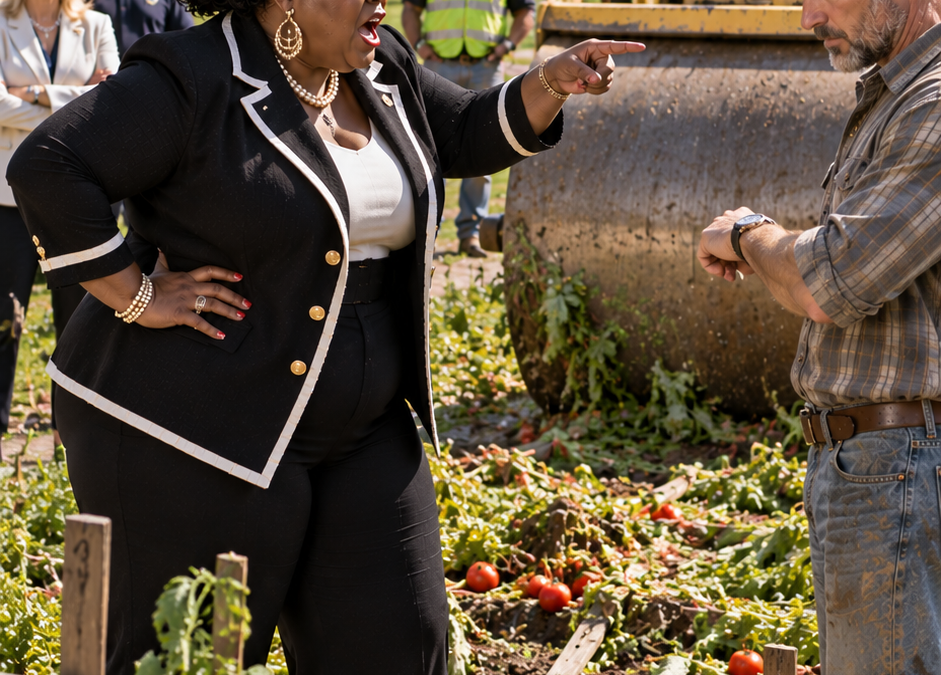
“Clear it.”
The excavator moved.
The bucket came down.
First row of tomatoes.
Gone.
Green vines.
Stakes.
Irrigation tubing.
Soil.
All mixed in seconds.
A child behind the fence asked:
“Why are they tearing up his food?”
Nobody answered.
The roller started next.
Heavy steel.
Slow.
It crushed irrigation line.
Tomato cages.
Moisture markers.
Two sampling stakes disappeared under the drum.
Dust rose.
I didn’t run toward it.
Didn’t scream.
Didn’t stand in front of the machine.
That would have given Vivien exactly what she wanted.
A hysterical homeowner.
A safety excuse.
Maybe even a trespassing or interference allegation despite the absurdity.
Instead, I checked my watch.
Vivien saw me.
“Waiting for your lawyer?”
“No.”
She smiled.
The roller kept moving.
Then the excavator swung near the apple tree.
That changed me.
The bucket passed close enough to scrape bark from a lower branch.
I stepped forward.
Placed one palm against the side of the machine.
The operator stopped.
“That tree stays.”
Vivien called:
“It’s inside the clearance area.”
I turned.
“No.”
She pointed toward the document.
“Everything within the hazard zone is subject to removal.”
I looked at the apple tree.
Anna had planted it while Paige sat in the dirt beside her holding worms like treasure.
“No.”
The operator looked between us.
He did not move.
My phone buzzed.
Marin.
Are they actively destroying the site?
I answered.
Yes.
Her reply came instantly.
We are four minutes out.
That was when I checked my watch again.
Vivien noticed.
“What?”
I looked at her.
“You just destroyed something the federal government was actively monitoring.”
She rolled her eyes.
“You already tried that.”
“No.”
I looked toward the ruined sampling area.
“I warned you.”
Then came the vehicles.
Black SUVs.
Three at first.
Then another government vehicle.
They turned onto the gravel road.
Slow.
Deliberate.
The crowd went quiet before anyone even got out.
The roller stopped.
The excavator shut down.
Marin Cross stepped from the lead vehicle.
Dark pants.
Windbreaker.
Badge visible.
Daniel Keane came around the passenger side.
Two additional investigators followed.
Marin walked directly to me.
“Are you hurt?”
“No.”
“Paige?”
“Not here.”
She nodded.
Then looked at the garden.
Her expression changed.
Not shock.
Calculation.
“Nobody touches anything.”
Daniel raised his voice.
“All equipment stays off. Everyone on site remains where they are until identified.”
Vivien stepped forward immediately.
“Excuse me. I’m Vivien Ashcroft, president of Ashborne Heights.”
Marin looked at her.
“Who ordered the clearing?”
Vivien didn’t hesitate.
“I did.”
Grant looked at her.
That was the first mistake she made in front of the agents.
Or maybe the hundredth.
Marin held out her hand.
“Documentation.”
Vivien gave her the clearance order.
Marin passed it to Daniel.
“This is a property dispute,” Vivien said. “Mr. Rowe is attempting to use government contacts to intimidate an HOA.”
Marin looked toward the steel stakes crushed into the ground.
“Mr. Rowe did not contact us this morning.”
Vivien’s face shifted.
“We were already coming.”
“Why?”
Marin didn’t answer.
Daniel studied the document.
Then looked at Vivien.
“Do you know what those numbered stakes were?”
“Garden markers.”
“No.”
“Survey markers?”
“No.”
He pointed toward the ruined rows.
“Federal evidence markers.”
Silence.
The residents behind the fence stopped whispering.
Vivien stared at him.
“Federal evidence for what?”
Daniel closed the document folder.
“We’ll get to that.”
Dr. Laurel Finch arrived less than fifteen minutes later.
The moment she saw the site, she stopped walking.
Three sampling locations were visibly gone.
One water line severed.
Several instruments crushed.
Baseline soil layers mixed.
She put on gloves.
Kneeled in the disturbed earth.
Started documenting.
Depth.
Location.
Equipment fragments.
Photographs.
Recorder running.
“This one took eight months to establish,” she said quietly.
Marin stood beside her.
“Recoverable?”
“Maybe part.”
Another location.
“That one isn’t.”
She looked toward the roller track.
“Continuous data chain is broken.”
Vivien crossed her arms.
“You’re talking as if I’ve destroyed a laboratory.”
Laurel stood.
“You did.”
That word landed.
Laboratory.
Not garden.
Not weeds.
Not slum farm.
Laboratory.
Daniel walked toward Vivien.
“Why did you need this exact strip cleared today?”
“Drainage hazard.”
“Who made that finding?”
“Our consultants.”
“Names.”
Vivien looked toward Grant.
He said nothing.
She pointed toward the paper.
“Harrington Dominion authorized emergency action.”
Daniel raised it.
“This?”
“Yes.”
He examined the signature.
“Interesting.”
Vivien frowned.
“What?”
“We’ll verify it.”
The federal team’s presence changed everything.
Residents who had laughed during meetings now watched silently.
People moved closer to the fence.
Phones came out.
Grant looked like he wanted to disappear into the side of one of the maintenance trucks.
Then Daniel asked the question that started pulling the larger investigation into daylight.
“Mrs. Ashcroft, are you familiar with the federal stormwater grant awarded to Ashborne Heights?”
Vivien’s face became still.
“Of course.”
“Two point eight million dollars?”
“Yes.”
“Where was the project installed?”
“The community improvements were completed as documented.”
“Which improvements?”
She hesitated.
“Drainage modernization.”
“Where?”
“Throughout Ashborne.”
Daniel looked toward my ruined garden.
“This sampling location has been monitoring runoff from your development because federal reports indicate infrastructure that our field teams cannot locate.”
Vivien stared at him.
“What are you suggesting?”
“I’m not suggesting anything.”
He looked toward Marin.
“We’re investigating where the money went.”
That was when people behind the fence started talking.
Not loudly.
But enough.
Two point eight million.
Federal grant.
Missing infrastructure.
Vivien’s eyes moved toward me.
“You reported us?”
I answered honestly.
“I reported water and soil data.”
“You’ve been working against the community.”
“No.”
“I knew it.”
“I noticed the project you reported as completed wasn’t there.”
She took a step toward me.
Marin moved between us without drama.
“Stay where you are.”
Vivien looked offended.
Then Daniel returned to the clearance document.
“There’s another issue.”
He pointed to the corporate signature.
“Who obtained this authorization?”
“Grant.”
Grant’s head snapped up.
Vivien continued.
“My operations manager prepared the documentation.”
Grant stared at her.
“Vivien.”
She didn’t look at him.
Daniel asked:
“Mr. Hollis, did you obtain this signature?”
Grant swallowed.
“No.”
Vivien turned.
“What are you doing?”
Daniel stepped closer.
“Who prepared it?”
Grant looked at Vivien.
Then at the agents.
“I was told to assemble the document.”
“By?”
Grant’s voice dropped.
“Vivien.”
“Who provided the signature image?”
Another pause.
“She did.”
The crowd reacted.
Vivien raised her voice.
“That is not what happened.”
Grant shook his head.
“You sent it.”
“I sent you an authorization.”
“You sent me a signature file.”
Marin watched both of them.
“Everyone stop talking.”
Then another vehicle arrived.
Long black sedan.
Three attorneys stepped out.
Then Gideon Harrington.
Gideon was in his late sixties.
Harrington Dominion Communities had developed Ashborne Heights decades earlier.
I knew him by reputation.
Tall.
Gray hair.
Dark suit despite the heat.
He didn’t look toward Vivien first.
He looked at the destroyed ground.
Then at me.
“Ethan?”
“Mr. Harrington.”
He extended a hand.
“I’m sorry we’re meeting this way.”
Vivien walked toward him.
“Gideon, thank God.”
He stopped her.
“Don’t.”
One word.
That was enough.
Daniel handed him the clearance document.
Gideon read it.
His expression hardened.
“This is not ours.”
Vivien said immediately:
“Your office approved the emergency work.”
“No.”
“The signature—”
“Belongs to Martin Caldwell.”
“Yes.”
Gideon looked toward Daniel.
“Martin Caldwell died eight months before the date printed on this document.”
Nobody moved.
Vivien’s confidence cracked.
Only slightly.
“Then somebody used an old authorization.”
Gideon looked at the seal.
“This corporate seal was retired six years ago.”
He turned toward one of his attorneys.
“Photograph this.”
Vivien folded her arms.
“This is clearly a clerical issue.”
Gideon looked at her.
“We denied this gate.”
Silence.
He continued.
“Your association asked permission eighteen months ago to construct secondary access through Mr. Rowe’s land.”
Several residents turned toward Vivien.
“I sent you written notice that Harrington Dominion would not support it.”
“That was a preliminary response.”
“It was a final denial.”
Vivien’s voice sharpened.
“You don’t understand the current investment opportunity.”
Gideon stared at her.
“I understand it very well.”
Then he said the sentence that exposed the financial motive.
“You represented to Bracken Hospitality that Ethan Rowe had agreed in principle to sell this corridor.”
My head turned.
Vivien said nothing.
Gideon continued.
“He never agreed.”
“No.”
I answered myself.
Gideon nodded.
“Your brokerage materials say otherwise.”
Marin looked toward Vivien.
“Financial interest?”
Gideon answered.
“Her brokerage holds exclusive listing rights on multiple undeveloped lots. A second access point would substantially improve the deal.”
“Commission?”
“Potentially more than a million dollars.”
Residents reacted louder this time.
The picture was coming together.
The garden wasn’t ugly enough to destroy.
It was in the way.
The investor needed access.
Vivien needed my land.
I wouldn’t sell.
So she created a hazard.
Created an emergency.
Created authorization.
Then sent machines.
Daniel asked Gideon:
“Did your company authorize any clearing on Mr. Rowe’s parcel?”
“No.”
“Any emergency abatement?”
“No.”
“Any use of your corporate seal?”
“No.”
“Did you authorize Martin Caldwell’s signature?”
Gideon’s jaw tightened.
“Martin was my partner for thirty-one years.”
He looked toward Vivien.
“He has been dead for eight months.”
That was the end of the forged authorization.
Then came the grant.
Investigators sealed the Ashborne office.
Grant’s computer was secured.
Association files preserved.
Vivien’s phone was requested.
She protested.
Marin told her not to delete anything.
The board treasurer, a quiet woman named Evelyn Shaw, approached Daniel carrying a small storage drive.
“I think you should see this.”
Vivien stared at her.
“Evelyn.”
The treasurer did not look back.
The drive contained recordings of meetings Vivien had instructed staff to delete.
Emails.
Invoices.
Budget spreadsheets.
Contract files.
Grant records.
Some of it went back years.
The grant scheme was less sophisticated than Vivien apparently believed.
Ashborne Heights had received $2.8 million for stormwater improvements.
Federal reports claimed the work was complete.
Photographs attached to those reports showed drainage structures.
Retention work.
Ecological buffers.
Investigators traced several images.
They came from another project.
In another state.
The company supposedly completing much of the work was called Ashcroft Civic Solutions.
Registered under Vivien’s brother.
Payments arrived in irregular increments.
Many just below internal review thresholds.
Invoices listed equipment rentals from a company that had closed two years earlier.
Other invoices claimed excavation on weekends when weather records showed continuous heavy rain.
Large portions of the grant money moved through related accounts.
Some funded clubhouse renovations.
Some upgraded Vivien’s private office.
Some resurfaced the board-only pool area.
Other transfers were harder to explain.
One account differed from Vivien’s personal name by a single middle initial.
Money from that account helped cover a vacation-home mortgage two states away.
Luxury purchases followed.
The more investigators looked, the less complicated it became.
Nobody had been clever enough to hide everything.
They had simply relied on nobody looking.
My garden was dangerous to that scheme for one reason.
Data.
The soil and water samples proved the stormwater system described in the federal reports did not exist.
Runoff still behaved like untreated runoff.
Contaminants still crossed the same path.
Flow volumes still reflected the old infrastructure.
Eight months of readings.
Storm after storm.
The garden wasn’t merely outside Vivien’s gate route.
It contradicted her paperwork.
Then came the timing.
Federal agents were scheduled to retrieve final samples the same morning Vivien sent the roller.
That coincidence did not look good.
Especially after recovered communications showed that Vivien had received Rebecca’s warning that interference could compromise an investigation.
Especially after Grant’s midnight photographs of the numbered stakes.
Especially after messages investigators found later.
One from Vivien to Grant:
Clear before Monday if possible.
Another:
Once it’s disturbed, he can’t prove what was there.
And another:
Do not put the second-gate language in the abatement file.
Those messages ended any claim that the demolition was simply aggressive landscaping.
Grant began cooperating almost immediately.
Not because he had suddenly become brave.
Because he realized Vivien intended to make him responsible.
He admitted changing dates.
Preparing the false emergency order.
Using the signature image Vivien provided.
Keeping project folders under neutral names.
He also acknowledged that the second gate had been the real objective from the beginning.
That did not erase his responsibility.
But it changed how investigators treated him.
The emergency HOA meeting took place that evening.
Nobody went home.
Too many people wanted answers.
The clubhouse filled.
Vivien sat at the head of the board table out of habit.
Marin was still outside with investigators.
Daniel remained nearby.
Gideon’s attorneys occupied one side of the room.
I stood near the back.
I was filthy.
Dust on my shirt.
Mud on my boots.
Tomato vines stuck to one pant leg.
Vivien looked almost exactly as polished as she’d looked that morning.
Only her hands betrayed her.
They trembled slightly whenever she reached for a paper.
She opened by saying:
“Today’s unauthorized federal intervention was triggered by Mr. Rowe.”
People began murmuring.
She raised her voice.
“He intentionally interfered with a legitimate community drainage project.”
Someone shouted:
“Was the developer signature fake?”
Vivien ignored it.
Another voice:
“Where’s the two point eight million?”
She hit the table.
“Order.”
Nobody listened.
The thing about borrowed authority is that once people realize it was borrowed, commands stop working quickly.
Evelyn Shaw made a motion.
Suspend Vivien from all presidential authority immediately.
Seconded.
Vivien stared.
“You cannot do that without notice.”
A board member replied:
“We can under the emergency provision you’ve been quoting all month.”
That drew a bitter laugh from the room.
Vote.
Unanimous.
Vivien’s access badge was deactivated.
Association accounts frozen pending audit.
Community vehicle privileges revoked.
Ashcroft Civic Solutions suspended.
Security staff instructed not to take direction from her.
Vivien stood.
Looked toward the head of security.
“Remove Ethan.”
He shook his head.
“You’re no longer authorized to give me that instruction.”
That may have been the first time in six years someone inside Ashborne refused her directly in public.
She looked stunned.
Then furious.
But the room had moved on.
People wanted numbers.
Contracts.
Grant reports.
Drainage plans.
The same residents who once laughed about the poor gardener were now comparing their assessment statements.
Several had paid special drainage fees.
Those payments did not match published budgets.
One woman who had defended Vivien for years stood against the back wall.
Arms crossed.
She never spoke.
Her face said enough.
Someone asked what I wanted.
Not an agent.
A resident.
“What are you going to sue us for?”
Us.
That word mattered.
The room was afraid.
And they had reason to be.
I had claims.
Trespass.
Destroyed crops.
Destroyed irrigation.
Research equipment.
Defamation.
Loss of income.
Property damage.
Potential damage to the apple tree.
I could have made the entire association spend years defending itself.
But most people in that room had not ordered a roller onto my land.
They had trusted the wrong person.
Some had laughed.
Some had stayed silent.
Some had looked away.
That wasn’t the same thing.
I thought about Paige.
About Anna.
About the garden.
About what justice actually needed to accomplish.
“I don’t want your homes.”
People went quiet.
“I don’t want special assessments paying me damages.”
Vivien looked toward me.
I continued.
“I want the people who did this to pay for what they did.”
Then I listed my conditions.
First:
Ashborne Heights formally acknowledges my property has never been subject to HOA authority.
All old violation notices withdrawn.
Every false reference to my land as association property removed.
Second:
No second gate.
Ever.
The drainage corridor receives permanent recorded protection against road construction and development inconsistent with watershed function.
Third:
Garden restoration paid through insurance, recovered grant funds where legally permitted, and assets of responsible parties.
Not through new assessments against uninvolved homeowners.
Fourth:
Full independent audit of every Ashborne contract and financial transaction covering the previous five years.
Fifth:
New board elections under independent oversight.
Sixth:
The restored stormwater system must finally be constructed to the standards the federal grant had promised.
And if done properly, I would continue allowing lawful runoff through the protected buffer exactly as the original hydrological design intended.
No one argued.
Rebecca later turned those principles into legal language.
That evening, they were simply promises I needed the room to understand.
Vivien listened.
Then laughed once.
Softly.
“You think this makes you noble?”
“No.”
“What do you think you are?”
I looked at the destroyed soil visible through the clubhouse windows.
“Tired.”
That answer seemed to confuse her.
Maybe because she needed me angry.
Revenge would have made me understandable to her.
She knew ambition.
Greed.
Status.
Control.
A man who simply wanted his land repaired gave her nothing to work with.
The investigation continued.
The full scale of the grant diversion took months to document.
Accounts were frozen.
Search warrants executed.
Contractors interviewed.
Email accounts imaged.
Bank transfers traced.
Government auditors reconstructed payment chains.
Vivien denied intent.
Then blamed Grant.
Then her brother.
Then vendors.
Then administrative confusion.
Eventually, every explanation collided with something she had written herself.
One email was particularly bad.
It referred to me directly.
“Rowe still thinks his drainage patch is untouchable.”
Another:
“If he won’t sell, make the parcel unusable.”
And the worst:
“Clear before Cross gets whatever she’s collecting.”
Marin showed me that one months later.
“You warned her federal investigators were involved.”
“Yes.”
“She knew my name?”
“Apparently.”
That meant the demolition had not merely occurred despite warnings.
Vivien knew enough to identify the lead investigator.
I didn’t feel vindicated.
I felt sick.
Because that made the roller more than arrogance.
It made it an attempt to destroy evidence.
Dr. Finch returned to the garden repeatedly.
Most instruments were ruined.
Several months of continuous sampling lost.
But Vivien failed completely in the one thing she had apparently hoped the demolition would accomplish.
The data already existed elsewhere.
Automatic uploads.
Remote backups.
Field notes.
Prior sample chains.
And one deeper device survived.
It sat below the roller’s compaction depth.
Damaged housing.
Intact memory.
Laurel recovered it.
Cleaned it.
Extracted the readings.
The final data confirmed what earlier measurements had shown.
The promised drainage improvements had never functioned because most of them had never been built.
Vivien destroyed my garden and still failed to destroy the evidence.
That mattered during prosecution.
So did Gideon Harrington’s records.
Harrington Dominion had preserved Vivien’s request for the second gate.
Formal denial.
Her acknowledgement of the denial.
Investor communications.
Brokerage proposals.
And documents representing that I had agreed “in principle” to sell.
I hadn’t.
Never had.
Gideon came to my property one afternoon about a month after the demolition.
No attorneys.
No cameras.
Just him.
The garden looked terrible.
Bare sections.
Temporary erosion matting.
Broken rows.
The apple tree had survived, though one branch was badly damaged.
Gideon stood looking at it.
“I’m sorry.”
“You’re not the one who drove the excavator.”
“No.”
He looked toward Ashborne.
“But my company created a governance structure that let someone accumulate too much unchecked control.”
“Your company built houses.”
“We also made assumptions about what would happen after we left.”
He turned toward me.
“Do you remember the first drainage assessment?”
“I wrote part of it.”
He smiled without humor.
“I know that now.”
He had discovered my name in old engineering files.
“Why didn’t you ever tell them?”
“Would it have changed my deed?”
“No.”
“Then it wasn’t relevant.”
Gideon looked toward the ruined sampling area.
“Vivien thought you were some broke gardener.”
“I am a gardener.”
“That’s not what I meant.”
“I know.”
He nodded.
Later, Harrington Dominion offered to fund part of the restoration.
Not as settlement.
Not in exchange for rights.
Gideon called it correcting an old responsibility.
I accepted on one condition.
No corporate branding.
No plaque.
No press release.
He agreed.
The restoration took months.
Federal specialists helped redesign the sampling layout.
The permanent ecological buffer received stronger legal protection.
Native species were replanted.
The irrigation system rebuilt.
Soil layers reconstructed where possible.
Drainage channels stabilized.
And then something happened I hadn’t expected.
Ashborne residents came to help.
At first, maybe ten people.
Then twenty.
One Saturday there were almost sixty.
People who had laughed at Vivien’s jokes.
People who had avoided me.
People who had simply never thought about the man outside the wall.
They carried mulch.
Reset fencing.
Rebuilt raised rows.
Installed irrigation.
Planted native flowers.
A retired accountant spent six hours hauling compost in a wheelbarrow.
The older woman who had questioned Vivien’s emergency authority worked beside me almost all afternoon.
Her name was Margaret Dean.
At one point she said:
“I should’ve pushed harder that night.”
“You asked.”
“I let her brush me off.”
“So did most people.”
“That doesn’t make it better.”
“No.”
She looked surprised.
I wasn’t going to comfort everyone out of responsibility.
Silence had helped Vivien.
That was true.
But helping repair the damage mattered too.
Justice doesn’t require pretending nobody made mistakes.
It requires deciding what to do after you recognize them.
Near sunset, Margaret stood.
Rubbed her back.
Looked at the rows.
“Better.”
“Getting there.”
She nodded toward the apple tree.
“Your wife planted that?”
“Yes.”
“Anna?”
I looked at her.
“How’d you know?”
“Paige told my granddaughter.”
That evening, I sat beneath the tree for a long time.
The damaged branch had been pruned.
The trunk remained.
Some fruit survived.
I thought about Anna laughing the day we planted it.
She had insisted the hole needed to be wider.
I told her it was wide enough.
She told me I was a hydrological engineer, not an arborist.
She was right.
Usually.
A week later, somebody arrived with a young apple sapling.
No name.
No card.
They planted it near the older tree.
Paige came home that weekend.
She stood looking at both trees.
“That’s not Mom’s.”
“No.”
“Why’d they put it there?”
“I think they wanted something new beside what survived.”
She considered that.
“I like that.”
So did I.
The final agreement protecting the drainage corridor was recorded with the county.
Rebecca wrote it carefully.
No road.
No gate.
No building.
No future HOA amendment could claim authority over it.
Any stormwater arrangement required recorded consent and compliance with environmental standards.
The buffer belonged to my property.
Its environmental function received permanent protection.
Paige and I put up one sign.
Wood.
Simple lettering.
ROWE GARDEN
PRIVATE PROPERTY
PROTECTED WATERSHED
Nothing else.
No warning about Vivien.
No mention of federal agents.
No story.
The land had enough to carry already.
Vivien eventually faced formal charges related to grant fraud, forged documents, misuse of funds, and obstruction.
The criminal process moved slowly.
As it should.
Trials are not HOA meetings.
Evidence has to be tested.
Witnesses examined.
Claims proved.
I testified.
So did Grant.
Evelyn.
Gideon.
Marin.
Daniel.
Dr. Finch.
Auditors.
Contractors.
Bank specialists.
The courtroom was much quieter than the clubhouse had ever been.
Prosecutors displayed bank transfers.
Invoices.
Emails.
False photographs.
Grant reports.
The forged developer authorization.
The timing of the demolition.
Vivien’s defense argued administrative failures.
Delegated responsibility.
Poor oversight.
Mistakes.
But mistakes don’t usually leave messages saying “clear before Cross gets whatever she’s collecting.”
The jury took less time than I expected.
Vivien was ordered to repay substantial amounts connected to misused funds and faced additional penalties.
A court barred her from serving in HOA management positions as part of the consequences that followed.
Her real estate work collapsed.
Ashcroft Civic Solutions disappeared.
Her brother’s involvement became its own legal problem.
Grant cooperated extensively.
That reduced his exposure.
It did not save his career.
Ashborne terminated him.
No other community management company in the area seemed interested in hiring someone whose text messages showed him discussing altered dates and forged paperwork.
I never saw either of them at Ashborne again.
One of the strangest moments came before Vivien was taken away after a later proceeding.
She looked toward me.
“You still lost the garden.”
I stared at her.
Behind her, two court officers waited.
I thought about the ruined tomatoes.
The destroyed sensors.
The severed lines.
Months of work.
Anna’s damaged apple tree.
Then I thought about Laurel recovering the deep monitor.
The remote backups.
The recorded agreement.
The newly protected buffer.
The people rebuilding.
“No.”
She frowned.
I said:
“You still don’t know where the important part was.”
She looked confused.
I didn’t explain.
Data survived.
Truth survived.
Land survived.
The garden would grow again.
Vivien had understood destruction only in physical terms.
Flatten the plants.
Flatten the stakes.
Flatten the evidence.
Flatten the owner financially.
Clear the strip before anyone stops you.
She never understood that some things are already rooted somewhere machinery can’t reach.
Ashborne finally built the stormwater system it had claimed to have for years.
Real work.
Real trenches.
Real retention structures.
Real inspections.
Real photographs taken at the actual site.
The federal government recovered part of the missing money through seized assets and legal settlements.
Insurance covered much of my property restoration.
Harrington Dominion paid additional costs voluntarily.
The residents were not hit with the crushing special assessment many had feared.
The new board hired an independent auditor.
Then another.
They rewrote contracting rules.
Related-party vendors had to be disclosed.
Large contracts required competing bids.
Meeting recordings were preserved.
No president could issue unilateral property-abatement orders.
And every board member received full access to grant correspondence.
Evelyn Shaw became interim president.
She lasted one year.
Then refused to run again.
“Why?”
I asked her once.
She laughed.
“Because anybody who enjoys that chair too much shouldn’t be sitting in it.”
That was probably the healthiest thing an Ashborne president had ever said.
Dr. Finch continued using my property for watershed monitoring.
But now the project was public.
Interested residents could attend scheduled educational visits.
Laurel taught them how soil moisture readings worked.
How native plants slowed runoff.
Why buffers mattered.
Why green lawns on steep terrain could increase fertilizer transport.
I watched residents who had once called my wildflowers weeds crouch beside monitoring equipment and ask serious questions.
That was satisfying in a way punishment never was.
Knowledge lasts longer.
One spring morning, a group of children from Ashborne came down with parents.
Laurel showed them a soil probe.
One boy pointed toward a steel stake.
“Is that the thing the roller smashed?”
His mother looked embarrassed.
Laurel answered carefully.
“Some of the old ones were damaged.”
“Why?”
She glanced at me.
I shrugged.
Tell him.
“A grown-up made a bad decision.”
The boy considered that.
“Did she not know what it was?”
Laurel smiled slightly.
“She was told not to touch it.”
That answer was enough.
Paige went away to college the following fall.
Environmental science.
I tried not to take credit.
She told me not to.
“You spent my childhood talking about drainage.”
“I did not.”
“Dad, you explained culverts on family vacations.”
“Somebody had to.”
“No. Nobody had to.”
She was right.
When she came home during breaks, she worked in the garden.
Mostly because she missed it.
Sometimes she brought friends.
The folding produce table returned.
Tomatoes.
Beans.
Squash.
A handwritten price sign.
Ashborne residents became the majority of customers.
That irony amused me.
Nobody from security stopped them anymore.
One Sunday, Gideon Harrington stopped at the table.
Bought tomatoes.
Paid twenty dollars for a basket marked six.
I handed fourteen back.
“Absolutely not.”
“Ethan.”
“Six dollars.”
“Take the donation.”
“No.”
He looked toward the garden.
“You’ve cost me a lot more than fourteen dollars in conscience.”
“That’s your problem.”
He laughed.
Paid six.
Took his tomatoes.
That was probably the most normal conversation we ever had.
Years later, people still told the story incorrectly.
The version that spread online went something like this:
Arrogant HOA destroys poor widower’s garden.
Federal agents appear.
Secret engineer exposes corrupt president.
It made for a good story.
But reality was less clean.
I wasn’t secretly waiting to humiliate Vivien.
I begged her not to touch the site.
Rebecca warned her.
Residents questioned her.
Her own operations manager knew the paperwork was questionable.
The developer had already denied the gate.
She had exits everywhere.
She simply refused to take one.
That’s what mattered.
Vivien didn’t fall because I outsmarted her in one dramatic moment.
She kept making decisions that narrowed her options until truth was the only thing left in the room.
The title.
The money.
The investors.
The brokerage.
The fake hazard.
The forged signature.
The hidden contracts.
The deleted recordings.
The federal grant.
Every time reality contradicted what she wanted, she altered the story instead of altering her plan.
Eventually the stories became too numerous to maintain.
The roller only made them visible.
I still walk the garden every morning.
Same worn path.
Check moisture.
Pinch leaves.
Look at the rain gauge.
Some of the monitoring stakes remain.
New ones replaced the destroyed equipment.
I know exactly what each number means now.
The garden looks different.
Maybe better.
Maybe not.
Anna’s apple tree leans slightly where the damaged branch was removed.
The younger tree grows beside it.
Every spring, both bloom.
That means more to me than I can explain cleanly.
Sometimes I stand there and remember the roller.
Steel drum moving through the rows.
Dust.
People watching.
Vivien’s arms folded.
Her expression certain.
For one morning, it looked like she had won completely.
Machines are powerful like that.
They make destruction immediate.
A plant takes months to grow.
A roller needs seconds.
A drainage dataset takes years.
One bucket can tear out the sensor.
A reputation takes decades.
One lie can damage it.
That’s why people confuse destruction with power.
Building is slower.
Repair is slower.
Truth is slower.
But slower doesn’t mean weaker.
The federal investigation had already copied the data.
My deed was already recorded.
The old drainage assessment already existed.
Gideon’s denial letter already existed.
Vivien’s own emails already existed.
The investors already had her representations.
The grant office already had the false reports.
The evidence was growing everywhere except where she was looking.
She flattened the only part she could see.
That was her final mistake.
The morning she destroyed the garden, she told the crowd:
“A man who grows his own vegetables has no business living beside people of real means.”
I thought about that for a long time afterward.
Real means.
Money.
Cars.
Stone houses.
Private pools.
Influence.
That was what Vivien meant.
My father had a different idea.
So did Anna.
Real means was knowing how to repair what broke.
How to grow something.
How to protect land.
How to raise a child after losing the person you thought would help you do it.
How to keep records.
How to say no without needing to shout.
How to rebuild after somebody decides your quietness makes you easy.
I never told Vivien any of that.
She wouldn’t have heard it.
The people most obsessed with appearances are usually the least interested in explanations that don’t flatter their own.
One evening, a few years after everything ended, I sat beneath Anna’s tree while Paige was home from college.
She had dirt on her knees.
We had spent the afternoon rebuilding one of the vegetable rows.
She looked toward Ashborne.
“They finally fixed that ugly drainage outlet.”
“They did.”
“Looks expensive.”
“It was.”
She smiled.
“Federal money?”
“Correctly this time.”
She picked a small apple from the younger tree.
Not ripe.
Bit it anyway.
Made a face.
I laughed.
Then she looked toward the brass plate she’d mounted near the sapling.
Two initials.
A.R.
Her mother’s.
And a date.
Nothing else.
“Do you ever think about selling?”
“No.”
“Never?”
“I thought about it once.”
“When?”
“Before you were born.”
She looked skeptical.
“I’m serious.”
“What stopped you?”
I looked over the garden.
“Your mother.”
“Of course.”
“She said this hill had the ugliest soil she’d ever seen.”
Paige laughed.
“That’s why you stayed?”
“She said if we could make something grow here, we’d know it belonged to us.”
Paige went quiet.
After a moment she said:
“She would’ve hated Vivien.”
“Probably.”
“No. Definitely.”
“Your mother disliked committees in general.”
“Smart woman.”
“Very.”
We sat there until the light faded.
Ashborne still looked polished on the ridge.
Matching roofs.
Stone walls.
Neat lawns.
But the relationship between that community and the land below had changed.
They knew where the boundary was.
They knew what the watershed did.
They knew a person living outside their wall was not an obstacle simply because his property disrupted somebody else’s plan.
That was enough.
I never joined the HOA.
Never wanted to.
Never needed to.
The new board stopped asking.
They also stopped sending violation notices.
The fence remained the color I chose.
The greenhouse remained.
The produce stand remained.
My old truck eventually died.
Paige made me replace it before the transmission exploded on the highway.
I bought another used one.
Blue again.
Dented within six months.
Some things don’t need improvement.
Marin retired eventually.
Daniel moved to another investigative unit.
Laurel kept working with watersheds.
Rebecca remained my attorney because once someone has watched federal agents walk through your destroyed tomato plants, changing lawyers feels unnecessarily dramatic.
Every few months, she still sends me county records if anything touches the southern corridor.
Usually nothing does.
That’s the best kind of legal news.
The federal case ended.
The grant accounts were settled as far as they could be.
Recovered funds were returned.
Restitution orders entered.
Contracting controls improved.
The headlines disappeared.
People moved on.
Land doesn’t move on in quite the same way.
It records things differently.
Compacted soil.
Changed drainage.
New roots.
Old roots.
Some places recover quickly.
Others keep scars for years.
I can still identify exactly where the roller crossed.
The soil structure changed.
Even after restoration.
Plants grow there now.
Good plants.
But if I push a soil probe deep enough, I can feel the layer where everything was compressed that morning.
That seems fitting.
Recovery is not erasure.
I never wanted the garden to look like nothing happened.
Something did.
We repaired it.
That’s different.
There’s a lesson in that I didn’t understand when Anna died.
At first, I thought healing meant getting back to how things were.
You don’t.
You can’t.
The person is still gone.
The branch is still cut.
The soil was still crushed.
The investigation still happened.
The daughter still had to watch her father be mocked publicly.
You build around what remains.
You plant again.
The new growth is real even if it isn’t the old growth.
That is enough.
Vivien once believed destroying the garden would weaken my position.
In a strange way, it clarified it.
Everyone finally saw what had been hidden beneath the surface.
The watershed.
The investigation.
The missing grant project.
Her financial interest in the second gate.
The forged authority.
All of it.
She wanted the land cleared because she believed bare ground would be easier to control.
Instead, bare ground exposed everything.
That is why I remember checking my watch.
People who saw the video later always asked why I looked so calm.
I wasn’t calm.
My hands were shaking.
The roller was destroying something Anna and I had built.
Federal evidence or not, those tomato rows were mine.
The apple tree was ours.
Part of me wanted to drag the operator out of the cab.
Another part wanted to stand in front of the machine and force them to choose between stopping and running me over.
I didn’t.
Not because I lacked anger.
Because anger wasn’t the most important thing happening.
I knew Marin was coming.
I knew cameras were running.
I knew Vivien had been warned.
And I knew that if I turned the morning into a physical confrontation, she would use that forever.
So I watched the time.
One minute.
Two.
Three.
Four.
Then the SUVs appeared.
What Vivien mistook for helplessness was restraint.
There is a difference.
That lesson stayed with me longer than the federal case.
People often reveal themselves when they believe nobody capable of stopping them is watching.
Vivien thought I was alone.
She thought my garden was just vegetables.
She thought the stakes were clutter.
She thought Rebecca’s warning was theater.
She thought Grant would protect her.
She thought the developer’s name on a fake document would end questions.
She thought money gave her more endurance than I had.
She thought public humiliation would make me surrender before anyone looked too closely.
She was wrong about all of it.
But the mistake beneath all the others was simpler.
She believed appearances were evidence.
I was a widowed man in an old shirt.
Therefore weak.
A garden was messy.
Therefore worthless.
A rich HOA was polished.
Therefore competent.
A stamped paper looked official.
Therefore valid.
A federal agent drove an unmarked SUV.
Therefore unexpected.
Reality does not owe appearances anything.
The garden proved that.
Above ground, vegetables.
Below ground, data.
Behind the data, a federal case.
Behind the case, missing money.
Behind the missing money, contracts.
Behind the contracts, people who assumed nobody would dig.
All of it sat beneath Vivien’s view while she made jokes about carrots.
Today, the sign near my lane is weathered.
ROWE GARDEN.
PRIVATE PROPERTY.
PROTECTED WATERSHED.
The letters need repainting.
Paige keeps telling me.
I’ll get to it.
Probably.
The folding table still goes out in summer.
A few dollars a basket.
Sometimes Ashborne kids walk down with their parents.
They buy tomatoes.
Peppers.
Apples when the trees produce enough.
One little girl asked me once:
“Is this the federal garden?”
I laughed.
“No.”
“My dad said federal agents came here.”
“They did.”
“So it is.”
“It’s just a garden.”
She pointed toward a monitoring stake.
“What’s that?”
“That belongs to scientists.”
She considered that.
“Then it’s a science garden.”
I decided not to argue.
Maybe she was right.
The most accurate version might be that it became many things at once.
Food.
Memory.
Work.
Watershed.
Evidence.
Research.
Home.
Vivien saw only one of those things.
And because she saw so little, she thought crushing the surface would erase the rest.
The roller flattened one season.
It destroyed instruments.
It cost months of work.
It damaged the tree Anna planted.
It did real harm.
I will never pretend otherwise.
But it couldn’t flatten the records.
Couldn’t flatten the bank transfers.
Couldn’t flatten the remote data backups.
Couldn’t flatten the emails.
Couldn’t flatten a deed.
Couldn’t flatten the federal grant file.
Couldn’t flatten Gideon Harrington’s denial letter.
Couldn’t flatten the memories of the residents who heard Vivien order the machines forward after three separate warnings.
And it certainly couldn’t flatten the truth.
That had been growing beneath the soil for years.
All Vivien did that morning was finally give it enough daylight to break the surface.








