𝗙𝗨𝗟𝗟 𝗦𝗧𝗢𝗥𝗬 The HOA President Had No Idea What My Silence Was Hiding When She Called the Sheriff to My Gate
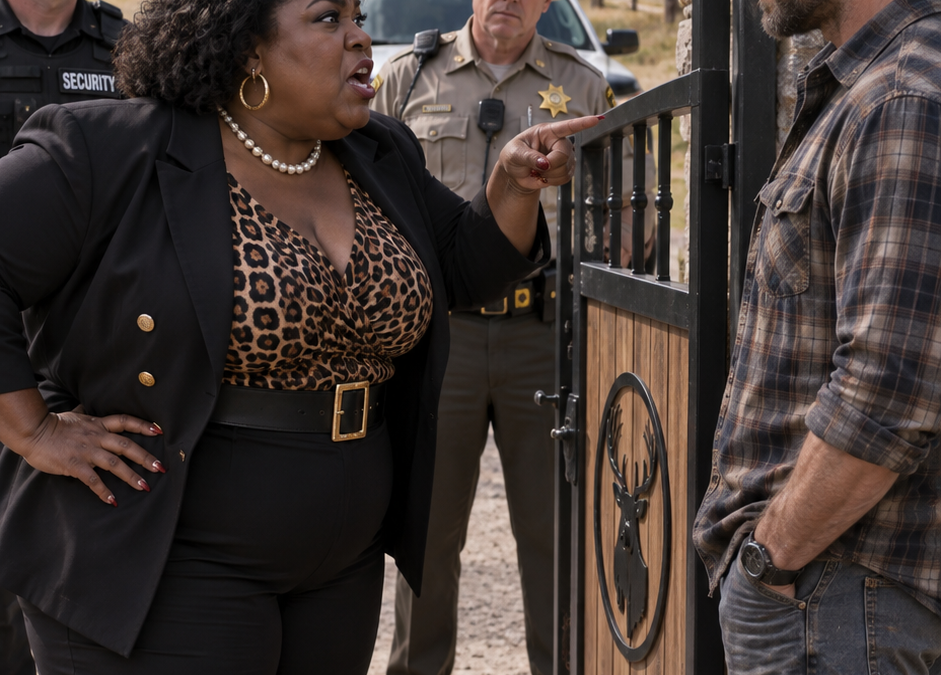
𝗙𝗨𝗟𝗟 𝗦𝗧𝗢𝗥𝗬
The violation was listed as an unauthorized exterior modification.
The modification was my fence.
My fence.
Standing entirely inside my parcel boundary.
I read the notice twice, then called the HOA office.
A man named Elliot Crane answered.
He was the property manager.
I gave him my parcel number.
There was a pause.
“Could you repeat that?”
I did.
Another pause.
“That’s the Ror parcel?”
“Yes.”
He sounded different after that.
Less certain.
“I’ll need to review something.”
“Good.”
“I’ll call you back.”
He never did.
Two days later, a second envelope arrived.
$500.
Commercial vehicle violation.
The commercial vehicle was my Ford.
It had no company markings, no equipment rack, no advertising.
It was simply a pickup carrying lumber.
I created a folder.
Old habits survive retirement.
I photographed the notice.
Recorded the date.
Wrote down the citation number.
Placed the original behind the first.
Less than a week later, the third notice came.
$1,000.
Failure to comply with previous directives.
That one made me sit at Warren’s old kitchen table for a while.
Three notices lay beneath the overhead light.
Two hundred fifty dollars.
Five hundred.
One thousand.
The amounts weren’t random.
Neither was the escalation.
I recognized the method.
Pressure doesn’t always arrive as a threat.
Sometimes it arrives as paperwork.
You create small consequences.
Then larger ones.
You make resistance increasingly inconvenient until surrender feels cheaper than continuing to say no.
Most people aren’t cowards when they eventually give in.
They’re tired.
They have jobs.
Children.
Mortgages.
They can’t spend six months arguing over a fence color.
The system works because exhaustion works.
I had spent enough of my life functioning while exhausted to recognize the strategy.
So instead of calling Vivien, I went to the county recorder.
The records office smelled like dust, toner, and old paper.
I spent two hours at a reference table with the 1987 plat spread in front of me.
The situation was simpler than Vivien wanted it to be.
Warren’s parcel predated Silver Pines by more than two decades.
When the development was created, one easement had been recorded across the western edge of his property.
Eighteen feet wide.
Its stated purpose was residential ingress and egress between the subdivision road and the county highway.
That was it.
Nothing in the document gave the HOA authority over Warren’s land.
Nothing allowed it to enforce architectural rules.
Nothing allowed it to install signs.
Nothing allowed it to regulate vehicles.
Nothing converted the underlying land into HOA property.
And nothing placed my sixty-one acres within the association’s governing boundaries.
I copied everything.
The deed.
Plat.
Development agreement.
Easement language.
Then I sent the relevant pages to Vivien’s office with a written request that all three fines be rescinded.
Her response arrived four days later.
One sentence.
“Our attorney interprets the documents differently.”
I read it twice.
Then smiled for the first time since she’d driven onto my property.
Not because it was funny.
Because it was useful.
Anyone with actual legal confidence would have explained the interpretation.
Cited the provision.
Named the clause.
Attached the opinion.
Vivien had done none of that.
She had used the phrase “our attorney” like body armor.
So I found an attorney of my own.
Dana Whitlock worked out of Pueblo and had practiced land-use law for more than twenty years.
The county clerk recommended her with the quiet certainty people use when they know exactly who they’d call themselves.
Dana was in her late forties, sharp-eyed, direct, and uninterested in wasting words.
She read every document while I sat across from her desk.
The fines.
Plat.
Deed.
Easement.
Vivien’s response.
She went through them twice.
Then she took off her glasses.
“Mason.”
“Yeah?”
“She’s not misreading anything.”
I leaned back slightly.
“What do you mean?”
Dana tapped the plat.
“This is uncomplicated.”
She touched the development agreement.
“This is also uncomplicated.”
Then Vivien’s letter.
“She’s betting you won’t push back.”
That landed harder than I expected.
Not because it surprised me.
Because it confirmed the instinct I’d had since the first envelope.
“Can you represent me?”
“Yes.”
That was our agreement.
I returned to the cabin and kept working.
That became my answer.
Vivien sent paper.
I replaced joists.
She sent warnings.
I rewired outlets.
She sent another demand.
I repaired the roof.
Then one Monday morning, I came outside and found a new sign attached to my fence.
SILVER PINES RESIDENT ACCESS ONLY.
White background.
Blue lettering.
Someone had driven four metal screws directly through the fence rail.
I stood looking at it for several seconds.
Then I took a utility knife, cut the zip ties around the post, removed the sign, and leaned it against the fence.
I did not damage it.
I photographed everything.
The screws.
The holes.
The location.
The easement markers.
At three that afternoon, Vivien returned.
This time Grant Bellamy, a member of the HOA board, was with her.
So were two private security guards.
Vivien was out of the SUV before the engine stopped.
She pointed at the sign.
“You removed HOA property from a community access point.”
I lifted the sign.
“Your people drilled this into my fence.”
“It marks resident access.”
“Then put it on HOA property.”
Her jaw tightened.
She looked toward Grant.
“This is exactly the attitude I warned everyone about.”
I remember that sentence clearly.
Because suddenly the last two weeks made more sense.
She hadn’t merely been dealing with me.
She had been describing me to other people.
Building a version of Mason Ror before they met me.
Difficult.
Hostile.
Uncooperative.
Possibly dangerous.
Once that story existed, all she needed was one moment of anger from me to prove herself right.
I placed the sign on the ground.
“You all need to leave.”
Vivien stepped closer.
“You think because you have a few acres and a rusted truck, you can speak to me like that?”
I looked at her.
“I think I can ask people to leave because I’m standing on my own land.”
Grant became very still.
One guard looked toward the trees.
The other, a man whose badge read CALEB MONROE, studied the fence.
Vivien raised her voice.
“You’re threatening an HOA representative.”
“No.”
“You need to calm down.”
“I am calm.”
She looked around at the others, almost inviting them to confirm a scene that wasn’t happening.
I kept my hands visible.
My voice level.
My distance unchanged.
She was trying to manufacture escalation.
I’d seen more dangerous versions of the same behavior before.
When someone needs you to become emotional because facts aren’t helping them, denying them that reaction can feel almost cruel.
Vivien pointed at the sign.
“Caleb, put that back.”
Caleb looked at the fence post.
Then at me.
Then at the survey marker.
“I don’t think this gate is inside the easement.”
Vivien stared at him.
“What?”
“I said I don’t think it’s inside the easement.”
“I’m telling you to reinstall the sign.”
He didn’t move.
“I’d rather have written authorization before attaching something to private property.”
Vivien’s face changed.
For the first time, someone she’d brought with her had declined to play the assigned role.
She turned toward me.
“Next time, I’m bringing law enforcement.”
I nodded toward the county road.
“Bring the deed, too.”
She left without answering.
Dana called two days later.
Her voice was different.
“Mason, I found the reason.”
“For what?”
“For why she’s willing to do this.”
I stopped what I was doing.
Dana had pulled planning-board filings.
Three weeks before Vivien’s first visit, a developer called Ridgeline Partners had submitted a preliminary application for a thirty-four-home expansion of Silver Pines.
The proposed road system connected through the existing easement corridor across my property.
That mattered.
The 1987 easement had been created for the original development.
Thirty-four additional homes meant significantly more traffic.
Construction equipment.
Utility work.
Emergency access.
Permanent residential use.
Dana explained that a substantial increase in the intensity or character of an easement’s use could exceed its original recorded scope.
The HOA might need a new agreement.
My agreement.
Suddenly the fines looked different.
The signs looked different.
The insistence that my property was somehow under HOA oversight looked very different.
“She needs a paper trail,” Dana said.
I sat at the kitchen table.
“Explain.”
“One payment from you. One signed response. One document where you acknowledge that they have enforcement authority over your parcel. Anything she can later point to and say, ‘See? Even the owner recognized our jurisdiction.'”
I stared through the window toward the easement.
“She was trying to create precedent.”
“Exactly.”
“And if I had paid the first $250?”
“She would have used it.”
For the first time, I felt something colder than irritation.
Vivien wasn’t confused.
She wasn’t protecting neighborhood aesthetics.
She was trying to maneuver an adjacent landowner into weakening his own legal position so a development project would have fewer obstacles.
“Why not negotiate?”
Dana gave a humorless laugh.
“Because negotiation requires admitting you have something she needs.”
That explained everything.
The disdain.
The truck.
The boots.
The assumption that I was a caretaker.
Vivien had looked at me and decided the easiest transaction was no transaction at all.
Just pressure until I moved.
Dana told me what she expected next.
“She’ll change the theory.”
“To what?”
“Emergency access. Public safety. Something that sounds bigger than fence paint.”
She was right.
With Dana’s help, I sent formal notice to the HOA.
My parcel was not under HOA jurisdiction.
All fines were disputed.
No HOA representative had permission to enter portions of my property outside the recorded easement.
No signs, cameras, hardware, or fixtures were to be installed without written authorization.
Any discussion of expanded easement use would go through legal counsel.
The HOA attorney responded with a vaguely threatening letter about potential court proceedings.
Two mornings later, I found two cameras at the easement entrance.
One was inside the corridor.
The other wasn’t.
It stood on a metal pole nine feet onto my property, pointed directly at my private gate.
I didn’t remove it.
Years earlier, I might have.
By then, I understood something Vivien still didn’t.
Evidence was more valuable than satisfaction.
I got a tape measure.
Photographed the pole.
Measured from the recorded line.
Photographed the measurements.
Recorded GPS coordinates.
Took wide-angle images showing the camera, stakes, gate, and easement.
Sent everything to Dana.
She called within an hour.
There was almost amusement in her voice.
“Keep doing exactly what you’re doing.”
“Meaning?”
“Let her keep documenting our case for us.”
I looked out toward the camera.
“Do you think she understands the liability?”
Dana was silent for a second.
“No.”
“Why not?”
“Because she’s probably never had someone refuse to fold before.”
That stayed with me.
Some people become powerful because they’re competent.
Others become powerful because everyone around them decides resisting is too exhausting.
Eventually those two kinds of power can look identical.
Until the wrong person says no.
The Saturday everything came apart began quietly.
I was outside before seven with coffee and a wrench.
The secondary gate at the north end of my property had an old lock that had nearly rusted through.
The gate sat roughly thirty feet outside the easement.
It led to a private timber road running toward the far ridge.
It had nothing to do with Silver Pines.
Nothing to do with resident access.
Nothing to do with the development road.
I removed the old lock and began installing a new deadbolt assembly.
At 8:50, I heard tires on gravel.
Vivien’s white SUV appeared first.
Another vehicle followed.
She brought two security guards, including Caleb.
A man I didn’t recognize stepped out carrying a yellow survey bag.
Vivien walked directly toward me.
“Stop what you’re doing.”
I kept one hand on the gate.
“Good morning.”
“That gate serves as emergency community access. You are not authorized to lock it.”
I looked at the gate.
Then at the easement stakes nearly thirty feet away.
“Show me the document.”
Her expression hardened.
“What?”
“The document designating this gate as emergency access.”
“It’s implied in the community development agreement.”
“Implied isn’t recorded.”
“We aren’t having this argument again.”
“I’m not arguing.”
I picked up the new lock.
“I’m changing hardware on my gate.”
She turned.
“Caleb, remove it.”
Caleb didn’t move.
Vivien looked at him.
“I gave you an instruction.”
He stared at the stakes.
Then the gate.
Then me.
“I’m not removing anything.”
Her face tightened.
“Excuse me?”
“This doesn’t appear to be inside the easement.”
“I am the HOA president.”
“I understand.”
“Then remove the lock.”
Caleb’s voice remained respectful.
“I need written authority from someone with legal standing before I remove hardware from private property.”
Silence.
It wasn’t dramatic.
No one shouted.
But something shifted.
Vivien had arrived expecting an audience.
Instead, one of her own people had become a witness.
She turned toward me.
“You think you scare me?”
“No.”
“You stand there acting like you’re above everyone.”
“I haven’t said anything like that.”
“You’ve been hostile from the beginning.”
I almost laughed.
Instead, I looked directly at her.
“Vivien, I have never raised my voice at you. I’ve never threatened you. I’ve never blocked the easement. I’ve never touched HOA property that wasn’t attached to my fence. I hired an attorney. I sent documents. I took photographs. I asked you to stay off the parts of my land you don’t have rights to.”
I paused.
“That’s the entire record.”
She stared at me.
People sometimes become angriest when you calmly summarize their behavior because a summary removes all the noise they’ve been using to hide inside.
She took out her phone.
“Fine.”
She called the sheriff’s office.
I listened as she told the dispatcher that a property owner was obstructing a lawful community access route.
She gave my address.
She said an officer was needed on scene.
Then she hung up.
Vivien looked toward Caleb.
“Wait until they put him in cuffs.”
Caleb said nothing.
I walked back to my truck and leaned against the driver’s door.
My documents were in the glove compartment.
Deed.
Plat.
Easement.
Fine notices.
Dana’s summary.
Every photograph.
Every letter.
I wasn’t worried about the sheriff.
I was tired.
There is a difference.
I had come to those sixty-one acres because I wanted one place where I didn’t have to spend every hour calculating another person’s intentions.
Yet there I was again.
Watching positions.
Reading body language.
Preparing for escalation.
The mountains hadn’t changed.
The people had.
About twenty minutes later, a county sheriff’s cruiser appeared through the pines.
It moved slowly up the road.
No lights.
No siren.
The cruiser stopped near the driveway.
The sheriff got out.
He was broad through the shoulders, grayer at the temples than the man I remembered, but there was something instantly familiar about the way he stood after closing the door.
Balanced.
Relaxed without ever being careless.
He scanned the scene before speaking.
Vehicles.
People.
Gate.
Markers.
Camera.
Then his eyes reached me.
He stopped.
Completely.
Two seconds passed.
“Mason?”
I looked harder.
Then the years fell away.
“Owen Cade.”
He exhaled a short laugh.
“Damn.”
Vivien smiled.
She misunderstood everything about that moment.
She thought recognition meant I had somehow been caught.
Owen walked closer.
“Ror.”
“Been a while.”
“A little more than a while.”
Owen Cade had been a Navy corpsman attached to special operations support during Afghanistan.
Different command.
Different job.
Same ugly pieces of geography.
We had crossed paths on two deployments, then spent nearly four months operating out of the same forward location.
Owen had been one of those men whose calm wasn’t an act.
Rounds or rain, bad news or breakfast, he was almost exactly the same person.
I trusted men like that.
You knew what you were getting before circumstances became inconvenient.
Vivien stepped between memory and the present.
“Sheriff, this man is refusing lawful HOA access to a community road.”
Owen turned toward her.
Whatever recognition had passed across his face disappeared behind the professional expression of a working sheriff.
“He has physically obstructed the entrance,” Vivien continued, “and removed community property.”
Owen held up one hand.
“I’ll hear everybody.”
Then he looked at me.
“Mason Ror.”
I nodded.
Vivien glanced between us.
Owen’s eyes narrowed slightly with recognition from years gone by.
“SEAL team?”
“Different team. Same neighborhood.”
He almost smiled.
Then he became Sheriff Cade again.
And what happened next mattered more to me than the recognition.
Owen did not take my side.
He didn’t need to.
He asked for documents.
“Ma’am, what gives the HOA authority over this gate?”
Vivien immediately produced a thick folder.
Community standards.
HOA bylaws.
Attorney correspondence.
Rules.
Board resolutions.
Owen took them to the hood of his cruiser.
“What parcel number?”
She gave it.
He wrote it down.
Then he looked at me.
“Deed?”
“In the truck.”
“Plat?”
“Same place.”
I brought both.
For almost eight minutes, Owen studied the records.
No one spoke.
He compared the plat to the physical stakes.
Walked several feet.
Looked back.
Returned to the hood.
Then he pointed toward the easement.
“The recorded corridor runs here.”
He traced a line with his finger.
Then toward my gate.
“This gate is completely outside it.”
Vivien stepped closer.
“He’s blocking community access.”
Owen looked at her.
“What access?”
She gestured toward the property.
“The emergency route.”
“Is the recorded easement blocked?”
She didn’t answer.
Owen looked down the corridor.
It was open.
Completely unobstructed.
He turned toward the camera pole.
“Who installed that?”
“The HOA.”
“Where’s the authorization?”
“It’s a standard security measure.”
“I’m asking about authorization to install equipment on this parcel.”
“The easement includes shared maintenance rights.”
Owen looked at the plat again.
Then at Vivien.
“An easement isn’t ownership.”
He didn’t say it loudly.
He didn’t need to.
Behind her, Grant Bellamy shifted his weight.
Owen asked about the fines.
“Who authorized these?”
Vivien folded her arms.
“The board.”
“Was this parcel verified as an HOA parcel before the notices went out?”
She hesitated.
Only slightly.
But hesitation matters when the answer should be immediate.
Owen looked around.
“Who maintains the parcel records?”
A voice came from behind us.
“I do.”
Elliot Crane was walking up from the direction of the subdivision.
He carried a manila folder.
Grant must have called him.
Owen waited until he arrived.
“Does Mason Ror’s parcel appear on the HOA membership list?”
Elliot glanced at Vivien.
“It was flagged.”
“For what?”
“Jurisdictional review.”
“Was the review completed?”
“Legal counsel addressed it.”
Vivien stepped in.
“Our attorney confirmed the HOA’s position.”
Owen turned to her.
“In writing?”
“Yes.”
“Can I see it?”
Elliot and Vivien looked at each other.
It lasted less than a second.
But I’ve spent enough years watching people in difficult rooms to recognize when two people suddenly realize they don’t share the same version of events.
Elliot opened the folder.
He removed several pages.
“This is the email chain.”
Owen read the first paragraph.
Then the second.
He stopped.
Went back to the beginning.
Read it again.
He looked at Elliot.
“When was this sent?”
“Six weeks before the first notice.”
Something inside me went cold.
Owen handed me the pages.
The email was addressed to Vivien Hargrove and Elliot Crane.
Subject:
ROR PARCEL JURISDICTION CLARIFICATION.
I read slowly.
The association’s attorney stated plainly that my parcel did not fall within Silver Pines Estates’ governing boundaries.
The recorded easement gave subdivision residents access rights.
It did not give the HOA regulatory authority over the underlying property owner.
Attempting to fine me would have no legal basis.
Doing so could expose the association to liability.
Then came the part Dana had suspected.
The attorney specifically addressed Ridgeline’s proposed expansion.
Any expansion of easement use beyond the scope contemplated in the original development documents could constitute a material change.
If so, the HOA would need a new agreement negotiated directly with the property owner.
With me.
At the bottom was one final instruction.
Clear.
Simple.
Impossible to misunderstand.
Do not proceed with enforcement actions against the Ror parcel.
I looked up.
Vivien was watching me.
For weeks she had insisted her attorney interpreted the documents differently.
That had been a lie.
Her attorney had interpreted them exactly as Dana had.
Vivien simply hadn’t liked the answer.
Owen took the email back.
“You received this before the fines were issued?”
Vivien’s voice became stiff.
“There were additional considerations.”
“Did you receive this email?”
“Yes.”
“Before the fines?”
“Yes.”
“And the notices were sent anyway?”
She lifted her chin.
“Under my executive authority as president.”
Behind her, Elliot closed his eyes briefly.
Owen didn’t react.
“What additional legal authority did you obtain after this email?”
Vivien said, “The historical use of the access area created implied rights the attorney did not fully consider.”
“Do you have that opinion in writing?”
“No.”
“Recorded amendment?”
“No.”
“Court order?”
“No.”
“New easement?”
“No.”
Elliot spoke quietly.
“She told me to keep sending the notices.”
Vivien turned.
“Elliot.”
He looked miserable, but he kept going.
“She said he’d fold.”
Nobody spoke.
Elliot swallowed.
“Those were her exact words.”
Something changed in Grant’s face.
Until then, he had looked uncomfortable.
Now he looked angry.
Not at me.
At her.
Owen placed the attorney’s email on the hood.
“This says you had no enforcement authority.”
Vivien started to answer.
Owen continued.
“It specifically warned you not to send fines.”
“I’ve explained—”
“And you sent them anyway.”
“Because I believed—”
“I’m not asking what you believed.”
His voice remained calm.
“I’m establishing what happened.”
That was when Dana arrived.
I hadn’t called her that morning, but after Vivien contacted law enforcement, Grant apparently had enough sense to understand where the situation was going.
Dana stepped from her car carrying her leather briefcase.
She took in the entire scene in a glance.
“Morning, Mason.”
“Morning.”
She introduced herself to Owen and produced a one-page chronology.
Dates.
Fine notices.
Recorded boundaries.
Attorney correspondence.
Photographs.
Measurements showing the camera nine feet beyond the easement.
The planned Ridgeline expansion.
Dana didn’t embellish.
She didn’t need to.
The facts were worse for Vivien when stated plainly.
“The HOA has no governing authority over Mr. Ror’s parcel,” Dana said. “Their own counsel told them so before enforcement began. The association then issued escalating fines, installed hardware on his fence, entered portions of his land after written notice, and mounted surveillance equipment outside the easement.”
Vivien looked at me.
Then at Owen.
Then at Dana.
Finally, something in her composure cracked.
Not dramatically.
Her voice simply lost the polished rhythm I’d heard since the first day.
“You expect everyone here to believe him because he has some military background none of us knew about?”
I almost felt sorry for her then.
Almost.
Because even after everything spread across the hood of a sheriff’s cruiser, she still thought the argument was about status.
About who I had been.
About who knew me.
About whether my history carried more weight than hers.
“No,” I said.
I pointed toward the plat.
“I expect them to believe the county records.”
Owen glanced down, hiding the beginning of a smile.
Then he looked at Vivien.
“I’ve known Mason a long time.”
She straightened as though expecting the statement to prove her point.
“If these documents showed his land belonged under your HOA authority, I’d tell him.”
Owen tapped the plat.
“I’d stand right here and tell him he was wrong.”
Then he looked directly at her.
“They don’t.”
He tapped the paper again.
“They show the opposite.”
His gaze shifted toward me.
“The past tells me who I’m talking to.”
Then back toward the map.
“This tells me whose land we’re standing on.”
That ended the conversation.
Not with handcuffs.
Not with shouting.
Not with anyone being dragged away.
Just paper.
Survey lines.
Recorded language.
The things Vivien had tried hardest to talk over.
Caleb caught my eye from beside the SUV.
He gave me one small nod.
Three days later, Grant called an emergency HOA board meeting.
Dana and I attended.
I wasn’t a member, but the board invited me because the dispute involved my property and because by then everyone understood ignoring me had been the original mistake.
The Silver Pines clubhouse was built to look like a mountain lodge.
Heavy timber beams.
Stone fireplace.
Old photographs of the neighborhood during construction.
I sat near the far end of a long conference table beside Dana.
Vivien sat at the head.
She looked composed again.
That didn’t surprise me.
People who build identities around control rarely surrender the appearance of it willingly.
She spoke first.
She described everything as a good-faith effort to protect neighborhood standards.
She called the dispute a misunderstanding.
She said the association had operated under a reasonable interpretation of historical access rights.
She blamed communication failures.
She referred repeatedly to “the best interests of the community.”
Not once did she say she’d been warned not to issue the fines.
Grant waited until she finished.
Then he opened the attorney’s email.
“I’d like this entered into the meeting record.”
He read it aloud.
Every line.
The parcel was outside HOA jurisdiction.
The easement conveyed access, not control.
Enforcement action would lack legal basis.
Expanded development use could require a new agreement.
Do not proceed with enforcement actions against the Ror parcel.
When Grant finished, he placed the email in the center of the table.
A board member named Carol Stein leaned forward.
She was older than Vivien, silver-haired, with the tired expression of someone who had probably joined an HOA board expecting to argue about snow removal.
“If our attorney told us this before the fines went out, who authorized the fines?”
Nobody answered.
Carol looked at Elliot.
“Elliot?”
He cleared his throat.
“The direction came from the president’s office.”
Vivien folded her hands.
“It required executive judgment.”
Carol stared at her.
“Did the board know we had this legal opinion?”
Vivien said nothing.
“Did you tell us?”
“The situation was evolving.”
“That’s not what I asked.”
Silence.
Carol leaned back.
The room felt different after that.
It was no longer Mason Ror versus Vivien Hargrove.
It was the board realizing that its president had exposed the entire association to liability without giving them the information their own attorney had provided.
Dana opened her folder.
“My client is prepared to resolve this without litigation.”
Everyone looked at her.
She listed the terms.
All fines rescinded in writing.
A formal acknowledgement that they had been issued in error.
Removal of the camera outside the easement within seven days.
Repair of the fence damaged by HOA-installed signage.
A permanent notation in HOA records stating that my parcel was not subject to association governance.
No future enforcement notices against the property.
And any proposed use of the easement beyond its original scope—including use related to the Ridgeline expansion—would require a separately negotiated agreement.
Dana closed the folder.
“If the board does not accept those terms, Mr. Ror is prepared to file.”
She didn’t threaten.
She simply stated where the exits were.
Grant made the motion to accept.
Carol seconded.
Two more board members voted yes.
Four to one.
Vivien cast the only no vote.
Then Grant introduced a second motion.
Formal review of the HOA president’s conduct.
Again, four to one.
Vivien remained seated for several seconds after the vote.
Nobody spoke to her.
Nobody needed to.
Eventually she stood.
She gathered her papers.
Then she looked down the length of the table at me.
“You ruined everything.”
There wasn’t much anger in her voice anymore.
Mostly disbelief.
As if some part of her still couldn’t understand why I hadn’t accepted the part she’d written for me.
I thought about the first afternoon.
Her looking at my boots.
My old truck.
Warren’s weathered cabin.
I thought about the $250 notice.
Then $500.
Then $1,000.
The sign screwed into my fence.
The camera pointed toward my gate.
The lie about her attorney.
The prediction that I would fold.
I looked at her.
“I asked you to read the documents.”
Her mouth tightened.
She left.
Three weeks later, Silver Pines and I signed the final agreement.
The original easement remained exactly what it had always been.
Eighteen feet wide.
Residential ingress and egress.
Nothing more.
If Ridgeline wanted enough additional access to support thirty-four new homes, that conversation would begin the way it should have begun from the start.
With a proposal.
A fair offer.
Lawyers if necessary.
And two chairs at the same table.
No one would manufacture my consent through fines.
No one would pretend an easement meant ownership.
No one would put a camera on my property and call it implied authority.
The camera came down.
An HOA contractor repaired the screw holes in my fence on a Tuesday morning.
He arrived alone.
Worked quietly.
Repainted the rail.
Then left.
A few days later, I received a formal letter rescinding all three fines.
Dana kept the original in her file.
I kept a copy in the same drawer where I’d stored the first violation notice.
Not because I expected to need it.
Because I had learned long ago that the document you think you’ll never need is usually the one worth keeping.
By September, the cabin looked different.
New roof.
Repaired porch.
Rewired electrical.
Fresh floorboards.
The foundation wall had been stabilized.
The north gate had its new lock.
One Sunday afternoon, Owen pulled into the driveway carrying two coffees from the diner in town.
We sat on the porch.
For a while, neither of us talked much.
We didn’t need to.
The afternoon light moved slowly across the meadow.
Wind ran through the tops of the pines.
Somewhere down near the creek, a bird kept making the same three-note call.
Owen finally looked toward the gate.
“You remember her telling that guard to call the cops?”
“I was standing there.”
“You know what I mean.”
I smiled.
“Yeah.”
“Did you know I’d be the one who showed up?”
“No.”
He shook his head.
“That’s something.”
“Bad luck for her.”
He laughed.
“Maybe.”
We sat quietly again.
Then Owen looked at me.
“Lucky for her you’ve mellowed.”
I took a drink of coffee.
“Have I?”
“Compared to twenty years ago?”
He raised his eyebrows.
“Absolutely.”
I didn’t argue.
After he left, I stayed on the porch.
The light faded behind the ridge, turning the meadow gold before gray began to settle over it.
I thought about Warren.
He had spent forty years protecting this place without making a performance out of owning it.
No monuments.
No grand speeches about property rights.
He simply knew where his boundary was.
That was enough for him.
I understood that better now.
For weeks, Vivien had treated the dispute as a contest of personalities.
She believed authority came from confidence.
From titles.
From stationery.
From saying something forcefully enough that everyone else began behaving as though it were true.
I had learned a different kind of authority.
The kind that doesn’t need to announce itself.
A deed.
A recorded line.
A fact you can prove.
A person willing to remain standing when pressure tells him sitting down would be easier.
People later heard the story about Sheriff Owen Cade arriving and recognizing me from our years around the teams.
That was the part they remembered.
I understood why.
It’s a cleaner story.
The arrogant HOA president calls law enforcement on the wrong man, only to discover the sheriff knows exactly who she’s dealing with.
But that wasn’t what defeated her.
If Owen had never met me before that morning, the plat would have said the same thing.
The easement would still have been eighteen feet wide.
The attorney’s email would still have warned her not to issue fines.
The camera would still have been nine feet over the line.
And my property would still have been mine.
My past didn’t win that fight.
It only gave Owen a name to go with a face.
Vivien lost because she mistook quiet for weakness.
She looked at an old pickup and muddy boots and decided I was a man who could be pressured into surrendering something he didn’t understand.
She kept escalating because every previous person who had resisted her had probably discovered it was easier to give her what she wanted.
She never stopped long enough to consider that this time, the man on the other side of the gate knew exactly where the line was.
More importantly, he was willing to stand behind it.
I looked across the sixty-one acres Warren had left me.
The roof I’d repaired.
The fence I’d rebuilt.
The gate that now closed cleanly with one hand.
Nothing about the place was impressive to anyone driving past.
That was fine.
I hadn’t come there to impress anyone.
I’d come there because after spending too much of my life moving toward objectives chosen by other people, I wanted one place where the decisions were mine.
One piece of ground where silence didn’t mean obedience.
One gate I could close because it belonged to me.
The mountains darkened around the cabin.
I went down the steps, walked the north path, and reached the gate as the last sunlight disappeared behind the ridge.
The new lock clicked into place.
I rested my hand on it for a moment.
Then I turned back toward home.
Sixty-one acres behind me.
Not HOA property.
Not community property.
Not a development opportunity someone could take by wearing me down.
My land.
And after everything Vivien Hargrove had tried to make me surrender, not one inch of it had moved.
Have you finished reading the story and want to read it again?
The HOA President Had No Idea What My Silence Was Hiding When She Called the Sheriff to My Gate
I had spent years learning that the quietest man in a confrontation usually saw the most.
So when Vivien Hargrove ordered her security guard to call the sheriff on me for standing behind my own locked gate, I didn’t argue.
What she didn’t know was that the man coming up that mountain already knew exactly who I was.
My name is Mason Ror.
I’m forty-two years old, and I don’t talk much about what I used to do for a living.
That isn’t secrecy for the sake of mystery. Men who spend enough years doing certain kinds of work eventually learn there are parts of their lives that don’t need to be carried into every room. You don’t introduce yourself with them. You don’t use them to settle arguments. You don’t expect strangers to be impressed.
You put them away.
For more than fifteen years, my life had been measured by other people’s timelines, other people’s intelligence reports, other people’s equipment, and objectives that usually belonged to men sitting thousands of miles from where the consequences landed.
I had been good at it.
Maybe too good.
But there comes a point when being useful to everyone else makes you realize how little of your own life you’ve actually built.
By the time I left that world behind, I didn’t want recognition.
I wanted ground.
Something solid.
Something that belonged to me because a deed said it did, a fence marked where it began, and no one could move the boundary because they had a louder voice.
That ground turned out to be sixty-one acres of timber and high meadow in the Colorado mountains.
My uncle Warren left it to me when he died two years earlier.
Warren Ror had owned the land for more than four decades. He built the cabin himself in the 1970s, back when people still hauled lumber up rough mountain roads without posting photographs of it afterward.
The place wasn’t beautiful in the polished way people mean when they’re trying to sell real estate.
The roof sagged.
The porch leaned slightly east.
One foundation wall had a crack wide enough to slide two fingers into.
The electrical system looked like three generations of men had each added one wire without ever asking what the previous generation had done.
But when I first stepped onto that porch after Warren’s funeral, I understood why he’d kept coming back.
Pines climbed the western ridge.
An open meadow rolled down toward the creek.
At sunrise, clouds sat low enough between the mountains that you could stand above them.
At night, the silence had weight.
There were no engines.
No radios.
No doors slamming in a hallway.
Nothing needed me.
For the first time in years, that felt like freedom.
Silver Pines Estates sat east and north of Warren’s land.
It hadn’t existed when he purchased the property.
Developers carved the subdivision out of neighboring parcels roughly ten years later, then added white fencing, stone entrance monuments, decorative streetlamps, landscaped medians, and all the other signals people use to announce that land has become a community.
Warren watched it happen.
He didn’t complain.
He didn’t join.
He simply continued living the same way he’d lived before they arrived.
His property was outside the subdivision.
The recorded plat said so.
The deed said so.
The county records said so.
As far as Warren was concerned, that ended the conversation.
I felt the same way.
I drove up from Colorado Springs on a Tuesday in early March with a duffel bag in the passenger seat and enough tools in the truck bed to keep me occupied until summer.
The cabin needed almost everything.
Roof decking.
Wiring.
Floorboards.
Foundation repair.
Several sections of fence had fallen beneath snow load.
The north gate had rusted nearly solid.
I was grateful for every problem.
Working with my hands gave me something I had missed without realizing it—the satisfaction of fixing one thing and knowing it was actually fixed.
No politics.
No shifting objective.
No briefing at midnight telling you yesterday’s priority no longer mattered.
A rotten board was rotten.
You cut it out.
You put in a new one.
The first week passed without interruption.
Then Vivien Hargrove drove through my gate.
She didn’t call.
She didn’t knock.
She simply turned her white SUV off the road and came up the gravel driveway as though she had every right to be there.
I was near the barn sorting pressure-treated lumber when she stepped out.
She wore dark slacks, leather boots without a trace of mud on them, a cream jacket, and sunglasses pushed onto highlighted hair. A leather folio rested beneath one arm.
She looked first at the cabin.
Then the lumber.
Then my truck.
Finally me.
Her eyes paused on my faded work shirt and mud-caked boots.
“You must be the new caretaker.”
There was no question in her voice.
I straightened.
“I’m the owner.”
That made her look at me again.
Then she glanced toward my truck, a twelve-year-old Ford F-250 with a cracked passenger-side mirror.
A small smile appeared.
Not friendly.
Evaluating.
“I’m Vivien Hargrove. President of the Silver Pines Estates Homeowners Association.”
She opened the folio.
“I wanted to address a few issues before they become problems.”
I waited.
She pulled out a printed sheet.
“The east fence needs to be repainted to conform with the neighborhood color palette. Your vehicle can’t remain visible from the primary road for extended periods. That storage shed will need architectural review, and any modification to the entry gate requires written authorization before work begins.”
She delivered it smoothly.
Like someone reciting rules she’d repeated so many times that no one had challenged the premise in years.
I looked toward the shed.
Warren had built it before Silver Pines existed.
Then I looked back at her.
“I’m not part of your HOA.”
She blinked once.
It wasn’t surprise.
It was closer to irritation that I had interrupted her.
“Everyone around here belongs to something.”
“I don’t belong to Silver Pines.”
She closed the folio.
“We’ll see.”
That was the first moment I understood this wasn’t going to be a neighborly misunderstanding.
I could have argued.
I could have walked into the cabin, pulled out the deed, unfolded the plat map, and shown her exactly where my parcel ended and her authority stopped.
I didn’t.
There is a mistake people make when they believe conflict is about who speaks first.
Sometimes the best thing you can do is let someone fully state the position they’re going to have to defend later.
Vivien turned toward her SUV.
Before getting in, she glanced back.
“I’ll be reviewing your property records.”
The sentence was delivered casually.
But I had spent too much time around people choosing words carefully not to hear what sat underneath it.
She wasn’t checking.
She was preparing.
Three days later, I found the first envelope shoved beneath the cabin door.
Silver Pines Estates HOA.
Formal Violation Notice.
Amount due: $250.
The violation was listed as an unauthorized exterior modification.
The modification was my fence.
My fence.
Standing entirely inside my parcel boundary.
I read the notice twice, then called the HOA office.
A man named Elliot Crane answered.
He was the property manager.
I gave him my parcel number.
There was a pause.
“Could you repeat that?”
I did.
Another pause.
“That’s the Ror parcel?”
“Yes.”
He sounded different after that.
Less certain.
“I’ll need to review something.”
“Good.”
“I’ll call you back.”
He never did.
Two days later, a second envelope arrived.
$500.
Commercial vehicle violation.
The commercial vehicle was my Ford.
It had no company markings, no equipment rack, no advertising.
It was simply a pickup carrying lumber.
I created a folder.
Old habits survive retirement.
I photographed the notice.
Recorded the date.
Wrote down the citation number.
Placed the original behind the first.
Less than a week later, the third notice came.
$1,000.
Failure to comply with previous directives.
That one made me sit at Warren’s old kitchen table for a while.
Three notices lay beneath the overhead light.
Two hundred fifty dollars.
Five hundred.
One thousand.
The amounts weren’t random.
Neither was the escalation.
I recognized the method.
Pressure doesn’t always arrive as a threat.
Sometimes it arrives as paperwork.
You create small consequences.
Then larger ones.
You make resistance increasingly inconvenient until surrender feels cheaper than continuing to say no.
Most people aren’t cowards when they eventually give in.
They’re tired.
They have jobs.
Children.
Mortgages.
They can’t spend six months arguing over a fence color.
The system works because exhaustion works.
I had spent enough of my life functioning while exhausted to recognize the strategy.
So instead of calling Vivien, I went to the county recorder.
The records office smelled like dust, toner, and old paper.
I spent two hours at a reference table with the 1987 plat spread in front of me.
The situation was simpler than Vivien wanted it to be.
Warren’s parcel predated Silver Pines by more than two decades.
When the development was created, one easement had been recorded across the western edge of his property.
Eighteen feet wide.
Its stated purpose was residential ingress and egress between the subdivision road and the county highway.
That was it.
Nothing in the document gave the HOA authority over Warren’s land.
Nothing allowed it to enforce architectural rules.
Nothing allowed it to install signs.
Nothing allowed it to regulate vehicles.
Nothing converted the underlying land into HOA property.
And nothing placed my sixty-one acres within the association’s governing boundaries.
I copied everything.
The deed.
Plat.
Development agreement.
Easement language.
Then I sent the relevant pages to Vivien’s office with a written request that all three fines be rescinded.
Her response arrived four days later.
One sentence.
“Our attorney interprets the documents differently.”
I read it twice.
Then smiled for the first time since she’d driven onto my property.
Not because it was funny.
Because it was useful.
Anyone with actual legal confidence would have explained the interpretation.
Cited the provision.
Named the clause.
Attached the opinion.
Vivien had done none of that.
She had used the phrase “our attorney” like body armor.
So I found an attorney of my own.
Dana Whitlock worked out of Pueblo and had practiced land-use law for more than twenty years.
The county clerk recommended her with the quiet certainty people use when they know exactly who they’d call themselves.
Dana was in her late forties, sharp-eyed, direct, and uninterested in wasting words.
She read every document while I sat across from her desk.
The fines.
Plat.
Deed.
Easement.
Vivien’s response.
She went through them twice.
Then she took off her glasses.
“Mason.”
“Yeah?”
“She’s not misreading anything.”
I leaned back slightly.
“What do you mean?”
Dana tapped the plat.
“This is uncomplicated.”
She touched the development agreement.
“This is also uncomplicated.”
Then Vivien’s letter.
“She’s betting you won’t push back.”
That landed harder than I expected.
Not because it surprised me.
Because it confirmed the instinct I’d had since the first envelope.
“Can you represent me?”
“Yes.”
That was our agreement.
I returned to the cabin and kept working.
That became my answer.
Vivien sent paper.
I replaced joists.
She sent warnings.
I rewired outlets.
She sent another demand.
I repaired the roof.
Then one Monday morning, I came outside and found a new sign attached to my fence.
SILVER PINES RESIDENT ACCESS ONLY.
White background.
Blue lettering.
Someone had driven four metal screws directly through the fence rail.
I stood looking at it for several seconds.
Then I took a utility knife, cut the zip ties around the post, removed the sign, and leaned it against the fence.
I did not damage it.
I photographed everything.
The screws.
The holes.
The location.
The easement markers.
At three that afternoon, Vivien returned.
This time Grant Bellamy, a member of the HOA board, was with her.
So were two private security guards.
Vivien was out of the SUV before the engine stopped.
She pointed at the sign.
“You removed HOA property from a community access point.”
I lifted the sign.
“Your people drilled this into my fence.”
“It marks resident access.”
“Then put it on HOA property.”
Her jaw tightened.
She looked toward Grant.
“This is exactly the attitude I warned everyone about.”
I remember that sentence clearly.
Because suddenly the last two weeks made more sense.
She hadn’t merely been dealing with me.
She had been describing me to other people.
Building a version of Mason Ror before they met me.
Difficult.
Hostile.
Uncooperative.
Possibly dangerous.
Once that story existed, all she needed was one moment of anger from me to prove herself right.
I placed the sign on the ground.
“You all need to leave.”
Vivien stepped closer.
“You think because you have a few acres and a rusted truck, you can speak to me like that?”
I looked at her.
“I think I can ask people to leave because I’m standing on my own land.”
Grant became very still.
One guard looked toward the trees.
The other, a man whose badge read CALEB MONROE, studied the fence.
Vivien raised her voice.
“You’re threatening an HOA representative.”
“No.”
“You need to calm down.”
“I am calm.”
She looked around at the others, almost inviting them to confirm a scene that wasn’t happening.
I kept my hands visible.
My voice level.
My distance unchanged.
She was trying to manufacture escalation.
I’d seen more dangerous versions of the same behavior before.
When someone needs you to become emotional because facts aren’t helping them, denying them that reaction can feel almost cruel.
Vivien pointed at the sign.
“Caleb, put that back.”
Caleb looked at the fence post.
Then at me.
Then at the survey marker.
“I don’t think this gate is inside the easement.”
Vivien stared at him.
“What?”
“I said I don’t think it’s inside the easement.”
“I’m telling you to reinstall the sign.”
He didn’t move.
“I’d rather have written authorization before attaching something to private property.”
Vivien’s face changed.
For the first time, someone she’d brought with her had declined to play the assigned role.
She turned toward me.
“Next time, I’m bringing law enforcement.”
I nodded toward the county road.
“Bring the deed, too.”
She left without answering.
Dana called two days later.
Her voice was different.
“Mason, I found the reason.”
“For what?”
“For why she’s willing to do this.”
I stopped what I was doing.
Dana had pulled planning-board filings.
Three weeks before Vivien’s first visit, a developer called Ridgeline Partners had submitted a preliminary application for a thirty-four-home expansion of Silver Pines.
The proposed road system connected through the existing easement corridor across my property.
That mattered.
The 1987 easement had been created for the original development.
Thirty-four additional homes meant significantly more traffic.
Construction equipment.
Utility work.
Emergency access.
Permanent residential use.
Dana explained that a substantial increase in the intensity or character of an easement’s use could exceed its original recorded scope.
The HOA might need a new agreement.
My agreement.
Suddenly the fines looked different.
The signs looked different.
The insistence that my property was somehow under HOA oversight looked very different.
“She needs a paper trail,” Dana said.
I sat at the kitchen table.
“Explain.”
“One payment from you. One signed response. One document where you acknowledge that they have enforcement authority over your parcel. Anything she can later point to and say, ‘See? Even the owner recognized our jurisdiction.'”
I stared through the window toward the easement.
“She was trying to create precedent.”
“Exactly.”
“And if I had paid the first $250?”
“She would have used it.”
For the first time, I felt something colder than irritation.
Vivien wasn’t confused.
She wasn’t protecting neighborhood aesthetics.
She was trying to maneuver an adjacent landowner into weakening his own legal position so a development project would have fewer obstacles.
“Why not negotiate?”
Dana gave a humorless laugh.
“Because negotiation requires admitting you have something she needs.”
That explained everything.
The disdain.
The truck.
The boots.
The assumption that I was a caretaker.
Vivien had looked at me and decided the easiest transaction was no transaction at all.
Just pressure until I moved.
Dana told me what she expected next.
“She’ll change the theory.”
“To what?”
“Emergency access. Public safety. Something that sounds bigger than fence paint.”
She was right.
With Dana’s help, I sent formal notice to the HOA.
My parcel was not under HOA jurisdiction.
All fines were disputed.
No HOA representative had permission to enter portions of my property outside the recorded easement.
No signs, cameras, hardware, or fixtures were to be installed without written authorization.
Any discussion of expanded easement use would go through legal counsel.
The HOA attorney responded with a vaguely threatening letter about potential court proceedings.
Two mornings later, I found two cameras at the easement entrance.
One was inside the corridor.
The other wasn’t.
It stood on a metal pole nine feet onto my property, pointed directly at my private gate.
I didn’t remove it.
Years earlier, I might have.
By then, I understood something Vivien still didn’t.
Evidence was more valuable than satisfaction.
I got a tape measure.
Photographed the pole.
Measured from the recorded line.
Photographed the measurements.
Recorded GPS coordinates.
Took wide-angle images showing the camera, stakes, gate, and easement.
Sent everything to Dana.
She called within an hour.
There was almost amusement in her voice.
“Keep doing exactly what you’re doing.”
“Meaning?”
“Let her keep documenting our case for us.”
I looked out toward the camera.
“Do you think she understands the liability?”
Dana was silent for a second.
“No.”
“Why not?”
“Because she’s probably never had someone refuse to fold before.”
That stayed with me.
Some people become powerful because they’re competent.
Others become powerful because everyone around them decides resisting is too exhausting.
Eventually those two kinds of power can look identical.
Until the wrong person says no.
The Saturday everything came apart began quietly.
I was outside before seven with coffee and a wrench.
The secondary gate at the north end of my property had an old lock that had nearly rusted through.
The gate sat roughly thirty feet outside the easement.
It led to a private timber road running toward the far ridge.
It had nothing to do with Silver Pines.
Nothing to do with resident access.
Nothing to do with the development road.
I removed the old lock and began installing a new deadbolt assembly.
At 8:50, I heard tires on gravel.
Vivien’s white SUV appeared first.
Another vehicle followed.
She brought two security guards, including Caleb.
A man I didn’t recognize stepped out carrying a yellow survey bag.
Vivien walked directly toward me.
“Stop what you’re doing.”
I kept one hand on the gate.
“Good morning.”
“That gate serves as emergency community access. You are not authorized to lock it.”
I looked at the gate.
Then at the easement stakes nearly thirty feet away.
“Show me the document.”
Her expression hardened.
“What?”
“The document designating this gate as emergency access.”
“It’s implied in the community development agreement.”
“Implied isn’t recorded.”
“We aren’t having this argument again.”
“I’m not arguing.”
I picked up the new lock.
“I’m changing hardware on my gate.”
She turned.
“Caleb, remove it.”
Caleb didn’t move.
Vivien looked at him.
“I gave you an instruction.”
He stared at the stakes.
Then the gate.
Then me.
“I’m not removing anything.”
Her face tightened.
“Excuse me?”
“This doesn’t appear to be inside the easement.”
“I am the HOA president.”
“I understand.”
“Then remove the lock.”
Caleb’s voice remained respectful.
“I need written authority from someone with legal standing before I remove hardware from private property.”
Silence.
It wasn’t dramatic.
No one shouted.
But something shifted.
Vivien had arrived expecting an audience.
Instead, one of her own people had become a witness.
She turned toward me.
“You think you scare me?”
“No.”
“You stand there acting like you’re above everyone.”
“I haven’t said anything like that.”
“You’ve been hostile from the beginning.”
I almost laughed.
Instead, I looked directly at her.
“Vivien, I have never raised my voice at you. I’ve never threatened you. I’ve never blocked the easement. I’ve never touched HOA property that wasn’t attached to my fence. I hired an attorney. I sent documents. I took photographs. I asked you to stay off the parts of my land you don’t have rights to.”
I paused.
“That’s the entire record.”
She stared at me.
People sometimes become angriest when you calmly summarize their behavior because a summary removes all the noise they’ve been using to hide inside.
She took out her phone.
“Fine.”
She called the sheriff’s office.
I listened as she told the dispatcher that a property owner was obstructing a lawful community access route.
She gave my address.
She said an officer was needed on scene.
Then she hung up.
Vivien looked toward Caleb.
“Wait until they put him in cuffs.”
Caleb said nothing.
I walked back to my truck and leaned against the driver’s door.
My documents were in the glove compartment.
Deed.
Plat.
Easement.
Fine notices.
Dana’s summary.
Every photograph.
Every letter.
I wasn’t worried about the sheriff.
I was tired.
There is a difference.
I had come to those sixty-one acres because I wanted one place where I didn’t have to spend every hour calculating another person’s intentions.
Yet there I was again.
Watching positions.
Reading body language.
Preparing for escalation.
The mountains hadn’t changed.
The people had.
About twenty minutes later, a county sheriff’s cruiser appeared through the pines.
It moved slowly up the road.
No lights.
No siren.
The cruiser stopped near the driveway.
The sheriff got out.
He was broad through the shoulders, grayer at the temples than the man I remembered, but there was something instantly familiar about the way he stood after closing the door.
Balanced.
Relaxed without ever being careless.
He scanned the scene before speaking.
Vehicles.
People.
Gate.
Markers.
Camera.
Then his eyes reached me.
He stopped.
Completely.
Two seconds passed.
“Mason?”
I looked harder.
Then the years fell away.
“Owen Cade.”
He exhaled a short laugh.
“Damn.”
Vivien smiled.
She misunderstood everything about that moment.
She thought recognition meant I had somehow been caught.
Owen walked closer.
“Ror.”
“Been a while.”
“A little more than a while.”
Owen Cade had been a Navy corpsman attached to special operations support during Afghanistan.
Different command.
Different job.
Same ugly pieces of geography.
We had crossed paths on two deployments, then spent nearly four months operating out of the same forward location.
Owen had been one of those men whose calm wasn’t an act.
Rounds or rain, bad news or breakfast, he was almost exactly the same person.
I trusted men like that.
You knew what you were getting before circumstances became inconvenient.
Vivien stepped between memory and the present.
“Sheriff, this man is refusing lawful HOA access to a community road.”
Owen turned toward her.
Whatever recognition had passed across his face disappeared behind the professional expression of a working sheriff.
“He has physically obstructed the entrance,” Vivien continued, “and removed community property.”
Owen held up one hand.
“I’ll hear everybody.”
Then he looked at me.
“Mason Ror.”
I nodded.
Vivien glanced between us.
Owen’s eyes narrowed slightly with recognition from years gone by.
“SEAL team?”
“Different team. Same neighborhood.”
He almost smiled.
Then he became Sheriff Cade again.
And what happened next mattered more to me than the recognition.
Owen did not take my side.
He didn’t need to.
He asked for documents.
“Ma’am, what gives the HOA authority over this gate?”
Vivien immediately produced a thick folder.
Community standards.
HOA bylaws.
Attorney correspondence.
Rules.
Board resolutions.
Owen took them to the hood of his cruiser.
“What parcel number?”
She gave it.
He wrote it down.
Then he looked at me.
“Deed?”
“In the truck.”
“Plat?”
“Same place.”
I brought both.
For almost eight minutes, Owen studied the records.
No one spoke.
He compared the plat to the physical stakes.
Walked several feet.
Looked back.
Returned to the hood.
Then he pointed toward the easement.
“The recorded corridor runs here.”
He traced a line with his finger.
Then toward my gate.
“This gate is completely outside it.”
Vivien stepped closer.
“He’s blocking community access.”
Owen looked at her.
“What access?”
She gestured toward the property.
“The emergency route.”
“Is the recorded easement blocked?”
She didn’t answer.
Owen looked down the corridor.
It was open.
Completely unobstructed.
He turned toward the camera pole.
“Who installed that?”
“The HOA.”
“Where’s the authorization?”
“It’s a standard security measure.”
“I’m asking about authorization to install equipment on this parcel.”
“The easement includes shared maintenance rights.”
Owen looked at the plat again.
Then at Vivien.
“An easement isn’t ownership.”
He didn’t say it loudly.
He didn’t need to.
Behind her, Grant Bellamy shifted his weight.
Owen asked about the fines.
“Who authorized these?”
Vivien folded her arms.
“The board.”
“Was this parcel verified as an HOA parcel before the notices went out?”
She hesitated.
Only slightly.
But hesitation matters when the answer should be immediate.
Owen looked around.
“Who maintains the parcel records?”
A voice came from behind us.
“I do.”
Elliot Crane was walking up from the direction of the subdivision.
He carried a manila folder.
Grant must have called him.
Owen waited until he arrived.
“Does Mason Ror’s parcel appear on the HOA membership list?”
Elliot glanced at Vivien.
“It was flagged.”
“For what?”
“Jurisdictional review.”
“Was the review completed?”
“Legal counsel addressed it.”
Vivien stepped in.
“Our attorney confirmed the HOA’s position.”
Owen turned to her.
“In writing?”
“Yes.”
“Can I see it?”
Elliot and Vivien looked at each other.
It lasted less than a second.
But I’ve spent enough years watching people in difficult rooms to recognize when two people suddenly realize they don’t share the same version of events.
Elliot opened the folder.
He removed several pages.
“This is the email chain.”
Owen read the first paragraph.
Then the second.
He stopped.
Went back to the beginning.
Read it again.
He looked at Elliot.
“When was this sent?”
“Six weeks before the first notice.”
Something inside me went cold.
Owen handed me the pages.
The email was addressed to Vivien Hargrove and Elliot Crane.
Subject:
ROR PARCEL JURISDICTION CLARIFICATION.
I read slowly.
The association’s attorney stated plainly that my parcel did not fall within Silver Pines Estates’ governing boundaries.
The recorded easement gave subdivision residents access rights.
It did not give the HOA regulatory authority over the underlying property owner.
Attempting to fine me would have no legal basis.
Doing so could expose the association to liability.
Then came the part Dana had suspected.
The attorney specifically addressed Ridgeline’s proposed expansion.
Any expansion of easement use beyond the scope contemplated in the original development documents could constitute a material change.
If so, the HOA would need a new agreement negotiated directly with the property owner.
With me.
At the bottom was one final instruction.
Clear.
Simple.
Impossible to misunderstand.
Do not proceed with enforcement actions against the Ror parcel.
I looked up.
Vivien was watching me.
For weeks she had insisted her attorney interpreted the documents differently.
That had been a lie.
Her attorney had interpreted them exactly as Dana had.
Vivien simply hadn’t liked the answer.
Owen took the email back.
“You received this before the fines were issued?”
Vivien’s voice became stiff.
“There were additional considerations.”
“Did you receive this email?”
“Yes.”
“Before the fines?”
“Yes.”
“And the notices were sent anyway?”
She lifted her chin.
“Under my executive authority as president.”
Behind her, Elliot closed his eyes briefly.
Owen didn’t react.
“What additional legal authority did you obtain after this email?”
Vivien said, “The historical use of the access area created implied rights the attorney did not fully consider.”
“Do you have that opinion in writing?”
“No.”
“Recorded amendment?”
“No.”
“Court order?”
“No.”
“New easement?”
“No.”
Elliot spoke quietly.
“She told me to keep sending the notices.”
Vivien turned.
“Elliot.”
He looked miserable, but he kept going.
“She said he’d fold.”
Nobody spoke.
Elliot swallowed.
“Those were her exact words.”
Something changed in Grant’s face.
Until then, he had looked uncomfortable.
Now he looked angry.
Not at me.
At her.
Owen placed the attorney’s email on the hood.
“This says you had no enforcement authority.”
Vivien started to answer.
Owen continued.
“It specifically warned you not to send fines.”
“I’ve explained—”
“And you sent them anyway.”
“Because I believed—”
“I’m not asking what you believed.”
His voice remained calm.
“I’m establishing what happened.”
That was when Dana arrived.
I hadn’t called her that morning, but after Vivien contacted law enforcement, Grant apparently had enough sense to understand where the situation was going.
Dana stepped from her car carrying her leather briefcase.
She took in the entire scene in a glance.
“Morning, Mason.”
“Morning.”
She introduced herself to Owen and produced a one-page chronology.
Dates.
Fine notices.
Recorded boundaries.
Attorney correspondence.
Photographs.
Measurements showing the camera nine feet beyond the easement.
The planned Ridgeline expansion.
Dana didn’t embellish.
She didn’t need to.
The facts were worse for Vivien when stated plainly.
“The HOA has no governing authority over Mr. Ror’s parcel,” Dana said. “Their own counsel told them so before enforcement began. The association then issued escalating fines, installed hardware on his fence, entered portions of his land after written notice, and mounted surveillance equipment outside the easement.”
Vivien looked at me.
Then at Owen.
Then at Dana.
Finally, something in her composure cracked.
Not dramatically.
Her voice simply lost the polished rhythm I’d heard since the first day.
“You expect everyone here to believe him because he has some military background none of us knew about?”
I almost felt sorry for her then.
Almost.
Because even after everything spread across the hood of a sheriff’s cruiser, she still thought the argument was about status.
About who I had been.
About who knew me.
About whether my history carried more weight than hers.
“No,” I said.
I pointed toward the plat.
“I expect them to believe the county records.”
Owen glanced down, hiding the beginning of a smile.
Then he looked at Vivien.
“I’ve known Mason a long time.”
She straightened as though expecting the statement to prove her point.
“If these documents showed his land belonged under your HOA authority, I’d tell him.”
Owen tapped the plat.
“I’d stand right here and tell him he was wrong.”
Then he looked directly at her.
“They don’t.”
He tapped the paper again.
“They show the opposite.”
His gaze shifted toward me.
“The past tells me who I’m talking to.”
Then back toward the map.
“This tells me whose land we’re standing on.”
That ended the conversation.
Not with handcuffs.
Not with shouting.
Not with anyone being dragged away.
Just paper.
Survey lines.
Recorded language.
The things Vivien had tried hardest to talk over.
Caleb caught my eye from beside the SUV.
He gave me one small nod.
Three days later, Grant called an emergency HOA board meeting.
Dana and I attended.
I wasn’t a member, but the board invited me because the dispute involved my property and because by then everyone understood ignoring me had been the original mistake.
The Silver Pines clubhouse was built to look like a mountain lodge.
Heavy timber beams.
Stone fireplace.
Old photographs of the neighborhood during construction.
I sat near the far end of a long conference table beside Dana.
Vivien sat at the head.
She looked composed again.
That didn’t surprise me.
People who build identities around control rarely surrender the appearance of it willingly.
She spoke first.
She described everything as a good-faith effort to protect neighborhood standards.
She called the dispute a misunderstanding.
She said the association had operated under a reasonable interpretation of historical access rights.
She blamed communication failures.
She referred repeatedly to “the best interests of the community.”
Not once did she say she’d been warned not to issue the fines.
Grant waited until she finished.
Then he opened the attorney’s email.
“I’d like this entered into the meeting record.”
He read it aloud.
Every line.
The parcel was outside HOA jurisdiction.
The easement conveyed access, not control.
Enforcement action would lack legal basis.
Expanded development use could require a new agreement.
Do not proceed with enforcement actions against the Ror parcel.
When Grant finished, he placed the email in the center of the table.
A board member named Carol Stein leaned forward.
She was older than Vivien, silver-haired, with the tired expression of someone who had probably joined an HOA board expecting to argue about snow removal.
“If our attorney told us this before the fines went out, who authorized the fines?”
Nobody answered.
Carol looked at Elliot.
“Elliot?”
He cleared his throat.
“The direction came from the president’s office.”
Vivien folded her hands.
“It required executive judgment.”
Carol stared at her.
“Did the board know we had this legal opinion?”
Vivien said nothing.
“Did you tell us?”
“The situation was evolving.”
“That’s not what I asked.”
Silence.
Carol leaned back.
The room felt different after that.
It was no longer Mason Ror versus Vivien Hargrove.
It was the board realizing that its president had exposed the entire association to liability without giving them the information their own attorney had provided.
Dana opened her folder.
“My client is prepared to resolve this without litigation.”
Everyone looked at her.
She listed the terms.
All fines rescinded in writing.
A formal acknowledgement that they had been issued in error.
Removal of the camera outside the easement within seven days.
Repair of the fence damaged by HOA-installed signage.
A permanent notation in HOA records stating that my parcel was not subject to association governance.
No future enforcement notices against the property.
And any proposed use of the easement beyond its original scope—including use related to the Ridgeline expansion—would require a separately negotiated agreement.
Dana closed the folder.
“If the board does not accept those terms, Mr. Ror is prepared to file.”
She didn’t threaten.
She simply stated where the exits were.
Grant made the motion to accept.
Carol seconded.
Two more board members voted yes.
Four to one.
Vivien cast the only no vote.
Then Grant introduced a second motion.
Formal review of the HOA president’s conduct.
Again, four to one.
Vivien remained seated for several seconds after the vote.
Nobody spoke to her.
Nobody needed to.
Eventually she stood.
She gathered her papers.
Then she looked down the length of the table at me.
“You ruined everything.”
There wasn’t much anger in her voice anymore.
Mostly disbelief.
As if some part of her still couldn’t understand why I hadn’t accepted the part she’d written for me.
I thought about the first afternoon.
Her looking at my boots.
My old truck.
Warren’s weathered cabin.
I thought about the $250 notice.
Then $500.
Then $1,000.
The sign screwed into my fence.
The camera pointed toward my gate.
The lie about her attorney.
The prediction that I would fold.
I looked at her.
“I asked you to read the documents.”
Her mouth tightened.
She left.
Three weeks later, Silver Pines and I signed the final agreement.
The original easement remained exactly what it had always been.
Eighteen feet wide.
Residential ingress and egress.
Nothing more.
If Ridgeline wanted enough additional access to support thirty-four new homes, that conversation would begin the way it should have begun from the start.
With a proposal.
A fair offer.
Lawyers if necessary.
And two chairs at the same table.
No one would manufacture my consent through fines.
No one would pretend an easement meant ownership.
No one would put a camera on my property and call it implied authority.
The camera came down.
An HOA contractor repaired the screw holes in my fence on a Tuesday morning.
He arrived alone.
Worked quietly.
Repainted the rail.
Then left.
A few days later, I received a formal letter rescinding all three fines.
Dana kept the original in her file.
I kept a copy in the same drawer where I’d stored the first violation notice.
Not because I expected to need it.
Because I had learned long ago that the document you think you’ll never need is usually the one worth keeping.
By September, the cabin looked different.
New roof.
Repaired porch.
Rewired electrical.
Fresh floorboards.
The foundation wall had been stabilized.
The north gate had its new lock.
One Sunday afternoon, Owen pulled into the driveway carrying two coffees from the diner in town.
We sat on the porch.
For a while, neither of us talked much.
We didn’t need to.
The afternoon light moved slowly across the meadow.
Wind ran through the tops of the pines.
Somewhere down near the creek, a bird kept making the same three-note call.
Owen finally looked toward the gate.
“You remember her telling that guard to call the cops?”
“I was standing there.”
“You know what I mean.”
I smiled.
“Yeah.”
“Did you know I’d be the one who showed up?”
“No.”
He shook his head.
“That’s something.”
“Bad luck for her.”
He laughed.
“Maybe.”
We sat quietly again.
Then Owen looked at me.
“Lucky for her you’ve mellowed.”
I took a drink of coffee.
“Have I?”
“Compared to twenty years ago?”
He raised his eyebrows.
“Absolutely.”
I didn’t argue.
After he left, I stayed on the porch.
The light faded behind the ridge, turning the meadow gold before gray began to settle over it.
I thought about Warren.
He had spent forty years protecting this place without making a performance out of owning it.
No monuments.
No grand speeches about property rights.
He simply knew where his boundary was.
That was enough for him.
I understood that better now.
For weeks, Vivien had treated the dispute as a contest of personalities.
She believed authority came from confidence.
From titles.
From stationery.
From saying something forcefully enough that everyone else began behaving as though it were true.
I had learned a different kind of authority.
The kind that doesn’t need to announce itself.
A deed.
A recorded line.
A fact you can prove.
A person willing to remain standing when pressure tells him sitting down would be easier.
People later heard the story about Sheriff Owen Cade arriving and recognizing me from our years around the teams.
That was the part they remembered.
I understood why.
It’s a cleaner story.
The arrogant HOA president calls law enforcement on the wrong man, only to discover the sheriff knows exactly who she’s dealing with.
But that wasn’t what defeated her.
If Owen had never met me before that morning, the plat would have said the same thing.
The easement would still have been eighteen feet wide.
The attorney’s email would still have warned her not to issue fines.
The camera would still have been nine feet over the line.
And my property would still have been mine.
My past didn’t win that fight.
It only gave Owen a name to go with a face.
Vivien lost because she mistook quiet for weakness.
She looked at an old pickup and muddy boots and decided I was a man who could be pressured into surrendering something he didn’t understand.
She kept escalating because every previous person who had resisted her had probably discovered it was easier to give her what she wanted.
She never stopped long enough to consider that this time, the man on the other side of the gate knew exactly where the line was.
More importantly, he was willing to stand behind it.
I looked across the sixty-one acres Warren had left me.
The roof I’d repaired.
The fence I’d rebuilt.
The gate that now closed cleanly with one hand.
Nothing about the place was impressive to anyone driving past.
That was fine.
I hadn’t come there to impress anyone.
I’d come there because after spending too much of my life moving toward objectives chosen by other people, I wanted one place where the decisions were mine.
One piece of ground where silence didn’t mean obedience.
One gate I could close because it belonged to me.
The mountains darkened around the cabin.
I went down the steps, walked the north path, and reached the gate as the last sunlight disappeared behind the ridge.
The new lock clicked into place.
I rested my hand on it for a moment.
Then I turned back toward home.
Sixty-one acres behind me.
Not HOA property.
Not community property.
Not a development opportunity someone could take by wearing me down.
My land.
And after everything Vivien Hargrove had tried to make me surrender, not one inch of it had moved.








