𝗙𝗨𝗟𝗟 𝗦𝗧𝗢𝗥𝗬 The HOA President Had My Five Shipping Containers Hauled Away—Then the Military Asked Who Had Cut the Seals
PART2
Sixteen months earlier, Deanna and I had not been enemies.
We barely knew each other beyond road maintenance, meeting notices, and the two-finger wave people exchange on rural Arizona roads.
My father built the shop on fourteen acres in the Big Chino, outside Paulden.
A graded pad. A well connection. A pole barn he raised with a friend named Dwayne.
The subdivision arrived five years later.
Granite Rim Ranches drew its lines around an operation that already existed, which was why a county zoning-verification letter hung on my office wall.
Lawful preexisting contractor’s yard.
I had read that phrase so often I could say it while half asleep.
My daughter, Marissa, once threatened to put it on my birthday cake.
We converted retired shipping containers into useful things: off-grid cabins, pump shelters, equipment storage, and supply-cache units for fire districts.
There was nothing glamorous about it.
We bought steel boxes that had spent years crossing oceans, repaired the damage, cut openings, insulated, wired, plumbed, and painted.
A good finished unit kept weather out and did exactly what somebody needed it to do.
That was enough for me.
Jodie handled payroll and bookkeeping. Eight employees worked the yard. We had a side lifter, two flatbeds, a telehandler, welding equipment, and a water truck for dust control.
Twelve to eighteen containers on the pad was ordinary.
Then there were the five under the defense subcontract.
A prime contractor had hired us to refurbish units returning from a Guard installation north of Flagstaff.
Three twenty-footers.
Two forty-footers.
Numbered bolt seals. Monthly inventories. Government property documented on hand receipts bearing my name.
Before approving the site, the contractor required fencing, lighting, cameras, an alarm, and a written security plan.
They inspected everything.
People hear “defense contract” and imagine a secret history.
Mine involved a graded pad, suitable lifting equipment, reliable work, and a business phone somebody answered.
Jodie hated when I said answering the phone was our competitive advantage.
“It would help if you also remembered to charge people,” she said.
Marissa painted finished units after school. She was sixteen when this began and already better at getting an even coat than I was.
I told her that once.
She never allowed the admission to expire.
Deanna was sixty-one, serving her fifth term as association president, and running Puit Land Company.
Her listings promised dark skies, open views, and shared water.
She had nine properties on the market, including twenty acres of her own that had been sitting unsold for years.
My container roofs were not part of her preferred view.
But that was only half of who she was.
For eleven years, she had run the water cooperative without pay.
She kept meter readings, monitored the well, answered emergency calls, and drove out on freezing nights when someone lost water.
The neighborhood trusted her because she had earned trust doing something difficult.
What none of us understood was how easily earned trust in one area could become assumed authority over everything else.
The first violation notice arrived in February.
It cited a 2019 rule against outdoor storage of commercial materials and gave me forty-five days to remove every container.
After that, fines would accrue at $150 a day.
Granite Rim had thirty-eight lots.
Exactly one contained a container-conversion business.
I wrote back.
Politely.
I attached the county letter and the original covenants, which permitted ranch, contractor, and equipment structures customary to the area.
Then I requested the adoption minutes and vote count for the 2019 rule.
No response.
A week later, Deanna walked my fence with her phone raised.
I waved from the cutting bay.
She kept photographing.
That evening, I told Jodie about it with the misplaced confidence of a man who believes a clear document ends an unclear argument.
“All she has to do is send the records.”
Jodie set down her fork.
“Ray, she runs the well.”
“I know what she runs.”
“You know what she’s responsible for. I’m not sure you understand how people see her.”
I dismissed that distinction.
It took considerable money to learn what my wife had offered me for free.
When Deanna could not make the county letter disappear, the road became the problem.
A woman renting one of her properties caught a piece of cinder behind one of my trucks and cracked her windshield.
That happened regularly on our road.
It was still aggravating, and I understood the complaint.
Deanna understood its usefulness.
Safety became the word attached to everything that followed.
Six weeks later, a gate went up at the cattle guard near the highway.
Each lot paid a $650 special assessment.
The board announced a twelve-thousand-pound gross-weight limit, residential access codes, forty-eight hours’ notice for commercial deliveries, a $200 road-impact charge per trip, and hauling hours restricted to eight through four.
My side lifter exceeded the weight limit empty.
I received a code.
For nine days, it worked.
On the tenth, a steel driver called from the highway.
“Your code’s dead.”
He carried eleven thousand pounds of tubing and plate.
I told him not to force anything.
Then I took my trailer to the highway pullout and began cross-loading material in a thirty-mile-an-hour wind.
Cinder blew sideways into our faces.
Every lift took longer than it should have.
Reuben, twenty-two and with me three years, pinched his hand between a bundle and a stake pocket during the second load.
Two fingers swelled purple.
He stood there insisting it was his fault while I wrapped his hand in a shop rag.
“Boss, I put it in the wrong place.”
“We shouldn’t be doing this here.”
He missed a week of grinder work.
That was when the dispute stopped feeling administrative.
I could absorb an ugly letter.
Watching an employee get hurt because our normal delivery route had been blocked was different.
Several people offered to cut the gate.
I hired a surveyor instead.
Then I went to Prescott and met Renata Fiori.
Fiori listened without interrupting, which initially made me think she doubted me.
Then she asked for the documents in chronological order.
Not the most insulting letter first.
Not the photograph that made Deanna look unreasonable.
Chronological order.
The survey confirmed a sixty-foot ingress-and-egress easement recorded in 1989.
Before the subdivision.
No commercial restriction.
No vehicle-class restriction.
No weight limit.
Fiori studied it.
“They have responsibilities for the road,” she said. “That doesn’t mean they can extinguish the access your deed already grants.”
She wrote the association and copied its attorney.
Eight days later, my code worked.
I thought we were finished.
Later, we learned the association’s lawyer, Aaron Vestal, had advised the board to restore access. He had plainly warned against using the gate to exclude an existing easement holder.
At the time, all I knew was that a truck could reach my yard again.
I mistook a temporary retreat for a change of mind.
Around then, I upgraded the cameras covering the entrance and pad, with local recording and cloud backup.
The insurance carrier had been pushing me.
I complained about the cost while running conduit.
Jodie reminded me that I complained about every expense that did not have an engine.
Those cameras eventually became more important than the engine on anything we owned.
The keypad vendor also kept logs.
Activation.
Deactivation.
Administrator account.
Timestamp.
I did not know that yet.
Neither did most of the people voting about my road.
They thought they were making decisions that disappeared into the next meeting.
They were leaving a record.
The county inspector arrived in May.
Two named complaints.
Illegal salvage operation.
Unsafe open-flame cutting during fire restrictions.
The second accusation scared me because, on its face, it deserved attention.
We lived in dry country.
A careless spark could threaten far more than my business.
Deanna’s submission was thorough: twenty-two dated photographs, container numbers, a sketch of the property, and recorded hours of torch activity.
I could dislike her motives without pretending the county should ignore it.
Before calling Fiori, I called Nadia Kesler, the prime contractor’s security officer.
“A county inspector is coming,” I said. “The complaint concerns our yard operation. I want you hearing it from me.”
“Send me the notice.”
That was all.
Eleven seconds that preserved something more valuable than my pride.
Then I gathered scrap manifests, extinguisher records, photographs of the cleared fire buffer, and the spark-watch log.
After hot work, Elias stayed on watch with an extinguisher and recorded his time.
Hundreds of pages.
One dependable man’s signature repeated until it looked like the quiet backbone of the operation.
I shut down cutting before the inspection.
The inspector spent six hours walking the property in ninety-six-degree heat.
He measured the buffer.
Examined bins.
Read logs.
Asked questions.
Finally, he looked up.
“Your clearance exceeds the requirement.”
I waited.
“Your documentation is better than a lot of places I inspect.”
The complaint closed without findings.
But the closure did not give me back the workdays.
I kept the torch cold until the written report arrived.
Nine working days lost.
Forty-four hundred dollars in consultant and legal costs.
Then Camp Verde moved a $61,000 order for four cache shelters to another shop.
The chief called personally.
“I need a delivery date I can rely on.”
“I understand.”
And I did.
That made it harder to be angry at anyone except the person whose complaint had created the uncertainty.
After the call, I sat in my truck rather than walk inside and explain what sixty-one thousand dollars looked like when it vanished.
Eventually, Jodie came out.
“Bad?”
I nodded.
She sat beside me.
We did not talk for a while.
Later, those complaint photographs mattered for another reason.
Four clearly showed the yellow placard on one of the government units.
In two, the identification underneath was legible.
Deanna had documented that container more than a year before telling a hauler it was an ordinary storage box.
She had done an excellent job preserving what she knew.
Wendell Cypes was seventy-four, retired from the telephone company, and one of the few board members who read every attachment.
He requested the closed county file.
At the next meeting, he pointed out that investigating a complaint and substantiating it were different things.
Deanna had been telling residents the county was examining my operation.
Wendell told them how that examination had ended.
For the first time in years, she had to explain herself publicly.
Three weeks later, the water rules changed.
The well level had fallen eleven feet over two dry seasons.
That measurement was real.
Deanna had recorded it herself, just as she had recorded the readings for years.
The annual meeting took place in the Paulden fire-station equipment bay.
Folding chairs.
Packaged cookies.
Coffee that tasted like somebody had rinsed out a tool.
Thirty-one people attended, with votes representing all thirty-eight lots.
Water brought people to meetings faster than landscaping ever could.
Deanna presented charts, rainfall history, and the declining static level.
She knew her material.
Listening, I felt the same uneasiness as everyone else.
Our hill depended on a finite supply.
Then she presented the proposed responses.
A commercial rate six times the residential rate.
A nine-hundred-gallon monthly cap.
A lockable enclosure over the commercial meter, with her holding the key.
There was one commercial user.
Me.
The next proposal concerned outdoor accumulation of unsecured combustible materials and debris during declared fire season.
The amendment passed twenty-six lots to twelve.
Attached to it was authority to remove those hazards at an owner’s expense during a county pre-evacuation notice.
I should have listened more carefully to that part.
I was concentrating on how to keep my business supplied with water.
When I stood, my voice became quieter than usual.
Jodie said that was how she knew I was truly angry.
“The well problem is real,” I told the room. “I accept the numbers. My shop is the biggest draw, so I’ll disconnect.”
Deanna blinked.
“I’ll install a ten-thousand-gallon tank. I’ll haul from Chino Valley at my expense. I can do it inside a month.”
Wendell raised his hand.
“Is a sealed steel box combustible?”
Deanna looked toward him.
“It’s clutter. Clutter burns.”
I turned back to her.
“I’m agreeing to take the shop completely off the well.”
“You can agree with me and still move the boxes.”
There it was.
Water conservation had a practical solution.
Her demand remained exactly the same.
Before sitting down, I handed my written offer to the secretary.
Fiori had told me to document every proposed solution and give it to somebody besides Deanna.
The cooperative accepted.
Eleven days later, the tank stood on its pad.
Sixty-two hundred dollars to install it.
Afterward, hauling ran roughly nine cents a gallon, with heavy-use weeks costing around three thousand dollars.
The crew called the tank Big Bertha.
I started watching its gauge the way other men watch their retirement accounts.
We reduced unnecessary water use.
Dust control became harder and the yard got dustier.
At the next meeting, Deanna raised dust as a concern.
I almost admired the completeness of it.
She could make the solution expensive, then object to its consequences without appearing to notice any connection.
The association recorded its meetings on a phone.
Wendell’s question remained on that recording.
So did her answer.
A sealed steel box.
Clutter burns.
We would hear those words again.
By the following April, Deanna’s twenty-acre parcel had taken another price reduction.
Her broker sent an email describing “industrial adjacency” as an obstacle.
She forwarded it to the board.
Wendell eventually saw it.
Within weeks, four new problems arrived.
First came a recorded lien for $37,400.
Container fines.
Road-impact fees.
Commercial water differentials.
All stacked together.
Jodie opened the bank’s letter.
“The lien flagged the side-lifter note.”
“It’s a fine for having containers in a container yard.”
“The loan officer needs something more useful than that.”
She was right.
The recorded claim complicated financing whether I agreed with it or not.
For two weeks, I tried to explain context to a process designed around boxes on forms.
Then Deanna wrote the defense prime.
She found its public small-business contact and asked whether the government knew its equipment was being stored on a property allegedly violating recorded covenants.
Its equipment.
Her words.
The liaison forwarded the letter.
You should see this.
I read it in the cutting bay with my helmet raised.
Until then, most of what I felt had been frustration.
That letter made me furious.
She was reaching into a relationship I had earned through years of careful work and trying to make uncertainty do what her notices had failed to accomplish.
She also called the Camp Verde chief, mentioning the county complaint while omitting its clean closure.
And she told neighbors I was under federal review.
The rumor reached the feed-store counter before I knew it existed.
Then it reached my daughter.
Marissa cleaned turnovers at one of Deanna’s rentals on weekends.
Forty dollars a unit.
Two or three on a Saturday gave her money for paint and ordinary seventeen-year-old independence.
In May, the calls stopped.
No explanation.
She mentioned it while helping me prepare a spray gun.
The pressure setting was wrong.
A tiny, fixable thing.
I turned and shouted at her.
Full volume.
I heard myself doing it and still failed to stop.
Her expression closed.
“Okay,” she said.
She set the gun down and walked away.
After everyone left, I sat in the bay listening to wind thump the roll-up door.
I could build a case against Deanna for interfering with my business.
There was no useful case against anyone else for the way I had treated my daughter.
That evening, I knocked on Marissa’s bedroom door.
“I’m sorry.”
She sat cross-legged on the bed.
“You didn’t deserve that.”
“I know.”
The answer hurt because it was true.
I started talking about the rental job.
She interrupted.
“Dad, I don’t care about the job. I care that you yelled at me.”
I sat on the edge of the bed.
“You’re right.”
She watched me, waiting for a qualification.
I did not give her one.
This time, I contacted the prime before another letter could arrive.
I laid out the dispute, attached the county closure and zoning letter, and invited a site inspection.
Nadia came the following Thursday.
She checked the fence, alarm, lighting, camera retention, and cloud backup.
Then she photographed all five intact bolt seals with timestamps.
Fifty minutes.
She recertified the site and left.
I stood in the yard afterward holding a clipboard I had barely used.
Nothing exciting had happened.
No speech.
No promise to protect me from the association.
Just a competent person verifying conditions and preserving a record.
Five photographs would later establish exactly what had been intact before the removal.
At the time, I was simply relieved the prime had stayed.
The units remained sealed on the pad through May, waiting for their scheduled movement.
Meanwhile, Deanna began asking a hauler how long it took to lift a loaded forty-footer.
I did not know that yet.
I was still trying to get through the work directly in front of me.
The storm arrived on a Sunday night.
Lightning.
Almost no rain.
By Tuesday, smoke rose nine miles west through the juniper.
By Wednesday morning, ash dusted our windshields.
That afternoon, Yavapai County issued a “Set” notice.
Prepare to evacuate.
Know where the animals are.
Get trailers ready.
It was serious.
It was not an order to leave.
People backed horse trailers toward pens and packed medication, photographs, and papers.
Deanna called a board vote by group text at 9:15 that night.
Three members voted yes.
Wendell voted no and expressly requested that his objection appear in the minutes.
The fifth member was away and did not respond.
The motion authorized removal of hazardous accumulations to off-site storage at an owner’s expense.
By Thursday morning, Deanna had signed the hauler’s customer form.
Above her signature was a warranty that she possessed authority to direct removal.
She also agreed to indemnify the carrier.
Her name.
Her title.
Her decision.
At 6:50, two tilt beds and a side lifter came down the road.
They cut my yard chain.
I was in Prescott picking up steel.
Elias and Reuben were installing a pump shelter elsewhere. The remaining crew worked at the north end behind a stack of empties.
By the time someone came around front, units were already moving.
Deanna held up her laminated resolution.
They called me.
I was heading north.
Ten minutes out, I called Nadia and reached voicemail.
By 1:25, four containers had left my property.
That was the yard I drove into.
The missing spaces.
The last forty-footer.
Deanna telling me to move my truck.
The foreman had already noticed the placard.
“Ma’am, is that a Department of Defense marking?”
“It’s a storage box,” she said. “I’ve photographed it four hundred times.”
“Then you saw the placard.”
He looked at me.
I kept my voice low.
“Give me the work order. You’re going to want me to have it.”
He returned from his truck with the entire packet.
The delivery address.
The removal instructions.
Her signed authority warranty.
He shut down his equipment.
The other driver, already loaded, followed Deanna toward the rear gate after I blocked the front.
My improvised steel barricade accomplished nothing except gouging a post.
And leaving me with a permanent reminder that being strong enough to lift a container did not make me strong enough to control the situation.
At 2:40, Nadia answered on the second ring.
I described the removal.
Then the seals.
My crew had recovered two cut seals from the cinder and bagged them.
I read the identification numbers.
“Again,” she said.
I repeated them.
“Stay available. Start the written notification now.”
My subcontract and security plan required reporting theft, loss, damage, or possible compromise of government-furnished property within twenty-four hours.
One unit contained controlled cryptographic items accounted for on my hand receipt.
That made broken seals far more than a billing dispute.
I was not going to describe the contents over a neighborhood argument or speculate about what anyone might have touched.
I was going to follow the reporting instructions precisely.
Seal numbers.
Container identifiers.
Times.
Last verified condition.
Destination.
Work order.
Video.
Jodie sat opposite me, scanning pages and eating crackers because neither of us had remembered dinner.
“Did you attach the May photographs?” she asked.
“Yes.”
“The full work order?”
“Yes.”
“The signed page?”
I checked again.
“Yes.”
I called the sheriff’s office, obtained a report number, and added it.
Then I waited.
That was the hardest part of the evening.
The report was submitted.
The containers were gone.
I could not fix either condition by walking outside and working harder.
Marissa brought us water.
She set a glass beside my keyboard.
“You did what you were supposed to do, right?”
“I’m doing it.”
She nodded.
I wished the difference between those answers did not matter so much to me.
By Friday morning, four calls came before eight.
Corporate security.
A counterintelligence office.
A Defense Criminal Investigative Service agent.
The Guard unit’s property-book officer.
Every question was specific.
Every answer had to be equally specific.
The affected equipment package had to be reported non-mission-capable pending verification.
Movement was frozen.
Recovery and inventory received immediate priority.
Nobody sent a dramatic convoy to my neighbor’s house.
The urgency appeared in coordinated calls, case numbers, assigned personnel, and instructions that left no room for improvisation.
The federal agent asked who had directed removal.
“The homeowners association president.”
A pause.
“Explain that again.”
I did.
At 9:15, I called the sheriff’s office back with the federal case number.
A deputy reached Ash Fork within the hour.
Deanna had supplied the storage address in writing.
Nobody needed to search the desert.
We needed to establish what had happened to the contents.
At 1:15 Friday afternoon, I stood in a gravel storage lot looking at all five units.
Bent gate.
No attendant.
No cameras.
The owner had rented spaces to a woman who paid a deposit.
He had no idea what she had delivered.
The heat had reached 101 degrees.
A shade tent went up for the inventory.
Three seals remained intact.
Their numbers matched Nadia’s photographs.
Two had been cut.
The foreman had admitted cutting them while checking for possible hazardous cargo before transport.
He gave a written account without waiting to be cornered.
His decision had been wrong under the circumstances, but he did not hide it.
That honesty mattered.
The inventory proceeded item by item against the hand receipt.
Numbers spoken.
Numbers checked.
Condition documented.
I stood nearby with sweat running down my back, waiting for the first discrepancy.
None came.
Everything was present.
No missing equipment.
No identified damage to the contents.
No evidence of interference beyond the breached seals.
I should have felt uncomplicated relief.
Instead, I felt sick at how easily the result could have been different.
Jodie called.
“They have everything?”
“Yes.”
“All of it?”
“All of it.”
Only then did my voice shake.
She did not fill the silence.
She waited while I got control of it.
Friday evening, I followed the recovery trucks home.
Five roofs ahead of me in the fading light.
I counted at every bend.
By nightfall, every unit was back on the pad.
On Saturday, the fire settled down.
Four hundred acres burned.
No structures lost.
The “Set” notice lifted Sunday.
The emergency had been real.
That mattered, even though I wished the facts were simpler.
Sunday evening, I brought two bankers’ boxes to Fiori’s office.
“The fire was real,” I said before she asked anything. “So was the notice.”
“Good. We build the case around all the facts.”
She opened the amendment.
“Read the words.”
I did.
“Outdoor accumulation of unsecured combustible materials and debris.”
“Now tell me what they took.”
“Sealed steel containers.”
“That distinction is where we start.”
She explained that the recorded language, the limits of the association’s authority, the manner of entry, and the nature of the property all mattered.
A board resolution did not turn private contractors into officers carrying a seizure order.
Whatever enforcement remedies the association possessed, we would challenge its claim that this removal fell within them.
Two weeks after recovery, we obtained temporary relief followed by a preliminary injunction.
No entry.
No removal.
No interference with the easement.
Gate access restored and protected.
The foreman supplied a sworn declaration.
Six weeks in, Fiori filed the civil complaint against the association and Deanna personally.
Conversion.
Trespass to chattels.
Interference with business relationships.
Wrongful lien.
Breach of the covenants.
We also challenged the application of the fire-season provision and commercial water classification.
It looked decisive on paper.
Living through it was much less satisfying.
The equipment had come home in roughly a day.
The litigation took seventeen months.
The insurance carrier initially reserved its rights.
Then it denied individual coverage for Deanna under the intentional-acts exclusion.
She hired her own lawyer.
Cutler.
About sixty.
Calm.
Capable.
Four hundred dollars an hour.
I refused to mistake his professionalism for agreement with his client.
He had real arguments.
The amendment had passed with enough votes.
A genuine county notice had been in effect.
The containers had gone to storage, not a scrapyard.
Everything came back.
Nothing inside was missing.
He argued reliance on a board decision and a licensed hauler.
Then he asked the question that troubled me most:
What compensable harm remained after a complete recovery?
I knew what the experience had cost my family emotionally.
A court needed more than how angry I felt.
Nadia’s office documented the standby costs, reinventory work, and site recertification.
Fiori collected the canceled order, fees, receipts, equipment downtime, and financing consequences.
Meanwhile, discovery pulled the history into view.
The keypad logs showed the access interruptions.
The county file preserved Deanna’s photographs.
Meeting audio preserved her response to Wendell.
My written disconnection offer showed a solution delivered before the water confrontation escalated.
The cooperative’s minutes showed acceptance.
Tank receipts proved follow-through.
The association’s new leadership eventually authorized disclosure of Vestal’s earlier legal warning.
His email established that the board had been advised about my easement rights before continuing its pressure.
Then the hauler’s accounting records arrived.
Not Deanna’s version of them.
The bookkeeper’s actual records.
A quote.
A $1,500 deposit.
Both dated the Friday before Sunday’s lightning storm.
Two days before any ignition.
There had been no fire when she paid to remove the containers.
I stared at the date longer than I needed to.
The fire had not created the plan.
It had provided the occasion.
During the deposition, Fiori asked when the deposit had been paid.
Deanna said she did not remember.
The record went on the screen.
“Where was the fire on that date?”
“I don’t recall the sequence.”
“There was no fire yet.”
Cutler stopped moving.
Then he wrote something down.
Deanna had brought a tabbed binder.
By the third hour, she was folding one paper corner back and forth instead of turning pages.
I took no pleasure in watching that.
I did take comfort in seeing a date remain a date despite everything she tried to make it mean.
In month fourteen, they proposed a mutual walk-away.
No payments.
A statement calling it a misunderstanding.
Everyone would move on.
Jodie read the proposed language.
“Do you want this?”
I thought about the highway shoulder and Reuben’s hand.
The chief apologizing as he moved the order.
Marissa standing beside the spray gun.
Nadia asking me to repeat the seal numbers.
“No.”
Fiori warned that continuing carried costs and uncertainty.
She was right.
I declined anyway.
Part of my reason was a seventeen-year-old losing forty-dollar cleaning jobs because her father would not surrender his livelihood.
That was not the strongest damages theory.
It was still part of why I could not put my name beneath “misunderstanding.”
The bench trial lasted three days.
No jury.
No dramatic audience.
A judge who had heard plenty of covenant disputes and wanted ours presented efficiently.
Fiori instructed me not to give speeches.
“Answer the question. Let the documents do their work.”
On the first morning, she displayed the amendment beside one of Deanna’s own photographs.
Combustible materials and debris.
A sealed steel container on a cleared cinder pad.
The association secretary read the language aloud.
Then the bookkeeper authenticated the quote and deposit.
Weather records established the storm’s date.
The judge studied the sequence.
Next came the photographs showing the placard.
Then eleven seconds of audio from my pad camera.
“It’s a storage box. I’ve photographed it four hundred times.”
Fiori let the recording stop.
She moved to the next exhibit without explaining what everybody had just heard.
Nadia testified about the intact seals, matching numbers, reporting requirements, inventory, and nineteen-day recertification process.
Cutler asked whether any equipment had been lost or compromised.
“No loss was identified.”
“Then what was the harm?”
She explained the response that a possible compromise required.
The package’s temporary unavailable status.
Standby personnel.
Reinventory.
Inspection.
Recertification.
She supplied dates and invoice numbers.
She never exaggerated.
That made her difficult to dismiss.
The final sequence concerned the alternatives Deanna had rejected.
The easement warning.
The accepted offer to leave the well.
The installed tank.
The meeting recording.
By then, the dispute looked less like a sudden emergency and more like a succession of problems that remained unsolved in Deanna’s eyes whenever the solution allowed my business to continue.
I testified for eighty minutes.
Near the end, Cutler asked what had been worst for me.
“Calling Nadia Kesler.”
He waited.
“It took years to earn that trust. Then I had to tell her property under my signature was gone.”
He nodded.
No sneer.
No clever follow-up.
Just a lawyer doing his job.
The ruling arrived sixteen days later.
On a Tuesday.
The fire-season provision did not apply to the containers taken from my yard.
The road restrictions and impact fees could not be enforced against my earlier easement in the manner attempted.
The lien was wrongful and ordered released.
The association and Deanna were liable for the unauthorized taking and interference with the property.
Deanna also faced personal liability for interfering with business relationships.
The award totaled $264,900, with attorney fees awarded under the covenants’ prevailing-party provision.
The documented losses included prime-contractor charges, lost work, downtime, consultant expenses, resealing and related restoration costs, water expenses allowed by the ruling, and wrongful-lien damages.
But I did not win everything.
The court upheld part of the commercial water classification.
The cooperative had actual authority over its well.
Its conservation concerns were legitimate.
I read that portion twice.
Jodie watched me.
“You okay?”
“I wanted the judge to read everything. That includes the part where I lose.”
Deanna had been wrong about what she could do to my property.
She had not been wrong that the well was falling.
I would not turn one fact into the other merely because it would make my story easier.
The criminal case proceeded separately.
It ended in a negotiated plea to a single theft count.
Probation.
Restitution.
Two hundred hours of community service.
No jail.
No courthouse spectacle.
Nobody applauded.
Afterward, Jodie asked if I wanted a green-chile burger.
We went.
For the first time in months, lunch was only lunch.
Deanna was recalled before the civil ruling arrived.
Twenty-nine to six.
Same fire-station bay.
Same folding chairs.
I did not attend.
Her personal share of the judgment forced the sale of her twenty acres.
A hay grower bought it for roughly what she had paid years earlier.
He cared more about practical agricultural use than the view.
She kept her house.
She kept her real-estate license, with a reprimand and further education requirements.
Three listing clients left.
Six stayed.
That was the outcome.
It did not erase her from the neighborhood.
We still passed on Granite Rim.
We lifted two fingers from the steering wheel.
It was neither friendship nor a declaration of peace.
We simply had mail to collect and work to do.
The association’s insurer covered most of its share, leaving a $50,000 retention.
That became an assessment of about $1,300 per lot.
People who had believed they were protecting property values received another bill.
Wendell became president.
Recorded votes.
Published counts.
Advance agendas.
Longer meetings.
People complained.
Nobody asked to return to the old arrangement.
The water cooperative hired a licensed operator and established a regular meter schedule and publicly available well-level records.
The well kept dropping.
Six more feet after trial.
No judgment repaired the aquifer.
I stayed disconnected.
Big Bertha remained beside the yard, and I continued paying for hauled water.
That had been the right response to a genuine supply problem, regardless of the person who first forced the discussion.
The hauler settled its part and changed its procedures.
Written proof of ownership or a court order before removal from private property.
Its foreman now hauled for me twice a month.
I tried to buy him lunch repeatedly.
Occasionally, he let me.
The prime kept our subcontract.
Then it added another five-unit refurbishment package.
When Nadia certified the second storage area, I asked why.
She answered without sentiment.
“Your incident documentation was complete. Your reporting was timely. The inventory reconciled. We know how you respond when something goes wrong.”
I had spent months afraid the theft would end that relationship.
The way we handled it helped strengthen the relationship instead.
Jodie said there was probably a lesson in that.
I said I preferred lessons that did not require litigation.
She agreed.
The bank cleared the lien issue within a week of receiving the release.
Our gate code worked.
The road fees stopped.
Trucks reached the yard at seven, the way they had when my father ran it.
Marissa graduated and took a painting job at a body shop in Prescott Valley.
She regularly informed me that she earned more than I had paid her.
I told her that was an excellent reason to buy her father lunch.
She developed opinions about clear coat I no longer attempted to challenge.
More importantly, she started wandering into the shop to talk again.
I listened better.
Some evenings, that felt like the most valuable thing we recovered.
The empty forty-footer I had dropped across the entrance stayed there for weeks while I dealt with the aftermath.
Eventually, I looked at it and saw a use beyond obstruction.
We cut windows.
Framed a door.
Ran power.
Installed a mini-split.
It became our yard office.
Jodie moved her desk inside.
There was a working coffee maker and enough room for customers to sit without balancing paperwork on welding gloves.
The gouges remained in the left gatepost.
I never filled them.
They reminded me of the ninety seconds when I believed dropping something heavy could solve a problem built out of years of smaller decisions.
What protected us had been slower.
A dated photograph.
A saved recording.
An honest account.
A report submitted before its deadline.
People doing the ordinary parts of their jobs carefully.
On the last Tuesday in April, five completed units left through the front gate on schedule.
The foreman lifted a hand from his window.
I stood in the doorway of the container I had once used as a wall and watched the trucks turn north.
Dust hung above the road.
Behind me, Jodie answered the business phone before the third ring.
I looked at the scraped post, then at the open entrance.
This time, the containers were leaving because the work was finished.
I went inside and started the next job.
Have you finished reading the story and want to read it again?
The HOA President Had My Five Shipping Containers Hauled Away—Then the Military Asked Who Had Cut the Seals
Four containers were already gone.
The fifth was chained to a truck.
Then I saw the broken seals.
I pulled into my driveway with a flatbed of steel plate behind me and knew immediately that something was wrong.
Anyone else might have seen an ordinary contractor’s yard: black cinder, stacked steel, equipment, and shipping containers baking beneath an Arizona sky.
I saw empty spaces where five units were supposed to stand.
Four spaces were vacant.
The fifth container, a forty-footer, sat on a tilt-bed trailer with chains drawn tight across its frame.
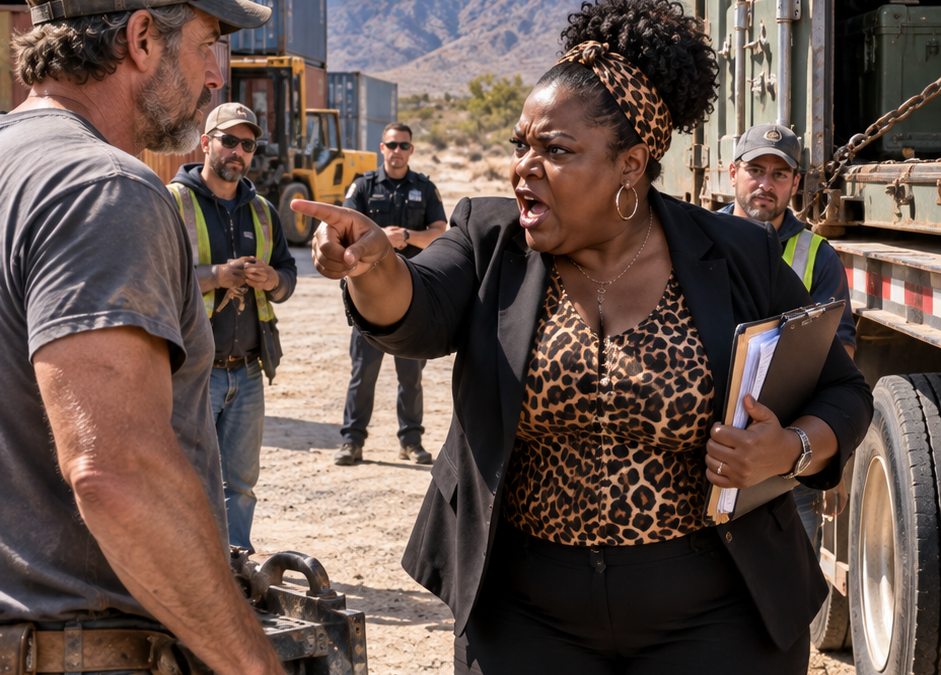
Deanna Puit stood beside it in a windbreaker, holding a laminated sheet and pointing a driver toward my gate.
She looked less like someone taking property than a woman directing chairs into place before a meeting.
I climbed out.
“What are you doing?”
She reached me before I reached the truck.
“The board voted Tuesday.”
I looked past her at the yellow placard on the container doors.
“Those units aren’t yours to move.”
“Ray, you weld rusted boxes into shacks for people who can’t qualify for a mortgage. This isn’t a business. It’s a junk pile with a mailbox.”
The insult landed somewhere I did not have time to feel.
“Two of those seals have been cut.”
She glanced at her laminated resolution.
“We have abatement authority.”
“There’s government property inside.”
For the first time, her expression shifted.
Only a little.
Then she turned toward the driver.
“Keep going.”
The hauler’s foreman stood near the doors, studying the placard. He had gone quiet in the particular way working men do when they discover a job carries risks nobody mentioned on the phone.
I could hear my side lifter idling farther down the pad.
An empty forty-foot container sat beside it.
I made a decision that felt practical for approximately ninety seconds.
I climbed into the machine, picked up the empty container, swung it around, and set it sideways across my front entrance.
Eight thousand pounds of steel between two gateposts.
The left corner scraped down one post with a shriek that cut through the yard.
Nothing on wheels was getting past it.
The foreman shut down his truck.
For one moment, I thought I had stopped the last load.
Then Deanna walked east, lifted her arm, and pointed toward my rear access gate.
I had built that gate for water deliveries.
It opened onto a two-track connecting with the county road.
The loaded driver followed her directions.
I stood beside the machine and watched the container pass through the back of my property, carrying equipment accounted for under my signature.
I did not run after it.
I did not stand in front of a truck.
I watched it turn north, and the dust stayed suspended long after the trailer disappeared.
My father had started this yard in 1989.
I had spent most of my adult life keeping it working.
Eight employees depended on it. My wife handled its payroll. My daughter had learned to paint inside one of those containers.
And now a woman with a board resolution had decided she could remove the part of our business I was least able to lose.
I went into the office.
The clock read 2:40.
I opened the seal log, pulled up the photographs on my laptop, and reached for a phone number I had spent years earning the right to call.
My hands were steady until I started reading the numbers.
Then they weren’t.
PART2
Sixteen months earlier, Deanna and I had not been enemies.
We barely knew each other beyond road maintenance, meeting notices, and the two-finger wave people exchange on rural Arizona roads.
My father built the shop on fourteen acres in the Big Chino, outside Paulden.
A graded pad. A well connection. A pole barn he raised with a friend named Dwayne.
The subdivision arrived five years later.
Granite Rim Ranches drew its lines around an operation that already existed, which was why a county zoning-verification letter hung on my office wall.
Lawful preexisting contractor’s yard.
I had read that phrase so often I could say it while half asleep.
My daughter, Marissa, once threatened to put it on my birthday cake.
We converted retired shipping containers into useful things: off-grid cabins, pump shelters, equipment storage, and supply-cache units for fire districts.
There was nothing glamorous about it.
We bought steel boxes that had spent years crossing oceans, repaired the damage, cut openings, insulated, wired, plumbed, and painted.
A good finished unit kept weather out and did exactly what somebody needed it to do.
That was enough for me.
Jodie handled payroll and bookkeeping. Eight employees worked the yard. We had a side lifter, two flatbeds, a telehandler, welding equipment, and a water truck for dust control.
Twelve to eighteen containers on the pad was ordinary.
Then there were the five under the defense subcontract.
A prime contractor had hired us to refurbish units returning from a Guard installation north of Flagstaff.
Three twenty-footers.
Two forty-footers.
Numbered bolt seals. Monthly inventories. Government property documented on hand receipts bearing my name.
Before approving the site, the contractor required fencing, lighting, cameras, an alarm, and a written security plan.
They inspected everything.
People hear “defense contract” and imagine a secret history.
Mine involved a graded pad, suitable lifting equipment, reliable work, and a business phone somebody answered.
Jodie hated when I said answering the phone was our competitive advantage.
“It would help if you also remembered to charge people,” she said.
Marissa painted finished units after school. She was sixteen when this began and already better at getting an even coat than I was.
I told her that once.
She never allowed the admission to expire.
Deanna was sixty-one, serving her fifth term as association president, and running Puit Land Company.
Her listings promised dark skies, open views, and shared water.
She had nine properties on the market, including twenty acres of her own that had been sitting unsold for years.
My container roofs were not part of her preferred view.
But that was only half of who she was.
For eleven years, she had run the water cooperative without pay.
She kept meter readings, monitored the well, answered emergency calls, and drove out on freezing nights when someone lost water.
The neighborhood trusted her because she had earned trust doing something difficult.
What none of us understood was how easily earned trust in one area could become assumed authority over everything else.
The first violation notice arrived in February.
It cited a 2019 rule against outdoor storage of commercial materials and gave me forty-five days to remove every container.
After that, fines would accrue at $150 a day.
Granite Rim had thirty-eight lots.
Exactly one contained a container-conversion business.
I wrote back.
Politely.
I attached the county letter and the original covenants, which permitted ranch, contractor, and equipment structures customary to the area.
Then I requested the adoption minutes and vote count for the 2019 rule.
No response.
A week later, Deanna walked my fence with her phone raised.
I waved from the cutting bay.
She kept photographing.
That evening, I told Jodie about it with the misplaced confidence of a man who believes a clear document ends an unclear argument.
“All she has to do is send the records.”
Jodie set down her fork.
“Ray, she runs the well.”
“I know what she runs.”
“You know what she’s responsible for. I’m not sure you understand how people see her.”
I dismissed that distinction.
It took considerable money to learn what my wife had offered me for free.
When Deanna could not make the county letter disappear, the road became the problem.
A woman renting one of her properties caught a piece of cinder behind one of my trucks and cracked her windshield.
That happened regularly on our road.
It was still aggravating, and I understood the complaint.
Deanna understood its usefulness.
Safety became the word attached to everything that followed.
Six weeks later, a gate went up at the cattle guard near the highway.
Each lot paid a $650 special assessment.
The board announced a twelve-thousand-pound gross-weight limit, residential access codes, forty-eight hours’ notice for commercial deliveries, a $200 road-impact charge per trip, and hauling hours restricted to eight through four.
My side lifter exceeded the weight limit empty.
I received a code.
For nine days, it worked.
On the tenth, a steel driver called from the highway.
“Your code’s dead.”
He carried eleven thousand pounds of tubing and plate.
I told him not to force anything.
Then I took my trailer to the highway pullout and began cross-loading material in a thirty-mile-an-hour wind.
Cinder blew sideways into our faces.
Every lift took longer than it should have.
Reuben, twenty-two and with me three years, pinched his hand between a bundle and a stake pocket during the second load.
Two fingers swelled purple.
He stood there insisting it was his fault while I wrapped his hand in a shop rag.
“Boss, I put it in the wrong place.”
“We shouldn’t be doing this here.”
He missed a week of grinder work.
That was when the dispute stopped feeling administrative.
I could absorb an ugly letter.
Watching an employee get hurt because our normal delivery route had been blocked was different.
Several people offered to cut the gate.
I hired a surveyor instead.
Then I went to Prescott and met Renata Fiori.
Fiori listened without interrupting, which initially made me think she doubted me.
Then she asked for the documents in chronological order.
Not the most insulting letter first.
Not the photograph that made Deanna look unreasonable.
Chronological order.
The survey confirmed a sixty-foot ingress-and-egress easement recorded in 1989.
Before the subdivision.
No commercial restriction.
No vehicle-class restriction.
No weight limit.
Fiori studied it.
“They have responsibilities for the road,” she said. “That doesn’t mean they can extinguish the access your deed already grants.”
She wrote the association and copied its attorney.
Eight days later, my code worked.
I thought we were finished.
Later, we learned the association’s lawyer, Aaron Vestal, had advised the board to restore access. He had plainly warned against using the gate to exclude an existing easement holder.
At the time, all I knew was that a truck could reach my yard again.
I mistook a temporary retreat for a change of mind.
Around then, I upgraded the cameras covering the entrance and pad, with local recording and cloud backup.
The insurance carrier had been pushing me.
I complained about the cost while running conduit.
Jodie reminded me that I complained about every expense that did not have an engine.
Those cameras eventually became more important than the engine on anything we owned.
The keypad vendor also kept logs.
Activation.
Deactivation.
Administrator account.
Timestamp.
I did not know that yet.
Neither did most of the people voting about my road.
They thought they were making decisions that disappeared into the next meeting.
They were leaving a record.
The county inspector arrived in May.
Two named complaints.
Illegal salvage operation.
Unsafe open-flame cutting during fire restrictions.
The second accusation scared me because, on its face, it deserved attention.
We lived in dry country.
A careless spark could threaten far more than my business.
Deanna’s submission was thorough: twenty-two dated photographs, container numbers, a sketch of the property, and recorded hours of torch activity.
I could dislike her motives without pretending the county should ignore it.
Before calling Fiori, I called Nadia Kesler, the prime contractor’s security officer.
“A county inspector is coming,” I said. “The complaint concerns our yard operation. I want you hearing it from me.”
“Send me the notice.”
That was all.
Eleven seconds that preserved something more valuable than my pride.
Then I gathered scrap manifests, extinguisher records, photographs of the cleared fire buffer, and the spark-watch log.
After hot work, Elias stayed on watch with an extinguisher and recorded his time.
Hundreds of pages.
One dependable man’s signature repeated until it looked like the quiet backbone of the operation.
I shut down cutting before the inspection.
The inspector spent six hours walking the property in ninety-six-degree heat.
He measured the buffer.
Examined bins.
Read logs.
Asked questions.
Finally, he looked up.
“Your clearance exceeds the requirement.”
I waited.
“Your documentation is better than a lot of places I inspect.”
The complaint closed without findings.
But the closure did not give me back the workdays.
I kept the torch cold until the written report arrived.
Nine working days lost.
Forty-four hundred dollars in consultant and legal costs.
Then Camp Verde moved a $61,000 order for four cache shelters to another shop.
The chief called personally.
“I need a delivery date I can rely on.”
“I understand.”
And I did.
That made it harder to be angry at anyone except the person whose complaint had created the uncertainty.
After the call, I sat in my truck rather than walk inside and explain what sixty-one thousand dollars looked like when it vanished.
Eventually, Jodie came out.
“Bad?”
I nodded.
She sat beside me.
We did not talk for a while.
Later, those complaint photographs mattered for another reason.
Four clearly showed the yellow placard on one of the government units.
In two, the identification underneath was legible.
Deanna had documented that container more than a year before telling a hauler it was an ordinary storage box.
She had done an excellent job preserving what she knew.
Wendell Cypes was seventy-four, retired from the telephone company, and one of the few board members who read every attachment.
He requested the closed county file.
At the next meeting, he pointed out that investigating a complaint and substantiating it were different things.
Deanna had been telling residents the county was examining my operation.
Wendell told them how that examination had ended.
For the first time in years, she had to explain herself publicly.
Three weeks later, the water rules changed.
The well level had fallen eleven feet over two dry seasons.
That measurement was real.
Deanna had recorded it herself, just as she had recorded the readings for years.
The annual meeting took place in the Paulden fire-station equipment bay.
Folding chairs.
Packaged cookies.
Coffee that tasted like somebody had rinsed out a tool.
Thirty-one people attended, with votes representing all thirty-eight lots.
Water brought people to meetings faster than landscaping ever could.
Deanna presented charts, rainfall history, and the declining static level.
She knew her material.
Listening, I felt the same uneasiness as everyone else.
Our hill depended on a finite supply.
Then she presented the proposed responses.
A commercial rate six times the residential rate.
A nine-hundred-gallon monthly cap.
A lockable enclosure over the commercial meter, with her holding the key.
There was one commercial user.
Me.
The next proposal concerned outdoor accumulation of unsecured combustible materials and debris during declared fire season.
The amendment passed twenty-six lots to twelve.
Attached to it was authority to remove those hazards at an owner’s expense during a county pre-evacuation notice.
I should have listened more carefully to that part.
I was concentrating on how to keep my business supplied with water.
When I stood, my voice became quieter than usual.
Jodie said that was how she knew I was truly angry.
“The well problem is real,” I told the room. “I accept the numbers. My shop is the biggest draw, so I’ll disconnect.”
Deanna blinked.
“I’ll install a ten-thousand-gallon tank. I’ll haul from Chino Valley at my expense. I can do it inside a month.”
Wendell raised his hand.
“Is a sealed steel box combustible?”
Deanna looked toward him.
“It’s clutter. Clutter burns.”
I turned back to her.
“I’m agreeing to take the shop completely off the well.”
“You can agree with me and still move the boxes.”
There it was.
Water conservation had a practical solution.
Her demand remained exactly the same.
Before sitting down, I handed my written offer to the secretary.
Fiori had told me to document every proposed solution and give it to somebody besides Deanna.
The cooperative accepted.
Eleven days later, the tank stood on its pad.
Sixty-two hundred dollars to install it.
Afterward, hauling ran roughly nine cents a gallon, with heavy-use weeks costing around three thousand dollars.
The crew called the tank Big Bertha.
I started watching its gauge the way other men watch their retirement accounts.
We reduced unnecessary water use.
Dust control became harder and the yard got dustier.
At the next meeting, Deanna raised dust as a concern.
I almost admired the completeness of it.
She could make the solution expensive, then object to its consequences without appearing to notice any connection.
The association recorded its meetings on a phone.
Wendell’s question remained on that recording.
So did her answer.
A sealed steel box.
Clutter burns.
We would hear those words again.
By the following April, Deanna’s twenty-acre parcel had taken another price reduction.
Her broker sent an email describing “industrial adjacency” as an obstacle.
She forwarded it to the board.
Wendell eventually saw it.
Within weeks, four new problems arrived.
First came a recorded lien for $37,400.
Container fines.
Road-impact fees.
Commercial water differentials.
All stacked together.
Jodie opened the bank’s letter.
“The lien flagged the side-lifter note.”
“It’s a fine for having containers in a container yard.”
“The loan officer needs something more useful than that.”
She was right.
The recorded claim complicated financing whether I agreed with it or not.
For two weeks, I tried to explain context to a process designed around boxes on forms.
Then Deanna wrote the defense prime.
She found its public small-business contact and asked whether the government knew its equipment was being stored on a property allegedly violating recorded covenants.
Its equipment.
Her words.
The liaison forwarded the letter.
You should see this.
I read it in the cutting bay with my helmet raised.
Until then, most of what I felt had been frustration.
That letter made me furious.
She was reaching into a relationship I had earned through years of careful work and trying to make uncertainty do what her notices had failed to accomplish.
She also called the Camp Verde chief, mentioning the county complaint while omitting its clean closure.
And she told neighbors I was under federal review.
The rumor reached the feed-store counter before I knew it existed.
Then it reached my daughter.
Marissa cleaned turnovers at one of Deanna’s rentals on weekends.
Forty dollars a unit.
Two or three on a Saturday gave her money for paint and ordinary seventeen-year-old independence.
In May, the calls stopped.
No explanation.
She mentioned it while helping me prepare a spray gun.
The pressure setting was wrong.
A tiny, fixable thing.
I turned and shouted at her.
Full volume.
I heard myself doing it and still failed to stop.
Her expression closed.
“Okay,” she said.
She set the gun down and walked away.
After everyone left, I sat in the bay listening to wind thump the roll-up door.
I could build a case against Deanna for interfering with my business.
There was no useful case against anyone else for the way I had treated my daughter.
That evening, I knocked on Marissa’s bedroom door.
“I’m sorry.”
She sat cross-legged on the bed.
“You didn’t deserve that.”
“I know.”
The answer hurt because it was true.
I started talking about the rental job.
She interrupted.
“Dad, I don’t care about the job. I care that you yelled at me.”
I sat on the edge of the bed.
“You’re right.”
She watched me, waiting for a qualification.
I did not give her one.
This time, I contacted the prime before another letter could arrive.
I laid out the dispute, attached the county closure and zoning letter, and invited a site inspection.
Nadia came the following Thursday.
She checked the fence, alarm, lighting, camera retention, and cloud backup.
Then she photographed all five intact bolt seals with timestamps.
Fifty minutes.
She recertified the site and left.
I stood in the yard afterward holding a clipboard I had barely used.
Nothing exciting had happened.
No speech.
No promise to protect me from the association.
Just a competent person verifying conditions and preserving a record.
Five photographs would later establish exactly what had been intact before the removal.
At the time, I was simply relieved the prime had stayed.
The units remained sealed on the pad through May, waiting for their scheduled movement.
Meanwhile, Deanna began asking a hauler how long it took to lift a loaded forty-footer.
I did not know that yet.
I was still trying to get through the work directly in front of me.
The storm arrived on a Sunday night.
Lightning.
Almost no rain.
By Tuesday, smoke rose nine miles west through the juniper.
By Wednesday morning, ash dusted our windshields.
That afternoon, Yavapai County issued a “Set” notice.
Prepare to evacuate.
Know where the animals are.
Get trailers ready.
It was serious.
It was not an order to leave.
People backed horse trailers toward pens and packed medication, photographs, and papers.
Deanna called a board vote by group text at 9:15 that night.
Three members voted yes.
Wendell voted no and expressly requested that his objection appear in the minutes.
The fifth member was away and did not respond.
The motion authorized removal of hazardous accumulations to off-site storage at an owner’s expense.
By Thursday morning, Deanna had signed the hauler’s customer form.
Above her signature was a warranty that she possessed authority to direct removal.
She also agreed to indemnify the carrier.
Her name.
Her title.
Her decision.
At 6:50, two tilt beds and a side lifter came down the road.
They cut my yard chain.
I was in Prescott picking up steel.
Elias and Reuben were installing a pump shelter elsewhere. The remaining crew worked at the north end behind a stack of empties.
By the time someone came around front, units were already moving.
Deanna held up her laminated resolution.
They called me.
I was heading north.
Ten minutes out, I called Nadia and reached voicemail.
By 1:25, four containers had left my property.
That was the yard I drove into.
The missing spaces.
The last forty-footer.
Deanna telling me to move my truck.
The foreman had already noticed the placard.
“Ma’am, is that a Department of Defense marking?”
“It’s a storage box,” she said. “I’ve photographed it four hundred times.”
“Then you saw the placard.”
He looked at me.
I kept my voice low.
“Give me the work order. You’re going to want me to have it.”
He returned from his truck with the entire packet.
The delivery address.
The removal instructions.
Her signed authority warranty.
He shut down his equipment.
The other driver, already loaded, followed Deanna toward the rear gate after I blocked the front.
My improvised steel barricade accomplished nothing except gouging a post.
And leaving me with a permanent reminder that being strong enough to lift a container did not make me strong enough to control the situation.
At 2:40, Nadia answered on the second ring.
I described the removal.
Then the seals.
My crew had recovered two cut seals from the cinder and bagged them.
I read the identification numbers.
“Again,” she said.
I repeated them.
“Stay available. Start the written notification now.”
My subcontract and security plan required reporting theft, loss, damage, or possible compromise of government-furnished property within twenty-four hours.
One unit contained controlled cryptographic items accounted for on my hand receipt.
That made broken seals far more than a billing dispute.
I was not going to describe the contents over a neighborhood argument or speculate about what anyone might have touched.
I was going to follow the reporting instructions precisely.
Seal numbers.
Container identifiers.
Times.
Last verified condition.
Destination.
Work order.
Video.
Jodie sat opposite me, scanning pages and eating crackers because neither of us had remembered dinner.
“Did you attach the May photographs?” she asked.
“Yes.”
“The full work order?”
“Yes.”
“The signed page?”
I checked again.
“Yes.”
I called the sheriff’s office, obtained a report number, and added it.
Then I waited.
That was the hardest part of the evening.
The report was submitted.
The containers were gone.
I could not fix either condition by walking outside and working harder.
Marissa brought us water.
She set a glass beside my keyboard.
“You did what you were supposed to do, right?”
“I’m doing it.”
She nodded.
I wished the difference between those answers did not matter so much to me.
By Friday morning, four calls came before eight.
Corporate security.
A counterintelligence office.
A Defense Criminal Investigative Service agent.
The Guard unit’s property-book officer.
Every question was specific.
Every answer had to be equally specific.
The affected equipment package had to be reported non-mission-capable pending verification.
Movement was frozen.
Recovery and inventory received immediate priority.
Nobody sent a dramatic convoy to my neighbor’s house.
The urgency appeared in coordinated calls, case numbers, assigned personnel, and instructions that left no room for improvisation.
The federal agent asked who had directed removal.
“The homeowners association president.”
A pause.
“Explain that again.”
I did.
At 9:15, I called the sheriff’s office back with the federal case number.
A deputy reached Ash Fork within the hour.
Deanna had supplied the storage address in writing.
Nobody needed to search the desert.
We needed to establish what had happened to the contents.
At 1:15 Friday afternoon, I stood in a gravel storage lot looking at all five units.
Bent gate.
No attendant.
No cameras.
The owner had rented spaces to a woman who paid a deposit.
He had no idea what she had delivered.
The heat had reached 101 degrees.
A shade tent went up for the inventory.
Three seals remained intact.
Their numbers matched Nadia’s photographs.
Two had been cut.
The foreman had admitted cutting them while checking for possible hazardous cargo before transport.
He gave a written account without waiting to be cornered.
His decision had been wrong under the circumstances, but he did not hide it.
That honesty mattered.
The inventory proceeded item by item against the hand receipt.
Numbers spoken.
Numbers checked.
Condition documented.
I stood nearby with sweat running down my back, waiting for the first discrepancy.
None came.
Everything was present.
No missing equipment.
No identified damage to the contents.
No evidence of interference beyond the breached seals.
I should have felt uncomplicated relief.
Instead, I felt sick at how easily the result could have been different.
Jodie called.
“They have everything?”
“Yes.”
“All of it?”
“All of it.”
Only then did my voice shake.
She did not fill the silence.
She waited while I got control of it.
Friday evening, I followed the recovery trucks home.
Five roofs ahead of me in the fading light.
I counted at every bend.
By nightfall, every unit was back on the pad.
On Saturday, the fire settled down.
Four hundred acres burned.
No structures lost.
The “Set” notice lifted Sunday.
The emergency had been real.
That mattered, even though I wished the facts were simpler.
Sunday evening, I brought two bankers’ boxes to Fiori’s office.
“The fire was real,” I said before she asked anything. “So was the notice.”
“Good. We build the case around all the facts.”
She opened the amendment.
“Read the words.”
I did.
“Outdoor accumulation of unsecured combustible materials and debris.”
“Now tell me what they took.”
“Sealed steel containers.”
“That distinction is where we start.”
She explained that the recorded language, the limits of the association’s authority, the manner of entry, and the nature of the property all mattered.
A board resolution did not turn private contractors into officers carrying a seizure order.
Whatever enforcement remedies the association possessed, we would challenge its claim that this removal fell within them.
Two weeks after recovery, we obtained temporary relief followed by a preliminary injunction.
No entry.
No removal.
No interference with the easement.
Gate access restored and protected.
The foreman supplied a sworn declaration.
Six weeks in, Fiori filed the civil complaint against the association and Deanna personally.
Conversion.
Trespass to chattels.
Interference with business relationships.
Wrongful lien.
Breach of the covenants.
We also challenged the application of the fire-season provision and commercial water classification.
It looked decisive on paper.
Living through it was much less satisfying.
The equipment had come home in roughly a day.
The litigation took seventeen months.
The insurance carrier initially reserved its rights.
Then it denied individual coverage for Deanna under the intentional-acts exclusion.
She hired her own lawyer.
Cutler.
About sixty.
Calm.
Capable.
Four hundred dollars an hour.
I refused to mistake his professionalism for agreement with his client.
He had real arguments.
The amendment had passed with enough votes.
A genuine county notice had been in effect.
The containers had gone to storage, not a scrapyard.
Everything came back.
Nothing inside was missing.
He argued reliance on a board decision and a licensed hauler.
Then he asked the question that troubled me most:
What compensable harm remained after a complete recovery?
I knew what the experience had cost my family emotionally.
A court needed more than how angry I felt.
Nadia’s office documented the standby costs, reinventory work, and site recertification.
Fiori collected the canceled order, fees, receipts, equipment downtime, and financing consequences.
Meanwhile, discovery pulled the history into view.
The keypad logs showed the access interruptions.
The county file preserved Deanna’s photographs.
Meeting audio preserved her response to Wendell.
My written disconnection offer showed a solution delivered before the water confrontation escalated.
The cooperative’s minutes showed acceptance.
Tank receipts proved follow-through.
The association’s new leadership eventually authorized disclosure of Vestal’s earlier legal warning.
His email established that the board had been advised about my easement rights before continuing its pressure.
Then the hauler’s accounting records arrived.
Not Deanna’s version of them.
The bookkeeper’s actual records.
A quote.
A $1,500 deposit.
Both dated the Friday before Sunday’s lightning storm.
Two days before any ignition.
There had been no fire when she paid to remove the containers.
I stared at the date longer than I needed to.
The fire had not created the plan.
It had provided the occasion.
During the deposition, Fiori asked when the deposit had been paid.
Deanna said she did not remember.
The record went on the screen.
“Where was the fire on that date?”
“I don’t recall the sequence.”
“There was no fire yet.”
Cutler stopped moving.
Then he wrote something down.
Deanna had brought a tabbed binder.
By the third hour, she was folding one paper corner back and forth instead of turning pages.
I took no pleasure in watching that.
I did take comfort in seeing a date remain a date despite everything she tried to make it mean.
In month fourteen, they proposed a mutual walk-away.
No payments.
A statement calling it a misunderstanding.
Everyone would move on.
Jodie read the proposed language.
“Do you want this?”
I thought about the highway shoulder and Reuben’s hand.
The chief apologizing as he moved the order.
Marissa standing beside the spray gun.
Nadia asking me to repeat the seal numbers.
“No.”
Fiori warned that continuing carried costs and uncertainty.
She was right.
I declined anyway.
Part of my reason was a seventeen-year-old losing forty-dollar cleaning jobs because her father would not surrender his livelihood.
That was not the strongest damages theory.
It was still part of why I could not put my name beneath “misunderstanding.”
The bench trial lasted three days.
No jury.
No dramatic audience.
A judge who had heard plenty of covenant disputes and wanted ours presented efficiently.
Fiori instructed me not to give speeches.
“Answer the question. Let the documents do their work.”
On the first morning, she displayed the amendment beside one of Deanna’s own photographs.
Combustible materials and debris.
A sealed steel container on a cleared cinder pad.
The association secretary read the language aloud.
Then the bookkeeper authenticated the quote and deposit.
Weather records established the storm’s date.
The judge studied the sequence.
Next came the photographs showing the placard.
Then eleven seconds of audio from my pad camera.
“It’s a storage box. I’ve photographed it four hundred times.”
Fiori let the recording stop.
She moved to the next exhibit without explaining what everybody had just heard.
Nadia testified about the intact seals, matching numbers, reporting requirements, inventory, and nineteen-day recertification process.
Cutler asked whether any equipment had been lost or compromised.
“No loss was identified.”
“Then what was the harm?”
She explained the response that a possible compromise required.
The package’s temporary unavailable status.
Standby personnel.
Reinventory.
Inspection.
Recertification.
She supplied dates and invoice numbers.
She never exaggerated.
That made her difficult to dismiss.
The final sequence concerned the alternatives Deanna had rejected.
The easement warning.
The accepted offer to leave the well.
The installed tank.
The meeting recording.
By then, the dispute looked less like a sudden emergency and more like a succession of problems that remained unsolved in Deanna’s eyes whenever the solution allowed my business to continue.
I testified for eighty minutes.
Near the end, Cutler asked what had been worst for me.
“Calling Nadia Kesler.”
He waited.
“It took years to earn that trust. Then I had to tell her property under my signature was gone.”
He nodded.
No sneer.
No clever follow-up.
Just a lawyer doing his job.
The ruling arrived sixteen days later.
On a Tuesday.
The fire-season provision did not apply to the containers taken from my yard.
The road restrictions and impact fees could not be enforced against my earlier easement in the manner attempted.
The lien was wrongful and ordered released.
The association and Deanna were liable for the unauthorized taking and interference with the property.
Deanna also faced personal liability for interfering with business relationships.
The award totaled $264,900, with attorney fees awarded under the covenants’ prevailing-party provision.
The documented losses included prime-contractor charges, lost work, downtime, consultant expenses, resealing and related restoration costs, water expenses allowed by the ruling, and wrongful-lien damages.
But I did not win everything.
The court upheld part of the commercial water classification.
The cooperative had actual authority over its well.
Its conservation concerns were legitimate.
I read that portion twice.
Jodie watched me.
“You okay?”
“I wanted the judge to read everything. That includes the part where I lose.”
Deanna had been wrong about what she could do to my property.
She had not been wrong that the well was falling.
I would not turn one fact into the other merely because it would make my story easier.
The criminal case proceeded separately.
It ended in a negotiated plea to a single theft count.
Probation.
Restitution.
Two hundred hours of community service.
No jail.
No courthouse spectacle.
Nobody applauded.
Afterward, Jodie asked if I wanted a green-chile burger.
We went.
For the first time in months, lunch was only lunch.
Deanna was recalled before the civil ruling arrived.
Twenty-nine to six.
Same fire-station bay.
Same folding chairs.
I did not attend.
Her personal share of the judgment forced the sale of her twenty acres.
A hay grower bought it for roughly what she had paid years earlier.
He cared more about practical agricultural use than the view.
She kept her house.
She kept her real-estate license, with a reprimand and further education requirements.
Three listing clients left.
Six stayed.
That was the outcome.
It did not erase her from the neighborhood.
We still passed on Granite Rim.
We lifted two fingers from the steering wheel.
It was neither friendship nor a declaration of peace.
We simply had mail to collect and work to do.
The association’s insurer covered most of its share, leaving a $50,000 retention.
That became an assessment of about $1,300 per lot.
People who had believed they were protecting property values received another bill.
Wendell became president.
Recorded votes.
Published counts.
Advance agendas.
Longer meetings.
People complained.
Nobody asked to return to the old arrangement.
The water cooperative hired a licensed operator and established a regular meter schedule and publicly available well-level records.
The well kept dropping.
Six more feet after trial.
No judgment repaired the aquifer.
I stayed disconnected.
Big Bertha remained beside the yard, and I continued paying for hauled water.
That had been the right response to a genuine supply problem, regardless of the person who first forced the discussion.
The hauler settled its part and changed its procedures.
Written proof of ownership or a court order before removal from private property.
Its foreman now hauled for me twice a month.
I tried to buy him lunch repeatedly.
Occasionally, he let me.
The prime kept our subcontract.
Then it added another five-unit refurbishment package.
When Nadia certified the second storage area, I asked why.
She answered without sentiment.
“Your incident documentation was complete. Your reporting was timely. The inventory reconciled. We know how you respond when something goes wrong.”
I had spent months afraid the theft would end that relationship.
The way we handled it helped strengthen the relationship instead.
Jodie said there was probably a lesson in that.
I said I preferred lessons that did not require litigation.
She agreed.
The bank cleared the lien issue within a week of receiving the release.
Our gate code worked.
The road fees stopped.
Trucks reached the yard at seven, the way they had when my father ran it.
Marissa graduated and took a painting job at a body shop in Prescott Valley.
She regularly informed me that she earned more than I had paid her.
I told her that was an excellent reason to buy her father lunch.
She developed opinions about clear coat I no longer attempted to challenge.
More importantly, she started wandering into the shop to talk again.
I listened better.
Some evenings, that felt like the most valuable thing we recovered.
The empty forty-footer I had dropped across the entrance stayed there for weeks while I dealt with the aftermath.
Eventually, I looked at it and saw a use beyond obstruction.
We cut windows.
Framed a door.
Ran power.
Installed a mini-split.
It became our yard office.
Jodie moved her desk inside.
There was a working coffee maker and enough room for customers to sit without balancing paperwork on welding gloves.
The gouges remained in the left gatepost.
I never filled them.
They reminded me of the ninety seconds when I believed dropping something heavy could solve a problem built out of years of smaller decisions.
What protected us had been slower.
A dated photograph.
A saved recording.
An honest account.
A report submitted before its deadline.
People doing the ordinary parts of their jobs carefully.
On the last Tuesday in April, five completed units left through the front gate on schedule.
The foreman lifted a hand from his window.
I stood in the doorway of the container I had once used as a wall and watched the trucks turn north.
Dust hung above the road.
Behind me, Jodie answered the business phone before the third ring.
I looked at the scraped post, then at the open entrance.
This time, the containers were leaving because the work was finished.
I went inside and started the next job.








