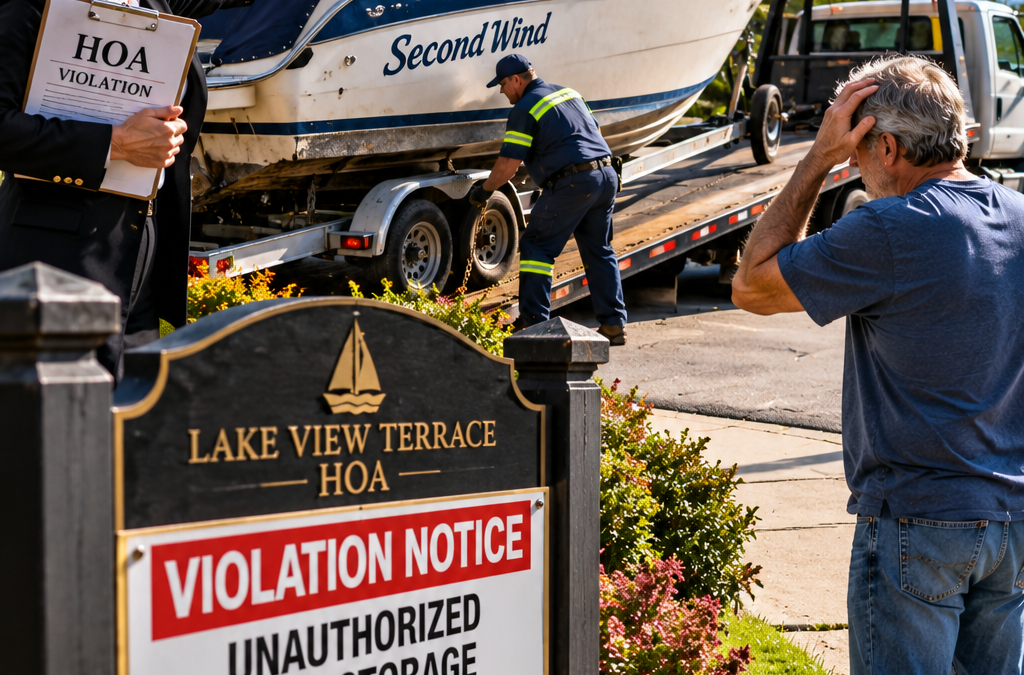
𝗙𝗨𝗟𝗟 𝗦𝗧𝗢𝗥𝗬 The HOA president had my boat hauled away over an eleven-day registration lapse after spending two years looking for any excuse to punish me. I stopped appealing, stopped arguing, and quietly made one decision that changed who held the leverage in Lake View Terrace forever.
𝗙𝗨𝗟𝗟 𝗦𝗧𝗢𝗥𝗬
That should have told me what kind of fight I was entering.
I still believed facts would matter.
Pamela taught me otherwise.
The boat violation disappeared for a few weeks.
Then other notices started.
Garden hose visible overnight.
Trash bin returned three hours late.
Side gate open during daylight hours.
A lawn edging complaint.
A supposed oil stain near my garage that turned out to be water from washing the truck.
At first I thought I was imagining the pattern.
Then one morning, I saw a young man standing across the street taking photographs of my house.
I walked outside.
“Can I help you?”
He lowered his phone.
“Compliance inspection.”
“Who are you?”
“Tyler.”
“That doesn’t answer the question.”
He pointed at the small badge clipped to his belt.
LAKE VIEW TERRACE COMMUNITY COMPLIANCE.
I had never heard of it.
“Who hired you?”
“The board.”
“Why are you photographing my house?”
“Routine inspection.”
“You inspect every house?”
He looked uncomfortable.
“I have an assigned route.”
“How often?”
He shrugged.
I stepped toward the sidewalk.
“Tyler.”
He sighed.
“Twice a week.”
“Twice a week?”
“That’s what I’m scheduled for.”
I felt something cold move through my chest.
“Who owns the company?”
He hesitated.
That told me.
Later I learned Tyler wasn’t just some contractor.
He was Pamela’s nephew.
Twenty-three years old.
No compliance background.
No property management experience.
Just a phone camera and a vendor account.
He started showing up regularly.
Tuesday mornings.
Friday afternoons.
Sometimes Saturday.
Photographing trash cans.
Fences.
Driveways.
My boat cover.
My yard.
Once he photographed me working on Second Wind’s engine through the open side gate.
That was when I confronted Pamela.
I called the HOA office.
“You hired your nephew to photograph my property?”
“Our vendor relationships are not your concern.”
“They become my concern when your relative is standing outside my fence twice a week.”
“Tyler is an independent contractor.”
“He’s your nephew.”
“That does not disqualify him from employment.”
“Was the contract bid?”
Silence.
“Derek, if you have concerns, submit them in writing.”
“Was it approved by the board?”
“Submit them in writing.”
She hung up.
I should have dug deeper then.
I didn’t.
I was tired.
That is what people like Pamela count on.
Not that you will agree with them.
That eventually you will get tired.
Tired of letters.
Tired of appeals.
Tired of meetings.
Tired of reading bylaws.
Tired of being angry inside your own home.
After a while, paying fifty dollars feels easier than fighting.
Moving the trash can feels easier than arguing.
Closing the gate feels easier than asking why some twenty-three-year-old is photographing your backyard.
I started understanding how unreasonable authority grows.
Not through one enormous act.
Through exhaustion.
Then October came.
Tuesday morning.
Cold enough that I could see my breath.
I stepped outside around seven with coffee.
Something looked wrong immediately.
The side yard felt empty.
I turned.
Second Wind was gone.
For several seconds, my brain refused to process what I was seeing.
The trailer was gone.
Wheel chocks gone.
Boat gone.
I actually walked toward the fence as though maybe twenty-six feet of fiberglass had somehow shifted behind the shed.
Nothing.
My coffee hit the ground.
I ran back inside and grabbed my phone.
First thought:
Stolen.
I called the sheriff’s non-emergency line.
Before dispatch finished taking information, an HOA email appeared on my screen.
NOTICE OF AUTHORIZED TOW.
I opened it.
My hands started shaking.
The HOA had ordered my boat removed.
Reason:
Expired trailer registration creating an unauthorized vehicle-storage condition.
My trailer registration had expired eleven days earlier.
Eleven.
I had already renewed it online two nights before.
The new sticker was in the mail.
Pamela knew that because I had emailed a copy of the renewal confirmation after receiving a notice.
Didn’t matter.
She had used a towing provision buried in the HOA’s contractor agreement to order removal before the physical sticker arrived.
I called Pamela.
She answered on the second ring.
“Lake View Terrace HOA.”
“Where is my boat?”
Pause.
Then:
“Derek.”
“Where is my boat?”
“The trailer was in violation.”
“I renewed the registration.”
“The displayed sticker was expired.”
“By eleven days.”
“The rules do not provide an eleven-day grace period.”
“You towed a twenty-six-foot boat off my private property.”
“The board exercised its enforcement authority.”
“What gave you permission to enter my side yard?”
“The towing contractor acted under the association agreement.”
“What agreement?”
“You’ve received notice.”
“How much?”
“What?”
“How much is this going to cost me?”
“You’ll need to contact the facility.”
She sounded calm.
That made me angrier.
Like we were discussing a late library book.
I called the impound company.
Second Wind had been hauled forty minutes away.
Release fee:
$1,100.
Storage:
$40 per day.
I stood in my empty side yard.
The gravel showed tire marks.
One wheel chock had been crushed.
The tarp straps were lying in the dirt.
I felt violated.
That’s the only word.
Not because of the money.
Not even because of the boat.
Because strangers had entered my property before sunrise and taken something that belonged to me because Pamela Cruz decided eleven days on a registration sticker gave her that power.
I drove to the impound lot.
Paid the fee.
Picked up Second Wind.
The boat had a scrape along one side where the towing company had tightened a strap carelessly.
Small.
Probably repairable.
I ran my hand over it.
For some reason, that scratch hurt more than the $1,100.
My wife used to sit there.
That side of the boat.
Coffee in hand.
Feet up.
Pamela had turned something deeply personal into another checkbox on her enforcement campaign.
Driving home, I made a decision.
No more appeals.
No more board meetings.
No more highlighting bylaws.
No more asking people acting in bad faith to please interpret rules fairly.
I didn’t know what I was going to do.
But I knew I was done playing defense.
That afternoon, while waiting on hold with the towing company to request documentation, I started scrolling through my phone.
Mostly to keep from throwing it across the room.
Then I saw a listing.
PELICAN COVE MARINA.
FOR SALE.
I stopped.
Pelican Cove sat maybe three hundred yards from the western edge of Lake View Terrace.
Same lake.
Twelve slips.
Fuel dock.
Small office.
Boat ramp.
Storage shed.
It had been there longer than the subdivision.
Family-owned.
Nothing fancy.
But anyone who lived around the lake knew it.
I opened the listing.
Asking price:
$240,000.
Owner retiring.
Established customer base.
Waterfront lease rights included.
Equipment negotiable.
I read it twice.
Then I laughed.
Not because I had a plan.
Not yet.
Because after spending all morning dealing with my boat being taken away, my phone was suddenly showing me a marina for sale.
I called the number.
A man answered.
“Pelican Cove.”
“Is this Gerald?”
“Depends who’s asking.”
That made me smile.
“My name’s Derek Harmon. I’m calling about the marina.”
“You buying or dreaming?”
“I don’t know yet.”
“Fair answer.”
We talked for nearly two hours.
Gerald Bennett was seventy-one.
He had owned Pelican Cove for thirty years.
His wife had died four years earlier.
His knees were bad.
His daughter lived in Oregon.
He was done.
Not desperate.
Just done.
He wanted someone who understood boats.
When I told him I had been a marine engineer, he became more interested.
We met the next morning.
The marina was better maintained than I expected.
Twelve slips.
Six occupied long-term.
Three seasonal.
Three being held for maintenance rotation.
The office needed paint.
Fuel pumps were old but certified.
The launch ramp was solid.
The shoreline needed reinforcement in one section.
Gerald walked me through everything.
Books.
Permits.
Maintenance.
Insurance.
Waitlist.
Customer records.
I had not planned to buy a business in retirement.
But by the end of the morning, I was thinking about it seriously.
I had equity in my house.
Retirement savings.
Investments.
Some cash reserves.
Buying Pelican Cove would not make me rich.
It would make me less liquid.
There is a difference.
I spent a week running numbers.
Then another.
Gerald let me inspect everything.
Environmental records.
Fuel system.
Dock rights.
Property boundaries.
Contracts.
Shared access arrangements.
That last category became interesting.
Pelican Cove shared a fence line and service access corridor with Lake View Terrace.
There was an old maintenance agreement between the marina and HOA.
As part of transfer due diligence, my accountant and attorney requested updated financial disclosures from the association related to shared obligations.
That was how Pamela made her second mistake.
The disclosure package included maintenance expenditures.
Vendor payments.
Shared fence costs.
Landscaping expenses.
One vendor kept appearing.
Cruz Community Compliance Services.
I stared at the name.
Cruz.
Tyler.
Pamela’s nephew.
The payments were small individually.
$1,200.
$1,500.
$900.
$1,700.
But they added up.
More than $11,000 over seven months.
All buried inside a general maintenance category.
I called the marina’s attorney.
“Can I see the board authorization for this vendor?”
“There isn’t one in the documents.”
“Are you sure?”
“We asked.”
“Was it competitively bid?”
“No record.”
“Conflict disclosure?”
“Nothing provided.”
That got my attention.
I was not an HOA lawyer.
But I had sat through enough meetings to know significant vendor contracts normally required board authorization.
Especially related-party contracts.
I pulled old minutes.
Nothing.
No vote hiring Tyler.
No disclosure that he was Pamela’s nephew.
No line item for compliance services.
The payments had simply been folded into maintenance spending.
I forgot about buying the marina for almost an hour.
All I could think was:
She sent her nephew to photograph my property twice a week and used our dues to pay him without a recorded board vote.
I called Gerald.
“You ever deal with Pamela Cruz?”
He groaned.
“That woman?”
“That’s a yes.”
“She applied for a slip eight months ago.”
I froze.
“What?”
“Waiting list.”
He opened a drawer.
Pulled out a folder.
There it was.
Pamela Cruz.
Ski boat.
Twenty-two feet.
Preferred slip.
Weekend use.
Application date eight months earlier.
Gerald said, “She’s called me six times asking when something opens.”
I looked across the dock.
One of the nicest slips was near the fuel station.
Easy access.
No shallow approach.
Perfect for a ski boat.
“You have a waitlist?”
“Seven names.”
“She’s where?”
“Third.”
I closed the file.
Something inside me shifted.
Not revenge exactly.
Opportunity.
But even then, I knew I couldn’t let anger drive the business.
If I bought Pelican Cove, it had to work financially without Pamela.
The marina had to make sense on its own.
So I kept doing due diligence.
Six weeks after Second Wind was towed, I signed the closing papers.
No announcement.
No neighborhood gossip.
No triumphant social-media post.
Gerald stayed for a month as a consultant.
Employees stayed.
Name stayed.
Rates stayed.
Customers stayed.
The only thing that changed publicly was the LLC on the ownership paperwork.
Second Wind got Slip 4.
The first time I tied her there, I felt something I had not felt in months.
Peace.
No canvas cover.
No side fence.
No Pamela standing across the street with a clipboard.
Just Second Wind floating where she belonged.
Gerald stood beside me.
“Good slip.”
“Best one here.”
“You own the place. You can say that.”
I laughed.
Then I looked across the lake toward Lake View Terrace.
Pamela’s house was not visible.
Good.
I did not buy Pelican Cove just because of her.
But I would be lying if I said the timing did not feel satisfying.
Still, the vendor records bothered me more than her slip application.
I made copies.
Invoices.
Bank transfers.
Accounting entries.
Vendor registration.
Everything.
Then I quietly contacted Robert Ellison.
Robert had served on the HOA board for three years.
Soft-spoken.
Retired accountant.
Pamela steamrolled him constantly.
At meetings, he sometimes asked questions about expenses.
She usually cut him off.
I invited him to the marina office.
He arrived looking confused.
“You bought this?”
“Three weeks ago.”
He stared around.
“Seriously?”
“Seriously.”
“Why?”
“I like boats.”
He laughed.
“That simple?”
“Mostly.”
Then I placed the paperwork on the desk.
His smile disappeared.
He read the first invoice.
Then the second.
Then the spreadsheet.
“Where did you get this?”
“Financial disclosure tied to the marina transfer.”
He kept reading.
“This is Tyler.”
“Pamela’s nephew.”
“I know who Tyler is.”
“Did the board approve his company?”
Robert looked up.
“No.”
“You’re sure?”
“I would remember eleven thousand dollars.”
“Maybe there was an executive session?”
“No.”
“Conflict disclosure?”
“No.”
He sat back.
For a long time, neither of us spoke.
Finally, he said, “She told us he was volunteering.”
That surprised me.
“What?”
“When homeowners complained about being photographed, Pamela said Tyler was helping with compliance informally.”
“Informally earned him eleven grand.”
Robert’s jaw tightened.
I had never seen him angry before.
“What do you want?”
That question mattered.
I could have said:
I want Pamela destroyed.
I want her humiliated.
I want every dollar back.
Instead, I said, “An audit.”
He nodded.
“And?”
“I want the towing provision reviewed.”
“Because of your boat?”
“Yes.”
“Fair.”
“And I want someone independent to determine whether any other related-party spending exists.”
Robert looked down at the documents again.
“She’ll fight.”
“I know.”
“She controls two board members.”
“Does she?”
He looked at me.
“Maybe not after this.”
We met with another director, Susan Keller.
Then another.
Quietly.
No accusations beyond what documents showed.
No rumors.
No dramatic plan.
Just paper.
Robert did what Pamela had failed to do for two years.
He read everything.
By the December board meeting, he had the votes.
I had not attended an HOA meeting in eight months.
That night, I did.
I arrived early.
Sat in the last row.
No folder in my hand.
No highlighted bylaws.
Nothing.
Pamela entered five minutes later.
Red jacket.
Leather binder.
Same confidence.
She did not see me immediately.
Residents settled.
The board sat.
Pamela tapped the microphone.
“I’m calling the December meeting of Lake View Terrace Homeowners Association to order.”
She moved through approval of minutes.
Treasurer report.
Holiday landscaping.
Then Robert raised his hand.
“Before we continue, I have a motion.”
Pamela looked annoyed.
“Robert, we’re following the agenda.”
“It’s a financial-control motion.”
“You can raise it under new business.”
“It concerns ongoing vendor payments.”
That got everyone’s attention.
Pamela’s posture changed.
“What vendor?”
Robert looked at the other directors.
“I move that all HOA finances be placed under an independent third-party audit effective immediately and that presidential vendor-authorization authority be suspended pending completion of that audit.”
Silence.
Pamela stared at him.
“What are you talking about?”
Susan seconded the motion.
Pamela turned toward her.
“You’re seconding this?”
“Yes.”
“This is absurd.”
Robert remained calm.
“We have payments that require review.”
“What payments?”
“Cruz Community Compliance Services.”
That name landed like a brick.
Pamela went still.
Then:
“This matter does not require public discussion.”
Robert said, “It involves HOA funds.”
“The vendor was authorized.”
“By whom?”
“Under president’s discretionary maintenance authority.”
“There’s no vote.”
“A vote wasn’t required.”
“For eleven thousand dollars?”
Murmurs started.
Pamela lifted her hand.
“Everybody please remain quiet.”
Then she looked at Robert.
“We can discuss this in executive session.”
“No.”
That was the first time I heard Robert tell Pamela no.
Her face changed.
“What did you say?”
“I said no. The motion is already seconded.”
She glanced down the board.
I watched her calculate.
One ally.
Then another director who wouldn’t meet her eyes.
Robert called for a vote.
It passed.
Four to one.
Pamela sat completely still.
Then she looked toward the back of the room.
That was when she finally saw me.
Our eyes met.
I said nothing.
I didn’t smile.
I didn’t nod.
But something moved across her face.
Recognition.
Not of the marina.
Not yet.
Of the documents.
She knew.
I could see it.
For the first time since she had become president, Pamela Cruz looked uncertain.
After the meeting, she marched toward me.
“What did you do?”
I stood.
“Good evening, Pamela.”
“Don’t play games.”
“I’m not.”
“Where did Robert get those records?”
“You should ask Robert.”
“You’re behind this.”
“Behind an audit?”
“You’ve been obsessed with undermining me.”
That sentence almost made me laugh.
“I stopped attending meetings eight months ago.”
“You’ve filed repeated complaints.”
“I appealed violations.”
“You’ve challenged board authority.”
“I read the bylaws.”
She stepped closer.
“This is retaliation over the boat.”
“No.”
“It absolutely is.”
I looked at her.
“The audit isn’t about my boat.”
“Then what is it about?”
“Your nephew.”
She went silent.
There it was.
No confusion.
She knew exactly what I meant.
I said quietly, “Good night, Pamela.”
Then I left.
The audit took six weeks.
They found the vendor payments.
All of them.
No formal board approval.
No competitive bid.
No conflict disclosure.
Some invoices had vague descriptions like:
Property documentation.
Compliance review.
Community standards monitoring.
Eleven thousand dollars to Pamela’s nephew.
The audit also found other procedural problems.
Nothing criminal was alleged in the final report.
But enough governance violations existed to destroy Pamela’s credibility.
Residents were furious.
Especially homeowners Tyler had photographed.
One woman stood during the audit presentation and asked:
“You paid your nephew with our money to spy on us?”
Pamela objected to the word spy.
That did not help.
She insisted Tyler provided legitimate services.
Maybe he did.
That wasn’t the point.
The point was how the contract had been created.
Hidden.
Undisclosed.
Unapproved.
Pamela had spent two years lecturing everyone about procedure while treating procedure as optional whenever it benefited her.
The community petitioned for a recall vote.
Pamela fought that too.
She emailed residents.
Called the audit politically motivated.
Said board members were being manipulated by disgruntled homeowners.
She never named me.
She didn’t have to.
Everybody knew.
The recall vote passed.
Pamela Cruz was removed as HOA president.
Not by me.
By the neighborhood.
That distinction mattered.
I did not want people later saying I had somehow bought influence through the marina.
The homeowners voted.
The board changed.
Robert became interim president.
His first major action was reviewing enforcement contracts.
Second was terminating Cruz Community Compliance Services.
Third was revisiting the towing agreement.
That’s where Second Wind came back into the story.
The board reviewed my towing case.
They found the clause Pamela had relied on was intended for abandoned vehicles obstructing common access lanes, not covered boats sitting on private side yards.
The tow had been an abuse of the contract.
Lake View Terrace reimbursed my $1,100 release cost and storage fee.
They also paid for the scratch repair.
More importantly, the HOA struck the towing provision from the contract and adopted a new requirement:
No vehicle could be removed from private residential property without documented legal authority, board review, and proper notice except in a true emergency.
That policy meant more to me than the money.
Nobody else’s boat was going to disappear at sunrise over eleven days on a registration sticker.
Then came Pamela’s marina application.
I had almost forgotten about it.
Gerald reminded me.
“She called again.”
“When?”
“Yesterday.”
“What did you tell her?”
“That new ownership was reviewing the waitlist.”
He smiled.
“You going to tell her?”
“Eventually.”
I had inherited marina policies from Gerald.
Most were informal.
So during my first month, I worked with counsel to formalize them.
Insurance requirements.
Boat condition.
Fuel rules.
Payment history.
Conduct.
Slip eligibility.
One rule addressed active financial disputes with local community entities where the dispute could create collection or access complications.
It was not written solely for Pamela.
I made sure of that.
My attorney reviewed the language.
The policy applied uniformly.
Pamela still had an active financial dispute related to unresolved HOA charges and audit-related reimbursement issues.
Her application did not meet the marina’s requirements.
I denied it.
Form letter.
Professional.
No sarcasm.
No mention of my boat.
No mention of her presidency.
Nothing personal.
Three days later, she walked into the marina office.
I was behind the desk reviewing fuel invoices.
The door opened.
Pamela stepped in.
She froze.
I looked up.
“Morning.”
For once, she had no answer ready.
Her eyes moved around the office.
Then back to me.
“What are you doing here?”
“Working.”
“At Pelican Cove?”
“Yes.”
“Why?”
I leaned back.
“Because I own it.”
The silence that followed was one of the most satisfying silences I have ever experienced.
Her face changed slowly.
“Excuse me?”
“I bought Pelican Cove in November.”
“You?”
“Yes.”
She looked toward the docks.
Then at the paperwork on my desk.
“You bought the marina.”
“Yes.”
I could almost watch the previous three months rearranging themselves in her mind.
My absence from meetings.
The financial disclosure.
Robert’s motion.
The audit.
Her slip denial.
Everything.
“This is unbelievable.”
“I thought the same thing when my boat disappeared.”
Her eyes sharpened.
“So that’s what this is.”
“What?”
“Revenge.”
“No.”
“You bought a marina to punish me?”
I laughed.
“Pamela, you think very highly of yourself.”
Her cheeks reddened.
“My application was denied because of you.”
“Your application was denied under marina policy.”
“A policy you wrote.”
“A policy reviewed by counsel and applied to applicants with active qualifying disputes.”
“Convenient.”
“So was towing my boat over an eleven-day sticker.”
“That was HOA enforcement.”
“And this is marina management.”
She stared at me.
“That is incredibly petty.”
I almost smiled.
“Maybe.”
Then I pushed a copy of the policy toward her.
“But it’s also documented.”
She did not touch it.
“You won’t get away with treating people like this.”
That sentence stopped me.
Of all the things she could have said.
That one.
I looked at her for a long time.
“Pamela.”
She waited.
“For two years, you sent your nephew to photograph my house.”
“He was a contractor.”
“You denied appeals without answering the rule.”
“We had authority.”
“You towed my boat from private property.”
“You were in violation.”
“You used HOA money to pay family without properly disclosing it.”
Her face tightened.
“That matter was reviewed.”
“Yes.”
“And you lost your presidency.”
She stepped closer to the desk.
“You think owning this place makes you powerful?”
“No.”
“Then what?”
I looked through the window toward Slip 4.
Second Wind moved gently against the dock.
“I think owning this place means I don’t have to keep my boat in my side yard anymore.”
That was the truth.
The rest was secondary.
Pamela stood there another few seconds.
Then turned and left.
No dramatic screaming.
No threat.
No final speech.
Just the office door closing.
I watched her cross the parking lot.
For the first time since she became president, she looked ordinary.
That surprised me.
Authority had made her seem larger.
Without it, she was just another person angry because she didn’t get what she wanted.
Pelican Cove changed my retirement.
I had expected to slow down.
Instead, I found myself working again.
But it did not feel like work.
I rebuilt the fuel pump.
Rewired part of the office.
Replaced two deteriorating dock boards.
Helped customers troubleshoot engines.
Taught one teenager how to winterize an outboard.
Gerald came by twice a week at first.
Then once.
Then mostly for coffee.
One spring morning, he stood at the fuel dock looking across the marina.
“You improved the place.”
“You’re contractually required to say that.”
“My consulting contract ended months ago.”
“Then I appreciate it.”
He pointed toward Second Wind.
“You keep that thing cleaner than half my old customers kept their kitchens.”
“She deserves it.”
Gerald nodded.
“Glad the marina went to somebody who’d take care of her.”
I knew he meant Pelican Cove.
Still, I looked at Second Wind.
“I feel the same way.”
He understood.
We sat on the dock drinking coffee.
The lake was almost flat.
A few fishing boats moved in the distance.
No letters.
No violation notices.
No arguments.
I told Gerald the full story that morning.
The HOA.
Pamela.
The towing.
Audit.
Slip application.
He laughed so hard he started coughing.
When he recovered, he said, “You bought a marina because somebody towed your boat?”
“No.”
“That’s how I’m telling it.”
“Please don’t.”
“Too late.”
The story spread anyway.
Not because I told everyone.
Lake communities survive on gossip.
Soon people joked that I had escalated a parking dispute into commercial real-estate ownership.
That wasn’t completely fair.
I had bought a functioning business.
Pelican Cove made financial sense.
I liked running it.
But yes.
The boat seizure pushed me toward the decision.
If Pamela had left Second Wind alone, I probably never would have opened the listing.
That fact amused me.
Her attempt to make my boat disappear from the neighborhood ended with my boat occupying one of the best slips on the lake permanently.
There was an irony in that I did enjoy.
Still, the part people usually misunderstood was the audit.
They assumed I discovered Pamela’s nephew payments because I was hunting for dirt.
I wasn’t.
The information surfaced during ordinary due diligence.
That was what made it important.
I did not manufacture anything.
I did not hack records.
I did not bribe anyone.
I did not invent accusations.
I bought a marina.
The marina had a contractual relationship with the HOA.
Transfer required financial disclosures.
The disclosures contained real payments.
Those payments raised real questions.
Robert and the board handled the rest.
That distinction mattered because by then I had learned something Pamela never seemed to understand.
Power becomes dangerous when process disappears.
She had convinced herself that good intentions—or what she called good intentions—excused procedure.
She wanted neighborhood standards maintained.
So her nephew could be hired informally.
She wanted my boat gone.
So the tow clause could be stretched.
She wanted control.
So questions became defiance.
Maybe she genuinely believed she was protecting Lake View Terrace.
That almost makes it worse.
Bad leadership is not always someone twirling a mustache and plotting harm.
Sometimes it’s somebody so convinced of their righteousness that they stop checking whether they are allowed to do what they want.
Robert was different.
When he became interim president, meetings changed.
He published expenses.
Required conflict disclosures.
Vendor bids went out openly.
Appeals were heard by a panel instead of decided by the president alone.
Violations dropped.
Not because the neighborhood suddenly became chaotic.
Because half of Pamela’s violations had been unnecessary.
I attended one meeting about a year later.
Robert saw me.
“Derek. Haven’t seen you in a while.”
“That is intentional.”
People laughed.
He smiled.
“Any complaints?”
“One.”
The room quieted.
I pointed toward the refreshment table.
“Coffee’s terrible.”
Even Robert laughed.
That was the difference.
Under Pamela, every question felt like war.
Under normal leadership, people could disagree without somebody reaching for a fine schedule.
I still kept my house in Lake View Terrace.
Some friends expected me to move.
I never seriously considered it.
Why should I?
I loved the lake.
Loved the house.
Loved my neighbors.
Pamela was one person.
Leaving would have meant giving her more importance than she deserved.
Second Wind stayed at Pelican Cove.
Slip 4.
Right beside the fuel dock.
I liked being able to walk from my house to the marina in minutes.
No trailer.
No registration-sticker drama.
No canvas cover.
No side-yard inspections.
If I wanted to leave before sunrise, I untied two lines, started the engine, and went.
One morning in early summer, I took Second Wind out just after five.
Mist hovered over the lake.
Engine low.
Coffee beside me.
I shut down near the center and let the boat drift.
Those mornings used to remind me of my wife.
They still did.
But now the memory felt different.
Less painful.
Maybe that was what she had meant by the name.
Second Wind wasn’t about forgetting the first life.
It was about finding enough air to keep moving.
I sat there until sunrise.
Then I noticed a white ski boat crossing the far side of the lake.
For a second, I wondered if it was Pamela’s.
Didn’t matter.
The thought surprised me.
There had been a time when seeing her would have ruined my morning.
Now she barely registered.
That was when I knew the conflict was truly over for me.
Not when she lost the board vote.
Not when I got reimbursed.
Not when I denied the slip.
When she stopped occupying space in my mind.
Revenge is loud in stories.
Real satisfaction is quieter.
It’s realizing the person who controlled your attention no longer does.
People still asked whether I bought the marina to get even with Pamela.
My answer remained the same.
“No.”
Then they usually smiled like they didn’t believe me.
So eventually I added:
“But I won’t pretend the timing wasn’t excellent.”
That was enough.
One winter afternoon, Robert came to the marina.
He had an envelope.
“What is this?”
“Final audit follow-up.”
“I don’t need it.”
“You should see page four.”
I opened it.
The HOA had formally closed every outstanding enforcement action related to my old boat-storage dispute.
All fines voided.
All towing costs reimbursed.
My account balance corrected.
At the bottom was a board resolution stating the association acknowledged that prior enforcement had exceeded the intended scope of the applicable towing policy.
No apology.
HOAs don’t seem naturally designed for apologies.
But it was close enough.
I folded the paper.
Robert said, “I thought you’d want it.”
“I do.”
“You framing it?”
“No.”
“Burning it?”
“Tempting.”
He laughed.
Then his expression became serious.
“You know, I should’ve pushed back sooner.”
“Against Pamela?”
“Yes.”
“You weren’t the only one.”
“I knew some things were wrong.”
“So did I.”
“But I stayed quiet.”
“Why?”
He looked through the office window.
“Didn’t want the fight.”
I nodded.
“That was most of us.”
He said, “That’s how she got so much control.”
Exactly.
Pamela’s power had not come only from bylaws.
It came from everyone else’s desire to avoid conflict.
Each time she pushed slightly farther, somebody decided it wasn’t worth arguing.
Then slightly farther.
Then farther.
Until one morning, an impound truck entered my property and hauled away the most personal possession I owned.
People later called that her biggest mistake.
Maybe it was.
But the towing itself wasn’t what beat her.
The documents did.
Invoices.
Disclosures.
Meeting minutes.
Contracts.
Bank records.
The same boring paperwork she had used for years to intimidate everybody else.
She loved documentation when it supported her authority.
She hated it when it exposed the limits of that authority.
I understood that more deeply after owning the marina.
Running Pelican Cove meant dealing with rules constantly.
Fuel regulations.
Environmental requirements.
Insurance.
Safety inspections.
Dock permits.
Employee records.
Customer agreements.
I could not simply say:
I’m the owner, therefore I can do whatever I want.
Ownership came with obligations.
Authority came with boundaries.
That was the difference between management and domination.
Gerald understood it.
Robert eventually understood it.
Pamela never did.
At least not while I knew her.
A couple of years after her removal, she sold her house.
I found out because somebody mentioned the moving truck.
I didn’t watch.
Didn’t drive by.
Didn’t care.
Her marina application had long expired.
A family from another county bought her home.
The new owners were nice.
They had two kids.
No boat.
Probably wise.
Pelican Cove expanded slightly under my ownership.
I repaired the old storage shed.
Added two legal slips after receiving the proper permits.
Improved lighting.
Rebuilt part of the fuel dock.
The waiting list stayed full.
Every application followed the same process.
No favorites.
No enemies.
No hidden exceptions.
One applicant once asked:
“What if somebody makes you mad?”
I said, “Then they’ll still get the same contract.”
He laughed.
I didn’t.
Policies are easy when you like everyone.
The test is whether you apply them fairly to people you don’t.
That was the lesson Pamela had given me, even if she never intended to.
I kept her denied application in the old records for the required retention period.
Not as a trophy.
Business record.
Eventually it was shredded with hundreds of others.
I thought I would feel something when it disappeared.
I didn’t.
Second Wind is still at Slip 4.
The scratch from the impound tow was repaired years ago.
If you know where to look, you can see a slight difference in the gel coat.
I never had it redone again.
I like that mark now.
Not because I enjoy remembering what happened.
Because it reminds me how close I came to doing what I had always done.
Appeal.
Complain.
Attend another meeting.
Wait for people who had already decided against me to suddenly become fair.
Instead, that morning forced me to change direction.
I stopped asking:
How do I beat Pamela at the HOA?
And started asking:
What kind of life do I want after this?
That question led me to Pelican Cove.
The marina gave me more than leverage.
It gave me purpose.
I had thought retirement meant doing less.
Turns out I needed something useful to do.
Engines to repair.
Docks to maintain.
People to help.
Boats to launch.
Coffee with Gerald.
Sunrise from Slip 4.
If I had spent all that energy trying to punish Pamela, I might have won a dispute and still been angry.
Instead, I ended up with a marina.
That’s why I don’t describe what happened as revenge.
Revenge would have been buying Pelican Cove only to deny Pamela a slip.
That would have been ridiculous.
I bought a viable business.
I improved it.
I enjoyed it.
Her denied application was simply one small consequence inside a much larger change.
Same with the audit.
I didn’t invent the invoices.
I didn’t force the board to remove her.
Her own choices created those consequences.
That distinction matters to me.
Because Pamela spent years blaming everyone else for the results of her own decisions.
If a homeowner got fined, they had failed.
If somebody appealed, they were difficult.
If people objected to her nephew, they were hostile.
When the audit exposed the payments, suddenly the audit was political.
When she was recalled, suddenly residents were ungrateful.
When her slip application failed, suddenly I was vindictive.
At no point did she seem interested in asking the simplest question:
What did I do to create this outcome?
I try to ask myself that question often now.
Running a marina humbles you.
A storm does not care who owns the dock.
A fuel pump does not respect authority.
A customer’s engine will fail no matter how confident you sound.
Reality keeps correcting you.
Maybe every HOA president should own a marina for a year.
It would teach them something.
One July evening, years after the whole mess, I sat outside the marina office with Gerald.
He was older.
Walked with a cane now.
Still criticized everything I changed.
“You moved that bench.”
“Two feet.”
“Wrong direction.”
“Gerald.”
“Just saying.”
We watched Second Wind bob against Slip 4.
He asked, “Still glad you bought the place?”
“Yes.”
“Even with the fuel inspections?”
“Yes.”
“Insurance?”
“Mostly.”
“Customers calling you at midnight because they can’t start a boat they forgot to put fuel in?”
“Less yes.”
He laughed.
Then said, “That HOA lady still around?”
“No.”
“Good.”
I looked across the lake.
“I don’t think about her much.”
Gerald nodded.
“Better.”
“What?”
“Better than winning.”
I understood.
Winning can keep you connected to the person you beat.
Peace means the connection disappears.
Pamela spent two years trying to control everything I did.
My fence.
My boat.
My hose.
My trash can.
My trailer sticker.
For a while, I let her define the boundaries of my attention.
Every envelope made my heart rate jump.
Every camera phone irritated me.
Every meeting consumed days of thought before and after.
Then she had Second Wind towed.
That was supposed to be the ultimate show of control.
Instead, it broke the pattern.
I stopped playing inside the little system she had built.
I looked beyond it.
Three hundred yards away sat a marina for sale.
I bought it.
Not because I was stronger.
Because I finally stopped asking permission from someone who never had as much power as she claimed.
That is the part I remember whenever somebody asks me what they should do with an unreasonable HOA.
I don’t tell them to buy a marina.
That would be terrible financial advice.
I tell them to read.
Read the bylaws.
Read the contracts.
Read the financial reports.
Read the title documents.
Read the meeting minutes.
Then stop arguing about personalities and start asking what the paperwork actually authorizes.
Pamela had a loud voice.
A title.
A binder.
A board seat.
For years, those things looked like power.
Then Robert opened eleven thousand dollars’ worth of invoices.
Suddenly they looked like decoration.
I had learned something similar when she towed my boat.
She thought taking Second Wind would prove she controlled where I could keep her.
Technically, she succeeded for one morning.
By spring, Second Wind was tied to Slip 4 at a marina I owned.
She never spent another night on that trailer.
Sometimes consequences have a sense of humor.
I still keep the old impound receipt in a drawer at the marina.
$1,100.
Plus storage.
The piece of paper that marked the day I finally stopped letting Pamela decide how I responded.
Beside it is the closing statement for Pelican Cove.
$240,000 purchase price.
Every now and then, I put them next to each other.
One expensive morning.
One much larger decision.
People assume the first caused the second.
Maybe.
But I think the towing only revealed something I had been ignoring.
I was tired of living defensively.
I was retired.
My time mattered.
My peace mattered.
Second Wind mattered.
If buying Pelican Cove gave me a place where all three could exist without Pamela’s permission, then it was worth more than a slip.
She had spent two years trying to make my world smaller.
Smaller rules.
Smaller choices.
Smaller tolerance.
In the end, I made my world bigger.
Twelve slips bigger.
A fuel dock bigger.
An office bigger.
A shoreline bigger.
And once that happened, Pamela Cruz became exactly what she should have been from the beginning.
One difficult neighbor.
Nothing more.
The HOA eventually returned to being what it had been before she arrived.
Background noise.
Newsletters.
Pool schedules.
Landscaping reminders.
Normal arguments over normal things.
The neighborhood survived.
So did I.
So did Second Wind.
On clear mornings, I still take her out before sunrise.
I idle past the last dock.
Open the throttle once I’m clear.
Feel the hull lift.
Then I head toward open water while Lake View Terrace grows smaller behind me.
Sometimes I think about that Tuesday morning when I stepped outside and found an empty space where my boat should have been.
At the time, it felt like Pamela had taken something from me.
Looking back, she accidentally pushed me toward something better.
She seized my boat over eleven days on a sticker.
I bought a marina.
She paid her nephew to document my property.
Her own vendor records helped trigger the audit that ended her presidency.
She spent two years trying to make me feel powerless.
And the final result was that I ended up with a business I loved, a permanent home for the boat my wife named, and a life that no HOA president could control from behind a folding table.
Pamela thought the most important thing in Lake View Terrace was having authority.
She was wrong.
The most important thing was knowing where that authority ended.
It ended at the marina gate.
And by the time she discovered that, I was the one holding the keys.
𝗧𝗛𝗘 𝗘𝗡𝗗
The HOA president had my boat hauled away over an eleven-day registration lapse after spending two years looking for any excuse to punish me. I stopped appealing, stopped arguing, and quietly made one decision that changed who held the leverage in Lake View Terrace forever.
My name is Derek Harmon.
I lived in Lake View Terrace for eleven years, and for most of that time, I thought homeowners associations were mostly background noise.
Annoying sometimes.
Occasionally useful.
Usually harmless.
The HOA sent newsletters nobody really read, organized a Fourth of July picnic, argued about mulch colors, and reminded people not to leave garbage cans at the curb overnight.
That was about it.
I paid my dues.
Kept my yard clean.
Didn’t bother anyone.
And spent most of my free time on the lake.
I had been a marine engineer before retirement, so boats had been part of my life for as long as I could remember.
Large commercial vessels when I was working.
Smaller boats when I wasn’t.
I understood engines, hulls, fuel systems, electrical systems, corrosion, propeller shafts, pumps, everything mechanical that made something float and move.
But Second Wind was different.
She wasn’t valuable because she was impressive.
She was valuable because she was mine.
Twenty-six feet.
Fiberglass cruiser.
White hull with a faded navy stripe along the side.
Single inboard engine I had rebuilt myself.
Nothing fancy.
No luxury cabin.
No teak deck.
No expensive electronics package.
But every part of that boat carried some memory.
My wife had named her years before she passed.
Second Wind.
She said retirement was supposed to be exactly that.
A second wind.
A chance to stop working for deadlines and start waking up because you wanted to.
After she died, the boat mattered even more.
There were mornings when I took her out before sunrise and let the engine idle in the middle of the lake while the sky changed colors.
No phone.
No HOA.
No neighbors.
Just water.
For me, that boat wasn’t transportation.
It was the last place where grief felt quiet.
For the first eight years I lived in Lake View Terrace, nobody cared where I kept her.
The neighborhood bylaws were clear.
Section 7, paragraph C allowed residents to store watercraft on private property as long as the vessel was covered or screened from street view.
Mine was.
I had a high side fence.
A fitted canvas cover.
From the road, you couldn’t see anything except maybe the top of the trailer hitch if you stood at the right angle.
Nobody complained.
Then Pamela Cruz became HOA president.
Everything changed within six months.
Pamela was one of those people who didn’t merely enjoy authority.
She seemed to need it.
She lived three streets over in a two-story house with white columns and landscaping so symmetrical it looked computer-generated.
She drove a pearl-white SUV.
Always wore oversized sunglasses.
Always carried a leather binder to meetings.
And spoke to homeowners as though every conversation was already part of some disciplinary record.
Before she became president, HOA meetings had been dull.
After Pamela took over, they became enforcement briefings.
Violations increased immediately.
Forty-three in six months.
Forty-three.
Hedges two inches too tall.
Exterior paint that had faded outside the approved shade range.
Oil stains on driveways.
A decorative bench that wasn’t listed on an architectural request.
One resident received a warning because his basketball hoop leaned slightly toward the sidewalk.
Another got cited because her holiday lights remained up four days past the approved removal date.
Pamela called it restoring standards.
Most of us called it ridiculous.
I tried not to get involved.
That worked until she decided my boat was an eyesore.
The first notice came in an HOA envelope.
UNAUTHORIZED WATERCRAFT STORAGE.
I read it twice because I thought I had missed something.
The letter said my boat violated neighborhood appearance standards and had to be removed within ten days.
I walked outside and stood at the street.
I could not see the boat.
I moved ten feet left.
Still couldn’t see it.
Ten feet right.
Nothing.
I took photographs from the road.
Then I opened the bylaws.
Section 7, paragraph C.
Exactly where I remembered.
Watercraft on private residential property were permitted if screened or covered from public view.
The boat was screened.
The boat was covered.
I was in compliance.
So I emailed the HOA.
Pamela replied herself.
She said the board had determined that my boat constituted an aesthetic nuisance.
I wrote back:
“Please identify the governing provision authorizing the violation.”
Her answer came twenty minutes later.
“The board has broad discretion to enforce neighborhood appearance standards.”
That phrase bothered me.
Broad discretion.
Whenever someone can’t point to the rule, they start talking about discretion.
I filed an appeal.
Denied.
I filed a second appeal with photographs and a highlighted copy of the bylaw.
Denied again.
So I went to the next board meeting.
That was my first mistake.
I walked in carrying the rulebook.
Pamela sat at the center of the table.
Five board members.
Maybe fifteen homeowners.
When homeowner comments opened, I stood.
“My violation notice contradicts Section 7, paragraph C.”
Pamela smiled without warmth.
“We’ve reviewed your complaint.”
“Then you know the boat is compliant.”
“The board does not agree.”
I held up the bylaws.
“It literally says watercraft are permitted if covered or screened.”
“We are aware.”
“Mine is both.”
“The board has determined that the overall storage arrangement negatively affects community aesthetics.”
“From where?”
She frowned.
“What?”
“You can’t see it from the road.”
Pamela looked toward the other board members.
Then back at me.
“This discussion is becoming repetitive.”
“Because nobody is answering the question.”
A few people in the audience nodded.
Pamela noticed.
That was when her expression changed.
Subtle.
But I saw it.
She didn’t like being challenged publicly.
She shuffled the agenda.
“This matter is tabled pending further review.”
“I’m asking for a ruling.”
“And I’m telling you it’s tabled.”
Then she moved on.
Swimming pool maintenance.
Just like that.
I sat down holding a highlighted bylaw nobody on the board wanted to acknowledge.
That should have told me what kind of fight I was entering.
I still believed facts would matter.
Pamela taught me otherwise.
The boat violation disappeared for a few weeks.
Then other notices started.
Garden hose visible overnight.
Trash bin returned three hours late.
Side gate open during daylight hours.
A lawn edging complaint.
A supposed oil stain near my garage that turned out to be water from washing the truck.
At first I thought I was imagining the pattern.
Then one morning, I saw a young man standing across the street taking photographs of my house.
I walked outside.
“Can I help you?”
He lowered his phone.
“Compliance inspection.”
“Who are you?”
“Tyler.”
“That doesn’t answer the question.”
He pointed at the small badge clipped to his belt.
LAKE VIEW TERRACE COMMUNITY COMPLIANCE.
I had never heard of it.
“Who hired you?”
“The board.”
“Why are you photographing my house?”
“Routine inspection.”
“You inspect every house?”
He looked uncomfortable.
“I have an assigned route.”
“How often?”
He shrugged.
I stepped toward the sidewalk.
“Tyler.”
He sighed.
“Twice a week.”
“Twice a week?”
“That’s what I’m scheduled for.”
I felt something cold move through my chest.
“Who owns the company?”
He hesitated.
That told me.
Later I learned Tyler wasn’t just some contractor.
He was Pamela’s nephew.
Twenty-three years old.
No compliance background.
No property management experience.
Just a phone camera and a vendor account.
He started showing up regularly.
Tuesday mornings.
Friday afternoons.
Sometimes Saturday.
Photographing trash cans.
Fences.
Driveways.
My boat cover.
My yard.
Once he photographed me working on Second Wind’s engine through the open side gate.
That was when I confronted Pamela.
I called the HOA office.
“You hired your nephew to photograph my property?”
“Our vendor relationships are not your concern.”
“They become my concern when your relative is standing outside my fence twice a week.”
“Tyler is an independent contractor.”
“He’s your nephew.”
“That does not disqualify him from employment.”
“Was the contract bid?”
Silence.
“Derek, if you have concerns, submit them in writing.”
“Was it approved by the board?”
“Submit them in writing.”
She hung up.
I should have dug deeper then.
I didn’t.
I was tired.
That is what people like Pamela count on.
Not that you will agree with them.
That eventually you will get tired.
Tired of letters.
Tired of appeals.
Tired of meetings.
Tired of reading bylaws.
Tired of being angry inside your own home.
After a while, paying fifty dollars feels easier than fighting.
Moving the trash can feels easier than arguing.
Closing the gate feels easier than asking why some twenty-three-year-old is photographing your backyard.
I started understanding how unreasonable authority grows.
Not through one enormous act.
Through exhaustion.
Then October came.
Tuesday morning.
Cold enough that I could see my breath.
I stepped outside around seven with coffee.
Something looked wrong immediately.
The side yard felt empty.
I turned.
Second Wind was gone.
For several seconds, my brain refused to process what I was seeing.
The trailer was gone.
Wheel chocks gone.
Boat gone.
I actually walked toward the fence as though maybe twenty-six feet of fiberglass had somehow shifted behind the shed.
Nothing.
My coffee hit the ground.
I ran back inside and grabbed my phone.
First thought:
Stolen.
I called the sheriff’s non-emergency line.
Before dispatch finished taking information, an HOA email appeared on my screen.
NOTICE OF AUTHORIZED TOW.
I opened it.
My hands started shaking.
The HOA had ordered my boat removed.
Reason:
Expired trailer registration creating an unauthorized vehicle-storage condition.
My trailer registration had expired eleven days earlier.
Eleven.
I had already renewed it online two nights before.
The new sticker was in the mail.
Pamela knew that because I had emailed a copy of the renewal confirmation after receiving a notice.
Didn’t matter.
She had used a towing provision buried in the HOA’s contractor agreement to order removal before the physical sticker arrived.
I called Pamela.
She answered on the second ring.
“Lake View Terrace HOA.”
“Where is my boat?”
Pause.
Then:
“Derek.”
“Where is my boat?”
“The trailer was in violation.”
“I renewed the registration.”
“The displayed sticker was expired.”
“By eleven days.”
“The rules do not provide an eleven-day grace period.”
“You towed a twenty-six-foot boat off my private property.”
“The board exercised its enforcement authority.”
“What gave you permission to enter my side yard?”
“The towing contractor acted under the association agreement.”
“What agreement?”
“You’ve received notice.”
“How much?”
“What?”
“How much is this going to cost me?”
“You’ll need to contact the facility.”
She sounded calm.
That made me angrier.
Like we were discussing a late library book.
I called the impound company.
Second Wind had been hauled forty minutes away.
Release fee:
$1,100.
Storage:
$40 per day.
I stood in my empty side yard.
The gravel showed tire marks.
One wheel chock had been crushed.
The tarp straps were lying in the dirt.
I felt violated.
That’s the only word.
Not because of the money.
Not even because of the boat.
Because strangers had entered my property before sunrise and taken something that belonged to me because Pamela Cruz decided eleven days on a registration sticker gave her that power.
I drove to the impound lot.
Paid the fee.
Picked up Second Wind.
The boat had a scrape along one side where the towing company had tightened a strap carelessly.
Small.
Probably repairable.
I ran my hand over it.
For some reason, that scratch hurt more than the $1,100.
My wife used to sit there.
That side of the boat.
Coffee in hand.
Feet up.
Pamela had turned something deeply personal into another checkbox on her enforcement campaign.
Driving home, I made a decision.
No more appeals.
No more board meetings.
No more highlighting bylaws.
No more asking people acting in bad faith to please interpret rules fairly.
I didn’t know what I was going to do.
But I knew I was done playing defense.
That afternoon, while waiting on hold with the towing company to request documentation, I started scrolling through my phone.
Mostly to keep from throwing it across the room.
Then I saw a listing.
PELICAN COVE MARINA.
FOR SALE.
I stopped.
Pelican Cove sat maybe three hundred yards from the western edge of Lake View Terrace.
Same lake.
Twelve slips.
Fuel dock.
Small office.
Boat ramp.
Storage shed.
It had been there longer than the subdivision.
Family-owned.
Nothing fancy.
But anyone who lived around the lake knew it.
I opened the listing.
Asking price:
$240,000.
Owner retiring.
Established customer base.
Waterfront lease rights included.
Equipment negotiable.
I read it twice.
Then I laughed.
Not because I had a plan.
Not yet.
Because after spending all morning dealing with my boat being taken away, my phone was suddenly showing me a marina for sale.
I called the number.
A man answered.
“Pelican Cove.”
“Is this Gerald?”
“Depends who’s asking.”
That made me smile.
“My name’s Derek Harmon. I’m calling about the marina.”
“You buying or dreaming?”
“I don’t know yet.”
“Fair answer.”
We talked for nearly two hours.
Gerald Bennett was seventy-one.
He had owned Pelican Cove for thirty years.
His wife had died four years earlier.
His knees were bad.
His daughter lived in Oregon.
He was done.
Not desperate.
Just done.
He wanted someone who understood boats.
When I told him I had been a marine engineer, he became more interested.
We met the next morning.
The marina was better maintained than I expected.
Twelve slips.
Six occupied long-term.
Three seasonal.
Three being held for maintenance rotation.
The office needed paint.
Fuel pumps were old but certified.
The launch ramp was solid.
The shoreline needed reinforcement in one section.
Gerald walked me through everything.
Books.
Permits.
Maintenance.
Insurance.
Waitlist.
Customer records.
I had not planned to buy a business in retirement.
But by the end of the morning, I was thinking about it seriously.
I had equity in my house.
Retirement savings.
Investments.
Some cash reserves.
Buying Pelican Cove would not make me rich.
It would make me less liquid.
There is a difference.
I spent a week running numbers.
Then another.
Gerald let me inspect everything.
Environmental records.
Fuel system.
Dock rights.
Property boundaries.
Contracts.
Shared access arrangements.
That last category became interesting.
Pelican Cove shared a fence line and service access corridor with Lake View Terrace.
There was an old maintenance agreement between the marina and HOA.
As part of transfer due diligence, my accountant and attorney requested updated financial disclosures from the association related to shared obligations.
That was how Pamela made her second mistake.
The disclosure package included maintenance expenditures.
Vendor payments.
Shared fence costs.
Landscaping expenses.
One vendor kept appearing.
Cruz Community Compliance Services.
I stared at the name.
Cruz.
Tyler.
Pamela’s nephew.
The payments were small individually.
$1,200.
$1,500.
$900.
$1,700.
But they added up.
More than $11,000 over seven months.
All buried inside a general maintenance category.
I called the marina’s attorney.
“Can I see the board authorization for this vendor?”
“There isn’t one in the documents.”
“Are you sure?”
“We asked.”
“Was it competitively bid?”
“No record.”
“Conflict disclosure?”
“Nothing provided.”
That got my attention.
I was not an HOA lawyer.
But I had sat through enough meetings to know significant vendor contracts normally required board authorization.
Especially related-party contracts.
I pulled old minutes.
Nothing.
No vote hiring Tyler.
No disclosure that he was Pamela’s nephew.
No line item for compliance services.
The payments had simply been folded into maintenance spending.
I forgot about buying the marina for almost an hour.
All I could think was:
She sent her nephew to photograph my property twice a week and used our dues to pay him without a recorded board vote.
I called Gerald.
“You ever deal with Pamela Cruz?”
He groaned.
“That woman?”
“That’s a yes.”
“She applied for a slip eight months ago.”
I froze.
“What?”
“Waiting list.”
He opened a drawer.
Pulled out a folder.
There it was.
Pamela Cruz.
Ski boat.
Twenty-two feet.
Preferred slip.
Weekend use.
Application date eight months earlier.
Gerald said, “She’s called me six times asking when something opens.”
I looked across the dock.
One of the nicest slips was near the fuel station.
Easy access.
No shallow approach.
Perfect for a ski boat.
“You have a waitlist?”
“Seven names.”
“She’s where?”
“Third.”
I closed the file.
Something inside me shifted.
Not revenge exactly.
Opportunity.
But even then, I knew I couldn’t let anger drive the business.
If I bought Pelican Cove, it had to work financially without Pamela.
The marina had to make sense on its own.
So I kept doing due diligence.
Six weeks after Second Wind was towed, I signed the closing papers.
No announcement.
No neighborhood gossip.
No triumphant social-media post.
Gerald stayed for a month as a consultant.
Employees stayed.
Name stayed.
Rates stayed.
Customers stayed.
The only thing that changed publicly was the LLC on the ownership paperwork.
Second Wind got Slip 4.
The first time I tied her there, I felt something I had not felt in months.
Peace.
No canvas cover.
No side fence.
No Pamela standing across the street with a clipboard.
Just Second Wind floating where she belonged.
Gerald stood beside me.
“Good slip.”
“Best one here.”
“You own the place. You can say that.”
I laughed.
Then I looked across the lake toward Lake View Terrace.
Pamela’s house was not visible.
Good.
I did not buy Pelican Cove just because of her.
But I would be lying if I said the timing did not feel satisfying.
Still, the vendor records bothered me more than her slip application.
I made copies.
Invoices.
Bank transfers.
Accounting entries.
Vendor registration.
Everything.
Then I quietly contacted Robert Ellison.
Robert had served on the HOA board for three years.
Soft-spoken.
Retired accountant.
Pamela steamrolled him constantly.
At meetings, he sometimes asked questions about expenses.
She usually cut him off.
I invited him to the marina office.
He arrived looking confused.
“You bought this?”
“Three weeks ago.”
He stared around.
“Seriously?”
“Seriously.”
“Why?”
“I like boats.”
He laughed.
“That simple?”
“Mostly.”
Then I placed the paperwork on the desk.
His smile disappeared.
He read the first invoice.
Then the second.
Then the spreadsheet.
“Where did you get this?”
“Financial disclosure tied to the marina transfer.”
He kept reading.
“This is Tyler.”
“Pamela’s nephew.”
“I know who Tyler is.”
“Did the board approve his company?”
Robert looked up.
“No.”
“You’re sure?”
“I would remember eleven thousand dollars.”
“Maybe there was an executive session?”
“No.”
“Conflict disclosure?”
“No.”
He sat back.
For a long time, neither of us spoke.
Finally, he said, “She told us he was volunteering.”
That surprised me.
“What?”
“When homeowners complained about being photographed, Pamela said Tyler was helping with compliance informally.”
“Informally earned him eleven grand.”
Robert’s jaw tightened.
I had never seen him angry before.
“What do you want?”
That question mattered.
I could have said:
I want Pamela destroyed.
I want her humiliated.
I want every dollar back.
Instead, I said, “An audit.”
He nodded.
“And?”
“I want the towing provision reviewed.”
“Because of your boat?”
“Yes.”
“Fair.”
“And I want someone independent to determine whether any other related-party spending exists.”
Robert looked down at the documents again.
“She’ll fight.”
“I know.”
“She controls two board members.”
“Does she?”
He looked at me.
“Maybe not after this.”
We met with another director, Susan Keller.
Then another.
Quietly.
No accusations beyond what documents showed.
No rumors.
No dramatic plan.
Just paper.
Robert did what Pamela had failed to do for two years.
He read everything.
By the December board meeting, he had the votes.
I had not attended an HOA meeting in eight months.
That night, I did.
I arrived early.
Sat in the last row.
No folder in my hand.
No highlighted bylaws.
Nothing.
Pamela entered five minutes later.
Red jacket.
Leather binder.
Same confidence.
She did not see me immediately.
Residents settled.
The board sat.
Pamela tapped the microphone.
“I’m calling the December meeting of Lake View Terrace Homeowners Association to order.”
She moved through approval of minutes.
Treasurer report.
Holiday landscaping.
Then Robert raised his hand.
“Before we continue, I have a motion.”
Pamela looked annoyed.
“Robert, we’re following the agenda.”
“It’s a financial-control motion.”
“You can raise it under new business.”
“It concerns ongoing vendor payments.”
That got everyone’s attention.
Pamela’s posture changed.
“What vendor?”
Robert looked at the other directors.
“I move that all HOA finances be placed under an independent third-party audit effective immediately and that presidential vendor-authorization authority be suspended pending completion of that audit.”
Silence.
Pamela stared at him.
“What are you talking about?”
Susan seconded the motion.
Pamela turned toward her.
“You’re seconding this?”
“Yes.”
“This is absurd.”
Robert remained calm.
“We have payments that require review.”
“What payments?”
“Cruz Community Compliance Services.”
That name landed like a brick.
Pamela went still.
Then:
“This matter does not require public discussion.”
Robert said, “It involves HOA funds.”
“The vendor was authorized.”
“By whom?”
“Under president’s discretionary maintenance authority.”
“There’s no vote.”
“A vote wasn’t required.”
“For eleven thousand dollars?”
Murmurs started.
Pamela lifted her hand.
“Everybody please remain quiet.”
Then she looked at Robert.
“We can discuss this in executive session.”
“No.”
That was the first time I heard Robert tell Pamela no.
Her face changed.
“What did you say?”
“I said no. The motion is already seconded.”
She glanced down the board.
I watched her calculate.
One ally.
Then another director who wouldn’t meet her eyes.
Robert called for a vote.
It passed.
Four to one.
Pamela sat completely still.
Then she looked toward the back of the room.
That was when she finally saw me.
Our eyes met.
I said nothing.
I didn’t smile.
I didn’t nod.
But something moved across her face.
Recognition.
Not of the marina.
Not yet.
Of the documents.
She knew.
I could see it.
For the first time since she had become president, Pamela Cruz looked uncertain.
After the meeting, she marched toward me.
“What did you do?”
I stood.
“Good evening, Pamela.”
“Don’t play games.”
“I’m not.”
“Where did Robert get those records?”
“You should ask Robert.”
“You’re behind this.”
“Behind an audit?”
“You’ve been obsessed with undermining me.”
That sentence almost made me laugh.
“I stopped attending meetings eight months ago.”
“You’ve filed repeated complaints.”
“I appealed violations.”
“You’ve challenged board authority.”
“I read the bylaws.”
She stepped closer.
“This is retaliation over the boat.”
“No.”
“It absolutely is.”
I looked at her.
“The audit isn’t about my boat.”
“Then what is it about?”
“Your nephew.”
She went silent.
There it was.
No confusion.
She knew exactly what I meant.
I said quietly, “Good night, Pamela.”
Then I left.
The audit took six weeks.
They found the vendor payments.
All of them.
No formal board approval.
No competitive bid.
No conflict disclosure.
Some invoices had vague descriptions like:
Property documentation.
Compliance review.
Community standards monitoring.
Eleven thousand dollars to Pamela’s nephew.
The audit also found other procedural problems.
Nothing criminal was alleged in the final report.
But enough governance violations existed to destroy Pamela’s credibility.
Residents were furious.
Especially homeowners Tyler had photographed.
One woman stood during the audit presentation and asked:
“You paid your nephew with our money to spy on us?”
Pamela objected to the word spy.
That did not help.
She insisted Tyler provided legitimate services.
Maybe he did.
That wasn’t the point.
The point was how the contract had been created.
Hidden.
Undisclosed.
Unapproved.
Pamela had spent two years lecturing everyone about procedure while treating procedure as optional whenever it benefited her.
The community petitioned for a recall vote.
Pamela fought that too.
She emailed residents.
Called the audit politically motivated.
Said board members were being manipulated by disgruntled homeowners.
She never named me.
She didn’t have to.
Everybody knew.
The recall vote passed.
Pamela Cruz was removed as HOA president.
Not by me.
By the neighborhood.
That distinction mattered.
I did not want people later saying I had somehow bought influence through the marina.
The homeowners voted.
The board changed.
Robert became interim president.
His first major action was reviewing enforcement contracts.
Second was terminating Cruz Community Compliance Services.
Third was revisiting the towing agreement.
That’s where Second Wind came back into the story.
The board reviewed my towing case.
They found the clause Pamela had relied on was intended for abandoned vehicles obstructing common access lanes, not covered boats sitting on private side yards.
The tow had been an abuse of the contract.
Lake View Terrace reimbursed my $1,100 release cost and storage fee.
They also paid for the scratch repair.
More importantly, the HOA struck the towing provision from the contract and adopted a new requirement:
No vehicle could be removed from private residential property without documented legal authority, board review, and proper notice except in a true emergency.
That policy meant more to me than the money.
Nobody else’s boat was going to disappear at sunrise over eleven days on a registration sticker.
Then came Pamela’s marina application.
I had almost forgotten about it.
Gerald reminded me.
“She called again.”
“When?”
“Yesterday.”
“What did you tell her?”
“That new ownership was reviewing the waitlist.”
He smiled.
“You going to tell her?”
“Eventually.”
I had inherited marina policies from Gerald.
Most were informal.
So during my first month, I worked with counsel to formalize them.
Insurance requirements.
Boat condition.
Fuel rules.
Payment history.
Conduct.
Slip eligibility.
One rule addressed active financial disputes with local community entities where the dispute could create collection or access complications.
It was not written solely for Pamela.
I made sure of that.
My attorney reviewed the language.
The policy applied uniformly.
Pamela still had an active financial dispute related to unresolved HOA charges and audit-related reimbursement issues.
Her application did not meet the marina’s requirements.
I denied it.
Form letter.
Professional.
No sarcasm.
No mention of my boat.
No mention of her presidency.
Nothing personal.
Three days later, she walked into the marina office.
I was behind the desk reviewing fuel invoices.
The door opened.
Pamela stepped in.
She froze.
I looked up.
“Morning.”
For once, she had no answer ready.
Her eyes moved around the office.
Then back to me.
“What are you doing here?”
“Working.”
“At Pelican Cove?”
“Yes.”
“Why?”
I leaned back.
“Because I own it.”
The silence that followed was one of the most satisfying silences I have ever experienced.
Her face changed slowly.
“Excuse me?”
“I bought Pelican Cove in November.”
“You?”
“Yes.”
She looked toward the docks.
Then at the paperwork on my desk.
“You bought the marina.”
“Yes.”
I could almost watch the previous three months rearranging themselves in her mind.
My absence from meetings.
The financial disclosure.
Robert’s motion.
The audit.
Her slip denial.
Everything.
“This is unbelievable.”
“I thought the same thing when my boat disappeared.”
Her eyes sharpened.
“So that’s what this is.”
“What?”
“Revenge.”
“No.”
“You bought a marina to punish me?”
I laughed.
“Pamela, you think very highly of yourself.”
Her cheeks reddened.
“My application was denied because of you.”
“Your application was denied under marina policy.”
“A policy you wrote.”
“A policy reviewed by counsel and applied to applicants with active qualifying disputes.”
“Convenient.”
“So was towing my boat over an eleven-day sticker.”
“That was HOA enforcement.”
“And this is marina management.”
She stared at me.
“That is incredibly petty.”
I almost smiled.
“Maybe.”
Then I pushed a copy of the policy toward her.
“But it’s also documented.”
She did not touch it.
“You won’t get away with treating people like this.”
That sentence stopped me.
Of all the things she could have said.
That one.
I looked at her for a long time.
“Pamela.”
She waited.
“For two years, you sent your nephew to photograph my house.”
“He was a contractor.”
“You denied appeals without answering the rule.”
“We had authority.”
“You towed my boat from private property.”
“You were in violation.”
“You used HOA money to pay family without properly disclosing it.”
Her face tightened.
“That matter was reviewed.”
“Yes.”
“And you lost your presidency.”
She stepped closer to the desk.
“You think owning this place makes you powerful?”
“No.”
“Then what?”
I looked through the window toward Slip 4.
Second Wind moved gently against the dock.
“I think owning this place means I don’t have to keep my boat in my side yard anymore.”
That was the truth.
The rest was secondary.
Pamela stood there another few seconds.
Then turned and left.
No dramatic screaming.
No threat.
No final speech.
Just the office door closing.
I watched her cross the parking lot.
For the first time since she became president, she looked ordinary.
That surprised me.
Authority had made her seem larger.
Without it, she was just another person angry because she didn’t get what she wanted.
Pelican Cove changed my retirement.
I had expected to slow down.
Instead, I found myself working again.
But it did not feel like work.
I rebuilt the fuel pump.
Rewired part of the office.
Replaced two deteriorating dock boards.
Helped customers troubleshoot engines.
Taught one teenager how to winterize an outboard.
Gerald came by twice a week at first.
Then once.
Then mostly for coffee.
One spring morning, he stood at the fuel dock looking across the marina.
“You improved the place.”
“You’re contractually required to say that.”
“My consulting contract ended months ago.”
“Then I appreciate it.”
He pointed toward Second Wind.
“You keep that thing cleaner than half my old customers kept their kitchens.”
“She deserves it.”
Gerald nodded.
“Glad the marina went to somebody who’d take care of her.”
I knew he meant Pelican Cove.
Still, I looked at Second Wind.
“I feel the same way.”
He understood.
We sat on the dock drinking coffee.
The lake was almost flat.
A few fishing boats moved in the distance.
No letters.
No violation notices.
No arguments.
I told Gerald the full story that morning.
The HOA.
Pamela.
The towing.
Audit.
Slip application.
He laughed so hard he started coughing.
When he recovered, he said, “You bought a marina because somebody towed your boat?”
“No.”
“That’s how I’m telling it.”
“Please don’t.”
“Too late.”
The story spread anyway.
Not because I told everyone.
Lake communities survive on gossip.
Soon people joked that I had escalated a parking dispute into commercial real-estate ownership.
That wasn’t completely fair.
I had bought a functioning business.
Pelican Cove made financial sense.
I liked running it.
But yes.
The boat seizure pushed me toward the decision.
If Pamela had left Second Wind alone, I probably never would have opened the listing.
That fact amused me.
Her attempt to make my boat disappear from the neighborhood ended with my boat occupying one of the best slips on the lake permanently.
There was an irony in that I did enjoy.
Still, the part people usually misunderstood was the audit.
They assumed I discovered Pamela’s nephew payments because I was hunting for dirt.
I wasn’t.
The information surfaced during ordinary due diligence.
That was what made it important.
I did not manufacture anything.
I did not hack records.
I did not bribe anyone.
I did not invent accusations.
I bought a marina.
The marina had a contractual relationship with the HOA.
Transfer required financial disclosures.
The disclosures contained real payments.
Those payments raised real questions.
Robert and the board handled the rest.
That distinction mattered because by then I had learned something Pamela never seemed to understand.
Power becomes dangerous when process disappears.
She had convinced herself that good intentions—or what she called good intentions—excused procedure.
She wanted neighborhood standards maintained.
So her nephew could be hired informally.
She wanted my boat gone.
So the tow clause could be stretched.
She wanted control.
So questions became defiance.
Maybe she genuinely believed she was protecting Lake View Terrace.
That almost makes it worse.
Bad leadership is not always someone twirling a mustache and plotting harm.
Sometimes it’s somebody so convinced of their righteousness that they stop checking whether they are allowed to do what they want.
Robert was different.
When he became interim president, meetings changed.
He published expenses.
Required conflict disclosures.
Vendor bids went out openly.
Appeals were heard by a panel instead of decided by the president alone.
Violations dropped.
Not because the neighborhood suddenly became chaotic.
Because half of Pamela’s violations had been unnecessary.
I attended one meeting about a year later.
Robert saw me.
“Derek. Haven’t seen you in a while.”
“That is intentional.”
People laughed.
He smiled.
“Any complaints?”
“One.”
The room quieted.
I pointed toward the refreshment table.
“Coffee’s terrible.”
Even Robert laughed.
That was the difference.
Under Pamela, every question felt like war.
Under normal leadership, people could disagree without somebody reaching for a fine schedule.
I still kept my house in Lake View Terrace.
Some friends expected me to move.
I never seriously considered it.
Why should I?
I loved the lake.
Loved the house.
Loved my neighbors.
Pamela was one person.
Leaving would have meant giving her more importance than she deserved.
Second Wind stayed at Pelican Cove.
Slip 4.
Right beside the fuel dock.
I liked being able to walk from my house to the marina in minutes.
No trailer.
No registration-sticker drama.
No canvas cover.
No side-yard inspections.
If I wanted to leave before sunrise, I untied two lines, started the engine, and went.
One morning in early summer, I took Second Wind out just after five.
Mist hovered over the lake.
Engine low.
Coffee beside me.
I shut down near the center and let the boat drift.
Those mornings used to remind me of my wife.
They still did.
But now the memory felt different.
Less painful.
Maybe that was what she had meant by the name.
Second Wind wasn’t about forgetting the first life.
It was about finding enough air to keep moving.
I sat there until sunrise.
Then I noticed a white ski boat crossing the far side of the lake.
For a second, I wondered if it was Pamela’s.
Didn’t matter.
The thought surprised me.
There had been a time when seeing her would have ruined my morning.
Now she barely registered.
That was when I knew the conflict was truly over for me.
Not when she lost the board vote.
Not when I got reimbursed.
Not when I denied the slip.
When she stopped occupying space in my mind.
Revenge is loud in stories.
Real satisfaction is quieter.
It’s realizing the person who controlled your attention no longer does.
People still asked whether I bought the marina to get even with Pamela.
My answer remained the same.
“No.”
Then they usually smiled like they didn’t believe me.
So eventually I added:
“But I won’t pretend the timing wasn’t excellent.”
That was enough.
One winter afternoon, Robert came to the marina.
He had an envelope.
“What is this?”
“Final audit follow-up.”
“I don’t need it.”
“You should see page four.”
I opened it.
The HOA had formally closed every outstanding enforcement action related to my old boat-storage dispute.
All fines voided.
All towing costs reimbursed.
My account balance corrected.
At the bottom was a board resolution stating the association acknowledged that prior enforcement had exceeded the intended scope of the applicable towing policy.
No apology.
HOAs don’t seem naturally designed for apologies.
But it was close enough.
I folded the paper.
Robert said, “I thought you’d want it.”
“I do.”
“You framing it?”
“No.”
“Burning it?”
“Tempting.”
He laughed.
Then his expression became serious.
“You know, I should’ve pushed back sooner.”
“Against Pamela?”
“Yes.”
“You weren’t the only one.”
“I knew some things were wrong.”
“So did I.”
“But I stayed quiet.”
“Why?”
He looked through the office window.
“Didn’t want the fight.”
I nodded.
“That was most of us.”
He said, “That’s how she got so much control.”
Exactly.
Pamela’s power had not come only from bylaws.
It came from everyone else’s desire to avoid conflict.
Each time she pushed slightly farther, somebody decided it wasn’t worth arguing.
Then slightly farther.
Then farther.
Until one morning, an impound truck entered my property and hauled away the most personal possession I owned.
People later called that her biggest mistake.
Maybe it was.
But the towing itself wasn’t what beat her.
The documents did.
Invoices.
Disclosures.
Meeting minutes.
Contracts.
Bank records.
The same boring paperwork she had used for years to intimidate everybody else.
She loved documentation when it supported her authority.
She hated it when it exposed the limits of that authority.
I understood that more deeply after owning the marina.
Running Pelican Cove meant dealing with rules constantly.
Fuel regulations.
Environmental requirements.
Insurance.
Safety inspections.
Dock permits.
Employee records.
Customer agreements.
I could not simply say:
I’m the owner, therefore I can do whatever I want.
Ownership came with obligations.
Authority came with boundaries.
That was the difference between management and domination.
Gerald understood it.
Robert eventually understood it.
Pamela never did.
At least not while I knew her.
A couple of years after her removal, she sold her house.
I found out because somebody mentioned the moving truck.
I didn’t watch.
Didn’t drive by.
Didn’t care.
Her marina application had long expired.
A family from another county bought her home.
The new owners were nice.
They had two kids.
No boat.
Probably wise.
Pelican Cove expanded slightly under my ownership.
I repaired the old storage shed.
Added two legal slips after receiving the proper permits.
Improved lighting.
Rebuilt part of the fuel dock.
The waiting list stayed full.
Every application followed the same process.
No favorites.
No enemies.
No hidden exceptions.
One applicant once asked:
“What if somebody makes you mad?”
I said, “Then they’ll still get the same contract.”
He laughed.
I didn’t.
Policies are easy when you like everyone.
The test is whether you apply them fairly to people you don’t.
That was the lesson Pamela had given me, even if she never intended to.
I kept her denied application in the old records for the required retention period.
Not as a trophy.
Business record.
Eventually it was shredded with hundreds of others.
I thought I would feel something when it disappeared.
I didn’t.
Second Wind is still at Slip 4.
The scratch from the impound tow was repaired years ago.
If you know where to look, you can see a slight difference in the gel coat.
I never had it redone again.
I like that mark now.
Not because I enjoy remembering what happened.
Because it reminds me how close I came to doing what I had always done.
Appeal.
Complain.
Attend another meeting.
Wait for people who had already decided against me to suddenly become fair.
Instead, that morning forced me to change direction.
I stopped asking:
How do I beat Pamela at the HOA?
And started asking:
What kind of life do I want after this?
That question led me to Pelican Cove.
The marina gave me more than leverage.
It gave me purpose.
I had thought retirement meant doing less.
Turns out I needed something useful to do.
Engines to repair.
Docks to maintain.
People to help.
Boats to launch.
Coffee with Gerald.
Sunrise from Slip 4.
If I had spent all that energy trying to punish Pamela, I might have won a dispute and still been angry.
Instead, I ended up with a marina.
That’s why I don’t describe what happened as revenge.
Revenge would have been buying Pelican Cove only to deny Pamela a slip.
That would have been ridiculous.
I bought a viable business.
I improved it.
I enjoyed it.
Her denied application was simply one small consequence inside a much larger change.
Same with the audit.
I didn’t invent the invoices.
I didn’t force the board to remove her.
Her own choices created those consequences.
That distinction matters to me.
Because Pamela spent years blaming everyone else for the results of her own decisions.
If a homeowner got fined, they had failed.
If somebody appealed, they were difficult.
If people objected to her nephew, they were hostile.
When the audit exposed the payments, suddenly the audit was political.
When she was recalled, suddenly residents were ungrateful.
When her slip application failed, suddenly I was vindictive.
At no point did she seem interested in asking the simplest question:
What did I do to create this outcome?
I try to ask myself that question often now.
Running a marina humbles you.
A storm does not care who owns the dock.
A fuel pump does not respect authority.
A customer’s engine will fail no matter how confident you sound.
Reality keeps correcting you.
Maybe every HOA president should own a marina for a year.
It would teach them something.
One July evening, years after the whole mess, I sat outside the marina office with Gerald.
He was older.
Walked with a cane now.
Still criticized everything I changed.
“You moved that bench.”
“Two feet.”
“Wrong direction.”
“Gerald.”
“Just saying.”
We watched Second Wind bob against Slip 4.
He asked, “Still glad you bought the place?”
“Yes.”
“Even with the fuel inspections?”
“Yes.”
“Insurance?”
“Mostly.”
“Customers calling you at midnight because they can’t start a boat they forgot to put fuel in?”
“Less yes.”
He laughed.
Then said, “That HOA lady still around?”
“No.”
“Good.”
I looked across the lake.
“I don’t think about her much.”
Gerald nodded.
“Better.”
“What?”
“Better than winning.”
I understood.
Winning can keep you connected to the person you beat.
Peace means the connection disappears.
Pamela spent two years trying to control everything I did.
My fence.
My boat.
My hose.
My trash can.
My trailer sticker.
For a while, I let her define the boundaries of my attention.
Every envelope made my heart rate jump.
Every camera phone irritated me.
Every meeting consumed days of thought before and after.
Then she had Second Wind towed.
That was supposed to be the ultimate show of control.
Instead, it broke the pattern.
I stopped playing inside the little system she had built.
I looked beyond it.
Three hundred yards away sat a marina for sale.
I bought it.
Not because I was stronger.
Because I finally stopped asking permission from someone who never had as much power as she claimed.
That is the part I remember whenever somebody asks me what they should do with an unreasonable HOA.
I don’t tell them to buy a marina.
That would be terrible financial advice.
I tell them to read.
Read the bylaws.
Read the contracts.
Read the financial reports.
Read the title documents.
Read the meeting minutes.
Then stop arguing about personalities and start asking what the paperwork actually authorizes.
Pamela had a loud voice.
A title.
A binder.
A board seat.
For years, those things looked like power.
Then Robert opened eleven thousand dollars’ worth of invoices.
Suddenly they looked like decoration.
I had learned something similar when she towed my boat.
She thought taking Second Wind would prove she controlled where I could keep her.
Technically, she succeeded for one morning.
By spring, Second Wind was tied to Slip 4 at a marina I owned.
She never spent another night on that trailer.
Sometimes consequences have a sense of humor.
I still keep the old impound receipt in a drawer at the marina.
$1,100.
Plus storage.
The piece of paper that marked the day I finally stopped letting Pamela decide how I responded.
Beside it is the closing statement for Pelican Cove.
$240,000 purchase price.
Every now and then, I put them next to each other.
One expensive morning.
One much larger decision.
People assume the first caused the second.
Maybe.
But I think the towing only revealed something I had been ignoring.
I was tired of living defensively.
I was retired.
My time mattered.
My peace mattered.
Second Wind mattered.
If buying Pelican Cove gave me a place where all three could exist without Pamela’s permission, then it was worth more than a slip.
She had spent two years trying to make my world smaller.
Smaller rules.
Smaller choices.
Smaller tolerance.
In the end, I made my world bigger.
Twelve slips bigger.
A fuel dock bigger.
An office bigger.
A shoreline bigger.
And once that happened, Pamela Cruz became exactly what she should have been from the beginning.
One difficult neighbor.
Nothing more.
The HOA eventually returned to being what it had been before she arrived.
Background noise.
Newsletters.
Pool schedules.
Landscaping reminders.
Normal arguments over normal things.
The neighborhood survived.
So did I.
So did Second Wind.
On clear mornings, I still take her out before sunrise.
I idle past the last dock.
Open the throttle once I’m clear.
Feel the hull lift.
Then I head toward open water while Lake View Terrace grows smaller behind me.
Sometimes I think about that Tuesday morning when I stepped outside and found an empty space where my boat should have been.
At the time, it felt like Pamela had taken something from me.
Looking back, she accidentally pushed me toward something better.
She seized my boat over eleven days on a sticker.
I bought a marina.
She paid her nephew to document my property.
Her own vendor records helped trigger the audit that ended her presidency.
She spent two years trying to make me feel powerless.
And the final result was that I ended up with a business I loved, a permanent home for the boat my wife named, and a life that no HOA president could control from behind a folding table.
Pamela thought the most important thing in Lake View Terrace was having authority.
She was wrong.
The most important thing was knowing where that authority ended.
It ended at the marina gate.
And by the time she discovered that, I was the one holding the keys.








