PART 2: HOA Karen Buried the Drainage Creek I Warned Them About—Then the Storm Put Their Homes Underwater
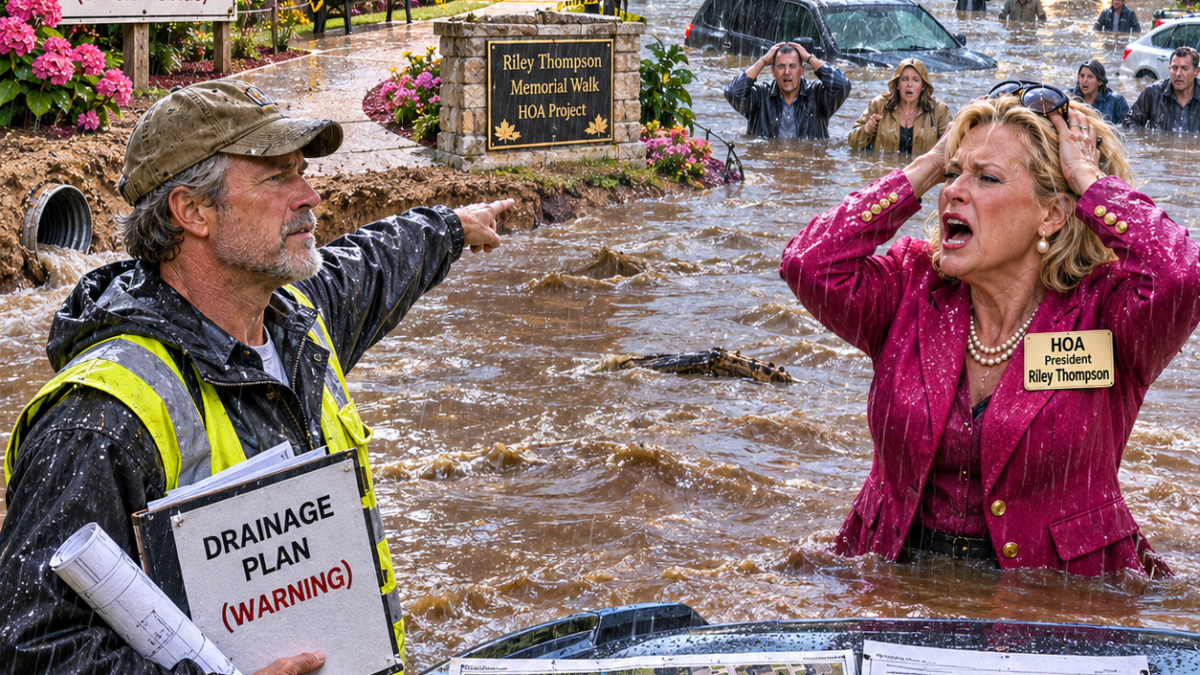
Three months after the HOA laughed at my drainage maps and called me an idiot with a calculator, I stood in driving rain watching the same board members wade through muddy water outside their million-dollar homes while the decorative walking path they were so proud of disappeared beneath a current exactly where I had told them it would form.
I had shown Riley Thompson the elevation lines, the county stormwater plan, the underground culverts, photographs of early pooling, and even a written warning that the shallow creek behind my house was not an ugly ditch but the only natural outlet carrying runoff away from half of Maple Creek Estates, yet she still spent hundreds of thousands of HOA dollars filling it with gravel, benches, flowers, and a wooden sign bearing her own name.
What nobody understood yet—not Riley, not the neighbors who clapped when she shut off my presentation, and not even me—was that the first real storm would not simply decide whether an engineer or an HOA president had been right; it was going to expose what happened when pride became more important than physics.
My name is Kenneth Baker, and before Maple Creek Estates, I spent more than twenty years as a civil engineer.
Bridges.
Roads.
Stormwater systems.
Retention basins.
Culverts.
The kind of infrastructure most people never think about until it stops working.
I understood something early in my career: water is patient.
You can redirect it.
Slow it.
Store it.
Guide it.
But you do not vote it away.
When I bought my home in Maple Creek, I thought I was finally leaving that kind of work behind.
The neighborhood looked like a brochure.
Tree-lined streets.
White fences.
Identical mailboxes.
Lawns trimmed so evenly they looked painted.
My corner lot backed up to a narrow natural drainage channel that curved behind several homes before feeding into the retention basin near Pine Hill Drive.
Most neighbors called it “the ditch.”
I loved it.
After rain, a thin stream moved through the channel beneath the trees. Birds gathered there. Frogs appeared in spring. It wasn’t glamorous, but it worked.
Then Riley Thompson became excited about “beautification.”
Riley was in her fifties, a former real-estate agent with perfect hair, perfect posture, and the kind of smile that made disagreement feel like a personal defect.
One Saturday morning, she walked toward me carrying a clipboard.
“Mr. Baker, wonderful news. The board approved the creek-path project.”
“What creek path?”
She pointed behind my fence.
“That ugly drainage ditch. We’re filling it and turning it into a proper walking area. Decorative stone. Benches. Landscaping.”
I lowered my hedge trimmer.
“You’re filling the runoff channel?”
She laughed.
“Oh, Kenneth. It’s barely a trickle.”
“Because it hasn’t rained hard.”
“The landscaper says it’s fine.”
“You spoke to a landscaper?”
“Of course.”
“You need a drainage engineer.”
Her smile cooled.
“I think you’re overcomplicating this.”
“No, Riley. I’m telling you what it is.”
She looked toward the channel.
“It’s an eyesore.”
“It carries stormwater from the upper subdivision.”
“We’ve never flooded.”
“Because the channel exists.”
She waved one hand.
“The board voted unanimously.”
That sentence told me everything.
In Riley’s world, a vote could transform geology.
That night, I pulled county records.
The maps confirmed what I already knew.
The channel behind my house was a designated stormwater route connecting neighborhood runoff to a downstream retention basin.
At the next HOA meeting, I brought the maps.
Elevation contours.
Drainage lines.
Photos.
I stood in front of a room full of neighbors and explained that blocking that corridor would force runoff toward lower homes.
Riley stared at the projector.
Then smiled at the audience.
“Does anyone remember Maple Creek ever flooding?”
Nobody answered.
She spread her hands.
“Exactly.”
A few people laughed.
I looked at them.
“The reason it hasn’t flooded is because the drainage system has been doing its job.”
Riley sighed dramatically.
“Kenneth, we’re discussing landscaping, not a dam failure.”
“Water doesn’t care what you call the project.”
A man near the front muttered, “This guy takes everything too seriously.”
Riley smiled.
“The board has already decided.”
Then she switched off my presentation.
A month later, trucks arrived.
Crews dumped gravel into the channel.
Decorative stone followed.
Then flowers.
Then two wooden benches.
Finally, Riley’s husband installed a little sign:
**THOMPSON TRAIL — A VISION OF PROGRESS**
The first light rain came two weeks later.
Water pooled beneath the gravel.
Nobody noticed.
I did.
I photographed it.
The second rain left neighboring lawns soggy for days.
I documented that too.
Then the weather service started using words I had spent my career respecting.
**Tropical disturbance.**
**Record rainfall possible.**
**Infrastructure stress.**
And while Riley planned a community celebration beside her beautiful new walking path, I stood behind my house looking at the darkening sky and realized Maple Creek was about to receive the only inspection that mattered.
PART 2
The next HOA meeting was standing room only.
That should have told me everything.
Nobody had shown that much enthusiasm when the board discussed roof repairs, insurance premiums, or emergency preparedness.
But the new walking path?
People loved it.
Riley stood at the front in a bright red blazer, smiling beneath a slide that showed families strolling beside decorative stone and flower beds.
“I just want to thank everyone who helped make Maple Creek more beautiful than ever.”
Applause.
“The path has already improved curb appeal.”
More applause.
“A local Realtor told me it could increase property values.”
That got the loudest reaction.
Property values.
The magic phrase.
You could tell half the room would have voted to cover the storm drains with marble if somebody told them it raised resale prices.
Riley clicked to a photograph of the benches.
“Even Kenneth has to admit it turned out beautifully.”
Every head turned toward me.
I had deliberately chosen a chair in the back.
I wasn’t planning to speak.
That plan lasted four seconds.
“It looks good.”
Riley beamed.
Then I added:
“But appearance and function aren’t the same thing.”
Her smile froze.
“Kenneth.”
“You asked.”
She placed one hand dramatically against the podium.
“Would you like to explain?”
“No.”
People laughed.
I stood anyway.
“If you’re actually asking, yes.”
I opened my laptop.
Riley’s face changed when she realized I had brought another presentation.
The neighborhood map filled the screen.
Elevation.
Lots.
Roads.
Culverts.
The natural channel.
“I compared the current project with the county drainage plan.”
A few people shifted impatiently.
“This channel used to carry a substantial share of runoff from the upper blocks during heavy rainfall.”
Riley crossed her arms.
“Substantial according to who?”
“The county stormwater design.”
“The neighborhood isn’t in a floodplain.”
“It doesn’t have to be.”
I pointed at the lower streets.
“Flooding isn’t only about floodplain designation. It’s about rainfall, elevation, soil saturation, available conveyance, and where water goes when its normal route is obstructed.”
Rick Thompson—Riley’s husband—spoke from the front row.
“So what’s your point?”
“My point is that you reduced the channel’s capacity.”
“How much?”
“Enough that I wouldn’t want my basement downhill from it.”
A few people laughed nervously.
Rick didn’t.
“How much, Kenneth?”
“I estimate the open flow area is down by more than half.”
Riley rolled her eyes.
“Estimate.”
“Yes.”
“Not proof.”
“It’s a preliminary calculation based on what I can legally inspect from common and private property.”
“So you’re guessing.”
“No.”
I looked at her.
“I’m telling you the direction of risk.”
She smiled triumphantly.
“That’s not an engineering report.”
“No.”
“Then please stop presenting it like one.”
I felt heat rise in my face.
“Fine.”
I pulled up the county map.
“This is.”
The room got quieter.
“The channel is designated.”
Riley glanced at it.
“Old map.”
“Still active.”
“Our landscaper reviewed the work.”
I stared at her.
“A landscaper.”
She smiled.
“Professional contractor.”
“A landscaping contractor is not the professional you rely on for stormwater hydraulics.”
Someone muttered:
“He’s doing this again.”
Another:
“Always has to be the smartest guy.”
I heard both.
I kept going.
“If a major storm arrives, the water will back up behind the new fill. Once storage is exceeded, it will move toward the lowest available homes.”
Riley shook her head.
“You’re frightening people.”
“I’m warning them.”
“Same thing.”
“No.”
I shut the laptop.
“Fear without reason is panic. Fear with reason is preparation.”
That didn’t get applause.
Riley stepped forward.
“The project is complete.”
Her tone became final.
“The board stands behind it.”
Then she turned my projector off.
I sat.
People applauded when she moved to the next slide.
Flowers.
Benches.
Happy families.
I looked at the photograph of Thompson Trail and thought of the phrase one of my old supervisors used whenever somebody ignored a design warning:
**The water gets the last vote.**
—
After the meeting, a younger neighbor named Mike caught me outside.
He waited until Riley was out of earshot.
“My backyard’s been wet.”
“How wet?”
“More than usual.”
“After rain?”
“Yeah.”
“How long does it stay?”
“Two days sometimes.”
I nodded.
“That area used to drain faster.”
“So you’re serious?”
“I was serious in there.”
He rubbed the back of his neck.
“My wife thinks you’re right.”
“Tell her to keep valuables out of the basement during storm season.”
His eyes widened.
“You think it’ll really get that bad?”
“I don’t know.”
That was the truth.
Engineering is rarely about predicting one exact future.
It’s about identifying how badly things can go wrong and reducing the chance.
I added:
“Check gutters. Make sure downspouts aren’t blocked. Pay attention to weather alerts.”
Mike nodded.
Then Riley walked past.
She looked at us.
Mike immediately stopped talking.
That bothered me more than anything said inside.
People weren’t merely disagreeing with me.
They were afraid to be seen considering my argument.
—
The first evidence showed up after another moderate rain.
I walked Thompson Trail early the next morning.
The decorative gravel had shifted.
Small channels had cut through it.
Water stood ankle-deep in two low spots.
One bench had mud around the legs.
I crouched and photographed everything.
Date.
Time.
Location.
Then emailed the HOA.
**SUBJECT: DRAINAGE PATHWAY OBSERVATIONS — EARLY OBSTRUCTION INDICATORS**
I attached the photographs.
I kept the language neutral.
No insults.
No “I told you so.”
I recommended an independent drainage review and restoring at least part of the original conveyance before peak storm season.
No response.
Two days later, Riley posted in the community Facebook group.
**The new walking path is functioning beautifully. Please ignore alarmist rumors and enjoy our upgraded common space!**
A smiling flower emoji.
A sunshine emoji.
I stared at the post.
Then took a screenshot.
—
I went to county public works.
Tom Lewis sat behind a counter covered in rolled plans.
He looked about sixty-five and had the tired expression of somebody who had spent decades watching private property owners discover why permits existed.
I showed him the maps.
Then photos.
Then the HOA’s project description.
He frowned.
“Beautification?”
“That’s what they called it.”
He read.
“Decorative landscape modification.”
“Yes.”
He looked at the original drainage map.
Then at me.
“They filled this?”
“Yes.”
“Did they submit stormwater modification drawings?”
“Not that I can find.”
Tom typed.
Searched.
Typed again.
“No.”
He sat back.
“They didn’t get approval for drainage alteration.”
“Can you inspect?”
“We can.”
“Before the storms?”
He looked at me.
“You think it’s urgent.”
“I wouldn’t be here otherwise.”
He nodded.
“I’ll flag it.”
Then he gave me a half smile.
“HOA?”
“Yes.”
He sighed.
“Why is it always an HOA?”
—
The county inspector came a week later.
Riley walked him behind the houses like she was giving a garden tour.
I was trimming hedges when they passed.
“This is the area.”
Riley laughed.
“Mr. Baker has become concerned because of his engineering background.”
The inspector looked at the stone path.
“Was this previously open drainage?”
“Technically a shallow ditch.”
“Technically?”
She laughed.
“You know how engineers are.”
I set down the trimmer.
The inspector looked at me.
“You’re Mr. Baker?”
“Yes.”
“Licensed civil?”
“Retired from full-time practice, but yes, my career was infrastructure and stormwater.”
Riley’s smile tightened.
He asked:
“Do you have the original county layout?”
“I emailed it to public works.”
Riley interrupted.
“We’ve had no flooding.”
The inspector ignored that.
He crouched.
Moved some loose stone with his boot.
“Who designed this?”
“Our landscaper.”
“Any civil review?”
“Not necessary.”
The inspector stood.
“That’s what we’re determining.”
Riley crossed her arms.
He continued:
“You’ll need to submit drainage compliance documentation.”
Riley smiled.
“Of course.”
The next day, she told the neighborhood:
**County inspection complete. Everything is fine.**
That was not what he had said.
I emailed Tom.
He responded with one line:
**Review pending. No approval issued.**
Screenshot.
Saved.
—
By late August, the weather changed.
Not rain yet.
Pressure.
Humidity.
That heavy Gulf air that makes the sky look bruised.
A tropical system formed.
I watched the forecast shift.
Then shift again.
Eight inches possible.
Then ten.
Some models showed twelve.
The exact number mattered less than the trend.
The ground would saturate.
Runoff would accelerate.
And Thompson Trail sat directly where the neighborhood needed open conveyance most.
I sent the strongest warning yet.
**SUBJECT: PREDICTED STORM SYSTEM — IMMEDIATE ACTION RECOMMENDED**
I attached the weather projection and county drainage map.
I wrote that the filled channel should be reopened before the storm.
I avoided giving residents a do-it-yourself excavation plan.
This needed proper crews and authority.
The message was simple:
**Restore the designed water route immediately.**
No reply.
Not that day.
Not the next.
On the third morning, Riley posted publicly.
**Some residents are spreading unnecessary panic about the coming rain. Our neighborhood infrastructure is safe, and the new path is performing as designed. Please stay positive.**
I read it twice.
Then walked outside.
Dark clouds stretched across the horizon.
Positive thinking has many uses.
Hydraulic capacity isn’t one of them.
—
I prepared my own property.
Checked drainage around the house.
Made sure my sump system was functional.
Cleared gutters.
Moved valuables from low storage.
Placed sandbags where I had identified vulnerable openings.
I didn’t do anything dramatic.
Preparation usually isn’t dramatic.
That’s why people underestimate it.
Jared, my next-door neighbor, came over with his seven-year-old son, Noah.
“Kenneth.”
“Yeah?”
“You think it’s really going to flood?”
His son stared at me.
I chose my words carefully.
“I think you should prepare like it might.”
Jared looked toward Thompson Trail.
“Riley says the landscaping absorbs water.”
“Some.”
“So?”
“Think of the old channel like an open hallway.”
He nodded.
“They filled most of the hallway with furniture.”
His face changed.
“The water still has to get through.”
“Yes.”
“And if it can’t?”
“It finds another room.”
He looked toward his house.
“Oh.”
I nodded.
“Move the car uphill.”
“What else?”
“Follow county emergency guidance. Keep valuables out of the basement. Know how you’ll leave if officials tell you to evacuate.”
Noah asked:
“Is our house going to float away?”
Jared looked horrified.
I crouched.
“No.”
Then I smiled.
“But maybe convince your dad to move your game console upstairs.”
Noah’s eyes widened.
“Dad.”
Jared sighed.
“See what you’ve done?”
“Saved civilization.”
—
At 9:03 that night, Riley texted me.
**Stop emailing the board. You’re frightening residents. The storm will pass. Be a team player.**
I replied:
**Prepared residents are safer residents. The drainage modification remains the concern. Please contact county public works.**
Her response:
**This is harassment.**
That was the last thing I sent.
At some point, repeating a warning stops helping.
The sky had received the message.
—
Rain began the next morning.
Gentle at first.
A normal storm.
By noon, it became steady.
By four, heavy.
At six, water was moving strongly through the drainage I had maintained along my property.
I stood beneath the porch roof.
Coffee in hand.
Watching.
An engineer can spend years studying flow equations and still feel something almost emotional watching water move exactly where a system intends.
The runoff entered the open portion.
Continued downhill.
Then reached Thompson Trail.
And slowed.
By seven, the decorative stone was underwater.
By eight-thirty, the path had become a pond.
At nine, water spread onto nearby lawns.
My phone buzzed.
Mike:
**Backyard flooding.**
Jared:
**Water against fence.**
Another neighbor:
**Riley says your trench caused this. Is that true?**
I laughed once.
No humor.
Of course she had found someone else to blame.
I put on rain gear and stepped outside.
—
The storm sounded like thousands of handfuls of gravel striking rooftops.
Street drains gurgled.
Water crossed the road in thin sheets.
As I approached the trail, those sheets became streams.
Then I saw it.
Behind the decorative fill, runoff had collected into a broad, dark pool.
A trapped river.
The benches Riley had installed were partially submerged.
One shifted under the pressure.
The Thompson Trail sign leaned sideways.
Riley stood in the rain with an umbrella turned almost useless by wind.
Phone pressed to her ear.
“Get the contractor out here!”
She shouted.
“Now!”
I walked closer.
Water reached my knees in the lower area.
She saw me.
“You.”
“Riley, get people away from the path.”
“This is your fault.”
I stared.
“What?”
“Your trench is sending water down here.”
“My drainage follows the original route.”
“You changed it.”
“No.”
“You did something.”
“No.”
She pointed wildly.
“The drains aren’t working.”
“You buried the route feeding them.”
“We did not!”
A loud grinding sound came from beneath the gravel.
I looked immediately toward it.
“Back up.”
“What?”
“Riley, move.”
The fill shifted.
A section of decorative stone collapsed.
Then water punched through.
Not an explosion.
A sudden release.
The current surged across the path.
One bench tore loose and rolled.
Riley lost her footing.
I caught her arm before she went down.
For one second, she stared at me.
Not HOA president.
Not real-estate expert.
Just frightened.
Then she turned toward her house.
Water was moving across her backyard.
Her face went blank.
“No.”
I let go of her arm.
“Go.”
She ran.
—
By midnight, lower Maple Creek had started flooding.
Water entered basements.
Garages.
Back doors.
People called one another in panic.
Emergency dispatch was overwhelmed across the county because the storm wasn’t only ours.
I went first to Jared’s house.
Water had crossed the lower floor.
He came out carrying Noah.
The boy had both arms locked around his father’s neck.
“Kenneth!”
“Bring him to my place.”
“Why is yours dry?”
“Higher ground and functional drainage.”
Jared looked toward the water behind him.
“My basement—”
“Forget the basement.”
“My tools—”
“Forget them.”
“My wife is getting the dog.”
“Get people first.”
That snapped him back into focus.
We moved toward my property.
My house became unofficial high ground.
Jared.
His wife.
Noah.
Their dog.
Then Susan from two houses down.
An elderly couple.
A woman carrying two cats in one carrier.
Nobody looked elegant anymore.
Nobody cared about mailbox color.
At two in the morning, twelve people were inside my living room.
Wet shoes everywhere.
Towels.
Coffee.
Fear.
No HOA rules.
Just neighbors.
—
Riley and Rick were still at their property.
I went back with Jared once his family was safe.
Water reached almost to Riley’s knees.
Rick was trying to save electronics from the garage.
“Leave them!”
I shouted.
He turned.
“Kenneth?”
“Kill power only if you can do so safely and get out.”
He looked at Riley.
She was standing in the driveway.
Hair plastered to her face.
No umbrella.
No clipboard.
“911 says the road’s blocked.”
“I know.”
“What do we do?”
“Come uphill.”
She looked at her house.
“This can’t be happening.”
“It is.”
“We followed the contractor’s design.”
“The contractor wasn’t responsible for approving stormwater changes.”
“He told us—”
“Riley.”
I pointed toward the rising water.
“Later.”
For once, she listened.
We moved.
Halfway toward my property, she stumbled and grabbed my arm.
“Why isn’t your house flooding?”
I looked at her.
I could have said a hundred cruel things.
I had imagined that moment.
Months of being mocked.
Ignored.
Called negative.
Alarmist.
Idiot.
I could have made her hear every word again.
Instead, I said:
“Because the drainage is still open on my side.”
She stared.
Realization moved across her face.
Then shame.
Brief.
Fragile.
She whispered:
“I thought you were exaggerating.”
“I know.”
—
By dawn, Maple Creek looked nothing like Maple Creek.
Lawns had vanished beneath brown water.
White fences floated sideways.
Trash bins drifted through intersections.
Cars sat half submerged.
The perfect neighborhood had become a disaster scene.
Emergency crews established access from the higher entrance.
Fire trucks.
Sheriff’s vehicles.
County engineers.
Rescue personnel.
I gave them everything I had.
Original photos.
Emails.
Meeting minutes.
County maps.
Inspector correspondence.
Riley’s public posts.
My storm warnings.
One gray-haired county engineer read through the folder.
“You kept all this?”
“Yes.”
“Why?”
“Because they stopped listening.”
He looked toward Thompson Trail.
“They filled the designated channel?”
“Most of it.”
“Permit?”
“None for drainage modification.”
Tom Lewis appeared behind him.
“I can confirm that.”
Riley walked toward us.
Wrapped in a blanket.
Mud on her pants.
She saw Tom.
Then me.
“You called them.”
Tom answered before I could.
“He contacted us before the storm.”
Riley looked at me.
“You made us look like fools.”
I was too tired to be angry.
“No.”
I shook my head.
“You did that without help.”
—
A sheriff asked Riley to move back from an unsafe section.
She snapped automatically:
“I’m the HOA president.”
The sheriff looked at the flooded street.
“Ma’am, right now you’re an evacuee.”
That was the first authority all night that Riley couldn’t argue with.
Then a crack sounded behind her property.
A decorative retaining wall failed under saturated soil and runoff.
Mud rushed into the yard.
Riley screamed.
The sheriff pulled her away.
I watched her shake.
Some part of me expected satisfaction.
I felt none.
Watching someone’s certainty collapse is not as enjoyable when their home collapses with it.
—
Local reporters arrived by afternoon.
One interviewed a woman whose basement was destroyed.
“The HOA said everything was safe.”
Another man shouted:
“They told us Kenneth was fearmongering.”
The camera panned toward what remained of Thompson Trail.
The sign was half buried.
**A VISION OF PROGRESS**
Only the word **PROGRESS** remained visible above the mud.
A reporter approached me.
“Mr. Baker?”
“Yes.”
“We’ve been told you warned the HOA this would happen.”
“I warned them there was a flood risk.”
“You predicted the storm?”
“No.”
I shook my head.
“I calculated what the drainage system would do if a heavy storm arrived.”
She held out the microphone.
“So you predicted the flooding.”
“No.”
I looked toward the ruined path.
“I calculated the consequence.”
She paused.
“What’s the difference?”
“Prediction sounds like guessing the future.”
I pointed toward the water.
“Drainage is physics.”
That quote made the evening news.
—
By night, the rain weakened.
Water began receding.
The damage became clearer.
Basements ruined.
Drywall destroyed.
Cars flooded.
Electrical systems damaged.
Landscaping ripped away.
Several homes temporarily uninhabitable.
The HOA reserve fund—already depleted by the beautification project—was nowhere near enough.
I walked Thompson Trail with a flashlight.
The gravel was gone.
Benches gone.
Flowers gone.
The creek had reopened itself violently.
I found the old sign in the mud.
**THOMPSON TRAIL**
I stood over it.
Months earlier, I might have enjoyed that sight.
Now I thought about Noah sleeping on my couch because his bedroom floor was wet.
I thought about Susan crying because family photographs had been stored in her basement.
I thought about an elderly couple who had lost furniture they could not afford to replace.
I didn’t want to be right.
That was the ugliest part.
Every “I told you so” had somebody’s ruined home behind it.
—
My house stayed dry.
Not magically.
Not because I was smarter than nature.
Because the lot sat slightly higher and the drainage path behind it still functioned.
Two neighboring properties whose owners had prepared remained mostly protected too.
I should have felt vindicated.
Instead, I sat by the window at three in the morning drinking coffee that had gone cold.
Jared came in.
“You were right.”
“Don’t.”
“What?”
“Don’t say it like that.”
“But you were.”
“I know.”
His face crumpled.
“My workshop is gone.”
“I’m sorry.”
He sat opposite me.
“Why didn’t we listen?”
I didn’t answer.
He did.
“Because she sounded confident.”
That was probably true.
Riley spoke in certainties.
I spoke in probabilities.
People prefer certainty until certainty floods their basement.
—
The next morning, rescue crews reached the lowest part of the subdivision by boat.
Riley and Rick had moved back to the upper story of their house during the night when conditions shifted again.
A deputy asked if I knew the layout.
I did.
I walked part of the way with the rescue team from safe ground and helped direct them.
Riley appeared on the balcony.
Mud on her blazer.
Golden retriever beside Rick.
She looked smaller than I had ever seen her.
When she came down into the boat, she looked at me.
“It’s all gone.”
I nodded.
“Some things can be rebuilt.”
She looked away.
I wasn’t sure whether she heard me.
—
The community center became a temporary shelter.
Dozens of residents packed inside.
Blankets.
Wet shoes.
Phone chargers.
Insurance calls.
Children sleeping across folding chairs.
And anger.
A lot of anger.
Riley stood near the front telling anyone who would listen:
“The county infrastructure failed.”
“The contractor assured us.”
“This was unprecedented rainfall.”
All partly useful phrases.
None answered the central question.
A county engineer finally interrupted.
“Mrs. Thompson.”
She turned.
“Your association modified a designated drainage corridor without the required stormwater review.”
“We had approval.”
“No.”
“We filed—”
“You filed it as cosmetic landscaping.”
Her mouth opened.
He continued:
“You did not disclose that the project filled and narrowed an active runoff channel.”
Silence spread through the room.
Riley looked around.
“We all voted.”
Karen Morales stood.
“We voted because you told us it was approved.”
Others joined.
“You told us Kenneth was wrong.”
“You said the county signed off.”
“You said it couldn’t flood.”
Riley’s voice cracked.
“I believed the contractor.”
Karen shouted:
“Kenneth showed you the maps!”
That ended the room.
Every face turned toward me.
I wanted to disappear.
Instead, I stood.
“I didn’t want this.”
Nobody spoke.
“I need everyone to understand that.”
I looked at Riley.
“I wasn’t trying to win an argument.”
Then at the residents.
“I showed you the maps because drainage infrastructure is invisible when it works.”
“That’s why it’s easy to dismiss.”
“There’s no ribbon cutting for a ditch doing its job.”
“No property-value brochure for an open channel.”
“But when you remove it, the consequences don’t stay invisible.”
Riley stared at the floor.
I continued:
“You didn’t need to agree with me.”
“You needed to get an independent engineer before changing the system.”
“That was all.”
I sat.
No applause.
Good.
It wasn’t an applause moment.
—
Tom Lewis walked the neighborhood with me that evening.
Water had dropped enough to see the cuts erosion carved through the former trail.
He crouched.
“Nature reopened it.”
“Violently.”
“Usually does when we don’t give it another option.”
He stood.
“The county report will identify the drainage modification as a major contributing cause.”
I nodded.
“You’ll be listed as the complainant who warned the association.”
“Doesn’t help them.”
“No.”
“Helps you.”
“I don’t care about me.”
“You should.”
He looked at me.
“You’re going to be blamed.”
“Riley already tried.”
“Then the documents matter.”
I stared down the creek.
He was right.
Documentation was not revenge.
It was protection against revision.
People rewrite history fastest when consequences arrive.
—
That night, several neighbors came to my driveway.
Jared.
Susan.
Mike.
Karen Morales.
Others.
Jared spoke first.
“We wanted to say thank you.”
“For what?”
“You got Noah out.”
“Anybody would’ve.”
“No.”
He shook his head.
“Not everybody did.”
Susan said:
“You kept warning us.”
I looked down.
“I couldn’t make the decision for you.”
“We laughed.”
“Some people did.”
“I did.”
Mike looked ashamed.
“I thought you were trying to show off.”
“I know.”
He frowned.
“You’re not going to say I told you so?”
“No.”
“Why?”
“Because your basement already did.”
Nobody laughed.
Then I softened it.
“Next time somebody gives you a technical warning you don’t like, don’t automatically believe them.”
They looked confused.
“Check.”
“Ask another expert.”
“Get independent review.”
“Don’t follow me because I was right once.”
“Follow evidence.”
Karen Morales nodded slowly.
“That should’ve happened the first time.”
“Yes.”
—
A week later, the county declared Maple Creek a disaster area.
Insurance adjusters arrived.
Cleanup crews.
Environmental inspectors.
Engineers.
The HOA emergency meeting moved to a temporary shelter because the clubhouse still smelled like floodwater.
Daniel Lee, the vice president, chaired it.
Riley sat at the front.
No red blazer.
No smile.
Daniel read from a printed statement.
“Effective immediately, the board has voted to remove Riley Thompson as president.”
The room erupted.
Some clapped.
Some shouted.
Riley stood.
“You can’t do this.”
Daniel continued.
“The board cites gross negligence, failure to obtain required approvals, inaccurate representations to homeowners, and unauthorized expenditures related to the Thompson Trail project.”
Riley’s face drained.
“You approved it.”
“We approved a landscaping project based on information you presented.”
“You’re blaming me to save yourselves.”
Daniel finally looked at her.
“We all share responsibility.”
That quieted people.
Then:
“But you told this board county approval existed when it did not.”
Riley sat.
County penalties were announced.
A major civil fine for unauthorized drainage alteration.
Additional environmental consequences pending.
Residents groaned.
The association reserves were already devastated.
Someone shouted:
“Where’s the money?”
The treasurer looked sick.
Much had been spent.
Decorative improvements.
Trail construction.
Landscaping.
Consultants.
Emergency costs.
The neighborhood had paid to create its own vulnerability.
Then would have to pay to repair it.
That was the cruel arithmetic.
—
Riley found me outside afterward.
She looked exhausted.
“Rick left.”
I didn’t know what to say.
“He says he can’t do this anymore.”
“I’m sorry.”
She laughed bitterly.
“You’re sorry?”
“Yes.”
“You hate me.”
“No.”
She stared.
“Why not?”
“Because that would require more energy than I have.”
A weak laugh escaped her.
Then disappeared.
“They’re saying it’s all my fault.”
“No.”
She looked surprised.
I continued.
“You led it.”
“You ignored warnings.”
“You misrepresented the permit status.”
“But the board voted.”
“Residents supported it.”
“Contractors built it.”
“Responsibility isn’t always one person.”
Her eyes filled.
“That’s supposed to make me feel better?”
“No.”
I looked toward her ruined house.
“It means you don’t need to lie to understand what you did.”
She wiped her face.
“I just wanted Maple Creek to look better.”
“I believe you.”
“Then how did this happen?”
I thought about every meeting.
Every warning.
Every laugh.
“Because once you decided the project was good, every objection became an attack.”
She looked at me.
“That’s not leadership.”
“No.”
“What is it?”
“Pride.”
She nodded.
Barely.
For once, she didn’t argue.
—
The county’s formal report arrived a month later.
Primary contributing factor:
**Unpermitted modification of designated stormwater drainage corridor.**
Responsible entity:
**Maple Creek Estates Homeowners Association.**
Documented prior warning:
**Kenneth Baker.**
Estimated property losses ran into millions.
Local news replayed footage from the HOA meeting.
My elevation map on the screen.
Riley dismissing the risk.
People laughing.
Then aerial footage of flooded homes.
I hated watching it.
Not because it made me look bad.
Because hindsight can make prevention look easy.
It wasn’t.
Back then, the room truly believed Riley.
That’s what people needed to remember.
Disasters often look obvious afterward.
Beforeward, they’re inconvenient warnings nobody wants to hear.
—
The county asked me to consult on restoration.
I said no at first.
Tom Lewis called.
“You’re the obvious choice.”
“I’m retired.”
“You’ve mentioned that every time I’ve met you.”
“Because people keep giving me work.”
“We’ll pay.”
“Still retired.”
“You know the system.”
“So do your engineers.”
“You know the neighborhood.”
I looked at the creek.
That mattered.
“How long?”
“Until restoration is stable.”
I sighed.
“Send the contract.”
Tom laughed.
“Knew it.”
—
My first day as restoration consultant, I stood where Thompson Trail had been.
Excavators removed the remaining gravel.
Crews cleared blocked culverts.
Engineers rebuilt the channel with more resilient capacity and erosion protection while respecting the natural corridor.
No decorative gimmicks.
No benches inside the active path.
Function first.
Then landscape around function.
As machines lifted muddy stone, the old creek shape appeared.
It was like uncovering something buried alive.
Same slope.
Same curve.
Same direction.
Water knew exactly where it wanted to go.
—
Riley came one morning.
I was studying a survey.
She stood behind the safety line.
“You’re really rebuilding the whole thing.”
“Restoring it.”
“Same difference.”
“No.”
She looked tired enough that I didn’t argue.
“I’m selling.”
“I heard.”
“Probably at a loss.”
“I’m sorry.”
“Stop saying that.”
“Why?”
“Because it makes this worse.”
I folded the map.
She stared at the excavation.
“I deserve whatever you want to say.”
“I don’t want to say anything.”
“Come on.”
“What?”
“You spent months warning me.”
“Yes.”
“I humiliated you.”
“Yes.”
“I called you an idiot.”
“You did.”
“And now you’re fixing it.”
“Yes.”
She swallowed.
“Why?”
I looked toward the houses.
“Because the people who live here still need drainage.”
Her eyes lowered.
“You really don’t care about proving me wrong anymore.”
“I never wanted this version of being right.”
She wiped her cheek.
“They’re suing me personally.”
“I know.”
“Rick’s gone.”
“I know.”
“I’ve lost my position.”
“Yes.”
Her voice became small.
“What do I have left?”
I considered.
“Whatever you build without lying to yourself.”
She looked at me.
Then at the creek.
“I wanted to make the neighborhood better.”
“You can believe your intentions were good and still admit your decisions were bad.”
That seemed harder for her than any fine.
Eventually she nodded.
Then left.
—
By winter, water flowed freely again.
Not dramatically.
A narrow creek.
Steady.
Clean.
The county installed better storm grates.
Reinforced vulnerable sections.
Updated neighborhood warning procedures.
And most importantly, nobody covered the channel because they thought gravel photographed better.
Residents returned slowly.
Some rebuilt.
Some sold.
Some could not face another storm in Maple Creek.
I understood.
Scars aren’t always visible in drywall.
—
Jared hosted a small gathering on the new wooden bridge.
Nothing official.
No speeches.
Hot cocoa.
A few folding chairs.
Children running around.
He leaned on the railing.
“Hard to believe this little creek took down an HOA president.”
I looked at the water.
“The creek didn’t do anything.”
He smiled.
“You know what I mean.”
“It followed gravity.”
Karen Morales joined us.
“Same thing.”
“No.”
I shook my head.
“That’s the lesson.”
She laughed.
“You ever think about running the HOA?”
“Absolutely not.”
“You’d be good.”
“I have seen what happens when engineers start believing that.”
Jared grinned.
“Still dramatic.”
“Occupational hazard.”
—
The new HOA structure survived.
Barely recognizable from Riley’s version.
Daniel became president.
Financial approvals required more transparency.
Infrastructure work required appropriate professional review.
County permits had to be verified directly.
Technical objections received written responses instead of Facebook posts about positivity.
At the first open house, Daniel introduced me as:
“The man who saw what none of us saw.”
I hated that.
When I stood, I corrected him.
“I saw exactly what the drainage map showed.”
People chuckled.
“I’m serious.”
I pointed toward the creek.
“There was no special insight.”
“The information existed.”
“The danger was that we preferred a prettier answer.”
The room got quiet.
“Nature isn’t our enemy.”
“It isn’t trying to punish us.”
“It is simply a system.”
“And systems don’t care whether a board vote was unanimous.”
A few smiles.
“You cannot outvote gravity.”
That got laughter.
Then I added:
“When expertise makes you uncomfortable, don’t automatically obey it.”
People looked surprised.
“Question it.”
“Get another opinion.”
“Check the evidence.”
“But don’t dismiss it because the answer ruins your plan.”
That got real applause.
Quiet.
Not theatrical.
Enough.
—
Several weeks later, an official envelope arrived.
Payment for my restoration consulting.
There was also an additional compensation amount related to my documented cooperation and technical assistance.
I stared at the check.
Months earlier, the HOA had called me negative for offering the same knowledge.
Now the county paid me to use it.
Poetic justice, maybe.
It didn’t feel like revenge.
It felt like accounting finally matching reality.
I deposited it.
Then donated part to a local flood-recovery fund supporting residents who still had uninsured losses.
Nobody needed to know.
—
The last time I saw Riley in court, she stood beside an attorney during final resolution of the civil and HOA matters.
She looked older.
Not physically by much.
Something behind the eyes.
When we passed in the hallway, she stopped.
“Kenneth.”
“Riley.”
“Thank you.”
I frowned.
“For what?”
“Helping rebuild it.”
“That was my job.”
“No.”
She shook her head.
“You could have walked away.”
I thought about that.
“I almost did.”
“Why didn’t you?”
I looked through the courthouse windows.
Rain had begun outside.
Light.
Spring rain.
“Because the creek didn’t cause the problem.”
She understood.
Her mouth tightened.
“Me.”
“Decisions.”
I corrected.
She looked at me.
“Still won’t let me take all the blame.”
“No.”
“Why?”
“Because if everybody says this was one terrible woman’s fault, nobody learns anything.”
That silenced her.
She extended a hand.
I shook it.
Then we walked in opposite directions.
—
Spring came early.
Grass returned.
Wildflowers appeared along the restored corridor.
The neighborhood was scarred.
Some houses still showed faint flood lines on brick.
A few empty lots remained where families had chosen not to return.
But Maple Creek felt more honest.
No brochure perfection.
Native grasses appeared instead of uniform turf in several yards.
Residents cleared drains before storms.
People checked on older neighbors.
Nobody laughed when weather warnings came through.
Fear hadn’t taken over.
Respect had.
There’s a difference.
—
The county finished my contract.
On my final inspection, I walked the creek alone.
The new wooden bridge crossed above it.
Solid.
Simple.
Functional.
Someone had attached a plaque to the railing.
I expected another ridiculous dedication.
Instead:
**MAPLE CREEK**
**LET IT FLOW**
I stood there for a long time.
That was the first memorial I liked.
No person’s name.
No “vision of progress.”
No ego.
Just an instruction everyone should have understood the first time.
—
A few weeks later, I received a handwritten letter.
Riley.
I considered leaving it unopened.
Then sat at my desk.
**Dear Kenneth,**
**I don’t expect you to forgive me.**
Good start.
**I spent most of my adult life selling people confidence. As a Realtor, clients wanted certainty. As HOA president, residents wanted certainty. Somewhere along the way I started believing that sounding certain was the same as being correct.**
I stopped.
Read that again.
Then continued.
**You showed me evidence and I treated it like disrespect. I called you negative because your warning interfered with the thing I wanted to build.**
**The worst part is that you were never trying to embarrass me. I did that myself.**
My throat tightened unexpectedly.
**I am sorry for mocking you.**
**I am sorry for telling residents the county approved something it had not approved.**
**Most of all, I am sorry that other families paid for my pride.**
**Riley Thompson**
I read it twice.
Then folded it.
Placed it beside the old folder:
**HOA DRAINAGE PROOF**
For months, that folder had represented defense.
Now it felt like a closed case.
—
Summer healed more.
Children played beside the creek.
Parents still watched them carefully.
A young couple bought one of the rebuilt houses.
Their toddler loved throwing pebbles into the water.
The father introduced himself one evening.
“You’re Kenneth?”
“Depends who’s asking.”
He laughed.
“The engineer.”
“Guilty.”
“Riley told us about you.”
That surprised me.
“When?”
“She was still here when we looked at the property.”
“What did she say?”
He smiled.
“She said if we ever change anything involving drainage, ask Kenneth first.”
I laughed so hard I had to lean against the mailbox.
“She actually said that?”
“Yeah.”
Then he became serious.
“She said you’re the reason the neighborhood still exists.”
I looked toward the creek.
“No.”
“Storm would’ve passed either way.”
“But—”
“People rebuilt this place.”
“The county fixed the system.”
“Neighbors helped one another.”
“I just complained earlier than everybody else.”
He grinned.
“Apparently useful complaint.”
“Sometimes.”
—
The county invited me to speak at a public-safety seminar.
Engineers.
Planning officials.
HOA board members.
Residents.
I almost declined.
Then I thought about the room where people laughed.
So I went.
My opening line surprised even me.
“Floods don’t begin with rain.”
Everyone looked up.
“They begin with decisions.”
I showed no dramatic disaster footage at first.
Instead:
A clean drainage map.
A photograph of the original creek.
A photograph of Thompson Trail on a sunny day.
Beautiful.
Then:
standing water after light rain.
Then:
blocked flow.
Finally:
the flooded subdivision.
“The storm was the trigger.”
I said.
“But vulnerability was built before the first drop fell.”
People wrote that down.
I continued.
“The most dangerous phrase in infrastructure is not ‘we don’t know.’”
“It’s ‘it’s probably fine.’”
A few engineers laughed.
They knew.
—
Afterward, a young planner asked:
“How do you make people listen without sounding alarmist?”
I thought about Riley.
“You can’t always.”
“That’s encouraging.”
“Sorry.”
I smiled.
“But you can explain risk clearly.”
“Document it.”
“Offer options.”
“Get independent review.”
“And understand that people hear technical warnings through emotion.”
“What emotion?”
“Cost.”
“Embarrassment.”
“Delay.”
“Pride.”
“Fear.”
“Your job isn’t only calculating water.”
“It’s understanding why somebody doesn’t want to believe the calculation.”
That lesson had cost Maple Creek millions.
I wished I had understood it earlier too.
Maybe I could have communicated differently.
Would Riley have listened?
I don’t know.
Responsibility doesn’t require pretending I was perfect.
—
Months later, another strong storm crossed the county.
Not as severe as Everett.
Heavy enough to test the restoration.
I stood on my porch.
Old habit.
Coffee.
Raincoat nearby.
Water moved into the creek.
Fast.
Steady.
The level rose.
Then stabilized.
The restored channel carried it toward the retention basin.
No lawns flooded.
No basements filled.
No frantic messages.
At 10:30 p.m., Jared texted:
**Watching the creek. Looks good.**
I replied:
**It is doing its job.**
He sent:
**Best-looking ditch I’ve ever seen.**
I laughed.
—
I walked outside after midnight.
Rain softened.
Water whispered beneath the bridge.
Thompson Trail was gone.
Good.
The creek had never needed a name change.
It only needed room.
That was when I finally understood why this whole experience stayed with me.
It wasn’t really about Riley.
It wasn’t even about the HOA.
It was about how easily people confuse control with safety.
Riley wanted Maple Creek controlled.
Uniform lawns.
Uniform mailboxes.
Uniform landscaping.
Even the natural drainage channel looked wrong to her because it wasn’t tidy.
The creek curved.
Collected leaves.
Grew weeds.
Changed depth.
It looked uncontrolled.
So she tried to improve it.
But some systems remain safe precisely because we allow them to behave naturally within boundaries we understand.
You don’t make a creek safer by pretending it is a sidewalk.
You don’t make a community stronger by silencing the resident who disagrees.
You don’t protect property values by ignoring the system protecting the property.
—
Years passed.
The flood became neighborhood history.
People joked about “Riley’s River.”
I never liked that name.
Too easy.
It made the disaster one person’s story.
Then one autumn, Daniel called.
“We’re removing the last old HOA monument.”
“What monument?”
“The stone sign at the entrance.”
**MAPLE CREEK ESTATES — LUXURY LIVING IN HARMONY WITH NATURE**
I laughed.
“Why?”
“Cracked in the flood.”
“And?”
“Residents want something smaller.”
“What?”
“Just Maple Creek.”
“Good.”
“Want to come?”
“No.”
“Why?”
“It’s a sign.”
He sighed.
“You’re impossible.”
But I drove by later.
The giant monument was gone.
Smaller wooden sign.
**MAPLE CREEK**
Underneath:
**EST. 1998**
Nothing about harmony.
Nothing about excellence.
Nothing about property values.
It felt more honest.
—
My retirement finally became retirement.
Mostly.
Neighbors still asked questions.
“Ken, can I add a patio?”
“Ask the county.”
“Ken, can I put a drain here?”
“Get a professional.”
“But you’re a professional.”
“Retired professional.”
“You’re literally standing here looking at it.”
“That costs extra.”
They laughed.
I helped anyway.
—
Jared’s son Noah grew older.
One afternoon, years after the flood, he found me near the bridge.
“You remember carrying me?”
“I remember you yelling because you left your game console.”
He groaned.
“I was seven.”
“You had priorities.”
He looked at the creek.
“My dad says you saved us.”
“Your dad got you out.”
“But you warned him.”
“Yes.”
Noah kicked a pebble.
“Why didn’t everyone listen?”
There are questions children ask that expose how complicated adults are.
I said:
“Because believing me meant admitting something they liked was dangerous.”
He frowned.
“So?”
“So people sometimes protect what they want to believe.”
“Even if it’s stupid?”
“Especially then.”
He nodded.
“Adults are weird.”
“Very.”
—
I never heard from Riley again after the letter.
That was fine.
She didn’t owe me a lifetime of apologies.
One was enough if she meant it.
Occasionally someone told me how she was doing.
New town.
Smaller place.
Different work.
No HOA leadership.
I didn’t investigate.
My peace did not require monitoring her punishment.
That might have been the final lesson.
Revenge keeps you attached.
Closure lets you stop checking.
—
One gentle spring rain, I sat on my porch.
Coffee.
No laptop.
No weather radar.
No emergency folder beside me.
Water moved off the roof.
Into the gutters.
Along the roadside drainage.
Then into Maple Creek.
Exactly where it belonged.
The sun broke briefly through the clouds.
Light caught the water.
For a moment, the creek looked almost gold.
Not landscaped.
Not symmetrical.
Not perfect.
Beautiful anyway.
I thought about the night of Tropical Storm Everett.
Riley screaming at the contractor.
Jared carrying Noah.
Neighbors gathered in my living room.
The bench ripping loose.
The county engineer reading my emails.
The ruined basements.
The smell of wet drywall.
Then I looked at the reopened channel.
Same gravity.
Different decisions.
That’s all engineering really is sometimes.
Respecting consequences before they become visible.
—
People call my story poetic justice.
I understand why.
The HOA buried the drainage system.
The storm arrived.
The homes flooded.
The woman who mocked the warning lost her position.
The engineer she called an alarmist got hired to rebuild what she destroyed.
That’s a satisfying shape for a story.
Real life felt different.
The flood didn’t know who deserved what.
It damaged homes belonging to people who laughed at me.
It also damaged homes belonging to people who never attended the meeting.
Children lost bedrooms.
Families lost photographs.
People spent months with insurance adjusters.
Nature didn’t punish Riley.
Nature simply responded to the system we gave it.
The punishment came later.
From facts.
Reports.
Fines.
Votes.
Responsibility.
That distinction matters.
—
If there was revenge, it wasn’t mine.
I didn’t block the creek.
I didn’t create the storm.
I didn’t want their houses flooded.
All I did was keep the evidence.
Warn them.
Prepare.
Help people when consequences arrived.
Then help rebuild afterward.
The closest thing to revenge was watching the restored creek flow exactly where I had always said it needed to flow while nobody in Maple Creek dared call it an ugly ditch anymore.
That was enough.
More than enough.
—
At sunset, I sometimes walk to the small wooden bridge.
The plaque is still there.
**MAPLE CREEK — LET IT FLOW**
No name beneath it.
Not mine.
Not Riley’s.
That’s how I like it.
One evening, two kids stood at the railing dropping leaves into the current.
They raced them downstream.
One leaf caught against a rock.
Then slipped free.
The other disappeared around the bend.
Their mother apologized.
“Sorry if they’re bothering you.”
“They’re fine.”
She smiled.
“They love this creek.”
“So do I.”
She walked on.
I stayed.
Water moved below me.
Quiet.
Steady.
Patient.
The same thing it had always been.
I rested my hands on the railing and thought about the HOA meeting where Riley switched off my presentation while people applauded.
At the time, I wanted desperately to make them understand.
Now I knew better.
Truth does not always win because it speaks louder.
Sometimes it waits.
Sometimes it gathers behind whatever has been built to stop it.
And when reality finally arrives, it doesn’t care who had the microphone.
I looked down at the current.
Then smiled.
Maple Creek had its voice back.
And this time, everyone was listening.
[END OF STORY]






