PART 2: I Warned the HOA Their Dam Was Failing—They Fined Me for “Spreading Panic” Until the Storm Arrived
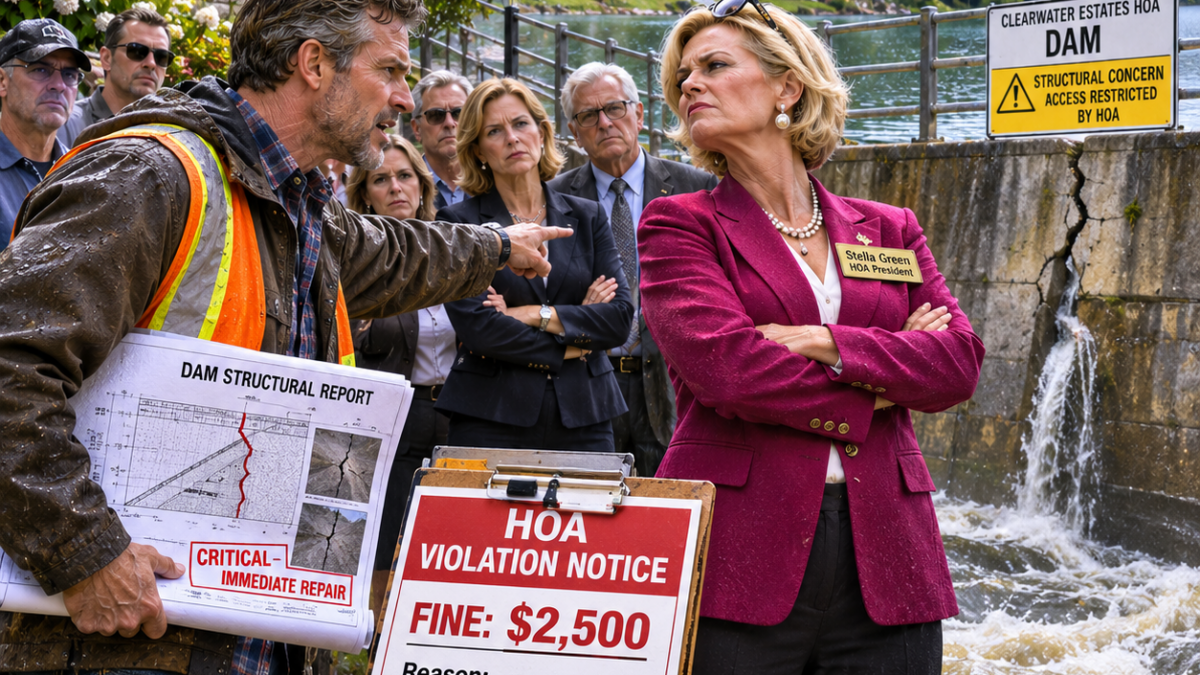
The first time I warned the Clearwater Estates board that the thin black crack running through the north base of our dam was actively leaking, HOA president Stella Green smiled in front of thirty neighbors, called my engineering report “Mark Hall’s little science project,” and reminded everyone that the structure had stood since the 1980s without needing a newcomer to frighten people.
Two weeks later, with rain hammering the valley hard enough to erase the road markings, I stood beside that same crack and watched water pulse through concrete that had begun to bow under the pressure, while Stella threatened to fine me for trespassing, ordered residents to ignore my warnings, and circulated an official notice insisting the dam was stable even as the ground beneath it started to liquefy.
What none of us understood yet was that the hairline fracture I had photographed on an ordinary October morning was only the visible part of a much older problem buried inside the dam—and by the time I found the first clue that someone had known about it before I ever moved to Clearwater, the storm was already giving us less time than anyone wanted to admit.
My name is Mark Hall, and I spent more than twenty years as a civil engineer working on municipal drainage, retaining structures, and flood-control projects before my wife Karen and I moved to Clearwater Estates.
We wanted quiet.
The development wrapped around an artificial lake bordered by pine trees, walking trails, expensive homes, and a concrete-and-earth dam that closed the valley at the north end. The brochures called it “private waterfront living with professionally managed infrastructure.”
I should have paid more attention to the word managed.
One cool October morning, six months after we moved in, I was jogging along the path below the dam when I saw the line.
At first it looked harmless.
A jagged crack, narrow enough that most people would have stepped over it without slowing down.
I stopped because the concrete around it was darker.
Moisture.
I crouched.
Cold water seeped from the fracture in a slow, steady line.
Then I pressed my fingers into the soil at the base.
Soft.
Too soft.
I took photographs, measured the approximate width using the edge of my key ring for scale, marked the location on my phone, and went home.
That afternoon, I emailed the HOA board.
No panic.
No dramatic language.
Just photographs, observations, and a recommendation that they arrange an immediate structural inspection and contact the county water-safety office.
Stella answered an hour later.
“Thank you for your concern, Mark. The dam is inspected annually and has never presented structural risk. We’ll look into it.”
Two days later, I attended the monthly board meeting.
Stella Green sat at the center table in a pastel suit and pearls, smiling like every decision had already been made before anyone else entered the room.
When public comments opened, I stood.
“I’m concerned about active seepage through the north section of the dam.”
Stella raised one hand.
“Mr. Hall, you’re fairly new here, correct?”
“Six months.”
She smiled toward the room.
“We’ve had this dam for decades.”
A few people chuckled.
I felt heat climb my neck.
“This isn’t about how long it’s been standing. The crack is active.”
“You’re an engineer?”
“Yes.”
“Of this dam?”
“No.”
“Then perhaps we should allow the professionals responsible for Clearwater to handle Clearwater.”
I opened my folder.
“I am asking you to bring one in.”
The smile disappeared for half a second.
Then returned.
“This community thrives on calm, Mark. We don’t need residents spreading fear over every puddle.”
Someone laughed.
I didn’t.
The next morning, the crack was wider.
Three days later, mud had begun collecting where dry soil should have been.
I photographed everything.
I sent another report.
This time Stella’s reply contained no thanks.
“Spreading unverified safety claims may violate community conduct standards. Please refrain from contacting residents directly.”
I showed Karen.
She read it twice.
“You’ve warned them.”
“I know.”
“Maybe now you let the board handle it.”
I looked across the lake.
Water pressed quietly against the dam beneath a perfectly calm surface.
“I can’t.”
That night, rain began tapping against our windows.
By morning it had become steady.
Two days later, the lake had risen nearly two feet.
And when I returned to the dam with a measuring gauge, my boot sank into ground that had been solid the week before.
I crouched, pulled out my phone, and started recording.
Then I noticed something beside the crack I hadn’t seen before.
A small metal inspection tag, half buried in mud.
Stamped into it was a date from the previous spring.
And beneath the date were three words:
REPAIR DEFERRED — BOARD.
PART 2
For several seconds, I forgot about the rain running down the back of my neck.
I wiped mud from the tag with my thumb.
The date was April 17.
Almost five months before Karen and I bought our house.
The tag had a contractor identification number stamped beneath the notation.
I photographed it from six different angles.
Then I recorded a short video showing its location relative to the crack, because I had learned long ago that a close-up means very little if nobody can later prove where the photograph was taken.
I stood and backed away.
My first instinct was anger.
My second was worse.
Fear.
If someone had inspected that exact area in April and written *repair deferred*, then Stella’s claim that the dam had “never shown structural risk” was either dangerously uninformed or deliberately false.
I called Karen.
“Are you home?”
“Yes.”
“Get my laptop out.”
“What happened?”
“I found something.”
“What?”
“Not over the phone.”
That sentence scared her more than I intended.
“I’m coming.”
I drove home through rain that had begun to thicken into gray curtains.
Karen was waiting in the kitchen.
I put my phone on the table and showed her the photograph.
She leaned closer.
“Repair deferred.”
“Yeah.”
“By the board?”
“That’s what it says.”
Her face changed.
“So Stella knew?”
“I don’t know yet.”
“You think she did.”
“I think somebody did.”
I searched the contractor number.
It belonged to Northstar Civil & Water, a regional engineering firm I knew by reputation.
Legitimate company.
Licensed engineers.
Dam inspections.
Slope stabilization.
Drainage work.
I called their office.
A receptionist answered.
“Northstar Civil.”
“My name is Mark Hall. I’m a resident at Clearwater Estates. I’m trying to verify an inspection tag from the north face of the Clearwater Dam.”
There was a pause.
“What tag number?”
I read it.
Keyboard clicking.
Then silence.
“Sir, I can’t release client reports without authorization.”
“So there is a report?”
Another pause.
“I didn’t say that.”
“You didn’t need to.”
“Mr. Hall—”
“I’m a licensed civil engineer. We have active seepage and significant rainfall. If your company identified a structural issue there in April, I need the appropriate emergency contact.”
Her tone changed.
“Active seepage?”
“Yes.”
“How much?”
“Enough that the downstream soil is saturated and the crack has widened approximately four millimeters since my first documented measurement.”
More typing.
“Hold.”
The line went quiet.
Karen watched me.
Thirty seconds later, a man came on.
“This is Alan Reeves, senior project engineer.”
“Mark Hall.”
“You’re at Clearwater?”
“Yes.”
“You said the north abutment is leaking?”
“Lower concrete section near the transition.”
He inhaled.
“Did the HOA call us back?”
My stomach tightened.
“For what?”
Silence.
Then:
“You need to speak to your board.”
“Mr. Reeves, I have spent two weeks speaking to my board.”
“I’m not authorized to discuss a client report.”
“Is there an immediate safety concern?”
“I can tell you this: if conditions have changed significantly since our last site visit, the owner should contact the county dam-safety office and arrange a current inspection.”
“The owner is the HOA.”
“Yes.”
“And if they refuse?”
Another pause.
“Document your observations and contact the county yourself.”
“I already have.”
“Do it again.”
The way he said it told me more than the words.
***
I emailed Stella that afternoon.
One sentence.
**Please provide the April Northstar Civil & Water report concerning the north dam face and explain why the inspection tag states REPAIR DEFERRED — BOARD.**
No answer.
I copied every board member.
Still nothing.
At 6:14 p.m., an email arrived from the HOA’s attorney.
**Mr. Hall, your repeated entry onto restricted association infrastructure and continued dissemination of unverified safety allegations are disruptive and potentially defamatory. You are directed to cease unauthorized inspection activity and allow the association’s retained professionals to manage the matter.**
I read it twice.
Then forwarded it to Alan Reeves.
I wrote:
**Are you the retained professional referenced here?**
He did not answer that night.
At 7:02 the next morning, he did.
**No.**
One word.
That was all.
I printed it.
***
The rain continued.
At breakfast, Karen watched me organize photographs into folders.
“You haven’t slept.”
“I slept.”
“You fell asleep in the chair for forty minutes.”
“That counts.”
“No, it doesn’t.”
I rubbed my eyes.
She sat across from me.
“Mark, listen to me.”
I stopped typing.
“If this is as serious as you think, we need to consider leaving.”
“I know.”
“Not after it gets worse.”
“I know.”
“Now.”
I looked toward the lake.
Our house sat on slightly higher ground than the first row of lakefront homes, but if the dam failed completely, the whole lower valley would take water.
“I want one more look at the old plans.”
Karen exhaled.
“Of course you do.”
“I need to understand the failure mode.”
“You need to understand you’re seventy feet from becoming the most annoying dead engineer in county history.”
That made me laugh.
Barely.
She didn’t.
“Promise me something.”
“What?”
“If you decide it’s unsafe, we leave. You don’t stay because you need to be proven right.”
That hit harder than she probably intended.
“I don’t need to be proven right.”
She gave me a look.
“Mark.”
I looked away.
Part of me did.
Not because I wanted the dam to fail.
God, no.
But after the jokes, the emails, the fines, the laughter at board meetings, some ugly little piece of me wanted Stella to stand in front of everyone and admit I had been right.
Karen saw it.
She always did.
“Being right won’t matter if we’re underwater.”
I nodded.
“You’re right.”
“Say that again.”
“Don’t push it.”
She smiled.
For ten seconds, the house felt normal.
Then my phone buzzed.
HOA group chat.
Stella.
**Residents are reminded that the Clearwater Dam remains safe and stable. Recent statements suggesting imminent failure are unsupported by the association’s engineering consultants. Please avoid spreading misinformation.**
I stared.
Then typed:
**Please identify the engineering consultant and provide the report.**
Three dots appeared.
Disappeared.
Then:
**Mark, this forum is not the proper venue for technical debate.**
I responded:
**Then give us the proper venue.**
She removed me from the group.
***
That afternoon, somebody taped a printed meme to my mailbox.
A man in a hard hat staring dramatically at a puddle.
**DOOMSDAY HALL REPORTING FOR DUTY.**
Karen found it first.
She brought it inside.
“Do you want me to throw this away?”
I looked at it.
“No.”
“Why?”
“Evidence.”
She sighed.
“Of what?”
“Human stupidity.”
“That’s not admissible.”
“Should be.”
I put it in the folder.
***
The next morning, Eric Lawson knocked on my door.
He lived three houses closer to the dam.
Thirty-eight.
Two kids.
Worked in HVAC.
He looked embarrassed.
“Can I ask you something?”
“Sure.”
“About the dam.”
I stepped aside.
He didn’t come in.
Instead he looked toward the lake.
“I walked the lower path last night.”
“Why?”
“My dog got loose.”
“What did you see?”
“Ground’s wet.”
“It’s raining.”
“No.”
He shook his head.
“Not like rain. It’s bubbling.”
My stomach tightened.
“Where?”
He pointed.
“Near the old bench below the north side.”
I was already reaching for my jacket.
“Show me.”
***
The soil was moving.
Not dramatically.
That was what made it frightening.
A patch about the size of a kitchen table looked almost alive, tiny pulses disturbing the muddy surface.
I crouched.
Water pushed upward through the soil.
Eric stood behind me.
“What is that?”
“Potential internal erosion.”
“In English.”
“Water may be finding a path through or beneath the dam and carrying fine soil with it.”
His face went pale.
“That bad?”
“If that’s what it is, yes.”
“How bad?”
“Potentially catastrophic.”
He stared toward the houses.
“My kids are home.”
“Get them uphill.”
“Now?”
“Yes.”
“But Stella said—”
I stood.
“Eric.”
He stopped.
“Take your family somewhere above the valley tonight.”
He swallowed.
“Okay.”
Then:
“Should we call the HOA?”
I looked at him.
He looked at me.
Neither of us laughed.
He called anyway.
Stella answered.
I could hear her through his phone.
“Eric, please stop feeding Mark’s obsession.”
“Stella, I can see water coming out of the ground.”
“It’s been raining for days.”
“He says it’s piping.”
“Mark says a lot of things.”
I leaned toward the phone.
“Ask her for Northstar’s April report.”
Eric did.
Silence.
Then Stella said:
“That document is confidential.”
My jaw tightened.
So it existed.
Eric looked at me.
I mouthed:
**Get your family out.**
He nodded.
***
I went back to the county water-safety office.
Peter was at the front desk again.
When he saw me, his shoulders fell.
“Mr. Hall.”
“I brought more.”
He looked at the binder.
“I figured.”
I showed him the bubbling soil video.
The crack measurements.
The inspection tag.
Northstar’s email.
The lake level.
Rainfall totals.
He stopped looking bored.
“Wait here.”
Ten minutes later, a woman named Denise Carter came out.
County water-resources supervisor.
She shook my hand.
“You’re the engineer?”
“One of them.”
She watched the video.
Again.
Then asked:
“Where exactly?”
I marked the map.
“Have you notified the association?”
“Repeatedly.”
“Do you have copies?”
I handed her the HOA emails.
She read Stella’s statement that the dam was stable.
Then the attorney’s cease-and-desist.
Her expression hardened.
“Who is their engineer?”
“They won’t tell me.”
“Northstar?”
“No. Northstar inspected in April, but they say they aren’t the current retained consultant.”
“Do you have the April report?”
“No.”
“Does the HOA?”
“Almost certainly.”
Denise stood.
“I’m making calls.”
“Can you inspect?”
“We need to establish our authority and coordinate emergency access. Private ownership complicates routine inspection, but imminent public-safety risk changes things.”
“How long?”
“I’m not promising a timeline.”
“Denise—”
“I know.”
She looked directly at me.
“I saw the video.”
That was the first official response that sounded like someone understood the clock.
***
Two hours later, Stella called.
“You went to the county again.”
“Yes.”
“You have no authority to involve outside agencies in association property.”
“Neither do you have authority to suspend physics.”
“You’re damaging property values.”
There it was.
Not safety.
Values.
“Is that what this is about?”
“What?”
“Property values.”
“Clearwater is one of the premier communities in the region. You are publicly implying that our central amenity is unsafe.”
“I’m privately documenting a failing dam.”
“You distributed flyers.”
“After you ignored me.”
“You’ve scared residents.”
“They should be scared.”
She inhaled sharply.
“Do you hear yourself?”
“Yes.”
“I’ve spoken to counsel. If you continue, the association will seek an injunction.”
“Then you’ll have to produce records.”
Silence.
I hadn’t planned that line.
But it landed.
“What records?” she asked.
“April inspection.”
“That is privileged board material.”
“Engineering reports aren’t magically privileged because you dislike what they say.”
Her voice dropped.
“You don’t know what you’re talking about.”
“I know Northstar was there.”
No response.
“I know they left a repair tag.”
Still nothing.
“I know they told you something serious enough to use the word repair.”
“Mark.”
Her tone changed.
Not angry.
Quiet.
“Let this go.”
I felt cold.
“Why?”
“You moved here six months ago. You don’t understand how complicated this community is.”
“Concrete doesn’t care how complicated your board is.”
“The repair estimate was unreasonable.”
I stopped breathing.
There it was.
“What estimate?”
She realized immediately.
“I didn’t say—”
“You just admitted there was a repair proposal.”
“That’s not what I meant.”
“How much?”
“Goodbye, Mark.”
She hung up.
I wrote down the entire conversation from memory.
Then I texted Karen.
**Pack documents tonight.**
She replied:
**Already started.**
***
By evening, the weather service upgraded the storm forecast.
Flash-flood watch.
Heavy rainfall.
Potential for more than six additional inches in the watershed.
I drove to Eric’s house.
His SUV was loaded.
His wife strapped their youngest child into the back.
“You leaving?”
“Hotel on the ridge.”
“Good.”
Eric looked embarrassed.
“I laughed at that meme.”
“I know.”
“Sorry.”
“Get your kids out.”
He nodded.
Then he grabbed my arm.
“Come too.”
“We will.”
“When?”
“Tonight.”
“You promise?”
“Yes.”
This time I meant it.
***
At home, Karen had two bags by the door.
Birth certificates.
Insurance paperwork.
Medication.
Clothes.
External hard drives.
Photo albums.
My old engineering license framed on the wall.
She pointed.
“That?”
“No.”
“Good.”
“What?”
“I was testing you.”
I almost smiled.
Then I looked at our wedding photo.
“Take that.”
She already had.
***
At 9:40 p.m., the HOA emailed every resident.
**CLEARWATER INFRASTRUCTURE UPDATE**
**The dam remains stable. Elevated lake levels are within expected storm conditions. Residents are asked to remain calm and refrain from circulating unverified information.**
I forwarded it to Denise Carter.
Subject:
**PLEASE CONFIRM COUNTY AGREES WITH THIS STATEMENT.**
She replied eleven minutes later.
**COUNTY HAS NOT CONFIRMED DAM STABILITY. WE ARE ATTEMPTING SITE ACCESS AND COORDINATING WITH EMERGENCY MANAGEMENT.**
I printed both.
Side by side.
***
At 10:16, someone knocked.
Deputy.
Rain pouring off his hat.
“Mark Hall?”
“Yes.”
He held a plastic sleeve containing a letter.
“I’m serving notice from association counsel regarding restricted infrastructure access and alleged harassment.”
I laughed.
The deputy looked apologetic.
“I’m just delivering it.”
“I know.”
He glanced at our packed bags.
“You leaving?”
“Yes.”
“Good.”
That surprised me.
“Why?”
He lowered his voice.
“Dispatch has been getting calls about water near the lower dam path.”
“From who?”
“Residents.”
I pulled up the piping video.
He watched.
His eyebrows rose.
“Send me that.”
“Give me your official email.”
He did.
I sent it.
Then I showed him Denise’s response.
The deputy looked toward the lake.
“You really think it can fail?”
“Yes.”
“How soon?”
“I don’t know.”
“That bad?”
“Could be hours. Could survive the storm. But if internal erosion is underway and the water keeps rising, nobody should bet their house on the second option.”
He nodded.
“I’ll call this up.”
“Thank you.”
He looked at the cease-and-desist in his hand.
Then at me.
“Stay away from the dam.”
“For once, we agree.”
He left.
***
At 11:07, Eric texted.
**LOWER PATH COLLAPSED. WATER MOVING FAST.**
I called him.
“Where are you?”
“Hotel.”
“Stay there.”
“What about everyone else?”
“I’m calling emergency management.”
I called Denise.
Voicemail.
Called dispatch.
Explained.
Sent the video.
Then my phone rang.
Stella.
I almost didn’t answer.
I did.
“What?”
“You need to stop calling emergency services with exaggerated claims.”
“Are you serious?”
“They’ve contacted me because of your reports.”
“Good.”
“You are creating panic during severe weather.”
“The lower path collapsed.”
“Because of runoff.”
“Water is piping through the foundation.”
“You cannot know that.”
“I have video.”
“You’re not the association’s engineer.”
“Then name yours.”
Silence.
“Name the person who says it’s safe.”
Nothing.
Lightning lit the lake through my window.
“Stella?”
“The board is handling it.”
“No.”
I looked at Karen.
She was standing beside the packed bags.
“You’re handling your reputation.”
“Mark—”
“If the dam fails tonight, every warning is in writing.”
Her voice changed.
“You’re threatening me?”
“No.”
I spoke slowly.
“I’m telling you to evacuate the neighborhood.”
“You’re not in charge.”
I looked out at the black water.
“No.”
Then:
“But neither are you.”
I hung up.
***
At 11:40, county emergency management finally issued an advisory for residents in the lower portion of Clearwater to prepare to evacuate.
Not mandatory.
Prepare.
It was something.
I forwarded it to every neighbor whose number I had.
Some answered.
Some didn’t.
Mr. Roberts called.
The same man who had patted my shoulder and told me to relax.
“Mark?”
“Yes.”
“This county message—”
“Leave.”
“You really think—”
“Bob, take your wife and go uphill.”
He was quiet.
“Stella says it’s precautionary.”
“I don’t care what Stella says.”
Another pause.
Then:
“Okay.”
That simple word may have saved both of them.
***
Karen and I loaded the truck.
I stood in the garage for one last moment.
Tools.
Boxes.
Old furniture.
The life you assume will still be there tomorrow.
Karen touched my arm.
“Mark.”
“I know.”
We left.
***
Halfway up Ridgeview Road, I stopped.
Karen stared at me.
“No.”
“I’m not going back.”
“Then why are we stopping?”
“I want to look.”
“Mark.”
“One minute.”
The ridge overlooked the valley.
From there, lightning revealed the lake in flashes.
It was nearly level with the emergency spillway.
Water churned against the dam.
Even at that distance, I could see pale lines of spray.
My engineering brain began calculating automatically.
Head pressure.
Reservoir elevation.
Overtopping risk.
Saturated embankment.
Potential progressive breach.
Karen grabbed my sleeve.
“You’re shaking.”
I hadn’t noticed.
I lifted my phone.
2:46 a.m.
I recorded.
“This is Mark Hall. Clearwater Dam. Multiple active leaks visible. Reservoir at or near spillway elevation. Residents downstream should evacuate immediately.”
Then the sound came.
A crack.
Deep.
Not thunder.
Concrete.
Karen whispered:
“What was that?”
I lowered the phone.
Another sound.
Then another.
I knew.
“Get in.”
We climbed into the truck.
Before I started the engine, the valley gave one long, low groan.
The kind of sound you feel through the seat before you hear it.
Then the dam broke.
***
The central section collapsed inward.
For one second, the lake seemed to hesitate.
Then gravity took over.
Water punched through the opening in a black wall.
The first surge struck the lower road.
Streetlights disappeared.
A parked car lifted sideways and vanished.
The breach widened.
More concrete gave way.
The roar grew until I could feel it through my chest.
Karen covered her mouth.
“Oh my God.”
I couldn’t speak.
Water slammed into the first row of houses.
Walls folded.
Roofs turned.
Trees snapped.
The clubhouse disappeared behind spray and debris.
I had spent my career designing systems around water.
Drainage channels.
Retention basins.
Storm sewers.
Culverts.
You learn to respect water mathematically.
Flow.
Velocity.
Pressure.
Volume.
But mathematics does not prepare you for seeing an entire lake decide it no longer belongs where human beings put it.
Karen screamed:
“Drive!”
I did.
We climbed higher.
Behind us, Clearwater Estates went dark one block at a time.
***
At the top of the ridge, several vehicles had stopped.
People stood in raincoats staring down.
Eric was there with his family.
His wife held both children against her.
He saw me.
“You were right.”
I grabbed his jacket.
“Don’t say that.”
He stared.
“You were—”
“Not now.”
Below us, another house broke apart.
The words meant nothing.
***
I called 911.
Dispatch already knew.
Multiple reports.
Flood rescue.
Road closures.
Fire departments from surrounding districts mobilizing.
I gave them the safest approach route I knew.
Told them which roads sat above predicted flood elevation.
Warned them about the propane storage near the clubhouse.
Engineering again.
Anything to avoid thinking.
Then lightning flashed.
Karen grabbed my hand.
“Mark.”
I looked where she pointed.
Stella’s house.
The largest home on the lake.
Three levels.
Stone terrace.
Private dock.
I had sat through three HOA meetings listening to her mention the property as proof that Clearwater preserved values.
The flood struck the lower level.
Windows vanished.
The deck peeled away.
The house shifted.
For a second, the upper floors remained upright.
Then one side dropped.
The structure twisted and disappeared into brown water.
I felt nothing satisfying.
Nothing.
No vindication.
Just horror.
“She might be in there,” Karen whispered.
I called dispatch again.
Gave the address.
***
We remained on the ridge until rescue personnel ordered everyone to the county shelter.
Before leaving, I looked down one final time.
My own house was partially submerged.
The porch roof still visible.
Then another surge came through.
I turned away.
Karen squeezed my hand.
“We’re alive.”
I nodded.
I couldn’t say it.
Because somewhere below us, not everyone was.
***
The evacuation center was a high school gym.
Wet people.
Blankets.
Dogs.
Children crying.
Phones ringing.
Names being called.
Lists taped to walls.
Missing.
Located.
Transported.
Hospital.
The kind of organized chaos I had worked around during public emergencies, except this time my address was part of it.
A volunteer handed Karen two blankets.
I couldn’t sit.
I walked.
Then I saw Stella.
Silver thermal blanket around her shoulders.
Mud across her face.
No pearls.
No perfect hair.
No board packet.
She stared at the floor.
A paramedic knelt beside her.
Alive.
I felt relief.
That surprised me.
Stella looked up.
Our eyes met.
For a second I thought she might say something.
She didn’t.
Neither did I.
I walked past.
There would be time for words.
People were still missing.
***
By sunrise, three deaths had been confirmed.
Two residents and a county-road driver caught downstream.
Several more were hospitalized.
Most residents had escaped, partly because emergency alerts and neighbors warning one another had pushed people uphill during the final hours.
Mr. and Mrs. Roberts were safe.
Eric’s family was safe.
Our house was destroyed.
Stella’s house was gone.
So was the clubhouse.
Hundreds displaced.
I sat beside Karen on a folding cot when the first aerial footage appeared on a television mounted above the gym.
Clearwater no longer looked like a neighborhood.
It looked like a river had been dropped onto a subdivision.
The lake basin was nearly empty.
The dam was a jagged opening between broken concrete walls.
A county official began a press briefing.
“Preliminary evidence indicates failure initiated near the northern section of the structure.”
My stomach turned.
Exactly where I’d photographed the crack.
Then:
“We are aware of reports that a resident raised safety concerns before the incident. Those records will be reviewed as part of the investigation.”
People around us turned.
Someone recognized me.
“That’s Mark.”
Another voice:
“The engineer?”
I wanted to disappear.
A reporter entered the gym.
Then another.
I stood.
Karen caught my hand.
“You don’t owe anybody a statement.”
“I know.”
“Then why are you going?”
I looked at the television.
“Because Stella already told everyone it was safe.”
***
Outside, cameras formed a semicircle.
I hated every second.
A county official asked whether I wanted to say anything.
I stepped toward the microphones.
My voice sounded unfamiliar.
“I warned the HOA.”
Flashes.
“I sent photographs. Measurements. Videos. Rainfall information. I asked for an inspection.”
I swallowed.
“They told me I was spreading fear.”
Behind the cameras, survivors stood under blankets.
That changed what I wanted to say.
“This isn’t about me being right.”
I pointed toward the valley.
“Being right didn’t save my home.”
Silence.
“People died.”
My voice cracked.
“So don’t turn this into an argument somebody won.”
I looked directly at the cameras.
“This was preventable if the warnings had been treated like warnings instead of criticism.”
I stepped back.
No more questions.
***
That afternoon, Detective Sarah Monroe found me.
County Emergency Task Force.
Forties.
Mud on her boots.
No interest in drama.
“Mark Hall?”
“Yes.”
“We need your records.”
“I have copies.”
“All of them?”
“Probably more than you want.”
She almost smiled.
“I doubt that.”
Karen handed me the external drive from our evacuation bag.
I gave Sarah the first duplicate.
She looked surprised.
“You evacuated with evidence?”
“And wedding photos.”
“Priorities.”
“My wife packed the photos.”
“Smart wife.”
Karen nodded.
“Finally, someone notices.”
Sarah took the drive.
“What’s on it?”
“Photographs by date. Crack measurements. videos. HOA emails. rainfall data. county correspondence. contractor information. inspection tag photographs.”
Her expression changed.
“Inspection tag?”
“Yes.”
“Contractor?”
“Northstar Civil.”
Sarah wrote it down.
“Did the HOA have a prior report?”
“I believe so.”
“Why?”
I explained the tag.
My call with Northstar.
Stella’s admission that there had been a repair estimate.
Sarah stopped writing.
“She admitted that?”
“On the phone.”
“Recorded?”
“No.”
“Anyone hear?”
“My wife heard my side.”
“Okay.”
She closed the notebook.
“We’ll find the paper.”
***
They did.
Three days later, Sarah called me to a temporary county office.
A conference room smelled like wet carpet and burned coffee.
She placed a document on the table.
Northstar Civil & Water.
**CLEARWATER DAM CONDITION ASSESSMENT — APRIL 17**
I stared at it.
Page one.
Seepage observed at north concrete transition.
Minor cracking with evidence of progressive water intrusion.
Recommendation:
Detailed engineering evaluation.
Drainage relief work.
Sealing and structural stabilization.
Estimated initial repair and investigation cost:
$186,000 to $240,000.
Then a sentence highlighted in yellow:
**Continued deferral may increase risk of internal erosion during sustained elevated reservoir levels.**
I closed my eyes.
Sarah said quietly:
“You okay?”
“No.”
She slid another paper forward.
HOA board minutes from April 22.
Stella speaking.
**Major repair expenditure at this time would require unacceptable special assessment and may negatively impact property values prior to summer sales cycle. Recommend monitoring and reassessment next fiscal year.**
I stared.
“Next fiscal year.”
Sarah nodded.
“There’s more.”
An email from the HOA treasurer.
**Northstar specifically warned about heavy-rain conditions. We should at least notify residents.**
Stella’s reply:
**Absolutely not. Publicizing speculative infrastructure risk will create panic and destroy values. We will monitor discreetly.**
My hands started shaking.
Karen put hers over mine.
Sarah waited.
Then placed another report on the table.
Different letterhead.
A consultant I’d never heard of.
One-page visual inspection.
No subsurface review.
No instrumentation.
No seepage measurements.
Conclusion:
**No evidence of immediate catastrophic failure observed during visual walkover. Continued routine monitoring recommended.**
Date:
July.
I looked at Sarah.
“This is the professional she kept citing.”
“Apparently.”
“Did they see Northstar’s report?”
“We’re asking.”
“Did they inspect the crack?”
“According to their notes, access was limited to the crest and upper downstream slope.”
I laughed.
It sounded ugly.
“They never looked at the base.”
Sarah nodded.
“That appears likely.”
There it was.
Stella had found the sentence she wanted.
Everything is fine.
Not because it was true.
Because someone had performed a narrower inspection that avoided the place where the evidence lived.
***
The investigation spread.
Board emails.
Insurance records.
Maintenance budgets.
Contract bids.
Meeting recordings.
Residents’ complaints.
The deeper investigators went, the less the collapse looked like a surprise.
The dam had been neglected for years.
Drainage outlets had not been properly maintained.
Vegetation encroached in areas that should have been clear.
Seepage observations appeared in older maintenance logs.
Crack repairs had been cosmetic.
Then the financial motive emerged.
Clearwater’s reserve fund was far smaller than residents had been told.
The board had spent heavily on landscaping, clubhouse renovation, lakefront beautification, and the annual gala.
A proper dam repair would have required a large special assessment.
Stella had campaigned for reelection on “no surprise assessments.”
She owned the most expensive house in the development.
She was also trying to sell an investment property in the neighborhood that summer.
A public structural warning would have damaged exactly the image she had built her power around.
Perfect lake.
Perfect homes.
Perfect values.
No panic.
No cracks.
***
At the shelter, people began approaching me.
Some apologized.
Some cried.
One man simply said:
“I shared the Doomsday Hall meme.”
I remembered him.
“Okay.”
“I feel sick.”
“We all do.”
“I should’ve listened.”
I looked at the rows of cots.
“We all should have asked more questions.”
“But you did.”
“Yes.”
“And we laughed.”
I didn’t know what he wanted me to say.
So I told him the only useful thing.
“When somebody warns you next time, don’t laugh first.”
He nodded.
***
Mr. Roberts found me near the coffee station.
His wife was beside him.
He looked twenty years older.
“Mark.”
“Bob.”
He stared at his hands.
“I told you that dam had been there since the eighties.”
“I remember.”
“I told you to relax.”
“I remember.”
His eyes filled.
“Our house is gone.”
“So is mine.”
He looked up.
“I’m sorry.”
I put my hand on his shoulder.
“Help your wife.”
That was all.
Punishing embarrassed survivors would not rebuild anything.
***
Stella avoided me for three days.
Then we crossed paths outside the temporary county office.
She was standing alone beside a portable generator.
No cameras.
No lawyer.
No board members.
“Mark.”
I stopped.
Her voice was rough.
“I didn’t know it would fail.”
I looked at her.
“Yes, you did.”
Her face tightened.
“No.”
“You knew it could.”
“That’s different.”
“Not when you’re responsible for people downstream.”
She looked away.
“The engineers weren’t certain.”
“Engineers are almost never certain.”
“That report said continued monitoring.”
“The July walkover did.”
I stepped closer.
“Northstar told you about internal erosion risk in April.”
She said nothing.
“You deferred the repair.”
Her eyes filled.
“We couldn’t afford it.”
“You could afford a gala.”
“That isn’t fair.”
“No?”
“You don’t understand what would have happened if I announced a two-hundred-thousand-dollar repair.”
“What?”
“People would panic.”
“Good.”
“Home values would drop.”
“Maybe.”
“Owners would sue the board.”
“Maybe.”
“The assessment would’ve destroyed retirees.”
“And what did the flood do?”
She flinched.
I regretted the cruelty immediately.
Not the truth.
The delivery.
Stella whispered:
“I thought we had time.”
That sounded human.
Finally.
“I know.”
“I thought if we stayed calm, we could handle it later.”
“Calm isn’t safety.”
She looked toward the shelter.
“I was trying to protect the community.”
“No.”
My voice stayed quiet.
“You were trying to protect the picture of the community.”
She started crying.
Not dramatically.
Just tears falling.
I could have said *I told you so*.
Months earlier, part of me would have enjoyed it.
Standing among displaced families, I couldn’t.
I walked away.
***
The federal disaster declaration brought FEMA assistance and additional resources.
Temporary housing.
Debris removal.
Infrastructure assessments.
Insurance teams.
Engineers.
Lawyers.
The valley became a place where everyone wore reflective vests.
My home was declared a total loss.
Karen and I were given a temporary apartment forty minutes away.
The first night there, she put two mugs on the counter.
I stared at them.
“What?”
“They’re ugly.”
“They came with the apartment.”
“I hate them.”
She started laughing.
Then crying.
Then laughing again.
I held her.
That was when the flood finally reached us emotionally.
Not at the ridge.
Not in the shelter.
In a small apartment with ugly mugs.
Our house was gone.
Her garden.
My workshop.
The oak table we’d bought when our son graduated college.
Boxes of Christmas ornaments.
A stack of old engineering notebooks.
Karen’s grandmother’s quilt.
Gone.
I had spent weeks warning about structural failure.
Somehow I had not prepared myself for loss.
***
For months, I woke at night hearing the crack.
That deep sound.
Concrete surrendering.
Sometimes I dreamed I was back at the dam with a wrench, trying to tighten something that had no bolts.
Sometimes Stella stood above me with a clipboard saying I needed permission.
I would wake sweating.
Karen stopped asking if I was okay.
She just put a hand on my chest until my breathing slowed.
One night I said:
“I should’ve done more.”
She sat up.
“No.”
“I knew.”
“You warned them.”
“I could’ve gone public sooner.”
“You went to the county.”
“I could’ve called the news.”
“And if they had laughed too?”
“I could’ve—”
“Mark.”
Her voice hardened.
“You are trying to redesign the past because engineers hate systems they can’t fix.”
I stared at her.
She continued.
“You didn’t own the dam.”
“I had expertise.”
“You used it.”
“Not enough.”
“Enough to get Eric out.”
I looked down.
“Enough to get Bob out.”
Silence.
“Enough that other people saw your emergency video and left before the breach.”
I hadn’t allowed myself to think about that.
Karen touched my face.
“You didn’t save everybody.”
“No.”
“Nobody can.”
I cried then.
Quietly.
For the people who died.
For the homes.
For the fact that she was right.
***
The final technical report took months.
Failure initiated through a combination of long-term deterioration, seepage, internal erosion, saturated downstream soils, insufficient drainage performance, and extreme sustained rainfall.
The storm was severe.
But the report was explicit.
The dam should not have been allowed to remain in that condition.
The warning signs were visible.
Earlier repairs could likely have reduced the risk substantially.
Emergency drawdown or evacuation before peak rainfall could have reduced consequences.
Then came the administrative findings.
Prior warnings not adequately acted upon.
Maintenance deferred.
Residents not notified.
Incomplete consultant scope represented to residents as proof of safety.
Internal reports withheld.
Certain maintenance summaries altered.
That last part changed the criminal investigation.
***
The county held a public hearing.
Packed auditorium.
Survivors.
Reporters.
Engineers.
Government officials.
Karen sat beside me.
Stella sat near the front with her attorney.
She looked smaller.
Gray coat.
Hair tied back.
No pearls.
Lead investigator Sarah Monroe walked to the podium.
“Following extensive review, the task force concludes that the Clearwater Dam collapse resulted from a combination of extreme rainfall and long-standing structural deficiencies that had been identified before the failure.”
The room was silent.
“Resident engineer Mark Hall provided repeated warnings beginning in October, supported by photographs, measurements, and video.”
Heads turned.
I hated that.
Sarah continued.
“Separate evidence confirms the HOA had received an engineering assessment months earlier recommending further evaluation and repair.”
Murmurs.
Stella lowered her eyes.
“Investigators also identified alterations to internal safety summaries and communications discouraging disclosure of known concerns.”
A woman behind me whispered:
“Oh my God.”
Then Sarah put my first photograph on the screen.
Tiny dark line.
The original crack.
Beside it, a post-failure engineering diagram.
Same location.
Failure zone.
The room made one collective sound.
Not quite a gasp.
I felt Karen take my hand.
***
When they invited me to speak, I almost refused.
Then I looked at the survivors.
I walked forward.
“I didn’t come here to say I told you so.”
My voice carried better than I expected.
“Because being right about a disaster is not winning.”
I looked toward Stella.
Then away.
“The crack in that photograph was small.”
I pointed at the screen.
“That’s why it was easy to dismiss.”
I paused.
“Most dangerous problems start that way.”
The room stayed silent.
“We lost homes. We lost people. We lost the place many of us expected to retire.”
My throat tightened.
“The physical crack mattered.”
I looked at the board members.
“But another crack formed before the dam broke.”
No one moved.
“The crack between evidence and ego.”
I stopped there.
Anything more would have sounded like a speech.
I returned to my seat.
No applause.
Good.
The silence felt honest.
***
Criminal charges followed against Stella and others involved in falsifying or withholding safety documentation.
The exact legal theories were less satisfying than television headlines.
Negligence-related charges.
False records.
Obstruction tied to official safety communications.
Separate civil claims.
Insurance litigation.
Board liability.
Stella’s attorney argued that she had relied on professionals and had not intended harm.
That was partly true.
Intent became the center of everything.
Had she wanted the dam to fail?
Obviously not.
Had she wanted anyone hurt?
No.
Had she knowingly minimized risk?
The emails said yes.
Had she withheld Northstar’s report from residents?
Yes.
Had she used the later limited inspection as a blanket assurance the structure was safe?
Yes.
Had she threatened residents who tried to raise the issue?
My emails said yes.
Her own emails said yes.
Consequences do not require cartoon villains.
Sometimes they only require someone choosing the convenient answer too many times.
***
During the criminal proceedings, a former board treasurer named Susan Blake testified.
I had barely known her.
She had resigned shortly before Karen and I moved in.
On the stand, she explained why.
Northstar had presented the repair estimate.
She wanted a special assessment vote.
Stella opposed it.
Susan produced an email.
**A dam scare will crater resale values and destroy confidence. We need messaging discipline until we have a more favorable technical opinion.**
Stella had written it.
The prosecutor asked:
“What did you understand ‘more favorable technical opinion’ to mean?”
Susan swallowed.
“A consultant who wouldn’t recommend immediate expensive work.”
The courtroom shifted.
Stella’s lawyer objected.
The judge limited speculation.
Then the prosecution produced the July engagement letter.
Scope:
Visual walkover only.
No subsurface investigation.
No seepage testing.
No stability modeling.
No review of Northstar report unless separately authorized.
It wasn’t fraudulent to hire a limited consultant.
The problem was what Stella did with the result.
She turned:
**No immediate catastrophic condition observed during limited visual inspection**
into:
**The dam is safe.**
Those were not the same sentence.
My entire career had lived inside distinctions like that.
Now an entire courtroom heard one.
***
Stella testified.
That surprised me.
Her attorney asked about her years as president.
Volunteer hours.
Budgets.
Resident complaints.
Responsibility.
She cried when discussing the flood.
“I loved Clearwater.”
I believed her.
That’s what made everything sadder.
She said:
“I genuinely believed we had time.”
Her attorney asked:
“Did you ever intend to place residents in danger?”
“No.”
“Did you knowingly cause the dam to fail?”
“No.”
“Did you believe the July consultant’s report meant catastrophic failure was not imminent?”
“Yes.”
Her attorney sat.
Then the prosecutor stood.
“Ms. Green, did Northstar recommend further investigation and repairs?”
“Yes.”
“Did the board approve them?”
“No.”
“Why?”
“Cost.”
“Did you tell residents?”
“No.”
“Why?”
“I didn’t want unnecessary panic.”
“Did you write that disclosure would damage property values?”
“Yes.”
“Did you tell residents the dam had never shown structural risk?”
Stella hesitated.
“Yes.”
“Was that true?”
She looked down.
“No.”
That answer seemed to drain something out of the room.
The prosecutor continued.
“Did you tell residents you had spoken to a professional who said everything was stable?”
“I summarized the July inspection.”
“Did that consultant use the word stable?”
“I don’t remember.”
The report appeared.
The prosecutor read the actual sentence.
No immediate catastrophic condition observed during limited visual inspection.
Then:
“Where does it say stable?”
Stella said nothing.
“Where does it say safe?”
Nothing.
“Where does it say the Northstar concerns had been resolved?”
Nothing.
Then came my October emails.
My measurements.
My photographs.
Her threats of fines.
Her group message:
**There is no risk of failure.**
The prosecutor looked at her.
“On what engineering basis did you make that statement?”
Stella’s voice broke.
“I was trying to keep people calm.”
The prosecutor waited.
Then:
“That wasn’t my question.”
Silence.
***
The case did not give anyone back their houses.
It did not resurrect the people who died.
But it established responsibility.
Stella was convicted on falsification-related counts and found criminally negligent under the charges brought in the case.
Other charges were resolved differently.
She received a custodial sentence followed by supervision, financial penalties, and significant restitution obligations subject to the broader civil proceedings.
The former HOA faced lawsuits.
Its insurer fought over coverage.
The board dissolved.
Assets were placed under court-supervised administration.
It was messy.
Justice usually is.
Anyone expecting a single gavel strike that made Clearwater whole was disappointed.
There was no whole anymore.
Only what we built afterward.
***
I saw Stella outside the courthouse after sentencing.
Two officers escorted her toward a vehicle.
Reporters crowded behind barriers.
She wore dark glasses.
For a moment she looked almost like the woman from my first HOA meeting.
Then she saw me.
Stopped.
The officer allowed her a second.
“Mark.”
I didn’t move closer.
She lowered her glasses.
Her eyes were red.
“I am sorry.”
I waited.
She continued.
“Not for getting caught.”
That mattered.
“For not listening.”
I nodded once.
She looked toward Karen.
Then back at me.
“I thought admitting the dam might be unsafe would mean I had failed the community.”
I said:
“And hiding it?”
She closed her eyes.
“I know.”
The officer touched her arm.
She walked away.
I didn’t forgive everything in that moment.
That would have been dishonest.
But I stopped needing her to suffer.
The flood had already taught me how useless that desire was.
***
Clearwater Estates was never rebuilt as it had been.
The county condemned large sections of the former lake basin.
Some homeowners rebuilt higher up.
Others took insurance settlements and left.
Karen and I were among the ones who left.
Not because we hated the valley.
Because we couldn’t sleep there anymore.
Our new house sat fifteen miles away on ordinary ground with no private lake.
The first time it rained hard, I woke at two in the morning and checked the drainage ditch with a flashlight.
Karen found me.
“Seriously?”
“It’s flowing properly.”
“Get inside.”
“I’ll be one minute.”
“Mark.”
“Thirty seconds.”
She dragged me in by the sleeve.
Some habits survive disasters.
***
The county asked me to serve as a volunteer technical adviser during inspections of other privately owned dams.
I hesitated.
Karen told me to do it.
“Why?”
“Because they’ll listen to you now.”
“I shouldn’t need a destroyed neighborhood for credibility.”
“No.”
She looked at me.
“But you have it.”
That was difficult to accept.
Still, I went.
***
The first inspection was at a retirement community north of Brookhaven.
Small reservoir.
Aging earth dam.
HOA board waiting in a clubhouse.
I walked in wearing work boots and carrying two photographs.
The first:
My original Clearwater crack.
The second:
The flood.
I placed them side by side.
One board member stared.
“That’s the same location?”
“Yes.”
Nobody laughed.
We found a clogged toe drain and suspicious seepage.
The board authorized testing that week.
Repairs followed.
No disaster.
No headlines.
Nobody outside that neighborhood ever heard about it.
That felt better than being famous.
***
Then another community called.
Then another.
I began receiving emails from HOA boards.
Municipalities.
Schools.
Small lake associations.
People sent photographs.
Some were harmless cracks.
Some were serious.
I refused to diagnose structures from phone pictures.
Instead, I taught them the question:
**Who is qualified to inspect this, and how quickly can we get them here?**
That was more useful than fear.
***
Clearwater’s former lake basin became part memorial, part controlled floodplain.
The county named it Clearwater Memorial Basin.
I disliked the name at first.
It sounded like somebody had turned tragedy into a park brochure.
Then I visited.
Grass had begun returning.
A shallow stream followed the old valley floor.
Birds landed where million-dollar docks once floated.
Near the overlook stood a stone monument.
No speeches carved into it.
Just the names of those who died.
And beneath them:
**LISTEN BEFORE THE WARNING BECOMES THE DISASTER.**
I stood there with Karen.
She slipped her arm through mine.
“You did good.”
I looked at the names.
“Three people died.”
“I know.”
“I didn’t do enough.”
She squeezed harder.
“Are we doing this again?”
“Probably.”
“Then listen carefully.”
I looked at her.
“You warned them.”
I started to interrupt.
She raised a finger.
“You went to the board.”
Another finger.
“You documented.”
Another.
“You went to the county.”
Another.
“You warned neighbors.”
Another.
“You sent the emergency video.”
Another.
“You got people uphill.”
She lowered her hand.
“What exactly would satisfy you?”
I had no answer.
She nodded.
“That’s what I thought.”
***
A few months later, we founded a small nonprofit.
Not because I had ever dreamed of running one.
The Hall Foundation for Structural Safety Awareness sounded far grander than the reality.
We had a borrowed office.
One part-time coordinator.
Volunteer engineers.
County support.
A website Karen hated.
Our mission was simple:
Help residents and community boards recognize early warning signs and know who to contact before concerns became crises.
Cracking.
Seepage.
Settlement.
Erosion.
Retaining-wall movement.
Blocked drainage.
Slope instability.
We didn’t inspect structures ourselves unless formally retained and qualified to do so.
Mostly, we taught people when not to shrug.
Our first seminar had twenty-three people.
The next had fifty.
Then a regional insurance association invited us.
I hated speaking.
Karen enjoyed watching me hate it.
***
I began every presentation with the same photograph.
Hairline crack.
Nothing dramatic.
I asked:
“What do you see?”
People said:
“A crack.”
“Old concrete.”
“Water stain.”
“Maintenance issue.”
Then I showed the next photograph.
The same location days later.
Wider.
Seepage.
Mud.
Then the bubbling soil.
Then the final image.
The breach.
Nobody needed dramatic music.
I would say:
“Risk rarely introduces itself with a siren.”
Then we talked about process.
Documentation.
Qualified assessment.
Escalation.
Emergency planning.
Board responsibility.
No slogans.
No revenge.
Just what Clearwater should have done.
***
One afternoon after a seminar, a woman waited until everyone left.
She was president of a lakeside HOA two counties over.
“I almost didn’t come.”
“Why?”
“I thought this was going to be anti-HOA propaganda.”
I smiled.
“Is it?”
“No.”
She looked embarrassed.
“We have a retaining wall with seepage.”
“Have you had it inspected?”
“Not yet.”
“Why?”
“Money.”
I nodded.
That word.
Always.
She continued.
“We were going to wait until next budget year.”
I looked at her.
She looked at the flood photograph behind me.
Then:
“I’ll call an engineer tomorrow.”
“No.”
She frowned.
“Call today.”
She did.
That was enough.
***
A year after the flood, Eric invited us to dinner.
His kids were taller.
His wife had bought a house far from any dam.
We sat in their backyard.
Eric brought out his phone.
“You remember this?”
The Doomsday Hall meme.
I groaned.
“You kept that?”
“Historical artifact.”
Karen laughed.
Eric’s expression softened.
“I used to think you were obsessed.”
“I was a little.”
“No.”
He shook his head.
“You were scared.”
That was more accurate.
“I didn’t understand that.”
He looked toward his children.
“You scared me enough to leave.”
I nodded.
“Good.”
“No.”
He smiled.
“Best thing anybody ever did for me.”
That line followed me home.
***
Mr. Roberts moved to Arizona.
No dams near his new place.
He mailed us a Christmas card.
Inside he wrote:
**I check the weather now. Bob.**
That was all.
I kept it.
***
Three years later, county officials completed a regional dam-safety reform package.
Privately owned community dams above defined hazard thresholds had to maintain current emergency action plans.
Independent inspections.
Record retention.
Clear resident notification requirements.
Escalation procedures for observed defects.
Emergency agencies could act more quickly when credible imminent-danger evidence existed.
No single HOA president could decide whether physics deserved a meeting agenda.
The reforms weren’t named after me.
Thank God.
They didn’t need to be.
They worked.
***
I returned to Clearwater Memorial Basin on the anniversary of the collapse.
Alone at first.
Early morning.
Mist sat low across the valley.
Where the lake had once reflected huge houses, grass now moved in the wind.
The broken dam had been removed except for one preserved concrete section near the overlook.
Part of the north face.
The county kept it as an educational exhibit.
I walked closer.
There it was.
Not the original crack exactly.
That concrete had been shattered.
But a section nearby still carried a dark stain from years of seepage.
I touched it.
Cold.
The way the wall had felt that first October morning.
Footsteps behind me.
Karen.
I smiled.
“You followed me?”
“You’ve been married to me thirty-four years and still think I don’t know where you’re going?”
“Fair.”
She handed me coffee.
We stood beside the preserved section.
“I dreamed about it last night,” I said.
“The flood?”
“The meeting.”
“What meeting?”
“The first one.”
Stella laughing.
People chuckling.
Me standing there with photographs.
Karen waited.
“I keep wondering whether I could have said it differently.”
“No.”
“Maybe if I’d been less technical.”
“No.”
“More forceful.”
“No.”
“Called the county sooner.”
“Mark.”
I stopped.
She pointed at the memorial.
“You’re trying to engineer human pride.”
I laughed quietly.
“Bad design problem.”
“Impossible design problem.”
We drank coffee.
***
Later that morning, a school group arrived.
Middle-school kids.
Too energetic for a disaster memorial.
Their teacher recognized me.
“Mr. Hall?”
I considered lying.
Karen smiled.
Traitor.
The teacher asked whether I would speak to the students for a minute.
I looked at twenty faces.
Then at the old concrete.
“Sure.”
A boy raised his hand before I started.
“Did you really know the dam was going to break?”
“No.”
He looked disappointed.
“I knew it had signs that required immediate professional attention.”
“So you didn’t know?”
“No engineer knows the future.”
A girl asked:
“Then why were you so worried?”
“Because uncertainty isn’t the same as safety.”
That quieted them.
I showed them a laminated copy of my first photograph.
Tiny crack.
One boy shrugged.
“That doesn’t look dangerous.”
“Exactly.”
He looked closer.
“So how do you tell?”
“You don’t always.”
I handed the photo back.
“You ask someone qualified to check.”
Another student asked:
“What if people laugh?”
I looked toward the basin.
“Let them laugh while you make the call.”
Karen smiled.
***
After the group left, I stood at the monument.
Three names.
Three lives.
I had learned not to turn them into symbols.
They had families.
Jobs.
Favorite meals.
Annoying habits.
One loved baseball.
One volunteered at an animal shelter.
The third had been driving home from a night shift when the flood crossed the county road.
Disasters become dangerous again when we reduce victims to numbers.
I touched the stone.
Then walked away.
***
The Hall Foundation eventually trained hundreds of board members and residents.
Not every call revealed danger.
Most didn’t.
That was important too.
We taught people that responsible safety work does not mean panicking over every crack.
Some cracks are cosmetic.
Some leaks are normal drainage.
Some settlement is expected.
But dismissal should follow competent evaluation, not precede it.
That distinction became the entire reason I kept doing the work.
Stella had accused me of wanting people afraid.
I never did.
Fear without information is useless.
What I wanted was attention.
There is a difference.
***
Years after her sentence, I received a letter.
No return address I recognized.
It was from Stella.
I sat at the kitchen table.
Karen watched me open it.
Stella wrote that she had spent years replaying the April meeting.
The repair estimate.
The treasurer warning.
Her own decision.
She admitted something I had never heard publicly.
She had already promised residents there would be no special assessment that year.
Her reelection was approaching.
Several homes were on the market.
Including one belonging to her sister.
She was terrified that announcing dam problems would collapse sales and expose how underfunded the reserve account had become.
So she delayed.
Then every delay made admitting the first delay harder.
When Northstar warned again, she sought another opinion.
When the second opinion was narrower, she treated it as vindication.
When I arrived with new evidence, listening to me would have required admitting the entire chain of decisions had been wrong.
So she made me the enemy instead.
Near the end she wrote:
**I kept telling myself I was preventing panic. The truth is I was preventing embarrassment. By the time I understood the difference, the water had already made the decision for us.**
I read that sentence twice.
Karen asked:
“What will you do with it?”
“Nothing.”
“You going to answer?”
I thought about it.
“Yes.”
“What will you say?”
I took a blank page.
For several minutes, nothing came.
Then I wrote:
**Stella,**
**I believe you.**
**I wish you had said it before the storm.**
**Mark**
That was enough.
***
I never heard from her again.
I didn’t need to.
***
The last time I visited Clearwater, grass covered most of the old lake bottom.
A narrow stream wound through it.
The valley had changed shape.
Nature had stopped caring about property lines long before we did.
At the overlook, the monument caught the evening light.
Karen stood beside me.
“So what now?”
“Dinner.”
“I mean with the foundation.”
“Oh.”
I thought.
“We keep going.”
“For how long?”
“As long as people keep building things and assuming maintenance is optional.”
“So forever.”
“Probably.”
She laughed.
Then pointed toward the valley.
“Look.”
Near the stream, a line of birds lifted from the grass.
For years after the flood, I thought of Clearwater only as destruction.
Then slowly, without asking permission, life returned.
Grass.
Birds.
Trees.
Water finding a smaller path through the basin.
Not forgiveness.
Nature doesn’t forgive.
It just continues.
Maybe that’s better.
***
I pulled out my phone.
Still carried the first photograph after all those years.
October morning.
Thin dark crack.
No flooding.
No sirens.
No ruined homes.
Just a warning sitting quietly in concrete.
I had shown that image to hundreds of people.
But standing above Clearwater, I realized the lesson wasn’t that I had seen what nobody else could see.
The crack was visible to anyone.
The difference was what happened after it was seen.
I had treated it as a question.
Stella had treated it as an inconvenience.
That was the whole tragedy.
Not engineering genius.
Not prophecy.
A question nobody in power wanted answered.
***
Karen started walking toward the truck.
“You coming?”
“In a minute.”
She turned.
“Mark.”
“Thirty seconds.”
“Twenty.”
I smiled.
She kept walking.
I looked down at the old dam site one last time.
For months after the collapse, I had wanted justice to mean Stella losing everything she had valued.
Her position.
Her mansion.
Her reputation.
Her freedom.
Some of that happened.
None of it brought satisfaction.
The most satisfying moment came years later in a community I had never heard of, when an HOA president called me after spotting seepage beneath a retaining structure and said:
“We don’t know if this is serious, so we’re closing the path and bringing an engineer in today.”
Nothing failed.
Nobody evacuated.
No one made the news.
That was justice.
A disaster that didn’t happen.
***
I slipped my phone back into my pocket.
The evening wind moved through the basin.
Somewhere below, water trickled over stone.
Quiet.
Ordinary.
Contained by nothing more dramatic than the shape of the land.
I walked toward Karen.
Behind me stood the monument, the preserved concrete, and the memory of a neighborhood that once believed calm words could make a dangerous structure safe.
Ahead of me waited our truck, my wife, and another seminar the following morning.
I didn’t need anyone to remember that I had been right.
I needed them to remember the crack.
So the next time one appeared, somebody would stop laughing long enough to listen.
[END OF STORY]




