PART 2: HOA Karen Sent Fake Police to Detain Me—Then My Military Convoy Rolled Up Behind Them
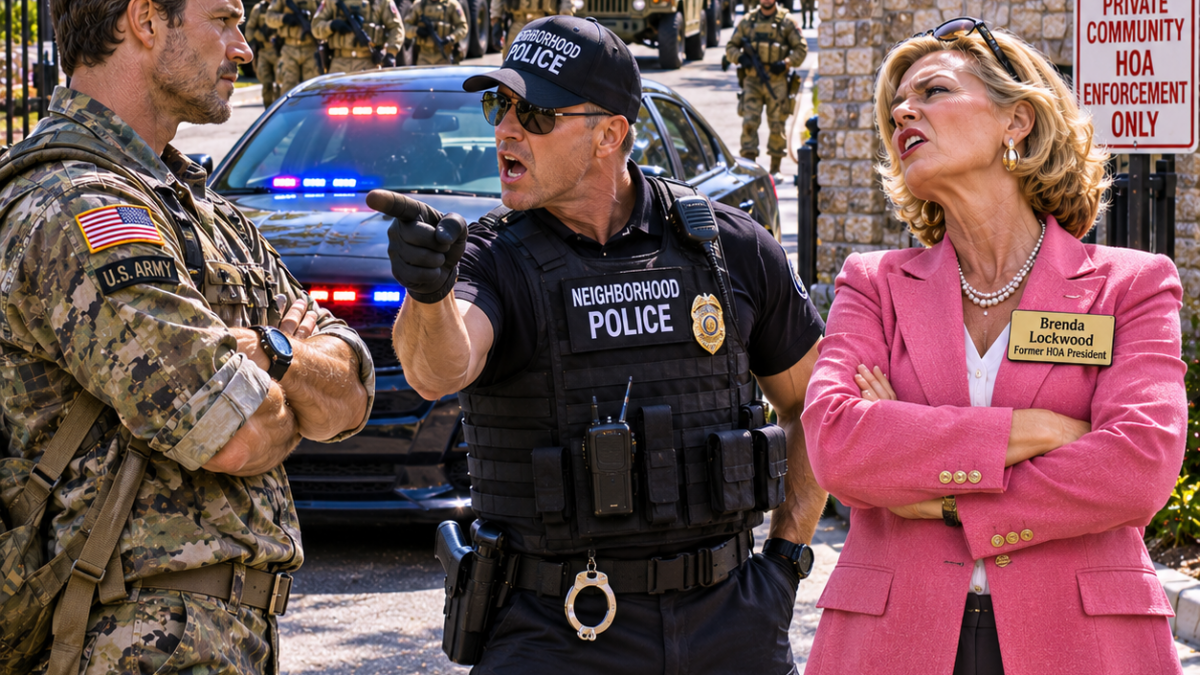
The first thing I saw when I turned into Copper Ridge Estates after three brutal weeks of desert field training was a black Dodge Charger cutting sideways across the road in front of my truck, its cheap red-and-blue dashboard flasher strobing against the houses while a man in mirrored sunglasses and a tactical vest stepped into my lane like he had just pulled over a cartel convoy instead of a tired Army reservist towing camping gear back to his parents’ house.
The second thing I saw was Brenda Lockwood—the former HOA president who had been voted out three months earlier for abusing her authority—standing behind him with a clipboard, a pastel cardigan, and the satisfied smile of someone who had spent weeks inventing a “Neighborhood Patrol Authority” so she could keep issuing commands after the neighborhood had already taken her power away.
What Brenda did not bother to look at was the road behind me, where four military trucks, three transports, a Humvee, and more than twenty soldiers from my training unit were climbing the hill in convoy formation, and I knew the moment her fake officer put a hand near his plastic badge and ordered me out of my truck that this homecoming was about to become something Copper Ridge would never forget.
My name is Ethan Walker.
I had been home for eight minutes.
My uniform still smelled like dust, diesel, sweat, and campfire smoke. There was sand packed into the grooves of my truck tires, a duffel bag wedged behind the passenger seat, and enough field gear in the trailer to make the whole rig look like I had driven straight out of the desert.
Which, technically, I had.
All I wanted was a shower, my mother’s casserole, and maybe twelve uninterrupted hours of sleep.
Instead, I found Brenda.
Copper Ridge had always been a little obsessive about appearances. My parents had lived there for nearly twenty years, back when the entrance sign was smaller, the trees were younger, and nobody acted as though a mailbox color could destabilize Western civilization.
Then Brenda Lockwood became HOA president.
Under Brenda, rules stopped being rules and became personal hobbies.
She measured grass.
She photographed garbage bins.
She once tried to fine my father because his garden gnomes were “visually inconsistent with neighborhood character.”
Dad kept the citation framed in his garage.
He called it modern art.
The problem was that Brenda never seemed to understand where HOA authority ended.
She acted as if being elected president made her mayor, sheriff, judge, zoning officer, and occasionally supreme commander.
Residents complained for years.
Finally, while I was away, they removed her.
My father emailed me the news with the subject line:
THE DRAGON HAS FALLEN.
I laughed so hard I showed it to half my unit.
So imagine my confusion when I entered Copper Ridge and saw fresh flyers taped to light poles.
NEIGHBORHOOD PATROL AUTHORITY ACTIVE.
ENFORCEMENT CHECKS IN PROGRESS.
REPORT SUSPICIOUS VEHICLES IMMEDIATELY.
At the bottom:
DIRECTOR BRENDA LOCKWOOD.
I actually said out loud, “You have got to be kidding me.”
Then the Charger blocked the road.
The fake officer stepped out.
His vest looked like it had come from a discount tactical website. The badge said NPA. His radio was clipped to his chest but not turned on.
He walked to my window.
“License, registration, and military ID.”
I lowered the glass halfway.
“What agency are you with?”
“Neighborhood Patrol Authority.”
“That isn’t an agency.”
“It is under community jurisdiction.”
Behind him, Brenda pointed at my truck.
“Your tires are excessively dirty.”
I stared at her.
She continued.
“Your trailer is not approved. Your vehicle’s condition violates roadway appearance standards.”
“I’ve been training in the desert for three weeks.”
“That is not Copper Ridge’s problem.”
The fake officer moved closer.
“Sir, step out of the vehicle.”
“No.”
His eyebrows rose.
Brenda’s smile widened.
“Dale,” she said, “he’s refusing compliance.”
So the fake officer had a name.
Dale.
“Detain him.”
I honestly thought exhaustion had damaged my hearing.
“Excuse me?”
Brenda folded her arms.
“You heard me.”
I leaned back in the seat.
Then my eyes moved toward the rearview mirror.
At first I saw only dust.
Then the first military truck appeared over the hill.
Behind it came another.
Then the Humvee.
Then the transports.
Captain Elena Morales was in the lead vehicle.
Every soldier behind her knew me.
And none of them had any idea why a black Charger with fake emergency lights was blocking their convoy.
I looked back at Dale.
He was still talking.
Something about lawful instructions.
I nodded toward my mirror.
“You might want to turn around.”
He didn’t.
Brenda didn’t.
Not yet.
PART 2
Dale took another step toward my window.
“Sir, I’m issuing a lawful order.”
“No, you’re not.”
His chin rose.
“You’re refusing an officer.”
“What officer?”
He touched the plastic badge on his vest.
“This.”
I looked at the letters.
NPA.
NEIGHBORHOOD PATROL AUTHORITY.
I had been awake for something close to twenty hours, so maybe that explained why I found the whole thing more irritating than frightening.
“Dale, whatever Brenda told you, an HOA cannot invent a police department.”
Behind him, Brenda snapped:
“Do not address my officer by his first name.”
I looked past Dale.
“Your officer?”
“He has been appointed to maintain order.”
“By who?”
“By the Neighborhood Patrol Authority.”
“Which was created by who?”
She hesitated.
Then lifted her chin.
“By responsible members of this community.”
“So you.”
“Among others.”
That meant Brenda.
Almost certainly only Brenda.
I glanced in the mirror again.
The convoy was closer.
Dale still hadn’t noticed.
“What exactly did I do?”
Brenda raised her notebook.
“Violation one: roadway contamination.”
I stared.
“Contamination?”
“Desert debris on your tires.”
“It’s dirt.”
“Violation two: unauthorized trailer.”
“My camping gear is in it.”
“Unverified contents.”
“Violation three: an unregistered commercial-appearing vehicle.”
“This is my truck.”
“Violation four: displaying military material without community clearance.”
I looked back at my trailer.
There were two folded camouflage tarps, an empty water can, a field cot, and a duffel bag.
“Brenda.”
“Yes?”
“Do you hear yourself?”
Her smile sharpened.
“I hear a resident refusing lawful community safety procedures.”
“I don’t live here.”
That stopped her.
“My parents live here.”
“You are entering Copper Ridge.”
“Which makes me a visitor.”
“Visitors must comply.”
“With real HOA rules, maybe.”
Dale’s hand moved toward the radio clipped to his vest.
It had no display.
No light.
Nothing.
He squeezed the side button anyway.
“Control, suspect is becoming argumentative.”
I almost admired the commitment.
There was obviously no control room.
Then the first military horn sounded behind us.
Dale froze.
Not dramatically.
Just enough.
He looked over his shoulder.
The lead truck crested the hill.
Then the second.
Then the Humvee.
Then three transports.
Dust rolled behind the line.
Captain Morales slowed the lead vehicle.
The convoy stopped.
One truck boxed the Charger from behind without touching it.
The Humvee angled slightly to the side.
Suddenly Dale’s fake traffic stop looked very small.
He stared.
Brenda turned.
For one incredible second, she looked annoyed rather than worried.
Like the United States Army had interrupted her HOA enforcement action without scheduling an appointment.
Then Captain Morales climbed down.
If you’ve never met Captain Elena Morales, there are three things you need to know.
She rarely raises her voice.
She hates wasted motion.
And when she becomes unusually polite, somebody is about to have a very bad afternoon.
She walked toward us.
Her eyes moved from me to Dale.
Then the fake badge.
Then the red-and-blue flasher in the Charger.
Then Brenda.
She stopped six feet away.
“Sergeant Walker.”
“Captain.”
“You okay?”
“Perfect.”
She looked at the Charger.
“What’s happening?”
Dale stepped forward before I could answer.
“Ma’am, this is a community safety stop.”
Morales slowly turned toward him.
“What law-enforcement agency are you with?”
“Neighborhood Patrol Authority.”
“What jurisdiction?”
“Copper Ridge Estates.”
She waited.
Dale seemed to believe he had answered.
Morales looked at me.
I shrugged.
Then Brenda stepped between them.
“Captain, thank you for your concern. This is an internal HOA matter.”
Morales looked at her uniform.
Then at Brenda.
“Do I know you?”
“Brenda Lockwood. Director of Neighborhood Enforcement.”
I heard Private Morrison cough behind me.
It sounded suspiciously like laughter.
Morales didn’t react.
“Director for what government agency?”
“The homeowners association.”
“An HOA is not a government law-enforcement agency.”
Brenda’s shoulders stiffened.
“We have community authority.”
“To make a military member step out of his vehicle?”
“He was violating neighborhood rules.”
“What rule?”
“Roadway Appearance Order Fourteen-B.”
Morales stared at her.
Then Dale.
Then the dirty tires on my truck.
“Sergeant Walker was returning from federal training.”
“That doesn’t exempt him from community standards.”
Morales’s face went blank.
That was worse than anger.
Before she answered, another voice came from the sidewalk.
“It absolutely does not matter, because there is no Order Fourteen-B.”
Everyone turned.
Linda Chavez was walking toward us carrying a thick binder.
Linda had become the actual HOA president after Brenda’s removal.
She was maybe fifty, wore a wide sun hat, jeans, and the expression of someone who had been called away from gardening because a former board president had created a fake police force.
She stopped beside Morales.
“Brenda.”
Brenda’s mouth tightened.
“Linda.”
“You need to stop.”
“I am protecting Copper Ridge.”
“You were removed from the board.”
“That vote is under appeal.”
“With who?”
“The residents.”
“They voted you out.”
“Under misinformation.”
Linda opened the binder.
“The board vote was unanimous. The member recall was eighty-seven percent.”
A neighbor standing near his mailbox called:
“Ninety-one after proxies.”
Several people laughed.
Brenda’s face went red.
Linda continued.
“You were formally removed for unauthorized citations, harassment complaints, and creating policies without board approval.”
“I was enforcing standards.”
“You tried to require approval for children’s sidewalk chalk.”
“That became excessive.”
Linda looked at Morales.
“She no longer holds any HOA authority.”
Morales nodded once.
Then looked at Dale.
“And you?”
He swallowed.
“I was appointed.”
“By the current board?”
He looked at Brenda.
Brenda said:
“By me.”
Linda sighed.
“No.”
Morales stepped closer to Dale’s Charger.
“Are those emergency lights registered?”
“They’re safety lights.”
“That wasn’t my question.”
Dale’s confidence had begun leaking out of him.
“I don’t think they need registration.”
One of our military police specialists, Garcia, came forward from the Humvee.
“Captain?”
Morales nodded toward the dashboard.
Garcia inspected the flasher through the windshield.
“Aftermarket red-blue emergency pattern.”
He looked at Dale.
“You use this while stopping vehicles?”
Dale hesitated.
“Only inside Copper Ridge.”
Garcia glanced at Morales.
That answer did not help.
***
Neighbors had begun appearing everywhere.
Porches.
Sidewalks.
Driveways.
A teenager on a bike stopped beside the curb.
An older man in slippers walked out holding coffee.
Phones came up.
Brenda noticed.
That was when her behavior changed.
Public humiliation had always been her greatest fear.
“You all need to return to your homes,” she announced.
Nobody moved.
“This is an active enforcement action.”
Linda said:
“No, it isn’t.”
Brenda ignored her.
“Residents interfering may be cited.”
A woman laughed.
“For what?”
“Obstruction.”
“Obstruction of your imagination?”
That came from Mrs. Collier.
Her husband had retired from the Navy and spent most of his mornings tending roses.
Brenda pointed.
“Margaret, this isn’t funny.”
Mrs. Collier crossed her arms.
“You fined me because my wreath was emotionally disruptive.”
“It was oversized.”
“It was Christmas.”
“Seasonal displays still have limits.”
Morales looked at me.
I said quietly:
“You’re beginning to understand.”
She almost smiled.
Then Dale stepped toward my truck again.
“Sir, I’m still going to need your ID.”
Morales stopped him.
“No.”
He blinked.
“I need to complete my report.”
“You have no authority to compel his identification.”
“He refused a lawful stop.”
“No lawful stop occurred.”
Brenda stepped forward.
“Captain, with respect, you don’t understand HOA regulations.”
Morales looked at her.
“With respect?”
My soldiers knew that tone.
A few straightened.
Brenda didn’t.
“Ma’am,” Morales continued, “you are attempting to exercise police powers you do not possess over a service member returning from duty.”
“This is private property.”
“The road is maintained by the municipality.”
Linda added:
“And even if it were private, Brenda still has no enforcement role.”
Brenda turned on her.
“You’ve destroyed this neighborhood since taking over.”
“I’ve been president for three months.”
“Exactly.”
Linda closed her binder.
“Three peaceful months.”
That got applause.
Brenda’s eyes flashed.
***
I finally opened my truck door.
Dale reacted immediately.
“Stay in the vehicle.”
Morales turned toward him.
“Why?”
“He’s detained.”
“No, he isn’t.”
“I said he’s detained.”
Morales’s voice dropped.
“By whom?”
Dale looked down at his badge.
For the first time, I think he actually saw it.
Plastic.
Cheap.
Meaningless.
Brenda came around the front of the Charger.
“Ethan, don’t make this worse.”
I climbed out.
After three weeks in the desert, my knees complained.
I stretched.
“Brenda, I am literally trying to go eat casserole.”
“You’ve disrespected community authority from the moment you arrived.”
“I arrived eight minutes ago.”
“You brought military vehicles into Copper Ridge without notification.”
“They’re convoying equipment back toward Fort Ironwood.”
“They are surrounding my officer.”
Morales looked at the vehicles.
Nobody had weapons raised.
Nobody had threatened Dale.
They were simply stopped because Dale had blocked the road.
Morales said:
“Your officer blocked a military convoy.”
Brenda looked offended by the wording.
“He was controlling traffic.”
I said:
“No. He stopped me.”
“You refused instructions.”
“Because he isn’t a cop.”
Dale finally said:
“We never claimed to be police.”
Everyone looked at him.
I pointed to the Charger.
“You have red-and-blue emergency lights.”
He pointed at his vest.
“It says patrol.”
“You asked for my license.”
“Community identification purposes.”
“You asked for my military ID.”
“Verification.”
“You ordered me out of the truck.”
“For safety.”
“You tried to detain me.”
Brenda interrupted.
“I ordered that.”
Dale looked at her.
It was the first moment I saw him realize she might not be helping.
***
Morales held out her hand.
“Sergeant, dashcam?”
I nodded.
I had two cameras.
One facing forward.
One inside the cab.
They recorded automatically whenever the engine was running.
I removed the storage card and handed it to her.
Brenda stepped forward.
“You cannot share private HOA footage.”
I stared.
“My dashcam is not HOA footage.”
“You recorded residents without consent.”
“In a roadway.”
“That’s illegal.”
Linda said:
“No, Brenda.”
“You don’t know that.”
“My sister is an attorney.”
“That doesn’t make you one.”
“No, but it makes family dinners educational.”
A few people laughed again.
Morales put the card into a reader connected to her tablet.
We waited.
The video started.
Dale’s Charger cutting across the road.
Flasher activated.
His approach.
His request for license, registration, military ID.
Then Brenda’s voice.
**Detain him.**
Morales paused the clip.
She looked at Dale.
Then Brenda.
“This is no longer an HOA dispute.”
Brenda’s confidence flickered.
“What does that mean?”
“It means local law enforcement needs to be involved.”
“This is unnecessary.”
Morales tapped the screen.
“You attempted to stop a vehicle while using police-style emergency lights and represented a private patrol as having authority to detain someone.”
Brenda’s face tightened.
“He represented himself.”
Dale stared at her.
“You told me what to say.”
“No, I didn’t.”
“You gave me the script.”
The street went very quiet.
Brenda turned slowly.
“What script?”
“The patrol binder.”
Linda said:
“What patrol binder?”
Dale looked trapped.
Finally:
“The training binder.”
Brenda snapped:
“Stop talking.”
That was possibly the worst instruction she could have given.
Morales heard it.
So did every phone recording nearby.
***
Garcia asked Dale to open his Charger.
Dale hesitated.
Morales said:
“You can wait for the sheriff if you prefer.”
He opened it.
Inside were stacks of orange and yellow citation sheets.
A clipboard.
A printed manual.
Two magnetic door signs reading:
**COPPER RIDGE NPA PATROL**
A handheld scanner.
A body camera.
A box containing plastic badges.
More flashers.
Linda looked genuinely ill.
“You’ve been giving these out?”
Brenda said:
“It’s a volunteer safety program.”
“No board approved this.”
“I didn’t need approval for a citizen initiative.”
“You used the HOA logo.”
“Copper Ridge residents have a right to organize.”
“Not as police.”
Dale held up both hands.
“She told me the sheriff knew.”
Brenda spun.
“You told me you understood volunteer enforcement.”
“What does that even mean?”
“I thought we were neighborhood watch.”
“You made me stop cars!”
“You volunteered.”
“You told me I’d eventually be recognized by the county.”
Morales looked toward me.
I whispered:
“This is better than television.”
She gave me a warning glance.
I shut up.
***
Then Mr. Collier approached.
He was in his seventies, wore an old Navy chief cap, and carried a wrinkled paper.
“Captain?”
Morales turned.
“Yes, sir?”
“I have something.”
Brenda said:
“George, go home.”
He ignored her.
He handed Morales the paper.
“Brenda sent this.”
Morales read.
I watched her eyebrows rise.
“What does ’emotionally disruptive seasonal display’ mean?”
Mr. Collier pointed toward his house.
“My Christmas wreath.”
A soldier behind me laughed and immediately pretended to cough.
Mr. Collier continued.
“She demanded I remove the flag from my porch on weekdays too.”
Morales looked at Brenda.
“Why?”
Brenda sighed dramatically.
“The display density at that property exceeded visual balance standards.”
Linda opened the binder.
“No such standard exists.”
“It was guidance.”
“You fined him.”
“Guidance can carry consequences.”
“That is literally what a rule is.”
Brenda opened her mouth.
Nothing came.
Then another neighbor approached.
“She fined my daughter for sidewalk chalk.”
Another:
“She photographed our backyard over the fence.”
Another:
“She threatened to tow my son’s car while he was deployed because the registration sticker was one month from expiration.”
Another:
“She measured my mailbox with a level.”
Brenda shouted:
“Because standards exist for a reason!”
A woman asked:
“What reason?”
“Property values!”
The woman pointed around.
“My house gained thirty percent while my mailbox was crooked.”
Someone clapped.
Then another.
Soon the entire street seemed to be talking.
Years of complaints pouring out at once.
Morales raised both hands.
“One at a time.”
That was when a young woman stepped forward carrying a folder.
Her husband followed with a baby sleeping against his chest.
I recognized them vaguely.
The Dillards.
He served at Fort Ironwood.
She wore a Family Readiness shirt.
Her name was Megan.
She looked nervous.
“Captain?”
Morales’s tone softened.
“Yes?”
“I think you need to see these.”
***
Seven notices.
All carrying the fake **Copper Ridge Compliance Bureau** seal.
The first complained about tall grass.
The date was two days after Megan’s husband deployed overseas.
The second threatened to contact base housing because toys remained visible in the driveway overnight.
The third accused them of storing “military materials” improperly.
Megan explained:
“It was a diaper bag.”
I saw Morales’s jaw tighten.
Then came the last letter.
Longer.
Official-looking.
It warned that the Dillards’ home was creating “community instability” and claimed Brenda could contact Sergeant Dillard’s command if they failed to improve compliance.
Morales looked up.
“Did she actually contact anyone at Fort Ironwood?”
Sergeant Dillard nodded.
“Family housing received a voicemail.”
“You saved it?”
“Yes.”
Morales turned to Garcia.
“Get a copy.”
Brenda had gone pale.
“That was an informal communication.”
Morales stared at her.
“You contacted a military installation pretending to have official authority over a service member’s household?”
“I was raising community concerns.”
“Did you identify yourself as HOA president?”
“I was HOA president.”
“At the time?”
Brenda hesitated.
Linda said:
“No.”
That single word changed the mood.
The ridiculousness drained out.
No more jokes.
No more garden gnomes.
This was bigger.
Military spouses being threatened while partners were deployed.
Careers invoked as leverage.
Families already carrying enough stress being told that some woman with a printer could contact command if their grass wasn’t perfect.
I looked at the sleeping baby.
Something inside me hardened.
Brenda had bothered my parents.
That was irritating.
This was cruel.
***
Morales asked me:
“Any similar threats?”
I thought back.
“Not that far.”
“Anything involving your service?”
“She used to complain about my truck.”
“Why?”
“Said it projected an aggressive appearance.”
Private Morrison muttered:
“It’s a Ford.”
A few people smiled despite themselves.
I continued.
“She once told Dad my uniforms hanging in the garage were visible from the street.”
“What was wrong with that?”
“Apparently they made the neighborhood look militarized.”
Morales blinked slowly.
“Anything else?”
“Last year she warned my parents that extended parking during my reserve duty could be considered vehicle abandonment.”
My father had called me laughing about that one.
But now it didn’t sound funny.
Morales wrote it down.
“Did she know you were on orders?”
“Yes.”
Brenda shouted from behind us:
“He left a truck parked for eleven days!”
Dad’s voice came from the porch.
“It was in my driveway!”
Everyone turned.
My father stood there holding a dish towel.
He had apparently come out halfway through the chaos.
I stared.
“Dad?”
He lifted one hand.
“Dinner’s getting cold.”
Even Morales laughed.
Brenda did not.
Dad walked down the driveway.
“You remember me, Brenda?”
She glared.
“Unfortunately.”
“Good.”
He looked at Morales.
“She threatened to report my son’s vehicle as abandoned while he was on military orders.”
Morales nodded.
“Thank you, sir.”
Dad pointed at Brenda.
“And the gnome citation is still framed in my garage if you need evidence of mental instability.”
“Dad.”
“What?”
“Not helping.”
“I’ve waited five years for this.”
Fair.
***
Brenda’s composure finally collapsed.
She surged toward me.
“You did this.”
I stepped back.
“How?”
“You brought soldiers here to intimidate me.”
“They were already behind me.”
“You planned this.”
“Brenda, I didn’t know you had invented a fake police department.”
“Patrol authority.”
“Whatever.”
“You’ve always undermined me.”
“I barely live here.”
“You mock this community every chance you get.”
“I make fun of you because you fined my dad’s garden gnome.”
“It was fluorescent!”
Dad shouted:
“It had a red hat!”
“Exactly!”
I looked at Morales.
“You see what we’re dealing with.”
Brenda reached for my trailer.
“You think you’re funny.”
Morales stepped between us.
“Ma’am, move back.”
Brenda ignored her.
“You people have no idea what it took to keep this neighborhood from collapsing.”
Linda said:
“It wasn’t collapsing.”
“Because of me!”
“No. In spite of you.”
Brenda whirled.
“You stole my position.”
“You lost an election.”
“It was manipulated.”
“You received nine percent.”
“People were afraid to vote correctly!”
The silence afterward was almost impressive.
Morales finally said:
“Ma’am, step toward the curb.”
Brenda crossed her arms.
“No.”
Garcia moved closer.
“Please.”
“I do not take commands from military police.”
Morales said:
“You’re not being placed under military jurisdiction. We are separating parties until the sheriff arrives.”
“I don’t need separation.”
Dale was already halfway to the curb.
Brenda looked at him.
“Where are you going?”
He sat.
“Where they told me.”
“Coward.”
He looked up.
“You said the sheriff approved us.”
“I said we had community cooperation.”
“No. You said Sheriff Hayes personally approved NPA patrol.”
Linda said:
“Sheriff Hayes retired two years ago.”
Dale closed his eyes.
“Oh, God.”
I almost felt sorry for him.
Almost.
***
The sheriff arrived fifteen minutes later.
Two marked cruisers.
Actual badges.
Actual emergency lights.
The difference was immediate.
Nobody needed to announce authority.
Deputy Marcus Reed stepped out.
Late forties.
Calm.
He spoke with Morales first.
Reviewed the video.
Looked through the patrol materials.
Talked with Linda.
Then approached Dale.
“Sir, did you knowingly represent yourself as law enforcement?”
Dale shook his head too fast.
“No. No, sir.”
“You stopped vehicles?”
“Yes.”
“Requested driver’s licenses?”
“Brenda told me that was allowed.”
“Used red-and-blue lights?”
“I thought because we were on private neighborhood roads—”
“This road isn’t private.”
Dale looked at Brenda.
She looked away.
Deputy Reed continued.
“You ordered Sergeant Walker out of his vehicle?”
“Yes.”
“Why?”
“He wouldn’t comply.”
“With what lawful authority?”
Dale’s mouth opened.
Closed.
“I don’t know.”
That was probably the first honest answer all day.
Then Reed turned to Brenda.
“Ms. Lockwood?”
“I won’t answer questions without counsel.”
“That’s your right.”
Her shoulders relaxed slightly.
Then Reed continued:
“But I am advising you that there are multiple allegations here involving impersonation, false representation of authority, attempted detention, harassment, and potentially other conduct that will require investigation.”
Her face changed.
“Criminal?”
“We’re investigating.”
“But I’m HOA.”
Linda said quietly:
“Former HOA.”
Brenda looked at her like she’d been betrayed by reality itself.
***
Neighbors kept coming forward.
A stack of evidence formed on the hood of the Humvee.
Fake citations.
Screenshots.
Videos.
Letters.
One man showed Brenda walking around at night photographing windows.
A woman showed a warning threatening a fine because her son had parked a motorcycle in the driveway for one afternoon.
Another family had been threatened with “occupancy review” because their adult daughter stayed with them for three weeks while escaping an abusive relationship.
Linda read that one and covered her mouth.
“I never knew.”
The mother said:
“We were embarrassed.”
That sentence stayed with me.
Embarrassed.
Brenda had convinced people that being targeted by her meant they had done something wrong.
That’s one of the ways bullies survive.
They make victims feel ashamed of being victims.
***
Then Mr. Dillard came forward.
Not Sergeant Dillard.
His father.
Robert Dillard.
Retired Navy.
His wife had undergone chemotherapy the year before.
He held an old citation.
“Deputy, I need this included.”
Reed took it.
Robert explained:
“My wife got sick in March.”
His voice stayed steady.
“The shrubs grew. Trash bins stayed out an extra day because I was driving her to treatment.”
He looked at Brenda.
“She fined us.”
Brenda started:
“I gave warnings first.”
Robert continued as if she hadn’t spoken.
“When I asked for extra time, she told my wife her illness didn’t suspend community obligations.”
The street went silent.
My father stopped smiling.
Robert’s hand began shaking.
“She cried.”
Brenda said:
“I didn’t mean—”
He finally looked at her.
“My wife thought she was letting the neighborhood down because she had cancer.”
No one moved.
“I spent two days convincing her a trash bin didn’t make her a bad neighbor.”
Brenda’s face fell.
“It was a standard notice.”
“No.”
Robert shook his head.
“It was cruelty printed on paper.”
That sentence hit harder than any accusation yet.
***
Deputy Reed closed the folder.
“Ms. Lockwood, enough.”
Brenda looked stunned.
“I was enforcing rules.”
Linda said:
“Rules you created.”
“The board was too weak.”
“You didn’t have authority.”
“Someone had to protect standards.”
Reed’s patience finally thinned.
“From what?”
Brenda blinked.
He gestured around.
“From wreaths? Chalk? Military families? Cancer patients? Dirt on tires?”
She said nothing.
“You didn’t protect this neighborhood.”
His voice remained calm.
“You terrified people into thinking you had powers you did not have.”
Brenda’s lips trembled.
For the first time all day, she looked less like an angry president and more like a frightened woman.
“I did everything for this community.”
Linda’s voice softened.
“That doesn’t make everything you did right.”
Brenda looked around.
At neighbors.
Soldiers.
Deputies.
Dale.
Me.
No one defended her.
Not one person.
That was the moment she really lost.
Not when the convoy arrived.
Not when Morales challenged her.
Not when the fake lights came off Dale’s dashboard.
When Brenda realized her authority had always depended on people behaving as if she had it.
And now they didn’t.
***
Reed told Dale and Brenda they would be transported separately for formal interviews.
Brenda erupted one last time.
“You cannot arrest me for enforcing HOA rules.”
“You are not being arrested at this moment.”
“Then I’m leaving.”
“No.”
“Why?”
“You are part of an active investigation involving an attempted traffic stop and multiple complaints. We need to complete interviews.”
“I want my attorney.”
“You may contact one.”
She looked at Linda.
“You did this.”
Linda shook her head.
“No.”
Then Brenda looked at me.
“You did.”
“I drove home.”
“You brought them.”
“They were already there.”
“You made me look ridiculous.”
That one surprised me.
Not:
You falsely accused me.
Not:
I did nothing wrong.
You made me look ridiculous.
There it was.
Her deepest wound.
Image.
I answered quietly.
“I didn’t put the badge on Dale.”
Dale groaned.
Brenda glared at him.
“You ruined everything.”
He snapped:
“You told me I’d get a real badge.”
The soldiers lost it.
Even Morales had to look away.
***
As Brenda was escorted toward the cruiser, she stopped beside me.
Close enough that only I heard her first words.
“You think they won.”
I looked at her.
“Who?”
“These people.”
She glanced at the neighbors.
“They can’t run this place.”
“Why not?”
“They’re weak.”
“No.”
I shook my head.
“They trusted the wrong person.”
Her eyes sharpened.
“You’ll see.”
Then louder:
“This isn’t over.”
I said:
“No, probably not.”
She seemed surprised.
I continued.
“But whatever happens next, you’re not running it.”
That hurt.
She got into the cruiser.
The door closed.
Dale climbed into the second vehicle voluntarily.
His fake badge was now inside an evidence bag.
The Charger remained parked where the whole mess began.
No flashing lights.
Just a black car looking suddenly ordinary.
***
Morales walked over.
“You good?”
“Yeah.”
“You sure?”
“No.”
She nodded.
“Better answer.”
I looked toward my parents’ house.
Dad stood in the driveway.
Mom had finally appeared behind him wearing an apron.
She looked at the convoy.
Then me.
Then the sheriff’s cars.
Her expression said:
**I leave you alone for one afternoon.**
Morales followed my gaze.
“Go home.”
“Yes, ma’am.”
“I mean it.”
“I’ve been trying.”
She smiled.
Then the convoy started moving.
The soldiers waved.
Morrison leaned out of a truck.
“Sergeant!”
“What?”
“Best homecoming ever!”
I gave him a gesture inappropriate for publication.
He laughed as the convoy rolled away.
***
Inside, Mom hugged me hard.
Then smacked my shoulder.
“Ow.”
“You couldn’t call?”
“I was eight minutes from the house.”
“You could call in eight minutes.”
“Mom, I was being detained by fake police.”
Dad opened the refrigerator.
“That sentence is going on the Christmas card.”
Mom pointed at him.
“Don’t encourage him.”
“I did nothing.”
Dad pulled out casserole.
“You want dinner?”
I looked at the clock.
It wasn’t even five.
“Yes.”
I ate three plates.
Then slept fourteen hours.
***
When I woke the next morning, I was internet famous.
Not celebrity famous.
Suburban disaster famous.
A teenager had uploaded footage of the convoy stopping behind Dale’s Charger.
The clip began with Brenda saying:
**Detain him.**
Then panned toward the Humvee.
Then Morales walking forward.
The caption:
**WHEN HOA KAREN CALLS FAKE COPS ON THE WRONG GUY.**
Millions?
No.
But enough local views that everyone from Fort Ironwood to three counties over seemed to know about it.
My unit chat was unbearable.
Morrison posted memes.
One showed Brenda saluting a lawn mower.
Another showed Dale’s plastic badge with:
**HONOR. COURAGE. HOA DUES.**
Morales sent one message:
**Stop encouraging civilians to harass anyone involved.**
That shut most of it down.
She was right.
Laughing at the absurdity was one thing.
Threatening Brenda or Dale was another.
I posted one statement.
**Please do not contact, threaten, or harass anyone shown in the videos. Law enforcement and the HOA are reviewing what happened.**
Then I deleted the apps for the day.
***
Linda called.
“Ethan?”
“Please don’t tell me there’s another patrol.”
“No.”
“Good.”
“We’re having an emergency HOA meeting Friday.”
“Also not my problem.”
“I want you there.”
“Why?”
“Because families are bringing documentation.”
“Give it to the sheriff.”
“We are.”
“Then?”
She hesitated.
“We need to rewrite everything.”
“What do you mean?”
“Enforcement procedures. Complaint processes. Oversight. Board powers.”
“Sounds healthy.”
“We want you as an adviser.”
I laughed.
She didn’t.
“No.”
“Think about it.”
“I don’t live here.”
“That might be an advantage.”
“Linda.”
“You understand authority.”
“I’m in the Army. That doesn’t make me a neighborhood-law expert.”
“No.”
Her voice softened.
“But you understand that authority has limits.”
That stopped me.
“Friday.”
“I didn’t say yes.”
“Seven o’clock.”
“Linda.”
“See you then.”
She hung up.
Dad heard from the hallway.
“You doing HOA work?”
“No.”
He smiled.
“You’re doing HOA work.”
“I would rather deploy again.”
“Your mother will be thrilled.”
“Why?”
“She keeps saying you need a hobby.”
***
The sheriff investigation moved quickly at first.
Dale cooperated.
Very cooperatively.
Apparently the moment somebody explained the possible legal consequences of impersonating official authority, he rediscovered his memory.
Brenda had recruited him after her removal.
She told him the new board had become lax.
She wanted a “citizen enforcement team.”
Dale had previous security-guard experience at a shopping center, which in Brenda’s mind apparently qualified him to conduct traffic stops.
She designed the badge.
Ordered the lights.
Printed citations.
Created the manual.
There were scripts.
Actual scripts.
According to what became part of the HOA review, one page read:
**Opening Contact: Identify vehicle violation. Establish authority immediately. Do not allow resident to redirect conversation toward jurisdiction.**
Another:
**Noncompliance Response: Repeat that neighborhood regulations are mandatory. Request identification. Document refusal.**
Another:
**Escalation: Inform subject they may be temporarily detained pending HOA review.**
When Linda read that section, she closed the binder.
“Unbelievable.”
I said:
“It’s actually impressive.”
She looked at me.
“In what universe?”
“The amount of effort required to avoid understanding the law.”
***
The most troubling material involved military households.
Brenda had created a separate list.
**High-Transient Residences.**
Most were military families.
Why?
Deployments.
Temporary-duty assignments.
Vehicles staying unused for weeks.
Spouses managing homes alone.
Relatives visiting during deployments.
Brenda interpreted every normal complication of military life as a compliance threat.
One note said:
**Military schedules often result in neglected exterior standards. Recommend proactive inspection.**
Another:
**Spouse-only occupancy may require confirmation of residence eligibility.**
When I saw that, my stomach turned.
Who was she to confirm whether a military spouse could live in her own house?
Nobody.
That was the answer.
But people had been too intimidated to challenge her.
***
The Friday meeting overflowed.
The clubhouse held maybe eighty comfortably.
More than a hundred came.
Folding chairs filled the room.
People stood along walls.
Someone had written on the projector:
**EMERGENCY HOA RESTRUCTURING**
Below it, in marker:
**THE BRENDA AFTERMATH**
Linda erased the second line.
Everyone booed.
“Adults,” she said.
A man in the back shouted:
“Allegedly.”
Laughter.
Linda waited.
Then began.
“What happened Monday exposed more than the actions of one former board member.”
The room settled.
“It exposed failures in how Copper Ridge handles authority.”
People nodded.
“We allowed one person to become the face, voice, interpreter, and enforcer of too many rules.”
She looked around.
“Even after she was removed, residents were uncertain enough about the limits of HOA power that a fake patrol operated for weeks.”
That was sobering.
“No resident should ever wonder whether someone with a homemade badge can detain them.”
A teenager whispered:
“Seems obvious.”
His mother elbowed him.
Linda continued.
“We have to rebuild trust.”
Then she introduced me.
I wanted the floor to open.
“Sergeant Ethan Walker.”
Applause.
I stood.
“Please don’t.”
More applause.
I walked to the front.
Military briefings didn’t bother me.
Put me in front of thirty soldiers and ask me to explain logistics, I was fine.
Put me in front of a hundred neighbors wanting emotional wisdom and I became a toaster with anxiety.
I looked at them.
“Hi.”
Laughter.
Strong start.
“I had a different Friday planned.”
More laughter.
“I was going to sleep.”
Dad called:
“You did.”
I pointed.
“Security, remove him.”
That helped.
Then I became serious.
“What happened Monday looked ridiculous.”
Heads nodded.
“A fake badge. A fake patrol. Dirt-on-the-tire violations.”
Someone laughed.
“But it stopped being funny when I saw the letters sent to deployed families.”
The room quieted.
“When I saw a cancer patient’s household threatened over garbage bins.”
Robert Dillard lowered his eyes.
“When I learned people had been afraid to challenge rules that weren’t rules.”
I rested my hands on the podium.
“In the military, authority is structured.”
I paused.
“That doesn’t mean authority is always exercised perfectly. It means there’s supposed to be a chain, a source, a responsibility attached to it.”
I looked toward Linda.
“If I give an order, I am accountable for that order.”
Then toward the residents.
“Brenda wanted the first part.”
Silence.
“The obedience.”
I let that sit.
“She didn’t understand the second part.”
Responsibility.
Nobody laughed now.
“If I help here, that’s the only thing I care about.”
I pointed at the bylaws.
“Every power needs a source.”
Then the complaint forms.
“Every accusation needs evidence.”
Then the residents.
“And every person deserves a way to challenge a decision without being punished for speaking.”
Mrs. Collier clapped first.
Then others.
I shook my head.
“Don’t clap yet. You haven’t heard how boring my paperwork ideas are.”
They clapped louder.
I hated them already.
***
The meeting lasted four hours.
Not because people loved bureaucracy.
Because years of suppressed frustration poured out.
We discovered fake rules Brenda had invented that never appeared in the governing documents.
“Excessive torso visibility.”
That one was real.
Or rather, fake.
A jogger named Mason had been cited for running shirtless.
No bylaw supported it.
“Emotionally aggressive lawn ornaments.”
Dad’s gnomes.
Fake.
“Unbalanced seasonal display.”
Fake.
“Vehicle intimidation profile.”
My truck.
Fake.
“Excessive guest clustering.”
A Thanksgiving gathering.
Fake.
“Patriotic display saturation.”
Mr. Collier’s flags.
Fake.
Linda had already voided dozens of citations after taking office.
Now we cataloged all of them.
Then came the more serious reforms.
No individual board member could issue a fine alone.
No physical enforcement.
No patrol vehicles.
No badges.
No emergency-style lighting.
No requests for identification.
No entry onto private property without permission except true emergencies allowed by law.
No targeting residents based on military status.
No contacting employers or military commands over neighborhood disputes.
No surveillance of homes outside lawful community security systems.
Every citation required:
The actual rule.
The evidence.
Date.
Appeal process.
Board review.
For larger penalties, independent review.
It wasn’t revolutionary.
It was competent.
That was all Copper Ridge needed.
***
Near the end, Linda said:
“One final item.”
I knew immediately I was in danger.
She looked at me.
“I move that Ethan Walker serve as a temporary community-governance adviser during restructuring.”
I stood.
“No.”
Everyone laughed.
“I mean it.”
Linda smiled.
“Unpaid.”
“Even worse.”
“Three months.”
“Linda.”
“Limited authority.”
“Zero authority sounds better.”
Dad raised his hand.
“I second.”
“Dad!”
The room erupted.
Linda called the vote.
Every hand went up.
I looked around.
“Seriously?”
Mrs. Dillard said:
“Yes.”
Mr. Collier:
“You owe us for bringing an Army.”
“I did not bring—”
Morrison wasn’t even there and somehow I could hear him laughing.
I had been voluntold.
A military tradition.
Apparently transferable to HOAs.
***
After the meeting, residents stayed behind.
Some thanked me.
That embarrassed me more than the applause.
I hadn’t done anything heroic.
I had stayed in a truck while a fake officer made bad decisions.
But people didn’t really thank me for Monday.
They thanked me for giving them a moment when fear stopped working.
Mrs. Dillard approached with her husband.
The baby was awake this time.
Big eyes.
Tiny fist wrapped around Sergeant Dillard’s finger.
Megan said:
“I wanted to say thank you.”
“You don’t owe me anything.”
“I know.”
She hesitated.
“I should’ve reported Brenda sooner.”
“No.”
“I was scared she’d contact his command.”
“That’s understandable.”
“I feel stupid now.”
“Don’t.”
She looked at me.
I meant it.
“If someone deliberately makes their authority confusing, being confused isn’t stupidity.”
Her eyes filled.
“Thank you.”
She hugged me.
I stood there like a fence post.
Soldiers are not automatically good at emotional moments.
***
When I walked outside, Brenda was near the parking lot.
Sunglasses.
Arms crossed.
I stopped.
“You shouldn’t be here.”
“This is my neighborhood.”
“You’re under investigation.”
“I’m allowed to walk on public streets.”
Fair.
She looked toward the clubhouse.
“They appointed you.”
“Temporarily.”
“You think you can replace me?”
“No.”
“You’re exactly what they want now.”
“What?”
“Someone in uniform.”
I looked at my clothes.
Jeans.
T-shirt.
No uniform.
“I’m not in uniform.”
“You know what I mean.”
“No, I actually don’t.”
She stepped closer.
“They’re afraid.”
“Yes.”
“You’re using that.”
That angered me.
“No.”
I kept my voice low.
“You used it.”
Her mouth tightened.
“I gave this neighborhood structure.”
“You gave it fear.”
“Same thing sometimes.”
There it was.
I stared.
“No.”
“What do you know? You leave. You deploy. You disappear for weeks and come back expecting everything to fit your idea of freedom.”
“My parents live here.”
“I lived every day fixing problems nobody appreciated.”
“Some problems were imaginary.”
“The neighborhood looked beautiful.”
“So?”
“That’s the point!”
Her voice cracked.
For the first time, I saw something beneath the control obsession.
Fear.
Not fear of jail.
Fear of irrelevance.
“You need people to need you,” I said.
Her eyes changed.
“Don’t psychoanalyze me.”
“Then stop acting like being removed erased who you are.”
“You took everything.”
“I took nothing.”
“You turned them against me.”
“They voted you out before I came home.”
She had no answer.
I softened my tone.
“Brenda, this doesn’t have to keep going.”
She laughed bitterly.
“You think I’m finished?”
“I think you should be.”
“You’ll regret this.”
Maybe.
But the threat sounded weak.
Not dangerous.
Sad.
She walked away.
***
My three-month advisory role became six months.
Of course.
Every time I tried to leave, Linda produced another binder.
The first major battle involved cameras.
Residents wanted security after Brenda’s fake patrol.
Some wanted cameras on every intersection.
Others, after Brenda’s history of surveillance, wanted none.
We compromised.
Cameras only at community-owned entrances and shared facilities.
Clear retention limits.
No board member could privately access footage.
Two-person authorization for reviewing recordings except emergencies.
Logs showing who accessed what.
One resident asked:
“Why so complicated?”
I said:
“Because systems should assume future leaders might be worse than current ones.”
That became our guiding principle.
Don’t write rules for the person you trust.
Write them for the person you don’t know yet.
***
The second battle involved fines.
People wanted every Brenda-era fine refunded.
Problem:
Some had actually violated real rules.
A homeowner had built a twelve-foot shed across an easement.
Another had repeatedly blocked a fire lane.
Those weren’t imaginary.
We couldn’t say:
Brenda was awful, therefore every rule was invalid.
So we reviewed cases individually.
Tedious.
Necessary.
Robert Dillard had all his landscaping penalties removed and refunded because documentation showed Brenda had denied reasonable accommodation requests while his wife underwent treatment.
Mr. Collier’s wreath and flag penalties vanished.
Mason’s torso citations disappeared.
Dad’s gnome fine had never actually been paid.
He refused to let us remove the paper from the historical record.
“Why?”
“It’s art.”
We compromised by marking it:
**VOID — NO GOVERNING RULE**
Dad framed the corrected copy too.
***
The sheriff investigation continued in the background.
Brenda hired an attorney.
Dale entered cooperation discussions.
I stayed out of details not publicly released.
That was hard because neighbors asked constantly.
“Is she getting arrested?”
“What’s Dale charged with?”
“Did the Army press charges?”
I answered the same way.
“The authorities are handling it.”
People hated that.
Good.
Rumors had helped Brenda.
I wasn’t feeding new ones.
What we did know officially was enough.
The case had been referred for review of alleged impersonation, attempted unlawful detention, harassment, and related conduct.
The military had documented the incidents affecting service members.
Local agencies had the evidence.
That was where my role ended.
***
One afternoon, Captain Morales called.
“How’s civilian government?”
“Send me back to the desert.”
“That bad?”
“Somebody argued for forty minutes about fence stain.”
“Sounds worse.”
“Much.”
She laughed.
Then her tone changed.
“I wanted to tell you something.”
“What?”
“The Dillards sent a letter to command.”
My stomach tightened.
“Problem?”
“The opposite.”
She explained that they had thanked the unit and military police for taking the harassment seriously.
Sergeant Dillard’s leadership had also reviewed the earlier voicemail Brenda left.
No career issue.
No housing issue.
Nothing.
Just a civilian pretending she had leverage she never possessed.
Morales said:
“They’re okay.”
That mattered.
“Good.”
Then she added:
“You did well that day.”
“I sat in my truck.”
“You didn’t escalate.”
“What was I supposed to do, challenge Dale to single combat?”
“Knowing you?”
“Captain.”
She laughed.
“Take the compliment.”
“Fine.”
***
Mom’s reaction to my HOA role was worse than Dad’s.
She bragged.
To everyone.
At the grocery store.
Church.
Dentist.
Possibly strangers at traffic lights.
“My son is helping restructure the association.”
I begged her to stop.
She added:
“He’s also a sergeant.”
“Mom.”
“And Captain Morales said—”
“Mom.”
Dad loved it.
He started calling me Commissioner.
Then Sheriff.
Then Supreme Allied Commander of Landscaping.
I threatened to revoke his gnome privileges.
He said:
“Abuse of power.”
Fair.
***
Slowly, Copper Ridge changed.
Not physically.
The lawns were still neat.
Mailboxes still matched enough that nobody had a nervous breakdown.
But the atmosphere changed.
Kids used sidewalk chalk.
Mason ran shirtless.
Dad’s gnomes multiplied.
I suspected intentional provocation.
Mrs. Collier put up a giant Christmas wreath.
Not just oversized.
Absurd.
Four feet across.
I stopped in front of it.
She opened her door.
“Problem?”
“Yes.”
She narrowed her eyes.
I continued.
“Needs more lights.”
She smiled.
Progress.
***
The biggest emotional change happened at meetings.
People argued.
That sounds bad.
It wasn’t.
Before, residents stayed quiet because disagreement meant Brenda might target them.
Now meetings were noisy.
Fence colors.
Budget priorities.
Pool hours.
Parking.
People disagreed openly.
Then went home.
No retaliatory notices.
No midnight inspections.
No fake patrol.
Healthy community isn’t everyone agreeing.
It’s people being safe when they don’t.
I learned that from them.
***
Three months after the incident, Robert Dillard’s wife came to a meeting.
Her hair had begun growing back after chemotherapy.
The room applauded when she entered.
She looked embarrassed.
Robert helped her to a chair.
During public comments, she stood.
“I don’t want anyone punished for what happened to us.”
The room quieted.
“I want you to understand something.”
She held one of Brenda’s old letters.
“When I got this, I had just finished treatment.”
Her hand shook.
“I was weak. Sick. Scared.”
Robert looked down.
“I read this notice saying our home was lowering community standards.”
She swallowed.
“And I believed it.”
Nobody moved.
“I knew logically it was nonsense. But when you’re sick, your mind does strange things.”
Her voice broke.
“I thought my illness was making me a burden.”
Linda’s eyes filled.
Mrs. Dillard continued.
“No rule should ever make a person feel smaller than the community supposedly being protected.”
She folded the letter.
“So when you rewrite these bylaws, leave room for people.”
That became another guiding principle.
Leave room for people.
***
We created hardship procedures.
Not loopholes.
Human judgment.
Illness.
Deployment.
Family emergency.
Disability.
Bereavement.
Things life does without asking whether the trash bins are aesthetically timed.
Rules could pause.
Deadlines could move.
Boards could listen.
It seemed obvious.
Apparently obvious things require writing sometimes.
***
Six months after my fake traffic stop, the board held a final restructuring vote.
The new governance package passed overwhelmingly.
Limited enforcement authority.
Transparent appeals.
Financial review.
Privacy policy.
No unsanctioned patrol.
Clear coordination with actual law enforcement.
Special protections against retaliation.
And an entire section stating:
**The Association possesses no criminal, police, detention, investigatory, military, employment, or governmental authority beyond the contractual powers granted by the recorded governing documents and applicable law.**
Linda read it aloud.
Someone asked:
“Do we really need to say that?”
The whole room looked at him.
He nodded.
“Right. Brenda.”
Passed unanimously.
***
My advisory term ended that night.
Officially.
Linda handed me a framed certificate.
I stared.
“What is this?”
“Thank you.”
“It has my name on it.”
“Yes.”
“Why?”
“So you can’t pretend you weren’t involved.”
Dad applauded.
I looked at the certificate.
**COMMUNITY OVERSIGHT ADVISER — ETHAN WALKER**
Below:
**For service during the Copper Ridge governance reforms.**
I said:
“I’m never putting this in my house.”
Dad said:
“I’ll take it.”
“Of course.”
***
Afterward, I walked outside.
Same street.
Same place where Dale’s Charger had blocked me.
No flasher.
No crowd.
No convoy.
Just evening.
A car rolled past slowly.
The driver waved.
I waved back.
Dad walked up beside me.
“You okay?”
“Yeah.”
“Done?”
“I think so.”
“You said that three months ago.”
“Linda promised.”
Dad laughed.
Then:
“Your mom meant what she said.”
“What?”
“She was proud.”
I looked down the street.
“Because I survived an HOA?”
“No.”
He shook his head.
“Because you didn’t become Brenda while fighting Brenda.”
That stayed with me.
***
I’d love to tell you Brenda disappeared forever.
Life isn’t that tidy.
She still lived in Copper Ridge.
She still attended some public HOA meetings as a homeowner once permitted under the applicable rules.
She still disagreed.
Loudly.
She appealed decisions.
Filed complaints.
Wrote long emails.
But now every claim had to pass through the same documented process as everyone else’s.
No special authority.
No private enforcement.
No badge.
No Dale.
No lights.
When she spoke, people listened if she had a point.
Ignored her if she didn’t.
That might have been the hardest consequence for her.
Becoming ordinary.
***
The first time I saw her months later, she was at the mailbox cluster.
I almost turned away.
Then she spoke.
“Ethan.”
“Brenda.”
She looked older.
Not dramatically.
Just tired.
“I heard you’re finished with the board.”
“Advisory role.”
“Whatever.”
Silence.
Then:
“I want to ask something.”
“Okay.”
“Do you think I’m a terrible person?”
I had expected anger.
Not that.
I thought before answering.
“I think you did terrible things.”
She flinched.
“That isn’t what I asked.”
“I know.”
She looked down.
“I thought if I stopped controlling everything, Copper Ridge would fall apart.”
“It didn’t.”
“I see that.”
“Good.”
She picked at the corner of an envelope.
“Do you know what bothered me most after the vote?”
“What?”
“No one called.”
I waited.
“I was president for five years.”
Her voice was quiet.
“Every day somebody needed something.”
“Then suddenly nobody did.”
There it was.
The thing I had seen outside the clubhouse.
“You confused being needed with being important.”
She looked at me.
“Maybe.”
“And being important with being in control.”
Her mouth tightened.
“You really are annoying.”
“I’ve been told.”
For the first time, she smiled.
Not the old smile.
No superiority.
Just tired humor.
Then it disappeared.
“I shouldn’t have involved military families.”
“No.”
“I shouldn’t have created the patrol.”
“Definitely not.”
“Dale was an idiot.”
“He was.”
She almost laughed.
Then:
“I was too.”
I didn’t answer.
She didn’t need me to.
***
A week later, she attended a meeting.
Sat in the back.
No clipboard.
During public comments, someone complained that children were leaving bicycles near the sidewalk.
Old Brenda would have stood immediately.
New Brenda stayed seated.
Linda asked:
“Is the path blocked?”
“No.”
“Safety issue?”
“No.”
“Then perhaps neighbors can speak directly before we make it an HOA issue.”
The resident nodded.
Done.
Thirty seconds.
As people moved to the next topic, I happened to look at Brenda.
She was staring at the table.
Then she gave the tiniest nod.
Maybe she was learning.
Maybe not.
People aren’t stories with perfect endings.
But systems can stop rewarding their worst habits.
Sometimes that’s enough.
***
My unit never let the incident die.
At annual training, Morrison handed me a plastic badge.
**NPA — NEIGHBORHOOD PATROL AUTHORITY**
I stared at him.
“You made this?”
“Custom order.”
“I hate you.”
“You’ll need it if dirt gets on the Humvee.”
Morales walked past.
Saw the badge.
Stopped.
“Morrison.”
He froze.
“Yes, ma’am?”
“Twenty push-ups.”
“For what?”
“Community standards.”
The entire platoon laughed.
Morrison dropped.
Best use of HOA authority I ever saw.
***
A year after the incident, Copper Ridge held a neighborhood barbecue.
Mom insisted I attend.
I arrived in a clean truck.
Dad came outside with a ruler.
“What are you doing?”
“Checking tire dirt.”
I stared.
He crouched dramatically.
“Possible contamination.”
“I’m putting you in assisted living.”
“Retaliation.”
Mom came out.
“Both of you stop.”
Dad pointed at me.
“He’s undermining my authority.”
“You have none.”
“Exactly like Brenda.”
Mom turned around and went back inside.
Probably reconsidering every decision that led to marrying Dad.
***
At the barbecue, I saw the Dillards.
Their baby was walking now.
Sergeant Dillard chased him across the grass.
Megan sat with Mrs. Dillard, who was doing better.
Robert waved me over.
“We’ve got something.”
He handed me a folded document.
I opened it.
A proposed volunteer program.
Military families in Copper Ridge offering help with lawns, transportation, errands, and home maintenance when another family faced deployment, illness, or emergency.
No fines.
No enforcement.
Just volunteers.
They called it:
**Neighbors on Watch**
I raised an eyebrow.
Megan laughed.
“Not that kind of watch.”
Robert said:
“We thought instead of watching people for violations, we could watch out for them.”
That hit me harder than I expected.
“You want HOA support?”
“Only coordination.”
“Good.”
I looked over the proposal.
“Who wrote this?”
Megan.
“Looks solid.”
“Will you help present it?”
I groaned.
Everyone laughed.
I did.
***
The program became one of Copper Ridge’s best changes.
A soldier deployed?
Neighbors helped mow.
Someone had surgery?
Meals.
Elderly resident?
Trash bins brought back from the curb.
Cancer treatment?
Yard work handled quietly, no one making them feel indebted.
It was everything Brenda had claimed she wanted.
Order.
Pride.
Community.
But without coercion.
That taught me something.
Control and care can look similar from far away.
Both involve noticing what people are doing.
But one asks:
**How do I make you comply?**
The other asks:
**How can I help?**
Copper Ridge finally learned the difference.
***
One Saturday, I found Brenda trimming Mr. Collier’s hedge.
I stopped my truck.
She saw me.
“Don’t start.”
I rolled down the window.
“I didn’t say anything.”
“You were about to.”
“Why are you trimming his hedge?”
“He hurt his shoulder.”
I smiled.
She pointed the clippers at me.
“Drive.”
“Yes, ma’am.”
She narrowed her eyes.
“Do not call me ma’am like Captain Morales.”
I drove away laughing.
Maybe people can change.
Or maybe they can at least choose better actions.
Close enough.
***
The criminal and administrative processes surrounding the fake patrol took their own course long after the neighborhood stopped making it daily entertainment.
I wasn’t present for every interview.
Didn’t want to be.
Statements had been taken.
Evidence preserved.
The fake equipment seized.
The conduct involving military families documented.
Whatever consequences followed belonged to the authorities responsible for those decisions, not the HOA gossip chain.
That distinction mattered to me.
Copper Ridge’s job wasn’t punishment.
It was making sure no one could build another pretend government out of printer paper and fear.
We did that.
***
Two years after the convoy incident, I came home from another training cycle.
Not three weeks this time.
Ten days.
My truck was dirty.
Very dirty.
I turned into Copper Ridge.
No patrol car.
No flashing lights.
No handmade checkpoint.
Just the entrance sign.
Dad had apparently been waiting because he stepped into the driveway holding a clipboard.
I slowed.
“No.”
He raised one hand.
“Safety inspection.”
“Dad.”
“License and registration.”
I kept driving.
He followed.
“Sir, dirt residue is excessive!”
Mom yelled from the porch:
“Henry!”
He shouted:
“I’m protecting the community!”
I parked.
Got out.
And for a second, I was back on that road two years earlier.
Brenda.
Dale.
The convoy.
Adrenaline.
Humiliation.
Anger.
Then Dad handed me the clipboard.
A welcome-home card was clipped to it.
Inside, residents had signed their names.
The Dillards.
Colliers.
Linda.
Mason.
Thomas.
Dozens of people.
Near the bottom was Brenda’s signature.
Just two words beneath it.
**Welcome home.**
I stared.
Dad became quieter.
“You okay?”
“Yeah.”
I closed the card.
“Just dusty.”
He looked at my truck.
“Extremely.”
“Don’t.”
He smiled.
***
Mom’s casserole was waiting.
Some things deserve to remain unchanged.
We ate at the kitchen table.
Dad told me about rabbits destroying his tomatoes.
Mom complained that he was feeding them when she wasn’t looking.
I listened.
No emergency lights outside.
No shouting.
No one measuring grass.
Peace is easy to underestimate when you’ve had it for too long.
You think peace means nothing is happening.
That’s wrong.
Peace is what happens when people finally trust that nobody is waiting to weaponize the next small mistake.
***
Later that evening, I walked through Copper Ridge.
Children had drawn chalk across a driveway.
A giant rainbow.
Technically outrageous under the old Brenda regime.
Mason jogged past without a shirt.
“Excessive torso!” I called.
He raised one finger.
Mrs. Collier’s wreath was still too large.
Dad’s gnomes had multiplied to eleven.
One wore a tiny military helmet.
I suspected Morrison.
Then I reached the hill where the convoy had stopped.
The road looked ordinary.
That was the best part.
No plaque.
No memorial.
No sign saying:
**HERE LIES THE FAKE HOA POLICE DEPARTMENT.**
Just pavement.
I stood there for a minute.
Then Linda approached with her dog.
“Thinking about the old days?”
“Trying not to.”
“You know what I remember?”
“What?”
“The second Brenda saw the Humvee.”
I laughed.
“Her face.”
“Priceless.”
We walked together.
Linda said:
“People still call that the day the Army saved Copper Ridge.”
“They didn’t.”
“I know.”
“They happened to be behind me.”
“I know.”
“The neighbors saved themselves.”
She looked at me.
“Eventually.”
“That’s the important part.”
Linda nodded.
“People think power changes when a stronger person arrives.”
I looked back at the road.
“Sometimes.”
Then I thought about the meeting.
The testimonies.
The rules.
Mrs. Dillard.
Neighbors on Watch.
Brenda trimming a hedge instead of measuring it.
“But real change happened after everyone stopped waiting for somebody stronger.”
Linda smiled.
“That’s why you were a good adviser.”
“I hated every minute.”
“Sure.”
“I did.”
“Of course.”
***
Before turning toward my parents’ house, I stopped.
“Linda.”
“Yeah?”
“Promise me something.”
“What?”
“If anyone ever proposes Neighborhood Patrol Authority again—”
She laughed.
“Automatic rejection.”
“Good.”
“And if they buy a plastic badge?”
“Permanent landscaping duty.”
“Perfect.”
We shook on it.
***
Years later, the story people remembered was still the convoy.
Of course it was.
Fake HOA cop stops soldier.
Military convoy surrounds fake checkpoint.
Former HOA Karen discovers a plastic badge cannot defeat federal reality.
It’s visual.
Funny.
Easy to retell.
But that wasn’t the part I remembered most.
I remembered Megan Dillard holding those seven notices against her chest.
I remembered Robert explaining that his wife cried because she thought cancer made her a bad neighbor.
I remembered people lining up with years of letters they had hidden because they were embarrassed.
I remembered Brenda saying:
**I did everything right.**
And believing it.
That’s the dangerous part of unchecked authority.
The person abusing it rarely wakes up thinking:
**Today I’ll become a villain.**
They tell themselves they’re maintaining standards.
Protecting order.
Keeping everyone safe.
Then one invented power becomes another.
One exception becomes normal.
One silent neighbor becomes ten.
And eventually someone sticks red-and-blue lights on a Dodge Charger and starts asking soldiers for identification.
Absurdity is usually the last stage.
The damage begins much earlier.
***
That is why I kept my framed advisory certificate after all.
Not in my living room.
I have standards.
It’s in Dad’s garage.
Beside the original garden-gnome citation.
He hung them together.
The fake violation:
**NONCOMPLIANT LAWN ORNAMENTATION**
Beside:
**COMMUNITY OVERSIGHT ADVISER — ETHAN WALKER**
Underneath, Dad added his own handwritten plaque.
**THE WALKER FAMILY’S COMPLETE HISTORY OF PUBLIC SERVICE.**
I threatened to remove it.
He cited artistic freedom.
I lost.
***
One night before heading back to base, I stood in the garage looking at those two frames.
Dad walked in.
“You know,” he said, “Brenda wasn’t wrong about one thing.”
I turned.
“Careful.”
“She wanted people to care about the neighborhood.”
“That’s generous.”
“She just forgot the neighborhood was people.”
I thought about that.
“Yeah.”
Dad picked up a garden tool.
“Rules are easy.”
“People aren’t.”
“Exactly.”
He smiled.
“You got your mother’s brain.”
“What did I get from you?”
“Excellent gnome taste.”
I walked away.
***
The next morning, I loaded my truck.
Clean tires.
Mostly.
Mom hugged me.
Dad saluted badly.
I drove toward the entrance.
No one stopped me.
In my mirror, Copper Ridge grew smaller.
Matching roofs.
Trees.
Mailboxes.
A neighborhood that had once mistaken fear for order.
Then I thought about the first day.
Dale ordering me out of the truck.
Brenda standing behind him.
The convoy coming over the hill.
At the time, I thought the satisfying part was watching her fake authority collapse when real authority arrived.
I was wrong.
Real authority didn’t save Copper Ridge.
A convoy could embarrass Brenda.
The sheriff could investigate.
The board could remove her.
But none of that could permanently fix a community whose residents were still too afraid to speak.
The lasting change came when they did.
When Mr. Collier brought his wreath citation.
When Megan brought the military-family letters.
When Robert told everyone what happened during his wife’s chemotherapy.
When Linda opened the bylaws and said:
**Show me where that power exists.**
When a hundred neighbors raised their hands to replace fear with rules that actually had limits.
That’s what surrounded Brenda in the end.
Not Humvees.
Not soldiers.
Not deputies.
People.
The very people she’d spent years convincing were powerless without her.
I smiled as Copper Ridge disappeared behind the hill.
My phone buzzed.
Dad.
A photograph.
One of his garden gnomes stood beside the driveway wearing a plastic NPA badge.
Caption:
**NEW DIRECTOR REPORTING FOR DUTY.**
I replied:
**Detain him.**
Dad sent:
**He says you have no jurisdiction.**
I laughed all the way back to base.
And that was fine with me.
Because after everything Copper Ridge had been through, the best thing anyone could finally say to imaginary authority was simple:
**You don’t have jurisdiction here.**
[END OF STORY]








