PART 2: HOA Fined Me $1,500 for My Boat—They Had No Idea I Owned the Entire 30-Acre Lake
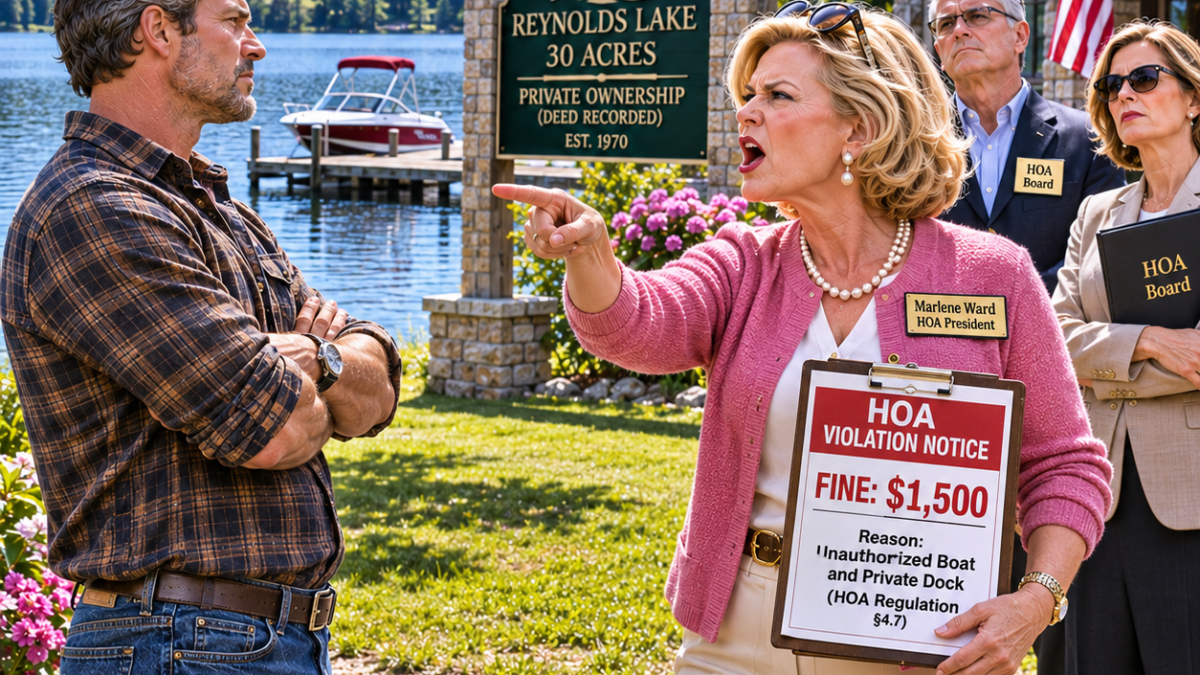
The morning Pinecrest Estates fined me fifteen hundred dollars for keeping my own boat beside my own dock, HOA president Marlene Ward stood in my driveway with a pastel cardigan, two board members, and a bright orange violation notice, calmly explaining that the thirty-acre lake behind my house was “community property” even though the deed locked in my safe said my family owned the lake bed, the shoreline rights, and every legal inch of water they had been fishing in for years.
What made the threat almost insulting enough to be funny was that Marlene had spent decades treating my parents like squatters on land they bought before Pinecrest existed—sending fake inspection complaints, demanding shared access, harassing my father after his heart attack, and even approaching my mother after his funeral with a smile and a suggestion that she should sell because “nonconforming properties” eventually became too difficult to maintain.
I could have ended the argument that morning by laying the deed across Marlene’s clipboard, but after everything my parents had endured, I decided I wanted to know just how far the HOA would go when it believed arrogance could rewrite ownership—and the answer began arriving before sunset.
My father, Henry Reynolds, bought this place in the 1970s because he wanted one thing more than money or status.
Quiet.
Back then, there were no decorative entrance signs, matching mailboxes, or luxury homes staring across the water. There were pine trees, dirt roads, my mother Laura’s vegetable garden, and a dock Dad built with his own hands.
Our deed was unusual.
The county had divided the original land in a way that left our family title with the entire lake bed and associated water rights.
About thirty acres.
Growing up, I never thought of that as special.
It was simply home.
Then developers bought the hills across the water.
I was twelve when bulldozers cut roads through the woods and Pinecrest Estates began climbing around us.
Within a year, the HOA appeared.
A board representative named Greg arrived with a fruit basket and a glossy brochure.
“We’re thrilled to welcome you into the community,” he told Dad.
Dad wiped sawdust from his hands.
“We’re not in your community.”
Greg smiled.
“Well, technically, properties surrounding Pinecrest benefit from the same shared amenities.”
“What amenities?”
“The lake, for one.”
Dad’s expression changed.
“Our lake?”
“The community lake.”
Dad pointed toward the water.
“My wife and I own that lake.”
Greg laughed as though Dad had made a charming rural joke.
Dad didn’t laugh back.
That was the beginning.
Letters followed.
Repaint the boathouse.
Replace native shoreline plants with turf.
Modify the dock.
Allow community access.
Dad answered every demand the same way.
“No.”
The HOA responded with anonymous complaints to county offices.
Unsafe wiring.
Dangerous dock.
Pollution.
Unregistered animals.
One inspector arrived because someone reported “aggressive livestock.”
The livestock was our elderly golden retriever, Buck.
As the years passed, HOA residents began fishing from our shoreline as if permission had somehow transformed into ownership.
Dad would tell them to leave.
They would say their dues paid for the lake.
He would point at the county records office.
They almost never checked.
Then Marlene Ward became HOA president.
Marlene was worse because she understood how to make aggression sound polite.
She never shouted.
She smiled.
She called threats “community concerns.”
After Dad suffered a mild heart attack, she came to our porch supposedly to wish him well and suggested selling might relieve the burden of maintaining such a “large nonconforming property.”
Dad told her to leave.
A year later, he died.
Three weeks after his funeral, the HOA sent Mom another maintenance warning.
Mom slammed it onto the kitchen counter.
“Thirty years,” she whispered. “They can’t even let us grieve.”
I promised I would handle them.
Eighteen months later, I buried her too.
Before she died, she made me promise something while we watched the sunset from the dock.
“Don’t let them take this place.”
I promised.
So when Marlene eventually stood beside my boat, holding that orange fine and telling me the lake belonged to Pinecrest, I didn’t argue.
I simply took the notice from her hand, looked at the amount, and asked one question.
“Are you absolutely sure you want to put that claim in writing?”
PART 2
Marlene’s smile tightened.
“Excuse me?”
I held the orange notice between two fingers.
“You’re saying the HOA owns or controls this lake.”
“I’m saying Pinecrest residents have established rights to use a shared community amenity.”
“That isn’t what I asked.”
One of the board members behind her shifted his weight.
Marlene glanced toward him, then back at me.
“Our legal position is very clear.”
“Good.”
I folded the notice once and slipped it into my shirt pocket.
“Then put all of it in writing.”
Her eyes narrowed.
“You’ve already received written notice.”
“No. This says I’m operating an unauthorized business and storing boats on community property. I want the part where you say the lake is HOA property.”
“You’re being difficult.”
“I’m being specific.”
She raised the clipboard against her chest.
“You have seven days to remove the equipment.”
“Or?”
“The penalties increase.”
“How much?”
“An additional fifteen hundred dollars for continued noncompliance, and the board may pursue legal remedies.”
I nodded.
“Anything else?”
She seemed almost disappointed that I wasn’t yelling.
“Yes. You will cease commercial activity immediately.”
“No.”
The board member on her left looked at me.
Marlene’s voice dropped.
“You may want to reconsider your tone.”
“My tone isn’t parked on your land.”
“This lake benefits the entire development.”
“That still doesn’t answer who owns it.”
Her smile vanished.
“You’ll be hearing from us.”
I stepped aside.
“So will you.”
She turned toward the golf cart.
I watched the three of them drive back up my gravel road.
Then I pulled out my phone and photographed the notice.
Front.
Back.
Date.
Signature.
Marlene had signed it herself.
That mattered.
My father had taught me a lot about wood, boats, and stubborn people.
But one sentence of his came back stronger than anything else that morning.
**When somebody insists on being wrong, get it in writing.**
I did.
***
Lake Day Rentals had started because I couldn’t stand what grief had done to the property.
After Mom died, the house became too quiet.
Her coffee mug stayed in the cupboard because I couldn’t bring myself to move it.
Dad’s workbench still had pencil marks on the edge where he’d measured pieces of cedar.
The lake, which had always felt alive, started feeling like a photograph.
Beautiful.
Still.
Painful.
I needed noise again.
Not HOA noise.
Life.
So I bought four kayaks.
Then two canoes.
Then a pair of paddle boats.
I repaired the old shed beside the dock and applied for every permit the county required.
Business registration.
Insurance.
Watercraft safety equipment.
Parking plan.
Liability coverage.
Tax ID.
I even had the fire extinguisher inspected because Dad had raised me to believe that if you were going to do something, you did it properly enough that nobody could honestly complain.
That turned out to be optimistic.
The first families who rented from me were locals.
Parents with kids who wanted a quiet lake without jet skis tearing through the water.
Retired couples who wanted to paddle at sunset.
A teacher who brought her son every Saturday because he had discovered fishing and talked about bass like they were personal enemies.
For the first time since my parents died, I looked forward to weekends.
Then Pinecrest noticed people were coming to my property without going through Pinecrest.
Marlene couldn’t stand anything she didn’t authorize.
***
Three days after that first written notice, a young couple was standing on my dock while I explained how to adjust their life jackets.
A golf cart came rattling down my driveway.
Marlene.
Pastel cardigan.
Pearls.
Clipboard.
Of course.
She stopped so close to my customers that gravel kicked against their shoes.
“Mr. Reynolds.”
I kept my voice calm.
“This is private property.”
“I’m conducting association business.”
“Not here, you’re not.”
The young woman beside me looked uncomfortable.
Marlene raised her voice.
“You were ordered to cease unauthorized commercial activity.”
I glanced toward the couple.
“Give me a minute.”
They nodded.
I stepped off the dock.
“Marlene, I have county permits.”
“That isn’t the issue.”
“Then what is?”
“You’re operating a business using a community amenity without HOA approval.”
“There it is again.”
“What?”
“Community amenity.”
She held out a new paper.
“Your failure to comply has resulted in accumulated penalties of three thousand dollars.”
I looked at it.
Three thousand.
Apparently HOA arithmetic moved faster than inflation.
“Marlene, I am not an HOA member.”
“You live adjacent to Pinecrest.”
“Correct.”
“Your activities affect Pinecrest.”
“That doesn’t make me subject to your bylaws.”
“The lake is surrounded by our homes.”
“And?”
“The lake is therefore part of the community environment.”
I almost admired the sentence.
It managed to use a lot of words without addressing ownership.
I handed the notice back.
She refused it.
“Keep it.”
“Why?”
“You’ll need it.”
“For what?”
“Court.”
The couple on the dock exchanged glances.
Marlene smiled.
“You should think carefully before threatening an association with considerably greater resources than you.”
I took one slow breath.
Then said:
“Leave my property.”
Her smile disappeared.
“Excuse me?”
“You’re trespassing.”
“I am president of Pinecrest Estates.”
“Congratulations.”
“You cannot—”
“You have thirty seconds to turn that golf cart around before I call the sheriff.”
Her face went rigid.
Then she leaned closer.
“The lake belongs to the community.”
I smiled.
“If you say so.”
She drove away.
The couple remained silent until the golf cart disappeared.
Then the husband looked at me.
“Does she do that often?”
“You have no idea.”
His wife said:
“We live in an HOA.”
“My condolences.”
They laughed.
I didn’t.
Not really.
Because something had changed.
Marlene was no longer merely sending annoying letters.
She was interfering with my business in front of customers.
And I had promised Mom I wouldn’t let them take the place.
That meant I needed to stop treating this like irritating neighborhood theater.
***
That night, I drafted a letter to the board.
Professional.
Short.
No insults.
No history lesson.
**My property is not part of Pinecrest Estates. My business is lawfully licensed. The association has no authority to regulate my residence, dock, shoreline, or commercial activity. Further entry onto my property without permission will be treated as trespass.**
I added:
**Please provide any deed, easement, recorded covenant, lease, license, or other document supporting the HOA’s claimed authority over the lake.**
Then I stopped.
My cursor hovered over one more sentence.
I could have written:
**For your information, I own the entire lake bed.**
I deleted it.
Not because I wanted to trick them.
Because I wanted them to answer the legal question on their own.
If they had a legitimate document I somehow didn’t know about, I wanted to see it.
If they didn’t, I wanted them to keep documenting exactly what they believed.
I sent the letter certified.
Marlene signed for it herself.
***
The fishing club arrived the following Saturday.
Six men.
Folding chairs.
Coolers.
Portable speaker.
Three were on my bank.
Two had cast lines directly across the area I used to launch kayaks.
One chair was so close to my rental sign that a customer had to walk around it.
I recognized Duke Mercer before he introduced himself.
He had attended several HOA meetings.
Stocky.
Camo vest.
Bright orange cap.
The kind of man who acted like volume was evidence.
I walked down.
“Morning.”
Duke smiled.
“Morning.”
“You need to move.”
“Why?”
“You’re blocking my launch.”
He looked over the water.
“Plenty of lake.”
“Exactly. So why are you sitting on my dock access?”
“We’ve always fished here.”
“My father let people fish when they respected the property.”
“That’s called established use.”
“No. That’s called permission.”
Duke laughed.
“The HOA lawyer says this is community water.”
“Did the HOA lawyer show you a deed?”
“Don’t need one.”
“You probably do.”
He reeled in slowly.
“We pay good money to live here.”
“I don’t.”
“That doesn’t mean you get to hoard the lake.”
I stared at him.
“Hoard?”
“Thirty acres of water surrounded by a community.”
“Which my parents bought before your community existed.”
He leaned back in the chair.
“Well, the HOA says we have every right to be here.”
I pulled out my phone.
“Say that again.”
His smile changed.
“You recording?”
“Yes.”
“You threatening me?”
“No.”
I tilted the phone slightly so the camera captured the property sign.
“Documenting.”
The men started packing ten minutes later.
Not because I persuaded them.
Because customers arrived.
Even Duke understood that six angry fishermen arguing with the business owner in front of families would look bad.
Before leaving, he said:
“This isn’t over.”
Apparently that phrase came free with HOA membership.
***
For the next three weeks, they made my life miserable without doing anything dramatic enough to force an easy response.
Fishing lines drifting into my launch zone.
Beer cans left near the shoreline.
A radio blasting at seven in the morning.
Trash beside the shed.
My rental sign knocked down.
Then three paddles disappeared.
Two days later, an HOA member named Rick “found” them floating near the far shore.
He delivered them to me with a grin.
“Lucky I saw these.”
I looked at the matching scratches on the shafts.
They had been locked inside my shed.
“Very lucky.”
He laughed awkwardly.
I installed another lock that afternoon.
***
Then came the online reviews.
**Illegal business.**
**Unsafe equipment.**
**Owner hostile to local residents.**
**Operating without community authorization.**
All posted within hours.
All from accounts with almost no history.
Bookings dipped.
A woman called me before bringing her grandchildren.
“I saw some things online.”
“Ask me anything.”
“Are you licensed?”
“Yes.”
“Insured?”
“Yes.”
“Is the lake safe?”
“Yes, within normal outdoor recreation risks, and I provide required safety equipment.”
“Are you being sued by your HOA?”
“I don’t have an HOA.”
Silence.
“What?”
“Exactly.”
She laughed.
Then booked anyway.
But not everyone did.
Money tightened.
That angered me more than the fines.
Marlene could waste her own time.
She didn’t get to damage a small business I had built out of grief.
***
Thomas Reid stopped by one afternoon.
He owned a house on the outer edge of Pinecrest but had never been part of Marlene’s inner circle.
He carried two coffees.
“One for the local menace.”
I took it.
“Which one of us?”
“You.”
“Disappointing.”
He leaned against the dock railing.
“People are talking.”
“When aren’t they?”
“Marlene says you’re trying to privatize the community lake.”
I stared at him.
“Thomas.”
“I know.”
“No, really. Listen to that sentence.”
He smiled.
“I did.”
“I can’t privatize something that’s already private.”
“I know.”
“Do they?”
“Most of them don’t.”
I looked across the lake at rows of expensive houses.
“They’ve used it for years.”
“Exactly.”
Thomas sipped his coffee.
“People confuse tradition with ownership.”
“That should be on a plaque.”
He lowered his voice.
“Marlene told the board your business is step one.”
“Step one toward what?”
“Restricting all access.”
“She may accidentally be right if they keep doing this.”
Thomas sighed.
“That’s why I’m here.”
He looked embarrassed.
“Some of us know she’s pushing too hard.”
“Then stop her.”
“You know what she’s like.”
“That isn’t an answer.”
“No.”
He looked out over the water.
“It’s an excuse.”
I appreciated that.
***
The fire started at 2:07 in the morning.
Buck woke me.
He wasn’t the same dog from my childhood.
That Buck had been gone for years.
I named this one after him because Dad had loved the old dog so much.
Golden retriever.
Eight years old.
Professional thief of sandwiches.
At first, his barking blended into my sleep.
Then it changed.
Not his squirrel bark.
Not his delivery-driver bark.
Panic.
I sat up.
Orange light moved across the bedroom wall.
I ran to the window.
The shed was burning.
“Damn it.”
I grabbed my phone and called 911 while pulling on whatever clothes I could reach.
By the time I reached the dock, flames had climbed through the roof.
Heat pushed me backward.
The kayaks stacked closest to the wall were already melting.
Plastic warped.
Life jackets burned.
Smoke rolled over the lake.
I dragged one canoe away until the heat became too strong.
Then I stood there helpless.
That was the worst part.
I had repaired that shed with Dad.
Not built it originally.
But repaired it.
The west wall still had one of his pencil marks behind the shelving.
Mom had painted the door blue because she said brown made it look like “a sad little barn.”
There were ordinary things inside that nobody would insure properly because nobody else would understand their value.
Dad’s old tackle box.
Mom’s folding chair.
A wooden sign he had carved when I was a teenager.
**QUIET WATER, QUIET MIND.**
The roof collapsed.
I turned away.
***
Fire trucks arrived.
Deputies.
Fire marshal.
Neighbors gathered at the end of my driveway.
Some in pajamas.
Some under umbrellas.
Marlene did not appear.
Not that night.
At dawn, the fire investigator crouched near the remains.
He called me over.
“We found indications of an accelerant.”
I stared.
“What?”
“We need lab confirmation.”
“You think someone set it?”
“I think the fire pattern is suspicious enough that we’re treating it that way.”
My hands went cold.
Then he pointed toward the cameras.
“Those work?”
“Normally.”
I checked.
Both units facing the shed had black paint across the lenses.
The feeds showed darkness starting at 1:46.
Someone had walked onto my property.
Covered the cameras.
Then twenty minutes later, my shed burned.
My anger became very quiet.
***
Marlene arrived at ten.
Golf cart.
Coffee.
Pastel sweater.
I had soot in my hair and hadn’t slept.
She stopped at the edge of the damaged area.
“Oh, my God.”
Her hand went to her chest.
I said nothing.
“This is terrible.”
Still nothing.
She looked at the burned shed.
“Were you storing fuel down here?”
I turned toward her.
“What?”
“I’m only asking because commercial operations increase risk.”
I stared.
She continued:
“Perhaps this is an indication that this type of activity isn’t appropriate for a residential environment.”
That sentence did something to me.
I stepped closer.
“Someone set this fire.”
She blinked.
“I wasn’t implying—”
“Someone painted my cameras and set my shed on fire.”
“That’s awful.”
“And your first thought is my zoning.”
She glanced toward the deputies.
“I’m trying to be practical.”
“No.”
My voice came out low.
“You’re trying to use this.”
Her expression hardened.
“Be careful.”
I pointed toward my driveway.
“Get off my property.”
“Mr. Reynolds—”
“Now.”
She turned without another word.
But as the golf cart started away, I saw her face.
Not guilt.
I couldn’t honestly say that.
Something else.
Calculation.
***
The threat arrived the next day.
No return address.
Magazine letters glued onto paper.
**NEXT TIME YOUR HOUSE.**
I stood in the kitchen reading it.
Buck sat at my feet.
For the first time since this started, I was genuinely afraid.
Not embarrassed.
Not angry.
Afraid.
The shed was fifty yards from where I slept.
If Buck hadn’t barked, I might not have seen the flames until the trees caught.
I called the sheriff.
Then the fire marshal.
Then my insurance company.
Then Bill Harper.
Bill had been my father’s attorney.
He was in his late sixties now and still worked from the same downtown office that smelled like old paper and coffee.
I brought the deed.
The HOA letters.
The fines.
Videos.
Fire report.
Threat.
Bill read in silence.
Eventually he pushed his glasses up.
“They fined you for boats?”
“Yes.”
“On this parcel?”
“Yes.”
“And they claim the lake is a community amenity?”
“Yes.”
He looked at me.
“Have they lost their minds?”
“That’s what I’m paying you to determine.”
He almost smiled.
Then he unfolded the original survey.
His finger traced the property boundary.
“Your father was right.”
“I know.”
“No, I mean this is cleaner than I remembered.”
He pointed.
“Lake bed title. Shoreline. Water-use rights subject only to state regulation. No recorded Pinecrest easement.”
He pulled another document.
“Developer plat doesn’t convey lake rights.”
Another.
“HOA declaration applies to subdivision lots only.”
He looked up.
“You’re not in it.”
“Exactly.”
Bill leaned back.
“So why haven’t you shut off their access?”
That question hurt.
“Dad let people fish.”
“Permission isn’t necessarily permanent.”
“Mom liked seeing kids out there.”
“Okay.”
“I didn’t want to become the guy who put fences around everything because a few people were jerks.”
Bill nodded.
“Reasonable.”
Then he tapped the arson report.
“This isn’t a few people being jerks anymore.”
I knew.
***
Bill’s plan was simple.
Certified notice to every Pinecrest household.
Not just the board.
Everyone.
A copy of the relevant deed language.
Survey.
Notice that prior informal permission for recreational access was revoked.
Clear statement:
No fishing.
No launching watercraft.
No shoreline entry.
No access without written permission.
Private property signs.
Trespass enforcement.
I hated the idea.
Dad had never wanted the lake to become hostile.
He used to let neighborhood kids fish if they picked up their trash.
Mom kept extra bread for children who came to feed ducks.
But what had begun as neighborliness had been transformed into an alleged right.
And somebody had burned my shed.
Bill said:
“You are not punishing children.”
“I know.”
“You are defining legal boundaries because your informal system has been abused.”
“I know.”
“You can create new permissions later.”
I looked at Dad’s old survey.
“Do it.”
***
The notices went out by certified mail.
One hundred and fourteen households.
The packet was impossible to misunderstand.
**PRIVATE LAKE OWNERSHIP NOTICE**
Attached:
1974 deed extract.
Survey.
Parcel information.
No recorded HOA easement.
Revocation of prior informal recreational permission.
Effective date.
Contact information for counsel.
Then the signs went up.
**PRIVATE LAKE — NO TRESPASSING**
**NO FISHING OR WATER ACCESS WITHOUT WRITTEN PERMISSION**
**VIOLATORS MAY BE PROSECUTED**
I photographed every sign.
GPS coordinates.
Date.
Time.
Bill laughed when I sent the folder.
“Your father really did raise you for litigation.”
“He raised me to measure twice.”
“Same principle.”
***
By noon the day the letters arrived, Pinecrest exploded.
My phone rang.
I stopped answering unknown numbers.
Emails came.
Some furious.
Some confused.
Some almost reasonable.
One woman wrote:
**My children have fished this lake for eight years. How can you suddenly take it away?**
I replied:
**I am not taking ownership away from anyone. The lake has always been privately owned. Informal permission has been revoked because repeated trespass, harassment, vandalism, and a recent suspected arson made the prior arrangement untenable.**
She responded:
**I didn’t do any of those things.**
That one bothered me.
Because she was right.
Most residents hadn’t burned anything.
Most hadn’t harassed my parents.
They had simply been told for years that the lake belonged to them.
Marlene had lied to them too.
But I couldn’t run private access based on guessing who was decent.
Not anymore.
***
Thomas brought me a stack of printed HOA emails.
“You’re going to enjoy this.”
“I doubt that.”
He handed them over.
Marlene’s message was first.
**Mr. Reynolds’ claim is without merit. No individual can unilaterally privatize a historic community lake. The board intends to defend Pinecrest residents’ established access rights.**
Then responses.
**We’ve paid dues for lake access.**
**Sue him.**
**Remove his signs.**
Then one from Linda Carver.
Linda was a real estate attorney who lived near the east side.
**Before anyone removes anything, the board should verify title. Private ownership of an entire lake bed is legally possible. If the deed provided by Mr. Reynolds is authentic and there is no recorded easement, the HOA may have no ownership interest at all.**
The thread went silent after that.
Six hours.
Then Marlene:
**Legal counsel is reviewing.**
I laughed.
Thomas sat on the porch rail.
“What?”
“She’s finally checking the county records.”
“Forty years late.”
***
An emergency HOA meeting happened the next evening.
I wasn’t invited.
Thomas attended.
He called afterward.
“You missed a masterpiece.”
“Details.”
“Marlene opened by calling your notice an intimidation campaign.”
“Of course.”
“Then Linda asked her to identify the document giving Pinecrest lake rights.”
“And?”
“She cited the bylaws.”
“Which apply to Pinecrest lots.”
“Linda said that.”
I started smiling.
“Then?”
“Someone asked for the lake parcel number.”
I laughed.
Thomas continued.
“Marlene said the lake is common property by historical practice.”
“What did Linda say?”
“Historical use is not the same as title.”
“God bless Linda.”
“Then she read part of your deed.”
I leaned back.
Thomas shook his head.
“You could hear a pin drop.”
“And Marlene?”
“Tapped her pen so hard I thought she’d break it.”
“Did anyone apologize?”
Thomas laughed.
“No.”
“Of course not.”
“Half the room wanted to negotiate. Half wanted to sue.”
“Which half was Marlene?”
“Guess.”
***
The fishing club chose confrontation.
Three days later, Duke and four men appeared on my shoreline.
Directly beneath a no-trespassing sign.
I walked down with my phone recording.
“Morning.”
Duke smiled.
“Beautiful day.”
“You received the notice?”
“What notice?”
“Certified mail.”
“Oh, that thing.”
“Then you’re trespassing.”
He cast his line.
“HOA lawyer says you’ve got no right to stop historical usage.”
“Your lawyer tell you to ignore posted trespass notices?”
“He says you’re bluffing.”
“Okay.”
I called Deputy Carter.
Duke laughed.
“You really calling the cops over fishing?”
“Yes.”
“Pathetic.”
Maybe.
Twenty minutes later, Carter arrived.
He had already reviewed my deed with the sheriff’s office because Bill had provided it after the earlier trespass complaints.
Carter approached Duke.
“Gentlemen, pack up.”
Duke looked shocked.
“You serious?”
“Private property.”
“This is a lake.”
“Correct.”
“We live here.”
“Also correct.”
“We’ve fished here for years.”
Carter pointed toward the sign.
“Permission was revoked.”
Duke looked at me.
“You did this because you hate the HOA.”
“No.”
I looked at the burned foundation of my shed.
“I did it because somebody made informal trust impossible.”
Duke’s expression flickered.
Then:
“You can’t prove any of us had anything to do with that fire.”
I hadn’t accused him.
Carter noticed.
So did I.
“Interesting,” I said.
Duke packed his rod.
***
The sheriff’s reports began building.
Trespass warning.
Another warning.
Teenagers sneaking onto the lake to film themselves fishing at night.
Parents furious when deputies brought them home.
A pontoon boat launched from an HOA-owned decorative access strip that did not legally reach the private water.
Carter ordered them back.
Marlene complained to the sheriff.
Carter told her:
“Recorded title controls more than your newsletter.”
Thomas repeated that quote for weeks.
***
Then the HOA lawyer sent Bill a demand letter.
Historical access.
Community amenity.
Reliance.
Potential easement by long use.
Discriminatory denial.
Loss of property value.
Bill read it.
Then laughed.
Not a polite chuckle.
Actual laughter.
“What?”
“They’re claiming an easement theory while their own development plat apparently acknowledges your parcel.”
“Good?”
“Very.”
He pointed.
“Your parents’ title predates Pinecrest. The developers didn’t convey lake access because they didn’t own lake access. More importantly, your father repeatedly objected to unauthorized use over the years. That undercuts any claim that use was clearly hostile or adverse under the assumptions they’re making.”
“So?”
“So they’re bluffing or their lawyer hasn’t reviewed enough records.”
“What do we do?”
Bill smiled.
“Help them review.”
***
His response was twenty-three pages.
Chain of title.
Recorded surveys.
Prior correspondence.
County records.
Photographs of private-property signs going back decades.
Dad’s old letters telling residents they were using the lake only by permission.
My recent certified revocation.
Sheriff reports.
The fake HOA fines.
Business interference.
Harassment.
Fire investigation.
Threat letter.
Bill ended with:
**Any continued attempt to exercise dominion or control over Mr. Reynolds’ lake, shoreline, dock, or business will be met with claims for trespass, harassment, defamation, interference with business relations, and attempted conversion of private property.**
Marlene’s lawyer received it Tuesday.
Thursday, Pinecrest filed suit anyway.
***
I was sitting on the dock when Bill called.
“They filed.”
I stared across the water.
“Seriously?”
“Very.”
“For what?”
“Declaratory relief regarding historical lake access, alleged community amenity rights, and damages.”
“Damages?”
“Emotional distress and lost recreational use are in there.”
I started laughing.
Buck lifted his head.
“They’re suing because they can’t fish?”
“In essence.”
“Bill.”
“Yes?”
“Please tell me this is good.”
He paused.
Then:
“They just gave us discovery.”
I stopped laughing.
“What does that mean?”
“It means they put their own records in issue.”
His voice became almost cheerful.
“We counterclaim Monday.”
***
Our response was not funny.
Harassment.
Trespass.
Defamation.
Interference with lawful business.
Improper attempts to assert control over private property.
Legal fees.
Damages.
And a request for declaratory judgment confirming my ownership and Pinecrest’s lack of automatic access rights.
Bill included the long history.
My father.
My mother.
The repeated attempts to force membership.
Fake complaints.
Fishing interference.
Business sabotage.
Fire investigation.
He did not accuse Marlene of arson.
We had no proof.
That distinction mattered.
We attached the emails we did have.
The fines.
The statements claiming community ownership.
Sheriff reports.
Then discovery started.
***
Bill always said litigation turns arrogance into paper.
Pinecrest had spent years assuming nobody would force them to explain themselves.
Now they had to.
We requested:
Five years of board minutes.
Financial records.
Vendor contracts.
Emails mentioning my family.
Emails mentioning the lake.
Communications involving my business.
Fishing club correspondence.
Documents supporting claimed lake rights.
Insurance communications.
Marlene’s lawyer objected.
Too broad.
Irrelevant.
Burdensome.
The judge narrowed a few categories.
Then ordered most of it produced.
Banker’s boxes arrived.
Digital files too.
I spent evenings at my dining table with coffee, sticky notes, and Buck asleep under the chair.
For several days, nothing.
Landscaping invoices.
Pool repairs.
Holiday decorations.
Gate maintenance.
Meeting minutes full of arguments about roof colors.
Then I found a line.
Three years old.
Mom had still been alive.
**Discussion: Apply enhanced enforcement tactics to Reynolds property until compliance or sale achieved.**
I read it again.
Enhanced enforcement tactics.
Until compliance or sale.
My hands started shaking.
I called Bill.
He came over.
Read the page.
Then sat very still.
“Who attended?”
I showed him.
Marlene.
Treasurer.
Two directors.
Duke listed under recreation committee.
Bill tapped the phrase.
“This matters.”
“My mother was alive.”
“I know.”
“They were intentionally trying to wear her down.”
“This indicates a coordinated strategy.”
“My father had just died.”
Bill looked at me.
“Don’t get ahead of the evidence.”
I hated him for saying it.
He was right.
“What do we call it?”
“A document.”
He slid it back.
“Let the document earn its own adjectives.”
***
More emails followed.
Marlene to the board:
**The Reynolds parcel remains the primary obstacle to full lake integration.**
Another:
**Continued noncompliance should have consequences sufficient to encourage sale.**
Another:
**If ownership transfers, the association may be able to negotiate permanent lake control with a cooperative purchaser.**
There it was.
This had never been about grass.
Or docks.
Or aesthetics.
They wanted the property.
Because whoever controlled my parcel controlled the lake.
Dad had understood that decades earlier.
I felt ashamed that it had taken me so long.
***
Then Peter Lang came into the case.
Forensic accountant.
Quiet.
Glasses.
Spoke about spreadsheets with the enthusiasm most people reserved for grandchildren.
Bill hired him because some HOA invoices didn’t make sense.
Silvercrest Management LLC.
Consulting charges.
Twenty thousand here.
Ten thousand there.
No clear deliverables.
Peter searched corporate records.
“Silvercrest is owned by Marlene Ward’s husband.”
I stared.
“Declared conflict?”
“Not in the records I’ve seen.”
Another company.
Bright Sky Maintenance.
Registered to the treasurer’s brother-in-law.
Invoices for work residents couldn’t identify.
Peter traced accounts.
Weeks passed.
Then he called a meeting.
He put a spreadsheet on the screen.
“Approximately three hundred fifty thousand dollars appears to have moved through related vendors over the review period without adequate evidence of corresponding services.”
Thomas, who attended as a member representative after residents began asking questions, whispered:
“Three hundred fifty thousand?”
Peter nodded.
“Potentially more. This is the supported suspicious total so far.”
I looked at Bill.
“Embezzlement?”
Bill answered carefully.
“Potential evidence of misappropriation. Criminal conclusions belong to investigators.”
Again.
Evidence first.
Adjectives later.
***
Then came the email that changed the arson investigation.
Marlene to Duke and the treasurer.
Three weeks before the fire.
**He’s still refusing to comply. Escalate pressure. Make it impossible for him to continue operating.**
Duke responded:
**Don’t worry. We’ll take care of it. He’ll be begging to sell before summer.**
I stared at the screen.
Bill said nothing.
I looked at him.
“That’s them.”
“It’s evidence of intent to pressure your business.”
“Three weeks before somebody burned my shed.”
“I know.”
“You think Duke—”
“I think we’re giving this to the sheriff and fire investigator immediately.”
“Bill.”
He met my eyes.
“We don’t guess.”
I hated that rule.
It saved me repeatedly.
***
The district attorney’s office became involved after financial records and the pressure emails were turned over.
The civil lawsuit kept moving.
But suddenly Pinecrest’s lawyers were no longer dealing with a fishing dispute.
They were dealing with their own client’s financial records becoming evidence in a separate investigation.
Marlene still refused to retreat.
At least publicly.
At the first major hearing, she arrived in a pale blue suit.
Perfect hair.
Pearls.
Same smile she had worn on my mother’s porch.
For a second, I was back there.
Mom beside me.
Grieving.
Marlene suggesting we sell.
My jaw tightened.
Bill whispered:
“Don’t let her put you somewhere else.”
I looked at him.
“What?”
“You’re here.”
He pointed at the courtroom.
“Stay here.”
I nodded.
***
The HOA lawyer argued first.
Historic community reliance.
Decades of lake use.
Marketing materials referring to lake amenities.
Home values based partly on waterfront access.
Then Bill stood.
He didn’t start with Marlene.
He started with the deed.
1974.
Recorded.
Survey.
Lake bed.
Water rights.
No transfer.
No HOA easement.
No covenant binding my parcel.
Then he displayed early Pinecrest development documents.
One map showed the subdivision lots stopping at my boundary.
The lake parcel was identified separately.
The judge leaned forward.
“Counsel, does plaintiff dispute the authenticity of this deed?”
The HOA lawyer hesitated.
“Not authenticity, Your Honor. We dispute defendant’s interpretation of the scope of historical use rights.”
Bill nodded.
“Then title itself is not disputed.”
The lawyer tried to qualify.
The judge stopped him.
“Is the lake bed titled to Mr. Reynolds?”
A pause.
“Yes.”
I heard someone gasp behind me.
Years of community mythology died in one syllable.
***
Bill then showed Dad’s old letters.
Permission.
Warnings.
Trespass objections.
No claim that residents could use the lake as a matter of right.
The HOA’s historic-use theory weakened with every document.
Then came my certified revocation.
Signs.
Sheriff notices.
Continued trespass.
By the end of the property portion, the judge’s expression had become very hard.
Then Bill moved to motive.
Marlene’s emails.
**Primary obstacle to full lake integration.**
**Encourage sale.**
**Escalate pressure.**
The room changed.
The HOA lawyer objected.
“Character evidence.”
Bill replied:
“Motive and intent regarding the asserted property claim and interference with defendant’s business.”
The judge allowed limited use.
Then the financial spreadsheet appeared.
Silvercrest.
Bright Sky.
Related parties.
Unexplained invoices.
Marlene stopped smiling.
Her lawyer stood.
“Your Honor, these financial matters have no bearing on title.”
The judge looked at him.
“They may bear on credibility and alleged motive depending on the claims now before the court. I will hear foundational testimony.”
Peter testified.
Calmly.
Numbers.
Transfers.
Corporate ownership.
No speeches.
The facts were enough.
Then Bill displayed the pressure email.
**Make it impossible for him to continue.**
I watched Marlene read her own words on the screen.
She finally looked at me.
No smile.
***
Her lawyer requested recess.
Twenty minutes later, they returned.
He asked to discuss settlement.
Bill leaned toward me.
“We can listen.”
“No.”
He looked at me.
“Think before you answer.”
“I have.”
“You may recover faster through settlement.”
“They sued me to force access to property they knew was mine.”
“I know.”
“They harassed my parents.”
“I know.”
“They tried to destroy my business.”
“Likely, yes.”
“Somebody burned my shed.”
“Still under investigation.”
I looked at Marlene.
“No private settlement.”
Bill studied me.
Then nodded.
“Okay.”
When court resumed, he told the judge no settlement had been reached.
The property claims proceeded.
The judge eventually dismissed Pinecrest’s access claims with prejudice and entered findings confirming the recorded ownership evidence supporting my control of the lake and rejecting the HOA’s asserted automatic community right on the record before her.
She also ordered further proceedings on my counterclaims and legal fees.
Then she addressed counsel.
“The financial materials and communications presented raise issues beyond the scope of this property action. Appropriate referrals may be made.”
Marlene looked like someone had opened a trapdoor beneath her chair.
The lake was mine.
Legally confirmed.
Publicly.
Finally.
But that wasn’t the part that made my hands shake.
It was knowing Dad had spent years being treated like a liar when the county records had supported him the entire time.
***
Outside the courthouse, Thomas hugged me.
I am not a hugging man.
Neither is Thomas.
Neither of us mentioned it afterward.
“You did it.”
“No.”
I looked at Bill.
“My parents did it in 1974.”
Bill smiled.
“They had good paperwork.”
I looked toward the courthouse doors.
Marlene came out surrounded by lawyers.
Former supporters moved away from her.
Not dramatically.
Just small steps.
People who once gathered around her now found reasons to look at their phones.
She saw me.
Walked over.
Her attorney tried to stop her.
She ignored him.
“You think this makes you king of the lake?”
I stared at her.
“No.”
“You’ve destroyed property values.”
“No.”
“Families bought homes believing they had lake access.”
“Because your HOA told them they did.”
Her face tightened.
“We created this community.”
“My family owned that water before Pinecrest had a name.”
“You’re punishing innocent residents because you hate me.”
That one landed.
Because there was truth inside it.
Not all of it.
But enough.
“I don’t hate you.”
She laughed.
“Of course you do.”
I thought about my parents.
My shed.
The threat letter.
Then said:
“I don’t trust anyone you taught to confuse permission with ownership.”
She had no answer.
I walked away.
***
The local newspaper ran the story the next day.
**HOA LOSES PRIVATE LAKE ACCESS CASE; FINANCIAL RECORDS REFERRED FOR INVESTIGATION**
My phone exploded.
Residents called.
Some furious.
Some apologetic.
One man shouted into voicemail:
“You’ve stolen an amenity we paid for!”
I deleted it.
Then a woman left another message.
“My husband and I bought here four years ago. Our real estate packet called the lake a Pinecrest recreational feature. We had no idea.”
I called her back.
Her name was Natalie.
She sounded nervous.
“I’m sorry if I’m bothering you.”
“You’re not.”
“Did the HOA really never own it?”
“Correct.”
“Then why did they tell us—”
“I can’t answer that.”
She went quiet.
“My son learned to fish there.”
I closed my eyes.
“I’m sorry.”
“Would you ever consider letting residents use it again?”
I looked out the window.
The lake was perfectly still.
“I don’t know.”
That was the honest answer.
***
The criminal investigation moved slower.
Months.
Subpoenas.
Interviews.
Forensic accounting.
The treasurer resigned.
Two board members quit.
Pinecrest meetings became war zones.
Residents demanded records.
Marlene claimed political persecution.
Then the district attorney announced charges relating to misappropriation of HOA funds.
Marlene.
Treasurer.
Fraud-related counts.
Embezzlement allegations.
Misuse of association funds.
The exact charges evolved through the case.
But the core allegation was simple.
Money residents paid for community purposes had been routed through related companies for private benefit.
The neighborhood turned on its leadership overnight.
***
Duke was questioned about the fire.
He denied everything.
Then one of his fishing-club friends cooperated.
His name was Russell.
He had been in the email chain.
According to investigators and later court testimony, Duke had talked for weeks about “scaring Reynolds out.”
Russell said Marlene encouraged escalating pressure but claimed he never heard her explicitly order arson.
That distinction became important.
Then investigators recovered phone-location records and convenience-store video tying Duke to the purchase of fuel shortly before the fire.
A search produced clothing consistent with one of the shadowed camera glimpses before the lenses were painted.
Finally, Russell admitted helping Duke approach the property that night but claimed he backed out before the fire was set.
The case against Duke hardened.
My stomach turned when Carter told me.
I had joked with that man on the shoreline years earlier.
Had watched him teach a child how to cast.
Human beings are rarely one thing.
That makes betrayal worse, not easier.
***
When Duke was arrested, I didn’t celebrate.
I walked down to the rebuilt shed.
Steel framing.
Fire-resistant siding.
New cameras.
Dad’s old tackle box was gone.
Mom’s blue paint was gone.
The wooden sign was gone.
I had recreated the words on a new cedar board.
**QUIET WATER, QUIET MIND.**
It wasn’t the same.
Some things can’t be rebuilt.
Buck sat beside me.
I scratched his ears.
“They finally got him.”
Buck yawned.
Dogs are excellent at keeping legal victories in perspective.
***
Marlene’s criminal case and the HOA financial scandal destroyed Pinecrest leadership.
Residents called a special election.
Nobody wanted to run.
Eventually Thomas was chosen as interim president.
He came to my house wearing work gloves and an expression of embarrassment.
“Don’t laugh.”
“What?”
“I’m HOA president.”
I laughed.
He waited.
“You done?”
“No.”
He waited longer.
Finally I stopped.
“How?”
“Everyone else either resigned or has a lawyer.”
“Strong candidate pool.”
“Exactly.”
He looked toward the lake.
“I came to apologize.”
“You didn’t do this.”
“I watched.”
I didn’t answer.
Thomas continued.
“A lot of us did.”
“That isn’t the same as doing it.”
“No.”
He met my eyes.
“But it helped her.”
That was true.
He handed me a folder.
Inside were signatures from residents demanding independent accounting and governance reform.
“We’re dissolving the old structure if we can.”
“Good.”
“Some people want to form a voluntary association instead.”
“Better.”
Then he hesitated.
“There’s another thing.”
“The lake.”
He looked embarrassed.
“Yes.”
I folded my arms.
“Go ahead.”
“People miss it.”
I said nothing.
“A lot of families genuinely believed they had rights.”
“I know.”
“Kids grew up fishing there.”
“I know.”
“Some residents had nothing to do with Marlene.”
“I know.”
Thomas sighed.
“This isn’t going how I practiced it.”
“Because I’m not yelling?”
“Pretty much.”
He looked across the water.
“Would you ever consider some kind of controlled access?”
My first reaction was immediate.
No.
Dad in the hospital.
Mom crying over the condolence violation letter.
My burned shed.
The ransom-style threat.
Duke smirking beneath the no-trespassing sign.
No.
Then another memory came.
Mom feeding ducks with neighborhood children.
Dad showing a boy how to tie a fishing knot.
Neither of them had wanted a fortress.
They wanted respect.
Mom’s voice returned.
**Don’t let bitterness decide what peace should look like.**
She had said versions of that my whole life.
I looked at Thomas.
“I’ll think about it.”
His eyebrows rose.
“Really?”
“On my terms.”
“Of course.”
“Written agreement.”
“Fine.”
“Limited access.”
“Fine.”
“Fees for maintenance and conservation.”
“Fine.”
“One act of harassment or property damage and access is gone.”
Thomas smiled.
“Very fine.”
I pointed at him.
“I haven’t agreed.”
“Right.”
He tried to stop smiling.
Failed.
***
Pinecrest residents voted to dissolve the mandatory HOA structure after the legal and financial mess was resolved through the required procedures.
What replaced it was a voluntary neighborhood association.
No authority over my property.
No mandatory fines.
No pretending to own the lake.
Thomas refused to call himself president.
“Coordinator.”
“That’s worse.”
“Less ego.”
“Sounds like a youth soccer job.”
“Perfect.”
He and I worked with Bill to create a lake-access agreement.
Seasonal passes.
Limited number.
No automatic right.
No transfer with home ownership.
No guests without registration.
Catch limits consistent with state law and my conservation plan.
No litter.
No alcohol abuse on the shoreline.
No loudspeakers near rental customers.
No launch in the rental zone.
No harassment.
No vandalism.
No assertion that permission created an easement or ownership interest.
And my favorite:
**Any act intended to interfere with the owner’s lawful use, business operations, property, or safety will result in immediate and permanent revocation of lake privileges and may be referred to law enforcement.**
Thomas read it.
“The don’t-mess-with-the-owner clause.”
“Exactly.”
***
The first person who applied was Natalie.
The woman who had called after the court decision.
She brought her son.
Twelve years old.
Fishing rod almost taller than him.
She signed every page.
Then looked at me.
“Thank you.”
“Follow the rules.”
“We will.”
Her son said:
“Does the lake really belong to you?”
I smiled.
“Yes.”
“All of it?”
“The lake bed.”
“What about the fish?”
“Fish don’t read deeds.”
He thought about that.
“Smart.”
I laughed.
Then showed him where Dad used to catch bass.
That afternoon, watching him fish, I realized something inside me had changed.
The lake didn’t feel stolen anymore.
It felt mine because I could choose generosity.
Choice mattered.
***
The criminal cases eventually ended.
Marlene accepted a plea agreement after prosecutors presented the financial records and related evidence.
She received three years in prison and restitution obligations tied to the diverted HOA funds.
The former treasurer received eighteen months along with restitution and community-service requirements after resolving his case.
Duke’s case was different.
Arson.
Conspiracy.
Harassment evidence.
He was convicted and sentenced to five years.
I attended the hearings.
Not because I wanted to watch them suffer.
At least that’s what I told myself.
Part of me probably did.
I’m not going to pretend grief had turned me into a saint.
I wanted Marlene to look across the courtroom and see that I still owned the lake.
I wanted Duke to understand the fire hadn’t driven me out.
I wanted them to know they had failed.
Then the judge began reading victim-impact material.
Residents whose dues had been stolen.
People who had trusted Marlene.
My own statement about the shed.
My parents.
The business.
The threats.
The anger started feeling heavy instead of satisfying.
When Duke was sentenced, he looked back once.
Our eyes met.
I didn’t smile.
Neither did he.
That was enough.
***
Lake Day Rentals came back stronger.
I rebuilt the shed.
Bought new kayaks.
Added fishing boats.
Nature tours.
A school district asked whether I would host environmental education days.
The first group arrived on a bright Tuesday morning.
Twenty fourth-graders.
Loud enough to scare every bird within a mile.
Their teacher apologized.
I laughed.
“My mother taught fourth grade. This sounds normal.”
That sentence caught in my throat.
The teacher noticed.
“You okay?”
“Yeah.”
I looked across the lake.
“Just remembering someone.”
***
We taught the kids about shoreline plants.
Fish habitat.
Water quality.
Why litter matters.
How private landowners and communities can work together.
One boy asked:
“Why are there so many private-property signs?”
I looked toward Thomas.
He was helping fit life jackets.
He grinned.
“Long story.”
I said:
“People forgot to ask permission.”
The boy nodded seriously.
“My sister does that with my Legos.”
“Same legal principle.”
Probably not.
But he understood.
***
The voluntary association started organizing shoreline cleanup days with my permission.
Residents who once left beer cans now carried trash bags.
Some were the same people.
That bothered me at first.
Then I realized accountability that leaves no room for changed behavior is just another form of control.
Duke wasn’t coming back.
Marlene wasn’t coming back.
The people standing on my shoreline now had signed agreements and asked permission.
That was different.
Boundaries had done what bitterness couldn’t.
They gave us a way forward.
***
Thomas and I became friends.
Real friends.
Not HOA friends.
The kind where he showed up without a clipboard.
We would sit on my porch with coffee.
One afternoon he looked across the lake.
“Can you believe we almost sued you for emotional distress because we couldn’t fish?”
“You did sue me.”
“I personally didn’t.”
“You were part of the HOA.”
“Don’t ruin this moment.”
I smiled.
He continued.
“Marlene really convinced everyone.”
“People wanted to believe her.”
“Why?”
“Because the alternative was inconvenient.”
He looked at me.
“What alternative?”
“That the best amenity in Pinecrest belonged to somebody outside Pinecrest.”
He nodded slowly.
“Yeah.”
“People don’t like discovering something they enjoy is a privilege.”
Thomas looked toward a father helping his daughter into a kayak.
“Now?”
“Now it’s still a privilege.”
He smiled.
“Just one we respect.”
Exactly.
***
Two years after the court case, I called Bill.
“I want to protect the lake permanently.”
“From what?”
“Everybody.”
“Specific.”
“Development. Future HOAs. Future owners. Me, if I get stupid when I’m eighty.”
He laughed.
We worked with a land trust.
Months of surveys.
Environmental review.
Legal drafting.
Tax discussions.
Conservation planning.
Eventually we created a conservation easement protecting the lake and surrounding buffer from incompatible development.
I retained ownership.
Managed access.
Could continue the rental operation within agreed limits.
But nobody could drain the lake for condos.
No future HOA could absorb it through some later land deal.
No developer could turn Dad’s shoreline into a row of luxury docks.
The day the documents recorded, Bill handed me the certified copy.
“Your father would approve.”
I looked at the signature lines.
“You think?”
“He hired me because I once told a developer to read his own survey before threatening him.”
I laughed.
“Definitely.”
***
That evening, I took the document to the dock.
Buck followed.
Older now.
Slower.
Still optimistic about dropped sandwiches.
Sunlight turned the lake gold.
I sat where Dad used to sit.
The original dock boards had been replaced over the years, but one old support post remained.
Dad had carved a tiny H into it.
Henry.
I ran my thumb over the mark.
“This is for you.”
The water moved gently below.
“And Mom.”
I thought about her final request.
**Don’t let them take this place.**
“They didn’t.”
My voice broke.
For years, I had imagined keeping that promise meant defeating Marlene.
Wrong.
Defeating Marlene was temporary.
Protecting the land beyond me was the promise.
***
Buck rested his head on my knee.
I watched a pair of kayaks cross the lake.
Pinecrest residents.
Legal passes.
Life jackets.
No loud music.
They waved.
I waved back.
Dad would have liked that.
Mom definitely would.
She never wanted enemies.
She wanted decent neighbors.
It had taken lawsuits, fire, criminal investigations, and an absurd amount of paperwork to get us back to something that simple.
***
The new neighborhood association held its annual picnic on land Thomas arranged near the clubhouse.
He invited me.
I almost didn’t go.
Old reflex.
Then I did.
No enforcement table.
No violation forms.
No clipboard patrol.
Just burgers.
Kids.
Music.
Linda Carver, the attorney who had first told everyone to actually read my deed, walked over.
“You know you’re famous now.”
“Terrible news.”
“People tell the new residents about you.”
“I hope they say I’m handsome.”
“They say you’re the guy who banned the HOA from its own lake.”
I sighed.
“Not its lake.”
She laughed.
“Exactly why the story survives.”
A new resident beside her looked confused.
“You really own the entire thing?”
I pointed toward the water.
“Lake bed and associated rights, yes.”
He stared.
“And the old HOA fined you?”
“For my boat.”
“That’s insane.”
Linda raised her cup.
“That’s why we check title before threatening people.”
I toasted that.
***
There were still difficult moments.
Not every former HOA resident forgave me.
One man refused to apply for lake access because he said paying a seasonal fee was humiliation.
“That water should be free.”
Thomas told me.
I shrugged.
“He can use the county reservoir.”
Another homeowner sold his house and blamed me for reduced value.
Maybe losing automatic lake access did affect some buyers.
I couldn’t promise otherwise.
But property value did not create ownership.
That was the lesson nobody liked because it was boring and absolute.
Wanting something didn’t put your name on the deed.
Neither did enjoying it for years.
Neither did paying HOA dues to people who never owned it.
***
Marlene wrote to me once from prison.
I almost didn’t open it.
Bill said it was my decision.
Thomas said burn it.
Linda said preserve it because lawyers are incapable of normal emotional advice.
I opened it.
Marlene wrote:
**Mr. Reynolds,**
**I know you probably believe I hated your family. I did not.**
I stopped.
Then continued.
**Your father represented something I could not control. The neighborhood grew around his property, but he never needed us. Every time he refused to join, I took it personally. I convinced myself that one holdout was hurting everyone.**
My hands tightened around the paper.
**After he died, I should have stopped. I did not. After your mother died, I should have stopped. I did not.**
I had to put the letter down.
Buck looked up.
I resumed.
**I told myself I was protecting residents, property values, and community access. The truth is I wanted the lake under HOA control because it would make Pinecrest more valuable and make me more powerful.**
Then:
**I did not order the fire. I did tell Duke to increase pressure. I have to live with knowing what that helped create.**
I stared at that paragraph for a long time.
The prosecutors had never proved she directly ordered the arson.
The record supported pressure.
Duke made the criminal choice.
That distinction didn’t absolve her.
But it mattered.
The final lines said:
**Your parents deserved better from us.**
**So did you.**
**Marlene Ward**
I didn’t answer.
For a long time, I thought not answering meant I still hated her.
Later I realized there was simply nothing I needed from her anymore.
Not apology.
Not confession.
Not suffering.
The lake was protected.
My business was alive.
The community had changed.
My parents’ home was still mine.
That was enough.
***
Buck died the following winter.
Age thirteen.
Peacefully beside the fireplace.
That loss surprised me with its force.
He had been there when the shed burned.
There when the rebuilt business opened.
There during the lawsuit.
There when the first legal lake-access passes were issued.
There when I recorded the conservation easement.
After I buried him beneath the pine trees near Dad’s old workshop, the house became quiet again.
The old kind of quiet.
Grief quiet.
Thomas came over.
He didn’t bring coffee.
Just sat beside me on the dock.
After a while he said:
“He was a good dog.”
“The best.”
“Probably violated several old HOA rules.”
“Constantly.”
We sat there until dark.
No advice.
No speeches.
That was friendship.
***
The next spring, a family brought a golden retriever to the lake.
Young dog.
Barely trained.
It jumped into the water before they could stop it.
The kids screamed.
The parents apologized.
I laughed so hard my stomach hurt.
For one second, the dog looked exactly like Buck swimming toward my dock.
I had to turn away.
Then a little girl asked:
“Can he swim here?”
I looked at the dog.
Then at the lake.
“Yeah.”
I smiled.
“He’s got permission.”
***
Lake Day Rentals expanded slowly.
Not into some giant resort.
I didn’t want that.
Six more kayaks.
Guided sunset paddles.
School programs.
Fishing mornings.
A conservation day every month.
Part of the access fees funded water-quality testing.
Native grasses returned along sections the old HOA had wanted converted to perfect turf.
Bird habitat improved.
The lake looked less manicured.
More alive.
Dad would have liked that too.
He always hated turf beside natural water.
“Grass is what people plant when they don’t know what belongs there,” he used to say.
***
Years passed.
Pinecrest stopped being synonymous with Marlene.
New families moved in who had never met her.
The voluntary association remained boring.
That was a compliment.
Thomas eventually stepped down as coordinator.
His replacement was a retired teacher named Denise who began every meeting by saying:
“We are not a government.”
Excellent start.
The association organized road cleanups, holiday events, and emergency contacts.
No fines.
No fake authority.
No one pretending voluntary agreements gave them jurisdiction over somebody else’s land.
The whole neighborhood looked slightly messier.
Also happier.
***
One summer afternoon, I found an orange piece of paper taped to the shed.
For half a second, my body reacted before my brain did.
Heart racing.
Jaw tight.
I ripped it down.
Then read it.
**NOTICE OF VIOLATION**
Below:
**OWNER IS HEREBY FINED ONE HOMEMADE PIE FOR FAILURE TO ATTEND THOMAS REID’S RETIREMENT BARBECUE.**
I stared.
Then heard laughing from behind a tree.
Thomas stepped out.
I chased him halfway to the road.
At sixty-something, neither of us looked dignified.
Worth it.
***
Later that night, we sat beside the water.
Thomas held a slice of pie.
“You know what I remember most?”
“What?”
“The first emergency HOA meeting after your deed went out.”
“Sounds traumatic.”
“Marlene kept saying nobody can own a lake.”
I smiled.
“A lot of people think that.”
“Linda read the deed and Marlene just sat there.”
He laughed.
“You should’ve seen her face.”
“I saw it later.”
Thomas became serious.
“Do you regret banning everybody?”
I looked across the water.
Families were packing up.
The last kayaks returning.
“No.”
“Even innocent people?”
“Yes.”
He waited.
“I needed a clean boundary.”
He nodded.
“Would you do anything differently?”
I thought.
“Maybe explain sooner that the ban didn’t have to be permanent.”
“You were dealing with arson.”
“Still.”
“Mark—”
I looked at him.
“My name isn’t Mark.”
Thomas laughed.
“Sorry. Wrong neighborhood drama.”
“Too many HOA stories.”
We sat quietly.
Then I said:
“I don’t regret the boundary.”
That was true.
Boundaries aren’t revenge.
What people do after encountering them tells you what happens next.
***
I eventually removed some of the no-trespassing signs.
Not all.
The important ones stayed.
The new signs read:
**PRIVATE CONSERVATION LAKE**
**ACCESS BY PERMISSION**
That wording mattered.
Not:
**KEEP OUT.**
Not:
**HOA MEMBERS PROHIBITED.**
Just the truth.
Private.
Protected.
Permission.
Simple.
***
The old bright orange violation notice stayed in a frame in my office.
Marlene’s signature at the bottom.
**Unauthorized boats on community property.**
Three thousand dollars in threatened penalties by the time she was done.
Every once in a while, a school visitor or business partner noticed it.
“What’s that?”
I would say:
“Long story.”
If they insisted:
“Someone forgot to check the deed.”
That was enough.
***
On the tenth anniversary of Mom’s death, I walked to the dock at sunset.
No customers.
No neighbors.
I closed the business early.
The sky turned orange over the western pines.
Same view she loved.
I carried two old photographs.
Dad holding a bass when I was ten.
Mom sitting in a lawn chair with her shoes off, laughing at something outside the frame.
I placed them beside me.
“I kept it.”
The words sounded strange out loud.
“I kept the promise.”
Water tapped against the dock.
For years, I had thought of the story as a fight between me and an HOA.
It wasn’t.
It was a fight over memory.
My parents had built a life here before Pinecrest existed.
Then another organization arrived and tried to tell us what that life meant.
What we owned.
How our shoreline should look.
Who could use it.
When we should sell.
They believed enough letters could create authority.
Enough repetition could turn permission into entitlement.
Enough pressure could erase a family that didn’t fit the brochure.
They were wrong.
But that wasn’t the ending I was proudest of.
The ending wasn’t Marlene in court.
Wasn’t Duke in prison.
Wasn’t the judge confirming the deed.
Wasn’t the fishing ban.
The part I was proudest of was the boy casting from the shore under a legal pass.
The schoolchildren paddling past native grasses.
The neighbors cleaning trash from a lake they now understood wasn’t theirs.
The fact that I could say yes again.
Because a meaningful yes requires the ability to say no.
My parents knew that.
It took me years to learn it.
***
As the sun dropped lower, a fishing boat moved quietly across the far end of the lake.
Thomas and his grandson.
He raised one hand.
I waved.
No argument.
No assumption.
No ownership dispute.
Just permission between neighbors.
The deed remained locked in my safe.
The conservation easement was recorded permanently at the county.
The old HOA was gone.
The lake was protected.
I looked at Dad’s photograph.
“The world got louder.”
A breeze moved through the pine branches.
“But we kept this part quiet.”
I gathered the photographs and stood.
Behind me, the last light stretched across thirty acres of water my family had defended for half a century.
For a long time, I thought revenge meant making Pinecrest understand that I could take the lake away from them.
I was wrong.
The satisfying part was proving I never had to take it away.
It had never belonged to them in the first place.
And once they finally learned to respect that, I was free to share it again—not because an HOA demanded it, not because a board voted on it, and not because somebody’s property value depended on it.
Because I chose to.
I walked back toward the house while the lake settled into evening behind me.
Dad’s dock.
Mom’s shoreline.
My responsibility now.
Still private.
Still protected.
Still ours.
And finally, peaceful again.
[END OF STORY]






