PART 2: HOA Built a $47M Shopping Mall on My Family Land—So I Let Them Finish Before I Pulled the Deed in Court
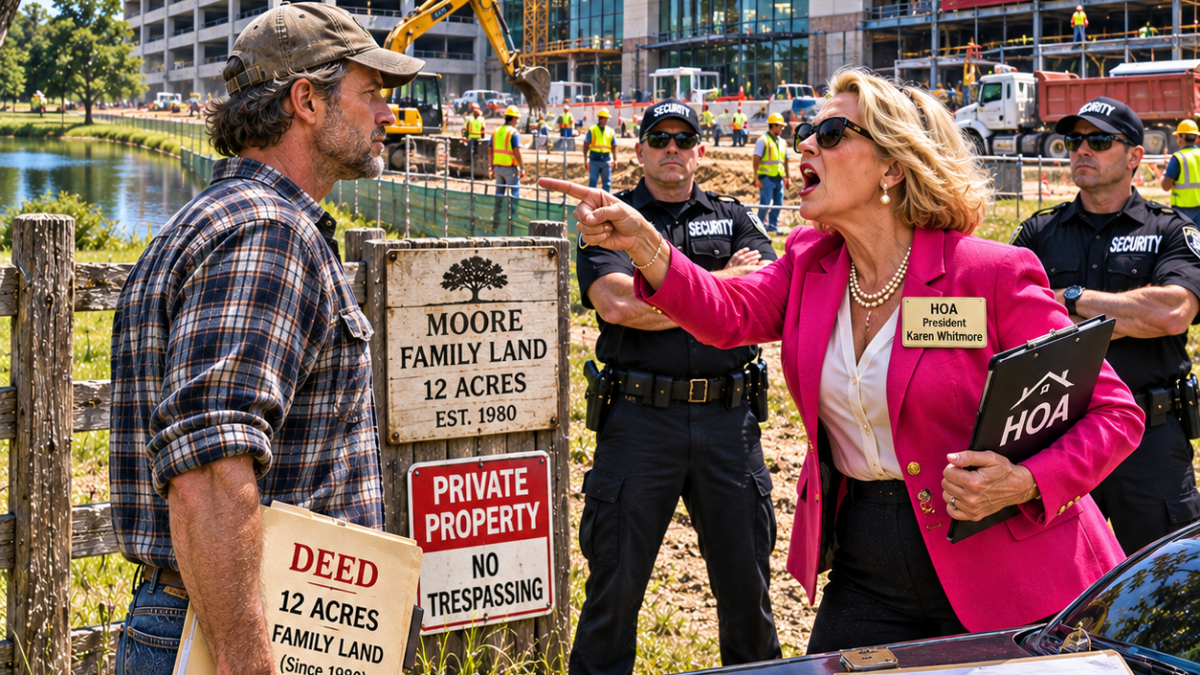
I came back to my uncle’s twelve-acre property carrying his ashes in one hand and found a three-story parking garage, glass storefronts, cranes, and a forty-seven-million-dollar shopping mall rising over the pond where he had taught me to fish as a boy—and when I told the woman in the pink blazer supervising the construction that every shovel of dirt beneath her project legally belonged to me, she laughed in my face and ordered security to remove me for trespassing.
The HOA president claimed she had taken the land through “adverse possession,” bragged that fifteen major retailers had already signed ten-year leases, and offered me twenty-five thousand dollars for a quitclaim deed after I produced forty-four years of tax records proving my family had never abandoned a single acre.
I wanted an injunction before another tree fell, but when my attorney finished reading the deed, the permits, and the strange parcel number the developers had used, she looked at the half-built mall and told me something so cold and calculated that I spent the next six months pretending I had lost.
My name is Charles Moore.
Four years had passed since I had driven the old county road into Maple Creek.
After Uncle Raymond died, I stayed away.
I told people it was because work kept me busy.
That was easier than admitting the truth.
The property hurt.
Raymond never had children. To him, I was the closest thing.
He taught me how to cast a fishing line without burying the hook in my own ear, how to sharpen a hand saw, how to identify walnut by bark, and how to drink coffee so black it could probably strip paint.
In 1978, he planted a line of walnut trees near the pond.
By the time I was old enough to help him clear brush, they were already taller than I was.
“Trees are a promise to people you might never meet,” he once told me.
That was Uncle Raymond.
He could turn planting nuts into philosophy.
When he died, the twelve acres came to me.
I kept the taxes current every year.
No liens.
No transfer.
No sale.
No abandonment.
I just couldn’t bring myself to visit.
Then that spring, I decided I had waited long enough.
His ashes had sat in an urn in my home for almost four years.
I wanted to take him back to the walnut grove.
The GPS led me toward the property, but nothing looked right.
The narrow road had become four lanes.
Traffic lights stood where an old cattle gate used to lean.
Streetlamps.
Sidewalks.
Fresh asphalt.
Then I saw the sign.
**RIVERSIDE PLAZA**
Below it:
**GRAND OPENING SOON**
My foot came off the accelerator.
Beyond the sign was a construction site so large I had trouble making sense of it.
Steel beams.
Concrete.
Cranes.
Glass.
A parking structure.
Workers in neon vests moving through the dust.
And beneath all of it was Raymond’s land.
I pulled over and walked toward the fencing with the urn in my hands.
A security guard stopped me.
“Sir, restricted site.”
“I own this property.”
He laughed.
“Sure.”
“I’m serious.”
Before he could answer, a woman approached.
Mid-fifties.
Blonde hair.
Diamond earrings.
Pink blazer.
The confidence of somebody accustomed to having people step aside.
“Is there a problem?”
“I’m Charles Moore.”
She smiled.
“Amelia Davis. President of Meadow Ridge Homeowners Association.”
I pointed toward the construction.
“This is my land.”
Her smile became almost sympathetic.
“I’m afraid not.”
I stared.
“Excuse me?”
“This acreage sat unoccupied for years. Our association secured development rights through adverse possession.”
“You took my uncle’s land because nobody was living here?”
“In simple terms.”
“I paid the taxes.”
That stopped her.
Only for a second.
Then she recovered.
“The county recognizes the redevelopment.”
“No transfer exists.”
“Mr. Moore, fifteen retailers have already signed leases. Forty-seven million dollars is committed to this project.”
She gestured behind her.
“You should be grateful something useful is finally being done with the property.”
I looked past her.
The walnut grove was gone.
The pond had been filled.
A parking deck stood where Raymond’s cabin once sat.
“You bulldozed his trees.”
Her expression barely changed.
“Sentimental attachment doesn’t establish ownership.”
I tightened my grip on the urn.
Then she raised her phone and photographed my license plate.
“You’re currently trespassing on HOA-controlled property.”
That night I spread the deed, surveys, tax receipts, and county records across my kitchen table.
Tucked inside one faded envelope was a note in Raymond’s handwriting.
**Don’t let them take what we built with honest sweat.**
By morning, the HOA’s lawyer had already called offering me $25,000 to sign away whatever rights I thought I still had.
Two hours later, my attorney Rebecca Torres studied the same papers.
Then she looked up.
“They’ve already lost, Charles.”
“Then we stop them.”
Rebecca shook her head.
“No.”
She tapped the construction photographs.
“We let them finish.”
PART 2
For a few seconds, I thought I had misheard her.
“Let them finish?”
Rebecca nodded.
I stared at her across my kitchen table.
The urn sat on the shelf behind me.
The deed lay beneath her hands.
Outside, a lawn mower droned somewhere down the block as though the world hadn’t just gone insane.
“They’re building on my land.”
“I know.”
“They tore out Raymond’s trees.”
“I know.”
“They filled the pond.”
“I know.”
“And your legal strategy is to let them keep pouring concrete?”
“Temporarily.”
I pushed back from the table.
“No.”
Rebecca didn’t react.
That was one of the things I had always respected about her.
We’d known each other since college, when she was the only person in our property-law elective who could make a professor reconsider his own lecture.
She didn’t raise her voice.
She waited until everyone else exhausted theirs.
Then she spoke.
“Charles, sit down.”
“I don’t want to sit down.”
“Then stand.”
I paced toward the window.
She picked up the county records.
“Let’s separate grief from strategy.”
I turned.
“Don’t do that.”
“Do what?”
“Talk about Raymond like he’s clouding my judgment.”
“He is.”
I stared at her.
Rebecca held up one hand.
“And that doesn’t make you wrong.”
That stopped me.
She continued.
“They destroyed something you loved. I understand that.”
“No, you don’t.”
“You’re right. I don’t.”
Her voice softened.
“But I understand what happens if you rush into court today.”
I said nothing.
She tapped the permits.
“They claim adverse possession.”
“Which is nonsense.”
“Probably.”
“Probably?”
“You want a lawyer or a cheerleader?”
I sank into the chair.
“Lawyer.”
“Good.”
She spread out the documents.
“The deed is clean.”
“My taxes?”
“Paid.”
“Every year.”
“I can see that.”
“Then what are we discussing?”
“Timing.”
She turned her laptop toward me.
Colorado records.
Development filings.
Parcel maps.
Construction permits.
“Adverse possession requires far more than land looking unused.”
“They don’t have the required time.”
“No.”
“They didn’t pay the taxes.”
“No.”
“They didn’t openly occupy the property for eighteen years.”
“No.”
“So?”
“So they’re bluffing.”
I leaned forward.
“Then stop them.”
Rebecca shook her head.
“If we seek an emergency injunction today, they’ll claim a mapping mistake.”
“It wasn’t.”
“I know.”
“They’ll blame the county.”
“Exactly.”
She clicked another document.
“They’ll claim good faith.”
“While offering me twenty-five thousand dollars for a quitclaim?”
“That helps us.”
“Then use it.”
“I will.”
“Now.”
Rebecca leaned back.
“Charles, they already have millions invested.”
I stared at her.
“That’s supposed to make me feel better?”
“No.”
“It makes them vulnerable.”
She let the sentence sit.
Then:
“They think you’re an old property owner who won’t have the stomach or money for a prolonged fight.”
“I’m not old.”
“You’re fifty-eight.”
“That’s not old.”
“Fine.”
“Experienced.”
“Thank you.”
“They’re betting you’ll take the twenty-five thousand.”
I looked at Raymond’s note.
Rebecca lowered her voice.
“What happens if you don’t?”
“They raise it.”
“Yes.”
“And?”
“They keep building because they’ve convinced investors the title problem is manageable.”
My eyes moved back to her.
“And if they finish?”
“The value tied to the encroachment grows.”
I understood where she was going.
Didn’t like it.
But understood.
“You want them to bury themselves.”
“I want them to establish damages and intent so clearly that nobody can pretend this was a harmless clerical error.”
I looked down.
“You’re asking me to watch them build over Raymond’s land.”
“Yes.”
That answer hurt more because she didn’t soften it.
“How long?”
“Until we’re ready.”
“What do I do?”
“Pay taxes.”
“Keep records.”
“Do not sign anything.”
“Do not threaten anyone.”
“Do not trespass into the active construction site.”
“Photograph only from places you’re legally allowed to be.”
“Forward every call and letter to me.”
“And most importantly?”
I waited.
“Don’t tell Amelia what we know.”
—
Rebecca charged me forty-five thousand dollars up front.
I almost choked.
“That’s a lot of patience.”
“Litigation is expensive.”
“You said they’ll reimburse it.”
“I said we’ll seek it.”
“Rebecca.”
“Lawyer.”
I signed.
Not because I was certain.
Because Amelia’s attorney had offered me $25,000 before they had even seen my full file.
People don’t offer money for rights they genuinely believe you don’t have.
That voicemail bothered Rebecca too.
She replayed it.
**The association would like to make a goodwill offer of twenty-five thousand dollars for a quitclaim deed. Let’s settle quietly. It’ll save everyone time.**
She paused.
“Keep this.”
“Obviously.”
“Original file.”
“Already backed up.”
She smiled.
“You’ve become annoying.”
“I learned from you.”
—
The next week, Rebecca came back with something worse.
She had spent days digging through permit filings.
She placed one document in front of me.
“Read the parcel number.”
“4427-BE.”
“Your parcel?”
“4427-B.”
“What’s the E?”
“Exactly.”
I looked at her.
“There is no 4427-BE.”
“Not in the county’s recorded parcel chain.”
“So what is it?”
“A project identifier presented as if it were a recognized subparcel.”
“That’s legal?”
“Not the way they used it.”
I felt something cold move through me.
“They invented a parcel.”
“I’m not saying they literally forged a county parcel.”
“Then what are you saying?”
“That somebody exploited an outdated redevelopment map and created enough ambiguity to push zoning review forward without the title examiner stopping the project.”
“Who?”
“We’re working on that.”
“And Amelia?”
“She’s involved.”
“How involved?”
Rebecca opened another file.
“Her husband.”
“Preston?”
“You know him?”
“Only by reputation.”
“Owns Ridgeline Capital.”
I frowned.
“The developer?”
“One of the funding vehicles.”
I sat back.
“So the HOA isn’t really building the mall.”
“Not exactly.”
She pointed at a corporate chart.
“Meadow Ridge is providing the community-development front.”
“Ridgeline is financing portions.”
“Private investors supply capital.”
“Tenants sign long-term leases.”
“And the HOA gets what?”
“Political cover.”
“Potential fees.”
“Expanded tax base.”
“Influence.”
“And Amelia?”
Rebecca’s eyes hardened.
“That is what we intend to learn.”
—
The more she showed me, the less the project looked like a stupid HOA mistake.
Amelia hadn’t wandered onto an empty field and accidentally erected a shopping mall.
People had planned this.
Lawyers.
Developers.
Consultants.
County staff.
Banks.
Investors.
Somebody had looked at the title problem and decided it was survivable.
Maybe they expected Raymond’s estate to be messy.
Maybe they believed I had abandoned the acreage emotionally and would abandon it financially too.
Maybe they thought the twenty-five thousand dollars would make me disappear.
What they didn’t understand was that Raymond had raised me to hate two things:
bad coffee and people who treated land like paper.
—
I returned to Maple Creek twice a week.
Never onto the construction site.
Always from public roads or neighboring areas where I had permission.
Camera.
Timestamps.
GPS.
Notebook.
The first month, Riverside Plaza was still steel and mud.
Then glass arrived.
Then signs.
Then asphalt.
Every visit hurt.
I watched them pave over places I could still see in memory.
Raymond standing beside the pond.
Raymond cursing because a fishing hook snagged his hat.
Raymond sitting beneath a walnut tree with a thermos between his boots.
The land beneath Riverside Plaza wasn’t spectacular.
No mountain view.
No waterfall.
No historic mansion.
Just twelve acres.
But memory is what makes ordinary ground sacred.
Amelia had called it useless.
That word stayed with me.
—
One evening, I took the urn out there.
I had never completed the reason I returned.
Most of the walnut grove was gone.
One stump remained beyond the edge of active construction.
I couldn’t reach it from the fenced site, so I stood near the legal roadside boundary and opened the urn.
Wind came from the west.
I scattered a small portion of Raymond’s ashes toward the field.
Not all.
Just enough.
“I’m sorry.”
The words came out before I planned them.
“For what?”
No answer.
“For staying away.”
“For letting them do this.”
That wasn’t fair to myself.
But grief doesn’t care about fairness.
I stood there until the dust settled.
Then whispered:
“They’re going to pay.”
I immediately regretted how it sounded.
Raymond had never cared about revenge.
He cared about not being cheated.
There is a difference.
I closed the urn.
“I’m going to make it right.”
That felt better.
—
By June, the mall was recognizable.
Three-story parking garage.
Anchor retail wing.
Restaurants.
Central courtyard.
Landscape crews.
Public signs.
Amelia spotted me near the entrance one afternoon.
She stepped out of a black Range Rover.
Pink suit.
Heels clicking on the new pavement.
“Still here?”
I raised my camera.
“Public road.”
“Obsessed.”
“Interested.”
“In what?”
“The property.”
She laughed.
“You’re still telling people it’s yours?”
“I haven’t told anyone anything.”
That seemed to bother her.
She wanted a public fight.
A Facebook rant.
A threat.
Anything she could use.
She stepped closer to the boundary line.
“You know we have counsel.”
“So do I.”
“Brian tells me you haven’t responded to our offer.”
“I forwarded it to my attorney.”
“You should take it.”
“Why?”
“Because litigation is expensive.”
She smiled.
“People your age should protect their retirement.”
I almost laughed.
There it was.
The assumption Rebecca had predicted.
Old man.
Limited resources.
Easy settlement.
I said:
“You seem very interested in buying rights you say I don’t have.”
Her smile slipped.
Only for a moment.
Then:
“Quitclaims eliminate nuisance disputes.”
“Then perhaps your investors should worry.”
Her face changed.
“You’ll regret playing games.”
I lifted the camera slightly.
“Still recording.”
She turned and walked away.
Rebecca loved the video.
“She cannot help herself.”
—
A week later, an anonymous package arrived at Rebecca’s office.
Inside was a printed transcript from a Meadow Ridge board meeting.
No cover note.
No sender.
One line mattered.
Amelia:
**Even if Moore appears, he won’t have the resources to fight. Once construction is far enough along, the practical outcome is obvious. We can settle for pennies compared with project value.**
Rebecca called me.
“Charles.”
“Yes?”
“Remember how I told you silence was useful?”
“Yes.”
“It’s paying interest.”
She sent the transcript.
I read it twice.
“Can we use it?”
“Only if authenticated.”
“Can we authenticate it?”
“We’re trying.”
“Who sent it?”
“No idea.”
“You sound pleased.”
“I’m a lawyer.”
“You people need hobbies.”
“This is my hobby.”
—
Construction accelerated.
By July, national retailers were installing interiors.
The source material named brands—Target, Best Buy, PetSmart, Olive Garden—and I watched familiar signs begin appearing where Raymond once stored firewood.
That was when the emotional part became hardest.
Steel and concrete felt temporary.
Retail signs didn’t.
They made the theft look finished.
One afternoon, a foreman saw me filming.
“You with the county?”
“No.”
“Press?”
“No.”
“Investor?”
“Not exactly.”
He laughed.
“Just like malls?”
“I have a personal interest.”
He pointed at the building.
“Going to be beautiful.”
I looked at the parking deck.
“I’m sure.”
He walked away.
I sat in my truck for twenty minutes afterward.
Not angry.
Numb.
Then Rebecca called.
“You’re at the site.”
“How do you know?”
“You always sound miserable when you’re there.”
“I hate watching it.”
“I know.”
“When do we file?”
“Not yet.”
“Rebecca.”
“Charles.”
“Give me a date.”
“Late September.”
I looked at the finished storefronts.
“That long?”
“Trust me.”
I hated that phrase.
But I did.
—
September brought the investor gala.
Rebecca told me not to miss it.
“Public event?”
“Yes.”
“Attend.”
“Why?”
“Because Amelia is going to talk.”
She was right.
Riverside Plaza glowed that night.
Spotlights.
Jazz.
Champagne.
Local officials.
Investors.
Business owners.
Amelia stood on a stage beneath a giant banner.
**A VISION OF COMMUNITY**
I wore jeans, a dark shirt, and a cap.
Nobody recognized me at first.
I stood near the back.
Amelia took the microphone.
“Four years ago, this land was abandoned.”
My jaw tightened.
“Forgotten.”
I raised my phone.
“Wasted.”
My hand shook.
“Through vision, leadership, and courage, Meadow Ridge transformed it into opportunity.”
Applause.
Then Preston joined her.
Gray suit.
Perfect smile.
“Our family risked everything.”
He put an arm around Amelia.
“We invested our home, our future, and our reputation into creating something that would outlast us.”
People applauded harder.
My stomach turned.
Not because the speech was arrogant.
Because some of it was probably true.
They had risked a great deal.
On land they knew might not be theirs.
That’s what made it so astonishing.
Greed doesn’t always make people cautious.
Sometimes it convinces them risk is proof of genius.
I recorded every word.
When I left, I heard an investor telling Amelia:
“You’ve built a legacy.”
She smiled.
“This is only the beginning.”
Rebecca watched the video the next morning.
Then said:
“That’s going to age badly.”
—
The filing date came.
September 23.
Nine in the morning.
Rebecca called.
“Title chain?”
“Confirmed.”
“Tax records?”
“Confirmed.”
“Survey?”
“Authenticated.”
“Estate transfer?”
“Confirmed.”
“Quitclaim offer saved?”
“Yes.”
“Videos?”
“Indexed.”
“Ready?”
I looked at Raymond’s note.
“Yes.”
Keyboard clicks.
Then silence.
Rebecca said:
“Filed.”
That was it.
Months of patience reduced to one word.
Filed.
—
The lawsuit hit the Davises like a truck.
Two days later:
**$47 MILLION MALL BUILT ON DISPUTED LAND**
**OWNER CHALLENGES RIVERSIDE PLAZA TITLE**
**GRAND OPENING IN JEOPARDY**
News vans appeared.
Retail tenants called lawyers.
Investors demanded answers.
Amelia issued a statement describing me as:
**a disgruntled opportunist attempting to exploit a minor administrative discrepancy.**
Rebecca forwarded it to me.
“Don’t answer.”
“I wasn’t going to.”
“Good.”
“Can I laugh?”
“Privately.”
—
October 1.
Nine days before the scheduled grand opening.
Judge issued an injunction.
No commercial opening.
No new lease transfers.
No sale.
No additional development while ownership was under review.
Riverside Plaza went from forty-seven-million-dollar monument to forty-seven-million-dollar locked box.
I drove past that evening.
The storefront lights still glowed.
But the parking lot was empty.
No customers.
No grand opening banners.
No music.
Just security.
For the first time since seeing the property, I felt the balance move.
Then Amelia retaliated.
—
Her Facebook post appeared six days later.
My name.
My photograph.
A warning.
She accused me of taking photographs of children near the construction zone.
Nothing could have prepared me for the feeling of seeing my own face beneath words designed to make strangers think I was dangerous.
Comments multiplied.
**Creep.**
**Call police.**
**Why is he photographing families?**
I sat frozen.
The camera work I had done was construction documentation from public areas.
No focus on children.
No school.
No hidden photography.
Didn’t matter.
The accusation spread faster than truth could move.
My daughter Emma called.
“Dad?”
Her voice shook.
“What’s happening?”
“It’s a lie.”
“People are messaging me.”
“I know.”
“Are police investigating you?”
“No.”
“Are you sure?”
That hurt.
Not because she doubted me.
Because Amelia had made my daughter ask.
“Emma.”
“Yes?”
“I have every original file.”
“Every timestamp.”
“Rebecca has everything.”
“I haven’t done what they’re saying.”
A long silence.
“I know, Dad.”
I closed my eyes.
“I’m sorry you’re getting dragged into this.”
“Don’t apologize.”
Then her voice changed.
“Don’t let her win.”
Raymond would have liked Emma.
—
I filed a police report documenting the harassment.
I preserved every post.
Screenshot.
URL.
Timestamp.
Share count.
Comment.
Rebecca started a separate defamation file.
“Do not respond online.”
“She called me a predator.”
“I know.”
“My daughter is being contacted.”
“I know.”
“Then why stay quiet?”
“Because Amelia wants you angry.”
“I am angry.”
“Be angry with me.”
“I’m expensive.”
“Exactly.”
I almost laughed.
Then Rebecca said:
“She is panicking.”
“That doesn’t make me feel better.”
“It should.”
“Why?”
“Because confident people settle.”
“Panicked people make evidence.”
—
Someone spray-painted **LIAR** across my garage.
Red.
Ugly.
Neighbors avoided eye contact.
My employer called.
Architecture firm.
Paid leave.
“Temporary.”
“Until what?”
“Until the controversy settles.”
“Controversy?”
“Charles.”
My boss looked miserable.
“We have school-district clients.”
“So Amelia lies and I lose work?”
“Paid leave.”
I ended the call.
Then my son David called from Denver.
“Dad, is this worth it?”
I stared at Raymond’s note on the refrigerator.
“Ask me something easier.”
“This woman sounds unstable.”
“No.”
“She sounds calculated.”
“That might be worse.”
“It is.”
“Then sell.”
I closed my eyes.
“David.”
“Dad, I’m serious.”
“She offered twenty-five thousand.”
“Negotiate.”
“I can’t.”
“Why?”
“Because if I let somebody knowingly build on Raymond’s property and then buy me off because fighting is inconvenient…”
I stopped.
“What?”
“Then the deed means nothing.”
David was quiet.
“It’s paper.”
“No.”
I looked at the old survey.
“It’s a promise.”
—
Then Emma received the threat.
Unknown number.
**Tell your father to drop the lawsuit or we’ll make sure none of you walk away clean.**
Everything changed.
I stopped feeling clever.
Stopped feeling patient.
Stopped thinking about millions.
I felt fear.
Real fear.
Not for me.
For her.
I called Rebecca.
Her first response infuriated me.
“Good.”
“What?”
“Charles—”
“My daughter was threatened.”
“I mean it’s evidence.”
“I don’t care.”
“I know.”
“Stop saying good.”
She went quiet.
Then:
“You’re right.”
That mattered.
“We document it.”
“Police?”
“Yes.”
“Protective measures?”
“Yes.”
“Emma stays with David for a few days if she’s comfortable.”
“She will.”
“And Charles?”
“What?”
“No vigilante nonsense.”
I looked at the baseball bat beside my chair.
“Fine.”
“You’re not convincing.”
“I said fine.”
—
A dead crow appeared in my mailbox.
Then a threatening video.
Gloved hand.
Red-marker note.
A photograph of me and Emma at her college graduation.
**DROP THE CASE OR YOU’LL REGRET IT.**
I sent everything to law enforcement.
Deputy Martinez took the later threats seriously.
“Someone wants you frightened.”
“They succeeded.”
He looked at me.
“Good.”
I almost snapped.
He continued:
“Fear makes you careful.”
That was different.
“Don’t let it make you reckless.”
Everyone had the same advice.
Apparently I had a reputation.
—
The preliminary hearing came on a gray morning.
Boulder County Courthouse.
Reporters outside.
Rebecca waited inside.
Black suit.
Red lipstick.
Confidence.
Amelia sat across the courtroom.
Navy blazer.
Pearls.
Preston beside her.
Their lead lawyer, Brian Kemp, opened.
“Simple misunderstanding.”
That phrase almost made me laugh.
He argued outdated zoning maps.
Administrative error.
Abandoned land.
Good-faith redevelopment.
Judge Angela Ramirez interrupted.
“Did your clients verify deed ownership?”
Silence.
Kemp started talking around it.
She cut him off.
“Yes or no.”
“No.”
Then Rebecca stood.
“Your Honor, my client paid the property taxes every year for forty-four years.”
She handed over certified records.
One.
Another.
Another.
Judge Ramirez flipped through them.
“Counsel?”
Kemp’s face tightened.
He tried the abandonment argument again.
Ramirez looked at him.
“With continuous tax payment by Mr. Moore?”
Silence.
“Then your theory has a problem.”
Amelia stopped smiling.
—
Rebecca wasn’t finished.
She introduced the email.
The real turning point.
Preston to Amelia.
March.
**Charles Moore technically owns the parcel.**
My stomach tightened hearing my name read aloud.
Then:
**Adverse possession likely won’t hold.**
The courtroom became silent.
Then the line that changed everything:
**If we move fast, confusion will stall him. Once construction is underway, he’ll settle cheap or drown in legal costs.**
I looked at Preston.
For the first time, his confidence disappeared.
Rebecca continued reading.
**Worked in Aspen. Risk moderate. Reward forty-seven million.**
Somebody in the gallery gasped.
Judge Ramirez looked at Kemp.
“Authentic?”
He hesitated.
“Context—”
“Authentic?”
“Yes, but—”
“Thank you.”
Then she turned toward the Davises.
“Do either of you deny sending or receiving this?”
Neither answered.
Amelia looked down.
Preston whispered to his attorney.
Rebecca said:
“This was not a mistake.”
No theatrics.
No raised voice.
She didn’t need them.
“This was a strategy.”
—
The court denied their motion to dismiss.
The injunction remained.
Use and transfer of Riverside Plaza remained frozen.
Then Rebecca revealed the whistleblower.
Former business associate.
Prior project.
Similar method.
Aspen.
Preston slammed his hand on the table.
The judge hit the gavel.
The courtroom erupted.
Reporters ran toward the hallway the second proceedings ended.
Outside, someone shoved a microphone toward me.
“Mr. Moore, did the HOA knowingly build on your land?”
I looked toward Riverside Plaza in my imagination.
Then said:
“They didn’t build on my land.”
The reporter blinked.
“They built on their mistake.”
Rebecca laughed as we walked away.
“I’m stealing that.”
“Invoice me.”
—
The preliminary hearing was only the beginning.
Rebecca built what she called “the web.”
Ridgeline Capital.
Other property projects.
LLCs.
Boundary disputes.
Settlements.
County approvals.
One project in Aspen where ownership confusion had been resolved through a multimillion-dollar settlement.
Not every project was identical.
Not every dispute proved wrongdoing.
Rebecca kept reminding me.
“Pattern requires proof.”
“Similarity isn’t proof.”
“You sound like a broken record.”
“Broken records win appeals.”
But the evidence kept growing.
A title-company payment labeled consulting.
Sixty thousand dollars.
Contractors saying they were told ownership had been cleared.
A campaign donation by Preston near the time of a zoning approval.
Internal emails.
An old voicemail.
Enough for investigative reporter Patricia Hughes to take interest.
—
Patricia came to my house in January.
No sensationalism.
No fake sympathy.
She placed a recorder on my kitchen table.
“Why didn’t you stop construction when you first found it?”
I looked at Rebecca.
Rebecca said:
“Answer honestly.”
I did.
“Because my attorney believed their investment would make the ownership issue impossible to hide.”
Patricia leaned forward.
“So you intentionally let them spend more?”
“Yes.”
“Revenge?”
I thought.
“At first?”
“Partly.”
“Now?”
I looked at Raymond’s photograph.
“Now I think I wanted them to understand that land doesn’t become yours because you can afford concrete.”
She asked about Uncle Raymond.
That interview became harder.
I showed her photographs.
The walnut grove.
The pond.
His cabin.
She asked:
“What hurt most?”
“The trees.”
“Not the mall?”
“No.”
“Why?”
“Buildings can change.”
I touched the picture.
“Those trees took forty years.”
We filmed near the remaining walnut stump.
I said:
“My uncle paid for this land with a lifetime of work.”
Then the sentence that made Patricia’s final report:
“They paved it over in six months.”
—
Her investigation aired one week before final trial.
The segment began with drone footage of the empty mall.
Beautiful.
Silent.
Forty-seven million dollars with nowhere to go.
Then deeds.
Tax records.
Preston’s email.
Former contractors.
Other disputed projects.
The title-company payment.
Campaign contribution.
My interview.
By the end, my phone exploded.
Emma called.
“Dad.”
“Yeah?”
“You’re everywhere.”
David shouted in the background:
“They’re done!”
I smiled weakly.
“No.”
“They’re exposed.”
Difference mattered.
Then an email from my employer:
**Return Monday.**
They apologized for the leave.
Not enough.
But something.
For ten minutes, I felt relieved.
Then another threat arrived.
Rebecca forwarded it to investigators.
The next morning, she called.
“A federal fraud unit contacted us.”
I sat down.
“Because of Patricia?”
“Partly.”
“Because of the financial records.”
“Mostly.”
“Are we federal now?”
“Potentially.”
I groaned.
“I preferred property court.”
“So did I.”
—
The final civil proceeding packed the courtroom.
Tenants came.
Retailers.
Contractors.
Reporters.
Residents.
People who had cheered Amelia’s redevelopment speeches.
People who now whispered when she entered.
The tenants were the hardest part for me.
They had not stolen my land.
They had signed leases believing the developers had title.
Some had spent savings.
Hired employees.
Purchased inventory.
One small bookstore owner had mortgaged his house.
I watched them and felt something uncomfortable.
If I “won” the mall in the bluntest possible way, innocent people could lose with the Davises.
That wasn’t what Raymond’s note meant.
Don’t let them take what we built.
It didn’t say:
Take from everybody else.
I leaned toward Rebecca.
“What happens to tenants?”
“We’ll address remedies after title.”
“I don’t want them punished.”
“I know.”
“Make sure.”
She looked at me.
“That’s why you’re different from Amelia.”
I didn’t feel different.
I felt tired.
—
Rebecca opened with documents.
Not anger.
Chain of title.
Tax records.
Survey.
Parcel mismatch.
Permit history.
Email.
Ridgeline relationship.
Title-company payment.
Contractor deposition.
The whistleblower.
Then the Davises’ own public speeches.
Amelia at the gala:
**This land was abandoned.**
Then Preston’s private email:
**Charles Moore technically owns the parcel.**
The contrast was brutal.
Public certainty.
Private knowledge.
Judge Ramirez watched both.
No expression.
That frightened me more than anger would have.
—
A contractor testified.
“We were told the title was clean.”
“By whom?”
“Project leadership.”
“Who specifically?”
“Mrs. Davis.”
Amelia stared at him.
He looked away.
Rebecca asked:
“Did you ever see a deed transferring title from Charles Moore?”
“No.”
“Did you ask?”
“No.”
“Why?”
“We trusted them.”
Again.
Trust.
That word was everywhere.
The tenants trusted developers.
Contractors trusted project management.
County staff trusted maps.
Investors trusted lawyers.
And somewhere in the middle, somebody decided trust could replace verification.
That’s how forty-seven million dollars ended up sitting on land nobody had lawfully purchased.
—
Reverend Morales, one of the tenants, asked to address the court through proper procedure.
His voice shook.
“We leased in good faith.”
He looked at me.
“We hired people.”
“Bought inventory.”
“Some of us spent everything.”
“We did not know.”
I believed him.
So did Rebecca.
The dispute had started as me versus an HOA.
Now it was me trying to recover land without creating another set of victims.
Justice gets complicated when consequences spread beyond the people who caused the harm.
—
Then I testified.
Rebecca began gently.
“Who was Raymond Moore?”
“My uncle.”
“What did he mean to you?”
“Everything.”
I looked at the gallery.
“He never had children.”
“He taught me most things my father didn’t have time to teach.”
“Fishing.”
“Carpentry.”
“How to swear at tractors.”
A few people laughed.
I continued.
“He planted walnuts in 1978.”
“Why?”
“He said trees were promises.”
My throat tightened.
Rebecca waited.
“Did you abandon the property?”
“No.”
“Did you stop paying taxes?”
“No.”
“Did you authorize Meadow Ridge HOA to develop it?”
“No.”
“Did you lease it to Ridgeline?”
“No.”
“Sell it?”
“No.”
“Transfer it?”
“No.”
“Grant construction rights?”
“No.”
“Then when did you first learn about Riverside Plaza?”
“The day I came to scatter his ashes.”
The courtroom went completely still.
I looked at Amelia.
For once, she looked away first.
—
Rebecca showed the photograph from that day.
Me.
Truck.
Urn.
Steel beams behind me.
Then a photograph from years earlier.
Raymond under the walnut trees.
She didn’t say anything dramatic.
Didn’t need to.
The difference between them was the case.
—
The defense argued good faith.
Mistakes.
Administrative confusion.
Overreliance on project consultants.
They blamed mapping.
They blamed subordinate staff.
They blamed outdated records.
They even suggested I had deliberately waited in order to inflate damages.
That one was partially true.
Rebecca had advised strategic timing.
I admitted it.
Kemp asked:
“Mr. Moore, you could have sought an injunction immediately.”
“Yes.”
“But you didn’t.”
“No.”
“You watched construction continue.”
“Yes.”
“You understood millions were being spent.”
“Yes.”
“And you remained silent.”
“Yes.”
He turned toward the judge as though he’d won.
“So this was a trap.”
I looked at him.
“No.”
He faced me again.
“You let my clients build.”
“I didn’t authorize anything.”
“You knowingly watched.”
“Yes.”
“Because you expected to profit.”
I took a breath.
“Because your clients already knew the land wasn’t theirs.”
Silence.
Kemp frowned.
I continued.
“If they had made an honest mistake, they could have checked the deed before the first foundation.”
Rebecca stood.
“Your Honor—”
Judge Ramirez raised one hand.
“Let him finish.”
I looked at Kemp.
“They offered me twenty-five thousand dollars for a quitclaim before I hired Rebecca.”
His face tightened.
“They didn’t need a quitclaim from a man they believed owned nothing.”
That ended the exchange.
—
Then came Preston’s email again.
It destroyed every remaining claim of innocent mistake.
**Technically owns the parcel.**
**Adverse possession likely won’t hold.**
**Confusion will stall him.**
**He’ll settle cheap or drown in legal costs.**
Those words hung over everything.
The mall.
The threats.
The smear campaign.
The offer.
The construction.
The investors.
All of it.
This wasn’t a technicality.
It was a bet.
They bet I would be too weak to defend what I owned.
—
Judge Ramirez’s written ruling arrived the next morning.
Sixteen pages.
Rebecca called before sunrise.
“Are you awake?”
“I am now.”
“We won.”
I sat up.
“Define won.”
“Title confirmed.”
I closed my eyes.
“All twelve acres?”
“All twelve.”
“What about Riverside?”
“Court recognizes your superior title and orders the necessary transfer and remedy process subject to tenant and creditor rights.”
“Damages?”
“Significant.”
“How significant?”
“Five-point-eight million in awarded compensatory and punitive components under the court’s ruling, plus legal fees and costs.”
I stopped breathing.
“Rebecca.”
“Yes?”
“Say that again.”
She did.
Then:
“Court also referred the evidence regarding Ridgeline, the title-company payment, and related conduct to federal authorities.”
I stared at the wall.
“This is real?”
“Yes.”
“Raymond’s land?”
“Yours.”
I looked at the urn.
Then cried.
Not dramatically.
No speech.
I just sat there with the phone against my ear and cried like a child.
Rebecca stayed silent.
Good friend.
Good lawyer.
—
Outside court, reporters asked about the money.
The mall.
The Davises.
I said:
“This isn’t about forty-seven million dollars.”
Someone shouted:
“Then what is it about?”
I thought about Raymond.
“The ground under it.”
That became the headline instead.
—
Federal cases came later.
Wire fraud.
Financial conspiracy allegations.
Money movement.
Improper payments.
Ridgeline’s corporate structure.
I won’t pretend I understood every charge.
I didn’t.
Rebecca did.
Patricia did.
Federal prosecutors definitely did.
Preston faced the most serious consequences.
Ridgeline collapsed.
Assets went into receivership.
Investors sued.
The title-company executive entered a guilty plea involving improper payments.
Amelia negotiated a lesser resolution requiring restitution and prohibiting future development or HOA leadership activity.
The confident woman in the pink blazer disappeared from television.
Then from Maple Creek politics.
People asked if I felt satisfied.
Some days.
Others?
I looked at Riverside Plaza and saw Raymond’s trees.
Winning doesn’t restore everything.
—
Then came the biggest decision.
What to do with the mall.
Legally, financially, and ethically.
Sell it?
Demolish it?
Operate it?
Charge enormous rents?
I could have become wealthy enough to spend the rest of my life doing nothing.
The thought was tempting.
Very.
Then I met the tenants.
Again.
Not in court.
At the old community center.
Bookstore owner.
Restaurant family.
Pet-store operator.
Small retailers.
Employees.
They weren’t Amelia.
They weren’t Preston.
They had been fooled too.
One woman said:
“I put my daughter’s college money into inventory.”
Another:
“My husband quit his job for this.”
Reverend Morales said:
“We understand it’s your land.”
That sentence hurt.
Because technically it was.
But sitting there, I remembered something Raymond used to say.
Owning land isn’t the same as deserving everything you can extract from it.
He never said it exactly like that.
He would’ve used fewer words.
Probably:
“Don’t be greedy, kid.”
—
Rebecca and Patricia helped me structure something better.
The **Raymond Trust**.
A nonprofit vehicle that would hold the commercial property and protect the legitimate businesses operating there.
Tenants received options.
Long-term fair leases.
Pathways to purchase certain units at cost or under structured terms.
No windfall extraction.
No sudden eviction.
A portion of revenue funded community programs.
I contributed part of my damages award.
People thought I was insane.
David called.
“Dad.”
“Yes?”
“You could be rich.”
“I am rich.”
“You drive a nine-year-old truck.”
“Excellent truck.”
“You know what I mean.”
“Yes.”
“Why give it away?”
“I’m not giving it away.”
“What are you doing?”
I looked at Raymond’s note.
“Finishing the job.”
—
We renamed Riverside Plaza.
Not after me.
I refused.
Rebecca suggested Raymond Square.
Too obvious.
Patricia suggested Walnut Square.
I liked it.
Then tenants voted.
**WALKER SQUARE**
A name tied to Raymond’s family history and the people who had worked that land before the development.
At the center, we planted a new walnut tree.
Small.
Almost embarrassingly small compared to the ones that had been destroyed.
I stood beside it holding the last of Raymond’s ashes.
Emma.
David.
Rebecca.
Patricia.
Tenants.
Neighbors.
No cameras from major media this time.
Just people.
I scattered the remaining ashes into the soil around the tree.
Emma held my arm.
“Grandpa would’ve liked this.”
I shook my head.
“He would’ve complained about parking.”
She laughed through tears.
“Definitely.”
—
Opening day came months after the original date.
No Amelia speech.
No Preston.
No Ridgeline banner.
The entrance read:
**WALKER SQUARE**
Below it:
**BUILT ON JUSTICE. HELD IN TRUST FOR COMMUNITY.**
Shops opened.
Employees returned.
Customers filled the plaza.
Children ran around the fountain.
A bookstore opened early because the owner was too excited to wait.
The restaurant ran out of bread before noon.
For the first time, I walked through the mall without feeling like an intruder.
Not because I owned the ground.
Because the place had finally stopped pretending Raymond never existed.
Near the center courtyard stood a plaque.
**IN MEMORY OF RAYMOND MOORE**
**1978 — HE PLANTED WALNUTS HERE FOR A FUTURE HE WOULD NEVER SEE.**
I touched the edge.
Then stepped away before anyone saw my face.
—
Amelia appeared once.
Months later.
She had taken a part-time job in a small retail shop.
I don’t know whether she needed the money or wanted anonymity.
Maybe both.
I walked past.
She looked up.
Our eyes met.
No pink blazer.
No diamonds.
No entourage.
Just a woman behind a register.
She looked away first.
I kept walking.
Some people expected me to confront her.
Ask if she remembered calling Raymond’s land useless.
Ask how it felt working in the mall she once claimed to own.
I didn’t.
There was nothing left to say.
Real revenge would have been humiliating her.
Justice had already done enough.
—
Years passed.
Preston’s federal case became one of those local stories law students later discussed.
Patricia won another award for her reporting.
Rebecca pretended she wasn’t proud.
She was.
Walker Square became stable.
The tenants formed an advisory council.
Financial reports became public.
The Trust held annual meetings.
Nothing glamorous.
Transparency usually isn’t.
The walnut tree grew.
Slowly.
Every year I photographed it.
Year one:
thin trunk.
Year two:
first real spread.
Year three:
stronger branches.
Raymond had been right.
Trees are promises to people you may never meet.
—
Sometimes visitors asked why I had let the mall finish.
They expected a clever answer.
Something about revenge.
Timing.
Letting enemies build their own downfall.
There was truth in that.
But years later, I saw it differently.
“I trusted the paperwork.”
That’s what I said.
Not because paper is magical.
Because records matter when power tries replacing truth with momentum.
Amelia thought forty-seven million dollars in concrete would become stronger evidence than one old deed.
She thought once the building existed, ownership would feel inevitable.
Investors would pressure me.
County officials would protect the project.
Lawyers would exhaust me.
Public opinion would make me look selfish.
In other words, she thought enough weight could make the wrong thing right.
She was wrong.
—
I kept the original twenty-five-thousand-dollar quitclaim voicemail.
Not because I needed it.
Because it made me laugh.
Forty-seven-million-dollar project.
Fifteen tenants.
Millions in future rents.
And they thought twenty-five thousand dollars might erase me.
Arrogance isn’t only believing you’re powerful.
Sometimes it’s believing everyone else has a price low enough for you to afford.
—
Rebecca retired eventually.
At her retirement party, I gave her a framed photograph.
The half-built mall.
Steel beams.
Mud.
Cranes.
She looked at it.
“What is this?”
“The day you told me to let them finish.”
She laughed.
“You hated me.”
“I still do.”
“You paid me seventy-eight thousand dollars in the end.”
“They paid you.”
“Best client ever.”
“You almost gave me a heart attack.”
“Best strategy ever.”
I shook my head.
“You got lucky.”
She smiled.
“Good lawyers know when to look lucky.”
Then became serious.
“You know, Charles, I wouldn’t always advise someone to wait the way we did.”
“I know.”
“It was risky.”
“I know.”
“The facts were unusually strong.”
“I know.”
“You could’ve lost.”
“I know.”
“Then why does everyone repeat it like a universal strategy?”
“Because people like simple stories.”
She nodded.
“And real life?”
“Messy.”
“Exactly.”
That mattered.
The lesson wasn’t:
Always let someone finish building illegally.
The lesson was:
Know your facts before you move.
—
The county changed its permitting process after Riverside.
Title confirmation got stricter for redevelopment parcels.
Independent ownership verification.
More cross-checks.
Better parcel-ID controls.
No system becomes perfect.
But harder to exploit.
That satisfied me almost as much as the judgment.
The next person might not need Rebecca.
That was worth something.
—
One afternoon, a young man found me near the walnut tree.
“Mr. Moore?”
“Yes?”
“My grandfather lost land in a development dispute.”
I looked at him.
“I’m sorry.”
“He didn’t fight.”
“Maybe he had reasons.”
“He said lawyers were too expensive.”
“That can be true.”
“You fought.”
“I was able to.”
He looked toward the mall.
“Was it worth it?”
I thought.
“Financially?”
“Emotionally.”
Harder.
I looked at Raymond’s plaque.
“Ask me on different days, you’ll get different answers.”
He smiled faintly.
“Today?”
I touched the tree.
“Yes.”
—
The mall became less strange over time.
At first, every brick felt like an insult.
Later, I began seeing people instead.
A teenager working her first job.
An elderly couple drinking coffee.
Parents buying school supplies.
A barber opening his first shop.
A kid sitting on the fountain edge reading a book from the store upstairs.
Buildings inherit meaning from what people do inside them.
Amelia built Riverside Plaza as a monument to power.
The community slowly made Walker Square ordinary.
That was better.
—
I never rebuilt Raymond’s pond.
Couldn’t.
Too much infrastructure.
Instead, the Trust funded a small wetland restoration project on another section of open land nearby.
We planted native species.
Built a walking path.
No fancy sign.
Only:
**RAYMOND GROVE**
There were walnut saplings there too.
I visited once a month.
One day I found a father teaching his son how to fish in the restored water feature.
The boy tangled his line.
Hook caught the father’s hat.
I laughed so hard they both stared at me.
“Sorry.”
The father smiled.
“First time.”
“I’ve seen it before.”
Very long time ago.
—
Emma eventually asked me to write down the full story.
“I don’t want the internet version.”
“What internet version?”
“The one where you somehow owned Target.”
I groaned.
People exaggerated everything.
Some versions said I evicted every tenant.
False.
Some claimed I bulldozed the mall.
False.
Some claimed Amelia went to prison for twenty years.
False.
Some said Rebecca secretly bought the property.
Nonsense.
“Write the real one.”
So I did.
Not because I thought it made me heroic.
Mostly because I wanted my grandchildren to understand Raymond.
That was the center of it.
Not Amelia.
Not Preston.
Not forty-seven million dollars.
Raymond.
—
I wrote about the walnut trees.
How he planted them in 1978.
How he taught me land was not an abstract asset.
It was responsibility across time.
You received something because someone before you protected it.
Then you had a choice:
consume it,
sell it,
neglect it,
or carry it forward.
Amelia saw twelve acres nobody occupied every day.
Raymond saw inheritance.
Those are different ways of measuring value.
—
The final time I saw Amelia was almost ten years after the lawsuit.
She was older.
So was I.
Walker Square held an anniversary event.
I didn’t want to attend.
Emma made me.
Amelia stood across the courtyard near the walnut tree.
Not working there anymore.
Just visiting.
She approached slowly.
“Charles.”
I hadn’t heard her voice in years.
“Amelia.”
She looked up at the tree.
“It’s gotten big.”
“Not yet.”
She smiled faintly.
“Still correcting people.”
“Sometimes.”
Silence.
Then:
“I was wrong.”
Simple.
No lawyer.
No cameras.
No press.
No explanation.
I waited.
She continued.
“I told myself the development justified everything.”
I said nothing.
“Jobs.”
“Tax revenue.”
“Growth.”
“Once enough people depended on it, I thought nobody would dare undo it.”
There it was.
The truth underneath the scheme.
Not just greed.
Momentum.
She had tried to turn consequences into legitimacy.
She looked at me.
“I thought you’d take the money.”
“Twenty-five thousand?”
Her face reddened slightly.
“Yes.”
“Why?”
“Because everyone does eventually.”
I almost laughed.
Instead:
“Not everyone.”
She nodded.
“I know.”
We stood beneath Raymond’s tree.
Finally she said:
“I’m sorry about the walnut grove.”
That one reached me.
Not the mall.
Not the money.
The trees.
“Thank you.”
She left.
I never saw her again.
—
That evening, I stayed after the anniversary crowd disappeared.
Stores closing.
Lights dimming.
The walnut leaves moved in the breeze.
I sat on a bench.
Raymond’s plaque beside me.
The plaza had changed names.
Changed owners.
Changed meaning.
But the ground beneath it hadn’t moved.
That was the quiet truth at the center of everything.
Lines on corporate diagrams changed.
Parcel identifiers changed.
PR changed.
Politicians changed.
Owners died.
Developers failed.
Businesses opened and closed.
But the deed chain told the same story.
Raymond.
Then me.
And later, by my choice, the Trust.
Choice mattered.
Consent mattered.
That was what Amelia had tried to erase.
—
People still ask what my favorite courtroom moment was.
Judge Ramirez reading Preston’s email?
Powerful.
The injunction?
Satisfying.
The final title judgment?
Emotional.
But the moment I remember most happened before court.
At my kitchen table.
Rebecca said:
“They’ve already lost.”
At the time, I thought she meant the lawsuit.
Years later, I understood something else.
Amelia and Preston lost the moment they knowingly decided another person’s rights were merely an obstacle to manage.
Everything afterward was accounting.
—
Raymond’s handwritten note remains in my kitchen.
Faded.
Creased.
Protected now behind glass.
**Don’t let them take what we built with honest sweat.**
For years, I interpreted it as:
Fight.
Hold.
Refuse.
Now I read it differently.
What did Raymond build?
Not only land.
A standard.
If something is yours, protect it.
If you are wrong, admit it.
If you have power, don’t confuse it with permission.
And if you win, don’t become the person you fought.
That’s why I didn’t destroy the tenants.
That’s why I didn’t turn Riverside into my personal empire.
That’s why the property went into trust.
Winning gave me the right to choose what happened next.
Character decided what I did with that right.
—
One autumn afternoon, I brought my grandson to Raymond Grove.
He was nine.
Same age I was when Raymond first taught me to fish.
He immediately tangled the line.
Of course.
I untangled it.
He asked:
“Grandpa says this used to be your land?”
“Some of it still is.”
“Did bad people steal it?”
Kids make complicated stories simple.
“They tried.”
“You beat them?”
I considered.
“The paperwork did.”
He looked disappointed.
“No fight?”
“Lots of lawyers.”
“Boring.”
“Very.”
He cast again.
Then asked:
“Why didn’t you sell?”
I looked toward the distant plaza.
“Because sometimes money isn’t the most valuable thing somebody’s asking you to give up.”
He frowned.
“What’s more valuable?”
I thought about Raymond.
“Being able to decide for yourself.”
He nodded as though that made perfect sense.
Then his line moved.
“Fish!”
And the lesson vanished.
Probably healthier.
—
Walker Square celebrates its anniversary every year now.
I rarely speak.
The first few years, reporters wanted me on stage.
I stopped agreeing.
The story doesn’t need me anymore.
That’s another sign of success.
The Trust runs.
Businesses operate.
Scholarships go out.
Twelve thousand dollars each year for students in architecture and forestry.
Raymond’s two loves.
One year, a scholarship recipient wrote me a letter.
She wanted to design urban projects that preserved existing trees instead of clearing them automatically.
I read that letter twice.
Then walked to Raymond’s walnut tree.
“See?”
Wind moved through the leaves.
He would’ve called me sentimental.
He would’ve been right.
—
My architecture firm offered me partnership after the case.
I declined.
Too many meetings.
Eventually I worked fewer hours.
Then retired.
I spent more time at Walker Square than I expected.
Not managing.
Walking.
Coffee.
Bookstore.
Watching.
One cashier called me “Mr. Mall.”
I hated it.
She kept doing it.
—
The final legal check from the Davises’ restitution process arrived years after the first judgment.
By then, the amount didn’t matter emotionally.
I deposited it into the Trust.
Rebecca called.
“You could keep that.”
“I know.”
“You’re impossible.”
“I learned from you.”
“Wrong lesson.”
—
Patricia later interviewed me for a retrospective.
Same question:
“Any regrets?”
I looked toward Walker Square.
“Some.”
“Which?”
“I wish I had visited Raymond’s land sooner.”
That was the only one that still hurt.
If I had returned a year earlier, maybe the trees would still be there.
Maybe the pond.
Maybe the cabin site.
Waiting gave us leverage after I discovered the mall.
But staying away for four years had given the developers opportunity before I knew anything was wrong.
Those are different things.
I made sure Patricia understood.
“Don’t turn this into a story about intentionally letting people steal from you.”
She smiled.
“I won’t.”
“Pay attention to your property.”
“Yes.”
“Read notices.”
“Yes.”
“Check records.”
“Yes.”
“Then call a lawyer before forty-seven million dollars shows up.”
She laughed.
“Better headline.”
—
On the twentieth anniversary of Raymond’s death, Emma and David joined me beneath the walnut tree.
It was finally tall enough to throw real shade.
We spread a picnic blanket.
Bad coffee.
Raymond would’ve approved.
David looked around.
“Hard to believe this was almost something else.”
“It was something else.”
“What?”
“His.”
Emma corrected:
“Ours.”
I smiled.
Then:
“Now everybody’s.”
That was the ending.
Not me getting a mall.
Not Amelia losing one.
Not Preston facing federal charges.
The land Raymond protected became something shared because the person who legally owned it chose to share.
That was the exact opposite of what Meadow Ridge had done.
They had called theft “community progress.”
We made community through consent.
Huge difference.
—
As sunset hit the plaza glass, the building reflected orange light.
For the first time, I thought it looked beautiful.
That surprised me.
Same walls.
Same concrete.
Same parking deck.
But years had changed what they meant.
I no longer saw Amelia’s monument.
I saw shop owners.
Employees.
Students funded by the Trust.
Children playing near the fountain.
Raymond’s tree.
Meaning isn’t poured into concrete.
People give it meaning afterward.
—
I stood.
My knees complained.
Age.
Actual age now.
Emma laughed.
“You okay?”
“Perfect.”
David said:
“You always say that before complaining.”
“Family tradition.”
We walked toward the parking lot.
Halfway there, I turned back.
The walnut tree moved in the evening wind.
Behind it:
**WALKER SQUARE**
No HOA name.
No Ridgeline.
No Amelia.
No Preston.
I remembered that first day.
Security guard laughing.
Amelia telling me my land had been abandoned.
Her saying I should be proud somebody had finally made it valuable.
She had been wrong about almost everything.
But one thing?
The land did become valuable in a way Raymond never imagined.
Not forty-seven million.
More.
Because now its value wasn’t measured only in what somebody could build on it.
It was measured in what the fight taught everyone who came after.
Titles matter.
Taxes matter.
Records matter.
Consent matters.
And patience—when guided by law instead of rage—can turn arrogance against itself.
—
I keep one last photograph on my desk.
Not the courthouse.
Not Amelia.
Not the mall.
Raymond in 1978.
Young.
Dirty shirt.
One knee in the soil.
Holding a walnut sapling.
Behind the photo, in his handwriting:
**Give it time.**
I didn’t notice those words until years after the case.
Maybe he meant the tree.
Maybe he meant nothing deeper.
But I like to think he understood something I had to learn the hard way.
Some things grow slowly.
Trees.
Truth.
Consequences.
Justice.
You don’t always see them working.
Then one day, something that looked small has roots deeper than anything built above it.
Amelia and Preston built forty-seven million dollars of glass and concrete on twelve acres they assumed nobody would defend.
I came to court with an old deed, forty-four years of taxes, and a promise written by a dead man.
In the end, the concrete wasn’t stronger.
The truth was.
And every time I walk beneath Raymond’s walnut tree, I remember exactly why.
[END OF STORY]




