PART 2: HOA Karen Kept Cutting Across My Farm—Then Her SUV Sank in the Trench She Had Been Warned About
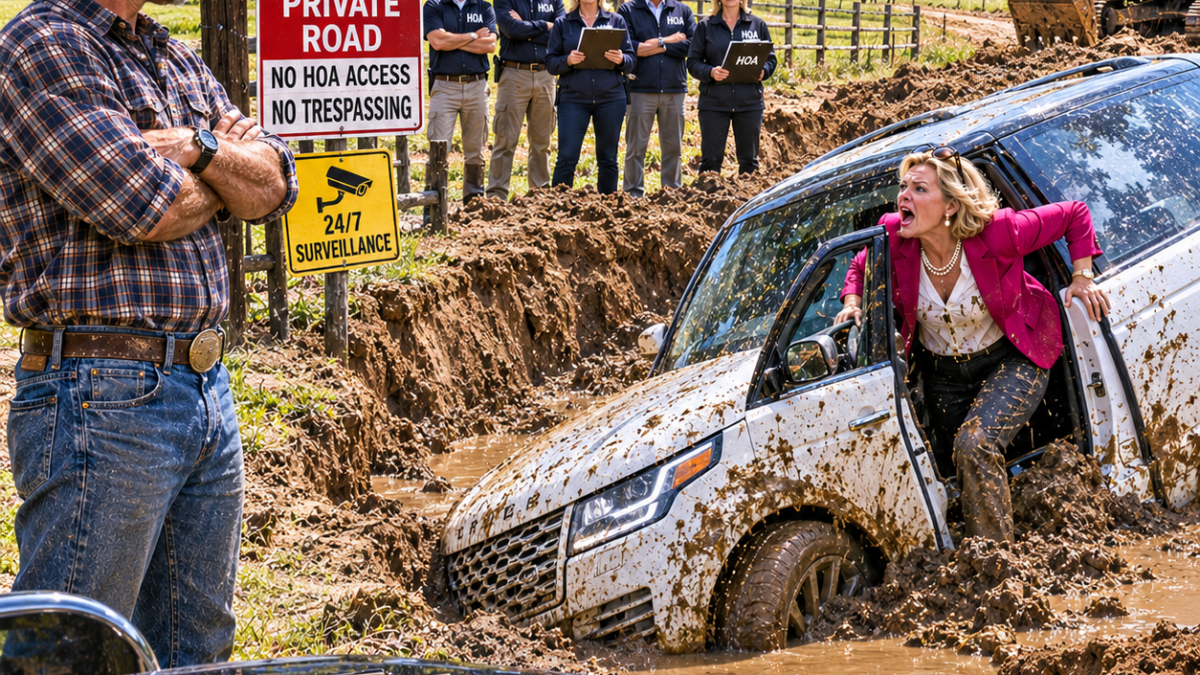
The morning Claire Phillips crushed my PRIVATE ROAD sign beneath the tires of her white HOA SUV, she didn’t brake, apologize, or even pretend she hadn’t seen me standing beside the barn—she just lifted two fingers from the steering wheel, gave me that smug little wave she always used when she believed rules belonged to other people, and kept tearing across the ranch road my family had maintained for fifteen years.
I had already asked her politely, installed signs, shown her the property line, called the county, and explained that Whispering Pines had its own legal highway access, but Claire had responded by gathering her HOA board on my land and holding a “community vote” to declare my road a shared easement, as though enough suburban homeowners raising their hands could somehow rewrite my deed.
What finally made me stop arguing wasn’t the broken sign, the fake violation letters, or even the laminated notice threatening me with HOA fines—it was something I found in the county archives that proved Claire’s entire campaign had been legally dead decades before she ever pointed her SUV toward my gate.
My name is Brandon Rogers, and that dirt road was never just a shortcut.
For fifteen years, it was the working artery of my ranch.
Feed trucks used it.
Veterinary trailers used it.
I used it before sunrise during calving season, after midnight when storms knocked fences down, and every August when dry Texas heat baked the ground hard enough to crack.
When summer rain carved ruts into the slope, I repaired them.
When brush crept toward the edges, I cleared it.
When a culvert clogged, I opened it.
Nobody else paid for that road.
Nobody else maintained it.
And until Whispering Pines appeared across the creek, nobody else believed they had a right to it.
The subdivision showed up almost overnight.
A hundred nearly identical beige houses.
Stone entrance.
Decorative gate.
Solar streetlights.
And a giant wooden sign:
**WHISPERING PINES**
There wasn’t a pine tree within three miles.
Then came Claire.
White SUV.
Chrome trim.
HOA logo on the door.
Every weekday around 7:30 in the morning, she’d emerge from the subdivision’s rear service gate, cut straight onto my ranch road, cross my property, and reach the highway several minutes faster than if she used Whispering Pines’ official entrance.
The first time, I assumed she’d gotten lost.
The second time irritated me.
By the fifth, I installed a sign.
**PRIVATE ROAD — NO TRESPASSING**
The next morning it was gone.
I found it snapped in half behind my hay bales.
So I waited for Claire.
She arrived exactly on schedule.
I parked my truck where she had to slow.
She lowered her window.
“Morning, Mr. Rogers.”
“You’re on private property.”
She smiled.
“We’re neighbors.”
“This isn’t a neighborhood road.”
“Oh, come on. What’s a little dirt between friends?”
“It becomes trespassing when the owner tells you to stop.”
Her smile tightened.
“I’ll see what the board says.”
Then she drove around me.
A week later, I discovered what “the board” meant.
Claire and three HOA members had folding chairs set up beside my ranch road.
Coffee.
Clipboards.
Ballot sheets.
A banner that actually read:
**COMMUNITY ACCESS VOTE — MAKING PROGRESS TOGETHER**
“You’re holding a vote on my property?” I asked.
Claire smiled.
“On integrating your access road.”
“You cannot vote somebody else’s road into your HOA.”
“We’re not taking it.”
She tapped her clipboard.
“We’re creating shared community access.”
“You don’t have an easement.”
“We will.”
That night, an HOA letter appeared in my mailbox claiming Whispering Pines had “incorporated” my road into community travel use and that blocking residents could result in fines.
I wasn’t even a member of Whispering Pines.
I kept the letter anyway.
Evidence.
Two days later, Claire drove across again and flattened the replacement sign I had installed.
That was the moment something changed in me.
I stopped wondering how to convince her.
Instead, I drove to the county clerk’s office.
I asked for every deed, plat, easement, road agreement, and development covenant ever recorded against my parcel and the land that later became Whispering Pines.
The clerk disappeared into the archives.
Two hours later, I was sitting beneath fluorescent lights with five decades of dusty paperwork surrounding me when I opened a yellowed document dated 1976.
I read the first paragraph.
Then the second.
Then I sat back and started laughing.
Because fifty years before Claire’s HOA voted to take my road, the developers of Whispering Pines had signed an agreement saying they could never use it.
PART 2
The document was titled:
**EASEMENT AND ACCESS AGREEMENT — 1976.**
County seal.
Notary.
Legal descriptions.
Signatures.
Everything.
I read the relevant section four times because I wanted to make absolutely sure I wasn’t seeing what anger wanted me to see.
The original developers had been granted approval to construct what would eventually become the Whispering Pines tract on one specific condition.
They had to establish and maintain their own access to the county highway.
And more importantly:
They expressly waived any right to use, widen, modify, claim, or incorporate the pre-existing agricultural road crossing the neighboring Rogers parcel.
My road.
The agreement had never been revoked.
Never superseded.
Never amended.
The county clerk leaned over the counter.
“You find something?”
I held up the document.
“I think I found fifty years of somebody telling Claire Phillips no.”
She adjusted her glasses.
Read the heading.
Then smiled.
“Make certified copies.”
“How many?”
I thought about Claire’s laminated HOA letter.
“Six.”
“Six?”
“One for me.”
“One for a lawyer.”
“One for the county.”
“One for the sheriff.”
“One for Claire.”
“And one because I don’t trust Claire with paper.”
The clerk laughed.
“Lamination machine’s downstairs.”
I laughed harder than I had in weeks.
—
I drove home with the certified copy on the passenger seat.
For the first time since Whispering Pines started using my road, I wasn’t angry.
I was calm.
That’s a dangerous shift in a property dispute.
Anger makes you shout.
Calm makes you read.
Derek Miller was behind the barn when I pulled up.
Derek had been my best friend since high school and had the temperament of a man who believed almost every problem could be improved by coffee, a tractor, or a bad joke.
He wiped grease from his hands.
“You look happy.”
“I found religion.”
“That bad?”
I handed him the document.
He read slowly.
Then whistled.
“So the HOA can’t use your road.”
“Never could.”
“Not even if they vote?”
“No.”
“Not even if Claire uses Comic Sans?”
“Especially not then.”
Derek shook his head.
“That poor woman.”
“Poor?”
“She built her whole personality around being right.”
He handed the paper back.
“This is going to hurt.”
—
I didn’t go to Claire immediately.
That surprised Derek.
He expected me to drive straight to Whispering Pines waving the agreement like a flag.
Instead, I called a real attorney.
Mara Pritchard.
Local property lawyer.
Thirty years handling ranch boundaries, easements, access disputes, county roads, development fights, and people who confused confidence with title.
Her office sat above an insurance agency downtown.
Bookshelves.
Maps.
No inspirational signs.
I liked her already.
She read the 1976 agreement without speaking.
Then she looked at the deed to my ranch.
Then the HOA letters.
Then photographs of the broken signs.
Then video from my trail cameras showing Claire’s SUV crossing almost every weekday morning.
Finally, she placed both palms on the desk.
“Your road is private.”
“Yes.”
“Whispering Pines has no recorded easement.”
“Correct.”
“This agreement specifically prevents their predecessor development from claiming use of it.”
“Yes.”
“And Claire has been notified verbally and in writing that she has no permission.”
“Yes.”
Mara looked at the HOA notice.
“Why is there a smiley face?”
“Leadership style.”
She stared at me for a second.
Then laughed.
“What do you want?”
“My road back.”
“That part’s straightforward.”
“And I want the harassment stopped.”
“Also possible.”
“And I don’t want another SUV tearing through while cattle are crossing.”
Her expression became serious.
“That’s the real issue.”
“Yes.”
Mara nodded.
“Then we do this correctly.”
She drafted a formal notice.
No jokes.
No threats.
No homemade legal theories.
It stated that the road was private.
That Whispering Pines possessed no access rights.
That repeated entry after notice constituted trespass.
That the 1976 agreement barred development access.
That further damage or interference would be documented.
And that any claim by the HOA had to go through counsel.
Mara sent it certified.
Claire signed for it herself.
The next morning, she drove across anyway.
—
I was feeding horses when I heard the SUV.
I didn’t step into the road.
Didn’t wave.
Didn’t argue.
I just watched.
Claire slowed enough to see me.
Then rolled her window down.
“You got yourself a lawyer?”
“Yes.”
She smiled.
“Over a dirt road?”
“Over trespassing.”
“You’re making this hostile.”
“No.”
I looked at the tire tracks.
“You’re making it repetitive.”
Her smile vanished.
“I’ve spoken to our legal counsel.”
“Your cousin?”
Her eyes narrowed.
“Douglas has extensive experience.”
“In what?”
“Community law.”
“Is he licensed?”
She ignored that.
“The HOA rejects your interpretation.”
“You don’t get to reject the county record.”
“We’ll see.”
Then she drove away.
Dust covered my boots.
I watched her go.
Mara had warned me not to get into roadside debates anymore.
I didn’t.
But I did send her the footage.
Her response:
**Excellent. Keep documenting. Do not escalate.**
That last part mattered.
Because I had work to do on the road anyway.
—
The lower bend on my ranch road had suffered erosion for years.
Heavy rain came off a slope near the creek and repeatedly washed sediment across the road.
I had been meaning to fix it before fall.
The plan was ordinary ranch work.
Improve drainage.
Cut a proper open trench along one side.
Restore the crossing.
Protect the downhill section.
Nothing hidden.
Nothing designed to catch vehicles.
Mara knew about it.
So did the county road-and-drainage office because I called to make sure no permit issue applied to the private agricultural work.
Derek brought his backhoe.
We installed bright warning markers.
Two reflective signs.
**PRIVATE PROPERTY**
**ROAD WORK — NO THROUGH TRAFFIC**
And another:
**OPEN DRAINAGE WORK AHEAD**
Derek looked at the signs.
“You think Claire reads?”
“No.”
“Should we use pictures?”
“Tempting.”
The trench ran beside and partially across the area where the private ranch road was being regraded, leaving a clearly marked muddy work section that ranch vehicles could avoid through my temporary bypass.
Claire had no lawful reason to be there at all.
That was the point.
Not to trap her.
To fix my land while making it impossible for her to pretend she hadn’t been warned.
—
Friday morning came.
Derek showed up with donuts.
“You expecting company?”
“I’m expecting cattle.”
“Liar.”
“Also Claire.”
We sat near the barn.
Not hiding.
Not waiting behind camouflage.
Just drinking coffee while the road work dried.
At 7:31, we heard the familiar engine.
Derek checked his watch.
“Remarkable woman.”
“Consistent.”
The white SUV appeared at the ridge.
Claire slowed when she reached the first warning sign.
I saw it clearly.
She could have turned around.
She could have used the HOA’s legal entrance.
Instead, she drove past.
Second sign.
She continued.
Then the reflective markers.
She stopped.
For three seconds, the SUV sat there.
Derek whispered:
“She sees it.”
“Yes.”
Claire’s window lowered.
She looked toward us.
Even from the barn, I could feel the attitude.
Then she eased forward.
Not fast.
That distinction mattered.
She was making a choice.
The front wheels left the firm portion of the road and entered the rain-softened construction area beside the new drainage cut.
The ground gave under the weight.
Not suddenly.
Slowly.
The front end dipped.
Claire tried reversing.
The tires spun.
Mud sprayed.
The vehicle settled deeper.
Derek looked at me.
I looked at him.
Neither of us laughed at first.
The SUV wasn’t destroyed.
Nobody was hurt.
It was simply stuck so deeply that Claire’s expensive white vehicle looked as though the ranch had decided to keep it.
Then her door opened.
Claire stepped out.
One shoe disappeared ankle-deep in mud.
She screamed.
Derek turned away.
His shoulders shook.
I lost the battle.
I laughed.
—
“You did this!”
Claire pointed at me.
I stood.
“Morning.”
“You sabotaged the road!”
“This is road and drainage work.”
“You knew I drove here.”
“I also told you not to.”
“You created a hazard!”
“There are three warning signs.”
She looked back.
The signs were visible.
Bright.
Unhelpful to her argument.
She turned toward me again.
“You’re going to pay for my vehicle.”
“Call your insurance.”
“I’m calling the sheriff.”
“Please do.”
She looked almost disappointed by that answer.
Within twenty minutes, Sheriff Cole Matthews arrived.
Cole had been in county law enforcement long enough to look permanently unimpressed.
He stepped out.
Hat.
Notebook.
One slow glance at Claire.
One at the SUV.
One at the reflective road-work signs.
Then at me.
“What happened?”
Claire answered before I could.
“He deliberately destroyed my vehicle.”
Cole looked at the SUV.
“Destroyed?”
“It sank!”
“Seems stuck.”
“It could be damaged.”
Cole walked toward the nearest sign.
Read it.
Then another.
“Road work.”
“He put those there because he knew I was coming.”
I said:
“They’ve been up since yesterday.”
Derek added:
“I helped install them.”
Claire spun.
“You stay out of this.”
Cole looked at her.
“Ma’am.”
She faced him.
“This is a public access road used by Whispering Pines.”
Cole turned toward me.
“Is it?”
“No.”
I handed him a certified county map.
Then Mara’s notice.
Then the 1976 access agreement copy.
Cole read longer than Claire liked.
Finally:
“This road is inside Mr. Rogers’s parcel.”
“Yes.”
Claire crossed her arms.
“Our HOA voted to recognize it as shared access.”
Cole slowly lowered the document.
“County know about that vote?”
“It doesn’t require—”
“Do you have a recorded easement?”
Silence.
Claire lifted her chin.
“The HOA has community authority.”
Cole looked toward Whispering Pines.
“Over him?”
“He borders our development.”
“That wasn’t my question.”
“No.”
Cole nodded.
Then pointed toward the SUV.
“So you entered private property despite signs stating private property and road work?”
Claire’s face reddened.
“I’ve used this road for months.”
“That doesn’t create a right by itself.”
“She can’t block community mobility.”
Cole sighed.
“Ma’am, Whispering Pines has another entrance.”
“It takes longer.”
Derek coughed.
I knew that cough.
It meant he was trying not to laugh.
Cole continued.
“You’re free to file a complaint about road conditions if you believe a crime occurred.”
“Good.”
“But based on what I’m seeing, you drove onto private property where the owner had posted road-work warnings.”
Claire stared.
“You’re taking his side.”
“No.”
Cole pointed toward the deed map.
“I’m taking the county record’s side.”
For one glorious moment, Claire had nothing to say.
Then:
“Get my vehicle out.”
Cole looked at me.
I looked at him.
He looked back at Claire.
“That’s between you and a tow operator.”
—
The first tow truck failed.
Not dramatically.
The ground was saturated and access was awkward.
The driver stepped out, looked at the SUV, looked at the mud, then looked at Claire.
“How’d you get down there?”
“I was driving.”
“Clearly.”
“This man dug a trench.”
The operator looked at my warning signs.
“Road’s closed?”
“Private.”
Claire snapped:
“Temporarily obstructed.”
I almost admired her ability to rename reality.
The driver inspected the situation.
“We’ll need heavier recovery equipment.”
“How long?”
“Tomorrow maybe.”
“Tomorrow?”
Claire’s voice carried all the way to the barn.
“My vehicle cannot stay on his property overnight.”
I said:
“First thing we’ve agreed on.”
She glared.
The driver shrugged.
“Ground’s too soft.”
Claire pulled out her phone.
“I want another company.”
“Call one.”
She did.
Second company reached the same conclusion.
By late afternoon, her SUV remained stuck.
Not broken.
Not wrecked.
Just helplessly buried up to part of the front wheel assembly in ranch mud.
Derek leaned against my fence.
“You know what’s beautiful?”
“What?”
“This could’ve been avoided by taking the road she actually owns the right to use.”
“There’s a lesson there.”
“Think she’ll learn?”
“No.”
“Good.”
“Why good?”
“I hate short stories.”
—
At six that evening, Claire marched up my driveway.
On foot.
Mud on her pants.
No smile.
“This isn’t finished.”
“I assumed.”
“You’re going to receive formal notice.”
“I’ll forward it to Mara.”
“You’ll be fined.”
“I’m not in your HOA.”
“We have regional authority.”
“No, you don’t.”
“We’ll see.”
She pointed toward the road.
“And you’ll fill that trench.”
“When the drainage work is finished, the road will be restored for ranch use.”
“For community use.”
“No.”
Her eyes hardened.
“You are one man standing against an entire neighborhood.”
“No.”
I looked toward my pasture.
“I’m one landowner standing on his deed.”
That was the last thing I said.
—
The HOA letter arrived the next day.
Glossy envelope.
Gold logo.
Two pages.
**NOTICE OF ENVIRONMENTAL VIOLATION**
Claire claimed my drainage work violated regional landscaping standards.
Regional landscaping standards.
On a working ranch outside her HOA.
Then:
**$100 PER DAY FINE.**
I laughed.
Derek read it.
“Section 4.2.”
“Yes.”
“What is that?”
I pulled up the actual county code.
“Doesn’t apply.”
“HOA code?”
“Let’s check.”
We did.
Section 4.2 of Whispering Pines rules concerned recycling containers.
Derek sat down.
“Brandon.”
“Yes?”
“She fined your trench under garbage-can rules.”
“Yes.”
He wiped tears from his eyes.
“Don’t ever move.”
—
Then Douglas Phillips arrived.
Claire’s cousin.
“Legal counsel.”
Short man.
Cheap suit.
Leather briefcase.
He stood outside my gate.
“Mr. Rogers?”
“Yes.”
“I represent Whispering Pines HOA.”
“Licensed attorney?”
He hesitated.
“I provide legal consulting.”
“Licensed?”
“I am completing certification.”
“What certification?”
He adjusted his tie.
“Coursework.”
“Law school?”
“Night program.”
“Accredited?”
Silence.
I almost felt bad.
Almost.
He handed me a packet.
“Cease and desist.”
I took one look.
No law-firm letterhead.
No bar number.
No court filing.
Nothing.
“Douglas.”
“Yes?”
“You understand you cannot represent yourself as a licensed attorney if you aren’t one.”
“I said counsel.”
“You’re carrying a legal briefcase.”
He looked at it.
“It’s my father’s.”
I sighed.
“Give Claire Mara’s number.”
“Who?”
“My actual attorney.”
His face fell.
“Oh.”
“Have a good day.”
He turned.
Then scraped his Prius on a tree root.
I closed the gate before Derek could come outside and make things worse.
—
Mara read Claire’s new letters.
Her expression became less amused.
“This ends now.”
She filed.
Trespass.
Property damage to signs.
Harassment.
Request for injunctive relief.
Declaratory judgment concerning access.
Recovery of legal costs where applicable.
And a formal response to Claire’s counterclaim over the stuck SUV.
I asked:
“Am I in trouble because of the trench?”
Mara looked at me carefully.
“You did not conceal a trap.”
“No.”
“You posted the work.”
“Yes.”
“County confirmed private-property drainage work.”
“Yes.”
“She had been formally notified not to enter.”
“Yes.”
“The camera shows her stopping near the warning markers before continuing.”
“Yes.”
Mara nodded.
“Then we present facts.”
That wasn’t a guarantee.
Good lawyers don’t guarantee.
But I slept better.
—
Claire escalated publicly.
Whispering Pines newsletter:
**RANCH OWNER ENDANGERS COMMUNITY ACCESS**
Facebook posts:
**NEIGHBOR CREATES HAZARDOUS CONDITIONS**
Then:
**HOA EXPLORING EMERGENCY EASEMENT OPTIONS**
Residents began appearing near my fence.
Some angry.
Some curious.
One man shouted:
“Why can’t you just share the road?”
I walked closer.
“Why don’t you drive through your neighbor’s yard?”
“This is different.”
“How?”
“It’s already a road.”
“My road.”
“The community needs access.”
“You have access.”
“The main entrance adds eight minutes.”
He stared.
I waited.
Finally:
“Eight minutes isn’t the point.”
“Then what is?”
He didn’t answer.
That was Claire’s real accomplishment.
She had convinced people inconvenience was injustice.
—
A few residents thought differently.
Harold Jennings came one afternoon.
Seventy years old.
Retired accountant.
Soft voice.
“Mr. Rogers.”
“Brandon.”
“I’ve been reading the HOA documents.”
“Sorry.”
He smiled.
“I deserve that.”
Then:
“Claire never showed us the 1976 agreement.”
“I assumed.”
“She told us there was an implied public easement.”
“There isn’t.”
“I checked.”
That surprised me.
“You went to the county?”
“Yes.”
“Good.”
Harold removed his hat.
“I voted for the shared-access proposal.”
I didn’t say anything.
“I believed her.”
“Okay.”
“I’m apologizing.”
I nodded.
“Accepted.”
He looked toward the stuck SUV site, now cleared after recovery.
“Why didn’t you just block the road with a gate?”
“I considered it.”
“Why didn’t you?”
“Feed trucks.”
“Emergency agricultural access.”
“And I shouldn’t have to redesign my entire ranch operation because Claire won’t drive eight extra minutes.”
He nodded.
“That makes sense.”
Then:
“She’s telling residents you’re trying to financially destroy Whispering Pines.”
“I’m trying to stop trespassing.”
“I know that now.”
Before leaving, Harold said:
“There are others asking questions.”
Good.
Not because I wanted the HOA destroyed.
Because questions were something Claire hated.
—
Court came six weeks later.
County courthouse.
Mara beside me.
Claire across the room in a beige suit.
Douglas sat behind her.
Not at counsel table.
Apparently someone had finally explained licensing.
Her actual attorney was a man named Steven Caldwell.
Real lawyer.
Real bar card.
Real expression of regret that he had taken this case.
Judge Holloway entered.
Older.
Gray hair.
No patience.
Mara opened simply.
Private land.
Recorded deed.
No easement.
1976 agreement.
Repeated unauthorized use.
Broken signs.
Written notices.
Ongoing trespass.
She didn’t mention Claire’s personality.
Didn’t call her a Karen.
Didn’t mock Comic Sans.
Law doesn’t care whether someone is annoying.
It cares what they did.
Then Caldwell argued.
Historical community use.
Implied necessity.
Reliance.
Safety.
And the trench.
He said:
“Mr. Rogers intentionally created a dangerous road condition knowing HOA residents regularly traveled the route.”
Mara stood.
“Residents had no lawful right to travel the route.”
Holloway raised one hand.
“One at a time.”
Caldwell continued.
“Whether access rights existed was disputed.”
Judge Holloway looked at him.
“Was there a recorded easement?”
“No, Your Honor.”
“Was there an agreement expressly restricting access?”
Caldwell paused.
“There is an older document.”
“Older doesn’t mean expired.”
“No.”
Holloway looked toward Mara.
“Show me.”
She handed over the certified 1976 agreement.
He read.
Then looked toward Caldwell.
“This appears remarkably specific.”
“Yes, Your Honor.”
“Developer must establish independent access and shall not use agricultural road on neighboring Rogers parcel.”
“Yes.”
“What supersedes it?”
“We have not located—”
“So nothing?”
Caldwell exhaled.
“Nothing recorded.”
Claire whispered something angrily.
The judge looked at her.
“Ms. Phillips, your attorney is speaking.”
She sat back.
—
Then came the road-work footage.
My cameras showed:
Warning sign.
Claire approaching.
Her SUV slowing.
Road-work markers.
Vehicle proceeding anyway.
Then settling into the muddy work area beside the drainage cut.
No hidden plywood.
No concealed pit.
No sudden drop engineered to catch her.
Just a private ranch work zone Claire had no right to be inside.
Caldwell’s face changed.
Claire’s version had apparently been more dramatic than the video.
Judge Holloway watched twice.
Then:
“Ms. Phillips.”
Claire stood.
“Yes?”
“Did you see the sign?”
“No.”
Holloway looked at the screen.
The SUV clearly slowed beside it.
“Your vehicle stopped.”
“I was distracted.”
“By what?”
She hesitated.
“A phone call.”
Mara didn’t even need to speak.
Judge Holloway’s eyebrows rose.
“So you entered a posted private road-work area while distracted.”
Claire realized too late what she had said.
“I mean—”
The judge held up a hand.
“Sit.”
She sat.
Derek, sitting in the gallery, made a choking sound.
I refused to look at him.
—
Mara called me.
I testified.
Fifteen years maintaining the road.
Whispering Pines built across the creek.
First trespass.
Second.
Repeated use.
Broken sign.
Conversation with Claire.
HOA vote.
Letters.
Mara held up the laminated notice.
Judge Holloway read it.
Then looked at me.
“Is that a smiley face?”
“Yes, Your Honor.”
The courtroom laughed.
Holloway did not.
Mostly.
He looked toward Claire.
“Your HOA told a nonmember that resistance to using his private agricultural road constituted noncompliance?”
Claire stood halfway.
“Community guidelines—”
“Sit down.”
She did.
Mara asked:
“Did you ever grant access?”
“No.”
“Accept payment?”
“No.”
“Sign an easement?”
“No.”
“Tell Claire she could continue?”
“No.”
“Did you warn her?”
“Repeatedly.”
“Did you post road work?”
“Yes.”
“Did she continue using the road after your attorney’s formal notice?”
“Yes.”
“No further questions.”
—
Caldwell crossed.
“Mr. Rogers, you were angry.”
“Yes.”
“You disliked my client.”
“Eventually.”
“You wanted her to stop driving.”
“Yes.”
“You knew she often traveled around 7:30.”
“Yes.”
“Then you performed road work during that period.”
“Yes.”
He looked pleased.
“You could have done it elsewhere.”
“Drainage doesn’t move because someone’s yoga schedule is inconvenient.”
A few people laughed.
Holloway gave them a look.
Caldwell continued.
“You knew the work might make the road impassable.”
“For unauthorized through traffic, yes.”
“Exactly.”
“For my ranch equipment, I had a temporary bypass.”
“So you deliberately restricted access.”
“Yes.”
“To my private road.”
He paused.
That answer did not help him.
I continued.
“I also put warning signs up.”
“Because you expected her.”
“Because road work requires warning signs.”
“Did you hope she’d get stuck?”
Mara stood.
“Objection.”
Judge Holloway:
“I’ll allow a narrow answer.”
I looked at Claire.
Then the judge.
“I hoped she’d stop.”
Caldwell waited.
“That’s it?”
“Yes.”
“Were you amused when she got stuck?”
“Yes.”
Somebody laughed.
I added:
“But amusement doesn’t create an easement.”
Judge Holloway actually smiled.
“Counsel, move on.”
—
Claire testified next.
That was when the case became much easier.
She began calmly.
Then Mara asked about the broken signs.
“I didn’t break them.”
Mara showed footage.
Claire’s SUV.
Sign standing.
Vehicle passing.
Sign gone afterward.
Not enough alone.
Then another camera angle.
Claire stopping.
Getting out.
Removing one of the replacement signs.
She stared at the screen.
Mara asked:
“That’s you?”
Claire said:
“I was clearing an obstruction.”
“On whose property?”
“Community-adjacent property.”
“That’s not a legal category.”
“It is conceptually.”
Judge Holloway closed his eyes.
Derek made another choking noise.
Mara continued.
“You personally drafted the notice claiming Mr. Rogers’s road had been incorporated into Whispering Pines?”
“As president.”
“Did the county approve that incorporation?”
“We were in process.”
“Did Mr. Rogers consent?”
“No.”
“Did a court grant access?”
“No.”
“Did you possess a recorded easement?”
“We believed one existed.”
“Did you search?”
Claire hesitated.
“We relied on board understanding.”
“Meaning no.”
“We were acting for community convenience.”
Mara nodded.
“Thank you.”
Those three words sounded fatal.
—
Then Mara introduced the 1976 agreement.
She asked:
“When did you first see this?”
Claire looked at me.
“When he brought it to my house.”
“And afterward, did you continue demanding road access?”
“I disputed validity.”
“Did you obtain a legal opinion declaring it invalid?”
“No.”
“Did you continue issuing HOA fines to Mr. Rogers?”
“Yes.”
“Was he an HOA member?”
“He was adjacent.”
Mara stared.
“Was he a member?”
“No.”
“Thank you.”
Again.
Fatal.
—
The judge took a short recess.
Outside, Claire passed me in the hallway.
“You’re enjoying this.”
“No.”
“Don’t lie.”
“I enjoyed the SUV part.”
Her face tightened.
“But not this.”
“Why?”
“Because court costs money.”
“Time.”
“Stress.”
“And none of this needed to happen.”
She laughed bitterly.
“You could have shared.”
I stared at her.
“You still don’t understand.”
“What?”
“It was never about whether sharing is nice.”
“It was about whether you get to decide for me.”
She looked away.
That was the closest Claire came to listening before judgment.
—
Judge Holloway returned.
Everyone stood.
He read slowly.
The Rogers ranch road was private.
Whispering Pines had no recorded right of access.
The 1976 agreement remained enforceable absent a superseding document.
HOA votes could not create property interests in land outside the association.
The court issued an injunction barring the HOA, its agents, officers, and members from using my road without my express permission.
Damages were awarded for documented property destruction, including signs and certain repair costs.
The fraudulent HOA fines were declared unenforceable.
Legal costs were addressed under the applicable claims.
Claire’s vehicle-damage claim failed because the evidence showed she knowingly entered a marked private work area despite repeated notice not to use the road.
Then Holloway looked directly at Claire.
“This court cannot remove someone from an HOA position merely because I find her conduct unwise.”
That differed from the exaggerated version people later told.
“But your association should seriously examine whether this conduct represents the leadership it wants.”
He looked toward the Whispering Pines residents.
Harold sat in the gallery.
Several others too.
Then the gavel came down.
Case decided.
No theatrical ten-year ban.
No judge running the HOA.
Something more realistic.
A legal boundary Claire couldn’t vote away.
—
Outside, reporters from the local paper waited.
Small-town property disputes apparently counted as breaking news.
One shouted:
“Mr. Rogers, what do you think the lesson is?”
Derek whispered:
“Say trenches.”
I ignored him.
“Read your deed.”
The reporter waited.
“That’s it?”
“And respect other people’s property.”
Another asked:
“Do you regret the drainage work that stranded Ms. Phillips’s SUV?”
“No.”
“Why not?”
“It needed doing.”
“And her car?”
“She had another road.”
That quote made the headline.
—
Whispering Pines held an emergency board meeting three nights later.
I didn’t attend.
I wasn’t a member.
Harold called afterward.
“Claire’s out.”
I paused.
“Out?”
“Resigned before the vote.”
“Really?”
“The board had the votes to remove her.”
“What changed?”
“Court.”
“Public embarrassment.”
“Legal bills.”
“And the fact she kept telling everyone you had no rights when the judge said otherwise.”
I leaned against my porch railing.
“Who’s president?”
“Temporary?”
“Me.”
I laughed.
“Congratulations.”
“Don’t.”
“You wanted transparency.”
“I wanted retirement.”
“Same mistake I made.”
Harold sighed.
“We’re canceling all access claims.”
“Good.”
“And we’re building the road.”
I stopped.
“What road?”
“Our own connection to the highway.”
“The one the 1976 agreement required?”
“That one.”
“Fifty years late.”
“Better late than another lawsuit.”
Fair.
—
Claire did not disappear immediately.
For two weeks, I still saw her SUV replacement near the subdivision.
Then a FOR SALE sign appeared at her house.
Rumors spread.
Florida.
Arizona.
Another county.
I didn’t care.
That surprised me.
For months, Claire had occupied too much room in my head.
Every engine sound.
Every mailbox trip.
Every dust cloud.
Suddenly she was becoming irrelevant.
That felt better than court.
—
The new HOA board visited the ranch.
Harold.
Two others.
No clipboards.
No lattes.
Harold removed his hat.
“Mr. Rogers.”
“Brandon.”
“We owe you an apology.”
“You already gave me one.”
“The board hasn’t.”
He handed me a letter.
Short.
Clear.
No smiley face.
Whispering Pines acknowledged that my ranch and road were outside HOA jurisdiction.
Acknowledged the 1976 agreement.
Withdrew every fine and notice.
Agreed not to enter.
Committed to constructing lawful independent access.
I read it.
Then held out my hand.
“Thank you.”
Harold shook it.
One board member asked:
“Would you ever allow emergency use?”
That was a fair question.
I thought.
“If there’s an actual emergency and public responders need it, yes.”
“Residents?”
“No routine shortcut.”
He nodded.
“No argument.”
That was all I had wanted.
Ask.
Don’t assume.
Respect the answer.
—
Construction on the new HOA road began that fall.
Permits.
Survey crews.
County inspection.
Actual easements.
Imagine.
I watched from my pasture.
They built along their own boundary toward the highway.
No need to cross my ranch.
No dramatic conflict.
It cost Whispering Pines money.
A lot more than using my road for free.
But property rights often become expensive only after someone refuses to respect them cheaply.
At the ribbon cutting, Harold gave a speech.
Derek convinced me to watch from the ridge.
Balloons.
New sign.
**NEW BEGINNINGS**
Harold said:
“We learned that convenience doesn’t create ownership.”
I almost applauded.
Derek whispered:
“He stole your line.”
“Good line.”
“Charge him.”
—
My drainage trench remained.
After the road work was complete, I shaped it properly as part of the ranch water-management system.
Rain filled the lower section seasonally.
Wildflowers appeared around the edges.
Then frogs.
One morning, two ducks landed.
Derek stared.
“You built a wetland.”
“I built drainage.”
“The ducks disagree.”
We named one Claire.
Juvenile.
Petty.
Worth it.
—
Then tourists started appearing.
That was less funny.
Someone posted a video about the lawsuit.
Another person called the place:
**THE HOA TRENCH**
A local teenager uploaded footage of Claire’s SUV stuck in the mud.
It went viral.
Not millions overnight the way exaggerated stories claimed, but enough that strangers started recognizing the ranch gate.
One Saturday, a couple from Dallas stopped.
“Is this where the HOA lady got stuck?”
I stared.
“Private property.”
“We just want a photo.”
“From the county road.”
The husband looked toward the trench.
“Beautiful.”
“It’s drainage.”
His wife whispered:
“Justice drainage.”
I went inside.
Derek thought we should sell T-shirts.
I threatened to evict him from the guest house.
He lived in his own house twelve miles away.
The threat lacked force.
—
The online version of events became ridiculous.
One video said I dug a ten-foot pit and covered it with leaves.
False.
Another claimed Claire’s SUV flipped.
False.
Another claimed the sheriff arrested her at the scene.
False.
One said she was sentenced to prison.
Definitely false.
People love turning a property dispute into mythology.
I started correcting the story whenever local residents repeated it.
“The trench was marked.”
“Her car sank in a muddy road-work area.”
“She wasn’t injured.”
“Court handled access.”
“HOA removed her later.”
Some people found the truth disappointing.
Truth often is.
It’s less cinematic.
More useful.
—
Mara called me after one especially ridiculous video.
“You’re famous again.”
“I blame you.”
“I’m not the one with a trench.”
“Drainage feature.”
“Of course.”
Then she became serious.
“I’ve had six new clients.”
“For what?”
“HOA boundary disputes.”
“Because of me?”
“Because people finally started checking deeds.”
That I liked.
“Any like Claire?”
“Worse.”
“Impossible.”
“Brandon.”
“What?”
“Never underestimate organized confidence.”
Fair.
—
Months became a year.
Ranch life returned.
Feed deliveries.
Fence repair.
Storms.
Calves.
Boomer asleep under the porch table.
Derek came by most Fridays.
No Claire at 7:30.
At first, I still looked toward the ridge.
Habit.
Then one morning I realized I hadn’t looked in weeks.
That’s when I knew the conflict was truly over.
Peace isn’t when your opponent loses.
It’s when you stop expecting them.
—
A certified letter arrived from Florida.
Claire Phillips.
I almost handed it directly to Mara.
Then decided to open it.
One page.
No HOA logo.
No gold seal.
No smiley face.
**Mr. Rogers,**
I stopped there.
Interesting.
Not Brandon.
Not “noncompliant resident.”
Mr. Rogers.
I continued.
**I am writing because my attorney suggested closure might benefit everyone. I understand that is not the same as an apology.**
Still Claire.
Then:
**I believed the road should serve the larger community because it was convenient and already existed. I convinced myself your refusal was selfish. The court made me understand that I was asking you to surrender something simply because I wanted it.**
I sat down.
**I also understand now that the HOA had no authority over your ranch, and I should have stopped after you first told me no.**
That sentence mattered.
**I was wrong to remove your signs. I was wrong to continue entering the property after notice. I was wrong to issue fines I had no authority to issue.**
Then:
**I still think the trench was excessive.**
I laughed.
Of course.
**But I accept that I should never have been driving there.**
**Claire Phillips**
I read it twice.
Then gave it to Derek.
He reached the trench paragraph.
“She’s growing.”
“Slowly.”
“Like mold.”
“Derek.”
“What?”
He handed it back.
“You answering?”
“No.”
“Why?”
“She finally found the boundary.”
—
One day, Harold stopped at my gate.
Not inside.
At the gate.
That detail mattered.
“Can I come in?”
“Yes.”
He drove up.
We sat on the porch.
Boomer inspected him.
Harold handed me a folder.
“What now?”
“Nothing bad.”
“Suspicious phrase.”
He opened a site map.
The HOA’s new road.
County-recorded access.
Maintenance agreement.
Clear boundaries.
“I wanted you to see the final record.”
I reviewed it.
“No overlap.”
“No.”
“No claim on my road.”
“No.”
“Good.”
Harold smiled.
“You know what Claire used to say?”
“I try not to.”
“She said communities fail when people insist too much on personal boundaries.”
I looked at him.
“And?”
“I think she had it backward.”
“How?”
“Communities fail when people stop respecting them.”
I nodded.
“Keep that.”
“I intend to.”
—
Whispering Pines changed after Claire.
Not completely.
HOAs don’t become monasteries after one lawsuit.
People still argued about grass.
Parking.
Holiday lights.
One resident wanted bright purple shutters.
Three others considered it an attack on civilization.
Normal suburban nonsense.
But the board stopped acting like county government.
Legal review became real.
Recorded easements mattered.
Adjacent landowners received actual notices instead of demands.
Harold instituted a rule:
No HOA vote could affect non-HOA property unless the board first had documented legal authority.
That sentence should never have been necessary.
Apparently it was.
—
Then something happened I didn’t expect.
Whispering Pines invited me to a property-boundaries workshop.
I laughed at Harold for five full minutes.
“You want me to speak?”
“Yes.”
“To your HOA?”
“Yes.”
“About boundaries?”
“Yes.”
“Do you understand irony?”
“Very well.”
I went.
Derek came because he claimed I needed security.
He really wanted free cookies.
The clubhouse was full.
Not packed.
But enough.
I stood at the front.
No PowerPoint.
No dramatic footage.
Just the deed map and the 1976 agreement.
I said:
“This is not an anti-HOA speech.”
Derek coughed loudly.
I ignored him.
“An HOA is a private association.”
“It has authority created by covenants, contracts, and law.”
“That authority has limits.”
“If your board doesn’t know where those limits are, find out before you send somebody a demand letter.”
People laughed.
I held up the old shared-access notice.
“And maybe don’t use Comic Sans.”
More laughter.
Then I became serious.
“If someone says no, don’t immediately assume they’re difficult.”
“Maybe they’re protecting something that belongs to them.”
“Ask what right you actually have.”
“Then check.”
“Property law is full of people who thought use created ownership, convenience created easement, or a board vote created jurisdiction.”
“Sometimes it doesn’t.”
“Sometimes it absolutely doesn’t.”
I held up the 1976 agreement.
“And sometimes the answer has been sitting in a county file for fifty years.”
They listened.
That felt better than the courthouse.
—
Afterward, a woman approached.
“Mr. Rogers?”
“Yes?”
“My backyard touches farmland.”
“Congratulations.”
She smiled.
“The HOA wants to extend a walking trail.”
“Talk to the farmer.”
“They say the farmer is difficult.”
“Talk to the farmer.”
“What if he says no?”
“Then ask whether the HOA has a right.”
“And if it doesn’t?”
I stared at her.
She laughed.
“Okay.”
“Good.”
Maybe things were changing.
—
Years passed.
Boomer got older.
Derek got grayer.
I did too, though I denied it.
The ranch road remained private.
I installed a gate eventually.
Not because Claire won.
Because feed schedules changed and there was less reason to leave it open.
The gate had a keypad for ranch vehicles and emergency access coordinated with county responders.
One metal sign:
**ROGERS RANCH — PRIVATE ROAD**
Nothing threatening.
No joke about trenches.
Derek complained.
“Boring.”
“Good.”
“You used to have personality.”
“I used to have Claire.”
“Fair.”
—
The trench became a permanent drainage swale.
Seasonal water.
Wildflowers.
Those ducks returned for several years.
Derek kept calling one Claire.
Eventually I did too.
One spring, Claire the duck showed up with ducklings.
Derek said:
“Character development.”
I told him to go home.
—
A decade after Whispering Pines appeared, I found the old broken PRIVATE ROAD sign behind the barn.
I’d kept it without realizing.
Split through the middle.
Dust worn off.
I carried it to the porch.
For years, that sign represented the moment I decided I had been disrespected enough.
Now it looked like junk.
Derek arrived.
“You keeping that?”
“I don’t know.”
“Wall decoration.”
“No.”
“Historical artifact.”
“No.”
“Sell it online.”
“Absolutely not.”
He sat beside me.
“What are you thinking?”
I looked toward the road.
“That I spent too much time angry.”
“She was driving across your land.”
“I know.”
“She broke signs.”
“I know.”
“She tried to annex your dirt with a clipboard.”
“I know.”
“You had reasons.”
“Reasons don’t make anger free.”
Derek became unusually serious.
“No.”
“They don’t.”
We sat quietly.
Then I threw the broken sign into the scrap pile.
That surprised him.
“That’s it?”
“That’s it.”
“Closure?”
“Trash.”
“Same thing sometimes.”
—
Claire’s letter stayed in a drawer.
Not framed.
Not treasured.
Just kept.
Mostly because Mara told me never to throw away property-dispute documents.
Lawyers ruin symbolism.
—
Sheriff Cole retired.
At his retirement barbecue, he saw me.
“Rogers.”
“Sheriff.”
“Not anymore.”
“Still Sheriff.”
He laughed.
Then:
“How’s the road?”
“Private.”
“Good.”
“How’s Claire?”
“No idea.”
“Better.”
He sipped iced tea.
“You know, people still tell that story wrong.”
“I know.”
“They say you built a trap.”
“I know.”
“I tell them the video showed signs.”
“Thank you.”
“They’re disappointed.”
“Of course.”
He looked at me.
“Truth isn’t as entertaining.”
“No.”
“Usually safer.”
That was the best summary anybody ever gave the whole mess.
—
Mara retired too.
I sent her a miniature laminated copy of the 1976 easement.
She mailed it back with a note:
**I HAVE ENOUGH PAPER.**
I framed that instead.
—
Whispering Pines eventually became a normal neighboring development.
The new road worked.
Residents used it.
Eight extra minutes turned out not to destroy civilization.
Sometimes I saw cars at the ridge.
Never on my ranch.
Most people probably didn’t even know the old dispute.
That’s what I wanted.
Boundaries work best when nobody is thinking about them.
—
One evening, years later, a young ranch hand asked:
“Why’s that drainage area shaped like that?”
I looked toward the wildflowers.
“Road erosion project.”
Derek, sitting on a fence rail nearby, shouted:
“That’s not the whole story.”
I ignored him.
The ranch hand looked interested.
“What happened?”
“Nothing.”
Derek shouted:
“HOA president.”
“White SUV.”
“Court case.”
“National tragedy.”
I threw my glove at him.
The kid laughed.
“Seriously?”
I sighed.
Then told him the short version.
Neighbor trespassed.
Wouldn’t stop.
Property records proved she had no access.
She ignored road-work signs.
Got stuck.
Court ended the dispute.
The ranch hand looked disappointed.
“That’s it?”
“That’s it.”
“I heard she sank into a hidden pit.”
“No.”
“Internet says—”
“Internet lies.”
He nodded.
“Still funny.”
“Yes.”
“Very.”
—
That distinction matters to me now.
If I had intentionally hidden a dangerous trench where I knew someone would drive, that wouldn’t have been standing my ground.
That would have been creating a new wrong because I was angry about the first one.
Claire didn’t need a trap.
She trapped herself.
Every sign she ignored.
Every letter she sent.
Every fake fine.
Every trespass after formal notice.
Every board vote claiming authority over land the HOA didn’t own.
Those were the things that sank her case.
The mud was just more photogenic.
—
My favorite memory isn’t the SUV.
It’s the county archive.
Me sitting beneath fluorescent lights.
Dust on the old folders.
That yellowed agreement in my hands.
Because that was the moment I understood something important.
Property rights aren’t defended by yelling louder.
They’re defended by records.
Deeds.
Surveys.
Recorded agreements.
Receipts.
Evidence.
Patience.
Claire brought an HOA vote.
I brought the county seal.
She brought community guidelines.
I brought title history.
She brought a smiley face.
I brought Mara.
Never underestimate Mara.
—
If I had to do it again, I’d call her sooner.
That’s the only part I’d change.
Not the signs.
Not the documentation.
Not the county research.
Not fixing the drainage.
I’d bring a real lawyer in before months of arguing stole so much peace from the ranch.
Because by the time people like Claire make you furious, they’ve already occupied more than your road.
They’ve occupied your attention.
That is expensive land too.
—
One cool fall evening, I sat on the porch with Derek.
Boomer was gone by then.
Old age.
Good dog.
We kept his collar by the barn.
The ranch felt quieter without him.
Derek opened two beers.
Handed me one.
“Remember when Claire’s SUV got stuck?”
“Yes.”
“You laughed.”
“So did you.”
“I nearly died.”
“I remember.”
“You think she ever tells people the story?”
“Probably.”
“What version?”
“She was attacked by a rogue rancher.”
“With a weaponized ditch.”
“Exactly.”
Derek raised his bottle.
“To being somebody else’s villain.”
I clinked mine.
“To recorded deeds.”
“Less catchy.”
“More useful.”
—
Sunset spread across the ridge.
The private road curved toward the highway.
Quiet.
Mine.
Not because a court made it mine.
It had always been mine.
The court simply reminded everybody else.
That mattered too.
Rights don’t become real only after someone violates them.
They were there before Claire.
Before Whispering Pines.
Before the SUV.
Before the trench.
The mistake had been thinking her confidence changed anything.
It didn’t.
—
The final trace of the whole fight came in the mail years later.
A holiday card.
No return address I recognized.
Florida postmark.
Inside:
A photograph of a quiet beach.
Handwritten:
**Mr. Rogers — I live somewhere now where the roads are very clearly marked. I pay attention. Merry Christmas. — Claire**
I stared.
Then laughed.
Derek was there.
“What?”
I handed him the card.
He read it.
“She’s funny now?”
“Apparently.”
“Do we forgive her?”
“We?”
“You’re right.”
He handed it back.
“Do you?”
I looked toward the ranch road.
“I don’t think about it enough anymore to need an answer.”
That was probably the best answer.
—
I kept the card.
Not because Claire mattered.
Because it proved people can occasionally learn something after driving straight past every warning sign life gives them.
Sometimes the lesson is a judge.
Sometimes a legal bill.
Sometimes humiliation.
Sometimes mud.
Usually a combination.
—
Whispering Pines held its twentieth-anniversary celebration later that year.
Harold was gone from leadership.
A younger woman named Lisa managed the board.
She sent me an invitation.
I considered throwing it away.
Then attended for twenty minutes.
The entrance road looked good.
Their road.
Properly recorded.
Properly maintained.
Not one tire on my ranch.
Lisa introduced herself.
“You’re Brandon Rogers.”
“Depends who told you.”
She laughed.
“I’ve read the access file.”
“My condolences.”
“It’s part of new-board orientation.”
I blinked.
“Seriously?”
“Seriously.”
“What does it say?”
She smiled.
“Verify jurisdiction before making demands.”
I laughed.
“That’s a good start.”
Then:
“And never use Comic Sans in a legal notice.”
I stared.
“You’re kidding.”
“No.”
Maybe my work here was done.
—
I drove home before sunset.
Turned through my gate.
The road stretched ahead.
Dust behind my truck.
Cattle near the far fence.
Wildflowers around the drainage swale.
Nothing dramatic.
Nothing viral.
No cameras.
No Claire.
Just the ranch.
That’s what victory looked like after enough years passed.
Ordinary ownership.
No one challenging it.
No one debating it.
No need to prove it.
—
I parked beside the barn.
Walked toward the drainage.
A few inches of rainwater sat in the lowest section.
Frogs somewhere in the grass.
The old online stories called it Karen’s Canyon.
People still occasionally tagged the ranch on maps.
I kept reporting the public pins until most disappeared.
This wasn’t a tourist attraction.
It was home.
I stood at the edge.
Thought about Claire’s SUV sitting there years before.
White paint splattered with mud.
Her furious expression.
Sheriff Cole reading my county map.
Derek trying not to laugh.
At the time, that moment had felt like revenge.
Now?
It felt like a transition.
The real victory came later.
The legal boundary.
The injunction.
The apology.
The new HOA road.
The years of silence.
Mud dries.
Court orders last longer.
Respect lasts longest when people finally understand why the boundary exists.
—
I walked back toward the house.
The metal PRIVATE ROAD sign caught the last sunlight.
No threat.
No joke.
Just information.
I touched the gate.
Locked it behind me.
Not because I was afraid someone would cross.
Because closing your own gate at the end of the day is one of those ordinary freedoms you don’t appreciate until somebody tells you they voted to take it away.
Claire Phillips once thought a neighborhood committee could turn my ranch road into community property because enough people wanted a shortcut.
She was wrong.
She thought repeated use would eventually make my “no” irrelevant.
Wrong again.
She thought authority came from a title, a clipboard, and confidence.
The county records disagreed.
And yes, one morning her SUV ended up buried in ranch mud beside a drainage trench she had been warned not to drive anywhere near.
People still laugh at that part.
I do too.
But the story was never really about a car sinking.
It was about a line.
A line between neighborliness and entitlement.
Between asking and taking.
Between community and control.
Claire crossed it so many times that eventually the law drew it again in ink she could not erase.
That was enough for me.
More than enough.
Because after all the dust, letters, court hearings, jokes, and arguments, I didn’t win anything new.
I simply kept what had always been mine.
And sometimes that’s the most satisfying ending there is.
[END OF STORY]








