PART 2: HOA Karen Blocked an Ambulance at My Gate—Then the Entire City Saw What She Did
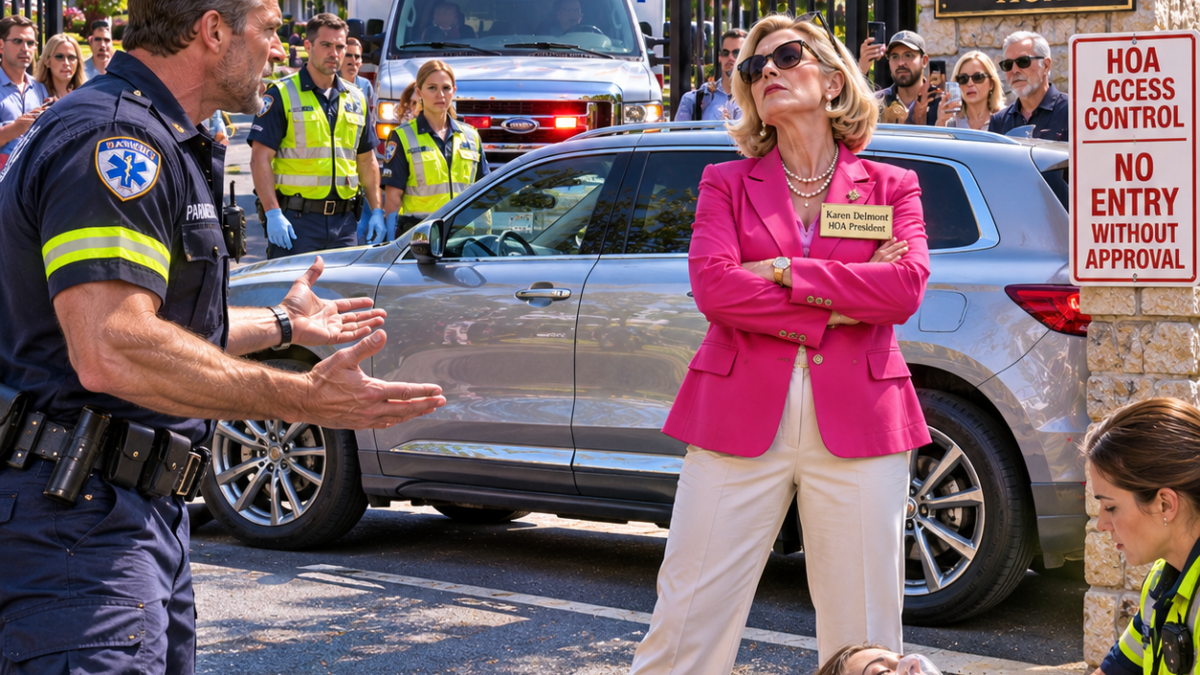
The ambulance was less than three hundred yards from a young woman fighting for her life when Karen Delmont parked her silver SUV sideways across the only vehicle entrance to Willow Creek Estates, stepped out in her bright pink HOA blazer, and told two paramedics that no emergency vehicle was entering her neighborhood until somebody completed the proper access procedure.
I had spent twenty years as a city paramedic, I was still wearing half my volunteer medic uniform from an outreach shift when the woman collapsed at our community barbecue, and as I ran toward the gate with sweat from CPR soaking through my shirt, I could hear Karen calmly repeating “rules are rules” while the ambulance siren screamed behind her and every wasted second increased the chance that my patient would never wake up.
I finally pulled out my phone and started recording because I realized I might not be able to force Karen to understand what she was doing, but if the worst happened on that lawn, I wanted there to be an exact record of who had been standing between that girl and the people trying to save her.
My name is Tom Bennett.
I moved to Willow Creek because I was tired of emergencies.
After two decades of sirens, wrecks, overdoses, house fires, and families hearing the worst sentence of their lives, I wanted mornings with coffee on a porch and evenings quiet enough to hear sprinklers.
Then I met Karen.
She ran Willow Creek like the neighborhood had elected her governor instead of HOA president.
During my first month, she fined me because my garbage bin stayed out forty-five minutes too long.
Then she cited the red emergency-response decal on my garage as “unauthorized signage.”
My favorite came a week later.
“Nonstandard flag.”
I called her.
“Karen, it’s the American flag.”
“It’s not about patriotism, Mr. Bennett. It’s about uniform aesthetics.”
That was Willow Creek under Karen.
She measured lawns.
Photographed bicycles.
Threatened to tow a visiting nurse because her car crossed a painted line while she helped an elderly resident.
But our real war began over my old ambulance.
I had bought the retired unit after leaving full-time city service and used it for volunteer medical outreach in rural communities.
Karen called it a commercial vehicle.
I called it the reason three people in underserved areas had made it to hospitals alive that year.
She slapped an orange violation sticker across the windshield anyway.
Three weeks later, Willow Creek held its annual charity barbecue beside the pool.
My neighbor Linda convinced me to attend after I returned from a volunteer shift.
At 3:07 p.m., a scream cut through the music.
A young woman had collapsed near the buffet.
She looked about twenty.
Pale.
Barely breathing.
I dropped beside her.
“Call 911.”
Her pulse was chaotic.
Then almost nothing.
I started compressions.
Someone brought the community AED.
Minutes later, I heard sirens.
Relief hit me.
Then the sound stopped.
I looked toward the entrance.
The ambulance was outside.
Karen’s SUV was across the gate.
I ran.
“Move your car!”
Karen turned.
“They didn’t sign in.”
I thought I’d misheard.
“What?”
“This is private property.”
“There’s a patient in cardiac distress.”
“Then dispatch should have followed our emergency access protocol.”
One paramedic leaned out his window.
“Ma’am, move the vehicle now.”
Karen folded her arms.
“No authorization, no entry.”
Neighbors started gathering.
I hit record.
“Karen, say that again.”
She noticed the phone.
“You cannot film me without HOA permission.”
“Someone is dying.”
“Don’t be dramatic.”
Behind me, a paramedic dragged oxygen and a defibrillator through the pedestrian gate because Karen still would not move.
We carried everything back across the lawn.
The young woman had lost her rhythm again.
We shocked her.
Compressions.
Oxygen.
Another shock.
Then a pulse.
Weak.
But there.
We loaded her onto the stretcher and pushed her toward the entrance by hand.
Only when a medic threatened to call police immediately did Karen finally reverse six feet.
The ambulance squeezed through.
As it disappeared, I turned the camera toward Karen.
“You delayed emergency treatment for almost fifteen minutes.”
She brushed dust from her sleeve.
“And yet she’s alive.”
Then she smiled.
“So perhaps you owe me a thank-you for keeping the situation under control.”
An hour later, I was sitting on my porch when Linda came running across the street.
“Tom!”
Her face was white.
“What?”
She stopped in front of me, struggling to catch her breath.
“Do you know who that girl was?”
PART 2
I stood up.
“No.”
Linda looked back toward the gate as if somebody might be listening.
“Chloe Hammond.”
The name was familiar, but my brain was still stuck in medical mode.
“Who?”
“Mayor Hammond’s daughter.”
Everything inside me went still.
I had seen Mayor Richard Hammond at city events.
Everyone had.
He had been mayor of Brookhaven for six years, the kind of politician who showed up at high school games, veterans’ breakfasts, flood briefings, ribbon cuttings, and funerals whether cameras were present or not.
I looked at Linda.
“You’re sure?”
“My niece went to school with her.”
I sat back down.
Linda lowered her voice.
“She was visiting Jennifer Cole. Jennifer’s the one who brought her to the barbecue.”
“What happened at the hospital?”
“I heard she’s in ICU.”
My stomach tightened.
“Where did you hear that?”
“Jennifer’s mother.”
I picked up my phone.
My video had already passed fifty thousand views.
I hadn’t even meant for it to become a spectacle. I had uploaded the raw footage because neighbors were already arguing in the group chat about what happened, and Karen had sent a message within thirty minutes claiming emergency responders had “refused established access procedures.”
I wanted the record clear.
That was all.
Now comments were multiplying faster than I could read them.
**She blocked an ambulance?**
**Call the police.**
**Who lets an HOA do this?**
**Is the patient okay?**
That last one was the only question I cared about.
I opened my old department contacts and texted a former colleague working at Brookhaven Memorial.
**Patient from Willow Creek barbecue. Young female. Any word?**
He replied ten minutes later.
**Stable for now. Serious arrhythmia. They got circulation back before transport. Your early CPR mattered.**
I exhaled.
Then another message appeared.
**Mayor is here. He’s furious.**
I stared at that for a long time.
Linda sat beside me.
“You okay?”
“No.”
“She’s alive.”
“I know.”
“That matters.”
“It does.”
I looked toward Karen’s house.
Her upstairs lights were on.
“And tomorrow?”
Linda followed my eyes.
“Tomorrow is Karen’s problem.”
***
I barely slept.
At 5:30 the next morning, a television van arrived outside the neighborhood.
Then another.
By six, reporters were standing near the gate where Karen had blocked the ambulance.
By seven, my video had crossed half a million views.
Somebody had clipped the moment where Karen said:
“No authorization, no entry.”
Another clip showed me asking:
“You think a rule book outranks a human life?”
Someone put the two together.
That was everywhere.
I made coffee and stared through my front window.
A year earlier, Karen had cited a neighbor for putting campaign signs too close to the sidewalk.
Now six news cameras were pointed at her gate.
The universe occasionally has a sense of humor.
At 7:20, Karen appeared.
Pink blazer.
Sunglasses.
Clipboard.
Of course.
She walked directly toward the cameras like this was a press event she had scheduled herself.
A reporter called:
“Ms. Delmont, did you block an ambulance yesterday?”
Karen smiled.
“There has been considerable misinformation about a very unfortunate situation.”
“Did you block it?”
“I was attempting to ensure that emergency access procedures were followed safely.”
Another reporter said:
“The patient was in cardiac distress.”
“I understand that now.”
“You were told that at the time.”
“There was confusion.”
I laughed.
I shouldn’t have.
The cameras turned.
Karen’s eyes found me across the entrance.
Her jaw tightened.
“Mr. Bennett,” she said loudly, “perhaps you’d like to continue your campaign against this board in front of the press.”
I walked closer.
“I don’t have a campaign.”
“You posted selective footage.”
“I posted the whole clip.”
“You created hysteria.”
“You parked sideways across the emergency entrance.”
Her smile became thinner.
“You have a history of conflict with the HOA.”
“That doesn’t make an ambulance less of an ambulance.”
One reporter stepped between us slightly.
“Mr. Bennett, were you treating the patient?”
“Yes.”
“Did you know she was Mayor Hammond’s daughter?”
“No.”
Karen’s head snapped toward me.
That was the first time I realized she genuinely hadn’t known.
The reporter looked at Karen.
“The mayor’s office confirmed the patient is Chloe Hammond.”
Her mouth opened.
Nothing came out.
Just for a second.
Then the mask returned.
“I wasn’t aware of the young woman’s identity.”
I stared at her.
“That should not matter.”
She turned toward me.
“What?”
“You should have moved for anybody.”
The reporter closest to me lowered her microphone slightly.
Karen said:
“I acted consistently with our community security policy.”
“Karen, if the patient had been a stranger, you still should have moved.”
“You’re simplifying—”
“No.”
I shook my head.
“You are.”
That exchange led every local broadcast by noon.
Not because I said anything brilliant.
Because people understood the problem immediately.
The value of a life could not depend on whether Karen recognized the last name.
***
At 11:15, the mayor’s office released a statement.
Chloe remained hospitalized but stable.
Doctors expected recovery.
Then came the second paragraph.
The City of Brookhaven and county authorities were reviewing whether Willow Creek’s emergency-access policies and Karen’s actions unlawfully interfered with emergency medical response.
Karen sent a community-wide email before lunch.
**CLARIFICATION REGARDING RECENT INCIDENT**
It was almost two pages.
Emergency responders had been “temporarily delayed.”
She blamed signage.
Communication breakdown.
Aggressive behavior by first responders.
And me.
She wrote that I had “amplified an already difficult situation through unauthorized recording and inflammatory language.”
Replies began within minutes.
One neighbor wrote:
**You blocked an ambulance.**
Another:
**There is nothing to clarify.**
Then Mr. Peters, who almost never used email, replied:
**I am eighty-one years old. If I have a heart attack, please tell the ambulance not to wait for your permission.**
I printed that one.
It deserved preservation.
***
Karen came to my house that night.
Nine o’clock.
Hard knock.
I opened the door but stayed behind the threshold.
She looked different without an audience.
Still pink blazer.
Still clipboard.
But her face was pale.
“Take the video down.”
“No.”
“You’re encouraging harassment.”
“I haven’t told anyone to contact you.”
“My family is being threatened.”
“I’m sorry.”
She blinked.
Maybe she expected me to enjoy that.
I didn’t.
Threats were wrong whether people liked her or not.
I continued.
“But the video stays.”
“You have no right to destroy my reputation.”
“I didn’t park your SUV.”
She stepped closer.
“You edited the circumstances.”
“I uploaded nineteen minutes continuously.”
“You called me a lunatic.”
“After you told paramedics to wait while someone had no pulse.”
Her fingers tightened around the clipboard.
“I was protecting the association from liability.”
“You created liability.”
Her eyes flashed.
“You think you’re some kind of hero now?”
“No.”
That came easily.
“I think I got lucky.”
“Lucky?”
“That Chloe survived long enough for us to carry equipment across your gate.”
Karen looked away.
For the first time since I had known her, she seemed unsure.
I almost felt something like pity.
Then she said:
“You should understand that actions have consequences.”
The pity disappeared.
“Is that a threat?”
“It’s advice.”
“My cameras are recording.”
Her eyes moved toward the porch light.
Then she stepped back.
“You’ll regret this.”
I closed the door.
After she left, I sat in the dark living room for almost an hour.
My hands were shaking.
That annoyed me.
I had worked pileups with people screaming.
Held pressure on wounds while bullets were still being counted.
Talked drunk drivers out of running into traffic.
Yet a woman with a clipboard standing on my porch had managed to make my pulse race like a rookie’s.
That was when I understood what years of Karen’s control had done to Willow Creek.
Nobody was terrified of her in the dramatic sense.
We had simply learned to anticipate punishment.
A fine.
A complaint.
A tow truck.
A letter.
A hearing.
A rumor.
Small consequences, applied constantly, until people stopped challenging anything.
That was power too.
***
The next morning, two sheriff’s vehicles entered Willow Creek.
Karen tried to stop them.
I watched from my porch.
One deputy approached the gate.
Karen held up a hand.
“County personnel need to coordinate through management.”
He showed her paperwork.
“Ma’am, we’re conducting an investigation.”
“This is private association property.”
He stared at her.
“So?”
“You need permission.”
He looked at the second deputy.
Then back at Karen.
“Not for this.”
They requested gate surveillance.
Visitor records.
HOA emergency access policies.
Board minutes related to security rules.
Karen argued for six minutes.
The older deputy finally said:
“Ms. Delmont, your HOA does not outrank lawful process.”
That sentence traveled through the neighborhood before the deputies reached the clubhouse.
I received five texts.
One simply said:
**FINALLY.**
***
The ambulance incident opened a door.
Residents walked through it carrying years of complaints.
Fourteen reports reached the sheriff’s office in the first two days.
Not all criminal.
Most weren’t.
But together they painted a picture.
Fines without proper board votes.
Selective enforcement.
Threatening emails.
Altered meeting minutes.
Questionable contractor relationships.
One elderly couple showed investigators a lien warning issued over landscaping fines they had successfully appealed months earlier.
A single mother produced emails where Karen threatened to restrict her pool access because her son left a bicycle near the clubhouse.
A retired accountant named George had records suggesting a landscaping company owned by Karen’s cousin repeatedly won contracts despite higher bids.
Once people stopped fearing retaliation, they became incredibly organized.
I had never seen anything like it.
***
Three days after the ambulance incident, the HOA board called an emergency meeting.
Every seat was filled.
People stood along the walls.
Karen sat at the head table.
Pink blazer.
Clipboard.
But her hands trembled.
“Let’s come to order.”
Mrs. Ramirez stood before Karen finished.
“No.”
Karen blinked.
“Excuse me?”
“You don’t get to call us to order.”
Applause broke out.
Karen struck the gavel.
“Sit down.”
Mrs. Ramirez didn’t.
“You fined my granddaughter because her bicycle was visible for twenty minutes.”
“This meeting concerns recent events.”
Mr. Peters stood.
“You threatened to put a lien on my house over a flagpole.”
“Please—”
Another resident:
“You changed the Christmas-decoration deadline without a vote.”
Another:
“You told us the landscaping contract was competitive.”
George held up a folder.
“It wasn’t.”
Karen’s face tightened.
“This is becoming a witch hunt.”
Howard, the vice president, shifted beside her.
I had always assumed Howard supported everything Karen did.
Maybe he had.
But that night he looked tired.
“Karen.”
She snapped toward him.
“What?”
“We need to address the ambulance.”
“I already issued clarification.”
“No.”
His voice shook.
“You need to address what happened.”
“I followed policy.”
Howard stared at her.
“Then the policy is insane.”
The room erupted.
Karen’s expression changed.
The betrayal from Howard hurt more than anything the residents said.
I recognized that look.
Control survives by assuming allies will remain predictable.
Howard had just stopped being predictable.
***
When my turn came, I carried a flash drive.
No speech.
I plugged it into the clubhouse computer.
The projector lit up.
My video played.
Karen’s SUV across the gate.
Ambulance lights.
Paramedics shouting.
My voice:
“Someone’s dying.”
Karen:
“No authorization, no entry.”
Her own face filled the wall.
Then:
“Rules are rules.”
Then the end.
“And yet she’s alive. So perhaps you owe me a thank-you.”
When the screen went dark, nobody spoke.
Karen stared at the table.
I said:
“You almost cost someone her life because you thought authority mattered more than emergency care.”
She looked up.
“You’ve made your point.”
“No.”
I shook my head.
“You made it.”
I sat down.
Howard cleared his throat.
“I move that Karen Delmont be removed as president pending investigation and barred from board authority.”
Someone seconded immediately.
Karen stood.
“You cannot do this.”
Howard looked at the bylaws.
“We can.”
“This board exists because I built it.”
Mrs. Ramirez laughed bitterly.
“That’s the problem.”
Hands went up.
Every voting director except Karen.
Unanimous.
Karen stared around the room.
“You’re all making a serious mistake.”
No one responded.
She gathered her papers.
Then looked at me.
“This is your fault.”
I didn’t answer.
That seemed to bother her more.
She walked out.
For the first time since I moved to Willow Creek, a meeting ended without Karen deciding when it was over.
***
The following morning at 7:42, three black SUVs arrived at the gate.
Linda ran across my lawn wearing slippers.
“Tom!”
I was holding coffee.
“What?”
“The mayor.”
I looked toward the road.
Mayor Hammond stepped from the lead vehicle.
No smile.
Two aides.
City attorney.
A few reporters who had somehow learned about the visit before sunrise.
Karen appeared from her house before I reached the entrance.
No board authority anymore.
Still acting like she had it.
“Good morning, Mayor Hammond.”
He looked directly at her.
“Save it.”
Cameras clicked.
Karen clasped her hands.
“I’m deeply sorry about the misunderstanding involving your daughter.”
“Misunderstanding?”
“I was enforcing established—”
“You blocked an ambulance.”
His voice didn’t rise.
It didn’t need to.
“My daughter’s heart was not beating normally, and your vehicle delayed the medical team trying to reach her.”
“I didn’t know who she was.”
Mayor Hammond stared at her.
“That may be the worst thing you could have said.”
Her face changed.
He continued.
“It should not matter whose daughter she was.”
The entire crowd went silent.
I felt something loosen in my chest.
Exactly.
That was the point.
Karen began:
“The paramedics failed to follow—”
“No.”
The mayor cut her off.
“I have watched the video.”
She looked toward me.
He noticed.
“Do not look at Mr. Bennett. He did not park your vehicle.”
Karen’s lips tightened.
The mayor continued.
“The city attorney and sheriff are reviewing the incident. Emergency-access requirements for private communities are being examined immediately.”
Karen whispered:
“You’re targeting me because she’s your daughter.”
Mayor Hammond’s face hardened.
“I’m paying attention because she’s my daughter.”
A pause.
“The rules we change will protect everyone else’s.”
That line stayed with me.
Then he turned toward me.
“Mr. Bennett?”
“Sir.”
He walked closer.
“Chloe asked about the man who treated her before transport.”
I swallowed.
“How is she?”
“Better.”
He exhaled.
“Doctors expect a full recovery.”
I closed my eyes for half a second.
That was the first true relief I had felt all week.
Mayor Hammond held out his hand.
“Thank you.”
I shook it.
“I did what I was trained to do.”
“No.”
He looked at the gate.
“You kept doing it when someone made it harder.”
I didn’t know what to say.
Fortunately, reporters did.
They swarmed.
Karen disappeared into her house while microphones followed the mayor and me.
For once, cameras were not interested in her.
***
The investigation broadened over the next week.
Not because the mayor ordered anyone to manufacture charges.
Despite what Karen later claimed.
Because once investigators legally accessed HOA records, other irregularities appeared.
Bank statements.
Vendor payments.
Reimbursements.
One account caught attention.
**WCE SECURITY AND BEAUTIFICATION FUND**
It sounded legitimate.
The expenses did not.
Luxury spa charges.
High-end restaurant bills.
Travel.
A family trip to Aspen coded as an “HOA leadership conference.”
Some payments were defensible.
Many weren’t.
Investigators eventually identified more than fifty-eight thousand dollars in questionable or misused funds.
That was when the story stopped being only about an ambulance.
***
George, the retired accountant, came to my house carrying a box.
“I knew something was wrong.”
“Why didn’t you say anything?”
“I did.”
He handed me old emails.
Karen telling him he was “confusing volunteer leadership with corporate audit practices.”
Another message:
**Persistent challenges to approved financial decisions may be considered disruptive conduct.**
George smiled without humor.
“She threatened to fine me for asking why her cousin kept getting landscaping contracts.”
“Can an HOA fine you for asking?”
“Apparently mine tried.”
He handed the box to investigators the next day.
Inside were contractor bids.
Invoices.
Copies of checks.
Karen had approved payments to a landscaping company connected to her cousin despite competing bids that were substantially lower.
One more thread.
One more reason the investigators stayed.
***
Then I received a letter.
No return address.
All caps.
**YOU THINK YOU WON. I KNOW YOUR SECRETS TOO.**
I stared at it.
My first reaction was anger.
Second was embarrassment because I couldn’t think of what secrets I supposedly had.
I showed it to Deputy Morrison.
Tall man.
Patient voice.
He read it.
“Any idea who sent it?”
“I could guess.”
“Don’t.”
He put it in an evidence sleeve.
“Guessing makes bad statements.”
“You’re starting to sound like my old supervisors.”
“Then they were smart.”
I pointed.
“Should I worry?”
“Be aware.”
“Meaning?”
“Keep your cameras working. Call if anyone threatens you directly. Don’t play detective.”
“That’s disappointing.”
He smiled.
“People under pressure often lash out.”
“Karen?”
“I said people.”
Right.
No guessing.
Documentation.
Apparently retirement had not ended my education.
***
The city held a public forum that weekend.
Residents from multiple HOA communities attended.
So did first responders.
Mayor Hammond sat on stage with city counsel, county emergency management, and several public-safety officials.
I had no desire to speak.
Then Chloe sent word through her father asking if I would.
That was harder to refuse.
I stood at the microphone.
For twenty years, public speaking had meant telling families what happened.
This felt worse.
“I moved to Willow Creek because I wanted peace.”
People waited.
“I thought peace meant order.”
I looked toward several residents.
“Turns out you can have plenty of order and still make people afraid.”
No applause.
Good.
I didn’t want applause.
“We had rules for mailboxes, grass, garbage cans, decorations, vehicles. We had procedures for almost everything.”
I paused.
“But when a woman needed medical help, somebody decided procedure mattered more than judgment.”
A firefighter in the front row nodded.
“The problem isn’t that communities have rules.”
I continued.
“The problem is when authority becomes more important than the reason the rules exist.”
That was all.
Mayor Hammond spoke after.
The city would review emergency-access standards for gated and private communities.
Gate override requirements.
Emergency responder access.
Training.
Contacts.
Clear prohibition on interfering with emergency vehicles.
Nothing glamorous.
Practical changes.
The kind that save time.
Sometimes time is all medicine has.
***
A week later, investigators came for Karen.
Two unmarked cars.
I watched from my porch.
No cheering.
No crowd at first.
Karen emerged with an officer beside her.
She wore a gray sweater.
No blazer.
No sunglasses.
No clipboard.
Her husband stood in the doorway.
They barely looked at each other.
Deputy Morrison later confirmed that the ambulance obstruction allegation was now part of a wider case involving falsified HOA records and financial misuse.
Karen was processed.
Released under conditions while the case proceeded.
News outlets used the word “arrested.”
Residents used stronger words.
I tried not to use any.
The image of Karen being placed in the back seat did not make me happy.
That surprised me.
Maybe because I had spent too many years seeing people at their worst moments.
Maybe because punishment looks less cinematic up close.
She looked frightened.
Not powerful.
Just frightened.
I remembered her telling the paramedics:
“Rules are rules.”
I wondered whether those words still comforted her.
Probably not.
***
Willow Creek became a temporary crime scene of paperwork.
Forensic accountants.
Lawyers.
Auditors.
County staff.
Evidence boxes leaving the clubhouse.
News vans outside.
The same association that once sent three emails about the correct shade of mulch could no longer explain tens of thousands of dollars.
Residents were furious.
Then embarrassed.
Then sad.
That’s how scandal usually works.
It begins with outrage.
Eventually people realize the villain didn’t act alone.
Someone approved invoices.
Someone signed checks.
Someone chose not to ask questions.
Someone saw something wrong and decided it was easier not to challenge it.
That realization hurt Willow Creek more than Karen’s arrest.
***
The insurance carrier froze certain HOA liability decisions pending review.
Property owners panicked about assessments.
Some demanded dissolution.
Others wanted receivership.
Howard resigned as vice president.
“I should’ve stopped her years ago,” he told me.
“Why didn’t you?”
He looked at the floor.
“She knew the bylaws better than everyone.”
“That’s not an answer.”
“No.”
He rubbed his forehead.
“She made disagreement exhausting.”
That was honest.
“Every time someone challenged her, there was another meeting. Another email. Another threat of legal review.”
I understood.
Still:
“You voted.”
“I know.”
“That’s the part you have to live with.”
He nodded.
“I know.”
I respected him more for not asking me to make it easier.
***
Karen sent a twelve-page document to every resident after her removal.
Title:
**A CITIZEN’S DEFENSE AGAINST TYRANNY**
Steve Peters brought me a printed copy.
“You reading this?”
“No.”
He flipped through it.
“Page seven says you engineered a coup.”
“Impressive.”
“Page nine suggests the mayor abused office because Chloe is his daughter.”
“Less impressive.”
“Page eleven compares the HOA vote to historical political purges.”
I took the document.
“Give me that.”
“Thought you weren’t reading.”
“I need to know whether there are threats.”
“Right.”
I read all twelve pages.
Mostly grievance.
Denial.
Self-defense.
Some genuine fear.
Karen believed everyone had turned on her because they hated discipline.
She still could not fully understand that people hated what she had done with authority.
That distinction would take her much longer.
***
The local criminal proceedings began months later.
By then, Chloe had recovered enough to appear publicly.
I had not met her since the barbecue.
Seeing her walk into court shook me.
Alive.
Healthy-looking.
Nervous.
She sat with her father.
When she noticed me, she smiled.
I looked away for a moment because my eyes had started burning.
That was the outcome that mattered.
Everything else was accounting.
***
Karen’s lawyer argued the ambulance event was a tragic mistake.
The gate policy was confusing.
Karen believed she had a duty to control vehicle access.
She panicked under pressure.
That argument would have been more believable without my recording.
The prosecutor played the video.
Paramedic:
“Ma’am, this is an emergency response vehicle.”
Karen:
“Then call dispatch to request proper HOA clearance.”
My voice:
“Someone’s dying.”
Karen:
“If I make one exception, everyone will expect the same.”
There are sentences that survive their speaker.
Those did.
Karen sat motionless while her own voice filled the courtroom.
Then came the records.
Altered board minutes.
Financial approvals.
Payments.
Contract irregularities.
The case was broader than the gate.
That helped and hurt.
Helped because it showed a pattern of control.
Hurt because I did not want Chloe’s medical crisis reduced to one item in a financial corruption case.
When I testified, I kept the focus narrow.
“What did you observe?”
“A patient in cardiac distress.”
“What did you do?”
“CPR, AED support, airway assistance as available.”
“Did an ambulance respond?”
“Yes.”
“Could it enter?”
“No.”
“Why?”
“Karen’s SUV blocked the gate.”
“Did you ask her to move?”
“Repeatedly.”
“Did paramedics?”
“Yes.”
“Did she understand there was a medical emergency?”
“Yes.”
“How do you know?”
“Because we told her. It’s on the recording.”
No drama required.
***
Karen’s attorney stood.
“Mr. Bennett, you and my client had a hostile history.”
“We disagreed.”
“She had fined you.”
“Yes.”
“You resented her.”
“At times.”
“You called her a lunatic.”
“During the emergency.”
“So you were angry.”
“Very.”
“Would you describe this as a personal vendetta?”
I almost laughed.
“No.”
“Yet you filmed her.”
“Yes.”
“You uploaded the video publicly.”
“Yes.”
“Causing severe reputational damage.”
“I uploaded an unedited record of what happened.”
He stepped closer.
“You wanted to punish her.”
I thought.
Then decided not to pretend.
“Part of me did.”
The courtroom went quiet.
His eyebrows rose.
I continued.
“I was furious.”
“Exactly.”
“But I hit record instead of touching her vehicle or physically confronting her.”
He hesitated.
“I documented what happened.”
The prosecutor watched carefully.
Karen’s lawyer tried again.
“So this was revenge.”
“No.”
I looked at him.
“Revenge would have been making something up.”
I nodded toward the screen.
“I didn’t need to.”
***
Chloe testified briefly.
Her memories of the collapse were fragmented.
She remembered heat.
Music.
A strange pressure in her chest.
Then waking in ICU.
Doctors later told her she had experienced a serious cardiac rhythm event requiring immediate intervention.
Her medical team had documented the timeline.
Her father sat behind her.
Karen would not look up.
The prosecutor asked:
“Do you remember Ms. Delmont?”
“No.”
“Did you know her before this?”
“No.”
That mattered.
This had never been personal between Karen and Chloe.
Chloe was simply the human being inconveniently placed on the other side of one of Karen’s rules.
***
The financial testimony came next.
Fifty-eight thousand dollars in misused or unsupported HOA expenditures became a centerpiece of the records case.
Spa charges.
Meals.
Travel.
Family expenses coded as leadership or association business.
The defense challenged amounts and classifications.
Some expenses were removed from the disputed total.
Others remained.
An accountant testified about documentation.
Not glamorous.
But devastating.
Then George testified about the cousin’s landscaping contract.
Board minutes showed votes.
Emails showed Karen lobbying.
Disclosure records did not clearly identify the family relationship.
Once again, the problem wasn’t one dramatic act.
It was authority used as private property.
***
The eventual resolution was less cinematic than the neighborhood expected.
Karen was found responsible on key local counts arising from obstruction and record/financial misconduct, with some issues resolved through the court process and negotiated disposition.
She received probation, community service, financial penalties and restitution obligations, and permanent removal from HOA leadership.
Civil recovery proceedings required additional repayment connected to improper HOA expenditures.
No fifteen-year prison sentence.
No dramatic judge shouting from the bench.
Just consequences.
Real ones.
The court imposed restrictions.
The association’s insurers and auditors pursued their parts.
Karen’s reputation collapsed.
Her leadership ended.
She had to answer financially for money she once treated as hers to direct.
In some ways, that seemed harder for her than jail would have been.
She had to live in the same world where everybody now knew exactly what she had done.
***
Outside the courthouse, I saw her.
She almost walked past.
Then stopped.
“You ruined me.”
Her voice was quiet.
I shook my head.
“No.”
She gave me a bitter smile.
“Of course you’d say that.”
“I hit record, Karen.”
Her eyes filled.
“You made sure everyone saw.”
“You made sure there was something to see.”
She looked at the courthouse doors.
“I was trying to keep order.”
“At the gate?”
She flinched.
“At all of it.”
“You blocked an ambulance.”
“I know.”
That was the first time she said it without adding *but*.
I waited.
She continued.
“I kept thinking if I made one exception, everything would become chaos.”
I almost answered immediately.
Then stopped.
She wasn’t asking for forgiveness.
She was trying to explain herself to herself.
Finally I said:
“You made a life into an exception.”
She looked down.
“I know.”
Her lawyer called her.
Karen walked away.
I stood there for a moment.
Not victorious.
Just tired.
***
The HOA dissolved temporarily under supervised administration while residents created a new governance structure.
Nobody cheered harder than Mr. Peters.
He hosted a barbecue.
“Approved charcoal?”
I asked.
“Illegal charcoal.”
“What makes it illegal?”
“I didn’t fill out a form.”
We both laughed.
Kids swam.
Someone parked slightly crooked.
Nobody measured.
For the first time, Willow Creek felt less manicured and more alive.
Linda nudged me.
“You running for president?”
“Absolutely not.”
“Everyone trusts you.”
“That’s their first mistake.”
“You’d be good.”
“I don’t want power.”
She considered that.
“Probably why you’d be good.”
I shook my head.
“I want neighbors.”
That was true.
After twenty years in emergency medicine, I had no desire to manage another system full of people ignoring common sense.
***
The new election eventually produced Patricia Chen.
She had served as assistant treasurer but had been one of the first people to turn financial documents over when investigators arrived.
Quiet.
Precise.
Not interested in applause.
At her first meeting, she stood in front of thirty residents.
No gavel.
No projector.
No clipboard.
“From now on,” she said, “empathy first, paperwork second.”
People applauded.
I raised a hand.
Patricia looked amused.
“Yes, Tom?”
“Sometimes paperwork needs to be first.”
People laughed.
She nodded.
“Fine. Empathy and competent paperwork.”
“Better.”
That became Willow Creek’s unofficial motto.
***
The new board rewrote emergency access immediately.
The gate received a direct responder override.
Fire.
EMS.
Police.
No HOA approval.
No resident escort.
No form.
Bright red emergency switch.
Clear signage.
First responders received updated access codes.
The city inspected it twice.
When the installer finished, he handed Patricia the documentation.
She called me.
“Want to test it?”
“Absolutely.”
We stood outside the gate.
She pressed the emergency-release control.
The barrier lifted instantly.
Three seconds.
Maybe less.
I stared at the open lane.
Fifteen minutes versus three seconds.
Patricia watched me.
“You okay?”
“Yeah.”
I wasn’t, exactly.
But I was getting there.
***
Mayor Hammond came to my house about a month after the case ended.
No cameras.
No aides except a driver.
Chloe was with him.
She looked healthy.
A little thinner than before.
She carried an envelope.
“Mr. Bennett?”
“Tom.”
She smiled.
“Tom.”
I invited them onto the porch.
Chloe handed me the envelope.
Inside was a handwritten letter.
I read it once.
Then again.
She thanked me for starting CPR.
For refusing to give up.
For arguing at the gate.
For documenting what happened.
The final line said:
**You stood between me and somebody else’s pride until help could reach me. I don’t know how to repay that, so I hope I can spend my life doing something useful with the time you helped give me.**
I had to look away.
Chloe said softly:
“You don’t have to say anything.”
“Good.”
She laughed.
“Why?”
“Because I’m about to embarrass myself.”
Mayor Hammond smiled.
“Wouldn’t be the worst thing you’ve done on camera.”
I looked at him.
“Sir.”
“Mayor joke.”
“Needs work.”
Chloe laughed harder.
That sound did more for me than any court ruling.
***
Mayor Hammond told me the city had adopted updated private-community emergency access requirements.
Mandatory responder access.
Training.
Gate override standards.
Coordination with fire and EMS.
Periodic verification.
“What happened here won’t happen again if we can help it.”
“Good.”
He looked toward our road.
“There’s something else.”
I became suspicious.
“What?”
“The residents submitted a request to rename the entrance road.”
“No.”
He laughed.
“I haven’t told you the name.”
“I know where this is going.”
“Bennett Way.”
“No.”
Chloe grinned.
“Too late.”
“Absolutely not.”
“Resident vote passed.”
I stared at her father.
“You approve everything residents vote for?”
“No.”
“Start here.”
He laughed.
“Request denied.”
Months later, the sign appeared.
**BENNETT WAY.**
I still hated it.
Mostly.
***
Karen’s house went up for sale.
Her marriage ended.
I heard she moved in with her sister several counties away after completing the first part of her community-service obligations.
Rumors multiplied.
She was broke.
She was writing a book.
She was suing everyone.
She was moving to Florida.
I ignored most of it.
Rumors are just gossip wearing running shoes.
Then an envelope appeared beneath my door.
No return address.
One page.
The handwriting was shaky.
**Tom,**
**You destroyed my life.**
I almost stopped reading.
Then:
**But I think you also forced me to see what I had turned it into. I told myself control meant safety. Every time people obeyed me, I felt less afraid. Eventually I stopped caring whether the rule made sense because enforcing it made me feel necessary.**
**I blocked that ambulance because backing down in front of everyone felt like losing control.**
I sat down.
The next line was harder.
**I understand now how insane that sounds.**
Then:
**Don’t think of me as a monster. Think of me as someone who forgot what compassion looked like until everyone else had to show me.**
No signature.
Didn’t need one.
I folded the letter.
Placed it in the same folder where I kept my original violation notices.
Garbage bin.
Ambulance decal.
American flag.
The whole strange history fit inside two inches of paper.
***
Willow Creek changed slowly.
Kids left bicycles outside.
People still complained sometimes.
Human nature survived reform.
Dogs barked.
Garbage bins stayed out too long.
Christmas lights remained up in February.
One homeowner painted his front door orange.
Patricia asked me what I thought.
“I think it’s ugly.”
“Violation?”
“No.”
“Good answer.”
The neighborhood became less perfect.
Much healthier.
***
The old HOA office turned into a community room.
The **NO TRESPASSING** sign disappeared.
A wooden sign replaced it.
**WELCOME, NEIGHBORS.**
Inside:
Coffee machine.
Bookshelf.
Emergency information.
Financial reports anyone could read.
Meeting schedule.
No portraits of board members.
That was my contribution.
Patricia had proposed hanging photographs of each president.
I threatened to move.
She dropped the idea.
***
A local station produced a follow-up story.
I declined the interview.
Then Chloe called.
“Do it.”
“No.”
“Why?”
“I’ve talked enough.”
“People should know the new gate rules.”
“Then you do it.”
She paused.
“Fine.”
So Chloe did.
She stood beside the emergency override and explained how private neighborhoods could work with first responders without sacrificing security.
No outrage.
No Karen footage.
No dramatic reenactment.
Just information.
That impressed me.
She had taken the worst fifteen minutes of her life and turned them into something practical.
Maybe that was why we became friends.
***
Chloe later helped establish a small nonprofit initiative called Open Gates.
Emergency-access education for private communities.
HOAs.
Apartment complexes.
Gated developments.
Volunteer training.
Public-safety coordination.
Nothing glamorous.
Exactly the kind of organization that prevents disasters nobody notices because they never happen.
She invited me to speak at the launch.
I said no.
She called again.
“No.”
Third time:
“Tom.”
“What?”
“You don’t have to give a speech.”
“Excellent.”
“Just tell the truth.”
“That’s a speech.”
“Five minutes.”
“No.”
“Three.”
“Chloe.”
“Two.”
I went.
She lied.
They gave me fifteen minutes.
***
I stood at the podium.
Firefighters.
Paramedics.
City officials.
HOA board members from across the region.
People who had seen my video.
People who hadn’t.
I told them about the gate.
Not Karen’s whole scandal.
Not the money.
Not the trial.
Just the gate.
Red lights.
Closed barrier.
A woman without a pulse.
A rulebook.
A choice.
Then I said:
“The most dangerous thing that day wasn’t hatred.”
The room stayed quiet.
“Karen did not want Chloe to die.”
That surprised some people.
“She wasn’t trying to hurt her.”
I paused.
“She was so committed to being in control that she stopped evaluating what the rule was for.”
Several board members shifted.
“That’s more dangerous than obvious cruelty sometimes.”
I looked toward Chloe.
“Pride can feel responsible right up until somebody gets hurt.”
Then I stepped away.
No big conclusion.
No slogan.
Chloe stood and hugged me.
I hated that because people clapped.
She knew I hated it.
That was why she did it.
***
The city later installed a bronze plaque beside Willow Creek’s gate.
I knew nothing about it until Linda dragged me outside one afternoon.
“Come on.”
“Where?”
“Gate.”
“Why?”
“You’ll see.”
Patricia waited there.
So did Steve.
The new bronze plaque read:
**IN HONOR OF THOSE WHO CHOOSE COMPASSION OVER CONTROL AND COURAGE OVER COMPLIANCE.**
Below:
**Dedicated to Paramedic Thomas Bennett and the first responders whose actions inspired Brookhaven’s Emergency Access Reform.**
I stared.
Linda put a hand on my shoulder.
“You going to cry?”
“No.”
“Looks like crying.”
“Allergies.”
“Bronze allergy?”
“Rare.”
They laughed.
I didn’t mind.
***
Months passed.
The gate story faded from national attention.
Good.
Karen’s name disappeared from headlines.
Better.
Willow Creek became a neighborhood again.
Best.
I returned to volunteer medical work.
The ambulance stayed in my driveway.
Patricia brought the issue to the board once.
She stood beside it.
“Technically, the bylaws still classify this as a commercial-type vehicle.”
I stared.
“You called me out here for this?”
She smiled.
“We’re amending it.”
“When?”
“Tonight.”
“Good.”
She patted the ambulance.
“Still work?”
“Perfectly.”
“Can I ride sometime?”
“No.”
“Why?”
“HOA presidents require special authorization.”
She laughed so hard she had to lean against the hood.
***
One Saturday, we held another barbecue.
Same pool.
Same lawn.
Different feeling.
No one handed out policy flyers.
No clipboard.
No staged speeches.
Chloe came.
So did Mayor Hammond.
Kids swam.
Someone burned hamburgers.
Linda blamed Steve.
Steve blamed equipment.
Normal community politics.
At one point, Chloe and I stood near the exact place where she had collapsed.
She looked down.
“Here?”
“About three feet left.”
She moved.
“Here?”
“Pretty close.”
She stared at the grass.
“It’s weird.”
“What?”
“I don’t remember it.”
“Probably good.”
“I remember waking up.”
“Also good.”
She smiled.
“You remember everything, don’t you?”
I looked toward the gate.
“Enough.”
She followed my eyes.
“The emergency override works now.”
“I test it.”
“How often?”
“Too often, according to Patricia.”
“Tom.”
“What?”
She laughed.
“You’re becoming HOA Karen.”
“Take that back.”
“Rules are rules.”
I pointed toward the pool.
“Leave.”
She walked away laughing.
That was the first time the phrase didn’t bother me.
***
The new HOA meetings lasted twenty minutes.
Usually.
Sometimes Steve made them longer on purpose.
Patricia ran them fairly.
Budgets online.
Contracts disclosed.
Complaint appeals.
No single person could issue major penalties alone.
Emergency procedures were untouchable except to improve them.
At one meeting, a homeowner complained that a neighbor’s flowers did not match the landscaping plan.
Patricia looked at him.
“Are they invasive?”
“No.”
“Blocking sight lines?”
“No.”
“Causing damage?”
“No.”
“Then this meeting has concluded the flower emergency.”
I almost applauded.
Karen would have needed six forms.
Progress.
***
One night, I found Karen’s old first violation letter while cleaning my desk.
**GARBAGE RECEPTACLE REMAINED VISIBLE FORTY-SEVEN MINUTES BEYOND APPROVED COLLECTION WINDOW.**
I laughed.
Forty-seven minutes.
Not forty-five.
She had timed it.
I placed the letter beside Chloe’s handwritten thank-you note.
The two pages could not have been more different.
One treated community as control.
The other treated life as gift.
I kept both.
Not because Karen’s letter mattered anymore.
Because contrast does.
***
Years of emergency work had taught me that people imagine crises reveal character.
Sometimes.
More often, crises reveal habits.
A person who practices calm usually reaches for calm.
A person who practices blame usually searches for someone to blame.
A person who practices control may keep controlling long after control stops making sense.
Karen did not wake up that morning planning to endanger Chloe.
She had simply spent years training herself never to back down.
Then the worst possible moment asked her to back down.
She couldn’t.
That’s what I remember most.
Not the blazer.
Not the clipboard.
The inability to say:
**I was wrong. Open the gate.**
Five seconds.
Those words could have changed everything.
***
One evening, long after the trial, I saw a woman standing near the gate.
For half a second, I thought it was Karen.
Similar height.
Dark sunglasses.
My body tensed automatically.
Then she turned.
Not Karen.
Just a new resident checking the emergency-access plaque.
I realized my hands had clenched.
Trauma can be ridiculous like that.
I had dealt with truly horrific calls during my career.
Yet part of me still reacted to sunglasses beside a gate.
I went home.
Made coffee.
Sat on the porch.
No shame.
No lesson.
Just waited until my breathing settled.
Peace isn’t forgetting.
It’s learning that the memory no longer has authority.
***
The next morning, Patricia called.
“Tom?”
“What broke?”
“Nothing.”
“Then why are you calling before eight?”
“New family moving in.”
“Congratulations.”
“They asked about the plaque.”
I sighed.
“Tell them the short version.”
“What’s the short version?”
I thought.
“An ambulance needed to enter. Someone made the gate more important than the patient.”
“That’s bleak.”
“It’s accurate.”
“And the ending?”
I looked toward Willow Creek.
“Now the gate opens.”
She was quiet.
“That’s pretty good.”
“Don’t put it on anything.”
She put it on the new-resident guide.
Of course she did.
***
The phrase appeared under the emergency section:
**THE GATE EXISTS TO PROTECT RESIDENTS. IN AN EMERGENCY, IT OPENS.**
Simple.
No history.
No Karen.
No drama.
I liked it.
***
I saw Chloe less often as time passed.
She went back to school.
Then graduate work in public health.
Open Gates expanded.
Her father eventually left office.
Life moved.
One Christmas, a card arrived.
Chloe standing beside a rescue ambulance.
Inside:
**Still opening gates.**
I put it on the refrigerator.
***
Karen sent no more letters.
I heard through someone who heard through someone else that she had started volunteering at a community center near her sister’s town.
Maybe true.
Maybe not.
I hoped it was.
Not because she deserved a tidy redemption story.
Life doesn’t owe anybody that.
I simply prefer a world where people can learn.
Accountability without the possibility of growth is just another kind of cage.
But growth does not erase consequences.
Those both have to be true.
***
On the fifth anniversary of the incident, Willow Creek held no ceremony.
My request.
No speeches.
No media.
No cake with my name.
We did one useful thing.
Local EMS crews came to test the gate.
Ambulance approached.
Emergency transponder activated.
Barrier lifted.
No pause.
The driver came through.
Stopped near the clubhouse.
Three seconds, maybe four.
I stood beside Patricia.
“Good?”
“Again.”
She rolled her eyes.
“Tom.”
“Again.”
They tested from the opposite direction.
Worked.
Backup code.
Worked.
Manual release.
Worked.
Power-loss fail-safe.
Worked.
Only then was I satisfied.
The EMS captain stepped down.
“You know we inspect these.”
“I know.”
“You know we’re competent.”
“I know.”
“You know you’re annoying.”
“I know.”
He shook my hand.
“Good system.”
That mattered more than the plaque.
***
Afterward, I stayed by the gate alone.
Late afternoon sunlight hit the metal.
I could still see the old scene if I wanted.
Karen’s SUV sideways.
Red lights bouncing off the guardhouse.
Paramedics carrying equipment.
My voice rising.
A young woman on the grass.
Fifteen minutes stretched into something enormous.
But I could also see what stood there now.
Emergency override.
Clear signage.
Bronze plaque.
Bennett Way, unfortunately.
A gate that opened.
That was the better picture.
Linda approached from behind.
“Coffee?”
She handed me a cup.
“You trying to get me sentimental?”
“No. You’re old and need hydration.”
“Coffee dehydrates.”
“Medic nerd.”
We stood quietly.
Then she said:
“You ever think Karen did us a favor?”
I looked at her.
“No.”
“You know what I mean.”
“I do.”
“And?”
I shook my head.
“She didn’t do us a favor.”
Linda waited.
“We did something useful with the damage.”
She nodded.
“Better way to say it.”
“Much.”
***
A car approached the gate.
New family.
The barrier lifted.
A little boy in the back seat pointed at the plaque.
His mother slowed.
Maybe reading.
Then they drove through.
No inspection.
No clipboard.
No demand to justify themselves.
Just neighbors coming home.
I finished my coffee.
Started walking back toward my house.
Halfway down Bennett Way, I heard a siren in the distance.
Old reflex.
I stopped.
Listened.
The sound grew louder.
An ambulance.
It turned toward Willow Creek.
My heart jumped.
The vehicle approached the entrance.
For one brief second, every memory returned.
Then the emergency system recognized it.
The gate lifted instantly.
The ambulance never slowed.
It passed me at speed and headed deeper into the neighborhood.
No SUV.
No argument.
No form.
No one shouting about authorization.
Just help getting where help needed to go.
I stood at the side of the road watching the red lights disappear around the corner.
Then I smiled and kept walking home.
[END OF STORY]




