PART 2: HOA Karen Called the Police to Remove Me From My Own Non-HOA Home—Then the County Opened Her Files
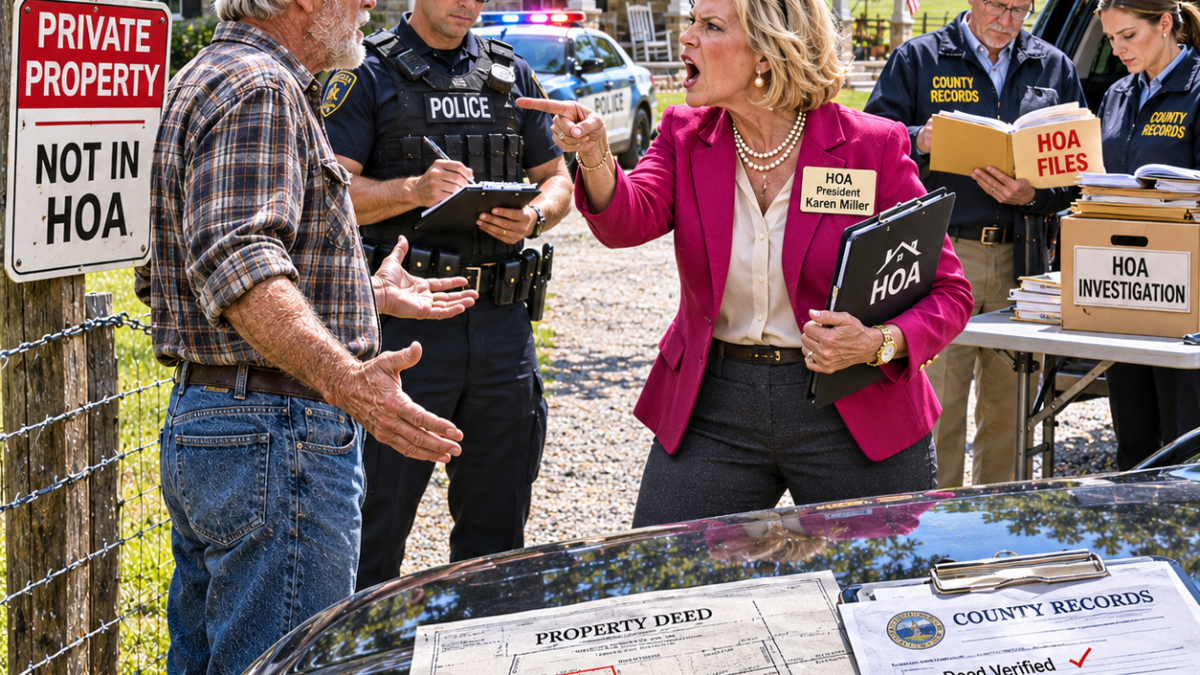
The police cruiser stopped directly in front of my driveway less than a week after I moved in, and before I could figure out what a sixty-seven-year-old widower sweeping his own porch had supposedly done wrong, the officer looked at his notes and told me an HOA had reported me for trespassing on property I had just bought.
I had spent months checking deeds, plat maps, zoning records, and county filings because after fifteen miserable years under my old HOA, the one promise I made myself when my wife died was that the next home I bought would belong to me completely—no committees, no fines, no neighborhood president deciding whether my granddaughter’s sidewalk chalk or the color of my front door met some ridiculous standard.
What I didn’t understand yet was why Karen Miller seemed so certain she could make the police believe my driveway, my lawn, and even the walkway to my own front door belonged to her HOA, or why two families on my new street had already moved away after fighting her over exactly the same thing.
My name is Robert Rivers, and I hadn’t always hated homeowners associations.
Twenty years earlier, I thought they were mostly harmless.
Newsletters.
Block parties.
Reminders about trash cans.
Then I spent nearly fifteen years in a neighborhood where the HOA treated every homeowner like a suspect.
I once received a formal warning because my American flag was three inches larger than the approved dimensions.
Another came because my granddaughter drew hopscotch squares with sidewalk chalk.
They fined me for leaving my trash bins out too long, for parking a truck they claimed looked “commercial,” and once for painting my front door a color they had approved two months earlier.
While my wife, Ellen, was alive, we used to laugh about it.
After she died, I stopped laughing.
Every pale-yellow envelope felt heavier.
I didn’t want to spend whatever years I had left arguing about mailbox height.
So when I sold that house, I gave my real-estate agent one nonnegotiable condition.
“No HOA.”
She showed me property after property.
I rejected anything with mandatory dues, architectural committees, or even a suspiciously organized neighborhood gardening association.
Then she called one morning.
“I found it.”
The house sat at the end of a quiet cul-de-sac beneath mature maple trees.
Brick exterior.
Wide driveway.
Big garage.
A wraparound porch where I could already picture myself drinking coffee.
More important, we checked everything.
Deed.
Plat.
County registry.
Zoning.
No HOA.
Not voluntary.
Not mandatory.
Nothing.
I bought it.
My son helped move my workbench into the garage.
My daughter unpacked the kitchen.
My grandchildren ran through the empty rooms while we ate pizza from boxes on the living-room floor.
“This is it, Dad,” my daughter said.
“You finally found somewhere nobody can bother you.”
I believed her.
The next morning, I was kneeling beside the side yard measuring a small garden border when a black SUV rolled slowly down the street.
It stopped at my driveway.
A woman stepped out carrying a clipboard.
Pastel blazer.
Perfect hair.
Smile with no warmth behind it.
“Good morning. You must be the new resident.”
“I suppose I am.”
“Karen Miller. President of Maple Grove Estates Homeowners Association.”
My stomach sank.
“I think you have the wrong house.”
Her smile widened.
“I’m afraid I don’t.”
“This property isn’t in an HOA.”
“According to our newly amended community plat, this street falls under Maple Grove jurisdiction.”
“No.”
She opened her clipboard.
“Before occupying the property, you were required to complete a residency application and request usage approval.”
I stared at her.
“Usage approval for what?”
“Common areas.”
She pointed at my driveway.
I almost laughed.
“That?”
“Yes.”
“My driveway?”
“And portions of the lawn, walkway, mailbox area, and frontage.”
I stood.
“Karen, I checked the county records myself.”
“County records can lag behind association amendments.”
“That’s not how ownership works.”
She gave me the patient smile adults use with difficult children.
“Until the boundary issue is resolved, you’re required to cooperate.”
“With what?”
She flipped another page.
“Currently, you’re occupying HOA-managed land without authorization.”
The word hit me harder than it should have.
“Occupying?”
“Yes.”
“You mean living in the house I own?”
“You have not been approved.”
I pointed toward the street.
“Leave.”
Her expression changed.
Only slightly.
But I saw it.
“If you refuse to comply, Mr. Rivers, we may have to involve law enforcement.”
I thought she was bluffing.
Five days later, standing barefoot on my own porch while two officers examined a complaint accusing me of trespassing on my own driveway, I realized Karen Miller wasn’t trying to enforce rules.
She was trying to make her version of the property line become true.
PART 2
The older officer glanced from his notepad to me, then toward the house.
“You’re Mr. Rivers?”
“Yes.”
“You own this property?”
“Every inch I paid for.”
Behind him, a second officer stood near the cruiser.
And behind both of them, parked twenty yards down the street, sat Karen’s black SUV.
She was leaning against the passenger door with her arms folded.
Watching.
I had seen smug people in my lifetime.
Government supervisors.
Insurance adjusters.
A building inspector who once told me my shed violated a rule that didn’t exist.
Karen had all of them beat.
The officer followed my gaze.
“You know the complainant?”
“Unfortunately.”
He cleared his throat.
“We received a report from Maple Grove Estates regarding possible unauthorized occupancy of association-controlled land.”
I looked at my porch.
My rocking chair.
The welcome mat my daughter had bought me.
Then at him.
“You understand how ridiculous that sounds?”
His expression softened slightly.
“Yes, sir.”
“Good.”
“But we have to check.”
That was fair.
Infuriating.
But fair.
I stepped inside.
“Come on.”
The file box was still sitting near the kitchen because I hadn’t finished unpacking.
I pulled out the closing packet.
Deed.
Survey.
County plat.
Title policy.
Zoning record.
Everything.
The older officer read carefully.
The younger one leaned over his shoulder.
“You bought this last month?”
“Yes.”
“Any HOA disclosures?”
“No.”
“Association dues?”
“No.”
“Covenants?”
“No.”
I pointed at the survey.
“The property line is right there.”
The older officer nodded.
“We’ll verify.”
Outside, Karen had moved closer.
Not onto my porch.
Not yet.
She stood near the sidewalk.
When the officers walked toward her, she straightened.
“Officers.”
The older one asked:
“Do you have documentation showing Maple Grove owns or controls this parcel?”
Karen lifted her clipboard.
“We have an amended community plat.”
“Recorded with the county?”
“It has been recognized by the association.”
“That wasn’t my question.”
Her smile tightened.
“The county process is ongoing.”
I almost laughed.
She looked at me.
“Mr. Rivers has been informed that cooperation is required during the transition.”
The officer said:
“Ma’am, an HOA doesn’t get temporary jurisdiction over somebody’s land because you’ve submitted paperwork.”
Karen blinked.
“He’s using a common-access driveway without authorization.”
I raised a hand.
“It’s my driveway.”
“We disagree.”
The older officer looked tired already.
“This appears civil.”
Karen’s expression brightened.
“Exactly.”
“No.”
He shook his head.
“Civil means we are not removing this man from property his deed says he owns.”
Her face fell.
“But—”
“If you believe your HOA has an ownership interest, you’ll need to resolve that through county records or court.”
I folded my arms.
“Can you also tell her she’s not allowed to enter my property without permission?”
Karen turned.
“I am authorized to perform compliance inspections.”
“On HOA property,” I said.
“This is HOA property.”
The officer held up one hand.
“Ma’am.”
She stopped.
“Until you establish that through proper legal channels, stay off his parcel.”
Her jaw tightened.
“You’re rewarding noncompliance.”
“No.”
He looked at the house.
“We’re preventing escalation.”
Karen stared at me.
Then smiled again.
Not friendly.
“This isn’t over.”
She walked back to the SUV.
I watched her leave.
The officer beside me sighed.
“HOA dispute?”
“Apparently.”
He looked at the house.
“You just moved in?”
“Five days.”
He shook his head.
“Welcome to the neighborhood.”
—
The police left.
I stood alone on the porch for several minutes.
What should have felt like a victory didn’t.
They hadn’t arrested me.
They hadn’t sided with Karen.
But they also hadn’t ended anything.
“Civil matter.”
Those words bothered me.
Because I’d lived long enough to know what civil disputes can become.
Letters.
Lawyers.
Costs.
Time.
Stress.
People often imagine legal fights as dramatic courtroom scenes.
Mostly they’re paper.
Paper in envelopes.
Paper from lawyers.
Paper demanding answers.
Paper threatening things you can’t afford.
At sixty-seven, I didn’t want a new career in paper.
I wanted coffee.
Tools.
Grandkids.
Maybe tomatoes.
That night, after finishing another box, I sat on the porch.
Ellen used to sit with me in the evenings at our old house.
She’d read.
I would pretend to read and mostly complain about whatever the HOA had mailed that week.
When things got ridiculous, she’d say:
“Robert, you give annoying people too much space in your head.”
She was right.
She was often right.
I looked at the empty chair beside mine.
“Trying not to, El.”
No answer.
Of course.
But saying it helped.
Then a black SUV rolled slowly past.
Very slowly.
I watched it disappear.
So much for peace.
—
The next morning, there was an envelope beneath my front door.
No stamp.
No return address.
Just:
**ROBERT RIVERS**
Handwritten.
Carefully.
Coldly.
I photographed it before touching it.
I don’t know why.
Instinct.
Maybe because Karen had already brought police into it.
I opened the envelope.
Two glossy pages.
Maple Grove Estates letterhead.
**NOTICE OF UNAUTHORIZED OCCUPANCY**
I read the first paragraph twice.
Then a third time because I assumed age had finally caught me.
**You are currently occupying HOA-managed land without association approval.**
Next:
**Cease usage of all common areas including driveway, lawn, walkway, mailbox area, and frontage.**
I laughed.
Actually laughed.
“What am I supposed to do?”
Hover from the road into the kitchen?
Then:
**Failure to submit a residency application within 24 hours may result in daily noncompliance penalties and legal action.**
I put the letter on the kitchen table.
Made coffee.
Sat.
Looked at it again.
The laughter disappeared.
They were trying to create a record.
That’s what bothered me.
Letter one:
We told him.
Letter two:
He refused.
Letter three:
He owes money.
Repeat enough times and suddenly somebody reviewing the dispute months later sees a “history.”
Whether the original authority was real becomes buried under volume.
I had spent enough years dealing with bureaucracies to recognize the trick.
So I made my own record.
Date.
Time found.
Photos.
Scan.
Envelope preserved.
No response.
—
At noon, I was watering shrubs when I saw a man at the end of the street.
Forties.
Polo shirt.
Phone.
Walking slowly.
He stopped.
Raised the phone.
Click.
“Can I help you?”
He jumped.
“Oh.”
He smiled.
“Just documenting landscaping.”
“For who?”
“Compliance.”
“Whose?”
“Maple Grove.”
I turned off the hose.
“This property isn’t part of Maple Grove.”
He glanced at his phone.
“Our records show the boundary was recently expanded.”
“County records don’t.”
He shrugged.
“You’d have to take that up with Karen.”
“What’s your name?”
His smile vanished.
“Why?”
“Because you’re photographing my property for an organization that doesn’t govern it.”
“I’m on a public street.”
“Then stay there.”
He took another picture of my mailbox.
Then walked away.
My phone buzzed five minutes later.
Unknown number.
**YOU CAN’T IGNORE US.**
I saved the message.
Then blocked the number.
I considered deleting it.
Didn’t.
Another piece of paper.
Another data point.
—
Three days passed.
I tried settling in.
Shelves.
Curtain rods.
Garage.
My workbench.
I found Ellen’s old gardening gloves in one moving box.
That stopped me.
They were faded green.
Small.
Still dirt-stained at the fingertips from the last spring she had been well enough to garden.
I sat on an unopened box with those gloves in my hands.
For twenty minutes, Karen didn’t exist.
That was the life I wanted.
Memories.
Family.
Small projects.
A house where grief could soften instead of getting crowded out by stupid battles.
Then I looked through the front window.
A jogger had stopped across the street.
Stretching.
Watching my driveway.
The anger came back.
I placed Ellen’s gloves in a drawer.
Carefully.
Then closed it.
I wasn’t going to let Maple Grove take this house from me psychologically even if they couldn’t take it legally.
—
On the fourth morning, two more police officers arrived.
Different pair.
Older.
More serious.
Karen stood beside her SUV.
Again.
I set my hedge trimmer down.
One officer approached.
“Mr. Rivers?”
“Yes.”
“We received a report from Maple Grove HOA regarding possible unlawful occupation and boundary interference.”
“Unlawful occupation.”
“That’s the wording.”
“Of my own house.”
He gave me a tired look.
“We need to ask some questions.”
Karen stepped forward.
“I can explain.”
The officer turned.
“We’ll speak with you after.”
She looked offended.
Good.
I led them inside.
The same file.
The same deed.
The same plat.
Same conversation.
One officer looked at the county stamp.
“This appears clear.”
“It is.”
“The HOA says there’s an amended plat.”
“They showed me something without a county stamp.”
Karen called from outside:
“It is pending official reconciliation.”
I walked back toward the door.
“Stop yelling into my house.”
She smiled.
“You see how hostile he’s become?”
The officer stepped between us.
“Ma’am.”
“He’s refusing the seventeen-step residency process.”
I stared at her.
“Seventeen?”
“Background review.”
“Architectural declaration.”
“Driveway-use authorization.”
“Landscaping compliance.”
I almost admired the creativity.
I said:
“I have a deed.”
Karen replied:
“We have standards.”
That sentence summarized her entire personality.
The officers stepped away to speak privately.
I stayed on the porch.
Karen drifted toward me.
Quietly.
“We can make this easy.”
“How?”
“Application.”
“Fee.”
“Assessment.”
“Then?”
“We regularize your status.”
I stared.
“You mean I pay you to stop claiming I’m trespassing?”
She smiled.
“That’s an unnecessarily hostile interpretation.”
“No.”
“That’s exactly what you said.”
She shrugged.
“Everyone eventually cooperates.”
“Not me.”
“We’ll see.”
The officers returned.
“Mr. Rivers, your ownership documentation appears valid. The HOA’s submitted plat does not match the county record we can access.”
I nodded.
Karen said:
“Because theirs is outdated.”
The officer ignored her.
“This is a civil boundary issue. We are not enforcing HOA claims.”
Then he looked at me.
“Until it’s resolved, avoid unnecessary property alterations if possible.”
Karen smiled.
I wasn’t giving her that victory.
“Officer.”
“Yes?”
“She’s standing on my property.”
Karen’s smile vanished.
“She has refused to leave before.”
The officer looked at her.
“Ma’am, step onto the public right-of-way.”
She clutched her clipboard.
“This is absurd.”
“Please.”
She stepped backward.
One step.
Another.
Curb.
Her face was rigid.
“This isn’t over.”
She got into the SUV.
Tires chirped as she left.
The older officer watched.
Then:
“She’s committed.”
“Wrong word.”
“Obsessed?”
“Closer.”
—
That afternoon, a man walked up my driveway.
Salt-and-pepper hair.
Polo.
Khaki shorts.
New Balance sneakers.
Suburban-dad uniform.
“You Rivers?”
“Yes.”
“Greg.”
He shook my hand.
“Three houses down.”
“Nice to meet you.”
He glanced toward the street.
“You’ve met Karen.”
“Several times.”
“I heard about the police.”
“Fast neighborhood.”
“Karen makes sure.”
We sat on the porch.
Greg lowered his voice.
“She has been trying to absorb this end of the street for years.”
I stopped.
“What?”
“Maple Grove originally ended two blocks over.”
“But?”
“She wants expansion.”
“Why?”
“More houses.”
“More dues.”
“More control.”
“That simple?”
Greg shrugged.
“Nothing with Karen is simple.”
He told me about rejected plats.
Boundary proposals.
Letters.
Pressure.
Two families who eventually sold.
“The Johnsons.”
“What happened?”
“Violation after violation.”
“They weren’t HOA?”
“Not originally.”
“Then?”
“They sold.”
“To who?”
Greg hesitated.
“Investment group.”
“Name?”
“Don’t remember.”
“Then?”
“House renovated.”
“New owner signed into Maple Grove.”
I stared toward the street.
“So Karen pressures independent homeowners until they sell.”
“Sometimes.”
“And then the property joins the HOA.”
“That’s what it looks like.”
“Why hasn’t anybody challenged it?”
“Some did.”
“And?”
“They got tired.”
That word again.
Tired.
My old HOA had used the same weapon.
Not always law.
Exhaustion.
Greg leaned forward.
“Karen’s targeting you because you’re new.”
“And old.”
He looked embarrassed.
“I wasn’t going to say it.”
“Say it.”
“Older homeowners living alone are easier to scare.”
I thought about Karen’s question:
**You live here alone, correct?**
A chill moved through me.
“She knew.”
Greg nodded.
“She notices everything.”
“Does she have access to real-estate information?”
“Probably.”
“And the investment company?”
He shrugged.
“I’d look at it.”
I looked toward my yard.
The house suddenly felt less like the target.
More like one item in a pattern.
Greg stood.
“Document everything.”
“Everybody keeps saying that.”
“Because it works.”
—
I did more than document.
I went to the county records office.
The clerk was an older woman named Marlene.
I gave her my parcel number.
“I need every approved plat affecting this lot.”
She typed.
Printed.
Stamped.
“There.”
“Any amendment from Maple Grove?”
She searched again.
“They submitted one last year.”
My stomach tightened.
“Approved?”
“No.”
“Why?”
“Incomplete documentation.”
“Did they resubmit?”
“No.”
“So there is no legal amendment?”
“Correct.”
I slid Karen’s photocopied map across the counter.
Marlene examined it.
“No county approval.”
“No stamp.”
“No recording reference.”
“Then what is it?”
She gave me the look government clerks reserve for questions whose answers could create paperwork.
“Something the county did not approve.”
Good enough.
“Can I get certified copies?”
“Yes.”
“Two.”
She looked at me.
“HOA?”
“Yes.”
She sighed.
“I hear that more than good morning.”
—
Greg had already given me an attorney’s name.
Cindy Han.
Property litigation.
Civil harassment.
HOA disputes.
She was in her mid-forties and had the kind of calm that makes loud people dangerous to themselves.
I explained everything.
She read the documents.
Then Karen’s map.
Then the notices.
Then the police incident numbers.
Then the text message.
When I finished, she said:
“Karen has a problem.”
“Good.”
“No.”
Cindy pointed at me with her pen.
“Do not get emotionally ahead of the evidence.”
“I’m sixty-seven.”
“And?”
“I’m entitled.”
“Not in my office.”
I liked her immediately.
She spread the maps side by side.
“County plat.”
“Recorded.”
“Yes.”
“Karen’s.”
“Not recorded.”
“Rejected proposal resembles it.”
“Likely.”
“Your property has never been annexed.”
“No.”
“You signed nothing.”
“No.”
“Previous owner?”
“No membership on title.”
“Good.”
Then she picked up the unauthorized occupancy notice.
“This is useful.”
“Useful?”
“They are demanding fees and compliance while asserting authority they appear to know they do not possess.”
“Illegal?”
“Potentially several things.”
“Such as?”
“Harassment.”
“Misrepresentation.”
“Possible attempted coercion.”
“If money is demanded with knowingly false jurisdictional claims, that gets more serious.”
I leaned back.
“So we sue?”
“Not yet.”
“Why?”
“Because Karen thinks she controls the paper trail.”
Cindy smiled.
“I want the paper trail.”
That was the first time I felt hopeful.
—
Cindy requested county records.
Maple Grove boundary submissions.
Board meeting minutes.
Amendment proposals.
Communications tied to annexation attempts where publicly available or obtainable through proper process.
She also told me to install cameras.
I bought four.
Front porch.
Garage.
Side yard.
Rear boundary.
Night vision.
Cloud backup.
Motion alerts.
Greg came over while I installed one.
“Need help?”
“Can you use a drill?”
“I own one.”
“That wasn’t my question.”
He laughed.
By evening, the house had more cameras than the bank downtown.
I sat on the porch.
Iced tea.
Watched.
6:42 p.m.
Black SUV.
Slow pass.
Different driver.
Clipboard visible.
I waved.
The SUV accelerated.
Ten minutes later, a jogger stopped.
Stretched.
Looked toward the porch.
I waved.
He left.
Then a woman photographed the mailbox.
I waved.
She nearly dropped her phone.
For the first time, I enjoyed myself.
Not because they were frightened.
Because secrecy was gone.
They could watch.
I could record.
Balance.
—
That night, motion alert.
Rear camera.
Blurry figure outside the fence.
Standing.
Watching.
Then retreating.
I saved the clip.
Couldn’t identify the person.
Didn’t guess.
That’s something Cindy drilled into me.
Evidence says what it says.
Not what you want it to say.
—
The next morning, my mailbox flag was up.
Another envelope.
Same handwriting.
I photographed everything first.
Then opened it.
**FINAL NOTICE OF TRESPASSING**
Two pages.
Unauthorized occupation.
Habitual noncompliance.
Community danger.
Then:
**Potential physical removal.**
I read that line twice.
Physical removal.
I called Cindy.
She answered:
“Tell me.”
I read it.
Silence.
Then:
“Don’t engage.”
“I haven’t.”
“Original envelope?”
“Yes.”
“Camera footage?”
“Checking.”
“Send scans.”
“Cindy.”
“Yes?”
“They’re threatening to remove me from my house.”
“I know.”
Her voice changed.
Harder.
“That escalates the matter.”
“Police?”
“Sheriff and county attorney receive copies.”
“What else?”
“We prepare for visitors.”
“What kind?”
“Karen may send compliance people.”
“Actual law enforcement?”
“No.”
“People pretending authority.”
“Wonderful.”
“Robert.”
“Yes?”
“Do not open the door if you feel unsafe.”
“I’m not afraid.”
“I didn’t ask.”
Right.
—
2:14 p.m.
Doorbell.
Long.
Aggressive.
I checked the camera.
Karen.
Two large men.
Black polo shirts.
Gold Maple Grove emblem.
One shaved head.
One sunglasses.
Neither looked like anyone I’d invite inside.
I opened the upstairs window.
“State your business.”
Karen looked up.
“Mr. Rivers, we’re here to serve final enforcement notice and conduct exterior compliance review.”
“No.”
“You need to come outside.”
“No.”
“We have authority.”
“No.”
One of the men muttered:
“He has to cooperate.”
I looked at him.
“What’s your name?”
He didn’t answer.
“Are you law enforcement?”
“No.”
“Licensed code enforcement?”
Silence.
“Security?”
Karen interrupted.
“They are HOA compliance officers.”
“That’s not a legal category.”
Her smile tightened.
“We are authorized to remove noncompliant structures.”
“What structures?”
“Fence.”
I stared.
“My fence?”
“Portions encroach on association-managed space.”
“The county rejected your map.”
Karen’s jaw flickered.
“We do not recognize the county’s previous boundary interpretation.”
I laughed.
“That’s incredible.”
“We have governing authority.”
“No, Karen.”
I took out my phone.
“You have ten seconds to leave.”
“Or?”
“Sheriff.”
The two men looked at each other.
Karen didn’t.
“They already told you it’s civil.”
I dialed.
—
Deputies arrived in under ten minutes.
Different agency than the first police calls.
County sheriff.
Older men.
No patience for theatrics.
Karen intercepted them.
“Officers, thank God. This resident has repeatedly—”
One deputy raised his hand.
“Ma’am.”
She stopped.
He looked at me.
“You called?”
“Yes.”
“Homeowner?”
“Yes.”
“These three entered your property?”
“Yes.”
“Asked them to leave?”
“Yes.”
He turned to the men.
“You two licensed security?”
No.
“Code enforcement?”
No.
“Law enforcement?”
No.
He looked at their shirts.
“Then you’re private citizens wearing matching polos.”
Greg had come outside by then.
He coughed.
I suspected laughter.
Karen said:
“They act under HOA authority.”
The deputy took out his tablet.
“We checked the parcel before arriving.”
Her face changed.
“This property is not inside Maple Grove Estates.”
“That database is outdated.”
“No, ma’am.”
“Our amended plat—”
“Rejected.”
Silence.
The deputy continued.
“County record shows no approved annexation.”
Karen’s face went white.
“You will leave Mr. Rivers’s property.”
“But—”
“Now.”
“He’s the one violating—”
“What rule?”
“Association—”
“He isn’t in your association.”
One of the men stepped backward.
Then the other.
Smartest thing either had done all afternoon.
Karen stayed.
Her hands trembled around the clipboard.
“This is a mistake.”
The deputy stepped closer.
“Ma’am.”
That tone ended it.
She retreated.
At the curb, she turned toward me.
“This isn’t the end.”
I answered quietly:
“For you, it might be.”
Her eyes burned.
Then she left.
The deputies waited until the SUV disappeared.
One looked at me.
“Document everything.”
“Already am.”
“Good.”
He glanced toward the street.
“This woman is trouble.”
“You’re late to the meeting.”
He almost smiled.
—
The neighborhood went quiet.
Too quiet.
I uploaded every video.
Labeled:
DATE.
TIME.
PERSON.
EVENT.
NO SPECULATION.
Cindy loved that last part.
I had just finished when she called.
“No greeting?”
“Big news.”
I sat.
“What kind?”
“County sent the Maple Grove submission history.”
“And?”
“Karen may have forged signatures.”
I stopped breathing.
“What?”
“Four homeowner signatures on annexation consent forms do not match county-recorded examples.”
“Could be old?”
“Maybe.”
“But?”
“One homeowner says he never signed.”
“Who?”
“Former Johnson property.”
Greg’s story.
I stood.
“The family that sold?”
“Yes.”
Cindy continued.
“Board-approval paperwork is also questionable.”
“How?”
“Meeting minutes reference a vote that other records suggest never occurred.”
I rubbed my forehead.
“Karen forged the annexation.”
“Potentially.”
“Cindy.”
“I know.”
“Say definitely once.”
“No.”
I laughed despite everything.
“Anything else?”
“Yes.”
Her tone changed.
“Maple Grove payments to Pine Ridge Resources.”
“Who are they?”
“Consulting contractor.”
“Doing what?”
“Boundary expansion.”
“Property acquisition support.”
“Compliance strategy.”
I sat again.
“And?”
“Registered to a P.O. box.”
“Owner?”
“Linked to Karen’s husband.”
The room went cold.
I looked through the window toward the street.
“So she pressures homeowners.”
“They sell.”
“Investor buys.”
“Property joins HOA.”
“More dues.”
“More expansion consulting.”
“Potentially.”
“And money goes to her family.”
“That’s what investigators will need to determine.”
I whispered:
“She wasn’t trying to enforce an HOA.”
Cindy answered:
“No.”
“She may have been building one.”
—
The complaints went out.
County attorney.
Sheriff.
District attorney.
Appropriate agencies.
No dramatic announcement.
No social-media post.
Cindy forbade it.
“Let investigators work.”
I hated waiting.
Then Karen came to me.
7:22 p.m.
Car screamed into the street.
Door slammed.
She stormed up my driveway carrying papers.
Her hair, normally perfect, had come loose.
“You!”
I stayed on the porch.
“No visitors.”
“You filed complaints.”
“Accurate ones.”
“You’re trying to ruin me.”
“I’m defending my house.”
“This neighborhood needs order!”
I almost laughed.
“You sent fake enforcement officers to threaten a retired man.”
“They were not fake.”
“Were they police?”
“No.”
“Were they county?”
“No.”
“Then?”
“HOA officials.”
“You don’t govern my house.”
She marched closer.
“People like you destroy community harmony.”
“Harmony?”
I pointed toward the camera.
“You’ve called police on me twice.”
“Threatened removal.”
“Sent strangers.”
“Photographed my home.”
“Now you’re standing on my driveway again after being told not to.”
Her eyes moved to the camera.
Fear.
Finally.
“You know nothing.”
“I know about Pine Ridge.”
Her face drained.
I had never seen color leave a person’s face that quickly.
“What?”
“Pine Ridge Resources.”
“You’re lying.”
“Cindy found the filings.”
“She doesn’t understand—”
“Forged signatures.”
Karen’s hands began shaking.
“You don’t know what you’re talking about.”
“Then explain.”
She looked toward the street.
Not me.
That was when the flashing lights appeared.
Sheriff’s cruiser.
Then another.
County vehicle.
Karen froze.
The first deputy walked toward us.
“Mr. Rivers?”
“Yes.”
“We need to speak with Ms. Miller.”
Karen backed away.
“Why?”
“Ma’am, please step away from the homeowner.”
“This is harassment.”
“We’re investigating complaints related to property filings and association records.”
“He did this!”
She pointed at me.
“He’s retaliating because I enforced the rules.”
I almost felt sorry for her.
Almost.
The deputy said:
“Ma’am, come with us so we can discuss documents.”
“No.”
“Please.”
“I am HOA president.”
The deputy’s face changed.
“The law does not care what office you hold.”
Karen looked at me.
Tears.
Not sadness.
Rage.
“You’ll pay.”
I spoke quietly.
“No.”
I shook my head.
“I’m finished paying for anything with your name on it.”
She was escorted to the cruiser for questioning.
Not convicted.
Not sentenced.
Not some Hollywood arrest.
An investigation beginning.
But as the door closed, something in me released.
Greg walked over.
Hands in pockets.
Whistled.
“Well.”
“What?”
“Block party is going to be awkward.”
I laughed.
“Bring potato salad.”
—
The investigation lasted months.
That’s the part stories usually skip.
People want the villain exposed Friday and convicted Monday.
Real systems move slower.
Investigators interviewed homeowners.
Board members.
Former residents.
County staff.
They compared signatures.
Emails.
Payments.
Meeting minutes.
Pine Ridge invoices.
What emerged was uglier than one fake map.
Maple Grove had repeatedly attempted to push its boundaries toward independent homes.
Some submissions were legitimate proposals.
Some were incomplete.
Some were never approved.
But Karen had treated rejected or pending paperwork as if it were law.
Then came the financial trail.
Pine Ridge Resources had received association money for “expansion consulting.”
Karen’s husband had an interest in it.
The investment group Greg mentioned?
Connected through business relationships to people who benefited when pressured homeowners sold.
Not every sale was illegal.
Not every complaint was fabricated.
Cindy emphasized that.
“Don’t turn suspicion into certainty.”
So I didn’t.
But enough was documented to destroy Karen’s credibility and trigger real consequences.
—
The HOA board removed her as president.
Not because of me alone.
Residents demanded it.
Some board members claimed they had been misled.
Others admitted they went along because questioning Karen made meetings unbearable.
Mrs. Patterson—one of the longest-serving members—stood at the removal meeting and said:
“We confused persistence with leadership.”
That stayed with me.
Karen had not become powerful in one day.
People handed her little pieces.
Fine authority.
Committee authority.
Interpretation authority.
Social authority.
Then stopped checking where the limits were.
Eventually she believed there were none.
—
The county froze pending Maple Grove boundary proposals.
My street remained independent.
Certified.
Recorded.
Undisputed.
Cindy had me request an updated title endorsement confirming no Maple Grove covenant applied.
I framed it.
My daughter laughed.
“You framed a title document?”
“You weren’t here.”
“Dad.”
“You weren’t here.”
She hugged me.
Then looked around the house.
For the first time since moving in, she seemed relaxed.
“I was worried.”
I looked at her.
“You didn’t say that.”
“You’re sixty-seven and stubborn.”
“Sixty-seven isn’t dead.”
“I know.”
She smiled.
“But Mom used to keep you from doing dumb things.”
That hurt.
Because it was true.
“I miss her.”
My daughter’s eyes filled.
“Me too.”
We sat on the porch.
Quietly.
That mattered more than every HOA meeting combined.
—
Neighbors started coming forward.
Stories.
Karen had threatened a widow with fines over landscaping.
Sent repeated notices to a family with a sick child.
Claimed another homeowner’s side yard might be community easement.
Pressured Greg over his mailbox.
Most incidents were smaller than mine.
That’s how systems like hers survive.
Each individual problem seems too petty to justify legal fees.
Fifty dollars.
A warning.
One letter.
One inspection.
So people pay.
Comply.
Move the mailbox.
Remove the chair.
Then one day the same authority claims a driveway.
Or a house.
—
The Johnson family contacted Cindy after hearing about the investigation.
They had moved away almost two years earlier.
Mr. Johnson told me later:
“We didn’t lose the house.”
“We surrendered.”
His wife had been exhausted.
Their son had just started middle school.
Karen sent letters weekly.
Fence.
Shed.
Dog.
Parking.
Noise.
Then boundary questions.
One day an investor made an offer.
They took it.
“Did Karen arrange the sale?”
“We can’t prove that.”
He paused.
“But she told us privately that selling might be ‘the cleanest way to resolve compliance.’”
That sentence made me furious.
Not because it proved a crime.
Because I understood the pressure.
I asked:
“You regret leaving?”
He looked at his wife.
“Yes.”
She shook her head.
“No.”
He smiled.
“See?”
Then she said:
“I regret that she made home feel unsafe.”
That was worse.
A house is walls.
Home is the feeling nobody can revoke your right to exist there.
Karen had tried taking that from me too.
—
Cindy filed civil claims on my behalf related to harassment, false authority claims, attempted coercive fees, and trespass.
Maple Grove’s new board settled much of it rather than defending Karen’s conduct.
They formally acknowledged:
My property had never been part of the HOA.
No assessment was owed.
No application required.
No common-area interest existed in my driveway, lawn, walkway, or mailbox.
They paid a portion of my legal costs.
The money mattered.
The letter mattered more.
I made ten copies.
Greg said:
“Wallpaper the porch.”
Tempting.
—
Karen’s legal consequences took longer.
Some allegations remained administrative or civil.
Others involving filings and financial relationships were reviewed by investigators.
I learned not to speculate.
News reports made everything sound simple.
“HOA President Fraud Scheme.”
Reality was more complicated.
Some conduct was proven.
Some not.
Some people around Karen knew things.
Others were just weak.
Pine Ridge became central to the financial investigation.
The board eventually pursued recovery of certain payments and commissioned an independent audit.
Karen’s husband distanced himself.
Then resigned from all community-related roles.
Their marriage reportedly became strained.
I didn’t celebrate.
Marriage breakdown is private pain.
Ellen had taught me better than that.
—
Karen herself eventually faced charges related to falsified documents and fraudulent representations tied to association filings.
There were plea negotiations.
Probation.
Restitution.
Restrictions.
No dramatic decades-long prison sentence.
Enough that her days of treating Maple Grove like a personal kingdom ended permanently.
When Cindy told me the resolution, she expected a reaction.
I just nodded.
“That’s it?”
“What do you want me to do?”
“Smile?”
I thought.
“I wanted her off my driveway.”
Cindy laughed.
“You are the only client I’ve ever had who turns a fraud case into a driveway dispute.”
“It was a good driveway.”
—
Maple Grove changed.
New board.
Open records.
Boundary maps posted publicly.
No expansion without county approval and documented owner consent.
Term limits.
Conflict-of-interest disclosures.
No compliance patrol photographing nonmembers.
Greg was invited to join.
He refused.
Smart man.
Instead, a teacher named Denise Cooper became president.
Her first act was sending letters to independent homeowners.
Not demands.
Apologies.
Mine read:
**Maple Grove Estates recognizes that your property is not and has never been subject to association governance. We apologize for prior conduct suggesting otherwise.**
I framed that too.
My daughter said I had developed a paperwork addiction.
Maybe.
—
The black SUV disappeared.
The slow joggers disappeared.
Nobody photographed my mailbox.
My front camera recorded raccoons, delivery drivers, grandchildren, and one very determined squirrel.
Normal life returned.
But at first, I didn’t trust it.
Any car slowing near the house made me look.
Any envelope without a return address made my stomach tighten.
I kept checking the cameras.
Morning.
Afternoon.
Night.
One evening, my granddaughter noticed.
“Grandpa.”
“What?”
“You check that app a lot.”
“Security.”
“Nothing happens.”
“That’s why it works.”
She gave me the same look Ellen used to give me when I was being ridiculous.
“You’re doing the face.”
“What face?”
“Worried face.”
“I don’t have a worried face.”
“You do.”
She was ten.
Brutal.
I put the phone down.
“Want ice cream?”
“Yes.”
Diplomatic victory.
—
Slowly, the house became what I bought it to be.
I built the garden border.
Exactly where Karen said I couldn’t.
No permit.
No architectural review.
Just cedar boards.
Tomatoes.
Peppers.
Basil.
My granddaughter drew chalk hearts on the driveway.
The first time she did, she stopped.
“Is this allowed?”
That broke something in me.
Because at my old HOA house, she had heard adults argue over her chalk.
I crouched beside her.
“This is Grandpa’s driveway.”
“So?”
“You can draw the whole thing purple.”
Her face lit up.
She nearly did.
By sunset, the driveway had flowers.
Stars.
A dragon.
Three badly drawn dogs.
One sentence in giant pink letters:
**GRANDPA’S HOUSE**
I photographed that.
Not for evidence.
For me.
—
Greg came over with beer.
Stood at the driveway.
“Well.”
“What?”
“Clear violation of community aesthetics.”
I pointed toward the street.
“Leave.”
He laughed.
We sat on the porch.
For months, people had talked to me about bravery.
I hated that word.
I wasn’t brave.
I was annoyed.
Prepared.
Lucky enough to afford a lawyer.
Lucky enough to find records.
Lucky enough that Greg spoke.
Lucky enough that Cindy understood the pattern.
Other families had not been as fortunate.
That bothered me.
—
So Cindy and I worked with a local homeowners’ legal clinic to produce a simple guide for independent property owners dealing with HOA boundary claims.
Nothing flashy.
Verify county records.
Preserve notices.
Don’t pay unsupported fees just because they appear official.
Get legal advice.
Use lawful security cameras where appropriate.
Document interactions.
Don’t threaten.
Don’t retaliate.
Make authorities distinguish between private HOA rules and actual law.
Greg read it.
“This is boring.”
“Exactly.”
“No flaming lawsuits?”
“No.”
“No dramatic confrontations?”
“No.”
“Terrible story.”
“Good advice.”
He agreed.
—
The former Johnson house eventually came up for sale again.
An independent buyer purchased it.
The new owner, a nurse named Allison, came to my porch before closing.
“Are you Robert Rivers?”
“Depends who wants to know.”
She laughed nervously.
“I heard you know the HOA history.”
“Sit down.”
She showed me her paperwork.
Her agent had correctly disclosed that the property was now within Maple Grove because a later owner had voluntarily joined under recorded covenants.
That was legitimate.
I explained.
“So my house is HOA.”
“Yes.”
“And yours isn’t.”
“Correct.”
“Even though we’re on the same street.”
“Yes.”
She looked confused.
“That seems messy.”
“Property law often is.”
“Is the HOA terrible?”
“Not anymore.”
“How do you know?”
“I watch them.”
She smiled.
“Karen?”
“Gone.”
“Good.”
I gave her Denise’s contact information.
“You’ll be fine.”
—
One year after Karen first stepped onto my driveway, I sat outside at almost the same time of morning.
Coffee.
Birds.
Maple leaves moving in the breeze.
I remembered her black SUV stopping.
Clipboard.
Smile.
**You are occupying HOA-managed land.**
I laughed.
Then realized I hadn’t checked the camera app yet.
That was progress.
—
The strangest ending came through Karen herself.
A letter.
Actual postage this time.
Return address from another county.
I almost threw it away.
Then opened it.
Short.
**Mr. Rivers,**
**I don’t expect you to respond.**
Good start.
**I believed I was protecting Maple Grove. Somewhere along the way, I stopped recognizing the difference between protecting an association and controlling people.**
I stopped reading.
Looked toward the garden.
Then continued.
**I was wrong about your property. I was wrong to send notices after county records contradicted me. I was wrong to involve others in pressuring you.**
No excuse.
That surprised me.
**I still believe neighborhoods benefit from standards, but I understand now that standards without consent or lawful authority are not governance. They’re coercion.**
I read that sentence twice.
Then the final line:
**I am sorry for what I put you through.**
**Karen Miller**
I sat quietly.
Did I forgive her?
Complicated question.
I didn’t need revenge anymore.
I didn’t need her apology either.
But receiving it felt like somebody setting down a heavy object that had been carried too long.
I wrote back one sentence.
**I hope you build something better with what you learned.**
No lecture.
No triumph.
Then mailed it.
—
Years passed.
My porch became the center of family weekends.
My son grilled.
My daughter reorganized my kitchen every time she visited.
My grandchildren grew.
The little girl who once drew chalk hearts eventually became a teenager who thought visiting Grandpa was less exciting than her phone.
Normal.
Beautifully normal.
I still kept Ellen’s gardening gloves in the drawer.
One spring, my granddaughter found them.
“Grandma’s?”
“Yes.”
She held them carefully.
“Can I use them?”
I almost said no.
Then stopped.
Objects aren’t preserved by refusing life.
“Yeah.”
We planted tomatoes.
She wore Ellen’s gloves.
Too big for her hands.
Seeing that hurt.
And healed something.
—
Greg eventually moved.
Not because of the HOA.
His daughter had twins two states away.
Before leaving, he came over with a box.
Inside was a mailbox.
Old.
Slightly crooked.
“What is this?”
“The one Karen said was noncompliant.”
I laughed.
“You kept it?”
“Trophy.”
“Why give it to me?”
He pointed toward my garage.
“Museum.”
I put it beside the framed apology letter.
My daughter was horrified.
“Dad, your house is becoming an HOA history exhibit.”
“Admission five dollars.”
“I’m not paying.”
“Family discount.”
—
Maple Grove survived Karen.
That’s important.
People sometimes tell stories like this as though the organization itself is automatically evil.
It wasn’t.
It had rules some residents wanted.
People voluntarily bought homes within it.
The problem was when one leader decided voluntary boundaries were inconvenient.
Denise’s board stayed boring.
Budgets.
Landscaping.
Pool repairs.
Holiday lights.
Occasional argument about parking.
Perfect.
Authority should be boring most of the time.
When it becomes theatrical, somebody is usually enjoying it too much.
—
At seventy, I finally took down two cameras.
Kept the front and garage.
Not fear.
Practicality.
The side-yard camera had spent three years recording nothing but cats.
My granddaughter objected.
“But what if another Karen comes?”
I smiled.
“Then Grandpa still has county records.”
“And Cindy?”
“Cindy says she’s retiring before I find another problem.”
“Will you?”
“Find another problem?”
She nodded.
“Absolutely.”
She laughed.
—
Cindy did eventually retire.
At her farewell dinner, I gave her a framed copy of Karen’s fake plat.
She stared.
“You kept this?”
“Evidence.”
“The case ended years ago.”
“Memories.”
She pointed at me.
“You were my most stubborn client.”
“Compliment?”
“No.”
She laughed.
Then:
“You know what bothered me most?”
“What?”
“You almost gave in.”
I frowned.
“When?”
“After the second police visit.”
“I never said that.”
“You didn’t have to.”
She was right.
I remembered standing in the kitchen afterward.
Looking at the boxes.
Thinking:
Maybe sell.
Maybe I bought trouble.
Maybe peace somewhere else would be easier.
For maybe ten minutes, Karen nearly won.
Not legally.
Emotionally.
I had forgotten that.
Cindy continued:
“That’s how people like her work.”
“They don’t need to win in court.”
“They need to make resistance more exhausting than surrender.”
I nodded.
“Greg said the same thing.”
“He’s smarter than he looks.”
“I’ll tell him.”
“Don’t.”
—
When I returned home from Cindy’s dinner, I parked in the driveway.
My driveway.
Funny how those words still carried weight.
I walked slowly toward the porch.
Seventy-plus years do that to a man.
The garden border I had been building the morning Karen arrived was weathered now.
Tomato stakes leaned.
One porch board needed replacing.
The house wasn’t perfect.
Thank God.
Perfect homes make me nervous.
I sat.
No clipboard.
No SUV.
No police cruiser.
Just quiet.
—
I thought about Ellen.
She would’ve hated the whole fight.
She would’ve also stood beside me through every second.
Probably brought cookies to Cindy.
Definitely corrected my language after Karen sent the two enforcers.
I looked at the chair beside mine.
“You would’ve told me to move.”
Maybe.
Then I smiled.
“No.”
She would’ve told me to decide based on what I wanted.
Not fear.
That’s what made the difference.
I stayed because staying was my choice.
I fought because the property was mine.
Not because I loved conflict.
Because giving in would have taught Karen that manufactured authority could become real if she applied enough pressure.
—
That was the larger danger behind her fake map.
A line on unofficial paper isn’t powerful.
What gives it power is behavior.
A homeowner pays the fee.
Signs the application.
Moves the fence.
Accepts the fine.
Sells.
Then someone later looks at the history and says:
“See? Everybody treated it like HOA land.”
That was Karen’s version of annexation.
Not law.
Momentum.
I stopped the momentum.
County records did the rest.
—
One evening, Denise from Maple Grove came by.
She had never once entered my property without asking.
Small thing.
Huge difference.
“Robert?”
“Come up.”
She carried a folder.
My stomach tightened out of habit.
She noticed.
“Nothing bad.”
“Folders are never good.”
She laughed.
“We’re updating our official boundary map.”
“Again?”
“Accurately.”
She opened it.
Maple Grove outlined in blue.
My street end outside.
My parcel shaded gray.
Label:
**INDEPENDENT PROPERTY — NOT HOA JURISDICTION**
I stared.
“We wanted adjacent owners to review before publication.”
I looked at her.
“You’re asking?”
“Yes.”
“Imagine that.”
She smiled.
“Any corrections?”
I examined the line.
“No.”
She handed me a copy.
“You want it?”
“Absolutely.”
“Frame?”
“Obviously.”
—
That became the third framed document.
My daughter gave up complaining.
—
On my seventy-second birthday, the family gathered.
My granddaughter—older now—brought sidewalk chalk.
“For nostalgia.”
She drew one giant square in the driveway.
Inside:
**NO HOA ZONE**
My son laughed.
“Dad, you’ve radicalized the children.”
“Good.”
My daughter shook her head.
“Mom would be embarrassed.”
“No.”
We all became quiet.
Then she smiled.
“She’d be laughing.”
She was right.
—
That night, after everyone left, rain started.
Soft.
Maple leaves shining under the porch light.
The chalk words blurred slowly.
**NO HOA ZONE**
Pink and blue running toward the gutter.
I watched without trying to preserve it.
Some things aren’t meant to last.
The deed lasts.
The boundary lasts.
The memory stays.
Chalk can wash away.
That’s what freedom looked like now.
Not defending every mark.
Not treating the house like a fortress.
Just letting rain fall on my own driveway without wondering whether somebody’s compliance officer would photograph it.
—
Years earlier, Karen had stood on that same concrete and told me I was trespassing.
At the time, the accusation felt insane.
Later, I understood it was strategic.
If she could make me question whether I belonged, every demand afterward became easier.
Application.
Fee.
Inspection.
Compliance.
Eventually surrender.
That’s what I refused.
Not an HOA.
A lie.
—
I never became anti-neighbor.
Quite the opposite.
Greg taught me that neighbors were what saved me.
Marlene confirmed the records.
Cindy understood the scheme.
Sheriff’s deputies enforced the actual boundary.
Former homeowners spoke.
Residents demanded accountability.
Even Karen, eventually, admitted where she had crossed the line.
Community wasn’t the problem.
A person confusing community with ownership was.
—
The final Maple Grove meeting I ever attended happened because Denise invited independent homeowners too.
No vote required from us.
Just neighbors discussing road drainage.
I went.
Karen would have loved the irony.
I sat beside HOA members.
Nobody asked me to join.
Nobody handed me an application.
Nobody measured anything.
When drainage plans affected the public street near my property, Denise asked:
“Robert, does this create any concern for your driveway?”
Imagine that.
They asked.
I looked at the plan.
“No.”
“Good.”
Meeting lasted forty-two minutes.
Boring.
I loved it.
—
As I walked home, Greg’s old mailbox trophy in my garage came to mind.
Karen’s fake map.
The police cruiser.
The two fake compliance tough guys.
The letter threatening physical removal.
It all felt absurdly far away.
Then I reached my driveway.
Stopped.
Not because anything was wrong.
Because everything was right.
My truck.
My garden.
My porch.
The house my kids helped me move into.
The home where my granddaughter had drawn chalk across the floor with pizza grease because nobody was there to issue a violation.
That had been the point from the beginning.
Not defeating Karen.
Getting home.
—
I walked up the porch steps.
My knees complained.
I sat in the chair.
Evening light moved through the maple leaves.
The other chair stayed empty.
Ellen’s chair.
Some losses never get replaced.
But life grows around them.
That house gave me room to discover that.
Karen nearly turned my retirement into another war.
For a while, she succeeded.
Then the war ended.
The porch remained.
The family remained.
I remained.
That was enough.
—
On the wall inside my garage, beside Greg’s old mailbox, I eventually hung a wooden sign.
Nothing threatening.
Nothing about Karen.
Just four words.
**HOME MEANS YOU BELONG.**
My granddaughter made it.
Crooked letters.
Bad spacing.
Perfect.
Karen Miller had once called the police because she said I was trespassing on HOA property.
She sent notices claiming I needed permission to use my driveway.
She tried to turn rejected plats into authority.
She threatened fines.
Inspections.
Physical removal.
And she almost made me forget why I bought the house.
Almost.
But county lines do not move because somebody prints them differently.
Ownership does not disappear because a clipboard says so.
And home does not require permission from people who never owned it.
That evening, I set my coffee on the porch rail.
Looked down the quiet street.
No black SUV.
No compliance patrol.
Just neighbors.
Some HOA.
Some not.
Exactly as the records said.
Exactly as it should have been.
I leaned back.
And for the first time since the day Karen walked onto my driveway, I didn’t feel like I had won anything.
I simply felt home.
[END OF STORY]



